Trump Offers To “Mediate” India & China’s “Raging Border Dispute” Amid Military Build-Up Tyler Durden
Wed, 05/27/2020 – 19:45
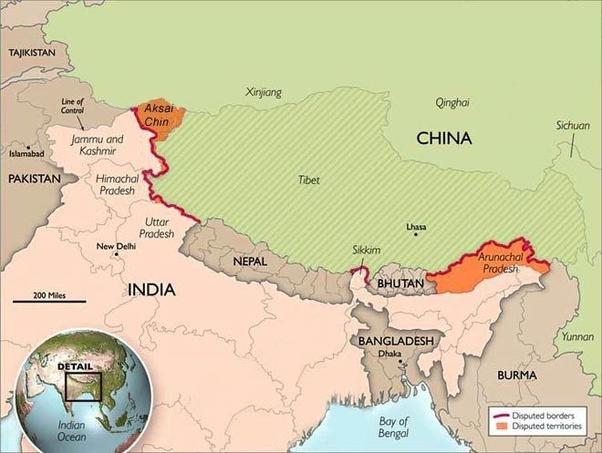
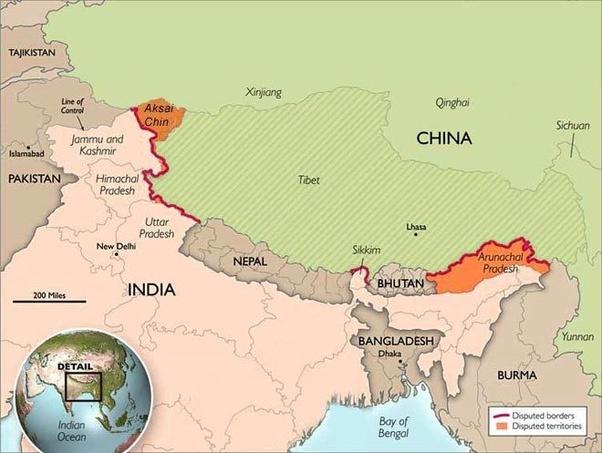
No doubt a huge surprise for both Beijing and New Delhi, locked in an escalating border dispute which in the past days has witnessed a troop build-up in multiple disputed border regions, given the historic difficulty of competing claims along the world’s longest unmarked border, President Trump on Wednesday morning offered to “mediate or arbitrate” between the two Asian powers.
He tweeted he is “ready, willing and able” to ease the tensions which are fast being militarized in a situation that FP recently noted could explode into major conflict between two nuclear armed powers.
“We have informed both India and China that the United States is ready, willing and able to mediate or arbitrate their now raging border dispute,” Trump said in the early morning tweet.
We have informed both India and China that the United States is ready, willing and able to mediate or arbitrate their now raging border dispute. Thank you!
The surprise offer, more than likely to be rejected considering Washington’s own boiling tensions with Beijing over a host of issues – the latest including Hong Kong – comes on the heels of a top American diplomat for South Asia making provocative remarks siding with India on the contested border issue.
Outgoing State Department official Alice Wells made the provocative statements a week ago at an Atlantic Council event, saying, “There’s a method here to Chinese operations and it is that constant aggression, the constant attempt to shift the norms, to shift what is the status quo.”
Wells added: “That has to be resisted whether it’s in the South China Sea… or whether it’s in India’s own backyard.”
Trump’s offer also comes after a new White House report laying out a broad strategy on China, accused Beijing of “provocative and coercive military and paramilitary activities” in the region, including Sino-Indian border areas.
Indian army lorry previously near Pangong Lake in Ladakh, via AP.
Sporadic but fierce clashes have occurred going back to the 1960’s along the shared 2,100 mile border, which often involves literal fist-fights among opposing troops and border patrol guards.
“Thousands of Chinese People’s Liberation (PLA) troops are reported to have moved into sensitive areas along the eastern Ladokh border, setting up tents and stationing vehicles and heavy machinery in what India considers to be its territory,” The Guardian reports Wednesday.
Over the past weekend Indian media began reporting that thousands of PLA troops have now moved into Ladakh’s disputed Galwan river area.
Via Quora
Some Indian media reports have suggested multiple thousands, while a new Business Standard India report goes so far as to claim up to 10,000 Chinese soldiers are now inside India occupying the Galwan Valley while digging into fortified positions.
Regardless, the intensifying border dispute is serious enough to have caught Trump’s attention, meaning a broader conflict or even war could be on the horizon.
via ZeroHedge News https://ift.tt/3gtAPlM Tyler Durden
A few weeks ago I presented a libertarian take on the ethics of the lockdown. Following Murray Rothbard in his Ethics of Liberty, I argued that the government has no right to confine or quarantine innocent people, even though it might lengthen some lives. The government is not the just owner of the streets. Rather citizens or taxpayers are, and consequently have the right to use their streets.
Moreover, anyone is innocent until proven guilty and cannot just be assumed to intentionally be infecting others with a deadly virus.
However, there are some who claim the moral high ground and maintain that it is unethical to leave one’s house during the corona epidemic. Their argument is that by leaving one’s house one could contribute to the transmission of a deadly virus. People can be confined during a pandemic such as the present one, because they are (potential) aggressors. Anyone could unknowingly carry the virus and transmit it, and therefore poses a potential threat to the health of others.
My reply is that preemptive violence cannot be justified against someone who is just a potential aggressor. One must prove beyond any reasonable doubt that someone is infected and wants to infect others. It is unethical to use defensive violence without having proven an imminent attack.
The question of street use is easier in a free society. As everything is private property in a free society, owners would establish rules for the use of their property, including streets. Note that people in their right minds would secure access rights before buying or renting a property and could not simply be denied access to or egress from their property in an epidemic.
As long as streets are not fully privatized, however, the question remains:Should there be any restriction on the use of streets for their owners, the citizens? It seems reasonable not to allow negligent behavior when it endangers the private property of others, such as other street users.
For example, a drunk driver who is not in control of his car and does not keep a prudent distance could be considered to be acting negligently, and it seems to be justified to pull this driver over. Applying this reasoning to the corona epidemic, someone who is infected with the virus and does not keep far enough away from others or sneezes in the street without covering could be asked to take precautions or be sent back to his property. What is clearly unjust and disproportionate is to prohibit everyone from driving because of the mere possibility of negligent driving, or to quarantine everyone because there’s a risk of infection.
To make the point more pronounced I will apply this reasoning to a useful example provided by Walter Block: imagine someone aiming a deadly arrow at a tree on his property. The assumption is that if he misses his target, the arrow will fly into his neighbor’s property, possibly hurting innocent people. Is shooting the arrow negligent behavior that should be stopped? Depending on the exact circumstances, so it seems. However, it does not justify quarantining the general population. First of all, not everyone owns a bow and arrow. Similarly, today not everyone has the virus and can “shoot” it at others. Second, not everyone who owns a “bow and arrow” (is infected) “shoots” (spreads germs) negligently in the direction of their neighbors.
If confining everyone because they could become infected, and in addition could act negligently, is justified in the case of the epidemic, one can make an analogous argument in the case of the bow and arrow: anyone could in principle purchase a bow and arrow and could in principle shoot arrows negligently. Hence, anyone is a potential “arrow threat” and everyone must be locked up in their homes. Or, alternatively, the sale of bows and arrows must be prohibited. However, this clearly violates private property rights. The violators of private property rights, far from occupying the moral high ground, must be considered criminals.
If we allow the use of violence against innocent people because they are a potential risk or threat to others, then there will be virtually no limit to the coercion that can be justified. For instance, in World War II the US government interned Japanese people and US citizens of Japanese ancestry in concentration camps, because these citizens were assumed to be a threat. They were expected to commit acts of sabotage killing innocent people. Possibly these acts of sabotage would encourage others to copy these acts, leading to more and more acts of sabotage and the loss of the war. Even if we grant that there was a higher risk that US citizens of Japanese ancestry would commit such acts, this does not justify the internment of innocent people. One must prove that someone is planning to commit an act of sabotage. The proof must be presented for each individual. Responsibility is individual, never collective. If we allow violence based on collective guilt, there is no limit to violence.
Why not, as a preemptive measure, lock up ethnic groups that have had a higher probability of committing crimes in the past than other groups? When we allow violence against someone who is considered a threat based on statistics, there is no limit to violence.
And what about other infectious diseases? If infecting others with the coronavirus is an aggressive act, what about infecting others with the flu or a mild cold. A mild cold can develop into a severe problem for someone with a weak immune system. These are just differences of degree. If one of these instances is an aggression and immoral, the others are, too. What is a fair punishment for someone who spreads a cold? Shall we quarantine the whole population every winter because thousands die from the flu? If we follow this reasoning, there is no limit to violence.
Why not confine the whole population all the time? It saves lives (or could save at least some lives in the short run). There always exists a risk that someone will catch a new, unknown virus, let’s say COVID-20, and will infect others, becoming an “aggressor.” Following this reasoning, anyone is a potential threat to anyone else—just by being alive and in contact with others, because he may spread bacteria and viruses. There is no limit to this reasoning.
We live in nature and with things that we do not control completely. Unfortunately, accidents also occur. Life is risky. Let’s suppose that a driver’s tire was punctured on the highway, leading to an accident that hurt others. The person was a careful driver whose car had recently passed inspection. What happened was not due to the driver’s negligence, but an accident. It certainly does not justify prohibiting all driving. Is the transmission of a cold, flu, or the coronavirus not often more akin to an accident than a criminal act? If we cannot prohibit driving because of the possibility of accidents, we cannot quarantine people because they could accidently spread a cold or flu.
Let us take another scenario from driving. What if someone tries to cross a highway on foot or in a wheelchair and is hit? Is the solution to oblige everyone to drive five miles per hour on highways from then on because there exists the possibility that someone in a wheelchair might try to cross and could get hurt? It makes more sense to create a crossing for those who are in danger of being hit, or for them to find safer paths to their destinations. In the case of the corona epidemic, older people with preexisting illnesses can take precautionary measures and isolate themselves if they want to. If we allow violence to be employed against innocent people because someone else may benefit from it, there is no limit to the violence that can be employed.
In sum, just the possibility of an “aggression” does not justify the violation of private property rights. Everyone is innocent until proven otherwise. Violence against innocent people is unethical. Once we allow aggression against innocent people, such as a lockdown or general quarantine, we are on a slippery slope with no limits.
via ZeroHedge News https://ift.tt/2XaHVUW Tyler Durden
Absolute Insanity: Retail Investors Flood Into Bankrupt Hertz, Make It Most Heavily-Traded US Stock Tyler Durden
Wed, 05/27/2020 – 19:05
Looking at the stock of Hertz today, one would think the rental company launched a blockchained, cannabis-enabled version of ZOOM that also slices bread instead of, you know, just filing for bankruptcy and flooding the market with 500,000 cars it desperately needs to sell.
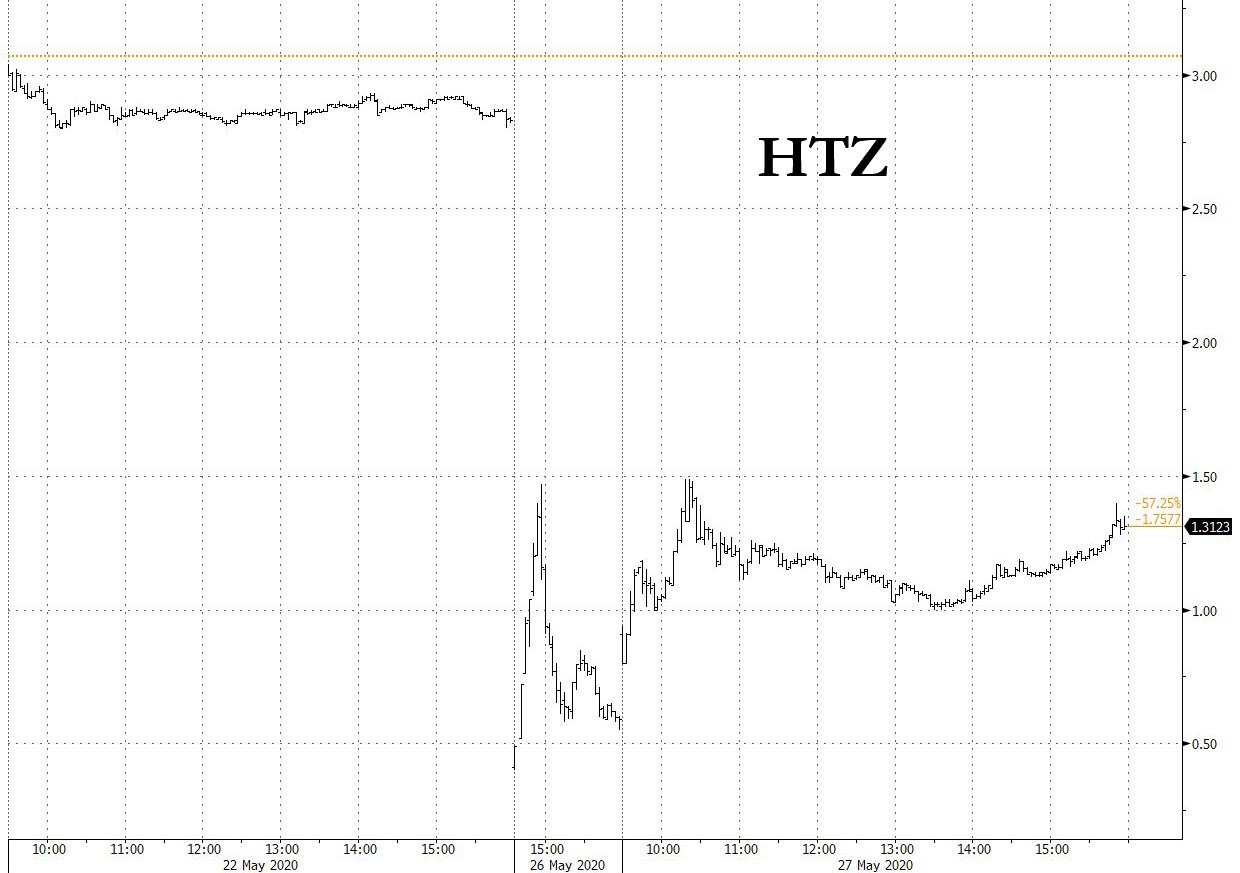
Why? Because as Bloomberg notes, Hertz became the most heavily traded U.S. stock Wednesday, with shares posting the largest gain on record before paring gains.
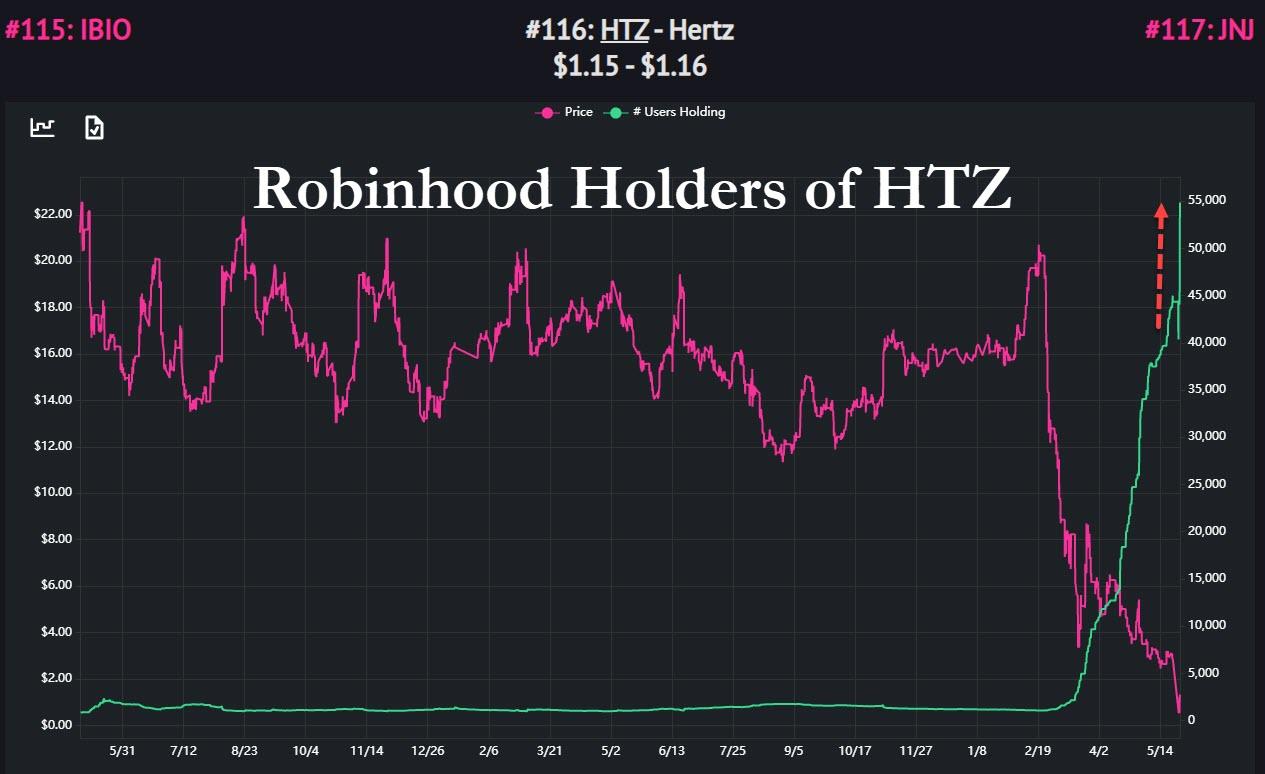
HTZ volume of 264 million was the most among US companies and more than double that of GE, which saw the second most activity; this flurry of activity helped the now worthless stock briefly reach $1.49, a record 168% increase, before paring gains to $1.00 only to rebound again and close at $1.31.
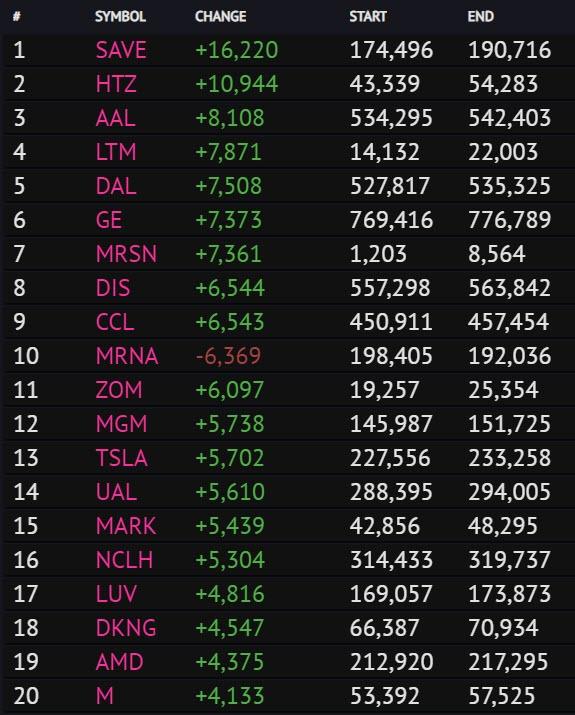
Why? Well, a familiar figure emerges once again: the retail investor. According to Robintrack which keeps tab on all the latest moves in the online platform (which was offline at the start of trading Wednesday for several hours until that whole pesky selloff nonsense was resolved), after the number of Robinhood retail holders of HTZ soared heading into the bankruptcy, on Wednesday, the bankrupt company was the second most popular stock on the free exchange…
… as investors first bought the fucking dip, and then bought the fucking bankruptcy.
And while it is unclear just what sparked today’s furious retail buying, maybe the hope that Chair Powell will start buying all those used Hertz cars that will soon flood the market and push the bankruptcy company back into solvency, one thing we do know is that as retail traders were buying, Carl Icahn – formerly the company’s largest sharehodler – was dumping right into their willing lap”. From Bloomberg:
Billionaire investor Carl Icahn has sold out of Hertz Global Holdings Inc., the rental-car company that filed for bankruptcy last week and counted him as its biggest shareholder.
“Hertz has encountered major financial difficulties and I support the board in their conclusion to file for bankruptcy protection,” Icahn said in a regulatory filing Wednesday. “Yesterday I sold my equity position at a significant loss, but this does not mean that I don’t continue to have faith in the future of Hertz.”
A holding company controlled by Icahn, 84, held more than 55 million shares of Hertz as of the end of the first quarter, a roughly 39% stake, according to data compiled by Bloomberg. Icahn described himself as “an investor and supporter of Hertz since 2014,” when his holding company began building its position.
And thanks to the retail buying frenzy, funded by the government’s stimulus checks, he had more than enough willing buyers. Incidentally, a similar pattern was observed in late April when Warren Buffett was liquidating his airline holdings. Guess who was buying.
And while retail investors continue to steamroll hedge funds in their unbooked YTD performance, a reminder that it’s not an actual gain until it is sold. For now, however, Joe Sixpack appears to be imitating the Fed’s trading pattern to the dot: buying, but never selling. Yet while the Fed can always print more money if it needs it, there will come a time over the next few weeks, when the stimulus checks that have funded this period of especially acute insanity, will stop.
via ZeroHedge News https://ift.tt/2XCzMYk Tyler Durden
Jeffrey Epstein’s lead attorney says that he knows the billionaire pedophile was murdered in prison, but does not know who the killer/s is/are, noting that Epstein was ‘upbeat and excited’ about going to the courts in an attempt to clear his name.
Epstein’s lawyer David Schoen made the comments in a Discovery documentary series about the disgraced multi-millionaire, revealing that the financier was preparing to reveal key information at trial.
Schoen is adamant that Epstein was not suicidal, noting “At one point a prison psychiatrist came in and asked me to leave so she could talk to Epstein on his own. They talked for five minutes and he seemed relaxed. He was smiling as she left.”
“He had plans to really fight this case. He’d made arrangements to hire me.” Schoen added.
In the three part documentary, titled Who Killed Jeffrey Epstein?, Schoen also said he was very concerned about Nicholas Tartaglione, a huge former cop, charged with four murders, who was initially sharing a cell with Epstein during his first alleged suicide attempt.
“The first incident that happened which the newspapers reported as a possible suicide attempt, Epstein didn’t want to discuss any further. He told the prison officers he couldn’t remember what happened, he didn’t want to answer any more questions,” Schoen said.
“Look, he was in a dangerous situation. He’s a very wealthy guy accused of sex offences stuck in with a guy accused of four murders.” the lawyer added.
“First of all he shouldn’t have been locked up in the general population, that’s reprehensible… He’d have guys who watch the nightly news on the prison TV and say to him, $70 million mansion, huh?” Schoen proclaimed.
“I’ve been through this with other clients and I told him to keep him an eye on this and tell me if anyone was extorting him.” the lawyer said.
Schoen also said that he was disappointed that Epstein’s ‘powerful friends’ kept their distance after his arrest.
“I’d hoped that Prince Andrew would be the one guy who stood up and said he was a friend, I didn’t know anything about it.” Schoen said.
The lawyer also slated the legal team that he took over from, calling Epstein’s former legal representative Jay Lefkowitz a ‘numbskull’.
Schoen also claimed that lawyers acting on behalf of victims were trying to milk Epstein for millions, in some cases asking for payments of up to $25 million to make the claims vanish.
“I wanted people to report on the fact how much lawyers were making off this thing. I’d hope that some people agree that some of these women tricked him.” Schoen declared.
Senior editor, Ash Bennington, joins managing editor, Roger Hirst, to discuss the latest developments in macro, markets, and coronavirus. Bennington and Hirst analyze what’s happening in Europe, including the recently proposed EU stimulus package, ballooning European debt, and the underlying structure of the eurozone. They also discuss recent moves in equity prices and the current landscape of currency markets. In the intro, Real Vision’s Nick Correa shares the details of both the EU’s and Japan’s proposed stimulus bills for economic relief.
via ZeroHedge News https://ift.tt/36BJJJu Tyler Durden
“Half Your Crew’s Not Wearing Masks!” MSNBC Suffers Shaming-Fail After Vacationer Mocks Reporter Tyler Durden
Wed, 05/27/2020 – 18:25
An MSNBC camera crew was called out for not wearing a mask while filming a Memorial Day segment over the network’s faux-outrage over people not wearing masks.
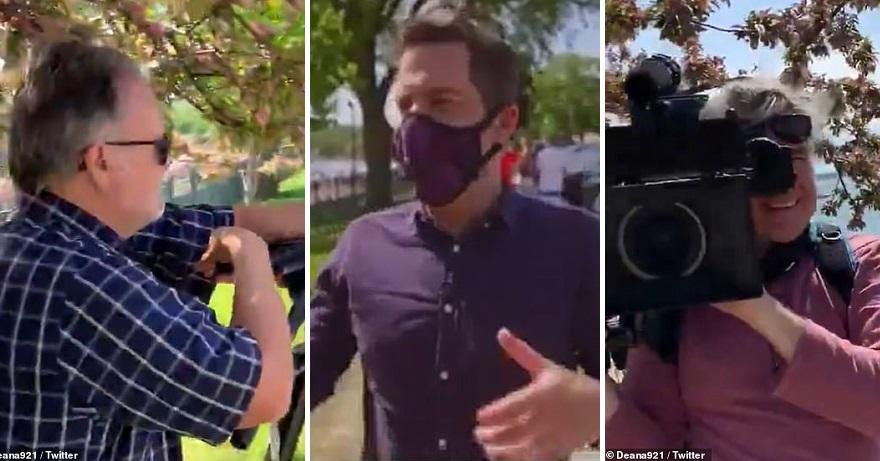
Journalist Cal Perry was reporting from Lake Geneva, Wisconsin where businesses have reopened after the coronavirus lockdown. As Perry attempted to call out a passer-by as an example of all the people without masks, the man fired back: “Including the cameraman!,” adding “Half your crew’s not wearing masks!“
You asked for it! Gotta love Cal Perry reach out and touch the cameraman who is not wearing a mask and is not social distancing…and who also touched his face. Breaking ALL the rules! pic.twitter.com/5UGQHTmNOX
According to the Daily Mail, the unidentified man’s video went viral on social media – which shows Perry breaking social distancing rules to touch the arm of his cameraman and get him to turn around.
Meanwhile over at CNN:
CNN’s Gary Tuchman removes mask after filming segment for this report.
via ZeroHedge News https://ift.tt/3goe4Qp Tyler Durden
Wikipedia Co-Founder Says Site Is ‘Badly Biased’ Tyler Durden
Wed, 05/27/2020 – 18:05
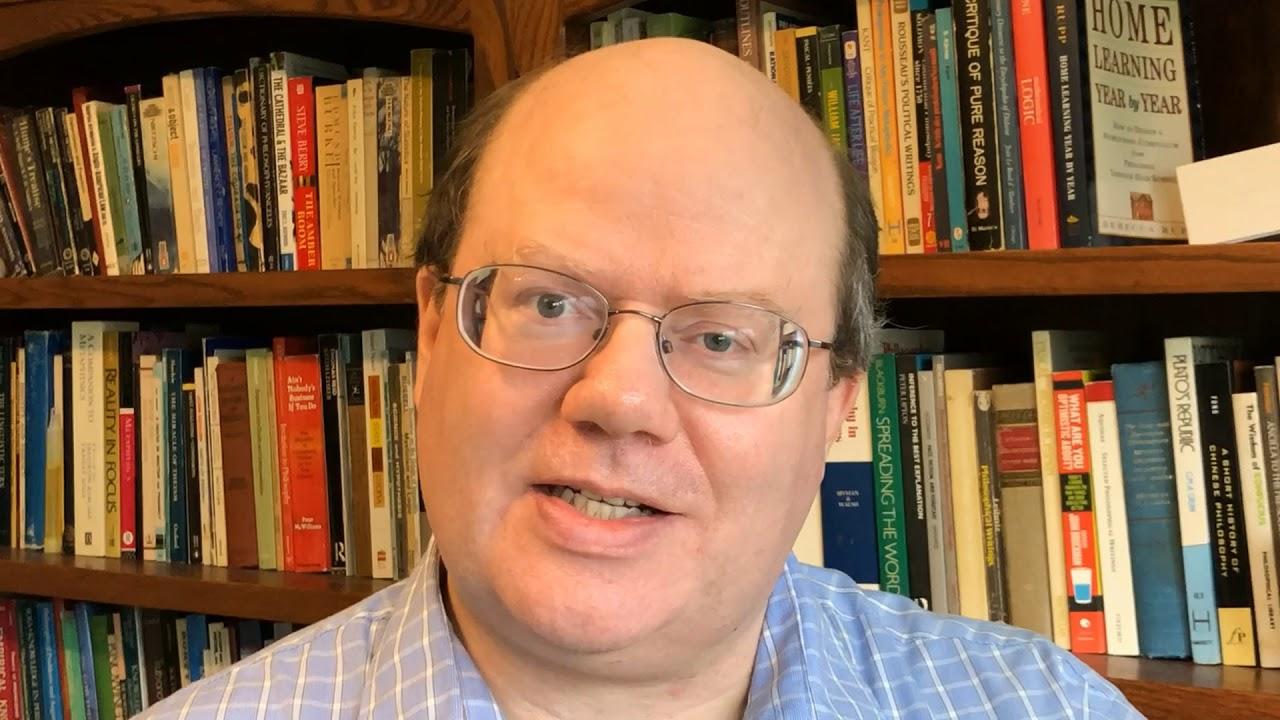
Wikipedia co-founder Larry Sanger has been sounding the alarm over the website for some time now – previously noting that the site had failed to reign in ‘bad actors’ and was ‘broken as a result.’
Now, Sanger opines on the website’s overt political bias against conservatives. Read on below:
Wikipedia’s “NPOV” is dead.1 The original policy long since forgotten, Wikipedia no longer has an effective neutrality policy. There is a rewritten policy, but it endorses the utterly bankrupt canard that journalists should avoid what they call “false balance.”2 The notion that we should avoid “false balance” is directly contradictory to the original neutrality policy. As a result, even as journalists turn to opinion and activism, Wikipedia now touts controversial points of view on politics, religion, and science. Here are some examples from each of these subjects, which were easy to find, no hunting around. Many, many more could be given.
Examples have become embarrassingly easy to find. The Barack Obama article completely fails to mention many well-known scandals: Benghazi, the IRS scandal, the AP phone records scandal, and Fast and Furious, to say nothing of Solyndra or the Hillary Clinton email server scandal—or, of course, the developing “Obamagate” story in which Obama was personally involved in surveilling Donald Trump. A fair article about a major political figure certainly must include the bad with the good. The only scandals that I could find that were mentioned were a few that the left finds at least a little scandalous, such as Snowden’s revelations about NSA activities under Obama. In short, the article is almost a total whitewash. You might find this to be objectively correct; but you cannot claim that this is a neutral treatment, considering that the other major U.S. party would treat it differently. On such a topic, neutrality in any sense worth the name essentially requires that readers not be able to detect the editors’ political alignment.
Meanwhile, as you can imagine, the idea that the Donald Trump article is neutral is a joke. Just for example, there are 5,224 none-too-flattering words in the “Presidency” section. By contrast, the following “Public Profile” (which the Obama article entirely lacks), “Investigations,” and “Impeachment” sections are unrelentingly negative, and together add up to some 4,545 words—in other words, the controversy sections are almost as long as the sections about his presidency. Common words in the article are “false” and “falsely” (46 instances): Wikipedia frequently asserts, in its own voice, that many of Trump’s statements are “false.” Well, perhaps they are. But even if they are, it is not exactly neutral for an encyclopedia article to say so, especially without attribution. You might approve of Wikipedia describing Trump’s incorrect statements as “false,” very well; but then you must admit that you no longer support a policy of neutrality on Wikipedia.
I leave the glowing Hillary Clinton article as an exercise for the reader.
Wikipedia can be counted on to cover not just political figures, but political issues as well from a liberal-left point of view. No conservative would write, in an abortion article, “When properly done, abortion is one of the safest procedures in medicine,” a claim that is questionable on its face, considering what an invasive, psychologically distressing, and sometimes lengthy procedure it can be even when done according to modern medical practices. More to the point, abortion opponents consider the fetus to be a human being with rights; their view, that it is not safe for the baby, is utterly ignored. To pick another, random issue, drug legalization, dubbed drug liberalization by Wikipedia, has only a little information about any potential hazards of drug legalization policies; it mostly serves as a brief for legalization, followed by a catalog of drug policies worldwide. Or to take an up-to-the-minute issue, the LGBT adoption article includes several talking points in favor of LGBT adoption rights, but omits any arguments against. On all such issues, the point is that true neutrality, to be carefully distinguished from objectivity, requires that the article be written in a way that makes it impossible to determine the editors’ position on the important controversies the article touches on.
What about articles on religious topics? The first article I thought to look at had some pretty egregious instances of bias: the Jesus article. It simply asserts, again in its own voice, that “the quest for the historical Jesus has yielded major uncertainty on the historical reliability of the Gospels and on how closely the Jesus portrayed in the Bible reflects the historical Jesus.” In another place, the article simply asserts, “the gospels are not independent nor consistent records of Jesus’ life.” A great many Christians would take issue with such statements, which means it is not neutral for that reason—in other words, the very fact that most Christians believe in the historical reliability of the Gospels, and that they are wholly consistent, means that the article is biased if it simply asserts, without attribution or qualification, that this is a matter of “major uncertainty.” In other respects, the article can be fairly described as a “liberal” academic discussion of Jesus, focusing especially on assorted difficulties and controversies, while failing to explain traditional or orthodox views of those issues. So it might be “academic,” but what it is not is neutral in the original sense we defined for Wikipedia.
Of course, similarly tendentious claims can be found in other articles on religious topics, as when the Christ (title) article claims,
Although the original followers of Jesus believed Jesus to be the Jewish messiah, e.g. in the Confession of Peter, Jesus was usually referred to as “Jesus of Nazareth” or “Jesus, son of Joseph”.[11] Jesus came to be called “Jesus Christ” (meaning “Jesus the Khristós”, i.e. “Jesus the Messiah” or “Jesus the Anointed”) by later Christians, who believe that his crucifixion and resurrection fulfill the messianic prophecies of the Old Testament.
This article weirdly claims, or implies, a thing that no serious Biblical scholar of any sort would claim, viz., that Jesus was not given the title “Christ” by the original apostles in the New Testament. These supposed “later Christians” who used “Christ” would have to include the apostles Peter (Jesus’ first apostle), Paul (converted a few years after Jesus’ crucifixion), and Jude (Jesus’ brother), who were the authors of the bulk of the epistles of the New Testament. “Christ” can, of course, be found frequently in the epistles.3 Of course, those are not exactly “later Christians.” If the claim is simply that the word “Christ” does not appear much in the Gospels,that is true enough (though it can be found four times in the book of John), but it is also a reflection of the fact that the authors of the Gospels instead used “Messiah,” and quite frequently; the word means much the same as “Christ.” For example, he is called “Jesus the Messiah” in the very first verse of the New Testament (Matthew 1:1). Clearly, these claims are tendentious and represent a point of view that many if not most Christians would dispute.
It may seem more problematic to speak of the bias of scientific articles, because many people do not want to see “unscientific” views covered in encyclopedia articles. If such articles are “biased in favor of science,” some people naturally find that to be a feature, not a bug. The problem, though, is that scientists sometimes do not agree on which theories are and are not scientific. On such issues, the “scientific point of view” and the “objective point of view” according to the Establishment might be very much opposed to neutrality. So when the Establishment seems unified on a certain view of a scientific controversy, then that is the view that is taken for granted, and often aggressively asserted, by Wikipedia.
The global warming and MMR vaccine articles are examples; I hardly need to dive into these pages, since it is quite enough to say that they endorse definite positions that scientific minorities reject. Another example is how Wikipedia treats various topics in alternative medicine—often dismissively, and frequently labeled as “pseudoscience” in Wikipedia’s own voice. Indeed, Wikipedia defines the very term as follows: “Alternative medicine describes any practice that aims to achieve the healing effects of medicine, but which lacks biological plausibility and is untested, untestable or proven ineffective.” In all these cases, genuine neutrality requires a different sort of treatment.
Again, other examples could be found, in no doubt thousands of other, perfectly unexciting topics. These are just the first topics that came to mind, associated as they are with the culture wars, and their articles on those topics put Wikipedia very decidedly on one side of that war. You should not be able to say that about an encyclopedia that claims to be neutral.
It is time for Wikipedia to come clean and admit that it has abandoned NPOV (i.e., neutrality as a policy). At the very least they should admit that that they have redefined the term in a way that makes it utterly incompatible with its original notion of neutrality, which is the ordinary and common one.4 It might be better to embrace a “credibility” policy and admit that their notion of what is credible does, in fact, bias them against conservatism, traditional religiosity, and minority perspectives on science and medicine—to say nothing of many other topics on which Wikipedia has biases.
Of course, Wikipedians are unlikely to make any such change; they live in a fantasy world of their own making.5
The world would be better served by an independent and decentralized encyclopedia network, such as I proposed with the Encyclosphere. We will certainly develop such a network, but if it is to remain fully independent of all governmental and big corporate interests, funds are naturally scarce and it will take time.
The misbegotten phrase “neutral point of view” is a Jimmy Wales coinage I never supported. If a text is neutral with regard to an issue, it lacks any “point of view” with regard to the issue; it does not take a “neutral point of view.” My preferred phrase was always “the neutrality policy” or “the nonbias policy.”[↩]
On this, see my “Why Neutrality?“, published 2015 by Ballotpedia.[↩]
Both in the form “Jesus Christ” (e.g., 1 Peter 1:1, Jude 1:1) and in the form “Christ Jesus” (1 Corinthians 1:2).[↩]
UPDATE: In an earlier version of this blog post, I included some screenshots of Wikipedia Alexa rankings, showing a drop from 5 to 12 or 13. While this is perfectly accurate, the traffic to the site has been more or less flat for years, until the last few months, in which traffic spiked probably because of the Covid-19 virus. But since the drop in Alexa rankings do not seem to reflect a drop in traffic, I decided to remove the screenshots and a couple accompanying sentences.[↩]
via ZeroHedge News https://ift.tt/2XvH8wE Tyler Durden
Why Credit Suisse Sees 0% Returns Over The Next Decade Tyler Durden
Wed, 05/27/2020 – 18:01
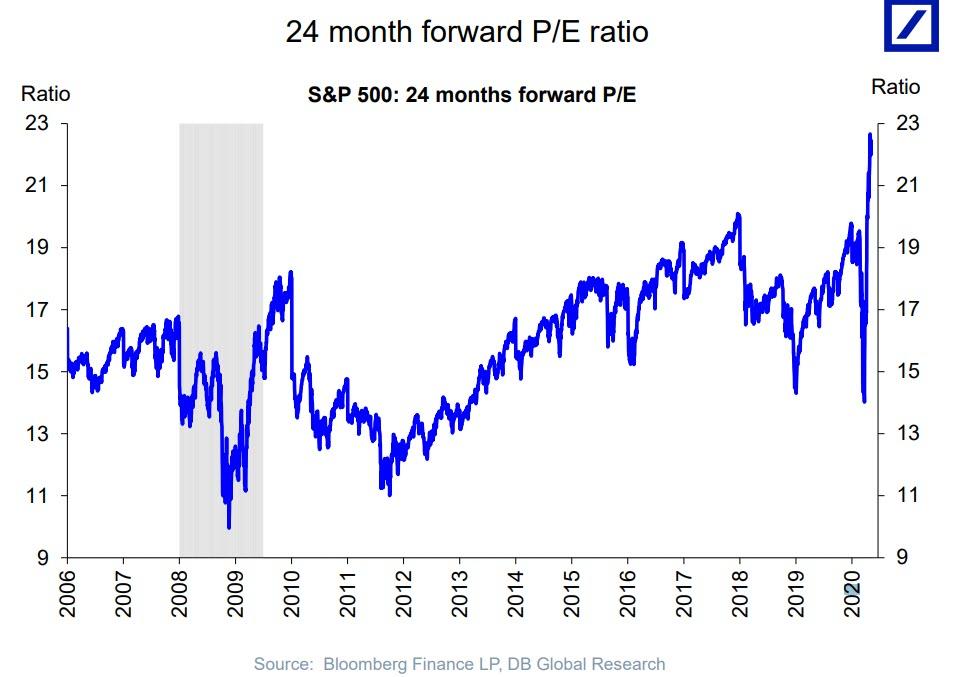
The chart showing the 2 year (not 1 year) forward P/E multiple on the S&P500, i.e., based on EPS from Dec 31, 2021, is now so ridiculous it barely fits in the chart let alone is worth to comment on.
And while one can argue that nobody cares about fundamentals in a world in which the economy, profits and markets all exist in a state of what BofA called a “Schrödinger Equilibrium” created by the Fed, Credit Suisse equity strategist Jonathan Golub just has trouble believing that we now live in a world in which PE multiple have reached a persistently higher plateau.
As he writes in his daily note to clients today, “we’ve repeatedly made the case that more cash flow-rich companies, in a less volatile environment, would lead to a new regime of persistently higher multiples and the secular outperformance of growth and long-duration (less volatile) equities.”
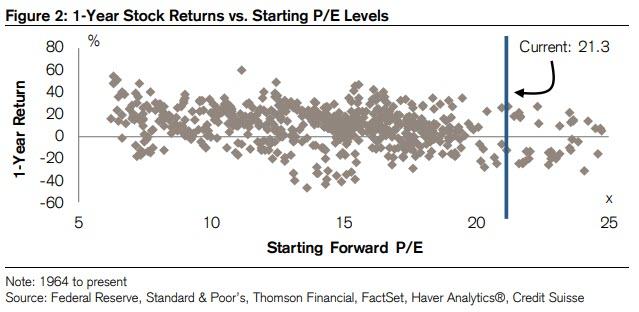
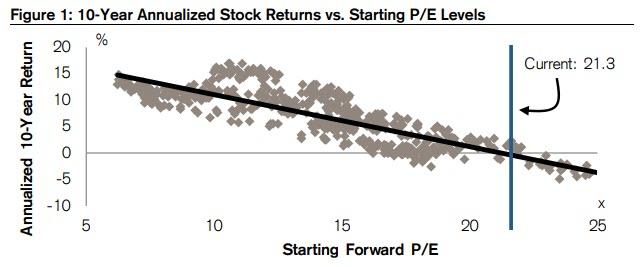
Golub then counters that while “bearish investors would (correctly) point out that future returns are highly influenced by starting valuations, with higher P/Es leading to weaker performance, as multiples de-rate toward long-term averages”, he would, in turn, respond that “valuations have little influence over the near-term” (the chart above makes that quite clear).
And yet, while Golub suggests that previously-skeptical investors are becoming increasingly comfortable with higher multiples, and in a world where retail investors are now the dominant force shaping marginal prices this is hardly surprising, he remains “unconvinced given the current backdrop.”
And just to underscore his point, Golub shows that whereas valuations indeed have little impact on 1-year stock returns…
… they certainly impact the market’s return over the coming decade. And as the second chart shows, when starting at the currently lofty valuation, returns over the next ten years tend to be more or less the same: 0%.
via ZeroHedge News https://ift.tt/3d9C0F7 Tyler Durden
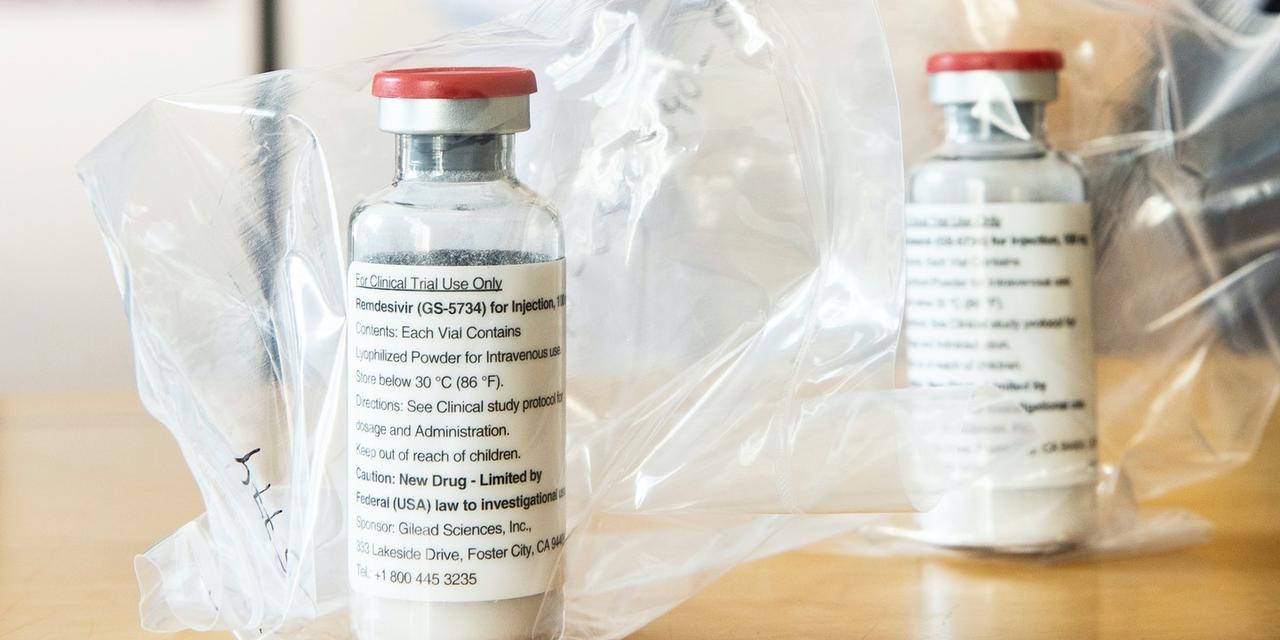
Gilead Sciences’ Remdesivir has been heralded as our best hope in fighting the coronavirus pandemic. Unfortunately, the antiviral drug doesn’t seem of much help to patients with Covid-19, the disease caused by the coronavirus. And while the company’s clever rollout has generated excitement among investors, politicians, and the public, a combination of generic drugs that appears to be more effective in fighting the coronavirus has flown under the radar.
Desperation for the limited supply of remdesivir is so great that Virginia will hold a lottery to determine which of the almost 1,500 severely ill patients in the state will be able to get its several hundred donated doses of the drug. In Minnesota, state officials have come up with an action plan to allocate their supply of the Covid-19 treatment, which calls for designating “triage officers” who will randomly choose among equally eligible patients. And in Alabama, physicians on a coronavirus task force set up by the governor will determine which patients get remdesivir.
Some hospitals there will receive just a single course of treatment. Still, Alabama’s state health officer, Dr. Scott Harris, recently offered his thanks to Gilead, the drug’s manufacturer, which donated some 940,000 vials of the drug to the federal government that are being distributed by state health departments. “Although the total supply of remdesivir is limited, we are grateful that hospitalized COVID-19 patients with severe disease in Alabama can receive this potentially lifesaving medication,” said Harris.
It is amid these feelings of scarcity and indebtedness that Gilead is setting the price for its antiviral medicine. The company, which has already arranged for distribution of remdesivir in 127 countries, is expected to begin selling it commercially as soon as June. And while a 10-day course of the drug, which was developed as a potential Ebola treatment with at least $79 million in U.S. government funding, costs only about $10 to produce, according to an estimate by the Institute for Clinical and Economic Review, its market price is expected to be several hundred times that amount.
Still, price gouging isn’t what has many scientists upset about remdesivir. It’s the fact that the coronavirus drug that has boosted hopes and sent Gilead’s stock price (and according to some analysts, the entire stock market) soaring doesn’t seem to do much for coronavirus patients.
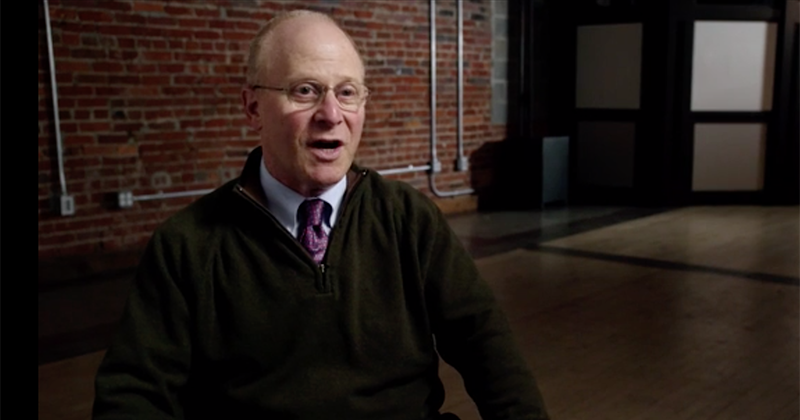
“Remdesivir doesn’t work at all, as far as I can tell, or has only a minor effect,” said William Haseltine, a scientist who has spent decades studying viruses and helped lead the U.S. government response to the HIV/AIDS epidemic.
“It is comparable to Tamiflu and maybe not even as good,” Haseltine added, referring to another antiviral drug that has been available by prescription for 20 years and is expected to be sold over the counter in the coming months.
Haseltine, who founded the divisions of biochemical pharmacology and human retrovirology at Harvard University’s School of Public Health, pointed out that Gilead hasn’t released data showing remdesivir’s effect on viral load in people with Covid-19. Meanwhile, the only available information on how the drug affects the amount of the coronavirus in patients, a Chinese study of the drug published in The Lancet, showed that the drug did not lower the viral load.
“That’s why I call it the fuzzy-wuzzy drug,” said Haseltine.
“When the Chinese tried to find the antiviral effect, it wasn’t there.”
Instead, the excitement about remdesivir is based largely on a study sponsored by the National Institute of Allergy and Infectious Diseases that showed people taking the drug had a faster recovery than those who didn’t take it: 11 days on average compared to 15 for those taking a placebo. An article published on May 22 in the New England Journal of Medicine showed mild improvement in hospitalized patients that took remdesivir, though the drug didn’t appear to be of any help to the sickest patients, who needed to receive high-flow oxygen through ventilators or other means. Nor did the drug significantly improve a patient’s chance of surviving Covid-19.
Nevertheless, at an April 29 Oval Office press conference with President Donald Trump, NIAID Director Dr. Anthony Fauci declared that preliminary results from that trial proved that “a drug can block this virus.” Since then, remdesivir has been positioned as our savior and Gilead as its benevolent dispenser.
While some patients and their families have spent the past few weeks frantically trying to procure remdesivir, another Covid-19 treatment has been quietly been shown to be more effective. Although neither option appears to be the much-needed cure for Covid-19, a three-drug regimen offered a greater reduction in the time it took patients to recover than remdesivir did. People who took the combination of interferon beta-1b, lopinavir-ritonavir, and ribavirin got better in seven days as opposed to 12 days for those who didn’t take it. Critically, the treatment has another leg up on Gilead’s: It clearly reduced the amount of the coronavirus in patients who took it, according to a study published in The Lancet on May 8.
Yet so far there has been no stampede of patients demanding the new regimen or lotteries to mete out the doses, which may be due at least in part to the fact that the treatment hasn’t been the subject of a major marketing campaign. It’s worth noting that each of the three drugs in the new combination is generic, or no longer under patent, which means that no company stands to profit significantly from its use.
In contrast, Gilead, a company that had more than $22 billion of revenue in 2019 and stands to make money from remdesivir for many years, has been carefully orchestrating the rollout of its new treatment, doling out small, tailored bits of encouraging information to the press and highlighting its compassionate use program.
It’s not unusual for pharmaceutical companies to paint their products in a rosy light or go to questionable lengths to maximize profit. And Gilead, which secured a lucrative orphan drug status for remdesivir in March before reversing course two days later, has faced widespread criticism before — particularly for the exorbitant pricing of its HIV medicine Truvada and hepatitis C drug sofosbuvir, which sells for $1,000 a pill.
But during the pandemic, buzz, politics, and greed are playing an even greater role than usual in determining which drugs are widely used while the usual scientific process for evaluating their safety and effectiveness is being sped up and curtailed. Trump, who whipped up excitement about the malaria drug hydroxychloroquine, a drug he has taken himself despite not having Covid-19, has led the way.
“You have a president putting intense pressure on companies, regulators, and others in an effort to salvage his reelection,” said Dr. Michael Carome, director of health research at Public Citizen. The consequences, Carome warmed, could be deadly.
“My great worry is that with all this hype and the press from the White House, that we’ll bring something to market much too quickly and harm a lot of people. That’s the danger.”
Already, the risk of death has been shown to be elevated in Covid-19 patients who take hydroxychloroquine. According to a study published in The Lancet last week, the approximately 15,000 people who received hydroxychloroquine or the closely related drug chloroquine were roughly twice as likely to die as those who didn’t take them.
The benefits of all drugs have to be balanced against their harms. In the case of remdesivir, those dangers appear to include possible damage to the kidney and liver. While the risks and benefits are typically clarified with further study, the NIAID called off the remdesivir trial that might have offered more information about both so that the patients who were getting the placebo could take the drug.
In addition to possibly hurting patients, basing decisions about coronavirus therapies and vaccines on hype rather than science also carries the risk of prematurely investing in one product at the expense of another. “It’s possible that we’re now investing a lot of effort in pursuing a drug that could lead to less research being done on something that could have been safer or more effective,” Carome said about what he described as questionable enthusiasm for remdesivir. After the drug received Emergency Use Authorization from the Food and Drug Administration on May 1, Public Citizen submitted a FOIA request for the complete data underlying the decision. The FDA has not provided the group with any documents and usually treats such data as proprietary.
Meanwhile, the excitement around another coronavirus development seems to be moving faster than the science. Last week, the biotech company Moderna also moved markets with a vague announcement about the preliminary results of a study. In this case, the company described initial findings of a trial of its potential coronavirus vaccine as “triumphant,” though they were based on eight people from a relatively early stage of research.
“Most products that pass this phase ultimately fail,” said Public Citizen’s Carome. While the company summarized its data, it didn’t release it. “We need to see the details, but we probably won’t.”
The vaccine development process promises to get faster and more vulnerable to conflicts of interest. On May 14, Trump announced Operation Warp Speed, the administration’s effort to produce and distribute a coronavirus vaccine by the end of the year, despite experts’ insistence that the process will likely take years. The operation is being led by former pharmaceutical executive Moncef Slaoui, who has received more than $13.5 million from pharmaceutical and biotech firms since 2016. Slaoui was also holding 155,000 shares of Moderna, whose value increased by more than $2 million after the good news about its vaccine hit the airwaves. In an unusual arrangement, the compensation for his government work is only $1 and is exempt from the usual federal disclosure and conflict-of-interest laws. After Sen. Elizabeth Warren called attention to his conflict of interest, Slaoui divested his shares in Moderna and announced that he would donate to cancer research the money he made off their increase after he joined Operation Warp Speed.
While vaccination may be the best hope to bring an end to the pandemic as quickly as possible, mistakes made because of haste or conflicts of interest could be devastating. Because the plan is to vaccinate some 1 billion people worldwide, even infrequent side effects could manifest on a huge scale. The wrong vaccines could even spread disease. “They could give you a nasty cold that you could give to unvaccinated people,” said Haseltine.
The current power of politics and greed over science make such outcomes more likely.
“I fear that the warp speed group will distort our regulatory process and that the administration will put its thumb on the scale to favor an outcome regardless of the cost to human life,” said Haseltine.
“People think warp means very fast, but warp also means distorting.”
via ZeroHedge News https://ift.tt/2AdBN5e Tyler Durden
Venezuela Allowed To Sell UK-Stored Gold To Buy Food And Medicine Tyler Durden
Wed, 05/27/2020 – 17:22
One month after Venezuela asked the Bank of England to sell part of the South American nation’s gold reserves held in its vaults and send the proceeds to the United Nations to help with the country’s coronavirus-fighting efforts, Venezuela has reached a deal with the U.N. Development Programme (UNDP) to use a part of its gold reserves Bank of England accounts to finance the purchase of food and medicine during the coronavirus pandemic, its central bank governor said on Wednesday according to Reuters.
The deal comes after the central bank made a legal claim earlier this month to force the bank to hand over part of the 31 tonnes of gold in accounts belonging to the government of President Nicolas Maduro, who Britain does not recognize as Venezuela’s legitimate leader due to allegations he rigged his 2018 re-election, and has effectively “temporarily” confiscated Venezuela gold until the country has a leader that is internationally recognized.
Central bank governor Calixto Ortega told Reuters that under the arrangement, the UNDP would receive the funds directly, a move meant to assuage concerns about potential corruption in the management of the money.
“It’s not my word, it’s not me saying that I am going to buy food, medicine and medical equipment,” Ortega said in an interview in his downtown Caracas office. “It’s the United Nations who is saying that, and they are not going to be involved in anything dark that is not neutral and independent.”
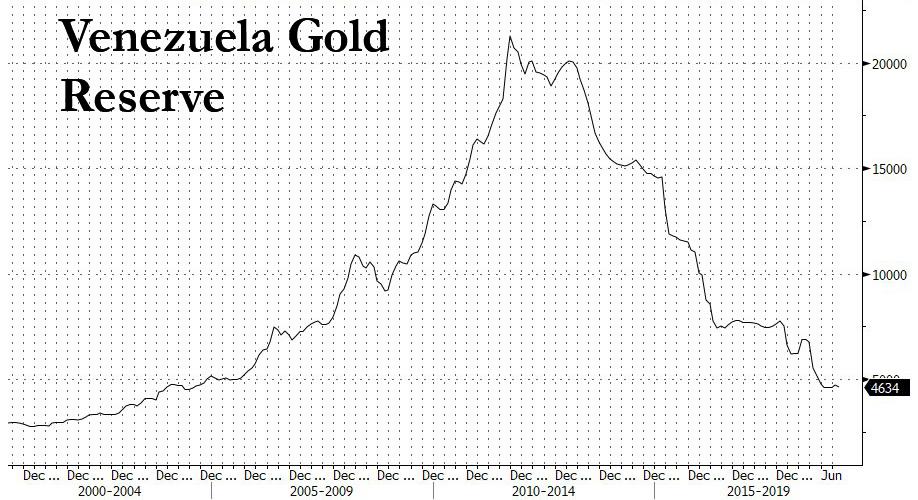
Venezuela for decades stored gold that makes up part of its central bank reserves in the vaults of foreign financial institutions including the Bank of England, which provides gold custodian services to many developing countries, before former president Hugo Chavez repatriated 160 tons of fold, worth more than $11BN at the time.
But the Bank of England has since 2018 refused to transfer the 31 tonnes of gold it still holds to the government of President Nicolas Maduro, whom Great Britain has refused to recognize as the country’s legitimate leader after his disputed 2018 re-election.
The ongoing effort signals that Maduro is desperately seeking financial resources around the world as the country’s economy struggles under low oil prices, crippling U.S. sanctions and a paralyzing coronavirus quarantine.
As Reuters reported last month, it was not immediately evident how much gold Venezuela was asking the Bank of England to sell. At current market prices, Venezuelan gold on deposit at the Bank of England would be worth around $1.7 billion.
Venezuela has lived a six-year economic crisis driven by an collapsing socialist system and a decaying oil industry, driving a mass migration of nearly 5 million people and fueling hyperinflation that has left many unable to obtain basic food. Recent tightening of U.S. sanctions meant to oust Maduro have strangled fuel imports, prompting Venezuelans to wait for hours in fuel stations queues or turn to the pricey black market.
* * *
Maduro’s government has for years raised cash by selling or pledging gold, both from artisanal mines in the southern Amazon jungle and from gold reserves held by the central bank.
The central bank has continued to remove gold from its coffers in the last month with the hopes of exporting it, according to three sources, one of whom said eight tonnes have been removed since quarantine started in mid-March. Central bank data shows that total monetary reserves fell more than $500 million between April 14 and 24.
Employees who work in the wing of central bank where the gold vaults are located have been arriving to work despite the quarantine, according to Reuters. It was not immediately evident how many gold sale operations had been carried out or where the gold was sold.
Part of the proceeds were used to acquire supplies to refine the country’s crude in response to the near collapse of the country’s 1.3 million barrel-per-day refining circuit.
Six tons of gold had already been withdrawn from the central bank between the end of 2019 and beginning of 2020 and sold to acquire euros in cash, which the institution channeled through local banks and the government used to pay suppliers.
Following the latest withdrawal, the central bank would still have more than 80 tonnes of gold in its vaults, according to sources, compared with 129 tonnes at the start of 2019.
via ZeroHedge News https://ift.tt/3cbHEVM Tyler Durden