Pelosi Joins Call To Boycott 2022 Winter Games Over China’s Human Rights Abuses

Pelosi Joins Call To Boycott 2022 Winter Games Over China’s Human Rights Abuses

With the Tokyo Summer Olympics expected to be the most underwhelming event in the history of the modern games (that is, if safety officials from the IOC ultimately allow it to continue), pressure for an international boycott of the 2022 Winter Games in Beijing is growing. House Speaker Nancy Pelosi just became the first senior American official to call for a boycott of the China games over Beijing’s treatment of Uygher Muslims in the far-flung northwestern province of Xinjiang.

Heads of state who go to China for the Olympics in light of genocide would not have moral authority to speak out about human rights, Pelosi insisted according to a newswire report.

She also called out the corporate sponsors of the game for “looking the other way” at China’s human rights abuses.

“How sad it is to see the Olympic corporate sponsors look the other way on China’s abuses out of concern for their bottom line.”

Beijing has responded to accusations that it’s carrying out a genocide of the Uyghers have turned accusations back around on the US, citing instances of police brutality, and America’s history of slavery, as signs of hypocrisy.

Pelosi’s decision follows an even more forceful call from a group representing other other minorities who have been oppressed by Beijing. The group explicitly accuses those who support the Games of giving tacit approval of genocide representing the people of Hong Kong, Uyghur Muslims and Tibetans, released a statement calling for the boycott on Monday. It also accused the IOC of deciding “to put profit before human lives and turn a blind eye to genocide,” according to the Daily Caller and Associated Press.

Support for a boycott is bipartisan, with high-profile Republicans like former UN Ambassador and former South Carolina Gov. Nikke Haley responding to calls from the group mentioned above by endorsing their call and saying it would be “unthinkable” for the world to ignore what Beijing has done to the Uyghers.

The statement said that the time for negotiations with Beijing over its abuses has passed, and that a full-on boycott is the only moral option available. “The time for talking with the IOC is over,” Lhadon Tethong of the Tibet Action Institute said in an exclusive interview with the AP. “This cannot be games as usual or business as usual; not for the IOC and not for the international community.”

Human Rights groups have met several times in the past year with the IOC, asking that the games be removed from China. A key member in those talks was Zumretay Arkin of the World Uyghur Congress.

And just last week, human rights groups and Western nations led by the US, the UK, and Germany accused China of massive crimes against the Uyghur minority and demanded unimpeded access for UN experts. At the meeting, Britain’s UN Ambassador, Barbara Woodward, called the situation in Xinjiang “one of the worst human rights crises of our time.”

“The evidence points to a program of repression of specific ethnic groups,” Woodward said. “Expressions of religion have been criminalized and Uyghur language and culture are discriminated against systematically and at scale.”

While President Joe Biden is probably a little too cozy with China to openly call for a boycott of the Winter Games, we wouldn’t be surprised to see President Trump, or other senior GOP, to highlight the president’s hypocrisy when it comes to China by joining with their own calls to back the boycott.

Tyler Durden
Tue, 05/18/2021 – 21:45

via ZeroHedge News https://ift.tt/3yvc8yH Tyler Durden

The $392,000 Lifeguard: “Baywatch” As Union Shop

The $392,000 Lifeguard: “Baywatch” As Union Shop

Submitted by Adam Andrzejewski, CEO and founder of OpenTheBooks.com,

Being a lifeguard isn’t easy, but in Los Angeles it can be lucrative. Auditors at OpenTheBooks.com found 82 county lifeguards earning at least $200,000 including benefits and seven making between $300,000 and $392,000. Thirty-one lifeguards made between $50,000 and $131,000 in overtime alone.

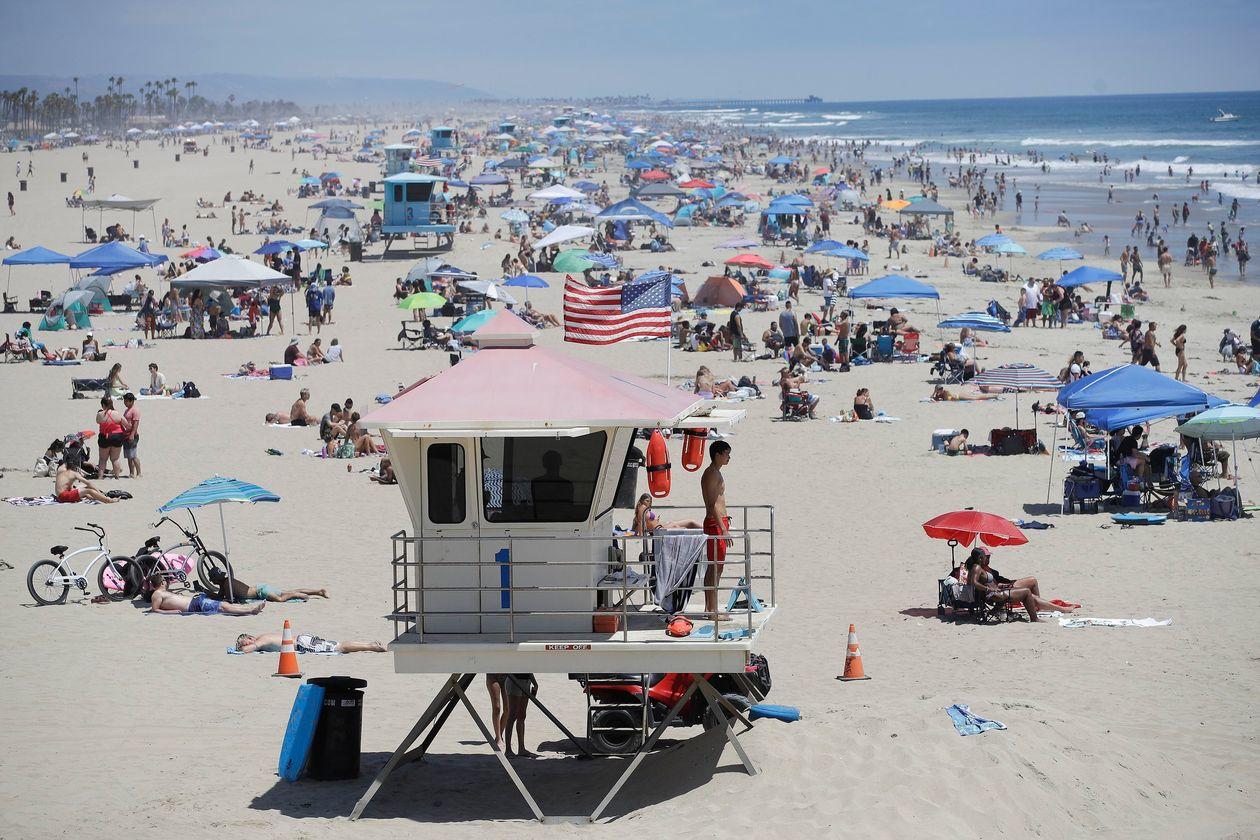
A lifeguard keeps watch in Huntington Beach, Calif., June 29, 2020.

After 30 years of service, they can retire as young as 55 on 79% of their pay. The Los Angeles County Lifeguard Association makes all this possible. Since 1995 the union has bargained for better wages, hours, benefits and working conditions.

Over the past five years, lifeguard captain Daniel Douglas brought home $630,000 in overtime alone. His total employment costs in 2019 were $368,668—$140,706 base bay, $131,493 in overtime, $21,760 in “other pay” and $74,709 in benefits.

In 2009 the city of Santa Monica signed a 10-year, $25 million contract with the county for lifeguard services. In 2019 the city extended the contract for five years and $17 million. There were no identified competitors and the contract wasn’t put out for bid.

To be sure, being a lifeguard isn’t all fun in the sun: Some are EMTs and paramedics, and some are part of an underwater recovery team and participate in diving operations. Some are marine firefighters with specialized training for fireboat operations. Some are on duty for 24 hours at a time—though they’re allotted eight hours for sleep, and if they have a call that interrupts their slumber after five hours or less, “the entire 24-hour period shall be counted as hours worked,” the contract states.

Still, they’re handsomely paid beyond what virtually all other EMTs receive. By comparison, the top-paid public lifeguard in Florida made $118,000, including benefits—though the pay goes further in the Sunshine State, which has no income tax. Even in New York City, the top-paid lifeguard made only $168,000.

Think of the Los Angeles Country Lifeguard Association as the teachers union of “Baywatch.”

Tyler Durden
Tue, 05/18/2021 – 21:25

via ZeroHedge News https://ift.tt/3oqk0wE Tyler Durden

‘Sickcare’ Is The Knife In The Heart Of Employment… And The Economy

‘Sickcare’ Is The Knife In The Heart Of Employment… And The Economy

Authored by Charles Hugh Smith via OfTwoMinds blog,

We need to change the incentives of the entire system, not just healthcare, but if we don’t start with healthcare, that financial cancer will drag us into national insolvency all by itself.

American Healthcare is a growth industry in the same way cancer is a growth industry: both keep growing until they kill the host, which in the case of healthcare is the U.S. economy.

While a great many individuals in the system care about improving the health of their patients, the healthcare system itself only cares about one thing: maximizing profits by any means available, including sending many patients to an early grave via medications which corporations declared “safe” and rigged the political-regulatory-research systems to comply.
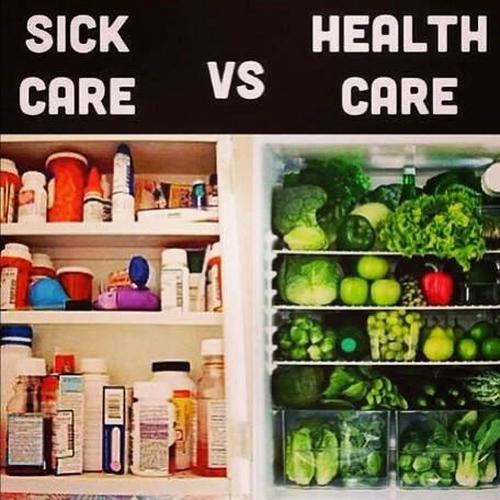
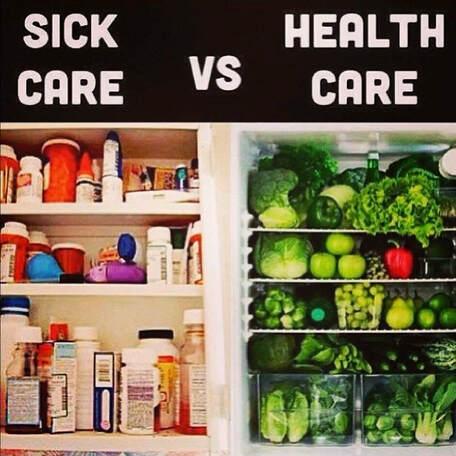
I call this maximizing profits by any means available system sickcare, for obvious reasons: this system profits by managing sickness, i.e. chronic diseases, rather than addressing the causes, which in most chronic disorders trace back to lifestyle: SAD (standard American diet), poor fitness and a generally unhealthy lifestyle of convenience (i.e. sedentary), heavy work/financial stress and addictions to meds, drugs, social media, etc.

Sickcare’s single-minded profiteering would be bad enough if we could afford its spiraling ever higher cost, but we cannot: as I noted way back in 2011, Sickcare Will Bankrupt the Nation all by itself. three years ago I noted that U.S. Healthcare Isn’t Broken–It’s Fixed (5/26/18), as generic meds that cost $22.60 for a month’s supply are pushed by Big Pharma as branded meds for $1,120 per month. Such a deal!

I’ve been discussing employment recently, and one of my patrons pointed out the enormously negative impact sickcare costs have on employment. I covered the incredibly negative impact of soaring sickcare insurance costs on small business back in 2011: Here’s Why Small Business Isn’t Hiring, and Won’t be Hiring (7/11/11), but the same soaring-costs dynamic makes Corporate America reluctant to hire anyone in America, too.

You’d have to be insane to pick America as your global base, given the grossly asymmetrical cost of healthcare in the U.S. compared to our developed-world competitors in Europe and East Asia (Japan and South Korea). Sadly, the treatment for your insanity will be so costly in America that your psychiatric problems will soon be exacerbated by financial ruin.

Those with heavily subsidized healthcare insurance may not realize that insurance for a family can cost more than a wage earner’s entire monthly net income. This generates a perverse incentive (from the perspective of a healthy economy, as opposed to a corrupt, rigged economy run for the exclusive benefit of profiteers, fraudsters, speculators and political fixers) for one spouse to quit their jobs or cut their hours to reduce the household income to the point that federal subsidies (ObamaCare) kick in and pay much or most of the insanely overpriced sickcare insurance tab.

The subsidies are of course ultimately paid by the taxpayers; sickcare profiteers thank you.

Needless to say, employers facing monthly healthcare insurance costs of $1,500 for an employee earning $2,500 will be looking for automation or overseas alternatives. How can the employer afford to keep paying healthcare insurance costs that spiral far above the Consumer Price Index (CPI)? Ultimately these higher costs come out of the employee’s paycheck, as employers could have given raises but instead had to fork over all the dough to the sickcare profiteers.

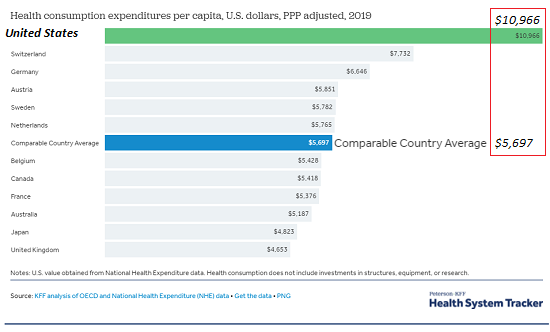
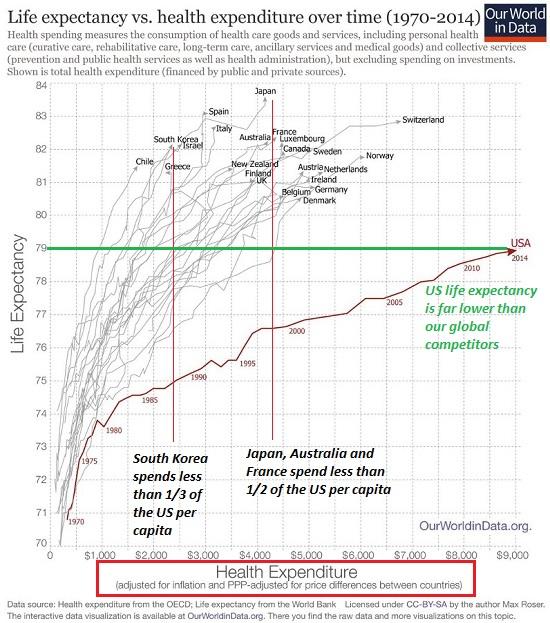
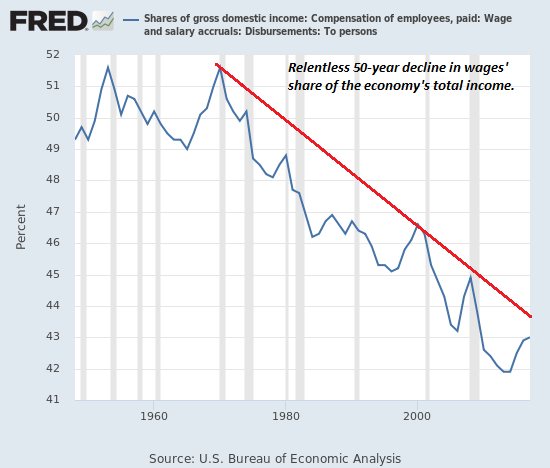
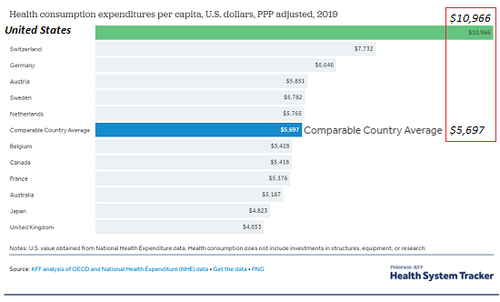
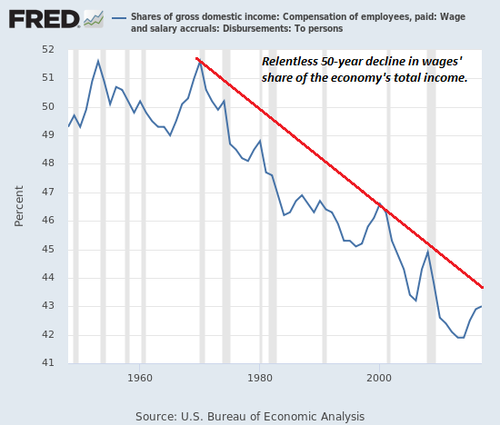
One driver of wages’ ever-declining share of the national income is trillions of dollars have been siphoned off by sickcare. As the comparison chart below shows, the U.S. pays roughly $5,000 more per capita (per person) per year for healthcare than other equally developed nations: the U.S. pays $10,966 per person per year and the average paid by other developed nations pay roughly half: $5,697 per person per year.

330 million Americans X $5,000 is $1.65 trillion a year. No wonder wages have gone nowhere for decades and corporations couldn’t wait to offshore jobs in America. (Not that the Corporate America needed much more of an incentive to offshore U.S. jobs, but let’s recognize that sickcare costs put American companies at a huge global disadvantage.)

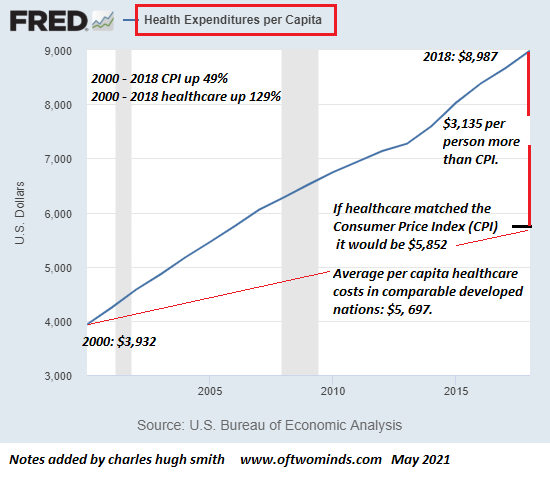
Please examine the chart below of healthcare expenses per capita (per person) in the U.S. from 2000 to 2018 (the last year available on the St. Louis Federal Reserve database). I’ve marked up the chart to indicate where healthcare costs per capita would be if healthcare had tracked the Consumer Price Index (CPI) for the past two decades.
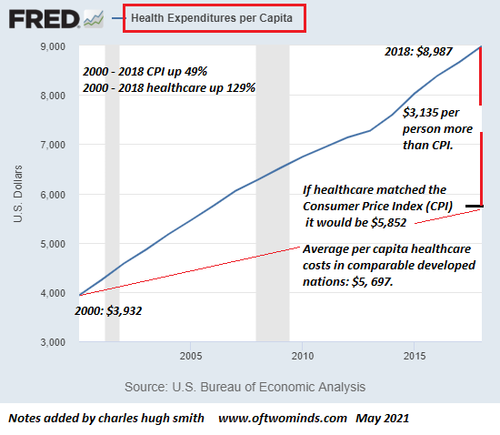
Strikingly, the cost had U.S. healthcare risen by the same percentage as everything else–$5,852 per capita per year–is very close to the average costs in comparable developed nations: $5,697 per capita per year. Instead, U.S. healthcare costs per person were $9,000 per year as of 2018.
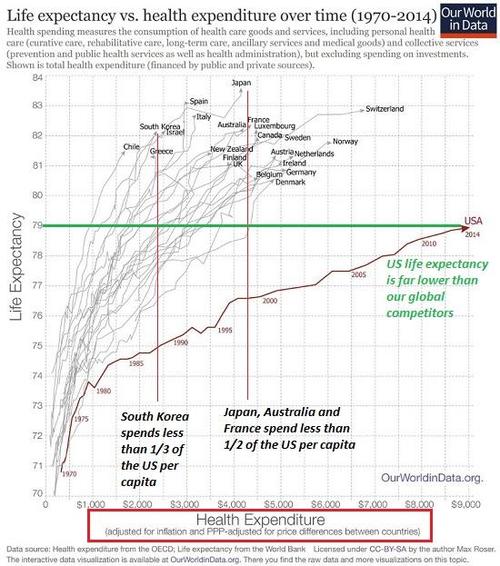
The third chart shows that the results of this asymmetric expenditure on health hasn’t done much in terms of life expectancy or other broad measures of national health and well-being. America is Number One in costs but far down the list of life expectancy and other measures of well-being.
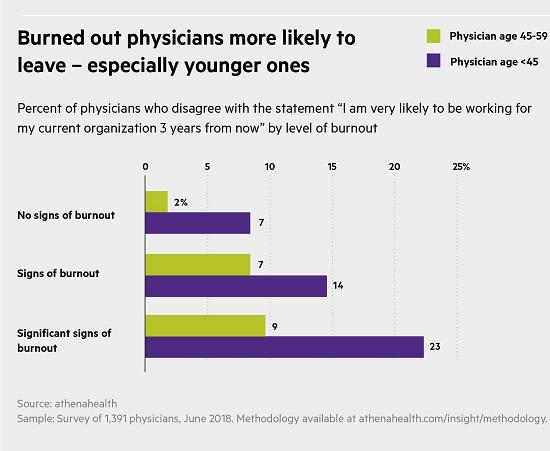
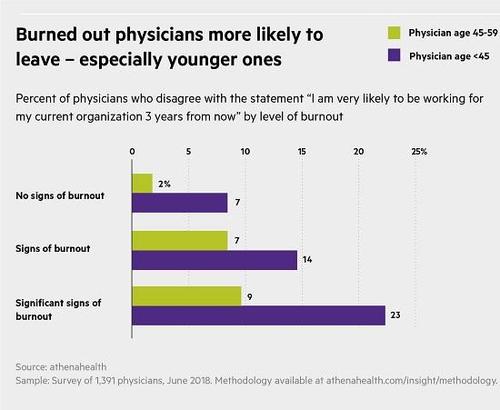
The human and financial costs of this sick system are pervasive. Those trying to provide care within the sickcare system’s perverse incentives are burning out (see last chart), and businesses are crushed by ever-higher costs for everything related to healthcare. The “solution” for employers is to push more of the insane cost increases onto employees, who are already staggering under the weight of stagnant wages and skyrocketing inflation in sectors other than healthcare.
Small business entrepreneurs end up not hiring any workers because they can’t afford to provide the mandated healthcare. Having to do all the work needed to keep the business afloat burns out the owners and they close the business, to the detriment of their community and the local government, which loses the tax revenues generated by the enterprise.

Here’s a real-world example of how healthcare has become unaffordable for employers: in the mid-1980s I could buy comprehensive healthcare insurance for my single employees (mostly young) for 6 hours’ pay for the average employee and 4 hours of my pay. (My partner and I paid all the healthcare insurance costs, the employees paid zero, I’m just using the hours and pay as a means of measuring the cost of healthcare in terms of the purchasing power of wages.)

Can an employer buy equivalent comprehensive healthcare insurance today for 6 hours’ of the employees’ pay? No, not even close. (Note that I’m talking about real insurance, not bogus simulacra of insurance, i.e. catastrophic coverage.)
Sickcare is a win for the sickcare profiteers and a loss for employers, employees, communities, government and the nation. Like cancer, sickcare will keep growing until it kills the host. We’re getting close.

Sickcare is the knife in the heart of employment. Sickcare puts the nation at a tremendous competitive disadvantage, crushes small businesses and generates perverse incentives to automate and offshore jobs just to get out from underneath the dead weight of ever-higher sickcare costs.

We need a whole new approach to healthcare that includes every aspect of American culture, society, education, economics and governance. We need to ditch SAD (standard American diet) and our unhealthy lifestyle, and incentivize improving health from the ground up rather than generating chronic lifestyle diseases such as metabolic disorders and then managing these disorders as a means of maximizing profits. The national goal should not be profiting from an over-medicated populace, it should be eliminating the need for medications. (A healthy person has no need for handfuls of medications.) Rather than profit from 74% of the populace being overweight and 40% being obese, the national goal should be to eliminate lifestyle diseases entirely by changing behaviors and incentives, not costly procedures and medications. That would free healthcare to serve those suffering from non-lifestyle diseases.

As Charlie Munger famously noted, “Show me the incentive and I will show you the outcome.” That’s how humans operate: we respond to the incentives presented, even if they diminish the health of the populace and bankrupt the nation. We need to change the incentives of the entire system, not just healthcare, but if we don’t start with healthcare, that financial cancer will drag us into national insolvency all by itself.

*  *  *

If you found value in this content, please join me in seeking solutions by becoming a $1/month patron of my work via patreon.com.

*  *  *

My recent books:

A Hacker’s Teleology: Sharing the Wealth of Our Shrinking Planet (Kindle $8.95, print $20, audiobook $17.46) Read the first section for free (PDF).

Will You Be Richer or Poorer?: Profit, Power, and AI in a Traumatized World (Kindle $5, print $10, audiobook) Read the first section for free (PDF).

Pathfinding our Destiny: Preventing the Final Fall of Our Democratic Republic ($5 (Kindle), $10 (print), ( audiobook): Read the first section for free (PDF).

The Adventures of the Consulting Philosopher: The Disappearance of Drake $1.29 (Kindle), $8.95 (print); read the first chapters for free (PDF)

Money and Work Unchained $6.95 (Kindle), $15 (print) Read the first section for free (PDF).

Tyler Durden
Tue, 05/18/2021 – 20:45

via ZeroHedge News https://ift.tt/3wfz1E1 Tyler Durden

Silicon Chip Shortage Leads To Potato Chip Shortage: Farmers Halt Equipment Shipments To Dealers

Silicon Chip Shortage Leads To Potato Chip Shortage: Farmers Halt Equipment Shipments To Dealers

Readers have been briefed on the ongoing semiconductor shortage that may last a “couple of years.” The auto industry has grabbed the spotlight as the hardest-hit industry, with some of the world’s biggest manufacturers restricting production. 

According to a new report, the worldwide chip shortage is impacting the agriculture industry that may last for a couple of years and has already impacted the price of potato chips.

Hoosier Ag Today reports, “The biggest factor impacting the ability of US farmers to produce the food we need has nothing to do with the weather, the markets, trade, regulations, or disease. The worldwide shortage of computer chips will impact all aspects of agriculture for the next two years and beyond… farm equipment manufacturers have halted shipments to dealers because they don’t have the chips to put in the equipment… not only have combine, planter, tillage, and tractor sales been impacted, but even ATV supplies are limited. Parts, even non-electric parts, are also in short supply because the manufacturers of those parts use the chips in the manufacturing process. As farmers integrate technology into all aspects of the farming process, these highly sophisticated semiconductors have become the backbone of almost every farming operation.” 

Rabobank’s Global Economics & Markets desk commented on the Hoosier Ag Today report and cautioned on the “technological wonders of a global economy based on just-in-time supplies of a few key inputs from only a few locations; and then demand surged due a virus that ran rampant through said global economy; and supply chains got snarled for that, and other reasons; and now a lack of silicon chips even impacts on the price of potato chips (in the US) and chips (in the UK).” 

The shortage has caused Reynolds Farm Equipment, one of Indiana’s largest John Deere dealers, to inform customers that order times are unknown at the moment because production for specific equipment has been disrupted because of the lack of chips. 

Bane Welker Equipment, which carries Case farm equipment and several other notable brands with dealerships in Indiana and Ohio, urged customers to plan ahead. The dealership warned customers that combine harvesters, planters, tillages, and tractor supplies have been limited because of the chip shortage. They even said ATV supplies are limited. All of this has severely dented sales for the dealership. 

Farmers have been rapidly integrating technology into the farming process for the last decade. Agricultural technology has enabled farmers to produce higher crop yields, decrease water, fertilizer, and pesticides, which keeps food prices down and saves the environment. Though as Rabobank described earlier when chips go missing the technological wonders of a global economy come crashing down. 

“In the U.S., we love our quick-fix solutions, which usually involve federal government bailouts. This time, however, that solution will not work to solve the shortage,” said Hoosier Ag Today. 

Intel’s CEO Pat Gelsinger has been the latest in a chorus of voices to warn about the ongoing semiconductor shortage that will last for a “couple of years.”

Gelsinger said U.S. dominance in the chip industry had dropped so much that only 12% of the world’s semiconductor manufacturing is made in the U.S., down from 37% about 25 years ago.

“And anybody who looks at supply chain says, ‘That’s a problem.’ This is a big, critical industry and we want more of it on American soil: the jobs that we want in America, the control of our long-term technology future,” he said.

Chip giant Taiwan Semiconductor Manufacturing Co. is also warning that the shortage will continue throughout this year and maybe extended into 2022. 

The worsening shortage is not just crushing the auto industry. It’s also spilling over into farming, where some farmers are unable to source new equipment. What this means is used farm equipment prices are about to skyrocket in price. 

Tyler Durden
Tue, 05/18/2021 – 20:25

via ZeroHedge News https://ift.tt/3wgfEuD Tyler Durden

BLM Founder Who Went On Property-Buying-Spree Complains About “White Supremacy” In Housing Market

BLM Founder Who Went On Property-Buying-Spree Complains About “White Supremacy” In Housing Market

Authored by Paul Joseph Watson via Summit News,

After going on a personal home buying spree, including one property located in one of the whitest areas of California, BLM co-founder Patrisse Khan-Cullors is now complaining about “white supremacy” in the housing market.

Cullors recently spent a total of $3.2 million on four homes, including a $1.4 million property in L.A.’s rustic and semi-remote Topanga Canyon, which has a black population of just 1.6 per cent.

Another of the homes, a “custom ranch” located in Georgia, is surrounded by “3.2 rural acres” and features a “private airplane hangar with a studio apartment above it” in addition to an indoor swimming pool.

Over the weekend, Cullors highlighted a story by NPR on the low rate of black home ownership in areas like Compton, which is 33% black.

“Thank you @npr for highlighting the history of racism inside of the housing market and why Black homeownership has always been a way to disrupt white supremacy,” wrote Cullors.

“Over the last 15 years, Black homeownership has declined more dramatically than for any other racial or ethnic group in the United States,” the NPR report states, adding that black homeownership in 2019 was as low as it was in the 60s.

However, for Cullors, who has generated significant wealth for herself grifting off of race baiting and divisive Black Lives Matter agitating, she has no such worries.

After her spending spree was revealed, the establishment went into full panic mode, with Facebook blocking links to a New York Post report about the issue and a black conservative activist being suspended by Twitter for highlighting the matter.

After an African-American BLM activist demanded an investigation into how the money was being spent, the national BLM organization threatened legal action before Cullors went on to claim that questions over her property buying spree were a “false and dangerous story” being pushed by “right wing forces” and “white supremacists.”

Cullors is a self-described “Marxist” who apparently thinks she’s the only one exempt when it comes to the sharing of private property.

BLM as a whole raked in a staggering $90 million dollars in donations last year alone, with the national organization being accused by local chapters of hiding “untold millions of dollars” while keeping the cash away from grassroots activists.

*  *  *

Brand new merch now available! Get it at https://www.pjwshop.com/

*  *  *

In the age of mass Silicon Valley censorship It is crucial that we stay in touch. I need you to sign up for my free newsletter here. Support my sponsor – Turbo Force – a supercharged boost of clean energy without the comedown. Also, I urgently need your financial support here.

Tyler Durden
Tue, 05/18/2021 – 20:05

via ZeroHedge News https://ift.tt/2S7bgiY Tyler Durden

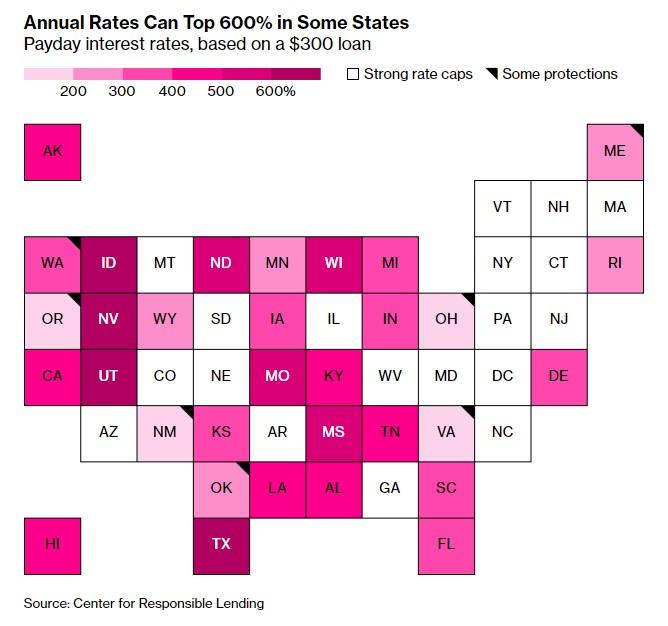
Predatory Lenders Charging Up To 589% Interest Posted Record Profits In 2020 Thanks To “Stimulus”

Predatory Lenders Charging Up To 589% Interest Posted Record Profits In 2020 Thanks To “Stimulus”

“I can’t even think about how much money I just paid in interest,” 44 year old Jamie Johnson said, thinking back to a payday loan he took out in April 2020.

His $5,000 loan – which eventually accrued interest at a clip of up to 589% annualized – was the topic of a new Bloomberg article on payday and predatory lending.

“It was just a big mess,” Johnson said, telling Bloomberg he used pandemic-relief unemployment insurance checks of $965 each week to hurriedly help pay back the debt for fear of being trapped in a neverending cycle of compounding interest and fees.

It’s stories like his that are the driving force behind payday and other high interest loan companies “emerging from the pandemic stronger than perhaps ever before”. The lenders raked in record earnings while Americans suffered during the pandemic. 

Lauren Saunders, associate director at the National Consumer Law Center, a non-profit that advocates for low-income borrowers, said: “Debt collectors had a big year, and so did predatory lenders. The idea that any company could keep charging 100% or 200% interest or more during this time of crisis is really outrageous.”

Additionally, studies have shown these types of loans are disproportionately targeted to black and Latino communities. In Michigan, where Johnson is from, “areas that are more than a quarter Black and Latino have 7.6 payday stores for every 100,000 people, or about 50% more than elsewhere,” the report notes.

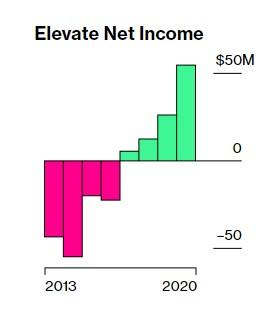
The irony is that it was the trillions in government stimulus that allowed these predatory companies to prosper. As we noted throughout 2020, many consumers used their stimulus to save and pay down debt. The New York Fed estimates about 33% of all cash received from stimulus checks was used to pay down debt. This equates directly to a boon for companies like Enova International Inc. and Elevate Credit Inc., who engage in these types of loans.

Moshe Orenbuch, an analyst at Credit Suisse Group AG, said: “Earnings were definitely higher than we would have expected because they benefited from an improvement in the credit environment. Consumers tended to pay back debt with funds they were given by the government.”

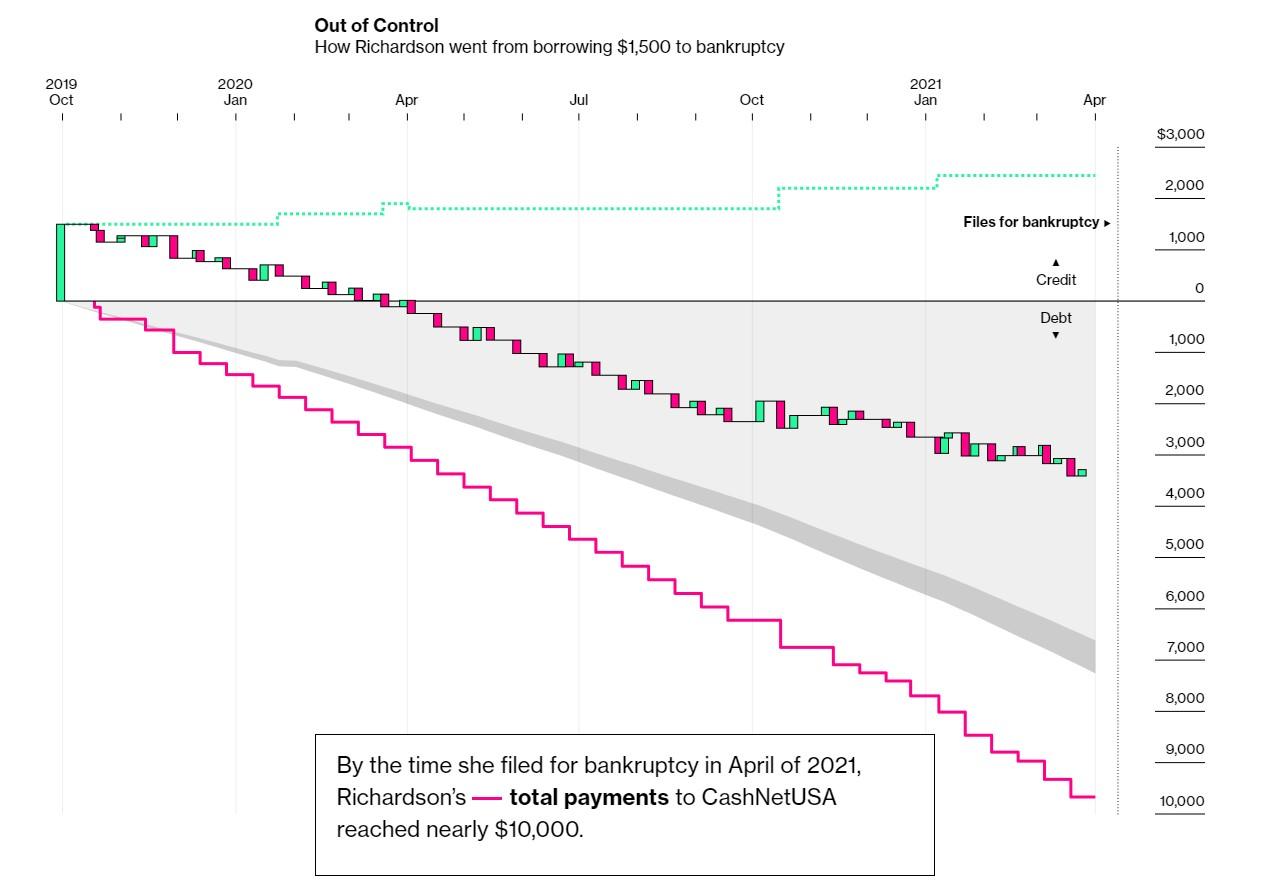
Kimberly Richardson found herself in an equally ugly scenario: she fell into a debt trap that caused her to go from borrowing $1,500 to bankruptcy. Interest on her $1,500 loan was accumulating at a rate of 276% and she was prompted by her loan provider to take additional borrowings under her credit line. She paid CashNetUSA more than $10,000 on the $1,500 loan and then filed for bankruptcy.

Elevate told Bloomberg “it is committed to serving those with non-prime credit scores who are locked out of traditional financial products.” Enova told Bloomberg “its policy is to provide customers with flexibility and to help them be successful with their loan.”

The kicker is that the National Consumer Law Center had urged Congress to cap these types of rates after Covid-19 was declared a pandemic. But just the opposite happened: in July 2020, the Consumer Financial Protection Bureau “repealed substantial portions of a 2017 rule that would have required lenders to determine consumers’ ability to repay loans.”

This rule could have wiped out as much as 68% of the industry’s revenue from payday loans.

Now, more than 12 states have caps limiting payday loans to 36% or less. Michigan and Tennessee remain excluded from this list, however.

And while there are some indications that the Biden administration may try to reverse course and regulate these loans further, the reality is that companies like Enova are once again licking their chops at a post-Covid boom.

Enova Chief Executive Officer David Fisher said on an April conference call: “As the economy opens back up, we believe that consumers will raise their spending potentially to elevated levels due to increased activity and pent-up demand. We saw the same dynamic following the financial crisis, which led to strong origination growth in 2010 and 2011.”

Tyler Durden
Tue, 05/18/2021 – 19:45

via ZeroHedge News https://ift.tt/2Rxmddv Tyler Durden

Lumber, Labor, & Gas Markets Tell SAD Stories

Lumber, Labor, & Gas Markets Tell SAD Stories

Authored by Art Carden via The American Institute for Economic Research,

The hits just keep coming. First, lumber prices exploded. Second, there was a terrible jobs report. Third, there was a gas shortage. These are all SAD stories–Supply And Demand. They are also, of course, stories about adaptation, adjustment, resilience, and unintended consequences.

First, consider the lumber market. As my AIER colleague Peter C. Earle points out, lumber prices at the beginning of May 2021 were about six-and-a-half times what they were at the beginning of April 2020. On the supply side of the lumber market, lockdowns have limited production. In August, the Financial Post reported that “A plague of tiny mountain pine beetles…has already destroyed 15 years of log supplies in British Columbia, enough trees to build 9 million single-family homes.” Good, old-fashioned protectionism is at play, as well, but the Wall Street Journal reports that tariffs and trade restrictions on Canadian lumber don’t play that large a role.

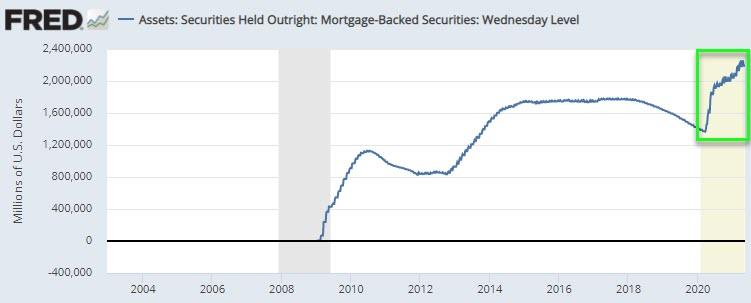
On the demand side, the US is in the middle of another housing and construction boom. Zillow is calling it “The Great Reshuffling” and reports that about 11% of Americans “have already moved during the pandemic.” My family is among them: we moved this past fall in search of more space, home office space in particular. Not long after moving, we added stairs to our back deck in no small part because we expect to be spending more of our time with friends outdoors. Moving, new building, and remodeling is being driven at least in part by low interest rates–we knocked our rate down from 3.75% to 2.49% when we moved–and, I suspect, aggressive Fed purchases of mortgage-backed securities during the pandemic. The Fed has added about $800 billion in mortgage-backed securities to their holdings since March 11, 2020:

It will be a while before people have done the empirical work that will untangle and measure the contributions of these different causes, but at a fundamental level, it’s a Supply And Demand story. The massive increase in lumber prices, of course, has some people worried, but as Thomas Sowell constantly reminds people, “There are no solutions. Only trade-offs.” People adjust to the new reality by making incremental substitutions that might not be terribly revolutionary or that might not be especially easy to see but that still reflect exactly how people respond to the signals they are getting from rising prices. High lumber prices say “Are you sure you need to do that project right now?” Sometimes, the answer is yes and other times the answer is no. We considered buying lumber and building a doghouse, but at current prices, we’re going to delay that project for a while.

Second, there is the labor market. The rhetorical battle is between people outraged by the laziness and moral failings of people who “don’t want to work anymore” and people outraged by the rapacity and callousness of people who expect others to go back to work for low wages. Maybe it is a sudden explosion of laziness. Maybe it is a sudden development of class consciousness that finally has us on the brink of Solidarity Forever.

Or maybe it’s a change in people’s incentives–specifically, the extension of high unemployment benefits. As David R. Henderson points out, “Paying people an extra $400 a week as long as they’re unemployed is a bad idea.” In a post for EconLog, Henderson notes that he got this wrong–”it’s ‘only’ $300,” but with these extra benefits, it shouldn’t be surprising that people aren’t jumping at employment opportunities. In his article on unemployment in the Concise Encyclopedia of Economics, Lawrence Summers explains:

“…government assistance programs contribute to long-term unemployment…by providing an incentive, and the means, not to work. Each unemployed person has a ‘reservation wage’–the minimum wage he or she insists on getting before accepting a job. Unemployment insurance and other social assistance programs increase that reservation wage, causing an unemployed person to remain unemployed longer.” 

Why? A sign at a local fast food place advertises starting wages of $11 per hour. That doesn’t sound like much, but two people each working 35 hours per week at that rate would have a household income of $40,040. That’s about 80% of the Alabama median household income of about $50,000 and well above the federal poverty guideline of $26,500 for a family of 4.

According to this unofficial unemployment benefits calculator, someone in Alabama who earned $20,020 by working in fast food would, upon becoming unemployed, be eligible for $193 per week in unemployment benefits for 20 weeks. If you add to that the additional $300 per week in the new stimulus bill, you get $493 per week. Is it any surprise that fewer people want to work 40 hours a week at $11 an hour when they could take home about $50 a week more than that by remaining unemployed?

Scott Sumner offers an interesting hypothesis: “Because millions of unemployed workers in low pay service sector jobs earn more on unemployment than they did on their previous jobs, and because most of those jobs are unpleasant, employment will likely remain quite depressed all summer, before bouncing back in the fall.” Alabama is ending the payments on June 19, but that’s still more than a month from this writing of reservation wages propped up by high unemployment benefits.

Third, a cyberattack shut down an oil pipeline. This led to panic buying at gas stations, a tweet from the US Consumer Product Safety Commission saying, “Do not fill plastic bags with gasoline,” the usual social media hand-wringing about people panic-buying gasoline and storing it stupidly, and, of course, the usual sabre-rattling about “price gouging,” which I’ve previously called “knowledge embargoes.”

Once again, supply and demand does the explanatory work–and if we had left the mechanism alone and let prices rise after the pipeline shutdown, we wouldn’t have had the mess we were in (or, it must be admitted, the entertaining memes). People who don’t pay attention to current events would get the message that they need to conserve gas pretty quickly, and we wouldn’t be dealing with shortages. It’s a minor inconvenience, but when your gas light comes on (as mine did the other day), it’s cold comfort to pull into a gas station and discover that there is no gas at $2.89 a gallon rather than some gas at $5 a gallon. A station across the street had gas, fortunately–but they had run out of premium (which I don’t need for my Toyota Corolla) and customers were limited to $20 purchases. As economists emphasize whenever price gouging rules kick in, ignoring what supply and demand analysis has to teach us usually means making the problem worse rather than better.

An apparently apocryphal curse says “May you live in interesting times.” Alas, we do. We needn’t be confused, however. I tell my students that I love economics because it gives me a simple set of tools that makes a lot of sense out of seemingly-disparate situations. Are we wondering what is going on with lumber? It’s a SAD story. Labor? Also a SAD story. Gas? Another SAD story made genuinely sad by politicians ignoring the story’s lesson. While I wish I could say “They’ll know better next time,” it saddens me to say “They won’t.”

Tyler Durden
Tue, 05/18/2021 – 19:25

via ZeroHedge News https://ift.tt/3osgcLj Tyler Durden

China Furious As Japan Refuses To Address Its Radioactive Fukushima Water Dumping Concerns

China Furious As Japan Refuses To Address Its Radioactive Fukushima Water Dumping Concerns

Angry that Japan has yet to respond directly to the concerns of the international community, China again urged Japan on Monday to face up to its responsibility and refrain from “wantonly” disposing the radioactive, polluted Fukushima water before reaching consensus with all stakeholders and international agencies through consultations.

China Foreign Ministry Spokesperson Zhao Lijian made the remarks at a daily news briefing when asked to comment on Seoul’s request to the International Maritime Organization (IMO) calling for exploring ways to cooperate with the UN nuclear watchdog to ensure safety in Japan’s planned release of Fukushima nuclear polluted water.

Tanks storing treated radioactive water on the premises of the Fukushima Daiichi nuclear power plant

Zhao expressed China’s understanding and support for the South Korean side’s actions, saying the international community as well as within Japan have expressed deep concern and opposition over the past month after Japan announced its decision.

And in the most harshly worded indication that China will not stand idly by as Tokyo releases 1 million tons of radioactive Fukushima water into the Pacific, Zhao said that “Regrettably, the Japanese government has turned a deaf ear to the protests from many governments, international organizations, environmental groups and people in various countries and has to date refused to respond directly to the concerns of the international community.”

He reiterated that Japan’s decision to dump the nuclear polluted water into the sea will endanger the global marine environment and international public health and safety.

The spokesperson stressed that Japan’s move lacks transparency and is irresponsible, adding that its attempts would only serve its own selfish gains while leaving the international community and future generations with endless problems.

Tyler Durden
Tue, 05/18/2021 – 19:05

via ZeroHedge News https://ift.tt/3hxFsOR Tyler Durden

PBS Journalist Implies That Ending Mask Mandates Is Racist

PBS Journalist Implies That Ending Mask Mandates Is Racist

Authored by Paul Joseph Watson via Summit News,

During a White House press briefing, a PBS journalist suggested that ending mask mandates was racist.

Yes, really.

Last week, the CDC disappointed face diaper extremists by lifting restrictions on mask wearing in numerous settings.

This prompted a massive backlash from those who have adopted the face covering as a kind of cult symbol, with a PBS journalist attempting to argue that not masking up will lead to the deaths of more black people.

“The CDC guidelines on masks is putting front line workers and especially people of color at risk and they’re calling for the CDC to reverse that, what’s the White House’s stance on…people of color (being) at risk,” said the journalist.

Leftists continue to be infuriated that mask mandates are ending because for the past year, they’ve been able to use them as a justification to ostracize and publicly shame conservatives, while the entire time claiming masks “aren’t political.”

Despite the CDC’s advice, authorities throughout liberal states are refusing to fully lift the mandates while zealots like AOC are insisting they will continue to mask up.

Meanwhile, two months after lifting its mask mandate, Texas recorded zero COVID deaths, the first time that has happened since data began to be collected.

Even after the pandemic ends, those who have cemented mask wearing as a signal of virtue, compliance and political obedience will fight tooth and nail to keep the mandates in place under any flimsy justification.

*  *  *

Brand new merch now available! Get it at https://www.pjwshop.com/

*  *  *

In the age of mass Silicon Valley censorship It is crucial that we stay in touch. I need you to sign up for my free newsletter here. Support my sponsor – Turbo Force – a supercharged boost of clean energy without the comedown. Also, I urgently need your financial support here.

Tyler Durden
Tue, 05/18/2021 – 18:45

via ZeroHedge News https://ift.tt/3wfveqr Tyler Durden

Steve Mnuchin Takes 21% Haircut On Selling His $25 Million Manhattan Co-Op

Steve Mnuchin Takes 21% Haircut On Selling His $25 Million Manhattan Co-Op

Not even being former Treasury Secretary of the United States can help your real estate appreciate in Manhattan right now, as Steven Mnuchin just found out the hard way.

Mnuchin just sold his Manhattan co-op for a “deep discount”, according to Bloomberg, reportedly suffering a 21% price reduction before finding a buyer for his duplex at 740 Park Ave. 

The five bedroom property was originally listed at $32.5 million in September of 2018 and finally just sold after being listed for $25.75 million. It marks the most expensive co-op to sell in Manhattan over the last 18 months. The final sale price will be recorded with the city in coming months. 

Co-ops like Mnuchin’s have been difficult to sell recently – not only because they are “old school” in the face of brand new high-end luxury condo skyrises – but also as many residents with deep pockets, including many businesses, have left New York in favor of red-leaning, tax friendly states, like Florida. 

Co-op owners get shares in a corporation that owns the building and don’t hold deeds to their specific units. Boards of the building can approve or deny buyers and have full say over all aspects of managing the building’s residents. 

Luxury condos have been “outselling co-ops nearly every year for a decade”, data from broker Olshan shows. Their data also shows that through April 25, 2021, there were 406 deals for condos listed at $4 million or more, compared to just 108 co-op purchases in the same category. 

And despite the “prestige” of 740 Park Ave., it hasn’t been spared from the trend. 

Tyler Durden
Tue, 05/18/2021 – 18:25

via ZeroHedge News https://ift.tt/3ykGe7K Tyler Durden