CNN ‘Medical Expert’ & CDC Suggest Americans’ “Freedoms” Be Restricted Until They Are Vaccinated

CNN ‘Medical Expert’ & CDC Suggest Americans’ “Freedoms” Be Restricted Until They Are Vaccinated

With nearly every state having opened vaccinations to all adults, the CDC on Friday announced the second loosening of certain federal guidelines by declaring that all Americans who are “fully vaccinated” – a status obtained two weeks after the second dose (for Moderna and Pfizer) or the one and only dose (for JNJ) can travel “at low risk to themselves” both with the US and abroad, and won’t need to be tested for COVID before boarding a plane.

However, the CDC advised that they should continue to take precautions like wearing a mask in public, avoiding crowds,  maintaining social distancing and washing one’s hands frequently.

While the press celebrated the advisory as a milestone in the road back to “normalcy”, some wondered whether the CDC got the memo about packed seats on airplanes and the virtually completely reopened Florida that’s attracting tourists from around the country.

While many Americans might not have realized it, the CDC has officially discouraged Americans from traveling – until now.

As more countries prepare to start using vaccine passports (airports have already been demanding proof of negative COVID status since last summer), the CDC said vaccinated Americans will not need a COVID test to travel anywhere, including another country (that is, unless they’re required to do so by authorities in their destination country).

While all this probably sounds promising, there’s a catch: vaccinated travelers still have to get a negative test result before boarding a flight back to the US, where they then must be tested against 3-5 days after returning home. This could create the potential for an explosion of false positives as some have linked to over-magnification on PCR tests used to detect the virus.

As we noted earlier, the CDC’s latest edict, just like its first one, is essentially “permission” to do something that millions of Americans are already doing. What’s wrong here? Did the CDC not get the memo that states are reopening already?

The answer can be found in a recent interview featuring Dr. Leana Wen, a former head of Planned Parenthood who served as a “medical expert” on CNN (just the facts, right people?).

She explained that the CDC’s only hope for convincing every adult American to get vaccinated is to withhold the “carrot” of freedoms from the people until they assent to being vaccinated.

Since the CDC wants everybody to continue observing social distancing guidelines like wearing masks and maintaining a safe distance, limiting their ability to travel and visit public places is really the only option. As Wen pointed out, the CDC needs to find ways to force people to get the vaccine now, or otherwise people “are going to go out and enjoy these freedoms anyway.”

“we need to make it clear to them that the vaccine is the ticket back to pre-pandemic life and the window to do that is really narrowing…” Wen added.

Put another way, while this latest message is couched as the CDC loosening restrictions on travel, what’s really happening is the government is giving private industry the green light to start barring travelers and customers who can’t prove their vaccination status. So instead of granting more freedom, they’re preparing to take freedoms away.

This latest announcement adds to the CDC’s previous guidance, released in March, allowing fully vaccinated people to visit with others in small groups in a private setting. We expect more declarations about the rights of the vaccinated vs. unvaccinated will be made in the near future.

Tyler Durden
Fri, 04/02/2021 – 16:10

via ZeroHedge News https://ift.tt/3rJarJ1 Tyler Durden

MLB Punishes Atlanta, Moves All-Star Game After Cancel Mob Targets Georgia Voting Law

MLB Punishes Atlanta, Moves All-Star Game After Cancel Mob Targets Georgia Voting Law

Major League Baseball has joined the woke backlash against a Georgia voting law which critics say ‘disenfranchises’ minorities through a series of measures designed to reduce election fraud.

“Over the last week, we have engaged in thoughtful conversations with Clubs, former and current players, the Players Association, and The Players Alliance, among others, to listen to their views,” MLB commissioner Rob Manfred said in a statement, per ESPN. “I have decided that the best way to demonstrate our values as a sport is by relocating this year’s All-Star Game and MLB Draft.”

So virtuous.

The league, essentially taking the hint from the White House, is based on a false narrative spread by the media – which was forced to issue corrections – when they misreported that the new voting law limits voting hours, when in fact it expands them.

And as Accuracy in Media‘s Ella Carroll-Smith notes:

Another common narrative surrounding the election law is that it is akin to old Jim Crow laws, but that’s hyperbolic and best and dangerous at worst. Yet news outlets including The Guardian, NBC News and Newsweek parroted these narratives without any sort of fact check or clarification. 

Calling the new Georgia voter law the “new Jim Crow” or Biden’s preferred language “Jim Crow on steroids” is not only misleading, but it undermines the significance of just how terrible Jim Crow laws really were. Requiring citizens to provide a form of ID to request an absentee ballot is not the same thing as a racial caste system that relegated Black Americans to the status of second-class citizens. 

People are required to provide ID in order to do all sorts of things in America. You must show ID to obtain a library card or fly on the plane, which makes Delta’s criticism of the bill somewhat ironic. Interestingly, CNN is also headquartered in Atlanta, but it remains to be seen whether activists will call to boycott them in protest. 

*  *  *

Earlier this week, 72 black executives were joined by the likes of Google, Apple, JPMorgan, Citigroup, BlackRock, Home Depot, Delta Airlines, Coca-Cola and others in opposing Georgia’s new voting law –  which they say will disproportionately impact black communities. Many of these virtue-signaling corporations were silent when the law was being considered or before Governor Brian Kemp (R) signed it into law on March 25, only to succumb to a Democrat-led pressure campaign against state GOP leaders.

Meanwhile, the MLB’s decision received pushback from Democratic Senator Jon Ossoff (GA), who told the Epoch Times: “I absolutely oppose and reject any notion of boycotting Georgia. Georgia welcomes business, investment, jobs, opportunity, and events.

“In fact, economic growth is driving much of the political progress we have seen here. Georgia welcomes the world’s business. Corporations disgusted like we are with the disgraceful Voter Suppression bill should stop any financial support to Georgia’s Republican Party, which is abusing its power to make it harder for Americans to vote,” he added.

And of course, sometimes there are unintended (?) consequences to unchecked wokeism. As PJ Media drives home:

Blacks make up 32.7 percent of the population of Atlanta — the largest black population of any major city – so it’s a mystery why MLB wants to move the All-Star Game from there. The tens of millions of dollars that would pour into the coffers of black businesses by Atlanta hosting the All-Star Game will now flow into the coffers of others.

The city of Atlanta would be a loser by moving the game. The people of Georgia would be losers. The only winners are those who want the game moved to prove a political point, no more.

Tyler Durden
Fri, 04/02/2021 – 15:44

via ZeroHedge News https://ift.tt/3rLXyOr Tyler Durden

GDP Hides The Damage From The COVID-19 Lockdowns

GDP Hides The Damage From The COVID-19 Lockdowns

Authored by Patrick Barron via The Mises Institute,

Do not believe government pronouncements that the economy is rebounding from very minimal damage caused by unprecedented covid-19-inspired closures of businesses. Government will use its favorite statistic of the health of the economy to justify its actions – gross domestic product (GDP).

GDP is supposed to represent the total of spending on final goods and services in the economy. It is a Keynesian term that elevates a concept called “aggregate demand” as most important. Not production and especially not savings. In fact Keynesians fear savings most of all. Now, you and I know that we can become wealthier only by saving some of our income and investing it wisely for the future. But Keynesians invented a concept called “the paradox of thrift,” whereby they claim that the economy enters a death spiral from reductions in spending caused by an increase in savings. Individually, savers may be better off, they say, but collectively the economy suffers. For example, the new auto that we savers do not buy, rather keeping our old one in good repair for a few more years, denies the automakers and all who work for them the money they need to continue production. Layoffs and plant closings ensue. The reduction in aggregate demand ripples outward, bankrupting more and more support businesses and their employees. This is the simplistic Keynesian view of savings.

But what happens to the money that we do not spend on as many new cars? Is it thrown down a rathole? No, of course not. It is invested in longer-term production processes that will yield even more wealth than if we had continued our former practice of buying new cars more often. Austrians call this phenomenon a change in the “structure of production.” We may produce few automobiles now, but later we’ll have access to products and services that would not have existed without our previous investment. We see this in our personal financial profiles. Our savings accounts increase at a compounding rate, allowing us to live a more comfortable existence later in life. This is the truth that used to be drilled into all of us before governments’ in-house economists propagandized that by being frugal we were denying our fellow citizens what was rightfully theirs: i.e., our money and our future. It’s nonsense.

But, you may ask, where does GDP enter the picture? Remember, aggregate demand is measured by spending on final goods and services, which becomes GDP. There are two critical problems with GDP. One, it does not capture a lot of spending on longer-term and intermediate-term production, but rather mostly retail sales. (For a quick explanation of how the government calculates GDP, listen to the twelve-minute narration of Mark Brandly’s Mises Wire article “Calculating GDP Correctly.” In his summary of key points, Brandly states that intermediate goods and services are not generally included in GDP unless added to inventories.) Headlines that retail sales are up are supposed to generate confidence that all is well with the economy. But is it? If you and I spent all our savings and even borrowed more, we would soon find ourselves in the poorhouse. But Keynesians would say that our individual financial difficulties were good for the economy. Anybody buying that? I certainly hope not!

GDP Captures Price Inflation and Calls It Economic Growth

But the biggest problem with GDP is the most obvious one—that GDP measures price increases, not increases in the production of real goods or services. For example, in the past month or so the price of a gallon of regular gasoline in my home state of Pennsylvania has gone up from just under $2.50 to around $3.00. That’s a 20 percent increase in price. Since gasoline consumption changes little in the short run, selling the same volume of gasoline at a higher price causes GDP to go up. But our standard of living just went down! Our increased dollar spending on the same amount of gasoline had to come from somewhere. We had to cut back somewhere else, either some other consumption item or, most likely, a reduction in savings. Whereas government says that the increase in GDP means that we are better off, actually we are worse off.

Increases in the Monetary Base and M2 Are Harbingers of Future Price Inflation

The best measure of long-term price inflation is not necessarily measuring retail prices in the short run but measuring the increase in the money supply over time. If the money supply increases, eventually this increase will work its way into the price structure. It can do nothing else. The two statistics that best measure the money supply are the “monetary base” and “M2.” The monetary base consists of all cash, wherever held, plus bank reserves held at the Federal Reserve Bank which may be converted into cash on demand by the banks. It is called the monetary base, because banks can create money out of thin air by pyramiding loans on top of their reserves at roughly a ten-to-one ratio. Just after the 2007/08 subprime-lending debacle the monetary base was $0.910 trillion. The Fed juiced the monetary base to bail out the banks, so that in January 2020, just prior to the covid-19 lockdowns, it stood at $3.443 trillion. That’s a 278 percent increase. After the covid-19 lockdowns the Fed juiced the monetary base again. Today it stands at $5.248 trillion, a further increase of 52 percent over the already inflated January 2020 level. And we haven’t seen the effect of the recently passed $1.9 trillion stimulus bill! Since this government helicopter money will be funded completely by money printing by the Fed—a process called “monetizing the debt”—the full amount will go directly into the monetary base as the checks are either cashed or deposited to the recipients’ bank accounts.

M2 is the broadest measure of the money supply that can be accessed by the public on demand. It comprises cash in the hands of the public (but not cash in bank vaults) plus money in checking and savings accounts. M2 has exhibited similar meteoric increases. M2 stood at $7.215 trillion in 2008, then was juiced to $15.419 trillion by January of last year. It now stands at $19.384 trillion. That’s a 169 percent increase, and tracks well with inflation in asset prices like stocks and housing. The $1.9 trillion third stimulus program will add dollar for dollar to M2 initially. If the banks pyramid more lending on top of this increase in their reserves, M2 will continue to grow beyond the $1.9 trillion. This is exactly what the government wants, because it will goose GDP.

The lesson is this – don’t be fooled by government statistics, especially GDP, that the economy is recovering nicely from the covid-19 lockdowns. The covid-19 lockdowns have caused immense damage to the economy. Government money printing may goose GDP, but It will do nothing to compensate for the deadweight loss that millions have suffered.

Tyler Durden
Fri, 04/02/2021 – 15:35

via ZeroHedge News https://ift.tt/2PMjMTf Tyler Durden

Trump Was Right: Sunlight Destroys COVID 8x Faster Than Scientists Believed, Study Shows

Trump Was Right: Sunlight Destroys COVID 8x Faster Than Scientists Believed, Study Shows

As it turns out, President Trump might have been on to something last spring when he rambled during a press conference about the possibility that “sunlight” could be leveraged to destroy the virus.

Research recently published by a team of academics at UC Santa Barbara found that the coronavirus is “inactivated” by sunlight as much as 8x faster than “current theoretical modelling” had anticipated. UC Santa Barbara assistant professor of mechanical engineering Paolo Luzzatto-Fegiz analyzed studies exploring the effects of different forms of UV radiation on SARS-CoV-2, and found a significant discrepancy, according to RT.

As with all electromagnetic radiation, UV falls on a spectrum. Longer-wave UVA reacts differently with parts of DNA and RNA than mid-range UV waves that are found in sunlight. These shorter-range waves can kill microbes and cause sunburns in humans. While short-wave UV radiation has been shown to deactivate viruses like SARS-CoV-2, light from this end of the spectrum is often deflected away from humanity by the Earth’s ozone lawyer.

But an analysis of various studies of how different types of UV light interacts with SARS-CoV-2 found that COVID should disintegrate even more quickly when exposed to summer sunlight, which features more short-wave radiation, one reason risk of contracting the virus outdoors during the summer is much, much lower than being indoors in the winter.

In practice, the team found that “inactivation” of virus particles rendered in simulated saliva was more than 8x faster than scientists believed in conditions similar to summer sunlight.

A July 2020 experimental study tested the power of UV light on SARS-CoV-2, contained in simulated saliva, and found the virus was inactivated in under 20 minutes.

However, a theory published a month later suggested sunlight could achieve the same effect, which didn’t quite add up. This second study concluded that SARS-CoV-2 was three times more sensitive to UV radiation in sunlight than the influenza A virus.

The vast majority of coronavirus particles were rendered inactive within 30 minutes of exposure to midday summer sunlight, whereas the virus could survive for days under winter sunlight.

“The experimentally observed inactivation in simulated saliva is over eight times faster than would have been expected from the theory,” Luzzatto-Feigiz and his team said. “So, scientists don’t yet know what’s going on.”

The UC Santa Barbara team hypothesized that the process that destroys the virus is similar to a process seen in wastewater treatment plants.

The team suspects that, as the UVC doesn’t reach the Earth, instead of directly attacking the RNA, the long-wave UVA in sunlight interacts with molecules in the virus’ environment, such as saliva, which speeds up the inactivation, in a process witnessed previously in wastewater treatment.

Their research suggests that an air filtration system equipped with certain types of UVA-emitters could dramatically reduce the spread of viral particles indoors.

For some reason, all this research about the effects of sunlight on the virus has been ignored by governments like the Spanish government, which recently ordered masks to be worn outdoors, something the country’s hospitality industry fears will destroy more already-embattled businesses while contributing nothing to the public safety effort. But maybe soon that will change.


Tyler Durden
Fri, 04/02/2021 – 15:10

via ZeroHedge News https://ift.tt/39Um1LF Tyler Durden

Caught Between A “Roaring ’20s” Rock & A “Liquidity Crisis” Hard-Place

Caught Between A “Roaring ’20s” Rock & A “Liquidity Crisis” Hard-Place

Authored by Kevin Smith and Tavi Costa via Crescat Capital,

Two diverging schools of macro thoughts are prevalent today. One calls for a “Roaring 20s” redux while the other believes in a forthcoming liquidity crisis. Both narratives have valid points and flaws. To be clear, we find ourselves right in between the two. Let us elaborate.

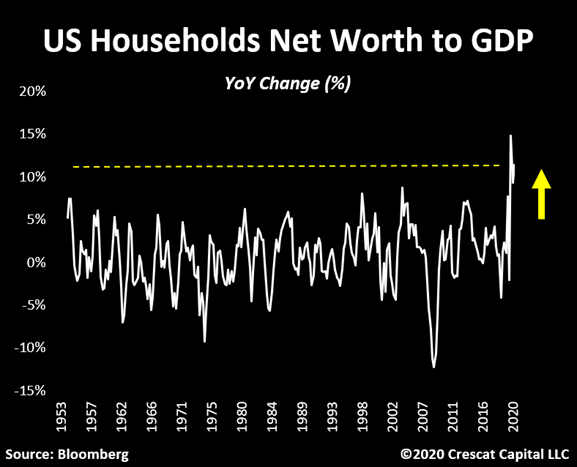
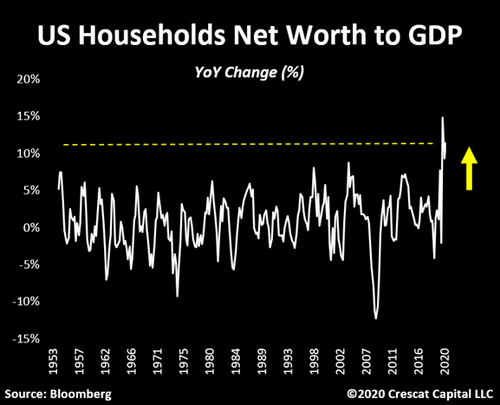
The central argument of the reflationary thesis is that a pent-up demand from consumers will likely cause explosive growth in the economy similar to the early 1920s. To be fair, financial conditions for US households have significantly improved. As shown in the chart below, their net worth is rising at the fastest pace since 1953, which also includes the largest wealth increase by the bottom 50% in history. Balance sheets also look the healthiest in a decade with the consumer deleveraging considerably, while savings rate remains elevate. This also means there is plenty cash on the sidelines. However, while we believe there is a strong probability that the re-opening of the economy will boost personal spending considerably, that is just one part of the story. By effectively creating the largest wealth transfer ever to the population, the US government now faces its own debt conundrum. The debt imbalances that restrain long-term economic growth were never resolved. Instead, they were transferred from the private sector to the government. In the wake of the pandemic, overall US debt to GDP has soared to record levels at the same time as the stock and credit markets have soared to new extremes. These are not the preconditions for a healthy reflationary environment nor the typical signs of an economy in the early stages of its business cycle.
We have yet to see a major reckoning for financial markets with asset valuations at record levels across virtually all asset classes aside from commodities. This brings us to the opposing bearish narrative. The dollar bull ‘deflationistas’, as they like to be called, have some important points to consider. Throughout history, speculative bubbles have always ended with brutal financial resets. Also, the dynamics behind “QE” are much more complex than the idea that money printing must always lead to higher consumer prices. In a deflationary reset, the debt burden tends to suck the liquidity out of the financial system causing a stock market crash, rising unemployment, and depressed consumer prices while money velocity collapses.

However, what we believe most, and what the deflationary camp fails to comprehend today, is that the economic and social impact of the current fiscal and monetary policies are completely different than what we experienced coming out of the last recession, which indeed was a deflationary one. From 2008 to 2011, the lower classes lost over 84% of their wealth, a clear deflationary backdrop. Since this time, on the other hand, the US bottom 50% just had its largest annual increase in net worth in history. Such is a force that would be hard not to have inflationary repercussions. Ultimately, a deflationary bust is a risk if one believes policy makers will undershoot their stimulus. Clearly, given the level of commitment and size of the monetary and fiscal policies, we believe overshooting is a much greater probability. We clearly have a ‘money party’ going on and no one can afford it to stop, especially the Fed.

Today’s deflationary debt imbalances are being met with a truly unprecedented inflationary response. So, how do we bridge the reflation and deflation narratives to find the appropriate middle ground? It is called the inflation camp. Yes, it is a bear camp, but it is not a deflationary one for consumer prices. It is important to point out that world history is full of inflationary financial market meltdowns as a consequence of too much debt. These include both hyperinflationary and stagflationary episodes where both stock and bond markets decline simultaneously, particularly when outright debt monetization is involved like we effectively have today. It is not all doom and gloom. We are bulls too. Bulls on commodities and basic resource stocks. We are raging bulls on precious metals exploration companies.

The combined stock and bond market is a speculative bubble and has been more than fully reflated already during the Covid-19 economic shutdown. As a result, the creative destruction process that we normally see at the depths of a business cycle, especially for traditionally cyclical companies, never happened. In 2020, we witnessed the first ever recession where stock prices soared. Without the economic purging that normally takes place in an economic downturn, the idea that we are poised for a robust and sustainable recovery is highly suspect. In terms of portfolio positioning, what is the logical way to be exposed? It comes down to our primary macro call: long commodities and short equities, but especially long precious metals.
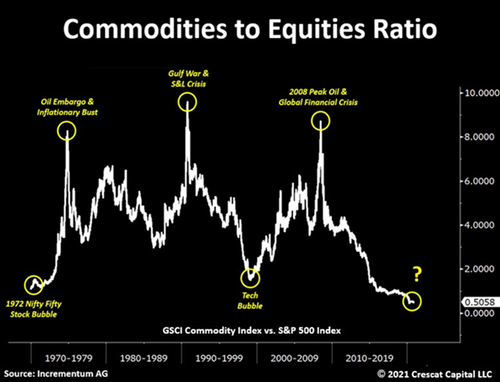
The short equity side of our portfolio can also perform well in a deflationary environment in case the Fed decides to tighten as the economy heats up. That was essentially the trigger of the last two recessions. We think the probability of this scenario happening again is significantly smaller. In terms of long commodities, we favor precious metals because they can work in both deflationary and inflationary environments, though they perform best under inflation when real interest rates are falling. In terms of the short equity side, we prefer overvalued large cap growth and technology stocks, the darlings of the last cycle, but also overvalued and overindebted zombie cyclicals that were not properly disassembled in the recession and do not represent value at all.

The need for extreme fiscal spending to mask the impairments in the economy entails a flood of Treasury issuances. With no sufficient buyers, the Fed must step in by expanding the monetary base to ensure subdued interest rates and allow the government to finance its debt and continue its wealth transfer and spending spree. This new demand is met with scarce supply due to underinvestment in the basic commodity resources of the forgotten old economy. Rising prices for food, energy, lumber, metals, etc. lead to cost push inflation throughout the supply chain. Some investors may be interpreting this macro dynamic as a healthy reflationary recovery. We believe there is a much greater probability that the economy is entering a disruptive long-term inflationary cycle.

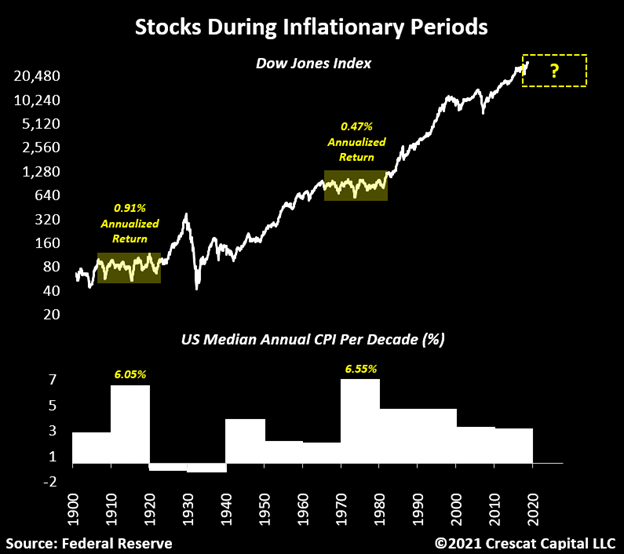
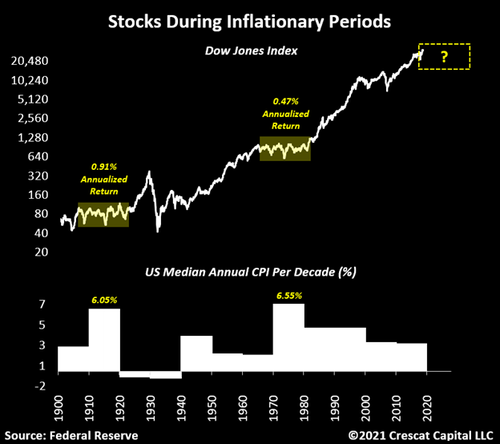
Since 1900, the US economy had two important inflationary periods, the 1910s and 1970s. Both times were marked by unique macro and geopolitical developments in which the median monthly YoY Consumer Prices Index (CPI) stood above 6% for an entire decade. The 1940s also had some sporadic spikes in CPI but, different than what most like to think, consumer prices did not consistently persist at high levels for the full 10-years. These inflationary periods were also marked by exceptionally low US equity returns. From January 1910 to December 1919, the Dow Jones had delivered a 0.91% annualized return. Similarly, from 1970 to 1980 stocks delivered a 0.47% annualized return. Considering the CPI index rates, real returns were negative for both decades. These were also very volatile periods accompanied by severe market crashes and major monetary developments. In December of 1913, President Woodrow Wilson signed the Federal Reserve Act into law. President Richard Nixon announced the end the dollar convertibility to gold in August 1971. With today’s mix of QE to infinity, “helicopter money”, 0% short-term interest rates, and World War II sized deficits, our base case is that this is the dawn of another long-term inflationary cycle. To recall, even though equities did not perform as well during the 10s and 70s, commodities did exceptionally well.
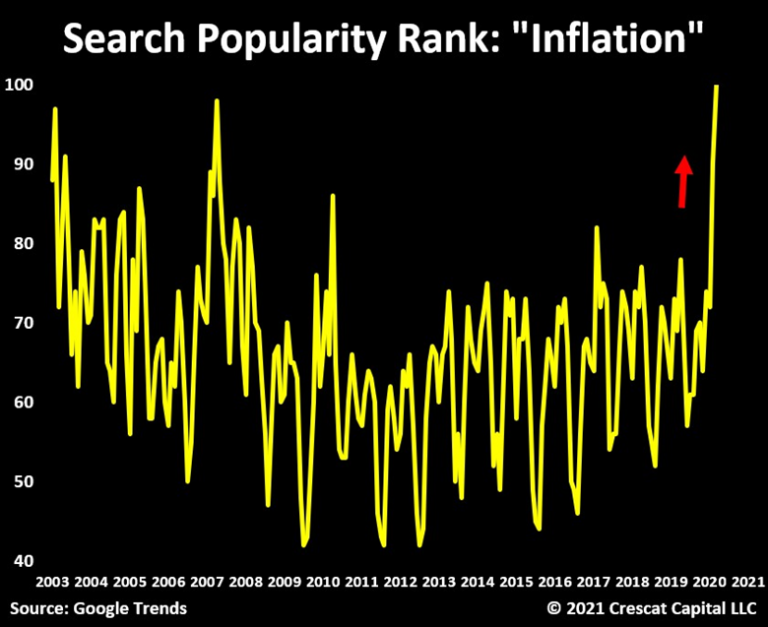
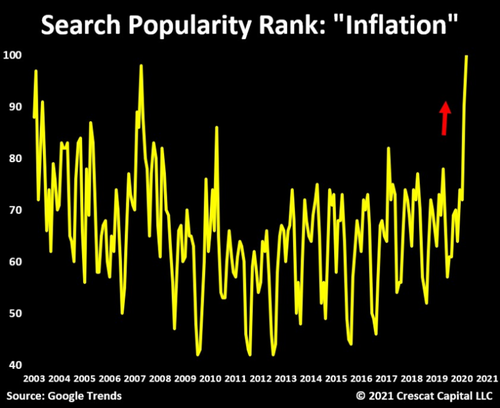
The popularity of the word “inflation” in Google searches has recently spiked to all-time highs as the monetary debasement narrative continues to gain momentum. While this surge may seem overextended, long-term inflationary cycles are often initiated by a general concern of the population in holding cash. By hoarding hard assets, investors create a self-reinforcing loop where higher prices of tangible assets lead to higher inflation expectations that then result in higher consumer good and service prices. Given the magnitude of the asset bubbles and debt imbalances in the economy today, we believe the Fed and the government will be forced to keep their aggressive stimulative policies in place for longer while being tolerant of an inflation overshoot.
A “Transitory” 13-Year High

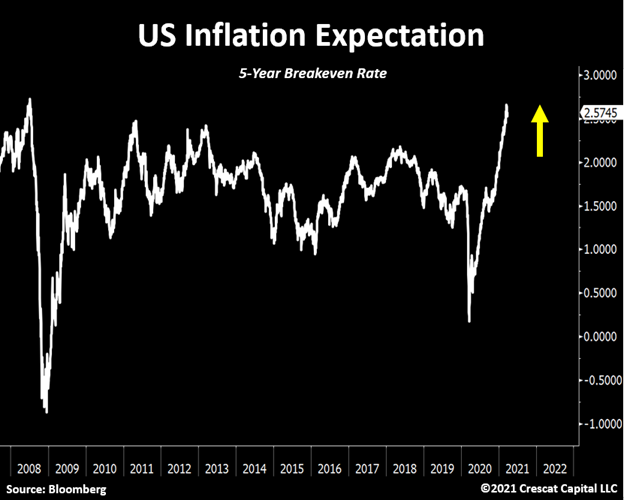
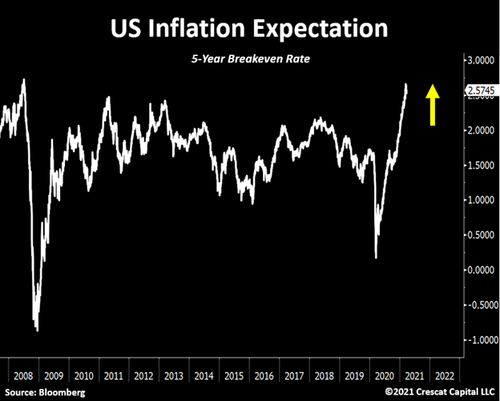
The Fed’s policy tools were originally designed to control money supply at times when economic conditions were either accelerating or decelerating. Today’s 5-year inflation expectation is reaching a 13-year high, but every monetary and fiscal policy in place is still pedal to the metal. M2 money supply just expanded by half a trillion in the last 8 weeks, the largest 2-month increase since June. The Fed’s QE pace is picking up significantly, now close to $300 billion worth of Treasury and mortgage-backed security in the last 2 months. The Fed Funds Rate also looks the same. As Jerome Powell likes to say, “We’re not even thinking about thinking about raising rates”. Fiscal spending, lastly, is even more radical with government deficits just reaching their worst level in 70-years. On the other hand, the overarching message from policy makers is essentially: Move along, nothing to see here. Sure, inflation is coming. We welcome it. But do not worry. It is just “transitory”.

It is true that central banks were able to get away with extreme stimulative packages without creating rising prices for most goods and services after the global financial crisis. We saw some inflation in medical costs, college tuitions, and other living expenses, but it was nothing close to what we experienced in a true inflationary period like the decade of the 1970s. In the easy money post the global financial crisis, inflation found its way into the domain of financial assets. Instead of a surge in consumer prices, aggressive monetary stimulus drove speculative asset bubbles in stocks and bonds. Now, in the Covid-19 recession and recovery, policy makers have added massive fiscal stimulus and direct wealth transfer (aka helicopter money) to the equation, or full modern monetary theory, creating a markedly different social and economic dynamic. We believe the stage is set for a substantial new inflationary cycle.
QE Re-accelerating

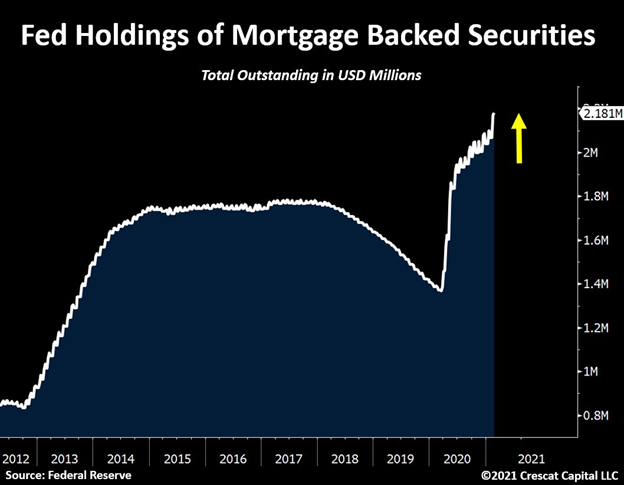
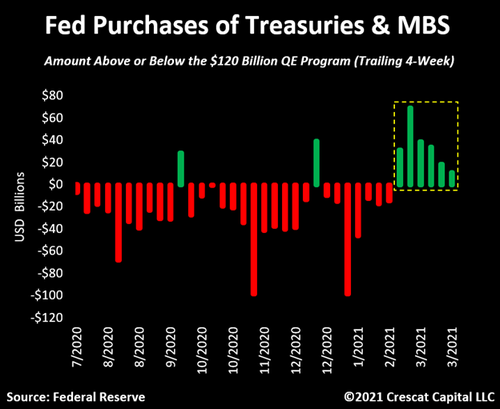
US 10-year yields have increased by 70 basis points in the last two months and the Fed had to engage in its largest buying spree of US debt since June 2020. For the sixth week straight, the Fed exceeded its minimum QE program amount of 120 billion, which consists of $80 billion of Treasuries plus $40 billion of mortgage-backed securities. Keep in mind that 90% of all Treasury purchases were longer duration Treasuries, mainly 5 to 7-year maturities. In other words, a non-trumpeted attempt at yield curve control (YCC) has already been underway. However, this stealth attempt has not been successful so far in preventing long dated yields from rising, therefore illustrating the liquidity sucking force of the massive debt pile and its thirst for more and more QE.
A House of Cards

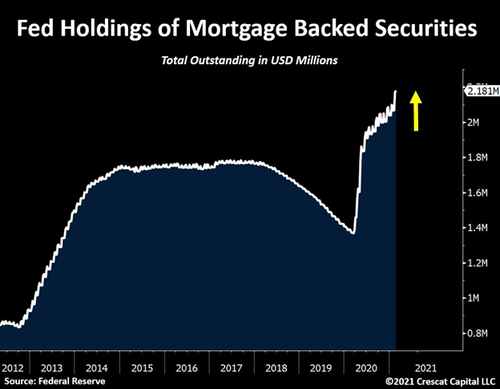
Central banks are as trapped as they can be. Since the beginning of the year, 10-year yields have moved from 1.6 to 2.4% and, therefore, creating significant pressure on mortgage rates to rise. To tamp down these forces, the Fed also had to increase its purchases of mortgage-backed securities (MBS). It has bought over $60 billion of MBS since February. If long-term interest rates continue to rise, the housing market could come under pressure. Remember, the bottom 50% own over 51% of their overall assets in real estate. It is critical for the Fed to suppress rates and prop up the housing market.
Tax Payers on the Hook

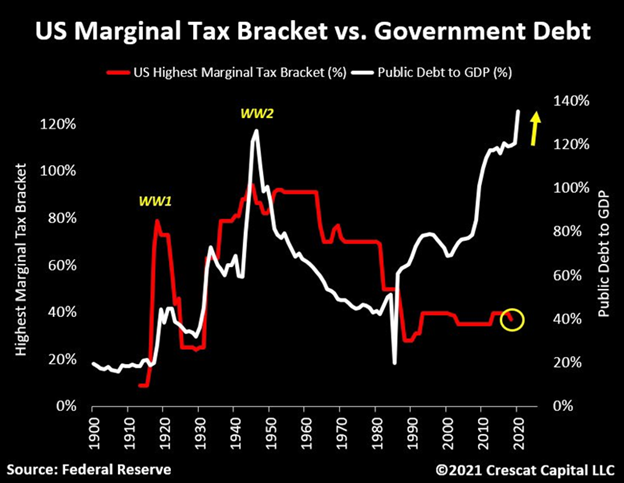
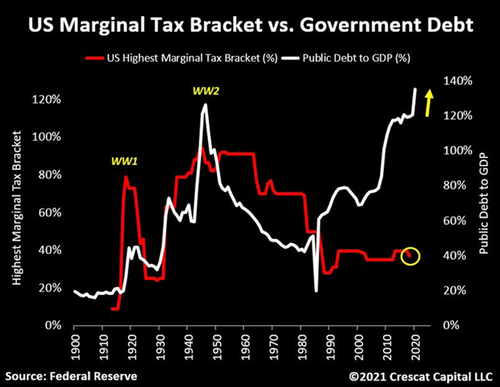
This is perhaps one of the most important charts today. Tax rates have followed government debt almost perfectly throughout history. Fiscal excess leads to higher income taxes, like it or not. The divergence between the two lines below is unsustainable. The Fed will not be able to pay for this wall of debt alone. Individual and corporate tax rates will rise. But because new tax legislation is not official yet, most Wall Street analysts have not factored it into their earnings estimates, leaving them too optimistic.
Another Disconnect

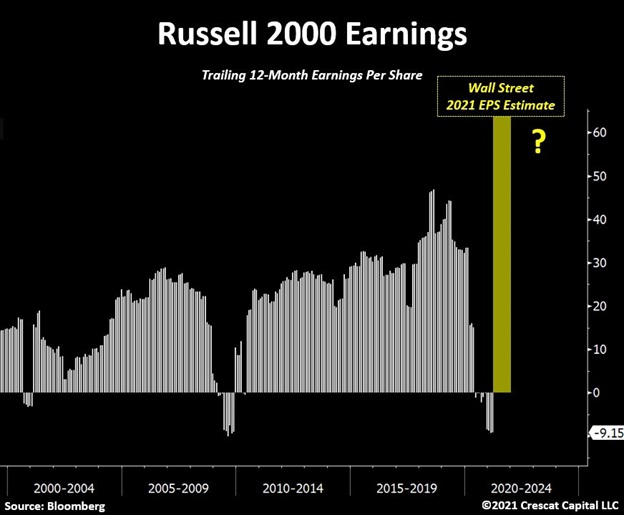
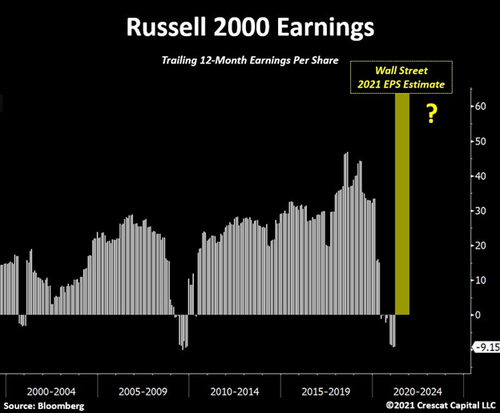
There is a high probability that the same disconnect between financial markets and the economy we had last year might redevelop in 2021. However, instead, the roles will likely be reversed. We believe most of the good news about the reopening of the economy is already priced in. Wall Street analysts are now estimating that small cap earnings for 2021 will be almost 40% higher than the previous highs in 2018. This level of optimism perfectly reflects the euphoric environment we are in.
The Great Rotation

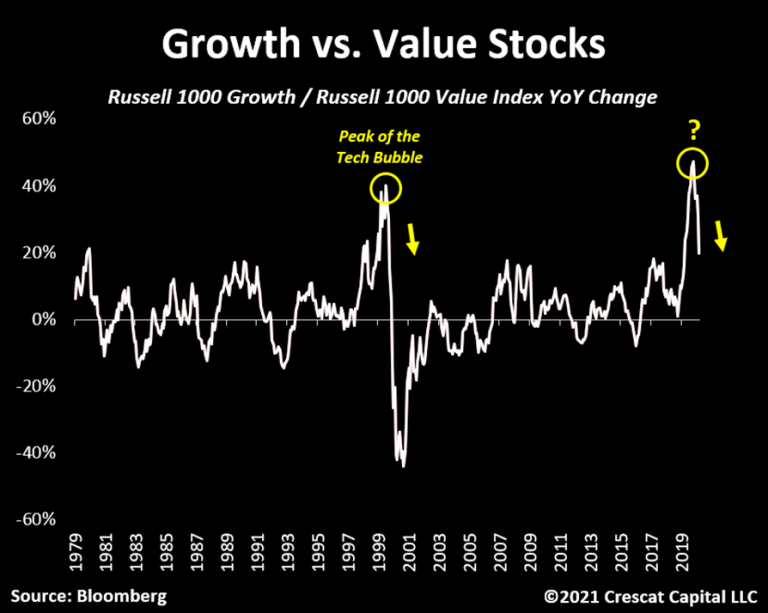
A major shift away from growth stocks and into value stocks is underway. In a similar fashion, the same underperformance of high-flying large cap growth and tech stocks relative to value stocks marked the beginning of the tech bust from 2000-02 which turned into a major economic downturn and overall crash for stocks at large.
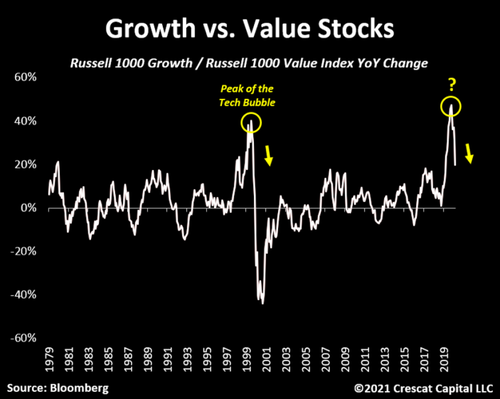
According to our models, the entire universe of stocks is more overvalued than it was at the height of the tech bubble. The area of true value today is narrow and much more likely to be found in the commodities, energy and materials sectors of the stock market. What we call “The Great Rotation” is about financial asset bubbles that have progressively built up for four decades finally being reconciled in reflexively self-reinforcing inflation. The US equity and fixed income markets have experienced an unsustainable four straight decades of declining interest rates and inflation. In this span, we have had five economic expansions and recessions with ever greater overall debt to GDP persistently growing throughout to the point we are perversely exiting this latest recession with the highest debt and largest valuation imbalances yet.

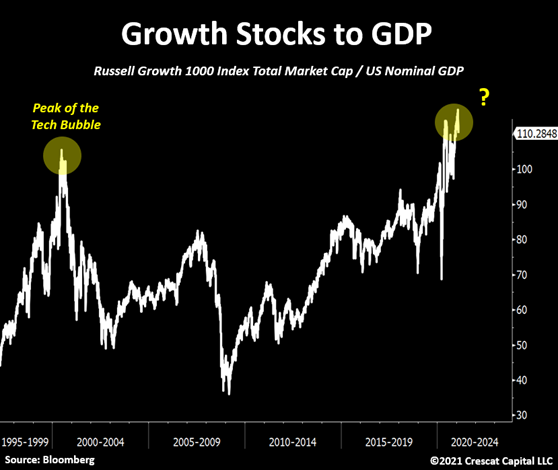
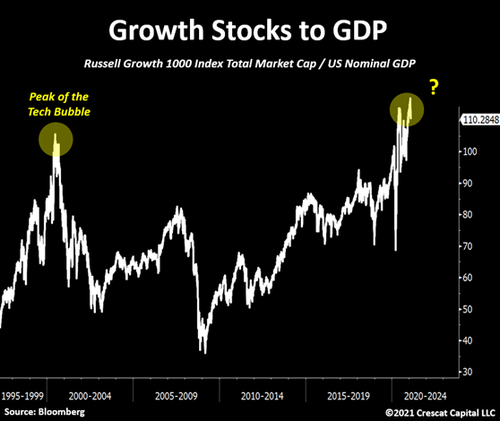
Growth stocks, composed by 45% of tech companies, represent a larger part of financial markets today than any other time in history. The total market cap for the Russell Growth 1000 Index relative to US nominal GDP is now at 110%, which compares with 105% at the very peak of the tech bubble.
More Signs of a Top

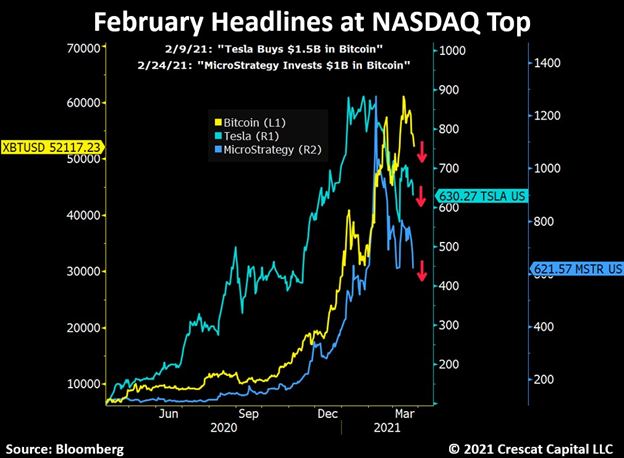
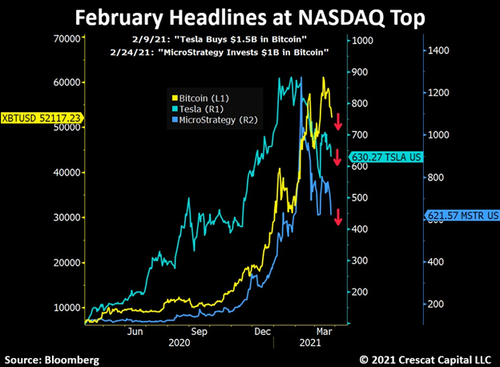
Last year’s darlings are now under pressure. Look at the headlines surrounding the recent peak in the NASDAQ 100 and NADSAQ Composite. We don’t think the bitcoin will ever replace gold as a central bank reserve asset. Crypto enthusiasts have some valid macro agruments against fiat currencies that we share. However, we also believe that speculation in the crypto space is excessive and creating additional risks in the financial markets today.
Late Stages of the Business Cycle

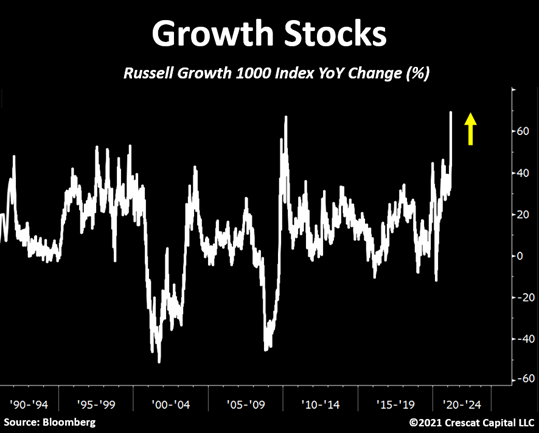
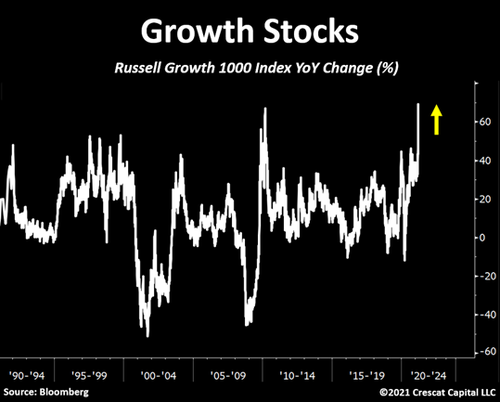
Here is another example of the level of speculative excesses in the market. Growth stocks just had their strongest year-over-year appreciation in history. Such large moves tend to happen at either the early or the late stages of the business cycle. Valuation factors should serve as a guide when trying to identify which one of these two parts of the cycle we are in. Given the fact that the Russell Growth 1000 Index currently trades at 30 times its aggregate earnings estimate for 2022, we think it is more probable that equity markets are much closer to the peak than the bottom.
A Looming Public Debt Crisis

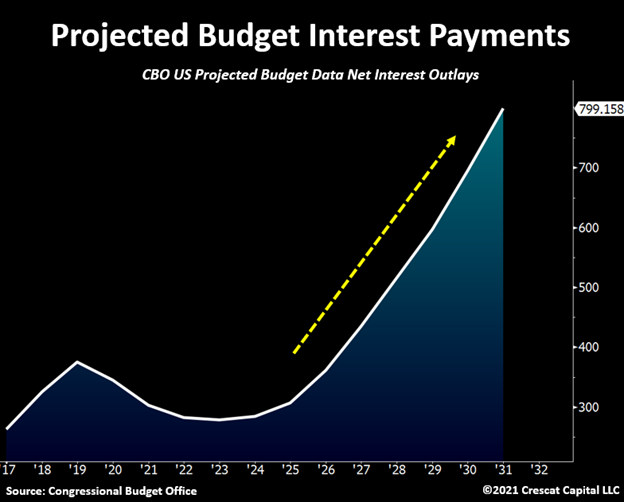
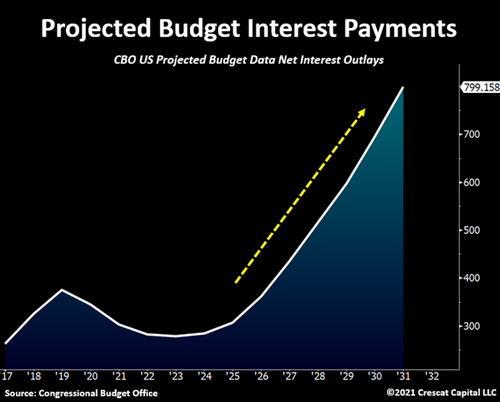
The government also recently increased its spending pace significantly. In January and February alone, it spent over $1.1 trillion, or the largest two-month amount since July. In comparison, it collected less than 60% of that amount in taxes. Long story short, public debt continues to grow at an unprecedented pace. Meanwhile, the Congressional Budget Office (CBO) projects that the Federal budget net interest expense will soar by $800 billion per year over the next decade. To clarify, the CBO’s estimate does not factor in another economic downturn along the way. We believe the estimate will fall short. The rising Treasury debt burden and deficits are necessarily forcing the Fed into the position of debt monetization which drives real interest rates lower and lower in negative territory and allows the Treasury to effectively collect an inflation tax. Systematic tamping down of the CPI plays a role given our government’s enormous off balance sheet Social Security and Medicare liabilities which are cost-of-living adjusted. 
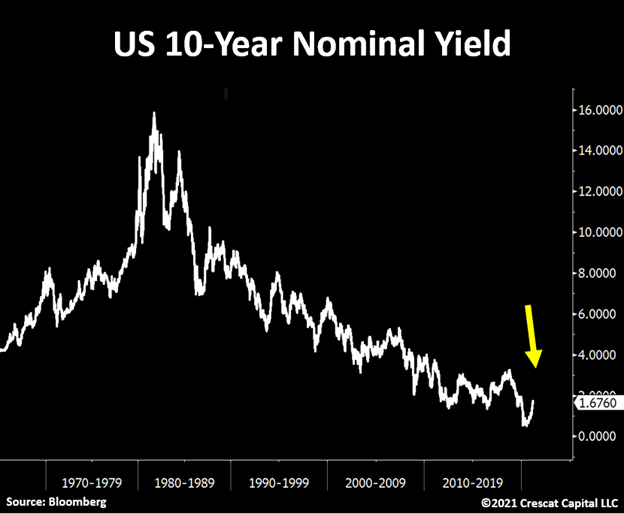
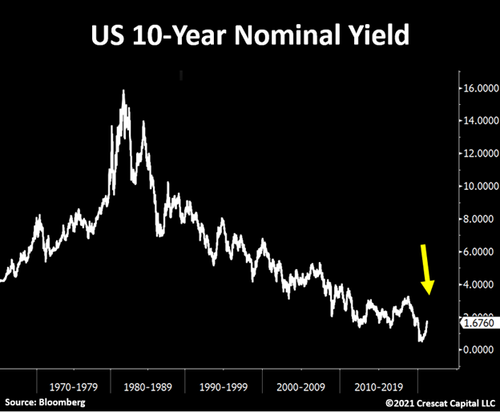
With the recent increase in long-term interest rates, financial conditions tightened slightly from a record loose state. Stocks, at historic valuations, suffered as a result. Nominal rates moved even higher than the move up in inflation expectations, causing real rates to rise slightly which added short term pressure on gold. In our view, the fact that financial markets are being impacted by 10-year yield that is still sub 2% speaks volumes about the fragility of the US economy.
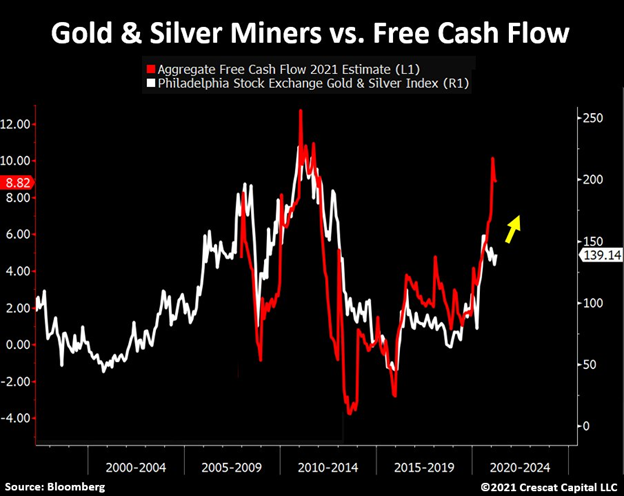
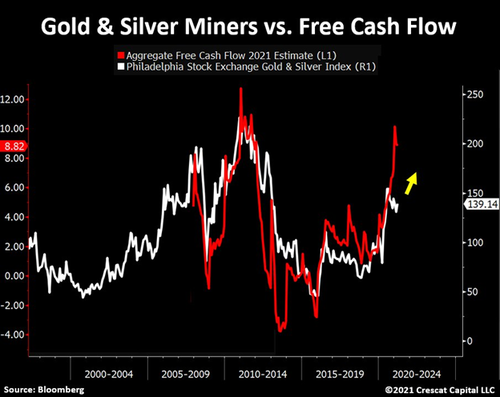
Miner’s Free-Cash-Flow on the Rise

Gold and silver companies continue to report exceptionally strong fundamentals. Free-cash-flow estimate for miners keeps improving despite the recent correction in precious metals. As we have seen throughout history, stocks tend to follow fundamental growth. We believe there is a major catch up in prices ahead of us.
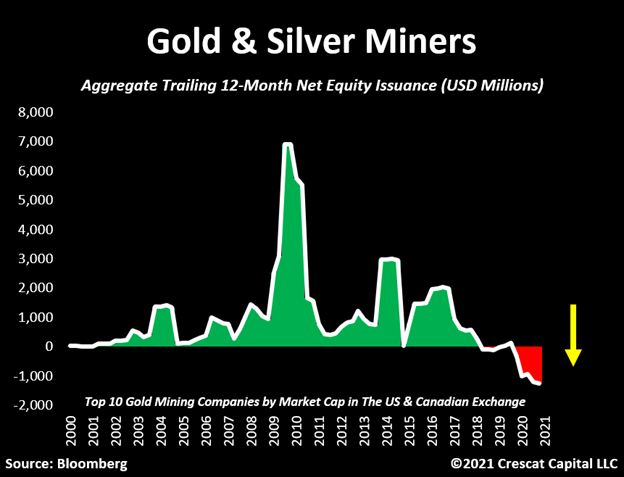
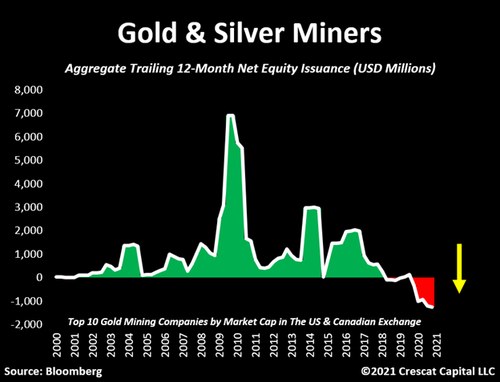
There used to be a time when all gold and silver miners would do was to invest in unproductive assets and dilute their capital structure to pay for it. Those days are over. For the first time in history, aggregate net equity issuance for the top 10 precious metals mining companies is now falling. In other words, these companies are buying back stock like we have never seen before. These are fundamentally cheap stocks that continue to benefit from this macro environment.
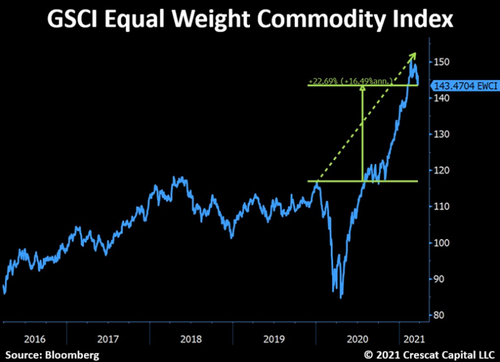
Commodity Inflation

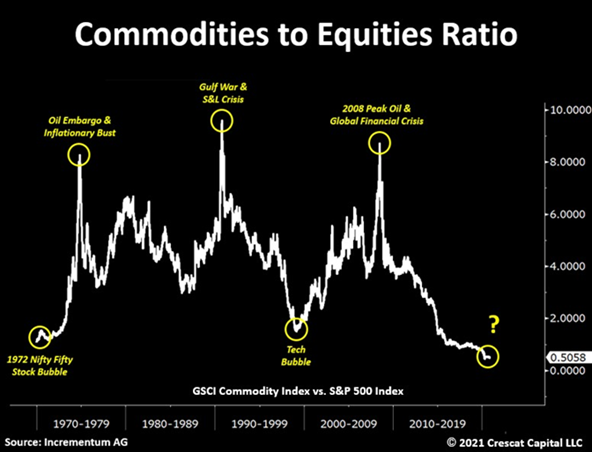
Inflation is coming. Cost-push inflation starts with rising commodity prices. An equal weighted commodity basket is already up 23% from pre Covid-19 highs. Imagine what it will look like when the economy re-opens.
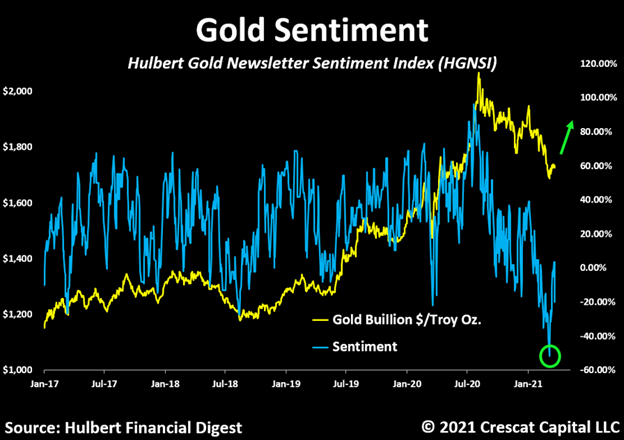
Gold Sentiment Buy Signal

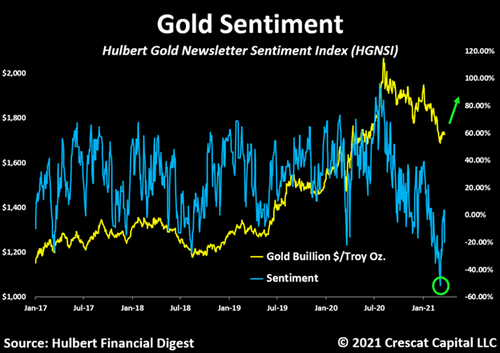
Gold sentiment became extremely negative recently, pulling gold prices down with it, a contrarian buy signal early in a new long-term inflation cycle. The precious metals bull market only began a year ago according to silver and junior miners. If it were after a 10-year run up already, a shift to negative sentiment would be a different story. Bull markets climb a wall of worry. We see it as a great opportunity to buy the pullback.
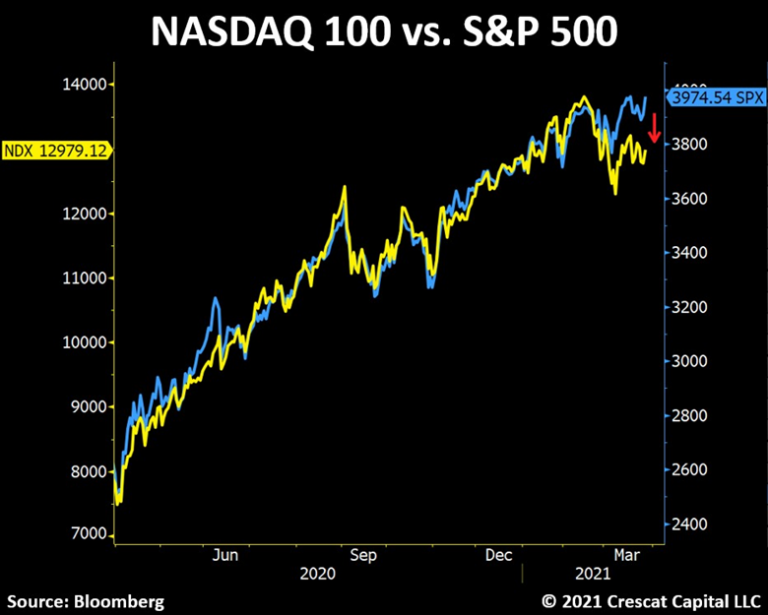
NASDAQ Divergence Sell Signal

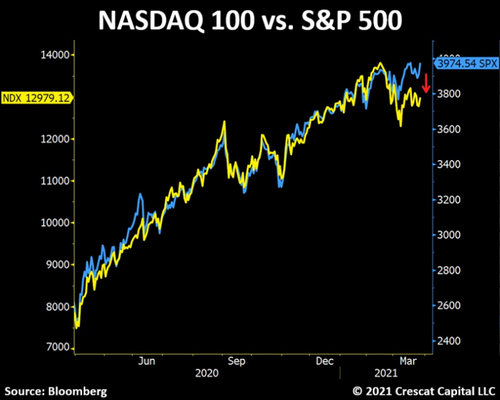
The Nasdaq 100 is rolling over while the S&P 500 is still making new highs. Inflationary forces are picking up driving investors out of long duration growth stocks with excessive valuations. This is similar to the beginnings of the 1973-74 bear market and 2000-02 tech bust.
Crescat Activist Gold Strategy

We are positioned for a rising macro precious metals price environment through a handpicked portfolio of predominantly exploration focused mining companies. These companies are focused on aggressive resource growth in viable mining jurisdictions around the world and have outstanding management teams. They own mining claims and are actively exploring many of the most prospective new high-grade gold and silver deposits around the world, according to Crescat’s proprietary research. The portfolio is thoroughly vetted by the Crescat investment team including its Geologic and Technical Advisor, world renowned exploration geologist, Quinton Hennigh, PhD.

We strongly believe there will be a high demand from the majors for our companies to continue overall industrywide production growth.

Such is the scale of what we believe we have already accomplished with our current portfolio in the last year. We plan to continue to grow our overall target resource through activist investing and technical advice to build high grade gold ounces in the ground. This is the opportunity that Crescat has already seized on the last year to surgically pick up the best prizes among global exploration assets after a ten-year bear market. 

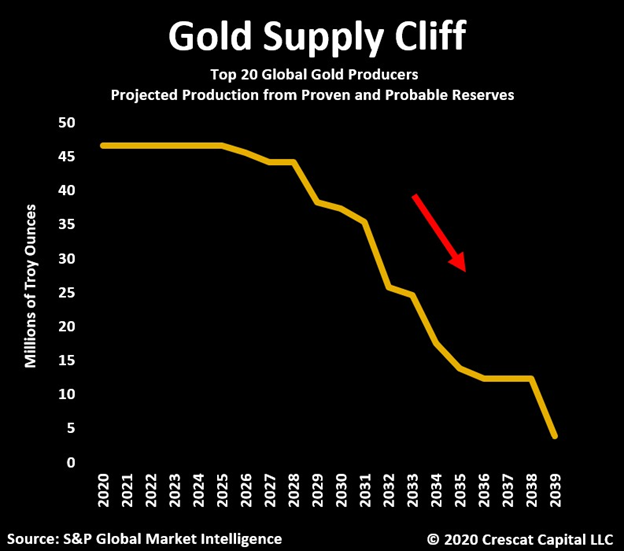
The majors have underinvested in replacing their reserves creating an industry supply cliff that is extraordinarily bullish for gold and silver prices. At the same time, investor demand for hard assets is poised to strengthen substantial under a macro backdrop of rising inflation. The major gold producers are enjoying record free cash flow today, but it is a short-sighted fix due to underinvestment in exploration and CAPEX. They are coasting off existing reserves with dwindling mine lives. Their party will end because remaining mine lives and reserves have been running down. They will need to replace their reserves. They will have very few places to go to do that. Because they choose not to invest organically, we believe they will be looking to our portfolio companies as acquisition candidates.
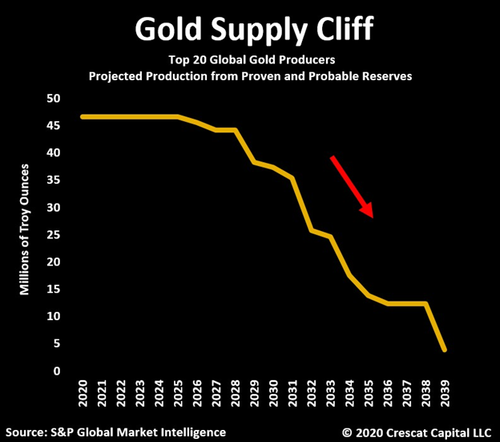
The macro outlook for a new secular bull market for mining companies is in the early innings. Our goal is to create the premier new gold and silver deposits of the next decade. We know what the majors want and need. They are not interested in the passed over old low grade deposits of the last cycle that will not be viable under almost any gold price environment. They need the large high-grade new deposits in mineable regions around the world. These are companies that the majors will pay a premium to acquire and this is what we believe to be in our portfolio. Our strategy is not solely dependent on acquisition, however. These companies can go into development and production on their own. In fact, many of them are on that path and some are already producing.

The setup today for precious metals is outstanding given supply constraints, rising inflation expectations, asset bubbles in traditional financial assets, record debt to GDP, double barreled fiscal and monetary stimulus, negative and declining real interest rates. The new bull market only started in March of 2020 after a ten-year bear. That is when junior miners and silver successfully made a double bottom retest of the 2016 lows with silver making a lower low. The last two major gold bull markets have similarly lasted 10 years, essentially the decade of the 1970s and the decade of the 2000s. We expect our activist precious metals portfolio to lead to substantial returns for our limited partners over the next three to five years. 

We believe the recent pullback in the precious metals asset class since August 2020 presents an excellent entry point for new and existing investors to add money to our most important macro theme today. We call it Global Fiat Debasement and it is expressed across all Crescat strategies today.

Tyler Durden
Fri, 04/02/2021 – 14:45

via ZeroHedge News https://ift.tt/3miEUNg Tyler Durden

Middle-Aged Millennials Succumb To The American Dream: Taking On Debt And Buying A House

Middle-Aged Millennials Succumb To The American Dream: Taking On Debt And Buying A House

The stereotype of the typical millennial renter living at home in mom’s basement may turn out to be not entirely accurate. 

While we’re sure there is still a fair share of stereotypical millennials, there’s also many – some of whom are getting close to turning 40 – who are middle aged homeowners, looking to pay down debt and improve their financial situation by contributing to their retirement. 

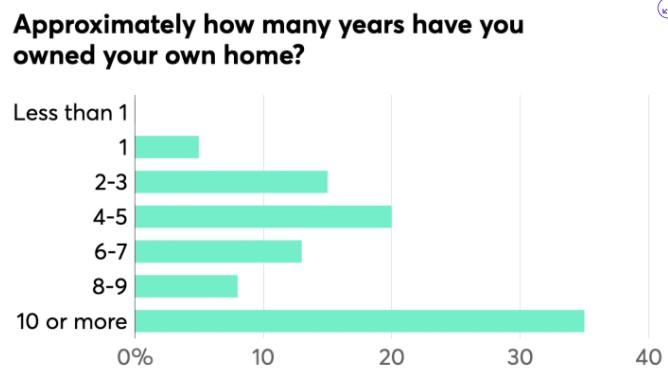
A new CNBC survey revealed that despite millennials constantly being painted as renters, many are actually now homeowners. The data comes as a result of a survey that polled 1,000 U.S. adults ages 33 to 40. 

“Most older millennials have owned their home for several years,” the survey found, with over half of them buying their home more than 5 years ago. 40% have owned their home one to five years. 

And despite this data, homeownership wasn’t always easy. About 10% of millennials reported taking loans from retirement accounts. 20% of millennials said they used a credit card to help with home purchase and/or closing costs. “When it comes to achieving homeownership, older millennials were just scrappy and very resourceful,” Harris Poll CEO John Gerzema told CNBC.

About 28% of millennials still rent and about 12% are living with parents or family members, the survey revealed. 

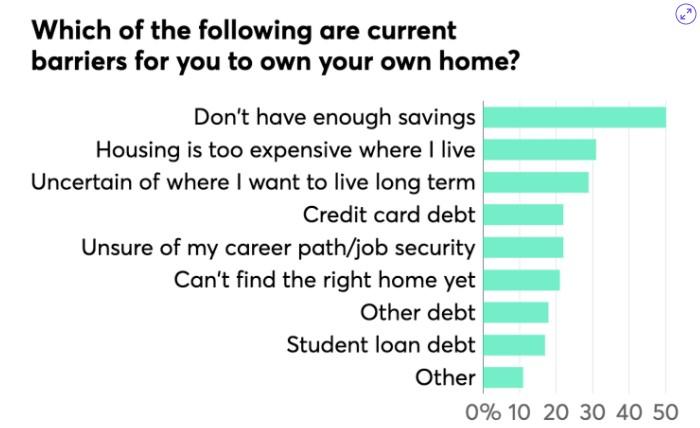
About 17% of millennials say that loans of debt present a barrier to them owning a home. Jung Hyun Choi, a senior research associate with the Housing Finance Policy Center at the Urban Institute commented: “With higher debt, it became more difficult for millennials to save.”

Additionally, lower savings rates – being attributed to a poor job market during 2007/2008 – have held many back from buying homes. “At that time, the unemployment rate was significantly high, so it meant that a lot of them faced difficulty finding jobs,” Choi continued.

St. Louis Federal Reserve economist Bill Emmons also said that Dodd-Frank was making it harder to get a mortgage: “The underwriting process for mortgage lending changed a lot from the pre- to the post-bubble period — and it would be groups like young people who would be most affected by that.”

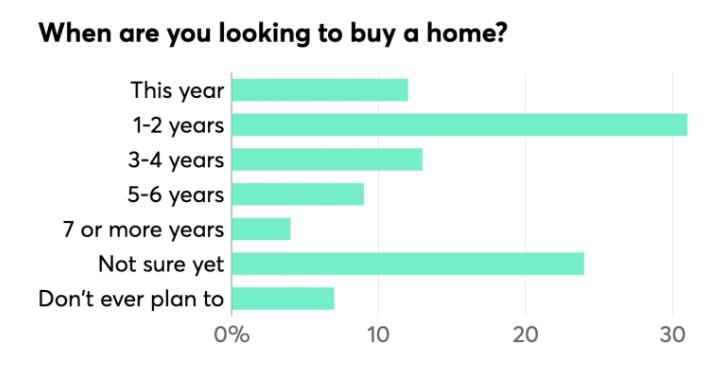
Despite Covid presenting a tailwind for many who were considering buying a home, only about 5% of older millennials bought a home over the past year, the survey revealed. The lack of a home can negatively affect people’s financial stability going forward, Choi said. “Having a home does not just give you an opportunity to access wealth and build wealth, but it also gives you more stability.”

And Emmons thinks a small “delay” from Covid that pushes home ownership back for millennials isn’t all that bad: “If it’s just a little bit of a delay, then maybe it’s not such a problem. Particularly if people are living longer, if they’re working longer or staying healthy longer, perhaps it’s not necessarily all bad.”


Tyler Durden
Fri, 04/02/2021 – 14:20

via ZeroHedge News https://ift.tt/3dmGKs4 Tyler Durden

Ramming Attack Sends Capitol Into Lockdown, Massive Police Response, Officers Critically Injured

Ramming Attack Sends Capitol Into Lockdown, Massive Police Response, Officers Critically Injured

Chaos has unfolded outside the Capitol building after a vehicle smashed into police that were guarding a barricaded entrance. It’s also being described as a possible shooting incident which left at least one officer critically injured. The Capitol complex is now on lockdown as a huge emergency response is underway, according to breaking reports. 

According to a US Capitol Police statement, it is currently “responding to the North Barricade vehicle access point along Independence Avenue for reports someone rammed a vehicle into two USCP officers. A suspect is in custody.”

The statement adds “Both officers are injured. All three have been transported to the hospital.”

It doesn’t appear Congressional members were present or near the site of the apparent attack, which seems to be over as police and emergency vehicles have taken over the scene. 

The AP reported that gunfire rang out in the area, before police with sirens blaring descended on the site.

It appears the suspect vehicle failed to stop before police opened fire according to the emerging details.

VOA News White House correspondent Steve Herman writes that “The suspect was shot after getting out of the car with a knife, according to media reports.”

developing…

Tyler Durden
Fri, 04/02/2021 – 14:08

via ZeroHedge News https://ift.tt/2OeWll0 Tyler Durden

Big Oil Beats NYC Appeal On Climate Change Lawsuit

Big Oil Beats NYC Appeal On Climate Change Lawsuit

Authored by Charles Kennedy via OilPrice.com,

A federal appeals court on Thursday ruled in favor of five of the world’s biggest oil companies in an appeal over a climate lawsuit that New York City was seeking re-opened.

The United States Court of Appeals for the Second Circuit ruled that New York City can’t hold the five firms – Exxon, Chevron, ConocoPhillips, BP, and Shell – responsible for damages caused by global warming under New York tort law.

The city sued the five companies in 2018, and then a federal district judge also dismissed NYC’s lawsuit arguing that problems pertaining to climate change should be tackled by Congress and the executive branch.  

In today’s ruling, in which NYC’s appeal was dismissed again, the court judges said “We affirm for substantially the same reasons as those articulated in the district court’s opinion.”

“Global warming presents a uniquely international problem of national concern. It is therefore not well-suited to the application of state law,” U.S. Circuit Court Judge Richard J. Sullivan wrote in Thursday’s ruling.

“The City of New York has sidestepped those procedures and instead instituted a state-law tort suit against five oil companies to recover damages caused by those companies’ admittedly legal commercial conduct in producing and selling fossil fuels around the world. In so doing, the City effectively seeks to replace these carefully crafted frameworks – which are the product of the political process – with a patchwork of claims under state nuisance law,” Judge Sullivan noted.

The appeals court dismissing the case of New York City is a setback for communities and other cities looking to hold the biggest oil corporations accountable for damages related to climate change. The court today said in no uncertain terms that states and cities do not have jurisdiction to sue oil companies for their contribution to global warming because emissions are under federal regulation.

Tyler Durden
Fri, 04/02/2021 – 14:00

via ZeroHedge News https://ift.tt/39CqKkZ Tyler Durden

Biden Condemns “Russian Aggression” In Ukraine In First Belated Call With President Zelensky 

Biden Condemns “Russian Aggression” In Ukraine In First Belated Call With President Zelensky 

Tensions between Russia and Ukraine are at their highest in years, with NATO and the Kremlin now entering a tit-for-tat ratcheting rhetoric of bellicose “warnings” – and Joe Biden has yet to even pick up the phone and speak to Ukraine’s President Volodymyr Zelensky… until today.

Axios is reporting Friday mid-morning the two leaders belatedly held their first phone call since Biden taking office: “It took more than two months for Biden to speak directly with the president of Ukraine, a key frontline partner in eastern Europe that has been pleading for more help from the West in its fight against Russian aggression.”

The White House call readout emphasized Biden expressing the United States’ “unwavering support for Ukraine’s sovereignty and territorial integrity in the face of Russia’s ongoing aggression in the Donbas and Crimea.”

“He emphasized his administration’s commitment to revitalize our strategic partnership in support of President Zelensky’s plan to tackle corruption and implement a reform agenda based on our shared democratic values that delivers justice, security, and prosperity to the people of Ukraine.”

The two also spoke of “Ukraine’s Euro-Atlantic aspirations” — language which will no doubt smack of suggesting a future invitation to join NATO, which would certainly trigger greater conflict in the region with Russia. 

Biden’s reference to Russian “ongoing aggression” is likely to fan the flames amid increased fighting in the restive Donbass region on the same day the Kremlin put NATO on notice, warning that any NATO troop deployment would result in immediate counter-action from Russia to ensure its own security and interests, as Reuters noted earlier in the day. 

Reuters is meanwhile reporting that Zelensky told Biden that the Ukrainian Army is ready to retaliate in Donbass.

Here’s more context of where things stand, according to Axios, after Kremlin spokesman Dmitry Peskov said that a “frightening” escalation is happing in Donetsk following the deaths of four Ukrainian soldiers last week:

Zelensky accused Russia of amassing troops at the border with the intent of creating “a threatening atmosphere” in violation of the most recent ceasefire brokered in July 2020, describing the military exercises as “traditional Russian games.”

Secretary of State Antony Blinken issued a statement on Wednesday noting that he had spoken with Ukraine’s foreign minister and condemned Russia’s aggression.

Joint Chiefs Chairman Gen. Mark Milley, Defense Secretary Lloyd Austin and White House national security adviser Jake Sullivan have also held phone calls with their Ukrainian counterparts, Politico reports.

Just prior to Friday’s belated White House phone call with Zelensky, Axios’ Jonathan Swan observed the cold shoulder toward Kiev seemed intentional and based on appeasing the Russians…

Meanwhile, there’s been more confirmation that a major Russian forces build-up is indeed underway along the border with Ukraine, also through dozens of social media videos out of the region, at a moment Zelensky has charged that Moscow is behind the bloody escalation in Donbass.

Tyler Durden
Fri, 04/02/2021 – 13:40

via ZeroHedge News https://ift.tt/3dr4UBX Tyler Durden

Peak Woke? The Rabid Left Comes For “Oppressor” Obama

Peak Woke? The Rabid Left Comes For “Oppressor” Obama

Authored by Monica Showalter via AmericanThinker.com,

Is the revolution finally devouring its children?

Seems like it now that the wokester mob has decided to come for President Obama.

According to Fox News, reporting from Obama’s own political hometown Chicago:

Immigration activists are objecting to renaming a Chicago school after Barack Obama. 

“I will not be part of renaming a school after someone who did not and does not represent the undocumented community,” said District 60 school board member Edgar Castellanos, who says he came to the U.S. as an undocumented child, according to ABC 7 Chicago. 

Waukegan’s Board of Education met Tuesday evening to debate renaming Thomas Jefferson Middle School and Daniel Webster Middle School, after it was decided the historical figures either owned slaves or supported slavery.

One of the top contenders for Thomas Jefferson Middle School’s new name is that of the first Black president, Barack Obama, and former First Lady Michelle. But that name is drawing the ire of immigration activists and some in the Latino community. Activists staged a protest outside the board meeting Tuesday. 

“From the time Barack Obama became President until 2017 when he left, he today is still the highest-ranking president with deportations in our nation,” said Julie Contreras, who runs shelters for immigrant children at the U.S.-Mexico border. She said Obama failed to deliver on his promises on immigration. 

“We feel that Barack Obama did disservice to us. He denied us, and he didn’t stop the deportations, the way he promised,” Contreras continued. 

“If you’re removing the name of Thomas Jefferson, one oppressor, the name of Obama is another oppressor, and our families do not want to see that name,” she added.

The ridiculousness of the whole thing is pretty obvious. Radical-left Obama, who ushered in the era of Black Lives Matter by stoking the Ferguson riots, as well as university snowflake wokesters, suddenly finds himself the bad guy, the latest Judas goat for the left. No more first black president, he’s now no different from a Confederate general. Which rather tells you they’ve run out of historic figures to cancel. As French Revolution-era figure Jacques Mallet du Pan famously wrote: “Like Saturn, the Revolution devours its children.” 

And what again, is it that Obama did that was oh so bad? That cancels out all the left-wing outrages that he did? I think it was partially enforce the border, to keep the television cameras off. The foreigners involved, otherwise known as illegal aliens, are upset they couldn’t break into the U.S. as they pleased, and for that, Obama, and all those racists who elected him, must be cancelled, erased from history. They write the history now. Fancy that, foreigners cancelling an American president and in the wokester era, quite possibly getting away with it.

Obama, of course, was a lot like the current Joe Biden. Like Joe, he both encouraged waves of illegal immigration, and I guess allowing the Border Patrol to do some of its lawfully committed duty, he wasn’t able to stop them entirely. He also built the kids-in-cages cages, not President Trump, though the left tried to pin those on Trump. During his presidency, leftists yelled that he was the ‘deporter in chief’ based on the fact that he encouraged illegal immigration yet didn’t completely open the border. The logical outcome of that is obvious — human waves plus kids in cages. Joe Biden, who was placed in charge of the matter at the time, is now making his same old mistakes, senile and unable to learn.

So now we have people who shouldn’t be here, and their advocates, demanding that Obama be cancelled. They’ve already done their worst on George Washington and Thomas Jefferson, now they’ve moved on to Obama. The funny thing here is that if it were anyone but Obama, Obama would support the move. Now that it’s Obama’s turn in the barrel, it will be interesting to see whether and how he reacts, now that there’s no Trump to kick around.

Tyler Durden
Fri, 04/02/2021 – 13:20

via ZeroHedge News https://ift.tt/3sQyBTq Tyler Durden