IMF Joins The Choir Singing The Holistic Praises Of Higher Taxes

IMF Joins The Choir Singing The Holistic Praises Of Higher Taxes

Authored by Mike Shedlock via MishTalk,

The IMF wants predistributive and redistributive policies. The center of the alleged holistic approach is of course higher taxes

Giving Everyone a Fair Shot

The IMF wants to Give Everyone a Fair Shot

The COVID-19 pandemic is intensifying the vicious circle of inequality. To break this pattern and give everyone a fair shot at prosperity, governments need to improve access to basic public services—such as health care (including vaccination) and education—and strengthen redistributive policies.

For most countries, this would require raising additional revenue and improving the efficiency of spending. 

Holistic Approach 

Enhancing access to basic public services will require additional resources, which can be mobilized, depending on country circumstances, by strengthening overall tax capacity. Many countries could rely more on property and inheritance taxes. Countries could also raise tax progressivity as some governments have room to increase top marginal personal income tax rates, whereas others could focus on eliminating loopholes in capital income taxation. Moreover, governments could consider levying temporary COVID-19 recovery contributions as supplements to personal income taxes for high-income households and modernizing corporate income taxation. In emerging market economies and low-income countries in particular, additional revenues could also be raised through consumption taxes to finance social spending. Further, low-income countries will need support from the international community to help with financing and implementing home-grown taxation and spending reforms.

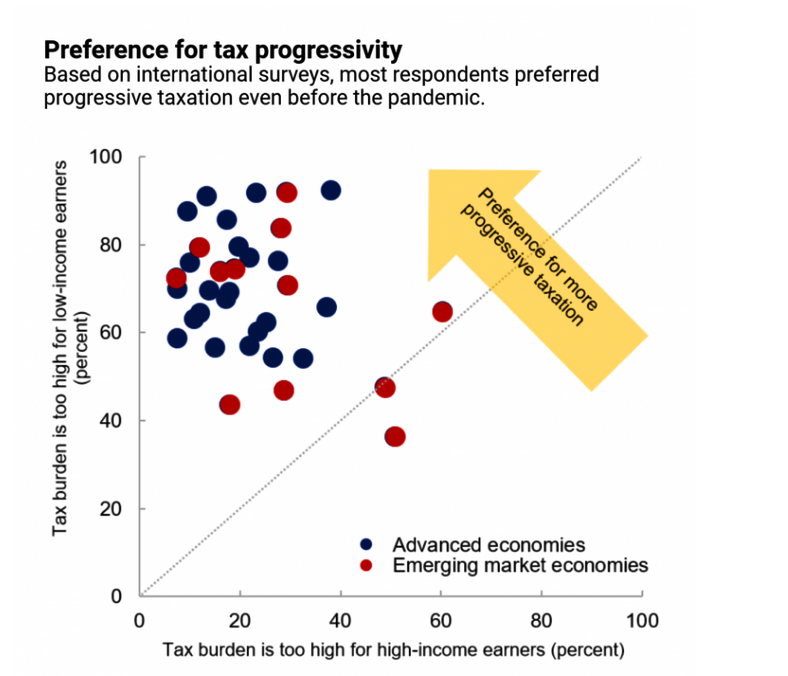
In some countries, public support for better access to basic services, financed through higher taxes, has been strong and is likely increasing with the pandemic. A recent survey in the United States shows that those who had personally experienced the impact of COVID-19, either through illness or unemployment, have developed a stronger preference for more progressive taxation.

Robinhood Politics

These schemes always start out by promising to “tax the rich”. In practice, it never stops there.

To support socialist redistribution schemes, taxation inevitably dives further and further into the middle class. 

You can see it coming with more “guaranteed income” proposals. 

And the ideas get crazier and crazier like AOCs and Al Gore’s plan to spend $90 trillion to save the earth from oceans rising three inches over the next 50 years. 

I assure you $90 trillion will not come from the wealthy or corporations. 

The ultimate goal is to fund environmental nonsense and ensure that Jeff Bezos does not make more than the bottom 200 workers at Amazon. 

Massive Tax Hikes

Yesterday, I commented Prepare for 3 Things: Big Government, Huge Boondoggles, Massive Taxes

Several readers wanted me do define massive taxes in the erroneous belief the proposals will only impact millionaires. 

It won’t stop there because it never does. And look at the gigantic basket: Wealth taxes, corporate taxes, capital gains taxes, death taxes, consumption taxes, value added taxes (VAT), property taxes. 

Spotlight Illinois

Illinois has 6,963 Taxing Bodies yet the state is broke with pension plans that are bankrupt. 

Nothing is ever fixed in Illinois. But guess what the alleged fix is. 

The governor wants higher taxes. Yet high taxes are the reason people escape Illinois. 

On Oct 5, 2019, I wrote Escape Illinois: Get The Hell Out Now, We Are.

I am pleased to say that I am out of Illinois. 

Exit Taxes

California progressives have their eyes on an exit tax, They want to go after anyone who lived in California and moved.

For discussion, please see California Seeks Wealth Tax to Soak the Rich, Even Those Leaving.

Don’t tell me these tax hikes will just be on the rich because they won’t.

It will never stop because politicians will dream up an endless parade of projects that can be funded by higher taxes. 

To give everyone a “fair shot”, the IMF wants government to be Robinhood deciding who is rich, who is poor, and who needs to be made more equal. Inevitably the middle class suffers. 

Tyler Durden
Fri, 04/02/2021 – 16:35

via ZeroHedge News https://ift.tt/3ue3rFV Tyler Durden

No Qualified Immunity for Cop Who Shot and Killed a Suicidal Man, Says Federal Court


rtrlnine745358

Albina Roque called 911 on May 2, 2017, to report that her son, Jason, was threatening to kill himself. When officers from the Austin Police Department arrived on the scene, Jason was pacing in front of his house, with a black gun—later determined to be a BB gun—in his waistband. “I’ll fucking kill myself!” Roque said as he turned away from the officers and pointed the gun at his head.

“Put the gun down,” yelled one of the officers. Video footage shows what happened next: As Roque began turning back towards the officers, with the BB gun raised in the air, he was shot by Officer James Harvel. That shot caused Roque to drop the gun. Harvel then quickly fired twice more. The third shot killed Roque.

Roque’s parents sued Harvel in federal court for using excessive force against their late son in violation of his Fourth Amendment rights. Harvel countered by invoking the controversial doctrine of qualified immunity, which shields state officials from being held civilly liable if the actions that they are being sued over did not violate a “clearly established” constitutional right.

In a ruling issued this week, the U.S. Court of Appeals for the 5th Circuit denied qualified immunity to the officer who fired the fatal shot. “By 2017, it was clearly established—and possibly even obvious,” wrote Judge Don Willett in Roque v. Harvel, “that an officer violates the Fourth Amendment if he shoots an unarmed, incapacitated suspect who is moving away from everyone present at the scene.”

In Tennessee v. Garner (1985), the U.S. Supreme Court said that a “police officer may not seize an unarmed, nondangerous suspect by shooting him dead.” Harvel and his lawyers argued that the present case is different. “All of the officers,” they maintained, “including Officer Harvel, believed that after the first shot, Roque was still armed. Roque was not compliant with police commands, was not running away or surrendering, but was armed, mobile, and capable of firing his weapon at his mother.”

The 5th Circuit took a different view. “As the video indisputably shows, [Roque] was unarmed and stumbling into the street, moving further away from anyone else,” after Harvel shot him the first time. “Whether a reasonable officer would have thought Jason was incapacitated or a threat to his mother,” the Court held, “is a question for the jury to decide.”

It’s a welcome result. All too often, the federal courts seem to go out of their way to defer to law enforcement in such cases. With qualified immunity denied to the officer here, this case is one big step closer to trial.

from Latest – Reason.com https://ift.tt/3wnsEPZ
via IFTTT

CNN ‘Medical Expert’ & CDC Suggest Americans’ “Freedoms” Be Restricted Until They Are Vaccinated

CNN ‘Medical Expert’ & CDC Suggest Americans’ “Freedoms” Be Restricted Until They Are Vaccinated

With nearly every state having opened vaccinations to all adults, the CDC on Friday announced the second loosening of certain federal guidelines by declaring that all Americans who are “fully vaccinated” – a status obtained two weeks after the second dose (for Moderna and Pfizer) or the one and only dose (for JNJ) can travel “at low risk to themselves” both with the US and abroad, and won’t need to be tested for COVID before boarding a plane.

However, the CDC advised that they should continue to take precautions like wearing a mask in public, avoiding crowds,  maintaining social distancing and washing one’s hands frequently.

While the press celebrated the advisory as a milestone in the road back to “normalcy”, some wondered whether the CDC got the memo about packed seats on airplanes and the virtually completely reopened Florida that’s attracting tourists from around the country.

While many Americans might not have realized it, the CDC has officially discouraged Americans from traveling – until now.

As more countries prepare to start using vaccine passports (airports have already been demanding proof of negative COVID status since last summer), the CDC said vaccinated Americans will not need a COVID test to travel anywhere, including another country (that is, unless they’re required to do so by authorities in their destination country).

While all this probably sounds promising, there’s a catch: vaccinated travelers still have to get a negative test result before boarding a flight back to the US, where they then must be tested against 3-5 days after returning home. This could create the potential for an explosion of false positives as some have linked to over-magnification on PCR tests used to detect the virus.

As we noted earlier, the CDC’s latest edict, just like its first one, is essentially “permission” to do something that millions of Americans are already doing. What’s wrong here? Did the CDC not get the memo that states are reopening already?

The answer can be found in a recent interview featuring Dr. Leana Wen, a former head of Planned Parenthood who served as a “medical expert” on CNN (just the facts, right people?).

She explained that the CDC’s only hope for convincing every adult American to get vaccinated is to withhold the “carrot” of freedoms from the people until they assent to being vaccinated.

Since the CDC wants everybody to continue observing social distancing guidelines like wearing masks and maintaining a safe distance, limiting their ability to travel and visit public places is really the only option. As Wen pointed out, the CDC needs to find ways to force people to get the vaccine now, or otherwise people “are going to go out and enjoy these freedoms anyway.”

“we need to make it clear to them that the vaccine is the ticket back to pre-pandemic life and the window to do that is really narrowing…” Wen added.

Put another way, while this latest message is couched as the CDC loosening restrictions on travel, what’s really happening is the government is giving private industry the green light to start barring travelers and customers who can’t prove their vaccination status. So instead of granting more freedom, they’re preparing to take freedoms away.

This latest announcement adds to the CDC’s previous guidance, released in March, allowing fully vaccinated people to visit with others in small groups in a private setting. We expect more declarations about the rights of the vaccinated vs. unvaccinated will be made in the near future.

Tyler Durden
Fri, 04/02/2021 – 16:10

via ZeroHedge News https://ift.tt/3rJarJ1 Tyler Durden

No Qualified Immunity for Cop Who Shot and Killed a Suicidal Man, Says Federal Court


rtrlnine745358

Albina Roque called 911 on May 2, 2017, to report that her son, Jason, was threatening to kill himself. When officers from the Austin Police Department arrived on the scene, Jason was pacing in front of his house, with a black gun—later determined to be a BB gun—in his waistband. “I’ll fucking kill myself!” Roque said as he turned away from the officers and pointed the gun at his head.

“Put the gun down,” yelled one of the officers. Video footage shows what happened next: As Roque began turning back towards the officers, with the BB gun raised in the air, he was shot by Officer James Harvel. That shot caused Roque to drop the gun. Harvel then quickly fired twice more. The third shot killed Roque.

Roque’s parents sued Harvel in federal court for using excessive force against their late son in violation of his Fourth Amendment rights. Harvel countered by invoking the controversial doctrine of qualified immunity, which shields state officials from being held civilly liable if the actions that they are being sued over did not violate a “clearly established” constitutional right.

In a ruling issued this week, the U.S. Court of Appeals for the 5th Circuit denied qualified immunity to the officer who fired the fatal shot. “By 2017, it was clearly established—and possibly even obvious,” wrote Judge Don Willett in Roque v. Harvel, “that an officer violates the Fourth Amendment if he shoots an unarmed, incapacitated suspect who is moving away from everyone present at the scene.”

In Tennessee v. Garner (1985), the U.S. Supreme Court said that a “police officer may not seize an unarmed, nondangerous suspect by shooting him dead.” Harvel and his lawyers argued that the present case is different. “All of the officers,” they maintained, “including Officer Harvel, believed that after the first shot, Roque was still armed. Roque was not compliant with police commands, was not running away or surrendering, but was armed, mobile, and capable of firing his weapon at his mother.”

The 5th Circuit took a different view. “As the video indisputably shows, [Roque] was unarmed and stumbling into the street, moving further away from anyone else,” after Harvel shot him the first time. “Whether a reasonable officer would have thought Jason was incapacitated or a threat to his mother,” the Court held, “is a question for the jury to decide.”

It’s a welcome result. All too often, the federal courts seem to go out of their way to defer to law enforcement in such cases. With qualified immunity denied to the officer here, this case is one big step closer to trial.

from Latest – Reason.com https://ift.tt/3wnsEPZ
via IFTTT

MLB Punishes Atlanta, Moves All-Star Game After Cancel Mob Targets Georgia Voting Law

MLB Punishes Atlanta, Moves All-Star Game After Cancel Mob Targets Georgia Voting Law

Major League Baseball has joined the woke backlash against a Georgia voting law which critics say ‘disenfranchises’ minorities through a series of measures designed to reduce election fraud.

“Over the last week, we have engaged in thoughtful conversations with Clubs, former and current players, the Players Association, and The Players Alliance, among others, to listen to their views,” MLB commissioner Rob Manfred said in a statement, per ESPN. “I have decided that the best way to demonstrate our values as a sport is by relocating this year’s All-Star Game and MLB Draft.”

So virtuous.

The league, essentially taking the hint from the White House, is based on a false narrative spread by the media – which was forced to issue corrections – when they misreported that the new voting law limits voting hours, when in fact it expands them.

And as Accuracy in Media‘s Ella Carroll-Smith notes:

Another common narrative surrounding the election law is that it is akin to old Jim Crow laws, but that’s hyperbolic and best and dangerous at worst. Yet news outlets including The Guardian, NBC News and Newsweek parroted these narratives without any sort of fact check or clarification. 

Calling the new Georgia voter law the “new Jim Crow” or Biden’s preferred language “Jim Crow on steroids” is not only misleading, but it undermines the significance of just how terrible Jim Crow laws really were. Requiring citizens to provide a form of ID to request an absentee ballot is not the same thing as a racial caste system that relegated Black Americans to the status of second-class citizens. 

People are required to provide ID in order to do all sorts of things in America. You must show ID to obtain a library card or fly on the plane, which makes Delta’s criticism of the bill somewhat ironic. Interestingly, CNN is also headquartered in Atlanta, but it remains to be seen whether activists will call to boycott them in protest. 

*  *  *

Earlier this week, 72 black executives were joined by the likes of Google, Apple, JPMorgan, Citigroup, BlackRock, Home Depot, Delta Airlines, Coca-Cola and others in opposing Georgia’s new voting law –  which they say will disproportionately impact black communities. Many of these virtue-signaling corporations were silent when the law was being considered or before Governor Brian Kemp (R) signed it into law on March 25, only to succumb to a Democrat-led pressure campaign against state GOP leaders.

Meanwhile, the MLB’s decision received pushback from Democratic Senator Jon Ossoff (GA), who told the Epoch Times: “I absolutely oppose and reject any notion of boycotting Georgia. Georgia welcomes business, investment, jobs, opportunity, and events.

“In fact, economic growth is driving much of the political progress we have seen here. Georgia welcomes the world’s business. Corporations disgusted like we are with the disgraceful Voter Suppression bill should stop any financial support to Georgia’s Republican Party, which is abusing its power to make it harder for Americans to vote,” he added.

And of course, sometimes there are unintended (?) consequences to unchecked wokeism. As PJ Media drives home:

Blacks make up 32.7 percent of the population of Atlanta — the largest black population of any major city – so it’s a mystery why MLB wants to move the All-Star Game from there. The tens of millions of dollars that would pour into the coffers of black businesses by Atlanta hosting the All-Star Game will now flow into the coffers of others.

The city of Atlanta would be a loser by moving the game. The people of Georgia would be losers. The only winners are those who want the game moved to prove a political point, no more.

Tyler Durden
Fri, 04/02/2021 – 15:44

via ZeroHedge News https://ift.tt/3rLXyOr Tyler Durden

How Immigration Restrictions Undermine the Rule of Law


Rule of Law 2

In an insightful contribution to the Yale Journal on Regulation online symposium on Adam Cox and Cristina Rodriguez’s important new book, The President and Immigration Law, UC Berkeley law Professor Daniel Farber describes how America’s system of immigration restrictions is inimical to the rule of law:

Here are the basic facts on the ground: Roughly eleven million people are living in the U.S. without legal permission, half of them having been here for ten years or more. The deportation system is capable of handling only a tiny fraction of those millions. At least for those who avoid arrest for serious crimes, deportation is seemingly a result of bad luck, aggressive enforcement officers, or shifting currents in immigration policy…

At present, Congress seems incapable of either providing a pathway to permanent status for settled immigrants or the wherewithal to deport millions of them. Staunch immigration opponents themselves seem to lack the stomach for a massive deportation program. Even our most vehemently anti-immigration president, Donald Trump, never asked Congress for the resources to identify and round up ten thousand people a day for about three years, which is what it would take to remove the current undocumented population. On the other hand, there is bitter opposition to regularizing the status of undocumented long-term residents….

Among its faults, the current system is at odds with the rule of law. The rule of law requires that government decisions deeply impacting the lives of individuals be based on a clear lawmaking process, not the discretion of executive officers. It also requires that the consequences of individual actions be predictable and clear, and that the legal system give people basic security in their ability to live their lives. No legal system can fully satisfy these aspirations, but immigration law falls dramatically short. Since any one of millions of people could be deported, none enjoy full security in their lives. As an operational matter, selection of individuals for deportation is determined by the executive branch, either at the retail level by immigration officers or wholesale through presidential policies. The statutes created by Congress tag millions of people as possible targets for deportation but fail to create workable rules for determining who actually gets deported….

The problem is not just that the system is either too draconian or too lax, depending on one’s view of immigration policy. It is also that immigration law, in practice, deviates so far from our norms about how policy should be made and how serious sanctions should be imposed on individuals. That should be a grave concern to all of us, regardless of our policy positions on immigration.

As I noted in my own contribution to the same symposium, the problem here is just one facet of the broader crisis in our legal system, where we have vastly more law—and thus vastly more lawbreakers—than even the most aggressive law enforcement officials can possibly apprehend and punish. As a result, undocumented immigrants are far from the only people who remain free only because of the discretionary decisions of law enforcement agencies, prosecutors, and other executive branch officials. The same applies to the tens of millions of Americans who have, for example, violated federal drug laws, or the many thousands of small businesses who have violated federal regulations or tax laws at one time or another. But the immigration situation is particularly problematic because of the severe consequences of detention and deportation, and the very weak due process protections for those caught up in the system.

Farber argues that there is no easy solution to the problem, though he does suggest some modest reforms. I fear he is right about that. But I do outline some incremental improvements in my contribution to the Yale Journal on Regulation symposium, including subjecting immigration policy to the same constitutional constraints that apply to virtually all other areas of federal policy (see also my 2019 Atlantic article on this subject). This could be achieved through a combination of judicial review and legislative reform.

Ultimately, however, the best way to deal with situations where the rule of law is undermined by having too many laws, is to reduce the number of laws. In the immigration field, that means making it much easier for would-be migrants to enter legally. In the legal system, more generally, it means substantially reducing the number of laws and regulations to which people are subject.

The rule of law is not the only important principle out there, and cannot always be prioritized over other goals. I recognize that most, if not all, of these laws are on the books because they enjoy substantial support from the general public, influential interest groups, or some combination of both. All too often, both left and right are intent on imposing their preferred criminal laws and regulations on the public, while giving little if any consideration to the possible impact on the rule of law. Wide-ranging executive discretion may even be a feature rather than a bug, so long as the people in power belong to our preferred party.

It may, therefore, turn out that we simply lack the political will to make the reforms needed to restore the rule of law in immigration policy—or anywhere else. Perhaps we just don’t value the rule of law as much as the rule of men and women whose agenda we like. But, if so, we should at least recognize the tradeoff we are making, and do what we can to minimize the harm at the margin.

But it is also possible that many people simply haven’t given much thought to the tradeoffs involved. Once they do see them, they may be willing to make some sacrifices to strengthen the rule of law, even if it means some of their own preferred laws have to be narrowed or—potentially—taken off the books entirely. Here, as elsewhere, the first step towards recovery is recognizing that we have a problem.

from Latest – Reason.com https://ift.tt/2OjFJc0
via IFTTT

Short Circuit: A Roundup of Recent Federal Court Decisions

Please enjoy the latest edition of Short Circuit, a weekly feature from the Institute for Justice.

Should federal courts of appeals act as advocates for the gov’t and raise defenses—unprompted—on the gov’t’s behalf? You can probably guess where we come down on this. For more details, dig into a recent IJ cert petition featuring a buffet of Younger abstention, sua sponte decision-making, and the Dormant Commerce Clause.

  • Here’s a legal-ethics brain-twister: If you previously served as the general counsel for a nonprofit, can you represent clients suing that nonprofit over matters in which you previously represented the nonprofit? If you said, “Yes,” then you, too, might end up having your license to practice law suspended for 90 days, as the D.C. Circuit did to Judicial Watch founder and former general counsel Larry Klayman.
  • Professional photographer takes photos of Prince, and then licenses one of the photos to Andy Warhol for a Rolling Stone piece. Andy Warhol proceeds to make a series of paintings of Prince based on the photo. Photographer: That’s copyright infringement. Andy Warhol’s Foundation: It’s fair use. District Court: Fair use. Second Circuit: Let’s not go crazy.
  • New York City sues oil companies under state nuisance law for damages stemming from global warming. But according to the Second Circuit that state law is preempted by federal common law because of the issue’s interstate and international character. Further, federal common law “functions much like legal duct tape,” and gets ripped off when Congress speaks. Which it has done with the Clean Air Act. And there’s no role for international federal common law either because international diplomacy is a tricky thing federal courts must shy away from. Thus, NYC, no claim for you.
  • Does the Fair Housing Act—which prohibits racial discrimination in housing—require landlords to address tenant-on-tenant harassment? Second Circuit (en banc): Landlords are not the boss of their tenants’ behavior towards other tenants, so no. Case dismissed. Dissent: If the landlord didn’t intervene because of the tenant’s race, that’s actionable. The case should go forward.
  • Retired probation officer strolling around New Rochelle, N.Y. is approached by two plainclothes police officers. Retiree’s version: The officers didn’t identify themselves as police, were physically rough, over-tightened the handcuffs, and banged my head on the (unmarked) police car. Officers: We identified ourselves, used only reasonable force to restrain the recalcitrant suspect, and immediately released him once we verified that he was not the misdemeanant we were seeking. District court: The retiree “should be thanking his lucky stars” his injuries were minor; this case is way less important than many of my other cases; and the defendants win. Second Circuit: Given the parties’ different accounts of what happened, there are obvious fact disputes bearing on whether the officers used excessive force. To trial the case must go. And while we’re at it, no qualified immunity if the retiree’s account of the incident is accurate.
  • Publicly intoxicated man is placed in the Botetourt County, Va. jail to sober up. A few hours later, he’s found dead. Man’s estate sues his custodians for displaying deliberate indifference to his serious medical needs (a Fourteenth Amendment violation). District court: Case dismissed. Fourth Circuit: Not so fast. The man was lethargic, semi-conscious, and barely able to walk, and the officers knew he had consumed prescription narcotics—all strongly suggestive of a drug overdose, which reasonable officers would have acted to address. The case may proceed to discovery.
  • The federal government maintains the Terrorist Screening Database (TSDB, as it’s known in the biz), which is used to screen travelers in airports and at the border. Twenty-three people (who allege they are in the TSDB) sue to invalidate the database under the Fifth Amendment’s Due Process Clause. Fourth Circuit: Much like the Sixth and Tenth Circuits, we emphatically decline to facially invalidate the TSDB.
  • Police hear from a confidential informant that a guy with a certain physical description and license plate number is a drug dealer. Later the CI tells the police that the same guy told the CI he just got some new product and it’s available for sale. Officer finds a man who matches the description and sees him shake someone’s hand in a parking lot. Based on his “training and experience” the officer initiates a stop-and-frisk and finds illegal drugs. Fourth Circuit: Motion to suppress should have been granted. Handshakes just aren’t that suspicious a thing. Concurrence: The whole “training and experience” thing has gone way too far.
  • Woman starts using prescribed opioids as a teen following an injury and gets hooked. She fills forged prescriptions, using half and selling half. She estimates that she sells 52k pills over two years, though the gov’t’s math is a bit higher—175k pills. She’s sentenced to 210 months. Fourth Circuit: Way too long. Dissent: Her sentence was at the low endpoint of the Sentencing Guidelines. It may not be a sound policy, but that doesn’t make it legally unreasonable.
  • Elderly Texas inmates housed in a geriatric unit allege that the prison warden didn’t do enough to respond to the COVID-19 dangers. By the time of trial, nearly half of the inmates had tested positive and 19 had died. District court: The warden isn’t doing enough. Here’s 17 things he must do going forward, including weekly testing and following cleaning plans. Fifth Circuit: This litigation helped motivate prison officials to act, saving countless lives, but a forward-looking injunction is unwarranted.
  • Allegations: Transgender woman is arrested for unlawful possession of a weapon and booked at the Dallas County, Tex. jail. Officer demands that she show him her genitals so he can confirm whether she has a penis or a vagina. She complies. Over the next couple of years, she’s repeatedly arrested, classified as male, held with male inmates, and forced to shower with them. She sues, among others, Dallas County and the county sheriff in her official capacity. Fifth Circuit: Accepting the complaint’s allegations as true, the county had a policy of strip-searching transgender detainees for the sole purpose of determining their gender and classifying them solely on their biological sex. Whether or not that policy violates the U.S. Constitution is for the district court to decide on remand.
  • Suicidal man waves gun in the air, ignores police commands. An Austin, Tex. officer shoots him. The man drops the gun and stumbles away. The officer shoots twice more, killing him. Officer: I didn’t see him drop the gun. Fifth Circuit: It’s pretty clear from the video, and—since it’s clearly established that it’s unreasonable to use deadly force after a suspect no longer poses a threat—this goes to a jury. No qualified immunity.
  • Shawnee State philosophy professor refuses to refer to transgender student by the student’s preferred pronouns because his religious convictions forbid it. After the university rejects several proposed accommodations (including using the student’s preferred pronouns while including a statement in the syllabus that it is being done under compulsion), the professor eventually settles on using the student’s last name. The student thereafter actively participates in class and receives a high grade. The professor is disciplined. He sues alleging violations under the First Amendment’s Free Speech and Free Exercise Clauses. Sixth Circuit: And his case should not have been dismissed.
  • Want to run as an independent for statewide office in Michigan? Great! All you’ll need is 30k signatures from registered voters obtained more than three months before the election, before you even know who the major-party nominees are, with least 100 of those signatures from half of the state’s 14 congressional districts. That’s in contrast to major party candidates who just have a primary or convention. Also, just FYI, no independent candidate has actually succeeded in making the ballot in the 30 years this system has been the law. Still want to run? There’s good news! The Sixth Circuit found all this to violate the First Amendment, and upheld the district court’s new 12k signature threshold.
  • Is the CDC’s order prohibiting evictions for non-payment of rent an example of “other measures” in this list of powers Congress has delegated to the HHS Secretary—”[I]nspection, fumigation, disinfection, sanitation, pest extermination, destruction of animals or articles found to be so infected or contaminated as to be sources of dangerous infection to human beings, and other measures, as in his judgment may be necessary”? Probably not, says the Sixth Circuit, denying a motion to stay the district court’s judgment filed by a group of landlords.
  • Missouri man walks into an IRS office and volunteers that he owned jewel mines, was in deep with the drug cartels, and New Mexico authorities were investigating him for embezzlement. Several months later, authorities search his house, discover 364k $1 coins depicting deceased U.S. presidents. IRS agents seize the coins, remove the packaging, run them through a coin counter, deposit $364k in an IRS account, and place the coins in circulation. Yikes! The coins actually belong to the man’s ex-wife (she got them in the divorce). The feds transfer the $364k in the account to her, but she sues alleging that she’s owed more given that the coins are valuable collector’s items. District court: Indeed, the guvvies owe the woman $95k. Eighth Circuit: Sovereign immunity. The agent’s decision to send the coins for processing (rather than saving them as he discovered them) was discretionary, so the ex-wife can’t get help under the Federal Tort Claims Act.
  • Denver police officers receive training that people have a First Amendment right to record them in public. But only courts can say what’s clearly established, says the Tenth Circuit, and we haven’t said so yet (and won’t here). So qualified immunity for police who illegally searched a man’s tablet in retaliation for his filming their use of force while arresting someone.
  • And in en banc news, the Third Circuit will not reconsider its ruling that federal law prohibits the operation of safe-injection sites, where drug users can inject drugs under the supervision of medical professionals.

It is completely legal to travel with any amount of cash on domestic flights. And if you check the Transportation Security Authority’s online list of items that are—and are not—prohibited (475 items), you will not find any restrictions on cash. And yet TSA screeners detain travelers traveling with money and turn them over to law enforcement, often DEA, who will take their money with no suspicion of criminal activity and without filing criminal charges and then subject them to a months- or years-long bureaucratic maze to try and get it back. Which is unconstitutional. And this week, a federal judge rejected the gov’t’s motion to dismiss an IJ class action challenging TSA’s and DEA’s airport cash seizure practices. Click here to learn more.

from Latest – Reason.com https://ift.tt/31FEaZ5
via IFTTT

High-Speed Rail Advocates Should Pay Attention to California’s Costly Disaster


freeport-ny-july-30-2014andmdashnew-york-gov-andrew-cuomo-held-a-news-conference-ed38e9-1600

With a Democrat in the White House and a $2.2 trillion infrastructure plan on the table, excitement about high-speed rail is on the rise again. A map by graphic designer and transit advocate Alfred Twu, featuring possible routes for bullet train lines crisscrossing the U.S., has been making the rounds on Twitter. The map was the subject of a recent Vox article that was tweeted out by Transportation Secretary Pete Buttigieg.

“Gen Z is dreaming big,” he wrote. “It’s time we all did the same.”

“I want her so fucking much,” which was accompanied by a picture of Twu’s map, was how one viral tweet summed up the prevailing mood back in January of 2020.

But anyone taking the promise of high-speed rail seriously should consider California’s disastrous attempt to build a bullet train in recent years—the project is unfinished and over budget, and one of its key political backers has turned against it.

Building high-speed rail requires bulldozing neighborhoods and disrupting communities, and would be a drain on a state’s finances if completed. In 2009, President Barack Obama proposed building 8,600 miles of high-speed rail and received $10.1 billion from Congress toward that goal. The money went to upgrading Amtrak instead.

The Cato Institute’s Randal O’Toole estimates that based on the costs and setbacks of the California project, building 8,600 miles of high-speed rail would have cost “well over $1 trillion dollars.”

Buttigieg’s definition of “dreaming big” is applying 20th-century technology to 21st-century problems.

When funding for the initial part of the California High-Speed Rail line was voted on in 2008, it was supposed to link Los Angeles with San Francisco for about $33 billion and take about a decade to complete. As the years dragged on, the cost ballooned to $100 billion at one point and the project had to be scaled back significantly to a shorter section between Merced and Bakersfield in California’s Central Valley.

Even with all the setbacks, including a lack of private investment that champions of the California rail line were always banking on, local California politicians continue to push for federal dollars.

During the 2020 presidential campaign, Joe Biden promised to make sure that America had the “cleanest, safest, and fastest rail system in the world.” Buttigieg and Congress should pay more attention to California’s costly disaster than a map circulating on Twitter.


Produced by Paul Detrick

Music: “Hall of the Mountain King” by Kevin MacLeod, Creative Commons Attribution 4.0 license.
https://creativecommons.org/licenses/by/4.0/

Photos: Murray/ZUMAPRESS/Newscom, Oliver Contreras / Pool via CNP / SplashNews/Newscom, Ken Cantrell/ZUMA Press/Newscom, Gary Reyes/TNS/Newscom, Photo 98224660 © Blackzheep | Dreamstime.com, Photo 136151613 © Cougarsan | Dreamstime.com

from Latest – Reason.com https://ift.tt/3sN9gKa
via IFTTT

How Immigration Restrictions Undermine the Rule of Law


Rule of Law 2

In an insightful contribution to the Yale Journal on Regulation online symposium on Adam Cox and Cristina Rodriguez’s important new book, The President and Immigration Law, UC Berkeley law Professor Daniel Farber describes how America’s system of immigration restrictions is inimical to the rule of law:

Here are the basic facts on the ground: Roughly eleven million people are living in the U.S. without legal permission, half of them having been here for ten years or more. The deportation system is capable of handling only a tiny fraction of those millions. At least for those who avoid arrest for serious crimes, deportation is seemingly a result of bad luck, aggressive enforcement officers, or shifting currents in immigration policy…

At present, Congress seems incapable of either providing a pathway to permanent status for settled immigrants or the wherewithal to deport millions of them. Staunch immigration opponents themselves seem to lack the stomach for a massive deportation program. Even our most vehemently anti-immigration president, Donald Trump, never asked Congress for the resources to identify and round up ten thousand people a day for about three years, which is what it would take to remove the current undocumented population. On the other hand, there is bitter opposition to regularizing the status of undocumented long-term residents….

Among its faults, the current system is at odds with the rule of law. The rule of law requires that government decisions deeply impacting the lives of individuals be based on a clear lawmaking process, not the discretion of executive officers. It also requires that the consequences of individual actions be predictable and clear, and that the legal system give people basic security in their ability to live their lives. No legal system can fully satisfy these aspirations, but immigration law falls dramatically short. Since any one of millions of people could be deported, none enjoy full security in their lives. As an operational matter, selection of individuals for deportation is determined by the executive branch, either at the retail level by immigration officers or wholesale through presidential policies. The statutes created by Congress tag millions of people as possible targets for deportation but fail to create workable rules for determining who actually gets deported….

The problem is not just that the system is either too draconian or too lax, depending on one’s view of immigration policy. It is also that immigration law, in practice, deviates so far from our norms about how policy should be made and how serious sanctions should be imposed on individuals. That should be a grave concern to all of us, regardless of our policy positions on immigration.

As I noted in my own contribution to the same symposium, the problem here is just one facet of the broader crisis in our legal system, where we have vastly more law—and thus vastly more lawbreakers—than even the most aggressive law enforcement officials can possibly apprehend and punish. As a result, undocumented immigrants are far from the only people who remain free only because of the discretionary decisions of law enforcement agencies, prosecutors, and other executive branch officials. The same applies to the tens of millions of Americans who have, for example, violated federal drug laws, or the many thousands of small businesses who have violated federal regulations or tax laws at one time or another. But the immigration situation is particularly problematic because of the severe consequences of detention and deportation, and the very weak due process protections for those caught up in the system.

Farber argues that there is no easy solution to the problem, though he does suggest some modest reforms. I fear he is right about that. But I do outline some incremental improvements in my contribution to the Yale Journal on Regulation symposium, including subjecting immigration policy to the same constitutional constraints that apply to virtually all other areas of federal policy (see also my 2019 Atlantic article on this subject). This could be achieved through a combination of judicial review and legislative reform.

Ultimately, however, the best way to deal with situations where the rule of law is undermined by having too many laws, is to reduce the number of laws. In the immigration field, that means making it much easier for would-be migrants to enter legally. In the legal system, more generally, it means substantially reducing the number of laws and regulations to which people are subject.

The rule of law is not the only important principle out there, and cannot always be prioritized over other goals. I recognize that most, if not all, of these laws are on the books because they enjoy substantial support from the general public, influential interest groups, or some combination of both. All too often, both left and right are intent on imposing their preferred criminal laws and regulations on the public, while giving little if any consideration to the possible impact on the rule of law. Wide-ranging executive discretion may even be a feature rather than a bug, so long as the people in power belong to our preferred party.

It may, therefore, turn out that we simply lack the political will to make the reforms needed to restore the rule of law in immigration policy—or anywhere else. Perhaps we just don’t value the rule of law as much as the rule of men and women whose agenda we like. But, if so, we should at least recognize the tradeoff we are making, and do what we can to minimize the harm at the margin.

But it is also possible that many people simply haven’t given much thought to the tradeoffs involved. Once they do see them, they may be willing to make some sacrifices to strengthen the rule of law, even if it means some of their own preferred laws have to be narrowed or—potentially—taken off the books entirely. Here, as elsewhere, the first step towards recovery is recognizing that we have a problem.

from Latest – Reason.com https://ift.tt/2OjFJc0
via IFTTT

GDP Hides The Damage From The COVID-19 Lockdowns

GDP Hides The Damage From The COVID-19 Lockdowns

Authored by Patrick Barron via The Mises Institute,

Do not believe government pronouncements that the economy is rebounding from very minimal damage caused by unprecedented covid-19-inspired closures of businesses. Government will use its favorite statistic of the health of the economy to justify its actions – gross domestic product (GDP).

GDP is supposed to represent the total of spending on final goods and services in the economy. It is a Keynesian term that elevates a concept called “aggregate demand” as most important. Not production and especially not savings. In fact Keynesians fear savings most of all. Now, you and I know that we can become wealthier only by saving some of our income and investing it wisely for the future. But Keynesians invented a concept called “the paradox of thrift,” whereby they claim that the economy enters a death spiral from reductions in spending caused by an increase in savings. Individually, savers may be better off, they say, but collectively the economy suffers. For example, the new auto that we savers do not buy, rather keeping our old one in good repair for a few more years, denies the automakers and all who work for them the money they need to continue production. Layoffs and plant closings ensue. The reduction in aggregate demand ripples outward, bankrupting more and more support businesses and their employees. This is the simplistic Keynesian view of savings.

But what happens to the money that we do not spend on as many new cars? Is it thrown down a rathole? No, of course not. It is invested in longer-term production processes that will yield even more wealth than if we had continued our former practice of buying new cars more often. Austrians call this phenomenon a change in the “structure of production.” We may produce few automobiles now, but later we’ll have access to products and services that would not have existed without our previous investment. We see this in our personal financial profiles. Our savings accounts increase at a compounding rate, allowing us to live a more comfortable existence later in life. This is the truth that used to be drilled into all of us before governments’ in-house economists propagandized that by being frugal we were denying our fellow citizens what was rightfully theirs: i.e., our money and our future. It’s nonsense.

But, you may ask, where does GDP enter the picture? Remember, aggregate demand is measured by spending on final goods and services, which becomes GDP. There are two critical problems with GDP. One, it does not capture a lot of spending on longer-term and intermediate-term production, but rather mostly retail sales. (For a quick explanation of how the government calculates GDP, listen to the twelve-minute narration of Mark Brandly’s Mises Wire article “Calculating GDP Correctly.” In his summary of key points, Brandly states that intermediate goods and services are not generally included in GDP unless added to inventories.) Headlines that retail sales are up are supposed to generate confidence that all is well with the economy. But is it? If you and I spent all our savings and even borrowed more, we would soon find ourselves in the poorhouse. But Keynesians would say that our individual financial difficulties were good for the economy. Anybody buying that? I certainly hope not!

GDP Captures Price Inflation and Calls It Economic Growth

But the biggest problem with GDP is the most obvious one—that GDP measures price increases, not increases in the production of real goods or services. For example, in the past month or so the price of a gallon of regular gasoline in my home state of Pennsylvania has gone up from just under $2.50 to around $3.00. That’s a 20 percent increase in price. Since gasoline consumption changes little in the short run, selling the same volume of gasoline at a higher price causes GDP to go up. But our standard of living just went down! Our increased dollar spending on the same amount of gasoline had to come from somewhere. We had to cut back somewhere else, either some other consumption item or, most likely, a reduction in savings. Whereas government says that the increase in GDP means that we are better off, actually we are worse off.

Increases in the Monetary Base and M2 Are Harbingers of Future Price Inflation

The best measure of long-term price inflation is not necessarily measuring retail prices in the short run but measuring the increase in the money supply over time. If the money supply increases, eventually this increase will work its way into the price structure. It can do nothing else. The two statistics that best measure the money supply are the “monetary base” and “M2.” The monetary base consists of all cash, wherever held, plus bank reserves held at the Federal Reserve Bank which may be converted into cash on demand by the banks. It is called the monetary base, because banks can create money out of thin air by pyramiding loans on top of their reserves at roughly a ten-to-one ratio. Just after the 2007/08 subprime-lending debacle the monetary base was $0.910 trillion. The Fed juiced the monetary base to bail out the banks, so that in January 2020, just prior to the covid-19 lockdowns, it stood at $3.443 trillion. That’s a 278 percent increase. After the covid-19 lockdowns the Fed juiced the monetary base again. Today it stands at $5.248 trillion, a further increase of 52 percent over the already inflated January 2020 level. And we haven’t seen the effect of the recently passed $1.9 trillion stimulus bill! Since this government helicopter money will be funded completely by money printing by the Fed—a process called “monetizing the debt”—the full amount will go directly into the monetary base as the checks are either cashed or deposited to the recipients’ bank accounts.

M2 is the broadest measure of the money supply that can be accessed by the public on demand. It comprises cash in the hands of the public (but not cash in bank vaults) plus money in checking and savings accounts. M2 has exhibited similar meteoric increases. M2 stood at $7.215 trillion in 2008, then was juiced to $15.419 trillion by January of last year. It now stands at $19.384 trillion. That’s a 169 percent increase, and tracks well with inflation in asset prices like stocks and housing. The $1.9 trillion third stimulus program will add dollar for dollar to M2 initially. If the banks pyramid more lending on top of this increase in their reserves, M2 will continue to grow beyond the $1.9 trillion. This is exactly what the government wants, because it will goose GDP.

The lesson is this – don’t be fooled by government statistics, especially GDP, that the economy is recovering nicely from the covid-19 lockdowns. The covid-19 lockdowns have caused immense damage to the economy. Government money printing may goose GDP, but It will do nothing to compensate for the deadweight loss that millions have suffered.

Tyler Durden
Fri, 04/02/2021 – 15:35

via ZeroHedge News https://ift.tt/2PMjMTf Tyler Durden