Short Circuit: A Roundup of Recent Federal Court Decisions

Please enjoy the latest edition of Short Circuit, a weekly feature from the Institute for Justice.

Should federal courts of appeals act as advocates for the gov’t and raise defenses—unprompted—on the gov’t’s behalf? You can probably guess where we come down on this. For more details, dig into a recent IJ cert petition featuring a buffet of Younger abstention, sua sponte decision-making, and the Dormant Commerce Clause.

  • Here’s a legal-ethics brain-twister: If you previously served as the general counsel for a nonprofit, can you represent clients suing that nonprofit over matters in which you previously represented the nonprofit? If you said, “Yes,” then you, too, might end up having your license to practice law suspended for 90 days, as the D.C. Circuit did to Judicial Watch founder and former general counsel Larry Klayman.
  • Professional photographer takes photos of Prince, and then licenses one of the photos to Andy Warhol for a Rolling Stone piece. Andy Warhol proceeds to make a series of paintings of Prince based on the photo. Photographer: That’s copyright infringement. Andy Warhol’s Foundation: It’s fair use. District Court: Fair use. Second Circuit: Let’s not go crazy.
  • New York City sues oil companies under state nuisance law for damages stemming from global warming. But according to the Second Circuit that state law is preempted by federal common law because of the issue’s interstate and international character. Further, federal common law “functions much like legal duct tape,” and gets ripped off when Congress speaks. Which it has done with the Clean Air Act. And there’s no role for international federal common law either because international diplomacy is a tricky thing federal courts must shy away from. Thus, NYC, no claim for you.
  • Does the Fair Housing Act—which prohibits racial discrimination in housing—require landlords to address tenant-on-tenant harassment? Second Circuit (en banc): Landlords are not the boss of their tenants’ behavior towards other tenants, so no. Case dismissed. Dissent: If the landlord didn’t intervene because of the tenant’s race, that’s actionable. The case should go forward.
  • Retired probation officer strolling around New Rochelle, N.Y. is approached by two plainclothes police officers. Retiree’s version: The officers didn’t identify themselves as police, were physically rough, over-tightened the handcuffs, and banged my head on the (unmarked) police car. Officers: We identified ourselves, used only reasonable force to restrain the recalcitrant suspect, and immediately released him once we verified that he was not the misdemeanant we were seeking. District court: The retiree “should be thanking his lucky stars” his injuries were minor; this case is way less important than many of my other cases; and the defendants win. Second Circuit: Given the parties’ different accounts of what happened, there are obvious fact disputes bearing on whether the officers used excessive force. To trial the case must go. And while we’re at it, no qualified immunity if the retiree’s account of the incident is accurate.
  • Publicly intoxicated man is placed in the Botetourt County, Va. jail to sober up. A few hours later, he’s found dead. Man’s estate sues his custodians for displaying deliberate indifference to his serious medical needs (a Fourteenth Amendment violation). District court: Case dismissed. Fourth Circuit: Not so fast. The man was lethargic, semi-conscious, and barely able to walk, and the officers knew he had consumed prescription narcotics—all strongly suggestive of a drug overdose, which reasonable officers would have acted to address. The case may proceed to discovery.
  • The federal government maintains the Terrorist Screening Database (TSDB, as it’s known in the biz), which is used to screen travelers in airports and at the border. Twenty-three people (who allege they are in the TSDB) sue to invalidate the database under the Fifth Amendment’s Due Process Clause. Fourth Circuit: Much like the Sixth and Tenth Circuits, we emphatically decline to facially invalidate the TSDB.
  • Police hear from a confidential informant that a guy with a certain physical description and license plate number is a drug dealer. Later the CI tells the police that the same guy told the CI he just got some new product and it’s available for sale. Officer finds a man who matches the description and sees him shake someone’s hand in a parking lot. Based on his “training and experience” the officer initiates a stop-and-frisk and finds illegal drugs. Fourth Circuit: Motion to suppress should have been granted. Handshakes just aren’t that suspicious a thing. Concurrence: The whole “training and experience” thing has gone way too far.
  • Woman starts using prescribed opioids as a teen following an injury and gets hooked. She fills forged prescriptions, using half and selling half. She estimates that she sells 52k pills over two years, though the gov’t’s math is a bit higher—175k pills. She’s sentenced to 210 months. Fourth Circuit: Way too long. Dissent: Her sentence was at the low endpoint of the Sentencing Guidelines. It may not be a sound policy, but that doesn’t make it legally unreasonable.
  • Elderly Texas inmates housed in a geriatric unit allege that the prison warden didn’t do enough to respond to the COVID-19 dangers. By the time of trial, nearly half of the inmates had tested positive and 19 had died. District court: The warden isn’t doing enough. Here’s 17 things he must do going forward, including weekly testing and following cleaning plans. Fifth Circuit: This litigation helped motivate prison officials to act, saving countless lives, but a forward-looking injunction is unwarranted.
  • Allegations: Transgender woman is arrested for unlawful possession of a weapon and booked at the Dallas County, Tex. jail. Officer demands that she show him her genitals so he can confirm whether she has a penis or a vagina. She complies. Over the next couple of years, she’s repeatedly arrested, classified as male, held with male inmates, and forced to shower with them. She sues, among others, Dallas County and the county sheriff in her official capacity. Fifth Circuit: Accepting the complaint’s allegations as true, the county had a policy of strip-searching transgender detainees for the sole purpose of determining their gender and classifying them solely on their biological sex. Whether or not that policy violates the U.S. Constitution is for the district court to decide on remand.
  • Suicidal man waves gun in the air, ignores police commands. An Austin, Tex. officer shoots him. The man drops the gun and stumbles away. The officer shoots twice more, killing him. Officer: I didn’t see him drop the gun. Fifth Circuit: It’s pretty clear from the video, and—since it’s clearly established that it’s unreasonable to use deadly force after a suspect no longer poses a threat—this goes to a jury. No qualified immunity.
  • Shawnee State philosophy professor refuses to refer to transgender student by the student’s preferred pronouns because his religious convictions forbid it. After the university rejects several proposed accommodations (including using the student’s preferred pronouns while including a statement in the syllabus that it is being done under compulsion), the professor eventually settles on using the student’s last name. The student thereafter actively participates in class and receives a high grade. The professor is disciplined. He sues alleging violations under the First Amendment’s Free Speech and Free Exercise Clauses. Sixth Circuit: And his case should not have been dismissed.
  • Want to run as an independent for statewide office in Michigan? Great! All you’ll need is 30k signatures from registered voters obtained more than three months before the election, before you even know who the major-party nominees are, with least 100 of those signatures from half of the state’s 14 congressional districts. That’s in contrast to major party candidates who just have a primary or convention. Also, just FYI, no independent candidate has actually succeeded in making the ballot in the 30 years this system has been the law. Still want to run? There’s good news! The Sixth Circuit found all this to violate the First Amendment, and upheld the district court’s new 12k signature threshold.
  • Is the CDC’s order prohibiting evictions for non-payment of rent an example of “other measures” in this list of powers Congress has delegated to the HHS Secretary—”[I]nspection, fumigation, disinfection, sanitation, pest extermination, destruction of animals or articles found to be so infected or contaminated as to be sources of dangerous infection to human beings, and other measures, as in his judgment may be necessary”? Probably not, says the Sixth Circuit, denying a motion to stay the district court’s judgment filed by a group of landlords.
  • Missouri man walks into an IRS office and volunteers that he owned jewel mines, was in deep with the drug cartels, and New Mexico authorities were investigating him for embezzlement. Several months later, authorities search his house, discover 364k $1 coins depicting deceased U.S. presidents. IRS agents seize the coins, remove the packaging, run them through a coin counter, deposit $364k in an IRS account, and place the coins in circulation. Yikes! The coins actually belong to the man’s ex-wife (she got them in the divorce). The feds transfer the $364k in the account to her, but she sues alleging that she’s owed more given that the coins are valuable collector’s items. District court: Indeed, the guvvies owe the woman $95k. Eighth Circuit: Sovereign immunity. The agent’s decision to send the coins for processing (rather than saving them as he discovered them) was discretionary, so the ex-wife can’t get help under the Federal Tort Claims Act.
  • Denver police officers receive training that people have a First Amendment right to record them in public. But only courts can say what’s clearly established, says the Tenth Circuit, and we haven’t said so yet (and won’t here). So qualified immunity for police who illegally searched a man’s tablet in retaliation for his filming their use of force while arresting someone.
  • And in en banc news, the Third Circuit will not reconsider its ruling that federal law prohibits the operation of safe-injection sites, where drug users can inject drugs under the supervision of medical professionals.

It is completely legal to travel with any amount of cash on domestic flights. And if you check the Transportation Security Authority’s online list of items that are—and are not—prohibited (475 items), you will not find any restrictions on cash. And yet TSA screeners detain travelers traveling with money and turn them over to law enforcement, often DEA, who will take their money with no suspicion of criminal activity and without filing criminal charges and then subject them to a months- or years-long bureaucratic maze to try and get it back. Which is unconstitutional. And this week, a federal judge rejected the gov’t’s motion to dismiss an IJ class action challenging TSA’s and DEA’s airport cash seizure practices. Click here to learn more.

from Latest – Reason.com https://ift.tt/31FEaZ5
via IFTTT

High-Speed Rail Advocates Should Pay Attention to California’s Costly Disaster


freeport-ny-july-30-2014andmdashnew-york-gov-andrew-cuomo-held-a-news-conference-ed38e9-1600

With a Democrat in the White House and a $2.2 trillion infrastructure plan on the table, excitement about high-speed rail is on the rise again. A map by graphic designer and transit advocate Alfred Twu, featuring possible routes for bullet train lines crisscrossing the U.S., has been making the rounds on Twitter. The map was the subject of a recent Vox article that was tweeted out by Transportation Secretary Pete Buttigieg.

“Gen Z is dreaming big,” he wrote. “It’s time we all did the same.”

“I want her so fucking much,” which was accompanied by a picture of Twu’s map, was how one viral tweet summed up the prevailing mood back in January of 2020.

But anyone taking the promise of high-speed rail seriously should consider California’s disastrous attempt to build a bullet train in recent years—the project is unfinished and over budget, and one of its key political backers has turned against it.

Building high-speed rail requires bulldozing neighborhoods and disrupting communities, and would be a drain on a state’s finances if completed. In 2009, President Barack Obama proposed building 8,600 miles of high-speed rail and received $10.1 billion from Congress toward that goal. The money went to upgrading Amtrak instead.

The Cato Institute’s Randal O’Toole estimates that based on the costs and setbacks of the California project, building 8,600 miles of high-speed rail would have cost “well over $1 trillion dollars.”

Buttigieg’s definition of “dreaming big” is applying 20th-century technology to 21st-century problems.

When funding for the initial part of the California High-Speed Rail line was voted on in 2008, it was supposed to link Los Angeles with San Francisco for about $33 billion and take about a decade to complete. As the years dragged on, the cost ballooned to $100 billion at one point and the project had to be scaled back significantly to a shorter section between Merced and Bakersfield in California’s Central Valley.

Even with all the setbacks, including a lack of private investment that champions of the California rail line were always banking on, local California politicians continue to push for federal dollars.

During the 2020 presidential campaign, Joe Biden promised to make sure that America had the “cleanest, safest, and fastest rail system in the world.” Buttigieg and Congress should pay more attention to California’s costly disaster than a map circulating on Twitter.


Produced by Paul Detrick

Music: “Hall of the Mountain King” by Kevin MacLeod, Creative Commons Attribution 4.0 license.
https://creativecommons.org/licenses/by/4.0/

Photos: Murray/ZUMAPRESS/Newscom, Oliver Contreras / Pool via CNP / SplashNews/Newscom, Ken Cantrell/ZUMA Press/Newscom, Gary Reyes/TNS/Newscom, Photo 98224660 © Blackzheep | Dreamstime.com, Photo 136151613 © Cougarsan | Dreamstime.com

from Latest – Reason.com https://ift.tt/3sN9gKa
via IFTTT

Vermont: Special Vaccine Access If You’re of the Right Racial Group

From Health Vermont:

ELIGIBILITY

People 50 years and older

People 16 years or older with high-risk health conditions

Parents and primary caregivers of children with high-risk health conditions

Black, Indigenous and people of color (BIPOC)

HOUSEHOLD MEMBERS OF BIPOC VERMONTERS

If you or anyone in your household identifies as Black, Indigenous, or a person of color (BIPOC), including anyone with Abenaki or other First Nations heritage, all household members who are 16 years or older can sign up to get a vaccine….

But such race discrimination violates the Equal Protection Clause, for reasons that Hans Bader (Liberty Unyielding) explains, with citations.

from Latest – Reason.com https://ift.tt/3dprJG6
via IFTTT

Trump Was Right: Sunlight Destroys COVID 8x Faster Than Scientists Believed, Study Shows

Trump Was Right: Sunlight Destroys COVID 8x Faster Than Scientists Believed, Study Shows

As it turns out, President Trump might have been on to something last spring when he rambled during a press conference about the possibility that “sunlight” could be leveraged to destroy the virus.

Research recently published by a team of academics at UC Santa Barbara found that the coronavirus is “inactivated” by sunlight as much as 8x faster than “current theoretical modelling” had anticipated. UC Santa Barbara assistant professor of mechanical engineering Paolo Luzzatto-Fegiz analyzed studies exploring the effects of different forms of UV radiation on SARS-CoV-2, and found a significant discrepancy, according to RT.

As with all electromagnetic radiation, UV falls on a spectrum. Longer-wave UVA reacts differently with parts of DNA and RNA than mid-range UV waves that are found in sunlight. These shorter-range waves can kill microbes and cause sunburns in humans. While short-wave UV radiation has been shown to deactivate viruses like SARS-CoV-2, light from this end of the spectrum is often deflected away from humanity by the Earth’s ozone lawyer.

But an analysis of various studies of how different types of UV light interacts with SARS-CoV-2 found that COVID should disintegrate even more quickly when exposed to summer sunlight, which features more short-wave radiation, one reason risk of contracting the virus outdoors during the summer is much, much lower than being indoors in the winter.

In practice, the team found that “inactivation” of virus particles rendered in simulated saliva was more than 8x faster than scientists believed in conditions similar to summer sunlight.

A July 2020 experimental study tested the power of UV light on SARS-CoV-2, contained in simulated saliva, and found the virus was inactivated in under 20 minutes.

However, a theory published a month later suggested sunlight could achieve the same effect, which didn’t quite add up. This second study concluded that SARS-CoV-2 was three times more sensitive to UV radiation in sunlight than the influenza A virus.

The vast majority of coronavirus particles were rendered inactive within 30 minutes of exposure to midday summer sunlight, whereas the virus could survive for days under winter sunlight.

“The experimentally observed inactivation in simulated saliva is over eight times faster than would have been expected from the theory,” Luzzatto-Feigiz and his team said. “So, scientists don’t yet know what’s going on.”

The UC Santa Barbara team hypothesized that the process that destroys the virus is similar to a process seen in wastewater treatment plants.

The team suspects that, as the UVC doesn’t reach the Earth, instead of directly attacking the RNA, the long-wave UVA in sunlight interacts with molecules in the virus’ environment, such as saliva, which speeds up the inactivation, in a process witnessed previously in wastewater treatment.

Their research suggests that an air filtration system equipped with certain types of UVA-emitters could dramatically reduce the spread of viral particles indoors.

For some reason, all this research about the effects of sunlight on the virus has been ignored by governments like the Spanish government, which recently ordered masks to be worn outdoors, something the country’s hospitality industry fears will destroy more already-embattled businesses while contributing nothing to the public safety effort. But maybe soon that will change.


Tyler Durden
Fri, 04/02/2021 – 15:10

via ZeroHedge News https://ift.tt/39Um1LF Tyler Durden

Vermont: Special Vaccine Access If You’re of the Right Racial Group

From Health Vermont:

ELIGIBILITY

People 50 years and older

People 16 years or older with high-risk health conditions

Parents and primary caregivers of children with high-risk health conditions

Black, Indigenous and people of color (BIPOC)

HOUSEHOLD MEMBERS OF BIPOC VERMONTERS

If you or anyone in your household identifies as Black, Indigenous, or a person of color (BIPOC), including anyone with Abenaki or other First Nations heritage, all household members who are 16 years or older can sign up to get a vaccine….

But such race discrimination violates the Equal Protection Clause, for reasons that Hans Bader (Liberty Unyielding) explains, with citations.

from Latest – Reason.com https://ift.tt/3dprJG6
via IFTTT

The U.S. Economy Got Great News Today


sharon-mccutcheon-8lnbXtxFGZw-unsplash

The U.S. economy added 916,000 jobs in March, the Labor Department said Friday, far exceeding the Dow Jones estimate forecasting that payrolls would increase by 675,000. Unemployment fell to 6 percent.

It’s the fastest growth the country has seen since August 2020 and a sign that the U.S. is rebounding after a year of COVID-19 restrictions that hamstrung the economy. Hospitality and construction added the most positions, coming in at 280,000 and 110,000 respectively. Notably, the uptick materialized without manipulation, casting doubt on the idea that we need President Joe Biden’s American Jobs Plan to chart a return to productivity.

The proposal would pour $2 trillion into U.S. infrastructure. True to the plan’s name, it’s not really about that. It’s about creating jobs—specifically union jobs, the likes of which directly contribute to the dizzyingly-high price of American infrastructure.

“Prevailing wage laws that require federal infrastructure projects to pay union rates to workers are a known contributor to America’s outrageously high infrastructure costs,” writes Reason‘s Christian Britschgi. “So are Buy America provisions that generally mandate federally-funded infrastructure projects procure (often more expensive) domestic parts and materials.”

The result: “Biden’s $2 trillion spending plan will buy a lot less infrastructure than it otherwise could.”

About $621 billion would go toward transportation, including revamping bridges and expanding Amtrak. Another $650 billion would address “quality of life,” which Biden would spend on constructing or giving makeovers to affordable housing, public schools, and various commercial buildings. He endeavors to replace every lead pipe and water service line for $11 billion, notes USA Today.

An additional $400 billion would go toward caregivers for the elderly and those with disabilities, and another $300 billion is set aside for manufacturing projects. He would devote $180 billion to research and development, focusing on fleshing out clean energy solutions.

It’s certainly true that U.S. workers experienced quite the shock this past year in the face of government-imposed lockdown orders and individual caution over the COVID-19 pandemic, upending livelihoods across a slew of sectors. Luckily, the country already has a solution: the vaccine, which is the key to rebounding both to normal life and a normal economy. Though Biden has reportedly sought to style himself after former President Franklin Delano Roosevelt, the U.S. does not actually need a 21st century New Deal.

Despite fearmongering to the contrary, the lifesaving vaccines are already helping to curb hospitalizations and deaths related to COVID-19. The national percent positive test rate for the virus currently sits at 4.7 percent, down from January’s 13.9 percent. California, which was slammed as the coronavirus hotbed through fall and winter, boasts a percent positive test rate of 1.5 percent, the lowest in the country.

And though case counts are seeing a slight bump in certain parts of the U.S., raw cases were never an appropriate metric to evaluate the severity of the virus in the first place. The elderly are far more likely to suffer should they contract COVID-19, and they have been prioritized nationwide for inoculation.

In other words, once the vaccine becomes even more widely available—as it is expected to be come May 1—cases, hospitalization, and deaths will continue to trend downward as the arc of the U.S. economy naturally follows the opposite direction. According to Axios, one estimate predicts the economy will grow by a full 8 percent—”the largest economic expansion for the U.S. in generations.”

“Business activity has returned to close to normal levels in much of the country despite the restrictions, with a tracker by Jefferies indicating that activity is at 93.5% of its pre-pandemic level,” reports CNBC. “Data from Homebase shows that employees working and hours worked both gained sharply over the past month, with significant improvements in both hospitality and entertainment. Those have been the hardest-hit sectors, but have improved over the past two months as governments have loosened up on some of the harshest restrictions on activity.”

And what about manufacturing, which Biden has specifically put a multibillion spotlight on in his plan? The sector “is enjoying a boom,” adds the network, “with an Institute for Supply Management gauge of activity in the sector hitting its highest level since late 1983 in March.”

from Latest – Reason.com https://ift.tt/31FXGnY
via IFTTT

The U.S. Economy Got Great News Today


sharon-mccutcheon-8lnbXtxFGZw-unsplash

The U.S. economy added 916,000 jobs in March, the Labor Department said Friday, far exceeding the Dow Jones estimate forecasting that payrolls would increase by 675,000. Unemployment fell to 6 percent.

It’s the fastest growth the country has seen since August 2020 and a sign that the U.S. is rebounding after a year of COVID-19 restrictions that hamstrung the economy. Hospitality and construction added the most positions, coming in at 280,000 and 110,000 respectively. Notably, the uptick materialized without manipulation, casting doubt on the idea that we need President Joe Biden’s American Jobs Plan to chart a return to productivity.

The proposal would pour $2 trillion into U.S. infrastructure. True to the plan’s name, it’s not really about that. It’s about creating jobs—specifically union jobs, the likes of which directly contribute to the dizzyingly-high price of American infrastructure.

“Prevailing wage laws that require federal infrastructure projects to pay union rates to workers are a known contributor to America’s outrageously high infrastructure costs,” writes Reason‘s Christian Britschgi. “So are Buy America provisions that generally mandate federally-funded infrastructure projects procure (often more expensive) domestic parts and materials.”

The result: “Biden’s $2 trillion spending plan will buy a lot less infrastructure than it otherwise could.”

About $621 billion would go toward transportation, including revamping bridges and expanding Amtrak. Another $650 billion would address “quality of life,” which Biden would spend on constructing or giving makeovers to affordable housing, public schools, and various commercial buildings. He endeavors to replace every lead pipe and water service line for $11 billion, notes USA Today.

An additional $400 billion would go toward caregivers for the elderly and those with disabilities, and another $300 billion is set aside for manufacturing projects. He would devote $180 billion to research and development, focusing on fleshing out clean energy solutions.

It’s certainly true that U.S. workers experienced quite the shock this past year in the face of government-imposed lockdown orders and individual caution over the COVID-19 pandemic, upending livelihoods across a slew of sectors. Luckily, the country already has a solution: the vaccine, which is the key to rebounding both to normal life and a normal economy. Though Biden has reportedly sought to style himself after former President Franklin Delano Roosevelt, the U.S. does not actually need a 21st century New Deal.

Despite fearmongering to the contrary, the lifesaving vaccines are already helping to curb hospitalizations and deaths related to COVID-19. The national percent positive test rate for the virus currently sits at 4.7 percent, down from January’s 13.9 percent. California, which was slammed as the coronavirus hotbed through fall and winter, boasts a percent positive test rate of 1.5 percent, the lowest in the country.

And though case counts are seeing a slight bump in certain parts of the U.S., raw cases were never an appropriate metric to evaluate the severity of the virus in the first place. The elderly are far more likely to suffer should they contract COVID-19, and they have been prioritized nationwide for inoculation.

In other words, once the vaccine becomes even more widely available—as it is expected to be come May 1—cases, hospitalization, and deaths will continue to trend downward as the arc of the U.S. economy naturally follows the opposite direction. According to Axios, one estimate predicts the economy will grow by a full 8 percent—”the largest economic expansion for the U.S. in generations.”

“Business activity has returned to close to normal levels in much of the country despite the restrictions, with a tracker by Jefferies indicating that activity is at 93.5% of its pre-pandemic level,” reports CNBC. “Data from Homebase shows that employees working and hours worked both gained sharply over the past month, with significant improvements in both hospitality and entertainment. Those have been the hardest-hit sectors, but have improved over the past two months as governments have loosened up on some of the harshest restrictions on activity.”

And what about manufacturing, which Biden has specifically put a multibillion spotlight on in his plan? The sector “is enjoying a boom,” adds the network, “with an Institute for Supply Management gauge of activity in the sector hitting its highest level since late 1983 in March.”

from Latest – Reason.com https://ift.tt/31FXGnY
via IFTTT

California Court Refuses to Apply Iranian Law, in Part Because It Reflects Religious Ideology Rather Than Economic Interest

In Sabetian v. Fluor Enterprises, Inc., decided a week ago by the California Court of Appeal (Justices Feuer, Perluss & Segal), Houshang Sabetian worked in Iran from 1959 to 1979, as an Iranian citizen, for the National Iranian Oil Company. He claimed that asbestos exposure at the facility caused testicular mesothelioma, and because of that the loss of his right testicle; the jury agreed, and found that the defendants, who were involved in constructing the facility, were negligent.

One question was what law applied—the law of Iran, or the law of California, the state to which Sabetian eventually moved after the asbestos exposure took place. In McCann v. Foster Wheeler LLC (Cal. 2010), the California Supreme Court dealt with a similar situation but involving Oklahoma law, and concluded Oklahoma law applied:

In light of the relevant facts of this case, we conclude that a failure to apply Oklahoma law would significantly impair Oklahoma’s interest. The conduct for which plaintiff contends Foster Wheeler should be held liable—plaintiff’s alleged exposure to asbestos during the application of insulation to a boiler designed and manufactured by Foster Wheeler—occurred in Oklahoma in 1957, at a time when plaintiff was present in Oklahoma and was an Oklahoma resident. As already discussed, the circumstance that Foster Wheeler is not an Oklahoma company—the circumstance relied upon by the Court of Appeal—is not a persuasive basis for finding that the failure to apply Oklahoma law would not significantly impair Oklahoma’s interest. Oklahoma’s interest in the application of its statute of repose applies equally to out-of-state businesses that design improvements to real property located in Oklahoma and to Oklahoma businesses that design such improvements situated within that state.

But here the Court of Appeal refused to apply Iranian law, in this case the Iranian law of damages:

[D]efendants filed a declaration from Mahmoud Katirai, an Iranian lawyer and scholar of Iranian law. On the issue of compensatory damages for personal injury, Katirai opined, “Under Iranian law, [p]laintiffs’ remedies are limited to a statutory compensation (‘diyeh’) pre-determined by the legislature, plus financial damages such as medical expenses and loss of income…. This statutory compensation, which is based on Islamic law, has been codified in the Islamic [Penal Code of Iran], but are of [a] civil nature….

“Statutory compensation … calls for payment in certain commodities[;] … since payment in such commodities is no longer practical, however, the price of such commodities is determined each year by virtue of a decree of the Department of Justice[,] and Iranian courts are required to award [a] remedy based on such decision. Presently, the amount of the statutory compensation in cases of death is 2,310,000,000 Rials. During certain lunar months (i.e., Zel-ghadeh, Zel-hajeh, Rajab, and Moharam) which are called ‘haram’ (celebratory months), the amount of the statutory compensation in cases of death is 3,080,000,000 Rials.” … Sabetian’s recovery for his physical injury was … limited to a maximum of two times the amount allowed for a single injury, 5.4 billion Rials (approximately $128,000)….

[Under the California choice of law rule,] we must “examine ‘each jurisdiction’s interest in the application of its own law under the circumstances of the particular case to determine whether a true conflict exists.'” The Fluor defendants do not dispute California has a legitimate governmental interest in having its law applied. The principal purpose of a damages award under California tort law is “to compensate a wrongfully injured party for injury to person or property.” As the McCann court observed, application of California law “to a current California resident who suffers an … illness as a result of his … prior exposure to asbestos in another jurisdiction would assist such residents in obtaining compensation for their injuries and in not becoming dependent on the resources of California for necessary medical, disability, and unemployment benefits.” Thus, California’s interest is substantial.

We disagree, however, with the Fluor defendants’ characterization of Iran’s interest as the promotion and protection of foreign investment in Iran. We must evaluate Iran’s interest in the context of the particular Iranian law the Fluor defendants seek to apply.

The Fluor defendants assert the salient Iranian interest at issue is embodied in its Foreign Investment Act, which protects foreign companies doing business in Iran by applying Iranian law to claims arising from conduct in Iran. But the Fluor defendants seek to impose the limitation on compensation for personal injury actions as codified in the Islamic Penal Code of Iran “based on Islamic law,” which provides statutory compensation as “provided in the [holy] religion” to compensate for unintentional conduct resulting in the “loss of a member.”

The evidence submitted by the Fluor defendants highlights this interest served by Iranian law. They submitted an Iranian news article characterizing statutory compensation as the amount due to “a Muslim male” in a particular calendar year, as well as evidence showing the amount of statutory compensation depended on whether the victim’s loss occurred in one of the “sacred” months of the year. In the case of the loss of a testicle, the Islamic Penal Code of Iran specifies payment of one-third the amount of full statutory compensation for removal of the right testicle, and two-thirds of the amount for the left, plus an additional proportion of the statutory compensation for impairment to general health. There can be no dispute these rules are “based on Islamic standards.”

{Evidence submitted in support of the supplemental declaration indicates, without qualification, “during the sacred [haram] months, the [statutory compensation] amount would be increased by one third.” Regardless of whether the rule would apply to Sabetian in this case, the variation in prescribed recovery by reference to the sacred months of the Iranian calendar illustrates the essential religious nature of Iran’s law of statutory compensation.} …

[O]ur task is not to determine … [which] rule is the better or worthier rule, but rather to decide—in light of the legal question at issue and the relevant state interests at stake—which jurisdiction should be allocated the predominating lawmaking power under the circumstances of the present case.”

The Fluor defendants are correct that “a jurisdiction ordinarily has the ‘predominant interest’ in regulating conduct that occurs within its borders, and in being able to assure individuals and commercial entities operating within its territory that applicable limitations on liability set forth in the jurisdiction’s law will be available to those individuals and businesses in the event they are faced with litigation in the future.”  McCann. That argument has some force here, where Sabetian’s injury was caused by conduct that occurred in Iran while he was a resident of that country.

But the concern in McCann—that applying California’s law would prevent Oklahoma from providing “any reasonable assurance … that the time limitation embodied in its statute would operate to protect … businesses in the future”—does not apply with the same force to the present circumstances where the Iranian law at issue does not seek to promote and protect foreign businesses with domestic business dealings, but rather, to ensure damages awards are consonant with state-endorsed religious teachings.

California’s interest in protecting recovery of damages for injuries suffered by its residents would be severely impaired if Iranian law applied in light of the significant reduction in recovery under Iran’s statutory compensation scheme. Sabetian suffered his injury while a resident of California [presumably because the initial exposure when he was an Iranian citizen led to disease after he moved to California -EV], and California has an interest in ensuring that Sabetian is fully compensated so he does not become dependent on California’s resources for necessary medical, disability, and unemployment benefits. By contrast, Iran’s interest in limiting damages paid by a foreign company to a California resident in accordance with the tenets of Islamic law (the same as Iranian companies) is relatively weak. Thus, California law applies to the Sabetians’ recovery of compensatory damages.

I’m pretty skeptical about this analysis, but in any event I thought some of our readers might find it interesting.

from Latest – Reason.com https://ift.tt/3dsSTMh
via IFTTT

Caught Between A “Roaring ’20s” Rock & A “Liquidity Crisis” Hard-Place

Caught Between A “Roaring ’20s” Rock & A “Liquidity Crisis” Hard-Place

Authored by Kevin Smith and Tavi Costa via Crescat Capital,

Two diverging schools of macro thoughts are prevalent today. One calls for a “Roaring 20s” redux while the other believes in a forthcoming liquidity crisis. Both narratives have valid points and flaws. To be clear, we find ourselves right in between the two. Let us elaborate.

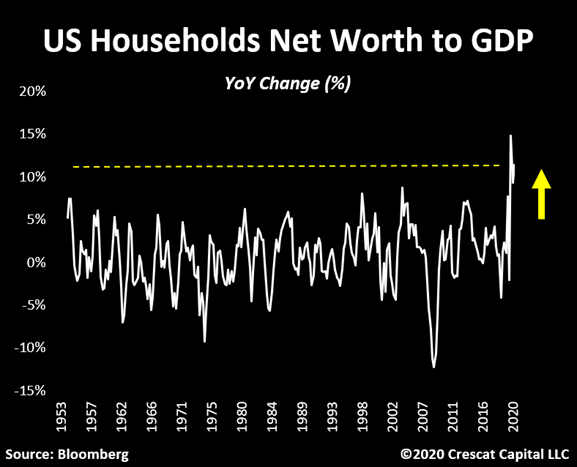
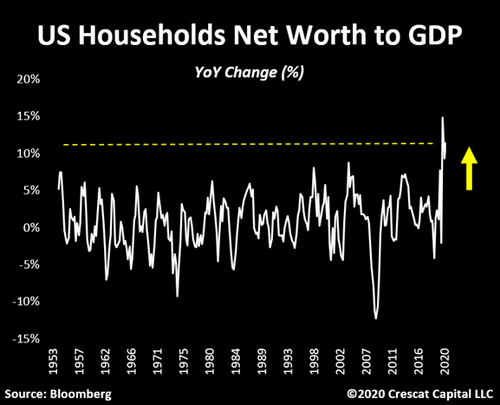
The central argument of the reflationary thesis is that a pent-up demand from consumers will likely cause explosive growth in the economy similar to the early 1920s. To be fair, financial conditions for US households have significantly improved. As shown in the chart below, their net worth is rising at the fastest pace since 1953, which also includes the largest wealth increase by the bottom 50% in history. Balance sheets also look the healthiest in a decade with the consumer deleveraging considerably, while savings rate remains elevate. This also means there is plenty cash on the sidelines. However, while we believe there is a strong probability that the re-opening of the economy will boost personal spending considerably, that is just one part of the story. By effectively creating the largest wealth transfer ever to the population, the US government now faces its own debt conundrum. The debt imbalances that restrain long-term economic growth were never resolved. Instead, they were transferred from the private sector to the government. In the wake of the pandemic, overall US debt to GDP has soared to record levels at the same time as the stock and credit markets have soared to new extremes. These are not the preconditions for a healthy reflationary environment nor the typical signs of an economy in the early stages of its business cycle.
We have yet to see a major reckoning for financial markets with asset valuations at record levels across virtually all asset classes aside from commodities. This brings us to the opposing bearish narrative. The dollar bull ‘deflationistas’, as they like to be called, have some important points to consider. Throughout history, speculative bubbles have always ended with brutal financial resets. Also, the dynamics behind “QE” are much more complex than the idea that money printing must always lead to higher consumer prices. In a deflationary reset, the debt burden tends to suck the liquidity out of the financial system causing a stock market crash, rising unemployment, and depressed consumer prices while money velocity collapses.

However, what we believe most, and what the deflationary camp fails to comprehend today, is that the economic and social impact of the current fiscal and monetary policies are completely different than what we experienced coming out of the last recession, which indeed was a deflationary one. From 2008 to 2011, the lower classes lost over 84% of their wealth, a clear deflationary backdrop. Since this time, on the other hand, the US bottom 50% just had its largest annual increase in net worth in history. Such is a force that would be hard not to have inflationary repercussions. Ultimately, a deflationary bust is a risk if one believes policy makers will undershoot their stimulus. Clearly, given the level of commitment and size of the monetary and fiscal policies, we believe overshooting is a much greater probability. We clearly have a ‘money party’ going on and no one can afford it to stop, especially the Fed.

Today’s deflationary debt imbalances are being met with a truly unprecedented inflationary response. So, how do we bridge the reflation and deflation narratives to find the appropriate middle ground? It is called the inflation camp. Yes, it is a bear camp, but it is not a deflationary one for consumer prices. It is important to point out that world history is full of inflationary financial market meltdowns as a consequence of too much debt. These include both hyperinflationary and stagflationary episodes where both stock and bond markets decline simultaneously, particularly when outright debt monetization is involved like we effectively have today. It is not all doom and gloom. We are bulls too. Bulls on commodities and basic resource stocks. We are raging bulls on precious metals exploration companies.

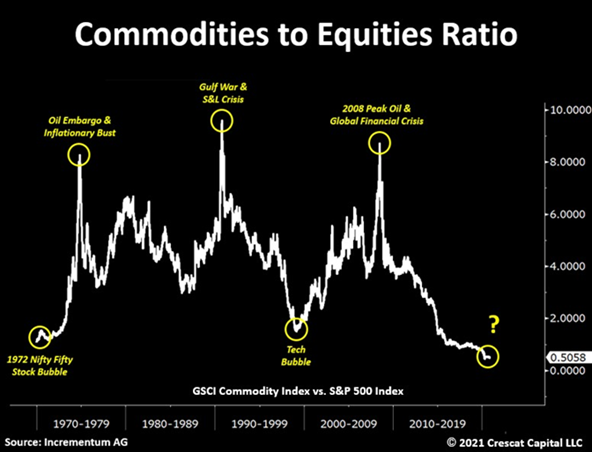
The combined stock and bond market is a speculative bubble and has been more than fully reflated already during the Covid-19 economic shutdown. As a result, the creative destruction process that we normally see at the depths of a business cycle, especially for traditionally cyclical companies, never happened. In 2020, we witnessed the first ever recession where stock prices soared. Without the economic purging that normally takes place in an economic downturn, the idea that we are poised for a robust and sustainable recovery is highly suspect. In terms of portfolio positioning, what is the logical way to be exposed? It comes down to our primary macro call: long commodities and short equities, but especially long precious metals.
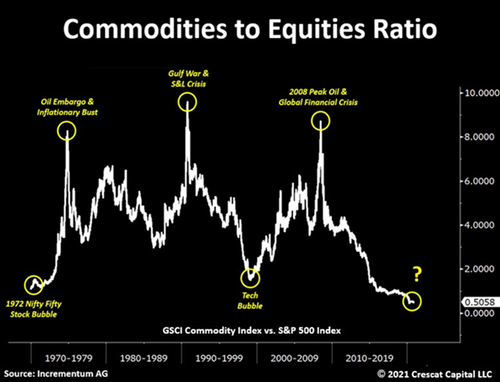
The short equity side of our portfolio can also perform well in a deflationary environment in case the Fed decides to tighten as the economy heats up. That was essentially the trigger of the last two recessions. We think the probability of this scenario happening again is significantly smaller. In terms of long commodities, we favor precious metals because they can work in both deflationary and inflationary environments, though they perform best under inflation when real interest rates are falling. In terms of the short equity side, we prefer overvalued large cap growth and technology stocks, the darlings of the last cycle, but also overvalued and overindebted zombie cyclicals that were not properly disassembled in the recession and do not represent value at all.

The need for extreme fiscal spending to mask the impairments in the economy entails a flood of Treasury issuances. With no sufficient buyers, the Fed must step in by expanding the monetary base to ensure subdued interest rates and allow the government to finance its debt and continue its wealth transfer and spending spree. This new demand is met with scarce supply due to underinvestment in the basic commodity resources of the forgotten old economy. Rising prices for food, energy, lumber, metals, etc. lead to cost push inflation throughout the supply chain. Some investors may be interpreting this macro dynamic as a healthy reflationary recovery. We believe there is a much greater probability that the economy is entering a disruptive long-term inflationary cycle.

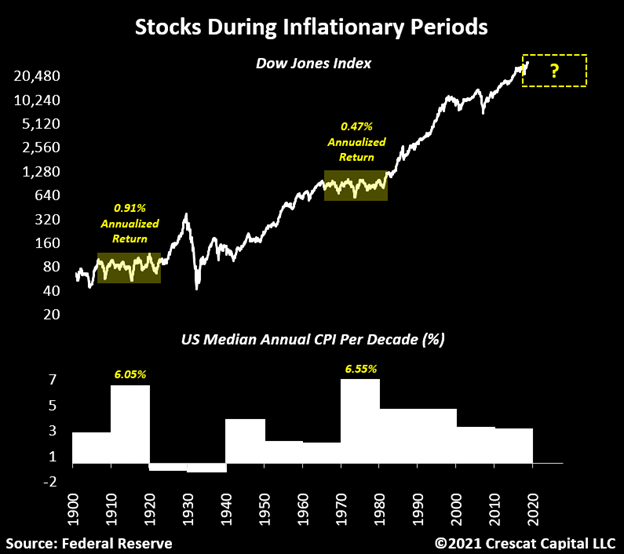
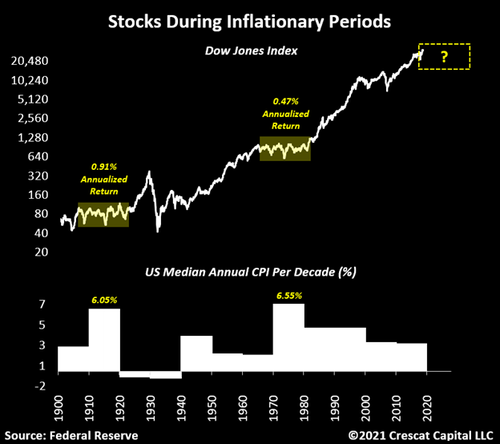
Since 1900, the US economy had two important inflationary periods, the 1910s and 1970s. Both times were marked by unique macro and geopolitical developments in which the median monthly YoY Consumer Prices Index (CPI) stood above 6% for an entire decade. The 1940s also had some sporadic spikes in CPI but, different than what most like to think, consumer prices did not consistently persist at high levels for the full 10-years. These inflationary periods were also marked by exceptionally low US equity returns. From January 1910 to December 1919, the Dow Jones had delivered a 0.91% annualized return. Similarly, from 1970 to 1980 stocks delivered a 0.47% annualized return. Considering the CPI index rates, real returns were negative for both decades. These were also very volatile periods accompanied by severe market crashes and major monetary developments. In December of 1913, President Woodrow Wilson signed the Federal Reserve Act into law. President Richard Nixon announced the end the dollar convertibility to gold in August 1971. With today’s mix of QE to infinity, “helicopter money”, 0% short-term interest rates, and World War II sized deficits, our base case is that this is the dawn of another long-term inflationary cycle. To recall, even though equities did not perform as well during the 10s and 70s, commodities did exceptionally well.
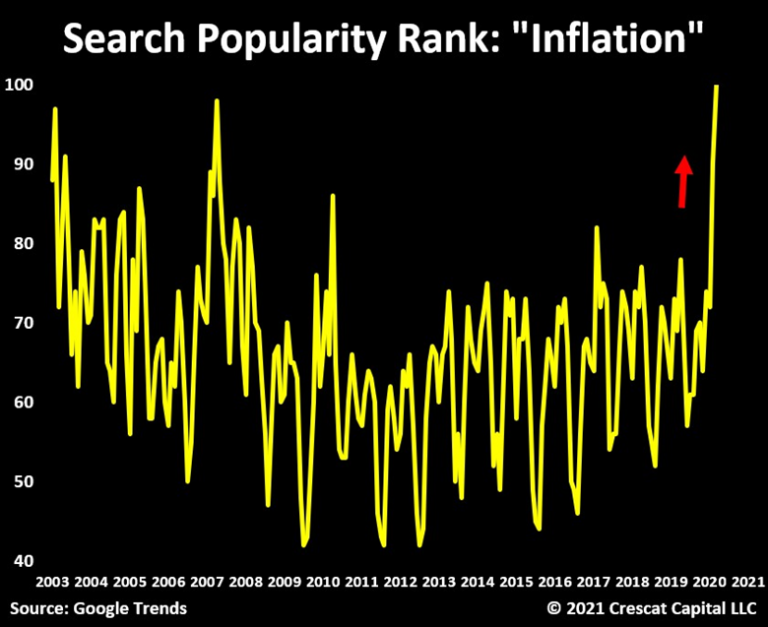
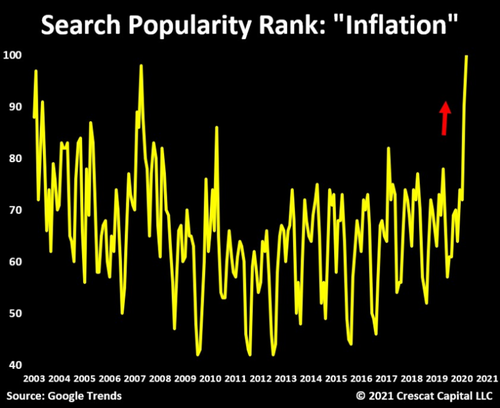
The popularity of the word “inflation” in Google searches has recently spiked to all-time highs as the monetary debasement narrative continues to gain momentum. While this surge may seem overextended, long-term inflationary cycles are often initiated by a general concern of the population in holding cash. By hoarding hard assets, investors create a self-reinforcing loop where higher prices of tangible assets lead to higher inflation expectations that then result in higher consumer good and service prices. Given the magnitude of the asset bubbles and debt imbalances in the economy today, we believe the Fed and the government will be forced to keep their aggressive stimulative policies in place for longer while being tolerant of an inflation overshoot.
A “Transitory” 13-Year High

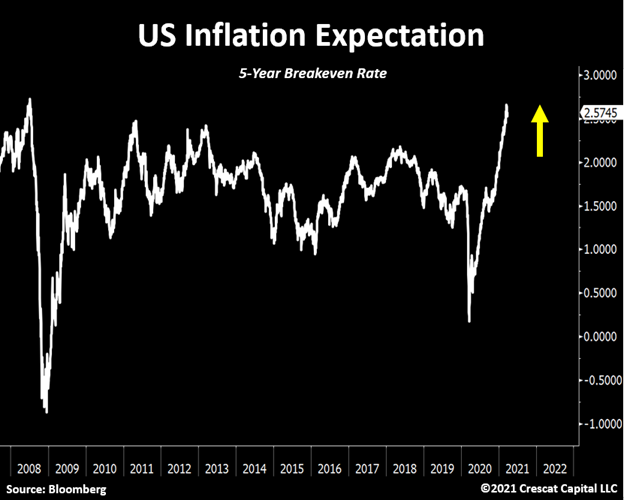
The Fed’s policy tools were originally designed to control money supply at times when economic conditions were either accelerating or decelerating. Today’s 5-year inflation expectation is reaching a 13-year high, but every monetary and fiscal policy in place is still pedal to the metal. M2 money supply just expanded by half a trillion in the last 8 weeks, the largest 2-month increase since June. The Fed’s QE pace is picking up significantly, now close to $300 billion worth of Treasury and mortgage-backed security in the last 2 months. The Fed Funds Rate also looks the same. As Jerome Powell likes to say, “We’re not even thinking about thinking about raising rates”. Fiscal spending, lastly, is even more radical with government deficits just reaching their worst level in 70-years. On the other hand, the overarching message from policy makers is essentially: Move along, nothing to see here. Sure, inflation is coming. We welcome it. But do not worry. It is just “transitory”.

It is true that central banks were able to get away with extreme stimulative packages without creating rising prices for most goods and services after the global financial crisis. We saw some inflation in medical costs, college tuitions, and other living expenses, but it was nothing close to what we experienced in a true inflationary period like the decade of the 1970s. In the easy money post the global financial crisis, inflation found its way into the domain of financial assets. Instead of a surge in consumer prices, aggressive monetary stimulus drove speculative asset bubbles in stocks and bonds. Now, in the Covid-19 recession and recovery, policy makers have added massive fiscal stimulus and direct wealth transfer (aka helicopter money) to the equation, or full modern monetary theory, creating a markedly different social and economic dynamic. We believe the stage is set for a substantial new inflationary cycle.
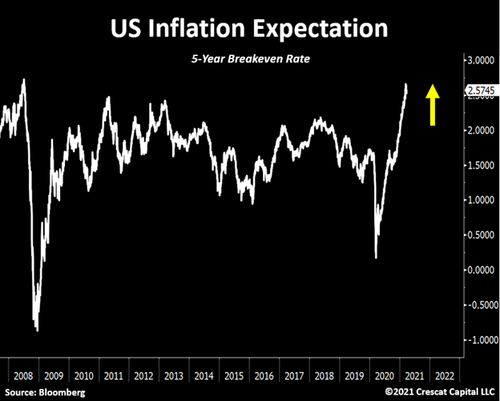
QE Re-accelerating

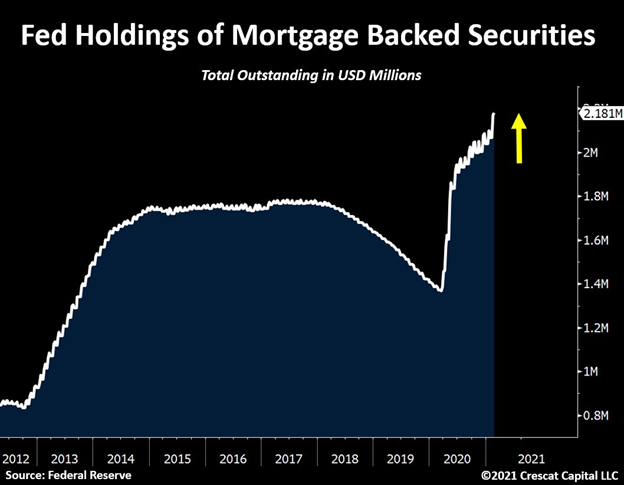
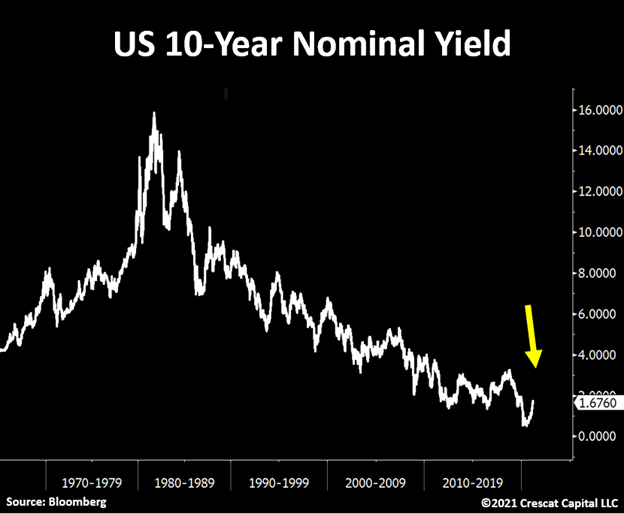
US 10-year yields have increased by 70 basis points in the last two months and the Fed had to engage in its largest buying spree of US debt since June 2020. For the sixth week straight, the Fed exceeded its minimum QE program amount of 120 billion, which consists of $80 billion of Treasuries plus $40 billion of mortgage-backed securities. Keep in mind that 90% of all Treasury purchases were longer duration Treasuries, mainly 5 to 7-year maturities. In other words, a non-trumpeted attempt at yield curve control (YCC) has already been underway. However, this stealth attempt has not been successful so far in preventing long dated yields from rising, therefore illustrating the liquidity sucking force of the massive debt pile and its thirst for more and more QE.
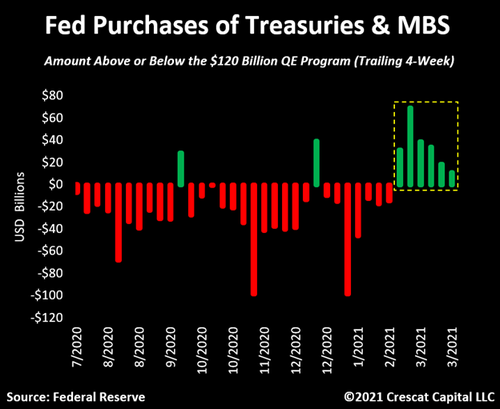
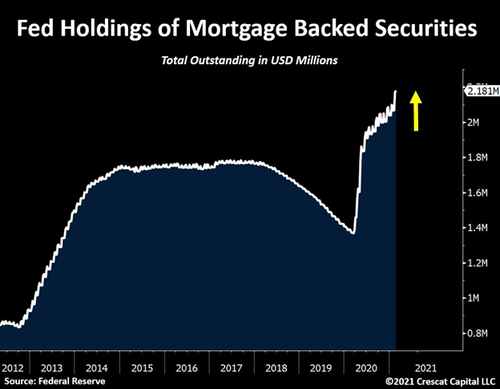
A House of Cards

Central banks are as trapped as they can be. Since the beginning of the year, 10-year yields have moved from 1.6 to 2.4% and, therefore, creating significant pressure on mortgage rates to rise. To tamp down these forces, the Fed also had to increase its purchases of mortgage-backed securities (MBS). It has bought over $60 billion of MBS since February. If long-term interest rates continue to rise, the housing market could come under pressure. Remember, the bottom 50% own over 51% of their overall assets in real estate. It is critical for the Fed to suppress rates and prop up the housing market.
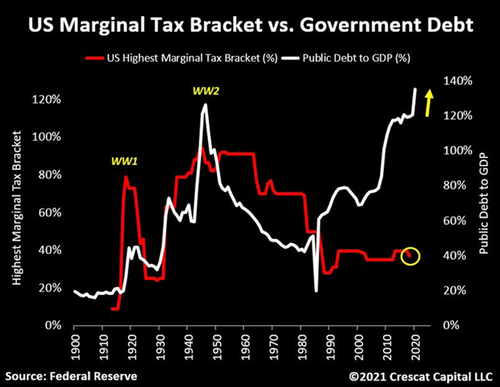
Tax Payers on the Hook

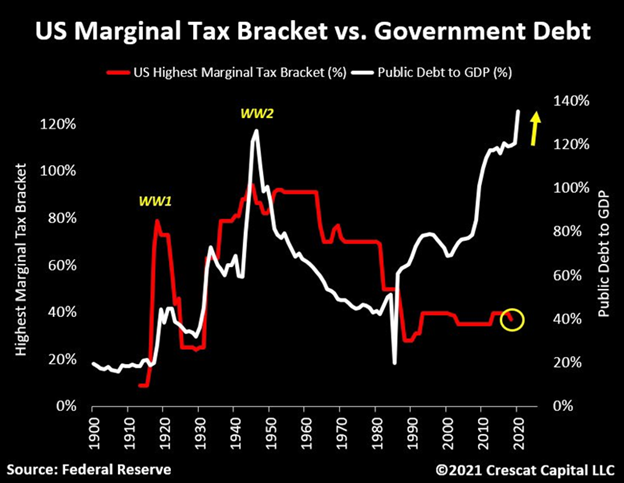
This is perhaps one of the most important charts today. Tax rates have followed government debt almost perfectly throughout history. Fiscal excess leads to higher income taxes, like it or not. The divergence between the two lines below is unsustainable. The Fed will not be able to pay for this wall of debt alone. Individual and corporate tax rates will rise. But because new tax legislation is not official yet, most Wall Street analysts have not factored it into their earnings estimates, leaving them too optimistic.
Another Disconnect

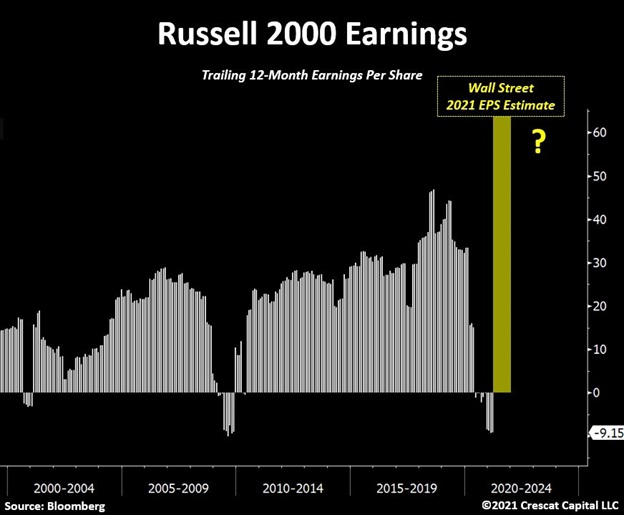
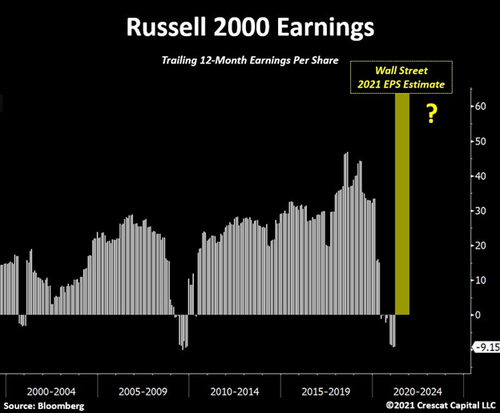
There is a high probability that the same disconnect between financial markets and the economy we had last year might redevelop in 2021. However, instead, the roles will likely be reversed. We believe most of the good news about the reopening of the economy is already priced in. Wall Street analysts are now estimating that small cap earnings for 2021 will be almost 40% higher than the previous highs in 2018. This level of optimism perfectly reflects the euphoric environment we are in.
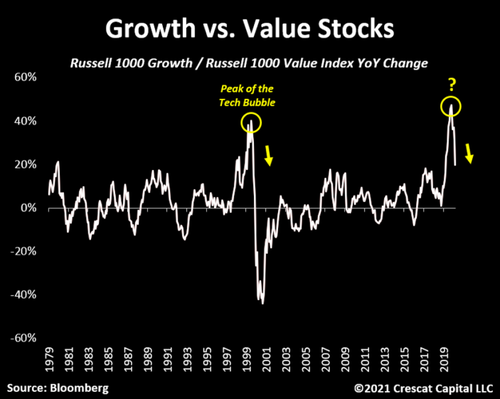
The Great Rotation

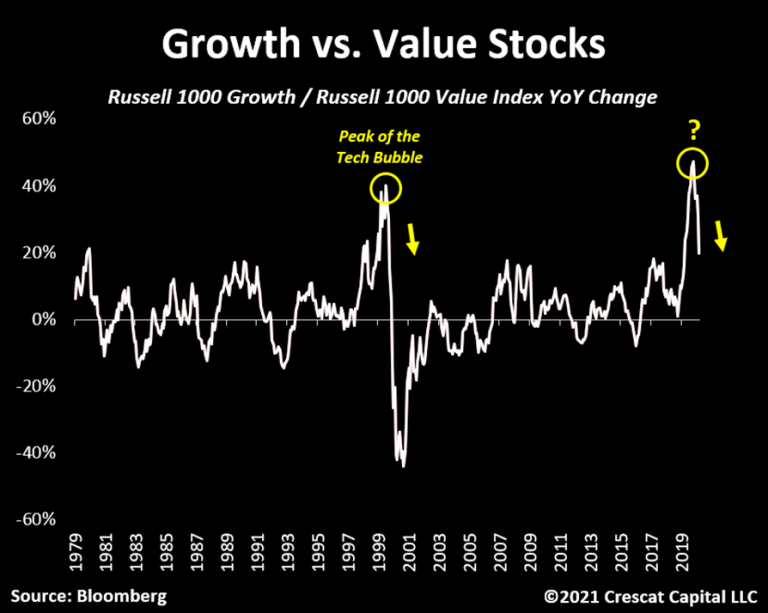
A major shift away from growth stocks and into value stocks is underway. In a similar fashion, the same underperformance of high-flying large cap growth and tech stocks relative to value stocks marked the beginning of the tech bust from 2000-02 which turned into a major economic downturn and overall crash for stocks at large.
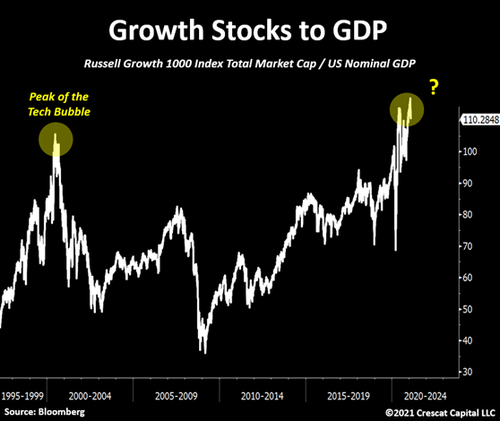
According to our models, the entire universe of stocks is more overvalued than it was at the height of the tech bubble. The area of true value today is narrow and much more likely to be found in the commodities, energy and materials sectors of the stock market. What we call “The Great Rotation” is about financial asset bubbles that have progressively built up for four decades finally being reconciled in reflexively self-reinforcing inflation. The US equity and fixed income markets have experienced an unsustainable four straight decades of declining interest rates and inflation. In this span, we have had five economic expansions and recessions with ever greater overall debt to GDP persistently growing throughout to the point we are perversely exiting this latest recession with the highest debt and largest valuation imbalances yet.

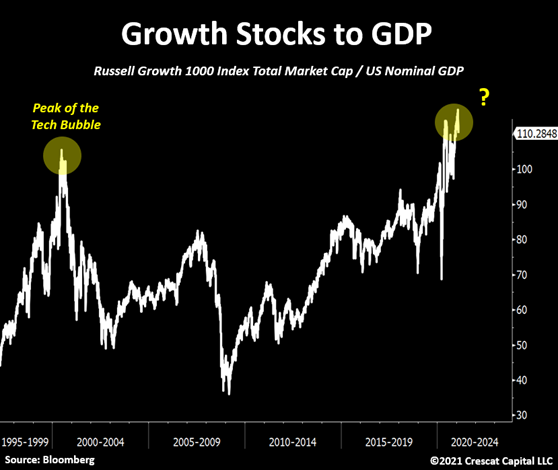
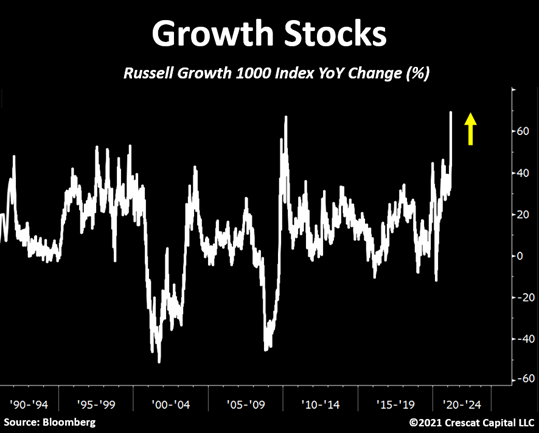
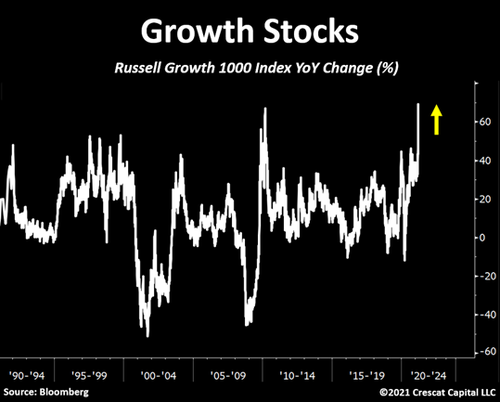
Growth stocks, composed by 45% of tech companies, represent a larger part of financial markets today than any other time in history. The total market cap for the Russell Growth 1000 Index relative to US nominal GDP is now at 110%, which compares with 105% at the very peak of the tech bubble.
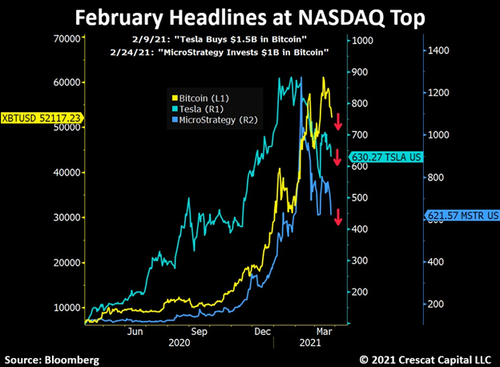
More Signs of a Top

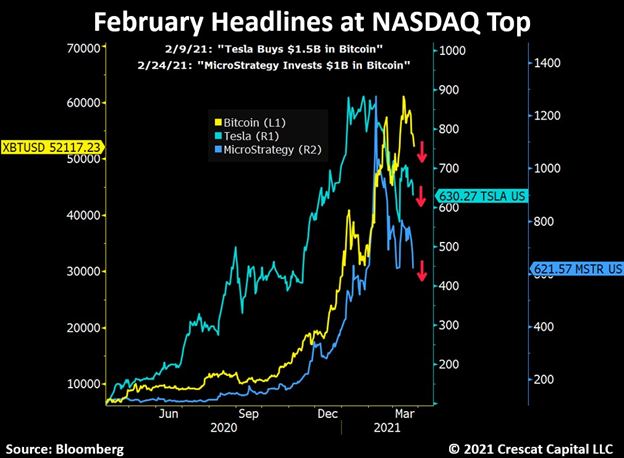
Last year’s darlings are now under pressure. Look at the headlines surrounding the recent peak in the NASDAQ 100 and NADSAQ Composite. We don’t think the bitcoin will ever replace gold as a central bank reserve asset. Crypto enthusiasts have some valid macro agruments against fiat currencies that we share. However, we also believe that speculation in the crypto space is excessive and creating additional risks in the financial markets today.
Late Stages of the Business Cycle

Here is another example of the level of speculative excesses in the market. Growth stocks just had their strongest year-over-year appreciation in history. Such large moves tend to happen at either the early or the late stages of the business cycle. Valuation factors should serve as a guide when trying to identify which one of these two parts of the cycle we are in. Given the fact that the Russell Growth 1000 Index currently trades at 30 times its aggregate earnings estimate for 2022, we think it is more probable that equity markets are much closer to the peak than the bottom.
A Looming Public Debt Crisis

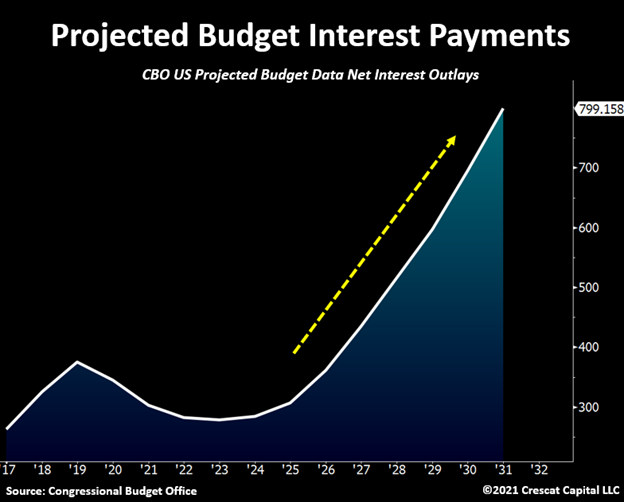
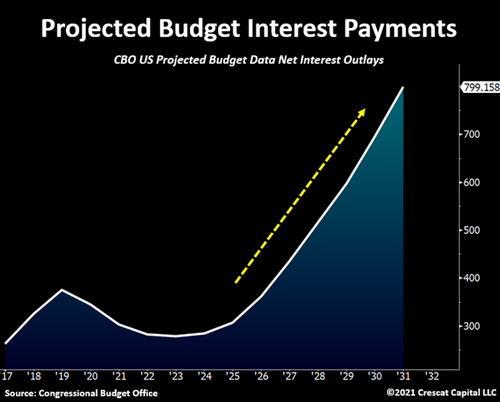
The government also recently increased its spending pace significantly. In January and February alone, it spent over $1.1 trillion, or the largest two-month amount since July. In comparison, it collected less than 60% of that amount in taxes. Long story short, public debt continues to grow at an unprecedented pace. Meanwhile, the Congressional Budget Office (CBO) projects that the Federal budget net interest expense will soar by $800 billion per year over the next decade. To clarify, the CBO’s estimate does not factor in another economic downturn along the way. We believe the estimate will fall short. The rising Treasury debt burden and deficits are necessarily forcing the Fed into the position of debt monetization which drives real interest rates lower and lower in negative territory and allows the Treasury to effectively collect an inflation tax. Systematic tamping down of the CPI plays a role given our government’s enormous off balance sheet Social Security and Medicare liabilities which are cost-of-living adjusted. 
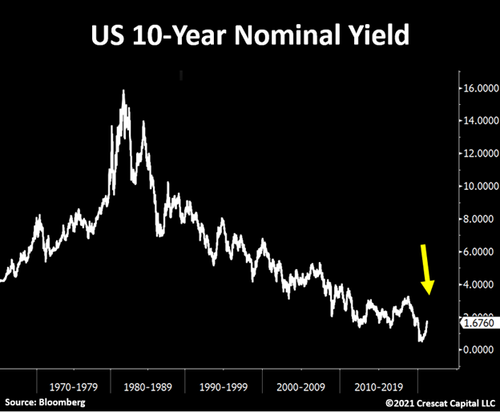
With the recent increase in long-term interest rates, financial conditions tightened slightly from a record loose state. Stocks, at historic valuations, suffered as a result. Nominal rates moved even higher than the move up in inflation expectations, causing real rates to rise slightly which added short term pressure on gold. In our view, the fact that financial markets are being impacted by 10-year yield that is still sub 2% speaks volumes about the fragility of the US economy.
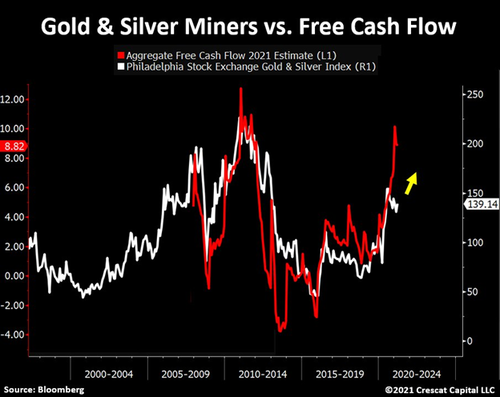
Miner’s Free-Cash-Flow on the Rise

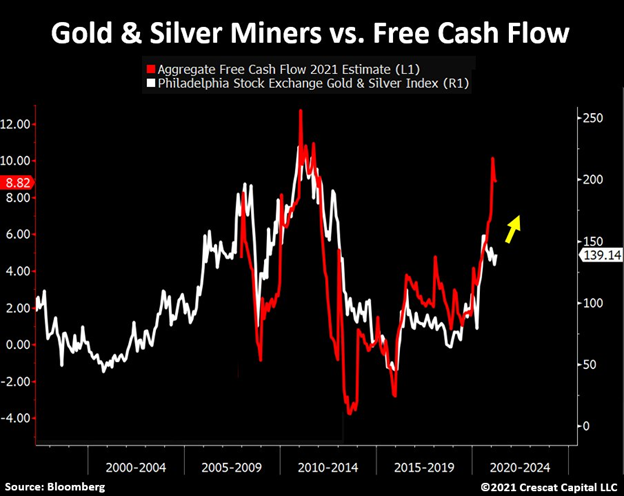
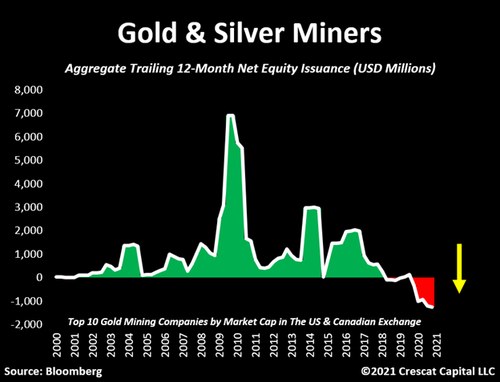
Gold and silver companies continue to report exceptionally strong fundamentals. Free-cash-flow estimate for miners keeps improving despite the recent correction in precious metals. As we have seen throughout history, stocks tend to follow fundamental growth. We believe there is a major catch up in prices ahead of us.
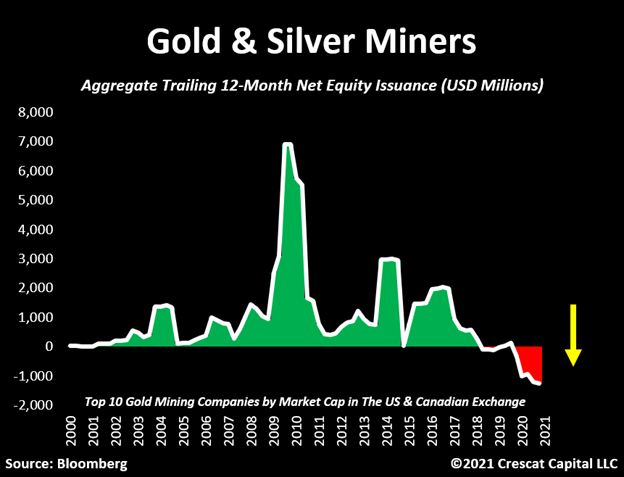
There used to be a time when all gold and silver miners would do was to invest in unproductive assets and dilute their capital structure to pay for it. Those days are over. For the first time in history, aggregate net equity issuance for the top 10 precious metals mining companies is now falling. In other words, these companies are buying back stock like we have never seen before. These are fundamentally cheap stocks that continue to benefit from this macro environment.
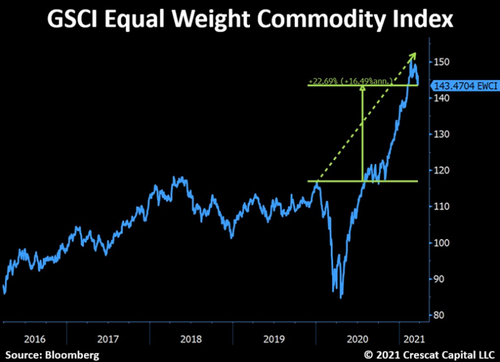
Commodity Inflation

Inflation is coming. Cost-push inflation starts with rising commodity prices. An equal weighted commodity basket is already up 23% from pre Covid-19 highs. Imagine what it will look like when the economy re-opens.
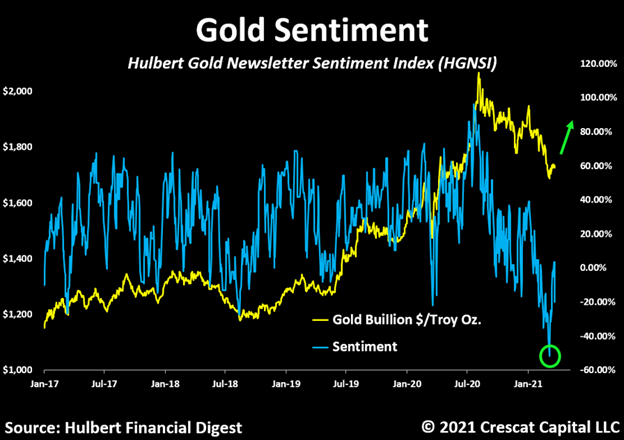
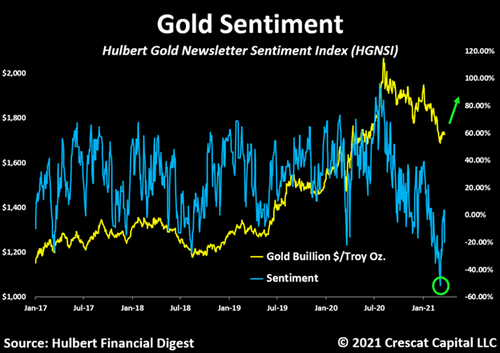
Gold Sentiment Buy Signal

Gold sentiment became extremely negative recently, pulling gold prices down with it, a contrarian buy signal early in a new long-term inflation cycle. The precious metals bull market only began a year ago according to silver and junior miners. If it were after a 10-year run up already, a shift to negative sentiment would be a different story. Bull markets climb a wall of worry. We see it as a great opportunity to buy the pullback.
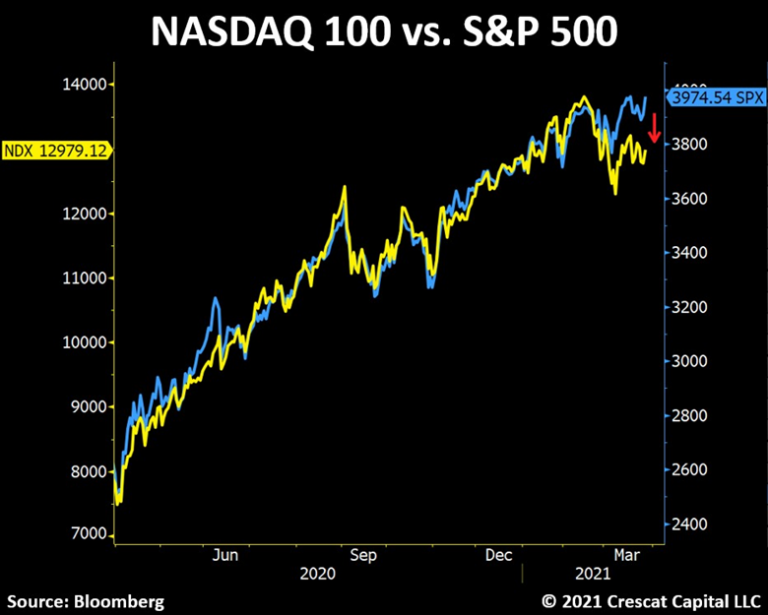
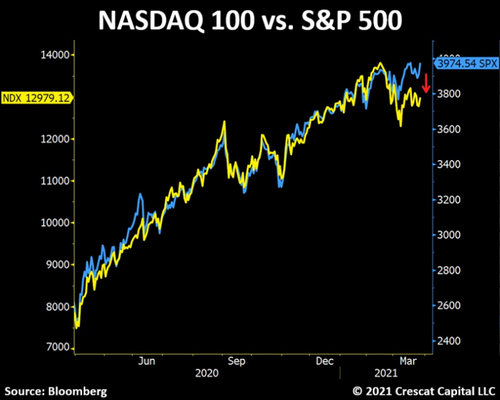
NASDAQ Divergence Sell Signal

The Nasdaq 100 is rolling over while the S&P 500 is still making new highs. Inflationary forces are picking up driving investors out of long duration growth stocks with excessive valuations. This is similar to the beginnings of the 1973-74 bear market and 2000-02 tech bust.
Crescat Activist Gold Strategy

We are positioned for a rising macro precious metals price environment through a handpicked portfolio of predominantly exploration focused mining companies. These companies are focused on aggressive resource growth in viable mining jurisdictions around the world and have outstanding management teams. They own mining claims and are actively exploring many of the most prospective new high-grade gold and silver deposits around the world, according to Crescat’s proprietary research. The portfolio is thoroughly vetted by the Crescat investment team including its Geologic and Technical Advisor, world renowned exploration geologist, Quinton Hennigh, PhD.

We strongly believe there will be a high demand from the majors for our companies to continue overall industrywide production growth.

Such is the scale of what we believe we have already accomplished with our current portfolio in the last year. We plan to continue to grow our overall target resource through activist investing and technical advice to build high grade gold ounces in the ground. This is the opportunity that Crescat has already seized on the last year to surgically pick up the best prizes among global exploration assets after a ten-year bear market. 

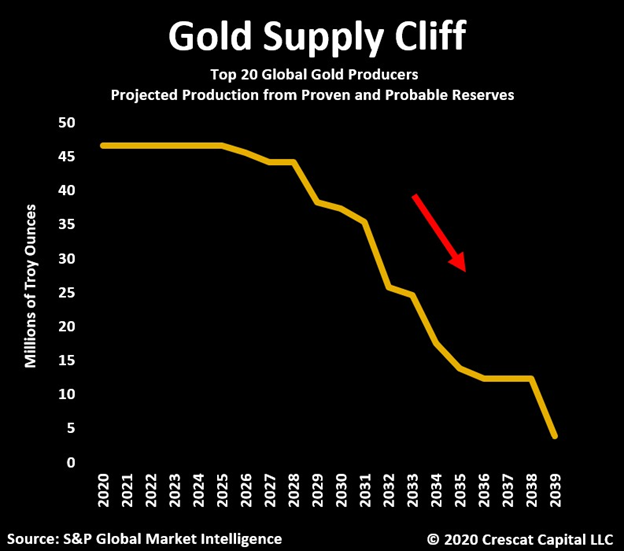
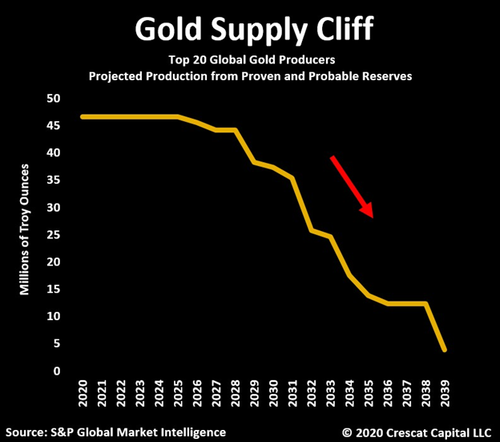
The majors have underinvested in replacing their reserves creating an industry supply cliff that is extraordinarily bullish for gold and silver prices. At the same time, investor demand for hard assets is poised to strengthen substantial under a macro backdrop of rising inflation. The major gold producers are enjoying record free cash flow today, but it is a short-sighted fix due to underinvestment in exploration and CAPEX. They are coasting off existing reserves with dwindling mine lives. Their party will end because remaining mine lives and reserves have been running down. They will need to replace their reserves. They will have very few places to go to do that. Because they choose not to invest organically, we believe they will be looking to our portfolio companies as acquisition candidates.
The macro outlook for a new secular bull market for mining companies is in the early innings. Our goal is to create the premier new gold and silver deposits of the next decade. We know what the majors want and need. They are not interested in the passed over old low grade deposits of the last cycle that will not be viable under almost any gold price environment. They need the large high-grade new deposits in mineable regions around the world. These are companies that the majors will pay a premium to acquire and this is what we believe to be in our portfolio. Our strategy is not solely dependent on acquisition, however. These companies can go into development and production on their own. In fact, many of them are on that path and some are already producing.

The setup today for precious metals is outstanding given supply constraints, rising inflation expectations, asset bubbles in traditional financial assets, record debt to GDP, double barreled fiscal and monetary stimulus, negative and declining real interest rates. The new bull market only started in March of 2020 after a ten-year bear. That is when junior miners and silver successfully made a double bottom retest of the 2016 lows with silver making a lower low. The last two major gold bull markets have similarly lasted 10 years, essentially the decade of the 1970s and the decade of the 2000s. We expect our activist precious metals portfolio to lead to substantial returns for our limited partners over the next three to five years. 

We believe the recent pullback in the precious metals asset class since August 2020 presents an excellent entry point for new and existing investors to add money to our most important macro theme today. We call it Global Fiat Debasement and it is expressed across all Crescat strategies today.

Tyler Durden
Fri, 04/02/2021 – 14:45

via ZeroHedge News https://ift.tt/3miEUNg Tyler Durden

California Court Refuses to Apply Iranian Law, in Part Because It Reflects Religious Ideology Rather Than Economic Interest

In Sabetian v. Fluor Enterprises, Inc., decided a week ago by the California Court of Appeal (Justices Feuer, Perluss & Segal), Houshang Sabetian worked in Iran from 1959 to 1979, as an Iranian citizen, for the National Iranian Oil Company. He claimed that asbestos exposure at the facility caused testicular mesothelioma, and because of that the loss of his right testicle; the jury agreed, and found that the defendants, who were involved in constructing the facility, were negligent.

One question was what law applied—the law of Iran, or the law of California, the state to which Sabetian eventually moved after the asbestos exposure took place. In McCann v. Foster Wheeler LLC (Cal. 2010), the California Supreme Court dealt with a similar situation but involving Oklahoma law, and concluded Oklahoma law applied:

In light of the relevant facts of this case, we conclude that a failure to apply Oklahoma law would significantly impair Oklahoma’s interest. The conduct for which plaintiff contends Foster Wheeler should be held liable—plaintiff’s alleged exposure to asbestos during the application of insulation to a boiler designed and manufactured by Foster Wheeler—occurred in Oklahoma in 1957, at a time when plaintiff was present in Oklahoma and was an Oklahoma resident. As already discussed, the circumstance that Foster Wheeler is not an Oklahoma company—the circumstance relied upon by the Court of Appeal—is not a persuasive basis for finding that the failure to apply Oklahoma law would not significantly impair Oklahoma’s interest. Oklahoma’s interest in the application of its statute of repose applies equally to out-of-state businesses that design improvements to real property located in Oklahoma and to Oklahoma businesses that design such improvements situated within that state.

But here the Court of Appeal refused to apply Iranian law, in this case the Iranian law of damages:

[D]efendants filed a declaration from Mahmoud Katirai, an Iranian lawyer and scholar of Iranian law. On the issue of compensatory damages for personal injury, Katirai opined, “Under Iranian law, [p]laintiffs’ remedies are limited to a statutory compensation (‘diyeh’) pre-determined by the legislature, plus financial damages such as medical expenses and loss of income…. This statutory compensation, which is based on Islamic law, has been codified in the Islamic [Penal Code of Iran], but are of [a] civil nature….

“Statutory compensation … calls for payment in certain commodities[;] … since payment in such commodities is no longer practical, however, the price of such commodities is determined each year by virtue of a decree of the Department of Justice[,] and Iranian courts are required to award [a] remedy based on such decision. Presently, the amount of the statutory compensation in cases of death is 2,310,000,000 Rials. During certain lunar months (i.e., Zel-ghadeh, Zel-hajeh, Rajab, and Moharam) which are called ‘haram’ (celebratory months), the amount of the statutory compensation in cases of death is 3,080,000,000 Rials.” … Sabetian’s recovery for his physical injury was … limited to a maximum of two times the amount allowed for a single injury, 5.4 billion Rials (approximately $128,000)….

[Under the California choice of law rule,] we must “examine ‘each jurisdiction’s interest in the application of its own law under the circumstances of the particular case to determine whether a true conflict exists.'” The Fluor defendants do not dispute California has a legitimate governmental interest in having its law applied. The principal purpose of a damages award under California tort law is “to compensate a wrongfully injured party for injury to person or property.” As the McCann court observed, application of California law “to a current California resident who suffers an … illness as a result of his … prior exposure to asbestos in another jurisdiction would assist such residents in obtaining compensation for their injuries and in not becoming dependent on the resources of California for necessary medical, disability, and unemployment benefits.” Thus, California’s interest is substantial.

We disagree, however, with the Fluor defendants’ characterization of Iran’s interest as the promotion and protection of foreign investment in Iran. We must evaluate Iran’s interest in the context of the particular Iranian law the Fluor defendants seek to apply.

The Fluor defendants assert the salient Iranian interest at issue is embodied in its Foreign Investment Act, which protects foreign companies doing business in Iran by applying Iranian law to claims arising from conduct in Iran. But the Fluor defendants seek to impose the limitation on compensation for personal injury actions as codified in the Islamic Penal Code of Iran “based on Islamic law,” which provides statutory compensation as “provided in the [holy] religion” to compensate for unintentional conduct resulting in the “loss of a member.”

The evidence submitted by the Fluor defendants highlights this interest served by Iranian law. They submitted an Iranian news article characterizing statutory compensation as the amount due to “a Muslim male” in a particular calendar year, as well as evidence showing the amount of statutory compensation depended on whether the victim’s loss occurred in one of the “sacred” months of the year. In the case of the loss of a testicle, the Islamic Penal Code of Iran specifies payment of one-third the amount of full statutory compensation for removal of the right testicle, and two-thirds of the amount for the left, plus an additional proportion of the statutory compensation for impairment to general health. There can be no dispute these rules are “based on Islamic standards.”

{Evidence submitted in support of the supplemental declaration indicates, without qualification, “during the sacred [haram] months, the [statutory compensation] amount would be increased by one third.” Regardless of whether the rule would apply to Sabetian in this case, the variation in prescribed recovery by reference to the sacred months of the Iranian calendar illustrates the essential religious nature of Iran’s law of statutory compensation.} …

[O]ur task is not to determine … [which] rule is the better or worthier rule, but rather to decide—in light of the legal question at issue and the relevant state interests at stake—which jurisdiction should be allocated the predominating lawmaking power under the circumstances of the present case.”

The Fluor defendants are correct that “a jurisdiction ordinarily has the ‘predominant interest’ in regulating conduct that occurs within its borders, and in being able to assure individuals and commercial entities operating within its territory that applicable limitations on liability set forth in the jurisdiction’s law will be available to those individuals and businesses in the event they are faced with litigation in the future.”  McCann. That argument has some force here, where Sabetian’s injury was caused by conduct that occurred in Iran while he was a resident of that country.

But the concern in McCann—that applying California’s law would prevent Oklahoma from providing “any reasonable assurance … that the time limitation embodied in its statute would operate to protect … businesses in the future”—does not apply with the same force to the present circumstances where the Iranian law at issue does not seek to promote and protect foreign businesses with domestic business dealings, but rather, to ensure damages awards are consonant with state-endorsed religious teachings.

California’s interest in protecting recovery of damages for injuries suffered by its residents would be severely impaired if Iranian law applied in light of the significant reduction in recovery under Iran’s statutory compensation scheme. Sabetian suffered his injury while a resident of California [presumably because the initial exposure when he was an Iranian citizen led to disease after he moved to California -EV], and California has an interest in ensuring that Sabetian is fully compensated so he does not become dependent on California’s resources for necessary medical, disability, and unemployment benefits. By contrast, Iran’s interest in limiting damages paid by a foreign company to a California resident in accordance with the tenets of Islamic law (the same as Iranian companies) is relatively weak. Thus, California law applies to the Sabetians’ recovery of compensatory damages.

I’m pretty skeptical about this analysis, but in any event I thought some of our readers might find it interesting.

from Latest – Reason.com https://ift.tt/3dsSTMh
via IFTTT