Did the Supreme Court’s DACA Decision Lead to the Biden Administration’s “Remain in Mexico” Defeat?

My initial reaction to the Supreme Court’s decision denying the Biden Administration’s to preserve its repeal of the Trump Administration’s Migrant Protection Protocol (MPP, better known as “Remain in Mexico”) policy was that this decision logically followed from the Supreme Court’s decision in DHS v. Regents of the University of California. It seems to me the two decisions reflect a new standard for judicial review of discretionary policies in the immigration context, and that this is not a positive development.

Over at Notice & Comment (a must-read for the AdLaw interested), Professor Zach Price offers a similar assessment with which I generally agree. A taste:

Like DACA, the Remain-in-Mexico policy should have been revocable with little or no explanation. Not only is the authority to return migrants discretionary, not mandatory, but returning them in large numbers to a neighboring country could raise delicate diplomatic questions that require a variable policy over time. Absent a more specific statutory mandate, courts have no business freezing executive policies like this in place.

In the waning days of the Trump Administration, however, Texas entered an agreement with the federal government guaranteeing advance notice prior to any rescission of Remain-in-Mexico. So, when the Biden Administration nevertheless rescinded the policy, Texas and Missouri sued, and a district court enjoined the administration from terminating the policy. Invoking UC Regents, the Fifth Circuit affirmed. It reasoned that, as with the Trump Administration’s explanation for the DACA repeal, the government’s explanation of the policy change showed inadequate consideration for Texas’s reliance interests and other potential negative effects of the policy change. In a terse order, the Supreme Court denied the government’s request for a stay pending appeal. Citing UC Regents, the Court declared simply that “[t]he applicants have failed to show a likelihood of success on the claim that the memorandum rescinding the Migrant Protection Protocols was not arbitrary and capricious.”

As should be clear, both UC Regents and the Fifth Circuit’s Remain-in-Mexico decision strike me as erroneous. But they are flawed in parallel ways

Not all concur in this view, however. Professor Ben Eidelson has offered this response to Prof. Price. Prof. Eidelson writes (in part):

while the two cases may appear alike—in each, the Court demanded a better explanation for the administration’s rescission of a discretionary immigration-enforcement policy—the legal merits are very different. So, as I’ll explain here, no rule of consistency requires those who supported the Court’s decision blocking the DACA rescission to view this latest order as relevantly alike. And far from being logically inevitable, the new majority’s refusal to distinguish between the two cases was a regrettable and entirely avoidable mistake. . . .

To the extent that Regents does bear on the Remain-in-Mexico case, it is only because of the Regents Court’s alternative holding—namely, that Secretary Duke had “failed to address whether there was ‘legitimate reliance’ on the DACA Memorandum.” Again, it bears emphasis that one could think this second holding was entirely misguided and still appreciate that the proper outcomes as to the DACA and Remain-in-Mexico rescissions were different. Even if Regents‘ “reliance” analysis did support the result in the Remain-in-Mexico case, therefore, it would still be wrong to say that progressives are somehow paying the fair price for persuading the Court of the DACA rescission’s illegality. At most, they would be paying a price for the Court’s inclusion of an unnecessary alternative holding in its Regents opinion.

But even that isn’t right, because the cases are eminently distinguishable from the perspective of Regents‘ second holding, too. The key point is that, in the DACA case, the operative decision memorandum totally failed to acknowledge or discuss any real-world consequences of the rescission. (A later memorandum was dismissed, rightly in my view, as a post hoc rationalization.) That disregard of consequences is just what one should expect in a decision predicated solely on a claim of legal compulsion: By the lights of the agency’s own reasoning, the real-world effects were irrelevant. So there was no indication that the pros and cons of rescinding DACA, as a matter of immigration policy, had been considered at all. And if one took the agency’s own explanation seriously, one would have to assume that they had not been.

For those interested in these questions, both essays are highly recommended.

from Latest – Reason.com https://ift.tt/3jB9hia
via IFTTT

Virgin Galactic Shares Plunge As FAA Grounds Flights Pending Probe

Virgin Galactic Shares Plunge As FAA Grounds Flights Pending Probe

On the heels of reports that Virgin Galactic’s space ship carrying billionaire Richard Branson and others deviated from its approved flight path on a July trip, the US FAA opened a probe and grounded all further flights until the investigation is complete.

Virgin Galactic may not return the SpaceShipTwo vehicle to flight until the FAA approves the final mishap investigation report or determines the issues related to the mishap do not affect public safety,” the FAA said in an emailed statement.

The New Yorker first reported the probe, claiming that the flight encountered high winds and flew outside its designated airspace for 1 minute, 41 seconds.

Virgin responded to The New Yorker by saying the report was “misleading” and that the flight was “safe and successful,” adding that the ship didn’t “travel above any population centers or cause a hazard to the public.”

“As we move towards commercial service, we are confident we have the right safety culture, policies and processes in place to build and operate a safe and successful business over the long term,” the company said in an emailed statement Wednesday.

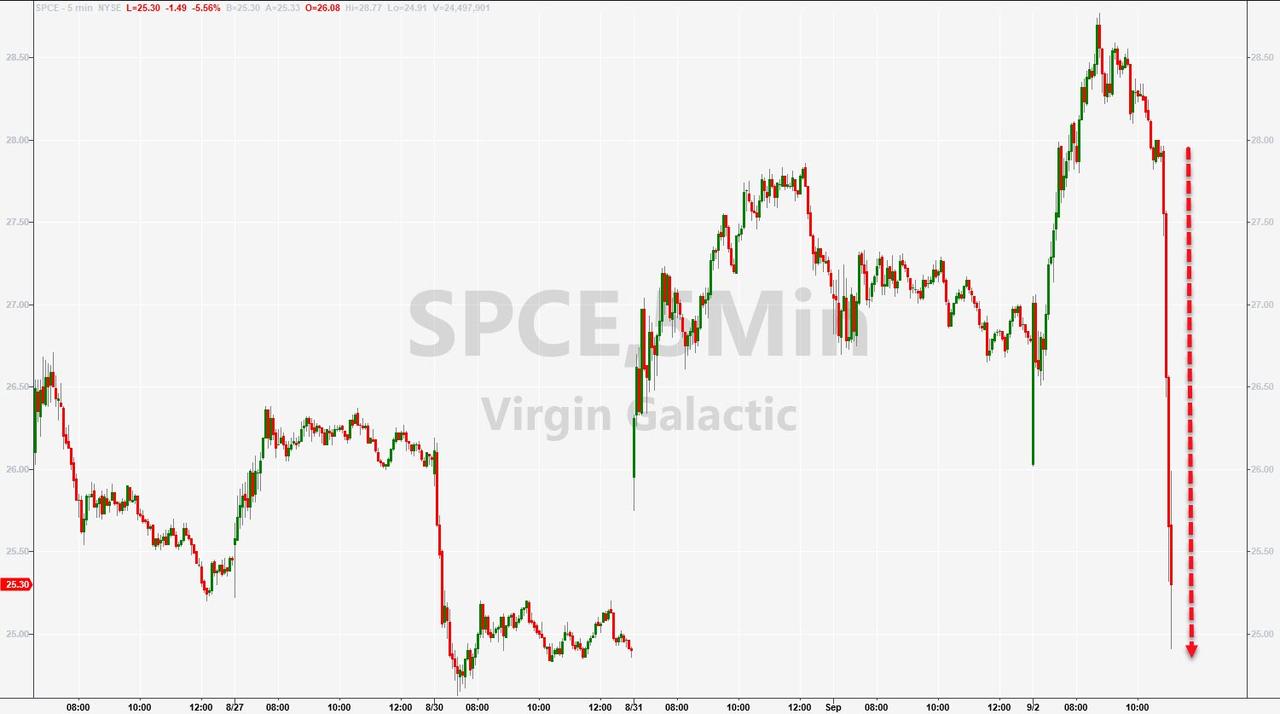
SPCE shares are tumbling on the news…

Virgin Galactic was planning its next suborbital spaceflight late this month or in early October.

Tyler Durden
Thu, 09/02/2021 – 14:10

via ZeroHedge News https://ift.tt/3gZ1mJH Tyler Durden

Did the Supreme Court’s DACA Decision Lead to the Biden Administration’s “Remain in Mexico” Defeat?

My initial reaction to the Supreme Court’s decision denying the Biden Administration’s to preserve its repeal of the Trump Administration’s Migrant Protection Protocol (MPP, better known as “Remain in Mexico”) policy was that this decision logically followed from the Supreme Court’s decision in DHS v. Regents of the University of California. It seems to me the two decisions reflect a new standard for judicial review of discretionary policies in the immigration context, and that this is not a positive development.

Over at Notice & Comment (a must-read for the AdLaw interested), Professor Zach Price offers a similar assessment with which I generally agree. A taste:

Like DACA, the Remain-in-Mexico policy should have been revocable with little or no explanation. Not only is the authority to return migrants discretionary, not mandatory, but returning them in large numbers to a neighboring country could raise delicate diplomatic questions that require a variable policy over time. Absent a more specific statutory mandate, courts have no business freezing executive policies like this in place.

In the waning days of the Trump Administration, however, Texas entered an agreement with the federal government guaranteeing advance notice prior to any rescission of Remain-in-Mexico. So, when the Biden Administration nevertheless rescinded the policy, Texas and Missouri sued, and a district court enjoined the administration from terminating the policy. Invoking UC Regents, the Fifth Circuit affirmed. It reasoned that, as with the Trump Administration’s explanation for the DACA repeal, the government’s explanation of the policy change showed inadequate consideration for Texas’s reliance interests and other potential negative effects of the policy change. In a terse order, the Supreme Court denied the government’s request for a stay pending appeal. Citing UC Regents, the Court declared simply that “[t]he applicants have failed to show a likelihood of success on the claim that the memorandum rescinding the Migrant Protection Protocols was not arbitrary and capricious.”

As should be clear, both UC Regents and the Fifth Circuit’s Remain-in-Mexico decision strike me as erroneous. But they are flawed in parallel ways

Not all concur in this view, however. Professor Ben Eidelson has offered this response to Prof. Price. Prof. Eidelson writes (in part):

while the two cases may appear alike—in each, the Court demanded a better explanation for the administration’s rescission of a discretionary immigration-enforcement policy—the legal merits are very different. So, as I’ll explain here, no rule of consistency requires those who supported the Court’s decision blocking the DACA rescission to view this latest order as relevantly alike. And far from being logically inevitable, the new majority’s refusal to distinguish between the two cases was a regrettable and entirely avoidable mistake. . . .

To the extent that Regents does bear on the Remain-in-Mexico case, it is only because of the Regents Court’s alternative holding—namely, that Secretary Duke had “failed to address whether there was ‘legitimate reliance’ on the DACA Memorandum.” Again, it bears emphasis that one could think this second holding was entirely misguided and still appreciate that the proper outcomes as to the DACA and Remain-in-Mexico rescissions were different. Even if Regents‘ “reliance” analysis did support the result in the Remain-in-Mexico case, therefore, it would still be wrong to say that progressives are somehow paying the fair price for persuading the Court of the DACA rescission’s illegality. At most, they would be paying a price for the Court’s inclusion of an unnecessary alternative holding in its Regents opinion.

But even that isn’t right, because the cases are eminently distinguishable from the perspective of Regents‘ second holding, too. The key point is that, in the DACA case, the operative decision memorandum totally failed to acknowledge or discuss any real-world consequences of the rescission. (A later memorandum was dismissed, rightly in my view, as a post hoc rationalization.) That disregard of consequences is just what one should expect in a decision predicated solely on a claim of legal compulsion: By the lights of the agency’s own reasoning, the real-world effects were irrelevant. So there was no indication that the pros and cons of rescinding DACA, as a matter of immigration policy, had been considered at all. And if one took the agency’s own explanation seriously, one would have to assume that they had not been.

For those interested in these questions, both essays are highly recommended.

from Latest – Reason.com https://ift.tt/3jB9hia
via IFTTT
A Bitcoin-Like Opportunity In Uranium?

A Bitcoin-Like Opportunity In Uranium?

Submitted by Adventures in Capitalism

Last summer, I recognized an odd phenomenon. An obscure entity named Grayscale Bitcoin Trust (GBTC – USA) was slowly cornering the free float in Bitcoin. This was a result of the trust structure where any capital that went in, was converted into Bitcoin, but there was no mechanism in place to ever sell coins and redeem that capital. As a result, GBTC became a growing repository of Bitcoin. At first, it bought a few hundred coins a day, then a thousand, then a few thousand. As the trading volume increased, the inflows also increased. As the inflows increased, the daily bitcoin purchases increased, eventually driving the Bitcoin price higher. As the price went higher, new investors were drawn to GBTC and the inflows accelerated—spinning the flywheel faster. It was so obvious that this would lead to higher prices, that I called it “My Favorite Ponzi Scheme…” Over time, much as I had predicted, these inflows drove the price of Bitcoin and ultimately GBTC dramatically higher. Early this year, I had a well-timed exit for a quick multi-bagger and my capital went onto greener pastures in depressed energy assets.

I bring this all up, as I see a similar phenomenon in uranium—a much smaller and less liquid market, potentially creating a more dramatic effect should inflows accelerate. Long-time readers of this site will remember that I have a sweet spot for Uranium. I wrote about it back in 2019 but sold out during the first quarter of 2020 as the global equity markets collapsed and better opportunities presented themselves. At the time, the thesis, while directionally accurate, didn’t pan out as the supply deficit was insufficient to overcome above-ground stockpiles, capping price discovery.

In the year and change since I sold out, the overall supply deficit has continued to increase, while above-ground stockpiles have continued to be consumed. While uranium aficionados like to fixate on calculating the current deficit to the nearest decimal, for the sake of this post, let’s use some VERY broad numbers. The world is producing roughly 125 million pounds from primary mining, 25 million pounds from secondary sources and consuming roughly 180 million pounds, for an overall deficit of 30 million pounds a year. This deficit will only increase in future years, as additional reactors come online. If you want to quibble with my numbers, quibble away. I know I’m off by a few million pounds, but so is everyone else. No one really knows the true numbers—which is what makes commodity markets so fascinating in the first place. All that matters is that there is a deficit, it’s a big percentage of total production, new mines are not coming online at current prices and existing mines have had years of under-investment—hence production should continue to trail off without new investment.

How large are the above-ground stockpiles? No one knows. All we know is that they’re drawing down rapidly and outside of government entities, most of the stockpiles are spoken for by utilities, which are using their uranium to fabricate finished products for their reactors. However, a new class of investors has entered the market and they’ve completely upended the equilibrium.

Remember, GBTC?? I remember it quite fondly. What if I told you there’s another entity doing the same thing in uranium, but it is cornering the free float at a rate that makes the boys at GBTC look like amateurs? What if the free float is organically shrinking due to the supply deficit? What will happen as institutional investors jam themselves into a far smaller market? Fukit, who cares? Someone intends to conduct this science experiment; consequences be damned. Importantly, this entity is using an At The Market offering (ATM). Hence, it immediately produces free trading shares; increasing trading volume far more rapidly than GBTC with its 6-month hold—making acquisition by institutional investors possible and driving adoption. Basically, it’s GBTC 2.0—issue shares to buy product. Every day. Relentlessly. Except, against a smaller and shrinking asset class.

Remember, no one ever needs a bitcoin. Everyone who is long Bitcoin is a potential seller and on the way up, they’ll all eventually sell. Uranium is different—almost everyone who owns uranium today, owns it because they intend to consume it in their reactors—these owners are all incremental buyers going forward. In a market with a deficit, they’re all implicitly short uranium. With an entity buying up the free float, they’re going to get squeezed. We all know how squeezes work, but I don’t know of any similar scenario where the squeeze was as aggressive or blatant. The utilities are blissfully unaware, they’re eventually going to panic and pay any price for uranium as a reactor that runs out of uranium is just an expensive paperweight.

Sprott Physical Uranium Trust commonly known as SPUT (U-U – Canada), is the entity that has upended the uranium market. Since launching its ATM 13 days ago, it has acquired 2.7 million pounds of uranium. This is an average daily rate in excess of 200,000 pounds or roughly a third of global production on an annual basis. If GBTC is the roadmap to follow, as the price of uranium begins to appreciate, the inflows into the trust should accelerate. Interestingly, there are plenty of other entities also purchasing physical uranium, uranium that utilities were counting on for their future needs. The squeeze is on.

As expected, the utilities are blissfully unaware. Surprised?? I’m not. Utilities are quasi-governmental agencies, managed by the types of fukwits who’d work at your local DMV, except they enjoy stock options. The fact that they’ve ignored the coming squeeze shouldn’t be surprising. Inevitably, they’ll demand rate increases to buy back this uranium–it’s not their money anyway. This is your bid at some point in the future.

Commodities are determined by supply and demand. Uranium is a small market at roughly $6.3 billion in annual consumption (180 million pounds at $35/lb). SPUT has raised approximately $85 million in the 13 days since the ATM went live. It’s hoovering up supply and is already struggling to procure pounds, as shown by their increasing cash balance—cash that they’re legally forced to spend. Something is going to give here, and I suspect it’s the price of uranium.

In any case, when I saw the rate at which SPUT was issuing shares, I legged into a rather large pile of SPUT. I’m also long a few producers along with some juniors for extra kick. (Please don’t ask me which—if I wanted to name them, I would have). Uranium just broke out to 5-year highs. New highs bring in publicity, which often brings in new buyers and the cycle repeats. I like buying new highs from a big base—especially with SPUT out there playing Pac-Man. I pulled back my exposure all summer as I was awaiting something interesting. I don’t think I’ll see anything better than uranium for a while. Let’s just say that I’m suddenly back to being VERY fully invested.

Tyler Durden
Thu, 09/02/2021 – 14:05

via ZeroHedge News https://ift.tt/3t8nrKP Tyler Durden

Bernie Sanders Is Wrong About Denmark. Tucker Carlson Is Wrong About Hungary.


thumbnail 2

Ideologues at both political extremes, like Sen. Bernie Sanders (I–Vt.) on the left and Fox News host Tucker Carlson on the right, have recently pointed to pet foreign countries as exemplars of what America should strive to be. Yet Sanders and Carlson are each misled by a superficial understanding of what these countries are really about.

As a proud, self-described socialist, Sanders thinks Denmark is a socialist paradise. But in reality, it’s far more free-market oriented than most people give it credit for. As a dyed-in-the-tweed conservative, Carlson has let his enchantment with Hungarian President Viktor Orban’s tough talk against “the libs” blind him to that “leader’s” cruel authoritarianism.

Let’s look more closely at Denmark: Yes, the country has some big government policies that Sanders would love to see implemented by Uncle Sam, like a decadent paid leave program along with other mandated family benefits. That said, not only is Denmark more economically free than it is socialist, but the country has also spent the last 30 years running away from the socialism that Sanders wants the United States to run toward.

After experiencing the utter economic disaster brought on by a Sanders-like model of democratic socialism in the 1970s, Denmark substantially reformed and shrank its welfare state, making it easier for employers to hire and fire workers. Its government also introduced some competition into its public schools, a move that labor-union devotee Sanders would never support. Moreover, Denmark reduced taxes, including on capital—which American socialists would like to increase here. Denmark is also more open to international trade than the United States currently is, and more than Sanders would like us to be.

Many voters may not be aware of the full extent of Sanders’ ignorance about the reality in Denmark, though conservatives were quite vocal in setting him straight. That included the Danish Prime Minister Lars Lokke Rasmussen, who told students at Harvard University in 2015 that “Denmark is far from a socialist planned economy. Denmark is a market economy.” It’s worth noting that in the Heritage Foundation’s Index of Economic Freedom, Denmark’s rank is 11 while the United States’ rank is 20.

Now, fast-forward five years, and the conservatives—or at least a very vocal subgroup of them often referred to as “nationalist conservatives” (although the more accurate label would be “Christian nationalists”)—are also being educated by a foreign leader, to wit: Orban. They claim that those critics who call him an authoritarian are wrong.

But let’s look at his record: Orban has erected barbed-wire fences to keep out immigrants. That may not bother nationalist conservatives, but he has also co-opted the Hungarian press to serve his regime by putting the press in the hands of loyalists. He also packed the courts and cracked down on academia in the name of combating “woke” liberalism. He has created a patronage economy where licenses and aid are handed to businesses that are friendly to his administration. He even passed a law that gives the state considerable control over churches and other religious institutions.

Much of Orban’s appeal to the Carlsons of the world springs from his unapologetic immigrant bashing, especially those from majority-Muslim countries, and his hostility to LGBTQ rights and other “woke” causes. My colleague Shikha Dalmia, a Visiting Fellow at the Mercatus Center’s Program on Pluralism and Civil Exchange, recently organized a conference called “The Real Truth About Hungary.” It perfectly captured just how misguided American conservatives are in their admiration for Orban. She told me, “In the name of defending a Christian ethno-state, Orban has curtailed religious liberty, press freedoms, and free enterprise. He has also dismantled Hungary’s already weak democratic checks and balances and rigged the electoral system to extend his hold on power.”

But the irony is that such tolerance for these policies to “own the libs” could backfire spectacularly on these conservatives. Once the limits on state power are gone, if the progressive left truly gets into power, it will have a much easier time implementing the very agenda that these conservatives fear the most. Also, since imitation is the sincerest form of compliment, I wonder what we are to make of these conservatives who have become the biggest cheerleaders for many progressive spending programs.

The bottom line is Sanders and Carlson are idolizing the wrong models to achieve what they claim they want. The senator’s mistake shows he’s plain ignorant. Carlson’s mistake suggests he’s more dangerous.

COPYRIGHT 2021 CREATORS

from Latest – Reason.com https://ift.tt/3DKsd5S
via IFTTT

Mets GM Zack Scott Arrested For DUI After Leaving Fundraiser At Owner Steve Cohen’s House

Mets GM Zack Scott Arrested For DUI After Leaving Fundraiser At Owner Steve Cohen’s House

Update (1340ET): The Mets have placed Zack Scott on administrative leave.

*  *  *

New York Mets General Manager Zack Scott is not going to be joining the team for its upcoming road trip after he was arrested for DUI Tuesday in White Plains, multiple sources including ESPN reported. He was reportedly on his way home from owner Steve Cohen’s house. 

Scott was arrested at about 4:45am in the morning on Tuesday, asleep at the wheel of his SUV at a traffic light, the report says. The police determined he was intoxicated and he then refused a breathalyzer test. He took a field sobriety test and failed, according to the NY Post.

He was booked and released that morning. The Mets released a statement, saying: “We were surprised and deeply disappointed to learn this morning about an alleged DUI involving Zack Scott. We take this matter very seriously. Zack will not be traveling with the team for our upcoming road trip while we learn more and determine next steps.”

To add insult to injury, the Post reports Scott was also “cited for stopping on a highway, disobeying a traffic control device and failing to notify the Department of Motor Vehicles of a change in address”.

Scott was reportedly at a fundraiser for the team’s Amazin’ Mets foundation at owner Steve Cohen’s house on Monday night. He reportedly left the event around 9PM.

He had been promoted to acting GM in January after the Mets previous GM was fired after an expose revealed he sent sexually explicit text messages to a female reporter.

Scott had previously worked for the Boston Red Sox for 17 seasons. He is due in court Thursday morning.

Tyler Durden
Thu, 09/02/2021 – 13:40

via ZeroHedge News https://ift.tt/38xihyu Tyler Durden

Bernie Sanders Is Wrong About Denmark. Tucker Carlson Is Wrong About Hungary.


thumbnail 2

Ideologues at both political extremes, like Sen. Bernie Sanders (I–Vt.) on the left and Fox News host Tucker Carlson on the right, have recently pointed to pet foreign countries as exemplars of what America should strive to be. Yet Sanders and Carlson are each misled by a superficial understanding of what these countries are really about.

As a proud, self-described socialist, Sanders thinks Denmark is a socialist paradise. But in reality, it’s far more free-market oriented than most people give it credit for. As a dyed-in-the-tweed conservative, Carlson has let his enchantment with Hungarian President Viktor Orban’s tough talk against “the libs” blind him to that “leader’s” cruel authoritarianism.

Let’s look more closely at Denmark: Yes, the country has some big government policies that Sanders would love to see implemented by Uncle Sam, like a decadent paid leave program along with other mandated family benefits. That said, not only is Denmark more economically free than it is socialist, but the country has also spent the last 30 years running away from the socialism that Sanders wants the United States to run toward.

After experiencing the utter economic disaster brought on by a Sanders-like model of democratic socialism in the 1970s, Denmark substantially reformed and shrank its welfare state, making it easier for employers to hire and fire workers. Its government also introduced some competition into its public schools, a move that labor-union devotee Sanders would never support. Moreover, Denmark reduced taxes, including on capital—which American socialists would like to increase here. Denmark is also more open to international trade than the United States currently is, and more than Sanders would like us to be.

Many voters may not be aware of the full extent of Sanders’ ignorance about the reality in Denmark, though conservatives were quite vocal in setting him straight. That included the Danish Prime Minister Lars Lokke Rasmussen, who told students at Harvard University in 2015 that “Denmark is far from a socialist planned economy. Denmark is a market economy.” It’s worth noting that in the Heritage Foundation’s Index of Economic Freedom, Denmark’s rank is 11 while the United States’ rank is 20.

Now, fast-forward five years, and the conservatives—or at least a very vocal subgroup of them often referred to as “nationalist conservatives” (although the more accurate label would be “Christian nationalists”)—are also being educated by a foreign leader, to wit: Orban. They claim that those critics who call him an authoritarian are wrong.

But let’s look at his record: Orban has erected barbed-wire fences to keep out immigrants. That may not bother nationalist conservatives, but he has also co-opted the Hungarian press to serve his regime by putting the press in the hands of loyalists. He also packed the courts and cracked down on academia in the name of combating “woke” liberalism. He has created a patronage economy where licenses and aid are handed to businesses that are friendly to his administration. He even passed a law that gives the state considerable control over churches and other religious institutions.

Much of Orban’s appeal to the Carlsons of the world springs from his unapologetic immigrant bashing, especially those from majority-Muslim countries, and his hostility to LGBTQ rights and other “woke” causes. My colleague Shikha Dalmia, a Visiting Fellow at the Mercatus Center’s Program on Pluralism and Civil Exchange, recently organized a conference called “The Real Truth About Hungary.” It perfectly captured just how misguided American conservatives are in their admiration for Orban. She told me, “In the name of defending a Christian ethno-state, Orban has curtailed religious liberty, press freedoms, and free enterprise. He has also dismantled Hungary’s already weak democratic checks and balances and rigged the electoral system to extend his hold on power.”

But the irony is that such tolerance for these policies to “own the libs” could backfire spectacularly on these conservatives. Once the limits on state power are gone, if the progressive left truly gets into power, it will have a much easier time implementing the very agenda that these conservatives fear the most. Also, since imitation is the sincerest form of compliment, I wonder what we are to make of these conservatives who have become the biggest cheerleaders for many progressive spending programs.

The bottom line is Sanders and Carlson are idolizing the wrong models to achieve what they claim they want. The senator’s mistake shows he’s plain ignorant. Carlson’s mistake suggests he’s more dangerous.

COPYRIGHT 2021 CREATORS

from Latest – Reason.com https://ift.tt/3DKsd5S
via IFTTT

NHTSA Adds 12th Crash To Tesla Investigation, Is Requesting An “Exhaustive” And “Sweeping” Amount Of Autopilot Data

NHTSA Adds 12th Crash To Tesla Investigation, Is Requesting An “Exhaustive” And “Sweeping” Amount Of Autopilot Data

The NHTSA appears that it could be digging in with Tesla, especially in the wake of yet another Autopilot accident involving a first responder vehicle that we reported on just hours ago.

The regulatory agency, which announced a broad and formal investigation into the company’s Autopilot feature just days ago, has now added a 12th crash into the scope of its investigation, CNBC reported this week.

It is demanding that Tesla provide an “exhaustive” amount of data about Autopilot before October 22. Phil Koopman, a professor at Carnegie Mellon, characterized the regulator’s request for data as “really sweeping”. 

He continued: “This is an incredibly detailed request for huge amounts of data. But it is exactly the type of information that would be needed to dig in to whether Tesla vehicles are acceptably safe.”

The agency was likely prompted by a crash in Orlando days ago involving a Tesla that “narrowly” missed hitting a State Trooper. The Tesla driver had the Autopilot engaged during the accident, according to police.

The NHTSA recently said it had opened a formal investigation into the company’s Autopilot feature. It said it is opening a probe into Tesla’s Model X, S, and 3 for model years 2014-2021. The broad range of models and model years means that this could be the broad investigation that Tesla skeptics have been requesting for years. 

Even Tesla founder Elon Musk doubts Tesla’s “Full Self Driving” Beta version 9.2, calling it “actually not great” in a casual conversation on Twitter.

Opinions on some online forums as to whether or not Musk’s feet will finally be held to the fire differ. But we can’t help but think the unfortunate reality is that Musk will drag on the process and somehow wind up getting away with it, as he does, again…
 

Tyler Durden
Thu, 09/02/2021 – 13:19

via ZeroHedge News https://ift.tt/3kLia8g Tyler Durden