Social Security Will Not Be Able To Pay Promised Benefits By 2034

Social Security Will Not Be Able To Pay Promised Benefits By 2034

Authored by Mike Shedlock via MishTalk.com,

Social Security faces a fiscal cliff in 2034. Let’s discuss what’s happening and what will be done about it.
2034 Fiscal Cliff 

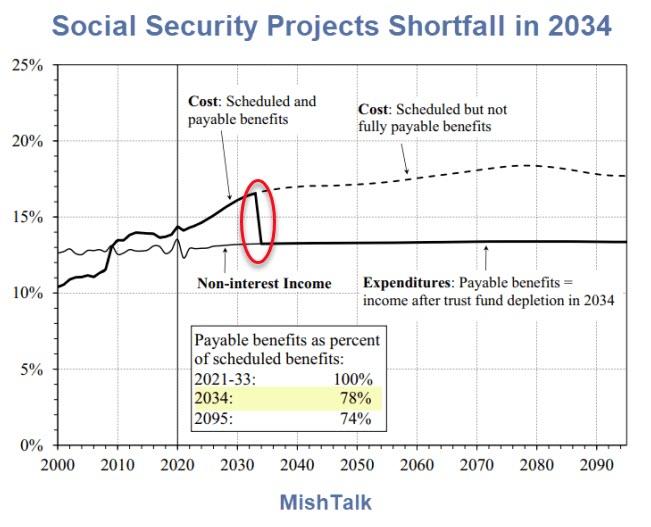
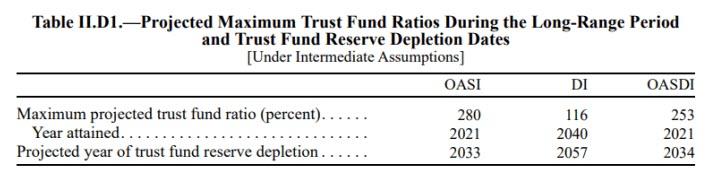
In its 276-page 2021 Annual Report, the Social Security Administrations projects a fiscal cliff starting in 2034.

The report dives into fertility assumptions, mortality assumptions, productivity assumptions, inflation assumption, tax contribution assumptions, etc.

Three Key Words

  1. Assumptions

  2. Shortfall 

  3. Hypothetical

Social Security Costs vs. Non-Interest Income

  • Under the Trustees’ intermediate assumptions, Social Security’s total cost is projected to be higher than its total income in 2021 and all later years. Social Security’s cost has exceeded its non-interest income since 2010.

  • The reserves of the combined OASI and DI Trust Funds along with projected program income are sufficient to cover projected program cost over the next 10 years under the intermediate assumptions. However, the ratio of reserves to annual cost is projected to decline from 253 percent at the beginning of 2021 to 85 percent at the beginning of 2030.

  • Under the Trustees’ intermediate assumptions, OASDI cost is projected to exceed total income in 2021, and the dollar level of the hypothetical combined trust fund reserves declines until reserves become depleted in 2034.

OASI is Social Security and DI is the Social Security Disability Fund. They are separate programs but typically merged in discussion. 

Magnitude of 75-Year Actuarial Shortfall 

To illustrate the magnitude of the 75-year actuarial deficit, consider that for the combined OASI and DI Trust Funds to remain fully solvent throughout the 75-year projection period: 

  • (1) revenue would have to increase by an amount equivalent to an immediate and permanent payroll tax rate increase of 3.36 percentage points to 15.76 percent; 

  • (2) scheduled benefits would have to be reduced by an amount equivalent to an immediate and permanent reduction of about 21 percent applied to all current and future beneficiaries, or about 25 percent if the reductions were applied only to those who become initially eligible for benefits in 2021 or later; 

  • (3) some combination of these approaches would have to be adopted. 

Possible Changes to Address Shortfall 

  • A: Cost-of-Living Adjustment 

  • B: Level of Monthly Benefits (PIA) 

  • C: Retirement Age 

  • D: Benefits for Family Members 

  • E: Payroll Taxes (including maximum taxable)

  • F: Coverage of Employment or Earnings/Inclusion of Other Sources of Revenue

  • G: Investment in Marketable Securities

  • H: Taxation of Benefits

  • I: Individual Accounts

The above points discussed in Office of the Chief Actuary’s Estimates of Individual Changes Modifying Social Security

Beneficiaries vs Contributors
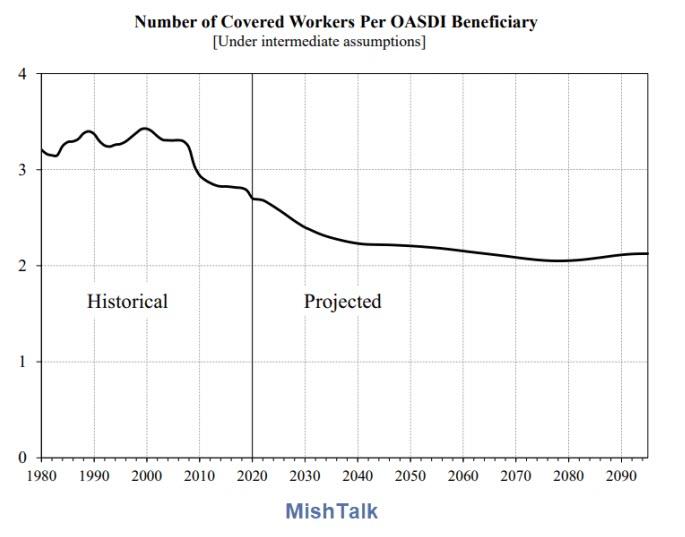
From 1974 through 2008, there were between 3.2 and 3.4 workers per beneficiary. Boomers largely retire by 2035. At that time the projected ratio of workers to beneficiaries is expected to collapse to 2.3.

Trust Fund Depletion
Cumulative Scheduled OASDI Income

Hypothetical Nonsense 

The last two charts and hundreds of pages of the doc are where it gets more than a little bit stupid.

No Trust Fund, No Trust

In reality, there is no trust fund. Nor is there any trust in the system (at least there shouldn’t be). 

The alleged Trust Fund has already been spent and then some, and it’s easy to prove.

Total Outstanding Debt

Total outstanding debt according to Treasury Direct is $28,427,317,184,527.64 as of August 31, 2021. 

It is absurd to believe there is some sort of Trust Fund that has not been spent when the government is in debt to the tune of $28 trillion, rising by trillions every year.

Democrats seek to add another $3.5 trillion to the debt pile this year. And that is on top of the $1 trillion infrastructure packages just approved but not in the $28 trillion listed above. 

What About Options A Through I? 

There are no realistic options and it silly to pretend that there are.

Neither Republicans nor Democrats will reduce benefits or tax them. It’s the “third rail” in politics. Touch it and you get electrocuted right out of office. 

 G and I are humorous. They presume the stock market is a guaranteed winner. And even if that was the case, please take another look at the debt.

System is Insolvent

The entire system is insolvent if one factors in the $28 trillion in debt representing alleged Trust Fund savings that are already spent on something else, especially wars.

Sure, Congress can raise taxes. But for 2021 alone the US will be $4.5 trillion in the hole if Democrats get their way. 

And it’s ridiculous to believe that even Democrats would opt for Item I: Raise payroll taxes from 3.36 percent to 15.76 percent. Heck, Democrats do not want to raise payroll taxes at all. 

The report wastes hundreds of pages addressing options that neither party will do. 

Three-Way Pretending

The only possible “solution” is to pretend. 

We have to pretend there is a Trust Fund collecting interest, pretend the system is solvent, and pretend that $28 trillion (and rising fast) debt does not matter at all.

Pretend it is. 

*  *  *

Like these reports? I hope so, and if you do, please Subscribe to MishTalk Email Alerts.

Tyler Durden
Thu, 09/02/2021 – 12:59

via ZeroHedge News https://ift.tt/3jKlhOx Tyler Durden

Pfizer Doses First Patient In Phase 2/3 Trial For Daily COVID Pill

Pfizer Doses First Patient In Phase 2/3 Trial For Daily COVID Pill

Pfizer revealed on Wednesday that it had finally dosed its first patient participating in the Phase 2/3 study examining the efficacy of PF-07321332, an orally administered protease inhibitor antiviral designed to combat COVID-19.

The randomized, double-blind trial will enroll approximately 1,140 participants, who will receive PF07321332/ritonavir, or a placebo, orally every 12 hours for five days.

Pfizer CEO Albert Bourla weighed in via tweet:

The drug is designed for patients who haven’t been hospitalized, but who are symptomatic with COVID but at low risk of seeing it progress to severe disease. Right now, there are no officially approved COVID therapeutics, a fact that podcast host Joe Rogan alluded to in a video where he revealed his COVID diagnosis.

According to Pfizer’s press release, PF-07321332 is a protease inhibitor, which means it hinders the activity of the main protease enzyme that the SARS-CoV-2 virus requires for replication.

This study is only one part of a development program that includes studies across the globe as authorities assess whether the drug is suitable for use in the broad population.

Even the vaccinated still need therapeutics because, as the public has learned, the vaccines aren’t as effective as initially believed. Therefore, there will always be a need for a therapeutic that averts mild to moderate COVID from progressing.

Given the tremendous need for a COVID Therapeutic, and Pfizer’s optimism surrounding the drug, the company has already started production of the medication even though it hasn’t finished with the clinical trials.

To be sure, when it comes to a COVID therapeutic, the world has already been disappointed once. Gilead’s remdesivir proved to be far less effective than some had expected.

Tyler Durden
Thu, 09/02/2021 – 12:42

via ZeroHedge News https://ift.tt/2WJlTL1 Tyler Durden

President Biden Threatens To Sue Over S.B. 8

Today, President Biden issued a statement critical of the Supreme Court’s decision in Whole Woman’s Health v. Reeves:

Hence, I am directing that Council and the Office of the White House Counsel to launch a whole-of-government effort to respond to this decision, looking specifically to the Department of Health and Human Services and the Department of Justice to see what steps the Federal Government can take to ensure that women in Texas have access to safe and legal abortions as protected by Roe, and what legal tools we have to insulate women and providers from the impact of Texas’ bizarre scheme of outsourced enforcement to private parties.

But who would the United States sue? The federal government cannot sue the state of Texas, as a whole.  There is no statewide injunction. The same Article III problems that were present in Whole Woman’s Health v. Reeves would also be present in United States v. Reeves. The sovereign immunity issues may be different.

from Latest – Reason.com https://ift.tt/3zH5GEH
via IFTTT

Stephen Breyer Makes the Liberal Case Against Court Packing


sfphotosfour936731

In 2008, the U.S. Supreme Court told George W. Bush that fighting a global war on terrorism did not entitle the president to evade or ignore the requirements of the Constitution. That decision, Boumediene v. Bush, would go down in the books as one of the most significant modern rulings against wartime government power. “We’ll abide by the Court’s decision,” Bush said. “That doesn’t mean I have to agree with it.”

What if Bush did not abide by the Court’s decision? What if Bush said the Court was dead wrong and that his administration would not be bound by its erroneous judgment? What if subsequent presidents followed Bush’s lead and ignored the Court whenever their own favored policies happened to lose?

Such what ifs are the driving force behind Justice Stephen Breyer’s timely and important new book, The Authority of the Court and the Peril of Politics (Harvard University Press). The 83-year-old Supreme Court justice is well aware that many modern liberals want President Joe Biden to pack the Court and create a new liberal supermajority. Breyer thinks those liberal court packers are being both dimwitted and shortsighted. “Think long and hard,” Breyer warns them, “before embodying those changes in law.”

Court packing is a naked power grab and an attack on the independence of the judiciary. It is a tit-for-tat race to the bottom. One party expands the size of the bench for nakedly partisan purposes, so the other party does the same (or worse) as soon as it gets the chance. Breyer understands this. He also understands something else: If the authority of the Supreme Court is trashed and squandered by court packing, then liberalism itself is going to suffer in the long run.

Let history be our guide. President Andrew Jackson flatly ignored the Supreme Court’s 1832 decision in Worcester v. Georgia, which ruled in favor of Cherokee control over Cherokee territory. Jackson later sent federal troops to forcibly remove the Cherokee people via the infamous Trail of Tears. The rule of law suffers when the political branches ignore the judiciary’s judgment.

Breyer worries that today’s liberal court packers are going to severely undermine judicial authority and pave the way for the next Andrew Jackson. “Whether particular decisions are right or wrong,” Breyer writes, “is not the issue here.” The issue “is the general tendency of the public to respect and follow judicial decisions, a habit developed over the course of American history.” One of the biggest risks of court packing is that it will reverse that general tendency.

Just imagine what American history would look like without basic political and public support for the Court’s decisions, Breyer writes. What “would have happened to all those Americans who espoused unpopular political beliefs, to those who practiced or advocated minority religions, to those who argued for an end to segregation in the South? What would have happened to criminal defendants unable to afford a lawyer, to those whose houses government officials wished to search without probable cause?”

Or take your pick of hot-button modern issues. If the court packers wreck the Court, as Breyer fears that they will, what’s to stop an anti–gay marriage legislature from banning gay marriage, despite the Supreme Court’s clear 2015 ruling to the contrary in Obergefell v. Hodges? Is that the future that liberals want?

Breyer’s message is clear and convincing: The court packers should be careful what they wish for.

from Latest – Reason.com https://ift.tt/3jCk6jS
via IFTTT

Bill Gross Mocks “Wokeness”, Lashes Out At Bonds As “Investment Garbage”

Bill Gross Mocks “Wokeness”, Lashes Out At Bonds As “Investment Garbage”

Bill Gross may no longer be running Pimco, or be the ruling bond king, a title which quietly was transferred over the DoubleLine’s Jeff Gundlach, but that doesn’t mean he doesn’t have opinions – at time quite stark – and his latest investment outlook posted on his website reminds us of that.

In the first half of the at times meandering letter, Gross first pokes fun of his own tabloid divorce and his infamous recent lawsuit with a neighbor over the constant blaring of the theme from Gilligan’s Island, before mocking the retail mania observed in the NFT world (where an invisible sculpture recently sold for $15,000) and proceeding to slam the cultural takeover by “wokeness“, which he equates with conformity, quitting and mediocrity. Indeed, he notes that the mere “fact that I even have an opinion” … is “probably subject to a wokeness misdemeanor, so better to first say I agree with your opinion, or someone else’s on critical race theory, abortion, or whether Simone Biles was brave or just a quitter”, to wit:

I’m finding that expressing an opinion or telling a joke in public company these days is most dangerous to one’s reputation, not that my past dustup with a Laguna Beach neighbor over Gilligan’s Island or planting a stink bomb going out the door in my ex-wife’s toilet haven’t sealed the deal for me already. But I now have a solution that allows me to vent opinions without consequences although I have to credit a Mr. Salvatore Garau for the brainstorm and the actual trailblazing creation of what he calls his “Invisible Sculpture” that takes NFTs and “live art” one step further.

This little-known artist (whoops I expressed an opinion) decided to create an existent but non-visible sculpture in a box with nothing but space in it, yet full as he claims “of energy” that the observer can feel. There is literally nothing in it. The artist, however, claims that if so, it is a metaphor of our times, and good for him, because he managed to sell it online for $15,000. Well, I’m not sure what to charge for my new box but I (and you) can now express opinions on sex, religion and politics without anyone being able to criticize. Just create an empty box with personal energy and opinions that can be felt but not heard. And sell it for $15,000 if possible!

But not so fast Bill! The fact that I even have an opinion, that there really is something in my empty box (brain) is probably subject to a wokeness misdemeanor, so better to first say I agree with your opinion, or someone else’s on critical race theory, abortion, or whether Simone Biles was brave or just a quitter. And then just drift way into conformity. Safe until the next witch hunt (Oops I did it again).

Social commentary aside, Gross then moves to a topic he has an even stronger opinion on, namely Treasury yields where the former bond king has emerged as an ultra bear, saying that while “cash has been trash for a long time” there are now new contenders for the “investment garbage can” – namely bond funds, but he adds that stocks could follow in the garbage truck unless ernings growth is “double-digit-plus.”

As Bloomberg reminds us, Gross has been bearish on bonds for a while, saying in March that he began betting against Treasuries at about the 1.25%. Rates initially sold off in the aftermath, but have since rallied as a resurgent coronavirus raises concerns over economic growth. Gross is more famous for his “short of a lifetime” call six years ago when referring to German bunds at around 0.1% back in 2015. While Bund yields indeed spiked to nearly 1% subsequent to Gross’ commentary they have since drifted to record lows and were last seen trading at a negative 0.385% yield this morning.

So why is Gross so confident that shorting bonds will work this time? He writes that supply and demand dynamics are stacking up against Treasuries, saying that “at 1.25% for the 10-year Treasury, they have nowhere to go but up” adding that he sees 2% on 10-year Treasuries over the next 12 months. “How quickly is the real question because even if they go up by 10 basis points a year over the next decade, a bond investor could still break even with an indexed bond fund. But they’ll go up quicker than that and probably much quicker.”
 
Gross then focuses on the Fed’s taper, and referring to a recent IIF paper, writes that “in the past year the Fed absorbed 60% of net issuance through quantitative easing with the balance purchased elsewhere. How willing, therefore, will private markets be to absorb this future 60% in mid-2022 and beyond? Perhaps if inflation comes back to the 2%+ target by then, a “tantrum” can be avoided, but how many more fiscal spending programs can we afford without paying for it with higher interest rates?”

Gross concludes that besides rising yields and falling earnings, risks also include “the now recent Afghanistan fallout, and the incessant push of global warming that few investors seem to care about unless there’s a new solar IPO to run up on the first day.”

So if every asset class is going into the garbage, is anything safe? In Gross’ view, “only a Honus Wagner baseball card and of course Salvatore Garau’s NFT may be safe. Oops – I’ve expressed another opinion.

The balance of Gross’ letter is below:

How about an opinion on interest rates? I’ll come right out and say it: At 1.25% for the 10-year Treasury, they have nowhere to go but up. How quickly is the real question because even if they go up by 10 basis points a year over the next decade, a bond investor could still break even with an indexed bond fund. But they’ll go up quicker than that and probably much quicker.

With quantitative easing about to reverse, it’s more than obvious that the $120 billion-a-month Federal Reserve deluge will probably end sometime in mid-2022 given inflation at greater than 2% and economic growth prospects remaining optimistic. Granted, that still leaves $600 or $700 billion of Treasury and mortgage debt yet to buy, but foreign central banks and investors have been selling in the past few years and $1.5 trillion fiscal deficits are perhaps a minimum of what we can expect in the U.S.

The Institute of International Finance in a recent advisory hit the nail on the head – not that they’re any better at forecasting than any other trade association. In an August 12th note the IIF’s Robin Brooks questioned ballooning debt levels and how much debt governments could sell to markets at current low yields. In the U.S., the IIF paper found that in the past year the Fed absorbed 60% of net issuance through quantitative easing with the balance purchased elsewhere. How willing, therefore, will private markets be to absorb this future 60% in mid-2022 and beyond? Perhaps if inflation comes back to the 2%+ target by then, a “tantrum” can be avoided, but how many more fiscal spending programs can we afford without paying for it with higher interest rates?

I’m thinking 2% 10-year Treasuries over the next 12 months. Through the benefit of my aging mathematical gymnastics, that equates to a 4%-5% price loss and a negative total return of 2.5%-3%. Cash has been trash for a long time but there are now new contenders for the investment garbage can. Intermediate to long-term bond funds are in that trash receptacle for sure, but will stocks follow? Earnings growth had better be double-digit-plus or else they could join the garbage truck. And then there’s the now recent Afghanistan fallout, and the incessant push of global warming that few investors seem to care about unless there’s a new solar IPO to run up on the first day. There are other problems but I best keep it simple.

Only a Honus Wagner baseball card and of course Salvatore Garau’s NFT may be safe. Oops – I’ve expressed another opinion.

Tyler Durden
Thu, 09/02/2021 – 12:20

via ZeroHedge News https://ift.tt/3yJ72xs Tyler Durden

President Biden Threatens To Sue Over S.B. 8

Today, President Biden issued a statement critical of the Supreme Court’s decision in Whole Woman’s Health v. Reeves:

Hence, I am directing that Council and the Office of the White House Counsel to launch a whole-of-government effort to respond to this decision, looking specifically to the Department of Health and Human Services and the Department of Justice to see what steps the Federal Government can take to ensure that women in Texas have access to safe and legal abortions as protected by Roe, and what legal tools we have to insulate women and providers from the impact of Texas’ bizarre scheme of outsourced enforcement to private parties.

But who would the United States sue? The federal government cannot sue the state of Texas, as a whole.  There is no statewide injunction. The same Article III problems that were present in Whole Woman’s Health v. Reeves would also be present in United States v. Reeves. The sovereign immunity issues may be different.

from Latest – Reason.com https://ift.tt/3zH5GEH
via IFTTT

Magical Thinking About Green Energy

Magical Thinking About Green Energy

Authored by Charles Hugh Smith via OfTwoMinds blog,

The incentives must change from “waste is growth” to hyper-efficiency, conservation, right to repair and manufactured objects engineered to last a generation or longer and be recyclable at scale.

Humans like novelty but don’t like change. It’s easy to confuse the two. When we say, “I need a change,” what we mean is “I’d like to be refreshed by some novelty,” not “I want all the uncertainty, ambiguity and potential for errors and losses that come with change.”

Humans like a new model of truck (novelty) but don’t like their truck is taken away (change).

Since life is change, we all some experience with it. Some changes happen to us, others are the result of conscious choices we make.

Every individual has a mix of aptitudes, strategies and experiences with both kinds of change. Some of us are better at handling one kind or the other, some don’t handle either very well, some handle all change remarkably well.

Very few of us say, “I sure would like to have a health crisis.” We don’t choose the health crisis, but we do choose our response.

Like many of you, I’ve had accidents (health crises), major career changes and multiple moves to different locales.

as a general rule, changes we choose / direct have a push-pull aspect: there’s something negative we want to avoid or end, and something positive we want to obtain.

For example, we might realize that our current job is a dissatisfactory dead-end (the negative) and we need a more satisfying career (the positive).

A health crisis is negative but the prospect of this being a catalyst for a healthier lifestyle is positive.

Being fired or losing our job is negative (not the change we wanted or chose) but once we accept that our life is going to change one way or the other, we can view this negative as a positive catalyst– a move we didn’t choose for various reasons, but a positive move because otherwise we wouldn’t have taken all the risks and uncertainties that go with fashioning another career.

As a species, humanity is approaching the end of the past 200 year period of expansion of energy consumption. In the initial stages of this vast expansion, much of the new energy went into positive improvements: rural electrification, enormous leaps in food production and healthcare, and so on.

But beyond a certain point, energy and resources are being spent on consumption rather than investment, what I call “waste is growth:” once we set energy / resource consumption as the measure of prosperity, vehicles burning fuel in traffic jams, food that has been thrown out, half-empty aircraft and so on are viewed as positive “growth” because more fuel and resources were consumed.

Needless to say, waste is not growth, it’s squandering precious resources.

Humans habituate to new conditions with remarkable ease. Conditions that are initially horrific (Gulag prison camps, etc.) are soon just “everyday life.”

So humans have habituated to “waste is growth” and consider wasting energy and resources perfectly normal and desirable, as waste is more convenient than conservation and efficiency.

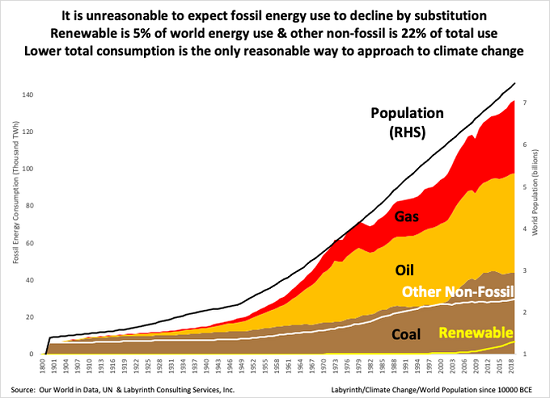
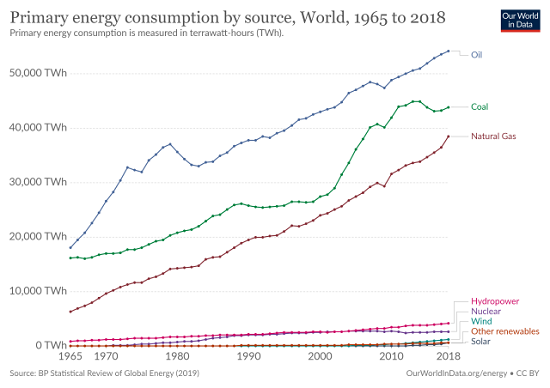
When humans are told 1) hydrocarbons are a limited resource that will soon become more expensive to extract and 2) burning hydrocarbons is ruining the biosphere we all depend on, few humans think “gosh, we should use much less energy.”

Instead, they think, “Let’s replace those 30 billion barrels of oil, the 30 billion (equivalent) barrels of natural gas and the 30 billion (equivalent) barrels of coal we burn every year with “green energy” that doesn’t pollute the biosphere with greenhouse gases and other negative consequences.”

Since humans don’t like change but they do like novelty, it’s very easy to anticipate electric-powered air-taxis (small helicopters), a billion all-electric vehicles, etc., all powered by “green” “renewable” energy sources such as wind turbines and solar panels.

The transition away from hydrocarbons won’t require any sacrifices or inconvenience, it will be a seamless transition from the petroleum-fueled vehicle to the electric vehicle, from gas-fired generators to solar/wind and batteries, and so on.

Everything in the new energy system will naturally be recyclable.

Unfortunately, the anticipated seamless transition to all renewable energy is magical thinking in virtually every way.

Renewables are not actually renewable, they wear out and must be replaced, so they are “replaceable” not “renewable.”

All these “replaceable” energy sources consume staggering amounts of minerals, metals and energy to be constructed, maintained, and replaced every 10 to 20 years. (The theoretical lifespan is claimed to be 30 years, but the real-world lifespan is consequentially less.)

Since all these “replaceable” energy sources are diffuse and intermittent, the energy they generate fluctuates across a wide range and must be concentrated to be stored /used in batteries or mechanical storage (reservoirs with hydro-powered generators, etc.) or chemical storage (converting electricity into hydrogen to be used as a fuel).

The billions of batteries required to store all this electrical energy must also be replaced every decade or so, and recycling batteries is difficult and costly. There is nothing remotely “green” about mining the planet for lithium, cobalt, etc. or manufacturing billions of batteries.

“Let’s Not Blow Up a Mountain and Call It Green”

As for recycling: a tiny percentage of the “replaceable” energy sources or batteries are being recycled because it’s too difficult and costly.

The scale required to replace 90 billion barrels of hydrocarbons with diffuse, intermittent energy sources and batteries is difficult to grasp.

Here is the reality:

“The annual output of Tesla’s Gigafactory, the world’s largest battery factory, could store three minutes’ worth of annual U.S. electricity demand. It would require 1,000 years of production to make enough batteries for two days’ worth of U.S. electricity demand. Meanwhile, 50–100 pounds of materials are mined, moved, and processed for every pound of battery produced.”

This report succinctly summarizes the physical limits of wind and solar efficiencies and the impossibility of replacing all hydrocarbons with energy sources that require millions of tons of minerals, metals, concrete, etc., are not recyclable and that must be replaced every generation. The “New Energy Economy”: An Exercise in Magical Thinking

This report summarizes why it’s impossible to obtain all the minerals/metals required: The Mining of Minerals and the Limits to Growth

The Delusion of Infinite Economic GrowthEven “sustainable” technologies such as electric vehicles and wind turbines face unbreachable physical limits and exact grave environmental costs.

If you prefer a video presentation, Nate Hagens compresses 15 years of research into 2 hours and 50 minutes: Earth and Humanity: Myth and Reality (2:50 hours)

There are many other resources that report the same physical realities: mining, smelting and transporting the millions of tons of materials required will be catastrophic for the environment, as it can only be accomplished by burning hydrocarbons and laying waste to the planet.

As for nuclear power: India has invested billions of dollars and years in trying to complete a full-scale thorium reactor, so far without success; to replace all hydrocarbon energy with nuclear-generated electricity ,the U.S. would have to bring a new reactor online every week for years. There hasn’t been a single new reactor built in decades, so this is the acme of magical thinking.

It’s much easier to sell change if it’s easy, convenient, cheap and doesn’t require sacrifices. But this is not how change works.

How change we don’t choose works is: “you had a heart attack and almost died. If you want to live longer than a few months, you’ll have to completely change your lifestyle, diet and fitness.”

Unfortunately, there is virtually nothing easy, convenient or cheap that doesn’t require sacrifices about changing your lifestyle from the ground up.

To make the necessary changes, we have to fashion a positive view and different incentives and goals: rather than put mouthfeel and taste above all else, we re-set the incentives to eating the healthiest foods in the tastiest ways. Rather than find excuses for not exercising, we find a form of exercise we like (or at least can tolerate) and that can be folded into a new habit.

We all understand the appeal of magical thinking: rather than go through all the hard work of remaking our lifestyle and daily habits, we put our faith in a “miracle diet” or equivalent.

Humanity’s resistance to needed change is understandable, but the irony is we quickly habituate to whatever changes force themselves on us.

That’s our choice with energy and the post-hydrocarbon era ahead. The incentives must change from “waste is growth” to hyper-efficiency, conservation, right to repair and manufactured objects engineered to last a generation or longer and be recyclable at scale.

If we can choose a positive vision and change our incentives and goals, we’ll look back and wonder why we clung so fiercely to magical thinking and “waste is growth.”

*  *  *

If you found value in this content, please join me in seeking solutions by becoming a $1/month patron of my work via patreon.com.

My recent books:

A Hacker’s Teleology: Sharing the Wealth of Our Shrinking Planet (Kindle $8.95, print $20, audiobook $17.46) Read the first section for free (PDF).

Will You Be Richer or Poorer?: Profit, Power, and AI in a Traumatized World (Kindle $5, print $10, audiobook) Read the first section for free (PDF).

Pathfinding our Destiny: Preventing the Final Fall of Our Democratic Republic ($5 (Kindle), $10 (print), ( audiobook): Read the first section for free (PDF).

The Adventures of the Consulting Philosopher: The Disappearance of Drake $1.29 (Kindle), $8.95 (print); read the first chapters for free (PDF)

Money and Work Unchained $6.95 (Kindle), $15 (print) Read the first section for free (PDF).

Tyler Durden
Thu, 09/02/2021 – 12:00

via ZeroHedge News https://ift.tt/3yDY9p4 Tyler Durden

Stephen Breyer Makes the Liberal Case Against Court Packing


sfphotosfour936731

In 2008, the U.S. Supreme Court told George W. Bush that fighting a global war on terrorism did not entitle the president to evade or ignore the requirements of the Constitution. That decision, Boumediene v. Bush, would go down in the books as one of the most significant modern rulings against wartime government power. “We’ll abide by the Court’s decision,” Bush said. “That doesn’t mean I have to agree with it.”

What if Bush did not abide by the Court’s decision? What if Bush said the Court was dead wrong and that his administration would not be bound by its erroneous judgment? What if subsequent presidents followed Bush’s lead and ignored the Court whenever their own favored policies happened to lose?

Such what ifs are the driving force behind Justice Stephen Breyer’s timely and important new book, The Authority of the Court and the Peril of Politics (Harvard University Press). The 83-year-old Supreme Court justice is well aware that many modern liberals want President Joe Biden to pack the Court and create a new liberal supermajority. Breyer thinks those liberal court packers are being both dimwitted and shortsighted. “Think long and hard,” Breyer warns them, “before embodying those changes in law.”

Court packing is a naked power grab and an attack on the independence of the judiciary. It is a tit-for-tat race to the bottom. One party expands the size of the bench for nakedly partisan purposes, so the other party does the same (or worse) as soon as it gets the chance. Breyer understands this. He also understands something else: If the authority of the Supreme Court is trashed and squandered by court packing, then liberalism itself is going to suffer in the long run.

Let history be our guide. President Andrew Jackson flatly ignored the Supreme Court’s 1832 decision in Worcester v. Georgia, which ruled in favor of Cherokee control over Cherokee territory. Jackson later sent federal troops to forcibly remove the Cherokee people via the infamous Trail of Tears. The rule of law suffers when the political branches ignore the judiciary’s judgment.

Breyer worries that today’s liberal court packers are going to severely undermine judicial authority and pave the way for the next Andrew Jackson. “Whether particular decisions are right or wrong,” Breyer writes, “is not the issue here.” The issue “is the general tendency of the public to respect and follow judicial decisions, a habit developed over the course of American history.” One of the biggest risks of court packing is that it will reverse that general tendency.

Just imagine what American history would look like without basic political and public support for the Court’s decisions, Breyer writes. What “would have happened to all those Americans who espoused unpopular political beliefs, to those who practiced or advocated minority religions, to those who argued for an end to segregation in the South? What would have happened to criminal defendants unable to afford a lawyer, to those whose houses government officials wished to search without probable cause?”

Or take your pick of hot-button modern issues. If the court packers wreck the Court, as Breyer fears that they will, what’s to stop an anti–gay marriage legislature from banning gay marriage, despite the Supreme Court’s clear 2015 ruling to the contrary in Obergefell v. Hodges? Is that the future that liberals want?

Breyer’s message is clear and convincing: The court packers should be careful what they wish for.

from Latest – Reason.com https://ift.tt/3jCk6jS
via IFTTT

Afghans Face Bank Runs, Food Shortages As Taliban Work To Form Government

Afghans Face Bank Runs, Food Shortages As Taliban Work To Form Government

As the Taliban shifts its focus to forming a functioning government and meeting the needs of the 38MM Afghans it’s now responsible for governing, fighters are working to bring the last remaining rebel-held province, Panjshir, under Taliban control. The Taliban said Thursday that they had finally captured the district of Shotul, while the rest of Panjshir remains in the hands of rebel groups who are simultaneously negotiating with the Taliban, per WSJ. Casualties have been reported on both sides.

But even more pressing than cementing their control over all of Afghanistan’s 34 provinces, is the fact that the Taliban needs to figure out how to reopen its country’s shattered economy before figuring out how to reorder society. They need to get money flowing through the country’s banks, and, by extension, food in people’s mouths, in what’s mostly a cash-based economy, the FT reports.

Banks have been closed since the Taliban took over, and at this point, many Afghans are starting to run out of money. The few branches that are open now have imposed strict withdrawal limits, leading to day-long queues and serious disruptions.

“Since 6am, I have been standing here in the queue,” an Afghan woman named Aalia told a reporter for the FT after Kabul’s night skies were pierced by Taliban fighters’ celebratory gunfire. “I have nothing left in my house and my kitchen.”

Though you won’t read about it in the western press, the average Afghan is relieved now that the Taliban have returned to power since the end of the war means an end to the fighting and the violence and the civilian collateral damage. In Kabul, most were especially grateful that the Taliban’s capture of the city as bloodless. The biggest problem now is fostering a return to economic harmony.

“I was very worried that there would be clashes and looting,” said a cheese vendor in a residential neighbourhood. “I was very happy that the Taliban came peacefully, there hasn’t been a clash and they prevented anarchy in the city.”

As far as markets are concerned, the price of food has soared as the value of the Afghan currency has plunged.

Meanwhile, WSJ reports that Afghans who live abroad are finding it more difficult than ever to send money back home. Money-transfer companies Western Union and MoneyGram International have suspended services in the country, in part to avoid running afoul of U.S. sanctions. Several Afghans living in London and other major international cities spoke to WSJ about the sudden diffculty that comes with sending money abroad. And while crypto obviously “solves this”, the Afghan economy simply isn’t well-adapted to digital payments.

The latest reports from the BBC say the Taliban could announce a new government within days, though a spokesman confirmed that no women will serve in senior roles.

In the mean time, the Taliban are trying to encourage some return to normality even as it considers how to reshape Afghan society. The group has launched a social media charm campaign, sharing peaceful scenes and a senior Talib kissing a baby. Zabihullah Mujahid, a Taliban spokesperson, has urged international investors to return to Afghanistan to rebuild the economy and called on business people to help the country overcome its economic crisis. Primary schools have reopened for younger students, including girls, after the Taliban agreed that children’s and teachers’ uniforms accorded with Islamic principles. Older students have yet to return to class, however.

Still, for many ordinary Afghans, the overriding concern remains how to access cash to buy food and other essentials. “We can agree to everything,” said one man watching the flags being taken down, “if only the banks would open.”

The Taliban are taking over at a time of severe drought. Already, some in the international community are calling for the west to intercede in order to prevent a deadly famine. Writing in the Diplomat, Mary-Ellen McGroaty, a director at the World Food Program, warns that a devastating drought has killed 40% of Afghanistan’s crops, which is terrible news for an economy that’s largely based on agriculture.

Drought is again sparking anguish across the country, as farmers have lost 40 percent of their crops. Livestock has been devastated. Wells have run dry, and children are walking kilometers to fetch water that is often unsafe to drink. More than half of all Afghan families rely on agriculture for income. Without a harvest, there is no food nor jobs.

One in three Afghans are acutely food insecure. That’s 14 million people who can’t put enough food on the table and will go to bed with empty bellies.

In these extraordinarily difficult times, families are forced to make desperate decisions. Parents are taking on debt to buy food or not eating at all. They’re leaving their homes to seek work and humanitarian relief.

The question is, will this be enough to bring the Taliban to heel? Western assistance might be the only thing standing in the way of mass starvation. Then again, a large swath of Afghanistan’s economy isn’t even accounted for in a legitimate sense, since it involves smuggling via Taliban-controlled land routes into neighboring countries like Pakistan and Iran.

Tyler Durden
Thu, 09/02/2021 – 11:41

via ZeroHedge News https://ift.tt/3mUo3mb Tyler Durden

COVID-19 Vaccination Should Not Be Legally Required for Parenthood


joice-kelly-38MGlMtsZyc-unsplash

A family court judge in Chicago denied a mother the right to custody over her son until she gets vaccinated against COVID-19, the implication being that an unvaccinated parent is not a fit parent. The ruling didn’t hold long—the judge himself quickly reversed course—but the initial decision will be chilling for thousands of parents across the country. Making parental or child vaccination a requirement for custody would be an enormous judicial and government overreach, setting a dangerous precedent for intervention into what has traditionally been the realm of the family. This case may be a fluke, but parents engaged in custody disputes across the country should be aware that their vaccination status might play a role in determining whether they have access to their child.

This is not the first time judges have tried to use judicial power to convince the unwilling to get vaccinated. In Ohio, at least two judges have made vaccination a condition of probation; the defendants will face jail time if they do not get vaccinated. These cases might not attract the sympathy of many. People who are facing probation have, by definition, been convicted of crimes and lost at least some of their autonomy to the state. There is a well-established history of judges using “creative” punishments to try to reform defendants (usually through public humiliation).

Reasonable people can disagree about the degree to which judges can, or should, try to impose creative sentences, including coronavirus vaccine mandates, for defendants. People who have been convicted of crimes are human beings, and forcing someone to choose between being vaccinated against their will or going to prison should at the very least raise eyebrows. But using COVID-19 vaccination as a factor in decision-making at family court erases the autonomy of parents who have committed no crimes and might otherwise be thoughtful, loving guardians.

Parents who are hesitant to be vaccinated aren’t the first to face judicial pressure because of their perceived failures as a parent. Christian Scientists, for example, traditionally refuse to receive all but the most limited medical care. This has had dire consequences: Christian Scientist parents who have failed to seek medical care for their children have been brought before courts to answer in criminal trials for their child’s injury or death. Even so, state law has explicitly protected parents who choose to forego medical treatment for their children in favor of prayer and spiritual healing.

By contrast, parents with some habits as common as smoking might find themselves losing custody of a child. While exposure to second-hand smoke is undoubtedly harmful, so is the disruption of the parent-child relationship. The fact that custody can be lost due to smoking, while the law often explicitly protects faith-healing, demonstrates the inconsistency of the government when it acts in loco parentis. Courts may have only the best of intentions towards children and families, but in the massive family court system, values become muddled.

The Jehovah’s Witnesses are another minority religious group with practices that have put them at odds with the American judiciary for their failure to raise their children the “right way.” In a 1944 case, the Supreme Court upheld the conviction of a Jehovah’s Witness mother who was accused of violating a Massachusetts child labor statute by having her young daughter distribute religious pamphlets. The parents would have been perfectly free to distribute pamphlets; the issue was simply whether their daughter could do so. The court wrote that “parents may be free to become martyrs themselves. But it does not follow they are free, in identical circumstances, to make martyrs of their children.”

But the mother in the Chicago vaccination case did not want to make a martyr of her son. While her choice to not be vaccinated against COVID-19 may be unwise, its connection to her ability to be a good mother is limited at best. Even if the judge feared that the mother might contract COVID-19 and pass it on to her child, this is not an adequate basis for damaging a familial relationship. COVID-19 poses about the same risk to children that influenza does, but parents do not routinely lose custody of their children for opting out of their annual flu shot. Besides, as has become obvious thanks to the delta variant, even a vaccinated parent could get their unvaccinated child sick.

One may find the mother in this case to be foolish for choosing to endanger herself by not getting the vaccine. Unfortunately, for those who would like to make vaccination a condition of parenthood, mothers and fathers are routinely permitted to make any number of seemingly foolish decisions without losing access to their children. That’s because the legal system generally recognizes the enormous damage that can be caused to a child by removing a parent from their life.

Every day, parents make decisions that others might consider unwise. Sometimes, they do so to the detriment of their child. But most of these people are still fundamentally loving parents despite their mistakes, and only in the most extreme of circumstances should courts tamper with the bond between parents and their children. The choice by a parent to refuse vaccination against the coronavirus does not rise to that level.

from Latest – Reason.com https://ift.tt/3BBGfoF
via IFTTT