“Untethered…”

“Untethered…”

Authored by Sven Henrich via NorthmanTrader.com,

As markets have continued the non stop levitation to new highs they become ever more untethered from basic market history and I want to highlight one interesting example.

But first for context:

In Failure is not an Option we discussed an unusual program running through markets and the market’s need for constant new highs to prevent a trend break. Since then markets have continued on this required program delivering new highs every week and on many days since then ending August with the most new highs since 1929 and 1987. Quite a feat.

But nobody should be surprised, liquidity remains the name of the game at the exclusion of all other factors.

After all Jay Powell did his bid to not disappoint markets and offered a predictably dovish non committal taper speech at Jackson Hole that markets used as an excuse to continue on the path of new highs.

But perhaps more importantly the period between June and August has seen incredible liquidity expansion on the side of just 2 central banks: The ECB and the Fed:

Just since June the ECB and the Fed combined have added $1 trillion to their balance sheets. For all the taper talk, the hot inflation prints, they have injected another $1 trillion in just the past 3 months.

For reference: It took the ECB and Fed THREE YEARS to expand their combined balance sheets by $1 trillion in the period immediately following the great financial crisis between January 2009 and December 2011.

What took 3 years then, they’ve just done in 3 months.
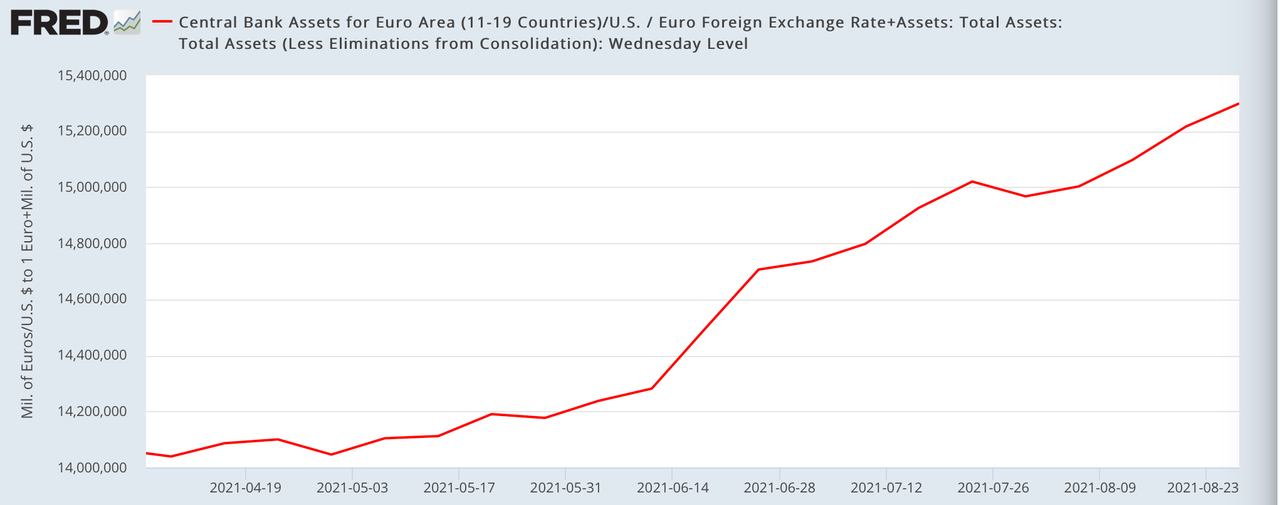
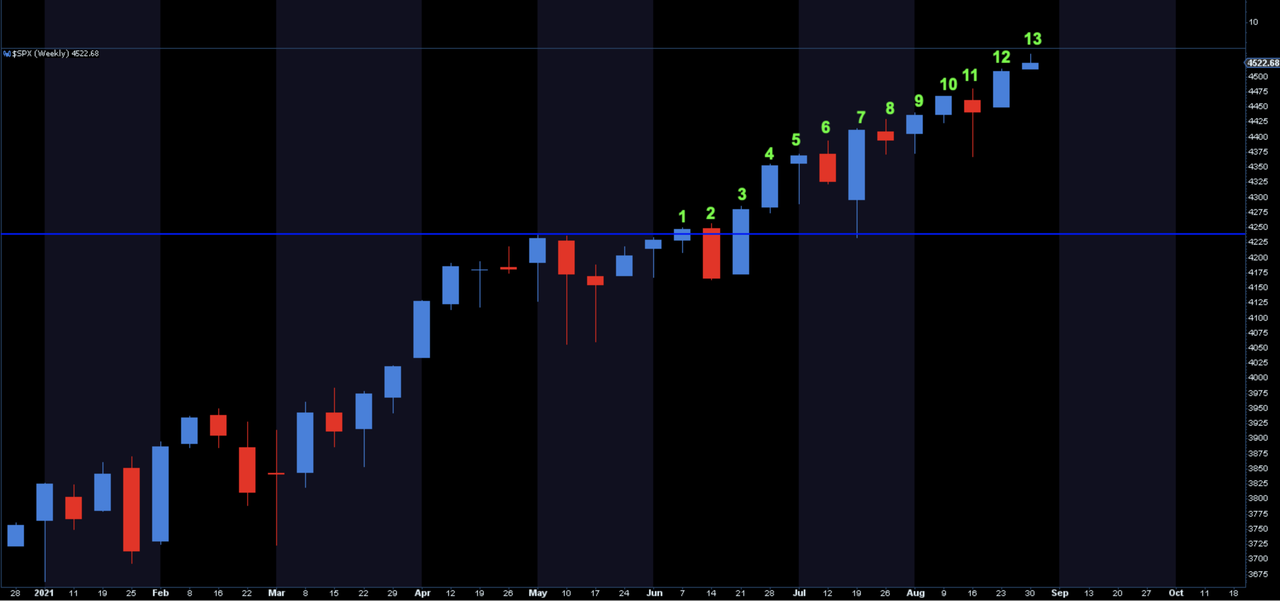
And coinciding with a $1 trillion liquidity injection since June suddenly the S&P makes a new all time high every single week:
Constant levitation has consequences and the evidence can be seen in the charts. One of the most common technical events in markets is a reconnect with the monthly 5EMA. Whether in bull or bear phases this EMA acts as support or resistance and gets tagged on a regular basis.

Sure, there are some months were it doesn’t get tagged, it may not get tagged for a couple of months, but it always gets tagged. But not in 2021:

Only 1 reconnect in 2021. Only 1 reconnect in 9 months. And now we are on month 10 with 6 months in a row of no reconnect:

There is no precedence for this. None. Not in 2000, not in 2007, not in 1987, not in any history of previous market extremes that I’ve seen. What was a regular part of regular market functioning has been removed from the market equation.

The 5 EMA is such a regular magnet for markets that all history also teaches us that the farther markets move away from the 5 EMA, either to the downside or the upside, it tends to revert and reconnect, a balancing out from excess if you will. Consider even the violent reactions to the upside and downside in recent years in the chart above and you see the regular revisit.

Not now. So far. Which makes one question the veracity of what we continue to witness driven by all this liquidity.

I’ll add one more piece of history for consideration as we are now in September. In the past 15 years $SPX has tagged its monthly 5 EMA in the month of September in every single year but one. That’s a 95% hit rate.

The one year it didn’t tag it? 2018, right before the 20% drawdown into Q4 of that year:
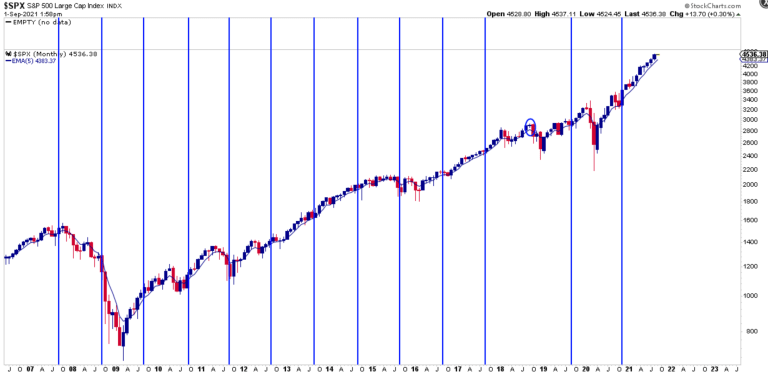
What’s this all mean? For one markets continue to defy all history, but not in a good way. It means markets are disconnected and distorted and all of history demands a reconnect with the monthly 5EMA.

Currently the monthly 5 EMA sits at 4383 or nearly 5% lower from here. No big deal right? After all these markets are way overdue for something larger than a 2%-3% pullback right?

Well, actually just a basic reconnect with the monthly 5EMA would come with a major price: The breaking of the uptrend:

Oops. So not only must markets make constant new highs, they can’t even afford a 5% pullback without breaking the uptrend which would invite all sorts of negative technical consequences and could change the current market landscape dramatically not necessarily staying confined to a mere 5% pullback.

The only way for markets to avoid a trend break then is to continue to avoid all market history of monthly 5EMA reconnects. All of history. This is what investors must then count on. Best of luck.

*  *  *

For the latest public analysis please visit NorthmanTrader. To subscribe to our market products please visit Services.

Tyler Durden
Thu, 09/02/2021 – 11:20

via ZeroHedge News https://ift.tt/3zF8Vg7 Tyler Durden
COVID-19 Vaccination Should Not Be Legally Required for Parenthood


joice-kelly-38MGlMtsZyc-unsplash

A family court judge in Chicago denied a mother the right to custody over her son until she gets vaccinated against COVID-19, the implication being that an unvaccinated parent is not a fit parent. The ruling didn’t hold long—the judge himself quickly reversed course—but the initial decision will be chilling for thousands of parents across the country. Making parental or child vaccination a requirement for custody would be an enormous judicial and government overreach, setting a dangerous precedent for intervention into what has traditionally been the realm of the family. This case may be a fluke, but parents engaged in custody disputes across the country should be aware that their vaccination status might play a role in determining whether they have access to their child.

This is not the first time judges have tried to use judicial power to convince the unwilling to get vaccinated. In Ohio, at least two judges have made vaccination a condition of probation; the defendants will face jail time if they do not get vaccinated. These cases might not attract the sympathy of many. People who are facing probation have, by definition, been convicted of crimes and lost at least some of their autonomy to the state. There is a well-established history of judges using “creative” punishments to try to reform defendants (usually through public humiliation).

Reasonable people can disagree about the degree to which judges can, or should, try to impose creative sentences, including coronavirus vaccine mandates, for defendants. People who have been convicted of crimes are human beings, and forcing someone to choose between being vaccinated against their will or going to prison should at the very least raise eyebrows. But using COVID-19 vaccination as a factor in decision-making at family court erases the autonomy of parents who have committed no crimes and might otherwise be thoughtful, loving guardians.

Parents who are hesitant to be vaccinated aren’t the first to face judicial pressure because of their perceived failures as a parent. Christian Scientists, for example, traditionally refuse to receive all but the most limited medical care. This has had dire consequences: Christian Scientist parents who have failed to seek medical care for their children have been brought before courts to answer in criminal trials for their child’s injury or death. Even so, state law has explicitly protected parents who choose to forego medical treatment for their children in favor of prayer and spiritual healing.

By contrast, parents with some habits as common as smoking might find themselves losing custody of a child. While exposure to second-hand smoke is undoubtedly harmful, so is the disruption of the parent-child relationship. The fact that custody can be lost due to smoking, while the law often explicitly protects faith-healing, demonstrates the inconsistency of the government when it acts in loco parentis. Courts may have only the best of intentions towards children and families, but in the massive family court system, values become muddled.

The Jehovah’s Witnesses are another minority religious group with practices that have put them at odds with the American judiciary for their failure to raise their children the “right way.” In a 1944 case, the Supreme Court upheld the conviction of a Jehovah’s Witness mother who was accused of violating a Massachusetts child labor statute by having her young daughter distribute religious pamphlets. The parents would have been perfectly free to distribute pamphlets; the issue was simply whether their daughter could do so. The court wrote that “parents may be free to become martyrs themselves. But it does not follow they are free, in identical circumstances, to make martyrs of their children.”

But the mother in the Chicago vaccination case did not want to make a martyr of her son. While her choice to not be vaccinated against COVID-19 may be unwise, its connection to her ability to be a good mother is limited at best. Even if the judge feared that the mother might contract COVID-19 and pass it on to her child, this is not an adequate basis for damaging a familial relationship. COVID-19 poses about the same risk to children that influenza does, but parents do not routinely lose custody of their children for opting out of their annual flu shot. Besides, as has become obvious thanks to the delta variant, even a vaccinated parent could get their unvaccinated child sick.

One may find the mother in this case to be foolish for choosing to endanger herself by not getting the vaccine. Unfortunately, for those who would like to make vaccination a condition of parenthood, mothers and fathers are routinely permitted to make any number of seemingly foolish decisions without losing access to their children. That’s because the legal system generally recognizes the enormous damage that can be caused to a child by removing a parent from their life.

Every day, parents make decisions that others might consider unwise. Sometimes, they do so to the detriment of their child. But most of these people are still fundamentally loving parents despite their mistakes, and only in the most extreme of circumstances should courts tamper with the bond between parents and their children. The choice by a parent to refuse vaccination against the coronavirus does not rise to that level.

from Latest – Reason.com https://ift.tt/3BBGfoF
via IFTTT

ACLU Endorses Vaccine Mandates Without Religious Exemptions

The ACLU once stood for the American Civil Liberties Union. But that acronym has as much vitality as the American Telegraph & Telephone Company. The organization no longer puts civil liberties first. The ACLU should drop the pseudo-acronym, and simply become known as the ACLU, like AT&T, CVS, GEICO, 3M, KFC, SAT, and NARAL. (The last example may be the most relevant name-change).

The latest case in point is a New York Times op-ed by ACLU leaders David Cole and Daniel Mach. They endorse vaccine mandates. And, they write, a forcible government mandate preserves liberty!

In fact, far from compromising civil liberties, vaccine mandates actually further civil liberties. They protect the most vulnerable among us, including people with disabilities and fragile immune systems, children too young to be vaccinated and communities of color hit hard by the disease.

Vaccine requirements also safeguard those whose work involves regular exposure to the public, like teachers, doctors and nurses, bus drivers and grocery store employees. And by inoculating people from the disease’s worst effects, the vaccines offer the promise of restoring to all of us our most basic liberties, eventually allowing us to return safely to life as we knew it, in schools and at houses of worship and political meetings, not to mention at restaurants, bars, and gatherings with family and friends.

This argument is very much premised on the progressive account of freedom. The government can promote liberty by forcing people to do things. Solicitor General Verrilli advanced this conception of liberty in NFIB v. Sebelius: requiring people to maintain insurance will allow other people to be free from concerns about health risks. Sort of like FDR’s “Freedom from Want.” This argument did not go over well at the Supreme Court. Still, I’m stunned to see the ACLU endorse this positivist account of freedom. Well, not stunned they hold these views. Stunned that they would show their cards.

The ACLU also rejects any place for exemptions based on the freedom religion. And the authors invoke Prince v. Massachusetts (1944):

What about those who object to vaccination on religious grounds? Like personal autonomy, religious freedom is an essential right, but not an unfettered license to inflict harm on others. As the Supreme Court explained more than 75 years ago in Prince v. Massachusetts: “The right to practice religion freely does not include liberty to expose the community or the child to communicable disease or the latter to ill health or death.”

Now, I am really stunned the Court favorably cited Prince. In this case, a Jehovah’s Witness woman was charged with violating child labor laws when she allowed a minor to distribute religious literature. The Court, per Justice Rutledge, upheld the prosecution. This is the precedent the ACLU hangs its hat on! The government pretextually used a child labor law to shut down the distribution of religious liberty for a persecuted minority. I would think the ACLU would line up with Justice Murphy’s dissent, which was joined by Justices Jackson, Roberts, and Frankfurter. But no, the ALCU lines up with the majority. Still the ACLU’s invocation of Prince is even more problematic.

The case had nothing do with spreading disease. The quoted sentence, at most, was a dictum. Moreover, in 1944, the Court had not established it modern Free Exercise Clause jurisprudence. The test put forward by Justice Rutledge is inconsistent with Sherbert v. Verner as well as Employment Division v. Smith. And Prince, like Jacobson. presents an escape hatch from modern constitutional law. During the pandemic, courts cited this dictum to uphold restrictions on abortion! And the ACLU gave the case its blessing.

In my new article on Jacobson, I discuss the vitality of Prince. Anyone who wishes to cite Prince, or Jacobson for that matter, shoulder understand the context.

from Latest – Reason.com https://ift.tt/3yIQWE2
via IFTTT

Europe’s CDC Breaks With Biden Admin, Says No Urgent Need For COVID Boosters

Europe’s CDC Breaks With Biden Admin, Says No Urgent Need For COVID Boosters

The Biden admin’s rushed decision to enforce covid booster shots on the population, is getting pushback not only from the FDA, where two top vaccine regulators resigned from the Food and Drug Administration on Tuesday, revealing anger, frustration, and turmoil at the federal agency as it balks at the White House’s steamrolling of accepted rules and regulations, but also from Europe.

Overnight, Europe’s CDC – the Centre for Disease Prevention and Control (ECDC) – said there was no urgent need for booster doses of COVID-19 vaccines for the fully vaccinated, citing data on the effectiveness of shots.

The comments follow a similar statement from the European Medicines Agency last month that more data was needed on the duration of protection after full inoculation to recommend using booster shots.

The evidence on real-world effectiveness shows that all vaccines authorized in the region are highly protective against COVID-19-related hospitalisation, severe disease and death, the ECDC said. But the agency said extra doses can be considered for people who experience a limited response to the standard regimen, adding that these shots should be treated differently from booster doses.

Germany and France have announced they would begin giving boosters to vulnerable people and the immunocompromised from this month to protect citizens from the more infectious Delta variant.

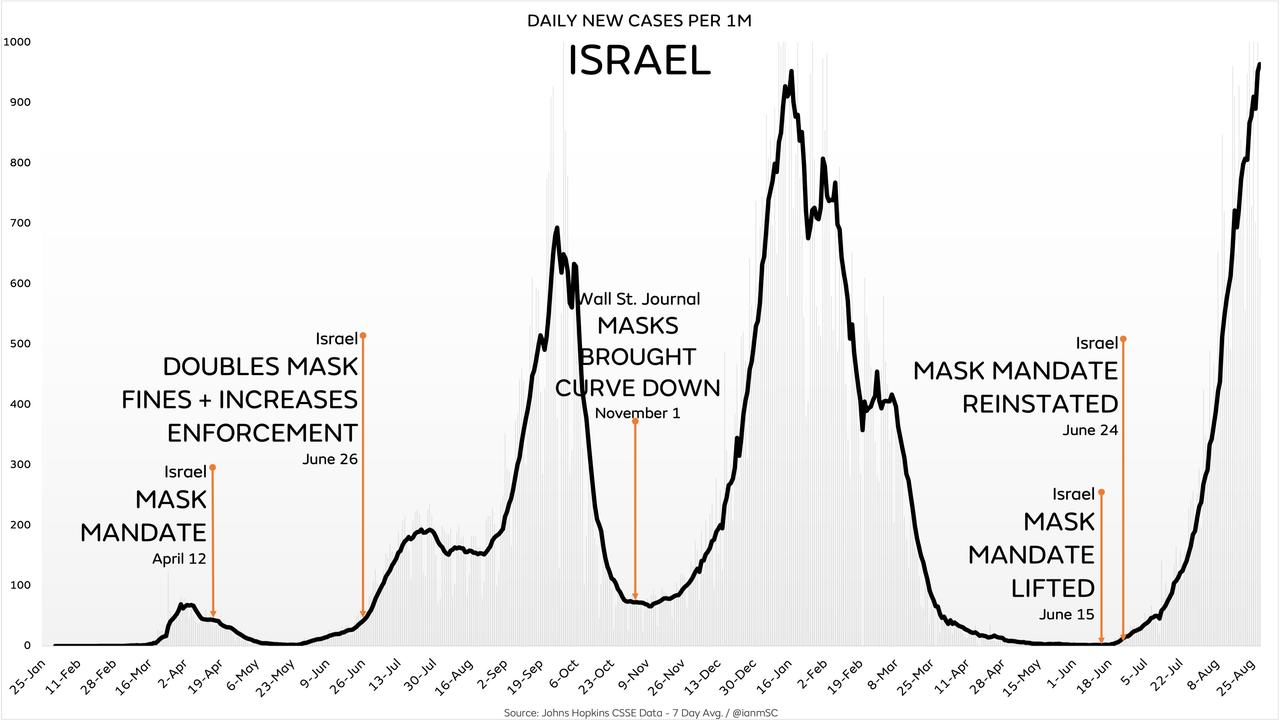
The U.S. government has also started administering a third dose of Pfizer Inc-BioNTech and Moderna Inc’s vaccines to those with compromised immunity. And while we doubt that the US will actually bother with such trivia as data and facts, one look at the soaring number of cases in Israel, which not only has the highest vaccination rate but has also mandated booster shots, indicates that something is very wrong with current “scientific” approach to fighting covid.

Yet as long as it leads to billions in revenues for Pfizer and Moderna – and the pharma sector’s lobby dollars keep flowing in the general direction of Congress – we doubt any officials will care too much, which is why the propaganda is out in full force, with Reuters overnight publishing a “survey” which “found” that 76% of surveyed Americans want a booster (while only 6% do not and 18% were not sure). One wonders if this is the same polling team that showed 90% odds of Hillary winning…

Tyler Durden
Thu, 09/02/2021 – 11:01

via ZeroHedge News https://ift.tt/3gU6U88 Tyler Durden

ACLU Endorses Vaccine Mandates Without Religious Exemptions

The ACLU once stood for the American Civil Liberties Union. But that acronym has as much vitality as the American Telegraph & Telephone Company. The organization no longer puts civil liberties first. The ACLU should drop the pseudo-acronym, and simply become known as the ACLU, like AT&T, CVS, GEICO, 3M, KFC, SAT, and NARAL. (The last example may be the most relevant name-change).

The latest case in point is a New York Times op-ed by ACLU leaders David Cole and Daniel Mach. They endorse vaccine mandates. And, they write, a forcible government mandate preserves liberty!

In fact, far from compromising civil liberties, vaccine mandates actually further civil liberties. They protect the most vulnerable among us, including people with disabilities and fragile immune systems, children too young to be vaccinated and communities of color hit hard by the disease.

Vaccine requirements also safeguard those whose work involves regular exposure to the public, like teachers, doctors and nurses, bus drivers and grocery store employees. And by inoculating people from the disease’s worst effects, the vaccines offer the promise of restoring to all of us our most basic liberties, eventually allowing us to return safely to life as we knew it, in schools and at houses of worship and political meetings, not to mention at restaurants, bars, and gatherings with family and friends.

This argument is very much premised on the progressive account of freedom. The government can promote liberty by forcing people to do things. Solicitor General Verrilli advanced this conception of liberty in NFIB v. Sebelius: requiring people to maintain insurance will allow other people to be free from concerns about health risks. Sort of like FDR’s “Freedom from Want.” This argument did not go over well at the Supreme Court. Still, I’m stunned to see the ACLU endorse this positivist account of freedom. Well, not stunned they hold these views. Stunned that they would show their cards.

The ACLU also rejects any place for exemptions based on the freedom religion. And the authors invoke Prince v. Massachusetts (1944):

What about those who object to vaccination on religious grounds? Like personal autonomy, religious freedom is an essential right, but not an unfettered license to inflict harm on others. As the Supreme Court explained more than 75 years ago in Prince v. Massachusetts: “The right to practice religion freely does not include liberty to expose the community or the child to communicable disease or the latter to ill health or death.”

Now, I am really stunned the Court favorably cited Prince. In this case, a Jehovah’s Witness woman was charged with violating child labor laws when she allowed a minor to distribute religious literature. The Court, per Justice Rutledge, upheld the prosecution. This is the precedent the ACLU hangs its hat on! The government pretextually used a child labor law to shut down the distribution of religious liberty for a persecuted minority. I would think the ACLU would line up with Justice Murphy’s dissent, which was joined by Justices Jackson, Roberts, and Frankfurter. But no, the ALCU lines up with the majority. Still the ACLU’s invocation of Prince is even more problematic.

The case had nothing do with spreading disease. The quoted sentence, at most, was a dictum. Moreover, in 1944, the Court had not established it modern Free Exercise Clause jurisprudence. The test put forward by Justice Rutledge is inconsistent with Sherbert v. Verner as well as Employment Division v. Smith. And Prince, like Jacobson. presents an escape hatch from modern constitutional law. During the pandemic, courts cited this dictum to uphold restrictions on abortion! And the ACLU gave the case its blessing.

In my new article on Jacobson, I discuss the vitality of Prince. Anyone who wishes to cite Prince, or Jacobson for that matter, shoulder understand the context.

from Latest – Reason.com https://ift.tt/3yIQWE2
via IFTTT

Two Top FDA Officials Resign “In Anger” Over “Intensifying Pressure” To Approve Booster & Shots For Kids Under 12

Two Top FDA Officials Resign “In Anger” Over “Intensifying Pressure” To Approve Booster & Shots For Kids Under 12

Submitted by Quoth the Raven at QTR’s “Fringe Finance” blog.

Just in case you didn’t think the Soviet-style mass vaccination propaganda wasn’t also doubling as a political campaign and was all about “the science”, it seems like a great day to point out that two FDA officials – with a combined total of over 40 years of work experience at the agency – just resigned over the politicization of the vaccination process.

Among those leaving is the director of the FDA’s Office of Vaccines Research & Review and the vaccine office’s deputy director. Nothing to see here…

Becker’s Hospital Review wrote about the resignations this week:

Marion Gruber, PhD, director of the FDA’s Office of Vaccines Research & Review, will retire Oct. 31. She’s been with the FDA for 32 years. Phil Krause, MD, the vaccine office’s deputy director, will leave in November, according to the letter from Peter Marks, MD, PhD, who leads the agency’s Center for Biologics Evaluation and Research.

A former senior FDA leader told Endpoints News the two leaders are stepping down from their roles because they’re frustrated that the CDC and its Advisory Committee on Immunization Practices are involved in decisions they believe should be the FDA’s. The White House’s announcement that booster shots would be available Sept. 20, which was made without the FDA’s approval, was reportedly what prompted the two leaders to step down.

“FDA is losing two giants who helped bring us many safe and effective vaccines over decades of public service,” former FDA acting Chief Scientist Luciana Borio, MD, tweeted about the resignations.

Other reports, like this one from Yahoo, claimed that the two officials were “leaving in anger” over President Biden’s plan to roll out booster shots before officials had a chance to approve it.

I can’t help but want to ask: tell me again why the unvaccinated are “crazy” for citing lack of FDA approval as a reason to be tentative about the vaccine?

Because it appears that FDA officials seem to think the agency’s approval/buy-in for vaccinations is so important, is has prompted them to resign after decades of working for the FDA.

According to the Yahoo! report, a senior FDA leader said two duo resigned because “they felt that the Centers for Disease Control and Prevention was making vaccine decisions that should have been left to the FDA”.

The report says:

“The source said the final straw was the Biden administration’s announcing the booster-shot plan before the FDA had officially signed off on it.”

At least it’s nice to know that it isn’t just with eviction moratoriums where the CDC is overstepping its boundaries and trying to usurp authority it doesn’t belong having. Remember when the Centers for Disease Control tried to tell people they didn’t have to pay rent?

ARS Technica added to the story this week, revealing that the officials also resigned over intensifying pressure” to approve booster “doses for children under the age of 12.”

ARS Technica reported that the pushback at the agency is growing to the point of becoming a “potential mutiny”:

Politico, which spoke with 11 former and current health officials, described the situation at the FDA as a “potential mutiny” among agency staff and outside vaccine experts.

Adding to the tension, the upheaval at the FDA comes as parents, caregivers, and teachers anxiously look to the agency to expeditiously review and authorize COVID-19 vaccine doses for young children, who are filling hospitals at higher rates than ever before during the pandemic.

For those unfamiliar with just how politicized Covid has gotten, I recently pointed out the vast, changing narrative behind when we can “return to normal” and herd immunity in this article, which lays out Dr. Fauci’s constantly changing narrative to the American public.

Thanks to continued feedback from my followers, I’ve known for more than a year now that large parts of the American public have woken up to the wool being pulled over our eyes from political leaders, as they try to use the pandemic to grab every bit of power they can. Now, it appears that regulatory agencies are catching on, too.

The two FDA scientists that resigned in protest go down in my book as heroes. It is only through consistent actions like these that dissenters to the “official” narrative will start to be heard.

Kudos, Drs. Gruber and Krause.

*  *  *

You can read the rest at my Substack newsletter, “FRINGE FINANCE” available by clicking here.

Help fight media censorship and groupthink here: http://quoththeraven.substack.com,

Tyler Durden
Thu, 09/02/2021 – 09:26

via ZeroHedge News https://ift.tt/2WNqA6J Tyler Durden

Morgan Stanley Nukes Its Q3 GDP Forecast, Now Sees Just 2.9% Growth, Down From 6.5%

Morgan Stanley Nukes Its Q3 GDP Forecast, Now Sees Just 2.9% Growth, Down From 6.5%

Two weeks ago, Goldman caused a stir across Wall Street and financial media when the bank slashed its GDP forecast for the second time in 3 weeks, and now sees just 5.5% Q3 growth, down from 8.5% previously even as it saw inflation continuing to rise at a precipitous pace, and while Goldman didn’t use the word – for obvious reasons – the conclusion was that stagflation is knocking.

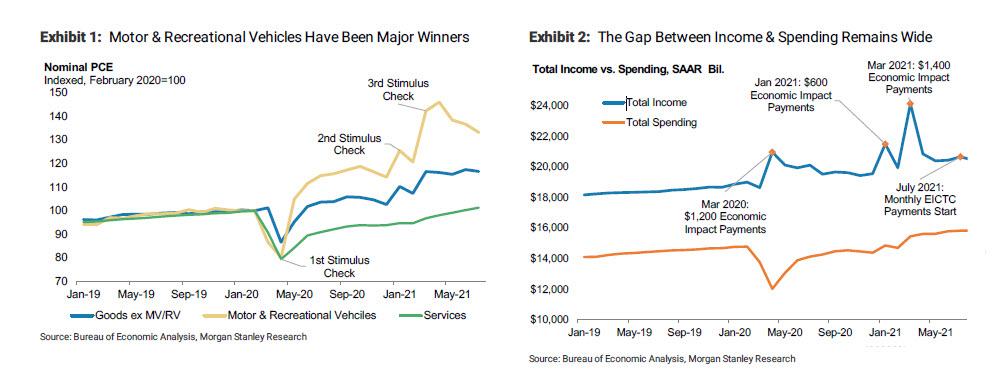
But if Goldman was a surprise, what Morgan Stanley did this morning – when the bank slashed its Q3 GDP from 6.5% to just 2.9% – was shocking. Citing the sharp slowdown in spending and consumer confident, Morgan Stanley noted that “motor vehicles sales in August was the latest data point to miss to the downside, with a fourth consecutive decline in annualized unit sales following the stimulus-related surge in April (highest rate since 2005).”

So, “incorporating motor vehicles sales, and implications for consumer spending, equipment investment, inventories, and capital goods imports and exports,” the bank is “lowering our tracking for 3Q GDP from 6.5% to 2.9%.”

Realizing that such a call could provoke some serious concerns across Wall Street, as other strategists scrambled to piggyback and thus confirm that the expansion is now effectively toast, or come up with “novel” reasons why Morgan Stanley is wrong if only to justify the market’s relentless trek higher, the bank’s chief economist, Ellen Zentner, tried to spin the huge downgrade in the nicest possible way, saying that August is the “bottom for growth in broad activity” and adding that the “expansion continues to advance, albeit at a slower-than-expected pace in 3Q. The slowdown is not broad-based and primarily reflects payback from stimulus spending and ongoing supply issues”, to wit:

Growth in the US economy is coming off a torrid pace in the first half of the year as stimulus spending and a reopening-fueled burst of activity cools. Ongoing supply constraints are additionally crimping key high value-add industries such as motor vehicles. We have anticipated slower growth in 2H21, but it has been greater-than-expected, concentrated in the third quarter. August is the month when we think broad activity slowed the most, which will be reflected in data reported throughout the month of September. We expect momentum to then rise again heading into 4Q with a more supportive base effect.

While the bank nuked its Q3 forecast, it remains hopeful that this will mark the lows and the economy will somehow manage to stage a rebound in Q4, yet even so the bank’s full year GDP forecast of 5.7% is well below the Fed’s most recent economic projection of 7.0% and Wall Street’s consensus of 6.3%.

Within this forecast, tracking for consumption moves down from 2.9% previously, to just 0.3% (vs. 11.6% annualized average in 1H21). With August as the low in activity, our forecast for 4Q GDP remains at 6.7%, helped by momentum in September as the sequential data begins to improve into the final quarter of the year. On balance, these revisions imply GDP growth of 5.6% 4Q/4Q (5.7%Y) this year, well lower than the Fed’s June SEP of 7.0% and 0.7pp below Bloomberg’s consensus of economists at 6.3%.

Then again, this is in line with what banks said every previous time when they slashed their growth estimates, so despite Zentner’s attempts at spinning this dismal figure positively, the most likely outcome is that the US is facing a negative GDP print in the coming quarters.

With that said, here are the summary highlights from the Morgan Stanley GDP downgrade:

  • We are revising down 3Q GDP tracking to 2.9% from 6.5%, previously. Our forecast for 4Q GDP remains at 6.7%. The revision to 3Q implies full year 4Q/4Q GDP at 5.6% (5.7%Y) this year – 1.4pp lower than the Fed’s forecast of 7.0% in its June Summary of Economic Projections (SEP), and 0.7pp below Bloomberg consensus of economists at 6.3%.
  • We have anticipated a sharp slowdown in 2H GDP growth, but looked for a more even distribution across the remainder of the year – payback instead has been front-loaded. An examination of the data reveals that the slowdown is not broad-based and primarily reflects payback from stimulus spending as well as continued supply chain bottlenecks. The swing factor is largest in spending on big-ticket durable goods that benefited most from stimulus checks and are affected most by lack of inventory and price increases due to supply shortages, for example motor vehicles.
  • August is the month when we think broad activity slowed the most (data to be reported throughout September). For example, motor vehicle sales have now dropped for 4 consecutive months. Our motor vehicle analysts believe the slowdown in sales has run its course. Monthly growth in core inflation is now slowing and Delta cases are peaking – both were top concerns that led to a recent drop in consumer confidence. Income continues to outstrip spending by a considerable amount, suggesting buying power has not flagged.
  • We do not see jobs being affected with labor force participation rates rising into the fall before moving into a slower-slog upward. In line with the path of LFPR we envision, average monthly job gains peak in 3Q around ~870k, but remain at robust levels thereafter.
  • Our view for monetary policy has not changed. Despite slower growth, the economy is expanding and the Fed continues to focus on reaching substantial further progress toward its goal of maximum employment – on our forecast for payrolls we get there by the end of the year. The Fed sees no need to tighten policy, rather, it is time to take its foot off the gas pedal by growing its balance sheet at a slower pace (i.e. taper its asset purchases). The September FOMC and minutes should solidify a November or December announcement. Our current baseline sees a December announcement, with risk of earlier in November.

Bad news aside, Morgan Stanley still sees buying power as fully supported by growth in income, as it shows in the next chart which depicts the path of income and spending throughout Covid: Pointing to the spread, Zentner writes that it has remained extremely stable, “suggesting that consumption is far from being constrained by lack of income. A strong labor market recovery and excess savings among lower-income households should support positive aggregate spending over the forecast horizon, even as fiscal stimulus fades and supply chain disruptions force households to pull back on purchases.”

Another reason for optimism is that Delta has now peaked: retail sales in July declined – a reflection of the wallet share shift – and yet food services (dining out) posted another strong increase. As MS notes, dining out is the only services spending tracked in the retail sales report and we believe that if folks are dining out then the ‘kids are alright’. This, Zentner writes, “makes the next data release on retail sales (September 16) incredibly important as concerns over the Delta variant and price increases affected household sentiment in August.”

What about the near record hit to confidence? Here too, MS is optimistic saying it may be short lived, with the bank’s BioTech Analysts believing that the Delta wave in the US has already peaked. Further, the bank’s forecasts point to slowing monthly growth in core inflation, with very early signs that price pressures in Covid-distorted categories may indeed be transitory. As such, the next University of Michigan’s preliminary report on consumer sentiment (due out September 17) is a key upcoming report.

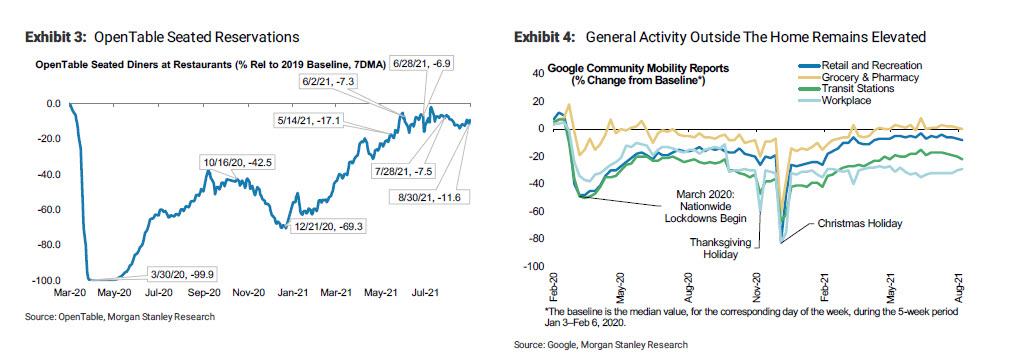
Two more signs of optimism can be seen in high-frequency data which “also point to healthy levels of mobility.” Case in point, OpenTable dining out has moderated slightly, but remains broadly in line with where it has been since June (Exhibit 3). General activity outside the home tracked by Google has flattened, but remains elevated (Exhibit 4).

Finally, despite the clearly negative revision of the bank’s economic outlook, Morgan Stanley was quick to note that “the economy continues to expand, and at a faster pace than its potential, pulling up the labor force participation rate, driving down the unemployment rate, and sending wages higher. In line with the path of LFPR we envision, average monthly job gains peak in 3Q around ~870k, remaining at robust levels thereafter.”

As such, the bank’s view for monetary policy has not changed: the Fed continues to focus on reaching “substantial further progress” toward its goal of maximum employment, which Morgan Stanley forecasts will be reached by the end of the year. Zentner then concludes that :”he Fed sees no need to tighten policy, rather, it is time to take its foot off the gas pedal by growing its balance sheet at a slower pace (i.e. taper its asset purchases). The September FOMC and minutes should solidify a November or December announcement. Our current baseline sees a December announcement, with risk of earlier in November.”

Tyler Durden
Thu, 09/02/2021 – 10:20

via ZeroHedge News https://ift.tt/3zEzEZT Tyler Durden

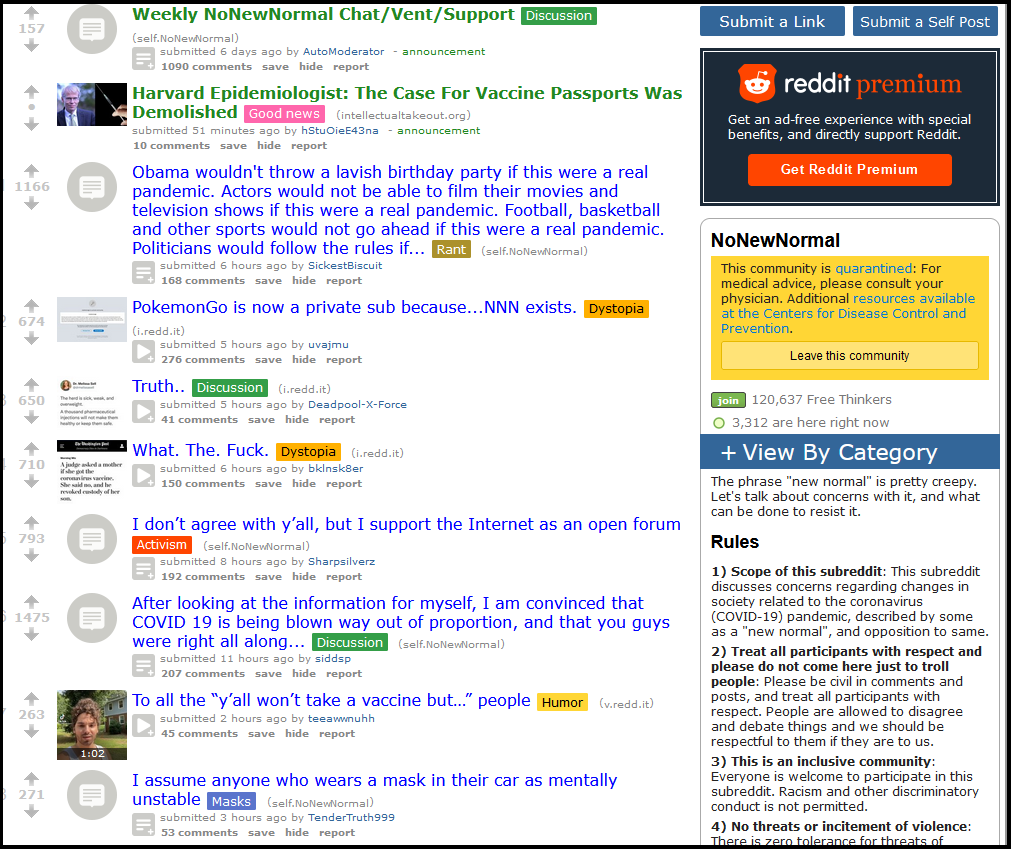
Reddit Bans Vaccine-Skeptic Subreddit r/NoNewNormal – Days After CEO Said He Wouldn’t

Reddit Bans Vaccine-Skeptic Subreddit r/NoNewNormal – Days After CEO Said He Wouldn’t

Last week, Reddit CEO Steve Huffman (u/spez) said that the site will not ban covid-19 misinformation because it values “dissent.”

Huffman, who once moderated a subreddit on cannibalism, said that while the site will encourage users to seek authoritative information on Covid-19 from the CDC, it would not stop people from posting content that runs counter to government guidelines.

Dissent is a part of Reddit and the foundation of democracy. Reddit is a place for open and authentic discussion and debate,” Huffman wrote in a lengthy post

Huffman’s note came in response to dozens of subreddits having gone ‘private’ protest the vaccine and mask-skeptic ‘r/NoNewNormal’ subreddit – vowing to stay locked until it was banned from the platform.

Locked subreddit in protest of r/NoNewNormal (via The Verge)

On Wednesday, Reddit did just that, banning NoNewNormal. Admin ‘worstnerd’ posted an even lengthier screed defending their about-face. In it, he accuses NoNewNormal users – without evidence – of ‘brigading’ other forums (invading them to cause trouble).

r/NoNewNormal screenshot, 8/30/2021 via Archive.is

In short, Reddit used an evidence-free claim to banish a forum which had 120,000 members engaging in “open and authentic discussion and debate” over vaccines, masks, and authoritarianism.

In addition, Reddit also ‘quarantined‘ 54 other subreddits associated with vaccine and mask hesitancy, removing them from site-wide searches and in some cases, forcing users to verify their email address before they can view quarantined content. Prior to its ban, NoNewNormal had been quarantined.

The revolution will not be televised. Or tweeted. Or posted on Reddit, Facebook, YouTube, or virtually any other big tech platform. And the left – former champions of free speech and resisting authority, has become the very useful idiots they once mocked.

Tyler Durden
Thu, 09/02/2021 – 10:03

via ZeroHedge News https://ift.tt/3jDufwR Tyler Durden

Supreme Court Punts on Constitutionally Dubious Texas Abortion Law


zumaamericasthirtytwo202073

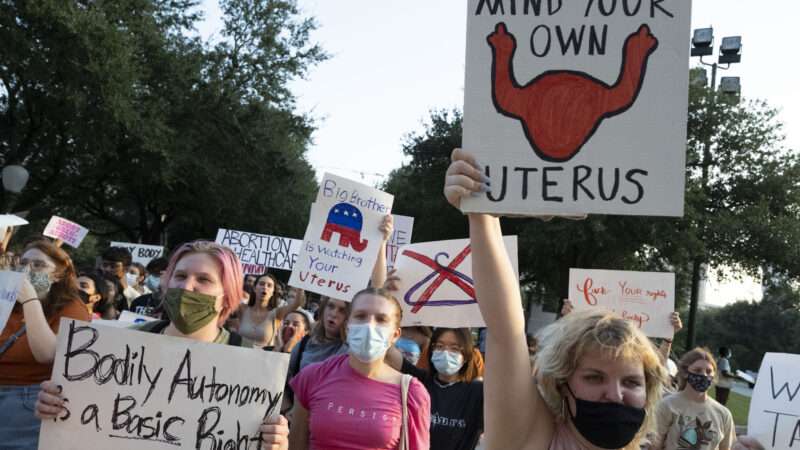
Supreme Court declines to block Texas abortion ban. In a 5–4 decision, the U.S. Supreme Court has declined to block enforcement of an extreme new abortion restriction in Texas. Notably, it did not rule on the law’s constitutionality. If it had, we would likely not be seeing this ban take effect.

“This order is not based on any conclusion about the constitutionality of Texas’s law, and in no way limits other procedurally proper challenges to the Texas law, including in Texas state courts,” notes the majority opinion.

“The law’s reach is so broad that it clearly violates the Court’s abortion precedents,” as Reason‘s Jacob Sullum noted yesterday. “In Roe v. Wade, it held that the Constitution protects a right to abortion, and it has repeatedly affirmed that basic conclusion since 1973. A case that the Court will hear next term, involving a Mississippi law that bans abortions after 15 weeks (vs. about six weeks under S.B. 8), will give the justices an opportunity to overturn or (more likely) scale back Roe and its progeny. But in the meantime, S.B. 8 is plainly inconsistent with what the Court has said about constitutional limits on abortion regulations.”

The law—which took effect September 1—bans abortion around six weeks of pregnancy and deputizes any private citizen in the country who thinks an abortion has taken place in violation of this rule to sue abortion providers or anyone who has facilitated the procedure. If they’re right, they get at least $10,000 per illegal abortion.

Whether the Texas law is constitutional is a question still winding its way through the federal court system. The matter is currently before the 5th Circuit Court of Appeals. But abortion providers and the American Civil Liberties Union were hoping the Supreme Court would intervene to block the law from taking effect as this plays out.

The reason the Court declined to temporarily block the law is complicated—and suspect, some say.

What the Justices Said

Supreme Court Justices Samuel Alito, Amy Coney Barrett, Neil Gorsuch, Brett Kavanaugh, and Clarence Thomas voted not to block the law. Justices Roberts, Breyer, Kagan, and Sonia Sotomayor dissented.

“The applicants now before us have raised serious questions regarding the constitutionality of the Texas law at issue,” noted the majority opinion. “But their application also presents complex and novel antecedent procedural questions on which they have not carried their burden. For example, federal courts enjoy the power to enjoin individuals tasked with enforcing laws, not the laws themselves. And it is unclear whether the named defendants in this lawsuit can or will seek to enforce the Texas law against the applicants in a manner that might permit our intervention.”

In other words, the court won’t yet intervene because it’s not the state tasked with enforcing the law but private citizens in civil court suits.

“We stress that we do not purport to resolve definitively any jurisdictional or substantive claim in the applicants’ lawsuit,” the majority opinion concludes.

This is echoed by Chief Justice John Roberts in a dissent joined by Justices Stephen Breyer and Elena Kagan. “Although the Court denies the applicants’ request for emergency relief today, the Court’s order is emphatic in making clear that it cannot be understood as sustaining the constitutionality of the law at issue,” writes Roberts.

Still, he isn’t buying the majority’s logic. Texas’ legislature “has imposed a prohibition on abortions after roughly six weeks, and then essentially delegated enforcement of that prohibition to the populace at large. The desired consequence appears to be to insulate the State from responsibility for implementing and enforcing the regulatory regime,” he points out.

To Roberts, that doesn’t fly:

I would grant preliminary relief to preserve the status quo ante—before the law went into effect—so that the courts may consider whether a state can avoid responsibility for its laws in such a manner. Defendants argue that existing doctrines preclude judicial intervention, and they may be correct. But the consequences of approving the state action, both in this particular case and as a model for action in other areas, counsel at least preliminary judicial consideration before the program devised by the State takes effect.

Breyer concurs. “I recognize that Texas’s law delegates the State’s power to prevent abortions not to one person (such as a district attorney) or to a few persons (such as a group of government officials or private citizens) but to any person. But I do not see why that fact should make a critical legal difference,” he writes in a dissent joined by Sotomayor and Kagan. “That delegation still threatens to invade a constitutional right, and the coming into effect of that delegation still threatens imminent harm.”

Sotomayor is more forceful in her dissent (which was joined by Breyer and Kagan):

The Court’s order is stunning. Presented with an application to enjoin a flagrantly unconstitutional law engineered to prohibit women from exercising their constitutional rights and evade judicial scrutiny, a majority of Justices have opted to bury their heads in the sand. Last night, the Court silently acquiesced in a State’s enactment of a law that flouts nearly 50 years of federal precedents. Today, the Court belatedly explains that it declined to grant relief because of procedural complexities of the State’s own invention.

Effect Beyond Texas

The Court saying that it can’t stay a likely unconstitutional law if it’s to be enforced by private actors and civil lawsuits could pave the way for all sorts of nutty new legislation.

“The immediate direct impact of Texas’ law and SCOTUS’ punt will be abortion rights, of course, but more broadly there will be an unstoppable temptation to draft nutty bounty laws in many states on many topics, right and left, which is going to be very bad for the court system,” tweeted lawyer Ken “Popehat” White.

This Texas ruling is disturbing for reasons that don’t even relate to reproductive choice,” commented Cato Institute senior fellow Julian Sanchez. “SCOTUS is effectively saying ‘if you build a Rube Goldberg enforcement mechanism for the express purpose of evading review of a facially unconstitutional law… very clever, that’ll work!'”

This is just what the folks behind the Texas law wanted, suggests University of Texas law professor Stephen I. Vladeck. “The whole *point* of #SB8 was to create exactly the procedural doubt on which the majority expressly relies to allow it to go into effect,” Vladeck tweeted, adding that the Roberts dissent “explains why that shouldn’t suffice.”

Effects in Texas

Abortion clinics are already having to turn away women seeking abortions.

Bhavik Kumar of Planned Parenthood in Houston told The Texas Tribune he normally performs two or three dozen abortions per day. On Wednesday, “Kumar saw only six patients. He had to deny abortions to half of them,” the Tribune reports.

“Since mid-August, all 11 of the Planned Parenthood health centers in Texas that provide abortion services have stopped scheduling visits after Sept. 1 for abortions past six weeks of pregnancy,” notes NBC News.

The new law could also create risks for women who miscarry and doctors who treat them.

What Happens Next?

“What happens now? Couple different tracks. First, this case is still pending before the 5th Cir., with unfinished business at the district court,” notes attorney Gabriel Malor on Twitter. “Second, any time now we should be seeing the first round of state court litigation with private citizen suits seeking to enforce SB8.”


FREE MINDS

Millennial myth busting:


FREE MARKETS

McFlurry madness:


QUICK HITS

• Cops say criminal justice reform is so demoralizing to them that officers are resigning in massive numbers. But labor data say otherwise.

• “In just five years, the percentage of Republicans with at least some trust in national news organizations has been cut in half – dropping from 70% in 2016 to 35% this year,” the Pew Research Center reports.

• Today in First Amendment violations: “A Connecticut judge has ordered blogger Kevin Brookman — a frequent critic of the Hartford Police Department — to turn over his laptop and cellphone as part of a police lieutenant’s quest to identify and sue anonymous commenters who disparaged him on Brookman’s site.”

• The federal government is warning Afghan refugees not to move to California.

• “Jenna Holm was incapacitated when one cop accidentally killed another. She’s now being charged with his death” in a ridiculous case out of Idaho.

• An annual report “to Congress from the Social Security Trustees, released this week, paints a grim picture of an entitlement program that was already veering towards insolvency before the COVID-19 pandemic accelerated that trend,” writes Reason‘s Eric Boehm. “The Trustees now estimate that Social Security will be unable to pay the full amount of promised benefits by 2033, one year sooner than the same report estimated last year.”

from Latest – Reason.com https://ift.tt/3tgOaEX
via IFTTT

Supreme Court Punts on Constitutionally Dubious Texas Abortion Law


zumaamericasthirtytwo202073

Supreme Court declines to block Texas abortion ban. In a 5–4 decision, the U.S. Supreme Court has declined to block enforcement of an extreme new abortion restriction in Texas. Notably, it did not rule on the law’s constitutionality. If it had, we would likely not be seeing this ban take effect.

“This order is not based on any conclusion about the constitutionality of Texas’s law, and in no way limits other procedurally proper challenges to the Texas law, including in Texas state courts,” notes the majority opinion.

“The law’s reach is so broad that it clearly violates the Court’s abortion precedents,” as Reason‘s Jacob Sullum noted yesterday. “In Roe v. Wade, it held that the Constitution protects a right to abortion, and it has repeatedly affirmed that basic conclusion since 1973. A case that the Court will hear next term, involving a Mississippi law that bans abortions after 15 weeks (vs. about six weeks under S.B. 8), will give the justices an opportunity to overturn or (more likely) scale back Roe and its progeny. But in the meantime, S.B. 8 is plainly inconsistent with what the Court has said about constitutional limits on abortion regulations.”

The law—which took effect September 1—bans abortion around six weeks of pregnancy and deputizes any private citizen in the country who thinks an abortion has taken place in violation of this rule to sue abortion providers or anyone who has facilitated the procedure. If they’re right, they get at least $10,000 per illegal abortion.

Whether the Texas law is constitutional is a question still winding its way through the federal court system. The matter is currently before the 5th Circuit Court of Appeals. But abortion providers and the American Civil Liberties Union were hoping the Supreme Court would intervene to block the law from taking effect as this plays out.

The reason the Court declined to temporarily block the law is complicated—and suspect, some say.

What the Justices Said

Supreme Court Justices Samuel Alito, Amy Coney Barrett, Neil Gorsuch, Brett Kavanaugh, and Clarence Thomas voted not to block the law. Justices Roberts, Breyer, Kagan, and Sonia Sotomayor dissented.

“The applicants now before us have raised serious questions regarding the constitutionality of the Texas law at issue,” noted the majority opinion. “But their application also presents complex and novel antecedent procedural questions on which they have not carried their burden. For example, federal courts enjoy the power to enjoin individuals tasked with enforcing laws, not the laws themselves. And it is unclear whether the named defendants in this lawsuit can or will seek to enforce the Texas law against the applicants in a manner that might permit our intervention.”

In other words, the court won’t yet intervene because it’s not the state tasked with enforcing the law but private citizens in civil court suits.

“We stress that we do not purport to resolve definitively any jurisdictional or substantive claim in the applicants’ lawsuit,” the majority opinion concludes.

This is echoed by Chief Justice John Roberts in a dissent joined by Justices Stephen Breyer and Elena Kagan. “Although the Court denies the applicants’ request for emergency relief today, the Court’s order is emphatic in making clear that it cannot be understood as sustaining the constitutionality of the law at issue,” writes Roberts.

Still, he isn’t buying the majority’s logic. Texas’ legislature “has imposed a prohibition on abortions after roughly six weeks, and then essentially delegated enforcement of that prohibition to the populace at large. The desired consequence appears to be to insulate the State from responsibility for implementing and enforcing the regulatory regime,” he points out.

To Roberts, that doesn’t fly:

I would grant preliminary relief to preserve the status quo ante—before the law went into effect—so that the courts may consider whether a state can avoid responsibility for its laws in such a manner. Defendants argue that existing doctrines preclude judicial intervention, and they may be correct. But the consequences of approving the state action, both in this particular case and as a model for action in other areas, counsel at least preliminary judicial consideration before the program devised by the State takes effect.

Breyer concurs. “I recognize that Texas’s law delegates the State’s power to prevent abortions not to one person (such as a district attorney) or to a few persons (such as a group of government officials or private citizens) but to any person. But I do not see why that fact should make a critical legal difference,” he wrote in a dissent joined by Sotomayor and Kagan. “That delegation still threatens to invade a constitutional right, and the coming into effect of that delegation still threatens imminent harm.”

Sotomayor was more forceful in her dissent (which was joined by Breyer and Kagan):

The Court’s order is stunning. Presented with an application to enjoin a flagrantly unconstitutional law engineered to prohibit women from exercising their constitutional rights and evade judicial scrutiny, a majority of Justices have opted to bury their heads in the sand. Last night, the Court silently acquiesced in a State’s enactment of a law that flouts nearly 50 years of federal precedents. Today, the Court belatedly explains that it declined to grant relief because of procedural complexities of the State’s own invention.

Effect Beyond Texas

The Court saying that it can’t stay a likely unconstitutional law if it’s to be enforced by private actors and civil lawsuits could pave the way for all sorts of nutty new legislation.

“The immediate direct impact of Texas’ law and SCOTUS’ punt will be abortion rights, of course, but more broadly there will be an unstoppable temptation to draft nutty bounty laws in many states on many topics, right and left, which is going to be very bad for the court system,” tweeted lawyer Ken “Popehat” White.

This Texas ruling is disturbing for reasons that don’t even relate to reproductive choice,” commented Cato Institute senior fellow Julian Sanchez. “SCOTUS is effectively saying ‘if you build a Rube Goldberg enforcement mechanism for the express purpose of evading review of a facially unconstitutional law… very clever, that’ll work!'”

This is just what the folks behind the Texas law wanted, suggests University of Texas law professor Stephen I. Vladeck. “The whole *point* of #SB8 was to create exactly the procedural doubt on which the majority expressly relies to allow it to go into effect,” Vladeck tweeted, adding that the Roberts dissent “explains why that shouldn’t suffice.”

Effects in Texas

Abortion clinics are already having to turn away women seeking abortions.

Bhavik Kumar of Planned Parenthood in Houston told The Texas Tribune he normally performs two or three dozen abortions per day. On Wednesday, “Kumar saw only six patients. He had to deny abortions to half of them,” the Tribune reports.

“Since mid-August, all 11 of the Planned Parenthood health centers in Texas that provide abortion services have stopped scheduling visits after Sept. 1 for abortions past six weeks of pregnancy,” notes NBC News.

The new law could also create risks for women who miscarry and doctors who treat them.

What Happens Next?

“What happens now? Couple different tracks. First, this case is still pending before the 5th Cir., with unfinished business at the district court,” notes attorney Gabriel Malor on Twitter. “Second, any time now we should be seeing the first round of state court litigation with private citizen suits seeking to enforce SB8.”


FREE MINDS

Millennial myth busting:


FREE MARKETS

McFlurry madness:


QUICK HITS

• Cops say criminal justice reform is so demoralizing to them that officers are resigning in massive numbers. But labor data say otherwise.

• “In just five years, the percentage of Republicans with at least some trust in national news organizations has been cut in half – dropping from 70% in 2016 to 35% this year,” the Pew Research Center reports.

• Today in First Amendment violations: “A Connecticut judge has ordered blogger Kevin Brookman — a frequent critic of the Hartford Police Department — to turn over his laptop and cellphone as part of a police lieutenant’s quest to identify and sue anonymous commenters who disparaged him on Brookman’s site.”

• The federal government is warning Afghan refugees not to move to California.

• “Jenna Holm was incapacitated when one cop accidentally killed another. She’s now being charged with his death” in a ridiculous case out of Idaho.

• An annual report “to Congress from the Social Security Trustees, released this week, paints a grim picture of an entitlement program that was already veering towards insolvency before the COVID-19 pandemic accelerated that trend,” writes Reason‘s Eric Boehm. “The Trustees now estimate that Social Security will be unable to pay the full amount of promised benefits by 2033, one year sooner than the same report estimated last year.”

from Latest – Reason.com https://ift.tt/3tgOaEX
via IFTTT