“Serious Threat”: Pentagon Blasts Beijing’s Demand That All Ships In South China Sea Register

“Serious Threat”: Pentagon Blasts Beijing’s Demand That All Ships In South China Sea Register

On Monday we reported that in a remarkable escalation of the fragile geopolitical status quo, Chinese authorities would require a range of vessels “to report their information” when passing through what China sees as its “territorial waters”, starting from September 1. The rule is supposed to apply to the South China Sea, the East China Sea, and the various islands and reefs dotted across the water that Beijing claims as its inalienable territory. The Communist Party-run Global Times reported that “such a rollout of maritime regulations are a sign of stepped-up efforts to safeguard China’s national security at sea by implementing strict rules to boost maritime identification capability” and its coming just days after the botched evacuation of Afghanistan by the BIden administration is hardly a coincidence.

It didn’t take long for the US – which this Chinese proclamation was squarely aimed at – to respond and on Wednesday, the Pentagon blasted  Beijing’s new demand that all foreign ships entering the South China Sea must register with Chinese maritime authorities, calling it a “serious threat” to freedom of navigation and trade.

“The United States remains firm that any coastal state law or regulation must not infringe upon navigation and overflight rights enjoyed by all nations under international law,” said John Supple, a Pentagon spokesman, in response to questions about China’s decree this week.

“Unlawful and sweeping maritime claims, including in the South China Sea, pose a serious threat to the freedom of the seas, including the freedoms of navigation and overflight, free trade and unimpeded lawful commerce, and the rights and interests of South China Sea and other littoral nations,” he said.

Make no mistake: while it may appear trivial and inconsequential in the grand scheme of things, the outcome of this feud between the two superpowers could well determine the world’s next superpower – should the US blinks, it will give China carte blanche to define the geopolitical reality in Asia without fear of US intervention. No wonder this takes place just days after Biden’s historic humiliation in Afghanistan.

China’s vast claims to the resource-rich waterways – among the busiest sea lanes in the world – have been a source of growing tension between Beijing, neighbouring governments and Washington for years, and China’s escalating demand suggests that China feels it now has the upper hand to press the US in staking its claim to the contested territorial waters.

Meanwhile, Vietnam, the Philippines, Brunei, Malaysia and Taiwan have competing claims in the South China Sea, and Japan and South Korea have their own disputes with Beijing in the East China Sea. Five years ago, an international tribunal ruled that Beijing’s sweeping claims of almost the entire South China Sea had no legal basis.

To indicate its dismissal of Chinese claims, the US regularly conducts what it calls “freedom of navigation” exercises in the region, meant to assert the waterways’ status as international sea routes. But lately there have been near-misses (or hits, as the case may be).

In July, China’s military claimed it “drove away” an American warship that had passed near the Paracel Islands in the South China Sea – known in China as the Xisha Islands and in Vietnam as the Hoang Sa Islands. The US Navy later said that China’s statement about driving away the US ship was false.

“The United States remains committed to upholding the rules-based international order and a free and open Indo-Pacific region,” said Supple, the Pentagon spokesman.

On a visit to Vietnam last week, US Vice-President Kamala Harris said the region needed to do more to stand up to China’s vast territorial claims and aggressive behaviour in the region. “We need to find ways to pressure and raise the pressure, frankly, on Beijing to abide by the United Nations Convention on the Law of the Sea, and to challenge its bullying and excessive maritime claims,” Harris said, even though the United States is not a party to that UN treaty.

China’s new rule was supposed to take effect on Wednesday, according to the country’s Maritime Safety Administration. The Chinese government has not clarified how the new rule would be enforced, but said it would apply the law if vessels failed to comply.

So the next time a US warship crosses through the South China Sea and refuses to report its cargo and information to Beijing, keep a close eye for the resulting fireworks.

Tyler Durden
Thu, 09/02/2021 – 09:30

via ZeroHedge News https://ift.tt/3gWwuJH Tyler Durden

NYC Paralyzed, 9 Dead As Ida Remnants Unleash “Once In A Century Storm” Across Northeast

NYC Paralyzed, 9 Dead As Ida Remnants Unleash “Once In A Century Storm” Across Northeast

The remnants of Hurricane Ida triggered Flash Flood Emergencies for New York City and New Jersey late Wednesday night as torrential rain, winds, and tornados unleashed chaos across the Northeast, effectively paralyzing New York where subways were flooded and where mass transit remains largely halted. Reuters reports at least nine weather-related deaths from flash flooding in NYC and New Jersey. The deadly waters swamped subway stations, airport terminals, highways, tunnels, and baseball stadiums. 

Here are some of the most recent developments courtesy of Bloomberg:

  • Travel Advisory in Effect on NYC Streets: 7:30 a.m. A travel advisory remains in effect in New York City, which asked all non-emergency vehicles to stay off the city’s streets and highways while clean up continues. The city had lifted a ban on non-essential travel at 5 a.m.
  • Biden to Speak About Federal Response to Ida: 7:26 a.m. President Joe Biden is scheduled to deliver remarks from the White House at 11:30 a.m. on the federal response to Hurricane Ida, which cut off power for millions and prompted gasoline shortages affecting millions of people across Louisiana. Biden plans to visit Louisiana on Friday to survey storm damage and assess the federal response.
  • MTA Service ‘Largely Suspended’ in NYC: 6:56 a.m. New York’s Metropolitan Transportation Authority service on subway, bus and commuter rails is “largely suspended due to heavy rainfall and flooding across the region,” according to the MTA’s website. The C, E, B, Z, S and Number 3 lines were among those suspended as of 7:30 a.m. Other lines had significant delays.

Around 2340 ET Wednesday, we posted a weather note detailing the mayhem in NYC as flash floods in subways and multiple tornadoes through New Jersey, caused both states and NYC Mayor Bill de Blasio to declare a state of emergencies.

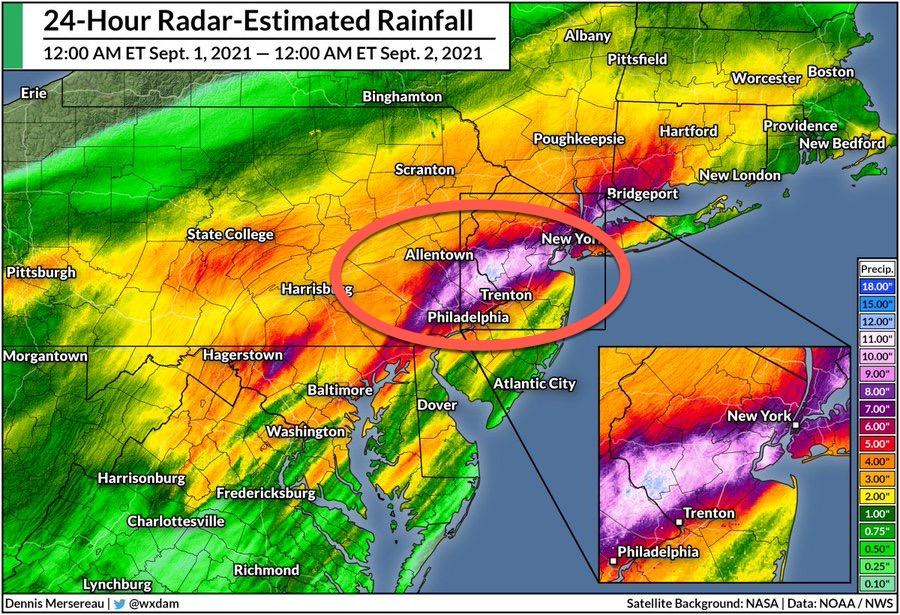
The expected rainfall rate in NYC was an astonishing 3 to 5 inches per hour. The National Weather Service (NWS) issued a Flash Flood Emergency that warned residents of the metro area to “Seek higher ground now!” 

Between 2051 ET and 2251 ET, remnants of Ida dumped 3.15 inches in Central Park. To put that in perspective, that’s about seven weeks of average rainfall in about an hour, NWS meteorologist Alex Lamers told Bloomberg

Northeast 24-Hour Rain Map 

NYC’s subway system was paralyzed as water from the streets poured onto underground train platforms in Manhattan. In New Jersey, nearly all of NJ Transit’s rail service was suspended. 

New York Gov. Kathy Hochul declared a state of emergency late Thursday — directly after NYC Mayor Bill de Blasio announced his, along with a travel ban for all non-emergency vehicles through 0500 ET. 

According to Axios, NWS discussions and other meteorologists have suggested yesterday’s storm was a one in 100- to 500-year event. 

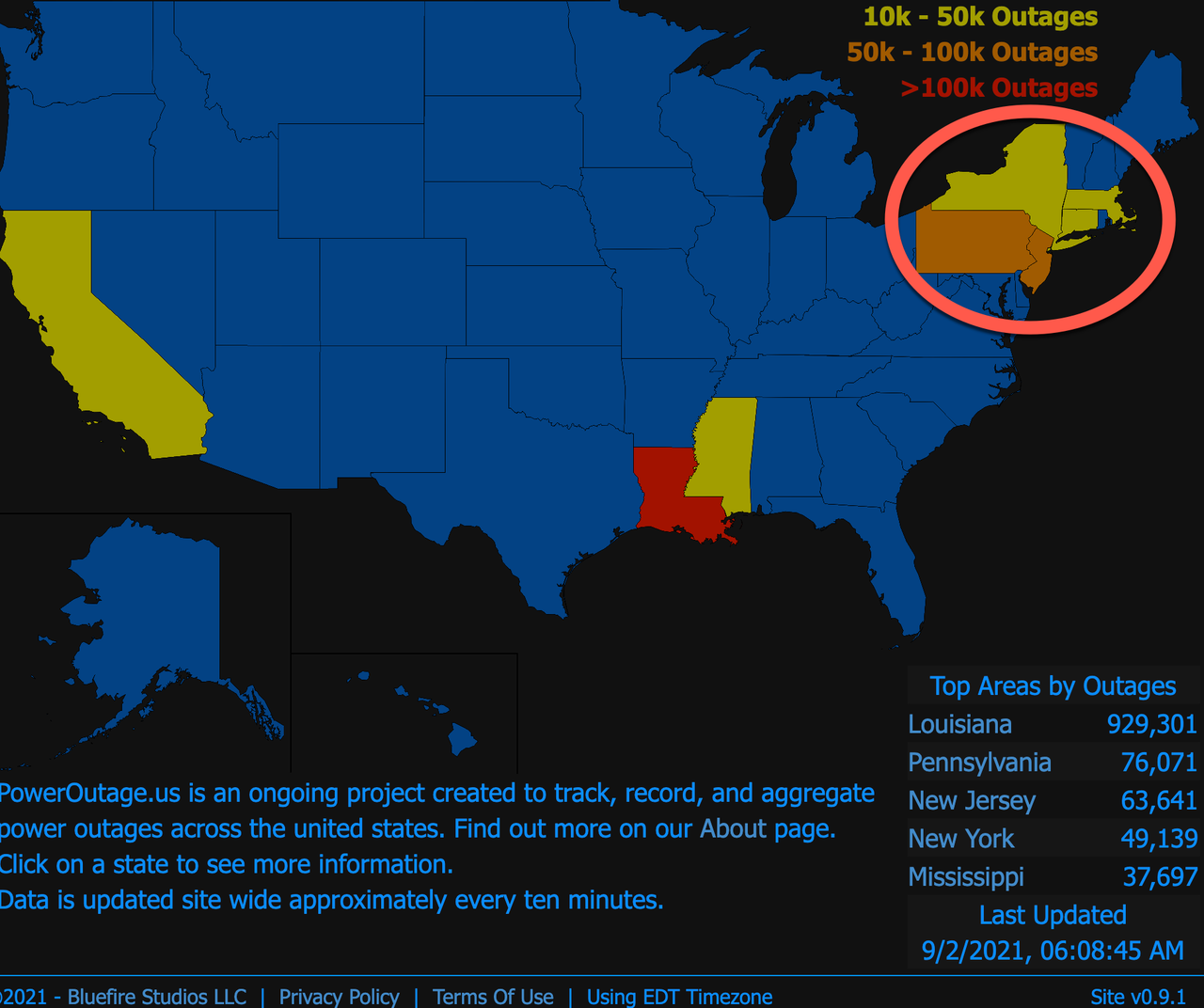
Between Pennsylvania, New Jersey, and New York, Poweroutage.US indicates approximately 200,000 people are without power on Thursday morning. 

Earlier Wednesday, multiple large tornadoes were spotted in Maryland, Pennsylvania, and New Jersey, causing damage. 

… and, of course, climate expert Greta Thurnberg was busy tweeting away last night about the chaos in the Northeast, seizing any opportunity to push her climate change agenda, because clearly this was the very first hurricane to hit the Tristate area since the Ice Age.

Tyler Durden
Thu, 09/02/2021 – 09:00

via ZeroHedge News https://ift.tt/3kQlGxU Tyler Durden

JD Vance Surrenders to the Politics of Hate


Hater.

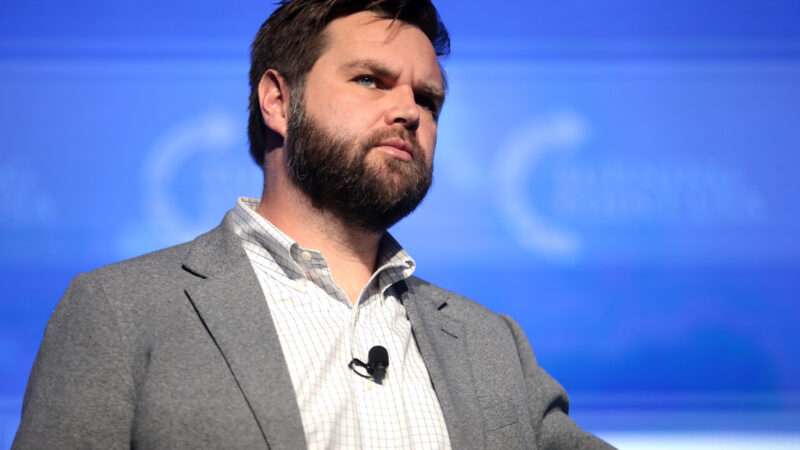
Hillbilly Elegy author JD Vance was already some way along a journey when he took the stage at the first “National Conservatism Conference” in July 2019. 

In the runup to 2016, he had been an outspoken critic of Donald Trump’s candidacy. “I find him reprehensible,” he tweeted a month before the election. “Fellow Christians, everyone is watching us when we apologize for this man.”

Within three years, his views had evolved sufficiently to put him on the program of an event widely viewed as an attempt by right-wing pundits and scholars to erect an institutional structure—or at least some intellectual scaffolding—around the Trump phenomenon. 

Earlier this year, just after announcing a run for U.S. Senate, he apologized to Ohio voters for having been “wrong about the guy.” 

But only last week did the full force of Vance’s spiritual reversal become apparent: “I think our people hate the right people,” he told The American Conservative magazine.

“Our people” might be understood broadly as the Republican base, while those he sees as worthy of contempt might be understood broadly as leftists and members of the coastal elite. Reached for comment, his campaign press secretary affirmed that “JD Vance strongly believes that the political, financial and Big Tech elites…deserve nothing but our scorn and hatred.”

By suggesting that antipathy toward the correct out-group is itself a moral imperative, Vance was engaging a powerful political current that has recently resurfaced within the conservative movement. He is not the first to be swept up in it.

In 2016 and 2017, New York Post op-ed editor Sohrab Ahmari wrote a pair of long magazine articles sounding the alarm to people of faith about rising illiberalism at home and abroad. “Simply put,” he said in the second piece for Commentary magazine, “in the real-world experience of the 20th century, the Church, tradition, and religious minorities fared far better under liberal-democratic regimes than they did under illiberal alternatives.” 

Two years later, Ahmari had had enough of all that. In a now-infamous broadside in the Christian journal First Things, he insisted that conservatives learn to see “politics as war and enmity,” that they shed their “great horror” of “the use of the public power to advance the common good,” and that they be willing “to fight the culture war with the aim of defeating the enemy and enjoying the spoils.”

At the very core of the new illiberal conservatism is a yen for power—and an unabashed willingness to use it to destroy one’s political opponents. Summing up the problem with libertarians and “establishment” conservatives in an essay last year, Hillsdale College’s David Azerrad assailed “the cowardice and accommodation in the face of leftist hegemony” exhibited by the “long list of enemies to the Right.” The more “manly” and “combative” conservatism that Azerrad claimed to speak for “understands not just ideas,” he said, “but power.”

Demands of this sort can be plausibly justified only if one’s adversaries are irredeemable and one’s life itself is at stake. Listen to the new conservatives’ online chatter and you’ll hear just such claims: that the left wishes to “subjugate” or “exterminate” them; that progressives have no qualms about using state power to accomplish their ends; that to do anything less than respond “in kind” amounts to “unilateral disarmament”; that this is a “war” in which the only choices are “suicide” or victory at any cost.

And these sentiments are not limited to anonymous accounts on the dark edges of social media. In July, former Trump official (and “Flight 93 Election” essayist) Michael Anton lambasted conservatives for not responding appropriately to the “proto-genocidal rhetoric” of the left. In February 2020, Harvard Law professor Adrian Vermeule stepped into hot water by tweeting that the anti-Trump attendees of a center-right conference would be “the very first group for the camps.” (He meant that their opposition to Trump will not be able to save them from the “gulags” when the “extremist left” takes over, he later clarified.) As talk radio provocateur Jesse Kelly put it this spring, “The Left and the Right have existed in a System where only the Left plays offense and the Right plays defense. They’ve existed in this System so long, both sides think it’s normal. And permanent. It’s not.”

A couple of things should be clear at this point. For one, this is not a left-right schism. For those I call “Will-to-Power Conservatives,” the fusionist right is no less an enemy than is the progressive-identitarian left. (Now would be a good moment to acknowledge that the politics of hate are not exactly foreign to segments of the progressive movement, either. Neither side has a monopoly on illiberalism.)

Second, this divide is not primarily about technocratic policy. 

Consider that the same nationalist conference at which Vance spoke in 2019 featured a debate. On one side, representing the MAGA faction, former Mitt Romey adviser Oren Cass argued that Washington should use its powers of taxation and regulation to prop up American manufacturing against foreign competition. On the other, Richard Reinsch, an editor at the libertarian publisher Liberty Fund, made the case for free markets and against attempts by the state to choose winners and losers.

It can seem like this type of studious wrangling over the proper size and scope of government is the main rift on the right today. It’s not. Cass’ top-down industrial planning is about as far from my free trade libertarianism as a political agenda can be. But as a dispositional liberal, Cass recognizes, just as Reinsch and I do, that people can disagree without despising one another.

The same, I fear, cannot be said of Vance and his compatriots. And once hate becomes a virtue to be celebrated and opponents become enemies to be destroyed, before long, no response is off the table. 

Students of intellectual history may be picking up a hair-raising resonance. The new illiberal conservatives have (sometimes quite explicitly) taken a page out of the book of Carl Schmitt, an anti-modernist, pro-authoritarian German political philosopher known for insisting that the core distinction of politics “is that between friend and enemy.” 

It’s occasionally said that Schmitt’s ideas were meant to be descriptive, not normative. Yet he plainly believed that blowing up constitutional limitations on the executive and withholding mercy from the out-group were the legitimate province of a sovereign state. Democracy, he once wrote, “necessarily involves first homogeneity and secondly—if necessary—the elimination or annihilation of heterogeneity.” 

As if to prove how strong the current of hate-based politics can be, Schmitt’s beliefs would lead him to a stint as the “crown jurist of the Third Reich.” Though he eventually left the Nazi Party, he refused to renounce the worldview that had made him one of Hitler’s most prominent apologists.

With their talk of enemies and enmity and civilizational war, it seems the new illiberal conservatives have tapped into something that isn’t so new after all.

from Latest – Reason.com https://ift.tt/3DGejBL
via IFTTT

Initial Claims Drop To New Post-Covid Low Even As Total Benefits Recipients Rise To 4 Week High

Initial Claims Drop To New Post-Covid Low Even As Total Benefits Recipients Rise To 4 Week High

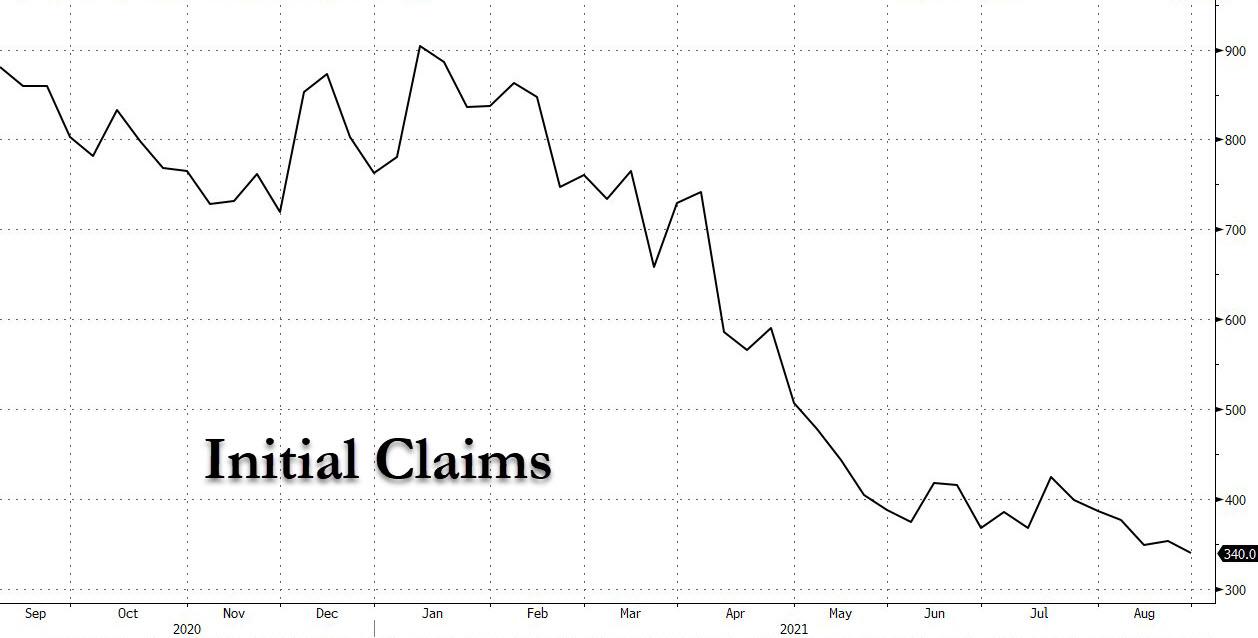
After yesterday’s dismal ADP jobs report and contraction in the ISM Mfg Employment Component, traders were looking forward to some good news on the jobs front, and they got it moments ago when the DOL reported that in the week ending August 28, initial jobless claims dropped again, sliding from 354K to 340K, beating expectations of a 345K print and a new post-covid lockdown low…

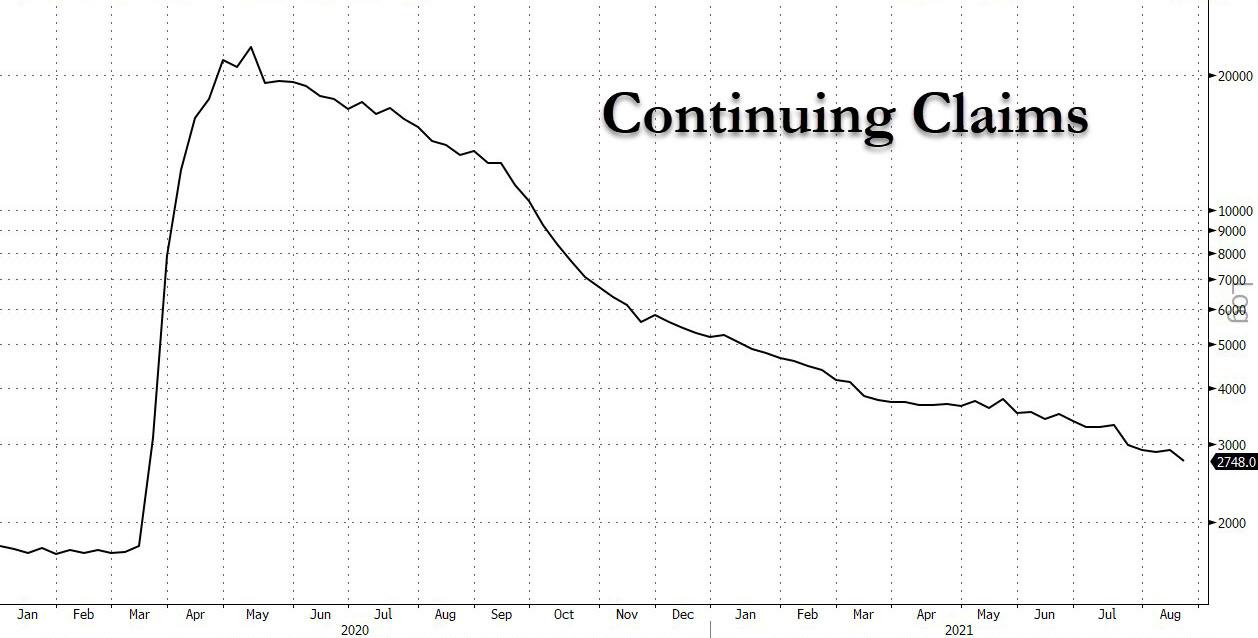
… while continuing claims also hit a new post-March 2020 low of 2.748MM, down from 2.908MM last week and also better than the 2.808MM expected.

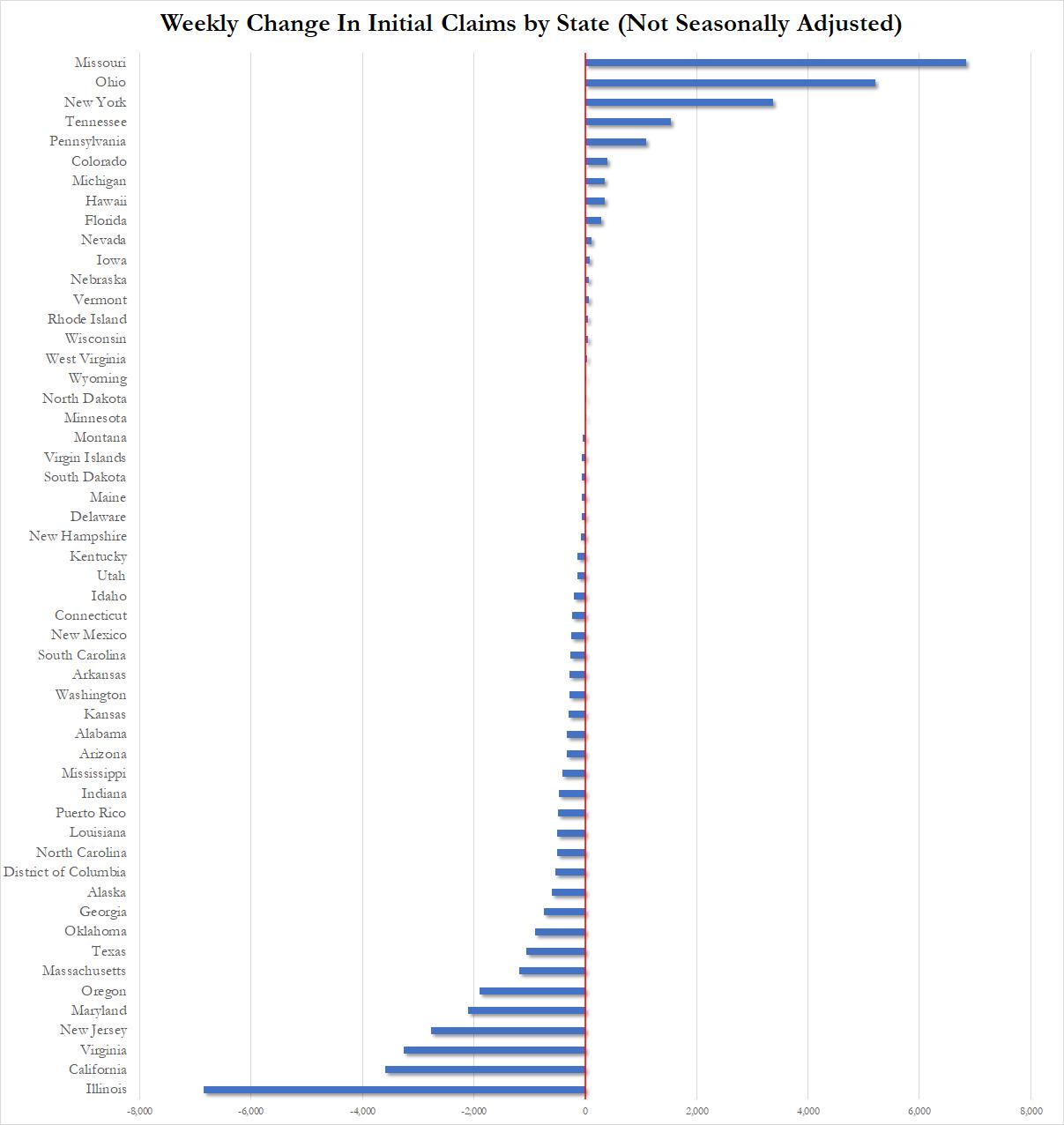
The states with the biggest increases in initial claims were Missouri (+6,837), Ohio (+5,217), and New York (+3,381), while the states with the biggest drops were Illinois (-6,854), California (-3,591), and Virginia (-3,258).

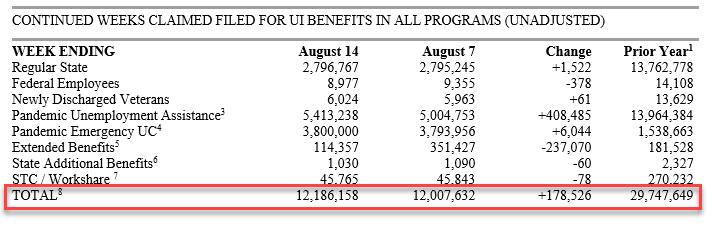
Yet despite the continued improvement in claims, the total number of Americans collecting benefits actually rose by over 178k to just under 12.2 million.

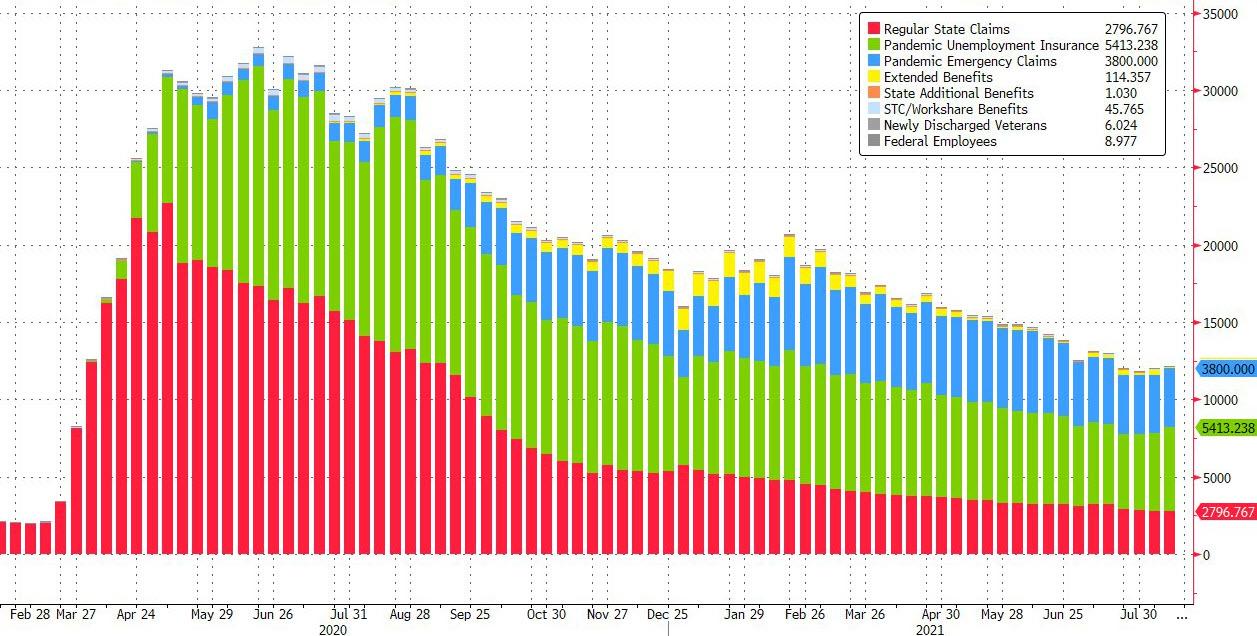
In fact, as shown below, the total number of claimants actually hit the highest level in 4 weeks despite the expiration of jobless benefits across various republican states.

Putting it all together, we now have a record 10+ million job openings and over 12mm people still on the dole. What’s wrong with this picture?

Tyler Durden
Thu, 09/02/2021 – 08:45

via ZeroHedge News https://ift.tt/3mWY7Gk Tyler Durden

JD Vance Surrenders to the Politics of Hate


Hater.

Hillbilly Elegy author JD Vance was already some way along a journey when he took the stage at the first “National Conservatism Conference” in July 2019. 

In the runup to 2016, he had been an outspoken critic of Donald Trump’s candidacy. “I find him reprehensible,” he tweeted a month before the election. “Fellow Christians, everyone is watching us when we apologize for this man.”

Within three years, his views had evolved sufficiently to put him on the program of an event widely viewed as an attempt by right-wing pundits and scholars to erect an institutional structure—or at least some intellectual scaffolding—around the Trump phenomenon. 

Earlier this year, just after announcing a run for U.S. Senate, he apologized to Ohio voters for having been “wrong about the guy.” 

But only last week did the full force of Vance’s spiritual reversal become apparent: “I think our people hate the right people,” he told The American Conservative magazine.

“Our people” might be understood broadly as the Republican base, while those he sees as worthy of contempt might be understood broadly as leftists and members of the coastal elite. Reached for comment, his campaign press secretary affirmed that “JD Vance strongly believes that the political, financial and Big Tech elites…deserve nothing but our scorn and hatred.”

By suggesting that antipathy toward the correct out-group is itself a moral imperative, Vance was engaging a powerful political current that has recently resurfaced within the conservative movement. He is not the first to be swept up in it.

In 2016 and 2017, New York Post op-ed editor Sohrab Ahmari wrote a pair of long magazine articles sounding the alarm to people of faith about rising illiberalism at home and abroad. “Simply put,” he said in the second piece for Commentary magazine, “in the real-world experience of the 20th century, the Church, tradition, and religious minorities fared far better under liberal-democratic regimes than they did under illiberal alternatives.” 

Two years later, Ahmari had had enough of all that. In a now-infamous broadside in the Christian journal First Things, he insisted that conservatives learn to see “politics as war and enmity,” that they shed their “great horror” of “the use of the public power to advance the common good,” and that they be willing “to fight the culture war with the aim of defeating the enemy and enjoying the spoils.”

At the very core of the new illiberal conservatism is a yen for power—and an unabashed willingness to use it to destroy one’s political opponents. Summing up the problem with libertarians and “establishment” conservatives in an essay last year, Hillsdale College’s David Azerrad assailed “the cowardice and accommodation in the face of leftist hegemony” exhibited by the “long list of enemies to the Right.” The more “manly” and “combative” conservatism that Azerrad claimed to speak for “understands not just ideas,” he said, “but power.”

Demands of this sort can be plausibly justified only if one’s adversaries are irredeemable and one’s life itself is at stake. Listen to the new conservatives’ online chatter and you’ll hear just such claims: that the left wishes to “subjugate” or “exterminate” them; that progressives have no qualms about using state power to accomplish their ends; that to do anything less than respond “in kind” amounts to “unilateral disarmament”; that this is a “war” in which the only choices are “suicide” or victory at any cost.

And these sentiments are not limited to anonymous accounts on the dark edges of social media. In July, former Trump official (and “Flight 93 Election” essayist) Michael Anton lambasted conservatives for not responding appropriately to the “proto-genocidal rhetoric” of the left. In February 2020, Harvard Law professor Adrian Vermeule stepped into hot water by tweeting that the anti-Trump attendees of a center-right conference would be “the very first group for the camps.” (He meant that their opposition to Trump will not be able to save them from the “gulags” when the “extremist left” takes over, he later clarified.) As talk radio provocateur Jesse Kelly put it this spring, “The Left and the Right have existed in a System where only the Left plays offense and the Right plays defense. They’ve existed in this System so long, both sides think it’s normal. And permanent. It’s not.”

A couple of things should be clear at this point. For one, this is not a left-right schism. For those I call “Will-to-Power Conservatives,” the fusionist right is no less an enemy than is the progressive-identitarian left. (Now would be a good moment to acknowledge that the politics of hate are not exactly foreign to segments of the progressive movement, either. Neither side has a monopoly on illiberalism.)

Second, this divide is not primarily about technocratic policy. 

Consider that the same nationalist conference at which Vance spoke in 2019 featured a debate. On one side, representing the MAGA faction, former Mitt Romey adviser Oren Cass argued that Washington should use its powers of taxation and regulation to prop up American manufacturing against foreign competition. On the other, Richard Reinsch, an editor at the libertarian publisher Liberty Fund, made the case for free markets and against attempts by the state to choose winners and losers.

It can seem like this type of studious wrangling over the proper size and scope of government is the main rift on the right today. It’s not. Cass’ top-down industrial planning is about as far from my free trade libertarianism as a political agenda can be. But as a dispositional liberal, Cass recognizes, just as Reinsch and I do, that people can disagree without despising one another.

The same, I fear, cannot be said of Vance and his compatriots. And once hate becomes a virtue to be celebrated and opponents become enemies to be destroyed, before long, no response is off the table. 

Students of intellectual history may be picking up a hair-raising resonance. The new illiberal conservatives have (sometimes quite explicitly) taken a page out of the book of Carl Schmitt, an anti-modernist, pro-authoritarian German political philosopher known for insisting that the core distinction of politics “is that between friend and enemy.” 

It’s occasionally said that Schmitt’s ideas were meant to be descriptive, not normative. Yet he plainly believed that blowing up constitutional limitations on the executive and withholding mercy from the out-group were the legitimate province of a sovereign state. Democracy, he once wrote, “necessarily involves first homogeneity and secondly—if necessary—the elimination or annihilation of heterogeneity.” 

As if to prove how strong the current of hate-based politics can be, Schmitt’s beliefs would lead him to a stint as the “crown jurist of the Third Reich.” Though he eventually left the Nazi Party, he refused to renounce the worldview that had made him one of Hitler’s most prominent apologists.

With their talk of enemies and enmity and civilizational war, it seems the new illiberal conservatives have tapped into something that isn’t so new after all.

from Latest – Reason.com https://ift.tt/3DGejBL
via IFTTT

Rabobank: We Have A New Champion In The “I Can’t Believe This Is Happening” Category

Rabobank: We Have A New Champion In The “I Can’t Believe This Is Happening” Category

By Michael Every of Rabobank

In a year in which every week see a fresh battle for top slot in the ‘I Can’t Believe This is Happening’ headline competition, we have a new potential champion. San Francisco has decided it will pay criminals $300 a month provided they do not put a bullet in anyone, or get one put in them. Is this the first ‘shot’ towards Universal Income outside of the recent Covid furloughs/cheques? Is there a sliding scale for knives and brass-knuckles? And shall we call this policy “Cash for Crooks” or “Universal In-Gun”?

This latest champion headline reflects the underlying polarization of our socio-economic system, as well as the ironic fusion of its extreme edges, e.g., the NRA and San Fran would both seem to benefit from a scheme that sees far more guns and then far less shooting of them. It also reflects the equally sharp dichotomy of stories we see in daily newsfeed and the analytical round-up – in particular between those that recognise the above trend, and those that choose to ignore it.

“S&P up 0.03%”; “US 10-year yields unchanged”; “WTI -0.58%, Brent -0.06%” These are examples of market headlines that most people working in markets are quite happy to see, and to focus on. You can change the numbers up or down a little bit and that remains true.

Meanwhile, here are a sample of headlines that I get the impression most people working in markets are very unhappy to see, and many choose not to focus on at all.

US:

  • “Techs Outperform as Risks to Payrolls Report Grow: Markets Live” (BBG) – after yesterday’s ADP employment report massively disappointed, suggesting that the US is still 7m jobs behind where it needs to be in this recovery, and with momentum fading, not gaining.
  • “US DOJ Readying Google Antitrust Lawsuit over Ad-Tech Business” (BBG) – suggesting that the above pivot may be in to a cul-de-sac.
  • “Amazon now running 164 flights a day to deliver stock in the US” (FT) – underlining that alongside supply chain disruption, some may try to ape ‘Too Big to Fail’ into ‘Too Big to Sail’ and vertically integrate logistics. Will mega-firms de facto own their own airlines and ships in order to control trade and set market terms? Looking back in time, think the VOC and EIC; looking forward, think ‘The Spice Must Flow!’
  • “Bill Gross Says Bonds Are ‘Investment Garbage’ Just Like Cash” (BBG) – as the former ‘Bond King’ says the King is dead due to low returns, and doesn’t add ‘Long Live the King’
  • “Crypto platforms need regulations to survive, says SEC boss” (FT) – Tick, tock, tick, tock.
  • “Corporate America fights uphill battle against anti-China push” (Politico) – which points out US Big Business is having to line up with the Democrat’s Progressive wing like Bernie Sanders (which politically deserves a “!” from both sides of the deal, NRA-San Fran style) to try to stall even more anti-China legislation being passed – and all the while November 2022 polling suggests that uphill battle may then be a vertical climb.
  • “China’s new U.S. ambassador goes full wolf in first major speech” (Politico) – stressing Qin Gang warning of “disastrous consequences” if the US seeks to suppress China using a “Cold War playbook.” On which note, see the political timeframe and underlying political dynamic referred to just above.

 China:

  • “Beijing’s ‘Volcker Moment’ May Be Approaching Fast: China Today” (BBG) – talking about the risks to the key property sector if house prices are targeted under Common Prosperity. (Which was discussed in “Pro-Fund or Profound Revolution?” yesterday.)
  • “China’s ‘Volcker Moment’ is a Mounting Risk to Global Recovery” (Telegraph) – echoing that this has global consequences even if the globe isn’t paying much attention.
  • “Chinese Firms Rush to Embrace Xi’s ‘Common Prosperity’ Slogan” (BBG) – meaning it is happening on some fronts at least already – so why not others?
  • ”China’s Economy Barely Responding to Contained Virus: Economics” (BBG) – after the Caixin manufacturing PMI joined the official services PMI below the contractionary 50 level, showing the economy can ill afford another Volcker Moment.
  • “Evergrande, Huarong Woes a Warning for Commodities: Intelligence” (BBG) – again showing how what happens in China does not stay in China.
  • “Xi Jinping calls on young officials to strengthen loyalty, competency for important tasks” (CGTN) – where his speech included: “It is unrealistic to always want to live a peaceful life and not want to fight. We must abandon our illusions, fight bravely, refrain from stepping or giving way to issues of principle, and safeguard national sovereignty, security, and development interests with unprecedented will and quality.“

EU:

  • Europe’s Waning Crisis Triggers ECB Debate on Ending Stimulus” (BBG) – where the ECB may be repeating its historic form of not being able to look beyond its own borders when thinking about tightening monetary policy (relatively).
  • “Repeat Warning for Equities in Falling Global Manufacturing PMI” (BBG) as case in point
  • “EU regulator warns of ‘high risks’ for market crash” (Politico) – as retail punters have gone in for things like cryptocurrencies and meme stonks.
  • “EU tries to redirect Afghan refugees to neighbouring countries” (ITAR-TASS) – so no “Wir Schaffen Das 2.0”, which mirrors Mrs Merkel being out the door in weeks. However, it means the EU paying people to stay away. Perhaps $300 a month, if they don’t shoot people?
  • “Europe’s glory days of trade deals are over” (Politico) – because “it’s never been so politically toxic”, and leaving what for all those trade-mavens to do from now on?

UK:

  • “UK House Prices Surge in August Despite Ending of Tax Cut” (BBG) – or, ‘Builders’ Bums Better’
  • BE Primer: UK Recovery to Slow in 2H as Virus Risks Intensify” (BBG) – or, ‘Bums Better Build’.

AU/NZ:

  • “A profound moment in the pandemic” (AFR) – as Victoria admits it can’t get to zero Covid even with lockdowns. And where Victoria leads…
  • ASX slips; BHP wipes 2021 gains; ANZ says RBA to delay taper” (AFR) – whocouldanooed?
  • “New Zealand Reports 49 New Cases of Covid-19 in Community” (BBG) – again, whocouldanooed?

One could go on. And on. And on. Or one can say: “S&P up 0.03%”; “US 10-year yields unchanged”; “WTI -0.58%, Brent -0.06%” Which in some ways is arguably not too far removed from getting $300 a month not to shoot people.

Tyler Durden
Thu, 09/02/2021 – 08:28

via ZeroHedge News https://ift.tt/3BBqdeE Tyler Durden

Refusing to Accept Crumpled $1 Bills as Property Tax Payment Doesn’t Violate First Amendment

From Lull v. County of Sacramento, decided Tuesday by Magistrate Judge Jeremy Peterson (E.D. Cal.):

Plaintiff claims that defendants engaged in retaliation forbidden by the First Amendment when they refused to let him pay some of his property taxes with crumpled one-dollar bills emptied from garbage bags, which he brought to the Sacramento County Department of Finance office on tax day. Defendants maintain that, although they do accept some cash payments and had previously accepted one from plaintiff, they refused the payment at issue because it did not comply with the county’s requirements for cash payments and because they did not have the resources to process it. Plaintiff disputes that defendants’ rejection of his payment was motivated by these considerations, claiming instead that defendants sought to suppress his protest, but he offers scant evidence of this. I recommend that the court grant summary judgment for defendants….

In 2017, plaintiff was behind on his property tax payments and was under pressure from his mortgage holder to pay the taxes. He needed to pay by February 6 to avoid either a fee, a higher interest rate, or default. Plaintiff sought to make his tax payment in one-dollar bills, which he alleges was intended as a form of protest. Before attempting such a cash payment, he consulted with the county attorney, Keith Floyd. Floyd told him that coins were not an acceptable form of payment, but dollar bills would be acceptable under certain conditions, namely:

  1. All tendered bills would have to be in a readily countable condition. This means the bills must be flat when presented. No folded, crinkled, wadded up, rolled, or otherwise altered bills would be accepted.
  2. The payment would have to be offered in person at an agreed upon date and time. The Department of Finance needs to ensure that it has adequate staffing resources available to count the money during regular business hours while you or your representative remain present during the process.
  3. The Department of Finance would allow for one recount if the counted total appeared to be less than the tax bill amount.

Plaintiff arranged with Floyd to pay with 16,400 one-dollar bills on February 6, 2017.

When plaintiff came to the Department of Finance’s public counter at 8:10 a.m., the 16,634 bills that he presented did not comply with the requirements that Floyd had laid out. Specifically, some of the bills were folded and crumpled, not flat. Plaintiff dumped them from garbage bags onto the counter, spilling some onto the floor. He also taped fake bills to the counter and spoke about his protest, recording it on video. Despite the condition of the bills, the county still accepted them as payment. Processing plaintiff’s payment took 35 hours of staff time and involved six staff members.

On February 9, Floyd sent plaintiff a letter confirming that plaintiff had made a partial payment on February 6 and stating that he still had an outstanding balance, which was due by April 10, 2017. The letter notified plaintiff that “the Department of Finance’s duty to serve the rest of the public through its normal budgeted operations prohibits accepting any further payment attempts in single, folded dollar bills. Placing a large pile of dollar bills on the Department of Finance public floor area also creates a significant security risk.”

Department of Finance officials recognized the need for a policy on cash acceptance, in part because of the burden of processing plaintiff’s payment on February 6. Thus, in addition to the guidance provided by the county attorney in advance of the February 6 payment, Ben Lamera, the director of finance, implemented an informal cash acceptance policy for the Department of Finance sometime prior to April 10. The policy stated:

  1. Bills must be readily countable (i.e. not folded, crinkled, or otherwise manipulated).
  2. Large quantities of bills or coins may not be placed on the public counter, floor, or any other place within the public area. The Tax Collector has the right to refuse the payment in coins of property taxes, penalties and interest.
  3. Large quantities of bills must be tendered by the customer in stacks that can be quickly placed in Department counting machines.
  4. The limit for non-tax payments made in coin is approximately $150 at a location where there is an automated coin counter and $5 at locations without one.
  5. All counting must occur at the public counter with the customer present.
  6. For payments involving significant quantities of cash, transactions must be able to be completed in a reasonable amount of time, during regular business hours. The county does not accept partial payments for property tax payments. Any counted cash must be returned to the customer if counting of tendered cash is not completed by the close of business, unless the customer offers to make a non-property tax partial payment.

On April 10, 2017, the state tax deadline, plaintiff came to the Department of Finance’s public counter without an appointment and attempted to make a tax payment with folded and crumpled one-dollar bills contained in two trash bags.

Plaintiff recorded his appearance on video and spoke with members of the public and county employees. While he was in line, a security officer approached him and asked that he not dump money on the floor. The officer indicated that he did not know whether plaintiff’s form of payment would be accepted. Defendant Mark Aspesi, a senior accounting manager, was working at the counter and refused to accept plaintiff’s payment. There was a line of customers stretching out the door because it was tax day. Aspesi later testified that he refused the payment because the office’s staff was busy and it would have taken a long time to count so many dollar bills. Plaintiff left without paying his taxes….

At issue is a single claim of First Amendment retaliation. To prevail, plaintiff would need to show that: “(1) he engaged in constitutionally protected activity; (2) as a result, he was subjected to adverse action by the defendant that would chill a person of ordinary firmness from continuing to engage in the protected activity; and (3) there was a substantial causal relationship between the constitutionally protected activity and the adverse action.” …

As for the first required element, plaintiff offers little to back up his claim that he engaged in constitutionally protected activity. Speech is protected by the First Amendment, but making a payment in a particular form is conduct, not speech—and conduct receives far more limited First Amendment protection. Although plaintiff apparently intended his choice of a form of payment—crumpled and folded one-dollar bills presented on tax day—to have an expressive element, it might merit no First Amendment protection at all….

But even if I accept the questionable proposition that the relevant activity was protected by the First Amendment, plaintiff has failed to offer evidence sufficient to satisfy the third element of retaliation: he has not shown that there was a substantial causal relationship between his purported constitutionally protected activity and the county’s adverse action—its refusal to accept his second payment. On the other hand, defendants point to copious evidence in the record that plaintiff’s form of payment was refused because the bills were not readily countable and could not be processed that day….

It is telling that both times that plaintiff brought trash bags full of money to the county office, he was permitted to engage in speech. He was able to film his interactions on April 10. He and his videographer were permitted to shove crumpled dollar bills through the service window, and he was able to speak out on video to county employees and members of the public. The evidence does not show that the county sought to shut down his protest, but rather that plaintiff ignored reasonable restrictions on cash payments, of which he had advance notice, and that this led to the rejection of his payment. Nothing in the record indicates that plaintiff’s payment would have been rejected had his bills been stacked and readily countable….


from Latest – Reason.com https://ift.tt/3mSh7WF
via IFTTT

Lawsuit Challenging Houston Asset Forfeiture Program Says Police Use Stock Language To Seize Cash Without Probable Cause


woods harris lawsuit

Ameal Woods was driving near Houston in May 2019 when he was pulled over by a Harris County Sheriff’s deputy, allegedly for driving too close to a semi-truck. The deputy let him go without a ticket or a warning, but he did take one one thing for his troubles: Woods’ and his wife’s life savings. 

The deputy seized $43,200 in cash that he found in the rental car Woods was driving, money that Woods and Davis say they planned on using to possibly purchase a tractor-trailer for Woods’ trucking business. Carrying large amounts of cash is legal, but the deputy seized it under suspicion that Woods was a drug trafficker using a practice known as civil asset forfeiture.

Now Woods and his wife, Jordan Davis, are the lead plaintiffs in a class-action lawsuit filed Monday in Texas district court against Harris County and the Harris County District Attorney by the Institute for Justice, a libertarian-leaning public interest law firm. The suit alleges that the county has a practice of seizing cash through civil forfeiture without probable cause, relying on boilerplate language and vague allegations to seize and keep property.

Under civil asset forfeiture laws, police can legally seize property—cash, cars, and even houses—suspected of being connected to criminal activity like drug trafficking, whether or not the owner has been charged with a crime.

Law enforcement groups say civil forfeiture is an essential tool to disrupt organized drug trafficking. However, civil liberties groups say the practice is profoundly tilted against owners, who often bear the burden of proving their innocence and fighting in court for months, sometimes years, to try and win back their own property.

“It’s two years later, and I still have the same reaction thinking about it,” Woods said about the seizure in a press release. “I just get depressed all over again. We hope we can get our savings back and make sure this doesn’t happen to anyone else.”

The lawsuit alleges that Harris County prosecutors have a pattern of seeking civil forfeitures based on boilerplate affidavits, written by police officers who were not at the scene. The Institute for Justice found that Harris County prosecutors filed at least 113 forfeiture petitions since 2016 that used stock language and identical phrases, each one noting that a police drug dog alerted on the property at some point after the seizure, each one written by an officer who was not at the scene. The use of boilerplate language led to errors in the affidavits, such as contradictory dates and incorrectly stating what property was seized.

It’s a practice that Institute for Justice managing attorney Arif Panj calls “copy-and-pasting your way to probable cause,” and he says it doesn’t pass constitutional muster. 

In addition, the lawsuit claims that Harris County’s forfeiture practices fail to provide owners with prompt hearings to challenge property seizures, require owners to prove their own innocence, and create perverse profit incentives for law enforcement, all of which violates the Texas constitution.

Forfeiture proceeds in the county go straight into the budgets of the district attorney’s office and the Harris County Sheriff’s Office. The lawsuit says the sheriff had paid about $2.3 million annually in salaries and overtime—all of which comes from forfeiture proceeds.

“Absent intervention from this Court, Harris County will continue to unconstitutionally seize and forfeit property from scores if not hundreds of new individuals every year, without probable cause, without due process, and often with the same affiant relying on identical hearsay testimony in some two-thirds of cases,” the Institute for Justice argues in its petition.

The Institute for Justice has successfully challenged civil forfeiture practices in other jurisdictions. Most recently, the Institute for Justice filed a lawsuit on behalf of Kermit Warren, a New Orleans grandfather who had roughly $28,000 seized by the Drug Enforcement Administration based on flimsy accusations of drug trafficking. Warren, like Davis, said he was carrying cash to possibly buy a tow truck to start a scrapping business. He was never charged with a crime.

In 2018, Philadelphia agreed to reform its forfeiture program and pay out settlements to alleged victims as part of a class-action lawsuit filed by the Institute for Justice. The organization is also currently litigating a class-action lawsuit on behalf of travelers who have had large amounts of cash seized from them at airports by federal agents.

Around 35 states have passed some form of civil forfeiture reform over the past decade in response to outrageous stories exposed by civil liberties groups and news outlets. However, no such legislation has passed in Texas, despite years of effort by advocates, and the Institute for Justice says the state has some of the worst forfeiture laws in the country.

“The existing legal remedies are totally inadequate to compensate [Woods and Davis] for having their money taken for over two years,” Panj says. “We’re hoping that real, meaningful constitutional relief ensures that their rights are protected, their money is returned, and everyone else’s rights are protected, too.”

The Harris County District Attorney’s Office did not immediately respond to a request for comment.

from Latest – Reason.com https://ift.tt/3yDH920
via IFTTT

Refusing to Accept Crumpled $1 Bills as Property Tax Payment Doesn’t Violate First Amendment

From Lull v. County of Sacramento, decided Tuesday by Magistrate Judge Jeremy Peterson (E.D. Cal.):

Plaintiff claims that defendants engaged in retaliation forbidden by the First Amendment when they refused to let him pay some of his property taxes with crumpled one-dollar bills emptied from garbage bags, which he brought to the Sacramento County Department of Finance office on tax day. Defendants maintain that, although they do accept some cash payments and had previously accepted one from plaintiff, they refused the payment at issue because it did not comply with the county’s requirements for cash payments and because they did not have the resources to process it. Plaintiff disputes that defendants’ rejection of his payment was motivated by these considerations, claiming instead that defendants sought to suppress his protest, but he offers scant evidence of this. I recommend that the court grant summary judgment for defendants….

In 2017, plaintiff was behind on his property tax payments and was under pressure from his mortgage holder to pay the taxes. He needed to pay by February 6 to avoid either a fee, a higher interest rate, or default. Plaintiff sought to make his tax payment in one-dollar bills, which he alleges was intended as a form of protest. Before attempting such a cash payment, he consulted with the county attorney, Keith Floyd. Floyd told him that coins were not an acceptable form of payment, but dollar bills would be acceptable under certain conditions, namely:

  1. All tendered bills would have to be in a readily countable condition. This means the bills must be flat when presented. No folded, crinkled, wadded up, rolled, or otherwise altered bills would be accepted.
  2. The payment would have to be offered in person at an agreed upon date and time. The Department of Finance needs to ensure that it has adequate staffing resources available to count the money during regular business hours while you or your representative remain present during the process.
  3. The Department of Finance would allow for one recount if the counted total appeared to be less than the tax bill amount.

Plaintiff arranged with Floyd to pay with 16,400 one-dollar bills on February 6, 2017.

When plaintiff came to the Department of Finance’s public counter at 8:10 a.m., the 16,634 bills that he presented did not comply with the requirements that Floyd had laid out. Specifically, some of the bills were folded and crumpled, not flat. Plaintiff dumped them from garbage bags onto the counter, spilling some onto the floor. He also taped fake bills to the counter and spoke about his protest, recording it on video. Despite the condition of the bills, the county still accepted them as payment. Processing plaintiff’s payment took 35 hours of staff time and involved six staff members.

On February 9, Floyd sent plaintiff a letter confirming that plaintiff had made a partial payment on February 6 and stating that he still had an outstanding balance, which was due by April 10, 2017. The letter notified plaintiff that “the Department of Finance’s duty to serve the rest of the public through its normal budgeted operations prohibits accepting any further payment attempts in single, folded dollar bills. Placing a large pile of dollar bills on the Department of Finance public floor area also creates a significant security risk.”

Department of Finance officials recognized the need for a policy on cash acceptance, in part because of the burden of processing plaintiff’s payment on February 6. Thus, in addition to the guidance provided by the county attorney in advance of the February 6 payment, Ben Lamera, the director of finance, implemented an informal cash acceptance policy for the Department of Finance sometime prior to April 10. The policy stated:

  1. Bills must be readily countable (i.e. not folded, crinkled, or otherwise manipulated).
  2. Large quantities of bills or coins may not be placed on the public counter, floor, or any other place within the public area. The Tax Collector has the right to refuse the payment in coins of property taxes, penalties and interest.
  3. Large quantities of bills must be tendered by the customer in stacks that can be quickly placed in Department counting machines.
  4. The limit for non-tax payments made in coin is approximately $150 at a location where there is an automated coin counter and $5 at locations without one.
  5. All counting must occur at the public counter with the customer present.
  6. For payments involving significant quantities of cash, transactions must be able to be completed in a reasonable amount of time, during regular business hours. The county does not accept partial payments for property tax payments. Any counted cash must be returned to the customer if counting of tendered cash is not completed by the close of business, unless the customer offers to make a non-property tax partial payment.

On April 10, 2017, the state tax deadline, plaintiff came to the Department of Finance’s public counter without an appointment and attempted to make a tax payment with folded and crumpled one-dollar bills contained in two trash bags.

Plaintiff recorded his appearance on video and spoke with members of the public and county employees. While he was in line, a security officer approached him and asked that he not dump money on the floor. The officer indicated that he did not know whether plaintiff’s form of payment would be accepted. Defendant Mark Aspesi, a senior accounting manager, was working at the counter and refused to accept plaintiff’s payment. There was a line of customers stretching out the door because it was tax day. Aspesi later testified that he refused the payment because the office’s staff was busy and it would have taken a long time to count so many dollar bills. Plaintiff left without paying his taxes….

At issue is a single claim of First Amendment retaliation. To prevail, plaintiff would need to show that: “(1) he engaged in constitutionally protected activity; (2) as a result, he was subjected to adverse action by the defendant that would chill a person of ordinary firmness from continuing to engage in the protected activity; and (3) there was a substantial causal relationship between the constitutionally protected activity and the adverse action.” …

As for the first required element, plaintiff offers little to back up his claim that he engaged in constitutionally protected activity. Speech is protected by the First Amendment, but making a payment in a particular form is conduct, not speech—and conduct receives far more limited First Amendment protection. Although plaintiff apparently intended his choice of a form of payment—crumpled and folded one-dollar bills presented on tax day—to have an expressive element, it might merit no First Amendment protection at all….

But even if I accept the questionable proposition that the relevant activity was protected by the First Amendment, plaintiff has failed to offer evidence sufficient to satisfy the third element of retaliation: he has not shown that there was a substantial causal relationship between his purported constitutionally protected activity and the county’s adverse action—its refusal to accept his second payment. On the other hand, defendants point to copious evidence in the record that plaintiff’s form of payment was refused because the bills were not readily countable and could not be processed that day….

It is telling that both times that plaintiff brought trash bags full of money to the county office, he was permitted to engage in speech. He was able to film his interactions on April 10. He and his videographer were permitted to shove crumpled dollar bills through the service window, and he was able to speak out on video to county employees and members of the public. The evidence does not show that the county sought to shut down his protest, but rather that plaintiff ignored reasonable restrictions on cash payments, of which he had advance notice, and that this led to the rejection of his payment. Nothing in the record indicates that plaintiff’s payment would have been rejected had his bills been stacked and readily countable….


from Latest – Reason.com https://ift.tt/3mSh7WF
via IFTTT

Lawsuit Challenging Houston Asset Forfeiture Program Says Police Use Stock Language To Seize Cash Without Probable Cause


woods harris lawsuit

Ameal Woods was driving near Houston in May 2019 when he was pulled over by a Harris County Sheriff’s deputy, allegedly for driving too close to a semi-truck. The deputy let him go without a ticket or a warning, but he did take one one thing for his troubles: Woods’ and his wife’s life savings. 

The deputy seized $43,200 in cash that he found in the rental car Woods was driving, money that Woods and Davis say they planned on using to possibly purchase a tractor-trailer for Woods’ trucking business. Carrying large amounts of cash is legal, but the deputy seized it under suspicion that Woods was a drug trafficker using a practice known as civil asset forfeiture.

Now Woods and his wife, Jordan Davis, are the lead plaintiffs in a class-action lawsuit filed Monday in Texas district court against Harris County and the Harris County District Attorney by the Institute for Justice, a libertarian-leaning public interest law firm. The suit alleges that the county has a practice of seizing cash through civil forfeiture without probable cause, relying on boilerplate language and vague allegations to seize and keep property.

Under civil asset forfeiture laws, police can legally seize property—cash, cars, and even houses—suspected of being connected to criminal activity like drug trafficking, whether or not the owner has been charged with a crime.

Law enforcement groups say civil forfeiture is an essential tool to disrupt organized drug trafficking. However, civil liberties groups say the practice is profoundly tilted against owners, who often bear the burden of proving their innocence and fighting in court for months, sometimes years, to try and win back their own property.

“It’s two years later, and I still have the same reaction thinking about it,” Woods said about the seizure in a press release. “I just get depressed all over again. We hope we can get our savings back and make sure this doesn’t happen to anyone else.”

The lawsuit alleges that Harris County prosecutors have a pattern of seeking civil forfeitures based on boilerplate affidavits, written by police officers who were not at the scene. The Institute for Justice found that Harris County prosecutors filed at least 113 forfeiture petitions since 2016 that used stock language and identical phrases, each one noting that a police drug dog alerted on the property at some point after the seizure, each one written by an officer who was not at the scene. The use of boilerplate language led to errors in the affidavits, such as contradictory dates and incorrectly stating what property was seized.

It’s a practice that Institute for Justice managing attorney Arif Panj calls “copy-and-pasting your way to probable cause,” and he says it doesn’t pass constitutional muster. 

In addition, the lawsuit claims that Harris County’s forfeiture practices fail to provide owners with prompt hearings to challenge property seizures, require owners to prove their own innocence, and create perverse profit incentives for law enforcement, all of which violates the Texas constitution.

Forfeiture proceeds in the county go straight into the budgets of the district attorney’s office and the Harris County Sheriff’s Office. The lawsuit says the sheriff had paid about $2.3 million annually in salaries and overtime—all of which comes from forfeiture proceeds.

“Absent intervention from this Court, Harris County will continue to unconstitutionally seize and forfeit property from scores if not hundreds of new individuals every year, without probable cause, without due process, and often with the same affiant relying on identical hearsay testimony in some two-thirds of cases,” the Institute for Justice argues in its petition.

The Institute for Justice has successfully challenged civil forfeiture practices in other jurisdictions. Most recently, the Institute for Justice filed a lawsuit on behalf of Kermit Warren, a New Orleans grandfather who had roughly $28,000 seized by the Drug Enforcement Administration based on flimsy accusations of drug trafficking. Warren, like Davis, said he was carrying cash to possibly buy a tow truck to start a scrapping business. He was never charged with a crime.

In 2018, Philadelphia agreed to reform its forfeiture program and pay out settlements to alleged victims as part of a class-action lawsuit filed by the Institute for Justice. The organization is also currently litigating a class-action lawsuit on behalf of travelers who have had large amounts of cash seized from them at airports by federal agents.

Around 35 states have passed some form of civil forfeiture reform over the past decade in response to outrageous stories exposed by civil liberties groups and news outlets. However, no such legislation has passed in Texas, despite years of effort by advocates, and the Institute for Justice says the state has some of the worst forfeiture laws in the country.

“The existing legal remedies are totally inadequate to compensate [Woods and Davis] for having their money taken for over two years,” Panj says. “We’re hoping that real, meaningful constitutional relief ensures that their rights are protected, their money is returned, and everyone else’s rights are protected, too.”

The Harris County District Attorney’s Office did not immediately respond to a request for comment.

from Latest – Reason.com https://ift.tt/3yDH920
via IFTTT