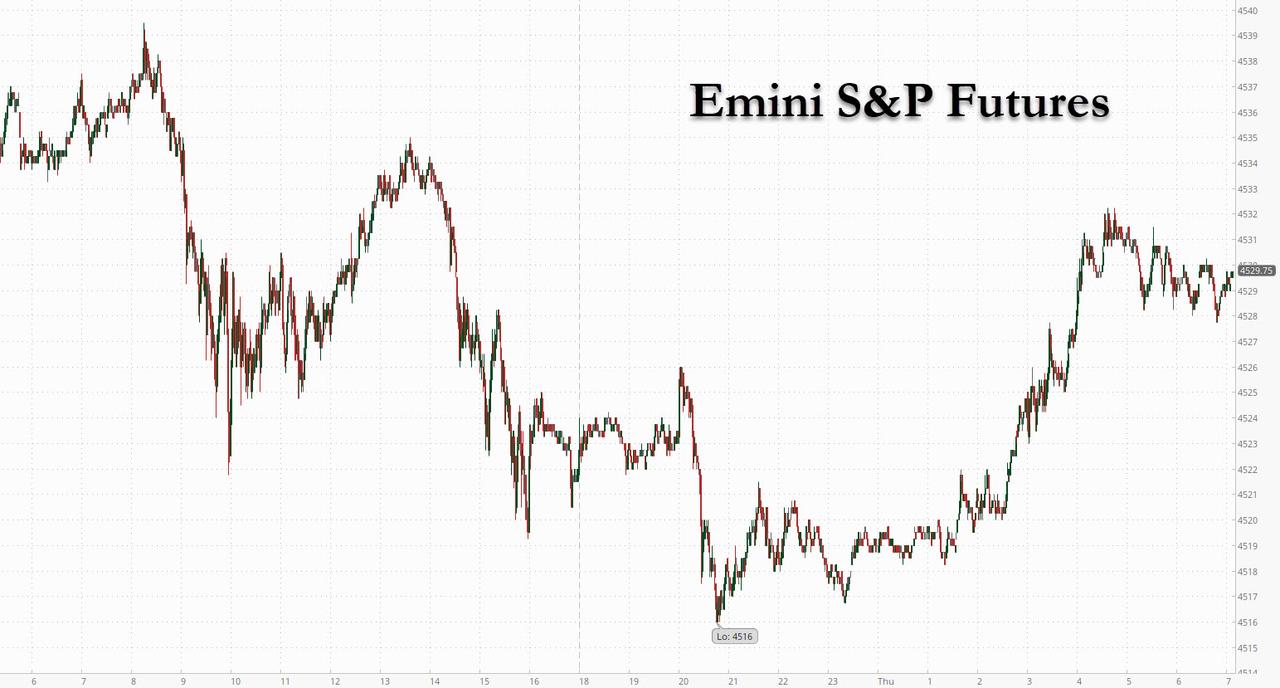
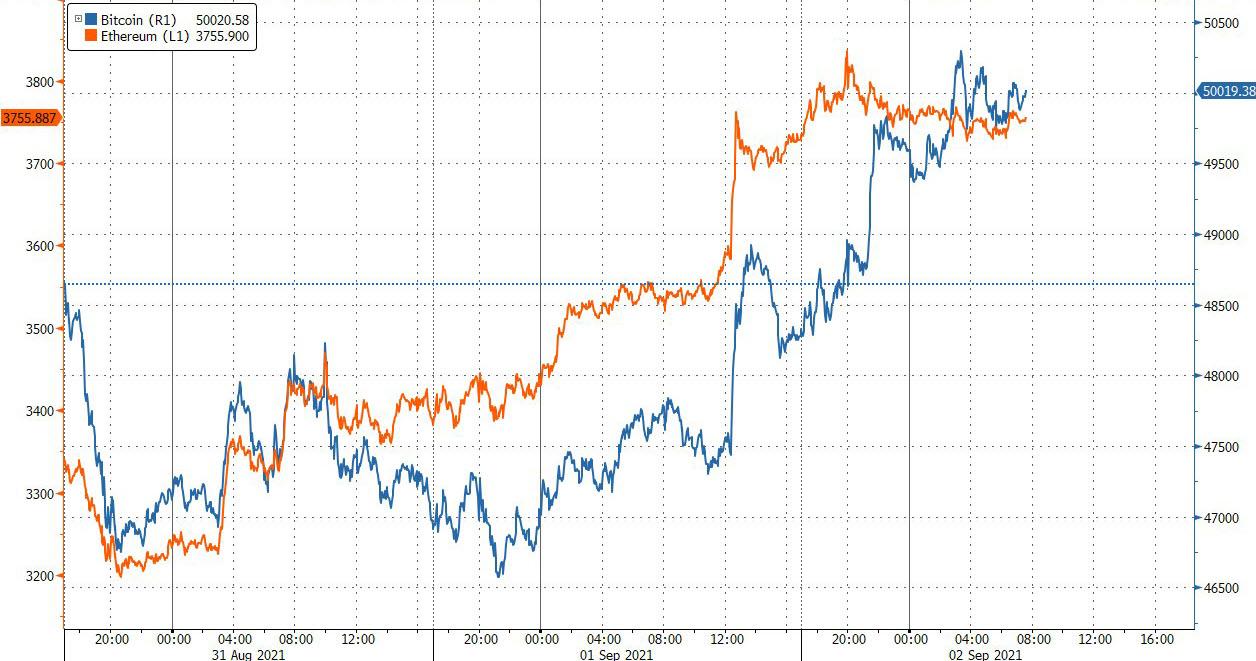
The financial capital of the world may be shut down after record flooding from Ida’s remnants has effectively frozen mass transit in New York, but that is not preventing the algos, trading out of comfortable, air-conditioned server farms to ramp S&P futures higher and this morning spoos are up again rising by 0.2% or 8 points to 4,529 with Nasdaq and Dow Jones futures both about 0.2% higher as attention turns to today’s initial claims data which is expected to print at 345K ahead of tomorrow’s closely watched payrolls report. 10Y Treasury yields steadied below 1.30%. The dollar was little changed, while bitcoin rose above $50,000.
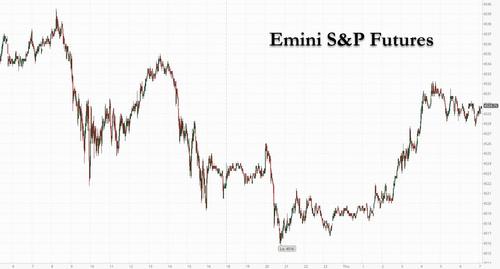
After the NYSE FANG index hit a new all time high yesterday, tech names were again broadly higher while a rise in the price of Brent crude above $72 helped move energy stocks higher after Wednesday’s drubbing. Here are some other notable movers today:
- Assembly Biosciences (ASMB) shares tumble 21% in premarket trading after the biopharmaceutical company announced plans to scrap the development of its ABI-H2158 (2158) drug for the treatment of chronic hepatitis B. William Blair downgraded its rating to market perform from outperform, citing a lack of clarity surrounding the serious adverse events induced by 2158, along with a scarcity of near-term catalysts.
- U.S. listed shares of Chinese ride hailing firm Didi (DID) fell 1.3% after Chinese regulators summoned ride-hailing firms including Didi to discuss concerns related to the sector.
- ChargePoint (CHPT) surges 12% with Jefferies (buy) saying the EV-charging company’s 2Q results and FY guidance look strong.
- Chewy (CHWY) shares fall 9.4% premarket after the online pet products retailer’s sales outlook and guidance disappointed, prompting analysts to trim price targets.
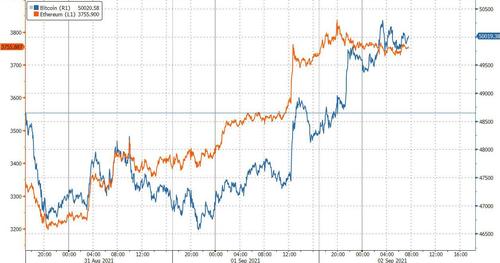
- Cryptocurrency-exposed stocks rise premarket, with Bitcoin continuing to gain and trading around the closely- watched $50,000 level. Bit Digital (BTBT) rises 5.8% and Marathon Digital (MARA) gains 4.5%, while Riot Blockchain (RIOT) advances 4%.
- Hall of Fame (HOFV) sinks 10% after the company said it has postponed the Highway 77 Musical Festival due to an increase in Covid-19 cases throughout Ohio.
- Focus Universal (FCUV) rallies as much as 61% after skyrocketing 278% on Wednesday.
- Meten EdtechX (METX) tumbles 49% after the China-based English language training company’s planned share and warrants offering implied a 67% discount from Wednesday’s closing price.
- Support.com (SPRT) rises 8.6% after slumping over the past two days, following a triple digit rally last week.
Expect a muted session today for the simple reason that many traders will be unable to leave their house: last night, the tail-end of hurricane Ida dumped a “record breaking” amount of rain over New York and New Jersey putting both areas into states of emergency. The weather triggered tornadoes, thunderstorms and torrential rain that has overwhelmed streets and forced transport services to grind to a halt. President Biden will address his administration’s response to Ida this morning.
In any case, all eyes are turning to jobs data due in 24 hours for clues on the economy and the Fed’s next steps. Investors are trying to assess when the delta-Covid variant outbreak might peak and how that will play into timing of Fed bond taper plans. Global stocks are near record levels and gauges of implied financial market volatility are declining, as many remain optimistic that the Fed will never let stocks drop again the reopening from the health crisis will weather challenges. At the same time, a move into defensive havens such as mega-tech stocks are a sign traders are bracing for more negative data surprises. The latest ADP jobs data showed U.S. companies added fewer jobs than expected in August. Manufacturing expanded at a stronger-than-estimated pace but faced supply snarls.
“The market is fading Covid more as a risk in terms of really hampering economic activity,” Tracie McMillion, head of global asset allocation strategy at Wells Fargo Investment Institute, said on Bloomberg Television. “We think the Fed is going to stick with their word and they will start tapering later this year. But we don’t think they are going to be in any hurry to raise interest rates.”
Economic pessimism was underscored by Goldman Sachs strategist Zach Pandl who said that “our U.S. growth forecasts for the next two years are below other bank forecasts for the first time since the recovery began. Markets may underappreciate the coming step-down in growth momentum.”
A Reuters poll last month showed the S&P 500 is likely to end 2021 at 4,500 points, slightly lower than current levels.
The Stoxx Europe 600 Index rose 0.2%, with most industry groups posting modest gains. Swedish Orphan Biovitrum jumped 25%, the most in nine years, after private-equity firm Advent International and Singapore wealth fund GIC agreed to buy the drugmaker for the equivalent of $8 billion.
Asian stocks also edged higher, setting course for a fifth consecutive day of gains, with trading in a narrow range ahead of a report on U.S. jobs data that’s a litmus test for economic health. The MSCI Asia Pacific index swung between a gain of 0.2% and a fall of 0.3% throughout the day. A subgauge of consumer-discretionary firms including Alibaba and Sony provided the biggest support, while materials-group shares fell, weighing most on the gauge, as BHP Group and Nippon Steel dropped amid weaker iron ore prices. The lull comes after the Asian stock benchmark capped a 2.3% gain in August, the best month since December, which helped the regional measure to trade near its highest since mid-July. The gains were preceded by two months of losses as worries over the delta virus variant and China’s tightening regulatory grip on various industries took a toll on the region’s investor sentiment. “Investors seem undecided on how to respond to the string of U.S. data, which is what you can tell from today’s market moves,” said Shogo Maekawa, a strategist at JP Morgan Asset Management in Tokyo, noting that while ISM manufacturing data was positive, the ADP jobs report fell short of expectations. “There are also a lot of investors wanting to wait to see the key U.S. employment data.” China’s technology stocks notched a fourth day of gains in a rally that lost some of its steam after regulators stepped up their criticism of the nation’s ride-hailing giants. Hong Kong’s Hang Seng Tech Index trimmed a rally of as much as 3.2% and closed up 1.6%, after criticism of ride-hailing firms highlighted risks from the nation’s ongoing crackdown on private industries. China’s overall market was steady, with traders assessing a central bank step to cushion the economy by helping smaller firms. Benchmarks in Thailand and India were the best performers, while those in Taiwan and South Korea retreated most.
Japan stocks rose after mega-cap companies in the U.S. rallied to a record as traders turned to defensive shares. The Topix rose 0.1% to 1,983.57 at the 3 p.m. close in Tokyo, while the Nikkei 225 advanced 0.3% to 28,543.51. Sony Group Corp. contributed the most to the Topix’s gain, increasing 1.4%. Out of 2,186 shares in the index, 896 rose and 1,195 fell, while 95 were unchanged. Shares of West Japan Railway Co. slid 13%. Japan’s third-largest listed rail operator is seeking to sell around $2.5 billion in shares amid mounting losses as the coronavirus pandemic that’s devastated tourism drags on.
India’s benchmark equity index rose, set for a third day of gains this week. Dr Reddy’s Laboratories advanced most. The S&P BSE SENSEX Index added 0.2% to 57,476.04 as of 9:55 a.m. in Mumbai, while the NSE Nifty 50 Index advanced by a similar magnitude. Both measures are trading near record highs after ending last month at new peaks. Of 30 shares in the Sensex, 14 rose and 16 fell. Sixteen of the 19 sector indexes on the BSE Ltd. advanced, led by a gauge of consumer durable stocks. Low interest rates and ample liquidity are driving the buying sentiment in local stocks, which are now among the top performers in Asia.
“The spread of the Delta variant amid still-low vaccination rates in many ASEAN economies and China’s zero-tolerance Covid strategy has prompted governments to impose restrictions and order factory/port closures,” warned analysts at Nomura. “Input shortages and low inventories will likely lead to production cuts and delayed shipments in Q3.”
In rates, amid the jobs chatter, 10-year Treasury yields eased back to 1.29% and away from the recent top of 1.375%, while the U.S. dollar index touched a one-month low.
The Bloomberg Dollar Spot Index was set to decline a third day after reversing an earlier gain; the greenback weakened most of its G10 peers as risk-sensitive currencies rallied while the yen and the Swiss franc hovered. The euro inched up to trade near almost a one-month high amid broad dollar weakness, and the pound also inched higher; European bond yields fell. The Australian dollar led G-10 gains after climbing on Prime Minister Scott Morrison’s plans to relax curbs on movements; the nation posted a record trade surplus in July of A$12.1b vs est. A$10b. Japan’s bonds held steady after a 10-year note auction met solid demand; the yen traded in a narrow range.
The ramp in cryptos continued, sending Ethereum to the highest level since its May record, while Bitcoin was trading back over $50,000.
To the day ahead now, and data highlights from the US include July’s industrial production, factory orders and trade balance, along with the weekly initial jobless claims. From the Euro Area, we’ll also get the PPI reading for July. Otherwise, central bank speakers include the Fed’s Bostic and Daly.
Market Snapshot
- S&P 500 futures up 0.2% to 4,531.00
- STOXX Europe 600 up 0.2% to 473.95
- German 10Y yield fell 1.7 bps to -0.390%
- Euro little changed at $1.1845
- MXAP little changed at 203.14
- MXAPJ little changed at 668.23
- Nikkei up 0.3% to 28,543.51
- Topix up 0.1% to 1,983.57
- Hang Seng Index up 0.2% to 26,090.43
- Shanghai Composite up 0.8% to 3,597.04
- Sensex up 0.8% to 57,770.59
- Australia S&P/ASX 200 down 0.5% to 7,485.75
- Kospi down 1.0% to 3,175.85
- Brent Futures up 0.2% to $71.73/bbl
- Gold spot up 0.1% to $1,815.27
- U.S. Dollar Index little changed at 92.45
Top Overnight News from Bloomberg
- The remnants of Hurricane Ida ripped through New York, New Jersey and across the Northeast early on Thursday morning, triggering tornadoes, thunderstorms, and torrential rain that inundated streets and paralyzed transport services
- The euro-area economy’s rebound and a dramatic inflation surge has reignited the sparring among European Central Bank policy makers about when to shift the institution away from its crisis mode
- For years, the premium paid for dollars over the euro, Japanese yen and so on in the cross-currency markets has been negative, indicating rampant demand for greenbacks. Now, these so-called cross-currency basis swaps are on the verge of turning positive in a major shift for money markets
- Aluminum reached a fresh decade high, rallying with other metals after China ramped up financial support for small businesses and pledged better use of local government bonds as the economy showed further signs of a slowdown because of tight property controls and fresh virus outbreaks
- After easing in the previous two months, a United Nations gauge of food costs rose 3.1% in August to near a peak set in May. The advance was driven by reduced grain production expectations, frosts that hurt sugar-cane crops in top grower Brazil and tightening oilseed supplies
- The Bank for International Settlements will test the use of central bank digital currencies with Australia, Malaysia, Singapore and South Africa in an experiment that could lead to a more efficient global payments platform
A more detailed look at global markets courtesy of Newsquawk
Asian equity markets took their cues from a similar indecisive performance stateside where price action was choppy and the major indices finished relatively flat as participants digested varied data releases, including the disappointing ADP Employment data which precedes Friday’s NFP jobs report. ASX 200 (-0.6%) was pressured amid a continued surge of COVID-19 infections and with the declines led by mining names after the recent losses in commodity prices and fresh bout of China’s state reserve selling, with mining giant BHP the worst hit as it traded ex-dividend. Nikkei 225 (+0.3%) lacked firm direction with Japan mulling extending the COVID-19 state of emergency by two weeks and the KOSPI (-1.0%) failed to benefit from the upgrade to Q2 GDP which confirmed the fastest growth in more than a decade, as the strong economic growth data and a 9-year high CPI, added to the case for a further BoK rate hike this year. Hang Seng (+0.2%) and Shanghai Comp. (+0.8%) were kept afloat after recent soft data releases stoked calls for PBoC easing, while China’s Cabinet will reportedly step up support for smaller businesses in which it will add CNY 300bln in relending quota for small firms and provide rediscount support to help ease their financing burdens. Finally, 10yr JGBs were slightly higher as they continued to nurse Tuesday’s slump and after having found support near 152.00. There were also comments from BoJ’s Kataoka who suggested the central bank should aggressively buy bonds and push yields down to prop up capex and investment, although the impact was muted given that he is a notorious dovish dissenter at BoJ meetings and with mixed results at the latest 10yr JGB auction also capping price action.
Top Asian News
- China Ties Climate Work to Better U.S. Relations in Kerry Talks
- Guangzhou R&F Dollar Bonds Sink to New Lows as Weakness Builds
- Philippine BSP’s Usual Tools Not Yet Fully Used: Diokno
- PAG-Backed $2 Billion Asia Hedge Fund to Reopen After Gains
European bourses remain just off the flat mark but have adopted more of an upside bias vs the mild downside seen across the region at the cash open following the cautious/mixed APAC handover. US equity futures have also seen some tailwinds from Europe, with broad-based performance across the ES, NQ, YM and RTY at the time of writing, and with catalysts scarce in European hours as the US jobs report looms. Sectors are predominantly in the green with no overarching theme. Travel & Leisure extends on earlier gains, led by its heaviest-weight stock Evolution (+3.5%) following reports that it has gone live in South Africa with SunBet. Healthcare also resides near the top of the bunch with AstraZeneca (+1.0%) cheering an announcement that multiple trials reinforce the efficacy of Imfinzi combinations, including with novel immunotherapies, for lung cancer patients across settings. On the downside, Basic resources are pressured as base metal prices remain subdued, albeit after taking somewhat of a breather overnight following yesterday’s selloff. However, some large-cap mining names are trading ex-divs, including the likes of Antofagasta (-0.4%), BHP (-6.3%) and Glencore (-0.6%). Banks have trundled to the foot of the bunch in sympathy with yields. In terms of individual movers, Babcock (-1.8%) continues to decline after the sale of its “nightmare” helicopter division for GBP 10mln after purchasing it for GBP 1.6bln seven years ago. The sale is part of the CEO’s turnaround plan which includes GBP 400mln of disposals. In terms of the FTSE 100 reshuffle, Just Eat Takeaway (+1.0%) and Weir Group (+1.1%) are to exit the FTSE 100 and be replaced by Morrisons (+0.4%) and Meggitt (+0.2%).
Top European News
- Sobi Shareholder AP4 Says Industrial Bidders Could Pay More
- JPMorgan Agrees to Pay EU25M to Settle French Tax-Fraud Case
- BNP Paribas in Talks With AgBank on Wealth Mgmt Venture: Reuters
- Danske Bank Global Head of Primary Markets Joins SEB
In FX, the Aussie and Kiwi have both extended gains beyond half round number levels vs their US rival that were hampering further upside, with Aud/Usd and Nzd/Usd now approaching 0.7400 and 0.7100 respectively after the former cleared technical resistance in the form of the 50 DMA at 0.7376 today. Meanwhile, the Kiwi has topped its 100 DMA at 0.7083, but is still trying to make its way towards 0.7100 amidst headwinds from the Aud/Nzd cross that remains elevated above 1.0400 in wake of a 2nd consecutive record Aussie trade surplus that is shading robust NZ terms of trade marginally by virtue of the fact that it relates to July rather than Q2 and is therefore more current.
- DXY – Antipodean Dollar outperformance aside, the Buck continues to flounder post-Powell and on the back of ADP most recently as the index struggles to find sure footing around 92.500 and the Greenback any real traction overall. However, the DXY is holding within a 92.536-388 range compared to Wednesday’s 92.376 low awaiting more pre-NFP jobs proxies that come via Challenger lay-offs today, but also a more timely snapshot of the labour market via IJC alongside trade and before factory orders, then 2 scheduled Fed speakers (Bostic and Daly).
- CAD/GBP – A partial recovery in crude has given the Loonie another fillip and incentive to probe 1.2600 again in the run up to Canadian building permits and trade, while the Pound is back within striking distance of 1.3800, but still striving hard to defend or contain declines around 0.8600 against the Euro in the absence of anything UK specific.
- EUR/JPY/CHF – All hugging tight lines vs their US counterpart, with the Euro taking a firmer grip of the 1.1800 handle and hardly hindered by stronger than expected Eurozone ppi data in contrast to the Yen that remains anchored around 110.00 following very dovish commentary from BoJ’s Katoaka. To recap, he stated that given economic developments bolder steps on monetary policy are needed, including an increase in bond buying to push short and long term rates down. Elsewhere, the Franc is restrained between 0.9160-40 and largely shrugged off, if not quite ignored conflicting Swiss macro releases, as CPI came in a tad firmer than forecast, but Q2 GDP missed and retail sales fell.
In commodities, WTI and Brent front month futures have been erring higher throughout the European session in the aftermath of the OPEC+ confab which turned out to be a smooth (and timely) affair. Producers, as expected, stuck to the plan of hiking 400k BPD – with the White House also welcoming the decision in a statement. WTI and Brent have erased the losses seen post-Novak yesterday, with the former just under USD 69/bbl and the latter near USD 72.00/bbl. Elsewhere, and from a policy standpoint, developments surrounding Iranian oil and nuclear talks will likely gain focus in the run-up to the next OPEC meeting in October. The Iranian Oil Minister said that as soon as the US’ unilateral illegal sanctions are lifted, Iran is ready to increase its oil output to the highest possible level to compensate for the losses caused by the sanctions, while he also noted that Tehran is determined to raise its oil exports irrespective of this. Aside from that, crude prices may take their cues from risk sentiment ahead of tomorrow’s US labour market report. In terms of bank commentary, the UBS notes that with oil demand set to rise, the bank expects the oil market to stay undersupplied, thus supporting prices. “We reiterate our advice for investors with a high-risk tolerance to be long Brent, add exposure to longer-dated oil contracts, or sell downside price risks”, the Swiss bank says. Elsewhere, spot gold and silver are once again uneventful within the same European ranges seen throughout most of this week thus far. LME copper remains subdued following yesterday’s selloff which was followed by a mild reprieve overnight – but again awaiting catalysts. Elsewhere, the Dalian commodity exchange is to raise speculative trading margin requirements for coking coal and coke futures to 15%, as of settlement on September 6th.
US Event Calendar
- 8:30am: Aug. Initial Jobless Claims, est. 345,000, prior 353,000; Continuing Claims, est. 2.81m, prior 2.86m
- 8:30am: 2Q Nonfarm Productivity, est. 2.5%, prior 2.3%; Unit Labor Costs, est. 0.9%, prior 1.0%
- 8:30am: July Trade Balance, est. -$70.9b, prior -$75.7b
- 10am: July Factory Orders, est. 0.3%, prior 1.5%
- 10am: July Durable Goods Orders, est. -0.1%, prior -0.1%
- 10am: July Cap Goods Ship Nondef Ex Air, prior 1.0%; -Less Transportation, est. 0.7%, prior 0.7%
- 10am: July Cap Goods Orders Nondef Ex Air, est. 0%, prior 0%;
- 10am: July Factory Orders Ex Trans, est. 0.5%, prior 1.4%
DB’s Jim Reid concludes the overnight wrap
Markets continue to creep higher as we await the all important US jobs report tomorrow. That was in spite of a mixed bag of data releases yesterday. By the close of trade, the MSCI World index (+0.41%) reached all-time highs once again, even though the S&P 500 sold off late in the session to close only +0.03% higher – just short of its record. Meanwhile the dollar weakened for the 8th time in the last 9 sessions, as the greenback has had to deal with Fed Chair Powell’s dovish Jackson Hole speech last week, alongside more hawkish rhetoric from the ECB and the domestic impact of the delta variant.
Running through those data releases, the first big one was the ADP’s report of private payrolls for August which strongly underwhelmed at +374k (vs. 625k expected). That said, the ADP’s reports have missed the actual number of private payrolls significantly in recent months, with last month’s initial reading also coming in beneath expectations at 330k (vs. 690k expected), before private payrolls then rose by +703k. So markets didn’t seem too disturbed by the release yesterday. Later on in the session, we then got the ISM manufacturing print for August, which unexpectedly rose to 59.5 (vs. 58.5 expected), with new orders up to 66.7 (vs. 61.0 expected), but the employment reading came in at a contractionary 49.0, so again not a great sign ahead of the jobs report tomorrow.
Against this backdrop, investors reallocated to more defensive sectors in the S&P 500, which was just better than unchanged (+0.03%) while trading in a c.15pt (0.3%) range yesterday. The search for defensives led to a decent outperformance from tech stocks, with both the NASDAQ (+0.33%) and the FANG+ Index (+1.28%) close to all-time highs of their own, as 9 of the 10 megacap tech stocks in the FANG+ moved higher on the day – Tesla (-1.9%) was the sole laggard. The concentrated tech index has now gained in 8 of the last 9 sessions, with the index up +8.73% over that time.
However, energy stocks lagged (-1.51%) amidst a further decline in oil prices. Brent Crude (-2.34%) followed up its poor August performance by sliding lower, while WTI recovered from falling -2.0% by midday to end up +0.13%. That came as the OPEC+ group agreed that they should continue with their planned production increases that will see a further 400k barrels per day added to supply. Other cyclicals similarly weighed on the index with banks (-1.29%) and capital goods (-0.65%) the other main S&P laggards as investors shifted to more defensive industries. This rotation saw bond proxies such as utilities (+1.30%) and real estate (+1.69%) lead the S&P’s gain, along with the aforementioned tech rally.
European stocks outperformed as US stocks slid after the close of trading here, with the STOXX 600 up +0.48%. Unlike in the US, the reopening trade did well on this side of the Atlantic with retail (+1.83%), travel & leisure (+1.81%), and consumer products (+1.81%) leading the way, though tech (+1.43%) outperformed as well.
Sovereign bond markets had a much more divergent performance yesterday, though yields on 10yr bunds (+1.0bps) rose once again as hawkish noises around next week’s ECB meeting continued. In particular, Bundesbank President Weidmann said that “we shouldn’t disregard the risk to too-fast inflation”, and that risks to the upside predominate. That follows the flash CPI estimate that showed Euro Area inflation at +3.0% in August, the highest in almost a decade. However, Greek central bank governor Stournaras said that higher inflation was due to temporary factors and he’d advise caution about the path of inflation relative to the medium-term target. As core European debt lost ground though, peripheral debt benefited, with yields on 10yr BTPs down -1.8bps. And in the US, yields on 10yr Treasuries declined -1.5bps to 1.294%, led by falling real yields (-1.8bps).
Sentiment in Asian markets this morning is being supported by the PBoC move to provide CNY 300bn of low cost funds to banks so they can lend to small and medium-sized companies. Besides this the PBoC has also announced other measures such as interest subsidies to firms hit hard by the pandemic and a bigger role for local special bonds in driving investment. This has helped Chinese stock markets to outperform overnight with the Shanghai Comp (+0.55%) and Shenzhen Comp (+0.23%) both advancing. Other Asian markets are also posting gains with the Nikkei (+0.28%) and Hang Seng (+0.08%) also up. The Kospi (-0.70%) is trading lower though. Elsewhere, futures on the S&P 500 (-0.05%) and the Stoxx 50 (-0.11%) are slightly lower.
Turning to the pandemic, data from the UK’s ONS showed that 94% of the adult population in England had Covid antibodies in the week commencing August 9, which is the highest percentage yet. Nevertheless, that number has shown signs of plateauing over recent weeks, having risen just 1 percentage point relative to 4 weeks earlier. The 16-24 age bracket were the least likely of the over-16 groups to have antibodies, at 85.4%, which is in line with them also being the least likely to be vaccinated. There is some evidence of antibodies waning for the earlier vaccinated elderly with rates down from their early summer peak by 2-3pp. They are still comfortably in the 90 plus percentage point range though. Staying in the UK, Scotland will be instituting vaccine passports to enter nightclubs and large events starting later this month, with the mandate going to members of the Edinburgh legislature by the end of the week. Meanwhile the weekly average of US hospitalisations fell for the first time since late-June yesterday in a sign that the current surge may be declining.
Looking at yesterday’s other data, the final manufacturing PMI readings for August cemented the picture seen in the flash readings late last month. The Euro Area reading was revised down a tenth to 61.4, its lowest level in 6 months, while the US reading was also revised down a tenth to 61.1. Another notable release were German retail sales, which fell by a larger-than-expected -5.1% in July (vs. -1.0% expected), but that was largely a normalisation following the strong increases in May and June after Covid restrictions were phased out.
To the day ahead now, and data highlights from the US include July’s industrial production, factory orders and trade balance, along with the weekly initial jobless claims. From the Euro Area, we’ll also get the PPI reading for July. Otherwise, central bank speakers include the Fed’s Bostic and Daly.