Is Bitcoin ‘The Real Deal’? – Ukraine Crisis Offers Perfect Opportunity To Find Out

Is Bitcoin ‘The Real Deal’? – Ukraine Crisis Offers Perfect Opportunity To Find Out

Authored by Russell Clark,

Current political and economic conditions are ideal for bitcoin, but positioning is negative. Which is more important?

There are many attractive features to Bitcoin.

By design Bitcoin has a rising costs basis which helps limit supply (the ever rising difficulty of mining bitcoin), computing power needed to mine is also driven by energy costs, and Bitcoin acts as a store of value outside the control of central authorities.

The Russian invasion of Ukraine, and the subsequent financial retaliation by Western powers has created a perfect environment for Bitcoin to prove it worth as a store of value.

European natural gas prices have risen 16 times from their 2020 lows, and have spiked again in the last week.

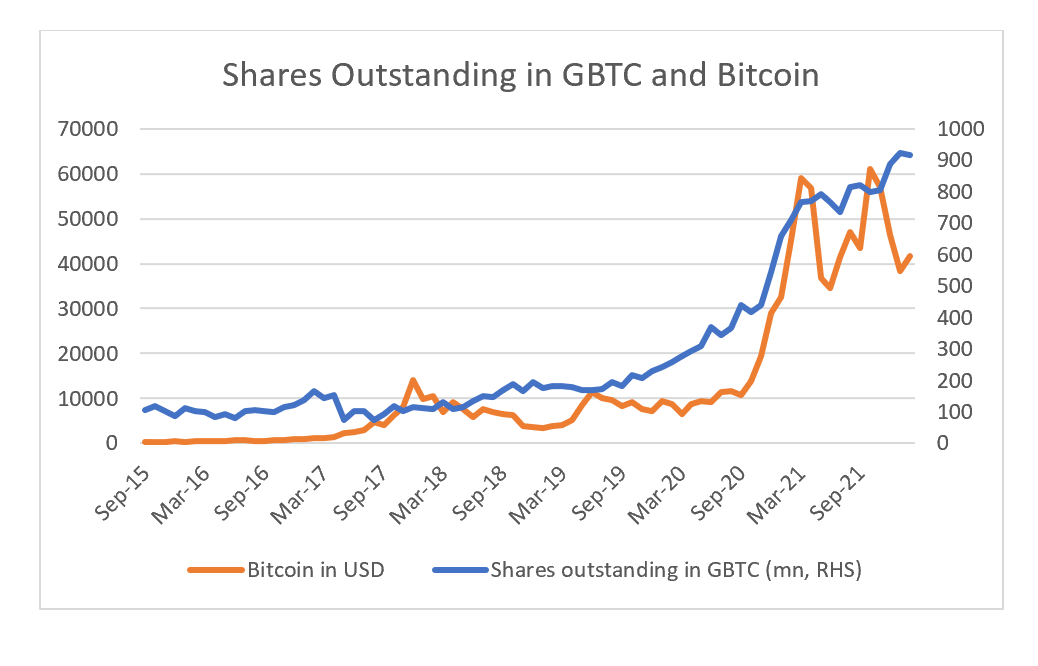
However, from a positioning point of view bitcoin looks more troubled. When I look at the largest Bitcoin “ETF” – the Grayscale Bitcoin Trust (GBTC) – shares outstanding have continued to rise in 2021 and 2022 even as Bitcoin performance has been lacklustre.

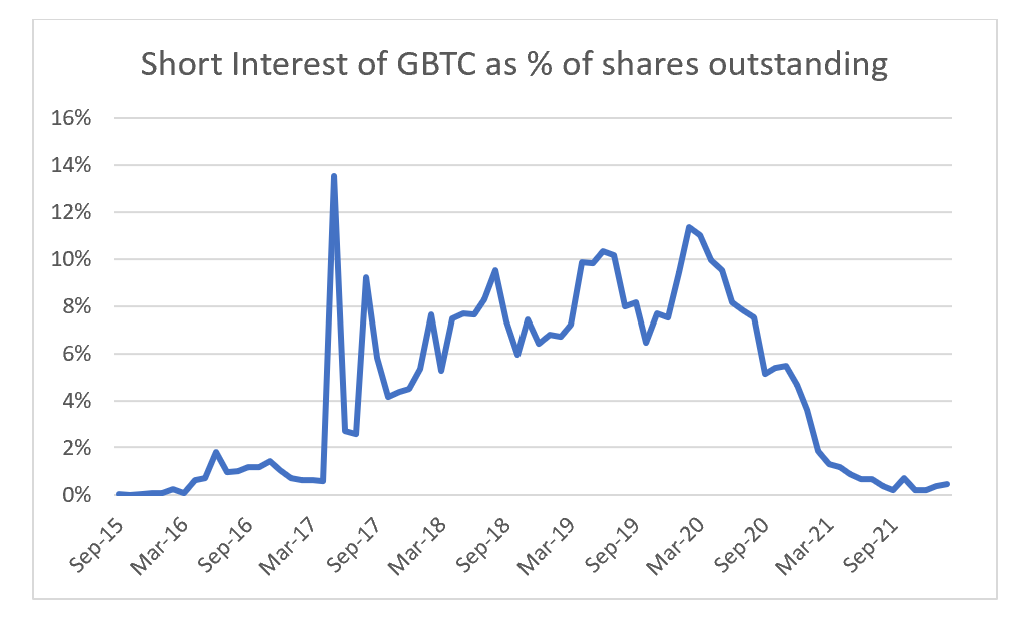
Short interest in GBTC remains non-existent.

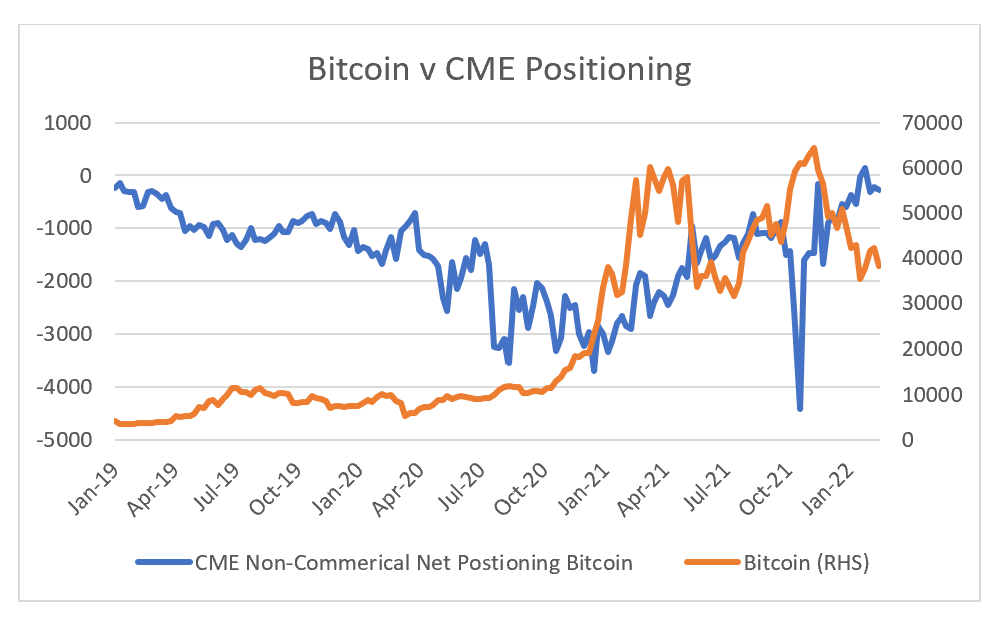
It is possible to argue that GBTC is less representative of the Bitcoin market than it used to be. As alternative we could look at the CME futures market for Bitcoin. Net positioning for Bitcoin was quite negative in late 2020, before it rallied 700%. Currently net short positioning is close to the lowest levels ever, suggesting few bearish bets.

Is Bitcoin the real deal – a digital gold – or is a speculative asset that has benefited from a combination of excessive liquidity and bearish positioning. The Russia/Ukraine crisis offers the perfect opportunity to find out.

*  *  *

Subscrbe to Russell Clark’s feed here…

Tyler Durden
Wed, 03/02/2022 – 17:00

via ZeroHedge News https://ift.tt/gNdGMfz Tyler Durden

Several Justices Seem Dismayed at the Idea That Doctors Can Be Accidentally Guilty of Drug Trafficking


hydrocodone-tablets-Ranjav-Raghav-Flickr

Under 21 USC 841, it is a felony for “any person” to “knowingly or intentionally” distribute or dispense a controlled substance “except as authorized by this subchapter.” Yesterday the Supreme Court considered how that language from the Controlled Substances Act (CSA) applies to physicians accused of prescribing opioid pain medication “outside the usual course of professional medical practice.” That issue is important for patients as well as doctors, because the threat of criminal prosecution for deviating from what the Drug Enforcement Administration (DEA) considers medically appropriate has a chilling effect on pain treatment.

The CSA authorizes physicians with DEA registrations to prescribe controlled substances. But according to a CSA regulation, a valid prescription “must be issued for a legitimate medical purpose by an individual practitioner acting in the usual course of his professional practice.” Grammatically speaking, Justice Samuel Alito argued, the phrase “knowingly or intentionally” cannot be read as applying to deviations from that ambiguous standard. Justice Stephen Breyer disagreed.

Regardless of whether Alito or Breyer is right on that point, most of the justices seemed to agree that “the presumption of scienter”—some degree of intent or knowledge—applies when the government seeks to imprison doctors based on their prescribing practices. Even if the CSA does not explicitly require that a doctor “knowingly or intentionally” departed from accepted medical practice, Justice Neil Gorsuch noted, one could still argue that “the ‘except’ clause has to have some mens rea element to it, because it’s what distinguishes lawful from unlawful conduct.”

Even Deputy Solicitor General Eric Feigen, who was defending the federal government’s position on how the CSA should be applied to prescribers, conceded that point. Feigen argued that the proper test is whether a doctor made “an honest effort” to “practice some recognizable form of medicine.”

By contrast, the U.S. Court of Appeals for the 11th Circuit has held that a physician’s “good faith belief that he dispensed a controlled substance in the usual course of his professional practice is irrelevant” to the question of whether he violated the CSA. Based on that reading of the law, the 11th Circuit rejected the appeal of a Mobile, Alabama, pain specialist who was sentenced to 21 years in federal prison for writing opioid prescriptions that deviated from accepted practice. According to the 11th Circuit, it did not matter at all whether the defendant, Xiulu Ruan, sincerely believed that he was doing what a doctor is supposed to do.

That decision is one of two involving doctors convicted of drug trafficking that the Supreme Court is reviewing. In the other case, the U.S. Court of Appeals for the 10th Circuit likewise held that a doctor’s good faith has no bearing on the question of whether his prescriptions were written in “the usual course of professional practice,” which it said must be determined “objectively.” That case involves Casper, Wyoming, physician Shakeel Kahn, who was sentenced to 25 years in prison.

Justice Brett Kavanaugh was clearly troubled by the implications of those decisions. “The doctor may have violated that objective standard but might have legitimately thought that the standard was somewhat different,” he observed while questioning Beau Brindley, the attorney representing Kahn. “In those circumstances,” Kavanaugh said, summarizing Brindley’s argument, the doctor “should not be sent away for 20 years to prison.”

The phrase “legitimate medical purpose,” Kavanaugh added, is “very vague language in my estimation, and reasonable people can disagree.” While questioning Feigen, Kavanaugh noted that cases like these typically feature dueling expert witnesses who disagree about the propriety of the defendant’s conduct. “If you’re on the wrong side of a close call,” he asked, “you go to prison for 20 years?”

Gorsuch underlined that point. “Even though it’s an extremely close case,” he said, “that individual stands, under the government’s view, unable to shield himself behind any mens rea requirement and is subject to essentially a regulatory crime encompassing 20 years to maybe life in prison.”

Justice Clarence Thomas likewise focused on the fact that severe criminal penalties can be imposed on physicians for what amounts to a regulatory infraction: violating the conditions of their DEA registration. “If a doctor in the State of Virginia, for example, does not comply with his or her license, then you lose your license to practice medicine,” he said. “So it’s regulatory. Here, there isn’t that intermediate step—that is, that you lose your registration that allows you to prescribe certain drugs. Instead, it’s folded into the underlying criminal violation….My concern [is] that we seem to be doing two things at the same time, with some quite significant criminal penalties.”

Brindley argued that criminal liability is appropriate only when a doctor has clearly stopped practicing medicine and is instead engaged in drug trafficking. He noted that the Court addressed this distinction in Gonzales v. Oregon, a 2005 decision that rejected an attempt to revoke the DEA registrations of doctors who prescribed drugs for assisted suicide. “The statute and our case law amply support the conclusion that Congress regulates medical practice insofar as it bars doctors from using their prescription-writing powers as a means to engage in illicit drug dealing and trafficking as conventionally understood,” the Court said. “Beyond this, however, the statute manifests no intent to regulate the practice of medicine generally.”

While a doctor who fails to prescribe drugs with appropriate care may be guilty of malpractice or of violating state medical regulations, Brindley argued, he is not “engage[d] in illicit drug dealing and trafficking as conventionally understood.” The government’s position “allows conviction of doctors who misapprehend the extent of their obligations but are not drug dealing as conventionally understood,” he said. “There are myriad mechanisms for protecting patients from doctors who violate the standard of care in various ways. That is not the function of Section 841. The question under 841 is not whether a doctor was a bad doctor but whether he was a drug dealer. Thus, under 841, any good faith definition must be based solely on the sincerity of the doctor’s purpose in writing the prescription.”

That standard, Feigen warned, leaves doctors free to decide for themselves what is medically appropriate, regardless of what their colleagues think. But Brindley noted that the government can still present evidence that a doctor’s prescriptions were plainly contrary to accepted practice, which goes to the question of whether he honestly believed his decisions were sound. When “all of the objective evidence comes in” and “it says that your position is crazy,” Brindley said, “you’re going to get convicted. That’s the reality.”

Feigen described the government’s preferred test, which he called “an objective
honest effort standard” and “a form of extreme objectively grounded mens rea,” this way: “You can’t be convicted so long as you took an honest effort to prescribe for a legitimate medical purpose. And there can be reasonable mistakes about what legitimate medical purposes are.”

Gorsuch seemed skeptical: “‘An honest effort.’ See, I don’t know what that means. But I do know what ‘knowing’ and ‘intentional’ mean.”

Like Brindley, Lawrence Robbins, the attorney representing Ruan, argued that a doctor should not be convicted under 21 USC 841 “unless the government proves that her prescriptions were made without a good-faith medical purpose.” But if the Court decides that an “honest effort” standard makes more sense, Robbins said, it should recognize that such a rule likewise incorporates a subjective element, contrary to the way the government frames it.

Feigen cited the jury instruction mentioned in the 1975 case United States v. Moore, which involved a doctor who “prescribed large quantities of methadone for patients without giving them adequate physical examinations or specific instructions for its use and charged fees according to the quantity of methadone prescribed, rather than fees for medical services rendered.” In a footnote, the Court noted that the jury was told that Moore “could not be convicted if he merely made ‘an honest effort’ to prescribe for detoxification in compliance with an accepted standard of medical practice.”

Robbins said Feigen was wrong to describe that standard as objective. “The defendant said he was just trying a novel technique to solve a problem, but the jury didn’t believe him,” he said. “That says that this is a subjective question. Did he make an honest effort? He said he did because he was using some novel technique, but the jury rejected it. The jury didn’t say: ‘Well, a reasonable doctor wouldn’t do that. An objectively reasonable doctor wouldn’t do that.’ No. They said ‘we don’t believe you,’ which is exactly what juries are entitled to do when they assess the purpose or intent of a defendant.”

Chief Justice John Roberts repeatedly implied that the standards for opioid prescribing and pain treatment are clear, specific, and uncontested, likening them to speed limits. But as Robbins pointed out, there are ongoing debates about how to weigh the risks and benefits of these drugs, which puts doctors who take a position the DEA does not like at risk. “Is there a book that tells us what the right amount of medication is for a certain kind of disability?” Robbins said. “The answer is there is no such book, and that’s the whole problem.”

The post Several Justices Seem Dismayed at the Idea That Doctors Can Be Accidentally Guilty of Drug Trafficking appeared first on Reason.com.

from Latest https://ift.tt/epsPmiR
via IFTTT

China Told Russia To Delay Ukraine Invasion Until After Olympics: US Officials

China Told Russia To Delay Ukraine Invasion Until After Olympics: US Officials

Senior Chinese officials “told” senior Russian officials in early February not to invade Ukraine before the end of the Winter Olympics in Beijing, according to the New York Times, citing senior Biden administration officials and a European official who spoke of a Western intelligence report on condition of anonymity.

According to the classified report, senior Chinese officials had some level of knowledge about Russia’s plans for Ukraine prior to the Olympics, at a time when Moscow and Beijing issued a joint 5,000-word statement declaring that their partnership had “no limits,” while denouncing NATO expansion, and vowing to establish a new global order with true “democracy.”

The intelligence on the exchange between the Chinese and Russian officials was classified. It was collected by a Western intelligence service and considered credible by officials reviewing it. Senior officials in the United States and allied governments passed it around as they discussed when Mr. Putin might attack Ukraine.

However, different intelligence services had varying interpretations, and it is not clear how widely the information was shared. -NYT

Also unknown is how high up the chain the alleged conversations went – and that “the material did not necessarily indicate the conversations about an invasion took place at the level of Mr. Xi and Mr. Putin.”

When asked whether it was true that Chinese knew of the invasion, Liu Pengyu, the Chinese Embassy spokesman in Washington, didn’t exactly deny it.

These claims are speculation without any basis, and are intended to blame-shift and smear China,” she said.

The Times notes that Putin ordered more Russian troops to enter Russia-backed separatist territories in Ukraine the day after the Olympics ended following a state television broadcast of the Russian president’s lengthy ‘pre-invasion’ speech in which he said Ukraine should be part of Russia, and slammed the west for lying about NATO expansion since 1990.

Prior to the Olympics, Russia had moved military units from its border with China and other parts of the east to their border with Ukraine and Belarus in advance of the invasion. Then, on Feb. 24, Russia began invading Ukraine – which included the use of ballistic missiles, artillery shells and tanks on Ukrainian cities.

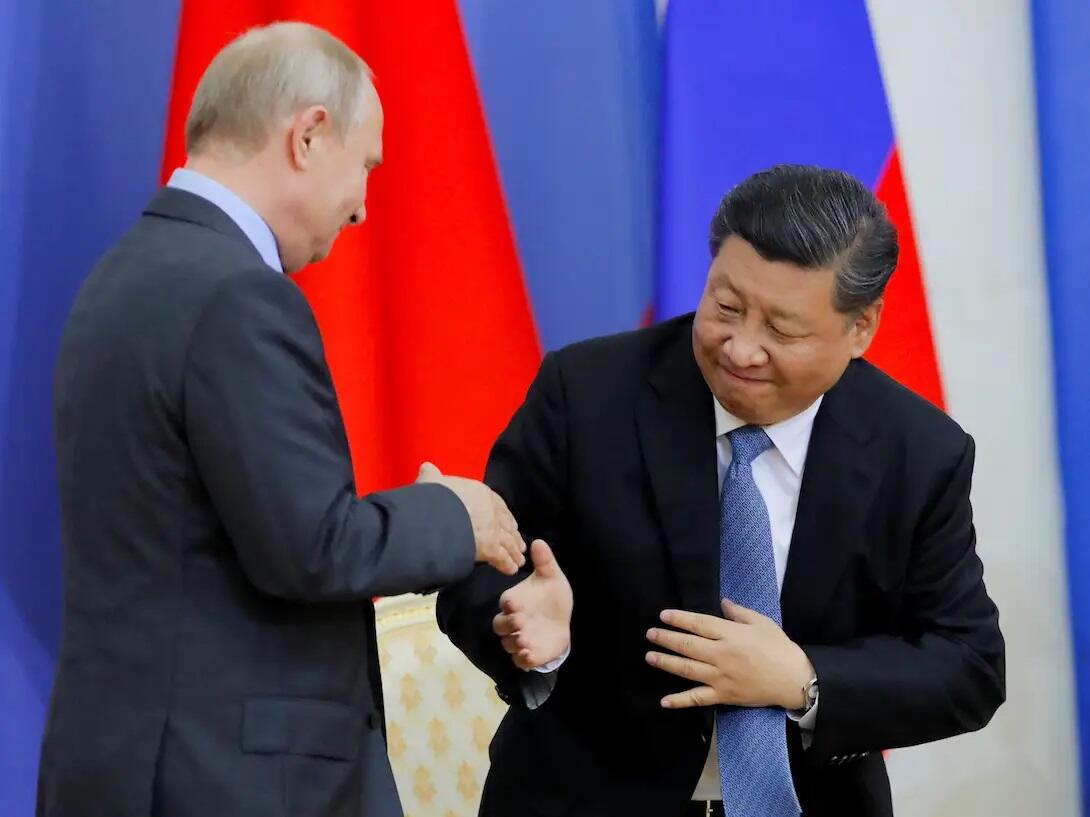
China and Russia have been growing close for several years – with Putin and Xi having met 37 times as national leaders ahead of the Olympics – and of course, that lengthy statement which marked the first time China had explicitly sided with Russia on NATO and European security. European leaders, meanwhile, have denounced both countries in recent weeks.

US officials implored China to intervene leading up to the Russian invasion, according to the report, but China simply went to Russia to let them know that America was ‘trying to sow discord’ and that they wouldn’t help.

For months, some American officials tried to recruit China in efforts to avert war in Ukraine.

Days after President Biden spoke to Mr. Xi in a video summit on Nov. 15, senior American officials decided to present intelligence on the Russian troop buildup around Ukraine to senior Chinese officials to try to get them to persuade Mr. Putin to stand down. The Americans spoke to Qin Gang, the Chinese ambassador in Washington, and to Wang Yi, the foreign minister, among others. In a half-dozen meetings, including one in Washington between U.S. officials and the Chinese ambassador just hours before the Russian invasion, Chinese officials expressed skepticism that Mr. Putin would invade Ukraine, American officials said.

After one diplomatic exchange in December, U.S. officials received intelligence showing Beijing had shared the information with Moscow, telling the Russians that the United States was trying to sow discord and that China would not try to impede Russian plans and actions, American officials said. -NYT

Around Feb. 10, US intelligence officials noted that Moscow was making final preparations for what appeared to be an attack – while intercepted communications revealed that senior Russian commanders were being assembled for a meeting believed by some Western governments to be a key decision point regarding the attack.

Now, China is trying to play peacemaker – with Foreign Ministry spokesman Wang Weinbin saying at a news conference in Beijing that Russia and Ukraine should “seek a political solution that accommodates the legitimate security concerns of both sides. China will continue to play a constructive role in promoting the de-escalation of the situation in Ukraine.”

Tyler Durden
Wed, 03/02/2022 – 16:40

via ZeroHedge News https://ift.tt/ZktsESg Tyler Durden

#MeToo/#TheyLied Settlements, Arbitration, and Rescission

Reiterman v. Abid, decided today by the Eleventh Circuit (in an opinion by Judge Gerald Bard Tjoflat, joined by Judges Elizabeth Branch and Britt Grant), involves a sexual assault allegation which led to a libel lawsuit, and which in turn led to a settlement agreement calling for arbitration. The question is whether the settlement agreement was rescinded, so that the libel plaintiff (Reiterman) could again sue the initial accuser (Abid):

{We make no comment on the truth or falsity of any of the background facts of this case, as the merits of Reiterman’s claims are not before us on appeal. For context purposes only, we summarize the facts of the merits dispute as they have been presented by the parties to this Court on appeal.}

Abid and Reiterman first met in 2014 in Tampa, Florida. At the time, Reiterman worked as an LSAT teacher for the test preparation company TestMasters. Abid was one of Reiterman’s students, and the two briefly dated. After the relationship ended, Abid accused Reiterman of sexual assault. This accusation resulted in an investigation by the Tampa Police Department, which ultimately declined to charge Reiterman. The Florida Attorney General’s Office also declined to intervene after reviewing the case at Abid’s request.

Abid then allegedly engaged in a pervasive, anonymous internet campaign to ruin Reiterman’s reputation by writing several blogposts accusing Reiterman of sexually assaulting multiple women. Each of these blogposts was ostensibly written by a different woman. The District Court would later describe this campaign as “remarkably extensive and forceful, in effect seeking to destroy Reiterman by painting him in the most graphic terms as a racist and a serial rapist.” These allegations severely affected Reiterman’s reputation while attending Harvard Law School from 2015 to 2018 and continue to impair his ability to obtain gainful employment.

On April 4, 2018, Reiterman sued Abid in the Middle District of Florida, claiming that she had defamed him by creating all or some of the anonymous blogposts. Abid denied involvement in the internet campaign, and so Reiterman and Abid quickly entered into settlement negotiations. In June 2018, the parties agreed to the 2018 Settlement Agreement disputed in this appeal. This agreement provided, inter alia, that the parties would exchange mutual releases for all claims they had against each other, that Reiterman would pay Abid a set amount of money in monthly installments, and that “[a]ny controversy or claim arising out of or relating to this contract, or breach thereof, shall be settled by arbitration.”

After the parties agreed to the 2018 Settlement Agreement, Reiterman learned of evidence indicating that Abid was responsible for all or most of the blogposts, contrary to what she had stated during the settlement negotiations. Furthermore, three new blogposts were posted after the agreement was made, which Reiterman suspected Abid was responsible for. As a result, Reiterman sent a letter to Abid on April 3, 2019, through his attorney. This letter stated that Abid’s conduct had rendered their 2018 Settlement Agreement “null and void” and that Reiterman was therefore relieved of his obligations under the agreement. Reiterman requested that Abid return the payments Reiterman had made so far and warned Abid that litigation would follow unless she agreed to Reiterman’s demands.

Abid personally responded to Reiterman’s letter on April 10 by email. In her response, Abid stated that “[s]ince Mr. Reiterman is accusing me of having breached the settlement agreement and believes he no longer has an obligation to abide by the clauses set therein, I will mirror that belief and no longer honor the clauses set forth in the agreement either.” Abid then went on to describe the various actions she would take now that she was released from the 2018 Settlement Agreement, such as publishing a book she claimed to have written about Reiterman’s alleged sexual assault and contacting politicians involved in the 2020 presidential race. In September 2019, Reiterman brought this action against Abid in the Middle District of Florida.

Once Abid obtained new counsel and waived service of process, she moved the District Court to issue an order compelling arbitration based on the arbitration clause in the 2018 Settlement Agreement. Reiterman opposed the motion, claiming that the parties had mutually agreed to rescind the 2018 Settlement Agreement through their April 2019 communications….

At [an] evidentiary hearing, the District Court heard testimony from both Abid and Reiterman’s lawyer, Krista Baughman, who wrote Reiterman’s April 2019 letter. Baughman’s testimony, which the Court found credible, established that the parties intended to rescind the 2018 Settlement Agreement in their 2019 communications. While Abid testified that she did not intend to rescind the 2018 Settlement Agreement in her 2019 email, the Court found her testimony to not be credible and instead found that she had intended to rescind the agreement in her 2019 email. Following the hearing, the Court entered an order denying Abid’s motion to compel arbitration as the parties had rescinded the 2018 Settlement Agreement. Abid timely appealed this order….

Abid is correct that courts must determine whether the parties formed a contract containing an arbitration clause before compelling arbitration and that this inquiry speaks to the existence of the contract. Abid is also correct that an arbitrator must decide any questions about whether a contract containing an arbitration agreement is void or voidable under state law.

But Abid’s argument fails when it attempts to classify a subsequent mutual rescission as just another state law ground rendering a contract void or voidable. Rather, a subsequent mutual rescission is an agreement between the parties to not be bound by their former contract any longer. As arbitration is “simply a matter of contract between the parties,” the parties may of course voluntarily decide to release each other from their obligations after forming a contract, including their obligation to arbitrate certain disputes. Any disputes about whether the parties later agreed to rescind their earlier contract are disputes about whether a new agreement was formed—and courts decide contract formation disputes, not arbitrators.

Furthermore, compelling arbitration after the parties have agreed to rescind their arbitration agreement would deprive the parties of the benefit of their subsequent bargain and encourage gamesmanship….

Lastly, the District Court did not clearly err in concluding that the parties intended to mutually rescind their 2018 Settlement Agreement through their April 2019 communications. The Court based its findings of fact in large part on its credibility determinations of the two witnesses: it found Baughman to be credible and Abid to not be credible. Federal Rule of Civil Procedure 52(a) allows reviewing courts to set aside trial court findings of fact only when they are clearly erroneous. But “[w]hen findings are based on determinations regarding the credibility of witnesses, Rule 52(a) demands even greater deference to the trial court’s findings; for only the trial judge can be aware of the variations in demeanor and tone of voice that bear so heavily on the listener’s understanding of and belief in what is said.” …

Note: I intervened in the district court in this case to unseal the settlement agreement and the order sealing the agreement; the court granted my motion to intervene and unseal. My participation in the case was limited to the open records question.

The post #MeToo/#TheyLied Settlements, Arbitration, and Rescission appeared first on Reason.com.

from Latest https://ift.tt/Uk0apPo
via IFTTT

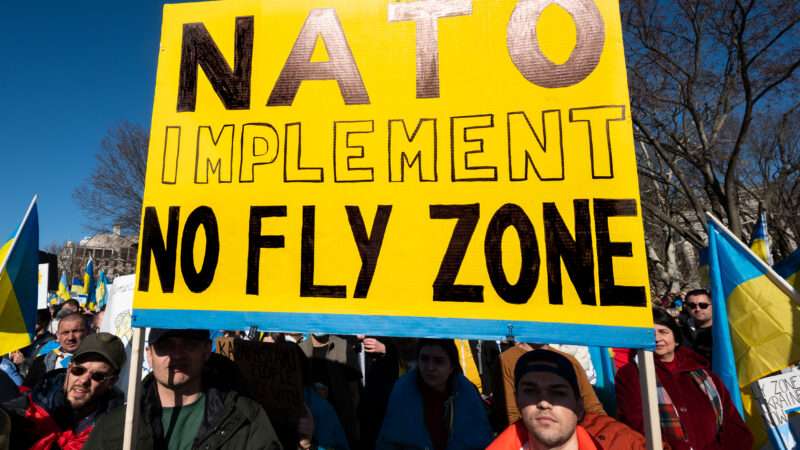
Cooler Heads Must Prevail in Ukraine


sipaphotosthirteen062715

Millions of people have watched the Russian invasion of Ukraine unfold with profound sadness, anger, and frustration. Ukrainian President Volodymyr Zelenskyy and Kyiv Mayor Vitali Klitschko have received praise from around the world for being modern-day George Washingtons battling for freedom against the powerful imperialists.

Military conflict is rife with injustice, suffering, and death. It is a cold and brutal reality where good intentions can often fail or make the situation worse.

That is why it is critical for the U.S. and our allies to be driven by objective and sober-minded strategic reasoning as we respond, which means guarding against the irrationalism that can be the result of well-intended but emotional decisions.

As Ukrainians flee their homes or take up arms to defend their communities, many people feel an instinct to help. After watching civilians hunker down in subway stations against aerial assaults, U.S. members of Congress were swayed and began to take seriously Zelenskyy’s call for America to institute a “no-fly” zone for Russian aircraft in order to ostensibly help Ukraine “defeat the aggressor.” 

The desire to protect civilians is noble, but in a recent interview with Foreign Policy, General Philip Breedlove, former supreme allied commander for NATO operations, detailed how the tactical realities of setting up and enforcing such a zone would be far too risky. “You have to be willing to use force against those who break the no-fly zone,” says Breedlove, “if you are going to fly coalition or NATO aircraft into that no-fly zone, then we have to take out all the weapons that can fire into our no-fly zone and cause harm to our aircraft.” Instituting a “no-fly” zone over Ukraine would require disabling Russian radar and communications, air defense weapons systems, and ultimately lead to attacking any Russian aircraft in the designated area.

Breedlove believes establishing a “no-fly” zone would be “interpreted as an act of war” by many. Nor would it help to avoid reaching the top of the escalation ladder: nuclear attack. This past weekend, Russian President Vladimir Putin placed his country’s nuclear forces on “high alert.”

The risk of escalating this conflict into a nuclear standoff is far too real to let emotions get in the way. Knowing the consequences, Breedlove still supports a “no-fly” zone. When pressed about it, he responded, “Are we going to sit and watch while a world power invades and destroys and subjugates a sovereign nation?” And Breedlove isn’t the only one calling for a “no-fly” zone over Ukraine. Last week, Rep. Adam Kinzinger (R-Ill.) tweeted, “The fate of #Ukraine is being decided tonight, but also the fate of the west. Declare a #NoFlyZone over Ukraine at the invitation of their sovereign govt.” Kinzinger’s tweet was met with intense criticism from other members of Congress, veterans, and analysts—rightfully so. Examining national interests requires level-headedness no matter how heart-wrenching a situation is. 

In 2011, the world watched as emotional decision making reared its ugly head in Libya. During increased civil unrest, reports indicated that Libyan leader Moammar Gadhafi’s military forces were poised to use aerial attacks on innocent civilians. NATO executed a “no-fly” zone with United Nations authorization, which elevated the conflict to a full civil war. Thousands died over a span of just a few years—including U.S. Ambassador J. Christopher Stevens. Libya turned into a breeding ground for terrorism with an unrelenting refugee crisis. Both problems persist today.

Letting emotion drive foreign policy is short-sighted, especially when actions driven by short-term vision can have serious long-term harm. Washington’s responsibility is to keep Putin’s invasion of Ukraine from escalating into something that threatens the lives and freedoms of Americans. Anything beyond that, no matter how noble, falls outside U.S. security interests and risks jeopardizing that primary objective.

The post Cooler Heads Must Prevail in Ukraine appeared first on Reason.com.

from Latest https://ift.tt/ep6WudA
via IFTTT

“The Act of Silencing a Speaker Is Fundamentally Contrary to the Values of This School”

From Fox News (Jessica Chasmar):

Ilya Shapiro, a constitutional scholar who recently found himself in hot water over a tweet about President Biden’s Supreme Court nominee, was shouted down by law students in San Francisco, videos show.

Shapiro joined a discussion Tuesday afternoon about Justice Stephen Breyer’s Supreme Court vacancy at the University of California, Hastings College of the Law, but he was interrupted by protesters pounding on desks and chanting “Black lawyers matter.” …

UC Hastings sent a letter to students Wednesday morning condemning the protesters’ behavior, saying it violated the code of conduct.

“The act of silencing a speaker is fundamentally contrary to the values of this school as an institution of higher learning; it is contrary to the pedagogical mission of training students for a profession in which they will prevail through the power of analysis and argument,” the school said in the letter, obtained by Fox News Digital.

Glad UC Hastings responded, and I hope that the violations of the code of conduct will come with some actual disciplinary measures. I’m not out for blood here: Shouting down a speaker is bad, but I think not, say, an offense meriting expulsion. There just ought to be some meaningful punishment for such misbehavior, or else the misbehavior will just get repeated.

I’ve heard some people argue that such heckling is itself constitutionally protected speech, but I don’t think that’s right (at least unless a school deliberately opens up such presentations as free shouting zones for everyone). Generally speaking, schools may and do set up viewpoint-neutral restrictions on speech at such events, generally that the speakers speak for X minutes and then the audience gets to ask questions for Y minutes, with the speakers responding. And of course student groups at law schools are generally free to set up their own events, where their views can be presented without being shouted down (or even materially interrupted by chanting and the like).

Of course, if shouting down is considered acceptable speech, I expect that many people may want to take advantage of it: some anti-abortion activists who oppose pro-abortion-rights speakers, some anti-critical-race-theory activists who oppose critical race theorists, some gun rights activists who oppose advocates of what they see as oppressive and unconstitutional violations of people’s gun rights, and more. I’d rather that none of them get to shout down rival speakers—but if critics of Shapiro were entitled to “silenc[e]” him at UC Hastings, then First Amendment viewpoint-neutrality rules would require that critics of other speakers would be entitled to silence them, too.

The post "The Act of Silencing a Speaker Is Fundamentally Contrary to the Values of This School" appeared first on Reason.com.

from Latest https://ift.tt/aHeoDZj
via IFTTT

Wars Rarely Achieve Their Initial Goals: The Curse Of Second-Order Effects

Wars Rarely Achieve Their Initial Goals: The Curse Of Second-Order Effects

Authored by Charles Hugh Smith via OfTwoMinds blog,

Initial victories do not guarantee the war will be won. Rather, they arouse the most dangerous enemy: the fatal hubris of over-confidence.

War tops the long list of human folly for a basic reason: it rarely achieves the initial goals of launching the war. It takes a special kind of human folly to discount all the negative possibilities that come from starting a war and focus exclusively on the one positive outcome in the belief it is inevitable, guaranteed, etc.

Wars carry a particularly heavy curse, that of long-term second order effects.

The decision to launch a war must discount bad outcomes and extrapolate previous minor military campaigns as “proof” that the war will be won quickly and with minimal second order effects. (First order effects: actions have consequences. Second order effects: consequences have consequences.) Put these two gratifying assumptions together and you arrive at a third assumption: the war will be over before we know it.

And so civilians make haste to view the initial battle lest they miss the all-too-brief excitement (First Battle of Manassas, American Civil War) or the combatants proclaim the war that started in late August will be over by Christmas (World War I). Alas, both wars dragged on for over four years as the bodies and consequences piled up.

All sorts of contingencies arise in war as plans go awry. For example, supplies viewed as more than ample for the expected lightning war run out as the war drags on, and there were no plans to resupply during the conflict. Opponents who were expected to run out of defensive ordnance manage to get resupplied, often by ingenious methods the attackers overlooked in their haste to grasp the easy, quick victory.

For example, when Israeli aircraft suffered major losses in the first stage of the 1973 war, the U.S. ferried A-4 Skyhawk aircraft across the Atlantic by positioning aircraft carriers so that pilots could hopscotch the short-range Skyhawks to the battle zone in record time.

Those launching wars tend to exaggerate their own ingenuity and forget that the fight for survival quickens the ingenuity of the opponent as well. It also quickens acts of heroism and hardens resolve. The Japanese aboard Imperial Navy ships steaming toward the island of Midway in June 1942 were surprised by American torpedo planes attacking without fighter cover, attacks that were essentially suicidal given the low odds of success. All the American planes were shot down and not a single American torpedo struck a Japanese ship.

Perhaps the ease of this small victory added to the hubristic over-confidence of the attackers, a hubris which when combined with the myopic planning mentioned above and the contingencies of combat mentioned above, left the cream of Japan’s carriers exposed to an attack by American dive bombers. Three of Japan’s four main battle carriers were left burning hulks and the fourth was destroyed within hours by secondary dive bomber attacks.

The U.S. Navy lost one carrier in the Battle of Midway. Japan lost the initiative. From then on, Japan was on the defensive.

Nobody makes war movies about logistics and supply lines. Moving rations, fuel and ordnance to the front lines is tedious and undramatic. Yet if the logistical train of the army or navy fails and rations, fuel and ordnance run out, the battle is lost and then the war is lost. War boils down to logistics, and the longer the supply lines, the greater the opportunity for disruption or destruction of the supplies by enemies. It turns out you need a second army and/or navy to protect your supply lines–something those confident in quick victory tend to overlook.

As the war drags on, the frustrated attackers resort to extremes of cruelty and destruction in a futile attempt to force a victory. But all the excessive cruelty and destruction does is launch a thousand second order effects, often including a hatred of the attackers that lasts decades or centuries.

It’s difficult to find a war that went as planned and impossible to find one that did not launch long-term second order effects. Europe’s Thirty Years War (1618 to 1648) is instructive on virtually every count of war’s folly: every attack galvanized opponents, every new campaign bled the treasuries of the attackers dry, every wave of destruction triggered a counter-wave of destruction until the exhausted combatants finally concluded the victory they’d anticipated was forever out of reach and so they settled for peace rather than war.

Wars are started with the assumption that the players and chessboard will remain as-is after the conflict, but this isn’t what happens. Consequences have consequences, and the players and chessboard change: some alliances strengthen, others weaken and dissolve, trade routes vanish and the weaker players are bankrupted by either the war or the occupation of the still-hostile opponents.

Nothing galvanizes opposition quite like naked aggression and nothing galvanizes domestic opposition like promising a splendid little war that transmogrifies into an endless costly occupation, bankruptcy and defeat.

Human folly depends most heavily on human pride. It’s difficult to swallow one’s pride and declare victory as a transparent cover for exiting the quagmire. (An honorable peace and other threadbare fictions.) The cost of pride not only bankrupts the treasury, it also lays waste to trust in the attacking nation to keep its word and sets aside whatever squabbles kept opposing nations from forming a united front.

Initial victories do not guarantee the war will be won. Rather, they arouse the most dangerous enemy: the fatal hubris of over-confidence.

The important lessons come from defeats, not victories. But by the time those lessons are absorbed, it may be too late to make use of them: the second order effects won.

This is a memorial outside an ancient village in the south of France. It is a typical village, perhaps a few hundred residents. The memorial commemorates three young French civilians who were taken out and shot by German soldiers in World War II for “crimes” of resistance.

*  *  *

My new book is now available at a 10% discount this month: Global Crisis, National Renewal: A (Revolutionary) Grand Strategy for the United States (Kindle $8.95, print $20). If you found value in this content, please join me in seeking solutions by becoming a $1/month patron of my work via patreon.com.

Tyler Durden
Wed, 03/02/2022 – 16:21

via ZeroHedge News https://ift.tt/SNxl7Ro Tyler Durden

#MeToo/#TheyLied Settlements, Arbitration, and Rescission

Reiterman v. Abid, decided today by the Eleventh Circuit (in an opinion by Judge Gerald Bard Tjoflat, joined by Judges Elizabeth Branch and Britt Grant), involves a sexual assault allegation which led to a libel lawsuit, and which in turn led to a settlement agreement calling for arbitration. The question is whether the settlement agreement was rescinded, so that the libel plaintiff (Reiterman) could again sue the initial accuser (Abid) for late

{We make no comment on the truth or falsity of any of the background facts of this case, as the merits of Reiterman’s claims are not before us on appeal. For context purposes only, we summarize the facts of the merits dispute as they have been presented by the parties to this Court on appeal.}

Abid and Reiterman first met in 2014 in Tampa, Florida. At the time, Reiterman worked as an LSAT teacher for the test preparation company TestMasters. Abid was one of Reiterman’s students, and the two briefly dated. After the relationship ended, Abid accused Reiterman of sexual assault. This accusation resulted in an investigation by the Tampa Police Department, which ultimately declined to charge Reiterman. The Florida Attorney General’s Office also declined to intervene after reviewing the case at Abid’s request.

Abid then allegedly engaged in a pervasive, anonymous internet campaign to ruin Reiterman’s reputation by writing several blogposts accusing Reiterman of sexually assaulting multiple women. Each of these blogposts was ostensibly written by a different woman. The District Court would later describe this campaign as “remarkably extensive and forceful, in effect seeking to destroy Reiterman by painting him in the most graphic terms as a racist and a serial rapist.” These allegations severely affected Reiterman’s reputation while attending Harvard Law School from 2015 to 2018 and continue to impair his ability to obtain gainful employment.

On April 4, 2018, Reiterman sued Abid in the Middle District of Florida, claiming that she had defamed him by creating all or some of the anonymous blogposts. Abid denied involvement in the internet campaign, and so Reiterman and Abid quickly entered into settlement negotiations. In June 2018, the parties agreed to the 2018 Settlement Agreement disputed in this appeal. This agreement provided, inter alia, that the parties would exchange mutual releases for all claims they had against each other, that Reiterman would pay Abid a set amount of money in monthly installments, and that “[a]ny controversy or claim arising out of or relating to this contract, or breach thereof, shall be settled by arbitration.”

After the parties agreed to the 2018 Settlement Agreement, Reiterman learned of evidence indicating that Abid was responsible for all or most of the blogposts, contrary to what she had stated during the settlement negotiations. Furthermore, three new blogposts were posted after the agreement was made, which Reiterman suspected Abid was responsible for. As a result, Reiterman sent a letter to Abid on April 3, 2019, through his attorney. This letter stated that Abid’s conduct had rendered their 2018 Settlement Agreement “null and void” and that Reiterman was therefore relieved of his obligations under the agreement. Reiterman requested that Abid return the payments Reiterman had made so far and warned Abid that litigation would follow unless she agreed to Reiterman’s demands.

Abid personally responded to Reiterman’s letter on April 10 by email. In her response, Abid stated that “[s]ince Mr. Reiterman is accusing me of having breached the settlement agreement and believes he no longer has an obligation to abide by the clauses set therein, I will mirror that belief and no longer honor the clauses set forth in the agreement either.” Abid then went on to describe the various actions she would take now that she was released from the 2018 Settlement Agreement, such as publishing a book she claimed to have written about Reiterman’s alleged sexual assault and contacting politicians involved in the 2020 presidential race. In September 2019, Reiterman brought this action against Abid in the Middle District of Florida.

Once Abid obtained new counsel and waived service of process, she moved the District Court to issue an order compelling arbitration based on the arbitration clause in the 2018 Settlement Agreement. Reiterman opposed the motion, claiming that the parties had mutually agreed to rescind the 2018 Settlement Agreement through their April 2019 communications….

At [an] evidentiary hearing, the District Court heard testimony from both Abid and Reiterman’s lawyer, Krista Baughman, who wrote Reiterman’s April 2019 letter. Baughman’s testimony, which the Court found credible, established that the parties intended to rescind the 2018 Settlement Agreement in their 2019 communications. While Abid testified that she did not intend to rescind the 2018 Settlement Agreement in her 2019 email, the Court found her testimony to not be credible and instead found that she had intended to rescind the agreement in her 2019 email. Following the hearing, the Court entered an order denying Abid’s motion to compel arbitration as the parties had rescinded the 2018 Settlement Agreement. Abid timely appealed this order….

Abid is correct that courts must determine whether the parties formed a contract containing an arbitration clause before compelling arbitration and that this inquiry speaks to the existence of the contract. Abid is also correct that an arbitrator must decide any questions about whether a contract containing an arbitration agreement is void or voidable under state law.

But Abid’s argument fails when it attempts to classify a subsequent mutual rescission as just another state law ground rendering a contract void or voidable. Rather, a subsequent mutual rescission is an agreement between the parties to not be bound by their former contract any longer. As arbitration is “simply a matter of contract between the parties,” the parties may of course voluntarily decide to release each other from their obligations after forming a contract, including their obligation to arbitrate certain disputes. Any disputes about whether the parties later agreed to rescind their earlier contract are disputes about whether a new agreement was formed—and courts decide contract formation disputes, not arbitrators.

Furthermore, compelling arbitration after the parties have agreed to rescind their arbitration agreement would deprive the parties of the benefit of their subsequent bargain and encourage gamesmanship….

Lastly, the District Court did not clearly err in concluding that the parties intended to mutually rescind their 2018 Settlement Agreement through their April 2019 communications. The Court based its findings of fact in large part on its credibility determinations of the two witnesses: it found Baughman to be credible and Abid to not be credible. Federal Rule of Civil Procedure 52(a) allows reviewing courts to set aside trial court findings of fact only when they are clearly erroneous. But “[w]hen findings are based on determinations regarding the credibility of witnesses, Rule 52(a) demands even greater deference to the trial court’s findings; for only the trial judge can be aware of the variations in demeanor and tone of voice that bear so heavily on the listener’s understanding of and belief in what is said.” …

Note: I intervened in the district court in this case to unseal the settlement agreement and the order sealing the agreement; the court granted my motion to intervene and unseal. My participation in the case was limited to the open records question.

The post #MeToo/#TheyLied Settlements, Arbitration, and Rescission appeared first on Reason.com.

from Latest https://ift.tt/BzVGxd5
via IFTTT

Cooler Heads Must Prevail in Ukraine


sipaphotosthirteen062715

Millions of people have watched the Russian invasion of Ukraine unfold with profound sadness, anger, and frustration. Ukrainian President Volodymyr Zelenskyy and Kyiv Mayor Vitali Klitschko have received praise from around the world for being modern-day George Washingtons battling for freedom against the powerful imperialists.

Military conflict is rife with injustice, suffering, and death. It is a cold and brutal reality where good intentions can often fail or make the situation worse.

That is why it is critical for the U.S. and our allies to be driven by objective and sober-minded strategic reasoning as we respond, which means guarding against the irrationalism that can be the result of well-intended but emotional decisions.

As Ukrainians flee their homes or take up arms to defend their communities, many people feel an instinct to help. After watching civilians hunker down in subway stations against aerial assaults, U.S. members of Congress were swayed and began to take seriously Zelenskyy’s call for America to institute a “no-fly” zone for Russian aircraft in order to ostensibly help Ukraine “defeat the aggressor.” 

The desire to protect civilians is noble, but in a recent interview with Foreign Policy, General Philip Breedlove, former supreme allied commander for NATO operations, detailed how the tactical realities of setting up and enforcing such a zone would be far too risky. “You have to be willing to use force against those who break the no-fly zone,” says Breedlove, “if you are going to fly coalition or NATO aircraft into that no-fly zone, then we have to take out all the weapons that can fire into our no-fly zone and cause harm to our aircraft.” Instituting a “no-fly” zone over Ukraine would require disabling Russian radar and communications, air defense weapons systems, and ultimately lead to attacking any Russian aircraft in the designated area.

Breedlove believes establishing a “no-fly” zone would be “interpreted as an act of war” by many. Nor would it help to avoid reaching the top of the escalation ladder: nuclear attack. This past weekend, Russian President Vladimir Putin placed his country’s nuclear forces on “high alert.”

The risk of escalating this conflict into a nuclear standoff is far too real to let emotions get in the way. Knowing the consequences, Breedlove still supports a “no-fly” zone. When pressed about it, he responded, “Are we going to sit and watch while a world power invades and destroys and subjugates a sovereign nation?” And Breedlove isn’t the only one calling for a “no-fly” zone over Ukraine. Last week, Rep. Adam Kinzinger (R-Ill.) tweeted, “The fate of #Ukraine is being decided tonight, but also the fate of the west. Declare a #NoFlyZone over Ukraine at the invitation of their sovereign govt.” Kinzinger’s tweet was met with intense criticism from other members of Congress, veterans, and analysts—rightfully so. Examining national interests requires level-headedness no matter how heart-wrenching a situation is. 

In 2011, the world watched as emotional decision making reared its ugly head in Libya. During increased civil unrest, reports indicated that Libyan leader Moammar Gadhafi’s military forces were poised to use aerial attacks on innocent civilians. NATO executed a “no-fly” zone with United Nations authorization, which elevated the conflict to a full civil war. Thousands died over a span of just a few years—including U.S. Ambassador J. Christopher Stevens. Libya turned into a breeding ground for terrorism with an unrelenting refugee crisis. Both problems persist today.

Letting emotion drive foreign policy is short-sighted, especially when actions driven by short-term vision can have serious long-term harm. Washington’s responsibility is to keep Putin’s invasion of Ukraine from escalating into something that threatens the lives and freedoms of Americans. Anything beyond that, no matter how noble, falls outside U.S. security interests and risks jeopardizing that primary objective.

The post Cooler Heads Must Prevail in Ukraine appeared first on Reason.com.

from Latest https://ift.tt/ep6WudA
via IFTTT

“The Act of Silencing a Speaker Is Fundamentally Contrary to the Values of This School”

From Fox News (Jessica Chasmar):

Ilya Shapiro, a constitutional scholar who recently found himself in hot water over a tweet about President Biden’s Supreme Court nominee, was shouted down by law students in San Francisco, videos show.

Shapiro joined a discussion Tuesday afternoon about Justice Stephen Breyer’s Supreme Court vacancy at the University of California, Hastings College of the Law, but he was interrupted by protesters pounding on desks and chanting “Black lawyers matter.” …

UC Hastings sent a letter to students Wednesday morning condemning the protesters’ behavior, saying it violated the code of conduct.

“The act of silencing a speaker is fundamentally contrary to the values of this school as an institution of higher learning; it is contrary to the pedagogical mission of training students for a profession in which they will prevail through the power of analysis and argument,” the school said in the letter, obtained by Fox News Digital.

Glad UC Hastings responded, and I hope that the violations of the code of conduct will come with some actual disciplinary measures. I’m not out for blood here: Shouting down a speaker is bad, but I think not, say, an offense meriting expulsion. There just ought to be some meaningful punishment for such misbehavior, or else the misbehavior will just get repeated.

I’ve heard some people argue that such heckling is itself constitutionally protected speech, but I don’t think that’s right (at least unless a school deliberately opens up such presentations as free shouting zones for everyone). Generally speaking, schools may and do set up viewpoint-neutral restrictions on speech at such events, generally that the speakers speak for X minutes and then the audience gets to ask questions for Y minutes, with the speakers responding. And of course student groups at law schools are generally free to set up their own events, where their views can be presented without being shouted down (or even materially interrupted by chanting and the like).

Of course, if shouting down is considered acceptable speech, I expect that many people may want to take advantage of it: some anti-abortion activists who oppose pro-abortion-rights speakers, some anti-critical-race-theory activists who oppose critical race theorists, some gun rights activists who oppose advocates of what they see as oppressive and unconstitutional violations of people’s gun rights, and more. I’d rather that none of them get to shout down rival speakers—but if critics of Shapiro were entitled to “silenc[e]” him at UC Hastings, then First Amendment viewpoint-neutrality rules would require that critics of other speakers would be entitled to silence them, too.

The post "The Act of Silencing a Speaker Is Fundamentally Contrary to the Values of This School" appeared first on Reason.com.

from Latest https://ift.tt/aHeoDZj
via IFTTT