Crypto & Crude Extend Yesterday’s Gains As Bonds & Stocks See Massive Roundtrip

Crypto & Crude Extend Yesterday’s Gains As Bonds & Stocks See Massive Roundtrip

The narrative for today’s gains were 1) apparently positive headlines from Ukraine (though contradictory messages from both sides on talks were made), 2) ADP showed strong job gains (but embarrassed itself as practically useless with a massive revision to last month’s job losses), and 3) Powell affirmed a single rate-hike in March but  opened the door for a 50bps hike in the future (reducing the odds of a 50bps hike , but the market shifted hawkishly on the actual rate trajectory).

Source: Bloomberg

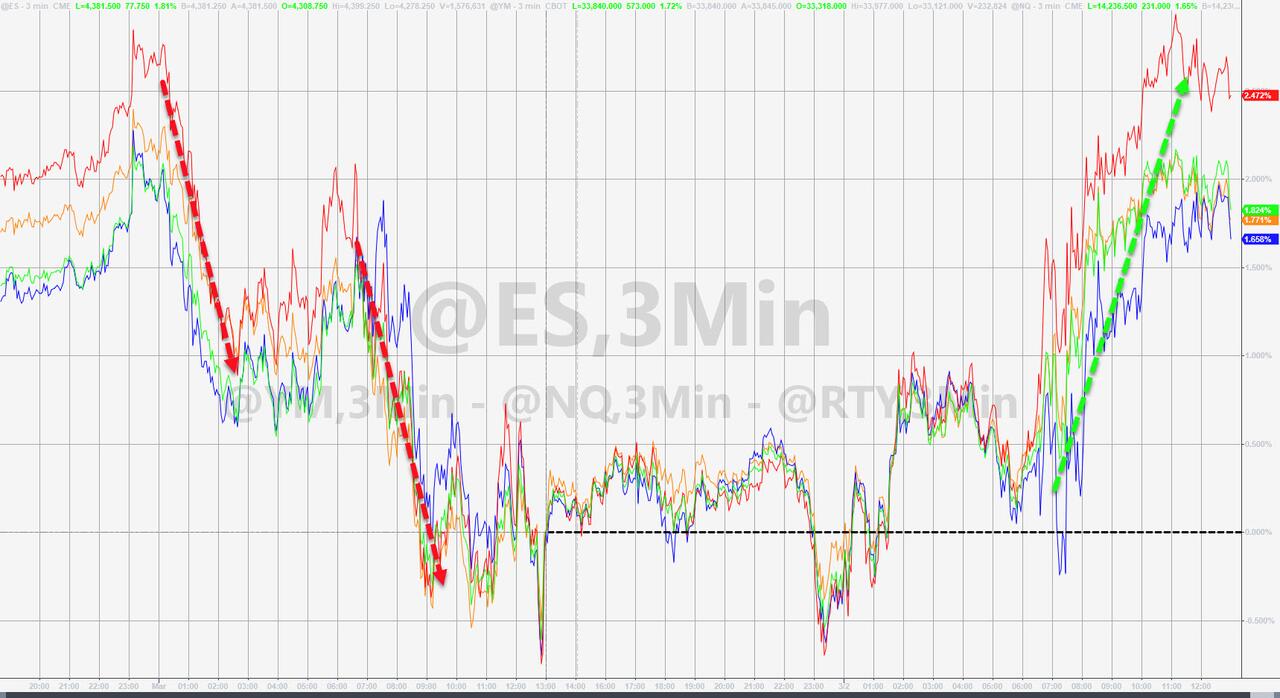
And that prompted a buying-panic in stocks, reverting everything to Monday’s overnight highs. Small Caps led the charge with the rest of the majors grouped together..

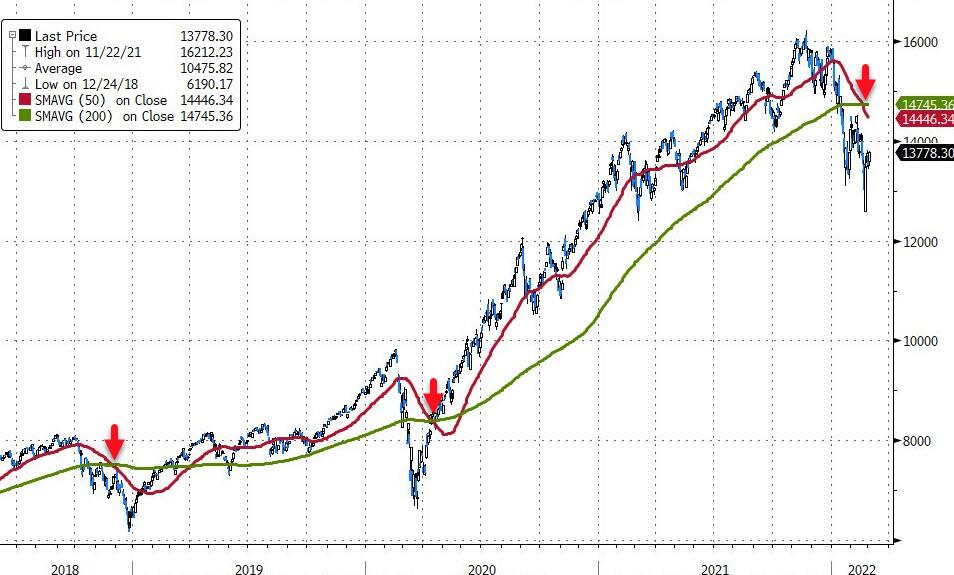
Nasdaq just triggered its first death cross (50DMA breaks below the 200DMA) since the COVID-lockdown crash in April 2020… (is this a buying opportunity like the last two times?)

Source: Bloomberg

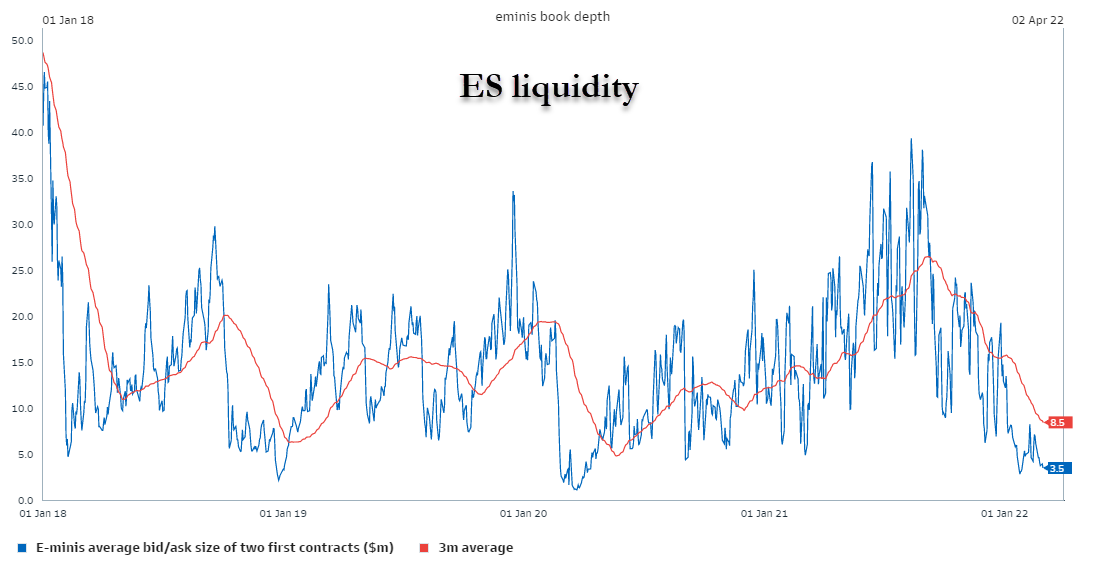
As a reminder – amid the chaotic swings, equity index liquidity remains near record lows…

Nomura’s Charlie McElligott noted late on what was driving today’s reversal in stocks…

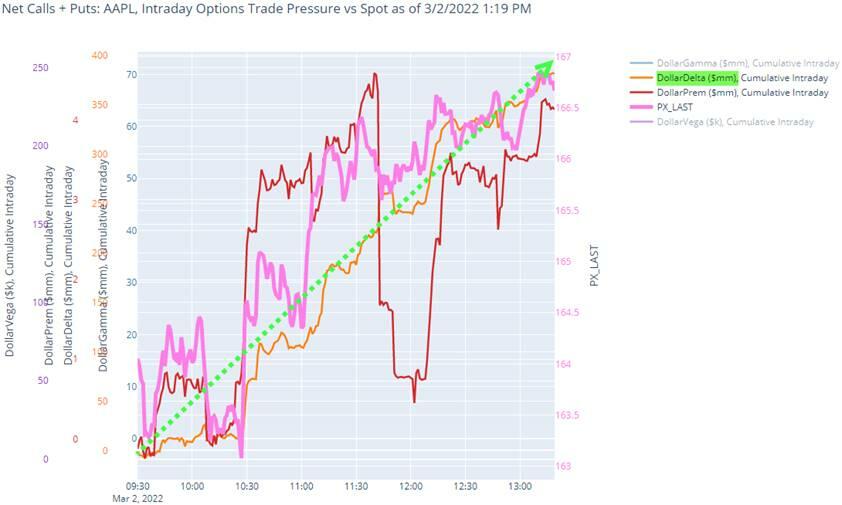
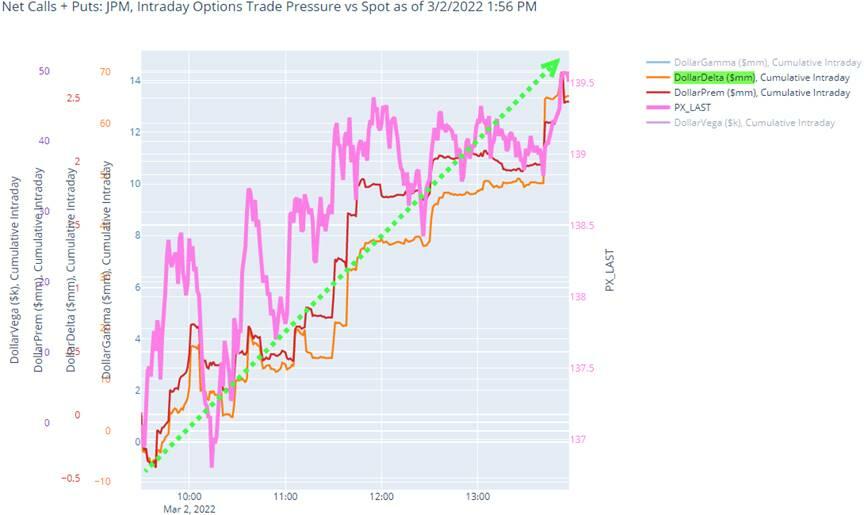
in single-stocks, we are seeing that old-school muscle memory likely out of Retail, buying short-dated Calls to further exploit / goose today’s broad market squeeze (along with a few fits of selling Puts), creating net positive Deltas there—highlighting AAPL and JPM below, notably as both Cyclical Value (Financials) and Secular Growth (Consumer Tech) rage today:

AAPL

JPM

The market is entirely schizophrenic…

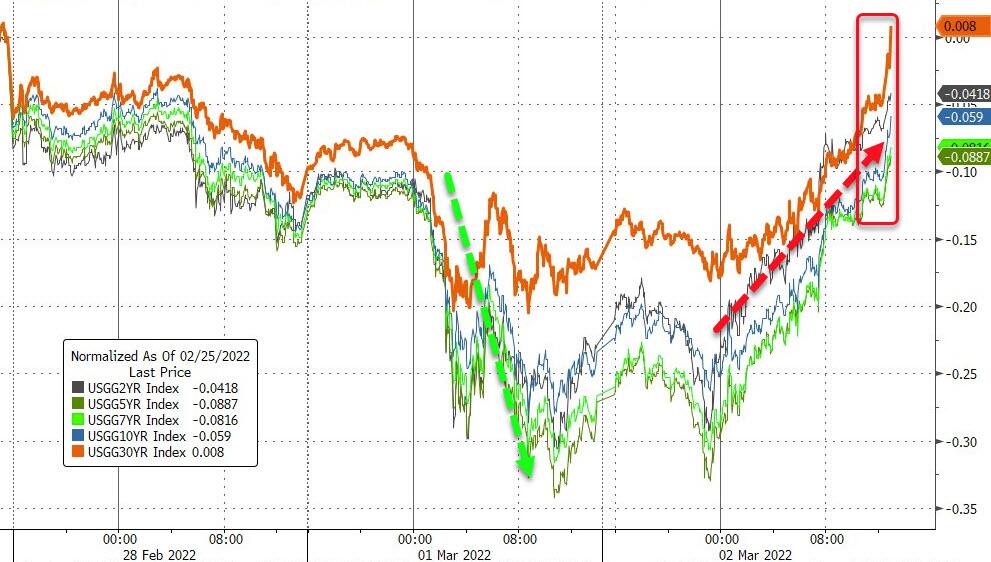
Massive swing back higher in European and US sovereign yields today after yesterday’s collapse.

Treasuries also saw a huge roundtrip today… it looks like it was a mad dash scramble to try and get 30Y Yields back to even from Friday’s close…

Source: Bloomberg

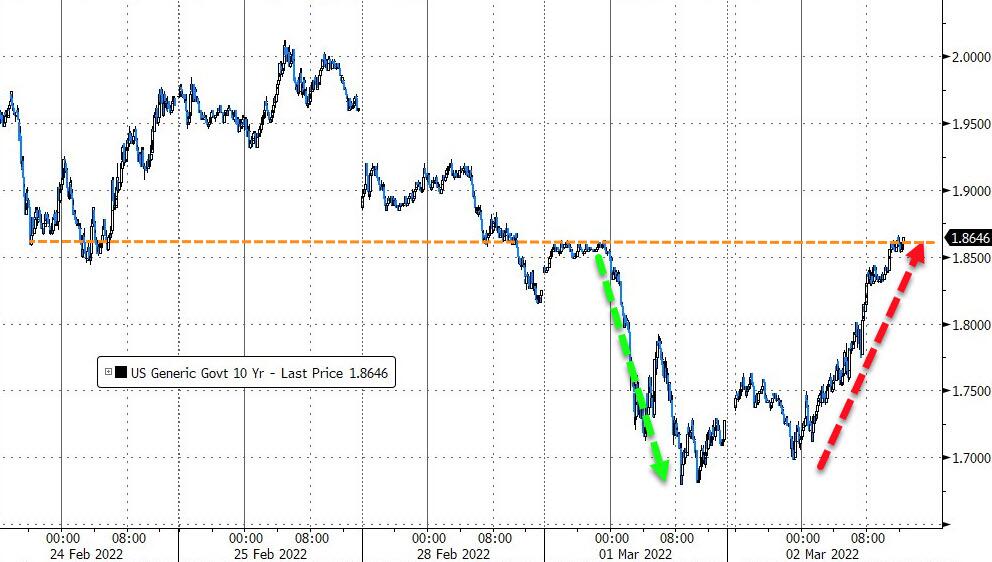
10Y yields seem to have found resistance on the way back up though…

Source: Bloomberg

And McElligott notes this is what drove today’s reversal in bonds (aside from Powell’s comments)…

critical in today’s Bond reversal is of course the “pent-up” Corporate supply release, which came back to market to take advantage of the recent move lower in interest rates; we see the UST long-end legging-lower with the nearly ~$20B of paper set to price this afternoon.

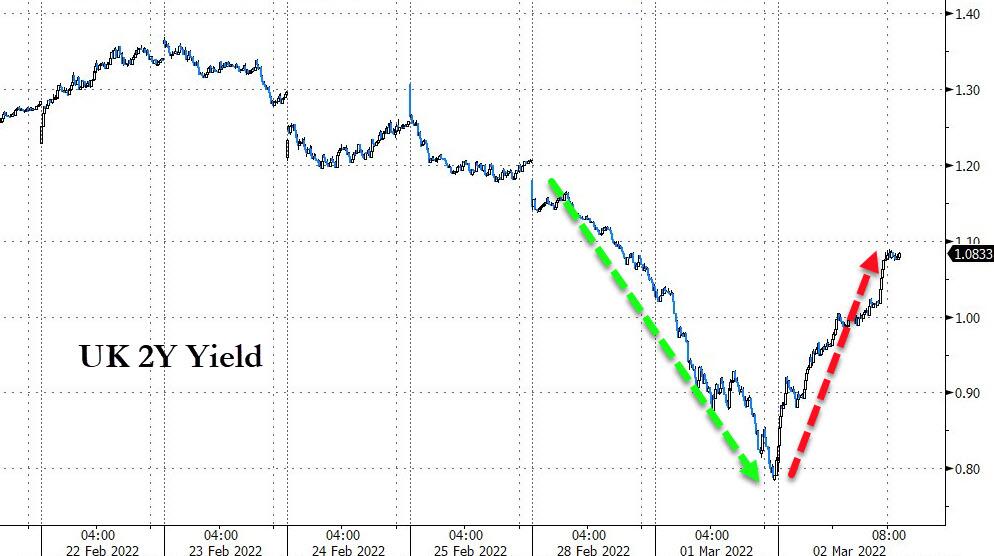
UK 2Y Yields dramatically reversed higher – above yesterday’s highs…

Source: Bloomberg

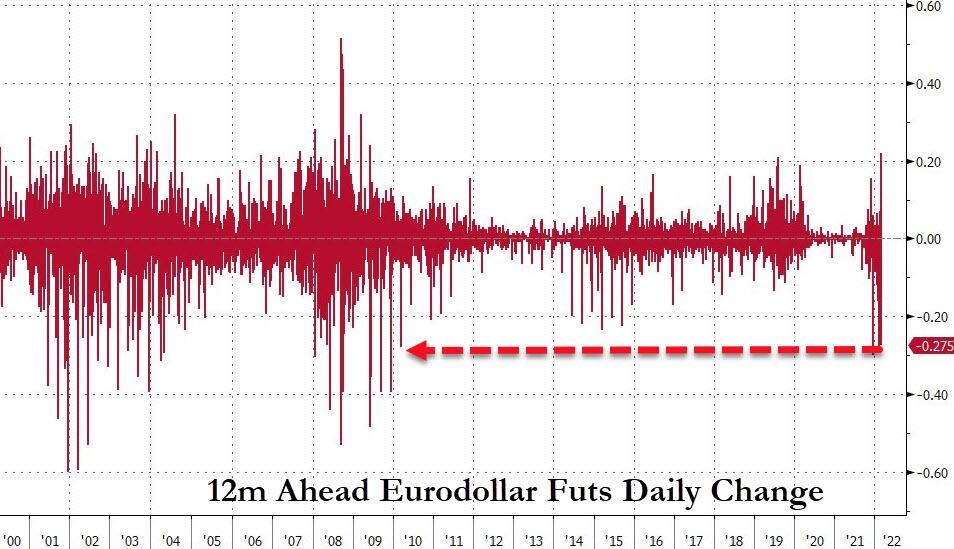
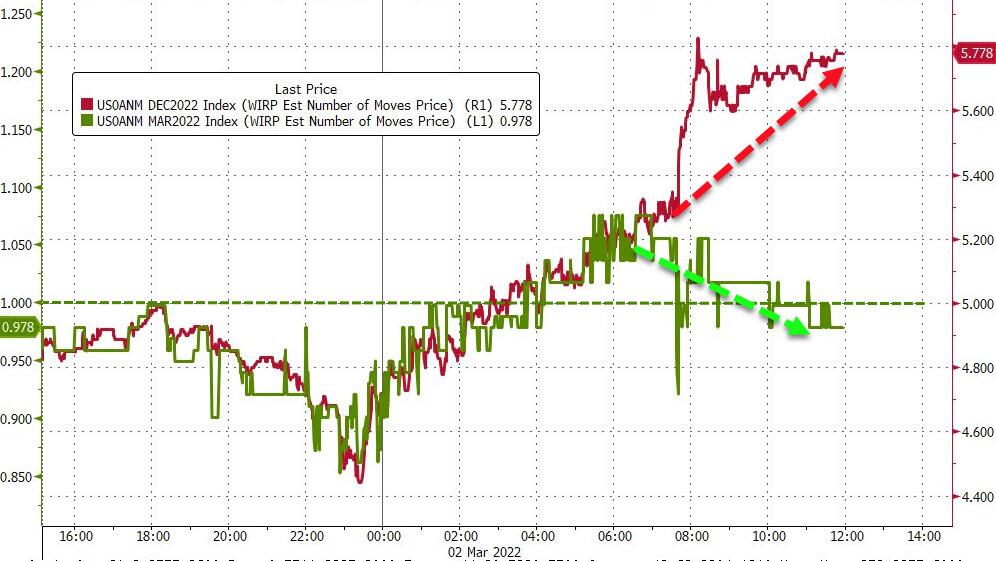
Notably the Dec 2022 rate-hike expectations soared today (the biggest 12m ahead spike in EDs since the chaos of the Great Financial Crisis)…

Source: Bloomberg

Breakevens soaring


Source: Bloomberg

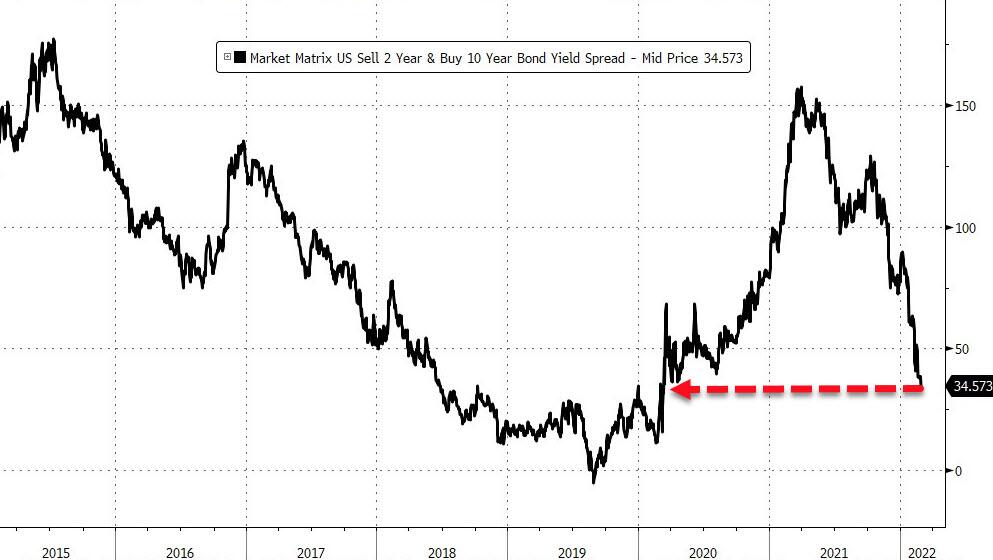
The yield curve tumbled (2s10s) to fresh cycle lows – its flattest since March 2020…

Source: Bloomberg

The dollar dipped today after retesting last week’s invasion spike highs…

Source: Bloomberg

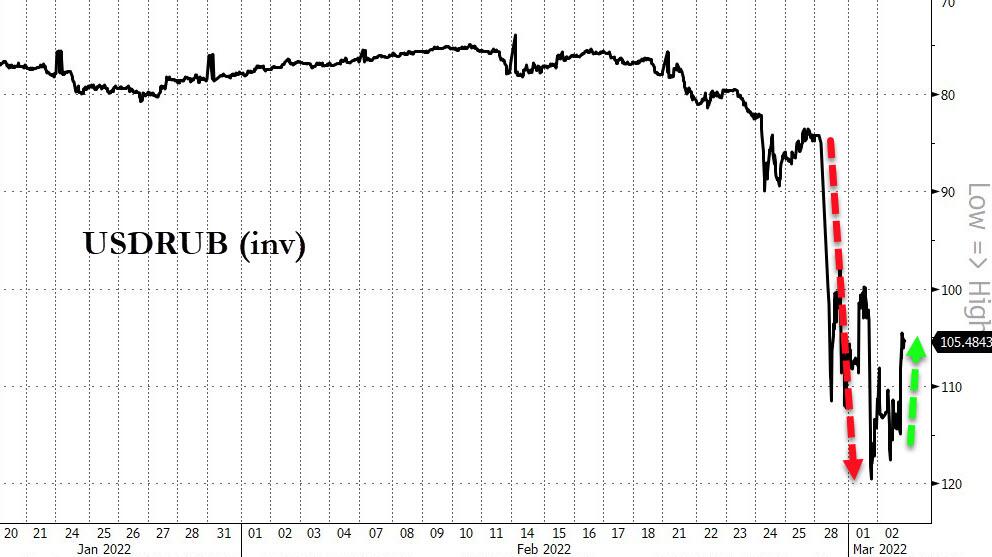
The Ruble rallied back a bit today after a week of carnage…

Source: Bloomberg

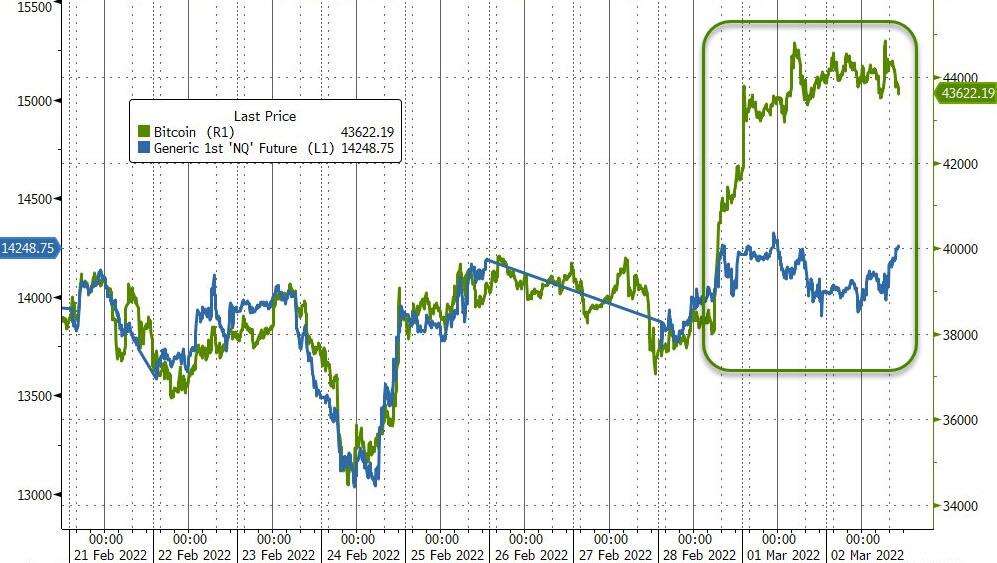
Bitcoin held on to gains and remains notably decoupled from tech stocks for now…

Source: Bloomberg

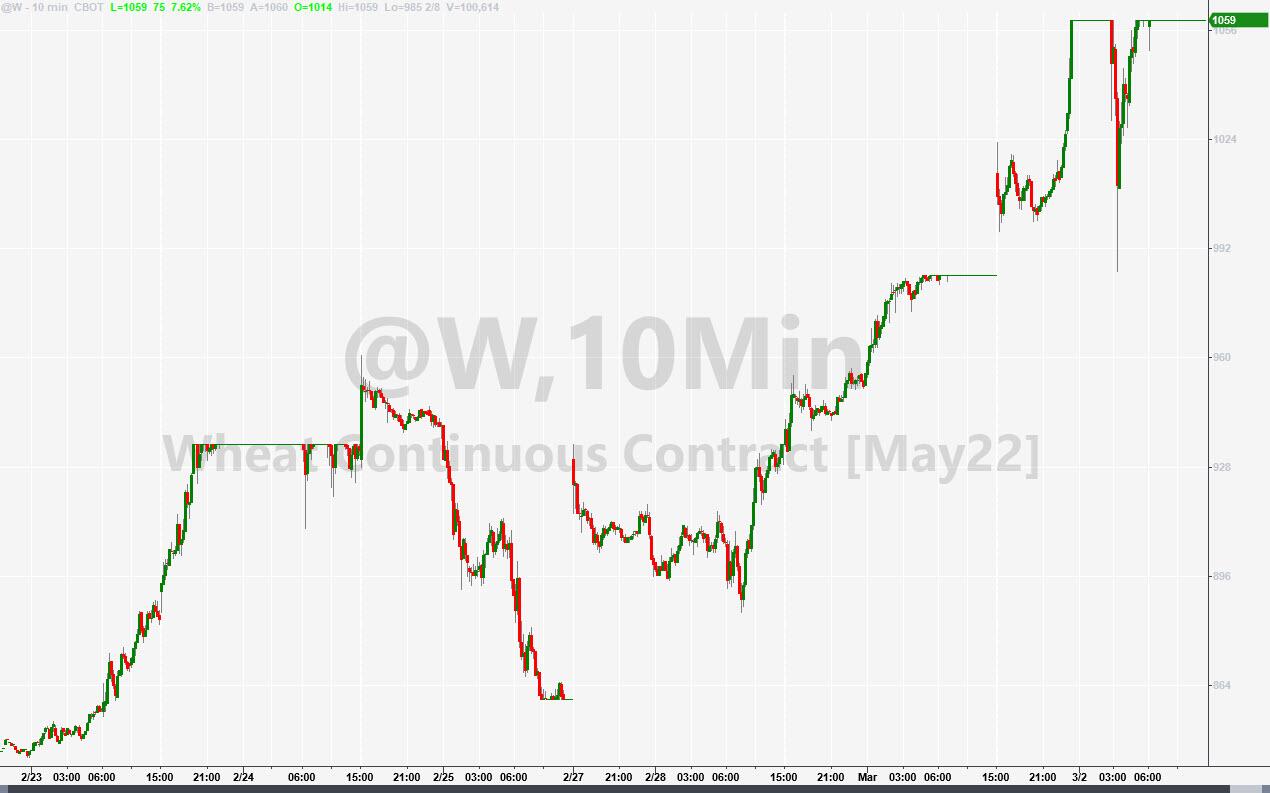
Wheat was limit-up at record highs… again…

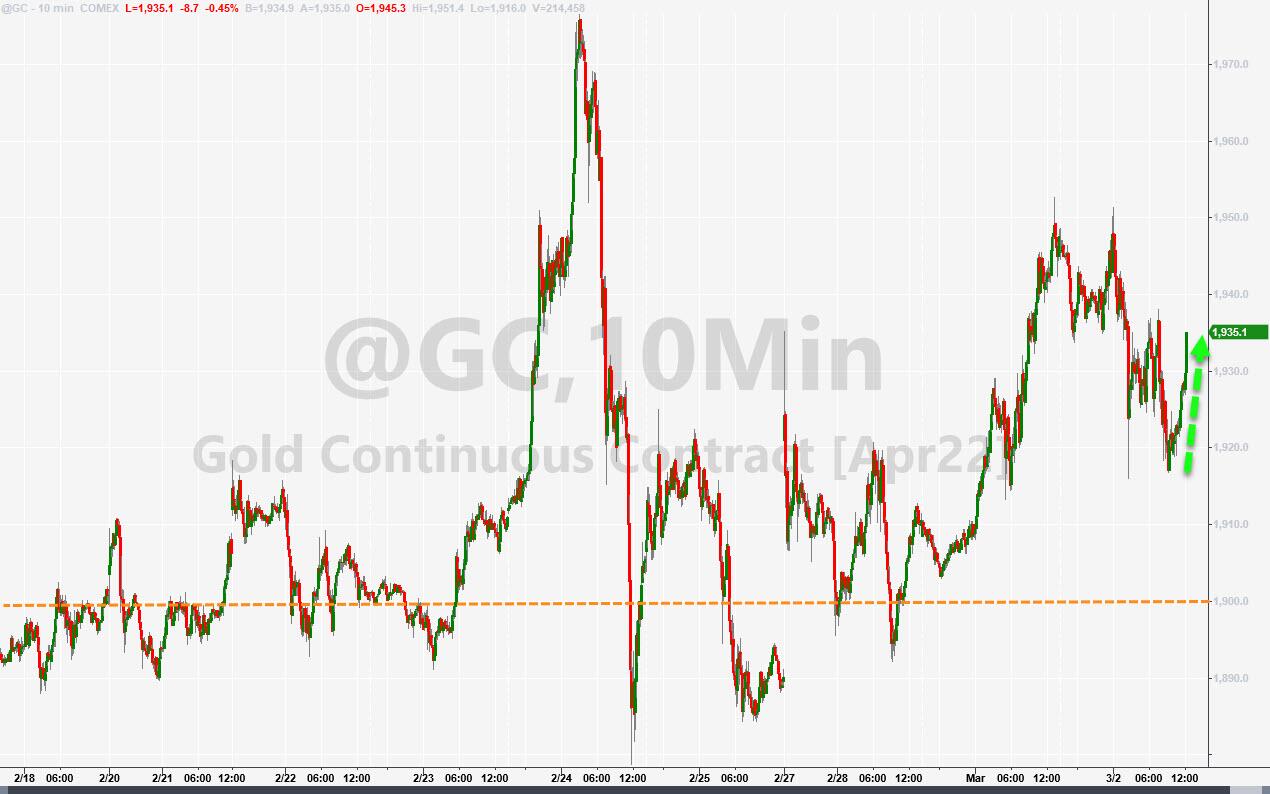
Gold closed lower on the day but well off the lows of the day…

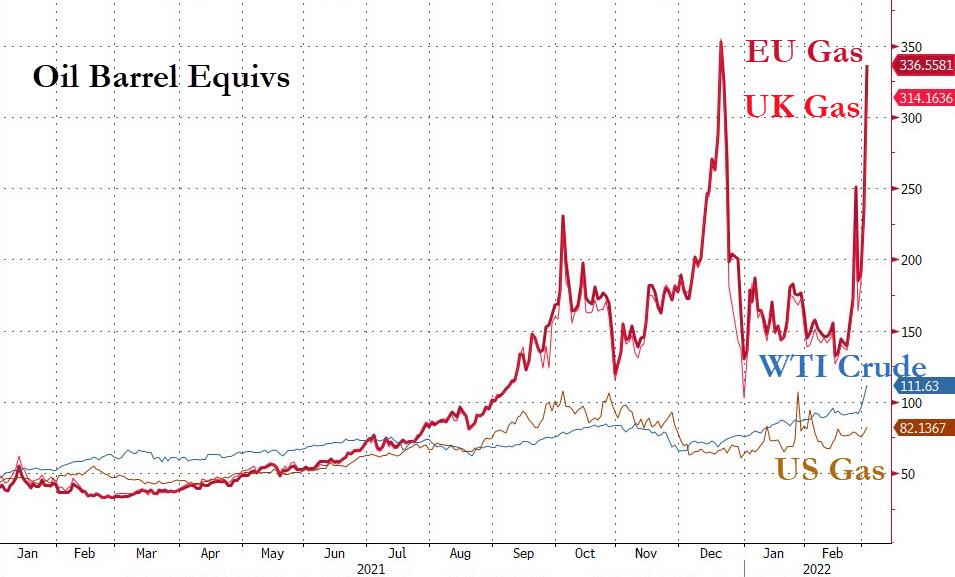
NatGas prices exploded higher in EU and UK today, smashing to record highs once again. The following chart offers some context for the cost of energy, shifting everything to barrel-of-oil-equivalents. At current levels, European Nat Gas is trading as if it were $340/bbl oil…

Source: Bloomberg

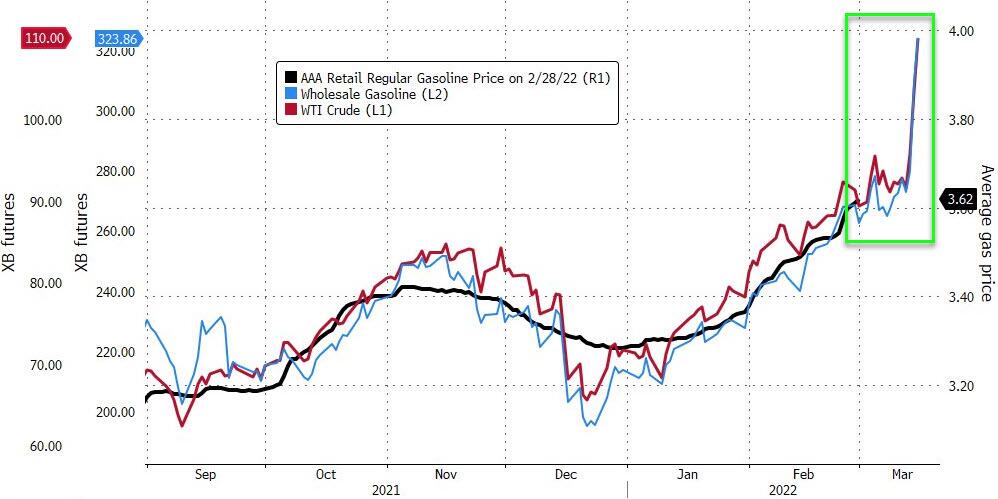
Crude prices soared even higher with WTI topping $112…

And that means $4 gas at the pump is imminent…

Source: Bloomberg

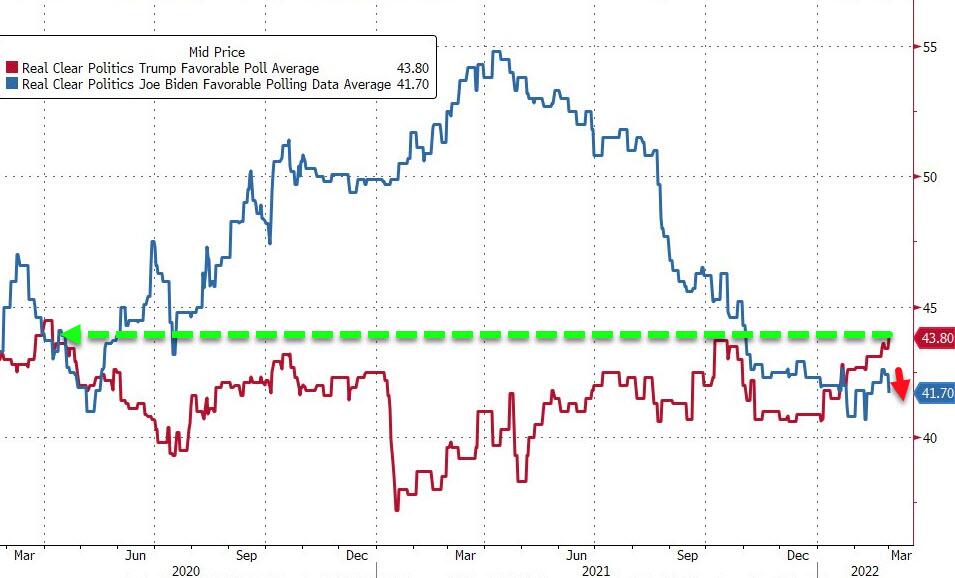
Finally, it appears President Biden’s first State of the Union did nothing for his approval rating as former President Trump’s approval is the highest since before COVID lockdowns…

Source: Bloomberg

“mad world” indeed.

Tyler Durden
Wed, 03/02/2022 – 16:01

via ZeroHedge News https://ift.tt/fVGgHd8 Tyler Durden

Zoltan Pozsar Warns Russian Sanctions Threaten Dollar’s Reserve Status

Zoltan Pozsar Warns Russian Sanctions Threaten Dollar’s Reserve Status

Over the weekend, the world gasped in shock when Western powers announced that the nuclear option would be used against Russia in retaliation for its invasion of Ukraine – sanctions against the country’s central bank and targeted expulsions of key banks from SWIFT, a move which has effectively locked Russia out of the western financial system and left its vast oil export industry – a key lifeline for the Putin regime – in limbo. But the real reason for the shock is that this was the first time the global reserve currency was weaponized against a G20 economy, setting a clear precedent for how the west would and could respond to any other nation that followed in Russia’s footsteps (something which China is clearly contemplating vis-a-vis Taiwan, and is carefully studying just how the west responds to Moscow),

As a result, and following this week’s dramatic freeze of the Russian central bank overseas assets, has prompted some to question just why countries build foreign currency reserves at all and, more broadly, whether the unprecedented western response to Russia hasn’t jeopardized the dollar’s reserve status.

In what one Washington lawyer described to Reuters as the “biggest hammer in the toolshed”, the G7 and European Union governments blocked certain Russian banks’ access to the SWIFT international payment system and also went a step further than many expected by paralyzing about half the Russian central bank’s $630 billion worth of foreign currency and gold reserves. In doing so, the west has undermined Moscow’s ability to defend the ruble – which has lost up to a quarter of its value since Friday alone – and recapitalize sanctioned banks as they face nascent bank runs. In fact, as some admitted, it was the explicit intention of the west to spark bank runs and to crash the Russian financial system from within.

While a huge blow for Russia’s economy, Reuters’ Mike Dolan wrote that the move quickly prompted questions about whether targeting reserve holdings as an act of “economic warfare” may prompt a rethink by reserve managers across the globe – not least in countries that may be at loggerheads or face a potential conflict with U.S. or EU governments – over where to bank their national stash.

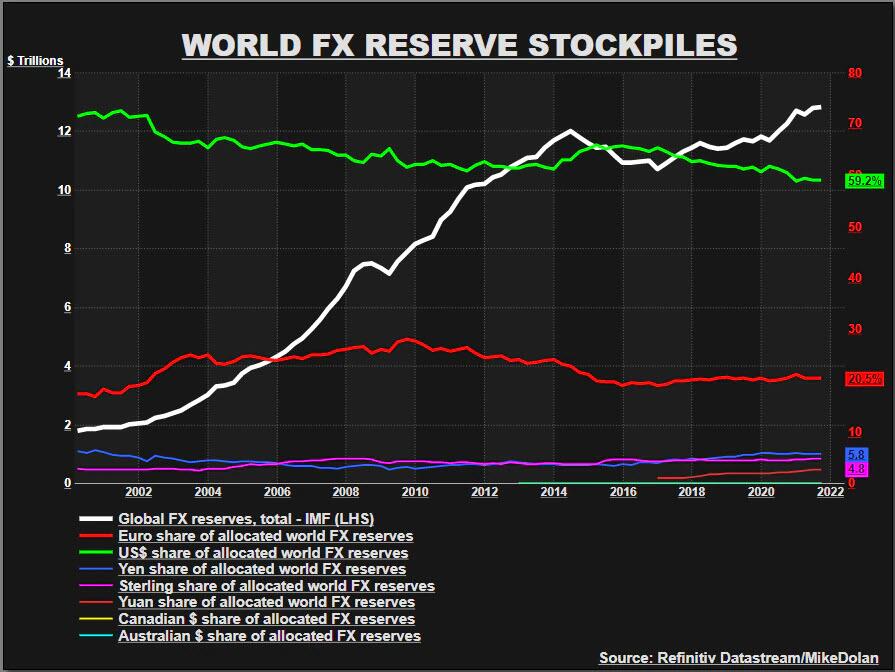
It’s a potentially huge issue for world markets given that central bank foreign currency reserves totaled a record $12.83 trillion late last year – a rise of $11 trillion over the past 20 years. This money is held mostly in U.S. and European government bills and bonds – with the U.S. dollar still accounting for almost 60% of that and the euro about 20%.
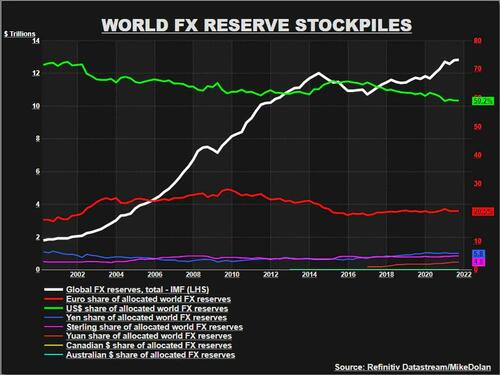
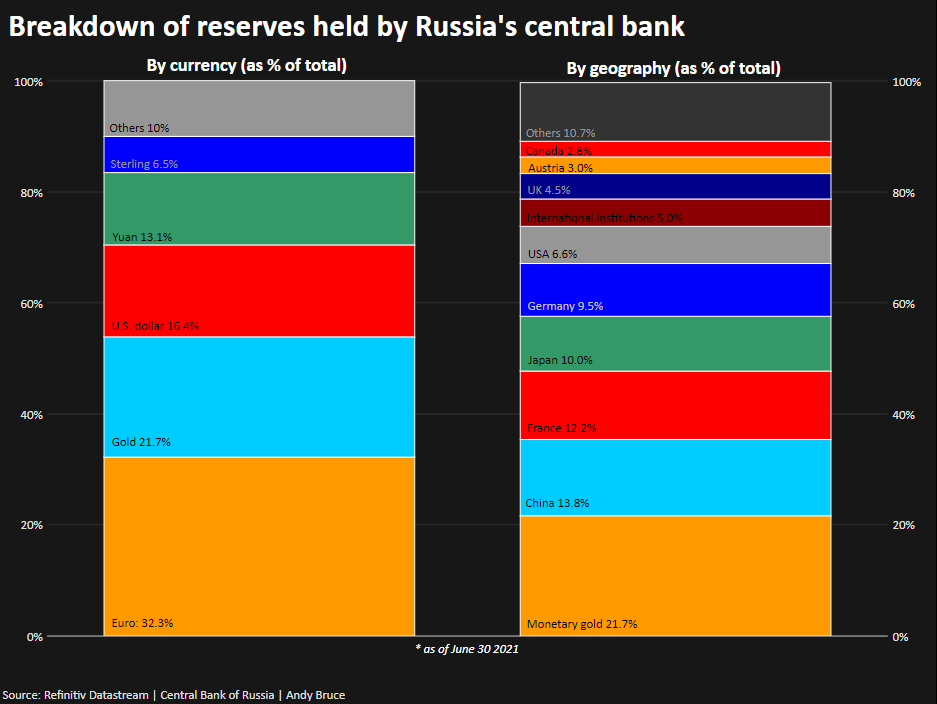
To be sure, Russia has long been aware of the potential risk involved in holding dollars as reserves, and since the annexation of Crimea in 2014, Russia’s central bank had steadily divested its reserves of most U.S. dollar assets. But the dollar, euro and sterling still account for more than 50% of its holdings, located in France, Germany, Japan, Britain, the United States, Canada and Australia.
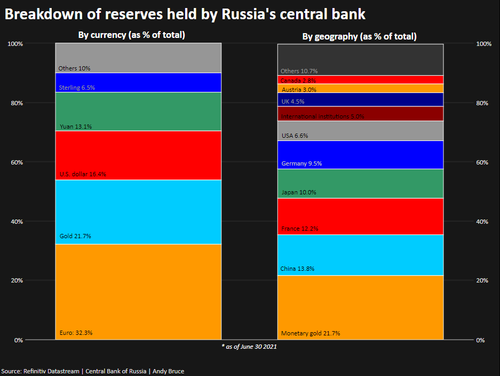
With Moscow and Beijing increasingly allied on the geopolitical stage and China refusing to either condemn the Ukraine invasion or join Western sanctions, China’s yuan – currently accounting for just 2.7% of world reserves – may be one clear option for anxious reserve managers in Moscow or elsewhere.

Of course China itself – for all its fraught relationship with the West – has been the biggest reserve stockpiler since it joined the global trading system 20 years ago amid tight control of its exchange rate. More than $3 trillion of its $3.22 trillion hoard was amassed since 2000 – precisely to offset foreign inflows to keep a lid on the yuan.

But is that about to change, and did western sanctions against Russia marked the beginning of the end of the dollar as the world’s reserve currency?

Berkeley professor and expert on world reserve management Barry Eichengreen reckons that of the two imperatives behind reserve stockpiling – to intervene or stabilize domestic markets or as a war chest against shocks, disasters or balance of payments crises – the latter may now be in question. “The main effect may be declining demand for reserves,” he said.

“If countries see reserves and foreign exchange management as less useful and available, then they will have to accept the inevitability of that their exchange rates are likely to move by more,” Eichengreen added. “In which case they need harden their financial systems and economies against exchange rate related disruptions, for example by discouraging corporates from borrowing in foreign currency.”

That in itself could have a profound impact on world markets and on the model for emerging markets and developing economies.

An even more alarming take comes from former Goldman economist Jim O’Neill who said the Western sanctions could ultimately lead to major reform of the global system.

“Amongst the fallout some countries may see less need to accumulate FX reserves,” he said, adding that could indeed seed “peak reserves” worldwide. “It might (also) make some of the bigger emerging markets think more seriously about reform and opening up their domestic markets, liberalizing and moving away from the U.S-centric system.”

But the most surprising take comes from former NY Fed staffer, current repo guru and Credit Suisse money market guru Zoltan Pozsar – who on any other day would be a stalwart advocate of the status quo – and who ominously said that the response to Russia may have set off a sequence of events in motion that eventually leads to the demise of the dollar as the reserve currency.

Speaking to Bloomberg, Pozsar – who this weekend warned that the lockout of Russia from the global financial system could prompt central banks to aggressively pump liquidity to stabilize markets – said noted that wars tend to turn into major junctures for global currencies, and with Russia losing access to its foreign currency reserves, a message has been sent to all countries that they can’t count on these money stashes to actually be theirs in the event of tension.

As such, he echoes the opinions voiced above that it may make less and less sense for global reserve managers to hold dollars for safety, as they could be taken away right when they’re most needed.

Of course, Russia wasn’t the first country to learn the hard way that dollar reserves can be weaponized at a moment’s notice. Last year, the Biden administration’s move to seize Afghanistan’s cash assets and confiscate the country’s gold held at the NY Fed to prevent access by the Taliban, was another such signal that reserves can be frozen.

Pozsar, similar to O’Neill, argues that this recognition will encourage central banks to diversify away from the dollar, or try to re-anchor their currencies to assets that are less susceptible to influence from U.S. or European governments. As such, recent tensions could usher in a new monetary order in which countries are far less interconnected through international bank accounts and reserves.

Speaking to the Odd Lots podcast, Pozsar said that “most FX reserves that exist in the world today are all forms of inside money, i.e. they are the liabilities of someone.” As a quick reminder, and as we explained over the weekend, central bank deposits, bank deposits, and securities are all “inside money” – money and money-like claims that are someone else’s liability, and it’s situations like this when “outside money”, or money claims like gold bullion that are no one’s liability, is king, especially if stored in vaults domestically. Unlike balances at the Deutsche Bundesbank, western G-SIBs, or Euroclear, you control what you have.

Echoing what he said over the weekend, Pozsar told Bloomberg that “whether you hold the sovereign debt of a country, or you keep a deposit at a central bank of a foreign country, or if you keep deposits at Western financial institutions, these are all forms of inside money that you don’t control. Someone owes it to you. And these things can be sanctioned.”

“If a central bank is in a situation like this and the currency’s under pressure, would it ever come to having to re-anchor your currency to something? Like gold? I think these are all questions that should be top of mind,” he added, forgetting to mention bitcoin and other cryptos, which an entire generation now views as digital gold.

“I don’t know if it’ll come to that, but if things get worse, you could basically re-anchor the ruble to a pile of gold because you need an anchor in situations like this”, he said, echoing what we have said for years, namely that in case Russia wanted to truly extricate itself from the current “dollar reserve” world, it should unveil a gold-backed currency, one which is co-sponsored by the Chinese yuan, which would then also announce unveil it is becoming gold-backed.

Others also share this dismal view: a few days ago, former Societe Generale strategist Dylan Grice who since founded Calderwood Capital, described the recent moves as a “weaponization” of money. “You only get to play the card once,” he tweeted. “China will make it a priority to need no USD before going for Taiwan. It’s a turning point in monetary history.”

A similar warning was issued by Steven Englander, former Citi head of FX and current Managing Director at Standard Chartered Bank.

“It’s a very long-term thing, so nothing immediate or even say on a two- to three-year basis, but if what we are seeing is a demonstration of the power of economic and financial force, the logical response if there is a risk that you will be on the receiving end is to see what you can do to immunize yourself,” he said. “Weirdly enough there may be a second response – what essentially is your potential economic foe importing from you and what can you do to have the maximum impact on their economy and least on yours.”

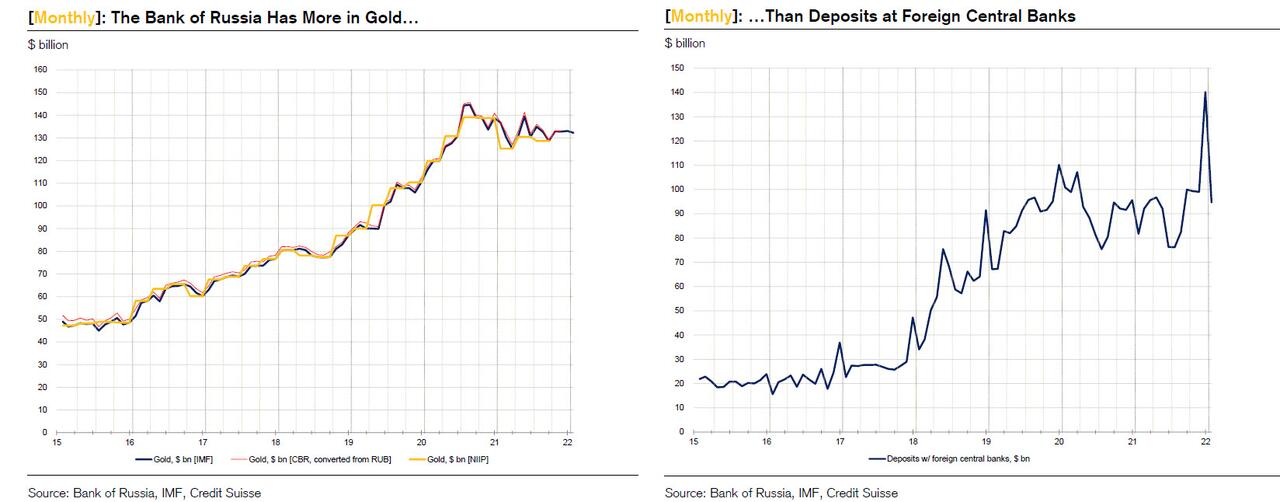
Of course, none of this is a surprise to Russia, which has been feverishly rotating out of its “inside money” dollar reserves, including dumping off all of its U.S. Treasuries in 2018 according to official data, and amassing a record stockpile of gold in the process. In fact, as Pozsar noted over the weekend, “the Bank of Russia now has more gold than deposits at foreign central banks!”
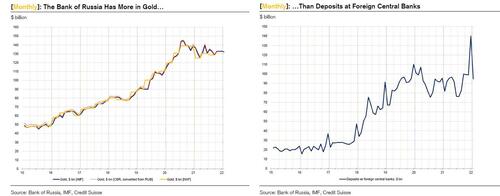
Another former Citi strategist, Brent Donnelly, who now runs Spectra Markets agreed with Pozsar: “In a cooperative game, more global trade and the accumulation of FX reserves makes sense.” But “in a competitive game, where your currency holdings are issued by an adversary and can be frozen or vaporized at that adversary’s discretion… Global trade and the accumulation of FX reserves makes … less sense.”

But while a growing number of countries, especially those that remain ideologically aligned with Russia like China and India, may seek to quietly – and not so quietly – rotate out of the dollar, they face another problem: they’ll need to convert those trillions in dollars into something, and for now the pool of potential suitable assets remains limited. Then again, if one wishes to avoid the fiat system entirely – since within the system every single asset is someone else’s liability and vice versa – one would need to seek refuge outside, i.e., in a non-fiat assets.

Here gold is the most obvious candidate, although as Bloomberg notes, there’s only so much of it available, which of course is a narrow view – after all, all that would need to happen is for gold to be revalued to make it worth far more. Incidentally, it was none other than a Pimco economic who back in 2016 suggested that in order to save the economy and devalue the dollar, the Fed should buy gold.

Failing that, the US government can just confiscate all the existing physical gold and devalue the dollar against it, similar to what FDR did with the infamous executive order 6102.

So will the Fed start buying gold in the open market? We doubt it… but just as attention is now turning to “regulating” (read banning) cryptos to avoid Russian oligarchs from using to to bypass sanctions, it stand to reason that the next trigger point as the fiat system continues along its relentless path to terminal disintegration, will be a confiscation of all precious metals. It’s only a matter of time.
Tyler Durden
Wed, 03/02/2022 – 15:54

via ZeroHedge News https://ift.tt/WizpyoY Tyler Durden

US Postpones ICBM Test To Avoid Escalating Tensions With Moscow

US Postpones ICBM Test To Avoid Escalating Tensions With Moscow

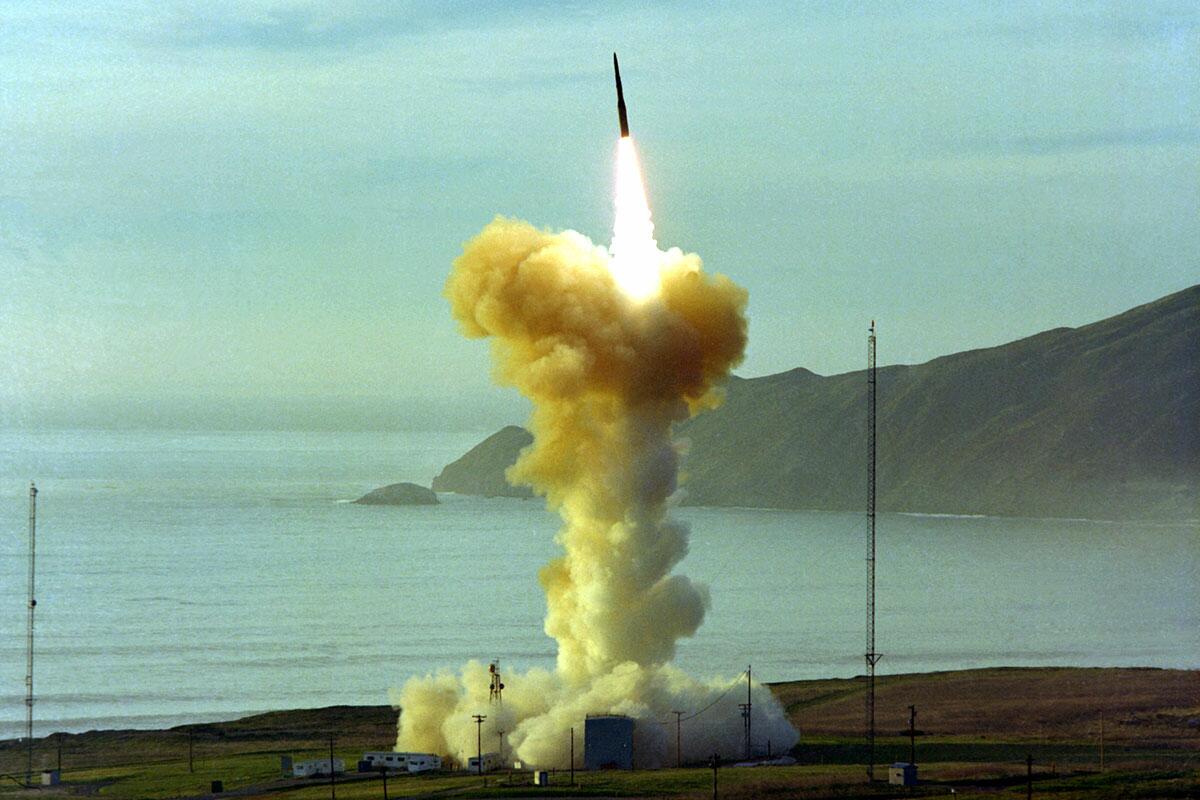
During a briefing on Wednesday afternoon, Pentagon spokesperson John Kirby told reporters that the scheduled test launch of a Minuteman III intercontinental ballistic missile (ICBM) had been postponed to show restraint. 

“In an effort to demonstrate that we have no intention in engaging in any actions that can be misunderstood or misconstrued, the Secretary of Defense has directed that our Minuteman III intercontinental ballistic missile test launch scheduled for this week to be postponed.

“We did not take this decision lightly, but instead to demonstrate that we are a responsible nuclear power,” Kirby said.

Kirby said the launch was scheduled for this coming weekend. He said the launch will not be performed due to high tensions with Russia over the invasion of Ukraine, where President Vladimir Putin declared Sunday that he was putting his nuclear forces into “special combat readiness.” 

The Minuteman III is part of the US strategic deterrent forces under the control of the Air Force Global Strike Command. 

Kirby also told reporters Russia’s heightened alert status is “unacceptable.” He noted a Russian convoy remains stalled outside of the Ukrainian capital of Kyiv due to resupply challenges. 

Tyler Durden
Wed, 03/02/2022 – 15:37

via ZeroHedge News https://ift.tt/5C4b310 Tyler Durden

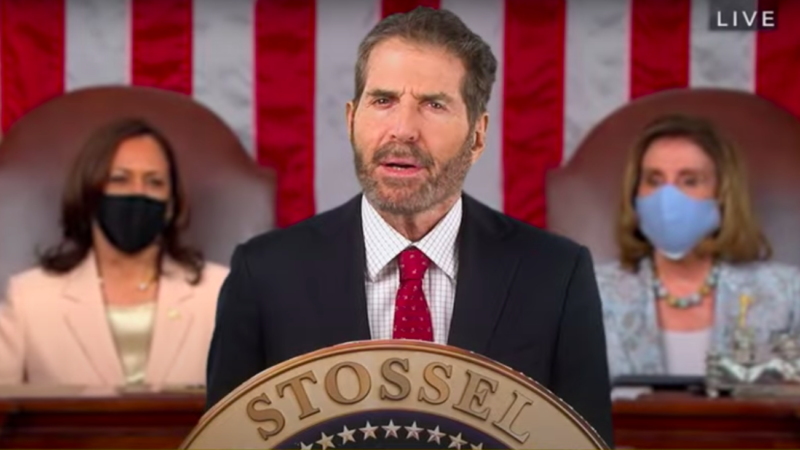
The Stossel State of the Union


Screen Shot 2022-03-02 at 11.48.37 AM

President Joe Biden just gave his State of the Union Address.

Here’s what I wish Biden said:

“Russia’s unwarranted invasion of Ukraine reminds us why it’s crucial that America’s military remains strong, and focused on defense, not distractions like gender equity.

“I stand with the people of Ukraine, and I will help them where I can, but America will not enter this war.

“My predecessors involved us in wars all over the world. Today, America posts soldiers in 80 countries: 25,000 in South Korea, 30,000 in Germany, 50,000 in Japan…

“I will bring those troops home. Those countries can pay for their own defense. I promise I will deploy America’s soldiers only if there is a direct threat to America’s interests.

“Avoiding war was one of the things my predecessor got right.

“Former President Donald Trump said he would ‘bring our troops back home.’ I followed through, and we now are out of Afghanistan. I didn’t plan the exit well, but at least we finally left.

“Turning to my governance at home, I have a lot to apologize for. Two years into the pandemic, I finally understand how much I got wrong.

“I said we wouldn’t mandate vaccines. My press secretary assured reporters, ‘That’s not the role of the federal government.’

“But just a few weeks later, I mandated vaccines for most employees.

“I said, ‘This is not about freedom or personal choice.’ But that’s nonsense. It was exactly about freedom and choice. Fortunately, the Supreme Court struck down my mandate.

“My government made endless mistakes.

“For a year, our Centers for Disease Control and Prevention maintained outdoor mask rules. That’s absurd. It’s almost impossible to contract COVID-19 outdoors. I think bureaucrats do things like that because they like bossing you around.

“I’ll stop that.

“Next, during the pandemic, both Trump and I liked sending you money. ‘I’m sure people will be very happy to get a big, fat beautiful check,’ said Trump. I said, ’85 percent of American households will have gotten a $1,400 rescue check.’

“But government has no money of its own, so that money wasn’t a gift; it’s taken from you. Then Washington, D.C., took a cut, and we handed out the rest like we’re Santa Claus.

“I’m not Santa. I promise, I’ll stop giving away all this money! The national debt is already an unsustainable $30 trillion. There’s no way I can pay that back. In fact, my reckless spending made the problem worse. I once even said, cluelessly, that my big spending would reduce inflation. Inflation then hit a 40-year high.

“But I’ve learned from my mistakes! Starting today, I will cut irresponsible spending.

“I will cut useless cabinet departments, like Housing and Urban Development, Labor, and Agriculture. Agriculture employs almost 100,000 people. Why? Independent farmers grow the food. I’ve been in Washington 50 years, and I still don’t know what most of my bureaucrats do.

“I’ll get rid of the Department of Education, too. Why does it even exist? Education is a local responsibility. It’s none of the federal government’s business! It’s none of my business.

“We don’t need a Commerce Department. After all, commerce just happens. I’ll get rid of those bureaucrats and sell the buildings.

“I’ll get rid of the Drug Enforcement Administration, too. We don’t need it because I’ll end the destructive War on Drugs. We all have a right to do what we want with our own bodies. Even if we didn’t, law enforcement is a local police responsibility.

“If we got rid of harmful laws and departments, we could focus on what the government should do: keep us safe and free.

“In closing, I pledge to follow our Constitution. It puts limits on what I can do. Trump once claimed that Article II gave him the power to do whatever he wanted. But that’s nonsense.

“We have limited powers.

“I can’t do whatever I want.

“And from now on, I promise I will do less.

“In fact, if I do my job right, you should barely know I’m here.”

COPYRIGHT 2022 BY JFS PRODUCTIONS INC.

The post The Stossel State of the Union appeared first on Reason.com.

from Latest https://ift.tt/D2fHFgm
via IFTTT

Bear Market Strategies – Are You Ready?

Bear Market Strategies – Are You Ready?

Authored by Michael Lebowitz via RealInvestmentAdvice.com,

The Federal Reserve and federal government have showered massive liquidity on the economy and markets to combat the pandemic. Their medicine worked. Economic activity rebounded quickly. Stocks and other assets soared in price, and in many cases, valuations now mirror those from 1999 and 1929. Fiscal spending is normalizing quickly, and the Fed is warning investors they are ready to remove stimulus. Such a reversal of monetary and fiscal liquidity does not guarantee a reversal of asset prices, but it means the odds of a bear market increase. As such, it’s time to start thinking about bear market strategies.   

Bear vs. Bull Market Strategies

Investors spend most of their time playing offense in bull markets. In other words, they select the best asset classes, assets, sectors, and securities they think will outperform the broader markets. In a bullish trend, the punishment for being wrong is often positive returns, albeit not as good as the market.

Bearish markets are infrequent but devastating to your wealth unless defensive strategies are employed. Some investors fail to react to bear markets, and it can take years to recoup losses. Others panic when markets have already given up substantial gains and lock in losses.

We prefer to play defense when markets are in bear markets and protect our wealth. Not only does such an approach limit losses, but it leaves us with cash when stock valuations are more reasonable.

Given the coming change in the monetary regime and extreme valuations, it is best to remind ourselves of bear market trading patterns and consider strategies to help retain our wealth in case the bear wakes from hibernation.

Benefits of Sidestepping Bear Markets

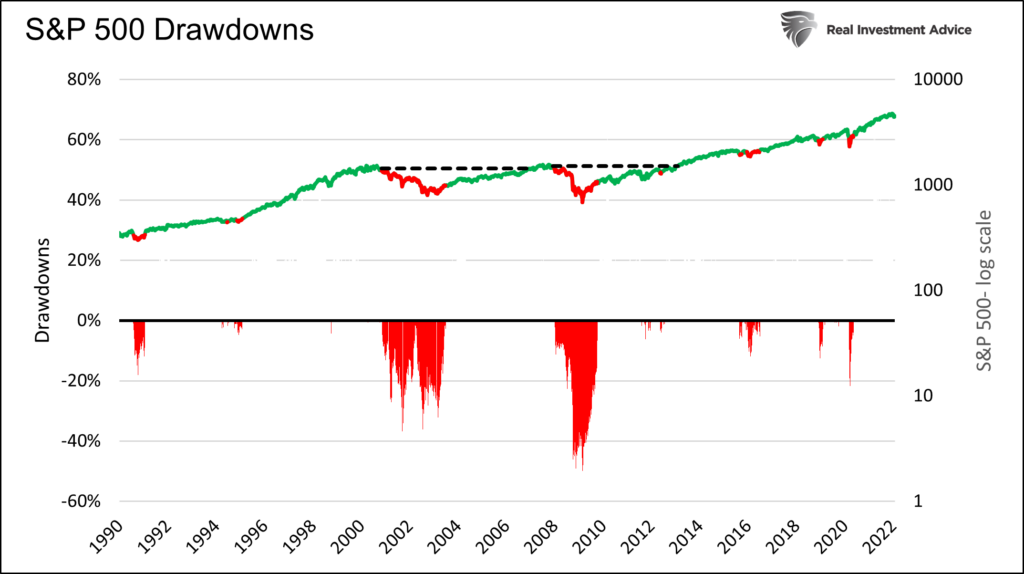
The graph below tracks the S&P 500 over the last 30 years. The red sections represent one-year periods where the S&P had a negative price return. As the graph shows, there have only been two prolonged bear markets in the last 30 years.

Of the last 30 years, only about 4.5 years were spent in the two aforementioned bear market declines. Yet, investors spent over a third of the period recovering from those losses. The dotted lines show it took six years after the tech crash and five years after the financial crisis to regain prior highs.

Bear vs. Bull Markets

Bear markets tend to be short-lived but are laden with significant up and down price movements. Bull markets last much longer and offer lower levels of volatility. Since 1990, the average annualized realized volatility for the S&P 500 was 14.7%. During the two bear markets of 2000 and 2008, it averaged 23.9%. Through the remaining periods, it averaged 13.2%.

The histograms below show the realized volatility profiles of bull and bear markets since 1990. 75% of the daily realized volatility readings in a bull market are 16% or less. 70% of realized volatility readings in a bear market are 16% or higher. Almost a third of the bear market’s readings are above 28%.

It is worth examining price movements during the two bear markets to understand their distinctive patterns better so we can develop potential strategies.

2000

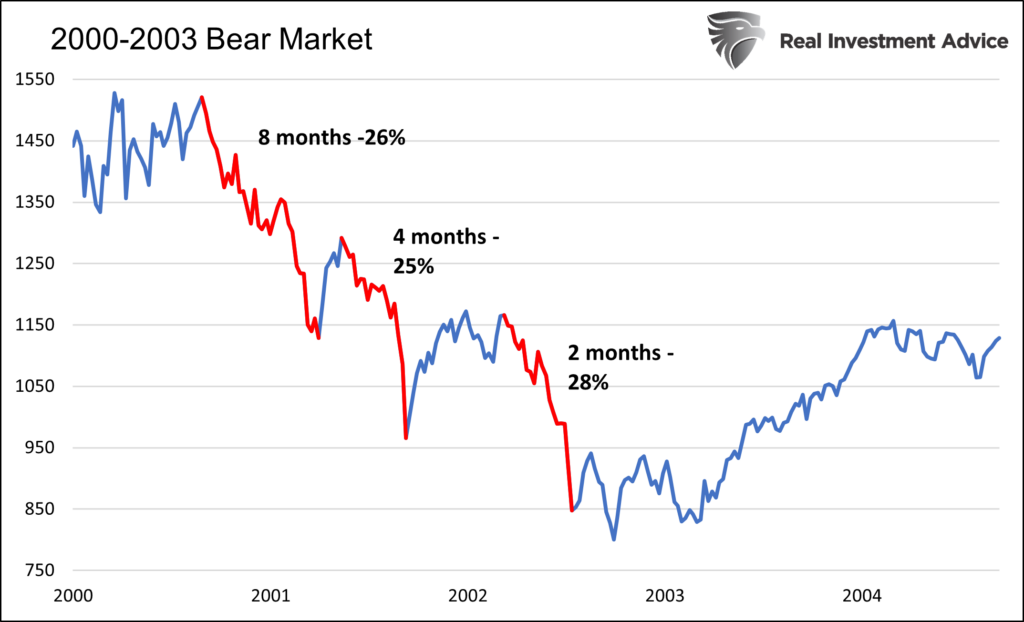
The graph below shows the bear market of 2000 to 2003. As highlighted in red, the bulk of the move lower occurred in three large chunks. The first decline saw the market lose 26% over eight months. The second sell-off had a similar loss but in half the time. The third and final decline was also similar in percentage terms but occurred again in half the time of the second one.
Equally important, there were significant rallies during the three-year period. After the first significant decline, the S&P 500 rallied 14% in a little more than a month. The second decline was followed by a 26% rally over two and half months. These bear market rallies offered a sense of relief to investors and hope the downslide was over. They both proved fatal to investors that bought the dip.

The graph below shows that the NASDAQ gave up 83% from top to bottom, but within the decline were two rallies of over 50% and three other significant rallies.

In bull markets, investors tend to buy the dips (BTD). In bear markets, we advise selling the rips (STR)

2008

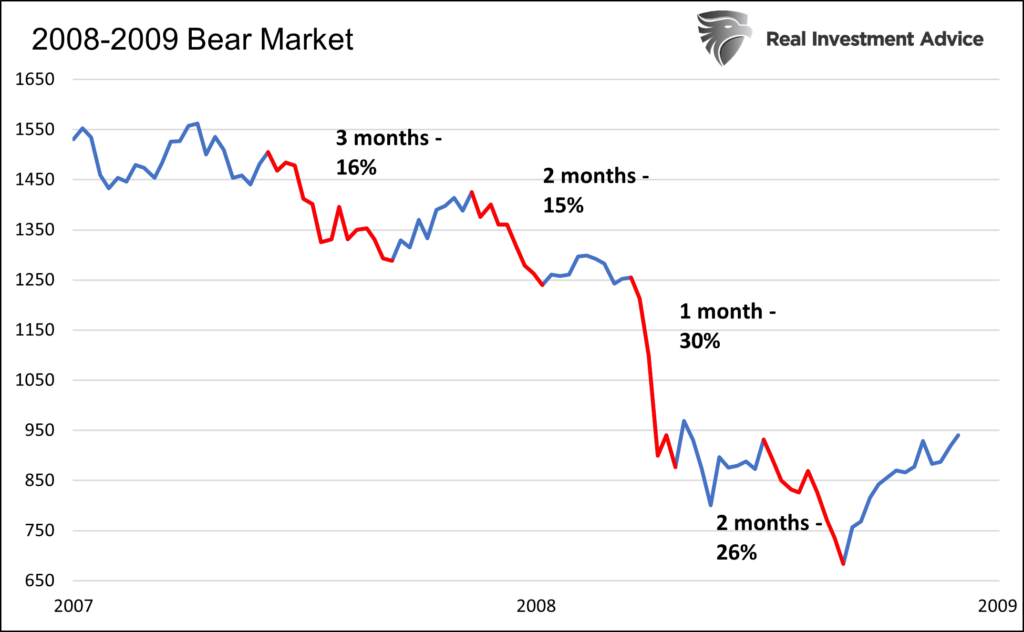
The bear market of 2008-2009 was different than 2000-2003, but it offers similar lessons. As shown below, the decline happened in four significant but quick moves. As in 2000-2003, each move lower happened in successively briefer periods; however, the final leg lower was slightly extended versus the prior one. Unlike 2000-03, the rallies between sell-offs were not impressive.

The Math of Gains and Losses

As you think about bear market rallies and the graphs above, it’s worth a quick reminder that percentage gains and losses are not comparable. The table below shows the percentage gain required to offset a loss. It serves as a reminder that bear market rallies can post large gains, but they pale compared to lesser percentage losses.

Trading a Bear Market

Volatility and emotions make bear market trading frustrating and complicated. As we show, bear market declines happen in short and volatile periods. Further, those periods tend to shrink in duration as the bear market continues. Such activity is logical, as the initial transition from a bull to a bear market often occurs when investors are bullish with little fear. Those unsuspecting of what is coming, provide a steady bid in such a circumstance. They think they are buying stocks at a discount.

Once a bear market establishes itself, bullish investors tend to become less zealous. They lick their wounds, become more fearful, and are not as quick to buy dips. Therefore, subsequent downdrafts happen in shorter time frames. 

Bear market rallies can be intense. Such high volatility makes it difficult to manage our emotions. Should we be greedy or fearful? For more on understanding and tempering our trading biases, please read our article Fear and Greed: An Investors Two Worst Enemies.

In a bear market, technical analysis becomes a vital tool. However, oversold markets can stay oversold longer than is typical in bull markets. They can also reach more extreme oversold levels than we are accustomed to. Lastly, oversold conditions may not imply a strong rally but merely a consolidation before another step lower.

Summary

“It’s always very difficult in a bear market, stocks don’t trade with rhythm you get these vicious rallies, you get squeezed out of shorts, people play all sorts of games” -Stanley Druckenmiller

Markets spend a large majority of their time in bullish trends. As such, investors spend most of their time playing offense and choosing assets and sectors that will outperform the market. Long bull markets can make us complacent and forgetting of how to play defense.

Defense is complex, as it bucks our predisposition to be fully invested. Volatile markets also exaggerate our fear and greed emotions that drive irrational behavior.

In a bear market, we recommend relying on technical studies but understanding the fundamental backdrop. Successfully dodging a bear market with infrequently used strategies allows one to buy stocks at deep discounts when others are selling. It may not be comfortable fighting the fearful herd, but history has proven those rare periods are incredibly beneficial to your wealth.

As Warren Buffett once said- “be fearful when others are greedy and greedy when others are fearful.”

Tyler Durden
Wed, 03/02/2022 – 15:15

via ZeroHedge News https://ift.tt/KENOewI Tyler Durden

The Stossel State of the Union


Screen Shot 2022-03-02 at 11.48.37 AM

President Joe Biden just gave his State of the Union Address.

Here’s what I wish Biden said:

“Russia’s unwarranted invasion of Ukraine reminds us why it’s crucial that America’s military remains strong, and focused on defense, not distractions like gender equity.

“I stand with the people of Ukraine, and I will help them where I can, but America will not enter this war.

“My predecessors involved us in wars all over the world. Today, America posts soldiers in 80 countries: 25,000 in South Korea, 30,000 in Germany, 50,000 in Japan…

“I will bring those troops home. Those countries can pay for their own defense. I promise I will deploy America’s soldiers only if there is a direct threat to America’s interests.

“Avoiding war was one of the things my predecessor got right.

“Former President Donald Trump said he would ‘bring our troops back home.’ I followed through, and we now are out of Afghanistan. I didn’t plan the exit well, but at least we finally left.

“Turning to my governance at home, I have a lot to apologize for. Two years into the pandemic, I finally understand how much I got wrong.

“I said we wouldn’t mandate vaccines. My press secretary assured reporters, ‘That’s not the role of the federal government.’

“But just a few weeks later, I mandated vaccines for most employees.

“I said, ‘This is not about freedom or personal choice.’ But that’s nonsense. It was exactly about freedom and choice. Fortunately, the Supreme Court struck down my mandate.

“My government made endless mistakes.

“For a year, our Centers for Disease Control and Prevention maintained outdoor mask rules. That’s absurd. It’s almost impossible to contract COVID-19 outdoors. I think bureaucrats do things like that because they like bossing you around.

“I’ll stop that.

“Next, during the pandemic, both Trump and I liked sending you money. ‘I’m sure people will be very happy to get a big, fat beautiful check,’ said Trump. I said, ’85 percent of American households will have gotten a $1,400 rescue check.’

“But government has no money of its own, so that money wasn’t a gift; it’s taken from you. Then Washington, D.C., took a cut, and we handed out the rest like we’re Santa Claus.

“I’m not Santa. I promise, I’ll stop giving away all this money! The national debt is already an unsustainable $30 trillion. There’s no way I can pay that back. In fact, my reckless spending made the problem worse. I once even said, cluelessly, that my big spending would reduce inflation. Inflation then hit a 40-year high.

“But I’ve learned from my mistakes! Starting today, I will cut irresponsible spending.

“I will cut useless cabinet departments, like Housing and Urban Development, Labor, and Agriculture. Agriculture employs almost 100,000 people. Why? Independent farmers grow the food. I’ve been in Washington 50 years, and I still don’t know what most of my bureaucrats do.

“I’ll get rid of the Department of Education, too. Why does it even exist? Education is a local responsibility. It’s none of the federal government’s business! It’s none of my business.

“We don’t need a Commerce Department. After all, commerce just happens. I’ll get rid of those bureaucrats and sell the buildings.

“I’ll get rid of the Drug Enforcement Administration, too. We don’t need it because I’ll end the destructive War on Drugs. We all have a right to do what we want with our own bodies. Even if we didn’t, law enforcement is a local police responsibility.

“If we got rid of harmful laws and departments, we could focus on what the government should do: keep us safe and free.

“In closing, I pledge to follow our Constitution. It puts limits on what I can do. Trump once claimed that Article II gave him the power to do whatever he wanted. But that’s nonsense.

“We have limited powers.

“I can’t do whatever I want.

“And from now on, I promise I will do less.

“In fact, if I do my job right, you should barely know I’m here.”

COPYRIGHT 2022 BY JFS PRODUCTIONS INC.

The post The Stossel State of the Union appeared first on Reason.com.

from Latest https://ift.tt/D2fHFgm
via IFTTT

China Won’t Join Russia Sanctions, Banking Regulator Warns

China Won’t Join Russia Sanctions, Banking Regulator Warns

After urging ceasefire talks between Ukraine and Russia, China on Wednesday announced that it would not join the West in imposing sanctions on Russia.

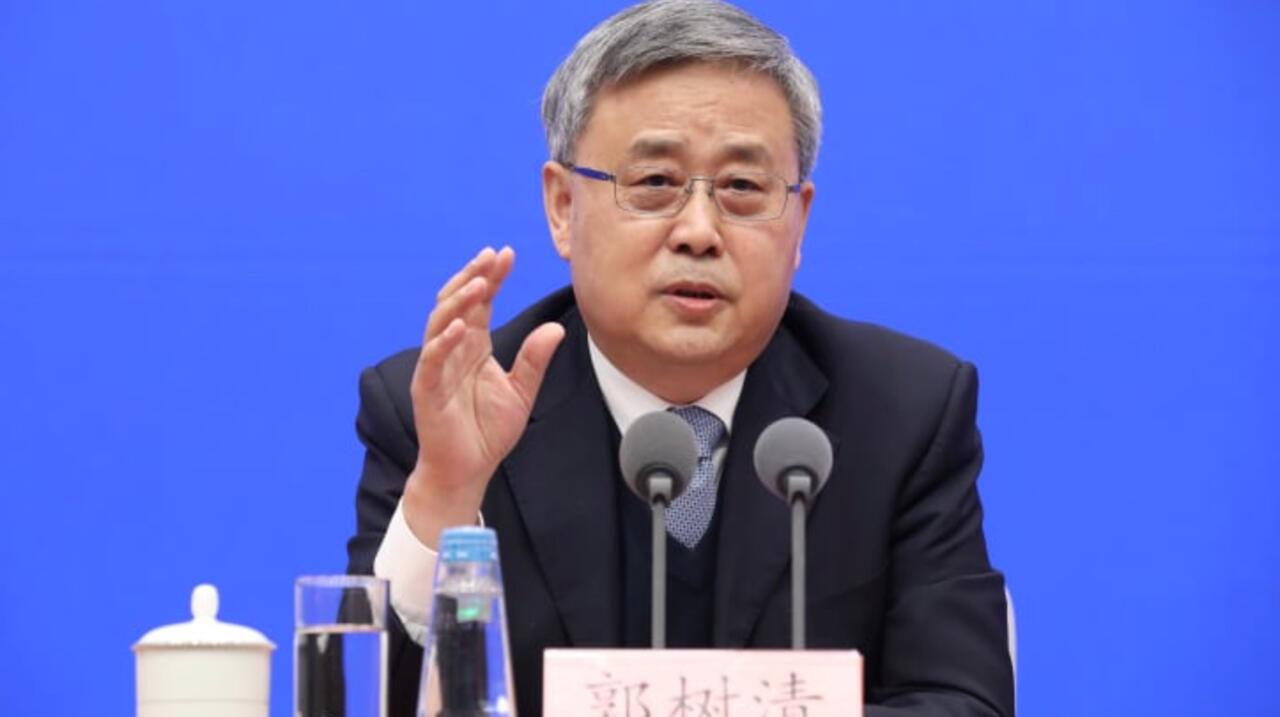
Guo Shuqing

The announcement was made by China’s banking and insurance regulator Guo Shuqing during a press briefing on Wednesday.

“Everyone is watching recent military conflict, or war, between Russia and Ukraine,” Guo Shuqing, chairman of the China Banking and Insurance Regulatory Commission, said during a press conference in Mandarin.

“China’s position has been stated clearly by the Ministry of Foreign Affairs. Our international policies are consistent.” “Regarding financial sanctions, we do not support that,” said Guo, noting particular opposition to “unilateral” sanctions, which he said don’t effectively address problems. “China won’t join such sanctions.“

Guo also happens to be the CCP’s secretary of the People’s Bank of China, the PRC’s central bank. He added on Wednesday that he hopes all sides will maintain ‘normal economic exchanges’ and insisted that the sanctions have had no apparent impact on China so far.

He’s not the only CCP official to rebuke the West over its treatment of both Russia and China during the Ukraine crisis.

Since the start of the conflict, Beijing has insisted on promoting dialogue between the two sides. As we noted yesterday, Beijing has claimed that it’s “extremely concerned” about civilian casualties in Ukraine. Ukraine, meanwhile, has begged China to pressure Russia to stop the war.

However, so far, China’s Ministry of Foreign Affairs has refused to even characterize Russia’s attack on Ukraine an invasion.

Instead, Beijing has chosen to promote negotiations as China tries to distance itself from Russia than was portrayed in early February during a high-profile meeting between Chinese President Xi Jinping and Russian President Vladimir Putin.

The US, UK and Europe have slapped onerous sanctions on Russia, but their efforts have so far failed to target Russia’s energy business, which is responsible for exporting much of the oil and natural gas that European nations like Germany use to provide heat to their populations.

As the death toll mounts, The UN human rights office said Tuesday that at least 136 Ukrainian civilians had been killed by Russian forces, including 13 children.

Tyler Durden
Wed, 03/02/2022 – 14:55

via ZeroHedge News https://ift.tt/Kes4RgN Tyler Durden

Lavrov Says Third World War Would Be “Nuclear” & “Destructive”

Lavrov Says Third World War Would Be “Nuclear” & “Destructive”

Authored by Paul Joseph Watson via Summit News,

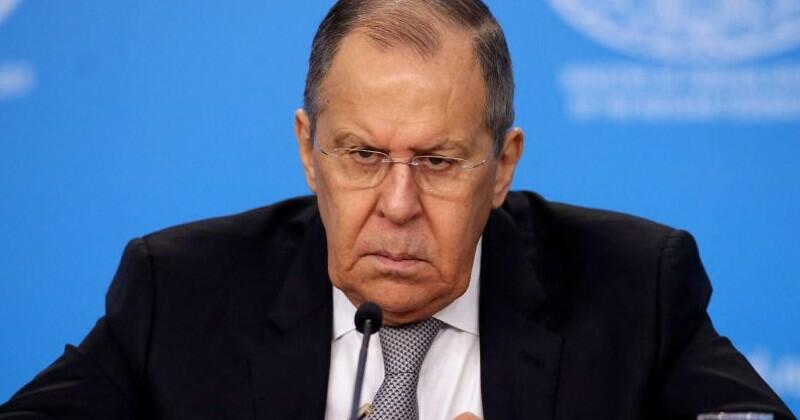
Russian Foreign Minister Sergei Lavrov said today that if a third World War were to take place, it would be “nuclear” and “destructive.”

Lavrov made the comments after an escalation in tensions following Russia’s invasion of Ukraine that led to Moscow putting its nuclear forces on high alert.

The Foreign Minister said that Russia would face “real danger” if Kiev were allowed to obtain nuclear weapons.

As we previously highlighted, Russian TV host Dmitry Kiselyov , dubbed “Putin’s chief propagandist,” previously bragged about how “our submarines can shoot more than 500 nuclear warheads.”

“This would guarantee destruction of the USA, and all other NATO countries,” he added.

Some voices have been lobbying NATO powers to impose a no fly zone over Ukraine, a move that would inevitably lead to Russian planes being shot down and risk the onset of World War III.

Undeterred by such a risk, journalist Daria Kaleniuk confronted British Prime Minister Boris Johnson on the issue before bursting out into tears.

“My family members, my team members, are saying we are crying, we don’t know where to run. This is what is happening, Prime Minister,” said an emotional Kaleniuk after demanding a no fly zone.

It subsequently emerged that Kaleniuk was actually an activist who was part of the Global Young Leaders program and had previously featured in a Joe Biden campaign video.

*  *  *

Brand new merch now available! Get it at https://www.pjwshop.com/

In the age of mass Silicon Valley censorship It is crucial that we stay in touch. I need you to sign up for my free newsletter here. Support my sponsor – Turbo Force – a supercharged boost of clean energy without the comedown. Get early access, exclusive content and behinds the scenes stuff by following me on Locals.

Tyler Durden
Wed, 03/02/2022 – 14:36

via ZeroHedge News https://ift.tt/4oHr3fI Tyler Durden

Beige Book Finds Spending Slowed, Inflation Rose In March As Shortages Increased

Beige Book Finds Spending Slowed, Inflation Rose In March As Shortages Increased

With Powell telling Congress that a 25 bps rate hike in two weeks is in the bag, moments ago the latest Fed Beige Book validated the cheerful economic outlook, noting that based on information collected before February 18, 2022, US economy activity expanded at “a modest to moderate pace since mid-January.” Of course, all this will change now following the Ukraine war but we’ll cross that bridge when the next Beige Book is released on April 20.

While covid is now a distant memory with mandates falling left and right as the US has a new crisis to obsess over, many districts reported that the surge in COVID-19 cases temporarily disrupted business activity as firms faced heighted absenteeism. Some Districts attributed a temporary weakening in demand in the hospitality sector to the rise in cases. Severe winter weather was also cited as disrupting activity. As a result, consumer spending was generally weaker than in the prior report.

Some other highlights from the report:

  • Reports on auto sales were mixed, while manufacturing activity continued to grow at a modest pace.
  • All Districts noted that supply chain issues and low inventories continued to restrain growth, particularly in the construction sector.
  • Reports from banking contacts indicated some weakening of financial conditions, although loan demand was generally unchanged.
  • Demand for residential real estate was generally strong, although many Districts reported no change in home sales due to seasonal trends and low inventories.
  • Agriculture reports were somewhat mixed, as some Districts experienced difficult growing conditions while others benefited from higher crop prices.
  • Reports on the energy sector indicated modest growth.

That said, the overall economic outlook over the next six months remained stable and generally optimistic, although reports highlighted an elevated degree of uncertainty.

Looking at labor markets, the Fed notes that employment increased at a modest to moderate pace. Widespread strong demand for workers remained hampered by equally widespread reports of worker scarcity, though some Districts reported scattered signs of improving labor supply. Many firms had difficulty maintaining their staffing levels due to high turnover; this challenge was exacerbated by COVID-19 disruptions in January, though workers and firms recovered more quickly than during previous waves. Firms continued to increase compensation and introduce workplace flexibility to attract workers—especially in historically low-wage positions—with mixed success. Contacts reported they expect the tight labor market and consequent strong wage growth to continue, though a few Districts reported signs of wage growth moderating.

Inflation, of course, remains the big problem, with prices charged to customers increasing at a robust pace across the nation. A few Districts reported an acceleration in prices. Rising input costs were cited as a primary contributing factor across a broad swath of industries, with elevated transport costs particularly significant. Labor cost increases and ongoing materials shortages also contributed to higher input prices. Firms reported an increased ability to pass on prices to consumers; in most cases, demand has remained strong despite price increases. Firms reported they expect additional price increases over the next several months as they continue to pass on input cost increases.

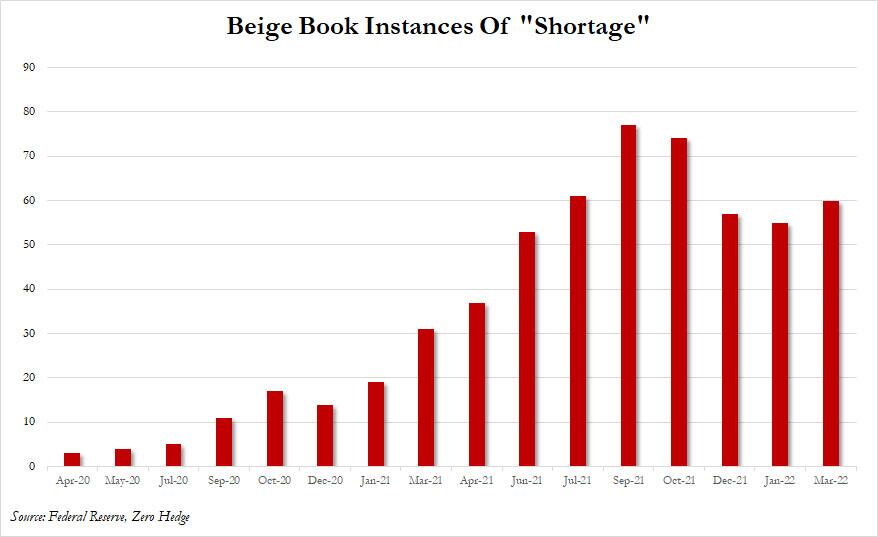
After several months of improvement (i.e. reduction) in mentions of shortages, the latest Beige Book saw an modest increase, rising from 55 in January to 60 in March.

Here are some examples:

  • Multifamily construction increased amid rising rents, but supply and labor shortages caused some delays
  • Worker shortages persist across a wide range of industries and occupations. Businesses in most major industry sectors plan to add staff, on net, in the months ahead.
  • Businesses noted shortages and exceptionally high costs of freight, as well as a wide range of supplies
  • The microchip shortage, which has kept inventories low, is not expected to abate until the second half of the year
  • Construction sector contacts expressed a good deal more optimism than in recent months about the general outlook, despite the ongoing challenge of elevated materials prices, supply bottlenecks, and shortages.
  •  A few firms indicated it had become slightly easier to hire, but for the most part reports of labor shortages remained widespread

Finally, here are the highlights by Federal Reserve District

  • Boston: Business activity expanded at a slight to modest pace. Labor demand remained very strong, but employment appeared roughly stable. Upward wage pressures remained substantial but eased for some positions. Prices increased moderately. Contacts were optimistic for spring but noted downside risks tied to inflation and supply chain disruptions.
  • New York: Growth stalled in the latest reporting period, constrained by ongoing supply disruptions, worker shortages, and the Omicron outbreak. Moreover, unusually high absenteeism made it difficult for firms to maintain adequate staff. Businesses continued to report substantial increases in selling prices, input prices, and wages. Despite these challenges, contacts remained optimistic about the near-term outlook.
  • Philadelphia: Business activity continued to grow modestly during the current Beige Book period, and some sectors remained below pre-pandemic levels. The surge in COVID-19 cases from the Omicron variant caused significant business disruptions before easing. The labor market remained tight with modest growth, while wages and prices grew sharply. However, there were signs that wage and price increases may be plateauing.
  • Cleveland: The District economy grew at a more modest pace as the Omicron wave temporarily dampened activity in high-contact services. Employment rose moderately. Labor shortages and supply chain challenges resulted in widespread increases in wages, nonlabor costs, and selling prices. Firms expected a solid year for sales, but they were concerned that labor scarcity and supply chain difficulties would persist.
  • Richmond: The regional economy has grown moderately since our previous report. Firms across a variety of sectors reported modest to strong growth in demand, but many struggled to meet that demand due to shortages of labor and persistent supply chain issues. In many cases, higher costs to businesses were passed through to customers, leading to a continued elevated rate of price growth.
  • Atlanta: Economic activity expanded moderately. Labor markets remained tight and wage pressures grew. Nonlabor costs rose. Retail sales were strong. Leisure travel softened somewhat. Housing demand was robust. Commercial real estate conditions were mixed. Manufacturing activity was robust. Banking conditions were stable.
  • Chicago: Economic activity increased moderately. Employment increased strongly; consumer spending, business spending, and manufacturing grew modestly; and construction and real estate activity was up slightly. Wages and prices rose rapidly, while financial conditions deteriorated some. Expectations for 2022 agriculture income moved up.
  • St. Louis: Economic conditions have remained unchanged since our previous report. Employers reported robust wage increases and continued difficulties finding workers. Firms reported improved ability to pass on price increases and anticipate continued increases. The Omicron COVID-19 variant contributed to decreased activity in the transportation and hospitality sectors.
  • Minneapolis: The region’s economy grew moderately over the first weeks of the year. Price pressures remained strong. Though employment increased overall, many firms reported decreased staffing levels due to higher turnover and recruitment difficulty. Contacts generally felt that wage acceleration was driven by tight labor markets rather than inflation expectations. New entrepreneurs reported quitting their outside jobs or cutting hours.
  • Kansas City: The Tenth District economy expanded at a modest pace in the first two months of the year. The temporary surge in COVID-19 cases slowed spending and hours worked in the leisure and hospitality sector, but activity rebounded quickly and grew steadily across other services and manufacturing sectors. Prices grew at a robust rate, and nearly all contacts reported they expect cost pressures to persist throughout the year.
  • Dallas: Expansion in the District economy moderated, with the COVID-19 surge exacerbating labor and supply chain shortages and disrupting demand in certain sectors. Employment rose fairly robustly, and wage growth pushed to new highs. Supply chain issues continued to drive up costs, and prices rose at a rapid clip. Outlooks remained positive, though uncertainty spiked.
  • San Francisco: Economic activity strengthened moderately over the reporting period. Employment grew further while overall conditions in the labor market remained tight. Wages and price levels climbed notably. Retail sales increased strongly, while conditions in the consumer and business services sectors picked up following the peak of the Omicron wave. Lending activity was steady.

The full report can be found here.

Tyler Durden
Wed, 03/02/2022 – 14:23

via ZeroHedge News https://ift.tt/o5GWfNc Tyler Durden

Texas Sued As State Starts Investigating Parents of Trans Children for ‘Child Abuse’


transprotest_1161x653

The American Civil Liberties Union has filed suit in Texas to prevent government officials from investigating parents for child abuse if they seek medical treatment for their transgender children.

Last week Republican Gov. Greg Abbott, responding to a memo from Republican Attorney General Ken Paxton, ordered the state’s Department of Family and Protective Services (DFPS) to launch these investigations. Paxton argued in his memo that any sort of medical treatment of a trans minor constituted child abuse because some treatments may interfere with the child’s ability to reproduce.

However, this threat didn’t just cover gender reassignment surgery—something that normally doesn’t happen to minors anyway—but also hormonal treatments that block the impacts of puberty on a trans teen—something that doesn’t sterilize them and is reversible. The order also came with a massive threat to any government official or health worker inclined to look the other way: They could also be prosecuted if they knew a parent was pursuing medical treatment for a trans child and did not report them to the authorities.

While this might have looked like the latest loudmouthed culture war fight—the memo doesn’t change the state’s statutory definition of child abuse—the Texas DFPS has begun investigating parents of trans kids. The first target was one of their own. The New York Times reports that the DFPS put one of its own staff members on leave as the agency investigates her over the medical treatment her 16-year-old trans daughter is receiving. The agency has attempted to demand the mother (who is not identified) provide the teen’s medical records. She’s refusing, and now with the ACLU’s help, she’s suing to attempt to stop both the investigation and enforcement of Abbott’s order.

The ACLU’s lawsuit, filed Tuesday in the District Court of Travis County, Texas, after spending pages explaining the process by which this banned treatment is recommended by medical professionals, zeros in on a position libertarians can appreciate: The governor, attorney general, and the DFPS do not have the authority to do any of this under Texas’ own laws. The parent and child (both listed as Does) are joined as plaintiffs in the lawsuit by Megan Mooney, a psychologist who treats trans patients and is legally required by Texas law to report actual child abuse to the state.

Texas lawmakers considered a bill just last year, S.B. 1646, that would have amended the state’s statutory definition of “child abuse” to include medical treatments for trans youths. The bill didn’t pass. The ACLU notes that after the bill failed, Abbott went on a radio to explain that he had a “solution” to this alleged problem. That solution was for the attorney general’s office to administratively declare that this treatment could count as child abuse anyway, deliberately ignoring all the professional medical organizations who say otherwise (including the Texas Pediatric Society).

This decision, according to the ACLU, puts Abbott, Paxton, and the DFPS at odds with Texas’ Administrative Procedure Act, which controls the process by which Texas agencies implement new rules. The ACLU argues that the decision to start investigating parents of trans kids as possible abusers obviously constitutes a change of rules, but it didn’t go through the process indicated by law. In short, nobody involved in this decision has the authority to just declare any of this.

“Every major medical organization in the United States considers the treatment now effectively banned and criminalized by DFPS to be medically necessary,” the lawsuit argues. “Such a radical disregard of medical science and the medical needs of a subset of minors in Texas cannot be squared with the agency’s authority by prescribed by Statute.”

The ACLU is asking the court to stop the DFPS from using Abbot’s and Paxton’s memos as justification to investigate parents of trans kids for child abuse over medical treatment; a judgement that the policy violates the state’s Administrative Procedure Act; a declaration that Abbott and DFPS have acted outside of their constitutional authority; and potentially a permanent injunction.

Critics of helping minors transition say parents are rushing into major decisions without a full understanding of the risks. Whether that’s true, the solution is not to put politicians and the government in control of what constitutes legitimate medical treatment. We’ve just endured two years of bizarre and seemingly arbitrary COVID-19 public health rules, many of which were not supported by science. Conservatives in particular should be very aware by now that politics is a poor mechanism for determining proper medical treatment. Politicians don’t decide what medical treatments work or don’t work. They decide which ones are legal or forbidden.

The ACLU includes in their lawsuit an appeal to parents’ rights, something that Abbott claims to support:

By, in effect, cutting off the ability of parents to treat their minor adolescent children in accordance with doctor-recommended and clinically appropriate care, the agency’s new rule infringes on the Does’ parental rights. The agency’s new rule substitutes parents’ judgment as to what medical care is in the best interests of their children for the judgment of the government.

But it turns out that in this case, throwing the parents of trans teens under the bus is a big political winner, according to Abbott’s political strategist. Don’t trust politicians in general, but especially don’t trust politicians who only believe in certain parents’ rights and not others.

The post Texas Sued As State Starts Investigating Parents of Trans Children for 'Child Abuse' appeared first on Reason.com.

from Latest https://ift.tt/cCGia2R
via IFTTT