Escobar: Follow The Money – How Russia Will Bypass Western Economic Warfare

Escobar: Follow The Money – How Russia Will Bypass Western Economic Warfare

Authored by Pepe Escobar via The Cradle,

The US and EU are over-reaching on Russian sanctions. The end result could be the de-dollarization of the global economy and massive commodity shortages worldwide…
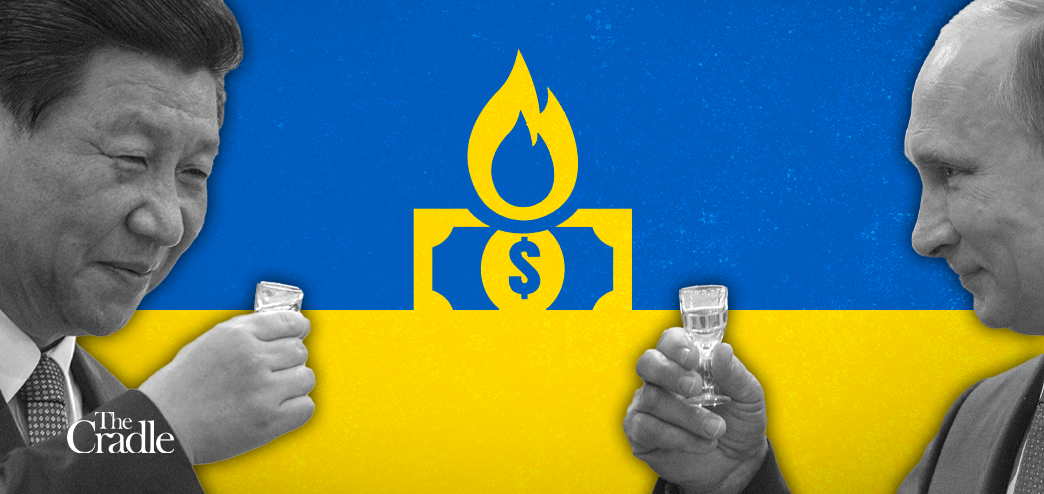
So a congregation of NATO’s top brass ensconced in their echo chambers target the Russian Central Bank with sanctions and expect what? Cookies?

What they got instead was Russia’s deterrence forces bumped up to “a special regime of duty” – which means the Northern and Pacific fleets, the Long-Range Aviation Command, strategic bombers and the entire Russian nuclear apparatus on maximum alert.

One Pentagon general very quickly did the basic math on that, and mere minutes later, a Ukrainian delegation was dispatched to conduct negotiations with Russia in an undisclosed location in Gomel, Belarus.

Meanwhile, in the vassal realms, the German government was busy “setting limits to warmongers like Putin” – quite a rich undertaking considering that Berlin never set any such limits for western warmongers who bombed Yugoslavia, invaded Iraq, or destroyed Libya in complete violation of international law.

While openly proclaiming their desire to “stop the development of Russian industry,” damage its economy, and “ruin Russia” – echoing American edicts on Iraq, Iran, Syria, Libya, Cuba, Venezuela and others in the Global South – the Germans could not possibly recognize a new categorical imperative.

They were finally liberated from their WWII culpability complex by none other than Russian President Vladimir Putin. Germany is finally free to support and weaponize neo-Nazis out in the open all over again – now of the Ukrainian Azov battalion variety.

To get the hang of how these NATO sanctions will “ruin Russia,” I asked for the succinct analysis of one of the most competent economic minds on the planet, Michael Hudson, author, among others, of a revised edition of the must-read Super-Imperialism: The Economic Strategy of American Empire.

Hudson remarked how he is “simply numbed over the near-atomic escalation of the US.” On the confiscation of Russian foreign reserves and cut-off from SWIFT, the main point is “it will take some time for Russia to put in a new system, with China. The result will end dollarization for good, as countries threatened with ‘democracy’ or displaying diplomatic independence will be afraid to use US banks.”

This, Hudson says, leads us to “the great question: whether Europe and the Dollar Bloc can buy Russian raw materials – cobalt, palladium, etc, and whether China will join Russia in a minerals boycott.”

Hudson is adamant that “Russia’s Central Bank, of course, has foreign bank assets in order to intervene in exchange markets to defend its currency from fluctuations. The ruble has plunged. There will be new exchange rates. Yet it’s up to Russia to decide whether to sell its wheat to West Asia, that needs it; or to stop selling gas to Europe via Ukraine, now that the US can grab it.”

About the possible introduction of a new Russia-China payment system bypassing SWIFT, and combining the Russian SPFS (System for Transfer of Financial Messages) with the Chinese CIPS (Cross-Border Interbank Payment System), Hudson has no doubts “the Russian-China system will be implemented. The Global South will seek to join and at the same time keep SWIFT – moving their reserves into the new system.”

I’m going to de-dollarize myself

So the US itself, in another massive strategic blunder, will speed up de-dollarization. As the managing director of Bocom International Hong Hao told the Global Times, with energy trade between Europe and Russia de-dollarized, “that will be the beginning of the disintegration of dollar hegemony.”

It’s a refrain the US administration was quietly hearing last week from some of its own largest multinational banks, including notables like JPMorgan and Citigroup.

Bloomberg article sums up their collective fears:

“Booting Russia from the critical global system – which handles 42 million messages a day and serves as a lifeline to some of the world’s biggest financial institutions – could backfire, sending inflation higher, pushing Russia closer to China, and shielding financial transactions from scrutiny by the west. It might also encourage the development of a SWIFT alternative that could eventually damage the supremacy of the US dollar.”

Those with IQs over 50 in the European Union (EU) must have understood that Russia simply could not be totally excluded from SWIFT, but maybe only a few of its banks: after all, European traders depend on Russian energy.

From Moscow’s point of view, that’s a minor issue. A number of Russian banks are already connected to China’s CIPS system. For instance, if someone wants to buy Russian oil and gas with CIPS, payment must be in the Chinese yuan currency. CIPS is independent of SWIFT.

Additionally, Moscow already linked its SPFS payment system not only to China but also to India and member nations of the Eurasia Economic Union (EAEU). SPFS already links to approximately 400 banks.

With more Russian companies using SPFS and CIPS, even before they merge, and other maneuvers to bypass SWIFT, such as barter trade – largely used by sanctioned Iran – and agent banks, Russia could make up for at least 50 percent in trade losses.

The key fact is that the flight from the US-dominated western financial system is now irreversible across Eurasia – and that will proceed in tandem with the internationalization of the yuan.

Russia has its own bag of tricks

Meanwhile, we’re not even talking yet about Russian retaliation for these sanctions. Former President Dmitry Medvedev already gave a hint: everything, from exiting all nuclear arms deals with the US to freezing the assets of western companies in Russia, is on the table.

So what does the “Empire of Lies” want? (Putin terminology, on Monday’s meeting in Moscow to discuss the response to sanctions.)

In an essay published this morning, deliciously titled America Defeats Germany for the Third Time in a Century: the MIC, OGAM and FIRE conquer NATO, Michael Hudson makes a series of crucial points, starting with how “NATO has become Europe’s foreign policy-making body, even to the point of dominating domestic economic interests.”

He outlines the three oligarchies in control of US foreign policy:

  • First is the military-industrial complex, which Ray McGovern memorably coined as MICIMATT (military industrial Congressional intelligence media academia think tank). Hudson defines their economy base as “monopoly rent, obtained above all from its arms sales to NATO, to West Asian oil exporters and to other countries with a balance-of-payments surplus.”

  • Second is the oil and gas sector, joined by mining (OGAM). Their aim is “to maximize the price of energy and raw materials so as to maximize natural resource rent. Monopolizing the Dollar Area’s oil market and isolating it from Russian oil and gas has been a major US priority for over a year now, as the Nord Stream 2 pipeline from Russia to Germany threatened to link the western European and Russian economies together.”

  • Third is the “symbiotic” Finance, Insurance and Real Estate (FIRE) sector, which Hudson defines as “the counterpart to Europe’s old post-feudal landed aristocracy living by land rents.”

As he describes these three rentier sectors that completely dominate post-industrial finance capitalism at the heart of the western system, Hudson notes how “Wall Street always has been closely merged with the oil and gas industry (namely, the Citigroup and Chase Manhattan banking conglomerates).”

Hudson shows how “the most pressing US strategic aim of NATO confrontation with Russia is soaring oil and gas prices. In addition to creating profits and stock market gains for US companies, higher energy prices will take much of the steam out of the German economy.”

He warns how food prices will rise “headed by wheat.” (Russia and Ukraine account for 25 percent of world wheat exports.) From a Global South perspective, that’s a disaster: “This will squeeze many West Asian and Global South food-deficient countries, worsening their balance of payments and threatening foreign debt defaults.”

As for blocking Russian raw materials exports, “this threatens to cause breaks in supply chains for key materials, including cobalt, palladium, nickel, aluminum.”

And that leads us, once again, to the heart of the matter: “The long-term dream of the US new Cold Warriors is to break up Russia, or at least to restore its managerial kleptocracy seeking to cash in their privatizations in western stock markets.”

That’s not going to happen. Hudson clearly sees how “the most enormous unintended consequence of US foreign policy has been to drive Russia and China together, along with Iran, Central Asia and countries along the Belt and Road initiative.”

Let’s confiscate some technology

Now compare all of the above with the perspective of a central European business tycoon with vast interests, east and west, and who treasures his discretion.

In an email exchange, the business tycoon posed serious questions about the Russian Central Bank support for its national currency, the ruble, “which according to US planning is being destroyed by the west through sanctions and currency wolf packs who are exposing themselves by selling rubles short. There is really almost no amount of money that can beat the dollar manipulators against the ruble. A 20 percent interest rate will kill the Russian economy unnecessarily.”

The businessman argues that the chief effect of the rate hike “would be to support imports that should not be imported. The fall of the ruble is thus favorable to Russia in terms of self-sufficiency. As import prices rise, these goods should start to be produced domestically. I would just let the ruble fall to find its own level which will for a while be lower than natural forces would permit as the US will be driving it lower through sanctions and short selling manipulation in this form of economic war against Russia.”

But that seems to tell only part of the story. Arguably, the lethal weapon in Russia’s arsenal of responses has been identified by the head of the Center for Economic Research of the Institute of Globalization and Social Movements (IGSO), Vasily Koltashov: the key is to confiscate technology – as in Russia ceasing to recognize US rights to patents.

In what he qualifies as “liberating American intellectual property,” Koltashov calls for passing a Russian law on “friendly and unfriendly states. If a country turns out to be on the unfriendly list, then we can start copying its technologies in pharmaceuticals, industry, manufacturing, electronics, medicine. It can be anything – from simple details to chemical compositions.” This would require amendments to the Russian constitution.

Koltashov maintains that “one of the foundations of success of American industry was copying of foreign patents for inventions.” Now, Russia could use “China’s extensive know-how with its latest technological production processes for copying western products: the release of American intellectual property will cause damage to the United States to the amount of $10 trillion, only in the first stage. It will be a disaster for them.”

As it stands, the strategic stupidity of the EU beggars belief. China is ready to grab all Russian natural resources – with Europe left as a pitiful hostage of the oceans and of wild speculators. It looks like a total EU-Russia split is ahead – with little trade left and zero diplomacy.

Now listen to the sound of champagne popping all across the MICIMATT.

Tyler Durden
Tue, 03/01/2022 – 22:45

via ZeroHedge News https://ift.tt/td7WLgs Tyler Durden
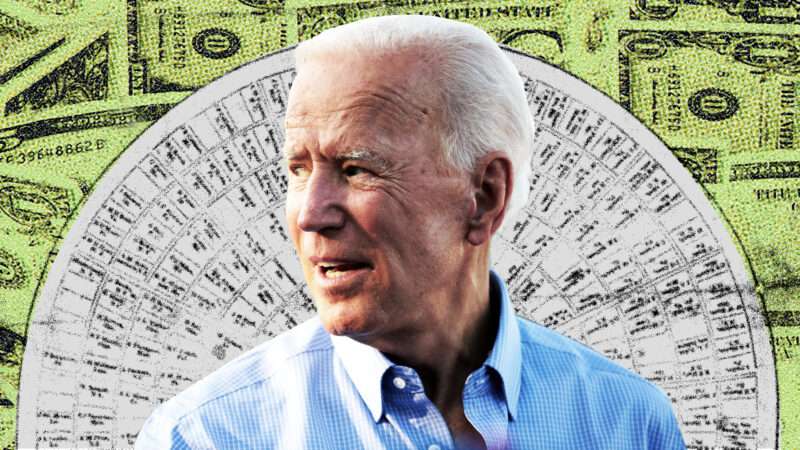
Biden Tries To Twist His Domestic Agenda Into a Form Joe Manchin Will Support


thumbnail (5)

During his first year in office, President Joe Biden tried and failed to get Sen. Joe Manchin (D–W.Va.) and other moderate Democrats in the Senate on board with his expensive domestic agenda.

In Year Two, Biden is promising to market that agenda in a way that seems carefully calibrated to appeal to the objections Manchin had raised about how Biden’s plans would add to America’s record-high national debt and trillion-dollar annual deficit.

“My plan will not only lower costs to give families a fair shot; it will lower the deficit,” Biden said during Tuesday’s State of the Union address.

A fine thesis—a welcome one, even—but Biden declined to fill in many details about how he intends to do that. The only specific plan announced on Tuesday was a new office within the Department of Justice to investigate and prosecute waste, fraud, and abuse within the pandemic relief bills passed over the past two years—bills that, in fairness, were wracked by waste, fraud, and abuse.

Other than that, Biden’s domestic agenda sounds about the same as it did last year: Protectionist “Buy American” provisions, a bigger social safety net including tax credits for parents, and a crackdown on the businesses that Democrats increasingly (and bizarrely) are trying to scapegoat for runaway inflation.

Going after waste is laudable, of course, if perhaps two years too late. But the fundamental drivers of the federal budget deficit are a structural disconnect between spending and revenue and unstable long-term costs in entitlement programs. A promise to reduce the deficit that doesn’t address those two things isn’t a serious plan.

Biden’s plan doesn’t appear to be a serious plan.

As he made clear a few moments later, promising that “by the end of this year, the deficit will be down to less than half what it was before I took office,” and following up by claiming that he would be “the only president ever to cut the deficit by more than one trillion dollars in a single year.”

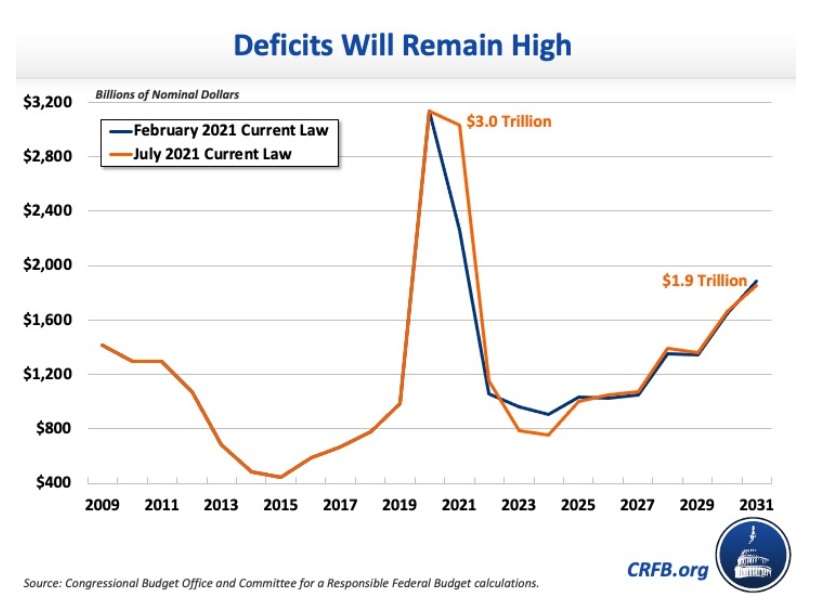
That’s a clever little game. Thanks to pandemic spending, the federal budget deficit ballooned to over $3 trillion during 2020 and rang in at $2.8 trillion last year. As the pandemic passes and all that emergency spending comes off the books, the deficit is projected to fall to about $1.1 trillion this year before leveling off and then rising again:

That decline is not the result of anything Biden is proposing to do—and it doesn’t mean that the underlying problems with the federal budget have been addressed.

Biden is setting the lowest possible goal for deficit reduction, setting himself up to take credit for achieving it, and hoping that’s enough to convince moderate Democrats to vote for more spending.

Because that’s absolutely the other shoe here. Biden’s “Build Back Better” plan died in the Senate last year because Manchin and other moderate Democrats refused to vote for more spending. Manchin was very explicit about this: “This is a recipe for an economic crisis,” he said of Biden’s plan in November.

Even after the White House tried to reconfigure the package to hide half its actual cost, Manchin correctly derided it for being full of “shell games” and “budget gimmicks.”

So Biden is promising to change the shells and announce new gimmicks, this time gift-wrapped specifically for Manchin. But this isn’t deficit reduction; it’s just more of the same.

The post Biden Tries To Twist His Domestic Agenda Into a Form Joe Manchin Will Support appeared first on Reason.com.

from Latest https://ift.tt/VAzc7Xb
via IFTTT

World Athletics Council Bans “All Russian & Belarusian Athletes” From International Sporting Events

World Athletics Council Bans “All Russian & Belarusian Athletes” From International Sporting Events

More and more international sports leagues are banning Russian athletes from competing after the country invaded Ukraine. The latest is the World Athletics Council announced: “all athletes, support personnel and officials from Russia and Belarus will be excluded from all World Athletics Series events.” 

Upcoming events include the World Athletics Championships Oregon22, the World Athletics Indoor Championships Belgrade 22, and the World Athletics Race Walking Team Championships Muscat 22, which begin on Friday in Oman (4 March).

The Council also agreed to consider further measures, including the suspension of the Belarus Federation, at its scheduled Council meeting next week (9-10 March).

The Russian Athletics Federation (RusAF) has been suspended from World Athletics since 2015, due to doping violations, and therefore is not currently eligible to host World Athletics events or send teams to international championships.

The Authorised Neutral Athlete (ANA) process remains in place but Russian athletes who have received ANA status for 2022 are excluded from World Athletics Series events for the foreseeable future.

This means that all Russian ANA or Belarusian athletes currently accredited for the World Athletics Race Walking Team Championships Muscat 22 and the World Athletics Indoor Championships Belgrade 22 (18-20 March) will have their accreditation withdrawn and entries denied, as will any support personnel and officials. – statement via World Athletics Council

World Athletics Council President Sebastian Coe said in a statement, “the world horrified by what Russia has done, aided and abetted by Belarus. World leaders sought to avoid this invasion through diplomatic means but to no avail given Russia’s unswerving intention to invade Ukraine. The unprecedented sanctions that are being imposed on Russia and Belarus by countries and industries all over the world appear to be the only peaceful way to disrupt and disable Russia’s current intentions and restore peace.”

Coe said, “imposing sanctions on athletes because of the actions of their government goes against the grain.” However, “this is different as governments, business and other international organizations have imposed sanctions and measures against Russia across all sectors.” 

Russian athletes were also barred from competing in international ice skating and skiing events on Tuesday, one day after being banned from hockey and soccer competitions. 

Here’s an updated list of international sporting events Russia has been banned from (courtesy of AP News): 

ARCHERY

Russia and Belarus flags and anthems banned at all World Archery international events.

AUTO RACING

Formula One canceled the Russian Grand Prix in Sochi in September.

Intercontinental Drifting Cup in Sochi in June canceled.

BADMINTON

Russia and Belarus athletes and officials banned from participating in all Badminton World Federation tournaments from March 8. Also, all BWF events in Russia and Belarus canceled. However, a few Russian players at two Para events in Spain this week and next week allowed to play as already on site, but as neutrals with no flags or anthems.

BASKETBALL

EuroLeague suspended Russian clubs CSKA Moscow, UNICS Kazan, and Zenit St. Petersburg, with all three in top eight standings. Lokomotiv Kuban Krasnodar was also suspended from second-tier EuroCup.

SPORT CLIMBING

Boulder and Speed World Cup in Moscow in April to be relocated.

CURLING

European championships in Perm, Russia, in November to be relocated.

World Curling Federation begun process to remove Russian entries from women’s world championship in Canada this month and men’s world championship in Las Vegas in April.

EQUESTRIAN

International Equestrian Federation canceled all remaining events this year in Russia (51) and Belarus (six), including the Eurasian Championships in Moscow in July.

FENCING

Alisher Usmanov, a Russian, stepped down as president of the International Fencing Federation.

GYMNASTICS

The International Gymnastics Federation canceled all World Cup and World Challenge Cup events in Russia and Belarus. Russia and Belarus flags and anthems banned at all FIG events. Canceled events included an acrobatics World Cup in Oktyabrskiy, Russia, in May, and a trampoline World Cup in St. Petersburg in September.

FIELD HOCKEY

Russia booted from Women’s Junior World Cup in South Africa in April.

ICE HOCKEY

Russia and Belarus banned from all International Ice Hockey Federation events. Russia men out of world championship in May. World junior championships in Russia in 2023 moved to Serbia. NHL suspended all business dealings in Russia. Finland’s Jokerit club withdrew from Kontinental Hockey League conference quarterfinals.

JUDO

Kazan Grand Slam, a World Judo Tour event, in May canceled. Russia President Vladimir Putin suspended as honorary president and ambassador of International Judo Federation. Sergey Soloveychik, Russian president of the European Judo Union, resigned.

KARATE

Karate 1-Premier League event in Moscow in October to be relocated.

MODERN PENTATHLON

Russia and Belarus athletes and officials banned from all International Modern Pentathlon Union events.

ROWING

Russia and Belarus athletes and officials banned from World Rowing events.

RUGBY

Russia and Belarus suspended from all internationals and cross-border club events. Russia men’s team barred from Rugby Europe Championship and qualifying for the 2023 Rugby World Cup. Russia women’s team barred from Rugby Europe Championship, sevens world series, and qualifying for the Rugby World Cup Sevens in South Africa in September. Russian Rugby Union’s membership of World Rugby suspended.

SKATING

Russia and Belarus banned from all International Skating Union events, including world figure skating championships in France this month.

SKIING

All International Ski Federation events in Russia to the end of the season canceled or relocated. The World Cup cancellations included ski cross in Sunny Valley last weekend, aerials in Yaroslavl last week and Moscow this Saturday; moguls in Kuzbass this weekend; cross-country in Tyumen this month; and women’s ski jumping in Nizhny Tagil and Chaikovsky this month. Russian athletes to compete under FIS flag and anthem.

SOCCER

FIFA and UEFA suspend Russia national teams and clubs from all competitions. National men’s team barred from World Cup qualifying playoffs this month and UEFA Nations League from June. National women’s team banned from Women’s European Championship in July.

Champions League final in May relocated from St. Petersburg to Paris. Spartak Moscow barred from Europa League last 16.

UEFA canceled sponsorship from Russian energy company Gazprom which covered Champions League, UEFA national team competitions and the 2024 European Championship.

SQUASH

World junior championships in St. Petersburg, Russia, in August to be relocated.

SWIMMING

World governing body FINA rules all Russia and Belarus athletes and officials to compete as neutrals with no country flag, colors or symbols. FINA Order awarded to Russian President Vladimir Putin withdrawn. World junior championships in Kazan, Russia, in August canceled. Diving world series in Kazan in April canceled.

TAEKWONDO

World Taekwondo and European Taekwondo Union will not organize or recognize any events in Russia and Belarus. Russia and Belarus flags and anthems banned at all international events. World Taekwondo withdrew honorary 9th dan black belt conferred on Russian President Vladimir Putin.

TENNIS

International Tennis Federation canceled all of its events in Russia and postponed a minor tournament in Ukraine in April. Russia is the defending champion in the Davis Cup and Billie Jean King Cup.

VOLLEYBALL

Men’s world championship in Russia in August to be relocated.

Volleyball National League games in Russia in June and July to be relocated.

WEIGHTLIFTING

European youth championships in Kazan, Russia, in August to be relocated.

OTHER

At Winter Paralympics, Russia and Belarus to compete as neutrals with no national flag, anthem or symbols in Beijing starting on Friday.

SportAccord World Sport and Business Summit in Yekaterinburg, Russia, in May canceled.

Tyler Durden
Tue, 03/01/2022 – 22:25

via ZeroHedge News https://ift.tt/xq0rBlA Tyler Durden

White House Says US Can Focus On Two Theaters As It Did In WWII

White House Says US Can Focus On Two Theaters As It Did In WWII

Authored by Dave DeCamp via AntiWar.com,

With all eyes on the conflict between Russia and Ukraine, President Biden’s top Asia official on the National Security Council said Monday that the US can still focus on increasing its “engagement” in the Asia Pacific to counter China.

According to Reuters, Kurt Campbell, the Indo-Pacific coordinator on the National Security Council, pointed out that the US has been deeply engaged in two theaters simultaneously before, including during World War II and the Cold War.

AFP via Getty Images

It’s difficult. It’s expensive. But it is also essential, and I believe that we’re entering a period where that is what will be demanded of the United States and this generation of Americans,” Campbell told an event hosted by the German Marshall Fund.

“There is a deep recognition and intention here inside the government, in the White House, to sustain every element of our engagement in the Indo-Pacific,” he added.

Reuters reported of his comments further:

Campbell said coming months would show U.S. “determination” to sustain high-level engagement with the region President Joe Biden has declared a priority for policy and resources in pushing back against China’s expanding influence.

In a sign of President Biden’s efforts to maintain focus on the region, his administration sent a delegation of former US military officials to visit Taiwan on Monday. In another sign, a US warship sailed through the Taiwan Strait on Saturday, marking the second time this year the US Navy transited the sensitive waterway.

At the start of the Biden administration, US officials made clear that countering China would be the top foreign policy priority. This was demonstrated by an uptick in US military activity in the South China Sea during Biden’s first year in office.

China views the US activity as a serious provocation and has grown closer to Russia as the two countries face similar pressure from the West.

Tyler Durden
Tue, 03/01/2022 – 22:05

via ZeroHedge News https://ift.tt/0jNEvUY Tyler Durden

Offer Asylum to Russian Soldiers Who Surrender


Captured Russian soldiers
Russian soldiers captured in Ukraine (Ukrainian Armed Forces).

Economist Timur Kuran has an excellent idea for how the US and its European allies can help Ukraine resist Russia at little cost to ourselves:

Don’t assume Russian soldiers and officers like what they are doing. Some—we can’t know many, because preference falsification is inherently invisible—must be willing to break ranks, if only they have options. Let EU and NATO countries offer asylum to Russian military defectors.

Kuran, author of Private Truths, Public Lies: The Social Consequences of Preference Falsification, is the world’s leading expert on “preference falsification” – the effects of situations where people have incentives to misrepresent their true beliefs. And there is good reason to believe that many Russian soldiers indeed would prefer not to be fighting Ukrainians. Political scientist Jason Lyall, an expert in the field of military morale, has a helpful summary:

Russia’s invasion of Ukraine has stumbled out of the starting gate. Gambling on rapid marches to force a quick surrender in Kyiv, the Russian army appears shocked by Ukrainian resistance. While still grinding forward, Russian operations have been plagued by poor coordination, snarled logistics lines and a curious reluctance to deploy all elements of Russian military power, including air power…..

Why has Russia struggled? While analysts have mostly focused on hardware and doctrine, many of Russia’s problems can be traced to a single source: low morale….

Evidence is mounting that many Russian soldiers are reluctant to fight.

Social media is littered with videos of lost and hungry soldiers looting, begging for food or ditching their tanks and trucks. Captured soldiers have expressed confusion about the war’s purpose and have surrendered once they discovered they were not on a training exercise. Hundreds of armored vehicles have been abandoned or captured by Ukrainian forces and, in at least one case, by a local farmer.

Many of Russian equipment losses have been because of abandonment and capture, not destruction. Indeed, dozens of videos of lines of stranded military equipment can be found on TikTok. Russian military authorities have threatened physical abuse or worse to enforce discipline in some units.

The rest of Lyall’s article details ways in which morale problems impede the Russian military’s effectiveness.

A shift in incentives from a situation where surrender is likely to mean eventual repatriation to Russia (where they may face disgrace and possible punishment) to one where it means a life of vastly greater freedom and prosperity in the West could significantly increase the number of Russian soldiers who decide to give up. Fear that their subordinates are angling for an opportunity to defect might also sow doubt and distrust in the minds of Russian commanders, thus further undermining morale and effectiveness.

The US and other NATO allies should take up Kuran’s idea. And they should publicize the offer of asylum as much as possible, using social media, leaflets dispersed by Ukrainian forces, and any other possible methods of communication. Every Russian soldier should be made aware that surrender means a better life for them in the West.

Yes, there is always the risk that a Russian  who surrenders and clams asylum might turn out to be some sort of spy or saboteur planted by the Kremlin. But people give access to classified information or jobs requiring security clearances, must undergo  extensive screening, whether they are immigrants or not. And if Vladimir Putin wants to insinuate spies or saboteurs into the US whose job it is to find openly available information or target facilities open to the public, realistically he has many other ways of doing so.

There are several other ways in which the US and its allies can use immigration and refugee policy to combat Putin and and ease the suffering caused by Russia’s war of aggression. I plan to write about them in detail soon. For now check out these articles by Robert Zubrin in National Review, and Reason’s Fiona Harrigan (here and here).

The post Offer Asylum to Russian Soldiers Who Surrender appeared first on Reason.com.

from Latest https://ift.tt/jNwiEK9
via IFTTT

Offer Asylum to Russian Soldiers Who Surrender


Captured Russian soldiers
Russian soldiers captured in Ukraine (Ukrainian Armed Forces).

Economist Timur Kuran has an excellent idea for how the US and its European allies can help Ukraine resist Russia at little cost to ourselves:

Don’t assume Russian soldiers and officers like what they are doing. Some—we can’t know many, because preference falsification is inherently invisible—must be willing to break ranks, if only they have options. Let EU and NATO countries offer asylum to Russian military defectors.

Kuran, author of Private Truths, Public Lies: The Social Consequences of Preference Falsification, is the world’s leading expert on “preference falsification” – the effects of situations where people have incentives to misrepresent their true beliefs. And there is good reason to believe that many Russian soldiers indeed would prefer not to be fighting Ukrainians. Political scientist Jason Lyall, an expert in the field of military morale, has a helpful summary:

Russia’s invasion of Ukraine has stumbled out of the starting gate. Gambling on rapid marches to force a quick surrender in Kyiv, the Russian army appears shocked by Ukrainian resistance. While still grinding forward, Russian operations have been plagued by poor coordination, snarled logistics lines and a curious reluctance to deploy all elements of Russian military power, including air power…..

Why has Russia struggled? While analysts have mostly focused on hardware and doctrine, many of Russia’s problems can be traced to a single source: low morale….

Evidence is mounting that many Russian soldiers are reluctant to fight.

Social media is littered with videos of lost and hungry soldiers looting, begging for food or ditching their tanks and trucks. Captured soldiers have expressed confusion about the war’s purpose and have surrendered once they discovered they were not on a training exercise. Hundreds of armored vehicles have been abandoned or captured by Ukrainian forces and, in at least one case, by a local farmer.

Many of Russian equipment losses have been because of abandonment and capture, not destruction. Indeed, dozens of videos of lines of stranded military equipment can be found on TikTok. Russian military authorities have threatened physical abuse or worse to enforce discipline in some units.

The rest of Lyall’s article details ways in which morale problems impede the Russian military’s effectiveness.

A shift in incentives from a situation where surrender is likely to mean eventual repatriation to Russia (where they may face disgrace and possible punishment) to one where it means a life of vastly greater freedom and prosperity in the West could significantly increase the number of Russian soldiers who decide to give up. Fear that their subordinates are angling for an opportunity to defect might also sow doubt and distrust in the minds of Russian commanders, thus further undermining morale and effectiveness.

The US and other NATO allies should take up Kuran’s idea. And they should publicize the offer of asylum as much as possible, using social media, leaflets dispersed by Ukrainian forces, and any other possible methods of communication. Every Russian soldier should be made aware that surrender means a better life for them in the West.

Yes, there is always the risk that a Russian  who surrenders and clams asylum might turn out to be some sort of spy or saboteur planted by the Kremlin. But people give access to classified information or jobs requiring security clearances, must undergo  extensive screening, whether they are immigrants or not. And if Vladimir Putin wants to insinuate spies or saboteurs into the US whose job it is to find openly available information or target facilities open to the public, realistically he has many other ways of doing so.

There are several other ways in which the US and its allies can use immigration and refugee policy to combat Putin and and ease the suffering caused by Russia’s war of aggression. I plan to write about them in detail soon. For now check out these articles by Robert Zubrin in National Review, and Reason’s Fiona Harrigan (here and here).

The post Offer Asylum to Russian Soldiers Who Surrender appeared first on Reason.com.

from Latest https://ift.tt/jNwiEK9
via IFTTT

China Buys 700K Barrels of Iranian Oil Every Day, Violating US Sanctions

China Buys 700K Barrels of Iranian Oil Every Day, Violating US Sanctions

Iran has been subjected to crippling oil-export sanctions for the last several years, but that hasn’t stopped China, whose imports of Iranian oil have increased by the month (read: here), traders and ship-tracking firms told Reuters. Chinese buyers are ramping crude purchases at low prices as the international crude benchmark Brent soars and outweighs any risks of U.S. sanctions. 

Indeed, as Reuters notes, Chinese imports of Iranian crude continued to skyrocket this year despite the sanctions that, if enforced, would allow Washington to cut off those who violate them from the U.S. economy. But when the U.S. president is unlikely to wake up from his afternoon nap or refuse to be disturbed while eating ice cream and do anything to punish China for violating the terms of the embargo, Chinese importers exceeded 700,000 bpd for January, according to estimates by three tanker trackers, which exceeded the 623,000 bpd peak recorded by Chinese customs in 2017 before former President Trump reimposed sanctions in 2018 on Iranian oil exports. 

One tanker tracker said imports between November to December were on average 780,000 bpd. 

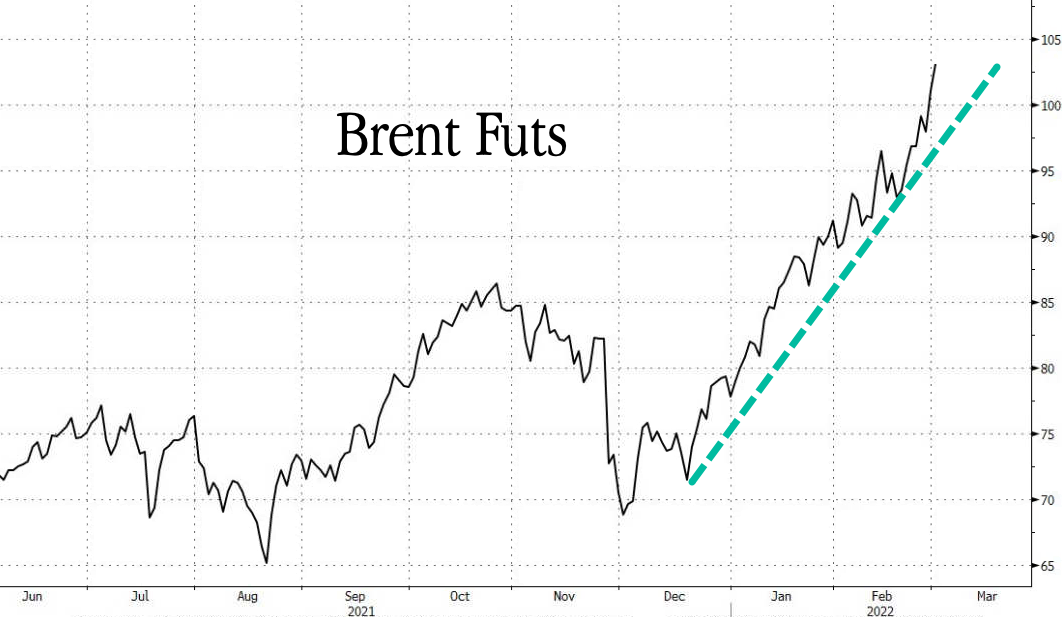
Much of the buying comes from independent Chinese refiners (otherwise known as “teapots”), who, traders said embraced Iran’s cheaper crude as Brent prices soared last month from $77 to $91. Teapots paid a discount to market, transacting $5 a barrel below Brent. 

Consulting firm Petro-Logistics, which tracks oil flows, said Iran’s total crude exports soared in December to over 1 million bpd, the highest in three years. 

“Iran’s oil exports are mostly going to China, often through convoluted routes and transshipments, with small volumes going to Syria each month,” said CEO Daniel Gerber.

Petro-Logistics expects total Iranian oil exports at 800,000 bpd in January and 700,000 bpd in February. Another tracker firm, OilX, said 1 million bpd could be seen for both January and February.

Iranian imports are increasing as Iranian and U.S. officials continue negotiating to restore the 2015 nuclear deal. If such a deal is reached in Vienna, lifting most international sanctions on Tehran would mean Iranian crude exports could flood the world and divert sales away from the Chinese teapots. 

The Ukrainian crisis likely gives Iran a stronger hand in the negotiations as Brent is driven above $100 a barrel on geopolitical concerns. Increasing political pressure on President Biden to tame inflation, more importantly, high gas prices at the pump ahead of midterms could make western politicians more receptive to a deal to squash oil prices. 

On Friday, a senior U.S. State Department official told WSJ there were only days left to close the remaining difference between Iran and the U.S. for a deal. 

“Final decisions have to be taken this week—either we have a deal or we do not,” an official from one of the European countries at the talks said Monday. “The context of the current international crisis means the window of opportunity is closing.”

In the meantime, it appears the U.S. will punish countries who violate its sanctions, though it won’t dare touch China as it is too afraid of what an escalation could look like.

Tyler Durden
Tue, 03/01/2022 – 21:45

via ZeroHedge News https://ift.tt/hfiV0IU Tyler Durden

Half Of Biden’s 500 Million Free COVID-19 Tests Unclaimed: Officials

Half Of Biden’s 500 Million Free COVID-19 Tests Unclaimed: Officials

Authored by Jack Phillips via The Epoch Times (emphasis ours),

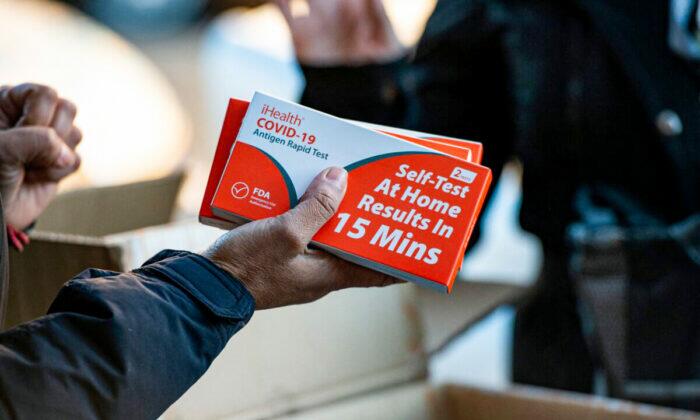
About half of the 500 million free COVID-19 tests that President Joe Biden recently made available haven’t been claimed, according to the White House.

Rapid at-home COVID-19 test kits are distributed by the GreenRoots environmental protection organization and Chelsea Community Connections in Chelsea, Mass., on Dec. 17, 2021. (Joseph Prezioso/AFP via Getty Images)

Biden administration officials told The Associated Press that Americans have placed 68 million orders for packages of tests, which contain four COVID-19 tests each. That leaves about 46 percent of the stock still available.

“We totally intend to sustain this market,” Dr. Tom Inglesby, testing adviser to the White House COVID-19 response team, told AP about the unclaimed tests. “We know the market is volatile and will come up and down with surges in variants.”

The shortfall in tests being claimed is likely because of a significant drop in COVID-19 cases across the United States, as well as an easing of restrictions such as vaccine or masking mandates in primarily Democrat-led states in recent weeks.

There is no question some people found out they were positive from taking one of these tests and were able to keep other people from getting infected,” Tim Manning, supply coordinator for the COVID-19 response team, told AP.

On the first day that COVID-19 tests were made available in January, the COVIDtests.gov website received more than 45 million orders, officials told AP. Fewer than 100,000 orders per day are coming in now.

About one month ago, the federal government said it would procure another 100 million COVID-19 tests via iHealth Labs.

“This effort supports the president’s plan to deliver 500 million free at-home COVID-19 tests to the nation in response to the Omicron variant,” the Department of Defense said in a Jan. 29 statement. “The procurement was funded through the American Rescue Plan Act to supply critical medical resources to the nation.”

Biden had announced the new testing measure after facing criticism that his administration has mainly focused on getting people vaccinated and that they haven’t done enough to encourage testing amid the spread of the Omicron coronavirus variant.

The White House didn’t respond to a request for additional comment by press time.

The National Poison Control Center and other poison control centers have issued warnings about rapid tests having a toxic chemical, sodium azide, which is a colorless and odorless powder that testers dip cotton swabs into.

“It is important to know that the extraction vial in many rapid antigen kits includes the chemical sodium azide as a preservative agent,” the center stated. “The BinaxNow, BD Veritor, Flowflex, and Celltrion DiaTrust COVID-19 rapid antigen kits all contain this chemical.”

The Associated Press contributed to this report.

Tyler Durden
Tue, 03/01/2022 – 21:25

via ZeroHedge News https://ift.tt/AjHSNpF Tyler Durden

Oil Hits $110 As Biden Begins SOTU Address; Goldman Says Emergency Oil Release Won’t Do Jack

Oil Hits $110 As Biden Begins SOTU Address; Goldman Says Emergency Oil Release Won’t Do Jack

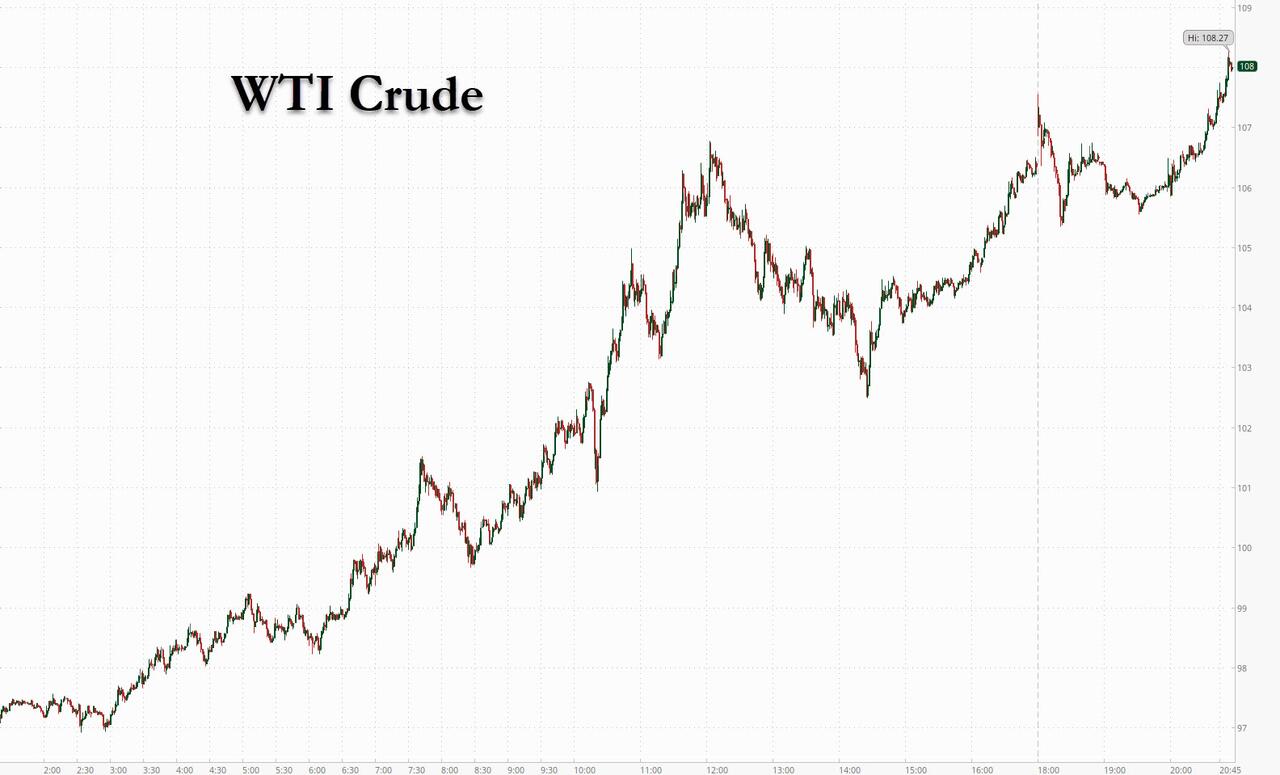
With Joe Biden set to begin his first State of the Union address any second, it is only appropriate that WTI oil has exploded higher, and just printed at an 8 year high of 108.63, rising more than $3 since the cash market close, and more than $10 in the past 24 hours!

At the same time, Brent which traditionally trades at a premium, just hit $110:

  • *BRENT CRUDE OIL EXTENDS RALLY ABOVE $110 A BARREL

One reason for that is a rather grim assessment from Goldman which echoes what we said earlier, namely that today’s IEA release of 60 million barrels of emergency oil reserves will do exactly nothing to halt oil’s tremendous surge higher.

As Goldman’s Damien Courvalin writes, writing about the release of 60 mb of emergency oil reserves following Russia’s invasion of Ukraine “we do not view this as sufficient relief, representing an only 1-month offset to a potential disruption to one-third of Russia’s 6 mb/d seaborne oil export flows, for example, consistent with the rally in prices after today’s announcement.

As such, Goldman reiterates its view – discussed here yesterday – that only demand destruction – through even higher prices – is now likely the only sufficient rebalancing mechanism, with supply elasticity no longer relevant in the face of such a potential large and immediate supply shock.

This leaves risk to our one-month $115/bbl Brent price forecast still skewed to the upside, with today’s $105/bbl spot prices only at the level we believed was required to balance the oil market prior to any escalation in Ukraine.

Furthermore, Courvalin writes that a short-term deescalation or a potentially faster ramp-up in OPEC+ production would also not derail the bank’s view for structurally higher prices, with Dec-23 Brent $24/bbl below our forecast; “Similarly, we do not expect a large price sell-off should an agreement with Iran be reached soon. Case in point, the global oil deficit in February is turning out to be twice as large as our above-consensus forecast while Iraq is experiencing 0.5 mb/d of outages, enough – if sustained and combined – to fully nullify Iran’s potential return to the global oil market.”

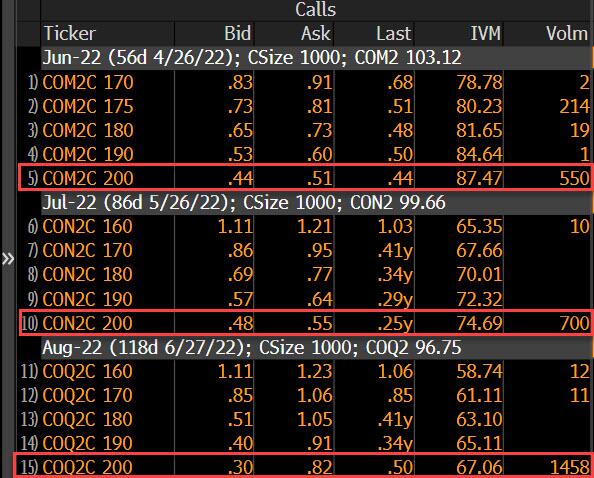
All of that means that Brent $200 calls expiring this summer look quite cheap.

The silver lining, is that at least one person is delighted by this tremendous ascent in oil prices: Jerome Powell. As we said almost a month ago, the quickest and safest way to “burn out” inflation is to send oil to $200… triggering a global recession if not depression.

Tyler Durden
Tue, 03/01/2022 – 21:06

via ZeroHedge News https://ift.tt/a7MV1gv Tyler Durden

Cargo Ship Carrying 4,000 Luxury Cars Sinks In Heavy Seas

Cargo Ship Carrying 4,000 Luxury Cars Sinks In Heavy Seas

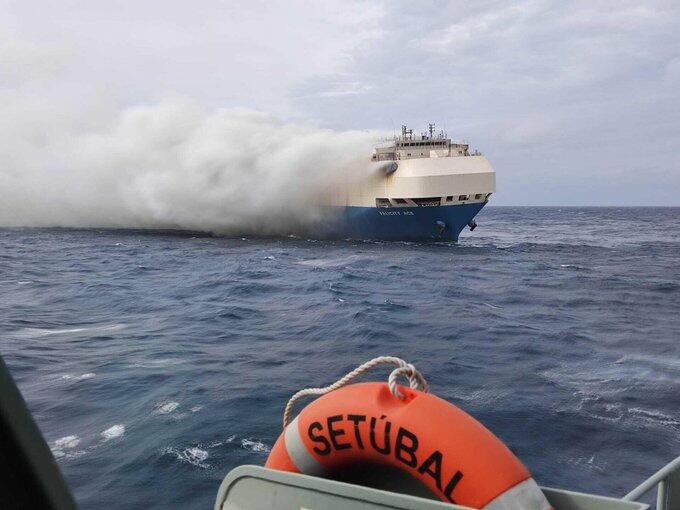
Two weeks after a roll-on-roll-off (RORO) car carrier loaded with thousands of Volkswagen AG vehicles, including VW, Porsche, Audi, Bentley, and Lamborghini- branded models, caught fire in the Atlantic Ocean, it sunk Tuesday morning, according to Bloomberg

We chronicled the incident last month (read: here & here), noting that the shipment of luxury vehicles had been bound for the US market, where a shortage of supply and surging demand has led to a severe crunch of new car supply.

Now the 656-foot long RORO, called Felicity Ace, has sunk to the bottom of the ocean, about 220 nautical miles off the coast of Portugal’s Azores Islands, around 0900 local time. 

The RORO was severely damaged from a fire that broke out on Feb. 16 and was leaning 45 degrees to its starboard side as a fleet of tug boats and salvage craft accompanied the vessel as it was being towed back to shore. The ship sank due to rough seas:

“The weather was pretty rough out there,” Pat Adamson, a spokesperson for MOL Ship Management (Singapore), a unit of Mitsui OSK Lines Ltd., said by phone. “And then she sank, which was a surprise.”

Volkswagen had 4,000 vehicles on board, and vessels in the area monitored the situation. Adamson said. “There doesn’t appear to be any oil pollution yet — they’re checking on that.” 

For any car enthusiast hoping to score a waterlogged Porsche, Bentley, and or Lamborghini, well, the ship sank in waters about 3,000 meters (9,842 feet) deep. 

So you’ll need much more than a scuba diving suit to retrieve the exotic cars.  

Tyler Durden
Tue, 03/01/2022 – 21:05

via ZeroHedge News https://ift.tt/PywVvcb Tyler Durden