How Are Energy Drinks Draining Your Brain’s Power ?

How Are Energy Drinks Draining Your Brain’s Power ?

Authored by Michelle Standlee via The Epoch Times (emphasis ours),

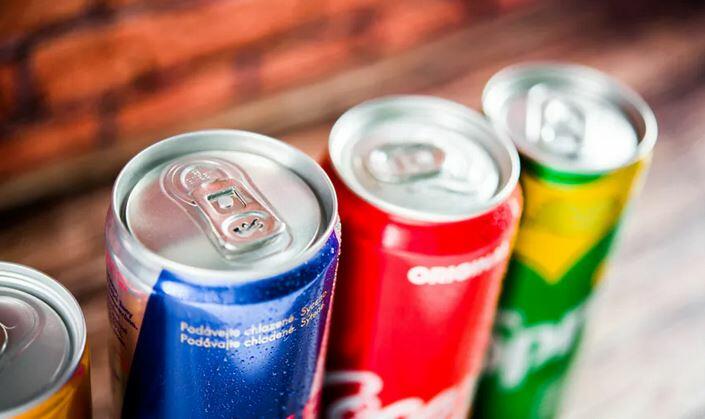
One step through the grocery store doors, and you’re surrounded by lightning bolts and bold lettering screaming, “Energy!”

The main ingredients of energy drinks—caffeine, amino acids, and herbal extracts—vow to deliver superhuman focus and alertness with just a sip. Yet lurking beneath the surface is a hidden risk that may outweigh any apparent benefits. It’s time to ask: What if this burst of energy comes with a cost greater than the price tag?
The Evolution of Energy Drinks

The origins of energy drinks can be traced back decades before their rise to mass popularity.

In 1929, the glucose-based drink Lucozade Energy (formerly Glucozade in 1927) was introduced in the UK as a nutritional supplement for hospital patients recovering from illnesses, including the flu.

Later, in 1949, Dr. Enuf, containing a mixture of caffeine, B vitamins, and sugar, became the first carbonated energy drink in the United States when it was launched in Chicago.

However, it was not until the introduction of Red Bull in 1987 in Austria and its vigorous marketing campaigns that energy drinks really took off globally. Red Bull, a mixture of caffeine, taurine, B vitamins, and sugar, established the standard energy drink formula many brands mimic today.

Today, the global energy and sports drinks market is valued at over $159 billion, with the United States alone accounting for nearly $14 billion.

In addition to adults, teenagers are drawn to these energizing tonics for academic or sports performance. Some schools have started to ban energy drinks because of their high sugar and caffeine content, which can result in an energy crash, making long-term focus and studying difficult.

The Sinister Side of Sweet Energy Surges

While energy drinks may provide short-term benefits like alertness and focus, research indicates they can also have negative health impacts.

“The amount and quality of caffeine inside the energy drinks gives a false source of energy,” Omar Eliwa, a registered pharmacist in Wisconsin, told The Epoch Times. “You’re getting more than what your brain can take. It will be detrimental in the long-term to memory, the aging of the cells, depletion of nutrients, and it makes you not want to eat, so it affects metabolism as well.”

1. How Energy Drinks Affect Your Brain

These zippy beverages adversely affect the brain by incurring the following:

Neurodegenerative Disorders and Brain Aging

Caffeinated energy drinks can cause neurodegenerative changes in the hippocampus, an essential structure for long-term memory, in male albino rats, according to a 2020 study published in the Anatomy and Cell Biology journal.

High sugar intake has also been linked to an increased risk of insulin resistance. Insulin resistance prevents cells throughout the body, including brain cells, from adequately absorbing glucose. Over time, impaired insulin signaling may contribute to neurodegeneration and accelerated brain aging.

Moreover, insulin resistance contributes to the advancement of Alzheimer’s disease through various mechanisms, including the escalation of oxidative stress, as indicated by a study published in the International Journal of Molecular Sciences in 2021.

“[Energy drinks] are often packaged in aluminum, a neurotoxin that has been linked to Alzheimer’s disease,” Dr. Aruna Tummala, an integrative psychiatrist at Trinergy Health and founder of Psychiatry 2.0, told The Epoch Times.

ADHD

Food dyes like red dye 40, also known as Allura Red AC, are common in energy and sports drinks. But they can decrease the absorption of minerals like zinc and iron, needed for growth and development.

Some research suggests artificial food colorings like red dye 40 may exacerbate attention deficit hyperactivity disorder (ADHD) symptoms in children. In 2007, a randomized controlled trial conducted in the UK revealed that the consumption of artificial colors and/or the widely used preservative sodium benzoate was linked to heightened levels of hyperactivity in children.

A meta-analysis conducted in 2012 estimated that around 8 percent of children with ADHD experience symptoms associated with the consumption of food dyes and indicated potential benefits in removing artificial colors from their diets.

Fatigue, Insomnia, and Headaches

“Sugar and caffeine crashes are very real,” Aidan Prud’Homme, a high school student, told The Epoch Times. He consumed one or two energy drinks daily to stay focused and energized at school. Some accompanying side effects included prolonged fatigue, headaches, and sleep problems.

As a diuretic, caffeine in energy drinks can lead to dehydration by increasing urine output. Adequate hydration is critical for proper brain function, as brain cells consist primarily of water. Dehydration from energy drinks can therefore cause fatigue and poor concentration.

Energy drinks can lead to long-term insomnia due to the caffeine they contain, according to Dr. Tummala. Caffeine promotes wakefulness by increasing levels of histamine and glutamate, neurotransmitters that disrupt sleep cycles.

Stopping energy drink consumption can lead to caffeine withdrawal, often causing headaches, Dr. Tummala said. Upon discontinuing caffeine, blood vessels widen, causing an increase in blood flow and resulting in heightened pressure that triggers a headache.

Anxiety

Energy drinks can increase the level of catecholamines, neurotransmitters involved in the body’s stress response. The spike in these chemicals increases heart rate and blood flow, triggering a fight-or-flight response in some people, leading to anxiety.

Seizures

There is growing concern over the link between energy drinks and increased seizures. The caffeine in energy drinks promotes the release of glutamate and dopamine, excitatory neurotransmitters, and reduces responsiveness to GABA, an inhibitory neurotransmitter in the central nervous system, thus lowering seizure threshold, according to a recent Nutrition review article. The seizures stopped when individuals refrained from consuming energy drinks.

2. How Energy Drinks Affect the Rest of the Body

Concerns over energy drinks’ overall health effects have been rising globally. Poland, for example, just recently banned sales of energy drinks containing taurine and caffeine to those under 18.

Diabetes

“Children are getting a sudden rush of sugar, setting the foundation for insulin resistance and Type 2 diabetes,” Dr. Tummala said.

Energy drinks’ high sugar content can lead to insulin resistance, resulting in elevated blood glucose levels that can, over time, lead to prediabetes and Type 2 diabetes.

Stress

The caffeine and other stimulating ingredients in energy drinks spur the adrenal glands to release excessive amounts of the stress hormone cortisol. Over time, this can overwork the adrenals, potentially leading to adrenal exhaustion (pdf), fatigue, and impaired stress response.

Heart Problems

The high caffeine content in energy drinks is associated with heart arrhythmias and sudden cardiac death,” Dr. Tummala said. Caffeine and taurine affect cardiac rhythm and repolarization, facilitating arrhythmia, according to a 2022 experimental study using rabbit hearts. At least one human case report has also connected excessive consumption of energy drinks to acute heart failure.

Healthy Alternatives

Having encountered troublesome side effects, high schooler Aidan eventually opted for healthier drinks.

Rather than relying on energy drinks, choosing healthier alternatives can provide sustained energy and focus minus the risks.

Physical activity like walking has been shown to reduce stress, boost energy levels, and support brain health.

Sparkling water with a splash of fruit juice makes a refreshing, soda-like drink packed with antioxidants. Herbal teas like hibiscus and rooibos also contain beneficial antioxidants and phytochemicals.

Health experts stress the importance of parental awareness regarding children’s drink choices. “One of the critical points I have against energy drinks is the deceptive method of marketing to the consumer who might not know what is being presented to them,” Mr. Eliwa said. “We have to pay attention to the little details. Check the labels,” he added. “We have to protect our kids.”

Tyler Durden
Sun, 08/06/2023 – 16:00

via ZeroHedge News https://ift.tt/9JjzK4Y Tyler Durden

Shadow Docket Delays

On July 24, the Fifth Circuit declined to stay the district court’s vacatur of the “Frame or Receiver” rule. Three days later, on July 27, the Solicitor General filed an application for a stay of the district court’s ruling. The next day, on July 28, Circuit Justice Alito entered an administrative stay and a briefing schedule:

Order issued by Justice Alito: Upon consideration of the application of counsel for the applicants, it is ordered that the June 30, 2023 order and July 5, 2023 final judgment of the United States District Court for the Northern District of Texas, case No. 4:22-cv-691, are hereby administratively stayed until 5 p.m. (EDT) on Friday, August 4, 2023. It is further ordered that any response to the application be filed on or before Wednesday, August 2, 2023, by 5 p.m. (EDT).

The briefing was completed, but no ruling came on August 2 or 3. On August 4, Circuit Justice Alito further extended the administrative stay:

Order issued by Justice Alito: Upon further consideration of the application of counsel for the applicants, the responses, and the reply filed thereto, it is ordered that the stay issued on July 28, 2023, is hereby extended until 5 p.m. (EDT) on Tuesday, August 8, 2023.

What do we make of this four-day delay? Two broad possibilities. First, a majority opinion has already coalesced–either to grant the stay or deny the stay–and the dissenters need some time to prepare a dissent. Second, a majority opinion has not coalesced, and more time is needed to conference the issue. (I think certiorari before judgment may be in the cards here.)

I did a quick search of the phrase “Upon further consideration of the application of counsel for the applicants, the responses, and the reply filed thereto” in the Supreme Court database. This language has been used about 7 times to vacate a stay. But I onyl found two other cases where this language was used to extend a stay: the mifepristone cases. Circuit Justice Alito extended an administrative stay of the Fifth Circuit’s ruling by seven days. And, after those seven days lapsed, the Court exercised its spooky shadow docket power, and stayed the Fifth Circuit. Why was there an extension of time? Perhaps Justice Alito needed more time to write a dissent. (Justice Thomas dissented without opinion.) Or, perhaps negotiations were in flux, and Alito was trying to scrounge more votes, but ultimately was unsuccessful. I could not find any other instance in which an administrative stay was extended with this language.

If past is prologue, the Court will stay the Fifth Circuit again in the “Frame or Receiver” case. Or, the Court may be cobbling together votes for cert before judgment. Plus don’t forget the recently-decided “Pistol Brace” case from the Fifth Circuit, which should be coming to the shadow docket soon. If these cases are granted, along with Rahimi, we will have a very Fifth Circuit gun-centric term ahead of us.

The post Shadow Docket Delays appeared first on Reason.com.

from Latest https://ift.tt/EXe84is
via IFTTT

Press Freedom Under Fire: Federal Judge Orders Former Fox Reporter To Reveal Sources In Controversial FBI Case

Press Freedom Under Fire: Federal Judge Orders Former Fox Reporter To Reveal Sources In Controversial FBI Case

A federal judge recently ruled that investigative reporter Catherine Herridge must reveal her sources for an investigative series involving an FBI investigation into a Chinese scientist named Yanping Chen.

Herridge, currently with CBS News – but was was employed by Fox News at the time of the reports – must sit for a deposition and answer questions under oath about the identity and intent of her sources, per US District Judge Christopher Cooper.

“The Court recognizes both the vital importance of a free press and the critical role that confidential sources play in the work of investigative journalists like Herridge,” wrote Cooper, and Obama appointee, in a 28-page ruling. “But applying the binding case law of this Circuit, the Court concludes that Chen’s need for the requested evidence overcomes Herridge’s qualified First Amendment privilege in this case.”

Cooper’s ruling has raised alarms with press freedom advocates, who argue that the ruling threatens the fundamental principle of journalists protecting their sources.

“Investigative journalism cannot function without credible assurances of confidentiality to sources,” said Gabe Rottman, a director at the Reporters Committee for Freedom of the Press, in a statement to CNN. “While the Privacy Act provides essential protections for the public, using it to breach reporter-source confidentiality poses significant risks to a free press.”

Legal representatives for Herridge and Fox News argued that the First Amendment shields journalists from such demands, and say that Chen’s case didn’t meet the criteria to violate this constitutional protection. They asserted that the public interest in safeguarding sources far outweighed the plaintiff’s demand for information, which carried no broader societal significance.

While the U.S. Constitution protects journalists’ right to shield their sources, the courts have acknowledged that certain circumstances, such as a critical need for information and exhaustive exploration of alternatives, can justify compelling a reporter to reveal sources.

“The balance of interests overwhelmingly favors protecting sources,” said Herridge’s legal team. “Plaintiff’s private interest in Privacy Act damages carries no broader public interest. Moreover, given the infirmities in the merits of her case, it is unlikely that Plaintiff can ever establish significant damages at all.

Since filing the lawsuit against the FBI and other federal agencies, Ms. Chen has been able to take 18 depositions of current and former government employees and obtained declarations from others but has still been unable to confirm Ms. Herridge’s sources. She believes an FBI agent, an alleged FBI informant, or other government agents leaked an internal FBI presentation created by the agent to Ms. Herridge. –Epoch Times

“The identity of Herridge’s source is central to Chen’s claim, and despite exhaustive discovery, Chen has been unable to ferret out his or her identity. The only reasonable option left is for Chen to ask Herridge herself,” wrote the judge.

A Hunt for the Truth

Chen, a naturalized U.S. citizen and founder of the University of Management and Technology, found herself at the center of an FBI investigation that triggered Herridge’s investigative reporting. The stories delved into Chen’s alleged ties to the Chinese military and the controversy surrounding the FBI’s handling of the case. Chen has pursued legal action, alleging that the leak of information violated the Privacy Act.

Despite multiple depositions and a search for information, Chen has been unable to confirm the identity of Herridge’s sources. This impasse led Judge Cooper to rule in favor of compelling Herridge’s testimony.

The FBI, starting in 2010, investigated Ms. Chen. Agents searched Ms. Chen’s home and the university’s main office. In 2016, prosecutors told Ms. Chen’s attorney she would not be charged.

Reporting by Ms. Herridge had focused on Ms. Chen’s alleged ties to the Chinese military, but Ms. Chen had said on immigration documents that she had never been affiliated with the military of the Chinese Communist Party. The stories also detailed the FBI investigation and said that agents and prosecutors disagreed over how the case was handled. -Epoch Times

In 2018, the DoD ceased helping pay the tuition of military members to attend Chen’s university. She then sued the FBI, alleging that the leak of information was illegal, which violated the Privacy Act.

“Soon after … Chen was informed that no charges would be brought against her, and in violation of federal law,” reads the lawsuit. “one or more agents of the Defendants, who possessed or had access to confidential FBI records pertaining to the investigation, caused the Leaked Records to be disclosed to one or more employees or agents of Fox News.”

Tyler Durden
Sun, 08/06/2023 – 15:30

via ZeroHedge News https://ift.tt/PqF9znv Tyler Durden

David Stockman On Why RFK Jr. Is The Only Candidate Who Can Oppose The Uniparty System…

David Stockman On Why RFK Jr. Is The Only Candidate Who Can Oppose The Uniparty System…

Authored by David Stockman via InternationalMan.com,

The economic policy of the bipartisan “uniparty” has been an abysmal failure. In fact, Bidenomics and Trump-O-Nomics are just two sides of the same deficient coin. They amount to the inflationary accommodation of powerful constituencies which have captured control of policy—-Wall Street for the GOP, domestic spending constituencies for the Dems and the military/industrial/intelligence complex for both.

The bottom line doesn’t lie, however. Real economic growth during the uniparty regime of Trump/Biden has averaged barely 2.0% per annum—notwithstanding an outpouring of monetary and fiscal stimulus that had never before even been imagined. Still, the economic growth rate since 2016 is just a fraction of the 5.0% average during the Kennedy-Johnson era and 3.5% under Ronald Reagan.

And, yes, these figures are more than fair comparisons because the results for the Trump/Biden era of borrow, borrow and borrow some more are currently overstated. That’s owing to the fact that there is still another recessionary shoe to fall.

So average in the impending six quarters ahead of negative GDP growth and/or stagflation and the uniparty will have achieved eight years of the weakest economic growth since WWII. And by a long shot at that when compared to the average growth of 3.2% for all presidents—good, bad and indifferent—during the seven decades between 1947 and 2016.

The cause of the problem is not mysterious. The Washington uniparty has become addicted to borrowing and printing. Between them, Trump and Biden have raised the national debt by nearly $13 trillion. That’s 40% of all the money that’s ever been borrowed by presidents since George Washington.

Likewise, the money-printing story at the Fed is actually worse, and neither POTUS has uttered so much as a cross word about the tsunami of fiat credit tumbling off the digital printing presses in the Eccles Building. Accordingly, during the last six and one-half years of uniparty rule the Fed’s balance sheet has swollen by $4 trillion. That’s 48% of all the money that’s ever been printed by the Fed since it opened its doors for business in the fall of 1914.

Needless to say, all of this egregious borrowing and money-printing has hit middle class America right in the economic solar plexus. Since December 2016 the smoothed CPI (16% trimmed mean CPI) is up by 24%. But where it really hurts main street is at the grocery store, with prices up by 27%, and at the gas pump and utility meter, with energy prices higher by 37%.

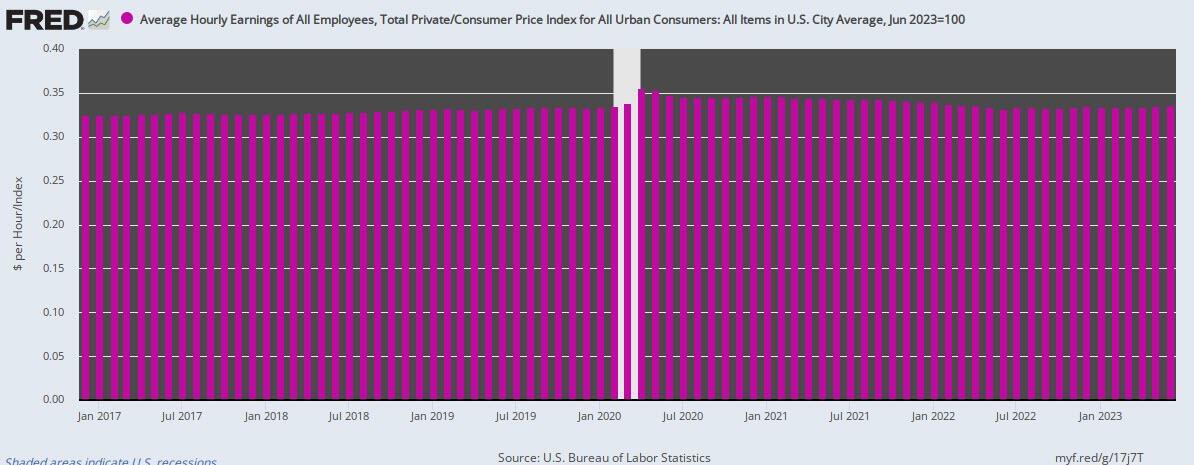
In everyday family budget terms, in fact, food and energy prices have risen more in the last 6 years than they did during the prior 12 years. Owing to all this cumulative inflation, therefore, real average hourly wages have risen by barely 3.5% since December 2016.

Inflation-Adjusted Average Hourly Wage, December 2016 to June 2023

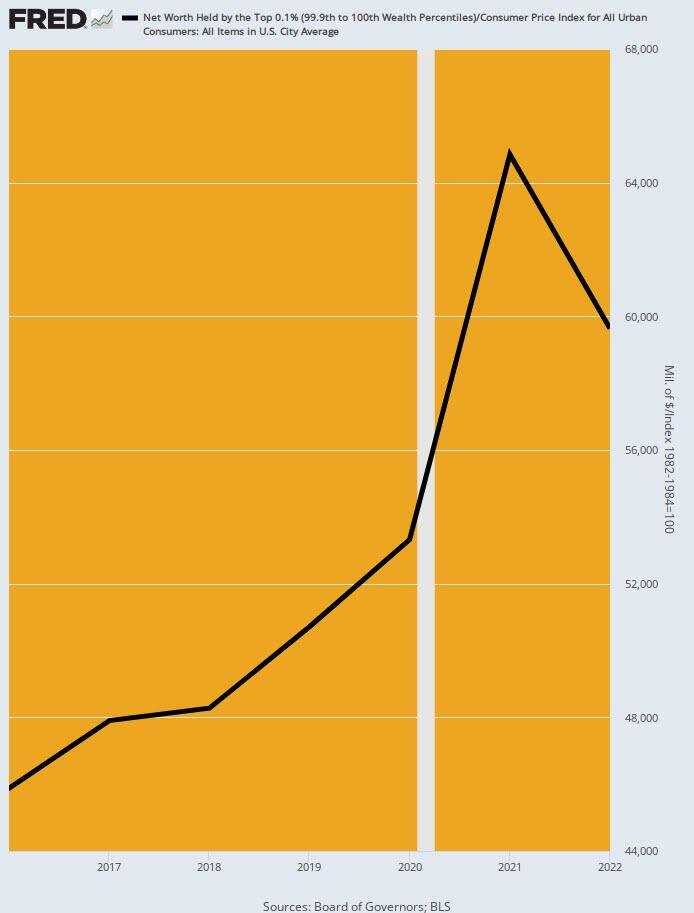
Needless to say, the above depicted stagnation of US worker incomes did not apply to the wealth of the top 0.1% of households. During the same six and one-half year period, the inflation-adjusted net worth of the 130,000 households at the tippy-top of the economic ladder has gained 30% or nearly ten-times more than average real wage gains.

That is to say, the unhinged stimulus bacchanalia conducted by the Washington uniparty has showered the already rich with unearned asset inflation, buried future generations in unspeakable public debts and left the vast bulk of the electorate scrambling to maintain their standard of living in the face of the most virulent inflation in forty years.

Inflation-Adjusted Net Worth of the Top 0.1% of US Households, 2016 to 2022

Self-evidently, the time to abandon the inflationary and inequitable economics of the uniparty has long passed. Yet these baleful policies are rooted in the fact that both parties have been captured by powerful interest groups that are not about to part with the spending, borrowing and unpaid for tax cuts that have fostered the current economic mess. Nor is the Fed’s capture by the Wall Street gamblers and Washington spenders alike going to give way to sound money on the watch of the uniparty, either.

Needless to say, Robert F. Kennedy Jr. is the only candidate on the 2024 horizon who has both the capacity to think independently and to act courageously in opposition to the uniparty consensus. So the question recurs: Is there any conceivable economic platform that he could plausibly embrace that would make a decisive break with the status quo, but also have even a remote chance of being embraced by a historic Kennedy Democrat, who needs to remain a viable contender in the Democrat primaries—with all the political constraints that implies— if his candidacy is to make any difference at all.

Well, that’s a tall order.

To wit, sweeping change in national economic policy yet not merely a blueprint brimming with academic idealism that wouldn’t have a snowball’s chance in the hot place of gaining traction on the national political stage.

We’d suggest that the only way to thread that needle is with a set of sound planks on core economic policy matters that have present day political resonance owing to affiliation with historic verities of the two parties and/or association with man-on-the-street common sense. Our candidates for such exacting requirements are summarized below.

  • Restoration Of The Carter Glass Scheme For Central Banking: The Fed is captive to both Wall Street and Washington spenders because it erroneously attempts to manipulate the main street economy via low interest rates and stock market price supports. The solution is to get the Fed out of Wall Street on a day-to-day basis by eliminating so-called “open market operations” and returning to the scheme of its original author, Congressman Carter Glass, who was later the co-author of Glass-Steagall.

  • Rep. Glass was a champion of the main street economy and sound money; did not want the Fed accumulating and monetizing the public debt; and insisted that the central bank operate through market-based discount windows at 12 regional banks, operating as far from Wall Street’s influence as possible.

  • The essential purpose of the Glassian central bank was to keep the commercial banking system liquid by means of discounting (advancing cash) against commercial bank loans collateralized by finished inventory and receivables. Crucially, the Fed was not authorized to peg interest rates at arbitrary levels ordained by a small monetary politburo, but was to charge market-based rates of interest plus a penalty spread for the privilege of using the discount window.

  • The scheme envisioned by Congressman Glass and his colleagues could not generate financial bubbles or main street inflation. That’s because it could only issue central bank credit (i.e. print money) based on goods already produced, thereby automatically keeping supply and demand in balance, and because the bank credit it enabled had to be convertible into gold money on demand.

  • Reinstatement of President Eisenhower’s Fiscal Policy Principles. Ike believed that budgets needed to be balanced over the long-haul and that the demands of the military-industrial complex needed to be sharply curtailed. He therefore reduced defense spending in real terms by nearly 40% during his early years in office and insisted that GOP-proposed tax cuts had to be earned through legislated action to cut spending or otherwise replace the lost revenue. Deficits averaged only about 0.4% of GDP during his tenure, the lowest level for any president in modern history.

  • Adoption of a 21st Century Supply-Side Model. America is suffering from “stagflation” in part due to a severe labor shortage, stemming from underlying demographics which are baked into the population cake. Accordingly, the work force from American born parents will actually be shrinking for many decades into the future, meaning that a large scale “Guest Worker” program is essential to support the 50% of economic growth which has historically been attributable to increased labor supply.

  • Increased supplies of labor and the goods and services they produce will help permanently liquidate the current inflation wave, but additional help could be achieved by eliminating the misguided Trump tariffs on goods from China and elsewhere. Much of the $75 billion per year import tax on these goods is being passed through into higher prices in markets that have become inflationary owing to stimulus swollen demand and household cash reserves that were built up during the period of Covid lockdowns and nearly $6 trillion of unhinged “stimulus” spending in Washington.

  • Dismantle The American Empire And Roll-Back The Defense Budget to the 1960 Eisenhower Standard. When he warned about the unwarranted influence of the military-industrial complex in his 1961 farewell address, President Eisenhower also affirmed that the then extant defense budget was thoroughly adequate to safeguard the security of the American homeland at the peak of the industrial and military might of the old Soviet Union. In today’s dollars of purchasing power this “Eisenhower standard” defense budget would total $500 billion or barely 55% of the $900 billion now being spent.

  • There are no remotely equivalent threats to the 1960s Soviet Empire in today’s world—so the defense budget could safely be cut to $500 billion per year based on eschewing Washington’s Forever Wars, bringing home the vast global military establishment and repairing to a Fortress America defense of the homeland as advocated by both Joe Kennedy and Mr. Republican, Senator Robert Taft, in the early days of the cold war. Shrinking the defense budget to the Eisenhower standard would save upwards of $4 trillion over the next decade.

  • Restore Fiscal Balance Through a Long-Term “Quarters Plan” for the Next Decade. If nothing is done about Washington’s huge structural deficit, the added public debt according to CBO’s latest (optimistic) projections will total $20 trillion over the next decade (on top of the $33 trillion we already have). But that torrent of red ink, which would bury future generations in impossible debts and cause interest rates to soar, could be reduced by 75% by coupling the $4 trillion of Fortress America defense cuts with $4 trillion each of domestic spending reductions, enhanced revenues and reduced interest expense. The required domestic spending and revenue increases would each amount to just 7% of baseline figures for each component and the $4 trillion of interest savings would automatically flow from the first three “Quarters”.

  • Furthermore, the 7% domestic spending cut would be achieved through means-testing all entitlements and devolving some Federal functions to state and local levels of government.

  • Attain Most Of The $4 Trillion Revenue Gain Through A Modest Tax on Wall Street Speculation and Trading. The net worth of the top 1% of households has been inflated by more than $30 trillion since the Great Financial Crisis, much of it due to the Fed-fueled inflation of financial asset prices. Recoupment of just one-tenth of these ill-gotten gains over a decade would be neither unjust nor a deterrent to the revival of American investment, enterprise and solid economic growth.

*  *  *

Unfortunately, there’s little any individual can practically do to change the trajectory of this trend in motion. The best you can do is to stay informed so that you can protect yourself in the best way possible, and even profit from the situation. Most people have no idea what really happens when a currency collapses, let alone how to prepare… How will you protect your savings in the event of a currency crisis? This just-released video will show you exactly how. Click here to watch it now.

Tyler Durden
Sun, 08/06/2023 – 15:00

via ZeroHedge News https://ift.tt/6AmOTD7 Tyler Durden

Shocking Video: Gun-Strapping Kids Roam ‘Grand Theft Auto’-Style Around St.Louis Suburb

Shocking Video: Gun-Strapping Kids Roam ‘Grand Theft Auto’-Style Around St.Louis Suburb

A disturbing pattern of out-of-control kids is being overserved in several US cities. This might result from progressive leadership in City Halls failing to enforce law and order while supporting disastrous ‘defund the police’ efforts that have transformed city streets into war zones in a few short years. The latest example of this chaos comes from an inner-ring suburb of the city of St. Louis in St. Louis County, Missouri. 

Local television station KMOV released a shocking video of kids pointing guns at a smart door camera of a home on the 700 block of Vernon. The five kids were strapped with pistols and semi-automatic rifles. They were seen knocking on the door, while one said, “Open that door, man.” 

Police said they received the video from an anonymous source. There is an open investigation into who the kids are and why they were at the home with guns. 

Last month, a gun-wielding 16yo was responsible for a deadly downtown St. Louis mass shooting in June that left one person dead and a dozen injured. 

Meanwhile, St. Louis Family Court’s Report to the Community for 2022, released in May, shows the number of felony referrals police sent to juvenile courts soared from 535 in 2021 to 878 in 2022. And that number is likely moving higher this year. 

Democratic Mayor Tishaura Jones’ move to defund the city’s police department by millions of dollars to put social justice and racial equity at the center of all public policy appears overshadowed by the continuation of violent crime. 

Jones has supported strict gun control and called on Congress to ban “weapons of war,” claiming if these guns were banned — it would result in a drop in violence. 

But — the mayor has been in damage control mode for about a month after open records request revealed private text messages showing a chat with her father in March, in which she said, “Chicago has strict gun laws as well but that doesn’t deter gun violence.”

Jones is correct. She understands gun control doesn’t work. However, public acknowledgment of this failed policy is considered taboo for Democrats. 

We must ask the tough questions: Why are these kids radicalized to violence? Is it because of violent video games, violent movies, and or music that preaches violence? Or perhaps it could be due to fatherless homes and the lack of stable households? Or what about the failed education system and faltering welfare-driven local economies that leaves kids with limited room for success? 

Whatever the reason why these kids feel the need to run around town like it’s a scene from the ‘Grand Theft Auto’ video game isn’t because of guns but instead a reflection of their environment that the Democratic party entirely controls. These kids feel limited upside in their ability to achieve the American Dream and automatically default to a life of crime — with some not expecting to live past the age of 30. 

This has to change. Democrats have spent too long ruining inner cities and keeping an entire class of people oppressed. Banning guns won’t solve the rot in inner cities — as Mayor Jones even noted, there need to be productive investments into these areas. Let’s start with real education reforms and investing in factories in inner cities. 

Tyler Durden
Sun, 08/06/2023 – 14:30

via ZeroHedge News https://ift.tt/U2FhKsB Tyler Durden

Rates, “Credit” And Geopolitical Inflation

Rates, “Credit” And Geopolitical Inflation

By Peter Tchir of Academy Securities

Rates, “Credit”, and Geopolitical Inflation

Rates dominated the market this week. Equities seemed to follow rates around, but that correlation broke down on Friday afternoon as yields moved lower (and stocks slumped). We will address rates and the “credit” story (which is really about the credit of the U.S. government). We will also re-emphasize several sources of inflation that seemed to garner attention this week.

Rates

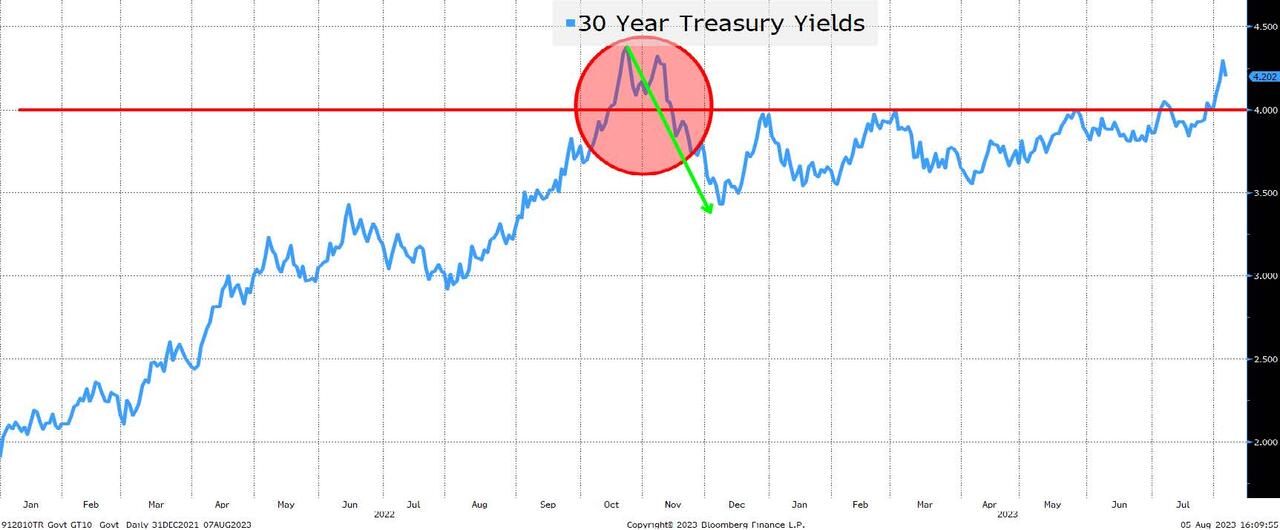
The 30-Year Yield Breaks Above 4%

For the second time since the Fed started hiking, the 30-year materially breached the 4% level. It had done that back in October 2022. At that time, the S&P 500 was at 3,600, a long way from today’s lofty level of 4,500. That move in Treasuries back in the autumn of 2022 was quickly followed by a move taking the 30-year Treasury back to 3.5%. It is unclear if that can or will happen again. It is also unclear if equities can be valued so highly now compared to then.

There are a few things that are “different” this time (yes, famous last words), but let’s first look at the other move in rates that caught my eye (and one that I’m completely on board with).

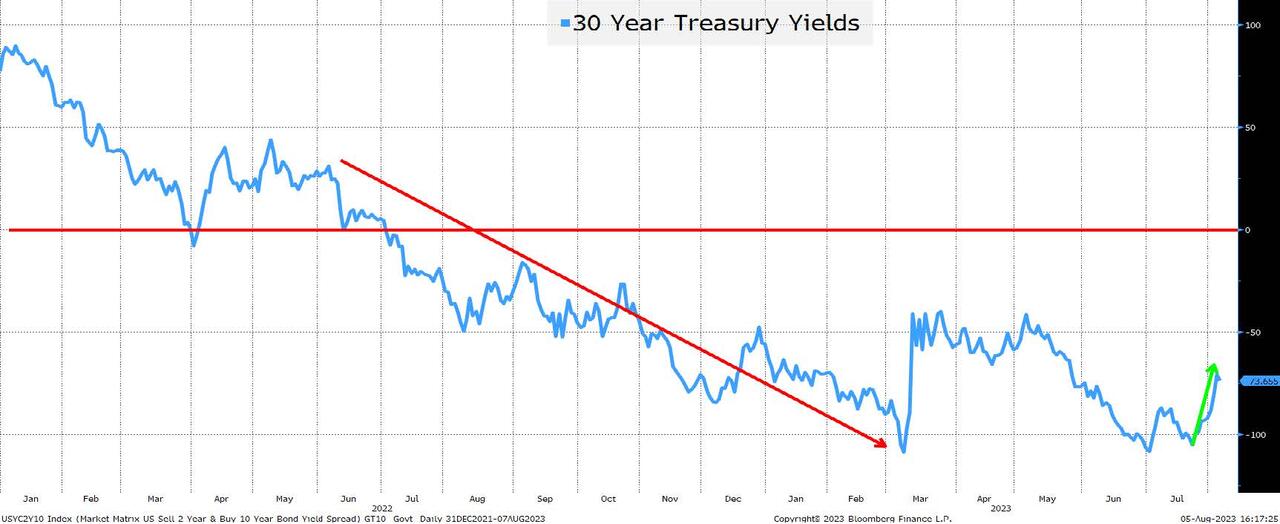
2-Year Yield vs 10-Year Yield Much Less Inverted

There are a few key differences in today’s environment compared to late 2022.

  • Landing. A soft landing seemed like wishful thinking back then, and while I’m dubious that it will happen, it is impossible not to admit the real possibility that we’ve made it through the worst of the Fed and survived. Clearly this possibility is one of the biggest drivers and helps explain why (unlike in late 2022) the curves are becoming less inverted as yields rally.
  • Fed.
    • The Fed was looking for excuses to hike (and any excuse that they could find turned into hawkish rhetoric and a hike). We are in an environment where the Fed is increasingly reluctant to hike and seems willing to play the “long and variable lag” card if they need an excuse to pause or skip a meeting.
    • The markets were willing to ignore the Fed’s insistence that they wouldn’t be cutting any time soon, but now they have been beaten into submission. The Fed has been effective at convincing markets that rate cuts are unlikely.
    • While the Fed was comfortable creating a recession this year, my belief is that the Fed is less willing to force us into a recession in an election year. The Fed is apolitical, so I’m not sure how valid my belief is, but I’d argue that creating a recession in an election year would influence the elections (it tends not to be good for incumbents). This means that forcing a recession could be viewed as being political, so they’d want to avoid it. Yes, all a bit weird, but the lessons of President George H. W. Bush, who went from being wildly popular to losing his bid for a second term (at least in part due to a recession that occurred while he was in office) cannot be lost on the Fed and certainly not on the politicians who seem more and more comfortable trying to exert influence on the Fed via the media.
  • Inflation. Double digit inflation is scary! Heck, even 5% inflation is scary and makes for great headlines. I’m not sure that 4% or even 3% strikes fear into the hearts of the American consumer or into the hearts of politicians craving soundbites to push the electorate one way or the other. While there is a lot of talk about sticky inflation (and some of the longer-term inflation risks that we’ve been discussing for ages), it will take a lot to motivate the Fed, the politicians, and the media. •
  • Term Premium. There is a lot of chatter about term premium. This makes sense to me. The Fed is unlikely to cut. Given some longer-term inflation pressures, it is easy to see the Fed move its “terminal” rate higher. So, if the “terminal rate” (lower than today’s rate) moves up over time, that will support higher yields at the longer end. The longer it takes for the Fed to cut rates to the terminal rate, the more support there is to keep longer-term yields higher. But is that enough to take us above last year’s high yields? I suspect not.
  • Debt Issuance. The growth in U.S. debt and the need to issue more bonds across the curve will put pressure on yields to go higher as a simple matter of supply and demand. But it also leads to some other questions.

“Credit”

Fitch downgraded the U.S. debt rating to AA+. At the time, I took the stance that “investors don’t buy Treasuries based on ratings”. That quotation was picked up by a myriad of financial publications (including Bloomberg, The New York Times, and the Financial Times). I completely stand behind that quotation and think that the downgrade was relatively trivial in the grand scheme of things.

I got some pushback, and maybe that is why stocks did poorly. The argument goes that if you make the “least risky asset” slightly riskier, than more risk premium must get priced into everything (from the long-end of the yield curve, to credit spreads, and also into equity valuations). I could have always “bought into” (or in this case “sold into”) the argument if something had really changed. But the difference between AA+ and AAA seems trivial to me. Sure, BB and AA are different, but what the heck is the difference between AAA and AA+? I’ve got more important things to worry about.

In an era where the NRSROs (Nationally Recognized Statistical Rating Organizations) have been looking to reduce the amount of debt that gets rated AAA, it isn’t at all surprising that the entities would take an opportunity to nudge ratings down slightly. If anything, the surprise to me is how long it took for another company to follow S&P’s lead.

I have no issue with the downgrade.

  • We are growing debt at a rapid pace in bad times and good. Somehow, we seemed to have gone from a nation that went into deficit spending in times of trouble (but made efforts to rein it in during good economic times) to increasing debt during what looks like economic “boom” times. Once upon a time, we seemed to experience debt “hangovers” (where we woke up one morning and promised ourselves that we wouldn’t do that again). Now we are a nation that wholeheartedly embraces the “hair of the dog” concept. This seems to be a shift in our attitude towards debt and would make me nervous about rating our debt as AAA.
  • Barely a pretense of worrying about debt and deficits. I read somewhere that the last time Congress completed all appropriation bills on time was over 20 years ago (in 1996). I’m not an expert, but that doesn’t seem good. The “debt ceiling” (which we will come to in a moment) is clearly not a “ceiling” in any way that you or I understand a ceiling. The party not in charge sometimes seems to hint about being concerned about debt, but the reality seems to be that they just don’t like that the debt is increasing on expenditures (other than the expenditures they want). When I think of D.C. right now, I think of “bread and circuses”. This was the Roman technique of keeping people happy by spending money that they didn’t have. This changing attitude seems to be worth something when considering the creditworthiness of the nation.
  • Threatening not to pay on time. It seems ridiculous that periodically we get confronted with the so-called debt ceiling and that more and more we seem willing to test it out and see if they can push us into non-payment (even for a few days). It seems like this should be a non-starter, but we flirt with it periodically, and while it hasn’t gone past the flirtation stage, it is possible that we could move beyond it. This is another reason to think that AAA might be a bit too good.
  • I do not understand why:
    • Policies can be passed that will inevitably lead to breaching the debt ceiling. Why, if something would likely push us over the debt ceiling, is it allowed? Not passing policies that are guaranteed to breach the debt ceiling would be a more interesting (and possibly effective) approach to managing the debt ceiling.
    • Why don’t we examine government policies and their impact on the budget for 10 years? Computers aren’t powerful enough to go beyond that? Since the debt ceiling isn’t really a debt ceiling, I guess that it doesn’t matter how far out we run our projections, but it seems weird to me that 10 years seems to be the limit of what is projected, which in turn, influences policy decisions.

I guess that is a long way of saying that I think the message being sent to D.C. by Fitch is that “we are heading in the wrong direction and while it isn’t remotely concerning from a risk standpoint today, we can’t just let you go down this path without at least raising our hand and trying to get your attention.”

Geopolitical Inflation

Our position on longer-term inflation is:

  • Inflation will run 3% to 5% on average for 3 to 5 years.

That has been our position for some time now and is largely (but not totally) driven by the efforts that the country and companies are taking to make their supply chains “more secure”.

We first tried to hammer home the point that ESG is Inflationary in March of 2021. I view “ESG Inflation” as a subset of “Geopolitical Inflation”. The two main themes of “ESG Inflation” were:

  • If it was the cheapest way to produce goods, then we’d already be doing it.
  • Certain places produce goods more cheaply for the “wrong” reasons.

We had some conditions that would be required for “ESG Inflation” to gain momentum:

  • Consumers willing to pay more for ESG friendly products.
  • Investors willing to pay more for ESG friendly companies.

I think that we could substitute “ESG” with “Security” or “Geopolitical” and come to the same conclusions, which are:

  • 1. Companies and countries are thinking about supply chains from more than just a simple “cost” analysis (and that is inflationary).
  • 2. The conditions for companies to act exist (not having access to your products will do that to you).

This fits in perfectly well with our Battle for Rare Earths and Critical Minerals theme. Global Relations Cooling is another key element of all of this “Geopolitical Inflation”. We hit on many of these inflationary and problematic issues at our Geopolitical Summit West earlier this year.

I cannot believe The Recentralization of China is 2 years old or that World War v3.1 may be far more broadly applicable than originally thought.

The flipside of the coin is the potential risk to sales for U.S. corporations if we are correct in the Shift From Made in China to Made By China and their increasingly deft use of their currency to shift power away from the West. Potential lost sales by non-Chinese companies (especially into emerging markets) would hurt earnings power. It isn’t part of the “inflation” argument, but it is a real risk that should be aggressively addressed now before it is too late and we find ourselves well down a slippery slope.

I could, quite easily, link to even more reports, but I’m running out of time, and you get the gist – this is a subject that is near and dear to my heart and one I think that we all need to be thinking about.

In any case, I expect inflation to be persistently higher for longer than it has been in the past few decades as every step of creating “secure” supply chains will increase costs (at least until they have been rebuilt). The term “secure” can also apply quite broadly.

My 3% to 5% estimate for 3 to 5 years is admittedly a finger in the air estimate and maybe I’m too low (or too short), but that is my working premise on inflation.

Is the 80 Cent Widget More Expensive than the 1 Dollar Widget?

This is the analogy that we use in meetings. It is meant to provoke thought and discussion and I think that this is relevant to most companies.

A few years ago, if it cost 80 cents to make a widget (say in China), but $1 to make the widget in the U.S., the choice was obvious – China.

But now companies are examining the accuracy of that 80 cent cost. What isn’t being priced into the 80 cents? Shipping costs? Shipping availability? Pollution? Hazardous or unsavory work conditions? Ability to refuse to produce or ship? How much is the intellectual property theft costing (extra important if I’m correct in the shift to China selling “their” goods and brands globally)? Sure, some things can be insured (driving up the cost), but some of the costs are intangible. Things that we either ignored or dismissed as “unlikely” turned out to have real costs. Are they outliers, or could they be repeated? Maybe another pandemic is unlikely, but our relationship with China seems to be shifting and it is impossible to ignore their growing influence across the globe. So maybe that 80 cent widget really should be viewed as costing 90 cents. Difficult to account for, but maybe an accurate reflection of the true cost.

With a bit of government support maybe we can get that cost down to 95 cents domestically. Bills like the Chips Act are meant to address this.

Finally, if investors value companies which have taken steps to secure/make their supply chains more sustainable and customers are willing to spend a fraction more for such products, then maybe the stock price can go up, even while paying 95 cents instead of 80 cents.

A theoretical and simple analogy, but I think that this is what companies (and countries) are facing in their decision process.

Bottom Line

Geopolitical (supply chain, ESG, rare earths, or any other name) inflation is real and persistent. The downgrade of the U.S. shouldn’t affect risk premiums (as it was negligible) and it wasn’t a “wrong” step to take.

However, this time is “different” enough that even with all that is going on, I think that curves will continue to become less inverted (though driven more by 2-year yields drifting lower than longer yields heading higher). Maybe the new range is 4% to 4.25% on the long bond, but I struggle to get too bearish on Treasuries even with my geopolitical inflation view.

Tyler Durden
Sun, 08/06/2023 – 14:00

via ZeroHedge News https://ift.tt/OVJsnvH Tyler Durden

Oregon Allows Self-Serve Gas: New Jersey Now Alone In Nanny-State Prohibition

Oregon Allows Self-Serve Gas: New Jersey Now Alone In Nanny-State Prohibition

Under a law that took effect immediately upon its signing by Governor Tina Kotek, drivers in Oregon are finally free to pump gas into their own vehicles, rather than being forced to wait for a gas station attendant to handle it for them. That leaves New Jersey as the last state where where pumping your own gas is a crime — punishable by a fine of up to $500

Self-serve was outlawed in Oregon in 1951. Lawmakers said the practice was too dangerous, citing the fact that “cashiers are often unable to maintain a clear view of and give undivided attention to the dispensing of [gas] by customers.”

Leaving one’s car also supposedly exposed drivers to “the increased risk of personal injury resulting from slipping on slick surfaces” and an “increased risk of crime.” What’s more, wrote the law’s authors, “the dangers of crime and slick surfaces…are enhanced because Oregon’s weather is uniquely adverse, causing wet pavement and reduced visibility.”  

Most of that makes us chuckle, but then again…

Oregon’s self-serve prohibition started eroding a few years ago. First, the state started allowing self-serve at night in rural areas, and then allowed it 24 hours a day in eastern Oregon. The first steps toward a degree of sanity were influenced by the Covid-era labor shortages created by federal programs that paid people not to work. 

We live in a small town in a large county and can’t find employees to pump fuel,” Steve Rogers, who lives near the Cascade Mountains, told legislators. “We are paying top dollar and also offering insurance, paid time off and retirement benefits, and still cannot fully staff.”

As with most regulations, the ones barring self-service weren’t created to protect the public, but rather to serve certain politically-influential constituencies. As Patrick Murray, the director of the Monmouth Polling Institute, explained to NBC:

“It goes back to the middle of the 20th century. There were forces involved who wanted to protect their interests in terms of the smaller gas owners against mega gas stations that were starting to be built at the time that would require self-service to be profitable.”

We wish we could report that Oregon’s simply withdrew the prohibition, leaving market forces to guide pumping decisions from here. Of course, that isn’t the case. Under the new law:

  • At least half the pumps must still be reserved for full-service gas-pumping. Rightly, stations don’t have to offer self-serve. 
  • Though full-service obviously costs more to deliver, stations have to charge the same price for both options.  

via Oregonians for Choice at the Pump

Union leaders howled at the prospect of Oregonians pumping their own gas, without the need for a paid attendant. Sandy Humphrey, secretary-treasurer of UFCW Local 555, told Associated Press that the move represents a “blatant cash grab for large corporations…With over 2,000 gas stations in Oregon, laying off just one employee per location represents millions of dollars a year that giant corporations are not paying in wages, benefits and public payroll taxes.

New Jersey now stands alone in mandating universal full-service gas-pumping, with a ban that was enacted in 1949. Though calls for repeal periodically surge along with rising gas prices, there’s nothing to suggest that any change is coming in the near future. 

Tyler Durden
Sun, 08/06/2023 – 13:30

via ZeroHedge News https://ift.tt/9XfwhoK Tyler Durden

“No Limit”: Elon Musk Says He’ll Fund Lawsuits Against Employers Who Fired Workers Over Their Twitter History

“No Limit”: Elon Musk Says He’ll Fund Lawsuits Against Employers Who Fired Workers Over Their Twitter History

Authored by Chris Menahan via InformationLiberation.com,

Elon Musk put out a call on Saturday for folks to contact Twitter/X if they “were unfairly treated” by their employer “due to posting or liking something on this platform” as he will help them sue and fund their legal bills with “no limit.”

“If you were unfairly treated by your employer due to posting or liking something on this platform, we will fund your legal bill,” Musk said. “No limit. Please let us know.”

“Elon understands that nothing changes behavior in the United States faster than threat of legal action,” Austen Allred commented.

“And we won’t just sue, it will be extremely loud and we will go after the boards of directors of the companies too,” Musk responded.

Musk suggested he was ready to take up the case of Kara Lynne, who was reportedly fired by Limited Run Games for following Libs of TikTok and other conservatives on Twitter.

Musk also suggested he may take up the case of a radical leftist who claims he was fired for “defending Hitler.”

Musk is a self-described “free speech absolutist” who has a clear disdain for cancel culture, and this latest move seems to align with his push to shift X away from content censorship, particularly relating to political and ideological views.

In December 2022, Musk tweeted that “cancel culture needs to be canceled.” Under his ownership, X has reinstated several accounts that were banned for policy violations under the previous ownership.

Many have theorized that the conservative boycott of Bud Light – one of the only successful conservative boycotts in perhaps decades – was particularly effective as a result of Musk’s takeover of Twitter and his unshackling of their previously-rigged algorithms.

Many companies are now reportedly afraid they’ll be the next “Bud Light” if they push transgenderism and other woke garbage.

In a similar vein, many colleges are now operating in fear that they’ll be sued for trying to get around the Supreme Court’s ruling against affirmative action.

The Wall Street Journal reported the “diversity officer” racket is rapidly contracting in part due to fears of lawsuits, which have only amplified in the wake of the ruling on affirmative action.

Tyler Durden
Sun, 08/06/2023 – 13:00

via ZeroHedge News https://ift.tt/6vJuRaz Tyler Durden

Moscow Airport Temporarily Halts Flights After Failed Drone Attack

Moscow Airport Temporarily Halts Flights After Failed Drone Attack

Moscow’s Vnukovo airport was forced to temporarily halt all flights due to a failed drone attack in the late morning hours, Russian officials said Sunday, in a rarity at a moment the Ukrainians step up efforts to strike inside the capital.

The airport is located about nine miles southwest of Moscow, and the defense ministry said the drone was inbound but was destroyed by electronic anti-air measures in the Podolsk region of the Moscow suburbs.

Vnukovo airport, file image

After a major Ukrainian drone attack on buildings in the Kremlin complex early this year, the military took steps to bolster anti-air measures and defenses in and around Moscow, including erecting Pantsir systems on tall buildings.

Moscow Mayor Sergey Sobyanin wrote on Telegram: “Today at around 11:00 a.m. a drone attempted to break through to Moscow. It was destroyed on the approach by air defenses. Well done military.”

It is significant that Ukraine’s long-range drone attacks have begun to halt or hinder air traffic over Moscow, even if briefly, and it comes after Ukraine’s President Zelensky vowed “return the war” to Russian soil. The past week saw at least two attacks on Moscow City business district. 

The Associated Press notes of Sunday’s drone operation, “The attack was one of four strikes on the Russian capital in the space of a month, spotlighting Moscow’s vulnerability as Russia’s war in Ukraine drags into its second year.”

Russia had on Saturday vowed that a response is coming to these increased cross-border incidents, particularly after the late Friday sea drone attack on a Russian civilian tanker near the Kerch Strait, which Moscow condemned as a “terrorist attack”. 

“The Kyiv regime, meeting no condemnation from Western countries and international organisations, is actively applying new terrorist methods, this time in the waters of the Black Sea,” Russian Foreign Ministry spokeswoman Maria Zakharova said, while vowing retaliation:

“There can be no justification for such barbaric actions, they will not go unanswered and their authors and perpetrators will inevitably be punished,” she added.

This weekend has seen heavy fighting in Ukraine and extensive Russian strikes across the country, resulting in multiple casualties, including among civilians.

Meanwhile, Ukraine continues major strikes on Crimean transport infrastructure and bridges

On Sunday, Ukraine’s air force said Russian forces launched 70 drones and missiles total, launched by both air and sea.

The Russians have also continued to deploy Iranian-made Shahed drones, and have even ramped up production in cooperation with Tehran at a joint facility on Russian soil.

Tyler Durden
Sun, 08/06/2023 – 12:30

via ZeroHedge News https://ift.tt/U5O7Zi0 Tyler Durden

Central Bank Gold Demand In First Half Of 2023 Was The Highest On Record

Central Bank Gold Demand In First Half Of 2023 Was The Highest On Record

Via SchiffGold.com,

Despite significant selling by Turkey that slowed net central bank gold buying in the second quarter, central banks added a record amount of gold to their reserves through the first half of 2023.

Net central bank gold purchases totaled 387 tons through the first half of the year, according to data compiled by the World Gold Council. That was the highest first-half total since the organization started compiling quarterly data in 2000.

Net central bank purchases were down in Q2 after setting a first-quarter record due to net sales of 132 tons between April and June. On net central banks added 102.9 tons of gold to their reserves in the second quarter.

Turkey was the biggest gold buyer in the first quarter but turned to selling in March. In a three-month span, Turkey reduced its gold holdings by 160 tons. According to the World Gold Council, this was a response to local market dynamics and didn’t likely reflect a change in the Turkish central bank’s long-term gold strategy.

Gold was sold into Turkey’s domestic market to satisfy very strong bar, coin and jewelry demand following a temporary partial ban on gold bullion imports.”

Significantly, Turkey resumed purchasing gold in June, adding 11.4 tons to its reserves.

There were other sellers in the second quarter. Kazakhstan reduced its gold holdings by 38 tons, and Uzbekistan sold 19 tons of gold. These two banks were the biggest sellers of gold during the first quarter of this year.  It is not uncommon for banks that buy from domestic production – such as Uzbekistan and Kazakhstan – to switch between buying and selling.

Russia, Cambodia and Germany reported slight declines in their reserves in Q2, likely due to coin minting.

Nine central banks were net gold purchasers during the first half of 2023

The People’s Bank of China was the biggest gold buyer in H1, adding 103 tons of gold to its official holding. Its purchases in the second quarter extended its buying streak to eight straight months.

Since recommencing reports of purchases in November 2022, the Peoples Bank of China has increased its official gold holdings to 2,113 tons. Gold accounts for 4% of China’s total reserves.

The Chinese central bank accumulated 1,448 tons of gold between 2002 and 2019, and then suddenly went silent until it resumed reporting in November 2022. Many speculate that the Chinese continued to add gold to its holdings off the books during those silent years.

There has always been speculation that China holds far more gold than it officially reveals. As Jim Rickards pointed out on Mises Daily back in 2015, many people speculate that China keeps several thousand tons of gold “off the books” in a separate entity called the State Administration for Foreign Exchange (SAFE).

Last year, there were large unreported increases in central bank gold holdings.  Central banks that often fail to report purchases include China and Russia. Many analysts believe China is the mystery buyer stockpiling gold to minimize exposure to the dollar.

The Monetary Authority of Singapore ranked as the second largest buyer during H1, adding 73 tons of gold it its hoard.

Poland also added a significant amount of gold to its reserves after resuming purchases in April. Polish gold holding rose by 48 tons through the first half of ’23.

In the fall of 2021, Bank of Poland President Adam Glapiński said the central bank planned to add 100 tons of gold to its reserves in 2022. It’s unclear why the bank didn’t follow through. The recent purchases could signal the beginning of another round of buying to reach that 100-ton goal.

Six other countries added gold to their holdings in H1.

  • India  — 10 tons

  • Czech Republic — 8 tons

  • The Philippines — 4 tons

  • Iraq — 2 tons

  • The ECB — 2 tons

  • Qatar — 2 tons

According to the World Gold Council, “Selling activity in Q2 has done little to dent the underlying positive trend in central bank gold demand.”

According to the 2023 Central Bank Gold Reserve Survey recently released by the World Gold Council, 24% of central banks plan to add more gold to their reserves in the next 12 months. Seventy-one percent of central banks surveyed believe the overall level of global reserves will increase in the next 12 months. That was a 10-point increase over last year.

Tyler Durden
Sun, 08/06/2023 – 12:00

via ZeroHedge News https://ift.tt/a3HuO6z Tyler Durden