Scholar of Dishonesty Accused of Research Dishonesty Sues for Libel, Claiming Accusers Were Dishonest

Prof. Francesca Gino, a celebrated scholar studying dishonesty, was recently put on unpaid leave by Harvard, based on allegations that she had fabricated data in her studies; the allegations had been raised and discussed by three professors who run Data Colada (Uri Simonsohn of ESADE Business School in Barcelona, Leif Nelson of the University of California, Berkeley, and Joseph Simmons of the University of Pennsylvania). Yesterday, in Gino v. Harvard Univ., Gino sued Harvard for employment law violations (basically, discrimination and breach of contract) and both Harvard and Data Colada for libel. The complaint is long, and I won’t try to summarize it in any more detail here; but those interested in the controversy (or in such controversies generally) may want to read it, of course recognizing that it’s just Gino’s side of the story. I expect to write more about this as the defendants raise their objections, likely in motions to dismiss.

The post Scholar of Dishonesty Accused of Research Dishonesty Sues for Libel, Claiming Accusers Were Dishonest appeared first on Reason.com.

from Latest https://ift.tt/PkIB8Se
via IFTTT

AB InBev Demonstrates “Resilience” In 2Q Results Despite Bud Light Boycott

AB InBev Demonstrates “Resilience” In 2Q Results Despite Bud Light Boycott

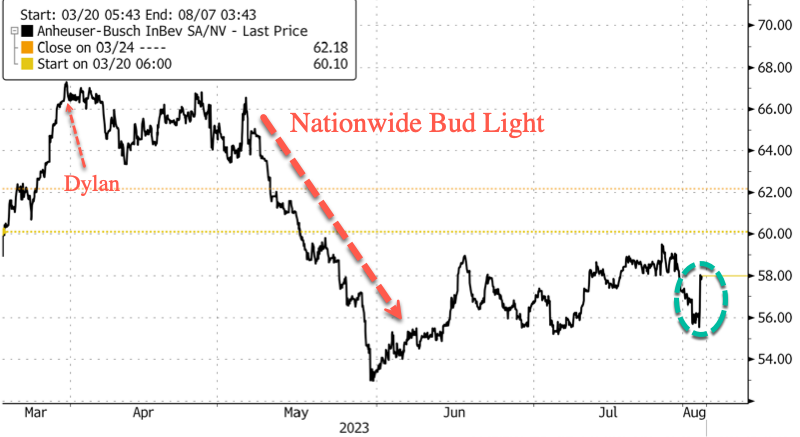
Anheuser-Busch InBev shares are up as much as 3% in New York during premarket trading Thursday after profit growth beat analysts’ expectations despite a slide in the US market following the Bud Light marketing fiasco with transgender social media influencer Dylan Mulvaney. 

The world’s largest brewer reported earnings for the second quarter that gained more than 20% in Brazil, China, and Colombia, which offset a massive 28% plunge in the US market. AB InBev maintained its profit guidance for the year. 

The weakness in the US market was “primarily due to the volume decline of Bud Light,” the brewer pointed out. Bud Light’s partnership in early April with Mulvaney sparked a nationwide boycott of the beer. 

AB InBev, which also manufactures Budweiser, Corona, and Stella Artois, reported revenues increasing 7.2%, beating a company-provided market consensus of 6.4%. 
“Given Bud Light’s travails this is an impressive demonstration of AB InBev’s resilience and diversification . . . we believe that the share price has overreacted to the Bud Light situation,” RBC Capital Markets analysts wrote in a note to clients. 

“We consider this to be a better result than had been feared,” wrote Investec analyst Alicia Forry. She added, “The unchanged full-year outlook is also positive.” 

Rivals have been benefiting from Bud Light’s demise. In June, Constellation Brands Inc. reported revenue that exceeded analysts’ expectations after its Modelo brand was crowned the bestselling US beer. On Tuesday, Miller Lite maker Molson Coors Beverage Co. recorded record sales. Bloomberg Intelligence analyst Duncan Fox noted that one-third of AB InBev’s profit last year was from North America. 

Moving forward, AB InBev maintains its forecast for 2023, forecasting Ebitda growth to be in line with its medium-term outlook of between 4% and 8%. The brewer also expects revenue to outpace Ebitda from a combination of volume and price. 

Royal Bank of Canada Analysts said they were “pleasantly surprised” today despite no recovery in sight for Bud Light. 

AB InBev shares were up 3% in the premarket hours. 

The earnings report highlights the importance of AB InBev’s diverse portfolio to remain resilient amid the demise of Bud Light. 

Tyler Durden
Thu, 08/03/2023 – 12:10

via ZeroHedge News https://ift.tt/0yKHdXu Tyler Durden

Freight Volume And Spending Declined Markedly In Second Quarter

Freight Volume And Spending Declined Markedly In Second Quarter

By Trucking News

Truck freight volume and spending in the second quarter of 2023 declined by the highest levels since the early days of the pandemic, the latest U.S. Bank Freight Payment Index revealed. Spending by shippers dropped 10.9% compared to the second quarter of 2022 while shipment volume dropped 9%, according to a statement from the Minneapolis-based bank.

“Trucking is in the midst of a significant slowdown,” said Bob Costello, senior vice president and chief economist at the American Trucking Associations.

Weaker consumer demand for goods and a slowdown in manufacturing activity and housing starts are having a major impact on the industry – especially carrier operations.”

Nationwide shipment levels have now decreased for five consecutive quarters. In the second quarter, volume dropped most in the Northeast (27.1%) and Southeast (12.6%) year-over-year. The Southwest continued to be a bright spot, with shipments increasing 14.8%.

“In the spot market, we’ve been observing for a while sharp spending drops caused by lower volumes and increased capacity. This trend has now solidly penetrated the contract freight market,” said Bobby Holland, director of freight business analytics, U.S. Bank.

“Nearly every category we track – both nationwide and regionally – contracted in the second quarter.”

The Midwest region had the sharpest spending drop in the second quarter, 18.7% year-over-year. The Northeast and West also experienced double-digit spending declines, dropping 10.9% and 10.2%, respectively versus the second quarter of 2022.

The bank’s regional data found:

  • WestTruck freight continued to struggle in the West region as port activity and housing starts there continued to slow. This is the lowest point for shipments in the West in three years.

  • SouthwestContinuing to outperform other regions, the Southwest’s volume is benefiting from increased truck-transported trade with Mexico. The 14.8% year-over-year increase in shipments is the highest since 2018.

  • MidwestContinued slowdowns in manufacturing likely led to year-over-year shipments dropping by the largest level in the region since Q4 2021. Yearly spending also dropped by the largest amount since Q2 2020.

  • NortheastThe 27.1% volume contraction is the largest in the history of the Freight Payment Index. The region faces multiple headwinds, including low housing starts. However, the contraction in household consumption likely had the biggest impact for this populated area.

  • Southeast: Even though shipments contracted 12.6% year over year and slightly on a linked quarter basis, this was an improvement for the region. In the first quarter, shipments fell 16.1% year over year and 10.1% on a linked quarter basis.

Truck freight spending levels have now contracted year-over-year for two consecutive quarters. With spending at all-time high levels for the preceding six quarters, the recent drops brought spending activity back to its relatively strong levels of mid-2021.

Tyler Durden
Thu, 08/03/2023 – 11:50

via ZeroHedge News https://ift.tt/PIuYlBd Tyler Durden

“Everything Appears To Be A Cover Up”: Capitol Police Chief Challenged J6 Narrative In Never-Aired Tucker Carlson Interview

“Everything Appears To Be A Cover Up”: Capitol Police Chief Challenged J6 Narrative In Never-Aired Tucker Carlson Interview

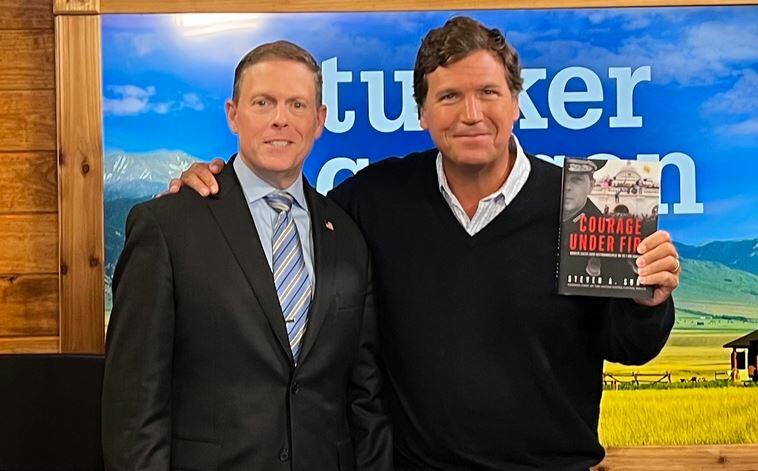
In never-before-seen footage that was withheld by Fox News, former Capitol Police Chief Steven Sund told former Fox News host Tucker Carlson that January 6th was a complete debacle and a “cover up.”

“Everything appears to be a cover up,” Sund tells Carlson in footage obtained by the National Pulse. “Like I said, I’m not a conspiracy theorist,” he continued. “…but when you look at the information and intelligence they had, the military had, it’s all watered down. I’m not getting intelligence, I’m denied any support from National Guard in advance. I’m denied National Guard while we’re under attack, for 71 minutes…

Beginning around 19 minutes into the conversation, Sund tells Tucker: “If I was allowed to do my job as the chief we wouldn’t be here, this didn’t have to happen,” adding that he’s “pissed off” about being “lambasted in public” over what happened that day.

The full interview has thus far been hidden from the public at the behest of Rupert Murdoch’s increasingly left-wing Fox News channel, which unceremoniously fired its prime time host Tucker Carlson allegedly as part of a private settlement with Dominion Voting Systems. -National Pulse

“It sounds like they were hiding the intelligence,” Carlson said, to which Sund responds: “Could there possibly be actually… they kind of wanted something to happen? It’s not a far stretch to begin to think that. It’s sad when you start putting everything together and thinking about the way this played out… what was their end goal?”

Last month Carlson told Russell Brand that Sund said the crowd on January 6th was ‘filled with federal agents.’

“I interviewed the chief of the Capitol Police, Steven Sund, in an interview that was never aired on Fox, by the way — I was fired before it could air, I’m gonna interview him again,” Carlson said.

“But Steven Sund was the totally non-political, worked for Nancy Pelosi, I mean, this was not some right-wing activist. He was the chief of Capitol Police on January 6, and he said, ‘Oh yeah, yeah, yeah, that crowd was filled with federal agents.’ What? ‘Yes.’ Well he would know, of course, because he was in charge of security at the site.”

“So, the more time has passed… it becomes really obvious that core claims they made about January 6 were lies,” Carlson explained.

“The amount of lying around January 6, and it was obvious in the tapes that I showed, is really distressing.”

Watch:

Tyler Durden
Thu, 08/03/2023 – 11:30

via ZeroHedge News https://ift.tt/zANVEkf Tyler Durden

Swipe Left

Swipe Left

By Stefan Koopman, Senior Macro Strategist at Rabobank

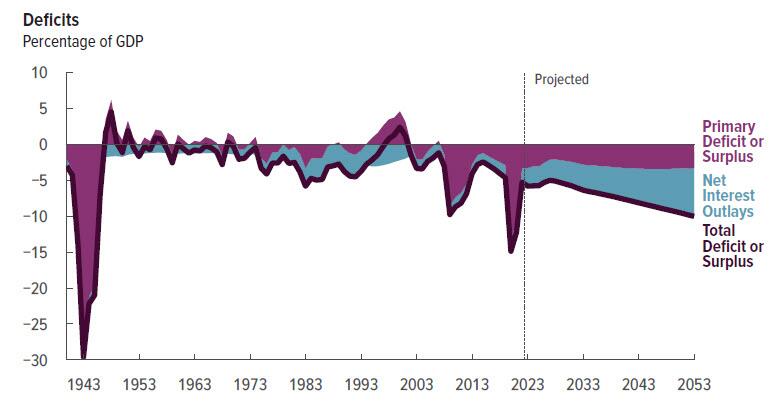
While most agree the US credit downgrade by Fitch will have limited real-world impact, it did serve as a reminder of the frankly unhinged state of US fiscal policy. According to the Congressional Budget Office, the federal deficit equals 5.8% of GDP in 2023, only declining to 5.0% of GDP by 2027 before growing steadily to reach 10.0% of GDP in 2053. The clear risk that a fiscal course correction has to be made someday caused equity investors to ‘swipe left’. The European Stoxx 600 closed down 1.6% – its largest drop in a month – and the S&P 500 slid 1.4% as well. The Nasdaq tumbled by 2.2%. The July rally had forced shorts to cover and brought in some reluctant recession-fearing buyers, leaving risky assets fragile.

The sell-off makes sense as an instinctive reaction, even if the downgrade does not change the practical value of US Treasuries. It is still a reserve asset that (eventually) pays you a coupon and hands back your notional, it has an investment proposition if you see yields falling, and it is very useful collateral. Give or take a few basis points, UST yields were essentially unchanged after the Fitch slap on the wrist. Indeed, bond investors only started to swipe left after the Treasury’s quarterly refunding announcement of higher-than-expected issuance. 10-year USTs are now trading at 4.13% – some 15bps higher than earlier this week and a 2023 high. The dollar appreciated to 1.093 versus the euro reflecting yesterday’s broader risk off sentiment.

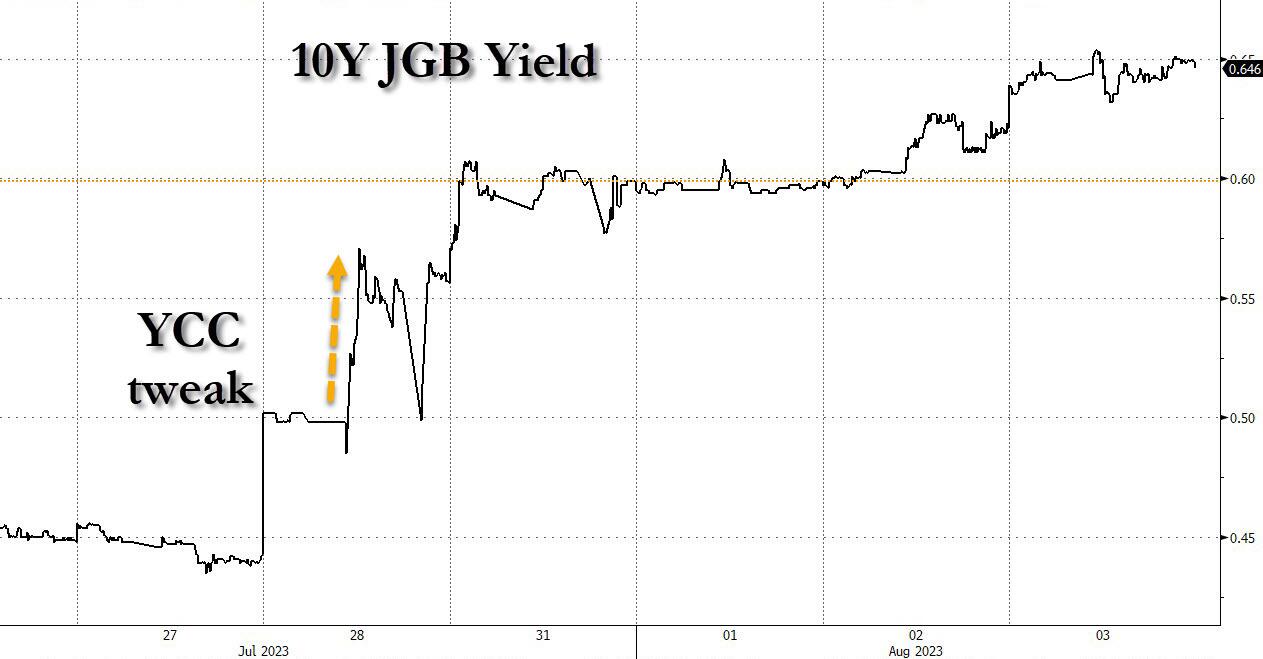
The Bank of Japan came into the market for the second time this week, sending a signal that its tolerance for higher bond yields has limits. It remains vague what exactly the Bank of Japan was attempting to signal by its change to YCC last week, but its actions make clear that it won’t tolerate a rapid move to the new 1% upper limit. The yen weakened a bit and now trades at 143.6 versus the dollar.

We explained yesterday why we tend to swipe left whenever the ADP survey shows up on our screens, but given that it was the only data release of the day and that it added to the bond sell-off, we’re going to give it the benefit of the doubt. The survey showed a higher-than-expected 324k rise in employment in July, well above the 200k consensus expectation for tomorrow’s official payroll figures. The job gains were boosted by an astonishing 201k rise in leisure and hospitality. This is also where we find the largest discrepancy between the latest couple of ADP and NFP reports, possibly due to differences in seasonal adjustment.

Now let’s make a short segue into the world of regulation (… sorry, now please don’t swipe left on me!). The UK government’s announcement to indefinitely extend the use of the EU’s CE safety marking, instead of requiring businesses to adopt the UK-specific UKCA system, again swiping left on Brexit’s core rationale. This seemingly mundane decision indicates continued alignment with EU standards, since CE compliance requires adhering to EU regulations. Even though UKCA isn’t abandoned, in practice it will mean that when a British firm only thinks about exporting something, it will seek to conform to EU standards and update these when the EU does.

The decision highlights three key implications.

  1. The sudden rush to the exit and the absolutist interpretation of “sovereignty” have created real costs and real inefficiencies for UK businesses, which constrained their supply capacity and contributed to higher inflation.

  2. Despite the “take back control” rhetoric, the UK finds itself forced to align with the EU in practical terms given their economic interdependence – a concept at the heart of Anu Bradford’s “Brussels Effect” theory. This was a live test of that theory, and the government has now recognized that pure sovereignty provides less control than having a seat at the table.

  3. It casts doubt on the UK’s planned regulatory controls on EU agri-food imports. This is a can that reportedly will be kicked down the road once again. High food inflation and a lack of political benefit of making the life of voters even more difficult are two key reasons. Even when controls are introduced at some point in the (distant?) future, limited infrastructure and lack of political will to invest in staff, scanners and structures suggest minimal real enforcement.

Tyler Durden
Thu, 08/03/2023 – 11:10

via ZeroHedge News https://ift.tt/I8c5Co7 Tyler Durden

With Bond-Stock Correlation At Record, Ackman’s Short Treasuries While Buffett’s Buying

With Bond-Stock Correlation At Record, Ackman’s Short Treasuries While Buffett’s Buying

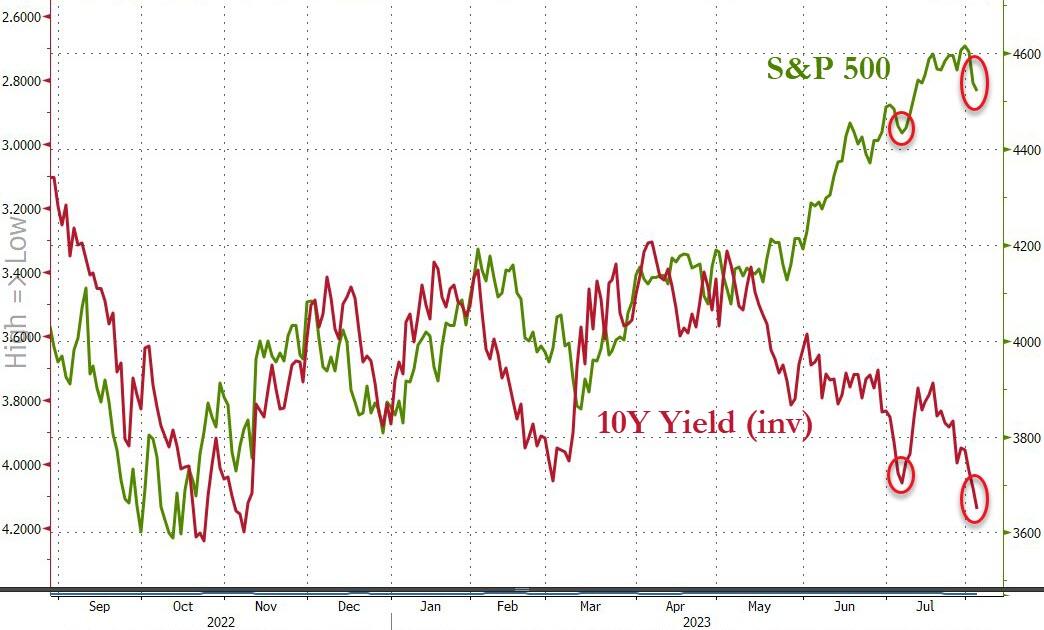
Equity markets appear to finally be starting to react to the move in bonds with 10Y yields at their highest level since November 2022…

Source: Bloomberg

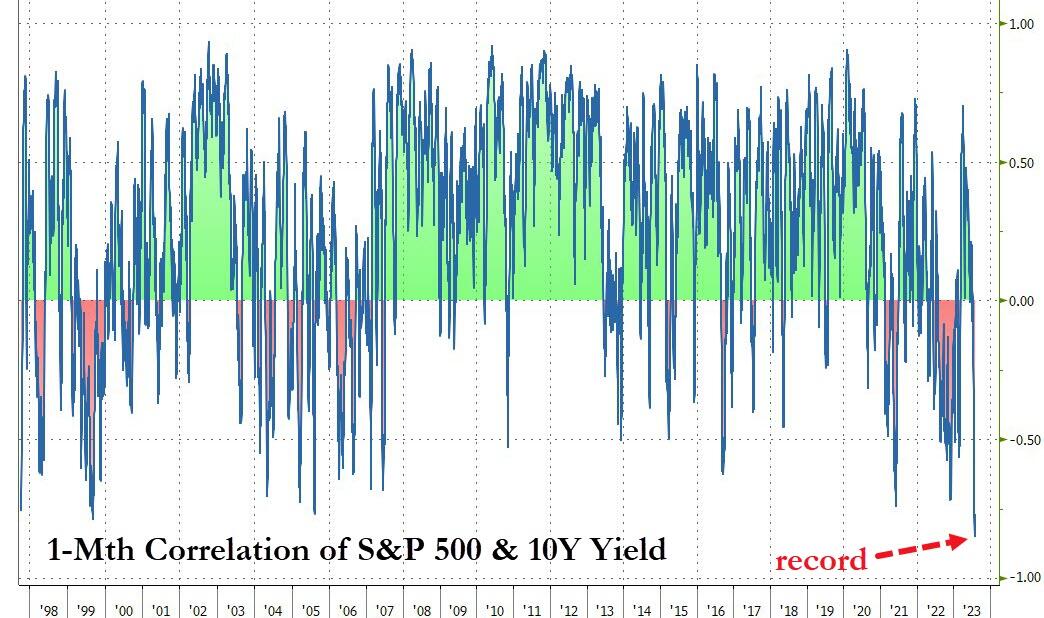
Most notably, the correlation of changes in the the S&P 500 relative to 10Y yields has dropped to its most negative ever…

Source: Bloomberg

And while rates have been moving higher recently, hedge fund manager Bill Ackman is still surprised that they are not a lot higher.

In his ubiquitously long tweet thread, he explains that he is short Treasuries (as both a hedge on long-duration stocks – think about the correlation above – and as a standalone bet that yields go higher, prices of bonds lower): (emphasis ours)

I have been surprised how low US long-term rates have remained in light of structural changes that are likely to lead to higher levels of long-term inflation including de-globalization, higher defense costs, the energy transition, growing entitlements, and the greater bargaining power of workers. As a result, I would be very surprised if we don’t find ourselves in a world with persistent ~3% inflation.

From a supply/demand perspective, long-term Treasurys (T) also look overbought. With $32 trillion of debt and large deficits as far as the eye can see and higher refi rates, an increasing supply of T is assured. When you couple new issuance with QT, it is hard to imagine how the market absorbs such a large increase in supply without materially higher rates.

I have also been puzzled as to why the @USTreasury hasn’t been financing our government in the longer part of the curve in light of materially lower long-term rates. This does not look like prudent term management in my opinion.

Then consider China’s (and other countries’) desire to decouple financially from the US, YCC ending in Japan increasing the relative appeal of Yen bonds vs. T for the largest foreign owner of T, and growing concerns about US governance, fiscal responsibility, and political divisiveness recently referenced in Fitch’s downgrade.

So if long-term inflation is 3% instead of 2% and history holds, then we could see the 30-year T yield = 3% + 0.5% (the real rate) + 2% (term premium) or 5.5%, and it can happen soon.

There are many times in history where the bond market reprices the long end of the curve in a matter of weeks, and this seems like one of those times.  

That’s why we are short in size the 30-year Tfirst as a hedge on the impact of higher LT rates on stocks, and second because we believe it is a high probability standalone bet.

There are few macro investments that still offer reasonably probable asymmetric payoffs and this is one of them.

The best hedges are the ones you would invest in anyway even if you didn’t need the hedge.  This fits that bill, and also I think we need the hedge.

We do note that Ackman later qualified his ‘short’ Treasury position is in fact in options:

We implement these hedges by purchasing options rather than shorting bonds outright. This makes it easier to sleep at night as it makes your downside finite. Our sleep-at-night test’ is a critical risk management tool.

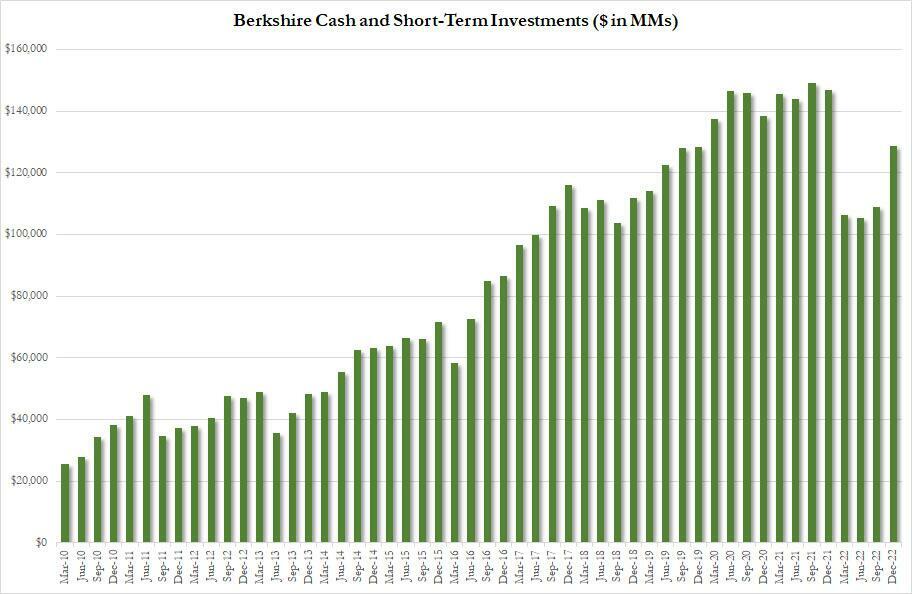
But, on the other side of the fence, Warren Buffett came out this morning, shrugging off Fitch’s USA downgrade, confirming that Berkshire Hathaway is still buying $10 billion in Treasuries every Monday.

“There are some things people shouldn’t worry about,” he told CNBC’s Becky Quick.

“This is one.”

That’s quite cash haul…

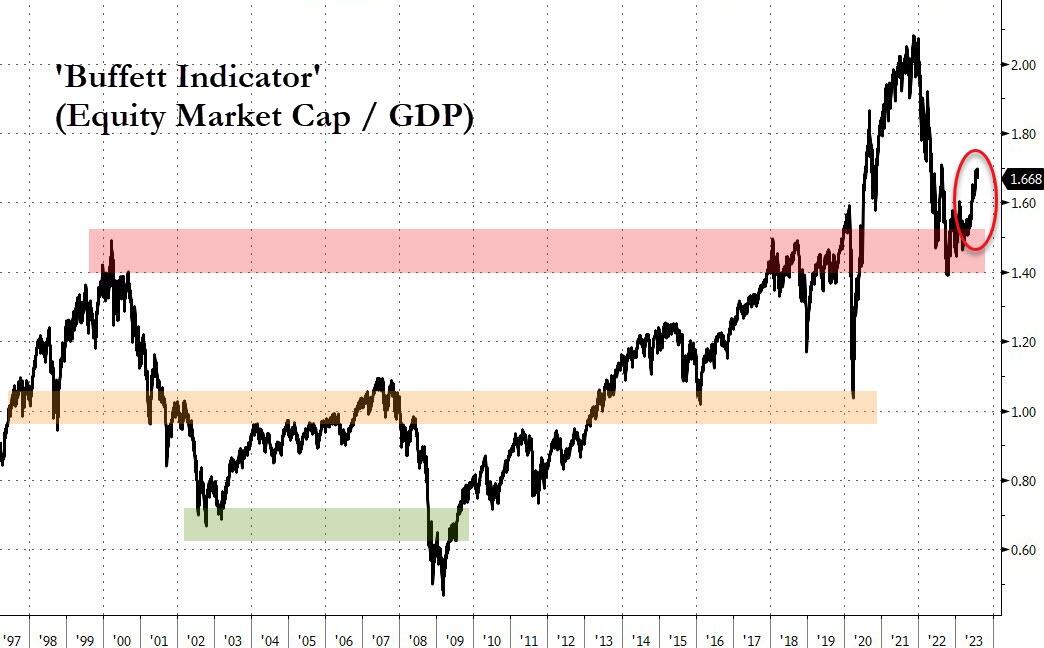
It appears Buffett still thinks the US equity market is too expensive…

Source: Bloomberg

So to summarize – the bond-stock-relationship regime has never been this extremely decoupled; Ackman is shorting bonds as a hedge on high-flying (long duration) stocks; and Buffett is buying bonds (because stocks are too expensive still).

Does that sound like a stock market that mom-and-pop should be piling their hard-earned retirement savings into?

Tyler Durden
Thu, 08/03/2023 – 10:55

via ZeroHedge News https://ift.tt/HU9PYQ4 Tyler Durden

‘Four Pinocchios’: The Washington Post Admits Biden Has Been Lying About Hunter Not Accepting Money From China

‘Four Pinocchios’: The Washington Post Admits Biden Has Been Lying About Hunter Not Accepting Money From China

Authored by Jonathan Turley,

President Joe Biden has been a regular recipient of “Pinocchios” by the Washington Post for his false statements on subjects ranging from election laws to abortion protections to deficit reduction. 

Biden is undeterred and regularly repeats false stories from his life that have ranged from an invented arrest with Nelson Mandela to a zombie-like train conductor. Undeterred, this week he continued with the false claim about the “Joey, Baby” conductor.

Now, the President has a fresh set of “Four Pinocchios,” but the false claim is far more serious than inventing a conductor or rewriting the history of the Second Amendment. 

The Post is admitting that Biden has been lying about how his son Hunter never made money from China. It is the latest indication that the protective media wall surrounding Biden is beginning to crumble under the weight of new evidence in the corruption scandal.

Glenn Kessler wrote yesterday that Biden has repeatedly and categorically maintained that his son did not receive money from China.

“But now, nearly three years later, Biden’s assertions have been directly rebutted by Hunter himself. In court testimony last week, the younger Biden acknowledged that he in fact had been paid substantial sums in China — the first official confirmation that this was the case.”

What is curious is that Kessler and the Post waited for Hunter to effectively confess rather than take notice of money transfers and records released by House committees investigating the corruption scandal. The Post and most of the media have taken little observable journalistic interest in independently confirming such payments or benefits. Instead, the media has adopted a largely passive stance and waited for confessions rather than find confirmation.

Nevertheless, as with the laptop, there is some credit to be given for eventually confirming what has long been known.

Kessler noted that these dealings overlapped with the President’s travels and meetings:

“Twelve days after he flew to Beijing, Hunter Biden joined the board of a just-formed investment advisory firm known as BHR (Bohai, Harvest and Rosemont), whose partners included Chinese entities, including the man he introduced to his father. Separately, after Joe Biden left public office, Hunter Biden in 2017 inked a deal with CEFC China Energy, a Chinese energy conglomerate. The Washington Post reported last year that documents, including emails found on a Hunter Biden laptop that emerged during the final weeks of the 2020 presidential campaign, showed that over the course of 14 months, the CEFC and its executives paid $4.8 million to entities controlled by Hunter Biden and President Biden’s brother, James.”

Nevertheless, the Post emphasized that it “did not find evidence that Joe Biden personally benefited from or knew details about the transactions with CEFC.” Of course, the Post has not been known to be particularly active in independently trying to confirm such benefits . . . absent another Biden admission or confession.

As with the clearly false claims that he had no knowledge or involvement in these dealings, the question is now not whether Joe Biden has been lying but why he has been lying.

Tyler Durden
Thu, 08/03/2023 – 10:35

via ZeroHedge News https://ift.tt/7Dxp5Nw Tyler Durden

US Factory Orders Surged In June, But…

US Factory Orders Surged In June, But…

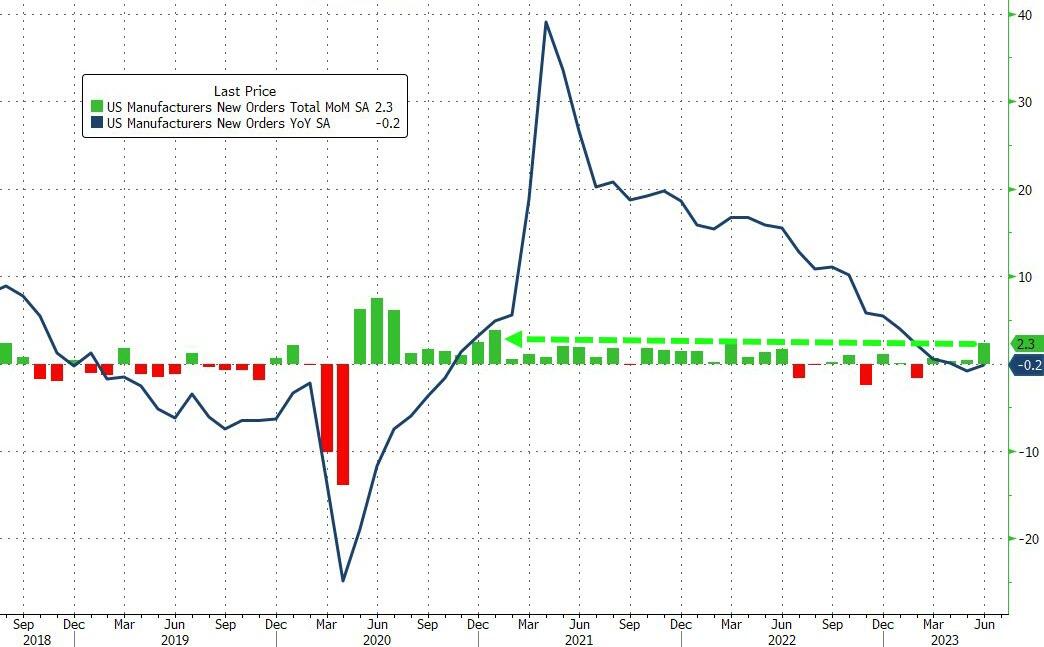
Despite Manufacturing surveys showing the sector in contraction, US Factory Orders jumped 2.3% MoM in June (as expected), the biggest MoM jump since January 2021

Source: Bloomberg

However, despite the bounce, on a year-over-year basis, orders remain down 0.2%.

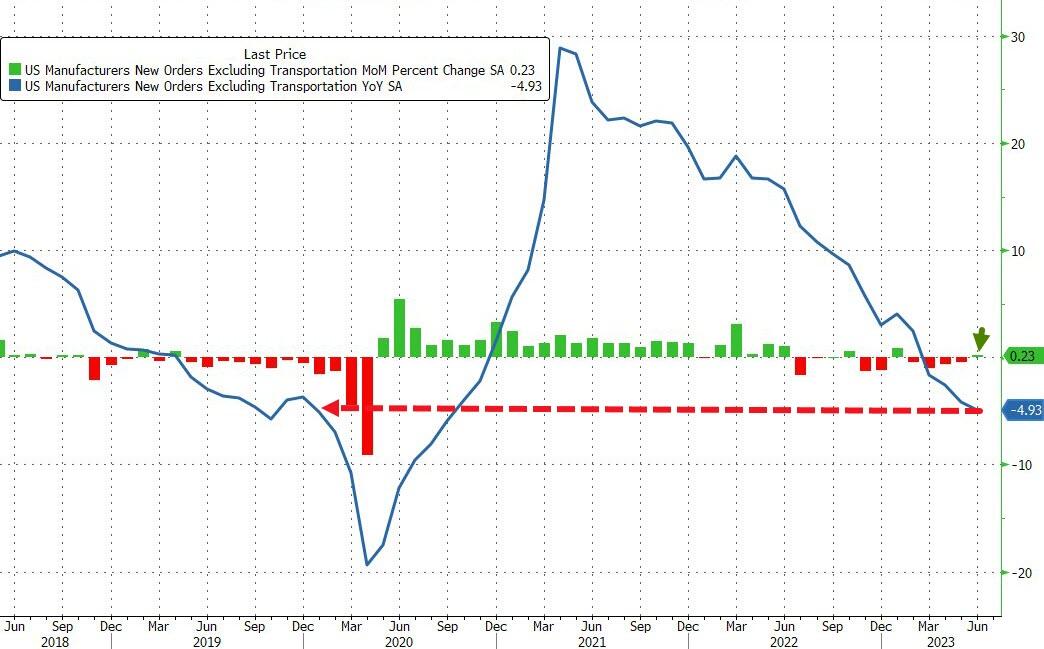
Removing the volatile Transportation sector, core factory orders rose only 0.23% MoM (though that did break a 4 month down streak)…

Source: Bloomberg

And left core factory orders down around 5% YoY – a drop we last saw at the start of the COVID lockdowns.

Soft-landing, maybe? But core looks more like more of the same decline.

Tyler Durden
Thu, 08/03/2023 – 10:25

via ZeroHedge News https://ift.tt/dNCIoqX Tyler Durden

US Announces Partial Embassy Evacuation As Biden Urges Ousted Niger President’s Release

US Announces Partial Embassy Evacuation As Biden Urges Ousted Niger President’s Release

As of late Wednesday (US time) the State Department ordered a partial evacuation of the American embassy in Niamey, the capital of Niger. This after European-led efforts to fly EU citizens from the capital were already well underway.

The State Department said non-emergency personnel and eligible family members would leave the country “given ongoing developments” and “out of an abundance of caution” amid the unrest following last Friday’s military coup, which saw President Mohamed Bazoum get overthrown by his own presidential guard. 

AFP/Getty Images

“The U.S. is committed to our relationship with the people of Niger. The embassy remains open, and our leaders are diplomatically engaged at the highest levels,” Secretary of State Antony Blinken announced. Senior officials will still be working from the embassy, which has remained functioning. 

“Commercial flight options are limited.  We updated our travel advisory to reflect this and informed U.S. citizens that we are only able to provide emergency assistance to U.S. citizens in Niger given our reduced personnel,” the statement said, also as France is leading evac flights for EU citizens seeking exit from the country.

Reportedly, hundreds of Americans have already been evacuated, and over 1,000 European Union citizens as well, as the flights out of the capital continue. France on Thursday announced the completion of its large-scale evacuations.

Meanwhile, in fresh statements President Joe Biden has urged the junta leaders to restore the democratically-elected government.

I call for President Bazoum and his family to be immediately released, and for the preservation of Niger’s hard-earned democracy,” Biden said. “The Nigerien people have the right to choose their leaders,” the US president said. “They have expressed their will through free and fair elections — and that must be respected.”

Ironically Biden’s plea to release and restore Bazoum came on the 63rd anniversary of Niger’s independence. His words also came amid rumors of possible French military intervention. There are hundreds of Western troops in the country, especially from France and the US, who were ostensibly there for ‘counterterror’ operations.

But the presence of Western bases in Niger might not last long under the junta, given ‘anti-imperialist’ nature of coup supporters in the streets has been amply demonstrated by their waving Russian flags. Also, the Russian mercenary group Wagner is just next door in Mali. From the West’s perspective, looming large in the background is expanding Russian influence in Africa.

Coup leader Gen Abdourahamane Tchiani is continuing to warned against “any interference in the internal affairs” of Niger, while alleging the now exiled government has been plotting with the French to allow some kind of intervention. This also as US Secretary of State Antony Blinken on Wednesday spoke to ousted President Mohamed Bazoum on Wednesday, and other international leaders have been in contact.

Tyler Durden
Thu, 08/03/2023 – 10:15

via ZeroHedge News https://ift.tt/KJhey7o Tyler Durden

Judge Blocks Idaho From Punishing Doctors for Referring Women Out of State for Abortions


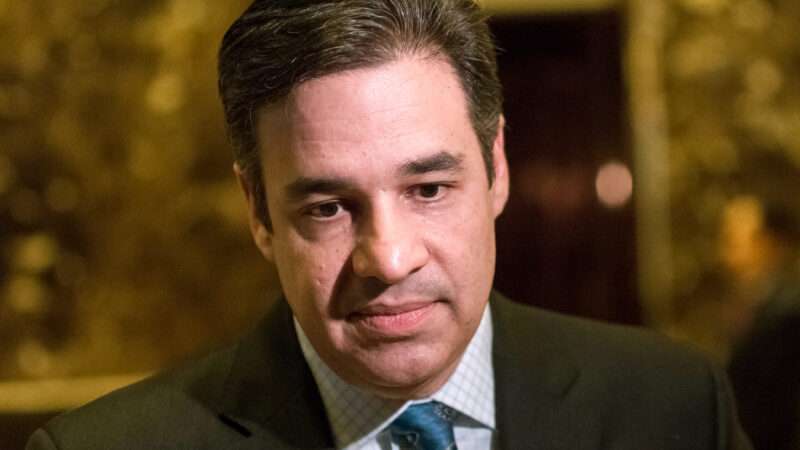
Idaho Attorney General Raul Labrador

Idaho can’t start prosecuting doctors for referring women to out-of-state clinics where they can get abortions, according to a new federal court ruling.

Judge B. Lynn Winmill of the U.S. District Court for the District of Idaho has granted a preliminary injunction against the state enforcing the law in this way.

Under current Idaho law, abortion is almost totally banned, and doctors who perform, attempt to perform, or assist in performing an abortion can have their licenses suspended and be criminally prosecuted. Idaho Attorney General Raúl Labrador stated in a March letter that the law “prohibits an Idaho medical provider from either referring a woman across state lines to access abortion services or prescribing abortion pills for the woman to pick up across state lines.”

“This letter was meant to be private and was not issued as formal guidance, but the anti-abortion group Stanton International obtained the letter and posted it on its website,” notes The Hill. “The attorney general later withdrew the opinion and said his letter was ‘mischaracterized as law enforcement guidance.'”

Still, Idaho physicians worried that Labrador’s private interpretation of the law might still have some weight. Planned Parenthood of the Greater Northwest and two doctors—Caitlin Gustafson and Darin L. Weyhrich—filed a lawsuit, arguing that Labrador’s interpretation violated the First Amendment and the Fourth Amendment.

Winmill agreed that criminalizing out-of-state referrals would violate the First Amendment. Doctors and clinics would “be forced to choose between facing criminal penalties themselves and offering referrals and information about legal out-of-state medicinal services to their patients,” he wrote. “Simply put, their speech will be chilled.”

Winmill’s ruling, issued Monday, blocks Labrador’s interpretation from being enforced. That means Idaho doctors cannot—at least for now—be prosecuted for helping patients obtain out-of-state abortions.

But Idaho’s abortion ban—passed in 2020 and triggered into effect by the overturning of Roe v. Wade last summer—is still one of the strictest in the nation. It makes it illegal for doctors to perform an abortion at any point in pregnancy except in cases where a mother’s life is threatened or in cases of rape or incest that have been reported to law enforcement.

“Rather than offering a narrow list of exceptions, as other anti-abortion laws do, Idaho’s law simply provides an affirmative legal defense for doctors arrested and charged with performing abortions,” as Reason‘s Emma Camp has noted:

If a doctor can prove by a “preponderance of the evidence” that “[he] determined, in his good faith medical judgment and based on the facts known to the physician at the time, that the abortion was necessary to prevent the death of the pregnant woman,” or if the physician has a copy of the patient’s police report of rape, such doctors cannot be found guilty of performing an illegal abortion. However, if doctors charged with providing abortions fail to meet this standard, they can face up to five years in prison.

Idaho also bans “abortion trafficking,” defined as helping someone under age 18 get an abortion. The law is meant “to prevent unemancipated minor girls from being taken across state lines for an abortion without the knowledge or consent of her parent or guardian,” said Idaho Gov. Brad Little. Violations of the law are punishable by two to five years in prison.

The abortion trafficking law also faces a legal challenge, notes the Associated Press. “Attorneys general from 20 states filed a brief Tuesday urging the court to block it.”

“The Constitution protects the individual right to travel between states, and Idaho’s radical Legislature cannot abolish that right,” said Washington Attorney General Bob Ferguson in a statement.


FREE MINDS

More takes on the new Trump indictment. Ken “Popehat” White takes issue with people describing the indictment as “unprecedented”:

Nobody’s ever been charged with this set of facts because nobody’s ever attempted to overthrow the government by fraud like this before. In that sense, this is “unprecedented.” But in other senses, that term is misleading. Each of these federal criminal laws — which are broad and flexible by design — has been used to charge a wide variety of fraud and misconduct.

This includes the conduct of which Trump is accused, White argues:

That doesn’t mean that it will be easy for the Special Counsel to prove beyond a reasonable doubt that Donald Trump had the requisite mental state to violate the law. It means that his actions plausibly violate the law….

Here’s the point: there are legal and factual defenses to this indictment, but anyone telling you that it obviously, inarguably violates the law is lying to you.

White also takes issue with National Review editors’ argument—which I included in Roundup yesterday—that “the Supreme Court reaffirmed just a few weeks ago, fraud in federal criminal law is a scheme to swindle victims out of money or tangible property. Mendacious rhetoric in seeking to retain political office is damnable — and, again, impeachable — but it’s not criminal fraud, although that is what Smith has charged.” Writes White:

The Special Counsel charged Trump with defrauding the United States under Section 371. The Supreme Court and lower courts have repeatedly and specifically ruled that Section 371 doesn’t require a scheme to take money or property. National Review is referring to the latest in a line of cases interpreting a completely different statute, the wire fraud statute, that includes a “money or property” requirement in its text…

Justice Thomas, in the 2023 case to which National Review alludes, expressly relies on that language to find that the wire fraud statute requires a scheme to take money or (as traditionally defined) property. He does not even mention Section 371, which does not include the “money or property” language and which has a long history of Supreme Court and lower court cases holding that the object of the fraud need not be money or property, but can be interfering with government function.

National Review‘s Noah Rothman offers “a dissent” from the editors’ argument, also challenging his colleagues on points of law and interpretation. “These charges deserve the hearing they are about to receive,” Rothman concludes.

Reason‘s Jacob Sullum also weighs in, asking if Trump really believed, despite so much evidence to the contrary, that the 2020 election had been stolen from him. “After covering Trump’s election claims since November 2020, I’m still not sure. Fair-minded jurors are apt to have similar doubts,” Sullum writes.

Lastly, the Cato Institute’s Walter Olson offers a nuanced look at strengths and weaknesses of the indictment, noting that it “is likely to raise legal issues that are relatively unfamiliar, uncertain, or both.” Olson continues:

Few legal commentators are deeply familiar with all four of the statutory bases on which the grand jury filed charges, and intuitions can be deceptive: in applying the law against defrauding the United States, for example, courts have not always construed the elements of fraud in the same way they do in some other fraud areas, and the interpretations have also changed. It is not entirely settled how the elements of obstructing an official proceeding will ultimately shake out in January 6 cases, and so forth.

In other words, caution is called for at this stage in predicting the extent to which judges will trim back the scope of this prosecution, if they do. It is widely agreed that the First Amendment protects some telling of lies for political benefit, and also that it protects (as, in effect, lobbying) some efforts to persuade government officials to carry out acts that are wicked and unconstitutional. It is equally certain that the First Amendment does not protect every act of speech or persuasion that someone might retroactively try to jam into these categories. If you shut down a pending courtroom trial by phoning in a false report of a dangerous gas leak, you cannot get off by arguing that you were just exercising your speech and lobbying rights, nor are you likely to get off by arguing that you knew there was a gas stove in the court cafeteria and were basing your 911 call on a sincere belief that there was an elevated risk of asthma from stray methane.

In short, it matters in law and under the First Amendment whether speech and lobbying intended to obstruct proceedings or nullify rights was taken in good faith or otherwise, and deceitfully or otherwise. That is probably one reason why the indictment cites extensive cause to believe that Trump knew his claims of election fraud to be false, rather than wandering around in some sort of fugue state in which he might reasonably believe them to be true.


FREE MARKETS

Biden’s new student loan repayment plan will turn many federal student loans “into glorified grants,” suggests Reason‘s Emma Camp:

The SAVE plan is a revamped income-driven repayment (IDR) plan, introduced last year along with President Joe Biden’s original student loan forgiveness scheme—though that proposal was struck down at the Supreme Court in June. While the SAVE plan received less attention than Biden’s now-defeated student-loan forgiveness proposal, it stands to do nearly as much long-term damage to taxpayers—and prospective student loan borrowers themselves.

Under the REPAYE plan, the most popular IDR plan currently in use, borrowers’ monthly payments are typically fixed at 10 percent of their discretionary income. Discretionary income is calculated as earnings above 150 percent of the federal poverty level. Under this plan, borrowers will have their remaining balance forgiven after 20 years of on-time payments, or 25 years for graduate borrowers. But the SAVE plan radically reduces monthly payments—and the time required before forgiveness. Under the plan, borrowers only pay 5 percent of discretionary income, which is now defined as earnings above 225 percent of the poverty rate. Borrowers only have to make 10 years of payments before forgiveness, if the balance is less than $12,000. Further, interest will not accrue on borrowers’ loan balances when their monthly payments are not enough to cover interest.

More here.


QUICK HITS

• Backpage co-founder, veteran journalist, and free speech warrior James Larkin has committed suicide, a little over a week before he was slated to stand trial for his role in running Backpage. A judge has ruled that the trial will still start next week.

• As the Biden administration “prepared to launch speedy screenings at Border Patrol holding facilities this spring, authorities pledged access to counsel would be a key difference from a Trump-era version of the policy. So far, that promise appears unfulfilled,” notes the A.P.

• Why middle-aged Americans aren’t going back to church.

• New Bureau of Labor Statistics data show “the number of job openings dipped to its lowest point in more than two years” in June, reports CNN.

• Mashable predicts good things for Threads. “Threads is on course to topple Twitter (or X, if you must),” writes Chris Taylor. “Don’t be surprised if Threads becomes the go-to place for all things trending by the end of 2023.”

• “A bipartisan trio of House lawmakers last week introduced legislation that would allow marijuana users past and present to qualify for security clearances and serve as federal employees,” notes Government Executive.

The post Judge Blocks Idaho From Punishing Doctors for Referring Women Out of State for Abortions appeared first on Reason.com.

from Latest https://ift.tt/ym9qnRo
via IFTTT