Services Surveys Signal Stagflation Threat Growing: Slowing Growth, Sticky Inflation

Services Surveys Signal Stagflation Threat Growing: Slowing Growth, Sticky Inflation

Following yesterday’s dismal Manufacturing survey data (both in contraction – sub-50 – for multiple months), ‘soft landing’-hopers are banking on this morning’s Services survey data to save the narrative.

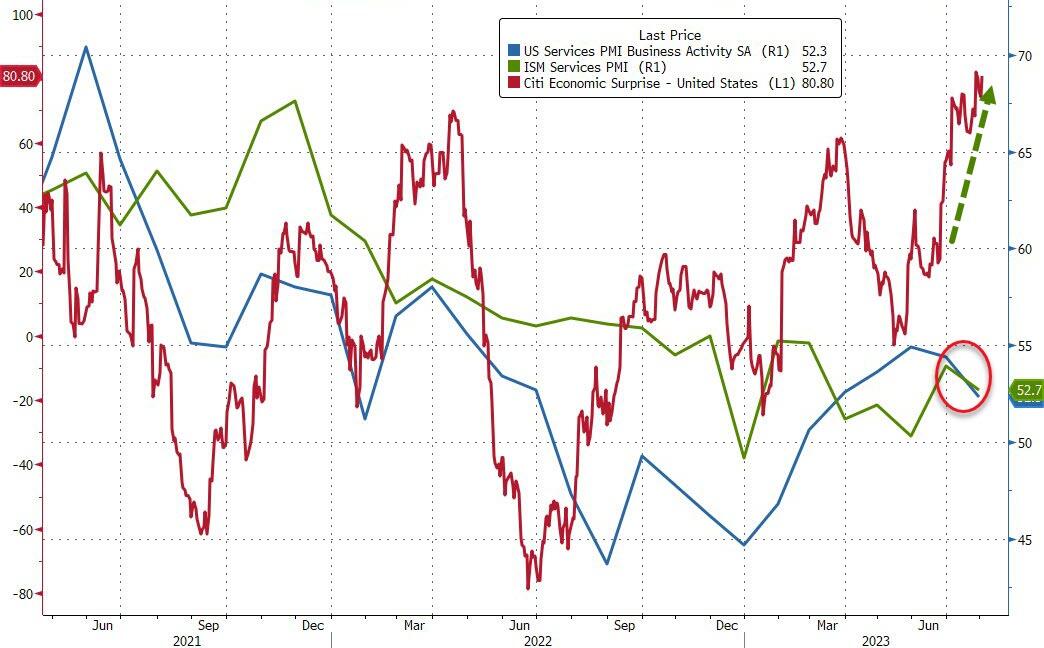
  • ISM Services (Final) dropped to 52.3 (below exp) in July (from 54.4 in June) – its lowest since Feb.

  • PMI Services dropped to 52.7 (below exp) in July (from 53.9 in June)

These disappointments are happening as US Macro data has been surprising to the upside…

Source: Bloomberg

Chris Williamson, Chief Business Economist at S&P Global Market Intelligence, said:

The service sector remains the main engine of growth in the US economy, though there are signs of the motor spluttering amid rising headwinds.”

“Business activity rose in July at the slowest rate since February, with the rate of expansion sliding further from May’s recent peak in response to sharply reduced growth of new business. Although spending from foreigners in the US continues to grow strongly as the post-pandemic travel surge shows signs of persisting, demand growth waned from domestic customers, often linked to the rising cost of living and higher interest rates. “

“Reflecting concerns that the upturn is faltering, companies have become much less optimistic about the outlook and reined-in their hiring as a result.”

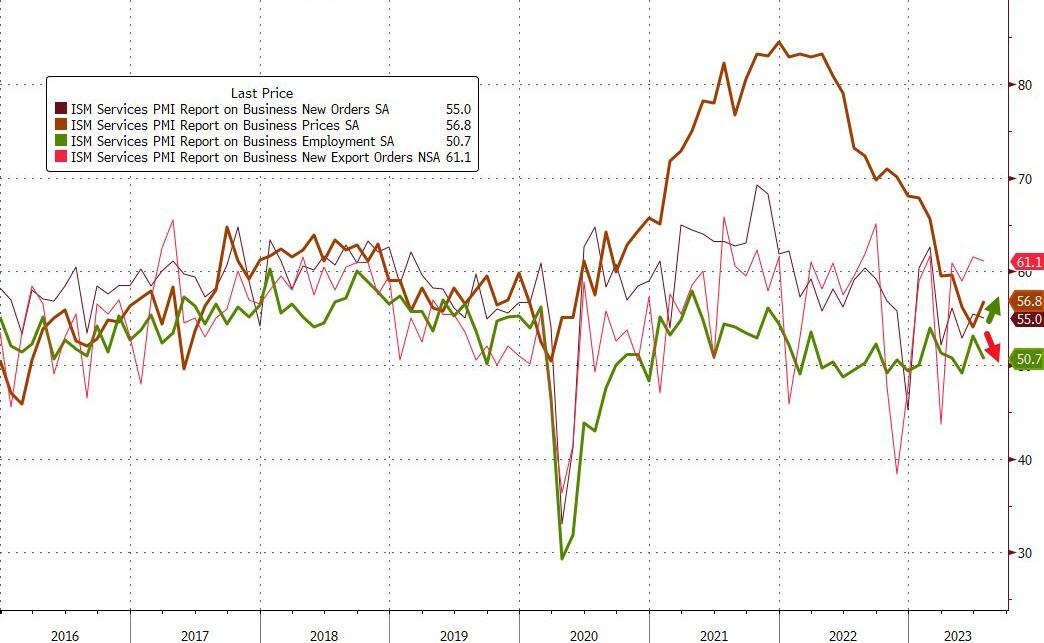
Inflationary pressures remained historically elevated in July, as service providers in particular continued to register marked increases in input costs and output charges, often attributed to hikes in wages.

By the way, Diesel prices are both up… and down…

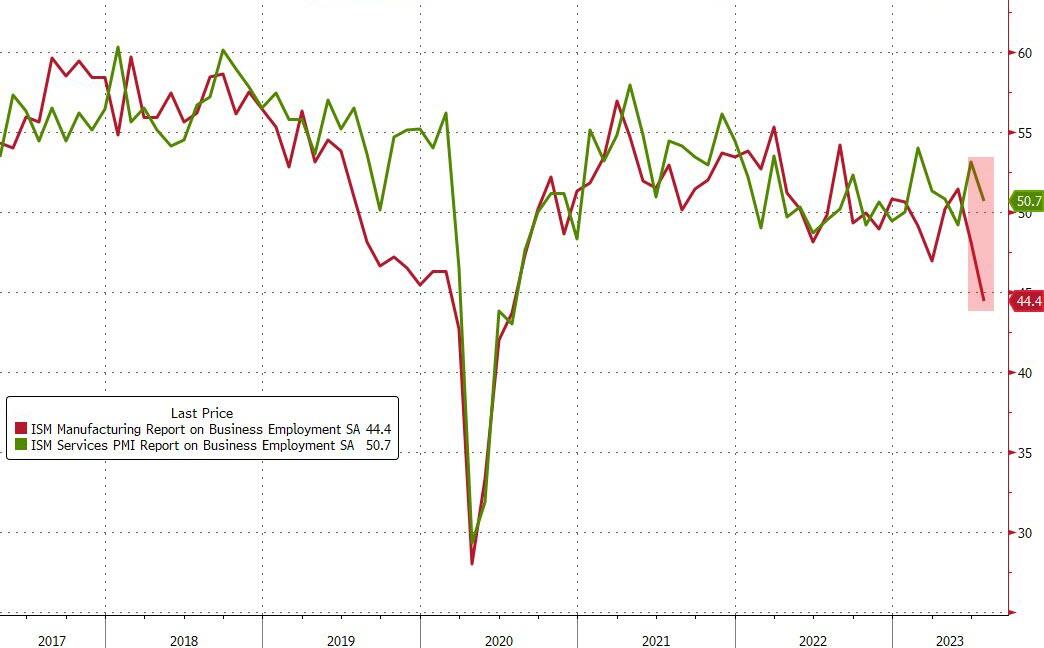
Services Employment slowed…

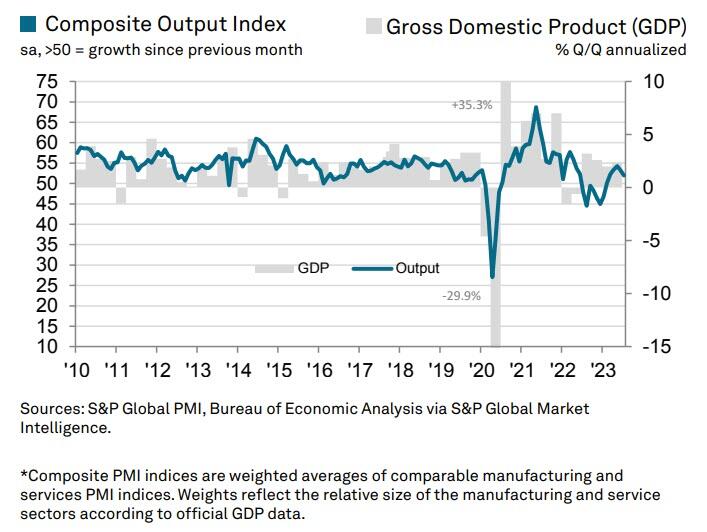
The S&P Global US Composite PMI Output Index posted 52.0 in July, down from 53.2 in June, to signal only a modest upturn in private sector business activity.

“With the weakening service sector expansion accompanied by a near-stalled manufacturing sector, the overall message from the surveys is that economic growth weakened at the start of the third quarter, cooling to an annualized rate of around 1.5%.

Williamson concluded even less optimistically that the survey’s price gauges, however, continue to signal a stubbornness of inflation around the 3% mark:

“An additional concern is that prices charged for services rose at an accelerated rate in July, often linked to higher staff costs. Such a wage-led stickiness of inflation in the vast service sector will naturally worry policymakers.

So, in other words – STAGFLATION!

Tyler Durden
Thu, 08/03/2023 – 10:06

via ZeroHedge News https://ift.tt/XFgjVCT Tyler Durden

Biden Admin Ordered Facebook To Change Algos To Suppress Conservatives

Biden Admin Ordered Facebook To Change Algos To Suppress Conservatives

Authored by Eric Lundrum via American Greatness,

In new memos recently released by Facebook, the social media giant was pressured by the Biden White House into altering its algorithms so that mainstream news sources would be elevated over conservative sites.

As Just The News reports, the documents over to the House Judiciary Committee following a subpoena detail a series of meetings between Facebook executives and White House Digital Director Rob Flaherty in the spring of 2021. The demands from the White House focused on posts related to the Chinese coronavirus and the efficiency of the COVID vaccines.

In one meeting on April 14th, 2021, Flaherty asked Facebook if it was possible to artificially promote outlets such as the New York Times and the Washington Post, instead the Daily Wire and Fox News, particularly commentator Tomi Lahren.

“If you were to change the algorithm so that people were more likely to see NYT, WSJ, any authoritative news source over Daily Wire, Tomi Lahren, polarizing people,” Flaherty asked.

“You wouldn’t have a mechanism to check the material impact?”

“We have to explain to President, Ron [Klain], people, why there is misinfo on the internet, bigger problem than FB,” said Flaherty, according to the typed notes from Facebook executives.

“Where issues are, what interventions are, how well they are working, for products, want to engage in things that you know to be effective. I don’t even care about specific methodology, you have better, richer data than we’ll ever have.”

Tomi Lahren, who boasted a large following on Facebook, had recently announced that she would refuse to get the COVID vaccine. Meanwhile, Daily Wire had filed a lawsuit against the Biden Administration’s mandate for private workplaces to force its employees to take the vaccine. The Supreme Court eventually struck down Biden’s workplace mandate, while upholding his vaccine mandate for facilities that are funded by Medicare and Medicaid.

“What are the things driving hesitancy on your platform? What is it? How big is the problem? When you are intervening, how are you measuring success?” Flaherty repeatedly grilled the Facebook executives in one meeting.

“Never-before-released internal documents subpoenaed by the Judiciary Committee PROVE that Facebook and Instagram censored posts and changed their content moderation policies because of unconstitutional pressure from the Biden White House,” said Congressman Jim Jordan (R-Ohio), Chairman of the Judiciary Committee, on Twitter.

Constitutional scholars have also raised the alarm over the revelations, with George Washington University law professor Jonathan Turley saying that he has “asked Congress to pass a law barring federal employees from engaging in censorship and targeting of citizens.”

“Agencies have a right to speak in their own voices,” Turley added.

“Instead, the Biden Administration sought to engage in what I have called ‘censorship through surrogate.’ This is part of that pattern.”

Turley’s take is reiterated by University of Tennessee law professor Glenn Reynolds told Just the News on Wednesday that the First Amendment issue is when the “government is asking people to censor speech, their action is attributable to the government, so both they and the government can be sued.”x

“By working with the government, Facebook exposed themselves to liability,” Reynolds said, noting that they do not “share sovereign immunity” with the government and will “probably very much regret it.”

Tyler Durden
Thu, 08/03/2023 – 09:45

via ZeroHedge News https://ift.tt/AsKnFC2 Tyler Durden

Watch: Bill Maher Says Democrats Are ‘Full Of Shit’ When It Comes To Illegal Immigrants

Watch: Bill Maher Says Democrats Are ‘Full Of Shit’ When It Comes To Illegal Immigrants

Bill Maher may be a little slow on the uptake when it comes to his willingness to call out disastrous Democrat policies and irrational leftist arguments, but at least he’s not afraid to go against the grain when the epiphanies strike. 

Conservatives and some moderates have been pointing out the Democrat insanity on illegal immigration for some time now, specifically the indignant rage leftists express over red states bussing migrants to major Democrat “sanctuary cities.” 

As Bill Maher notes, these city governments often pontificate on the virtues of the “American melting pot” until they are faced with housing and feeding thousands of migrants that pack the streets and the parks. Democrats support illegal immigration as long as they never have to deal with those migrants on their doorstep.  A humanitarian crisis is forming in New York, DC, Chicago, etc. and it is entirely caused by the political left’s unwillingness to admit that they were wrong. 

When one realizes that most illegals are only in this country with the intent to collect on as many entitlement handouts as possible, the delusion of the hard working migrant seeking out the American dream quickly fades and reality sets in.  


Keep in mind that the Democrats are still trying to form an “investigation” into Ron DeSantis and his move to bus a handful of migrants to the ritzy progressive vacation town of Martha’s Vineyard. 

While Dems focus intently on what they call “human trafficking” on the part of the Florida government, they seem to be oblivious to their own hypocrisy – They fed those same migrants a cheap lunch for the media cameras and then kicked them out of town within 24 hours to a nearby military base. 

The leftist ideal of the “melting pot” is a fraud. 

They don’t want to take care of the migrants either, they just want those sweet illegal votes in states where ID is not required. 

Tyler Durden
Thu, 08/03/2023 – 09:30

via ZeroHedge News https://ift.tt/Ojd8BJT Tyler Durden

Want a Caribbean passport? Last chance to get one before the pricing doubles

In late 2019, right before Covid-1984 and Tony “the Science” Fauci became household names, Sovereign Man hosted an event for our Total Access members on the idyllic island of St. Lucia.

As is customary for these intimate get-togethers, we invited a leading local law firm, real estate developers, as well as some local banking reps to deliver insightful presentations to our members.

But our keynote speaker was none other than the sitting St Lucian prime minister, Allen Chastanet.

Hailing from a business background, Chastanet is an impressive figure with exceptional insights into subjects like national identity and Citizenship By Investment (or CBI, for short).

Having a second passport is like having a life insurance policy against sovereign risk. Against government overreach in your home country. Against the Black Swan events no one sees coming.

And having a second passport means that you will always have another home country to go to, should you ever be faced with another lockdown… Or the threat of nuclear war… or some climate related disaster in your home country.

(This thinking is NOT alarmist; the past few years have proven that these risks aren’t hypothetical.)

It also means being able to pass the benefit of greater travel freedom and the ability to live, work and study in at least one other country to your children.

And for folks who aren’t part of what we call the “Lucky Bloodline Club” – i.e. those who can obtain second passports based on their ancestry – Citizenship By Investment programs offer a fast way to obtain alternative citizenship – and a second passport – by making an investment or donation.

(These are typically priced from around $100,000+ excluding fees.)

Now, Bolshevik news outlets like 60 Minutes love portraying CBI programs as somehow illegal, or immoral – but this couldn’t be farther from the truth.

CBI programs are based on official legislation in democratic sovereign nations. And for small Caribbean islands with limited resources and little tax revenue, these programs are a true boon.

At our 2019 event, Chastanet explained to our Total Access members that foreign powers are undermining St. Lucia’s sovereignty, as well as that of the other Caribbean CBI countries.
Ironically, governments in the US and Europe are perfectly fine with small island nations going deeper and deeper into debt each year.

CBI programs, in contrast, enable these countries to sell sovereign equity – which is really what citizenship is – in order to avoid falling into a sovereign debt trap.

But leftist media outlets tend to cherry-pick a handful of examples of instances where CBI passport holders were involved in wrongdoing to paint all CBI programs everywhere with a tar brush.

But this is bad logic.

It’s like saying that because some cartel bosses use iPhones, Apple facilitates criminal enterprise.

The reality is that governments like St. Lucia have an incentive to conduct due diligence on CBI applicants; they have a vested interest to ensure their new citizens are of upstanding moral character.

Is their due diligence perfect 100% of the time?

Of course not; but then again, which country can truly claim that theirs is? Even the United States immigration system occasionally lets a few criminals slip through the cracks and become green card holders or citizens.

Nonetheless, a few rotten apples out of tens of thousands of CBI applications was enough for the EU (and more recently the UK) to threaten CBI countries with provoking their visa-free travel privileges.
And in fact, both Vanuatu and Dominica recently lost their visa-free access to the UK. (Vanuatu also lost their EU access during May of 2022.)

Visa-free access to the Schengen Zone is arguably the largest selling point of any Caribbean CBI program, and no one wants to jeopardize this advantage.

So, last week, with a view to avoid a similar fate, St. Kitts acquiesced to demands by the EU and US to implement sweeping changes to their CBI program.

Most notably, St. Kitts and Nevis have DOUBLED their minimum donation and real estate investment amounts – effective immediately.

  • The updated donation amounts are now as follows:
  • Single applicant: $250,000 (previously $125,000)
  • Applicant plus spouse: $300,000 (previously $150,000)
  • Family of up to four: $350,000 (previously $170,000)
  • Each additional minor dependent: $50,000 (previously $10,000)
  • Each additional adult dependent: $75,000 (previously $25,000)

In addition, these numbers do NOT include the now increased due diligence fees.

Other notable modifications to the program include the introduction of mandatory online or in-person interviews for all applicants, and the exclusion of siblings and grandparents as qualifying dependents.

St. Kitts is home to the Caribbean’s flagship CBI program, and they made the first move. But it is reasonable to expect that other CBI countries will follow, raising their prices and redesigning their application procedures in the near future.

What can we learn from this?

As a result of the recent developments in St. Kitts, obtaining second citizenship by donation or investment is likely to become more expensive across the board.

That’s also why we’ve been pounding the table for over a decade, saying that:

When it comes to second residency and citizenship programs, if there’s a great deal on the table, then take swift action.

These deals can and do go away practically overnight – and the remaining options become both more expensive and increasingly onerous over time.

Fortunately, however, none of the other four Caribbean CBI programs have increased their prices – yet. Which means that you have a narrow-window opportunity to secure a second citizenship for half the price you can expect to pay in the future.

The passports of countries like Saint Lucia, Antigua and Barbuda as well as Grenada are very good travel documents, and these programs all enjoy solid international reputations.

Also, on that note…

There is still time to obtain a Caribbean passport at the current low prices – AND to benefit from massive supplier discounts – by joining Total Access…

As you may know, members of Total Access – our highest-end membership program – can obtain Caribbean passports for less than anyone else in the world.

For example: If you apply for a donation-based St. Lucian passport as a family of four via Total Access, you’ll save a whopping $20,000

We asked our CBI providers in the other four Caribbean countries whether our TA members could still apply there before any potential changes take effect in their programs.

And for the moment, at least, it appears to be possible still.

Moreover, if you’re considering getting a CBI passport before the other programs increase their prices, you’re in luck, as Total Access enrolment is open right now (August 3, 2023).

(And these passport deals are just one of the many benefits we offer our TA members…)

Total Access is a tight-knit, exclusive community of successful, freedom-minded entrepreneurs, thinkers and doers. TA is also where we share the best private opportunities we come across, as well as other deals and opportunities that are too sensitive to put into print anywhere else.

If this sounds like a place where you could belong, then be sure to check out the program today.

But know this: The current low CBI passport pricing is not going to last long.

Moreover, we expect the handful of TA slots to sell out within the next few hours, so if you’ve got your heart set on one, move fast.

The bottom line

We will be updating our website and readers once we have more definitive details on how all of these changes are going to affect the relevant programs…

But as we have emphasized repeatedly: If you find a residency or citizenship program that appeals to you, act promptly. The world of immigration is highly unpredictable, and attractive options can and do vanish unexpectedly.

Yours in Freedom,
Team Sovereign Man

PS: Total Access enrolment is now open, but we only have a handful of slots left. So if you want to grab one of the remaining few, click here now.

Source

from Sovereign Man https://ift.tt/jPIAEgJ
via IFTTT

US Yield Curve Control Not Here Yet, But It’s Coming

US Yield Curve Control Not Here Yet, But It’s Coming

By Simon White, Bloomberg Markets Live reporter and analyst

Slumping bonds are a reminder that implicit or explicit yield curve control in the US is increasingly likely at some point, although there is scant evidence the Treasury is already engaging in such a policy by stealth.

Markets love a good “stealth” story. Whether it’s stealth QE, stealth QT or stealth FX intervention, there’s a (sometimes well-founded) yearning to challenge the mainstream narrative. One such theory of late has been that the Treasury has been engaging in stealth yield curve control (YCC).

There is little evidence to support that this is happening, as I’ll show. But with yields climbing and within 15 bps of 15-year highs, it pushes to the top of the agenda whether it will happen eventually. Given the worsening fiscal and market backdrop and elevated inflation, it’s looking more likely than not.

It’s been a tumultuous week for yields, with the Bank of Japan’s policy tweak, and the Treasury increasing its funding needs. But Fitch was the weatherman with its US downgrade, telling us about the downpour we can see for ourselves just by taking a glance at the fiscal data. In short, the US faces a perfect storm of a vertiginous fiscal deficit, a near-historically swollen debt load, ballooning interest-rate costs and collapsing tax revenues.

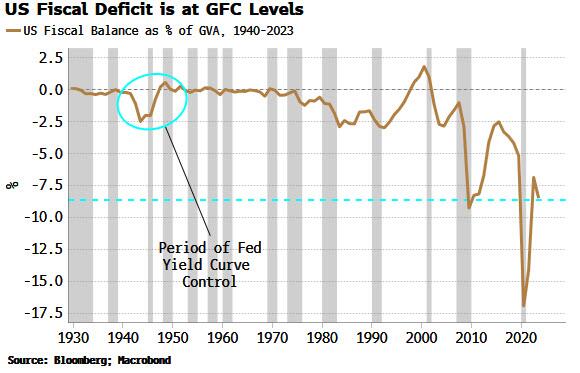
First, the deficit. It’s close to historical wides, bigger than it’s ever been outside of a recession, and almost as wide as it was in the depths of the GFC. It’s the largest in the world in GDP terms, and it is currently heading in the wrong direction. This heaps more pressure on the government debt-to-GDP level, already uncomfortably high at 112%.

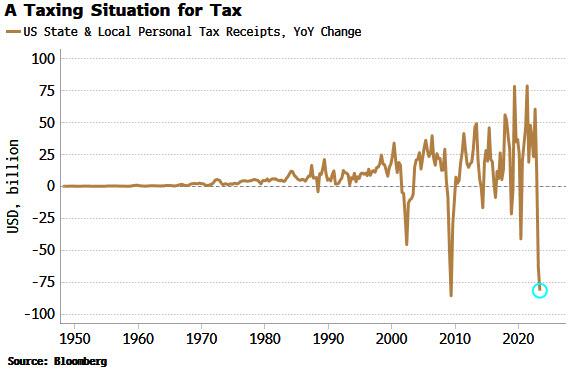
Second, tax revenues. These have seen almost their largest annual fall ever, in an economy that’s supposed to be growing at 2.4%.

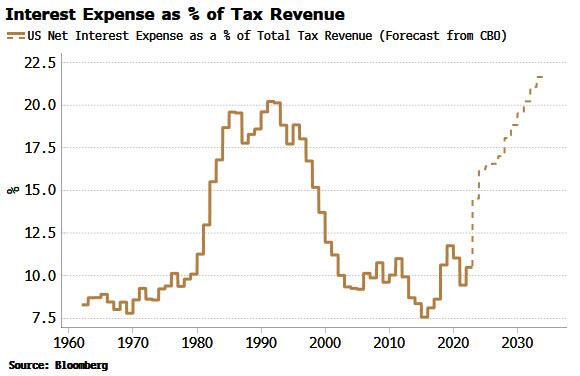
And then there’s rising interest-rate costs. The total interest expense as a percentage of tax revenue is expected to rise sharply in the next year or two, and make new highs by the end of the decade. However, these CBO forecasts should be taken with a grain of salt as they are based on a 10-year yield of only 3.8% (the ten-year average has been higher than that in every decade bar the 2010s and 2020s).

There is a view the Treasury is already implementing YCC, based on the fact it has been skewing its issuance towards bills and away from coupons. But issuing more bills is simply the easiest and fastest way for the Treasury to replenish its account at the Fed (the TGA). It was run down to almost zero in the lead-up to the debt-ceiling limit, and has now risen to over $500 billion.

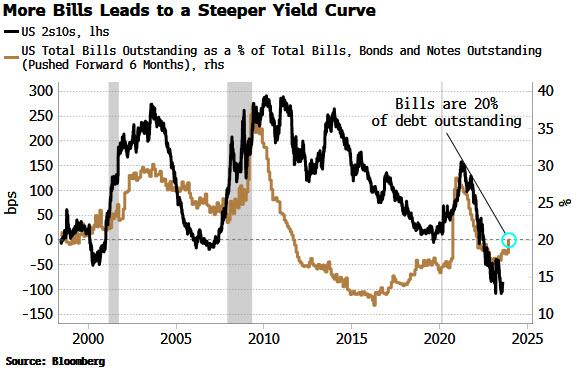
This level of bill issuance is not unusual. The Treasury has an implicit target of about 20% for the amount of bills outstanding as a percentage of total debt. As we can see from the chart below, bills have often been more than 20% of debt outstanding over the last 30 years. Moreover, the Treasury announced this week it was raising its coupon-issuance amounts.

According to the stealth YCC thesis, less longer-dated Treasury issuance implicitly caps longer-term yields, but this has not historically been the case. As the chart above shows, the yield curve typically steepens – not flattens – when there is greater bill issuance – the opposite of what is desired by YCC.

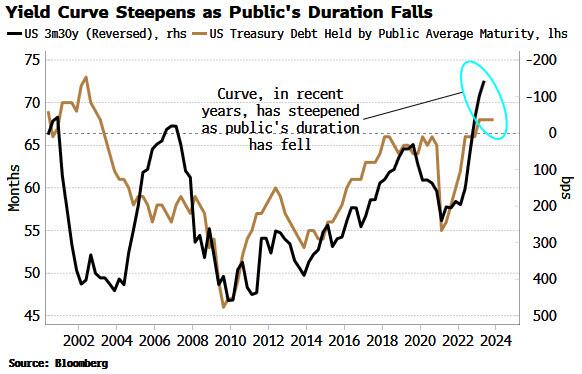
We see the same relationship if we look the duration of US government debt outstanding. When the average duration falls – as it would if issuance is skewed toward bills – the yield curve tends to steepen. The current average duration held by the public is consistent with a steeper, not a flatter, yield curve.

This sounds counter-intuitive. If issuance drives yields, then more issuance at the front-end of the curve versus the longer end – equating to a fall in duration – implies the yield curve should flatten.

But the fact the relationship is the other way implies it’s likely that demand is the more dominant driver of yields in the medium term. There is ready-made demand for bills, from MMFs, etc, so when supply increases, demand rises to meet it, suppressing the yield-curve impact.

It’s thus hard to argue the Treasury is engaging in yield curve control. But that does not detract from the rising possibility it will need to be implemented in some shape or form eventually.

Banks and the Fed are reducing their Treasury holdings, while foreigners now collectively own about $5 trillion less USTs – about 10% – than they did in 2021. At the same time the “Treasury put” means large fiscal deficits are likely to become a feature, not a bug. That means inflation is likely to become embedded.

Fiscal profligacy and elevated price growth are a combustible mix and a road to prohibitively high yields via rising term premium. Yield capping thus starts to look like the endgame.

How it’s done is another matter, whether it’s the Fed co-opted to cap yields as it was in WWII, Treasury buybacks, or financial repression, whereby domestic institutions are forced to hold more government debt. Whatever way, at some point yield curve control in the US is becoming increasingly likely – by stealth or otherwise.

Tyler Durden
Thu, 08/03/2023 – 09:16

via ZeroHedge News https://ift.tt/dNVxgDw Tyler Durden

Tesla China Sales Fall 31% Sequentially As BYD Continues Growth

Tesla China Sales Fall 31% Sequentially As BYD Continues Growth

Tesla sold 64,285 China-made electric vehicles for the month of July, down 31% from the month prior, according to data from the China Passenger Car Association, reported by Reuters

The number is the lowest Tesla has posted so far this year in China. 

Sequentially, the numbers were lower but year-over-year, thanks to the benefit of a 2022 Shanghai shutdown for production line improvements, sales of the Model Y and Model 3 were actually up 128%.

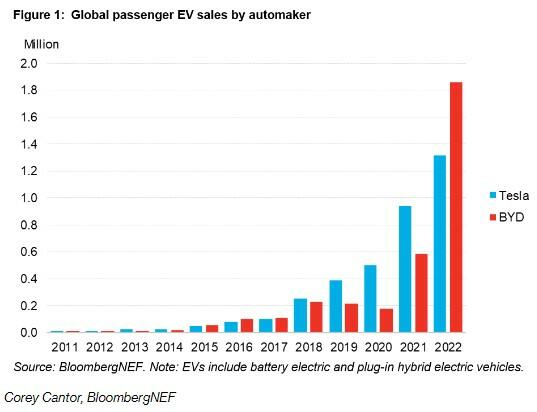
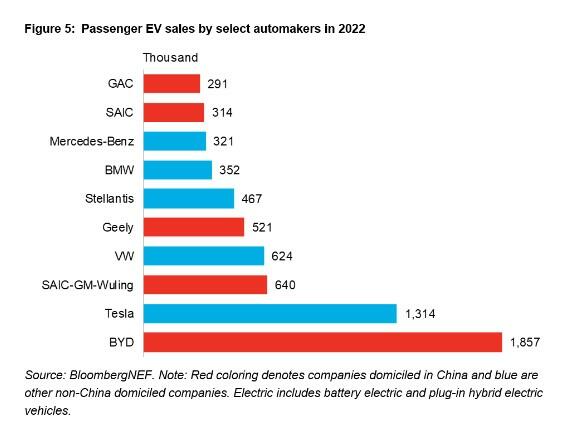
One of Tesla’s largest competitors in China, BYD, posted 261,105 EV sales in July, up 61% year over year without the benefit of an abnormally easy 2022 comp. As Bloomberg notes, BYD has now surpassed Tesla in global EV sales, effective last year. 

Last year BYD sold 1.85 million electric vehicles, up exponentially from the 200,000 the automaker sold in 2019. The chart above shows just how quickly BYD sales have surpassed Tesla. 

Some Twitter/X users have asked questions about whether demand in China could be drying up, posting that the company was offering a referral program for Model 3 sales for the month of August.

The dropoff in July will have Wall Street watching Tesla’s China numbers closer heading into Q3. June looked like it held more promise for Tesla, with the automaker posting 74,212 vehicles sold and 19,468 units exported, solidifying a 20.6% sequential rise for the EV maker.

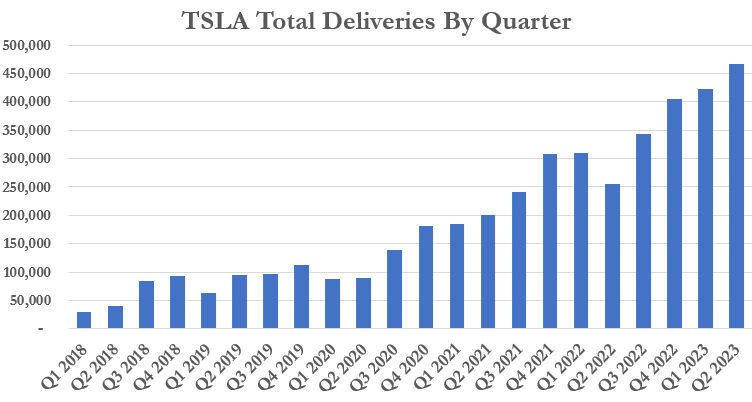
At the end of Q2 Tesla posted 466,140 deliveries for the quarter, ahead of Bloomberg’s consensus estimate of 448,351. The auto manufacturer produced 479,700 vehicles in the quarter, exceeding estimates of 456,617.

Tyler Durden
Thu, 08/03/2023 – 08:45

via ZeroHedge News https://ift.tt/hFm43zZ Tyler Durden

Jobless Claims Hover Near 6-Month Lows, Missouri Sees Big Jump

Jobless Claims Hover Near 6-Month Lows, Missouri Sees Big Jump

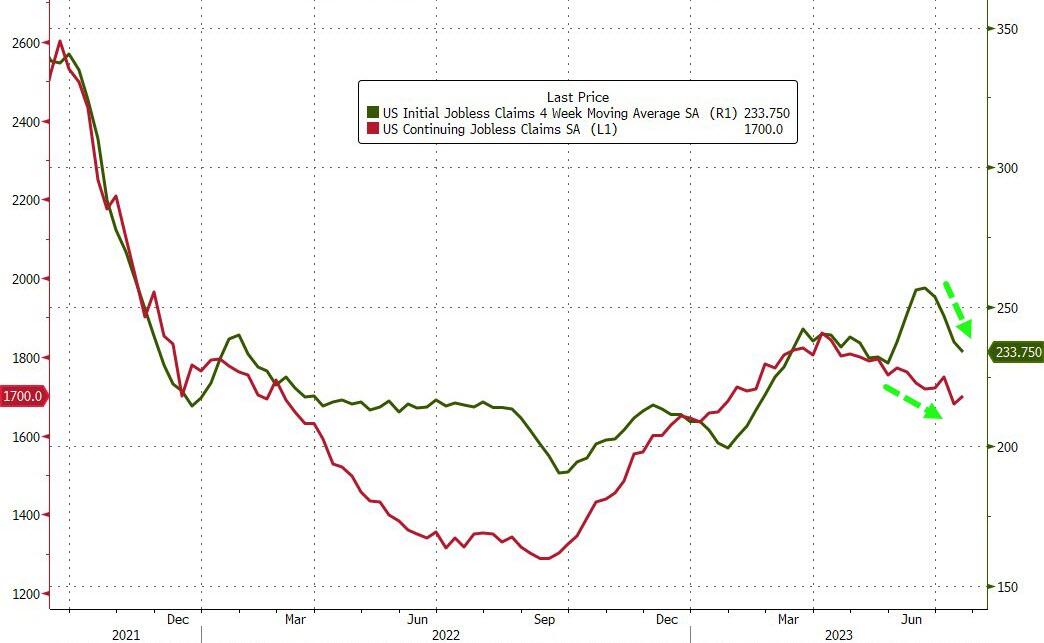
Both the ISM/PMI surveys and ADP showed job losses in the manufacturing sector, while the latter showed solid job gains on the services side. After last week’s decline in initial jobless claims, expectations are for more of the same labor market strength this week and sure enough, 227k Americans filed last week, up very modestly from the 221k (downwardly revised last week) hovering around 6-month lows. Non-seasonally-adjusted, initial claims fell to 205k, near 9 month lows…

Source: Bloomberg

Under the hood, Missouri saw a big jump in claims with Ohio, California, and Georgia all seeing notable declines…

Continuing claims also remained near 7 month lows at 1.700mm…

Source: Bloomberg

So more of the same, all indications suggest a strong labor market entirely dislocated from The Fed’s tightening moves.


Tyler Durden
Thu, 08/03/2023 – 08:37

via ZeroHedge News https://ift.tt/MfYWJud Tyler Durden

Expert Witness Redux in California

An interesting new expert witness controversy has broken out; this time in California. You will recall the Florida fiasco recounted here and here and here.

A group of parents are suing the state over the learning losses that that the state’s pandemic response imposed on children. Plaintiff attorneys recruited expert witnesses from Stanford University to support their case. The California education department claims that the researchers signed an agreement to not testify against the state as a condition of accessing the state’s data on k-12 schools during the pandemic. The prohibition, the state argues, extends to any testimony against the state, even when that testimony does not rely on the state’s own data.

From the state’s letter to one of the researchers:

This letter is to remind you of your obligations as the CDE’s authorized representative performing research for and on behalf of the CDE. As CDE’s authorized representative, in both paragraph 16 of the Agreement and paragraph 6 of the confidentiality provisions in Exhibit D, you agreed that you would not “testify, advise or consult” for any party other than the CDE or the State Board of Education. This prohibits any work for Plaintiffs in Cayla J.

The ACLU is now involved, arguing that any such provision in the data access agreement would amount to an unconstitutional condition.

From the ACLU letter to the California Department of Education:

The contract condition at issue is viewpoint discriminatory. LPI’s contract with CDE specifies that, for the duration of the agreement, “LPI’s employees, executives, and other representatives shall not voluntarily testify for, consult with, or advise a party in conjunction with any mediation, arbitration, litigation, or other similar proceeding” where the LPI-associated individual “knows that the party is adverse to CDE, the State Superintendent of Public Instruction or the State Board of Education.” There is no similar restriction on an LPI-associated individual’s ability to testify, advise, or consult in a proceeding on behalf of CDE. Indeed, the contract clearly permits testifying as an expert for the CDE or other state agencies. CDE may only terminate the contract and impose penalties if a contractor testifies for or advises parties who hold interests adverse to it or other listed state educational entities.

Therefore, the provisions keep out of court, mediation, arbitration, or other similar proceedings viewpoints and opinions that might harm CDE’s and other state government entities’ interests in litigation, while allowing viewpoints and opinions that would serve the government’s interests and positions. Moreover, by preventing individuals associated with LPI from even advising or consulting with a party adverse to the government in the listed circumstances, these provisions hamper the ability of the adverse party to assess information, data, or research on its own. Therefore, the provisions do what the Court in R.A.V. expressly prohibited by “proscribing only [speech] critical of the government.” R.A.V., supra, 505 U.S. at 384.1

If the government were to try to institute this restriction on its own, outside of the context of a contract, it would be clear unconstitutional viewpoint discrimination. It may not achieve the same result by conditioning a benefit on a provision that has the effect of preventing experts from testifying against the state. See Perry, 408 U.S. at 597.

News coverage of the case here and here.

The post Expert Witness Redux in California appeared first on Reason.com.

from Latest https://ift.tt/5xOEQ97
via IFTTT

Futures Slide Amid Global Selloff As Bond Rout Accelerates

Futures Slide Amid Global Selloff As Bond Rout Accelerates

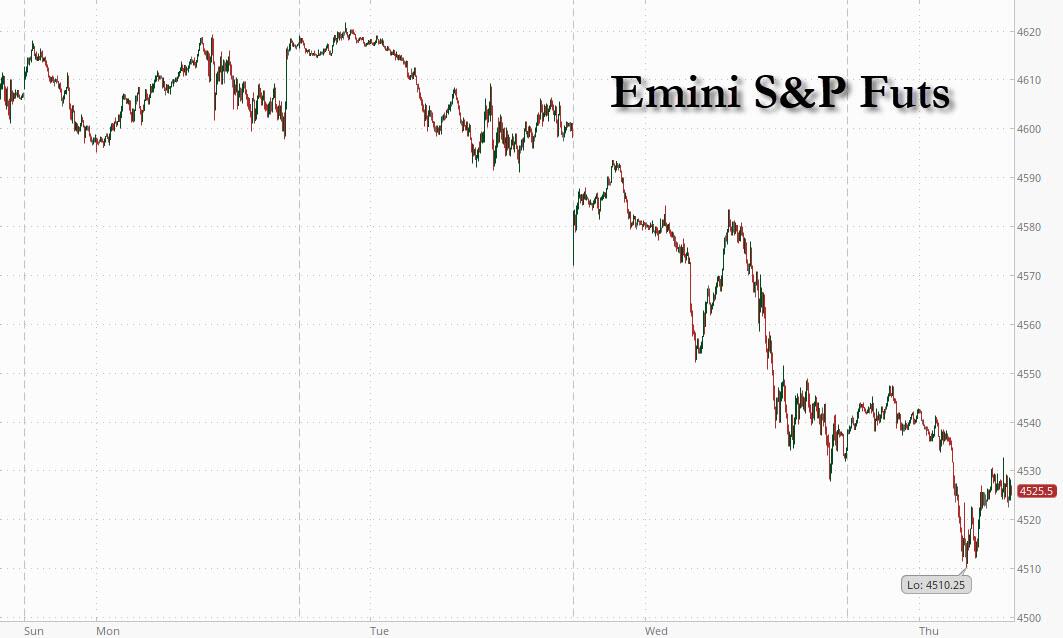
US equity futures are weaker for a second day amid a global stock sell-off sparked by a rout in US Treasuries which  accelerated overnight when the BOJ “unexpectedly” stepped in with unlimited bond buying for a second time this week after the benchmark 10-year note yield touched a fresh nine-year high of 0.65%, confusing markets about what it wants to do: keep a cap on yields or strengthen the collapsing yen. European stocks fell 0.6% and Asian markets suffered their worst two-day drop since February  as the S&P 500 was set to extend yesterday’s losses. As of 7:45am ET, S&P futures were down 0.3% while Nasdaq futures dropped 0.4% after several very disappointing earnings after the close yesterday. Tech gigacaps were mixed pre-mkt ahead of AAPL (-38bps) and AMZN (+34bps) earnings. 
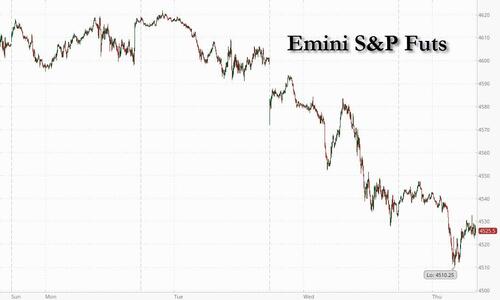
Global bond yields continue to surge higher with 10Y yields now +19.2bps this week. Bill Ackman added to the bearish mood by announcing he’s shorting 30-year Treasuries as a hedge on the impact of higher long-term rates on stocks. Commodities are mixed as the dollar strengthened for a fourth day; nat gas the upside standout with Ags and base metals giving up recent gains, which appear to be more geopolitically related moves. Today’s macro data focus includes ISM-Srvcs, Durable Goods/Cap Goods, Factory Orders, and Jobless Claims. The earnings highlight is after the close when AAPL and AMZN report and while they may not give a strong read-through on the broader economy, certainly every investor will be watching results.

It has been a busy session in premarket trading following an earnings deluge, with PayPal falling as much as 9% after the company’s transaction revenue fell short of estimates and as analysts cut their price targets on the stock, saying that the digital payments company’s transaction margins were disappointing and will weigh on sentiment. Qualcomm shares also fell around 8%, after the chipmaker gave a revenue outlook seen as weak by analysts, underlining headwinds in the handset market. Brokers said the struggling handset business will be slow to recover. Deutsche Bank cut the recommendation on the stock to hold from buy. Here are some other notable premarket movers:

  • American Well drops 9% after Morgan Stanley downgrades its rating on the telehealth company to equal-weight and says Wednesday’s second-quarter results were “another setback on growth.”.
  • Aravive shares fall 47% in US premarket trading after its Phase 3 AXLerate-OC trial evaluating the safety and efficacy of batiraxcept in platinum-resistant ovarian cancer did not meet its primary endpoint of progression-free survival. .
  • DoorDash shares jump 3.6% after the online food ordering and delivery platform reported second-quarter adjusted Ebitda that beat estimates. Analysts said results were good, with William Blair highlighting the strong user engagement and increase in total orders both year-over-year and sequentially.
  • DXC Technology shares slide 19% after the information technology servicer reported first-quarter revenue and adjusted earnings per share that missed consensus estimates. The company also reduced its full-year outlook for adjusted earnings per share and revenue. RBC Capital Markets downgraded their recommendation on the stock to sector perform from outperform, labeling the print “disappointing.”
  • EVgo shares rise as much as 16% after the electric-car charging company said CEO Cathy Zoi will retire in November and be succeeded by board member Badar Khan. The company also reported $50.6 million of second-quarter revenue Wednesday, more than five times what it generated in the same period last year.
  • Etsy shares fell as much as 8.7%, after the online retailer reported its second-quarter results and gave an outlook that Citi said wouldn’t be enough to reassure investors about its growth prospects.
  • Procore Technologies’ results on Wednesday were solid, but there are gathering macro headwinds, Loop Capital Markets writes in note downgrading the construction-management software company to hold from buy.
  • Robinhood (HOOD US) shares dropped as much as 9%, after the trading platform’s monthly active users missed analyst estimates, overshadowing the company reaching profitability for the first time since its IPO. On a more positive note, some analysts said that the company beating revenue expectations was a good sign.
  • Spirit AeroSystems Holdings shares fall 1% after Goldman Sachs cuts its rating on the planemaker’s stock to neutral from buy, saying the company’s medium-term profitability and free cash flow is worse than expected.
  • US-listed shares of Shopify fall as much as 2.7% on Thursday as Morgan Stanley notes that investors still lack direction from the company on longer-term growth. The Canadian e-commerce company, however, reported revenue for the second quarter that beat the average analyst estimate.
  • Unity Software shares rise as much as 6.6%, after the graphic tools provider reported second- quarter revenue that beat expectations and raised the low end of its full-year revenue forecast.
  • Upwork climbs 17% after the online-recruitment company increased its revenue and profit projections for the full year.

All attention remains on the 10-year Treasury yield which increased five basis points to 4.13% this morning. The selling has come on the heels of news that the Treasury will issue $103 billion of securities next week, more than forecast. The decision by Fitch Ratings to strip the US of its AAA credit ranking also put a spotlight on the country’s booming fiscal deficits.

“The US downgrade doesn’t have any direct impact on markets, but what’s happened is there’s been a lot of concurrent news,” Fowler at UBS said. “Treasury supply is going to pick up. And the Bank of Japan’s policy change has also removed the floor on bonds and that’s led to rising yields.”

Long-term debt looks “overbought” from a supply and demand perspective and it’s hard to see how the market will cope with the increased issuance “without materially higher rates,” Ackman said in a tweet.

Warren Buffett, on the other hand, told CNBC the Fitch move doesn’t change what Berkshire Hathaway Inc. is doing at the moment. “Berkshire bought $10 billion in US Treasurys last Monday. We bought $10 billion in Treasurys this Monday. And the only question for next Monday is whether we will buy $10 billion in 3-month or 6-month” T-bills, CNBC cited Buffett as saying.

Elsewhere, the Bank of Japan came into the market for the second time this week to slow gains in benchmark sovereign bond yields, underscoring its determination to curb sharp moves in rates even as it makes room for them to rise. The yen strengthened against all its major peers, adding 0.3%.

In European equities, the Stoxx 600 Index headed for the steepest three-day retreat since March. Infineon Technologies AG plunged as much as 12% after disappointing forecasts from the German chipmaker. Deutsche Lufthansa AG dropped amid concerns over debt and higher costs. Here are the most notable European movers:

  • Anheuser-Busch InBev shares jump as much as 5.1%, after the brewer reported second-quarter organic adjusted Ebitda that came ahead of estimates. BC Capital Markets said the results were an “impressive demonstration” of the company’s resilience and diversification
  • Zalando shares gain as much as 9% after the online fashion retailer reported adjusted Ebit for the second- quarter that topped estimates, with analysts pointing to lower marketing costs among the key drivers
  • Merck KGaA gains as much as 4% after the German health-care conglomerate reported its latest earnings and cut its forecast for the full year. Analysts say the reduced forecast is largely accounted
  • Beiersdorf shares rise as much as 4.6%, after it reported adjusted Ebit for the first half-year that beat the average analyst estimate Jefferies says the German consumer-goods group’s results came in well ahead in consumer segment
  • Adecco shares rise as much as 5.9%, as investors look past below-consensus 2Q earnings and focus on the staffing company’s market share gains, robust organic growth and cost control
  • SES shares rise as much as 16%, after the satellite operator reported estimate-beating results, announced buybacks and said it expects to receive a $3b pretax payment in 4Q after clearing C-band airwaves ahead of schedule
  • Societe Generale shares gained 3.3%, second best-performer on the Stoxx 600 Banks Index, after the French lender reported net income for the second quarter that beat the average analyst estimate in the first set of results
  • Infineon shares fall as much as 12%, the most since March 2020. The chipmaker’s fourth-quarter forecasts for margin and revenue both missed analyst estimates as inventory levels edged higher
  • Veolia Environment falls as much as 8% in Paris trading after broadly in-line 1H results, with Citi analysts saying consensus already prices more than average long- term Ebitda growth and margin outlook
  • Tenaris’s shares tumbled as much as 8.6% after the Italian steel pipe maker warned that sales and margins will be “significantly lower” in the second half due to an expected decline in sales in the Americas
  • Solvay drops as much as 4%, as the Belgian chemicals producer reports weaker 2Q volumes and a drop in adjusted Ebitda. Morgan Stanley highlights the steady guidance as a bright spot, however, given the recent spate of profit warnings across the sector
  • BPER Banca shares declined as much as 9.1% after the Italian lender gave what Deutsche Bank called “prudent” guidance that reflects a slowdown in 2H including in net interest income

Earlier in the session, Asian equities fell, taking their two-day drop to the most since February, as investors sold tech and consumer discretionary shares on concerns over higher bond yields. The MSCI Asia Pacific Index extended losses by as much as 0.8% after a 2.1% drop on Wednesday. Alibaba, Sony Group and Samsung Electronics were among the biggest drags as 10-year Treasury yields climbed past 4.1%. Valuations for tech stocks are generally impacted by higher yields as elevated interest rates affect expectations for future earnings growth.

Fitch Ratings’ downgrade of US sovereign rating and increased Treasuries issuance sparked risk-off mood globally, with the recent rally in Asian stocks halting in August, which is seasonally a bad month for equities. The index has slumped as much as 2.7% so far this week amid bouts of profit-taking in North Asian markets as the AI rally peters out. 

Benchmarks in Japan led declines in the region Thursday. All sectors were in the red. Australia’s ASX 200 was dragged lower by losses in tech after the underperformance of their US counterparts, with sentiment not helped by softer monthly exports and a continued contraction in quarterly retail trade.

Investors are now looking ahead to US non-farm payroll data on Friday for cues on the Federal Reserve’s next policy move after ADP Research Institute data showed that US companies added more-than-expected jobs in July. “I think the selloff was waiting to happen,” said Aninda Mitra, head of Asia macro and investment strategy at BNY Mellon Investment Management. “Overconfidence about the inevitability of a US soft landing and dovish policy pricing, when in reality the regime of high inflation and high rates is very much entrenched.”

In FX, the Bloomberg dollar index gained for a fourth day, rising 0.2%; the pound fell 0.3% against the dollar after the BOE hiked rates by 25bps, disappointing markets which had priced in roughly 33% odds of another 50bps hike. JPY stood as the outperforming currency amid haven flows following overnight weakness sparked by another unscheduled BoJ JGB purchase operation. EUR is softer against the Dollar with the Single Currency digesting the Final PMIs for July while the Sterling gears up the Bank of England policy decision.

In rates, treasuries extend losses and the recent bear steepening move with long-end underperformance, leaving 30-year yields cheaper by around 6bps on the day. US yields cheaper by 2bp to 6bp across the curve with long-end led losses steepening 2s10s, 5s30s spreads by 3.5bp and 2.2bp on the day; 10-year yields around 4.13%, cheaper by 5bp on the session with gilts outperforming by 5bp in the sector. Gilts outperformed after the Bank of England raised rates 25bps, in line with estimates. The US session focuses on the flood of US economic data due, including initial jobless claims and ISM services.  On the day UK 2-year yields richer by 7bp following Bank of England 25bp hike in a three-way vote split. The Dollar IG issuance slate empty so far; three deals priced $12.2b Wednesday, where issuers paid ~6bps in concessions on order books that were 4.4 times oversubscribed.

In commodities, iron ore slipped back below $100 a ton as investors questioned China’s resolve to revive growth with steel-intensive stimulus and the nation’s biggest group of mills called for curbs on trading. Futures in Singapore lost as much as 4.3%, to head for the sixth weekly drop in the past seven.

Looking ahead, US economic data slate includes July Challenger job cuts (7:30am), 2Q nonfarm productivity, unit labor costs, initial jobless claims (8:30am), S&P services PMI (9:45am), June factory orders, durable goods orders, July ISM services index (10am).  We also have the UK July official reserves changes, Italian July services PMI, June retail sales, German June trade balance, the French budget balance for June and the Eurozone PPI result for June. In terms of central banks, we have the BoE decision, the Decision Maker Panel survey and we will also hear from the Fed’s Barkin. Finally, company earnings include Apple, Amazon, ConocoPhillips, Amgen, Booking Holdings, Stryker, Airbnb, Gilead Sciences, Cigna, Regeneron, Monster Beverage, EOG Resources, Block, Moderna, Cheniere, Warner Bros Discovery, Expedia and Draft Kings.
Market Snapshot

  • S&P 500 futures down 0.5% to 4,516.25
  • MXAP down 0.8% to 165.41
  • MXAPJ down 0.5% to 524.45
  • Nikkei down 1.7% to 32,159.28
  • Topix down 1.5% to 2,268.35
  • Hang Seng Index down 0.5% to 19,420.87
  • Shanghai Composite up 0.6% to 3,280.46
  • Sensex down 1.1% to 65,036.75
  • Australia S&P/ASX 200 down 0.6% to 7,311.68
  • Kospi down 0.4% to 2,605.39
  • STOXX Europe 600 down 0.9% to 456.84
  • German 10Y yield little changed at 2.57%
  • Euro down 0.2% to $1.0914
  • Brent Futures down 0.5% to $82.76/bbl
  • Gold spot up 0.1% to $1,935.90
  • U.S. Dollar Index up 0.19% to 102.79

Top Overnight News from Bloomberg

  • China will be sending a representative to a major Saudi Arabia summit focused on achieving peace in Ukraine, suggesting Beijing is eager to see the conflict conclude. WSJ
  • China’s services PMI comes in ahead of the Street at 54.1 (up from 53.9 in June and ahead of the consensus forecast of 52.4). RTRS
  • The BOJ intervened for a second time this week after the benchmark 10-year yield touched a fresh nine-year high of 0.65%. The unscheduled move pushed the rate fractionally below this level but still well above where it traded before last week’s policy tweak. BBG
  • Brazil cut its policy rate by 50bp, more than the 25bp anticipated by investors, and said there would be further reductions in the months ahead. WSJ
  • Another BOE rate hike is in the cards today, the size of which is uncertain given the recent slowdown in inflation. Economists expect at least a 25-bp move to 5.25%, with a strong chance that policymakers may repeat June’s 50-bp jump. Traders see rates peaking around 5.75% by year end, almost a full point below expectations just a month ago. BBG
  • SALT is causing another fiscal battle in Washington – certain Republicans in the House are threatening to block spending bills unless the $10K cap is increased. WSJ
  • The SEC is preparing to adopt a rule package as soon as this month aiming to bring greater transparency and competition to the multitrillion- dollar private-funds industry, people familiar with the matter said. SEC Chair Gary Gensler has said he hopes to bring down fees and expenses that cost hundreds of billions of dollars a year. WSJ
  • Fitch’s downgrade of its U.S. government debt rating Tuesday only fueled more of the partisan bickering that the firm said was raising concerns about America’s ability to tackle its swelling budget deficits. And as Congress prepares to hash out spending for next fiscal year, the two parties aren’t considering the policies that could meaningfully address the problem: raising taxes or cutting spending on major programs such as Medicare or Social Security. WSJ
  • Bill Ackman is making sizable bets on declines for 30-year US Treasuries as a hedge on the impact of higher long-term rates on stocks. Ackman also sees the short as a “high probability” standalone play, the Pershing Square Capital Management founder said in a post on X, the platform formerly known as Twitter. An increasing supply of Treasuries will be needed to fund the current budget deficit, future spending plans and higher refinancing rates, Ackman said. BBG

A more detailed look at global markets courtesy of Newsquawk

APAC stocks mostly followed suit to the weakness in global peers including on Wall St where stocks and bonds were pressured by the US rating downgrade, AMD earnings and hot ADP data, albeit with some of the losses were stemmed in Asia as participants digested Chinese Caixin Services and Composite PMI figures. ASX 200 was dragged lower by losses in tech after the underperformance of their US counterparts, with sentiment not helped by softer monthly exports and a continued contraction in quarterly retail trade. Nikkei 225 underperformed as yields edged higher and with newsflow dominated by earnings. Hang Seng and Shanghai Comp were choppy and briefly clawed back opening losses in the aftermath of somewhat mixed Chinese Caixin Services and Composite PMI data.

Top Asian News

  • China’s Foreign Ministry said China is willing to maintain communications regarding the US inviting Chinese Foreign Minister Wang Yi for a visit, according to Reuters.
  • US House Committee opened an investigation into the suspected Chinese hacking of State Department and Commerce Department emails.
  • Japanese Chief Cabinet Secretary Matsuno said he hopes the BoJ works closely with the government and guides policy appropriately to stably and sustainably hit the 2% price target, while he added the government is closely watching FX moves and their impact on Japan’s economy and prices, according to Reuters.

European bourses and US futures continue to slump in an extension of Wednesday’s price action as yields continue to rise; Euro Stoxx 50 -0.8% & ES -0.3% Sectors in Europe are lower across the board with marked underperformance in Tech as Infineon -7.7% slumps post-earnings given two-way commentary and below-forecast Q4 guidance. Autos also stalling on BMW while Travel & Leisure is affected by Lufthansa. Stateside, given the marked yield action the NQ -0.4% is the incremental underperformer with attention on data points before numerous blockbuster earnings, incl. Apple and Amazon after-hours.

Top European News

  • ECB’s Panetta says monetary policy may operate not just by increasing rates but also by keeping the prevailing level of policy rate for longer. With policy rates now firmly in restrictive territory, setting and communicating the direction of monetary policy has become more complex. The risks to inflation are becoming balanced. Supply chain pressures have substantially abated compared with last year. It is possible that the transmission of our monetary policy might be even stronger than the staff projections indicate.. Adds, will decide in September whether we should pause or not.

FX

  • Another session of gains thus far the Buck, driven by an upside in bond yields as debt futures continue to trundle lower in a continuation of recent price action. DXY found overnight support around 102.50 before edging higher in early European trade to a 102.84 high at the time of writing.
  • JPY now stands as the outperforming currency amid haven flows following overnight weakness sparked by another unscheduled BoJ JGB purchase operation.
  • EUR and GBP are both softer against the Dollar with the Single Currency digesting the Final PMIs for July while the Sterling gears up the Bank of England policy decision.
  • Antipodeans are all modestly softer on the day amid the firmer Dollar and broader risk aversion, but losses are stemmed by the overnight Chinese Caixin Services PMI which topped forecasts, whilst Australian Trade Balance printed at a slightly wider surplus than expected, although Imports and Exports both contracted.
  • PBoC set USD/CNY mid-point at 7.1495 vs exp. 7.1933 (prev. 7.1368)
  • Brazil Central Bank cut the Selic rate by 50bps to 13.25% (exp. 25bps cut) with the decision not unanimous. BCB stated the current scenario demands serenity and moderation in the conduct of monetary policy and if the expected scenario is confirmed, the committee unanimously expects rate cuts of the same magnitude in coming meetings, while it considered a 25bps cut but concluded a 50bps cut was appropriate due to the improvement in inflation dynamics.

Fixed Income

  • In short, a continuation of Wednesday’s post-Fitch/Refunding price action with catalysts since somewhat light as we count down to the BoE.
  • EGBs and USTs are lower across the board and have dropped markedly below the prior sessions’ troughs.
  • JGBs buck the trend and are modestly firmer after another unscheduled BoJ purchase overnight, which came much later in the session than normal and is the second such operation since the YCC tweak.
  • BoJ offered to buy JPY 100bln in 1yr-3yr JGBs and offers to buy JPY 300bln in 5yr-10yr JGBs in an unscheduled operation.

Commodities

  • WTI and Brent futures are subdued as risk sentiment remains on the backfoot whilst the Dollar is underpinned.
  • Spot gold remains heavy amid the recent gains in the Dollar, with the yellow metal extending losses under USD 1,950/oz following yesterday’s fall below the psychological level.
  • Base metals are subdued but not to a great extent following the recent selloff in the complex, with the downside possibly cushioned by the rosier Chinese Caixin Services PMI overnight.
  • Saudi Arabia and Kuwait reaffirmed they jointly own rights to natural resources in the Durra Gas field and renewed calls for Iran to negotiate over the demarcation of borders, according to Saudi’s Foreign Ministry.
  • Chile Codelco copper production fell 7.39% Y/Y in June to 120.3k tonnes, while Escondida copper mine production rose 8.7% Y/Y to 111.4k tonnes in June.
  • Ukraine’s PM says Ukraine is considering the possibility of insuring ships and companies going via a “grain corridor”, according to Interfax-Ukraine.

Geopolitics

  • Ukrainian military warned of drone attacks around Kyiv and said anti-aircraft units were in operation, while explosions were also reported, according to Reuters.
  • Russian Defence Ministry said navigation is restricted in Kerch Strait and that movement in the Kerch Strait is also limited for aircraft, according to TASS.
  • Polish PM says Wagner’s forces are moving towards NATO’s eastern flank to destabilize, according to Al Arabiya.

US Event Calendar

  • 07:30: July Challenger Job Cuts -8.2% YoY, prior 25.2%
  • 08:30: July Initial Jobless Claims, est. 225,000, prior 221,000
    • July Continuing Claims, est. 1.71m, prior 1.69m
  • 08:30: 2Q Unit Labor Costs, est. 2.5%, prior 4.2%
    • Nonfarm Productivity, est. 2.3%, prior -2.1%
  • 09:45: July S&P Global US Services PMI, est. 52.4, prior 52.4
  • 10:00: June Durable Goods Orders, est. 4.7%, prior 4.7%
    • June Durables -Less Transportation, est. 0.6%, prior 0.6%
  • 10:00: June Factory Orders, est. 2.3%, prior 0.3%
    • June Factory Orders Ex Trans, est. 0.1%, prior -0.5%
  • 10:00: June Cap Goods Ship Nondef Ex Air, prior 0%
    • June Cap Goods Orders Nondef Ex Air, prior 0.2%
  • 10:00: July ISM Services Index, est. 53.0, prior 53.9
    • July ISM Services Prices Paid, prior 54.1
    • July ISM Services New Orders, prior 55.5
    • July ISM Services Employment, prior 53.1

DB’s Jim Reid concludes the overnight wrap

August is often a month where everyone thinks it will be quiet but also one that throws up a disproportionate amount of surprises in what are thin liquidity conditions. Clearly by the time the real dog days of the month are amongst us in a couple of weeks we may have forgotten about the Fitch US debt downgrade but its certainly given the start of the month a big dose of volatility with the S&P 500 (-1.38%) seeing its worst day since April. However the increased treasury issuance will live on so that’s something we won’t be able to forget in the weeks and months ahead. All this excitement has occurred ahead of a big day today including the BoE rate decision (we think 25bps over 50bps), US services ISM, jobless claims, unit labour costs and productivity, with Apple and Amazon then reporting after the bell.

The straw that probably broke the back for the Fitch downgrade was the surprise announcement on Monday of the Treasury’s near-term borrowing needs which were formalised yesterday in the refunding announcement. At the margin it seems slightly bigger than the very recently revised expectations but within the range of likely outcomes. Indeed rising borrowing needs are what Fitch cited as a key factor driving its decision to lower its rating for US sovereign debt. The increase in issuance announced yesterday is unlikely to be the last, as the Treasury concurrently announced that it expects “further gradual increases will likely be necessary in future quarters” into 2024. In the subsequent press conference, the Treasury also emphasised it was too early to speculate whether this would lead to future actions by Congress to reduce the deficit. Much too early for that discussion I would imagine but it’s a small shot across the bows nevertheless.

The culmination of this week’s news led to a decent steepening of the curve with 2yr and 10yr USTs -2.4bps and +5.6bps respectively with the latter up to 4.08% (peak at 4.12% for the day), their highest closing level since November last year. The 2s10s slope, while still deeply inverted at -80.5bp, rose to its highest level since early June. 30yr yields also continued to rise, gaining +8.3bps to 4.17%, also the highest since last November. This morning in Asia, US Treasuries are up another couple of basis points to 4.10% as I type.

A strong ADP (more later) contributed to an initial sell off at the front end (with 2yr trading +3.5bp higher at one point). But rates then rallied, especially at the short end, with Fed funds pricing for end-24 down -6.0bps on the day to 4.14%. So longer end yield moves were more of an issuance story than a response to the ADP given the Fed repricing. A reminder that DB thinks that US term premium should be going up for structural issues but the trade has certainly got a kicker from the BoJ last week and now the refunding announcement and Fitch this week.

In contrast, European bonds saw a bull steepening as the equity risk-off story and a flight to quality away from US debt was the dominant theme. 10yr German bund yields fell -2.4bps, with 2yr yields falling -6.0bps.

Equities were in the red across the board, with the S&P 500 slipping -1.38% in its largest down move since April, with only the consumer staples (+0.25%) and healthcare (+0.06%) sectors remaining in the green. 73% of the constituent members of the S&P 500 were negative on the day. Technology led the decline, with the NASDAQ falling -2.17%. The FANG+ index fell -3.45%, with all 10 constituents down. Accompanying the equity decline was a rise in implied volatility, with the VIX seeing its sharpest daily increase since the March banking stress, and up to its highest level since the end of May at 16.09. European equities also slipped with the STOXX 600 falling -1.35%. The retreat was even broader than in the US, with 88% of constituents down on the day.

The credit market was not left unscathed. US high-yield credit default swaps rose +11.3bps, with European Crossover rising +11.5bps. The indices for US and European investment grade credit default swaps also increased, +2.1bps and +2.5bps respectively.

In terms of data, we had the US July ADP report, which upwardly surprised at +324k (vs 190k expected), even if that marked a slowdown from +455k in June. Although typically not the most reliable monthly print, the annual wage growth component of the survey did prove consistent with the softening inflation narrative, falling from 6.4% to 6.2%. Overall, the market paid little attention to the report, with the US debt issuance surprise proving the lead story.

Turning to the UK, Prime Minister Rishi Sunak was reported stating that he felt inflation was not falling as fast as he would like. This came ahead of the BoE monetary policy decision later today. Our economists are expecting a 25bps hike to bring the policy rate to 5.25% and looking ahead, we see two further quarter point rate hikes, with the terminal rate at 5.75%. Read their preview here. 2yr gilt yields traded down -6.2bps yesterday ahead of the meeting, following the broader short-end rally in Europe. Money markets moved to price a 27% chance of a 50bp hike, down from 32% the day before. This had been at over 70% prior to the weaker UK inflation print on 19 July.

Risk-off sentiment has continued in Asia overnight. As I check my screens, the Nikkei (-1.42%) is sharply lower with the KOSPI (-0.64%), the Hang Seng (-0.15%), the Shanghai Composite (-0.18%) and the CSI (-0.02%) also edging lower. S&P 500 (+0.07%) and NASDAQ 100 (-0.03%) futures are fairly flat. 10yr JGB yields earlier rose +4bps to 0.66%, the highest since April 2014, but the second unscheduled bond buying program of the week has led to a 2bps rally from the yield highs.

Early morning data showed that China services activity expanded at a faster place in July as the Caixin services PMI edged up to 54.1 v/s (52.4 expected) from a level of 53.9, thus partly offsetting the drag from the weak manufacturing sector. Elsewhere, Australia’s services sector activity contracted in July as the Judo Bank services PMI fell to 47.9 (the lowest since December) from 50.3. Separately, the country’s trade surplus unexpectedly swelled to A$11.3 bn in June (v/s A$10.75 bn expected) compared to a downwardly revised surplus of A$10.5 bn in May.

In the geopolitics sphere, it was reported yesterday morning that Russia conducted a drone strike on the key Danube port in the Odesa region, Ukraine, hitting grain storage facilities. In response, the price of Chicago wheat futures jumped +4.87% above its previous day close before slipping to finish the day down -1.88%. Corn futures also spiked, before falling -1.76% on the day. US corn prices have in fact declined to their lowest since the end of 2020 amid a more encouraging weather outlook.

Looking ahead, we have the US July ISM services index, the Q2 unit labour costs, nonfarm productivity, June factory orders and initial jobless claims from the US. We also have the UK July official reserves changes, Italian July services PMI, June retail sales, German June trade balance, the French budget balance for June and the Eurozone PPI result for June. In terms of central banks, we have the BoE decision, the Decision Maker Panel survey and we will also hear from the Fed’s Barkin. Finally, company earnings include Apple, Amazon, ConocoPhillips, Amgen, Booking Holdings, Stryker, Airbnb, Gilead Sciences, Cigna, Regeneron, Monster Beverage, EOG Resources, Block, Moderna, Cheniere, Warner Bros Discovery, Expedia and Draft Kings.

Tyler Durden
Thu, 08/03/2023 – 08:20

via ZeroHedge News https://ift.tt/muMcblP Tyler Durden

New Disney Board Eliminates Diversity, Equity, And Inclusion Programs

New Disney Board Eliminates Diversity, Equity, And Inclusion Programs

Authored by Dan M. Berger via The Epoch Times (emphasis ours),

The new district board overseeing Disney World in Florida has eliminated its Diversity, Equity, and Inclusion (DEI) programs, including a DEI board.

A float with people dressed as characters from the Walt Disney movie “Peter Pan” is seen as people attend the “Festival of Fantasy” parade at the Walt Disney World Magic Kingdom theme park in Orlando, Fla., on July 30, 2022. (REUTERS/Octavio Jones)

In February, Gov. Ron DeSantis signed legislation creating the new board and abolishing its predecessor, which was tightly linked with the primary business it regulated— Disney World.

The act was part of Mr. DeSantis’s war with Disney after its leaders came out against his Parental Rights in Education bill last year, one dubbed the “Don’t Say Gay” bill by detractors.

Since the district’s 1967 creation, Disney had enjoyed a unique self-governing status, putting it outside Florida county or city governments. It was governed by the Reedy Creek Improvement District, and it appointed the members to it. It enjoyed various tax exemptions.

Nick Caturano (C) speaks out against Disney to Florida Gov. Ron DeSantis on Fox News (Courtesy of Nick Caturano)

Mr. DeSantis, noting no other business in Florida had such a sweetheart deal, created the new board—the Central Florida Tourism Oversight District (CFTOD)—whose members he appointed.

“Today, District Administrator Glenton Gilzean announced the abolition of all DEI programs at the Central Florida Tourism Oversight District,” the district said in a public statement on Aug. 1.

“The announcement comes after the Reedy Creek Improvement District implemented hiring and contracting programs that discriminated against Americans based on gender and race, costing taxpayers millions of dollars.

The announcement comes after an internal investigation into the district’s policies,” according to the statement.

“The district’s DEI committee will be dissolved and any DEI job duties will be eliminated. CFTOD staff will also no longer be permitted to use any staff time to pursue DEI initiatives.

An aerial view of the Walt Disney World in Orlando, Fla., on Feb. 8, 2023. (Joe Raedle/Getty Images)

“The so-called diversity, equity, and inclusion initiatives were advanced during the tenure of the previous board and they were illegal and simply un-American,” said Mr. Gilzean.

“Our district will no longer participate in any attempt to divide us by race or advance the notion that we are not created equal.

“As the former head of the Central Florida Urban League, a civil rights organization, I can say definitively that our community thrives only when we work together despite our differences.”

According to the statement, Reedy Creek, under its Minority/Women Business Enterprise and Disadvantaged Business Enterprise program, routinely awarded contracts “based on racially and gender driven goals to businesses on the basis of their owners’ race and gender.”

The Reedy Creek district instituted gender and racial quotas “to ensure that contractors met a certain threshold of diversity,” the new district said in the statement.

In order to meet those quotas, it is estimated that the district had to pay millions of dollars more in order to find businesses who could comply.

The new district further alleged in the statement that Reedy Creek employees, after entering a contract, “aggressively monitored [the] contractor’s racial and gender practices, wasting taxpayer dollars.”

Contractors who didn’t keep up with the quotas were threatened with nonpayment and disqualification from future bidding, the district said.

The new district board has been pushing to establish its independence.

Last week it adopted a “Conflict of Interest” policy one board member described as “even more rigorous than anything you might find required or mandated by the state.”

Board members clarified they intended to insulate against pressure from outside influences and personal interests, including those that could come from state officials.

Disney World isn’t the only business within the district. More than 200 third-party companies operate on Disney World property, and the district also includes luxury homes in the Golden Oaks neighborhood.

Tyler Durden
Thu, 08/03/2023 – 07:45

via ZeroHedge News https://ift.tt/IwPHD89 Tyler Durden