Credit Card Debt Grinds To A Halt As Average APR Hits New Record High

Credit Card Debt Grinds To A Halt As Average APR Hits New Record High

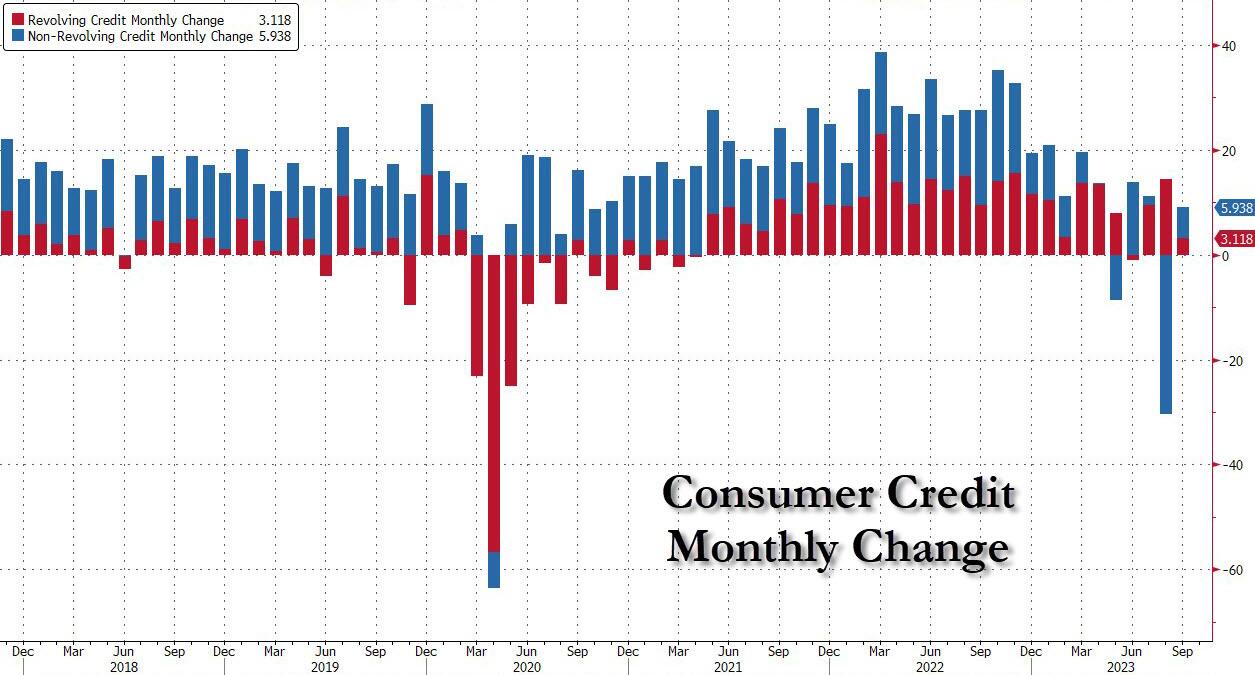
After several months of wild swings in US household debt, moments ago the Federal Reserve published the latest data consumer credit data which showed that in September, total debt increased by just $9.1 billion, which while an improvement from last month’s -$15.8 billion, the result of last month’s revision to student loans, was not only a miss to consensus estimates of $9.5 billion, but also a clear slowdown from recent months when the monthly increase was in the $20/$30BN range.

Looking at the composition, both revolving and non-revolving credit were weak.

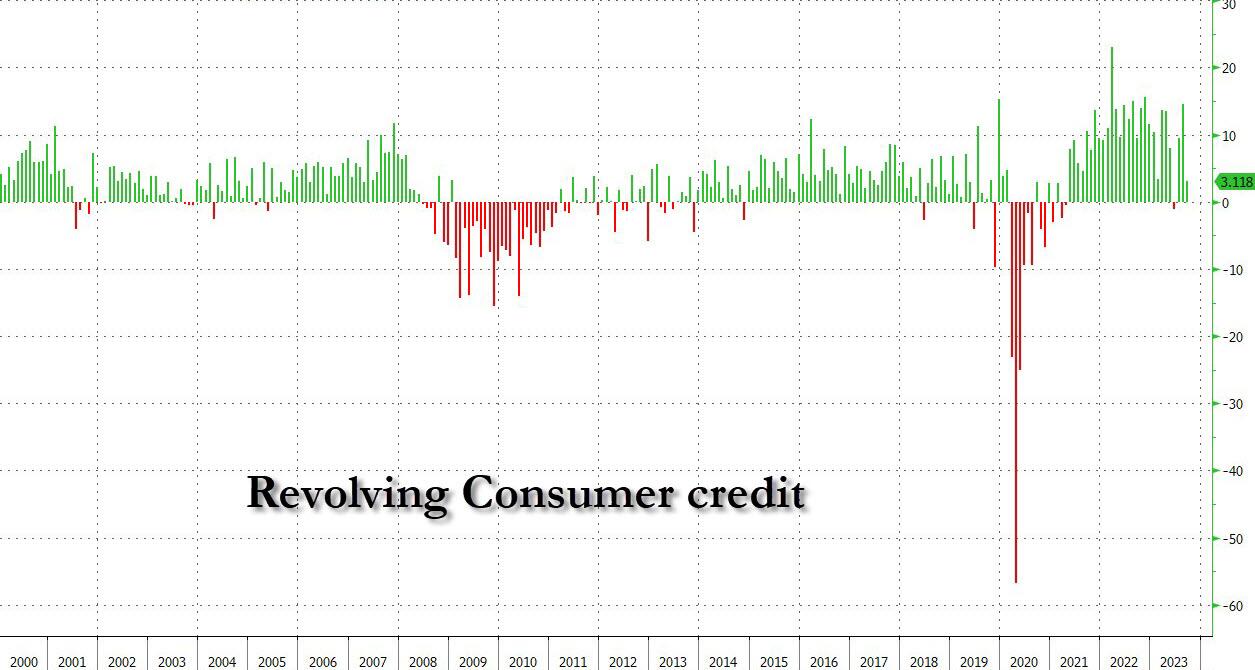
Starting with the former, in September, credit card debt rose by just $3.1 billion, which with the exception of June’s freak negative revolving credit print, was the lowest monthly increase since the covid crisis.

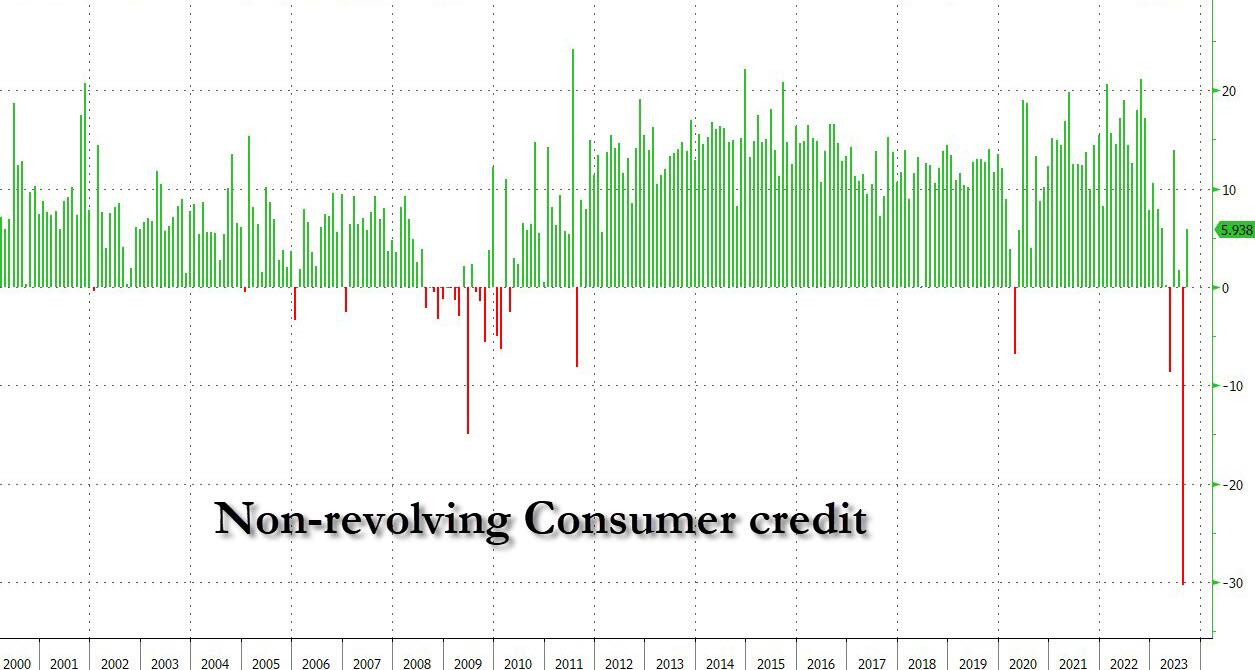
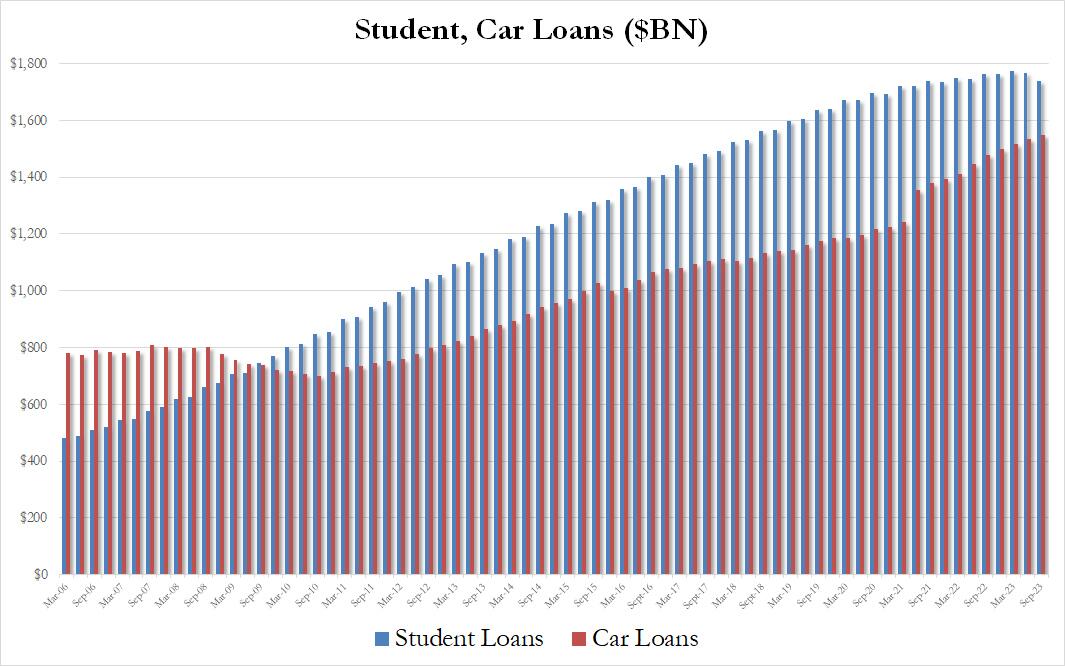
As for non-revolving credit, or student and auto loans, here too things have gotten bogged down, and after last month’s record ($30BN) contraction driven by student-loan forgiveness, in September just $5.9 billion in total loans were issued, also one of the lowest monthly increases since covid.

Looking at the breakdown in nonrevolving credit we find that while student loans shrank by a record $27.8 billion, to be expected at a time of aggressive vote buying and debt forgiveness by the Biden administration, auto loans actually jumped by $14.2 billion, which while a slowdown from recent quarters was still solid at a time when the rate on the average auto loans is pushing double digits.

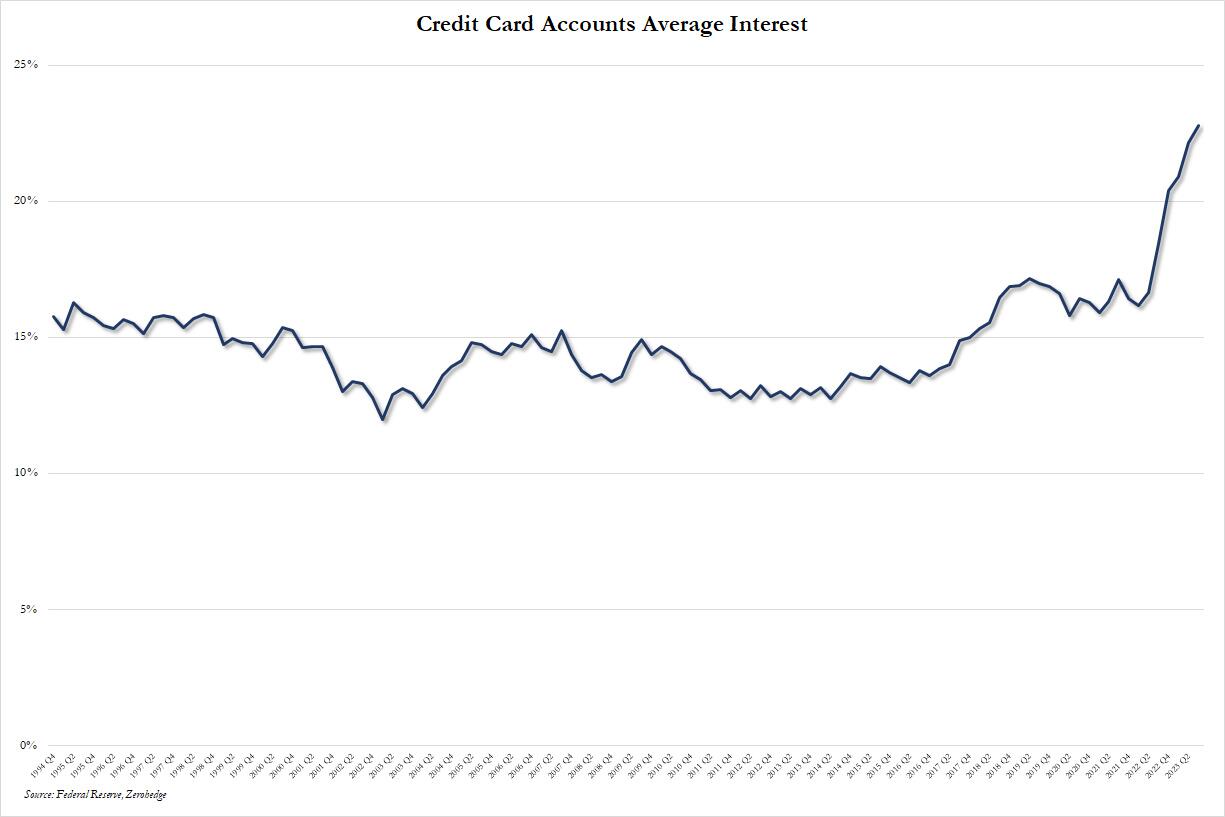
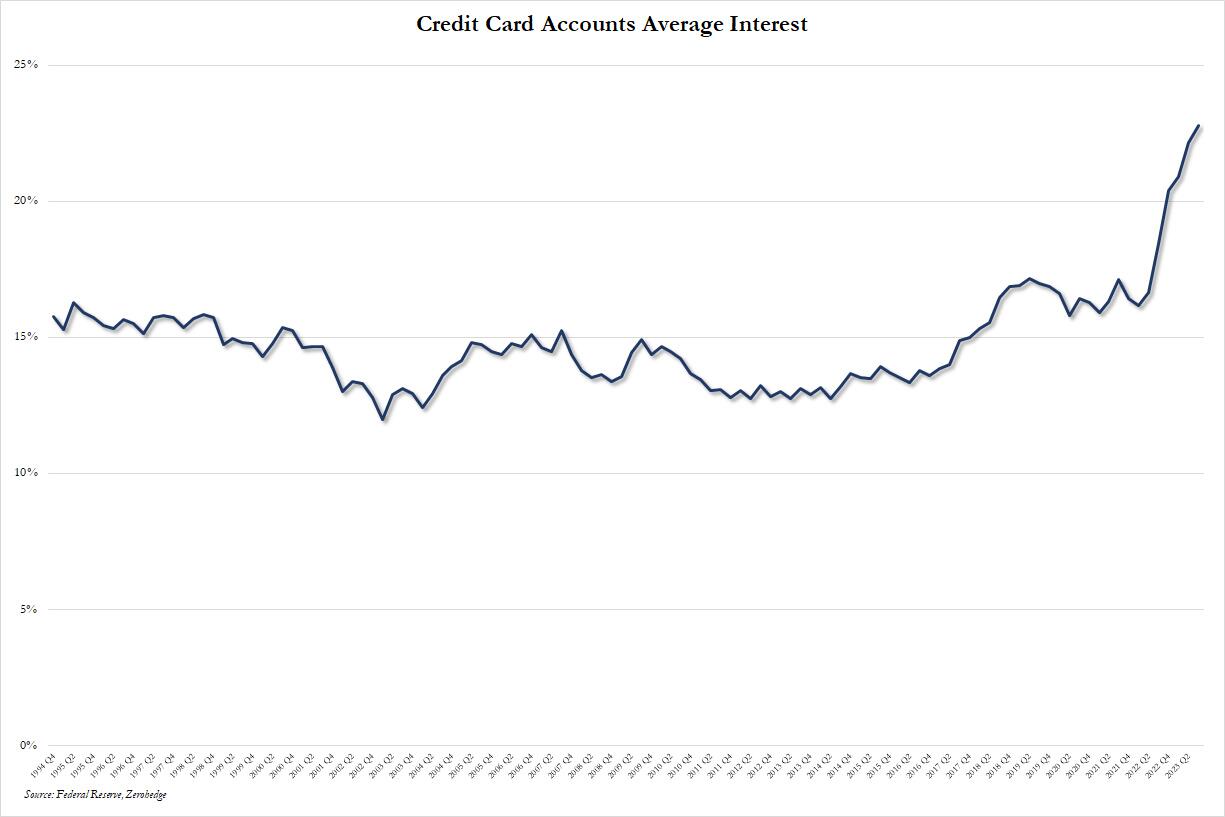
Last but not least, the slowdown in debt, and especially credit card debt, is not a surprise since as the Fed also reported today, in September, the average rate on credit cards across US financial institutions just hit a record high of 22.77%.

And with consumers increasingly reluctant to max out their credit cards due to record high rates, at a time when the personal savings rate in the US has collapsed from over 5% to 3.4% – the lowest since 2022 – in just a few months…

… it is now only a matter of time before US GDP prints deep negative now that that pillar supporting 70% of the US economy, consumer purchases, is about to crack.


Tyler Durden
Tue, 11/07/2023 – 15:36

via ZeroHedge News https://ift.tt/GWTvFhO Tyler Durden

Worst Sales Beats Since 2019 Expose Weak US Consumer

Worst Sales Beats Since 2019 Expose Weak US Consumer

By Sagarika Jaisinghani and Farah Elbahrawy, Bloomberg Markets Live reporters and analysts

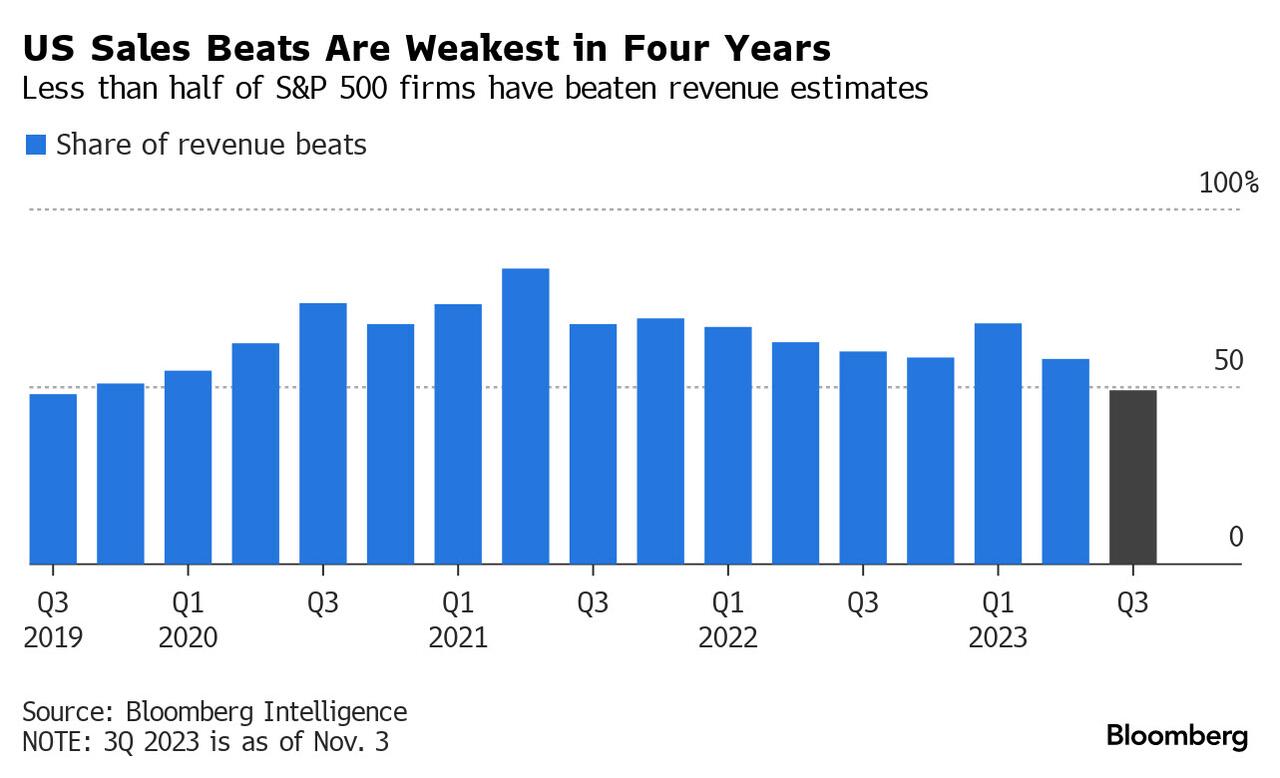
Corporate America is delivering the bleakest sales reports in four years this earnings season, a sign that weakening consumer demand is limiting companies’ ability to raise prices further.

With more than 80% of S&P 500 firms having reported, less than half have beaten revenue estimates for the third quarter — the lowest share since the same period in 2019, according to data compiled by Bloomberg Intelligence. The pace of sales growth globally has also moderated to “the lower end of their pre-pandemic ranges,” Deutsche Bank Group AG strategists said.

That’s overshadowed a surprise increase in quarterly earnings so far, with investors instead focusing on a long list of revenue warnings from the likes of Apple Inc. and Estée Lauder Cos. In Europe, too, the season has been characterized by high-profile cuts including from Remy Cointreau SA.

“We heard a lot of caution in managements’ guidance during the season and that’s exactly what we are watching for — weaker sales and margins compression as pricing power wanes,” said Marija Veitmane, senior multi-asset strategist at State Street Global Markets. “For now, consumer and corporates still have access to credit, but it’s getting harder and more expensive. Once that dries out, we would see more pain.”

Apple warned last week that revenue in the holiday quarter will be about the same as last year, disappointing investors banking on a rebound in growth. Estée Lauder shares tumbled after the owner of the MAC and Tom Ford brands flagged declining sales. Remy Cointreau fell to a three-year low after the French distiller cut its annual sales guidance.

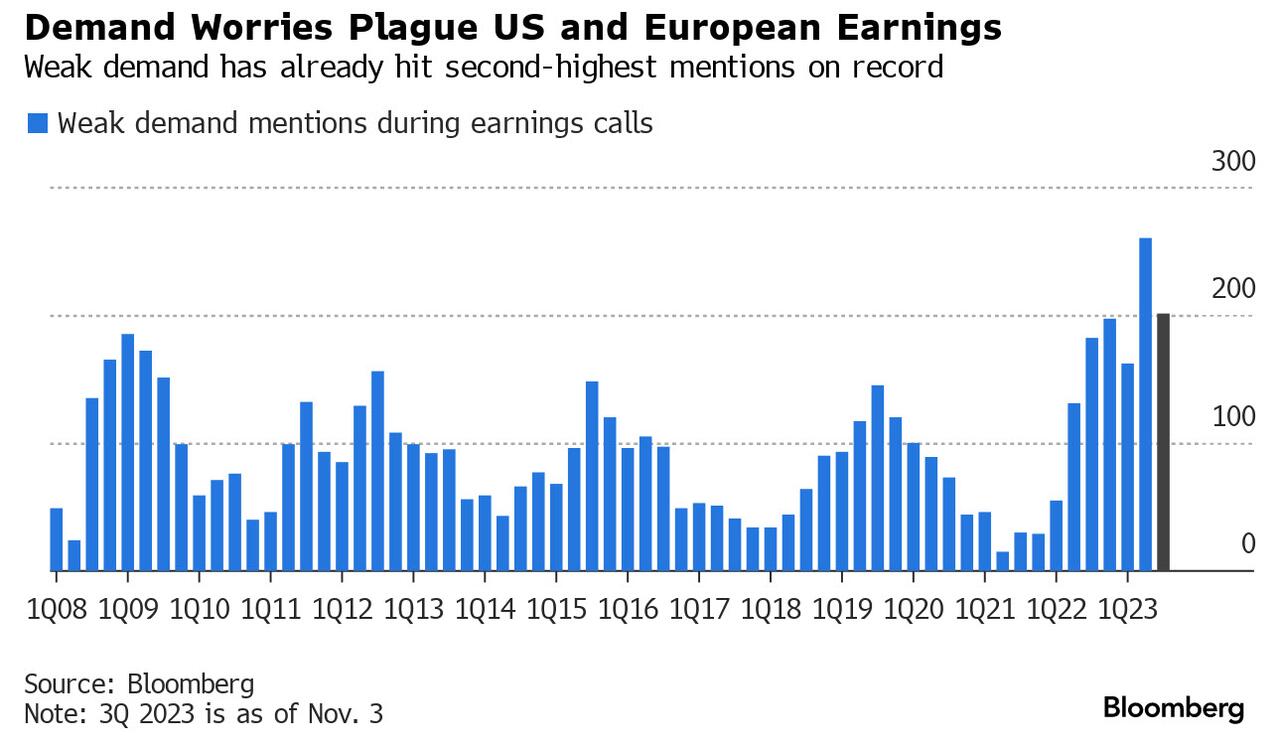
A Bloomberg analysis of earnings call transcripts shows “weak demand” is among the top trending phrases in both the US and Europe. With 20% of companies still to report, these mentions are already the second-highest on record, according to data going back to 2000.

Figures from Barclays Plc also show that management teams are sounding far more negative about the outlook for revenue than they are about profits as margins appear to hold be holding up for now. As a result, analysts are revising sales estimates down faster than those for earnings-per-share, strategist Emmanuel Cau said.

For Morgan Stanley’s Michael Wilson, the trend particularly signals eroding pricing power for goods over services. The strategist — among the top equity bears on Wall Street — retained his pessimistic view on the S&P 500 for the remainder of 2023, citing a gloomy earnings outlook, weaker macro data and deteriorating analyst views.

Tyler Durden
Tue, 11/07/2023 – 15:20

via ZeroHedge News https://ift.tt/MwxZyGK Tyler Durden

Conservative Watchdog Alleges Retaliatory IRS Audit After Exposing Biden Nominees

Conservative Watchdog Alleges Retaliatory IRS Audit After Exposing Biden Nominees

In what appears to be a brazen echo of the Lois Lerner scandal, a conservative watchdog group says the Biden administration is unfairly targeting it with an IRS audit in retaliation for its work which put a critical spotlight on would-be occupants of the Biden administration’s inner sanctum.

The American Accountability Foundation (AAF), a conservative watchdog known for its longstanding scrutiny of public figures, alleges that the IRS has been “politically weaponized” – and began looking into their 501(c)(3) tax-exempt status following their investigative work that spotlighted questionable aspects of President Biden’s nominees to senior administrative roles. A letter from the IRS obtained by The Epoch Times indicates an examination of AAF’s activities and requests extensive documentation, including all external communications.

AAF President Tom Jones sees this move as nothing short of a politically motivated crackdown, given the timing and nature of the IRS’s audit request. According to Jones, the demand for records tied to current elected officials is a clear sign of targeting against the AAF’s research and education activities. He has termed it a “deliberate attempt to punish and suppress” the foundation’s work.

This sudden request by the IRS is not random,” Jones said in a statement, insisting that the records request is “clearly a sign that they are targeting our research and education activities.”

“It’s a deliberate attempt to punish and suppress AAF’s activities. It is surely no coincidence that AAF—the very organization that exposed the weaponization of the IRS—is now the target of it,” Jones added.

The AAF has been a thorn in the side of the Biden administration, running ad campaigns that brought to light the “radicalism” of nominees like Gigi Sohn for FCC chair, who eventually withdrew her nomination. The group’s assertion is that it played a pivotal role in the unraveling of these candidacies by informing the public about what they perceived as extreme and partisan positions held by the nominees.

Not the first time

According to the report, Senator Sheldon Whitehouse (D-RI) pressured the IRS to investigate other conservative groups like Turning Point USA and the Conservative Partnership Institute, alleging that their activities were politically charged and aimed at undermining democratic elections.

Cleta Mitchell, an attorney who represented conservative groups targeted by the IRS during Obama’s presidency, sees a pattern in the AAF’s ordeal – particularly given that the IRS has previously admitted wrongdoing in targeting conservative groups. The agency’s past admissions of inappropriately increased scrutiny serve as a stark reminder that the IRS’s actions are not forgotten and the potential for misuse of power remains a concern.

“As the attorney for many conservative, tea party groups targeted and harassed by the Obama IRS a decade ago, this certainly smacks of the exact same tactics used by the IRS then … and apparently being used again now against AAF,” Mitchell said in a statement, adding “Before the IRS starts down this road again, it would be worth remembering the scorn heaped upon it the last time it allowed itself to be used as a pawn by a liberal  in the White House.”

In 2017, the IRS ended up admitting that it was wrong when it based screenings of the groups’ applications for tax-exempt status on their names, which included words like “Tea Party” or “patriots” on application forms. The IRS also acknowledged that it had acted inappropriately when it subjected the groups to increased scrutiny and delays, while demanding unnecessary information from them.

Depending on the type of exemption sought, groups applying for tax-exempt status under federal law may engage in limited amounts of political activity. Some experts have said that this fact—along with vague rules—can make it difficult for IRS agents to tell which groups overstep and become ineligible for exemption. –Epoch Times

According to the AAF, the latest action by the IRS is part of a pattern of “weaponized” federal agencies under the Biden administration. Other examples include the infamous October 2021 memo from AG Merrick Garland which instructed the FBI to keep tabs on parents protesting leftist indoctrination of their children.

“We demand that this abuses is put to an end at once,” Jones said in a statement. “Our Constitution and Declaration of Independence guarantee our God-given right to speak the truth about the powerful without being punished and harassed.”

Tyler Durden
Tue, 11/07/2023 – 15:00

via ZeroHedge News https://ift.tt/wkdHmDs Tyler Durden

Lawmakers Try To Insert Privacy Protections Into the Feds’ Snooping Powers


Stylized eyeball | Illustration: Lex Villena; Midjourney

A bipartisan collection of privacy-minded lawmakers today announced the introduction of a bill that would reform and restrain the authorities of federal agencies from snooping on American citizens and collecting data without getting a warrant first.

Federal surveillance authorities under Section 702 of the Foreign Intelligence Surveillance Act (FISA) are up for congressional renewal this year. Section 702 is intended to authorize the warrantless surveillance of foreigners outside of the United States for potential threats to national security. But in truth, through various loopholes and tricks, these authorities have been used by the federal government to collect and track domestic data and communications by American citizens, without us knowing and without warrants.

We’ve had years of evidence that federal intelligence authorities like the National Security Agency (NSA) have been misusing their powers and a number of legislative attempts to rein them in. Today, a pack of lawmakers introduced the Government Surveillance Reform Act of 2023, intended to add several new restrictions to protect Americans from warrantless snooping and collection of data as a condition of renewing Section 702.

The law is co-sponsored in both the House and Senate by privacy- and liberty-minded lawmakers from both parties, from Sen. Ron Wyden (D–Ore.) and Rep. Zoe Lofgren (D–Calif.) on the left to Sen. Mike Lee (R–Utah) and Rep. Nancy Mace (R–S.C.) on the right, among others.

“The FISA Court and the Director of National Intelligence have confirmed that our government conducted warrantless surveillance of millions of Americans’ private communications,” said Lee in a prepared statement. “It is imperative that Congress enact real reforms to protect our civil liberties, including warrant requirements and statutory penalties for privacy violations, in exchange for reauthorizing Section 702. Our bipartisan Government Surveillance Reform Act stops illegal government spying and restores the Constitutional rights of all Americans.”

Their bill addresses and attempts to end a host of different ways that federal authorities have attempted to make end runs around the Fourth Amendment’s requirements that officials get a warrant before accessing Americans’ private data or communications. Some of the important reforms include:

  • Ending the “backdoor search” loophole. The massive collection of data authorized by FISA has created a trove of stored info that the FBI has accessed to investigate domestic crimes, even though that data was collected without warrants for the alleged purpose of protecting us from foreign spies and terrorists. The power of the FBI to do so was actually expanded under President Donald Trump (in spite of his anger over being subjected to secret surveillance). The Government Surveillance Reform Act would close this loophole by requiring authorities to get a warrant before searching citizens’ data.
  • Ending “reverse targeting” of Americans in foreign surveillance. One clever bypass federal snoops have used to listen in on Americans’ communications without having to get a warrant has been to target foreigners overseas those Americans talk to instead. When FISA authorities allow the NSA to wiretap foreign targets, they will have access to all sides of the communication, and that includes Americans whom under normal situations they would not be able to snoop on so secretly, thanks to the Fourth Amendment. This bill would prohibit such targeting without consent and prevent the use of data gathered this way in court proceedings.
  • Ending the authority for surveillance “about” U.S. citizens. Another way the feds secretly spy on us is by collecting data and communications that are “about” us that come from valid foreign FISA surveillance targets. In other words, the feds can tangentially snoop on specific Americans by warrantlessly collecting communications from foreign sources that mention them. This bill would end that practice.
  • Ending purchases of private data from third-party brokers. In order to bypass warrant and Fourth Amendment requirements to gather private information about Americans, government agencies have been turning to third-party data brokers who compile information from our use of phones and computers. Government agencies simply buy data that we have stored through third-party sources that they would not be allowed to access on their own without a warrant or subpoena. This bill would prohibit such purchases.

And there’s more to the full bill, which can be read here. It is chock full of changes to surveillance authorities that some lawmakers have been trying to pass for years now, in exchange for a four-year renewal of Section 702.

As such, the bill also has support from civil rights and privacy groups from across the political spectrum, including the American Civil Liberties Union (ACLU), the Electronic Frontier Foundation, the National Association for Criminal Defense Lawyers, FreedomWorks, Restore the Fourth, the Due Process Institute, and many others.

“We have said again and again that Section 702 should not be reauthorized absent fundamental reforms, said Kia Hamadanchy, a senior policy council at the ACLU, in a prepared statement. “The Government Surveillance Reform Act meets this high standard. This legislation would address the countless abuses of Section 702 we have seen from the government, and it would ensure the protection of Americans’ Fourth Amendment rights. Congress should not vote to reauthorize Section 702 without the critical reforms contained in this bill.”

The post Lawmakers Try To Insert Privacy Protections Into the Feds' Snooping Powers appeared first on Reason.com.

from Latest https://ift.tt/UDY6KJG
via IFTTT

In Colorado, Voters Could Undo Key Component of TABOR Law


Voter casting a ballot in front of the Colorado state flag | DPST/Newscom

Voters in Colorado are being offered a bit of a Faustian bargain this Election Day: the promise of a short-term property tax cut that comes with some scary long-term consequences.

Proposition HH, if approved, would undo a key component of the state’s unique Taxpayer Bill of Rights law (TABOR). That law, passed as a ballot initiative in 1992, limits the annual growth of government spending to a formula based on inflation and population growth. It’s been widely hailed by fiscal conservatives across the country as a model for forcing the government to live within its means.

As part of the TABOR law, Colorado is required to return excess tax revenue to taxpayers—rather than running big surpluses that easily tempt state lawmakers into expanding existing programs or dreaming up new ones.

Proposition HH would change that. If approved, the ballot initiative would create a new, higher cap on how much revenue the state is allowed to keep as an annual surplus. In return, taxpayers would get a reduction in property tax rates and some other changes to how property taxes are calculated that might provide additional tax cuts to some homeowners.

With property taxes rising sharply in recent years, it’s easy to understand why some voters might like that trade-off. But the Independence Institute, the state’s free market think tank, warns against making a deal with the devil. The group estimates that the state would get to keep and spend an additional $65 billion over the next two decades if Proposition HH is approved.

“If voters approve Proposition HH this November, it will not reduce property taxes,” Ben Murrey, the Independence Institute’s fiscal policy director, wrote last month in National Review. “Its adoption would merely produce a slightly smaller increase” while giving the state the power to keep billions of dollars that it would otherwise have to refund to voters.

Gov. Jared Polis, a Democrat, has been advocating for the passage of Proposition HH. In July, when he signed the bill that put this question on the ballot, Polis said passage of the initiative would allow the state to tap a “very strong TABOR surplus” to avoid cutting funding for schools while still providing property tax relief to homeowners.

While Polis often demonstrates libertarian instincts, particularly on social issues, this push to undermine TABOR should be a serious black mark on his record. Indeed, he comes away from this campaign looking like a fairly typical politician who wants to get his hands on more taxpayer money.

As is often the case with complicated policy changes put in front of voters, the language used on the ballot to describe Proposition HH has been a source of controversy. The description provided to voters focuses on the property tax reductions and makes only a passing mention of how the initiative would undermine TABOR.

Independent assessments of the ballot initiative’s wording confirm that it could confuse many voters. As Ballotpedia notes, one commonly used system for determining the readability of ballot questions says Proposition HH is written at a Grade 23 level—which suggests you might need a doctoral degree to understand it.

Tricky things, those deals can be. In Colorado, taxpayers could end up paying the price.

The post In Colorado, Voters Could Undo Key Component of TABOR Law appeared first on Reason.com.

from Latest https://ift.tt/te6WYfL
via IFTTT

Is a Land Value Tax the Solution to Detroit’s Messed Up Property Tax System?


Detroit, Michigan city skyline | Lindaparton/Dreamstime.com

The clock is ticking on Detroit’s efforts to adopt a land value tax.

With just a couple weeks left to go in the Michigan Legislature’s session, a must-pass package of bills enabling Detroit to tax land values has stalled thanks to the opposition of some Democratic lawmakers.

That spells trouble for Detroit Mayor Mike Duggan, also a Democrat, who has made the adoption of a land value tax his pet issue. He’s pitched it as a way to fix the worst elements of Detroit’s existing, highest-in-the-nation property taxes.

“We’re going to double the taxes on the land, which means you as a homeowner pay less and the people who own abandoned buildings pay more, people who have surface parking lots pay more, and people who have scrap yards, pay more,” said Duggan at a community meeting late last month, reports the Detroit News.

The idea that Detroit’s property tax system is in need of serious reform is not a controversial opinion.

While much of the rest of the country has too little housing, Motor City arguably has too much. Years of declining population and minimal economic growth have left 18 percent of Detroit’s homes vacant. Many of those have fallen into a state of disrepair. The taxable value of Detroit’s residential properties has halved in the last decade.

This sad state of affairs has only been made worse by the city’s decision to continually increase its property taxes to make up for declining taxable property values.

Instead of netting the city more revenue, continual tax hikes have mostly produced a doom loop of tax foreclosures and property abandonment, which then lowers property values even more, prompting the city to raise rates.

The end result is persistent blight and the suppression of needed development.

Any “new investment boosts the property value which then gets taxed at the high rate. It’s extremely high effective tax rates,” says Andrew Justus, a housing policy scholar at the Niskanen Center and a former employee at the Detroit Land Bank Authority.

Enter the idea for a land value tax. The idea is that shifting the tax burden from existing homes to the value of the land they sit on will stabilize tax revenue, remove a disincentive for homeowners to improve their properties, and encourage speculating land owners to develop or sell their vacant parcels.

The Lincoln Institute of Land Policy has produced a series of white papers arguing for Detroit to adopt just such a policy. The idea has won a convert in Duggan, who first pitched the idea of a land value tax earlier this summer. In September, he unveiled a more detailed proposal for cutting the city’s levy on actual structures while raising its tax on underlying land value.

The mayor argues his plan will give the average homeowner a 17 percent property tax cut while penalizing land owners holding vacant land as a speculative bet. Duggan says the shift to a land value tax will be revenue neutral.

Standing in the way of Duggan’s land value tax is a lot of process, politics, and a general distrust of bright ideas from city hall.

In order to implement a land value tax, Detroit voters need to pass a referendum approving the levy. Before that happens, the Michigan Legislature also needs to sign off on the idea.

Getting lawmakers’ approval has proven unexpectedly difficult.

In October, Democratic defections and abstentions stalled a package of bills giving Detroit the power to adopt a land value tax. In interviews with Bridge Detroit, legislative opponents said they needed more time to consider the complex proposal and complained that the land value tax issue was taking time away from other issues of statewide concern.

Local property tax activists have also come out strongly against Duggan’s land value tax as well. For years, these activists have been fighting the city over-inflated property assessments that have overtaxed Detroit residents by some $600 million and forced many homeowners into tax foreclosure. A land value tax will do nothing to fix the continued overappraisal of property taxes, they argue.

“Mayor Duggan must prioritize stopping the illegally inflated property taxes that still affect the city’s lowest valued homes,” Bernadette Atuahene, a property law scholar and member of the Coalition for Property Tax Justice told Detroit News.

“A lot of people have expressed skepticism that the mayor’s behind this, you can’t trust the mayor, so, therefore, this must be a bad proposal regardless of what it does,” says James Hohman, the director of fiscal policy at the free market Mackinac Center for Public Policy.

A land value tax wouldn’t fix Detroit’s lingering problems with tax assessments, says Hohman. But he also doesn’t think it would make them any worse. In general, he argues a land value tax would shift the city toward a fairer, less economically damaging system of taxation.

“Better taxes are taxes that influence behavior less. There’s not much that any individual landowner can do to affect their land value taxes or avoid their land value taxes. It will encourage some development,” says Hohman. “Detroit has a lot of problems and this fixes one of them.”

The post Is a Land Value Tax the Solution to Detroit's Messed Up Property Tax System? appeared first on Reason.com.

from Latest https://ift.tt/SAR5Jkw
via IFTTT
You can’t spell INFOSEC without the SEC

In a law-packed Cyberlaw Podcast episode, Chris Conte walks us through the long, detailed, and justifiably controversial SEC enforcement action against SolarWinds and its top infosec officer, Tim Brown. It sounds as though the SEC’s explanation for its action will (1) force companies to examine and update all of their public security documents, (2) transmit a lot more of their security engineers’ concerns to top management, and (3) quite possibly lead to disclosures beyond those required by the SEC’s new cyber disclosure rules, at the risk of alerting network attackers to what security officials know about them in something close to real time.

Jim Dempsey does a deep dive into the administration’s executive order on AI, adding details not available last week when we went live. It’s surprisingly regulatory, while still trying to milk jawboning and public-private partnership for all they’re worth. The order more or less guarantees a flood of detailed regulatory and quasiregulatory initiatives for the rest of the President’s first term. Jim resists our efforts to mock the even-more-in-the-weeds OMB guidance, saying it will drive federal AI contracting in significant ways. He’s a little more willing, though, to diss the Bletchley Park announcement on AI principles that was released by a large group of countries. It doesn’t say all that much, and what it does say isn’t binding. So if you missed it, you didn’t really miss much.

David Kris covers the Supreme Court’s foray into cyberlaw this week – oral argument in two cases that ask when politicians can block people from their social media sites. This started as a Trump issue, David reminds us, but it has lost its predictable partisan valence, so now it’s just a surprisingly hard constitutional controversy that, as Justice Elena Kagan almost said, left the Supreme Court building littered with first amendment rights.

Finally, I drop in on Europe to see how that Brussels Effect is doing. Turns out that, after years of huffing and puffing, the privacy bureaucrats are finally dropping the hammer on Facebook’s personal-data-fueled advertising model. In a move that raises doubts about how far from Brussels the Brussels Effect will reach, Facebook is changing its business model, but just for Europe, where kids won’t get ads and grownups will have the dubious option of paying about ten bucks a month for Facebook and Insta. Another straw in the wind: Ordered by the French government to drop Russian government news channels, YouTube competitor Rumble has decided to drop France instead.

Download 480th Episode (mp3)

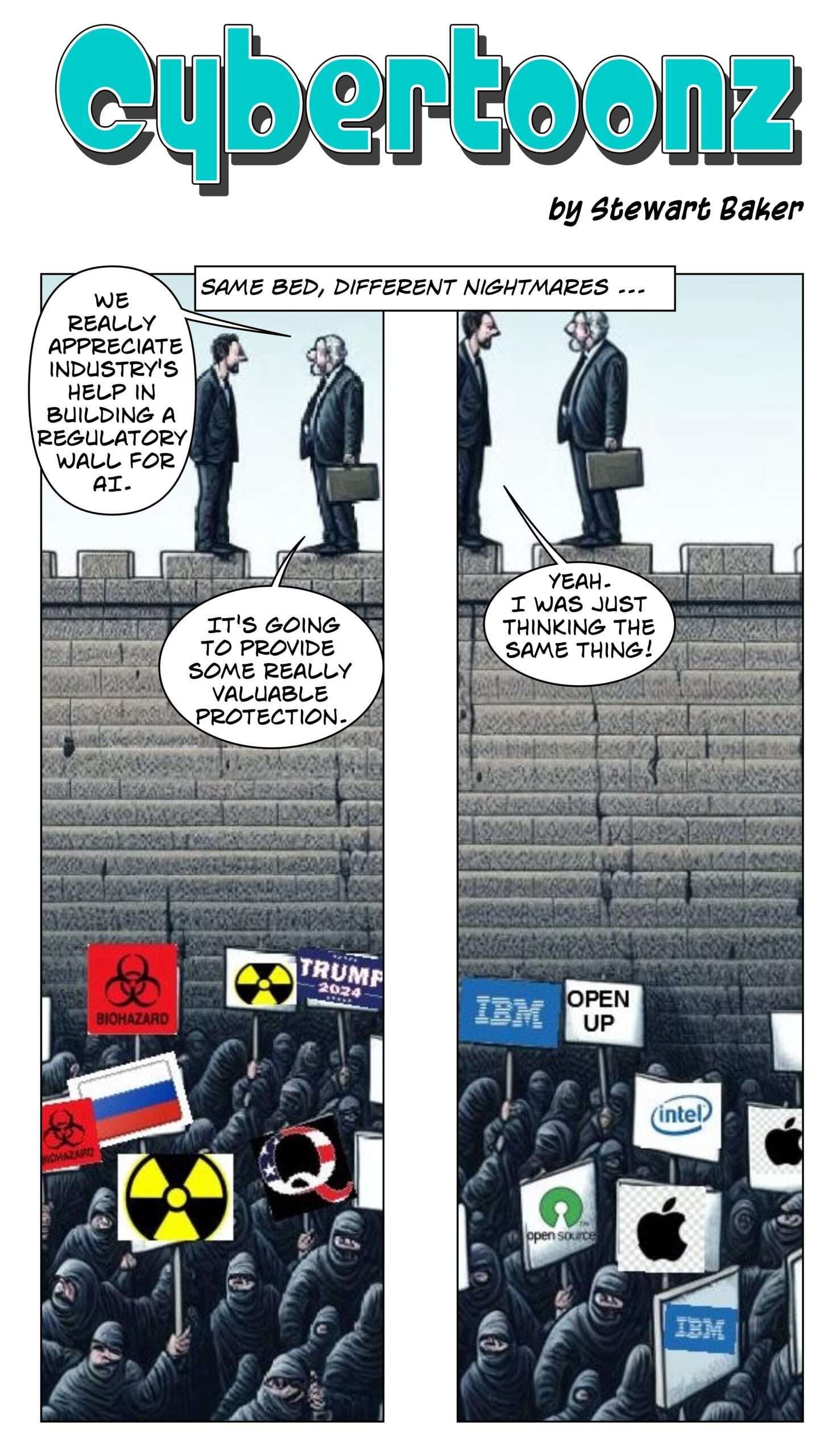
And in recognition of the week’s focus on international AI regulation, Cybertoonz explains what’s really going on in Bletchley Park:

You can subscribe to The Cyberlaw Podcast using iTunes, Google Play, Spotify, Pocket Casts, or our RSS feed. As always, The Cyberlaw Podcast is open to feedback. Be sure to engage with @stewartbaker on Twitter. Send your questions, comments, and suggestions for topics or interviewees to CyberlawPodcast@gmail.com. Remember: If your suggested guest appears on the show, we will send you a highly coveted Cyberlaw Podcast mug! The views expressed in this podcast are those of the speakers and do not reflect the opinions of their institutions, clients, friends, families, or pets

The post You can't spell INFOSEC without the SEC appeared first on Reason.com.

from Latest https://ift.tt/SVLPgbA
via IFTTT

Police Arrest Man With ‘AR-15’ Near US Capitol Complex

Police Arrest Man With ‘AR-15’ Near US Capitol Complex

Footage shared on the ‘free speech’ social media platform X shows Capitol Police detaining a man carrying a “long gun” in the park alongside Delaware Avenue NE, across from Union Station. 

Here’s the suspect. 

Another view (via Roll Call)… 

And another. 

“USCP Officers just arrested a man with a gun in the park across from Union Station. At this time we have no reason to believe there is an ongoing threat. We are working to gather more information and will put out more details when they are confirmed,” US Capital Police wrote on X around 1300 ET. 

Capital Police said, “We just searched the area in the park that we secured. Out of an abundance of caution, we going to search the suspect’s belongings. Again, the suspect is in custody. Investigation ongoing.”

In an update around 1400 ET, Capitol Police wrote on X, “Still investigating. Keep you all posted when the scene is clear. Again, the suspect is in custody. Thanks for your patience as we work to confirm all the information.”

Capitol Police told multiple media outlets, including Fox News and NBC News, that the suspect had “an AR-15.” 

Despite Washington, DC’s ban on assault weapons, which effectively makes possessing these firearms in the district illegal, the man was still found with a semi-automatic rifle in the center of the nation’s capital.

Tyler Durden
Tue, 11/07/2023 – 14:44

via ZeroHedge News https://ift.tt/ukyZasv Tyler Durden

On The (Eventual) Irrelevance Of SBF

On The (Eventual) Irrelevance Of SBF

Authored by Omid Malekan via Medium.com,

Sam Bankman-Fried’s recent conviction inspired many front page stories, most of which read like obituaries. Not just of his time as a free man but also the broader dreams of crypto. It all makes me laugh because none of this will matter in the long run. The afroed and acronymed psychopath will be forgotten long before he gets out of jail.

Anyone who disagrees should take a moment to reflect on the importance of Bernie Ebbers to the modern internet.

If you’ve never heard of him then you are in good company, none of my students knew anything about him or his company either.

Bernard John Ebbers was the founder and CEO of Worldcom, once one of the largest telecommunication companies in the world and a contributor to the physical infrastructure of the internet, until it collapsed due to an accounting scandal — still the largest in US history. Far more value was destroyed by Worldcom than FTX, and Ebbers was sentenced to 25 years in prison.

So what does this story have to do with the modern internet? Virtually nothing. A network of computers that transmit packets of data was always going to be a thing. The soap opera of who did what when during its awkward adolescent years is now just a footnote in history. The same is true for most other tech revolutions, despite their own bubbles, frauds, and charismatic psychopaths. The only question that mattered in the long run was whether the proposed solution did something useful.

The money management industry is ten times bigger today than it was when a different Bernie went down in flames. The railroad bubbles of the 1800s didn’t invalidate the idea of trains and Ken Lay didn’t make us turn off the lights. Mortgage-backed securities are still an important thing, even if Lehman isn’t. You probably live off of electronic payments, but have never heard of Wirecard.

And yet:

Wall Street JournalSam Bankman-Fried Verdict Reflects Crypto’s Broken Dreams

Financial TimesDownfall of a crypto billionaire: the conviction of Sam Bankman-Fried

New York TimesWild Ride and Dizzying Crash for Reluctant King of Crypto

Plenty of people never bought SBF’s schtick.

“Kings” are anathema to a technology meant to break up intermediaries and disseminate power. He wasn’t reluctant about anything and the only people who found him credible were suckers and skeptics. Now they pile on, either to deflect from their poor judgment or to push a corporatist agenda.

The rest of us are too busy building or actually using the tech to care. Did we think he was perpetuating a massive fraud? No. But we didn’t dwell much on an impolite asshole who didn’t believe in DeFi, either.

Crypto still has a lot of challenges to overcome. SBFs conviction won’t address any of them.

I’m glad the justice system worked and that his victims get some closure, but the length of his sentence will not tell us anything about the complexities of decentralized governance.

It won’t help Bitcoin’s economic security after the next halving or tell us what to do about Lido’s concentration in Ethereum staking. It won’t make smart contracts safer or accelerate the tokenization of assets.

Solving these challenges will go a long way to helping make crypto an important part of the future. Nobody will care about SBF if we succeed.

Tyler Durden
Tue, 11/07/2023 – 14:40

via ZeroHedge News https://ift.tt/fZ68iho Tyler Durden

Regional Bank Reckoning Looms As Regulators Call For FHLB Limits

Regional Bank Reckoning Looms As Regulators Call For FHLB Limits

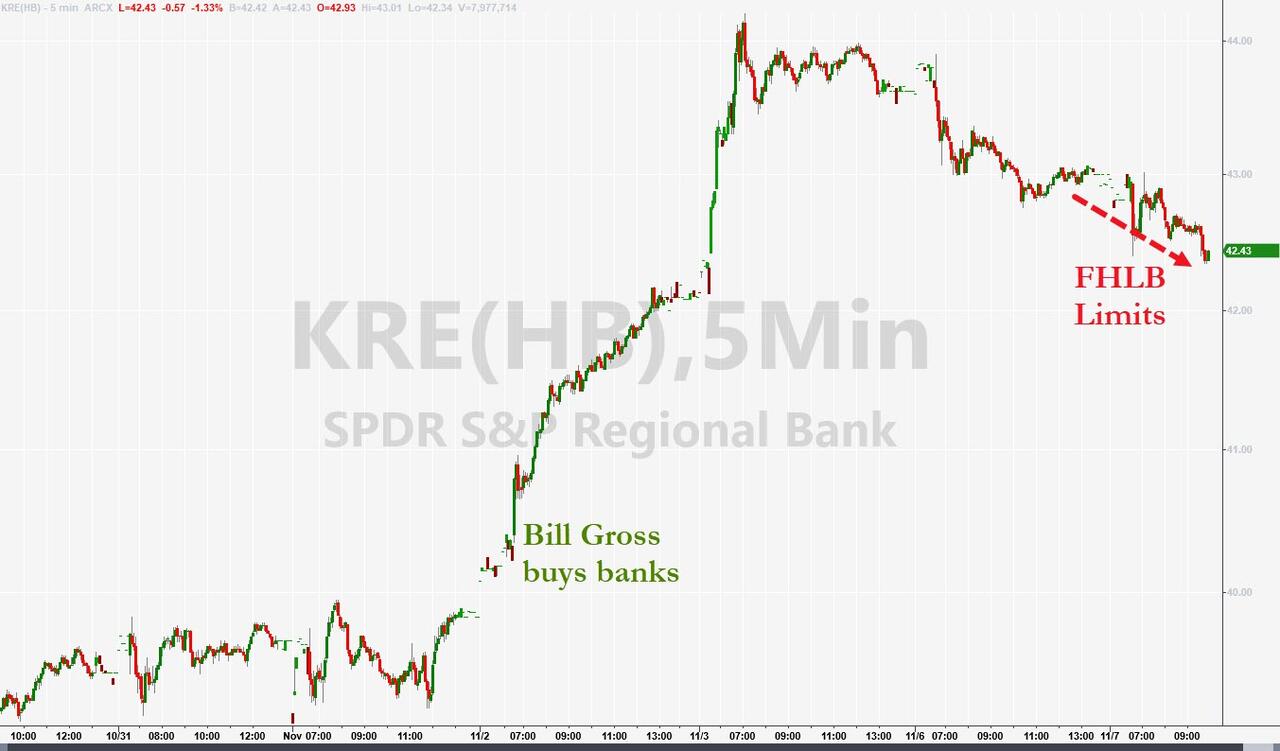
Is Bill Gross about to face another big loser? On Nov 2nd, the former ‘bond king’ wrote on X that “regional bank falling knife has hit bottom” adding that he was buying shares of Truist Financial, Citizens Financial Group, KeyCorp, and First Horizon.

The Regional Bank Index soared for two days after that, but the last two days have seen the index give some of those gains back…

And today, we get headlines that – on their face – would seem like very bad news for smaller banks as regulators push to close the cookie jar of cheap rescue cash that access to Federal Home Loan Banks has provided.

After a review of the system that lasted more than a year, the Federal Housing Finance Agency will move FHLBs away from serving as lenders of last resort for financial firms in turmoil, and back to their roots in housing finance. Specifically, the plans ratchet up federal oversight and seek to push banks toward the Fed’s discount window in times of extreme stress, according to a report to be published Tuesday.

As Bloomberg reports, banks borrow hundreds of billions of dollars from the government-chartered FHLBs each year to fulfill short-term funding needs.

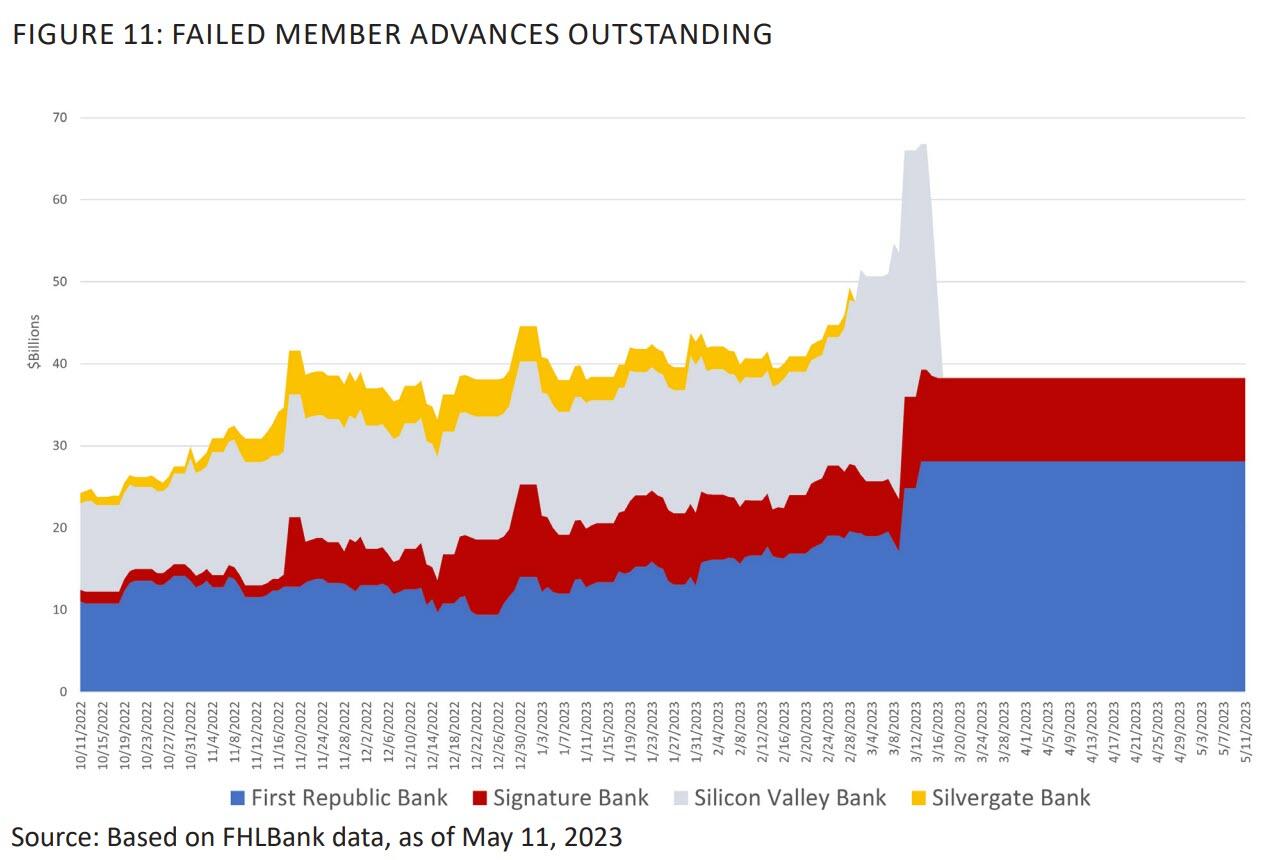
The practice came under scrutiny after the FHLBs, which have implied backing from the government, lent heavily to Silicon Valley Bank, Signature Bank and First Republic Bank as they careened toward failure.

The report specifically notes that “concerns with FHLBank lending to significantly deteriorating financial institutions must be addressed.”

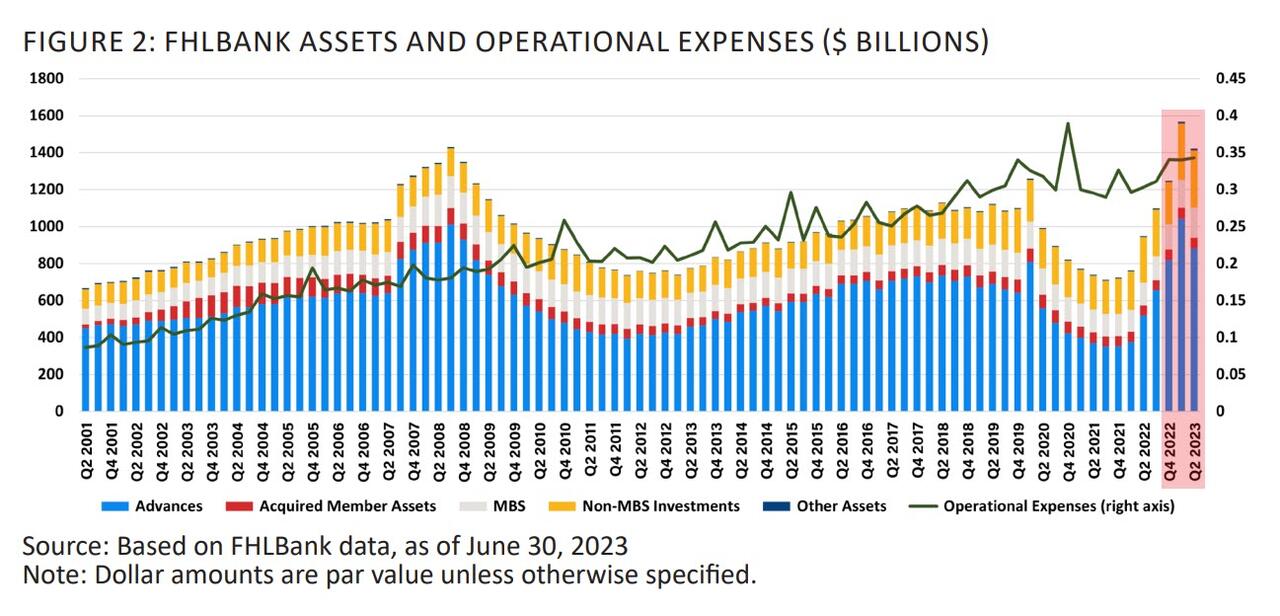
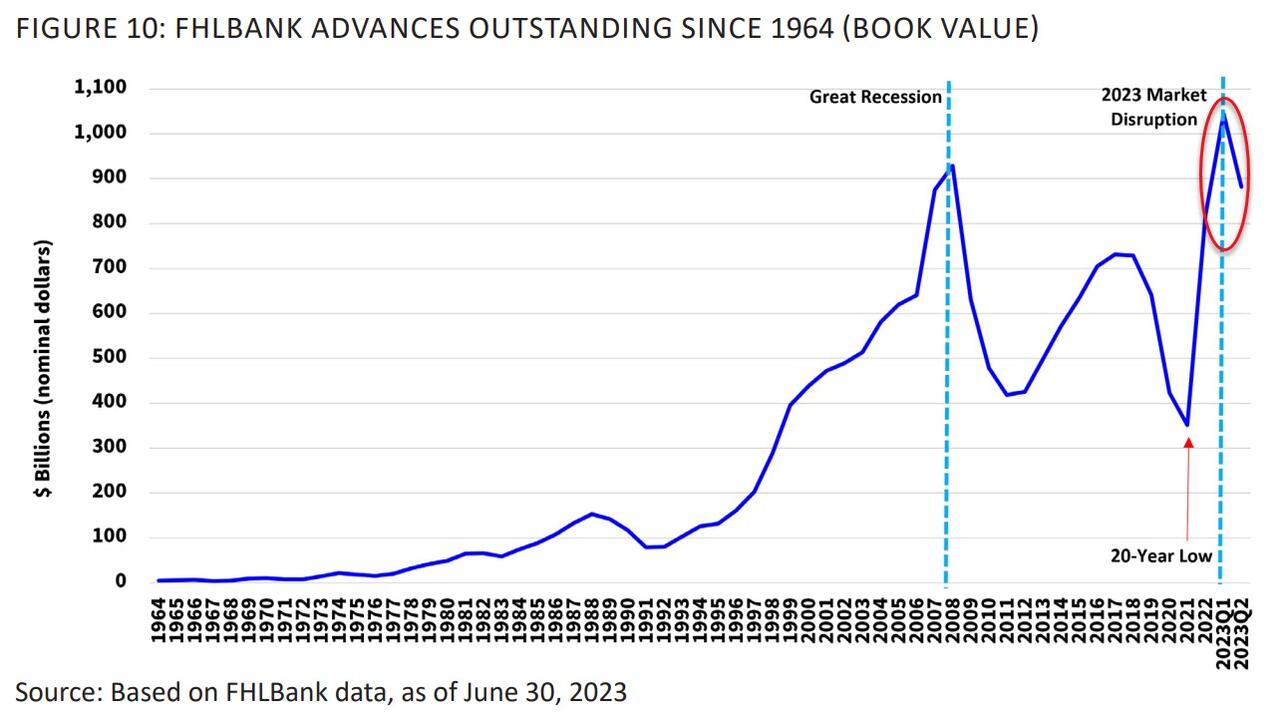
…advance volumes fell to 20-year lows in late 2021, coinciding with rising volumes of deposits that provided a liquidity cushion for commercial banks during the pandemic.

However, during the week beginning March 13, 2023, the FHLBanks funded $675.6 billion in advances, the largest one-week advance volume in FHLBank System history.

While the FHLBank advances helped many members withstand market stress, Silvergate Bank (an active borrower) voluntarily dissolved in the prior week.

Shortly thereafter, Silicon Valley Bank and Signature Bank failed after actively borrowing from their respective FHLBanks.

First Republic Bank, another member, failed approximately seven weeks later.

As shown in Figure 11, these four entities increased their borrowings from their FHLBanks starting in late 2022.

This resembled a pattern observed in the lead-up to the 2008 crisis, during which the System saw increased borrowing by members in distress just before failure.

The FHLBank System did not incur losses on its advances to these failed members.

The broader financial system, however, incurred losses because of these failures, highlighting the need for greater focus by the FHLBanks on evaluating member creditworthiness and better coordination with their members’ primary regulators when a member’s financial condition is deteriorating.

Even more problematically, the report notes that during the March 2023 bank failures, the FHLBanks also discovered that some large, troubled members had not established the ability to borrow from the Federal Reserve discount window and therefore were overly reliant on the FHLBanks.

While the FHLBanks continue to serve as a source for reliable liquidity – which allows members, particularly smaller members, to continue to serve their communities – the Federal Reserve has long been considered the U.S. banking system’s lender of last resort.

Nevertheless, during the March 2023 bank failures, the FHLBank System’s role of providing low-cost liquidity came under stress, due to sizable advance demand from large members, some of which were significantly bigger than the FHLBanks themselves.

The reliance of some large, troubled members on the FHLBanks, rather than the Federal Reserve, for liquidity during periods of significant financial stress may be inconsistent with the relative responsibilities of the FHLBanks and the Federal Reserve.

Among the major changes, the Federal Housing Finance Agency, which oversees FHLBs, will propose a rule to force many banks to hold 10% of their assets in mortgage loans to maintain access to the FHLBs.

The regulator is also exploring new guardrails for lending money to troubled institutions and tougher stress tests.

Bloomberg’s Alex Harris highlights some of the possible issues:

  • Smaller fed funds market: FHLBs are the largest lender of cash in the market for federal funds. If banks borrow less, FHLBs may have less excess cash to lend

  • Jumpier monetary policy rate: Less volume in the fed funds market could make the fed funds rate — the US monetary authority’s target benchmark — more prone to movements within the range, prompting officials to tweak tools to maintain control

  • Less issuance: The FHLB Office of Finance issues agency discount notes to fund system-wide demand for short-term loans, or advances. Fewer advances means less market supply, which may push T-bill yields lower and motivate buyers of FHLB paper, such as money-market funds, to continue parking cash at the Fed’s reverse repo facility

  • Higher costs: If banks have to turn elsewhere for funding, such as to the commercial paper market, that may drive borrowing rates higher for institutions

  • More reserves: Losing a portion of low-cost funding could drive bank liquidity coverage ratios lower, at which point institutions could hold more reserves to fill the funding gap. That means the banking system’s lowest comfortable level of reserves could actually be much higher

Simply put, this regulatory overhaul will ripple through dollar funding markets – and potentially Fed policy – as smaller US banks are forced to pay up for their emergency cash at The Fed’s discount window or the BTFP (which will offer the market much more transparency into just how bad the situation is).

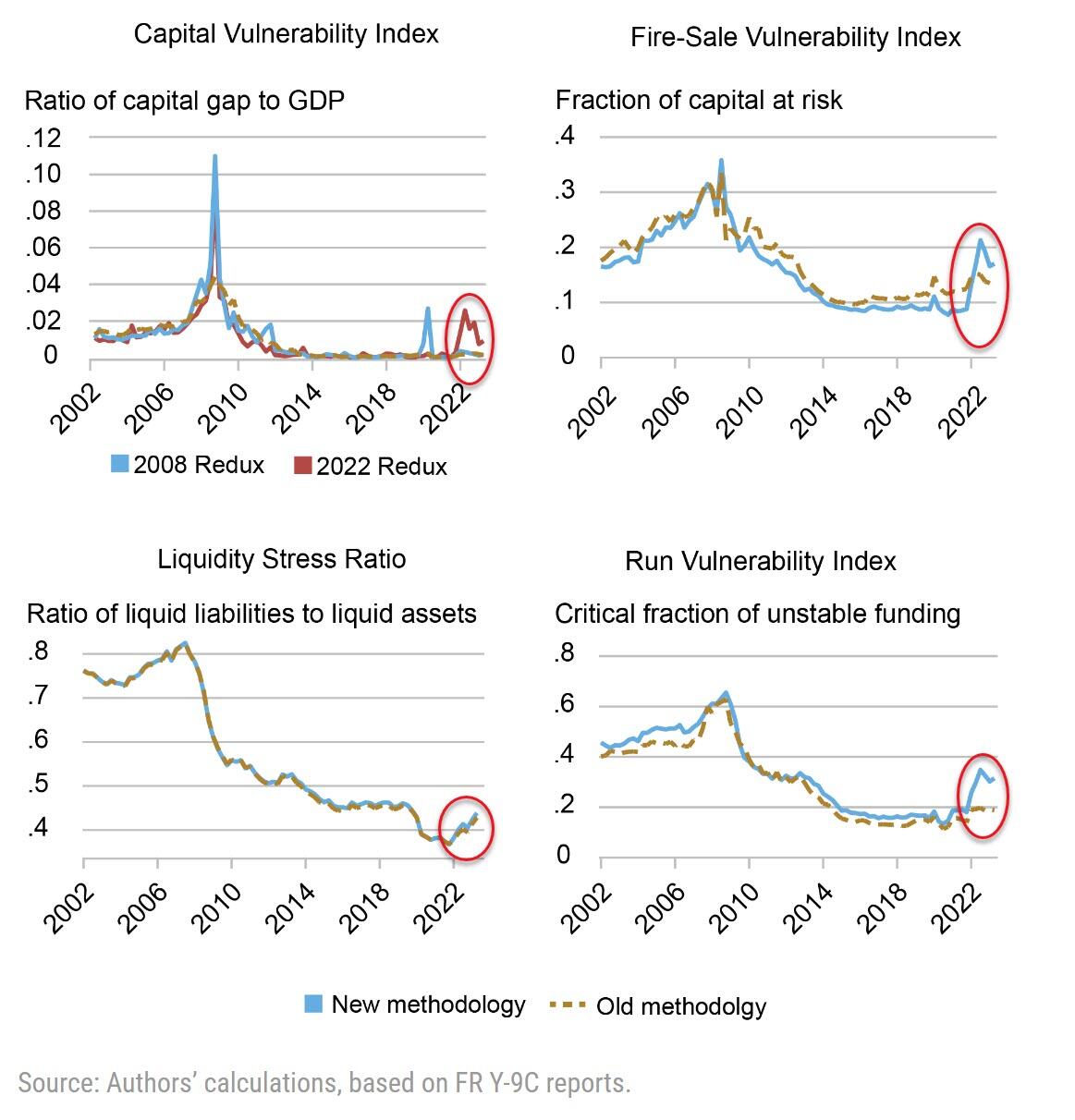
And in case you really believed Bill Gross, just a day ago, the NYFed blog reported new models of banking system vulnerability.

The most important change in methodology is that the measures now incorporate unrealized losses (or gains) on all securities. The goal of this change is to reflect more closely the economic value of bank assets in a stress scenario.

Their new measures, adapted to this recent shock, suggest a moderate increase in systemic vulnerability compared to the low levels of the previous ten years.

Tyler Durden
Tue, 11/07/2023 – 14:20

via ZeroHedge News https://ift.tt/iVE7CTz Tyler Durden