Bond Bear Market – Is It Dead, Or Just Hibernating?

Bond Bear Market – Is It Dead, Or Just Hibernating?

Authored by Lance Roberts via RealInvestmentAdvice.com,

Is the bond bear market finally over? That is the question everyone is asking now that bond prices rallied sharply following the November FOMC policy meeting. As noted in the #BullBearReport this past weekend:

“On Wednesday, Jerome Powell’s speech sparked a broad rally in stocks and bonds as market expectations for further rate hikes collapsed. There was nothing new about the Fed’s recent policy announcement as they maintained that higher Treasury yields are doing their work in slowing economic activity and, ultimately, inflation. However, they did, again, as expected, leave open the possibility of further rate hikes as needed.”

  • POWELL: PROCESS OF GETTING INF. TO 2% HAS A LONG WAY TO GO

  • *POWELL: FULL EFFECTS OF TIGHTENING YET TO BE FELT

  • *POWELL: NOT CONFIDENT WE’VE REACHED STANCE FOR 2% INFLATION

“Given that the Fed did little to talk up the projections of further rate hikes, the market took this as meaning the Fed is likely done hiking rates. Of course, that means, from the market’s perspective, the subsequent actions will be ‘rate cuts.’”

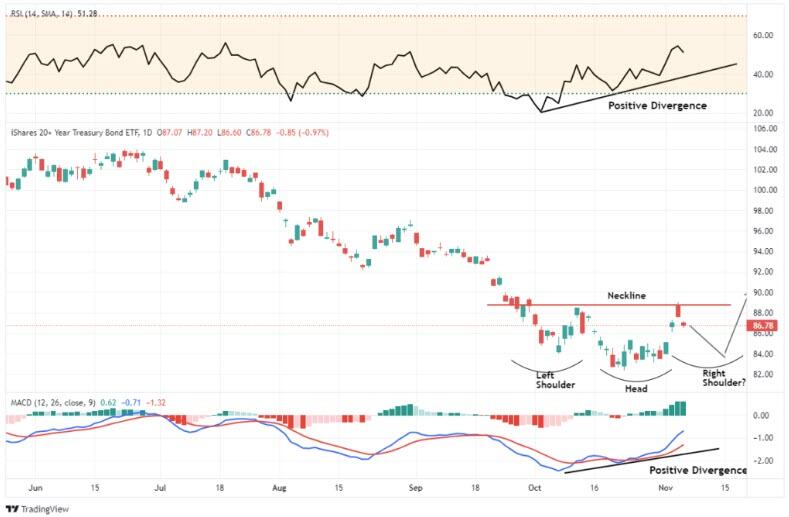
With the more “dovish” tone of the Fed’s commentary, combined with a much weaker-than-expected employment report last Friday, expectations for higher yields collapsed, sending bond prices higher. As shown, on a short-term basis, bond prices rallied sharply to the “neckline” of a potential “head and shoulders” low. That technical pattern, which is bullish for bond prices if it completes, is supported by a positive divergence in both the MACD “buy signal” and the Relative Strength Index (RSI).

However, while this rally has been very encouraging in the short term, there are many “trapped longs” that will be looking for an exit to sell holdings at higher prices. Such will apply pressure to the recent rally, as we saw profit-taking last Friday and again on Monday. As shown above, a retracement that sets a higher low and then breaks the above the neckline would likely confirm the start of a “bond bull market.” Furthermore, the massive short-position by professional hedgers will also support bond prices when they are forced to cover.

I would expect, over the next couple of weeks, that we will likely see yields remain in a more volatile trading range as the “Bond Bulls” and “Bond Bears” continue to “duke it out.”

But I agree with Jeff Gundlach’s recent point over the longer term.

“We like long-term treasury bonds for the short-term trade going into a recession. The 30-year US treasury yield downtrend of the past four decades has completely reversed, skyrocketing nearly 400bps in under two years. There has been about a 50% drawdown in the long bond, which means there is now potential for the long bond to increase in price.”

The technical setup for ending the “bond bear” market is in place.

Technical Setup For The End Of The Bond Bear Market

While in the short term, bond prices will likely pull back after the recent surge, the technical and fundamental backdrop for the end of the bond bear market is improving.

Let’s start with the technical setup.

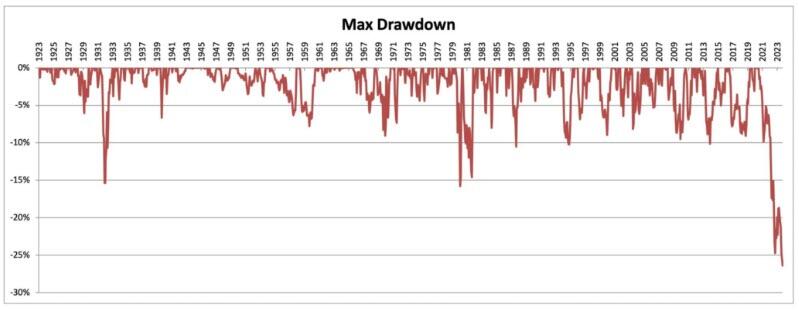
First, as with everything, “what goes up must come down,” and vice versa. At the moment, bonds are in the worst drawdown…ever.

From a purely contrarian point of view, when no one wants to own something because they believe that prices are “only headed in one direction, indefinitely,” such is often the time to become a buyer. Historically, buying when there is “blood in the streets,” as stated by Barron De Rothschild, has often been profitable.

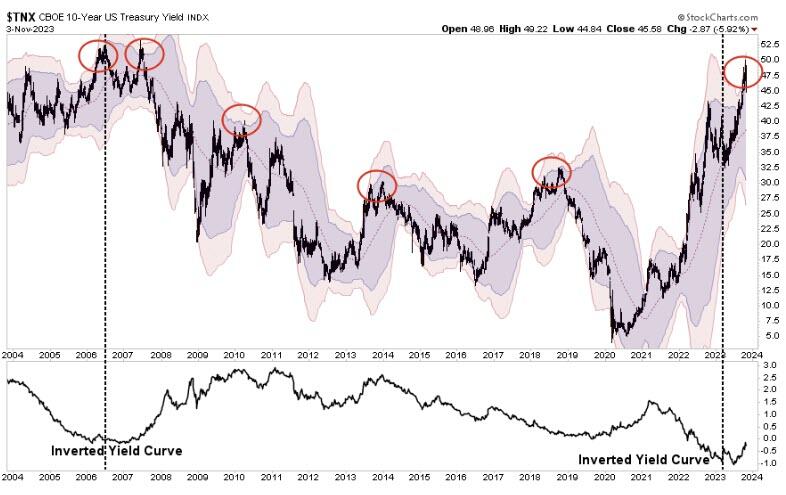
Secondly, once we step away from the daily volatility caused by hedgers and traders, a longer-term view also supports a potential reversal in bond prices. Historically, when interest rates traded at “2 standard deviations” above the 1-year moving average, a reversal occurred. Such was due to a financial event, economic strain, or other outcome caused by higher interest rates on a leveraged economy. Currently, rates are “3 standard deviations” above that mean. From a purely technical perspective, such extensions are unsustainable, suggesting an eventual reversion will occur.

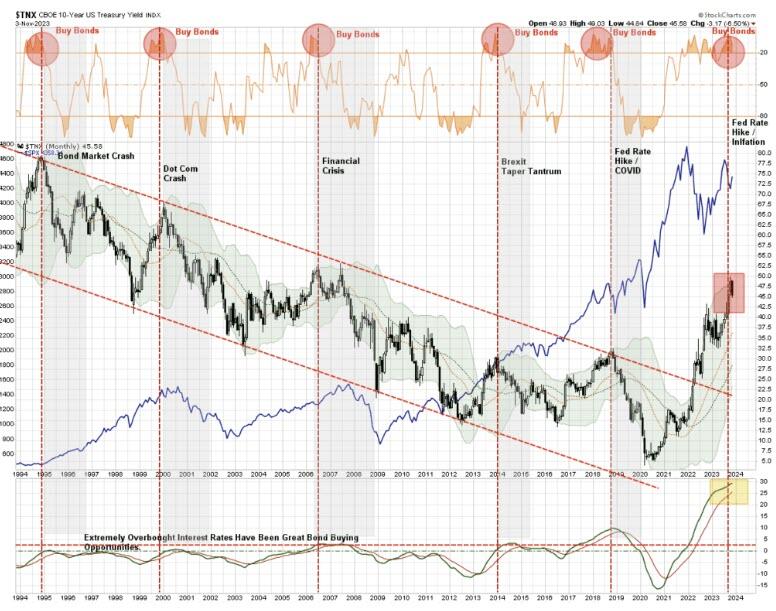
But, if we push our analysis out further, using MONTHLY data, we see the same extreme deviations from the norm. Going back to 1994, whenever rates were highly overbought and deviated from long-term means, such were good buying opportunities for bonds. This time is unlikely to be different, and the failure of Citizens Bank this past weekend is further evidence of the financial strain on the economy.

The surge in bond yields has created another historic opportunity to buy bonds at a deeply discounted price. Just as investors don’t want to buy stocks at the bottom of “bear markets,” they don’t want to buy bonds for the same reason.

However, as shown above, history has repeatedly shown that some of the best bond-buying opportunities have come when investors are sure “this time is different.” The reality is that rates can’t rise much before the impact on economic growth leads to a crisis, recession, or bear market. Such is the problem of a heavily indebted and leveraged economy.

However, a drop in yields and the subsequent rise in asset prices is a problem for the Fed.

A Problem For The Fed

The end of the bond bear market in the short term is a problem for the Fed, but it is inevitable in the long term. In recent speeches from Federal Reserve officials and Jerome Powell himself, they specifically noted that higher yields on Treasury Bonds are acting as “defacto rate hikes.” Such is why they have “paused” on further rate hikes despite inflation still above their 2% target.

However, falling yields and rising stock prices undermine that objective by loosening financial conditions.

“Higher asset prices represent looser, not tighter, monetary policy. Rising asset prices boost consumer confidence and act to ease the very financial conditions the Fed is trying to tighten. While financial conditions have tightened recently between higher interest rates and surging inflation, they remain low. Such is hardly the environment desired by the Fed to quell inflation.” – Real Investment Advice

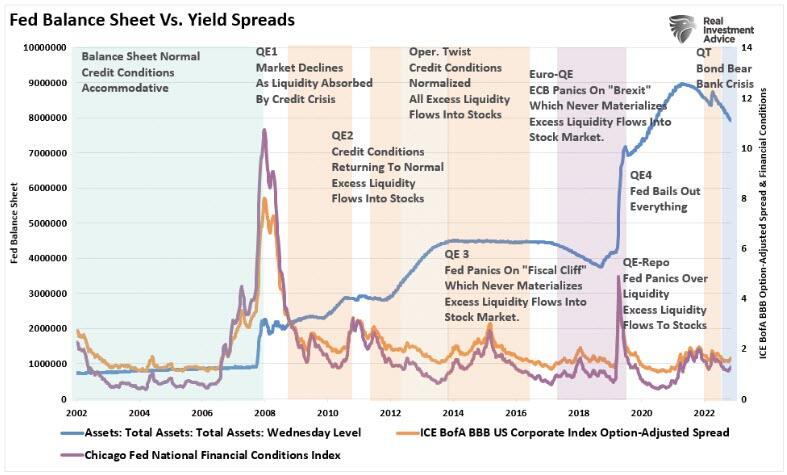
The FOMC needs substantially tighter financial conditions to slow economic demand and increase unemployment, lowering inflation toward target levels. Tighter financial conditions are a function of several items:

  • A stronger US dollar relative to other currencies (Check)

  • Wider spreads across bond markets (No, See below)

  • Reduction in liquidity (Quantitative Tightening or QT)

  • Lower stock prices. (Check, but only a minor correction)

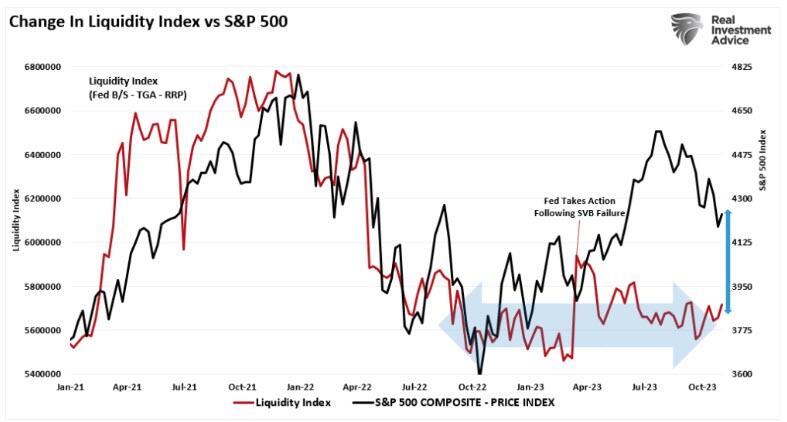
However, despite evidence that financial conditions are tightening, they are not shrinking drastically. As shown, liquidity has remained primarily neutral over the last year. Last week’s surge in stocks and bonds is reflected in a recent uptick in liquidity.

The problem for the Fed is that increased liquidity, higher asset prices, and lower yields remove the pressure from consumers. If consumer confidence improves, then so does consumption. That increased demand then fosters higher prices, which is not what the Fed wants, at least not yet.

The Fed’s challenge is potentially a trap of their own making. On the one hand, they want falling asset prices and weaker economic data to quell inflation. However, the Fed does NOT want an economic event destabilizing the financial system. Unfortunately, the Fed may soon face a very tough decision. Either allow a deeper recession to take hold, quelling inflation, or cut rates to keep a banking crisis from spreading.

We will likely know the answer sooner than later.

However, I believe that Treasury bonds will be the asset class of choice.

Tyler Durden
Tue, 11/07/2023 – 11:00

via ZeroHedge News https://ift.tt/1dO839k Tyler Durden

Korean Stocks Crash Day After ‘Political’ Short-Selling Ban

Korean Stocks Crash Day After ‘Political’ Short-Selling Ban

Who could have seen that coming…

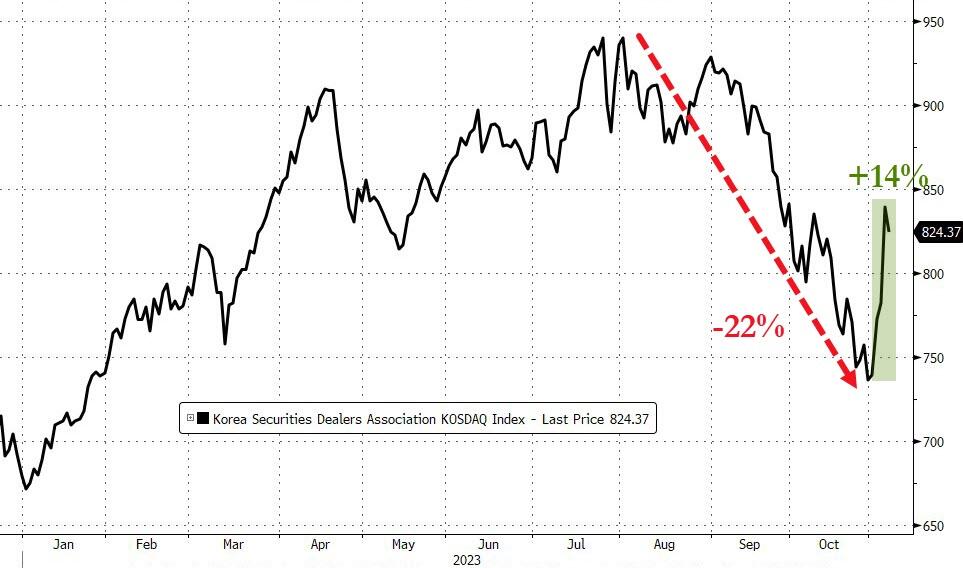
Much like the rest of the world, after exuberant run-ups in the first half of the year, Korean equity markets plunged over 20% in the past three months…

Clearly this is unacceptable and so, over the weekend, South Korean regulators unleashed a “short-selling ban” on equity investorsbecause blaming those nasty un-patriotic short-ers is easier than admitting 1) perhaps the valuation was extreme to start with and/or 2) there is an actual economic problem here.

The Financial Services Commission’s order to prohibit new short-selling positions on stocks in the Kospi 200 Index and Kosdaq 150 Index through the end of June 2024 left many market watchers surprised, with some observers saying that broad outright bans like this only make the market less transparent and therefore less attractive.

Note that the decision doesn’t impact existing positions.

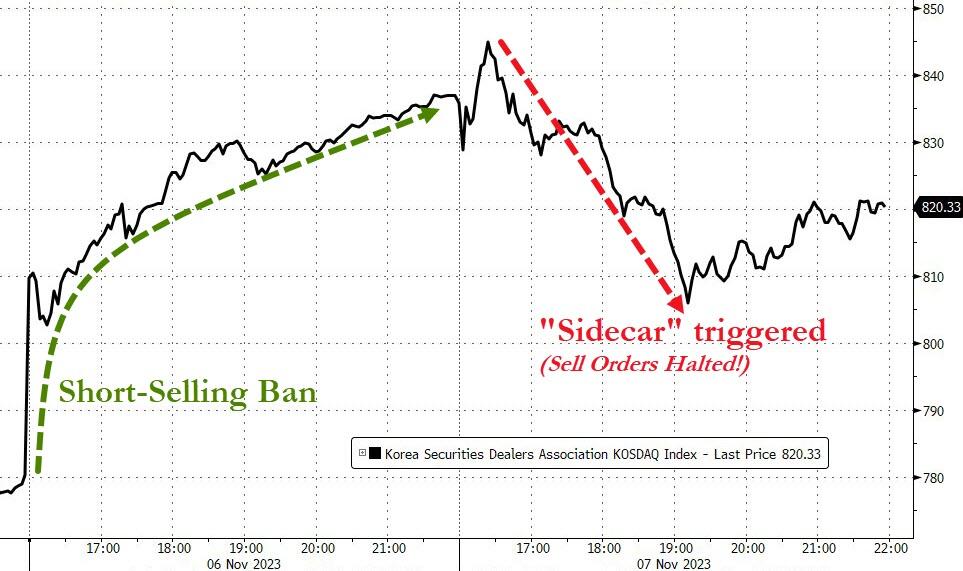
The kneejerk reaction was – of course – a buying frenzy on Monday (Kospi up 5.7% – the best day since March 2020).

But, the move raised questions as Huh Jae-Hwan, an analyst at Eugene Investment & Securities, pointed out, it is “unusual” as authorities are comprehensively prohibiting short selling at a time when there is no major external risk.

As Bloomberg reports, South Korea had banned short selling during the Global Financial Crisis in 2008, amid the euro-zone debt crisis and the US sovereign downgrade in 2011, and then again during the start of the pandemic in 2020.

“There is a possibility that international investors may lose trust and opportunities in the Korean market,” said Wongmo Kang, an analyst at Exome Asset Management.

“Without the ability for investors to express a view that markets and individual stocks are ‘mispriced’ to the upside, stock markets lose long-term credibility on the world stage.”

And so, overnight (Tuesday in Korea), the equity market crashed, with KASDAQ Futs plunging over 7% at one point…

So what did Korean regulators do? You can’t make this up… The Korea Exchange temporarily issued its “sidecar” limit to halt sell orders for program trading.

“The ban may boost prices of a few specific stocks for a few days, but over the longer haul it will increase overall price volatility, reduce market liquidity and make pricing less efficient,” said Hyosung Kwon, an economist at Bloomberg Economics.

“Even worse, it could discourage investment and further deepen the discount on South Korea’s stocks, hurting the retail investors it was supposed to protect.”

How many more times do we have to see this “short-selling-ban” plan fail for regulators to realize it makes things worse not better.

“Banning short-selling is like removing a lighthouse during a storm,” said Kher Sheng Lee, Asia-Pacific co-head of the Alternative Investment Management Association, a global industry body whose members oversee more than $2.5 trillion of assets in hedge and private credit funds.

“It not only strips the market of its vital pricing signals but also dries up liquidity – the very lifeblood of trading. Such bans should be a last resort.”

…will regulators never learn?

Of course, the real reason for this move is far more simple… South Korea is set to conduct general elections for the National Assembly in April. “The chance of this ban being part of a strategy to win votes couldn’t be ruled out, considering how unpopular short-selling is among retail investors,” said Hong Sung-gul, professor of public administration at Kookmin University in Seoul.

Tyler Durden
Tue, 11/07/2023 – 10:40

via ZeroHedge News https://ift.tt/so5Uk1l Tyler Durden

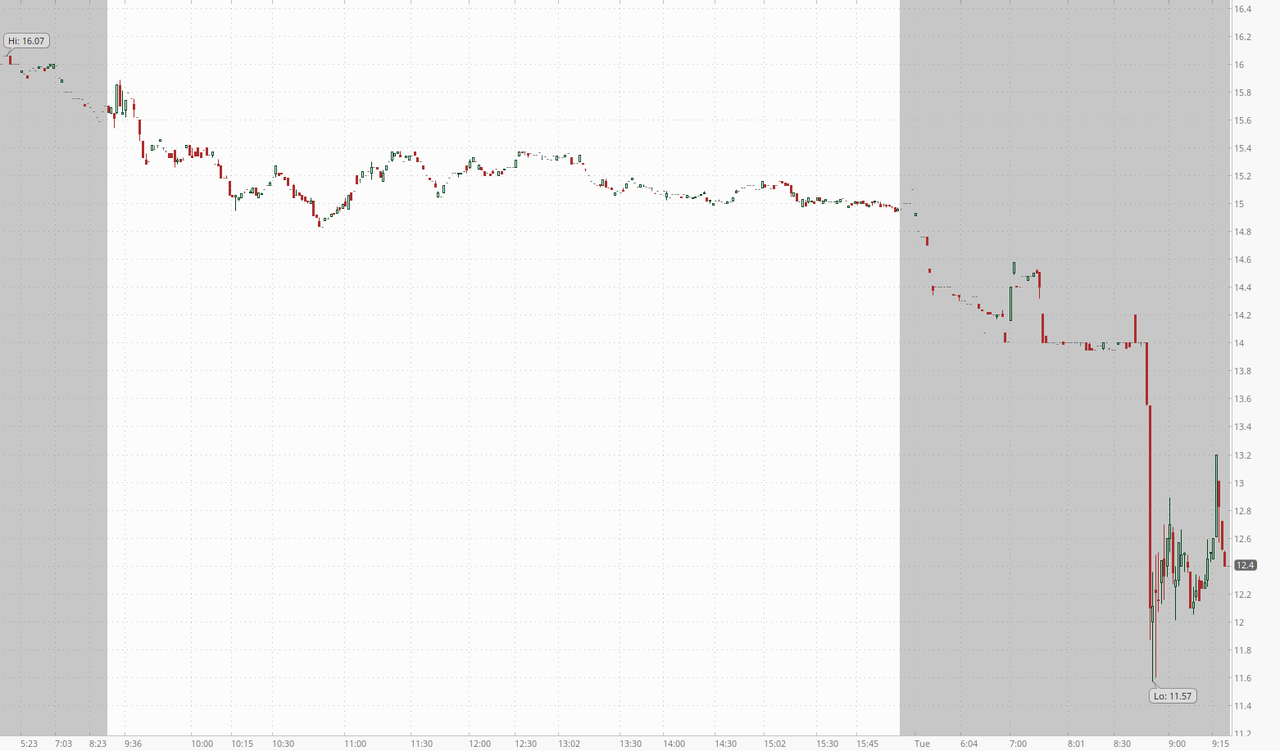
Shares Of China-Based EHang Plunge 16% After Short Seller Hindenburg Claims “Fake Sales” And “Hollow Order Book”

Shares Of China-Based EHang Plunge 16% After Short Seller Hindenburg Claims “Fake Sales” And “Hollow Order Book”

Shares of China-based EHang are down by about 16% in the pre-market session after short seller Hindenburg Research published on the name, claiming “fake sales” and a “hollow order book”. 

The new report is called “EHang: Hollow Order Book And Fake Sales Make This China-Based eVTOL Company Last In Line For Takeoff”.

The report points out the company’s “shoestring” budget relative to its peers and that one of its capital raises was led by a “South Korean music producer who was previously put on an INTERPOL wanted list and sentenced to 2 years in prison for embezzling from a Korean company he founded”.

On top of that, echoing the story Hindenburg once published about Lordstown Motors (which is now bankrupt), the short seller took aim at the company’s pre-order book, calling it “hollow”. 

“We found that 92+% of EHang’s claimed 1,300+ unit preorder book is based on “dead” or “abandoned” deals, failed partnerships, and newly-formed customer entities with no discernible operations,” the short seller wrote. 

The report continues:

“EHang’s largest deal is a 1,000-unit preorder from one of its pre-IPO investors, a biotech company called United Therapeutics, which represents ~74% of EHang’s total preorders. The deal was initially signed in 2016. In 2020, the CEO of United Therapeutics said she was looking for a much longer-range aircraft than what EHang offered, saying, “250 nautical miles… is the sweet spot in terms of range,” while EHang’s EH216 offers a range of just 19 miles (30km). 

United Therapeutics quietly sold its entire $109 million stake in EHang by February 2021. In November 2021, in its last public comments on Ehang, the VP of Drone Delivery for United Therapeutics said, “I don’t think anyone could say right now that they [EHang] have a certifiable configuration in terms of aircraft design.” A former EHang employee said the deal was “dead”. We repeatedly inquired with United Therapeutics and rather than confirm the partnership, we were told by its PR rep: “We have no comment. We’re just not going to comment on this.” EHang continues to market the deal as active in its SEC filings and investor presentations.”

“EHang’s second largest commitment is a 100-unit preorder, worth ~$30 million, from Prestige Aviation, an Indonesian entity that was formed with $34,000 in registered capital 1 day prior to its announced partnership with EHang,” the short seller writes. “Outside of promotional events with EHang, we found no website and zero evidence of any aviation operations for Prestige Aviation except for a photoshoot where it appears to have photoshopped its logo onto a rented jet.”

Interestingly, the report also seems to also validate past critiques about fake sales made by short seller Wolfpack Research in 2021:

“In 2021, a research firm alleged that one of EHang’s largest customers, Kunxiang, was secretly a pre-IPO investor that signed “sham sales contracts” so that EHang could report revenue growth as it approached its IPO. EHang’s CEO denied the allegations, calling its dealings “arm-length transactions.” 

Corporate records reveal that Kunxiang is in fact controlled by a sanctioned Chinese financier whose venture capital firm invested in EHang pre-IPO through an offshore shell company in 2017. An executive from the venture capital firm admitted in a 2018 interview to investing in EHang. Further confirming this, the same executive was photographed celebrating with EHang CEO Hu Huazhi at the company’s Nasdaq IPO bell-ringing ceremony.”

Hindenburg also takes exception with the company’s valuation, writing: “EHang has generated net losses since inception and currently trades at ~50.3x its tangible book value, a significant premium to competitors Joby Aviation (4.1x) and Archer Aviation (5.0x). Despite its premium valuation, EHang’s flagship aircraft is outmatched by competitors on key performance metrics.”

The report concludes:

“Overall, EHang seems to have a major credibility issue—whether it be by fluffing up its preorder book (which looks to almost entirely be vapor) or by brazenly misleading about early sales that bear all the hallmarks of fake revenue. Trust is crucial in the aviation industry, both for investors and potential customers who are literally putting their lives at risk. We think the company is a fatal accident waiting to happen, both for investors and for passengers.”

And now, we wait for the company’s response…

Tyler Durden
Tue, 11/07/2023 – 10:05

via ZeroHedge News https://ift.tt/bKOCugL Tyler Durden

Markets Are Pricing For Utopia Of Low Rates, Rising Stocks, Low Inflation, No Recession And No War

Markets Are Pricing For Utopia Of Low Rates, Rising Stocks, Low Inflation, No Recession And No War

By Benjamin Picton, Senior macro strategist at Rabobank

Utopia or Eutopia?

US equities overcame a gloomy lead from Europe to close higher yesterday. That makes for 6 straight trading days of gains after major US indices rose every day of last week. Asian markets posted strong gains too. The Nikkei was up 2.37%, the Hang Seng 1.71% and even the Australian ASX200 managed to squeeze out a gain of 0.27% as it braces for a rate hike from the RBA today.

While equities basked in the afterglow of last week’s soft non-farm payrolls report, 10y treasury bonds unwound almost 8bps of the ~43bps of easing that markets have provided since October 23rd. As our Global Strategist Michael Every observed yesterday, buying bonds in anticipation of the Fed ending its tightening cycle *because* high bond yields have done the tightening for it is a self-defeating strategy. Economists usually claim that markets are rational, but logic has proven no impediment to the market pricing for a Utopia of low rates, rising asset prices, low inflation, no recession and no (major) war.

‘Utopia’ fittingly translates to “no place”, or “the place that cannot be.” Does that suggest that recent falls in yields are a blip, and we will see another run at 5%? The 2s10s spread flattened 2.5 bps yesterday as the market looked ahead to $48 billion of 3-year issuance today. Curve flattening has been the trend since the US Treasury reduced its expected Q4 borrowing from $852 billion to $776 billion (still a record), and concentrated planned issuance in the short end. Perhaps that might revert tomorrow and Thursday when the focus turns to 10-year and 30-year issuance?

The NY Fed’s Crump and Moench (what a name) term premia measure now stands at 19bps vs a 30-year average of 92bps. 14 of those 30 years was the QE era, where central banks were forcibly muscling long yields lower. Not only is that no longer the world we live in, the Fed is now engaged in quantitative tightening to the tune of $60 billion each month. The monetarists among us would tell you that quantitative tightening heralds imminent deflation, leading to rate cuts and bull-steepening of the curve. Huw Pill nodded to this view overnight by suggesting that the BoE could be cutting by the summer of next year.

Huw is an outlier here. Deflation and rate cuts is a niche view among senior central bankers. Most follow our logic that fragmentation means “higher for longer”, implying that any rise in term premia arrives from bear-steepening. Stan Druckenmiller recently observed that “the academics call it term premium. I call it normalization.”

Utopia’s homonym ‘Eutopia’ means “the good place”. The ancient Greeks must have had a sense of humor, because things don’t look too good in the EU at the moment. Final PMI readings for October confirmed yesterday the dire state of industry across the continent. German September factory orders offered a glimmer of optimism by printing at +0.2% m-o-m against the expected -1.5%, but the meager growth only came courtesy of a big downward revision in the previous month’s figures.

Just to emphasize the gloomy outlook, Austria’s Robert Holzmann said that the ECB “must be ready to hike again if needed.Thus continues the meme whereby central banks attempt to convince us that they’re poised with their finger above the button, even though the market now fully expects that most are finished tightening. They’re talking the talk of higher for longer, but can they walk the walk as their economies slow? Enter the RBA.

Australia’s latest national accounts surprised to the upside, retail sales in September surprised to the upside, Q3 retail sales ex inflation surprised to the upside, Q3 inflation surprised to the upside and the latest labour force report saw the unemployment rate fall to just 3.6%.

Concurrently, the war between Israel and Hamas adds a new supply-side shock, with the attendant risks for inflation expectations. This is especially the case if the situation escalates and draws in other players, as we expect it will. Just yesterday the Pentagon announced that an Ohio class nuclear submarine has been deployed to the Middle East. The Ohio class is not just nuclear propelled, but nuclear armed, and the Pentagon almost never tells us where they are located. This is a message with only one intended recipient, and it isn’t Hamas, Hezbollah or rag-tag Houthi rebels in Yemen.

So, the RBA is ostensibly a ‘data-dependent’ central bank now confronted with loads of data suggesting that they should hike. Despite this, the OIS market today judges the probability of a rate rise at less than 60%. Therein lies a credibility gap where the Eutopian dual mandate of price stability and full employment will prove to be Utopian.

We still expect a 25bps hike from the RBA to 4.35% today, but they’ve had to have their arm twisted to do it (ZH: they did hike 25bps but it was a dovish hike and the AUD tumbled).

Tyler Durden
Tue, 11/07/2023 – 09:45

via ZeroHedge News https://ift.tt/OvFcpHU Tyler Durden

10,000 Dead


Injured Palestinian woman | Apaimages/SIPA/Newscom

One month ago today: Exactly one month ago, Hamas terrorists brutally attacked Israeli civilians, killing 1,400 innocent people in a brutal pogrom and kidnapping 240 (most of whom are still being held hostage).

You probably know what’s followed. The Israel Defense Forces (IDF) began a massive attack on the Gaza Strip, designed to weed out the group responsible for the massive slaughter of civilians. International observers have criticized Israel for hitting civilians in the course of trying to reach their targets. The whole region looks like a powder keg about to blow; Israel’s northern front with Iranian-backed Lebanon, where Hezbollah operates, has been heating up, and many fear the cascade of events that will ensue—Iranian-backed groups entering the conflict—if Israel makes a misstep.

Now, after one month of strikes and a ground invasion that started a week ago and has succeeded at splitting Gaza in two, separating north from south, the Israeli military has now killed more than 10,000 Palestinians. Children comprise about 40 percent of the total killed. It’s unclear how many of the total dead are Hamas terrorists. Estimates are from Gaza’s health ministry, which is controlled by Hamas and thus not always reliable; but when pressed to corroborate death tolls after President Joe Biden cast doubt on them, officials in Gaza “released a list with the names, ages, genders and ID numbers of all those it counted in its death toll, except for 281 whose remains were unidentifiable,” per New York Times reporting. “Gaza is becoming a graveyard for children,” Union Nations Secretary-General António Guterres told reporters this past Sunday.

Israeli strikes have led to massive civilian death tolls, but the IDF insists that this is due to the way Hamas conducts its operations, using Gazans as human shields. “Hamas fighters, numbering perhaps 30,000 by Israeli estimates, embed within Gaza’s population of 2.2 million and store weapons in or under civilian sites,” reports The New York Times. Israeli politicians have also turned toward citing massive death tolls imposed by other large Western democracies: the atomic bombs dropped in Hiroshima and Nagasaki by the U.S. (which killed 200,000 civilians); Britain bombing a Gestapo headquarters in Copenhagen, accidentally hitting a school instead (killing 86 children and more than a dozen adults); a U.S. airstrike in Mosul that ended up killing 100 civilians instead of Islamic State targets.

Attacks on refugee camps keep upping the death toll. One on the Maghazi refugee camp killed 40 over the weekend. A few days prior, an attack near Bureji refugee camp killed 13.

“Very unfair”: Yesterday, former President Donald Trump took the witness stand in Manhattan during his civil trial, in which he has already been found to have defrauded banks and insurers by overstating his net worth and property valuations. (This trial will determine penalties and charges.) Referring to financial statements submitted to banks on his behalf: “I would look at them, I would see them, and I would maybe on occasion have some suggestions,” said Trump.

“I think I am probably more expert than anyone else,” said Trump, referring to his ability to help his lawyers and accountants with property valuation statements they submitted to banks. “I can look at buildings and tell you what they’re worth.”

“The net worth of me was far greater than the financial statements,” said Trump at a different point, to state attorney Kevin Wallace, who was questioning him. “People like you go around and try to demean me and try to hurt me,” he added to Wallace. (The trial was “very unfair,” added Trump.)

Trump apparently just couldn’t stop exaggerating, even on the stand. He was asked about the square footage of his residence at Trump Tower, which he initially claimed was 11,000 square feet. Then he upped it to 12,000, and then to 13,000. He oscillated between minimizing the importance of the asset valuation statements in question and talking up his own contributions to crafting them. But mostly, Trump’s impressive showmanship was on full display, as he called the trial a “witch hunt” and reverted to campaign-like soliloquies about the deck being stacked against him.


Scenes from Tamarindo, Costa Rica:

Some of you are needier than my 1-year-old! It appears that in my absence from writing Roundup, the rumor mill started churning and some feared I’d been canned or otherwise abandoned you people. Instead, I was surfing in Costa Rica (and I promise never to leave you ever again).

Anyway, here’s some COVID-related rage I stumbled across:

surfing crimes?
(Liz Wolfe)

Though surfers tend to be a mighty chill breed, the residual anger at COVID lockdowns is quite strong in some places (and rightfully so). Season two of 100 Foot Wave, which follows the big-wave surfer Garrett McNamara, has more on this, and how it affected the pro surfer community in Nazaré, Portugal. What an insane thing, to dictate that surfers—riding waves solo and outdoors, distanced by the nature of the sport—must stay shut inside, and suffer the health consequences that follow when one chooses a sedentary lifestyle over life outdoors. 


QUICK HITS

  • Adam Neumann’s brainchild, WeWork, just filed for bankruptcy. The company’s creditors “agreed on a restructuring plan that would include reducing its portfolio of office leases.” It’s always been odd to me that Neumann went down in startup-world history as a megalomaniac oddball worth rubbernecking at when WeWork isn’t really a startup—it’s more of a real estate company, and it still has tons of customers even if it has struggled to figure out how to be profitable. Anyway, I remain soft on (former kibbutznik) Neumann and his cuckoo wife and think they should not be referred to in the same breath as bona fide charlatans like Theranos’ Elizabeth Holmes.
  • Today, the Supreme Court will hear oral arguments for United States v. Rahimi, a case involving whether gun rights can be restricted for people with domestic abuse records.
  • In the past, people had, like, dysentery and typhoid and no deodorant or Amazon Prime. I hereby cosign everything Dreyfuss is saying:

  • Disturbing: 

The post 10,000 Dead appeared first on Reason.com.

from Latest https://ift.tt/vBnsYJb
via IFTTT

Israel To Control Gaza ‘Indefinitely’ After War: Netanyahu Contradicts Blinken 

Israel To Control Gaza ‘Indefinitely’ After War: Netanyahu Contradicts Blinken 

The Biden White House has lately floated a plan that would see international peacekeeping forces control the security situation in the Gaza Strip once the war is over, which is premised on the total demise of Hamas, proving no small task especially given the immense network of miles of tunnels the group can utilize.

The post-Hamas “day after” has also been subject of proposals out of some leading Congressmen. There was speculation at first that Israeli leadership might welcome this, but a new televised interview with Prime Minister Benjamin Netanyahu which aired Monday night reveals different thinking in Tel Aviv. Netanyahu asserted it is Israel which will have “security responsibility” over the Gaza Strip for some ‘indefinite’ amount of time after the conflict is over.

Image: AFP via Getty Images

“I think Israel will for an indefinite period have security responsibility,” Netanyahu told ABC News. “We’ve seen what happens when we don’t have that… security responsibility, what we have is the eruption of Hamas terror on a scale that we couldn’t imagine.”

The comments come after the Israel Defense Forces (IDF) have confirmed 30 Israeli troops have been killed in combat in Gaza since the ground war was launched. At this point over 10,000 Gazans – mostly civilians – have been killed, primarily by the unrelenting aerial assault. But here’s what Blinken said just last week in Israel:

“The idea of Hamas remaining responsible for governance such as it was and posing an ongoing and enduring threat to Israel and its citizens is unacceptable,” said Blinken. “We also know that Israel cannot reassume control and responsibility for Gaza, and it’s important to note that Israel has made it clear that it has no intention or desire to do that. So within those parameters, we are and will continue to have discussions with partners throughout the region and well beyond about what should follow.”

After US Secretary of State Antony Blinken just traveled to region again to meet with both Israeli and Arab leaders, it became clear that Washington is not in favor of a ceasefire, but Biden’s top diplomat did push for humanitarian pauses. 

Netanyahu in the ABC interview said he is open to “tactical little pauses” for the sake of hostages getting out and also humanitarian aid getting in, but emphasized that the IDF is ready to begin taking the fight to the tunnels, where Hamas commanders and fighters can wait out airstrikes while mounting sporadic ambush operations against tank units. 

At one point in the interview, Netanyahu was asked about the security failures of Oct.7, which resulted in over 1,400 Israelis in the south of the country being slaughtered: “Do you believe that you should take any responsibility?”

He replied: “Of course. It’s not a question,” and said there will be time after the war “to allocate” that responsibility and assess what happened. A week ago he issued a statement, before quickly retracting, which appeared to blame the military and its leadership for Oct. 7.

The deleted statement which generated the outrage, having been briefly posted to X, said: “Under no circumstances and at no stage was Prime Minister Netanyahu warned of war intentions on the part of Hamas.” It continued, “On the contrary, the assessment of the entire security echelon, including the head of military intelligence and the head of Shin Bet, was that Hamas was deterred and was seeking an arrangement.”

But in the new ABC remarks he didn’t delve into much detail on this question of taking responsibility for severe failures which left the door open to the single deadliest terror attack in Israel’s history. Netanyahu’s political opponents have accused him of using the crisis to solidify power using the guise of the wartime emergency government.

Tyler Durden
Tue, 11/07/2023 – 09:25

via ZeroHedge News https://ift.tt/n4vKHlU Tyler Durden

Credit Is Safe But Mortgages Risky? Blame Inflation

Credit Is Safe But Mortgages Risky? Blame Inflation

Authored by Simon White, Bloomberg macro strategist,

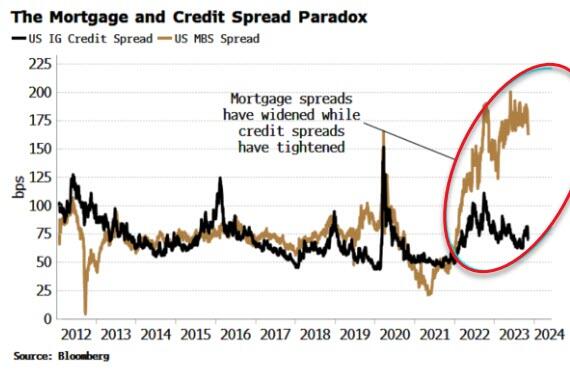
The growing divergence between mortgage and credit spreads is highly unusual and counter-intuitive: it’s not obvious why corporates should be getting less risky and mortgages more when rates have risen for everybody. It turns out the ultimate cause is inflation.

It has been said that anyone who says they understand quantum mechanics doesn’t understand quantum mechanics. That applies equally to markets. Just when you think you have a handle on things, a new head-scratcher pops up.

A current one is the growing divergence between spreads on mortgage-backed securities (MBS) and credit spreads. In recent years they have moved relatively closely together, but when the Fed is raising rates, credit tends to tighten across the board, and all risk spreads widen. However, in this cycle MBS spreads have blown out to GFC-wides while investment-grade credit spreads have been trending down.

What gives? To answer the question requires touching on several different markets – credit, mortgages, equity, fixed-income and volatility. Doing so will illuminate the connections between them to better understand the current backdrop, and why elevated inflation is the ultimate cause of this anomaly. It will also give us clues about what to look for when the mortgage-credit divergence is about to correct.

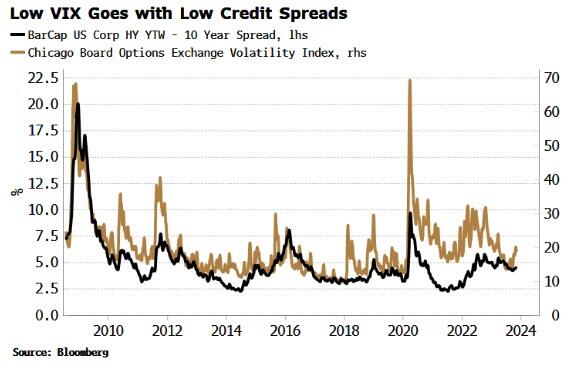
So first we have to answer why credit spreads have remained contained, given rapid Fed rate increases and mounting signs of underlying credit stress? A principal driver has been the relatively depressed value of the VIX.

Implied volatility, which the VIX is a measure of, is a direct input to models of how likely firms are to default. Credit spreads and the VIX typically move very closely together.

In turn, the VIX has been repressed for at least three reasons.

I have discussed two of them previously: low implied correlation and a rise in call option speculation.

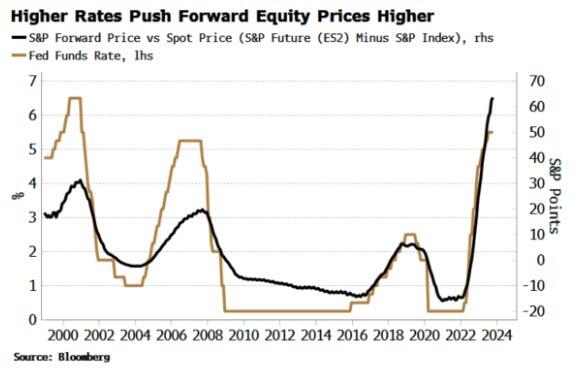
The third reason is the elevated level of forward rates of equity indexes.

The forward price has to take into account the carry cost of financing the position. As interest rates move higher, the cost of financing the position increases and this is reflected in higher forward prices. The current rate-hiking cycle has taken the spread between the second mini S&P future (i.e. the forward price of the S&P one to two quarters ahead) and the spot price of the S&P to at least 25-year highs.

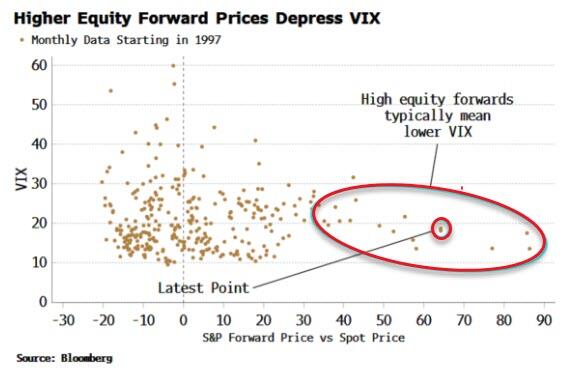
Where does the VIX come in? Options are priced not off the spot rate, but off the forward rate at the time of option’s expiry. Therefore a higher forward price has the effect of cheapening put prices and increasing call prices.

The VIX is an average of all options with an ~1-month expiry, but as downside protection tends to cost more, and a greater number of the puts outstanding are typically more out-of-the-money than calls outstanding (investors prefer to protect against larger price declines), this means higher forward prices keep a lid on the VIX.

Thus forward prices are helping to keep credit spreads in check, but it is also forward prices, this time for bond yields, that are part of the reason why the spreads on newly-issued MBS have blown out.

MBS spreads are the spread between US bond yields and mortgage bonds issued or guaranteed by government-sponsored agencies – Freddie Mac, Fannie Mae and Ginnie Mae. Given MBS and government bonds are both de facto guaranteed by the US Treasury, you might think the spread should be quite narrow, not the ~150 bps it currently trades at.

The reason is pre-payment risk.

Borrowers can typically pre-pay their mortgage at any point with no penalty, which means MBS holders may see some of their principal repaid early. As this is more likely to happen when rates are falling, which means cash returned can only be invested at a lower level, MBS spreads reflect this extra risk.

But MBS spreads have been widening even as rates have been rising. There are two reasons for this, as Harley Bassman describes in his latest Convexity Maven letter: an inverted yield curve and high fixed-income volatility. As Bassman explains, an MBS can be approximated by buying a 10-year bond and selling an out-of-the-money call option on it with a three-year expiry.

A flat or inverted yield curve means forward yields are lower, which in turn increases the price of the call option, and therefore depresses the price of the bond-option package, i.e. flatter yield curves will, all other things equal, reduce the price of MBSs.

Essentially, the call option captures the cost of the prepayment risk, and the lower forward price means a higher chance of prepayment.

Cheapening MBS further is elevated fixed-income volatility, captured by the MOVE index.

Higher volatility means there is a greater chance of bigger moves in yield, and more so to the downside given the skew in bond options. That risk must be compensated for and is reflected in lower MBS prices and thus wider MBS spreads.

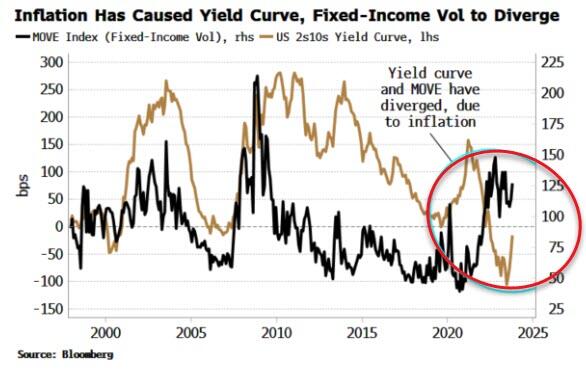
One last piece of the puzzle is why fixed-income vol has risen so much. Normally flat and inverted yield curves limit FI vol as there are fewer potential paths long-term rates can take to converge to short-term rates (as they eventually must do).

But this time FI vol has diverged from the yield curve.

The difference is inflation. The most elevated price growth since the 1980s has added more uncertainty to the path of rates, raising volatility.

Thus all roads lead back to inflation. It was inflation that led the Federal Reserve to hike rates, which raised equity forward prices, helping to depress the VIX. It was also higher rates that took the yield curve to its most inverted state in decades.

It’s unlikely the MBS and credit-spread divergence will last. MBS spreads should start to come in as the yield curve steepens, and fixed-income vol should ease back as inflation volatility falls. Credit spreads should eventually widen to better reflect the deterioration in underlying fundamentals.

Which happens first is hard to know, but either way, by the time this anomaly has resolved itself, there’ll no doubt be another one along to puzzle over.

Tyler Durden
Tue, 11/07/2023 – 09:05

via ZeroHedge News https://ift.tt/r3xiGwb Tyler Durden

Hunter Biden Wants To Sic Daddy’s DOJ On Whisteblower Biz Partner

Hunter Biden Wants To Sic Daddy’s DOJ On Whisteblower Biz Partner

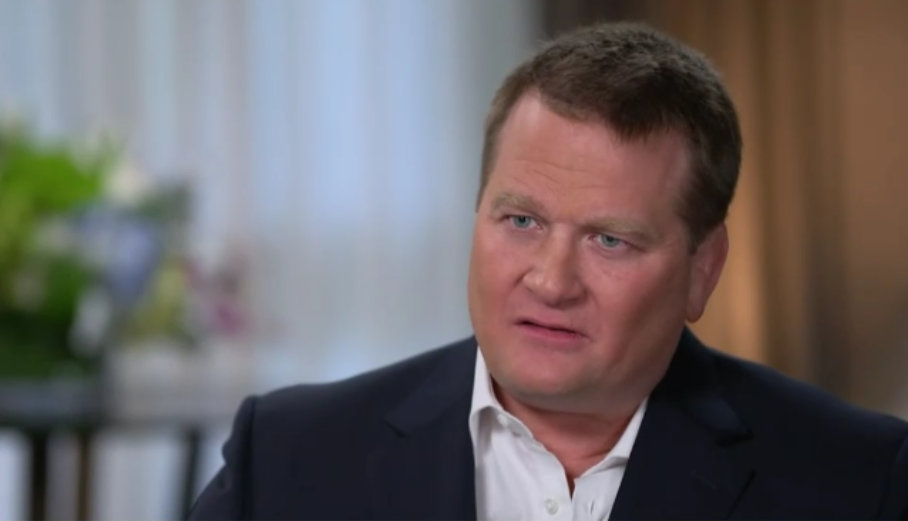
Former Navy lieutenant Tony Bobulinski, the Biden family whistleblower who recorded operatives begging him not to blow the whistle (“You’re just gonna bury all of us man”), may receive a knock from the Biden DOJ, after NBC News reports that Hunter Biden wants him investigated.

According to the report, Bobulinski allegedly made false statements to the FBI.

“Specifically, we recently received information demonstrating that numerous statements made by Mr. Bobulinski in Washington, D.C. during an interview with the FBI on October 23, 2020, concerning our client, Hunter Biden, are false,” writes Hunter’s defense attorney, Abbe D. Lowell.

Hunter is asking that Biden-appointed DA for Washington DC, Matthew Graves, head the investigation. Graves was appointed by Biden after working on his 2020 presidential campaign as an unpaid policy advisor, according to the Daily Caller, citing a Senate Judiciary Committee questionnaire. Graves also donated to Biden’s 2020 campaign while he was an attorney in the private sector.

Graves testified to the House Judiciary Committee in October and confirmed he refused to partner with Delaware U.S. Attorney David Weiss on potentially charging Hunter Biden for alleged tax offenses, according to a transcript reviewed by the Daily Caller.

Bobulinski’s FBI interview in October 2020 was summarized by an FBI FD-302 form released in September by the House Ways and Means Committee as part of a trove of documents supporting testimony from IRS whistleblowers Gary Shapley and Joseph Ziegler.

Lowell disputes Bobulinski’s claim to the FBI that he was present in Miami for a meeting Hunter Biden held with Chinese business associate Ye Jianming, the chairman of Chinese infrastructure company CEFC, NBC reported. -Daily Caller

Bobulinski told the FBI that he had attended the Miami meeting, where they discussed the work that the Biden family was doing for CEFC beginning when Joe was VP.

“CEFC had used its relationship with HUNTER BIDEN and JAMES BIDEN – and the influence attached to the BIDEN name – to advance CEFC’s interests abroad. HUNTER BIDEN and JAMES BIDEN did not receive any monetary compensation for their assistance in these projects. HUNTER BIDEN and JAMES BIDEN did not receive any compensation because JOSEPH BIDEN was still VPOTUS during this time period,” reads the document.

“There was a concern it would be improper for payments to be made to HUNTER BIDEN and JAMES BIDEN by CEFC due to its close affiliation with the Chinese government. HUNTER BIDEN and JAMES BIDEN both wanted to be compensated for the assistance they had provided to CEFC’s ventures; in particular, they believed CEFC owed them money for the benefits that accrued to CEFC through its use of the BIDEN family name to advance their business dealings.”

According to the report, Bobulinski was one of the business associates who discussed a “sinohawk” venture with CEFC, which Joe Biden was potentially going to be involved in, per the FD-302 form. Bobulinski told the FBI that he met with Joe Biden in Beverly Hills, California to discuss.

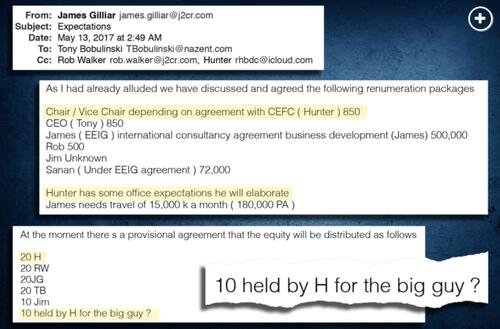
The proposed joint venture with CEFC appeared to be the subject matter of an infamous email thread where business associate James Gilliar referred to Joe Biden as “the big guy” in a message about potential equity distribution.

“10 held by H for the big guy?” Gilliar asked his colleagues, the email shows. He suggested making Hunter Biden chair of the company and Bobulinski the CEO.

The “sinohawk” venture appeared to fall through, and instead Hunter Biden and James Biden set up a joint venture with CEFC called Hudson West III in August 2017, according to bank records released Wednesday by the House Oversight Committee.

Hunter Biden and Jianming appeared to change the terms of the joint venture at the Miami meeting, emails released by the Ways and Means Committee show. -Daily Caller

“My Understanding is that the original agreement with the Director was for consulting fees based on introductions alone a rate of $10M per year for a three year guarantee total of $30M. The chairman changed that deal after we me in MIAMI TO A MUCH MORE LASTING AND LUCRATIVE ARRANGEMENT to create a holding company 50% percent owned by ME and 50% owned by him,” Hunter emailed Chinese business associate Gongwen Dong on Aug. 2, 2017.

“Consulting fees is one piece of our income stream but the reason this proposal by the chairman was so much more interesting to me and my family is that we would also be partners inn the equity and profits of the JV’s investments,” he continued. “Hence I assumed the reason for our discussion today in which you made clear that the Chaireman [sic] would first get his investment capital returned in the profits would then be split 50/50. If you saying that is not the case then please return us to the original deal 10M per year a guaranteed 3 years plus bonus payments for any successful deal we introduce.”

Read the rest here, and see what Bobulinski claims about the Bidens, in his own words.

Tyler Durden
Tue, 11/07/2023 – 08:45

via ZeroHedge News https://ift.tt/ad5uLTY Tyler Durden

69-Year-Old Jewish Man Dies After Being Struck By Megaphone By Pro-Palestinian Protester In California

69-Year-Old Jewish Man Dies After Being Struck By Megaphone By Pro-Palestinian Protester In California

Authored by Jill McLaughlin via The Epoch Times,

A 69-year-old man demonstrating in support of Israel has died after sustaining a head injury during a fight with a pro-Palestinian protester during a rally on Nov. 5 in Thousand Oaks, about 40 miles northwest of Los Angeles.

The Ventura County medical examiner has ruled Paul Kessler’s death a homicide, and the county sheriff’s office has not ruled out a hate crime. Mr. Kessler was Jewish, according to the Jewish Federation of Greater Los Angeles.

Officials say Mr. Kessler was attending the rally Sunday afternoon when he became involved in an altercation with a counter-protester who was demonstrating nearby at a pro-Palestinian event.

The incident happened at the intersection of Westlake Boulevard and Thousand Oaks Boulevard in Ventura County.

The Ventura County Sheriff’s Office responded to the altercation after several citizens called 9-1-1 to report a battery at about 3:20 p.m.

Deputies arrived to find Mr. Kessler suffering from a head injury. Witnesses told police he fell backwards during the fight and struck his head on the ground. He was taken to an area hospital for treatment but succumbed to his injuries Monday, the sheriff’s office reported.

The Ventura County Medical Examiner’s Office determined Mr. Kessler died from blunt-force head injury, according to the sheriff’s office.

The sheriff’s office is continuing to investigate the incident. Anyone who witnessed or has information about the incident, or who was at the demonstration, is encouraged to contact the sheriff’s department. The department has scheduled a press conference for Tuesday morning.

The Jewish Federation of Greater Los Angeles was devastated by the news, according to a statement issued by the group Monday evening. The group reported Mr. Kessler was struck in the head by a megaphone.

“We are devastated to learn of the tragic death of an elderly Jewish man who was struck in the head by a megaphone wielded by a pro-Palestinian protestor in Westlake Village,” the federation said on X, formerly Twitter.

“Our hearts are with the family of the victim. While we wait for more information from our law enforcement partners, we remind you that this is the fourth major antisemitic crime committed in Los Angeles this year alone.”

“Violence against our people has no place in civilized society,” the federation added. “We demand safety. We will not tolerate violence against our community. We will do everything in our power to prevent it.”

Tyler Durden
Tue, 11/07/2023 – 08:31

via ZeroHedge News https://ift.tt/VZqz49J Tyler Durden

US Futures End Six-Day Winning Streak As Fed Speakers Dampen Hopes Of Rate Cuts

US Futures End Six-Day Winning Streak As Fed Speakers Dampen Hopes Of Rate Cuts

US stocks were set to snap a six-day rally on Tuesday as traders reassessed expectations of Fed interest-rate policy after hawkish comments Monday by Minneapolis Fed President Neel Kashkari dampened hopes of speedy interest rate cuts from the US central bank. Kashkari is back today for round two; Indeed, traders appear to be awaiting more from Fed officials on the rate path outlook following Kashkari’s comments, with Fed Chair Jerome Powell also set to speak later in the week, but first we have to get through today’s calendar:

  • 07:30: Kashkari
  • 08:00: Goolsbee
  • 09:15: Barr
  • 09:50: Schmid
  • 10:00: Waller
  • 12:00: Williams
  • 13:25: Logan

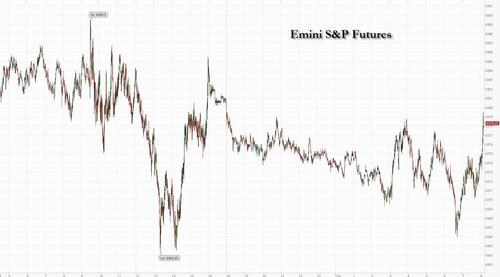
As of 7:50am, S&P 500 futures are down 0.3% to 4372 with Nasdaq futures dropping by the same amount, while Europe’s Stoxx 600 index posted a similar loss.
Commodities ex-base metals/natgas are weaker while WTI slides under $80 for the first time in 2 months despite a war raging in the middle east. Today’s Macro data is primarily focused on consumer credit, the 7 Fed speakers, and the 3Y auction at 1pm. MegaCap Tech names are weaker premarket; here are some of the most notable premarket movers:

  • Alteryx shares rise 17% after the software company reported better-than-expected results, providing relief following last quarter’s disappointing revenue forecast. Analysts said that the firm’s execution improved, showing some resilience against a tough backdrop and prompting some price target hikes.
  • Coherus Bio shares tumble 18% as the biotech company cut its net product revenue and combined R&D and SG&A expenses forecast for the full year.
  • DigitalOcean Holdings shares gain 8.2% as Goldman Sachs double-upgrades its rating on the cloud computing firm to buy, saying in note that cyclical risks appear to be priced in.
  • Hims & Hers Health shares jump 7.0% after reporting third-quarter revenue that beat estimates and boosting its adjusted Ebitda guidance for the full year ahead of expectations. Analysts saw the results as strong, highlighting the execution of management.
  • RingCentral shares rise 9.7% after the communications software provider narrowed its software subscription revenue guidance for the full year and reported what analysts said was a strong set of results, boosting hopes of further growth.
  • TransMedics Group shares climb 37% after the organ transplant company boosted its sales forecast for the full year. The health-care firm also reported third-quarter revenue that exceeded the average analyst estimates.
  • TripAdvisor shares jump 11% after the online travel company reported third-quarter adjusted earnings per share and revenue that came ahead of estimates. Analysts said the results were better than expected, highlighting the performance of TripAdvisor Core and Viator.
  • Ventyx Biosciences shares drop 73%, set for a record fall, after the biotech said it’s terminating its Phase 2 trial of VTX958 in plaque psoriasis and psoriatic arthritis as efficacy results did not meet the internal target to support further development. The update prompted a downgrade from Wells Fargo, with the broker saying that its thesis on the stock is “busted.”
  • Vimeo shares rise as much as 14% in premarket trading after the video software company reported better-than-expected 3Q revenue and boosted its adjusted Ebitda guidance for the full year
  • Clover Health shares fall as much as 19% in premarket trading on Tuesday after reporting third quarter revenue that missed the average analyst estimate.

Kashkari, speaking in an interview on Fox News on Monday, said it’s too soon to declare victory over inflation. He added that while there have been three months of promising data on inflation, it isn’t enough.

“The Kashkari comment has injected a sense of reality back into the market, which had got carried away thinking that policy easing was just around the corner,” said Stuart Cole, head macro economist at brokerage Equiti Capital.

Meanwhile, bond markets rallied, led by the UK, as Bank of England Chief Economist Huw Pill hinted rate cuts may be on the table by the middle of 2024 and German industrial output figures suggested that recession isn’t far off. Two-year gilt yields fell 10 basis points to 4.6% and the rate on 10-year Treasuries slid five basis points to 4.59%.

European stocks are lower, with the Stoxx 600 falling 0.2%. Among individual stock movers, oil producers dragged down European equity benchmarks, with Shell Plc and BP Plc sliding more than 1%. UBS gained as much as 5%, most in two months, as the Swiss bank’s third-quarter results were “messy” yet better than expected as expenses were lower, according to analysts. Here are some of the other notable European movers:

  • Engie shares gain as much as 2.4% after the French utility company raised its full-year guidance and reaffirmed its dividend policy. Morgan Stanley sees 7% upside to current consensus estimates for 2023 net income
  • Associated British Foods shares rise as much as 7%, reaching the highest since July 2021, after reporting full-year adjusted operating profit that beat estimates and announcing an additional £500 million buyback
  • NatWest Group rises as much as 2.3% and is among the biggest gainers on the Stoxx 600 banks index on Tuesday after BNP Paribas Exane double-upgrades its rating on the UK lender to outperform from underperform
  • Nexi shares jump as much as 4.4% on Tuesday after newspaper MF reported the Canada Pension Plan and Francisco Partners are among firms that may be interested in the payments company. It didn’t say where it obtained the information
  • Watches of Switzerland shares jump as much as 15%, the biggest intraday gain since Sept. 25, after the luxury watch retailer reported second-quarter results that analysts said showed resilience in a tough macroeconomic environment
  • Poste Italiane shares gain as much as 2.3%, the most intraday since Oct. 10, after the company boosted its full-year Ebit guidance and released what Morgan Stanley called a strong set of third-quarter results
  • Daimler Truck shares fall as much as 4.8% to their lowest intraday since June after the German commercial vehicle maker’s third-quarter Ebit showed the impact of supply-chain bottlenecks and missed estimates, says Citi
  • Demant shares drop as much as 8.7%, the most in a year and dragging peer GN Store Nord lower, after the Danish hearing-aid maker reported third-quarter sales that missed expectations and narrowed its organic revenue forecast for the year
  • RS Group shares fall as much as 19% after a tough first half as weakness in electronics weighs on the industrial and electronic products distributor sales, according to analysts
  • OCI slumps as much as 5.8% after the Dutch fertilizer maker’s third-quarter results saw a big miss on adjusted Ebitda. There could be double-digit downgrades to full-year Ebitda numbers, Morgan Stanley says
  • The Restaurant Group shares fall as much as 3.3% after Wheel Topco, the owner of Pizza Express, said it won’t make an offer for the owner of Wagamama due to “market conditions”

Earlier in the session, Asian equities declined, halting their best four-day advance since November 2022, with Chinese and Korean stocks leading the selloff in the region: South Korea’s Kospi Index lost 2.3% after Monday’s rally that was triggered by a short-selling ban, while Australia resumed policy tightening and raised its inflation forecast, a sign that central banks are not necessarily done hiking interest rates.

The MSCI Asia Pacific Index fell as much as 1.3%, its biggest drop since Oct. 26, with POSCO, Alibaba and AIA Group among the top laggards. Korean stocks were headed for their worst day in more than a year on profit-taking after a ban on short-selling triggered their biggest rally since March 2020 on Monday. Chinese shares also declined after data showed that exports unexpectedly deepened in October, underscoring the country’s fragile economic recovery. A gauge of technology stocks in Hong Kong fell the most in a week.

  • Hang Seng and Shanghai Comp opened lower amid the broader market mood. Muted price action was seen after the narrower-than-expected October Chinese Trade Balance, although imports saw surprise growth, while China Vanke’s shares firmed after state shareholders showed signs of providing liquidity support.
  • Australia’s ASX 200 saw its downside led by Financials, Energy, and Materials, although the index clambered off worst levels following the RBA’s dovish hike.
  • Japan’s Nikkei 225 fell back under 32,500 as the index conforms to the losses across the region.
  • Indian stocks ended a three-day rally to end flat amid declines in Asia and European markets. The S&P BSE Sensex settled at 64,942.40, erasing an intraday loss off 0.5%. The NSE Nifty 50 Index also ended flat at 19,406.70. The MSCI Asia Pacific Index slid as much as 1.4%, ending a four-day winning run that was the longest since October 12.

Asian equities started November with gains after three successive months of decline over hopes that the higher-for-longer interest rates narrative may be fading. Still, sentiment has slightly soured amid fresh doubts over the Fed’s policy path and as Australia resumed its interest rate hikes after stronger than expected inflation data. “Following the stellar rallies across the region yesterday, indexes are giving back some of their gains, with a recovery in bond yields and a firmer US dollar to start the week,” said Jun Rong Yeap, market analyst at IG Asia Pte.

In FX the Bloomberg Dollar Spot Index is up 0.2%. The Aussie is the weakest of the G-10 currencies, falling 1% versus the greenback after the RBA signaled a higher hurdle to further policy tightening.

In rates, Treasuries rose along with the dollar, ahead of a flurry of Fed speakers later on Tuesday and following wider gains across European rates. 10Y TSY are trading at 4.625% down 2bps from yesterday’s close. Gilts in particular underwent a sharp bull-steepening after Bank of England chief economist Huw Pill said there will be a “sharp further fall” in inflation for October and hinted that interest rates could be cut by the middle of next year.  Adding to the upward pressure on UK bonds, market research firm Kantar reported UK grocery price inflation slowed to single digits for the first time in 16 months. UK two-year yields fall 10bps to 4.62%.

The US session includes at least seven Fed officials scheduled to speak and $48b 3-year note sale at 1pm New York time. US are yields richer by less than 2bp across the curve with gains led by belly, steepening 5s30s spread by around 1bp on the day; gilts lead gains across core European rates with 2-year sector richer by 10bp on the day into early US session, while in 10-year sector gilts outperform Treasuries by 4.5bp.

In commodities, West Texas Intermediate crude dropped below $80 a barrel for the first time in more than two months. WTI fell 2% to trade near $79.20. Spot gold falls 0.5%.

Looking to the day ahead now, data releases include German industrial production, Euro Area PPI, and the US trade balance for September. From central banks, we’ll hear from the Fed’s Barr, Schmid, Waller, Williams and Logan, along with the ECB’s Nagel. Finally in the political sphere, the King’s speech is taking place in the UK, where the government outlines its legislative agenda for the next parliamentary session. In the US, there are also 2 gubernatorial elections taking place today in Kentucky and Mississippi.
Market Snapshot

  • S&P 500 futures down 0.3% to 4,373.00
  • MXAP down 1.3% to 157.64
  • MXAPJ down 1.2% to 493.63
  • Nikkei down 1.3% to 32,271.82
  • Topix down 1.2% to 2,332.91
  • Hang Seng Index down 1.6% to 17,670.16
  • Shanghai Composite little changed at 3,057.27
  • Sensex little changed at 64,907.46
  • Australia S&P/ASX 200 down 0.3% to 6,977.07
  • Kospi down 2.3% to 2,443.96
  • STOXX Europe 600 down 0.2% to 442.82
  • German 10Y yield little changed at 2.71%
  • Euro down 0.2% to $1.0694
  • Brent Futures down 2.1% to $83.38/bbl
  • Gold spot down 0.5% to $1,967.78
  • U.S. Dollar Index up 0.29% to 105.52

Top Overnight News

  • RBA hiked rates by 25bp to 4.35% (market expectations were close to 50/50 about whether they would move at this meeting) although the accompanying language evolved in a dovish fashion. RTRS  
  • China’s exports fall short of expectations in Oct, coming in -6.4% Y/Y (vs. the Street estimate of -3.5%), although imports were a bit better (+3% vs. the Street -5%). RTRS
  • Tumbling pork prices could push China back into deflation this week, as the largest listed hog farmers flood the domestic market and complicate Beijing’s efforts to bolster confidence in the world’s second-largest economy. FT
  • China steps in to provide support to stressed developer Vanke, with Shenzhen Metro, a state-owned enterprise, vowing to provide full support to the company. WSJ
  • German industrial production for Sept comes in cooler than anticipated (-1.4% M/M vs. the Street’s -0.1% forecast). BBG
  • The BOE might wait until the middle of next year before cutting interest rates from their current 15-year high, the BoE’s Chief Economist Huw Pill said on Monday. Pill said pricing in financial markets – that currently points to a first rate cut to Bank Rate in August 2024 – “doesn’t seem totally unreasonable, at least to me.” RTRS
  • UBS shares climbed as stronger-than-expected client inflows and progress in cost savings overshadowed its first quarterly loss in six years. Sergio Ermotti said Credit Suisse has stabilized though remains structurally unprofitable, while demand for UBS debt is strong. BBG
  • The UN reported the reopening of the crossing between Gaza and Egypt. Benjamin Netanyahu said he sees his country having security control over Gaza for an “indefinite period.” BBG
  • James Gorman signaled he plans to step down as Morgan Stanley’s chairman by the end of 2024 as he prepares to vacate his CEO post this year. He pushed back on the notion of entering politics, saying, “I don’t like sharks.” BBG

A more detailed look at global markets courtesy of Newsquawk

Asia-Pac stocks were softer across the board following the prior day’s gains and the choppy/mixed lead from Wall Street. South Korea’s KOSPI is the notable underperformer – slumping over 2.8% – after surging yesterday on the back of the stock short-selling ban. ASX 200 saw its downside led by Financials, Energy, and Materials, although the index clambered off worst levels following the RBA’s dovish hike. Nikkei 225 fell back under 32,500 as the index conforms to the losses across the region. Hang Seng and Shanghai Comp opened lower amid the broader market mood. Muted price action was seen after the narrower-than-expected October Chinese Trade Balance, although imports saw surprise growth, while China Vanke’s shares firmed after state shareholders showed signs of providing liquidity support.

Top Asian News

  • RBA hikes its Cash Rate by 25bps as expected to 4.35% from 4.10%, and tweaked its forward guidance to say “Whether further tightening of monetary policy is required…will depend upon the data” (prev. “Some further tightening of monetary policy may be required”). The RBA also noted inflation in Australia has passed its peak but is still too high and is proving more persistent than expected a few months ago.
  • China’s Commerce Ministry has issued new rules to strengthen management of rare earth exports, effective Oct 31 2023 to Oct 31, 2025; issued new rules to strengthen import management of crude oil, iron ore, copper concentrate, potash, according to Reuters.
  • PBoC Deputy Governor said he is not too worried about the Chinese economy, and added the overall debt level of the Chinese government is in the mid to lower range by international standards, according to Reuters.
  • PBoC injected CNY 353bln via 7-day reverse repos with the rate at 1.80% for a CNY 259bln net daily drain.
  • Japan ruling ally Kometo tax chief says should not pre-decide to limit income tax cuts to just a year, according to Reuters.
  • South Korean Vice Finance Minister says FX authorities will continue to monitor currency markets as done now even after rule changes in licenses, according to Reuters.
  • IMF upgrades China’s GDP Growth forecasts: 2023 5.4% (prev. 5%), 2024 4.6% (prev. 4.2%); follows strong Q3 and growth policies.

European bourses are in the red, Euro Stoxx 50 -0.2%, but have been fairly contained throughout the morning with specific catalysts light and the tone thus far largely emanating from APAC pressure. Sectors are mixed with outperformance in Retail names post-AB Foods while Banks derive support from UBS despite yield pressure; in M&A Telefonica’s offer to purchase the remainder of Telefonica Deutschland has led to gains of circa. 40% for the German telecom name. Stateside, futures are in the red printing broad-based losses in a continuation of Monday’s/APAC risk tone, ES -0.2%, docket today features notable data incl. Manheim and numerous Fed speakers before a handful of earnings.

Top European News

  • ECB’s de Guindos says low growth or economic standstill is expected to carry on into Q4 for the Eurozone.
  • Telefonica Seeks 28% in German Unit for About €2 Billion
  • UBS Seeks to Get Rid of $5 Billion in Rich Clients’ Assets
  • Sunak Aims to Trap Labour With Election-Geared King’s Speech
  • Aldi and Lidl Are Now Just as Middle Class as Other UK Grocers

FX

  • Aussie retreats as risk aversion and less hawkish RBA guidance outweigh the widely anticipated 25bp hike, AUD/USD closer to 0.6400 than 0.6500, AUD/NZD cross sub-1.0850 from just under 1.0900.
  • Buck maintains recovery momentum almost across the board as DXY climbs to 105.63 from a 105.25 low awaiting US trade data and a slew of Fed speakers.
  • Euro losing grip of 1.0700 handle, Pound probes 1.2300 and Yen back below 150.00 all over again.
  • Loonie undermined by a slide in oil ahead of Canadian trade with USD/CAD closer towards the top of 1.3755-1.3691 range.
  • PBoC set USD/CNY mid-point at 7.1776 vs exp. 7.2854 (prev. 7.1780)
  • BCB Minutes: It was decided to maintain the recent communication, which already includes the appropriate conditionality in an uncertain environment; rate cuts of 50bps are appropriate to keep the necessary contractionary monetary policy for the disinflationary process.

Fixed Income

  • Debt futures resurgent after further retracement and curves revert to a flatter trajectory ahead of US refunding.
  • Bunds bounce from 129.35 to 130.20 and Gilts from 94.47 to 95.42 in the wake of solid demand for 2034 UK issuance.
  • T-note back on 108-00 handle within 107-19+/108-03+ range.

Commodities

  • Crude benchmarks remain under pressure after slipping during APAC trade in-fitting with the broader risk tone and have been unable to stage any form of recovery this morning, despite equity performance being much more contained in comparison.
  • WTI Dec’23 and Brent Jan’23 lose the USD 80/bbl and USD 84/bbl handles respectively, an action which pushes the benchmarks to multi-month lows with support seen around USD 78/bbl mark in WTI from late-August.
  • Metals feature marked pressure in spot gold with the stronger USD offsetting any potential haven demand that may typically have been expected from the current tone, a tone which is weighing on base metal peers.
  • US DoE announced a supplemental solicitation for up to 3mln barrels of oil for delivery in January 2024 for US Strategic Reserve.
  • OPEC Secretary General says oil demand continues to rise significantly; Oil demand to grow more than 2mln BPD in 2024.

Geopolitics

  • Israeli PM Netanyahu says Israel is open to “short pauses” in Gaza, but ruled out a ceasefire, according to Bloomberg.
  • The Biden administration is reportedly planning a USD 320mln transfer of precision bombs for Israel, according to WSJ.
  • Russian Defence Ministry says Russia destroyed 17 Ukraine-launched drones over Russian territory, according to RIA.

US Event Calendar

  • 08:30: Sept. Trade Balance, est. -$59.8b, prior -$58.3b
  • 15:00: Sept. Consumer Credit, est. $9.5b, prior -$15.6b

Central Banks

  • 07:30: Fed’s Kashkari Speaks on Bloomberg Television
  • 08:00: Fed’s Goolsbee Speaks on CNBC
  • 09:15: Fed’s Barr Speaks on Financial Technology
  • 09:50: Fed’s Schmid Speaks at Dallas/Kansas City Energy Conference
  • 10:00: Fed’s Waller Speaks at St. Louis Fed Conference
  • 12:00: Fed’s Williams Moderates Discussion in New York
  • 13:25: Fed’s Logan Participates in Moderated Discussion

DB’s Jim Reid concludes the overnight wrap

Just when you thought it was safe to go back into the water and hoover up every bond in sight, yesterday saw yields do yet another 180 degree turn, something we’ve been used to seeing in recent weeks, even if last three days of last week was one way traffic. 2yr US yields led the way (+9.6bps). T he S&P 500 managed to eke out a narrow gain (+0.18%) but US small caps (Russell 2000 -1.29%) suffered again with higher rates.

Diving in, the bond selloff perhaps came as investors began to wonder if last week’s narrative about rate cuts was overdone. For instance, market pricing for the Fed now implies a 16% chance of another rate hike, up from 11% on Friday. Moreover, the rate priced in by the December 2024 meeting was up +12.4bps to 4.47%. So there was a clear, albeit partial unwinding of last week’s moves. After the market close, we heard from Minneapolis Fed Kashkari, one of the more hawkish FOMC voices, who said that “we need to let the data keep coming to us to see if we really have got the inflation genie back in the bottle”. So some pushback against declaring victory over inflation.

For markets, this is hardly the first time we’ve seen expectations of a dovish pivot, and Henry pointed out yesterday (link here) that this is at least the 7th time this cycle where markets have reacted notably in response to dovish speculation. Clearly rates aren’t going to keep going up forever, but on the previous 6 occasions we saw hopes for near-term rate cuts dashed every time. Note that we’ve still got above-target inflation in every G7 country. With that in mind, next week’s US CPI release will be an important factor on that front, and our US economists expect core CPI to remain at +0.3% for a third consecutive month .

In the latter half of the US session, we got the latest Senior Loan Officer Opinion Survey (SLOOS) from the Fed, which looks at bank lending standards and has traditionally been a strong leading indicator for the economy more broadly. This showed some improvement in banks’ willingness to lend compared to the previous quarter’s lows, with the net balance of banks reporting tighter lending standards falling from 50.8 to 33.9 for commercial & industrial loans and from 71.7 to 64.9 for CRE loans. However, more banks reported tightening standards for mortgages, up from 13.8 to 16.0. So the general SLOOS improvement is welcome but most measures are still at levels usually associated with recessions. Can the SLOOS improve quickly enough over the next 2-3 quarters before the current tight lending standards cause an accident or a serious growth slowdown. We likely have a race against time.

In terms of the actual moves for bonds, 10yr Treasury yields ended the day up +7.1bps to 4.64%. Real yields drove the increase, with the 10yr real yield up +5.2bps to 2.23%, following its biggest weekly decline of 2023 so far last week. The sell-off was stronger at the front-end, with 2yr yields up +9.6bps to 4.94%. $24bn worth of corporate bond deals getting priced on Monday may have added upward pressure on yields. It’s worth highlighting that although the QRA was more positive last week, supply and QT is a regular part of life now and today kicks off a 3-day Treasury auction schedule with 3yr notes today, 10yr tomorrow and 30yr bonds on Thursday. So markets will still have to price these to sell over the coming months.

Meanwhile in Europe, the rises in yields were also significant, with those on 10yr bunds (+9.3bps), OATs (+10.2bps) and BTPs (+13.3bps) all moving higher. Indeed, for BTPs it was the joint largest daily rise in yields since July 6. However the front end rise was more contained with German, French and Italian 2yr yields up +3.9 bps, +3.2bps and +9.1bps respectively .

The bond moves were an obvious headwind to equities, but the S&P 500 (+0.18%) still managed to build on last week’s advance, with a 6th consecutive gain for the first time since June. However, this advance was a narrow one with only 31% of the S&P constituents up on the day. The biggest driver were tech mega caps, with the Magnificent Seven index up +0.87%, and the NASDAQ (+0.30%) rising for a 7th consecutive session for the first time since January. On the other hand, small-caps put in a very weak performance, with the Russell 2000 (-1.29%) losing ground after recording its strongest week since February 2021. As with bonds, the picture was a bit weaker in Europe, with losses for the STOXX 600 (-0.16%), the DAX (-0.35%) and the CAC 40 (-0.48%).

Asian equity markets have turned negative this morning following the softer markets yesterday. As I check my screens, the KOSPI (-3.07%) is sliding hard after posting its best session yesterday (+6.43%) since late March 2020 following the renewed ban on short selling over the weekend. Elsewhere, the Hang Seng (-1.50%), the Nikkei (-1.12%), the CSI (-0.68%) and the Shanghai Composite (-0.35%) are also retreating. Meanwhile, the S&P/ASX 200 (-0.15%) is also trading lower after the RBA increased its key interest rate by 25bps as expected (more on this below). S&P 500 (-0.21%) and NASDAQ 100 (-0.15%) futures are ticking lower. Treasury yields have fallen 0 to -1.5bps across the curve, led by the front end.

The latest trade data from China showed that exports declined for a 6th consecutive month, dropping -6.4% y/y, worse than Bloomberg’s estimate of a -3.5% drop and against a -6.2% drop in September. Imports surprisingly rebounded +3.0% y/y in October (v/s -5.0% expected) after a revised -6.3% drop the previous month. The resulting trade surplus amounted to $56.53 billion (v/s $82.0 billion expected).

Elsewhere, the RBA lifted its cash rate for the first time in five months (+25bps) to a 12-year high of 4.35% citing a slower-than-expected decline in inflation while still indicating that inflation would return to its target range of 2% to 3% in a reasonable timeframe. The Aussie dollar (-0.79%) dropped against the US dollar in response to the rate hike as the central bank’s statement failed to confirm the possibility of another hike in this cycle. Policy sensitive 3yr government bond yields fell -3.1 bps to 4.24% before slightly recovering, standing at 4.25% as I type.

Looking at yesterday’s data, there wasn’t too much but we did get some of the final PMI readings from Europe, where the main headlines were in line with the flash prints from a couple of weeks ago. For instance, the final Euro Area composite PMI was exactly in line with the flash reading at 47.8, and in Germany it was revised by only -0.1pts to 45.8. One source of concern was Italy, where the composite PMI fell -2.0pts to 47.0, its lowest in 12 months. Otherwise, the latest reading on German factory orders for September showed a +0.2% expansion (vs. -1.5% expected), but with this upside offset by a major downward revision to the previous month (+1.9% vs +3.9% previously). This still leaves German factory orders down -4.3% year-on-year.

To the day ahead now, and data releases include German industrial production, Euro Area PPI, and the US trade balance for September. From central banks, we’ll hear from the Fed’s Barr, Schmid, Waller, Williams and Logan, along with the ECB’s Nagel. Finally in the political sphere, the King’s speech is taking place in the UK, where the government outlines its legislative agenda for the next parliamentary session. In the US, there are also 2 gubernatorial elections taking place today in Kentucky and Mississippi.
Tyler Durden
Tue, 11/07/2023 – 08:13

via ZeroHedge News https://ift.tt/W5VJMeK Tyler Durden