Tennessee Alcohol Wholesalers Are Grabbing Control of the State’s Hemp Market


A hemp plant | Juan Aunion/Newscom

Few things are more difficult to eradicate in our system of modern governance than a government-sanctioned monopoly or oligopoly. A recently passed bill in Tennessee, which will allow the state’s alcohol wholesalers to take over hemp distribution in the state, shows that these monopolies are not only difficult to eliminate but also often attempt to expand their reach.    

The new law sets up a distribution system for hemp—which was legalized at the federal level in the 2018 Farm Bill—that mirrors the notorious three-tier system for alcohol distribution, which requires producers, wholesalers, and retailers to be legally separate entities. The three-tier system restricts producers and suppliers from selling directly to their customers and mandates that they work through a wholesaler to reach the market. This allows wholesalers to operate as functional monopolies or oligopolies in certain parts of states where only one or two wholesalers operate.

The law, which takes effect on January 1, 2026, also requires all wholesalers and retailers of hemp products to maintain a physical presence within the state. Out-of-state hemp suppliers will be prohibited from engaging in direct-to-consumer shipping to customers in Tennessee, and instead will be forced to work through the state’s wholesaler and retailer tiers. While in-state Tennessee hemp suppliers cannot ship their products to Tennesseans either, they are able to sell on-site directly to their customers, providing a workaround to avoid the three-tier system.

Cornbread Hemp, a Kentucky hemp supplier that recorded $1 million in Tennessee-based sales last year, is challenging the new law in federal court. Cornbread Hemp argues that Tennessee’s law unconstitutionally discriminates against out-of-state competitors in favor of in-state businesses, which is a violation of the Constitution’s Dormant Commerce Clause.

Supreme Court observers will recognize how closely the case mirrors Tennessee Wine and Spirits Retailers Association v. Thomas (2019). In the case, the majority struck down Tennessee’s requirement that applicants for alcohol wholesaling or retailing licenses must have resided in the state for over two years, finding it to be unconstitutional discrimination against out-of-state economic interests.

Tennessee’s constitutional rationale for residency requirements in the hemp context is even weaker than with alcohol. The main constitutional defense in support of residency requirements for alcohol is that the 21st Amendment, which repealed Prohibition, devolved alcohol regulation back down to the state and local level. States, therefore, argue that the Constitution’s recognition of state power in the alcohol arena should inoculate residency clauses from Dormant Commerce Clause challenges. While some lower courts have continued to buy this argument, the Supreme Court has refused to go along in recent decades.

As liquor attorney Sean O’Leary notes, the 21st Amendment allows a discriminatory state law in the alcohol context to face a lower level of constitutional scrutiny than a non-alcohol law. The argument essentially boils down to: Alcohol is uniquely treated under the U.S. Constitution. Hemp has no corollary to the 21st Amendment, meaning a discriminatory hemp law will face a higher level of constitutional scrutiny.

Now alcohol wholesalers—already a government-sanctioned oligopoly or monopoly in many locales—are trying to expand their control beyond alcohol. The new law makes this power grab particularly blatant, since it moves hemp from under the purview of the Tennessee Department of Agriculture to the state Alcoholic Beverage Commission.

In fact, this change was made “at the behest of the wholesaler lobby,” O’Leary notes. “The wholesaler’s goal is to mandate a three-tier system where they get a piece of the action.” He predicts that, given the power of the alcohol wholesaler lobby in state capitals across America, more state legislatures will be following Tennessee’s lead.

The post Tennessee Alcohol Wholesalers Are Grabbing Control of the State's Hemp Market appeared first on Reason.com.

from Latest – Reason.com https://ift.tt/TIasHOU
via IFTTT
Was Scandinavia’s Russian Drone Scare A False Flag To Crack Down On Russia’s Shadow Fleet?

Was Scandinavia’s Russian Drone Scare A False Flag To Crack Down On Russia’s Shadow Fleet?

Authored by Andrew Korybko via Substack,

It’s highly suspicious that Zelensky just claimed without any evidence that they were launched by Russian tankers and subsequently demanded that Europe close the straits to its shipping in response…

Unknown drones recently flew in close proximity to Danish and Norwegian airports, prompting speculation among some that they were Russia’s delayed hybrid retaliation against NATO for backing Ukraine’s drone flights in proximity to Russia’s own airports over the past few years.

No evidence has emerged in support of that hypothesis, but Zelensky still dishonestly passed off such claims as fact during his speech at the latest Warsaw Security Forum.

According to him, “there is growing evidence that Russia may have used tankers in the Baltic Sea to launch drones – the drones that caused major disruption in Northern Europe. If tankers used by Russia are serving as drone platforms, then such tankers should not be free to operate in the Baltic. This is de facto Russia’s military activity against European countries, so Europe has the right to close straits and sea routes to protect itself.”

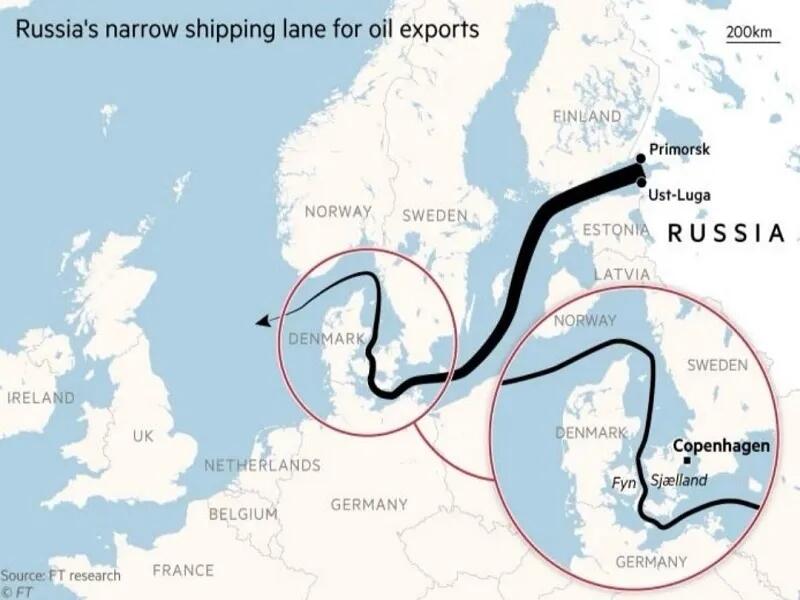
His proposal for NATO to close the Danish Staits to Russian shipping on this pretext, which would amount to an illegal blockade that could thus legitimize offensive action by Russia in self-defense, was predictable given Ukraine’s and some of its patrons’ interest in escalating the bloc’s tensions with Russia. In fact, it might even be the case that this was the false flag that Russia’s Foreign Intelligence Service twice warned could soon be staged by the UK and Ukraine, albeit ultimately taking a different form.

They assessed that those two might orchestrate potentially forthcoming provocations in the Baltic that would then be blamed on Russia in order to justify cracking down on its sanctioned energy trade that the West dramatically describes as being conducted by a “shadow fleet” transiting through that sea. While no US ship was targeted with Ukrainian-transferred Soviet/Russian torpedoes nor were such mines fished out of the Baltic, Scandinavia’s Russian drone scare still arguably fulfills the same role.

Skeptics might insist that Russia resorted to “plausibly deniable hybrid retaliation” against NATO, yet it’s illogical that Russia would risk anything that could justify the same escalation that Putin’s restraint has thus far avoided, the same goes for the earlier drone incident in Poland. Ditto that for the associated accusation that it violated Estonia’s maritime airspace. All these incidents were spun by the West as deliberate Russian provocations and preceded escalatory proposals misportrayed as “retaliation”.

The Polish and Estonian ones were exploited to get Trump to greenlight NATO downing Russian jets on the basis of them violating the bloc’s airspace, which might embolden some to attempt this on false pretexts, while the Scandinavian ones were exploited to call for closing the Danish Straits to its shipping. Both concern escalations in the Baltic, which could amount to an illegal blockade that obstructs the free movement of Russian planes and ships there, thus also placing unprecedented pressure on Kaliningrad.

This insight strongly suggests that Scandinavia’s Russian drone scare was indeed a false flag to justify cracking down on Russia’s “shadow fleet”, though it’s presently unclear whether any NATO members will cross the Rubicon by seriously making any such move like closing the Danish Straits to its shipping. In any case, Zelensky’s proposal proves that he’s trying to manipulate Trump into a disaster of epic proportions together with some of his like-minded NATO patrons, but hopefully Trump won’t fall for it.

Views expressed in this article are opinions of the author and do not necessarily reflect the views of ZeroHedge.

Tyler Durden
Sun, 10/05/2025 – 07:00

via ZeroHedge News https://ift.tt/Vmhx3py Tyler Durden

Lindy-Hopping Nazis and Golems With Guns: The Return of Thomas Pynchon


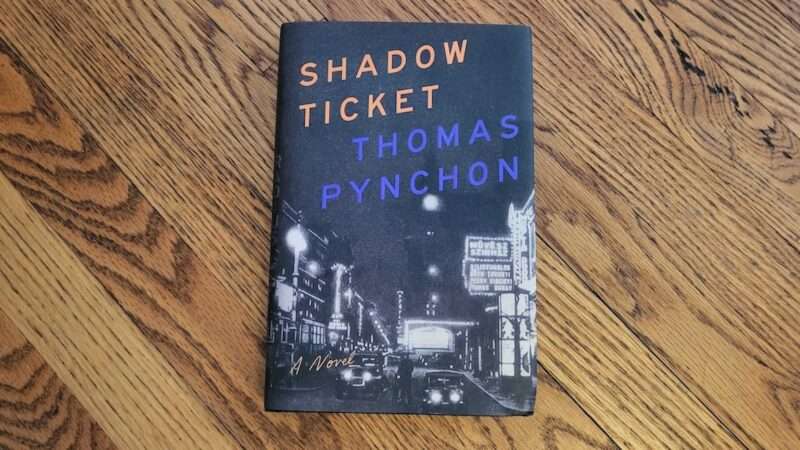
Cover of 'Shadow Ticket' by Thomas Pynchon | Penguin Press

Shadow Ticket: A Novel, by Thomas Pynchon, Penguin Press, 293 pages, $30

My favorite story about Thomas Pynchon, which may or may not be completely true: When Timothy Leary found himself in the hole at Sandstone Federal Prison, the defrocked Harvard doc asked a guard for something to read and the screw tossed a copy of Gravity’s Rainbow into the cell. Would a random prison guard really have that book at the ready? Beats me, but I love the image of someone trapped in a tiny room with Pynchon’s difficult, funny, endlessly digressive novel as his only escape hatch. There’s a photo floating around the internet of Leary’s marked-up copy of the book (sometimes misidentified as Neil Armstrong’s copy, which makes a different sort of crazy sense). Leary’s notes certainly look like things you might scrawl if you’re being driven mad simultaneously by solitary confinement and by Pynchon’s sprawling universe.

There is often a scent of madness around Thomas Pynchon’s fan base, and I say that as someone who has been one of those fans for around 40 years. The man has a reputation in some quarters as an unapproachable writer rarely read outside the academy, but the Pynchon cultists I encounter are more likely to be eccentric autodidacts prone to building elaborately strange mental models of the world. I have run across but cannot find again a small online subculture whose devotees combined the tenets of Marxism-Leninism with esoteric conspiracy theories about elite occultist pedophile rings; they regarded almost every prominent countercultural figure with suspicion but seemed to revere Pynchon as a prophet. They were the purest form of Pynchon fans: the kind who could be Pynchon characters. I imagine him dropping them into a novel as an aside, maybe in the middle of a list of terror cells or of rival gangs of mathematicians.

But now a door has materialized between the author and the mainstream. Paul Thomas Anderson’s impressive film One Battle After Another, based very loosely on Pynchon’s 1990 book Vineland, hit No. 1 at the U.S. box office in late September, giving the writer an opportunity to pick up new readers. Almost immediately afterward, a fresh product appeared for those newcomers to buy: Pynchon’s ninth novel, an acid noir titled Shadow Ticket. This one offers the writer in a relatively accessible mode. There are no dense passages that stretch on for pages, no detours into literal rocket science, no homoerotic encounters with Malcolm X. It’s short, it’s funny, and its core plot—private eye chases runaway dame—is familiar enough to give a cautious reader something to cling to as the book gets stranger.

It does get plenty strange. It is one thing to say the novel is about a strikebreaker turned detective in 1930s Milwaukee who gets hired to track down a cheese heiress and finds himself traveling through central Europe against a backdrop of rising fascism. But that bare-bones sketch won’t prepare you for a story that also includes a dog piloting an autogyro, an unsurrendered Austro-Hungarian submarine lurking about Lake Michigan, a bowling alley where Nazi dancers Lindy-hop to a swing version of the “Horst Wessel Song,” and a golem whose left arm doubles as “a modified ZB-26 Czech light machine gun.” This is the sort of book that casually invokes “a secret Indian reservation, mentioned only once in a rider to a phantom treaty kept in a deep vault under a distant mountain belonging to the U.S. Interior Department and unrevealed even to those guarding it.” It has vast conspiracies, encounters with the supernatural, and a development near the end that reveals we’ve tumbled into an alternate historical timeline.

For all that, the book is not some Permanently Wacky Zone that is never anything but absurd and strange. Gravity’s Rainbow isn’t all aerial pie fights and octopus attacks, after all; it has sequences, like an Advent service in wartime Kent, that are genuinely moving. While nothing in Shadow Ticket is as affecting as that Christmas Eve scene, the book has an emotional core to it. Among the characters traversing its surreal labyrinths, you’ll find some three-dimensional beings capable of disappointment and love.

And just as Gravity’s Rainbow deals with serious political ideas, so too does Shadow Ticket. Its 1930s setting makes that inevitable: Fascists are lurking in Europe (and Wisconsin), the persecution of Jews is starting to pick up, and the left isn’t exactly incapable of authoritarian ugliness either. (Besides an inevitable allusion to Stalin, the book periodically brings up Béla Kun’s short-lived 1919 communist dictatorship in Hungary, which is damned here not just for its own predations but for teaching lessons in persecution to the paramilitary antisemites who came along later. The Tankie Esotericists might not care for those parts.) There are no tedious efforts to make everything match up one-to-one with contemporary politics, but there are certainly moments when the fiction feels familiar. At one point, a man grumbles that “there used to be more time to make a getaway. Now they’re flashing everybody’s mug shot all around the world in the blink of an eye, pretty soon there’s no place to run to anymore…”

Not that this is a totally surveilled society. The book’s characters are forever finding refuge in the folds of the map, from that secret Indian reservation to that unsurrendered submarine. (The latter resurfaces later, far from the Great Lakes, rescuing people from death squads.) Nor is it just the congenial characters who seek refuge. A cheese syndicate becomes “more global and sinister in scope” by “avoiding central headquarters, instead choosing a more distributed model, free-zone hopping, setting up shop in short-lived entities emerging from the World War and the Russian Revolution, preferring mixed populations, disputed territories, histories of plebiscites and provisional government, currencies printed on inexpensive stock in fugitive inks.”

One of those places is Fiume, a then-Italian, now-Croatian city that briefly became independent when the poet-soldier Gabriele D’Annunzio seized it after World War I. During that autonomous interval, Pynchon reports, the place “had a reputation as a party town, fun-seekers converging from all over, whoopee of many persuasions, wide open to nudists, vegetarians, coke snorters, tricksters, pirates and runners of contraband, orgy-goers, fighters of after-dark hand-grenade duels, astounders of the bourgeoisie.” In his 1991 tract T.A.Z., the anarchist writer Hakim Bey described Fiume in similar terms, presenting it as an anti-authoritarian festival that briefly blipped onto and off of the map. I’d wager that Pynchon, whose books are peppered with anarchists, has read that. But Pynchon also surely knows that D’Annunzio had an authoritarian side, inventing public rituals that would later be adopted almost wholesale by Benito Mussolini. In our world, as in Pynchon’s, even an apparently free zone can feed into something antithetical to freedom.

Shadow Ticket is eminently quotable, and I could probably lay down another couple thousand words relaying good lines (“If you happen to be a spy, one big selling point about Vienna is there are no laws against spying, as long as the spying isn’t on Austria”) or describing amusing scenes (when “the Al Capone of cheese” meets the actual Al Capone, he asks what Capone is the Al Capone of). But at some point I’d just be retyping the book, and who needs that? Better to go straight to the source.

And to savor it. Pynchon is 88 years old, and this might be the last novel he’ll publish in his lifetime. Though who knows? The man was working on Mason & Dixon while he was also writing Vineland. Maybe he doubled up this time too, and Shadow Ticket is an aperitif for another 10-course psychedelic feast—the sort of book you’d like to have handy in solitary confinement or a space capsule.

The post Lindy-Hopping Nazis and Golems With Guns: The Return of Thomas Pynchon appeared first on Reason.com.

from Latest – Reason.com https://ift.tt/zfQEtk1
via IFTTT

Donald Trump Is the Coal President


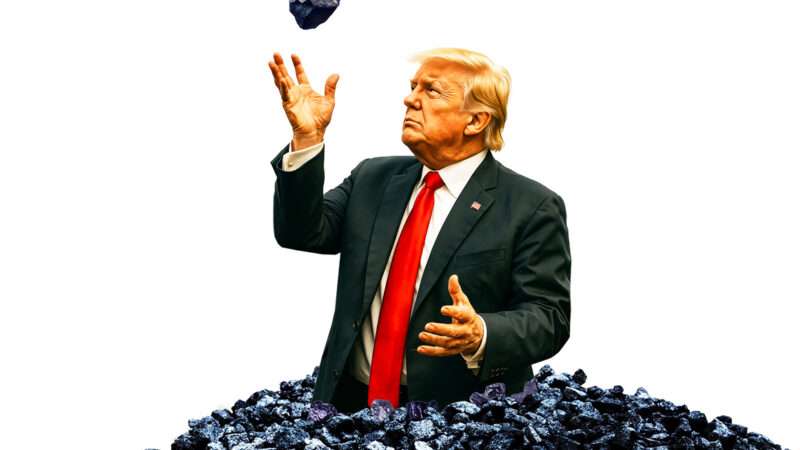
An illustration of Donald Trump in a pile of coal | Illustration: Joanna Andreasson; Source images: iStock, ChatGPT-4

Coal—the dominant fuel in the U.S., before it was steadily replaced by cheaper and cleaner energy sources—has found new life under President Donald Trump. In April, Trump issued an executive order to reinvigorate “America’s Beautiful Clean Coal Industry,” which directed federal agencies to remove regulatory barriers to coal production and coal mining on federal lands.

Since then, the Energy Department has opened up federal financing opportunities for coal production (which include a $200 billion fund at the agency’s Loan Programs Office), designated coal as a critical material (which allows it to receive more federal funding), and reinstated a federal coal advisory committee that had lapsed.

The Interior Department, meanwhile, has fast-tracked fossil fuel and coal projects on federal lands. Earlier this year, the agency officially ended a moratorium on federal coal leasing, and in August it approved a plan that will make 14.5 million tons of coal available for mining in Wyoming through 2037. The agency has also implemented rules making it harder to permit renewable energy projects on federal lands.

Congress has also made it easier for coal to succeed. The One Big Beautiful Bill Act reduced royalty rates for coal projects on federal lands and mandated that more federal acres be opened up to coal production. The bill also subsidizes foreign steelmaking by giving a tax break to the type of coal used in this production.

The change in coal’s fortune is remarkable given how it fared under the Biden administration. In addition to calling for coal plants across the U.S. to be shut down and replaced by renewables, former President Joe Biden also finalized strict air pollution
regulations that would have increased costs and closed fossil-fueled power plants nationwide. The Trump administration began rescinding these regulations in June.

Just as Biden’s preference for renewables distorted markets and harmed
consumers, so too does Trump’s bias toward coal. In May, the Energy Department ordered the Midcontinent Independent System Operator—which oversees most of the power grid from Minnesota to Louisiana—to keep a Michigan coal plant open through the summer to avoid rolling blackouts. The plant was scheduled to close that month.

In addition to not preventing outages, the order ended up costing the utility $29 million over five weeks, reports E&E News. Consumers Energy, which runs the plant, is seeking “cost recovery” from federal regulators, which would “allow the costs to be spread over millions of electricity customers,” per E&E.

The U.S. needs more energy generation and is facing a capacity shortfall
that could lead to future blackouts and rate hikes. But this shortfall is largely a result of bad government policies, such as federal regulations that delay nuclear power, and politicians picking energy winners and losers. Trump risks repeating the mistakes of past presidents. Coal companies might benefit, but ratepayers, markets, and the environment will be left worse off.

The post Donald Trump Is the Coal President appeared first on Reason.com.

from Latest – Reason.com https://ift.tt/yCN2Sbs
via IFTTT

Donald Trump Is the Coal President


An illustration of Donald Trump in a pile of coal | Illustration: Joanna Andreasson; Source images: iStock, ChatGPT-4

Coal—the dominant fuel in the U.S., before it was steadily replaced by cheaper and cleaner energy sources—has found new life under President Donald Trump. In April, Trump issued an executive order to reinvigorate “America’s Beautiful Clean Coal Industry,” which directed federal agencies to remove regulatory barriers to coal production and coal mining on federal lands.

Since then, the Energy Department has opened up federal financing opportunities for coal production (which include a $200 billion fund at the agency’s Loan Programs Office), designated coal as a critical material (which allows it to receive more federal funding), and reinstated a federal coal advisory committee that had lapsed.

The Interior Department, meanwhile, has fast-tracked fossil fuel and coal projects on federal lands. Earlier this year, the agency officially ended a moratorium on federal coal leasing, and in August it approved a plan that will make 14.5 million tons of coal available for mining in Wyoming through 2037. The agency has also implemented rules making it harder to permit renewable energy projects on federal lands.

Congress has also made it easier for coal to succeed. The One Big Beautiful Bill Act reduced royalty rates for coal projects on federal lands and mandated that more federal acres be opened up to coal production. The bill also subsidizes foreign steelmaking by giving a tax break to the type of coal used in this production.

The change in coal’s fortune is remarkable given how it fared under the Biden administration. In addition to calling for coal plants across the U.S. to be shut down and replaced by renewables, former President Joe Biden also finalized strict air pollution
regulations that would have increased costs and closed fossil-fueled power plants nationwide. The Trump administration began rescinding these regulations in June.

Just as Biden’s preference for renewables distorted markets and harmed
consumers, so too does Trump’s bias toward coal. In May, the Energy Department ordered the Midcontinent Independent System Operator—which oversees most of the power grid from Minnesota to Louisiana—to keep a Michigan coal plant open through the summer to avoid rolling blackouts. The plant was scheduled to close that month.

In addition to not preventing outages, the order ended up costing the utility $29 million over five weeks, reports E&E News. Consumers Energy, which runs the plant, is seeking “cost recovery” from federal regulators, which would “allow the costs to be spread over millions of electricity customers,” per E&E.

The U.S. needs more energy generation and is facing a capacity shortfall
that could lead to future blackouts and rate hikes. But this shortfall is largely a result of bad government policies, such as federal regulations that delay nuclear power, and politicians picking energy winners and losers. Trump risks repeating the mistakes of past presidents. Coal companies might benefit, but ratepayers, markets, and the environment will be left worse off.

The post Donald Trump Is the Coal President appeared first on Reason.com.

from Latest – Reason.com https://ift.tt/yCN2Sbs
via IFTTT

Hegseth Removes Another Top Pentagon Official

Hegseth Removes Another Top Pentagon Official

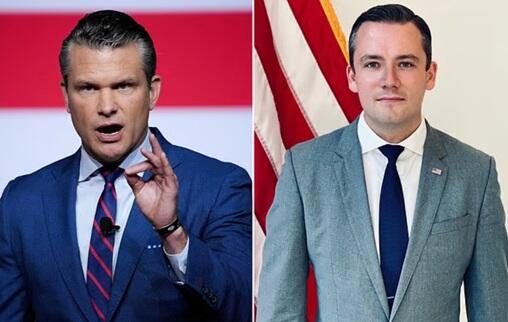
Friday saw more of the expected house-cleaning and reshuffling at the Pentagon under Pete Hegseth, as Navy chief of staff Jon Harrison has been fired.

“Jon Harrison will no longer serve as Chief of Staff to the Secretary of the Navy. We are grateful for his service to the Department,” a Department of Defense (DOD) official said.

Via The Daily Mail

Harrison had been appointed to the United States Arctic Research Commission by Trump in 2020, and interestingly he from the start of the current administration became a key architect implementing Hegseth’s and Trump’s new vision for the Pentagon.

“The sudden ouster, according to two defense officials and a former defense official, follows the confirmation this week of Navy Undersecretary Hung Cao,” Politico writes.

The publication further notes that Harrison made changes which also sought to limit the power and influence of the undersecretary job:

POLITICO previously reported that Phelan and Harrison had reassigned several aides who were supposed to help Cao navigate the role once he’s confirmed. They had also planned to interview all future military assistants for Cao to ensure decisions came from the secretary’s office.

Cao is a high-profile Navy veteran and former Republican Senate candidate in Virginia who President Donald Trump nominated for the post.

The ouster follows months of musical chairs inside the Pentagon. Hegseth fired several top aides earlier this year and removed the chair of the Joint Chiefs, as well as the uniformed leaders of the Navy, Air Force and Coast Guard.

As another example, in August Lt. Gen. Jeffrey Kruse had been ousted from his role as director of the Defense Intelligence Agency (DIA).

The official reason disclosed is “loss of confidence”. While the DIA is lesser known among the nation’s major intel agencies like the CIA or NSA, it coordinates all military intelligence among US armed forces, and is mostly staffed by civilians – but under DoD leadership.

Hegseth also removed Vice Adm. Nancy Lacore, head of the Navy Reserve, and Rear Adm. Milton Sands, a Navy SEAL in charge of Naval Special Warfare Command, from their posts, according to officials.

Tyler Durden
Sat, 10/04/2025 – 22:45

via ZeroHedge News https://ift.tt/cEMpF8G Tyler Durden

Deterring The Next Quasi-World War: China–Russia–North Korea Versus US

Deterring The Next Quasi-World War: China–Russia–North Korea Versus US

Authored by Joseph Yizheng Lian via The Epoch Times,

Russian planes recently flew into Polish and Romanian airspace to test NATO’s resolve while the world veers toward a conflict in Asia—one that could be far worse than the situation in Ukraine—where true deterrence and resolve remain largely absent.

Let’s backtrack a little.

On Sept. 3, Beijing staged a military extravaganza to parade a full suite of fearsome weapons. Many journalists were awed, and some defeatist experts advocated Chamberlainian appeasement. Others, mostly China observers, tried decoding the seating plan of senior Chinese Communist Party (CCP) officials atop Tiananmen Square for clues about the power struggles in Zhongnanhai.

However, what is often overlooked in the discussion about the event is that it represents the financing and support mechanisms behind a new type of quasi-world war. The ongoing Russia–Ukraine war is one example, and the potential invasion of Taiwan by the Chinese regime is another. Let’s explore this further.

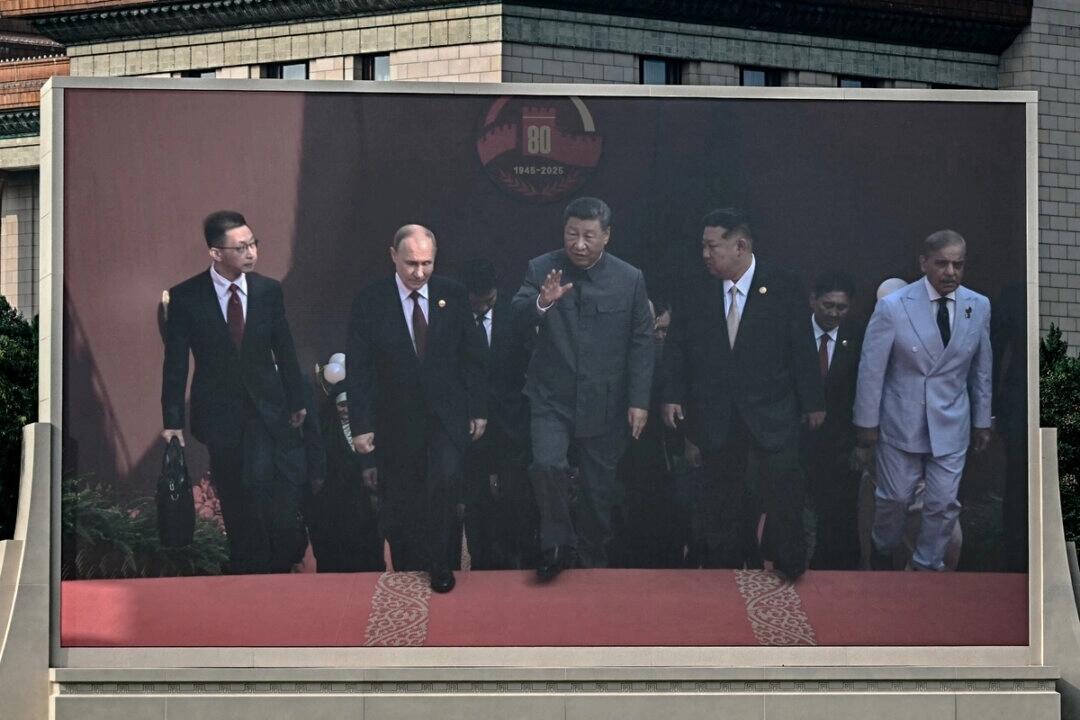
The Xinhua images of the Sept. 3 event, featuring Chinese leader Xi Jinping, Russian President Vladimir Putin, and North Korean leader Kim Jong Un consorting in solidarity, should be interpreted as a calculated response to the new tripartite model the West has devised for militarily supporting Ukraine. That model conveys that Kyiv identifies its military hardware needs, European allies provide the financing, and the United States produces and delivers the hardware.

The Beijing event showcased a parallel model: Moscow requests war materiel, including troops, China and North Korea supply them in exchange for cheap Russian energy, with India and a few other countries dipping in. Thus, even though the war’s actual fighting is confined within Ukraine and Russia, its financing involves a much wider array of adversarial states. The coalitional symmetry in this financing mechanism can prolong the bloody conflict indefinitely, which Russia and Ukraine, if left to their own devices, cannot achieve.

A way to stop the war is to break that symmetry, which seems to be the goal of U.S. President Donald Trump’s “secondary tariffs.” On Aug. 6, he doubled the headline tariff on India to 50 percent for buying cheap Russian oil. It is showing results. India reportedly bought much less Russian oil in August. Notably, Indian Prime Minister Narendra Modi, who attended the Shanghai Cooperation Organization meeting in Tianjin from Aug. 31 to Sept. 1, quietly skipped the Sept. 3 military parade.

Now, Trump is pressuring Europe to immediately end its remaining reliance on Russian energy and join him in a similar effort against Beijing, and has called for imposing up to 100 percent additional tariffs on China for buying Russian crude oil. The EU leadership is not yet entirely on board, but has proposed to advance its target of ending all energy imports from Russia from 2027 to 2026 or even sooner.

But whatever happens to the war in Ukraine, the world would not be okay even when Putin agrees to call it quits, because Xi has all the intentions to do a sequel. Xi’s primary interest in supporting Russia lies in an expected reciprocation from Moscow if China invades Taiwan. What would a China–Taiwan war look like?

The Russia–Ukraine war is already a quasi-world war. Despite the combat space being narrowly confined, it nevertheless involves the participation of approximately 50 countries on four continents in various capacities.

A China–Taiwan war would likely be confined to the Taiwan Strait and its surrounding areas. However, Taiwan’s prowess in microelectronics manufacturing, which includes a near-monopoly on artificial intelligence-based data-center servers—aside from its more eye-catching and well-known 90 percent global market share in high-end microchips—means that its stability and survival as an independent state are far more critical to the world than those of wheat-exporting Ukraine. A Chinese invasion would conflagrate into a much more intense conflict, immediately impacting and pulling in all the advanced industrialized countries that depend on Taiwan’s high-tech exports.

An estimate of the total economic cost of the now three-year-old Russia–Ukraine war is around 3.5 percent of global GDP, or approximately $3.5 trillion. On the other hand, the global cost of a full-blown China–Taiwan war could easily be more than three times as large, reaching a staggering $10 trillion, according to Bloomberg Economics.

The United States, in contrast to its current peacemaking role and indirect involvement in the Ukraine war, would have no choice but to take center stage in combat. Japan would also be compelled into an important role due to geographic proximity and treaty obligations. The conflict would come closer to an actual world war.

Facing such a daunting possibility, the United States may have already begun strengthening its hand. The Senate’s Fiscal Year 2026 Defense Appropriations bill earmarks $1.5 billion for the Indo-Pacific Security Initiative, while the House version allocates $500 million for Taiwan via the Taiwan Security Cooperation Initiative. Once reconciled, the bill will be ready for the president’s signature.

Moreover, the week before the Sept. 3 Beijing parade, senior defense officials from Taiwan and the United States met in Alaska. That seemingly low-key event was leaked to the press on Sept. 4 and confirmed by a U.S. official on the same day. Apparently, the timing of the meet-leak-confirm sequence was a calibrated, premeditated U.S. answer to the Beijing parade. But can Trump really deter China? He can, if he successfully puts three pieces in his grand strategy together.

Trump needs to strengthen Europe by encouraging it to reduce its extensive welfare state and allocate more resources to its defense. The same applies to Japan, South Korea, Taiwan, and Australia, as they need to be aligned firmly along the First Island Chain. However, behind these two geopolitical pieces must be a thoroughly revitalized United States, which, unfortunately, has seen its strength sapped by decades of socio-economic decay. Trump is achieving this through a thorough revamping of American institutions and policies regarding culture, education, industry, trade, and defense—the essence of the MAGA movement.

Like a severely wounded beast whose blood flows to the core of its body to preserve its dwindling life force, the United States, as it restores itself, may seem isolationist to countries long accustomed to enjoying the economic openness and defense umbrella provided by Pax Americana. That is a dangerous misreading of Trump by many countries, friends and foes alike.

Views expressed in this article are opinions of the author and do not necessarily reflect the views of The Epoch Times or ZeroHedge.

Tyler Durden
Sat, 10/04/2025 – 22:10

via ZeroHedge News https://ift.tt/GQlgBte Tyler Durden