Trump To Slash Refugee Admissions By 94% From Biden Levels
The Trump White House is poised to dramatically reduce the number of refugees that will be accepted into the United States over the next fiscal year — with the ceiling falling a whopping 94% from the limit set by the Biden administration, according to a New York Times report.
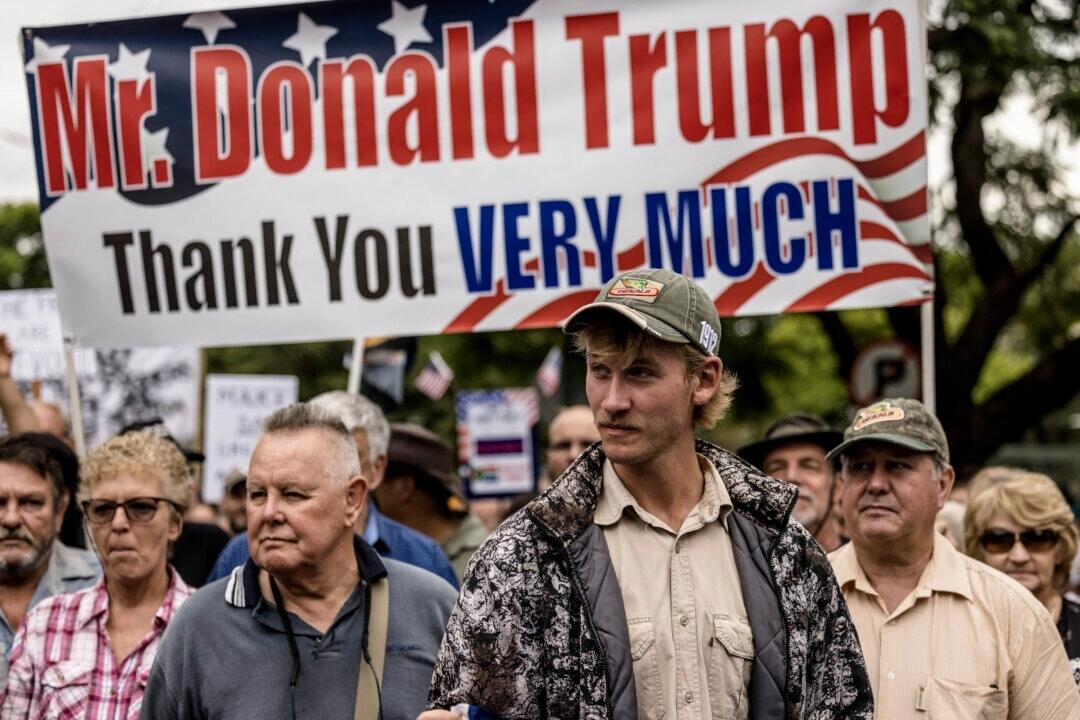
Citing “people familiar with the matter,” the Times says a maximum of just 7,500 refugees would be admitted over the coming year, a tiny fraction of the 125,000 limit set by the Biden administration last year. Most of those slots would be reserved for white Afrikaners fleeing South Africa and its murderous violence against white people and the looming threat of uncompensated land confiscation. Afrikaners now represent less than 5 percent of South Africa’s population.
The pending reduction and prioritization of white refugees elicited condemnation from promoters of mass immigration. “Such a low refugee ceiling would break America’s promise to people who played by the rules,” Hebrew Immigrant Aid Society (HIAS) president Mark Hetfield, told the Times. “Trump isn’t just putting the Afrikaners to the front of the line, he is kicking years-long-waiting refugees out of the line.” HIAS has itself been hammered by Trump policies, slashing its staff by more than half after the new administration slashed funding for refugee programs.
In May, a group of 59 white Afrikaner refugees arrived in the United States via a chartered flight, raising eyebrows given the speed with which they were whisked into the country, in contrast to people from other countries who’ve faced waits that extend over years. “They tell quite harrowing stories of the violence that they faced in South Africa that was not redressed by the authorities by the unjust application of the law,” Deputy Secretary of State Christopher Landau said after welcoming them to Dulles International Airport near Washington DC.
BREAKING: First white South African refugees fleeing persecution arrive in the U.S.
On Sep. 30, Trump signed a presidential determination to reset the ceiling. However, it won’t become official until after consultations with Congress that are required by federal law. For now, those consultations will seemingly have to wait until the government shutdown ends. Earlier this week, a quartet of Democratic senators and representatives used a joint letter to accuse Trump of neglecting his duty:
“Despite repeated outreach from Democratic and Republican committee staff, the Trump administration has completely discarded its legal obligation, leaving Congress in the dark and refugees in limbo…The consequences are dire…[the virtual shutdown of the program is] betraying the nation’s promise as a refuge for the oppressed.”
Moving aggressively to put the brakes on Biden’s open-border policies, Trump suspended the refugee program with an executive order signed shortly after his inauguration. He similarly suspended the acceptance of migrants presenting at the border under a different official avenue referred to as asylum. Trump subsequently carved out an explicit exception to his refugee-program suspension for Afrikaners. However, it appears the total number of Afrikaners to be accepted into the United States this year is less than 100.
Meanwhile children are taught to sing “kill the boer(white man), kill the farmer” in South Africa.
“prrr phaaa”….
Imagine white people teaching their children songs to kill black people. I’t would be all over mainstream media.pic.twitter.com/tlZCDKkdnl
Making it to the United States via the refugee program often entails a multi-year wait in overseas refugee camps, along with successfully passing interviews, background checks and medical exams. Some 130,000 conditionally-approved refugees and 14,000 Iranian religious minorities who’ve already cleared the prerequisites are stuck in limbo.
In other news on the immigration front, the Trump administration has started offering $2,500 apiece to unaccompanied migrant children who are age 14 and older if they’ll self-deport to their home countries. The policy was instituted via a memorandum sent to the Department of Health and Human Services on Friday afternoon. NBC News, which obtained a copy, also reported that, according to rumors among immigration advocates, Immigration and Customs Enforcement (ICE) has christened the self-deportation scheme “Freaky Friday.” ICE refuted the name, but confirmed the program, emphasizing that it was a “strictly voluntary option to return home to their families.” In just one of many dimensions of the previous era of open-border madness, more than 300,000 unaccompanied children entered the country during the Biden administration.
“Shock Outcome:” Japan Hardline Conservative Takaichi Elected Party Leader, Set To Become First Female Prime Minister
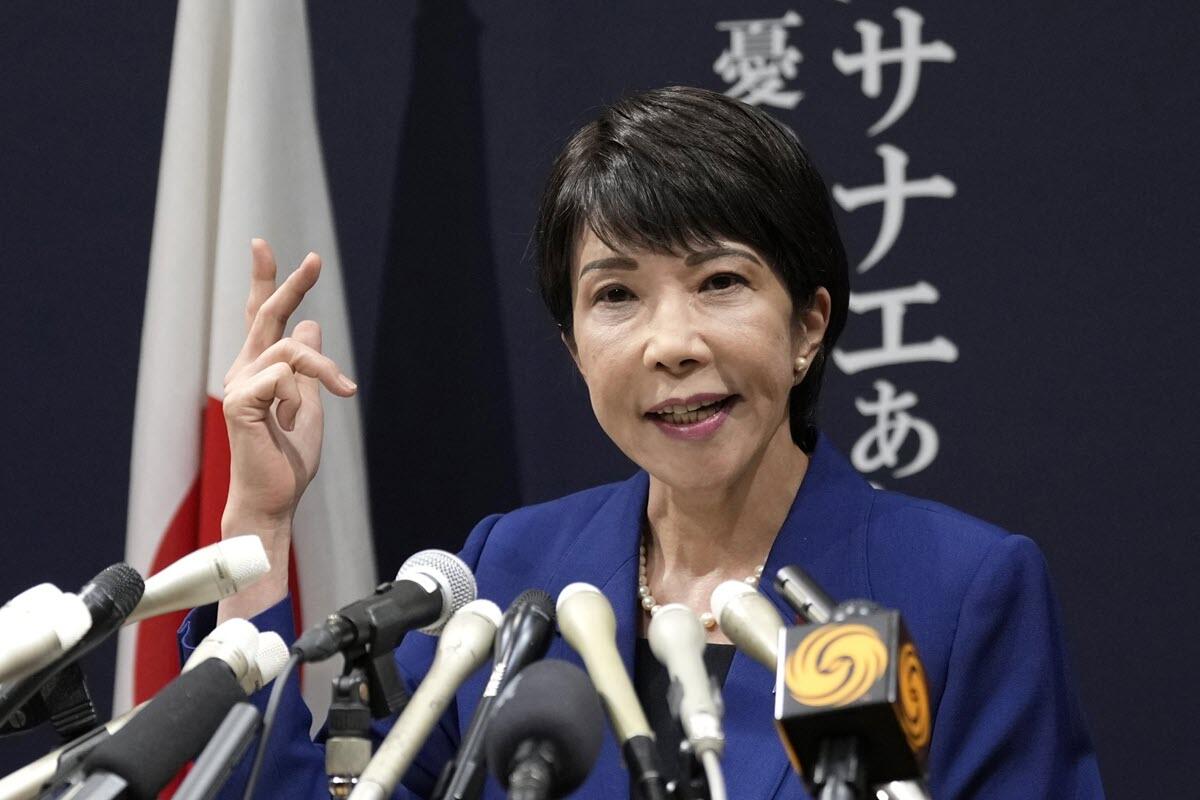
Japan’s ruling Liberal Democratic Party (LDP) elected former Economic Security Minister Sanae Takaichi as its new leader, positioning her to become the country’s next prime minister in a parliamentary confirmation vote expected in mid-October.
Takaichi, 64, a staunch conservative and vocal China hawk, defeated her moderate rival Shinjiro Koizumi by 185 votes to 156 in a runoff at LDP headquarters in Tokyo. The victory makes her Japan’s first female party president and, almost certainly, its first female prime minister since the LDP remains the largest bloc in parliament and opposition parties are too fragmented to mount a united challenge.
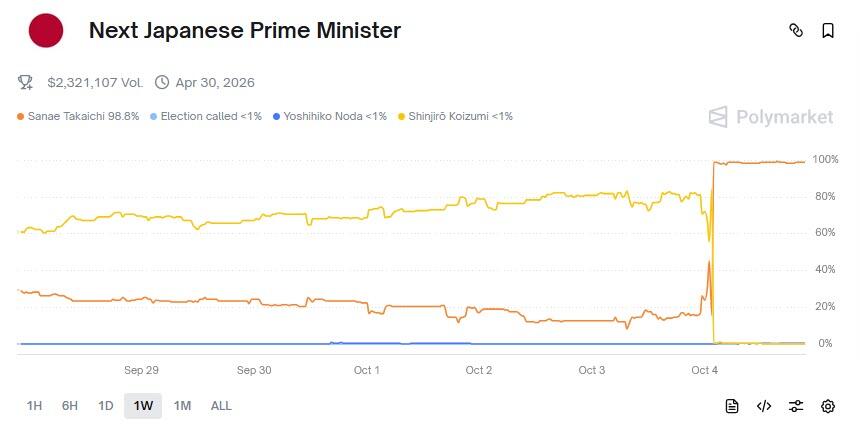
As Goldman trader Ippei Yamaura writes, the outcome was a shock: “Before the election began, polymarket were pricing an 80%+ probability of a Koizumi victory. Odds for Koizumi dipped somewhat as local vote tallies came in, but most observers still viewed developments as broadly in line with expectations. Betting markets held around 60–80% until the first-round result was released. The first-round outcome was largely in line with expert expectations (arguably a touch less favorable for Takaichi), and betting markets again raised the implied probability of a Koizumi win. However, in the runoff, Takaichi secured more Diet member votes than anticipated, reportedly with support from the Aso faction. Some Diet members who had backed Hayashi were also said to have shifted to Takaichi, as Hayashi did not whip his supporters for the runoff. Virtually no one—including media, political analysts, opposition parties, and even LDP insiders—had expected this result (and myself).”
Moments after the result was announced, Takaichi called for unity and renewal inside a party battered by scandal and electoral setbacks. “Rather than feeling happy right now, I feel real challenges lie ahead,” she said. “We must all pull together across all generations and work as one to rebuild the LDP. Everyone will have to work like a horse.”
The leadership race followed deeply unpopular Prime Minister Shigeru Ishiba’s resignation in early September after a year in office and two election defeats due to a stagflationary debacle culminating in soaring prices (of mostly food products) and a deteriorating economy. The handover comes at a time of economic uncertainty, social transformation, and mounting geopolitical tensions across the Asia–Pacific region.
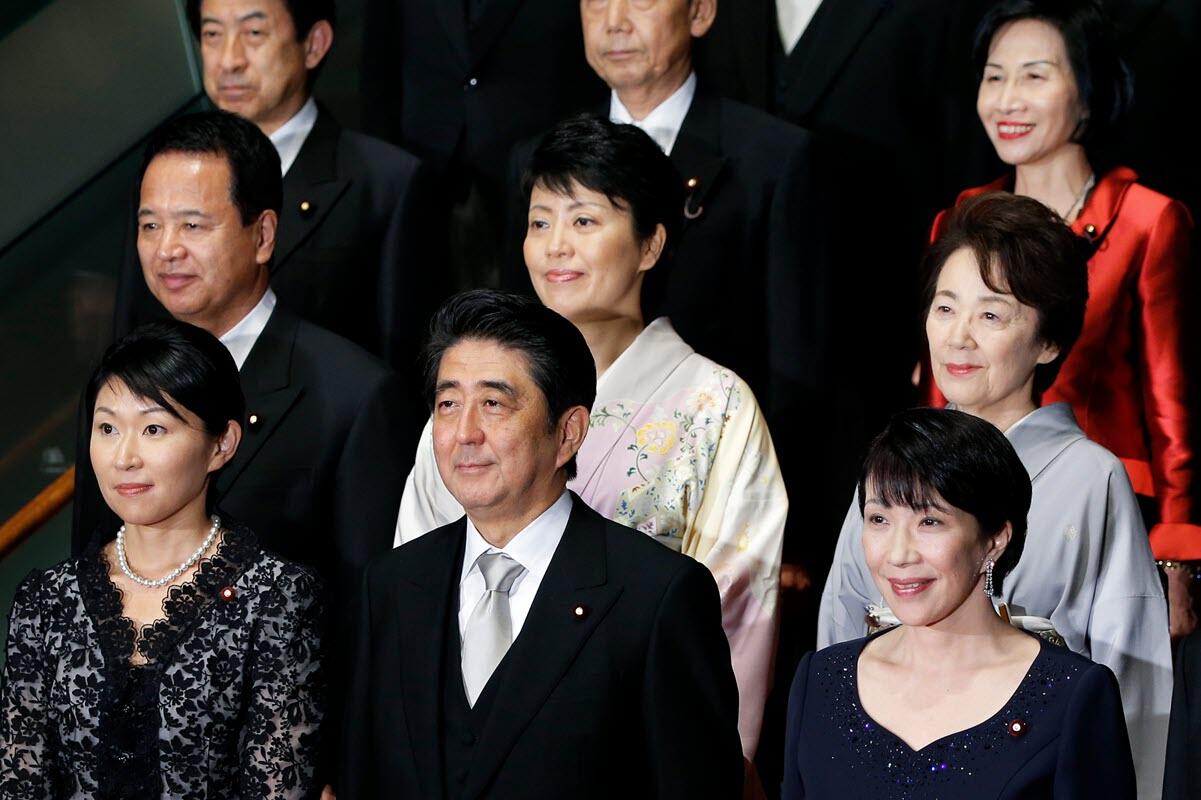
Takaichi, the pro-stimulus and anti-immigration conservative poised to become Japan’s first female prime minister widely viewed as Abe 2.0, is an energetic nationalist with a soft spot for the hard-nosed politics of Iron Lady Margaret Thatcher and the heavy metal music of Iron Maiden. In choosing the former economic security minister as its leader, the Liberal Democratic Party is essentially betting on a swing back to the right to attract the younger voters who have flocked to smaller populist outfits, including the arch-conservative Sanseito party.
It’s a move that could backfire if the party is seen simply reverting to the easy money and hawkish diplomacy of her mentor, former Prime Minister Shinzo Abe, without any new ideas.
An admirer of former British Prime Minister Margaret Thatcher and protégé of the late Shinzo Abe, Takaichi has championed Abe’s conservative agenda and frequently visited the Yasukuni Shrine, a flashpoint in Japan’s relations with its Asian neighbors, primarily China. Her win is expected to reassure the LDP’s nationalist base but will complicate diplomacy with China and South Korea.
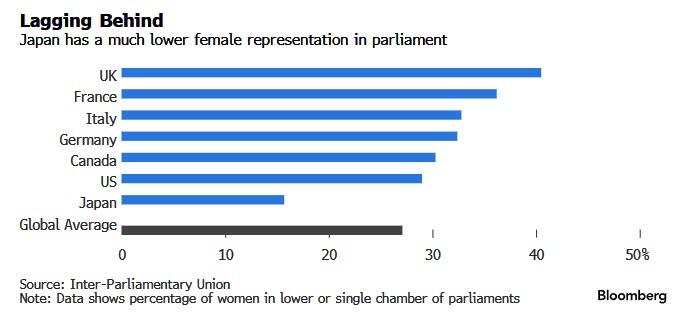
As Bloomberg notes, Takaichi is expected to become premier later this month in a parliamentary vote. In becoming the LDP’s chief, Takaichi has already smashed a glass ceiling in a nation that has only seen male ruling party leaders.
Her ascent to the top of the political world will send ripples through the male-dominated society that languishes near the bottom end of global gender equality rankings. But like Thatcher, the former UK prime minister whom she cites as an inspiration, her conservative views place her a long way from the stance of progressive feminism.
Her ability to build a lasting legacy as the nation’s leader will depend less on her ability to further the position of women than on her capacity to restore the fortunes of a ruling party in disarray after decades of dominance in postwar Japan.
“From a normal woman’s perspective, she’s what you might call an idol for ‘old men,’” said Mieko Nakabayashi, politics professor at Waseda University. “She’s someone who expresses ‘old man’ opinions from a woman’s mouth and makes them happy.”
If confirmed, Takaichi will soon face her first diplomatic test: a potential meeting with U.S. President Donald Trump at the end of October, ahead of the Asia-Pacific Economic Cooperation summit in South Korea amid reports that the US president will make a stop in Japan in late October during a trip to Asia. Takaichi has pledged to make the Japan–U.S. alliance the cornerstone of her foreign policy. “It is essential to … confirm the reinforcement of the Japan–U.S. alliance,” she said, adding that Tokyo must deepen cooperation with partners such as South Korea, Australia, and the Philippines to ensure a free and open Indo-Pacific.
Takaichi’s election drew swift international reactions. U.S. Ambassador to Japan, George Glass, issued a statement congratulating Takaichi on becoming the 29th president of the LDP and its first female leader. “I look forward to working with her to strengthen and grow our partnership on every front.”
Taiwanese President Lai Ching-te offered his “most sincere and warmest congratulations” on X, calling Takaichi a “steadfast friend of Taiwan” and expressing hope that her leadership would usher in a “new stage” of cooperation in trade, security, and technology.
China’s Foreign Ministry reacted cautiously, calling the outcome “Japan’s internal affair.” In a statement, the spokesperson’s office said Beijing hopes Tokyo would “promote a strategic and mutually beneficial relationship.”
Takaichi’s longevity at the head of a fickle political machine known for quickly axing its presidents will depend on how swiftly she can unite the party, win back public support and connect with those younger voters. She will also need to build consensus with opposition parties to pass legislation in a parliament where the LDP no longer has a majority.
Takaichi was the most forthright among the five candidates in the leadership race over the possibility of renegotiating parts of Japan’s trade deal with the US. But she toed the line following her election on Saturday, saying that an immediate renegotiation was not on the table. She still said Japan will make its opinions known through the appropriate routes should the deal not serve its interests.
But she said that might happen only if there are problems implementing the deal in its current form, a comment that suggests she is on board with the agreement for now.
On issues such as ramping up Japan’s defense spending and capabilities, containing China’s growing influence and building supply chains that align with US interests, she is likely to be a good match for Trump’s views. Still, she likely has less name recognition among US conservatives who have met her rival in the leadership contest, Shinjiro Koizumi, and who remember his father Junichiro wearing Elvis shades and serenading former President George W. Bush two decades ago.
“Takaichi has extensive experience as a politician, and since the US’s hardline stance toward China does not significantly conflict with her own views, she should be able to build a good relationship with President Trump,” said Yuichi Kodama, chief economist at Meiji Yasuda Research Institute.
For investors, the main concern will be her reputation for wanting spending to achieve growth and her penchant for central bank stimulus to goose the economy. In the latest leadership campaign, she toned down her scathing views on the Bank of Japan’s interest rate hikes from last year, when she described its raising of rates as “stupid.” But in a recent Kyodo survey she still said the BOJ should leave interest rates unchanged for now. That comment comes amid expectations the bank may raise borrowing costs again later this month. Still, it is very likely that the yen will tumble on Monday sliding toward 150 if not lower.
Her spending plans are less clear. All of the candidates were expected to unleash a package of economic measures to help consumers deal with inflation in the fall, but she was the boldest in saying that extra bond issuance may be needed. In line with many in the LDP, she remains cautious on the idea of opposition demands to lower the sales tax, one of the costliest options for dealing with the cost-of-living crunch.
Instead Takaichi has promised cash handouts and tax rebates to help households. She’s also hinted at raising the tax-free income allowance before the end of the year, a move that would resonate well with the Democratic Party for the People, another populist party that has made major inroads in the last year or two.
While saying her spending plans will be “responsible” and that she’ll ensure the nation’s net debt load will fall over time, she said “the goal is achieving economic growth, not fiscal health,” in a sign of her expansionist spending tendencies.
“While she always leaned toward a reflationary stance, the current economic environment has changed significantly, and curbing inflation has become the country’s mission,” said Meiji Yasuda’s Kodama. “Opposing the BOJ’s rate hikes would be contradictory, so I don’t think she can make extreme statements regarding monetary policy.”
Still, the possible outcome for markets when they open on Monday is a fall in the yen on expectations of slower central bank normalization, a rise in stocks on a weaker currency and an uptick in super-long yields on fears over longer term spending plans.
Background
Takaichi was born on March 3, 1961 and grew up in the ancient capital of Nara, a city known for the emergence of Buddhism in Japan. Her father worked as a salesman at an equipment manufacturing company while her mother worked for the Nara police force. She studied business management at Kobe University.
As a student, she rode a motorbike and played drums in a heavy metal band, and counts herself as a fan of British heavy-metal bands Black Sabbath and Iron Maiden, according to local media. She still occasionally picks up the sticks to hammer away on an electric drumset at home, if she squabbles with her husband, she told a local broadcaster in an interview. Her go-to song is “Burn” by Deep Purple.
“To be honest I wish I could go out for karaoke, but I’ve been reining myself in these past years,” she said in that interview.
She studied at the Matsushita Institute of Government and Management, an organization focused on producing leaders in the world of politics and industry.
She worked briefly as a news anchor before winning her first election in 1993 as an independent at a time when the LDP was in disarray following the bursting of Japan’s economic bubble. That election saw a multitude of opposition parties join forces to form a patchwork administration and oust the LDP for the first time since its formation. But as it has done subsequently, the LDP found a way of regrouping and taking back power, while most of the parties that ousted it have vanished.
Over her years as a politician, including her time as internal affairs minister, promoter of “Cool Japan” and as economic security minister, Takaichi has garnered a reputation as studious with an attention to fine detail. She is known to shun socializing and drinking with her peers.
“If I’m going to go out for dinner or have a drink, I’d much rather work or study something new,” she said during a campaign speech last year, adding that she often works over weekends.
Shortly after winning the LDP election she doubled down on that message. “I’m going to abandon the phrase ‘work-life balance,’” she said, prompting laughter from the rows of LDP lawmakers listening to her speech. “There is a mountain of things that we must accomplish together and I would like to see you work like horses.”
As a conservative darling and Abe protege, China may be wary of how she navigates a relationship that has remained tense in recent years.
Previously, Takaichi did not mince her words when asked whether she would visit Yasukuni shrine, which honors Japan’s war dead including those who were charged as war criminals after World War II. Visits by previous prime ministers have angered neighboring countries and proven to be a flashpoint for Japan and China.
“Once the sentence is carried out, they are no longer criminals,” she said during a live TV show last week. She toned down her messaging after being elected Saturday, saying that she’ll make appropriate decisions over praying at the shrine.
She opened her campaign speech with a gripe about foreign tourists in Nara, saying she had heard of some tourists kicking the deer that roam freely in the local parks.
That gripe seemed to tap into broader anxieties felt by the public as the number of foreign-born visitors and workers rises amid a drop in Japan’s own population. With Sanseito gaining ground in elections by capturing such concerns under a “Japanese first” message, Takaichi could be the conservative icon the LDP thinks it needs to win back right-wing voters. Among the five candidates, she consistently ranked as the most popular in recent opinion polls among the general public.
In a twist of irony for Japan’s likely first female prime minister, her conservatism may not bode well for gender equality issues. She opposes same-sex marriage or allowing spouses to have separate surnames, claiming it could undermine family unity. Novelist Kyoko Nakajima once called Takaichi “an honorary man” for maintaining views consistent with a traditional male-centered society, the Japan Times reported in 2021.
And while her appointment breaks a glass ceiling, it also risks becoming a glass cliff.
“Female leaders are often given some leeway for not doing things the ‘traditional’ way,” said Waseda’s Nakabayashi, who was skeptical whether Takaichi’s election represents a new era for women in Japan. “That’s why it’s often the case that women only get the leadership positions when the going gets really tough.”
Expected Market Reaction
The equity market may move higher on expectation for increased fiscal expenditure, potentially driven by a larger defense budget and/or tax reductions, and/or cuts to social insurance costs. In her letter to Hudson Institute, she cites the following themes as potential growth areas: …
Industries include AI, semiconductors, perovskite, digital, quantum, nuclear fusion, materials, biotechnology, aerospace, shipbuilding, drug discovery and advanced medicine, disaster prevention, defense Industries, and more.
Of these, defense and next generation power are the areas which have meaningful impact on large caps while potential losers should be financials on fear for pressure on BOJ rate hikes. *though I believe story of “regional banks consolidation” will keep going.
Defense: MHI(7011, Buy), KHI(7012, Buy CL), IHI(7013, Buy), Japan Steel works(5631, Buy, also work as a nuclear power play), Sky perfect JSAT(9412, Buy, also aero/space related), Melco(6503, Buy), NEC(6701, Buy), Fujitsu(6702, Buy), Namura(7014, Buy, Shipbuilding).
Next generation power: Japan Steel works(5631, Buy, nuclear power related), Hitachi(6501, Buy, SMR related), MHI(7011, Buy, Advances Light Water Reactor), Sekisui Chemical(4204, perovskite-related), TEPCO(9501, NR, nuclear power), KEPCO(9503, NR, nuclear power and light water reactor), Hamamatsu Photonics(6965, NR, Nuclear Fusion)
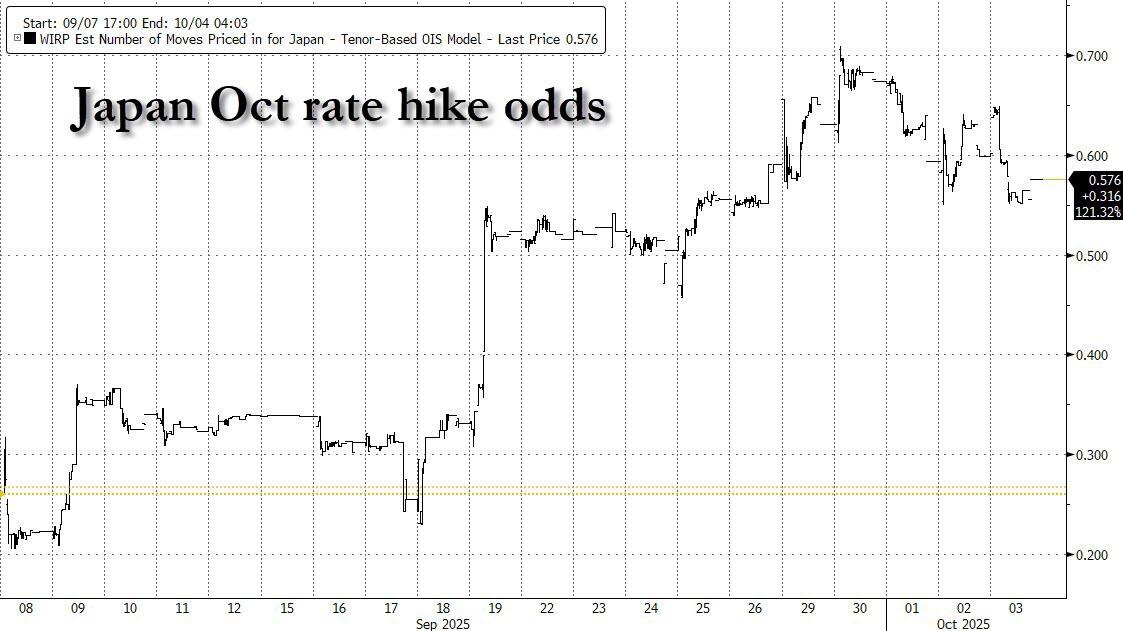
In the FX market, the yen will move lower as investors still think Takaichi can possibly delay BOJ’s rate hike. Although she has milder tone on BOJ recently, she says “In terms of economic policy, the government is responsible for deciding the direction of fiscal and monetary policy“. Although BOJ have recently paved the way for another rate hike and OIS market priced 60% chance of Oct hike as of Friday close, investor may now think BOJ to face higher hurdle to do so, which may drive the yen lower.
While the yen will slide, JGB yields will go higher on fears for further fiscal expenditure. Although Takaichi recently reiterates she does care about fiscal discipline, she is said to feel no issue with nominal debt increase as long as the pace of increase is lower than nominal economic growth. i.e. nominal debt goes lower vs GDP driven by growth. Unless JGB market shows some kind of meaningful crush, she can possibly try to stimulate economy through expanding fiscal expenditure.
Of course, we will continue to pay close attention to fiscal discipline. The first priority is ensuring fiscal sustainability. To that end, we will monitor the markets and take appropriate measures to stabilize and reduce the debt-to-GDP ratio.
The JGB yield is a key for equities market too. As long as JGB market shows solid moves, I believe equities market can welcome inauguration of Takaichi. However, once JGB market is crushed, equities market may face valuation headwind from higher JGB yields.
Advisers to Pakistani army chief Field Marshal Asim Munir proposed to US officials the construction of a new port on the Arabian Sea near the borders with Afghanistan and Iran, according to a Financial Times report released Saturday, citing a plan reviewed by the outlet.
The plan envisions US investors constructing and managing a terminal in Pasni, a coastal town in Gwadar District, Balochistan. The site is described as a gateway to Pakistan’s vital mineral reserves.
The blueprint rules out any US military bases. Instead, it highlights development finance opportunities for a rail network linking Pasni to mineral-rich western provinces, the report says.
The British financial outlet noted that the proposal was circulated to some US officials and later shared with Munir in advance of his recent meeting with US President Donald Trump at the White House.
That meeting, held late last month, followed earlier talks in September when Munir and Prime Minister Shehbaz Sharif sought US investment in agriculture, energy, technology, and mining.
According to FT, Sharif pressed Washington to encourage private-sector involvement in Pakistan’s economy, while Munir’s advisers positioned the Pasni port project as a strategic opportunity for American companies.
The report noted that the initiative reflects Islamabad’s efforts to attract western development financing, particularly for infrastructure projects linked to the country’s resource sectors.
Reuters reported that the US State Department, the White House, and Pakistan’s Ministry of Foreign Affairs did not respond to requests for comment. Attempts to reach the Pakistani Army were also unsuccessful.
Alongside economic overtures such as the Pasni port proposal to the US, Pakistan is also reshaping its defense posture in West Asia, utilizing its new mutual defense pact with Saudi Arabia to anchor itself as a security guarantor.
Defense Minister Khawaja Asif confirmed last month that the pact is defensive, not expansionist, and left the “door open” for other Arab states to join, comparing it to NATO.
The American College of Cardiology recently released recommendations indicating that inflammation should be considered when trying to predict heart disease.
In a report issued in the Journal of the American College of Cardiology on Sept. 29, the college said that the high-sensitivity C-reactive protein (hsCRP) blood test that measures CRP, a known inflammatory marker that increases in response to inflammation in the body, can determine whether a person is at risk of developing cardiovascular disease (CVD).
“Because clinicians will not treat what they do not measure, universal screening of hsCRP in both primary and secondary prevention patients, in combination with cholesterol, represents a major clinical opportunity and is therefore recommended,” said the American College of Cardiology.
“In patients with known CVD, hsCRP level is at least as predictive of future events as LDL cholesterol levels, even in patients treated with statin therapy,” the college said in a separate statement.
It is referring to low-density lipoprotein that is sometimes called “bad” cholesterol, and statins, meanwhile, are a class of drugs that are used to lower cholesterol in the blood.
“In individuals with increased inflammatory burden, an early initiation of lifestyle interventions is recommended to reduce inflammatory risk,” the report said, adding that a “finding of a persistently elevated hsCRP level should lead to consideration of initiation or intensification statin therapy, irrespective of LDL cholesterol.”
The report further stated that for people who have cardiovascular disease who are either taking or not taking statins, the inflammation measurement “is at least as powerful a predictor of recurrent vascular events as that of LDL cholesterol” and shows the importance of evaluating residual inflammation in patients.
It also noted that a low dose of colchicine, a medication that is used to treat gout and sometimes a type of heart inflammation called pericarditis, has been shown to reduce cardiovascular events in individuals with chronic stable atherosclerosis, or the buildup of fats and cholesterol on artery walls.
A type of monoclonal antibody called canakinumab has been shown to reduce major adverse cardiovascular events, they said.
The researchers noted that some anti-inflammatory drugs such as methotrexate, corticosteroids, and TNF inhibitors have not shown benefits in major trials. (ZH: Methotrexate is particularly ‘problematic’ as they say for multiple reasons)
The group recommended that health providers should encourage people to focus on the “consumption of fruits, vegetables, whole grains, legumes, nuts, and olive oil” and increase the intake of omega-3 fatty acids by including fish in their diet.
They’re also encouraged to focus on minimizing red and processed meats, refined carbohydrates, and sugary beverages, it said, adding that other lifestyle changes that may be recommended for individuals with high inflammatory markers include more exercise, quitting smoking, and maintaining a healthy weight.
A study published last month, conducted by researchers at Florida Atlantic University, found that there is a correlation between people whose diets have the most ultra-processed foods and higher levels of hsCRP, the marker of inflammation.
“The time is also ripe for the development of strategies to promote increased physician awareness of the crucial role of inflammation in CVD and accelerate the adoption of evidence-based, guideline-directed anti-inflammatory therapy through dissemination and implementation research,” the college said.
* * * Anti-Inflammatory supplements in order of effectiveness
After Quiet Hurricane Season Peak, Meteorologists Monitor New Development In Atlantic Basin
Last year, the global-warming alarmists at Yale Climate Connections were once again citing research claiming that “human-caused climate change made many recent extreme weather events far more damaging.”
A year late, Yale Climate Connections journalists are glitching because they can’t explain “Another round of weird peak-season quiet in the Atlantic tropics.”
So what changed over the past year? Did global warming suddenly evaporate, or did the funding to push the narrative dry up?
But only time will tell if these progressive Ivy League elites, operating under the Yale Program on Climate Change Communication, within the Yale School of the Environment, are right about human-caused climate change dooming the planet.
After all, Democrats have pushed narratives that span everything from cow farts and Taylor Swift’s private jet to gas stoves, 2-stroke dirt bikes, and petrol-powered cars that present immediate doom to the planet.
Why? Because Democrats used climate propaganda as cover for the biggest heist on the U.S. Treasury …
Much of their credibility has been staked on pushing immediate ‘climate doom porn’ – using Greta Thunberg as a puppet – insisting that unless we pay more climate taxes, drive more EVs, and destabilize the grid with intermittent solar and wind, the world is literally toast.
However, let’s return to the topic of the quiet hurricane season that has perplexed climate alarmists.
Last month, Ernesto Rodríguez, meteorologist in charge of the National Weather Service forecast office in San Juan, Puerto Rico, said that it was only the second time that no named storms had formed during the peak of the Atlantic hurricane season since modern record-keeping began in 1950.
“Usually, conditions during this period are prime,” Rodríguez said around mid-September. The quietest peak was recorded in 1992, after Hurricane Andrew devastated Florida.
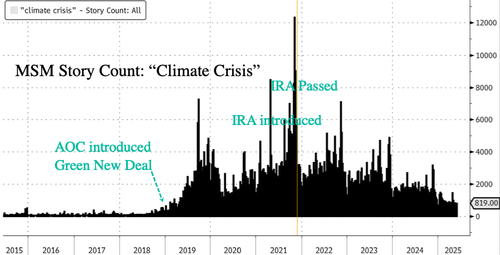
But, we’re not out of the woods yet, and perhaps the next tropical wave in the Atlantic Basin will provide climate doomers with some cover and generate climate propaganda in corporate media outlets. We do miss the days when climate alarmists told us the world would burn to a crisp by 2023 (read here). Yet here we are, still sitting on the Bloomberg Terminal, penning this weather note while eating a burger.
So here is what The Weather Channel’s meteorologists are focusing on ahead of next week: “The National Hurricane Center has increased the odds to a medium chance of development for a tropical wave coming off the coast of Africa.”
Keep an eye on this tropical wave, which could become a tropical storm or hurricane near the Lesser Antilles – at some point next week.
Strong signal that our next tropical wave could become a tropical storm or hurricane near the Lesser Antilles next week…
Long term, we need to keep an eye on this in case it enters the Caribbean Sea. pic.twitter.com/8hdSorDLqJ
Reuters and its anonymous (oil-shorting) sources are again stirring the oil market. This time, the wire says OPEC+ is preparing another supply hike in November, with Saudi Arabia pushing for something big and Russia urging restraint. But if recent history is any guide, a report of rising quotas doesn’t necessarily translate into rising barrels… and OPEC is getting increasingly irritated with the narrative.
According to Reuters’ unnamed insiders, Riyadh wants an increase of 274,000 to as much as 548,000 bpd, while Moscow is said to prefer another modest 137,000 bpd bump. The group’s eight key producers are due to meet virtually on Sunday to decide. But it’s hard to forget that just three days ago, OPEC issued an unusually sharp rebuke of the media, flatly rejecting circulating reports of a half-million-barrel hike as “wholly inaccurate and misleading.” The statement was widely read as a direct shot at Reuters, whose reports had already knocked prices lower.
The bigger issue is the difference between quota hikes and actual production increases. OPEC+ has been promising staged increases since April as it unwinds cuts, but it’s only managed to deliver about 75% of those barrels. Many members can’t raise production even if they want to.
Nigeria, Angola, and Iraq are still repaying earlier overproduction through “compensation cuts,” while only Saudi Arabia and the UAE have meaningful spare capacity.
That leaves traders stuck parsing press leaks against physical reality. On paper, OPEC+ could announce another big hike. In practice, the barrels may never show up. The result is market theater: Reuters reports a glut-in-the-making, OPEC pushes back to protect the narrative, and prices swing on expectations rather than evidence.
Brent crude is already down more than 7% this week on the latest supply-hike chatter, even though the “extra” oil hasn’t actually arrived. For now, the gap between quota headlines and physical flows is as wide as ever.
[1.] There’s a lot going on in the Trump Administration’s proposed “Compact,” and there’s a lot that we might want to ask about it. Some questions would have to do with whether particular demands (such as a tuition freeze or a 15% cap on foreign students or mandatory U.S. civics classes for foreign students) are a good idea. Some might be and some might not be. Some might have to do with the way that the Compact would rebalance power between universities and the federal government.
Some might have to do with whether particular demands (for instance, the requirement that universities require all applicants to take standardized admission tests) should be implemented top-down on a one-size-fits-all basis. The federal government may have the power to impose certain conditions on the recipients of government funds, but that doesn’t mean that it necessarily should do so. This question of when conditions become excessive micromanagement perennially arises when it comes to government contracts and grants.
Some questions have to do with whether the Executive Branch can impose these conditions through just an announcement, whether this would require notice-and-comment regulatory rulemaking, or whether it would require express Congressional authorization. Similar questions have arisen in the past with regard to whether, for instance, Title IX should be understood to mandate university investigation of alleged sexual assault by students; whether it should be understood as mandating a preponderance-of-the-evidence standard in such situations rather than a clear-and-convincing-evidence; and other matters. In particular, the Compact seems to contemplate conditions on universities’ “preferential treatment under the tax code,” which I expect would likely require revisions to the tax code. But there too there have been controversies about where the Executive Branch has power to read provisions into tax exemption requirements that hadn’t been expressly authorized by Congress (see, e.g., Bob Jones Univ. v. U.S. (1983)).
Still, I can at most note such matters—important as they are—since they aren’t within my core area of expertise. So let me turn instead to the First Amendment problems posed by the Compact, which I am more knowledgeable about. I don’t want to suggest that these are the most important issues, but that’s where the light is best for me, so maybe I can find some keys there.
[2.] As a general matter, when the government is providing funding or other benefits for private parties’ speech, it may not discriminate based on viewpoint. Thus, for instance, Rosenberger v. Rector (1995), held that when a university funds student newspapers, it can’t exclude ones that convey religious viewpoints. The Court there expressly “reaffirmed the requirement of viewpoint neutrality in the Government’s provision of financial benefits.” Many other precedents say the same.
To be sure, the government may create programs for conveying its own preferred viewpoints. As Rust v. Sullivan (1991) noted, Congress can set up a National Endowment for Democracy without setting up a National Endowment for Communism. But the Court has distinguished such government speech, which the government can select based on viewpoint, from government programs that subsidize a diverse range of private speech, as in Rosenberger. To quote Rosenberger again,
[W]hen the government appropriates public funds to promote a particular policy of its own it is entitled to say what it wishes. When the government disburses public funds to private entities to convey a governmental message, it may take legitimate and appropriate steps to ensure that its message is neither garbled nor distorted by the grantee. It does not follow, however, … that viewpoint-based restrictions are proper when the [government] does not itself speak or subsidize transmittal of a message it favors but instead expends funds to encourage a diversity of views from private speakers.
Moreover, the government can’t impose even viewpoint-neutral funding conditions that seek to restrict the recipient’s speech using its own funds. Thus, in FCC v. League of Women Voters (1984), the Court struck down a law that barred editorializing by the recipients of public broadcasting subsidies. The Court acknowledged that the government could provide that federal funds can’t be used to editorialize (that would be a viewpoint-neutralize restriction). But Congress can’t provide that “a noncommercial educational station that receives only 1% of its overall income from [federal] grants is barred absolutely from all editorializing.” It is unconstitutional for Congress to thus bar a partly federally subsidized station “from using even wholly private funds to finance its editorial activity.”
[3.] In the Compact, the government isn’t just awarding grants for promoting particular government-supported viewpoints, which both Democrat and Republican administrations have long done. Rather, it applies to a vast range of funding and benefit programs, such as “(i) access to student loans, grant programs, and federal contracts; (ii) funding for research directly or indirectly; (iii) approval of student and other visas in connection with university matriculation and instruction; and (iv) preferential treatment under the tax code.” Indeed, when it comes to tax exemptions, Rosenberger expressly made clear that “Congress’ choice to grant tax deductions” was subject to “the requirement of viewpoint neutrality”; and see also the similar holding in Matal v. Tam (2017) with regard to the nonmonetary benefit of trademark registration.
[a.] This suggests that the Compact’s requirement that, as a condition of getting benefits, signatories must “commit themselves” “to transforming or abolishing institutional units that purposefully … belittle … conservative ideas” is unconstitutional: It targets particular viewpoints (those that “belittle … conservative ideas”), however vaguely defined those viewpoints may be.
[b.] I think the same is likely true about the demand that universities “shall adopt policies prohibiting incitement to violence, including calls for murder or genocide or support for entities designated by the U.S. government as terrorist organizations.” To be sure, “incitement” may constitutionally be even criminalized outright, if it’s limited to speech intended to and likely to produce imminent illegal action, which is to say action in the coming hours or days, as opposed to speech that advocates such action “at some indefinite future time.” (See Brandenburg v. Ohio (1969) and Hess v. Indiana (1973).) But in context, that doesn’t seem the likely meaning of the demand: After all, basically no speech in the U.S. involves advocacy of imminent genocide by the listeners (as opposed to calls for genocide at some indefinite future time), and even calls for murder on college campuses are almost invariably calls for violence at some indefinite future time.
Likewise, while “material support” for foreign terrorist organizations, in the sense of providing personnel, training, and the like, is constitutionally unprotected (see Holder v. Humanitarian Law Project (2010)), “support” in the lay sense—which is to say independent expression of endorsement of a terrorist organization’s position or actions—remains constitutionally protected. Indeed, Holder several times stressed that the law upheld in that case “does not cover independent advocacy” supporting a foreign terrorist group’s position.
So unless the “shall adopt policies prohibiting incitement to violence, including calls for murder or genocide or support for entities designated by the U.S. government as terrorist organizations” is read very narrowly indeed, this demand would require universities to suppress fully protected student speech. And even if a private university could suppress such speech on its own (simply because a private university isn’t itself constrained by the First Amendment), the government can’t pressure the university into engaging in suppression (see, e.g., NRA v. Vullo (2024)).
[c.] I also think the government can’t demand that universities, as a condition of getting benefits, “pledge … screen out [foreign] students who demonstrate hostility to the United States, its allies, or its values.”
The government likely can deny visas to prospective students based on their viewpoints; see Kleindienst v. Mandel (1972) (I oversimplify matters here somewhat). Whether the federal government can deport already-admitted people based on such speech is a separate matter, but it likely can reject them when they’re just applying for a student visa.
But that’s something the government can do itself, because of its special power over immigration. I don’t think it can demand that universities, in exercising their own decisions about whom to associate with and whom to speak to, exclude foreign students based on the students’ viewpoints.
[d.] The Compact also requires that universities receiving federal benefits “shall maintain institutional neutrality at all levels of their administration,” including “all colleges, faculties, schools, departments, programs, centers, and institutes.” This means “that all university employees, in their capacity as university representatives, will abstain from actions or speech relating to societal and political events except in cases in which external events have a direct impact upon the university.” This expressly does not apply to “students, faculty, and staff” commenting “in their individual capacities, provided they do not purport to do so on behalf of the university or any of its sub-divisions.”
This requirement, unlike the ones I discussed in items (a) to (c) above, is facially viewpoint-neutral; and I think the government could require that no federal funds be spent on ideological commentary by university departments. That would be much like the requirement, upheld in Regan v. Taxation with Representation (1983), that no tax-exempt contributions—which are in effect subsidized by the government through the charitable tax exemptions—be spent on advocacy for or against a candidate, or on substantial advocacy for or against legislation. To be sure, Regan involved only candidate- and legislation-related speech, not all ideological advocacy, but I think such a viewpoint-neutral requirement would be permissible even if it covers ideological advocacy more broadly.
But as I read the Compact, it contemplates that universities “abstain from … speech relating to societal and political events” even when such speech is paid for solely with their own funds (of which universities have plenty). And that’s precisely the sort of broad condition on funding that the Court struck down in FCC v. League of Women Voters, when it held that the government couldn’t use its subsidies to public broadcasters to prohibit all editorializing by the broadcasters (including editorializing paid for from other funds).
I appreciate the rationale the Compact offers for the mandate, quoting the President of Dartmouth:
Consider a student interested in majoring in a certain subject. Upon going to the department homepage to discover course offerings, the student is slapped in the face with an official statement excoriating his own political ideology. How comfortable would that student feel taking a class in that department? Our Principles of Institutional Restraint permit departments to issue public statements only on limited issues directly related to their academic expertise. Rather than publishing these proclamations on their homepages, departments must create new webpages specifically dedicated to public statements and endorsements. This ensures that departments promote their academic missions, not their social or political beliefs.
I generally support such ideological neutrality mandates for university administrations and departments myself as a policy matter, partly for this very reason. But whatever the value of institutional neutrality mandates as a means of promoting uninhibited discourse among students and faculty, I don’t think that this value can justify suppressing speech by the universities themselves. And, as FCC v. League of Women Voters makes clear, that remains so even when the universities are receiving government money to support some of their operations.
[e.] The Compact also seems to broadly call for universities to promote a “broad spectrum of ideological viewpoints.” As I’ll be blogging this coming week, I have a forthcoming law journal article in which I argue that ideological diversity mandates are generally a bad idea and likely unconstitutional, even when they are imposed as a condition on access to government funding. This having been said, it’s not completely clear whether the Compact outright demands enforceable viewpoint mandates (which the April letter to Harvard appears to have contemplated), or whether it sets forth viewpoint diversity as an aspirational goal, the way one might set “excellence,” “openmindedness,” and the like as an aspirational goal.
The Compact states, in relevant part, that funding recipients must “commit themselves to fostering a vibrant marketplace of ideas on campus,” to engaging in a “rigorous, good faith, empirical assessment of a broad spectrum of viewpoints among faculty, students, and staff at all levels,” to “sharing the results of such assessments with the public,” and to “seek[ing] such a broad spectrum of viewpoints not just in the university as a whole, but within every field, department, school, and teaching unit.” It also states that “A vibrant marketplace of ideas requires an intellectually open campus environment, with a broad spectrum of ideological viewpoints present and no single ideology dominant, both along political and other relevant lines.” The question here, I think, will largely turn on how such a call for a vibrant marketplace of ideas and a broad spectrum of viewpoints will be operationalized.
[* * *]
In any event, these are just some tentative thoughts about some of the provisions; I look forward to seeing more discussion of the Compact in the months ahead.
Yesterday, the US Court of Appeals for the First Circuit issued a decision that Donald Trump’s executive order denying birthright citizenship to children of undocumented immigrants and non-citizens present on temporary visas is unconstitutional. It also ruled that it violates a 1952 law granting naturalization to children born in the United States, and upheld a nationwide injunction against implementation of the order. This is the second appellate court decision ruling against Trump’s order, following an earlier Ninth Circuit decision. Multiple district court judges (including both Democratic and Republican appointees) have also ruled that the order is illegal, and so far not a single judge has voted to uphold it.
Judge David Barron’s opinion for the First Circuit runs to 100 pages. But he emphasizes that this length is the product of the large number of issues (including several procedural ones) that had to be considered, and does not mean the case is a close one:
Theanalysisthatfollowsisnecessarilylengthy,aswe mustaddresstheparties’numerousargumentsineachofthecases involved.Butthelengthofouranalysisshouldnotbemistaken forasignthatthefundamentalquestionthatthesecasesraise aboutthescopeofbirthrightcitizenshipisadifficultone.It is not, which may explain why it has been more than a century since abranchofourgovernmenthasmadeasconcertedaneffortasthe ExecutiveBranchnowmakestodenyAmericanstheirbirthright.
I won’t try go to through all the points in the decision in detail. But I think Judge Barron’s reasoning is compelling and persuasive, particularly when it comes to explaining why this result is required under the Supreme Court’s ruling in the 1898 Wong Kim Ark case, and why the 1952 naturalization statute provides an independent ground for rejecting Trump’s order.
I would add, as I have noted previously (e.g. here and here), that virtually all the government’s arguments for denying birthright citizenship to children of undocumented immigrants and those on temporary visas would also have denied it to numerous slaves freed as a result of the Civil War and the Thirteenth Amendment. For example, if children of people who entered the US illegally are ineligible, that would exclude the children of many thousands of slaves who were brought into the US illegally after Congress banned the slave trade in 1808. And granting citizenship to freed slaves and their children was, of course, the main purpose of the Citizenship Clause of the Fourteenth Amendment.
I also think the ruling is sound in concluding that the state government plaintiffs in the case have standing to sue (though, admittedly, the Supreme Court’s precedents on state standing are far from a model of clarity), and in suggesting that “complete relief” for their injuries requires a nationwide injunction (though it ultimately remanded this issue to the district court for further consideration). State lawsuits are one of several possible exceptions to the Supreme Court’s general presumption against nationwide injunctions in Trump v. CASA, Inc. Both this exception and that for class actions have been used in lower court decisions against the birthright citizenship order, since Trump v. CASA came down in June. These exceptions are among the reasons why CASA has so far not had anywhere near as devastating an impact as some feared (though I continue to believe it was a bad decision).
Both the substantive birthright citizenship issue and the procedural issue of the proper scope of injunctions are likely to return to the Supreme Court. Hopefully, the justices will affirm the lower court rulings on these issues. We shall see.
Trump Thanks Israel For Halting Gaza City Offensive, Urges Hamas “Move Quickly” Or Deal Is Off
The Israeli military has been ordered by the Netanyahu government to pause its offensive in Gaza City, according to Israeli army radio on Saturday, just a day after Hamas is said to have agreed to the Trump-proposed peace plan which seeks the release of all remaining hostages, living and deceased.
The Israeli military in an official statement said it had been ordered to “advance readiness” for implementing the first stage of Trump’s plan. Army radio noted that military operations in Gaza would be scaled back to “the minimum” – but what have been dubbed defensive strikes will continue. Prime Minister Netanyahu says the hostages will be freed in days.
Some of these airstrikes were still observed throughout the day, with Palestinian sources sayingat least 55 people have still been killed since dawn.
President Trump himself late Friday urged Israel to halt its bombardment, while also calling on Hamas to “move quickly” on implementing the 20-point peace plan.
“I appreciate that Israel has temporarily stopped the bombing in order to give the Hostage release and Peace Deal a chance to be completed,” Trump stated on Truth Social Saturday morning.
But he also warned that “Hamas must move quickly, or else all bets will be off,” adding that “I will not tolerate delay, which many think will happen, or any outcome where Gaza poses a threat again. Let’s get this done, FAST. Everyone will be treated fairly!”
But Hamas had only said it is ready to enter negotiations on Trump’s peace plan, suggesting there are many more hurdles to go as each condition is agreed to.
Prime Minister Netanyahu in fresh remarks to reporters emphasized that the plan calls for the complete demilitarization of Hamas – but this is anything but certain in terms of whether the Palestinian militant group will actually lay down its weapons.
But Hamas did say it has agreed to releasing all 48 remaining hostages that it’s ready to surrender power over the Gaza Strip, but the proverbial devil will be in the details in terms of how precisely this all comes to fruition.
It remains an open question the degree to which fighting has actually stopped in Gaza City…
it has been 18 hours since trump ordered israel to stop bombing gaza to implement the “peace plan” and predictably israel has yet to cease its bombing of gaza.
trump then followed up and made it seem like israel has stopped its operations on the strip. pic.twitter.com/AfiWuemEOc
The Palestinian side hopes to see 250 prisoners serving life sentences and 1,700 Palestinians detained without charge released as a result of the Trump 20-point plan.
Israeli military Arabic-language spokesperson Avichay Adraee is meanwhile telling Palestinian residents not to return to their homes in Gaza City or northern Gaza.
Still, this moment seems the best shot at truce or permanent peace in the two-year long war in quite a while, and the White House seems ready to seize the initiative and push the sides to the finish line.
ICE Agents Ambushed In Chicago As Trump Deploys National Guard
Immigration and Customs Enforcement (ICE) agents were ‘rammed and boxed in by 10 cars’ in Broadview, Illinois on Saturday, according to the Department of Homeland Security’s Tricia McLaughlin in a statement to Fox News.
According to the McLaughlin, officers “were forced to deploy their weapons and fire defensive shots at an armed U.S. citizen.”
The armed attacker, a woman who is a US citizen who was named in a Customs and Border Protection (CBP) intelligence bulletin, allegedly doxxed agents and posted online: “Hey to all my gang let’s f— those motherf—— up, don’t let them take anyone.”
The firefight took place as “agents were reportedly performing a routine patrol in Broadview, a suburb of Chicago.” No agents were injured in the incident, and “the woman involved drove herself to the hospital to get care for wounds.”
“Today in Chicago, members of our brave law enforcement were attacked—rammed and boxed in by ten vehicles, including an attacker with a semi-automatic weapon,” wrote DHS Secretary Kristi Noem in a Saturday post on X, adding “I am deploying more special operations to control the scene. Reinforcements are on their way.”
Today in Chicago, members of our brave law enforcement were attacked—rammed and boxed in by ten vehicles, including an attacker with a semi-automatic weapon.
I am deploying more special operations to control the scene. Reinforcements are on their way.
Hours earlier, in response to plans by President Trump to federalize 300 members of the Illinois National Guard, Gov. JB Pritzker posted a barrage of statements on X – accusing the Trump administration and federal law enforcement of “unprecedented escalations of aggression against Illinois citizens and residents.”
“This morning, the Trump Administration’s Department of War gave me an ultimatum: call up your troops, or we will,” Pritzker wrote. “It is absolutely outrageous and un-American to demand a Governor send military troops within our own borders and against our will.”
As the Epoch Times notes further, the confrontation marked the latest escalation in an increasingly tense standoff between federal authorities and some states over “Operation Midway Blitz,” a federal immigration enforcement initiative launched on Sept. 8.
DHS said recently the operation has resulted in more than 800 arrests in Illinois, targeting individuals with criminal records, including sexual offenses and gang ties.
Pritzker has denounced the operation as unconstitutional, calling it “a pretext to send armed military troops into our communities.”
The governor, at a press conference last week, accused federal agents of using tear gas, pepper spray, rubber bullets, and flashbangs against protesters exercising their First Amendment right in Broadview.
McLaughlin had earlier urged Pritzker to tone down “rhetoric about ICE” after clashes broke out between protesters and federal agents outside the Broadview ICE processing facility.
“These riots outside the ICE Broadview Processing Center and attacks on ICE officers come after Democrat politicians, including Governor Pritzker and Mayor Brandon Johnson, have villainized and demonized ICE law enforcement,” McLaughlin stated.
The Department of War confirmed last week that it had received a DHS request to deploy troops to Illinois to help protect federal personnel, property, and functions. It said any decisions would be made “in accordance with established processes and announced at the appropriate time.”
In his Oct. 4 statement, Pritzker said that “there is no need for military troops on the ground in the State of Illinois” and that local law enforcement have been working “to ensure public safety around the Broadview ICE facility, and to protect people’s ability to peacefully exercise their constitutional rights.”
“I will not call up our National Guard to further Trump’s acts of aggression against our people,” he added.