The Smashing Machine Looks at the Early Days of a Combat Sport Politicians Wanted To Ban


Dwayne Johnson in "The Smashing Machine" | A24

It’s easy to forget, in today’s world of UFC superstars, that in the early days of mixed martial arts there was a push from politicians to ban the sport. In the 1990s, Sen. John McCain (R–Ariz.) called it “human cockfighting,” The New York Times editorial board called for the banning of its “extreme barbarism,” and the state of New York even went so far as to enact a prohibition. This sort of no-limits combat, the argument went, was not a civilized form of sport or entertainment. It was just brutality. 

Efforts to ban the UFC are only briefly mentioned in The Smashing Machine, the new movie about Mark Kerr, one of the sport’s early pioneers. But the brutality is front and center. In the ring, Kerr demolishes his opponents, grappling them to the floor, pinning them down, and then pounding them into submission. The movie’s title is his nickname, the man he became in the ring. But the point it tries to make, with varying degrees of success, is that there was no way to completely confine that brutality to the ring.

Played by wrestler and actor Dwayne Johnson, better known as The Rock, The Smashing Machine is a character study of Kerr, a film about the connection between the body and the mind, life and work, and the fight to survive both in the ring and outside of it.

When he’s not beating people to a pulp, Kerr is gentle and soft-spoken, a teddy bear of a man despite his massive size and bearing. He’s sweet with old ladies and thoughtful with reporters, calmly—almost gently—explaining how he plans to demolish his opponents. Yet he’s demolishing himself.

When the movie starts, he’s addicted to painkillers. The opioids reduce his physical pain, but there’s also a suggestion that they reduce mental anguish—at least some of which stems from his rocky relationship with his girlfriend, Dawn (Emily Blunt). The movie never quite seems sure whether Dawn is a villain, a selfish and malignant force in Kerr’s life, or whether she’s a victim, stuck in a strange relationship with a dangerous man who constantly picks at her and occasionally tears a door off its hinges during arguments. That might stem from the impenetrability of human relationships themselves—fair enough. But at times, it plays more like the filmmakers simply don’t know what to make of her.

Kerr is far more fully realized, thanks in part to Johnson’s physical transformation. In a hairpiece and facial prosthetics, the star is nearly unrecognizable, and the performance has nothing of the lock-jawed, bordering-on-camp action-star bravado he so often brings to roles. If nothing else, The Smashing Machine is a reminder that Johnson—who has gravitated toward generic star vehicles that showcase his bulk more than his performing chops—is, in fact, a remarkable screen actor, capable of a kind of nuance and psychological complexity that he rarely shows.

But as remarkable as that performance is, it can’t quite make the film whole. Director Benny Safdie relies on a choppy narrative structure, in which scenes feel disconnected from one another. This structure manages to avoid some (though not all) biopic clichés, but the movie never quite seems to know why any given scene flows from the next.

It’s an uneven film that never quite seems to decide what it’s about. A coda suggests it wants to be a story about the rise of combat sports, and the way early fighters like Kerr paved the way. Today, superstar fighters like Conor McGregor can earn tens of millions of dollars, whereas the final tournament in The Smashing Machine offers a reward of just $200,000—an amount the movie repeatedly insists is “life-changing.” One reason the sport survived its early political battles is that it became too popular to ban. And as its audience grew, a modicum of respectability followed.

At times, the movie seems to suggest that it wants to be about losing, about failure, about what happens when bodies age and the high of victory is no longer available. But it can’t quite connect the threads to fully land this theme either. So Safdie relies on Johnson’s striking, subtle performance to carry the film, acting as its through-line and center of gravity. He’s the machine that makes this scattered movie run—and he smashes it.

The post <i>The Smashing Machine</i> Looks at the Early Days of a Combat Sport Politicians Wanted To Ban appeared first on Reason.com.

from Latest – Reason.com https://ift.tt/PVTBNoA
via IFTTT

No Calamity


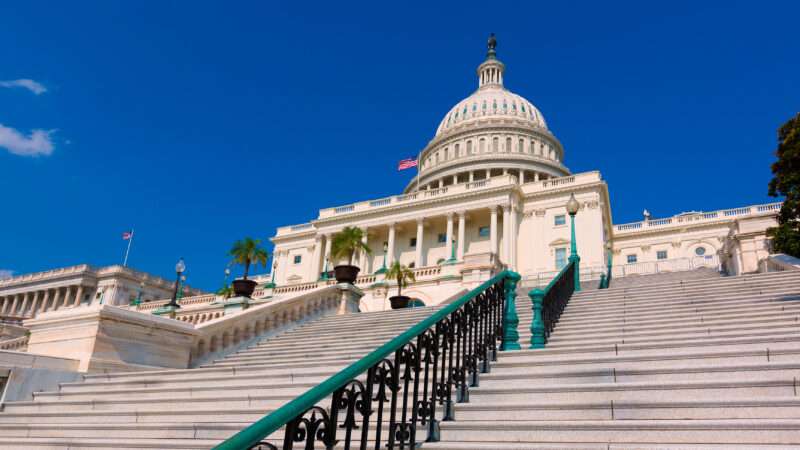
U.S. Capitol seen up a staircase | Lunamarina/Dreamstime.com

Votes scheduled for Friday: The partial government shutdown continues into its third day, and legislators have votes scheduled for Friday on funding bills that offer possibilities for extending funding. One would extend it until October 31, possibly putting us into this same situation several weeks from now. But why should we let our politicians get in the way of a good time?

Right now, some 750,000 federal workers are furloughed. The White House has, at every stage of this process, suggested that more permanent reductions in force will be considered throughout this shutdown, but a senior official told The Washington Post yesterday that the administration actually expects to fire some 16,000 federal workers or fewer.

This, like so many Trump administration moves, would fall far short of libertarian hopes. Consider the cuts Democrats have lamented so far, like “$8 billion in energy projects in states represented by Democratic senators and $18 billion for New York transportation projects.” Why should the federal government be funding such projects when they could receive private investment or be funded by the state and city?

The much-ballyhooed jobs report release delay—it was scheduled to be released by the Department of Labor this morning, but will not be—”is the first casualty in what is likely to be a string of delayed or missed economic data,” reports the Post. “The timing could hardly be worse. Policymakers have been watching closely for signs that a cooling job market, rising unemployment and worsening inflation could be weighing on the economy. The September jobs report was expected to provide a much-anticipated snapshot of the U.S. labor market, after a summer of rapid cooling.”

I mean, sure, I suppose. But we’ve been trapped in a cycle of staggeringly large and frequent revisions, such that the jobs numbers we’re seeing in each release aren’t really very accurate. So does this matter much at all?

Of course, it’s possible that the shutdown, if it continues, “could delay other key economic data too, including inflation reports scheduled for Oct. 15 and 31, and third-quarter [gross domestic product] figures on Oct. 30,” adds the Post. And all those factors combined could make it much harder for the Federal Reserve to decide what actions to take with regard to interest rates later in the month. But it seems like most analysts predict they’ll err on the side of another cut: “First, it would take a solid [September] jobs report to keep an [October] hold in play. If the [September] jobs data are not available, Chair [Jerome] Powell will likely be inclined to push for another ‘risk management’ cut,” writes Bank of America economist Stephen Juneau. “Second, the Fed would want to lean against downside risks from an extended shutdown, particularly if government workers are laid off.”

Besides, it’s not like there’s literally no data to go off of in the absence of official government collections: “Economists polled by Bloomberg expected that employers added 53,000 jobs last month, fewer than the 64,000 added on average over the six previous months, before revisions,” reports The New York Times. “Other labor market indicators generated by the private sector have been downbeat. The payroll processor ADP estimated that nongovernmental employers shed 32,000 jobs in September, while the outplacement firm Challenger, Gray & Christmas found that companies’ announced hiring plans so far this year were at the lowest level since 2009.”

One of the great dirty little secrets of every government shutdown—which, again, is a misnomer, because vast swaths of the federal bureaucracy continue to operate—is that everything remains mostly fine, and many functions that the federal government currently performs could be phased out or replaced by the private sector.


Scenes from New York: Mayoral candidate Zohran Mamdani says he wants to end gifted programs for kindergarteners, first graders, and second graders enrolled in New York City public schools. Half of me is so Waldorf-pilled I don’t even mind: Children should be wandering through Prospect Park barefoot, practicing their whittling, not tested and put on high-achieving tracks at the age of five or six. But half of me is livid: Gifted programs are not the enemy, and leveling is not the goal. We’re not pursuing a Harrison Bergeron world. Letting smart children advance faster, stave off boredom, and foster their love of learning should be a major goal of teachers—not equality of outcome.

Also:


QUICK HITS

  • “Currently I think Hollywood is failing us; the quality of its movies has never been lower in my lifetime,” writes Tyler Cowen for The Free Press. “Most of the top hits are boring and predictable tentpole franchises. Fight and chase scenes are overdone and laden with CGI at the expense of good dialogue and dramatic content. If you watch an older movie such as Alfred Hitchcock’s Rear Window (on a large screen, please) or Stanley Kubrick’s Barry Lyndon, you may be shocked how much the art of moviemaking has declined.” (Yes to Rear Window.) But then the article veers off the rails: Cowen seems to believe Tilly Norwood—an AI-generated actress—and others like her will help improve the industry. I highly doubt it.
  • Tit for tat: California Gov. Gavin Newsom is now threatening to yank away “billions of dollars” in state funding from California universities if they sign onto the compact offered by the Trump administration—covered in yesterday’s Roundup—that makes demands regarding international student admissions, use of standardized tests, and implementing tuition freezes. “President Donald Trump’s so-called proposed ‘compact’ is nothing short of a hostile takeover of America’s universities,” said Newsom. “It would impose strict government-mandated definitions of academic terms, erase diversity and rip control away from campus leaders to install government-mandated conservative ideology in its place.”
  • Two men, 53-year-old Adrian Daulby and 66-year-old Melvin Cravitz were killed while worshipping at Yom Kippur services at a synagogue in Manchester, England. “Police shot and killed a suspect seven minutes after he rammed a car into pedestrians outside the synagogue on Thursday morning and then attacked them with a knife. He wore what appeared to be an explosives belt, which was found to be fake,” reports NPR. Police are investigating it as a terrorist attack.
  • Another generic version of the abortion pill, mifepristone, was just approved by the Food and Drug Administration. Mifepristone dilates the cervix, blocks progesterone, and causes a woman’s body to expel the baby. It is prescribed in the U.S. up until roughly 10 to 12 weeks, typically in a two-pill combo with misoprostol.
  • Disturbing:

  • I fundamentally do not agree with this or relate. We need consequences when people repeatedly offend:

The post No Calamity appeared first on Reason.com.

from Latest – Reason.com https://ift.tt/nZ9eGMv
via IFTTT

The Smashing Machine Looks at the Early Days of a Combat Sport Politicians Wanted To Ban


Dwayne Johnson in "The Smashing Machine" | A24

It’s easy to forget, in today’s world of UFC superstars, that in the early days of mixed martial arts there was a push from politicians to ban the sport. In the 1990s, Sen. John McCain (R–Ariz.) called it “human cockfighting,” The New York Times editorial board called for the banning of its “extreme barbarism,” and the state of New York even went so far as to enact a prohibition. This sort of no-limits combat, the argument went, was not a civilized form of sport or entertainment. It was just brutality. 

Efforts to ban the UFC are only briefly mentioned in The Smashing Machine, the new movie about Mark Kerr, one of the sport’s early pioneers. But the brutality is front and center. In the ring, Kerr demolishes his opponents, grappling them to the floor, pinning them down, and then pounding them into submission. The movie’s title is his nickname, the man he became in the ring. But the point it tries to make, with varying degrees of success, is that there was no way to completely confine that brutality to the ring.

Played by wrestler and actor Dwayne Johnson, better known as The Rock, The Smashing Machine is a character study of Kerr, a film about the connection between the body and the mind, life and work, and the fight to survive both in the ring and outside of it.

When he’s not beating people to a pulp, Kerr is gentle and soft-spoken, a teddy bear of a man despite his massive size and bearing. He’s sweet with old ladies and thoughtful with reporters, calmly—almost gently—explaining how he plans to demolish his opponents. Yet he’s demolishing himself.

When the movie starts, he’s addicted to painkillers. The opioids reduce his physical pain, but there’s also a suggestion that they reduce mental anguish—at least some of which stems from his rocky relationship with his girlfriend, Dawn (Emily Blunt). The movie never quite seems sure whether Dawn is a villain, a selfish and malignant force in Kerr’s life, or whether she’s a victim, stuck in a strange relationship with a dangerous man who constantly picks at her and occasionally tears a door off its hinges during arguments. That might stem from the impenetrability of human relationships themselves—fair enough. But at times, it plays more like the filmmakers simply don’t know what to make of her.

Kerr is far more fully realized, thanks in part to Johnson’s physical transformation. In a hairpiece and facial prosthetics, the star is nearly unrecognizable, and the performance has nothing of the lock-jawed, bordering-on-camp action-star bravado he so often brings to roles. If nothing else, The Smashing Machine is a reminder that Johnson—who has gravitated toward generic star vehicles that showcase his bulk more than his performing chops—is, in fact, a remarkable screen actor, capable of a kind of nuance and psychological complexity that he rarely shows.

But as remarkable as that performance is, it can’t quite make the film whole. Director Benny Safdie relies on a choppy narrative structure, in which scenes feel disconnected from one another. This structure manages to avoid some (though not all) biopic clichés, but the movie never quite seems to know why any given scene flows from the next.

It’s an uneven film that never quite seems to decide what it’s about. A coda suggests it wants to be a story about the rise of combat sports, and the way early fighters like Kerr paved the way. Today, superstar fighters like Conor McGregor can earn tens of millions of dollars, whereas the final tournament in The Smashing Machine offers a reward of just $200,000—an amount the movie repeatedly insists is “life-changing.” One reason the sport survived its early political battles is that it became too popular to ban. And as its audience grew, a modicum of respectability followed.

At times, the movie seems to suggest that it wants to be about losing, about failure, about what happens when bodies age and the high of victory is no longer available. But it can’t quite connect the threads to fully land this theme either. So Safdie relies on Johnson’s striking, subtle performance to carry the film, acting as its through-line and center of gravity. He’s the machine that makes this scattered movie run—and he smashes it.

The post <i>The Smashing Machine</i> Looks at the Early Days of a Combat Sport Politicians Wanted To Ban appeared first on Reason.com.

from Latest – Reason.com https://ift.tt/PVTBNoA
via IFTTT

UK Cops Killed One Of The Manchester Synagogue Victims, Injured Another

UK Cops Killed One Of The Manchester Synagogue Victims, Injured Another

One of the two victims who died in the synagogue attack in Manchester, UK was shot dead by police, with the other victim killed by suspect. In fact, the police were the only ones with guns at the incident.  

Peter Byrne/Press Association, via Associated Press

Here’s what happened: The suspect, Jihad al-Shamie, rammed a vehicle into a crowd of people gathered outside the synagogue, striking several individuals. He then exited the car and stabbed at least one person before attempting to enter the building. Worshippers and security staff managed to block his entry – when armed cops showed up within 7 minutes and shot al-Shamie.

Al-Shamie killed one of the victims and sent two to the hospital with injuries, while the cops accidentally killed another victim and shot a 3rd person who was also sent to the hospital. 

Graphic: Guardian

“Overnight, we have taken advice from the Home Office pathologist ahead of full postmortem examinations scheduled for later today. The Home Office pathologist has advised that he has provisionally determined that one of the deceased victims would appear to have suffered a wound consistent with a gunshot injury,” said Greater Manchester police chief constable, Sir Stephen Watson. 

It is currently believed that the suspect, Jihad al-Shamie, was not in possession of a firearm and the only shots fired were from GMP’s authorised firearms officers as they worked to prevent the offender from entering the synagogue and causing further harm to our Jewish community.

Forensic investigators on Thursday at the synagogue entrance © Peter Byrne/PA

“It follows therefore that subject to further forensic examination, this injury may sadly have been sustained as a tragic and unforeseen consequence of the urgently required action taken by my officers to bring this vicious attack to an end.

The two victims killed in the attack at Heaton Park Synagogue were identified on Friday as  53-year-old Adrian Daulby and 66-year-old Melvin Cravitz. al-Shamie was wearing a fake explosive vest during the attack. 

Jihad, 35, moved to the UK from Syria as a child and became a naturalized British citizen while he was a minor in 2006. Home secretary Shabana Mahmood (!) said on Friday that Jihad was not known to counterterrorism police, however in 2012, MP John Howell received threatening emails from ‘Jihad Alshamie’ according to a report by the Jerusalem Post. It’s unclear if it’s the same Jihad.

Footage of the scene showed Al-Shamie writhing on the ground when police shot him – with a nearby officer shouting “He has a bomb” and “move back.”

In a statement posted on Facebook, Al-Shamie’s father, Faraj, said that the attack by his son, who he named Jihad, was a “profound shock,” adding “The Al-Shamie family in the UK and abroad strongly condemns this heinous act, which targeted peaceful, innocent civilians.” 

Tyler Durden
Fri, 10/03/2025 – 09:45

via ZeroHedge News https://ift.tt/EalMn1u Tyler Durden

Futures Hit Another All Time High As Government Shutdown Enters Day 3

Futures Hit Another All Time High As Government Shutdown Enters Day 3

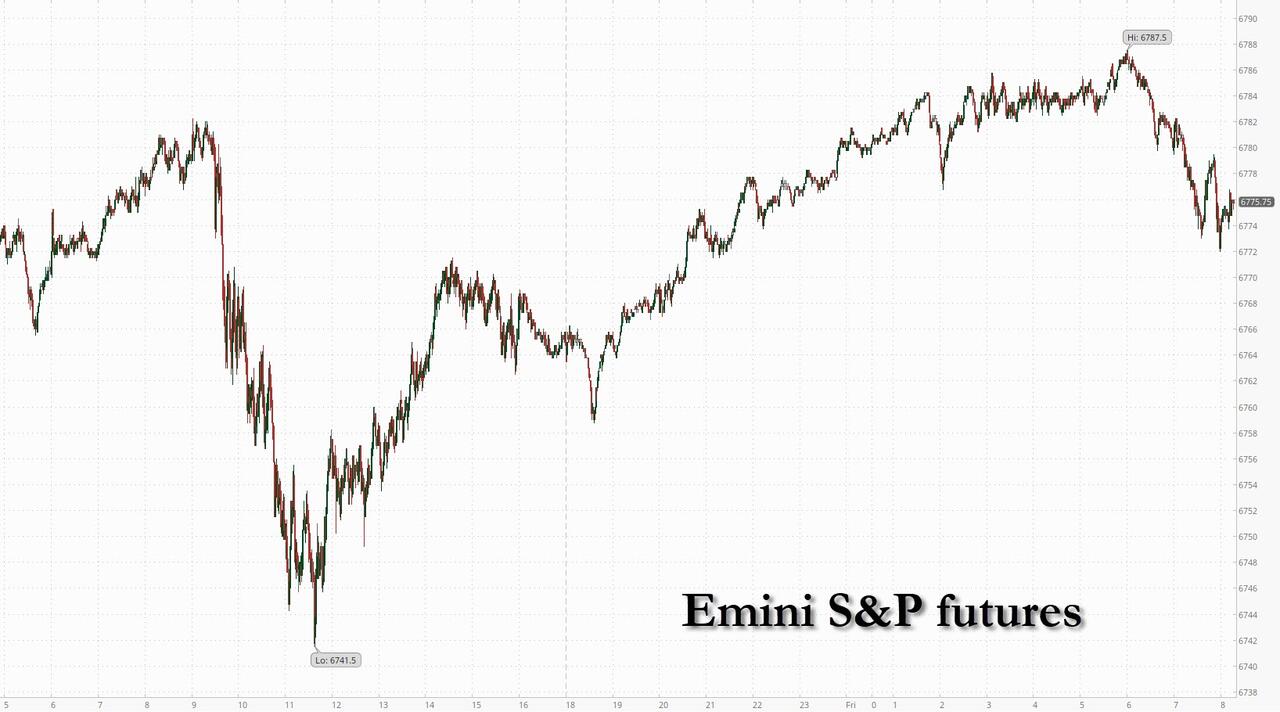
US equity futures are heading into Day 3 of the US government shutdown on pace for what is now another daily all time high. S&P 500 and Nasdaq 100 futures rose 0.1% as of 8:15 am in New York, on course for the longest winning streak since July. Pre-market, Mag 7 are all higher led by TSLA (+1.6%), NVDA (+0.6%) and AMZN (+0.6%). European stocks enjoyed similar as the tech-fueled rally continues. Nikkei rose almost 2% after Japan’s Hitachi teamed up with OpenAI and Fujitsu, expanding its collaboration with Nvidia. Today’s job report will become the latest casualty of the Democrats’ government shutdown, and that’s actually helping to keep volatility subdued, according to ING strategists. Bond yields are mostly unchanged; USD is lower. Energy and precious metals are both higher. Gold was on track for a seventh weekly gain, fueled by central bank buying amid falling US interest rates and lingering inflation concerns. There’s also a view that the underlying labor market likely isn’t as weak as the ADP print estimated this week. There have not been much incremental updates overnight as investors are still waiting for updates from the White House. The only major data release we will receive will be ISM Services which is expected to print at 51.7 vs. 52.0 prior.
In premarket trading Mag 7 stocks are all higher (Tesla +1.2%, Meta +0.5%, Nvidia +0.4%, Amazon +0.4%, Alphabet +0.2%, Microsoft +0.1%, Apple +0.1%). 

  • Applied Materials (AMAT) is down 2.6% after the semiconductor-equipment maker said net revenue for FY 2026 is set to decrease by $600 million due to a new rule by the US Department of Commerce’s Bureau of Industry and Security.
  • Freeport-McMoRan Inc. (FCX) rises 1.3% after UBS upgraded the metals company to buy from neutral.
  • Maplebear (CART), doing business as Instacart, falls 1% after Piper Sandler analyst Tom Champion cut his recommendation on the delivery-services provider to neutral from overweight, citing intensifying competitive pressures.
  • Tronox Holdings (TROX) is down 2.7% as JPMorgan downgrades to neutral from overweight, saying conditions in the titanium-dioxide industry have become more difficult near term.
  • Baidu Inc. US shares (BIDU) are up 1.2% after Morgan Stanley raised its price target on the China-based search engine to $140 from $100.
  • USA Rare Earth (USAR) shares rise 9.6% after CNBC reported that the company is in close communication with the Trump administration, when asked whether it would be open to a deal with the US government.

In corporate news, Boeing’s 777X is said to fly commercially for the first time in early 2027 instead of next year, a fresh setback to the US planemaker. A large blaze has broken out after an explosion at a Chevron refinery in Los Angeles County, according to CBS News. Tesla was sued over claims that defects in the doors of a crashed Cybertruck made it a “death trap.” 

Investors are wagering that the billions pouring into the AI sector will translate into profits and extend gains in tech shares. So far none of that has happened. Meanwhile, the rally underscores how bullish momentum is overshadowing concerns about a US government shutdown, now in its third day and prompting a blackout in key economic data. In fact, it’s been 114 trading sessions since the S&P 500 had a 5% pullback, as US stocks take investors on a one-way ride up. Not surprisingly, Bloomberg Intelligence found that bears are becoming a vanishing breed, as bullish call option volumes posts new records and shorting has become increasingly dangerous in the meme-stock era. Global equity ETFs saw $152 billion of inflows in the past three weeks, the most on record, according to BofA strategists citing EPFR Global data.

“Financial market volatility is falling across the board, partly driven by the US government shutdown and the delay to key data releases such as the September jobs data,” wrote ING strategists Chris Turner and Francesco Pesole. “Instead, investors remain transfixed by the AI-driven rally in megacap tech shares, which shows no signs of slowing.”

One way to play the AI mania is to barbell valuation extremes using cheap cyclical assets against rich tech, according to BofA’s Michael Hartnett. Fueling the excitement this week: Global Infrastructure Partners is in advanced talks to acquire Aligned Data Centers, while OpenAI continues to announce new partnerships. VC’s have poured $192.7 billion into AI startups so far this year, setting new global records according to PitchBook data.

The continued optimism around AI is stoking questions over how far the rally can run. Concerns are growing that valuations look overheated as spending has yet to translate into earnings.

“The market may well start asking questions whether current valuation levels are justified,” said Wolf von Rotberg, equity strategist at Bank J. Safra Sarasin. “Further upside is set to be much more gradual, with risks of a setback fairly elevated.”

Even as investors remain transfixed by AI and the hype that surrounds it, they’re keeping one eye on the relentless rally in gold. Central banks around the world are accumulating the metal, while a gauge of gold mining stocks has significantly outperformed chip makers this year. 

European stocks are on track for their strongest week since May, gaining for a sixth day in a row, driven by investor optimism over artificial intelligence developments. In individual stocks, Barry Callebaut shares jump after Bloomberg News revealed the Swiss company’s main shareholder previously explored taking the chocolate maker private. Stoxx 600 rises 0.4% to 569.9 with 461 members up, 128 down, and 11 unchanged. Here are the biggest movers Friday:

  • Barry Callebaut shares rise as much as 8.2%, climbing to their highest level since March, after Bloomberg News reported that the Swiss company’s main shareholder previously explored taking the chocolate maker private
  • Galapagos rises as much as 7.7%, hitting their highest level since 2024, after a report by newspaper De Tijd that former CEO Paul Stoffels has formed a consortium to table a bid for the biotech company’s cell therapy business
  • Raiffeisen gains as much as 8.9% after the FT reported the EU is preparing to lift sanctions on assets linked to Russian oligarch Oleg Deripaska to compensate Raiffeisen Bank International for damages it had to pay in Russia
  • Diploma gains as much as 4.1% after the building components supplier received a double-upgrade from RBC Capital Markets, with analysts describing the firm as “one of the safest growth names in the wider sector”
  • Kongsberg gains as much as 2.1% after being upgraded to hold from sell at Pareto Securities, with the broker noting the Norwegian company has underperformed its European defense-sector peers, but has recently re-rated
  • Intertek Group rises as much as 1.2% as BofA Securities describes the testing group as “best in class” and reinstates coverage with a buy rating and 5,990p price target
  • Zinzino gains as much as 7.4%, the most since July, after the Swedish nutritional health firm reported preliminary 3Q sales figures, posting a 48% increase in 3Q sales to SEK786.7 million from the year ago period
  • J D Wetherspoon shares tumble as much as 6.2% after the UK pub chain reported annual results. Earnings came in ahead of expectations, although analysts at Jefferies said investors are remaining cautious
  • Shares of European chip equipment makers edge lower on Friday after Applied Materials warned that a US export restriction published earlier this week will reduce its revenues

Earlier in the session, Asian stocks rose to head for a fifth consecutive session of gains, driven by technology shares on continued optimism over artificial intelligence. The MSCI Asia Pacific Index rose as much as 0.7%, taking its weekly advance to 2.7%. Japan was among the region’s top gainers ahead of the ruling party’s leadership election this weekend, while stocks slumped in Hong Kong. Markets were shut for holidays in mainland China and South Korea.
Heightened risk appetite fueled regional market gains Friday, with TSMC and Hitachi among the top contributors to the benchmark’s advance. Hitachi jumped 10% on a new strategic partnership with OpenAI while Fujitsu Ltd. expanded its collaboration with Nvidia. The day’s rally highlighted how global investors are largely brushing aside concerns about a potential bubble in tech shares. Meanwhile, Global Infrastructure Partners was in advanced talks to acquire Aligned Data Centers, a major beneficiary of the AI spending boom, in a deal that could value the company at about $40 billion. Hong Kong’s stock benchmarks slipped, taking a breather after recent gains. Most tech and EV shares were down, while Alibaba extended its rally.

In FX, dollar weakens against most of the G-10. The yen lags after BOJ Governor Kazuo Ueda avoided any clear hints on the rate path.

In rates, treasury yields are within a basis point of Thursday’s closing levels as US session gets under way, with government shutdown in its third day to postpone the release of September employment report. Yields kept to narrow ranges overnight, leaving 10-year near 4.08%; Gilts outperforming in Europe, with yields edging lower: UK 10-year is ~2bp richer vs US after weaker-than-expected UK services PMI. IG dollar issuance slate empty so far and expected to remain light; weekly total stands at $13.7 billion vs dealers’ projection of $25 billion. Services gauges from S&P Global and ISM are unaffected, however, and several Fed officials are slated to speak.

In commodities, oil prices bounced, though still set for a hefty weekly loss, Brent trading just below $65/barrel. Oil headed for its biggest weekly decline since late June, ahead of an OPEC+ meeting that’s expected to result in the return of more idled barrels. Gold slightly higher, up about $5 for the session and off records hit earlier in the week. Gold was on track for a seventh weekly gain, fueled by central bank buying amid falling US interest rates and lingering inflation concerns. And despite all the hype around AI and the surge in chip stocks this year, gold miners have actually been the better bet. An MSCI Inc. gauge of global gold equities has soared about 135% in 2025. It’s on course for its biggest-ever outperformance against the index compiler’s measure of major semiconductor firms, which is up 40%. 

Looking at today’s US economic calendar we get the September final S&P Global US services PMI (9:45am) and September ISM services (10am); September jobs report would normally land at 8:30am but it is being delayed. Fed speaker slate includes Goolsbee (8:30am), Miran (9:35am, 3:30pm), Logan (1:30pm) and Jefferson (1:40pm)

Market Snapshot

  • S&P 500 mini +0.3%
  • Nasdaq 100 mini +0.3%
  • Russell 2000 mini +0.4%
  • Stoxx Europe 600 +0.4%
  • DAX +0.1%
  • CAC 40 +0.3%
  • 10-year Treasury yield +1 basis point at 4.09%
  • VIX -0.4 points at 16.27
  • Bloomberg Dollar Index little changed at 1201.41
  • euro +0.2% at $1.1733
  • WTI crude +1% at $61.09/barrel

Top Overnight News

  • US President Trump said there could be firings and project cuts if the shutdown continues, according to an interview.
  • The Trump administration is pursuing deals across up to 30 industries, involving dozens of companies deemed critical to national or economic security, according to more than a half dozen people familiar with the talks. In some cases, the administration is offering tariff relief in exchange for concessions, revenue guarantees, or taking equity stakes in troubled companies, among other types of help. RTRS
  • The White House has compiled a list of agencies it plans to target for federal firings and is expected to announce it as soon as today. CNN
  • US administration to enlist powerful businesses and labor groups to push Democrats to end shutdown, reports: Axios.
  • Government report flags security risks from China’s DeepSeek models, though they remain behind American counterparts: Axios.
  • The US banking system’s reserves, a key factor in the Federal Reserve’s decision to keep shrinking its balance sheet, tumbled for the eighth straight week to a new mark below $3 trillion. Bank reserves fell by about $20.1 billion to $2.98 trillion in the week through Oct. 1, according to Fed data released on Thursday. That’s the lowest level since January. RTRS
  • Google will locate a new data centre in West Memphis, Arkansas, with a multi-billion USD investment: Reuters. 
  • Hedge funds are gearing up for Japan’s LDP leadership election tomorrow, with some investors looking to take risk off the table, while others are looking to profit from possible yen strength. BBG
  • Huawei Technologies Co. used advanced components from Asia’s largest technology firms (TSMC, Samsung, and SK Hynix)  in at least some of its leading Ascend AI processors, a research firm discovered during teardowns, highlighting China’s reliance on foreign hardware as it works to boost domestic production of AI semiconductors. BBG 
  • The yen weakened after Kazuo Ueda failed to indicate whether the BOJ will raise rates this month. The unemployment rate rose to its highest in more than a year. BBG 
  • A senior Hamas official said the Palestinian militant group will respond to Donald Trump’s plan to end the war in Gaza “very soon.” BBG 
  • Applied Materials fell premarket (AMAT -3% in pre)  after the firm warned of a $600 million sales hit in fiscal 2026 from the latest US curbs on China. BBG 
  • President Trump has projected unwavering confidence that he is winning the messaging war over the government shutdown. But behind the scenes, his team is increasingly concerned that the issue at the center of the debate will create political vulnerabilities for Republicans. Advisers are worried that the GOP will take the blame for allowing healthcare subsidies to expire, raising costs for millions of Americans ahead of next year’s midterm elections, according to administration officials. WSJ 
  • Fed’s Williams (voter) does not comment on the outlook for monetary policy. Says, robust policy works to anchor inflation expectations

Trade/Tariffs

  • US President Trump said he is considering taxpayer rebates of USD 1,000–2,000 funded by tariff revenue, according to Reuters.
  • China launches trade barrier probe into Mexico tariffs; vows necessary measures to defend companies’ rights.

A more detailed look at global markets courtesy of Newsquawk

APAC stocks were mostly firmer, taking their cue from Wall Street’s gains amid light newsflow, whilst the looming delay of the US jobs report due to the government shutdown keeps focus on Fed speak and upcoming ISM data. Mainland Chinese and South Korean markets remained closed for holidays. ASX 200 was supported by strength in technology and healthcare names, though gold miners lagged as the yellow metal pulled back. Nikkei 225 outperformed, driven by weakness in the yen and strength in technology, while remarks from BoJ Governor Ueda following this week’s Tankan Survey underlined the need to maintain an accommodative monetary environment, with focus also on the upcoming LDP elections. Hang Seng declined, bucking the regional trend as it failed to benefit from gains in technology, with Stock Connect closed and Mainland participants absent during Golden Week.

Top Asian News

  • BoJ Governor Ueda said the Bank will continue raising interest rates if the economy and prices move in line with its forecast, while stressing the need to maintain an accommodative monetary environment to support the economy. He said the likelihood of the baseline forecast materialising will be scrutinised alongside upside and downside risks, with close monitoring of the global outlook, including the US economy, the impact of tariffs on corporate profits, wage and price-setting behaviour, and overall price developments. Ueda noted signs that consumers are cutting back on spending amid rising food prices, which the BoJ is watching carefully. He said corporate profits are likely to stay elevated, though some manufacturers are being hit by tariffs, as seen in exports and output data. He reiterated the BoJ wants to support business activities by keeping policy loose, but warned that tariff policy creates global uncertainty and a 15% tariff rate would weigh on the economy. He added that economic growth is likely to moderate before rising again as overseas economies return to a moderate growth path, and emphasised that judgements will be made without preconceptions on whether the economy and prices are moving in line with the forecast. He repeated that interest rates will continue to be raised if conditions follow the outlook, while noting that the impact of US tariffs has not spread to Japan’s entire economy so far, according to Reuters.
  • Japan Finance Minister Kato said tariffs cannot be boosted on countries importing Russian oil from the perspective of compliance with international laws. He added that Japan is watching with high interest the impact of the US government shutdown on markets and the economy.

European bourses (STOXX 600 +0.4%) opened slightly firmer and have traded sideways throughout the morning. No real moves to EZ Final PMI revisions. European sectors have opened slightly firmer with Banks (+1.0%), Basic Resources (+0.8%) and Retail (+0.6%) leading the way. The former benefits from upside in Raiffeisen Bank (+6.2%) after the FT reported that the EU is to lift sanctions on Deripaska to compensate the bank. Towards the bottom of the pile; Technology has been the worst performing sector, with losses broadbased; ASML (-0.8%) and BE Semiconductor (-2.4%) both on the backfoot. This pressure can be attributed to commentary via Applied Materials (-3.8% pre-market) which stated that the US BIS Affiliates Rule will cut Q4 revenue by about USD 110mln and reduce FY26 revenue by about USD 600mln.

Top European News

  • ECB President Lagarde says Klass Knot would make a good ECB President, via ANP. Says Europe needs to level up regulation of non Banks involved in Bank-like activities.
  • UK OBR reportedly wants to end the ongoing status of assuming that the 5p cut to fuel duty will be reversed in the spring and then increase with inflation thereafter, via The Sun citing sources.
  • French Prime Minister Lecornu announces he will renounce the use of 49.3 to pass the French Budget.

FX

  • USD is flat today and currently trades within a very narrow 97.75 to 97.94 range; most recently, some modest pressure has been seen in the Dollar, but without a clear driver. Nothing really too pertinent for the Dollar by way of newsflow; some focus has been on President Trump, where he stated that he is considering taxpayer rebates of USD 1,000–2,000 funded by tariff revenue, according to Reuters. Elsewhere, the WSJ reported that Trump is looking to send billions in cash bailouts to farmers with taxpayer money. With the jobs report now shelved, focus will now be on US PMIs and ISM Services. The former is generally overshadowed by the ISM report; on that, the consensus expects the headline to fall slightly to 51.8 from 52.0 in September; the business activity gauge is seen falling to 51.8 from 55.0. Additionally, a handful of Fed officials are scheduled today.
  • EUR is on a slightly firmer footing today, but without a clear driver. The bulk of the marginal upside was seen around the European cash open and continued to trend higher on the releases of European PMIs. To recap those PMIs, Spain Services and Italian Services both beat expectations whilst the French, German, and then the EZ-wide metrics were revised a touch lower. The EZ release highlighted that the data will likely “confirm the stance” for those ECB members who opt for no more cuts. Sticking with the ECB, some very marginal upside was seen in the single-currency after ECB President Lagarde said former ECB member Knot would make a “good” President at the Bank, via ANP; for reference, Knot was a hawkish member during his tenure. Now focus will turn to ECB’s Schnabel later in the day, who is also speaking at a Knot farewell symposium.
  • JPY is the worst-performing G10 currency, albeit very marginally so. Focus overnight has been on BoJ Governor Ueda, who stressed the importance of maintaining an accommodative monetary environment to support the economy – these comments sparked some modest pressure in the Yen. As it stands, markets currently assign a 64% chance of a hold at the October meeting. Ueda aside, focus will be on the weekend’s LDP election. In brief, polls currently suggest Takaichi as the favourite, followed closely by Koizumi; ING suggests that the former would be seen as more bearish for the JPY.
  • GBP is incrementally higher today and trades in a 1.3430 to 1.3467 range, and towards the midpoint of the prior day’s range. Today’s focus has been on the region’s Final PMI metrics, where the Services component was subject to a decent downward revision to 50.8 (prev. 51.9); as such, the Composite moved lower to 50.1. The accompanying release highlighted that corporate clients are deferring spending decisions until after the Autumn budget.
  • Antipodeans are both slightly firmer vs the Dollar, and with some very modest outperformance in the Kiwi. Nothing really driving the upside today, but perhaps buoyed by the continued upside in base metals prices.

Fixed Income

  • A slightly softer start for USTs to a much more limited session than initially scheduled due to the US government shutdown. much more limited session than initially scheduled due to the US government shutdown. Into the ISM Services print, the odds of a Fed move in October have just retreated beneath being fully priced with a c. 97% implied probability at the time of writing, vs the over 100% we saw following the surprising negative ADP print earlier in the week.
  • EGBs are contained this morning, limited reaction in OATs to the concession from French PM Lecornu that he will not be utilising Article 49.3 to pass fiscal reform.
  • Bunds contained in a very thin range of c. 10 ticks, updates in the space light, no reaction to remarks from Lagarde or final PMIs.
  • Gilts trade a little better than peers, but are essentially unchanged on the session. Awaiting any update/leak around the OBR’s first forecast round being presented to Chancellor Reeves, forecasts are expected to be very bleak from Reeves’ perspective. Furthermore, The Sun reports that the OBR wants to end the fuel duty assumption in the forecast, an update that would add further pressure to Reeves.

Commodities

  • Crude benchmarks rebound after WTI and Brent extended below key levels of USD 61/bbl and USD 64.20/bbl respectively in Thursday’s session. Initially, oscillating between USD 60.90-61.27/bbl and USD 64.50-64.85/bbl after picking up modestly during the APAC session. In geopolitics, a senior Hamas official said that they will need more time and are demanding substantial changes to the Trump plan. Crude benchmarks extended modestly on this to session highs of USD 61.38/bbl and USD 65.02/bbl respectively. As a reminder, Trump gave Hamas just three days to consider and accept the US-backed plan for Gaza. This upside was ultimately short-lived and has entirely pared.
  • Spot gold has thus far been relatively muted, after selling off from a strengthening dollar yesterday. XAU is currently oscillating within a c. USD 30/oz bound as economic newsflow remains light due to the US government shutdown.
  • Base metals continue to extend on gains and are on track for the biggest weekly gain since April as supply disruptions, a weaker dollar, and optimism about demand support gains. 3M LME Copper oscillated around USD 10.5k/t before extending to a high of USD 10.85k/t.

Geopolitics: Middle East

  • “A senior Hamas official told the Saudi media: “We have informed the mediators that we need more time for consultations regarding the Trump plan. Hamas Demands Some “Fundamental Changes” in Some of the Plan’s Clauses”, via Kan News.

Geopolitics: NATO

  • Germany’s Munich Airport has been closed after drones were spotted over the airport, a federal police spokesperson told BILD.
  • Munich Airport later reopened after being closed overnight amid drone sightings, according to witnesses

Geopolitics: Russia-Ukraine

  • Russian President Putin also said the possible seizure of vessels would increase the risks of confrontations at sea, and warned that any US supply of Tomahawk missiles to Ukraine would not change the battlefield but would be dangerous, damage relations, and escalate the conflict, according to Reuters.

US Event Calendar


DB’s Jim Reid concludes the overnight wrap

This week continues to see Europe and Asia outperforming the US, as fears about a prolonged government shutdown and some hawkish-leaning data meant sentiment in the US lagged again yesterday. However, a late rally led by Tech meant that the S&P 500 (+0.06%) just reached another record high, while the US 10yr Treasury (-1.5bps) fell back to 4.08%. But in Europe there was a more positive story again, with the STOXX 600 (+0.53%) up to a new record.
In terms of the US shutdown, yesterday brought no sign of an end to the impasse, with investors becoming increasingly concerned that it could drag on into next week. For instance, the Polymarket odds of the shutdown lasting beyond October 15 is currently at 45%, having stood at 34% as we went to press yesterday. So that added to concern about the shutdown having a larger economic impact, particularly given markets are lacking a lot of key data right now. Indeed, we’d normally be previewing the US payrolls number this morning, but the shutdown has seen that postponed, along with the usual weekly jobless claims yesterday. 

In terms of progress on negotiations, Treasury Secretary Bessent called for a “clean continuing resolution” on federal spending in a CNBC interview, and warned that the shutdown could lead to a hit to US GDP and growth prospects. Those comments came as Trump posted on Truth Social that he would be meeting with his budget chief to determine which Democratic agencies he would decide to cut federal spending on, and whether these cuts would be temporary or permanent, potentially threatening “thousands” of jobs.  

US Treasuries had spent the early part of the US day higher in yield, particularly at the front-end. One cause of that was an unusual release markets don’t normally pay much attention to, which was a payrolls estimate from Revelio Labs. That suggested nonfarm payrolls were up around +60k in September, which contrasted with the contractionary print (-32k) in the ADP’s report of private payrolls on Wednesday. That was also backed up by the Challenger job cut numbers, which found that job cuts in September were down -25.8% year-on-year. So that boosted optimism on the near-term US outlook, and meant investors pared back their expectations for rate cuts, now pricing in 91bps by the June meeting, down -1.0bps on the day. The 2yr yield spiked around 3bps on the data but ultimately settled barely higher (+0.4bps) at 3.539%, whilst the 10yr yield (-1.5bps) closed at 4.08%. Yields are back up just over a basis point overnight in Asia.  

Back to the Fed, and we also heard a bit from Bessent on the Fed chair interviews, which he said were currently underway, and that he expected “3-to-5” candidates would be put forward for Trump’s consideration. Current Fed speakers continued to display a fairly balanced view. While the market wrestles with how to handicap the health of the US labour market without BLS data, Federal Reserve Bank of Chicago President Goolsbee said officials can turn to other sources. He noted that his staff had produced labor market data that “indicates some steadiness in the labor market and I think the underlying economy is still growing pretty solidly”. Earlier in the day Federal Reserve Bank of Dallas President Logan said that she “has a little bit slower of a normalization of the policy path in order to make sure we get all the way to 2%.” She added that she felt labour market risks are “fairly balanced” and that “It doesn’t appear to be that policy is more than modestly restrictive.”

The S&P 500 (+0.06%) was able to shrug off shutdown jitters to creep to yet another record high. Things had looked even more promising at the open, before faltering following the employment data. Indeed, the S&P was pulled higher as the NASDAQ (+0.39%) managed to reach a new record, even as the Mag-7 underperformed that (+0.08%). Chipmaker stocks outperformed, with the Philadelphia Semiconductor index up +1.94% after yesterday’s overnight news that Samsung Electronics and SK Hynix have partnered with OpenAI as part of its Stargate AI push into data cloud centres.

In Europe, the mood was positive, and the STOXX 600 was up +0.53% to another record. We also saw multiple indices like the CAC 40 (+1.13%) and DAX (1.28%) jump over one per cent, although the UK’s FTSE 100 (-0.20%) lagged behind. That advance for the DAX comes as the multi-year German stimulus package is starting to come into effect, which is something I looked at in my chart of the day yesterday (link here). Meanwhile for bonds, yields on 10yr bunds (-1.3bps), OATs (-1.1bps) and BTPs (-0.6bps) all moved lower. 10yr Gilts (+1.4bps) underperformed as fiscal concerns persist and there was some intraday weakness after data from the Bank of England’s DMP survey which showed business inflation expectations were unchanged at 3.4%, albeit in-line with expectations.

In Asia, Japanese markets are leading the way, with the Nikkei soaring by +1.69%, nearing recent peaks, after a surprisingly dovish speech by BoJ Governor Ueda and ahead of a crucial ruling party vote that would determine the next Prime Minister of the country.

Ueda reaffirmed the bank’s longstanding position on interest rates, thus avoiding signalling any policy changes for this month following recent market speculation about an imminent rate hike. Market pricing has dipped to 59% for an October hike down from 65%. The Yen has weakened around a third of a percent. Staying with Japan, the jobless rate increased to 2.6%, its highest level in over a year in August, from 2.3% the previous month, and against expectations of 2.4%. Additional data revealed that the job-to-applicant ratio decreased to 1.20 from 1.22, marking the lowest number of job openings since 2022.

In other markets, the S&P/ASX 200 is up by +0.37%, whereas the Hang Seng is down by -0.94%, impacted by losses in EV stocks following a decline in Tesla overnight. Trading volumes are subdued due to market holidays in China and South Korea, with Chinese markets remaining closed until the middle of next week. US equity futures are up a couple of tenths of a percent.

To the day ahead now, we’ll get UK September official reserves changes, France August industrial production, Italy September services PMI, August retail sales, Q2 deficit, and Eurozone August PPI. For central banks, we’ll hear from the Fed’s Williams and Jefferson, ECB President Lagarde, and the ECB’s Sleijpen, Villeroy and Schnabel, and BOE Governor Bailey.

Tyler Durden
Fri, 10/03/2025 – 08:35

via ZeroHedge News https://ift.tt/R3beYPG Tyler Durden

No Calamity


U.S. Capitol seen up a staircase | Lunamarina/Dreamstime.com

Votes scheduled for Friday: The partial government shutdown continues into its third day, and legislators have votes scheduled for Friday on funding bills that offer possibilities for extending funding. One would extend it until October 31, possibly putting us into this same situation several weeks from now. But why should we let our politicians get in the way of a good time?

Right now, some 750,000 federal workers are furloughed. The White House has, at every stage of this process, suggested that more permanent reductions in force will be considered throughout this shutdown, but a senior official told The Washington Post yesterday that the administration actually expects to fire some 16,000 federal workers or fewer.

This, like so many Trump administration moves, would fall far short of libertarian hopes. Consider the cuts Democrats have lamented so far, like “$8 billion in energy projects in states represented by Democratic senators and $18 billion for New York transportation projects.” Why should the federal government be funding such projects when they could receive private investment or be funded by the state and city?

The much-ballyhooed jobs report release delay—it was scheduled to be released by the Department of Labor this morning, but will not be—”is the first casualty in what is likely to be a string of delayed or missed economic data,” reports the Post. “The timing could hardly be worse. Policymakers have been watching closely for signs that a cooling job market, rising unemployment and worsening inflation could be weighing on the economy. The September jobs report was expected to provide a much-anticipated snapshot of the U.S. labor market, after a summer of rapid cooling.”

I mean, sure, I suppose. But we’ve been trapped in a cycle of staggeringly large and frequent revisions, such that the jobs numbers we’re seeing in each release aren’t really very accurate. So does this matter much at all?

Of course, it’s possible that the shutdown, if it continues, “could delay other key economic data too, including inflation reports scheduled for Oct. 15 and 31, and third-quarter [gross domestic product] figures on Oct. 30,” adds the Post. And all those factors combined could make it much harder for the Federal Reserve to decide what actions to take with regard to interest rates later in the month. But it seems like most analysts predict they’ll err on the side of another cut: “First, it would take a solid [September] jobs report to keep an [October] hold in play. If the [September] jobs data are not available, Chair [Jerome] Powell will likely be inclined to push for another ‘risk management’ cut,” writes Bank of America economist Stephen Juneau. “Second, the Fed would want to lean against downside risks from an extended shutdown, particularly if government workers are laid off.”

Besides, it’s not like there’s literally no data to go off of in the absence of official government collections: “Economists polled by Bloomberg expected that employers added 53,000 jobs last month, fewer than the 64,000 added on average over the six previous months, before revisions,” reports The New York Times. “Other labor market indicators generated by the private sector have been downbeat. The payroll processor ADP estimated that nongovernmental employers shed 32,000 jobs in September, while the outplacement firm Challenger, Gray & Christmas found that companies’ announced hiring plans so far this year were at the lowest level since 2009.”

One of the great dirty little secrets of every government shutdown—which, again, is a misnomer, because vast swaths of the federal bureaucracy continue to operate—is that everything remains mostly fine, and many functions that the federal government currently performs could be phased out or replaced by the private sector.


Scenes from New York: Mayoral candidate Zohran Mamdani says he wants to end gifted programs for kindergarteners, first graders, and second graders enrolled in New York City public schools. Half of me is so Waldorf-pilled I don’t even mind: Children should be wandering through Prospect Park barefoot, practicing their whittling, not tested and put on high-achieving tracks at the age of five or six. But half of me is livid: Gifted programs are not the enemy, and leveling is not the goal. We’re not pursuing a Harrison Bergeron world. Letting smart children advance faster, stave off boredom, and foster their love of learning should be a major goal of teachers—not equality of outcome.

Also:


QUICK HITS

  • “Currently I think Hollywood is failing us; the quality of its movies has never been lower in my lifetime,” writes Tyler Cowen for The Free Press. “Most of the top hits are boring and predictable tentpole franchises. Fight and chase scenes are overdone and laden with CGI at the expense of good dialogue and dramatic content. If you watch an older movie such as Alfred Hitchcock’s Rear Window (on a large screen, please) or Stanley Kubrick’s Barry Lyndon, you may be shocked how much the art of moviemaking has declined.” (Yes to Rear Window.) But then the article veers off the rails: Cowen seems to believe Tilly Norwood—an AI-generated actress—and others like her will help improve the industry. I highly doubt it.
  • Tit for tat: California Gov. Gavin Newsom is now threatening to yank away “billions of dollars” in state funding from California universities if they sign onto the compact offered by the Trump administration—covered in yesterday’s Roundup—that makes demands regarding international student admissions, use of standardized tests, and implementing tuition freezes. “President Donald Trump’s so-called proposed ‘compact’ is nothing short of a hostile takeover of America’s universities,” said Newsom. “It would impose strict government-mandated definitions of academic terms, erase diversity and rip control away from campus leaders to install government-mandated conservative ideology in its place.”
  • Two men, 53-year-old Adrian Daulby and 66-year-old Melvin Cravitz were killed while worshipping at Yom Kippur services at a synagogue in Manchester, England. “Police shot and killed a suspect seven minutes after he rammed a car into pedestrians outside the synagogue on Thursday morning and then attacked them with a knife. He wore what appeared to be an explosives belt, which was found to be fake,” reports NPR. Police are investigating it as a terrorist attack.
  • Another generic version of the abortion pill, mifepristone, was just approved by the Food and Drug Administration. Mifepristone dilates the cervix, blocks progesterone, and causes a woman’s body to expel the baby. It is prescribed in the U.S. up until roughly 10 to 12 weeks, typically in a two-pill combo with misoprostol.
  • Disturbing:

  • I fundamentally do not agree with this or relate. We need consequences when people repeatedly offend:

The post No Calamity appeared first on Reason.com.

from Latest – Reason.com https://ift.tt/nZ9eGMv
via IFTTT

The Heritage Guide to the Constitution: Essay Nos. 151–175

To continue my preview of The Heritage Guide to the Constitution, which will ship on October 14, here are the authors of essays 151–175.

Essay No. 151: Prohibition On Amendment—Migration, Importation, And Apportionment —Robert G. Natelson

Essay No. 152: Prohibition On Amendment—Equal Suffrage Of The States —Robert G. Natelson

Essay No. 153: The Debts And Engagements Clause —Judge Paul B. Matey

Essay No. 154: The Supremacy Clause —Gary S. Lawson

Essay No. 155: The Oath Or Affirmation Clause —Judge Gregory G. Katsas & Andrew W. Smith

Essay No. 156: The Religious Test Clause —Gerard V. Bradley

Essay No. 157: The Ratification Clause —John P. Kaminski

Essay No. 158: The Attestation Clause —John P. Kaminski

Essay No. 159: The Establishment Clause —Stephanie Barclay

Essay No. 160: The Free Exercise Of Religion Clause —Vincent Phillip Muñoz

Essay No. 161: The Freedom Of Speech And Of The Press Clause —Eugene Volokh

Essay No. 162: The Freedom Of Assembly Clause —Tabatha Abu El-Haj

Essay No. 163: The Freedom Of Petition Clause —David E. Bernstein & R. Trent Mccotter

Essay No. 164: The Right To Keep And Bear Arms Amendment —Nelson Lund

Essay No. 165: The Quartering Troops Amendment —Andrew P. Morriss

Essay No. 166: The Unreasonable Searches And Seizures Clause —Orin S. Kerr

Essay No. 167: The Warrant Clause —Judge Elizabeth L. Branch, Francis Aul, & Austin Mayron

Essay No. 168: The Grand Jury Requirement Clause —Judge Julius N. Richardson

Essay No. 169: The Grand Jury Exceptions Clause —Judge Gregory E. Maggs & Robert Leider

Essay No. 170: The Double Jeopardy Clause —Judge Timothy M. Tymkovich & Adam Steinhilber

Essay No. 171: The Self-Incrimination Clause —Paul G. Cassell

Essay No. 172: The Due Process Clause —Gary S. Lawson

Essay No. 173: The Takings Clause —William Baude & Sarah Leitner

Essay No. 174: The Speedy Trial Clause —Judge Andrew Brasher & Jack Tucker

Essay No. 175: The Public Trial Clause —Judge Patrick R. Wyrick & Tyler Shannon

The post The Heritage Guide to the Constitution: Essay Nos. 151–175 appeared first on Reason.com.

from Latest – Reason.com https://ift.tt/IOgXmN5
via IFTTT

Economic Freedom Begins Recovery From COVID-Era Government Meddling


The globe, bound in chains, with a lock that bears the COVID-19 molecule. On one side, the chains are breaking. | Illustration: Eddie Marshall | Midjourney

The good news is that the first 20 years of the millennium saw overall increases in economic freedom around the world—with continuous improvement through the second decade. The bad news is that not just the United States but most of the world lost ground during the massive government interventions of the COVID-19 pandemic. That’s unfortunate for individual liberty, but also for prosperity since the economic freedom of a country strongly correlates with higher incomes and lower poverty. The world appears to be recovering freedom and wealth, but it lost years of progress to government meddling.

The World Starts To Regain Lost Ground

The latest edition of the Economic Freedom of the World report, published by Canada’s Fraser Institute, the Cato Institute, “and more than 70 think tanks around the world” is out, and it finds the world digging itself out of a hole that started in 2020.

“Overall, the index shows that economic freedom has increased since 2000, but fell precipitously following the coronavirus pandemic, erasing nearly a decade of progress,” the authors note. “We take no position on the efficacy of the various public-health policies designed to deal with the coronavirus pandemic; they very well may have saved millions of lives, or they may have been completely ineffectual….Our concern is economic freedom, and on that margin, there is no question that government policies responding to the coronavirus pandemic have reduced economic freedom.”

While global economic freedom has started to improve again as the pandemic and its interventions fade into memory, the average across nations is back to where it was in 2012. Weighted for population, which accounts for large countries with statist governments including China, the world’s economic freedom is just a hair better than it was in 2013 and has yet to start recovery from the COVID-era dip.

The index shows North America experiencing the largest decline over the measured period, with Latin America, the Caribbean, the Middle East, and North Africa following. “The latter region’s decline is especially tragic given its low starting point,” comment the authors.

“In 2023—the latest year for which data are available—the 10 highest scoring nations were Hong Kong, Singapore, New Zealand, Switzerland, the United States, Ireland, Australia and Taiwan (tied for 7th), Denmark, and the Netherlands.”

Even High-Scoring Jurisdictions Suffer From Interference

Hong Kong has consistently been at or near the top of the index for economic freedom, but that’s a sign of a relative position rather than an absolute one. The Chinese government’s growing interference in the territory’s civil and economic life is doing real damage. “The deterioration in the territory’s regulation and legal system and property rights areas is no doubt due to a notorious 2020 security law that seems to have ended China’s promise of ‘one country, two systems,'” per the report.

Hong Kong isn’t the only place suffering from government meddling. As a chapter of the report released early as a standalone publication (“U.S. Economic Freedom in a Trade War”) makes clear, America’s reborn protectionism under the Trump administration continues to threaten economic freedom:

Due to the President’s trade war, US citizens will soon pay some of the highest tariffs in the world. We use these tariffs to offer an estimated preview of US economic freedom in 2025. They cause the country’s trade freedom rank to fall from 56th to 76th place, and the US’s overall economic freedom rank to fall from 5th to 10th.

Economic Free Countries Have Better Quality of Life

These declines in economic freedom are enormously important not just because they represent an erosion in people’s ability to guide their own lives (not that this should be minimized in any way). As the report shows, countries with greater economic freedom have higher per-person gross domestic product (GDP) than less-free countries. More-free countries have lower poverty rates, higher life expectancy, and reduced infant mortality as well. Also, economically free countries have greater personal freedom than unfree countries.

It’s interesting to see how closely the COVID-era decline in economic freedom coincides with other misfortunes during the same period of time.

According to the Human Freedom Index, which measures “a broad measure of human freedom, understood as the absence of coercive constraint” and was published in 2024 by the Cato Institute and the Fraser Institute, “87.4 per cent of the world’s population lost freedom from 2019 to 2022.”

The Economist Intelligence Unit’s Democracy Index 2024 reports that “four years after the start of the covid-19 pandemic, which led to a rollback of freedoms around the globe, the 2024 results point to a continuing democratic malaise.”

In economic terms, the Human Progress Simon Abundance Index, which “quantifies and measures the relationship between resources and population” and finds that “resources have become 509.4 percent more abundant over the past 43 years” parallels the findings of Economic Freedom of the World. It reports a strong recovery for resource abundance “after a sharp downturn between 2021 and 2022, which was caused by the COVID-19 pandemic, government lockdowns and accompanying monetary expansion, and the Russian invasion of Ukraine.”

And the number of people living in poverty is once again shrinking, according to the World Bank. It had alarmingly jumped from 840 million in 2019 to 890 million in 2021 after decades of steady decrease (it was 2.23 billion in 2000). The 2025 figures put the number of the world’s poor at 831 million.

Economic Freedom Is Worth Fighting For

So, there’s good reason to regret the ground the world lost when government interference in economic activity made the world’s economies less free. At the same time, people around the world lost personal and political freedom. People also became poorer as their freedom to buy, sell, own property, and enter into contracts was compromised by presumptuous officials.

By the same token, we should celebrate the seeming return to growth in economic freedom. That freedom is essential to our personal autonomy. We also need it for human flourishing, to defeat poverty and misery. That makes economic freedom something worth fighting for.

The post Economic Freedom Begins Recovery From COVID-Era Government Meddling appeared first on Reason.com.

from Latest – Reason.com https://ift.tt/KUjB79Z
via IFTTT

Fire At U.S. West Coast’s Most Important Refinery Contained 

Fire At U.S. West Coast’s Most Important Refinery Contained 

A massive fire erupted overnight at one of the largest and most critical refineries on the U.S. West Coast, which supplies 20% of Southern California’s motor vehicle fuels and 40% of its jet fuel.

On Thursday night, Chevron’s El Segundo refinery suffered an explosion, though official statements on what sparked the fire remain limited. Local media reported early Friday that the blaze had been contained.

Here’s why Chevron’s El Segundo refinery is so critical to the region:

  • Capacity & Output: Processes around 290,000 barrels per day. It supplies about 20% of all motor vehicle fuels and 40% of the jet fuel consumed in Southern California.

  • Importance: Its proximity to LAX makes it a vital hub for jet fuel supply, and its scale makes it critical for gasoline and diesel distribution across the region.

Early indications from analysts familiar with the refinery suggested to Reuters that the fire would have a limited impact on the broader oil market, but could lead to a rise in jet fuel prices. 

The refinery’s total storage capacity is about 12.5 million barrels, held in a massive on-site tank farm.

As the smoke clears, the question is what disruptions will materialize – something that will likely become clearer later today.

Tyler Durden
Fri, 10/03/2025 – 07:40

via ZeroHedge News https://ift.tt/9hNmgjp Tyler Durden