Coinbase CEO’s Bizarre Final Words On Q3 Call Just Paid Off A Lucky Few

Coinbase CEO’s Bizarre Final Words On Q3 Call Just Paid Off A Lucky Few

Authored by Brayden Lindrea via CoinTelegraph.com,

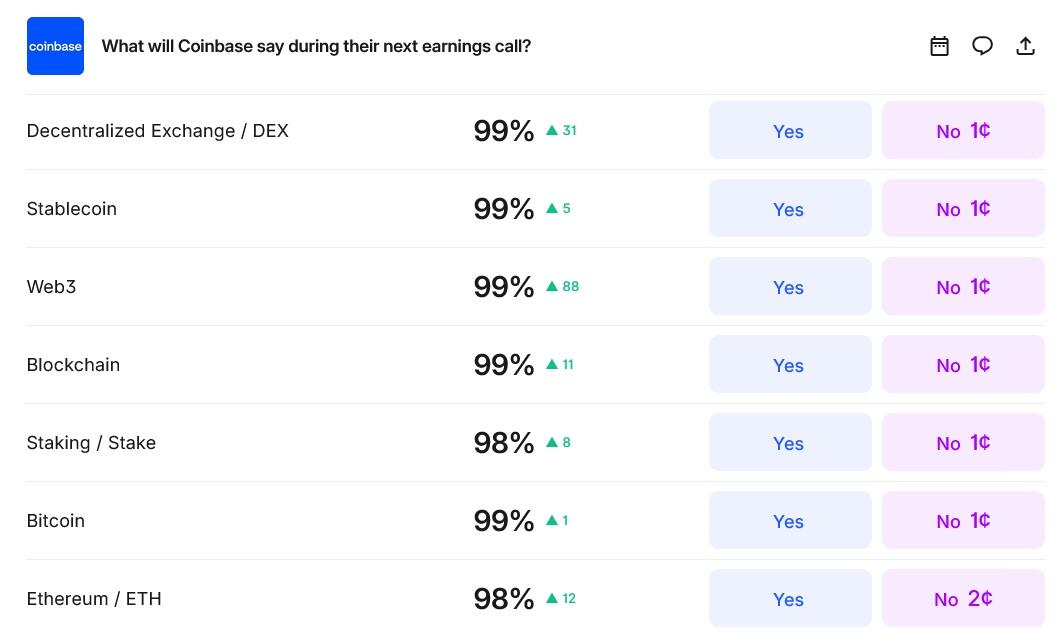
Coinbase boss Brian Armstrong shook up two prediction markets in the final seconds of Thursday’s third-quarter earnings call by dropping a list of crypto buzzwords that Kalshi and Polymarket users bet would be mentioned in the call, resolving all markets to a “yes.” 

Several Kalshi and Polymarket users were ecstatic that their bets paid off in the final seconds. In contrast, others were understandably rattled to hear that a prediction market could be so easily upended.  

“I was a little distracted because I was tracking the predictions market about what Coinbase will say in their next earnings call, and I just want to add here, the words Bitcoin, Ethereum, blockchain, staking, and Web3, make sure we get those in before the end of the call,” said Armstrong. 

The “What will Coinbase say during their next earnings call” markets from Kalshi and Polymarket saw $80,242 and $3,912 worth of bets placed.

That included 24 punters on Polymarket, where fortunately, no one lost more than $12 on a single bet. 

Armstrong later on X said it happened “spontaneously when someone on our team dropped a [prediction markets] link in the chat.”

Armstrong seemed to please more punters than not

Almost every punter in the comments section was pleased with Armstrong’s last-minute decision to list the crypto buzzwords not mentioned earlier.

“HAHAHAH THE GOAT BRIAN,” Polymarket user TheMasterMind said, while Kalshi users Redbullfool and Chungboy thanked Armstrong for the “gift.”

Mention words in Kalshi’s “What will Coinbase say during their next earnings call” market. Source: Kalshi 

While prediction markets are powerful tools for gauging expectations, they rely on the trust that insiders won’t won’t exploit their knowledge for personal gain.

Actions like this have previously raised suspicions of insider trading and market manipulation.

Coinbase performed well in Q3

Although the earnings call had an unusual conclusion, Coinbase delivered another profitable quarter, with $432.6 million in net income and $1.9 billion in revenue, representing a 55% increase from the same quarter in the previous year.

Coinbase also increased its Bitcoin holdings by 2,772 BTC to 14,458 BTC — putting it back in the top 10 largest corporate Bitcoin holding companies, BitcoinTreasuries.NET data shows.

Tyler Durden
Fri, 10/31/2025 – 08:55

via ZeroHedge News https://ift.tt/0owxPd3 Tyler Durden

In Yorgos Lanthimos’ Bugonia, Elites Are Alien Creatures


Emma Stone in 'Bugonia' | Focus Features

As movies that diagnose the modern condition go, you can’t do much better than Yorgos Lanthimos’ Bugonia. Lanthimos has always been cold and caustic, proffering oddball metaphors for the absurd state of existence. But those fantastic metaphors have often been a little too on the nose, and his coldness has sometimes read as self-satisfied smugness. In Bugonia, his absurdist streak finally seems to have landed somewhere in the vicinity of the real world. Or maybe the real world just caught up. 

The movie follows two young men, Teddy Gatz (Jesse Plemons) and Don (Aidan Delbis), as they plan and execute a plot to kidnap a corporate CEO, Michelle Fuller (Emma Stone).

Disheveled and disturbed, there is clearly something wrong with both men: Don is what press materials describe as neurodivergent, and he looks up to Teddy. Teddy, meanwhile, is clearly intelligent and possessed of a wild-eyed intensity. But after doing his research on YouTube, he’s become obsessed with the idea that aliens have secretly invaded Earth, taking human form in an elaborate plot to experiment on humans. The two call themselves the human resistance. And they believe that Michelle is an alien. 

What follows is, at heart, a series of exchanges between Teddy and Michelle. And their dialogue is a Lanthimos-ian metaphor for what’s broken about the world. Teddy spouts a series of manic, intricate, crazed-seeming theories about alien control and techno-enslavement. He’s gone deep on YouTube paranoia. Michelle responds by trying to talk to him like he’s an equal in her elite corporate world, negotiating and making calm and rational arguments. Teddy is an amateur beekeeper and one of his arguments is that bee colonies have started to collapse; he blames corporate-alien mischief and fears humans will follow. When Michelle responds that colony collapse disorder is more complicated than the nefarious and hard-to-follow plot he imagines and notes, accurately, that bee colonies have actually revived in recent years, he refuses to listen. When this strategy fails, she tries to diagnose him as afflicted by internet misinformation. It’s not his fault he’s been fed these lies. Teddy responds that he’s read all the New York Times essays, too. He doesn’t want to be condescended to, in the language of a thinkpiece. He’s read all of them, too. He doesn’t buy it. She’s an alien, and he knows it. 

This is the movie’s biting metaphorical conceit. They don’t know how to talk to each other. With her extreme wealth, her polished corporate-HR language, her expectation that the grimy world of Teddy’s basement will function like the gleaming glass world of her antiseptic corporate office, she really is like an alien. (That Teddy and Don have forcibly shaved her head, to prevent contact with her mothership, only adds to the effect.) Teddy and Michelle might as well be from different planets; they have incompatible ways of thinking, speaking, understanding, and being in the world. And they are both right about the baffling otherness of their interlocutor; She really is smug and unselfaware and superior in her ways—and he really is an erratic, paranoid, nobody obsessed with hairbrained ideas. Bugonia is a film about inequality, yes, but it’s not really about haves and have-nots. Instead, it’s about the unbridgeable cultural gap between these two people and their intertwined worlds. 

As the film progresses, we see that there is more to the story. Teddy works a tenuous job in a shipping fulfillment center for the company Michelle runs. And they share a history together through his mother, who was harmed by a novel treatment for opioid addiction developed by that company. His father was never around. It’s implied that a babysitter abused him. The movie doesn’t quite go easy on Teddy. But if that were your life, the movie seems to ask, wouldn’t you be a bit broken too? 

The back-and-forth between the two forms the core of the film’s second act, which spirals and escalates in madcap-yet-cogent ways. To a degree, the film resembles Fight Club, another bleak, satirical take on the modern condition that expanded and twisted its scenario in ways that weren’t exactly realistic but were driven by a relentless internal coherence. 

Like Fight Club, Bugonia probably won’t be for everyone, at least at first. It’s too dark, too unsparing, too grandiosely nihilistic, especially toward the end. But I found it thrilling, funny, and pointed—a movie that captures the contradictions of modern alienation by rendering it simultaneously plausible and absurd. 

The post In Yorgos Lanthimos' <i>Bugonia</i>, Elites Are Alien Creatures appeared first on Reason.com.

from Latest – Reason.com https://ift.tt/WGnHpea
via IFTTT

Zohranpocalypse?


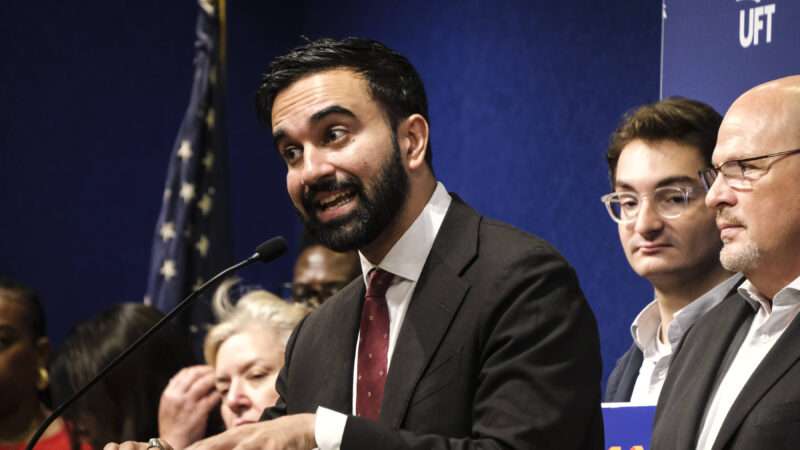
Mayoral Candidate Zohran Mamdani gets endorsed by the United Teachers Federation in downtown Manhattan on July 9th 2025. | IMAGO/Kaite Godowski / MediaPunch/IMAGO/MediaPunch/Newscom

What will Zohran do? Early next week, New York City is set to elect our first democratic socialist mayor (if we’re to believe the polls). The luxury-beliefs class is thrilled. The rest of us? Not so much. I, for one, don’t think Jews are about to be victimized by widespread antisemitic hate crimes that go unprosecuted, or that sharia’s about to come after me for the way I dress, or that we’re going to have to wait in breadlines to get anchovies and steak from Citarella. But I am confident New York will get worse in more insidious ways, and that national Democrats might take the wrong lessons away from this and seek to reproduce this candidate and these results elsewhere.

Transportation: First off, Zohran Mamdani has championed “fast and free buses.” This really misunderstands New York City’s transit problems and “feels like an argument imported from another city,” as journalist Megan McArdle put it on X.

As Janno Lieber—the Metropolitan Transportation Authority head—recently told a group of New York journalists, “compared to the whole country, people [here in New York] spend a lot less on transportation as part of their budgets.” The city already administers programs that subsidize fares for poor New Yorkers, and there are weekly fare caps so the lowest income New Yorkers are never expected to pay more than $17 in a given week on transportation—as many trips as they want, to anywhere within the five boroughs. About half of bus riders choose not to pay their fares, stealing from the system (which already has revenue issues). And a big issue making buses move slower is the rampant double-parking that happens in bus lanes—something authorities have begun to crack down on via automated ticketing by camera.

Mamdani seems to really misunderstand what slows buses down and which affordability issues actually bother New Yorkers, and he seems blissfully unaware of how the system is currently administered.

Public safety: Over the course of his campaigning, Mamdani has tried hard to distance himself from his earlier 2020–2023 sound bites about defunding the police (whose boot…on your neck…was “laced by the IDF“?):

“I don’t think the system actually makes us safer,” he said several years ago, referring to both the way prisons are run and to how policing is conducted, alluding to underlying problems and “trauma” that needs to be addressed.

He hasn’t really pivoted away from these underlying nonsensical views; he’s just tried to play a smarter PR game in recent months, recognizing that totally crapping on the NYPD won’t help him win. And he still seems in favor of some amount of diverting certain issues to social workers, an idea that looms large in the progressive imagination.

But public safety, more broadly, is an area where he might actually be able to do some damage: The mayor has a lot of control over the NYPD’s budget; Mayor Eric Adams restored funding for training to try to grow the police force.


Housing: Incredible.

Schools: “The mayor’s authority over education in New York has long been a political Rorschach test,” writes The New York Times.Supporters argue that it promotes accountability and makes possible large-scale changes, such as Mayor Bill de Blasio’s rollout of free prekindergarten for all 4-year-olds. Critics say it shuts teachers and parents out of decision making, and means that educational priorities can change with every election cycle.” Expect these dynamics to worsen as Mamdani takes charge.

Mamdani has said he wants to phase out gifted programs and gifted tracking for young students; he has at times said he wants to eliminate the specialized test administered to middle school students that allows some of them to gain entrance to the city’s eight elite public high schools (talking about how “segregated” such schools are, as if there was some sort of deliberate racism at play); and he has plans to create universal pre-K for all children, starting at 6 weeks of age. It’s unclear where he’ll get the money to fund such a high-cost initiative, and whether this will be a new program or an expansion of the 3-K program pioneered by Bill de Blasio.

(Policy aside: Mamdani, contra opponent Andrew Cuomo, actually wants less mayoral control over the city’s school system, but it’s not clear how he reconciles these issues with the system-wide changes he’s advocating, like axing certain gifted and talented programs; and some mayoral-control critics are in fact in favor of giving more power to teachers and their unions, not to parents, so it’s not totally clear what flavor of devolution Mamdani supports—to the extent that he’s thought about the mechanism at all.)

In some cities, mayors are sort of pointless figureheads, in charge of relatively little. This is not the case in New York City.

The mayor can “appoint hundreds of commissioners, department heads, their deputies and other senior managers without the advice and consent of the City Council,” notes Vital City. He oversees 300,000 employees and an annual budget of more than $115 billion. The mayor totally controls the Department of Education (“a function often overseen by semi-independent Boards of Education in other cities,” adds Vital City) and there are relatively few checks on his power. Some entities, like the MTA, actually respond to the governor, which makes it a little funny that Mamdani has made transit issues such a huge part of his campaign, given the relatively little control he will have there.

But Mamdani seems to believe he’ll have powers that he won’t have, and seems to advocate for an all-out war on the rich, whom he seems to view as cash cows who will serve as infinite revenue streams, never changing their behavior—or their domicile—to avoid such abusive treatment.

“To pay for his plans, Mr Mamdani proposes two tax hikes: an additional tax of 2% on incomes of more than $1m a year, and raising the top state corporate-tax rate to 11.5%, from 7.25%,” reports The Economist, which he seems to believe will raise $4 billion and $5 billion. But, “mayors cannot set income or business taxes. Hiking them would require the state legislature to act, plus the governor’s signature. And Kathy Hochul, New York’s Democratic governor, has already ruled the idea a nonstarter.” So that’s good, but also somewhat weird that Mamdani doesn’t appear to realize this.

Perhaps the real problem—aside from the fact that my fellow New Yorkers seem persuaded by Mamdani’s bad policy proposals and disturbing rhetoric; aside from the fact that Mamdani doesn’t seem to know which powers he would have and which he wouldn’t; aside from the fact that the sort of generic, vague antisemitism and 9/11 disrespect is unnerving—is that Democrats nationally might overextrapolate from this likely win. Mamdani ran against an incumbent who messaged badly and was plagued by corruption scandals, and a former governor who had resigned that post embroiled in multiple scandals. One takeaway they might have is that Mamdani was a post-wokeness candidate who made cost of living the center of his platform. I think that would be a decent takeaway, leading to them running better/more serious candidates, but I don’t really buy that that’s what’s happening here:

I think it’s simpler: Mamdani is fresh and new and reminds the luxury-beliefs liberal-arts-school class of themselves. He’s a class-solidarity vote. He’s one of them. And he was running against rather bad opponents who read as blatantly corrupt. He won’t improve the cost of living in the slightest, and he will be forced to confront over and over again that he doesn’t actually have the budget to do the things he wants. And over here in Roundupville, we get constant entertainment as other people discover in real time that socialism lite isn’t, in fact, all that great.


Scenes from New York: 


QUICK HITS

  • Looks like China has a ton of bargaining power—and has started to use it, securing rather favorable trade deals from Trump.
  • Inside the rise of Luddite clubs. (“People are just sick of this march forward and having to view technology as progress,” sociologist Caitlin Begg tells The New York Times. “They don’t want their time and attention to be commodified anymore.”)
  • “Defense Department officials do not know precisely who they have killed in multiple military strikes against alleged drug smuggling boats in the Caribbean that have claimed the lives of at least 57 people, according to Democratic lawmakers who attended a classified House briefing on the issue Thursday,” per Politico. Military lawyers were apparently “pulled from the briefing shortly before it started” and members of Congress from both parties “were left frustrated over the lack of clarity on the justifications for the military actions.”
  • “Children born to mothers infected with covid-19 during pregnancy faced a higher risk of autism, along with other neurological differences such as delays in speech and motor development, according to a study published Thursday,” reports The Washington Post. “The analysis of more than 18,100 births in Massachusetts, published in the journal Obstetrics and Gynecology, is among the largest studies to date examining children born to women who contracted the virus starting in the early months of the pandemic through some of 2021, before vaccines were widely available.…as an observational study, the findings do not prove that covid-19 causes the conditions diagnosed in children, but rather signal an association between maternal infection and these outcomes.”
  • Insane:

The post Zohranpocalypse? appeared first on Reason.com.

from Latest – Reason.com https://ift.tt/ExrZfLs
via IFTTT

Palestinian Youth Movement Social Media Posts with “No Justice, No Peace” Urging Protest Outside Synagogue Are Protected Speech

From Helmann v. Codepink Women for Peace, decided June 13 by Judge Stephen Wilson (C.D. Cal.), but just posted on Westlaw; I blogged earlier today about a different facet of the case, which allowed a threats claim to go forward against CodePink for its social media posts, but the court also rejected the claim against the Palestinian Youth Movement for its posts. First, the background:

This case arises out of the events that took place at the Adas Torah [Orthodox] Synagogue … on June 23, 2024 … in Los Angeles’s Pico-Robertson neighborhood.

On June 23, 2024, the Synagogue held its usual religious services: a morning, afternoon, and evening prayer. That same day, the Synagogue also hosted a special “Aliyah Event,” where a real estate company presented opportunities to purchase homes in Israel. According to the complaint, this event held religious significance for many attendees, who view moving to Israel as a fulfillment of a religious commandment. Similar events often include prayer or Torah study and are generally understood by the community as religious in nature.

{Defendants contest the religious nature of the Aliyah Event, largely because Plaintiffs’ claims depend in part on whether they were attempting to enter the Synagogue to exercise their First Amendment rights. The complaint contains detailed allegations regarding the religious nature of the Aliyah Event, e.g. that a common belief among Orthodox Jews is that returning to and dwelling in Israel is a religious commandment. At the motion to dismiss stage, the Court takes Plaintiffs’ allegations regarding the religious nature of the Aliyah Event as true and therefore that attempts to enter the Synagogue to attend that event pertained to an exercise of First Amendment rights. In any event, several Plaintiffs allege that they attempted to enter the Synagogue at least in part for a squarely religious purpose, e.g. to attend prayer services.}

Plaintiffs sued various defendants over various roles in what they characterized as “a mob” that assembled outside the Synagogue; some members allegedly engaged in violence against some of the synagogue-goers. Here, I’ll focus on claims that certain posts were “threat[s] of force” and thus violated the FACE Act, the Freedom of Access to Clinic Entrances Act of 1994; that law bars interference through obstruction, force, or threat of force not just with reproductive health facilities but also with places of religious worship.

The PYM social media posts call on their supports to “STAND AGAINST SETTLER EXPANSION AT SUNDAY’S REAL ESTATE EVENT SELLING HOMES TO BUILD ‘ANGLO NEIGHBORHOODS’ IN PALESTINE.” The post continues by describing the Aliyah Event as a “blatant example of land theft” perpetrated by “[r]acist settler expansionists.”  The posts finish with “FROM THE BELLY OF THE BEAST NO JUSTICE, NO PEACE.”  Plaintiffs allege, “upon information and belief,” that the phrase “belly of the beast” refers to a synagogue.

Even if “belly of the beast” refers to the Synagogue, these posts are not true threats. At most, they express a political message: if there is no justice for Palestinians, there will be no peace—even in religious spaces.

That kind of message is too vague to qualify as a true threat. To be sure, the posts may invoke violent imagery—”no peace” inside of the Synagogue. But “mere advocacy of the use of force or violence does not remove speech from the protection of the First Amendment.” NAACP v. Claiborne Hardware Co. (1982). For example, in Claiborne, even the statement, “if we catch any of you going in any of them racist stores, we’re gonna break your damn neck,” was protected speech.

To lose this First Amendment protection, a statement must be “a serious expression of an intent to commit an act of unlawful violence to a particular individual or group of individuals”—i.e., a “true threat.” PYM’s post does not meet that standard. It targets no individual. It makes no specific threat.

The Supreme Court has upheld similar speech. In Watts v. United States (1969), a protester said: “if they ever make me carry a rifle, the first man I want to get in my sights is L.B.J.” The Court held that the statement was not a true threat. Rather, it was “political hyperbole.”

PYM’s post follows the same structure: a conditional statement tied to a political grievance. To paraphrase PYM’s posts, “if there is no justice, then there will be no peace—even in a synagogue” mirrors the logic of the statement in Watts: if the speaker is drafted, he will target the President. Both are vague expressions of protest—not direct, credible threats. Like the language in Watts, PYM’s statement is “political hyperbole,” “expressly conditional.” and too imprecise to strip it of First Amendment Protection.

This difference between PYM’s posts and true threats is well illustrated by Planned Parenthood. There, anti-abortion activists published “GUILTY” posters naming abortion providers that closely resembled earlier “WANTED” posters. Id. at 1085. After doctors appeared on those earlier posters, they were murdered. Id. at 1085. In that context, the Ninth Circuit said the “GUILTY” posters’ message was clear: “You’re Wanted or You’re Guilty; You’ll be shot or Killed.”

And of course, the Court applied that same reasoning to CodePink’s posts. CodePink’s posts placed the Synagogue’s address in an inverted red triangle. Plaintiffs alleged that symbol is used by Hamas to identify Jews and Jewish targets for “extermination.” That kind of symbol, placed over a specific address, sends a “serious expression of intent to inflict bodily harm.”

PYM’s posts are different. They do not use symbols historically linked to violence. And there are no allegations that phrases like “no justice, no peace” or “belly of the beast” have led to violence. Without that kind of context or history, there is no basis to infer that these posts are true threats. They are political speech that call for protest—such speech is protected by the First Amendment.

Because PYM’s posts are not true threats, they cannot serve as a “threat of force” under the FACE Act. The Court therefore does not need to analyze Plaintiffs’ FACE Act claims against PYM any further—they fail at step one….

The post Palestinian Youth Movement Social Media Posts with "No Justice, No Peace" Urging Protest Outside Synagogue Are Protected Speech appeared first on Reason.com.

from Latest – Reason.com https://ift.tt/wrf0yHB
via IFTTT

Don’t Panic Over Federal Cuts for Homeless Programs


Homeless encampment |  Abaca Press/Europa Press/Abaca/Sipa USA/Newscom

The upset is palpable. News reports that the Trump administration is planning to cut state grants to build permanent housing for homeless people has led state officials and homeless activists to claim that the likely decision will send thousands of people back on the streets just as California is turning the corner on this massive problem.

The usually levelheaded CalMatters reported that the expected deep cuts are the “latest blow in a seemingly endless barrage of bad news for the California agencies tasked with fighting homelessness.” The “news has sent counties throughout California into a panic” and they are “bracing to lose hundreds of millions of dollars,” the publication added.

It’s time to take the proverbial chill pill. Yes, I believe the homelessness situation is a travesty and addressing it is a legitimate government function—for the sake of people living on the streets and the rest of us who want to reclaim public parks and sidewalks. But dig a little deeper, and the cuts might not be as troubling as expected. As Politico reported, those funds “will be cut and moved to transitional housing assistance with some work or service requirements.”

In other words, the money might not evaporate, but instead will be reprogrammed to support a different set of mostly reasonable policies. CalMatters noted the permanent-housing money pool “will shrink from $3.3 billion down to about $1.1 billion.” But that’s a nationwide number. So the “hundreds of millions of dollars” our state potentially loses is a rounding error in a total budget that tops $322 billion. If fighting homelessness is a priority, lawmakers can shift funds from less-urgent matters.

Sure, I dislike the Trump administration’s constant culture-war approach. Instead of analyzing what’s working and what isn’t, the White House is looking to remove funds from service providers that don’t conform to its conservative social views. As LAist reported, the administration’s new Continuum of Care rules penalize organizations and agencies from sanctuary cities, those that offer harm-reduction programs, and also those that recognize transgender people.

Drug addiction, immigration violations (mainly from recent asylum seekers), and mental illness are rampant among the homeless population, so it’s cruel to deny funds to groups that are on the front lines of the problem. Gender issues shouldn’t even come into play here. These groups need to assist anyone in dire straits. The feds ought to focus on providing help, not advance their tangential cultural agendas.

Nevertheless, I agree with the administration’s expectation that funding recipients “operate in a city, county, or state that prohibits public camping.” Unlike those other rules, this one applies directly to the homelessness problem.

The U.S. Supreme Court’s Grant’s Pass decision last year finally freed localities to clear out park encampments. It overturned the Ninth Circuit’s wacky Boise decision, which considered anti-camping statutes to be cruel and unusual punishment. Many California cities have taken advantage of the new latitude. Those that don’t should look for funding elsewhere.

So, California can fill in the gap—or localities can figure out ways to conform to the new guidelines, even if some of them are ridiculous. More significantly, our state needs to rethink its overall approach toward providing “permanent” housing.

The state’s official policy is called Housing First. As a fact sheet on the state’s Housing and Community Development website explains, “Under the Housing First approach, anyone experiencing homelessness should be connected to a permanent home as quickly as possible, and programs should remove barriers to accessing the housing, like requirements for sobriety or absence of criminal history.”

That approach is fine for a portion of the homeless population but is a failure as a broad-based policy for two reasons. First, it doesn’t address underlying social problems. Housing First was originally meant for mothers with young children who had suddenly lost their housing due to, say, a domestic-abuse situation. Fine, but it’s a recipe for disaster when applied to homeless people with debilitating addictions or mental delusions. They need social services, not just apartments. The state needs to consider a variety of options.

Second, California doesn’t build anything inexpensively and efficiently. With onerous state regulations and union work requirements, new permanent housing costs a fortune—and the state can’t build it quickly enough to meet the needs of 187,000 homeless people. Recent projects have cost upwards of $1 million a unit. The federal and state governments will never have the kind of money available to fix the problem at that rate. And, of course, the promise of “free” permanent housing will lure many people who could otherwise find their own accommodations. The waiting lists would be virtually endless.

California’s homeless population has been dropping after years of growth. But I’d be wary of those who claim that moving funds from permanent-housing programs will undo that welcome progress. Officials need to spend more time reforming existing programs and less time getting overwrought.

This column was first published in The Orange County Register.

The post Don't Panic Over Federal Cuts for Homeless Programs appeared first on Reason.com.

from Latest – Reason.com https://ift.tt/01f5SAX
via IFTTT

Futures Rebound Lifted By Strong Amazon, Apple Earnings

Futures Rebound Lifted By Strong Amazon, Apple Earnings

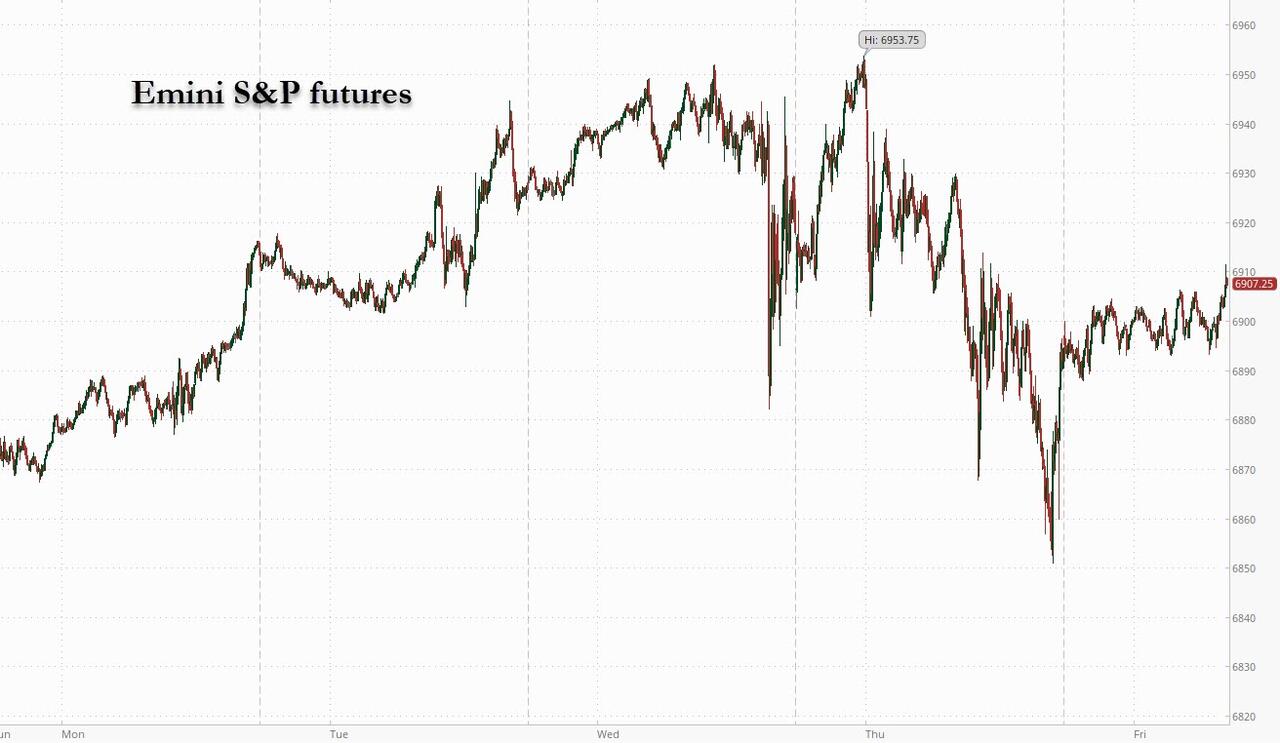
US equity futures rebound from the Thursday drop, led by Mag 7. As of 8:00am ET, S&P futures are 0.8% higher and Nasdaq futures gain 1.2%, on pace for sixth and seventh straight monthly gains respectively, with all Mag 7 names higher premarket, led by AMZN (+12.7%) and AAPL (+1.9%) after their robust earnings release (AWS sales growth of 19.7%, best since 2022 and AAPL’s revenue guidance) yesterday after-close. Europe’s Stoxx 600 fell for a fourth day, putting the gauge on track for its longest losing streak since July; in Japan, the tech-heavy Nikkei 225 closed up and notched its best month since 1990. Bond yields are flat, the USD is higher. Commodities are mostly lower; copper fell -2.4%. Today’s calendar slate includes October MNI Chicago PMI at 9:45am (several minutes earlier for subscribers); US government data continue to be postponed by shutdown that began Oct. 1.  Fed speaker slate includes Dallas Fed President Logan (9:30am) and Cleveland Fed President Hammack and Atlanta Fed President Bostic (12pm). Both CVX and XOM reporting earnings this morning.
In premarket trading, Mag 7 stocks are all higher: Amazon.com (AMZN) jumps 12% after the company’s cloud unit posted the strongest growth rate in almost three years, reassuring investors who were concerned that the largest seller of rented computing power was losing ground to rivals. Apple Inc. (AAPL) is up 2% after the company predicted a major sales surge during the holiday season after releasing new iPhones, helping assure investors that its flagship product remains a growth engine (Nvidia (NVDA) +2%, Alphabet (GOOGL) +1.2%, Meta Platforms (META) +1.4%, Tesla (TSLA) +1.2%, Microsoft (MSFT) +0.4%)

  • Brighthouse Financial (BHF) soars 22% after the Financial Times reports that Aquarian Holdings is in advanced talks to take the US life insurer private.
  • Charter Communications (CHTR) falls 5% after posting third-quarter results.
  • Cloudflare (NET) rises 8% after the software company forecast revenue for the fourth quarter that beat the average analyst estimate.
  • Coinbase (COIN) advances 4% after the largest US crypto exchanged reported third-quarter revenue that exceeded estimates following an uptick in trading as token prices climbed to record highs.
  • Dexcom (DXCM) sinks 12% after the glucose-monitor company cut its adjusted gross margin forecast for the full year.
  • Floor & Decor (FND) shares are up 7% after the home products retailer reported adjusted earnings per share for the third quarter that beat the average analyst estimate.
  • Illumina (ILMN) gain 6% after the gene-sequencing company boosted its adjusted profit and operating margin for the full year. Analysts note the better-than-expected results for the third quarter should help ease investor concerns.
  • Netflix Inc. (NFLX) gained more than 2% in premarket trading. The company approved a 10-for-1 stock split to make its share price more accessible for employees who participate in the company’s stock option program. Separately, Reuters reported the company is exploring a bid for Warner Bros. Discovery’s studio and streaming businesses.
  • Pony.ai (PONY) is up 4% after the autonomous vehicle technology company said it’s been granted Shenzhen’s first citywide permit for fully driverless commercial robotaxi operations.
  • Reddit (RDDT) gains 10% after the social-media company reported third-quarter results that beat expectations and gave an outlook that is above the analyst consensus.
  • Roku (ROKU) shares are down 4% after the streaming-video platform company reported its third-quarter results and gave an outlook. While analysts are broadly positive, they said the results aren’t enough to meet high expectations.
  • Western Digital (WDC) rises 9% as the computer-storage company reported better-than-expected 1Q results and its current quarter forecast came in largely ahead of estimates.

In corporate news, Exxon Mobil outperformed Wall Street expectations for a sixth consecutive quarter after beginning operations at its fourth oil-production project in Guyana. Chevron beat earnings estimates as profits from the $53 billion Hess Corp. acquisition were included in the results for the first time, boosting oil production and cash flow. Nvidia CEO Jensen Huang still hopes to sell chips from the company’s Blackwell lineup to customers in China, though he has no current plans to do so, he told reporters Friday. Millennium Management is raising $5 billion in a new fund to invest in private market opportunities.

US stock gains offered investors a respite from Thursday’s bruising session, amid lingering doubts over whether heavy AI spending will pay off. The S&P 500’s advance has increasingly relied on a group of tech megacaps – recent record highs were hit on record negative breadth – with warnings over lofty valuations following a blistering rally.

Volatility has become a feature rather than a bug — day-to-day swings now regularly move major stocks by hundreds of billions of dollars,” said Ulrich Urbahn, head of multi-asset strategy and research at Berenberg. “The feedback loop of investor sentiment, speculative positioning, and rapid news-driven reactions amplify these moves.”

On Friday, futures rose as Amazon jumped 13% in premarket trading, a move set to add about $300 billion to its market value after reporting the fastest cloud-unit growth in nearly three years. Apple also climbed on a revenue beat and upbeat holiday forecast. Nvidia meanwhile, unveiled new partnerships with South Korea’s biggest firms, extending a global push to expand artificial intelligence infrastructure. Friday’s market gains will seal the index’s longest monthly winning streak since August 2021, capping a rally that has withstood global trade tensions and geopolitical risks.

Earnings season remains top of mind with more than 60% of S&P 500 companies having reported to date, and a further 150 expected today and next week. Contrast of earnings receptions to AI spending has diverged within big tech, as investors seek quantification of how investments are benefiting related businesses.  Earnings have also broadly topped forecasts, with about 80% of S&P 500 companies that have reported so far beating expectations.

According to BofA’s Michael Hartnett, global equities drew $17.2 billion in inflows in the week to Oct. 29. Hartnett added that AI’s leadership remains firmly in place. Market breadth remains a concern for traders, and divergence notable between US and European equities. Michael Burry, the man who made his name shorting the US housing market, sent what appears to be a cryptic warning to retail investors about market exuberance. Equity performance in 2025 has been characterized by extreme concentration of volatility episodes, according to Barclays strategists.

“The risks are mainly flows. They have been the main driver, much more than EPS growth,” said Karen Georges, an equity fund manager at Ecofi. “If flows begin to halt on risky assets, then there will be a genuine selloff. But it’s like a black swan, you never know when it’s coming.”

On the trade front, Treasury Secretary Scott Bessent said he expects the US to return to the negotiating table with China in a year. That came after Donald Trump and Xi Jinping agreed to a tariff truce, roll back export controls and reduce other trade barriers. Xi also warned against “breaking supply chains” in his first public remarks after meeting with Trump. “A comprehensive deal still looks far away and while trade tensions have eased for the time being, they have the potential to resurface,” said Mohit Kumar, chief economist and strategist at Jefferies International.

In Europe, the Stoxx 600 fell for a fourth day, putting the gauge on track for its longest losing streak since July. Telecoms, insurance and construction stocks are dragging. Treasuries and European bonds relatively steady, with small outperformance at the short-end in gilts. Here are the biggest movers Monday:

  • Puig shares rose as much as 9.8% with trading volume almost 10 times the 20-day average after the Spanish group reported better-than-expected 3Q sales and upgraded its guidance for the last three months of the year
  • Fuchs shares gain as much as 12%, the most since March 2020, after the chemicals company reported a stronger-than-expected Ebit as North and South American markets improved from previous softness
  • Danske Bank gains as much as 2.8%, the most in a month, after the Danish lender reported solid third-quarter numbers, with analysts flagging strong core revenues and a slight beat to net interest income (NII)
  • Interpump shares rise as much as 6.8%. Equita analysts upgraded the Italian hydraulics and pumps manufacturer as they expect the stock to outperform thanks to improving margins and organic trends and see M&A opportunities
  • Kongsberg shares gain as much as 4.9% after a slew of analysts upgraded the stock following the Norwegian company’s results-driven declines on Thursday, leaving the firm with no sell or equivalent recommendations
  • UMG shares rise as much as 1.8% after the world’s largest record label delivered a beat on both revenue and adjusted Ebitda in the third quarter, with growth in the important subscription unit ahead of expectations
  • Erste shares rise as much as 4.1% as the Austrian lender raised its net interest income growth and CET1 capital ratio guidance. The bank sees its deal to buy Santander’s Polish unit on track to close around the year-end
  • Viridien shares rose as much as 26%, the biggest jump since 2020, after the French group reported operating profits well above expectations
  • Scor shares fall as much as 8.2%, the most since July, as analysts grew concerned about the reinsurance company’s solvency ratio and real estate amortization after it reported third-quarter results
  • Spie shares fall as much as 5.9% to the lowest since May as the France-based engineering services company’s third-quarter organic growth came up short
  • AXA shares dropped as much as 2.5% after the French insurer reported nine-month results. Jefferies highlighted the Solvency II ratio as the biggest news from the results, while Citi saw the update as uneventful
  • Saint-Gobain falls as much as 3.2%, to the lowest since mid-April, after reporting third-quarter like-for-like sales that missed consensus estimates, and expected to trigger small downgrades to consensus numbers
  • Acerinox falls as much as 3.4% after the stainless steelmaker said fourth-quarter Ebitda is expected to be lower than in the third quarter. Analysts see potential double-digit downgrades to full-year consensus
  • Elis shares fall as much as 1.2% after the French cleaning services group reported growth in Central Europe that missed estimates due to softness in Germany. This morning, the firm also said it will buy Larosé
  • Drax shares fall as much as 3.7% after UBS initiated coverage of the chemicals firm with a sell rating, saying too much optimism is priced in for the shares

Earlier in the session, Asia’s benchmark also pared its monthly advance.

In FX, the Bloomberg Dollar Spot Index is little changed Friday, set to gain 1.5% in October, which would be its second monthly advance this year. USD/JPY fell to 153.65 as inflation in Tokyo rose at a faster pace in October, backing the case for a Bank of Japan rate hike. It has since reversed losses, trading little changed around 154.12. In addition to Tokyo inflation, Japan’s better-than-expected industrial output in September also supported the yen earlier. Spot hit the session low after Finance Minister Satsuki Katayama said the government is monitoring the yen with a strong sense of urgency

In rates, US Treasuries steadied after two sessions of sharply higher yields; most yields were within a basis point of Thursday’s closing levels. US 10-year around 4.105% is just below Thursday’s high; bunds and gilts in the sector keep pace. Curve is slightly steeper, widening 2s10s and 5s30s spreads by less than 1bp on the day. Price action in European bonds is similarly muted following French and euro-area inflation data for October. 

In commodities, gold lower and hovering around $4,000/oz. Oil falling, with Brent short of $65/barrel. Oil set for a third monthly loss.

US economic calendar slate includes October MNI Chicago PMI at 9:45am (several minutes earlier for subscribers); US government data continue to be postponed by shutdown that began Oct. 1.  Fed speaker slate includes Dallas Fed President Logan (9:30am) and Cleveland Fed President Hammack and Atlanta Fed President Bostic (12pm)

Market Snapshot

  • S&P 500 mini +0.7%
  • Nasdaq 100 mini +1.2%
  • Russell 2000 mini little changed
  • Stoxx Europe 600 -0.3%
  • DAX -0.4%
  • CAC 40 -0.1%
  • 10-year Treasury yield +1 basis point at 4.1%
  • VIX -0.8 points at 16.15
  • Bloomberg Dollar Index little changed at 1218.88
  • euro little changed at $1.157
  • WTI crude -0.6% at $60.18/barrel

Top Overnight News

  • Trump Urges Republicans to End the Filibuster to Reopen Government. WSJ
  • Elon Musk’s SpaceX Set to Win $2 Billion Pentagon Satellite Deal. WSJ
  • Private Credit’s Rising Pile of ‘Bad PIK’ Points to Default Woes. BBG
  • A narrow Pacific waterway is at the heart of U.S. plans to choke China’s vast navy. RTRS
  • China’s factory activity slumped for the longest streak in more than nine years, prompting fresh calls for greater policy support even as the country reached a trade truce with the US. BBG
  • Trump’s exit is Xi’s cue to take centre stage at APEC. RTRS
  • More Home Purchases Are Falling Through in an Uncertain Economy. WSJ
  • King Charles strips brother Andrew of titles and his mansion. RTRS
  • The great AI buildout shows no sign of slowing. RTRS
  • Disney Channels Go Dark on YouTube TV. WSJ
  • Big Tech Is Spending More Than Ever on AI and It’s Still Not Enough. WSJ
  • China signals sharper pivot to consumption as imbalances worsen. RTRS
  • The Japanese government is monitoring the yen with a strong sense of urgency, Finance Minister Satsuki Katayama said, sending her first clear warning on currency movements since taking on her role. BBG
  • Inflation in Tokyo rose at a faster pace, supporting the case for the Bank of Japan to keep raising interest rates gradually and giving the yen a boost. BBG
  • Japan’s new Prime Minister Sanae Takaichi told China’s President Xi Jinping her concerns over his country’s rare earth export restrictions in their first formal meeting, as tensions spanning from trade to security continue to simmer between the two countries. BBG
  • US President Trump’s administration fired Fannie Mae ethics officials, according to WSJ.
  • NVIDIA (NVDA) CEO Huang told reporters that he hopes to sell the Blackwell chip to China, but as it stands there are no plans to do so. Sales were not a topic of discussion during the meeting with China’s Council for the Promotion of Trade. Co. has been growing quickly, but in the last six months this has accelerated “quite substantially”.

Trade/Tariffs

  • Chinese President Xi called for safeguarding multilateral trade at the APEC summit and urged members to practice true multilateralism, while he called on APEC to keep industrial and supply chains smooth and stable. Xi said APEC should promote an open regional economic environment and called for promoting trade and investment liberalisation, as well as urged members to jointly promote the digitalisation and greening of free trade.
  • China’s top trade negotiator Li Chenggang said they will conduct studies on international standards, economic and trade rules, and continue to meet them in terms of green standards. Li said export volume of photovoltaic products exceeded CNY 200bln for four consecutive years, and that export volume of electric vehicles exceeded 2mln units for the first time last year. Furthermore, he said green vehicles such as locomotives have also maintained strong growth and that China will continue to adapt to the global trend of green and low-carbon development.
  • South Korean President Lee said they are at a critical inflection point of change in global order, and global trade uncertainty is deepening.
  • EU officials will today be informed about a visit by US Commerce Secretary Lutnick to the EU on November 24th for trade talks, via Politico.
  • Japan’s PM Takaichi to Chinese President Xi says she would like to confirm basic direction of Japan-China relation, including building constructive and stable ties.

A more detailed look at global markets courtesy of Newqsuawk

APAC stocks traded mixed as the region digested recent earnings releases and a data deluge at month-end. ASX 200 was flat as gains in mining, materials and resources were offset as defensives lagged. Nikkei 225 outperformed and climbed above the 52,000 level to print a fresh all-time high after recent currency weakness and the lack of immediate rate hike signals from the BoJ, while participants digested a slew of data, including a higher Unemployment Rate, hot Tokyo CPI and a rebound in Industrial Production. Hang Seng and Shanghai Comp were amid losses in tech stocks, and after Chinese Manufacturing PMI data missed expectations and showed a faster pace of contraction in factory activity

Top Asian News


  • Japanese Finance Minister Katayama said discussions on lowering gasoline prices have progressed, including sources for funding, while she added that the Bank of Japan’s recent decision was extremely reasonable and that monetary policies are up to the BoJ to decide. Katayama also commented that they are recently seeing one-sided and rapid moves, as well noted, it is important for currencies to move in a stable manner reflecting fundamentals and they are closely watching foreign exchange moves with a high sense of urgency.

European bourses (STOXX 600 -0.4%) opened mostly lower and have traded with a negative bias throughout the morning. Pressure which lacks a fresh catalyst, but follows on from a tentative APAC session. European sectors hold a strong negative bias, with only a few sectors managing to hold afloat. Banks buoyed by upside in the likes of Danske Bank (+1.8%) and Caixabank (+1.4%), post-earnings. Construction & Materials is found right at the foot of the pile, pressured by losses in Saint-Gobain (-1.9%), after it missed on its Q3 revenue figure.

Top European News

  • ECB’s Rehn says keeping interest rate unchanged is justified due to uncertainty about inflation outlook in the coming years. The impact of tariffs on inflation appears to be disinflationary.
  • ECB’s Muller says economic situation has gradually improved and current interest rates level is appropriate.
  • ECB’s Kazaks says ECB will move when needed but shouldn’t be ‘jumpy’, growth is still weak with high uncertainty. Should not overinterpret 2028 inflation outlook.

FX

  • DXY is slightly firmer and currently trading at the mid-point of a 99.41-99.66 range. Nothing really behind the mild strength today, but it does comes amid elevated yields in the aftermath of the hawkish Powell presser. Focus for the day will be on the Chicago PMI and commentary from Fed’s Logan and Bostic; Miran and Schmid will also likely explain their recent dissent. As a reminder, Miran voted for a 50bps cut, whilst Schmid opted for U/C.
  • EUR is flat vs the USD, trading in a tight 1.1556-1.1577 range. The single-currency was little moved on the ECB decision itself, and President Lagarde lacked surprises at her presser thereafter. Following the announcement, Reuters sources suggested that ECB policymakers are preparing for a December showdown on inflation and rates. Some favour a cut, to prevent undershooting in 2028 whilst others give little weight to longer-term outlooks. Turning to this morning, a few ECB members have provided commentary; Rehn said keeping rates steady was justified due to uncertainty, Muller said current interest rates are appropriate and Kazaks suggested the ECB should not be “jumpy” adding that growth is still weak. On data, little move to the EZ HICP, whereby the headline printed in-line with expectations at 2.1% (prev. 2.2%); core and super-core metrics remained unchanged from the prior, defying the forecast for a slight moderation.
  • GBP is a touch softer vs the broadly firmer Dollar; currently trading within a narrow 1.3126-1.3164 range. Really not much by way of fresh in terms of the UK’s Budget, but traders are now weighing up possibilities of a Budget without Chancellor Reeves. In more detail, in the last few days, Reeves reportedly breached renting-related rules, forcing her to apologise for the mistake. There were calls for her to resign, though PM Starmer poured cold water on those suggesting that there is “no need” for further action. GBP did sour a touch in recent sessions, but has since stabilised as PM Starmer backed his Chancellor.
  • JPY is a touch lower today and trades within a 153.66 to 154.41 range. Overnight the pair saw modest pressure following a hotter-than-expected Tokyo CPI report, which saw the Y/Y jump to 2.8% (exp. 2.4%, prev. 2.4%). Also in focus for the Yen was some jawboning from the Japanese Finance Minister Katayama who said he has been recently seeing one-sided, rapid moves, adding that, he is closely watching foreign exchange moves with a high sense of urgency.
  • Antipodeans are underperforming today, continuing the pressure seen in the APAC session. Downside which follows on from subdued Chinese Manufacturing PMI, and amidst a tentative risk tone in Asia and into the European session.

Fixed Income

  • USTs are under modest pressure early doors amid the constructive performance of US equity futures as numbers from Amazon and Apple drive the region, and particularly the NQ, higher. Additionally, the debt space has been hit by Meta announcing USD 30bln of issuance, the largest corporate HG offering this since 2023 and the largest Meta has ever tapped the market for. Newsflow this morning has been light as we await upcoming Fed speakers. Into those, UST are towards the trough of a 112-17+ to 112-23+ band with downside of 5+ ticks at most. The low is just a tick above Thursday’s 112-16 post-Powell base. The Fed docket begins with Logan (2027), Bostic (2027) and Hammack (2026); however, the topics don’t appear to be directly pertinent to current/future monetary policy. Instead, the main focus will likely be on the dissent texts from Miran (voted for a 50bps cut, again) and Schmid (voted for U/C).
  • Bunds are weighed on in-fitting with the above. Down to a 129.16 trough into the flash EZ HICP print, posting losses of c. 20 ticks at worst. Little move on the EZ HICP, whereby the headline printed in-line with expectations at 2.1% (prev. 2.2%); core and super-core metrics remained unchanged from the prior, above expectations. Ultimately, the print does not change the narrative for the ECB that inflation remains near target and the outlook is broadly unchanged. As a reminder, post-ECB Reuters sources added to the known narrative around December; that the 2028 inflation forecasts could spark a ‘showdown’ on inflation and by extension interest rates, as the 2028 projection could print in favour of easing.
  • Gilts opened lower by 18 ticks at the benchmark reacted to the overnight pressure from US earnings and Meta issuance. Thereafter, Gilts fell another 10 to a 93.44 trough but still clear of Thursday’s 93.29 base and the WTD low of 93.15 from Monday. Specifics for the UK are relatively light, domestic press remains focussed on the rental blunder by Chancellor Reeves. As it stands, PM Starmer is standing by her but the scandal could ultimately lead to her dismissal; given how close we are to the Autumn Budget, if that occurs before the replacement would likely be a continuity-appointment to essentially deliver Reeves’ budget.

Commodities

  • Crude benchmarks are on the backfoot but remain rangebound as the market waits for the OPEC+ meeting at the weekend. Currently, WTI and Brent are oscillating in a tight USD 60.02-60.53/bbl and USD 63.83-64.33/bbl range respectively. On the Gaza ceasefire, it was reported that the US has allowed Israel to enforce the ceasefire and fire at Hamas targets behind the yellow line where the IDF holds in Gaza. Artillery shelling has been reported inside the yellow line east of Gaza city. However, this news has not shifted crude prices.
  • Spot XAU followed on from Thursday’s rebound, extending to a peak of USD 4046/oz in the early hours of the APAC session before falling back lower to a trough of USD 3988/oz. XAU remains above USD 4k/oz, currently trading at 4003/oz, as the market digests a week of central bank announcements.
  • Base metals continue to fall despite the positive China-US talks held in the early hours of Thursday’s session. Following Thursday’s selloff weighed on by dollar strength, 3M LME Copper rebounded in the latter hours of Thursday’s session and peaked at USD 10.98k/t as the APAC session got underway. The red metal fell to a trough of USD 10.86k/t and oscillated in a tight c. USD 40/oz before extending on the day’s losses. Thus far, 3M LME Copper remains near session lows at USD 10.83k/t.
  • Oman December crude OSP at USD 65.06/bbl (prev. USD 70.01 M/M), via GME data.
  • China Iron and Steel Association said China’s apparent steel consumption from January to September fell 5.7% Y/Y to 649mln metric tons, while it added that apparent steel consumption in 2025 is expected to fall for a fifth straight year.

Geopolitics

  • Palestinian media reports Israeli raids targeted Khan Younis in the southern Gaza Strip, according to Sky News Arabia.
  • US reportedly cancelled the Trump-Putin meeting after Moscow sent a memo to Washington, as the Russian Foreign Ministry’s maximalist demands for ending the Ukraine war led to the US scrapping the planned meeting in Budapest, according to FT.
  • Russia’s Kremlin on FT report that US President Trump and Russia’s President Putin meeting is cancelled says “I’d refer you to Russia’s Foreign Ministry statement, not newspapers reports”.
  • US President Trump’s administration identified targets in Venezuela that include military facilities used to smuggle drugs, according to WSJ citing US officials familiar with the matter. Furthermore, the officials stated that if Trump decided to move forward with airstrikes, the targets would send a clear message to Venezuelan leader Maduro that it is time to step down.
  • US Secretary of Defense Hegseth met with Chinese counterpart Dong Jun, which he said was a good and constructive meeting, while he highlighted the importance of maintaining the balance of power in the Indo-Pacific. Furthermore, he highlighted US concerns about China’s activities in the South China Sea and said the US will continue to stoutly defend its interests.

US Event calendar

  • 8:30 am: Sep Personal Income, est. 0.4%, prior 0.4%
  • 8:30 am: Sep Personal Spending, est. 0.4%, prior 0.6%
  • 8:30 am: Sep Real Personal Spending, est. 0.18%, prior 0.4%
  • 8:30 am: Sep PCE Price Index MoM, est. 0.3%, prior 0.3%
  • 8:30 am: Sep PCE Price Index YoY, est. 2.8%, prior 2.7%
  • 8:30 am: Sep Core PCE Price Index MoM, est. 0.2%, prior 0.2%
  • 8:30 am: Sep Core PCE Price Index YoY, est. 2.9%, prior 2.9%
  • 8:30 am: 3Q Employment Cost Index, est. 0.9%, prior 0.9%
  • 9:45 am: Oct MNI Chicago PMI, est. 42, prior 40.6

DB’s Jim Reid concludes the overnight wrap

Happy Halloween to you all. My main skill today will be to persuade my family that although I’m a bit more mobile now, the risks of going trick or treating is just too great so soon after the back operation. I’m not convinced that will fly. I may threaten to show off my two huge operation scars to frighten everyone! The whole family have extravagant outfits delivered yesterday from Amazon with every accessory imaginable. No wonder their results were so good last night.

Indeed just as the tech mood had soured yesterday, this morning that has mostly turned around following results from Apple and Amazon after the closing bell. Amazon’s shares surged by +13% in post-market trading as its cloud revenue grew +20% y/y, the fastest since 2022. So that boosted sentiment on what has been the weakest performing of the Mag-7 stocks this year, with only a +1.58% YTD gain after yesterday’s -3.23% decline.  Meanwhile, Apple saw a +2% after-market gain as it projected 10-12% revenue growth in the current quarter (vs. +6% est.) driven by stronger iPhone sales. US equity futures are erasing much of yesterday’s decline this morning, with those on the S&P 500 up +0.65% and on the NASDAQ up +1.21%.

This renewed momentum has helped sentiment after a more challenging day yesterday despite the positive outcomes from the US-China trade discussions. Investor concerns over AI-related capital expenditure resurfaced, highlighted by Meta’s sharp decline of -11.33% after results after the closing bell on Wednesday night. The company also announced a $30 billion bond issuance – the largest in over two years – to fund its operations. So not all capex is being funded out of cash! Nvidia also fell -2.00% as investors didn’t received any clarity on possible Blackwell chip sales to China. Overnight Trump has actually said that they didn’t talk about Blackwell specifically. These developments curtailed the recent equity rally, with the S&P 500 down -0.99%, the Nasdaq off -1.57%, and the Magnificent 7 sliding -2.73%. We could get a bounce back today.

One of the more fascinating stories yesterday was Meta’s $30 billion bond sale announcement, aimed at supporting its AI growth and infrastructure. US IG was a couple basis points wider yesterday to make room for the deal. A deluge of corporate bond issuance also appeared to push up Treasury yields early in the US session, with 10yr yields closing +2.1bps at 4.10%. Meta’s shares were already falling before the deal was announced due to disappointments in the earnings release the night before. Initially they dropped as much as -13.50% before closing -11.33% lower – its largest fall since the autumn 2022 bear market. This followed Wednesday’s disclosure that Meta expects to spend up to $72 billion on capital expenditures this year, primarily on datacentres and infrastructure, with further increases anticipated in 2026. Investors are increasingly questioning the return on such spending, particularly given Meta’s revenue-to-capex ratio of just 3.02—the lowest among its peers.

Markets are also still digesting the outcome of the meeting between President Trump and President Xi Jinping in South Korea. While most agreements had been priced in beforehand, the two leaders agreed to a one-year trade truce until November 2026. The US will reduce its fentanyl-related tariff from 20% to 10%, and China will remove its 10–15% retaliatory tariffs on various US agricultural products and delay rare earth export controls announced earlier this month. Despite this stabilisation, structural differences persist, and it’s easy for there to be some scepticism of the deal’s scope due to the lack of concrete commitments. The sense that we are seeing more of an extended truce rather than a de-escalation was added to by US Trade Representative Greer confirming last night that the US will continue a recently opened probe into China’s compliance with the limited trade agreement reached during Trump’s first term.

Asian equity markets saw mixed performance this morning, with the Nikkei (+2.03%) and KOSPI (+0.5%) helped by gains in semiconductor and AI-related stocks. The S&P/ASX 200 is flat with China risk lagging on poor PMI data.  The CSI (-1.14%), Hang Seng (-0.88%), and the Shanghai Composite (-0.75%) are all lower.

With regards to that data, the official manufacturing PMI for October was reported at 49.0, compared to the expected 49.6, down from 49.8 in September, and the lowest for 6 months. The non-manufacturing PMI increasing to 50.1 in October as anticipated. However, the weakness in manufacturing has caused the composite PMI to decline to 50.0 in October from 50.6.

In Japan, Tokyo’s core CPI increased by 2.8% in October, surpassing expectations (2.6%) and underscoring ongoing inflationary pressures. Ueda yesterday seemed to place more emphasis on monitoring things like progress on the next spring Shinto wage negotiations and how the economy was dealing with tariff uncertainty. So this higher inflation alone won’t seemingly change much. Also in Japan, factory output in September rose by 2.2% from the previous month, exceeding market forecasts of a 1.5% increase, while retail sales showed a modest year-on-year rebound of 0.5%, compared to the expected 0.7%, indicating fragile domestic demand. Additionally, Japan’s unemployment rate unexpectedly remained stable at 2.6% in September (expectations at 2.5%).

Turning to Europe, the ECB held rates steady at 2% for the third consecutive meeting, citing mixed signals on growth and inflation. President Christine Lagarde reiterated that policy is “in a good place”, though she emphasised it is “not a fixed place”, and the ECB will act as needed to maintain stability. While there were no material surprises, our economists note that if anything the ECB seemed a little more confident about growth amid all the uncertainties, continuing a trend of increasingly less dovish statements. They continue to see the ECB as having reached the end of its easing cycle (see their reaction here). Market expectations for ECB rate cuts remain muted, with just 11.6bps of cuts priced by next September (-0.7bps on the day).

European sovereign yields moved modestly higher, with the 10yr Bund yield up +2.2bps, OATs +1.7bps, and BTPs +1.7bps. That rise in yields was supported by decent Euro area Q3 GDP data, with quarter-on-quarter growth at +0.2% (vs. +0.1% expected). Germany posted flat growth (0.0% vs. 0.0% expected), while France outperformed at +0.5% (vs. +0.2% expected). You can view our economists’ note here. Positives include strong private sector savings, fiscal policy flexibility (except in France), and a less restrictive monetary outlook. However, US tariffs remain a headwind. Despite the stronger-than-expected growth, the Stoxx 600 (-0.10%) lost ground, with France’s CAC (-0.53%) and Spain’s IBEX (-0.68%) leading the decline.

In commodities, gold rebounded above $4,000/oz, rising +2.40%. Brent crude saw a modest gain, climbing to $65.00/bbl (+0.12%), after President Trump indicated that China will begin importing oil and gas from Alaska.

In other news, liberal Dutch leader Rob Jetten is poised to become the next prime minister in the Netherlands after the D66 party performed better than expected in Wednesday’s parliamentary elections. This marks a shift back to the centre following the 2023 elections, which were won by the far-right Freedom Party, now set to lose 11 seats.

Looking ahead to today, the main release will be inflation data in Europe, with October CPI due for France, Italy and the Euro area. We’ll also hear from Fed officials Logan, Hammack, and Bostic, while key earnings reports are expected from ExxonMobil, AbbVie, and Chevron.

Tyler Durden
Fri, 10/31/2025 – 08:37

via ZeroHedge News https://ift.tt/pUqrM6s Tyler Durden

Air Traffic Controllers Ask Public For Donations As Shutdown Drags On

Air Traffic Controllers Ask Public For Donations As Shutdown Drags On

Authored by Jill McLaughlin via The Epoch Times (emphasis ours),

Air traffic controllers who missed their paychecks for the first time on Oct. 28 during the ongoing government shutdown gathered at several airports nationwide to ask the public for donations.

An air traffic control tower at Los Angeles International Airport on Oct. 28, 2025. John Fredricks/The Epoch Times

Controllers passed out leaflets at 20 airports to also ask people to call their congressional representatives and urge them to reopen the government.

The effort was organized by the National Air Traffic Controllers Association, which represents nearly 20,000 controllers, engineers, and other safety-related professionals across the United States.

Association President Nick Daniels joined Transportation Secretary Sean Duffy at New York’s LaGuardia Airport on Tuesday for a press conference about the missing paychecks.

The shutdown has strained the nation’s network of air traffic controllers, causing flight delays and cancellations as staff shortages leave some towers without enough support, officials reported.

The extra stress of worrying about putting food on the table and paying rent has exacerbated the crisis, according to Daniels.

“America’s air traffic controllers are now having to focus on how do they put gas in their car? How do they take care of their children? How do they pay for child care?” Daniels said. “That makes the system less safe.”

He urged people to contact their congressional representatives to take action and end the shutdown.

These hardworking men and women are showing up to do their jobs,” he said.

Duffy said many long-serving controllers can survive without this first paycheck because they have planned for days such as these. But many new controllers who are still in training can’t handle not being paid.

Some controllers have taken on second jobs with Uber, DoorDash, and other services to get through the shutdown, he said.

But missing another paycheck would be devastating for most of them, he said.

Transportation Secretary Sean Duffy speaks about how the government shutdown is affecting travel at airports throughout the country during a press conference at LaGuardia Airport in New York City on Oct. 28, 2025. Michael M. Santiago/Getty Images

“Almost every controller can’t make it [without] two paychecks,” Duffy said.

The demonstrations at airports this week were meant to send a message to Congress, he said.

A bill was presented in the Senate on Tuesday that would have allowed the shutdown to continue and also provided pay to critical workers, such as air traffic controllers. The bill failed after Senate Democrats voted against it.

Controllers and those other critical employees need our government to be open, and they need to be paid,” Duffy said.

The shutdown could create long-term problems for the Transportation Department, even if the government reopened this week, Duffy said.

Some trainees have left the air traffic control program, and instructors at the academy are not being paid.

“This truly can drive people out of a profession where we’re trying to build more numbers instead of taking numbers away from us,” Duffy said.

Duffy estimated the department had about one week left before it runs out of funding for the air traffic control academy.

Tyler Durden
Fri, 10/31/2025 – 08:05

via ZeroHedge News https://ift.tt/PXZajop Tyler Durden

CodePink Social Media Posts with Inverted Red Triangle Urging Protest Outside Synagogue Could Be Punishable Threats of Violence

From Helmann v. Codepink Women for Peace, decided June 13 by Judge Stephen Wilson (C.D. Cal.), but just posted on Westlaw:

This case arises out of the events that took place at the Adas Torah [Orthodox] Synagogue … on June 23, 2024 … in Los Angeles’s Pico-Robertson neighborhood.

On June 23, 2024, the Synagogue held its usual religious services: a morning, afternoon, and evening prayer. That same day, the Synagogue also hosted a special “Aliyah Event,” where a real estate company presented opportunities to purchase homes in Israel. According to the complaint, this event held religious significance for many attendees, who view moving to Israel as a fulfillment of a religious commandment. Similar events often include prayer or Torah study and are generally understood by the community as religious in nature.

{Defendants contest the religious nature of the Aliyah Event, largely because Plaintiffs’ claims depend in part on whether they were attempting to enter the Synagogue to exercise their First Amendment rights. The complaint contains detailed allegations regarding the religious nature of the Aliyah Event, e.g. that a common belief among Orthodox Jews is that returning to and dwelling in Israel is a religious commandment. At the motion to dismiss stage, the Court takes Plaintiffs’ allegations regarding the religious nature of the Aliyah Event as true and therefore that attempts to enter the Synagogue to attend that event pertained to an exercise of First Amendment rights. In any event, several Plaintiffs allege that they attempted to enter the Synagogue at least in part for a squarely religious purpose, e.g. to attend prayer services.}

Plaintiffs sued various defendants over various roles in what they characterized as “a mob” that assembled outside the Synagogue; some members allegedly engaged in violence against some of the synagogue-goers. Here, I’ll focus on claims that certain posts were “threat[s] of force” and thus violated the FACE Act, the Freedom of Access to Clinic Entrances Act of 1994; that law bars interference through obstruction, force, or threat of force not just with reproductive health facilities but also with places of religious worship.

The CodePink social media post at issue claims that “A MEGA ZIONIST REAL ESTATE EVENT IS IN LA THIS WEEK” and asks CodePink’s followers to “HELP US ADVOCATE THE STOP OF HOMES BEING SOLD ON PALESTINIAN LAND!” Neither statement contains a threat on its face.

But CodePink’s social media posts are not limited to these innocuous statements. Plaintiffs allege that in the social media posts, CodePink placed the date of the Aliyah Event and the address of the Synagogue inside an inverted red triangle. This inverted triangle, according to Plaintiffs, is used by “Hamas and its supporters (particularly those on social media) … as a symbol for Hamas and to celebrate its use of violence against Jews and Israelis.” The inverted triangle also purportedly acts “as a target designator to identify Jews and Jewish targets for extermination.” In short, Plaintiffs allege that when CodePink placed the date of the Aliyah Event and the address of the Synagogue inside an inverted red triangle, they were calling on Hamas supporters to take violent action at the synagogue.

This use of the inverted red triangle, as alleged, plausibly constitutes a true threat. A true threat is one in which, “in the entire context and under all circumstances,” a “reasonable person” would interpret it “as a serious expression of intent to inflict bodily harm.” That is exactly how a reasonable person would interpret CodePink’s use of the red triangle. And for multiple reasons.

First, the legal reality is that the Court must take Plaintiffs’ allegations as true and make all reasonable inferences in their favor. So, if Plaintiffs allege that Hamas and their supporters commonly use the inverted red triangle as a call for violence, the Court must assume that is true and infer that other people know about its meaning.

And while the Court certainly does not need to consider conclusory allegations, Plaintiffs do not invent their assertion about the inverted red triangles out of thin air. They cite to a report from the Anti-Defamation League, which describes the inverted red triangle “as a symbol that in certain cases can signify support for violent Palestinian resistance against Israel” and “as a way to call for further violent resistance.”

Second, the context in which CodePink made its social media posts makes it plausible that a reasonable person would understand the meaning of the inverted red triangle and interpret it as a threat. The post was made in June 2024, less than nine months after the widely publicized October 7, 2023 terrorist attack by Hamas. At that time, the conflict between Israel and Hamas dominated headlines. Given this backdrop, it is entirely plausible that a reasonable person would recognize symbols associated with Hamas—particularly those linked to violence—and view their use as threatening.

Third, CodePink’s history of violent and disruptive protests makes it more likely that a reasonable person would interpret their use of the inverted red triangle as a threat. Courts consider context when assessing whether a statement qualifies as a true threat, including “whether the victim ha[s] reason to believe that the [alleged threat] maker had a propensity to engage in violence.” Here, Plaintiffs allege that CodePink has a well-documented record of protests that “often result in violence, arrests, and unlawful disruptions.”

For example, Plaintiffs claim that in July 2024, a CodePink member “assaulted Congressman Derrick Van Orden during a CodePink protest.” They further allege that in November 2024, “CodePink operatives” “harassed CNN anchor Dana Bash” at a synagogue while she was attending a religious service.

Given the widespread media attention surrounding pro-Palestine protests after the October 2023 Hamas attacks, it is plausible that a reasonable person would be aware of CodePink’s reputation. That awareness, combined with the use of a symbol like the inverted red triangle, supports the inference that a reasonable person could view the posts as threatening—particularly in light of Plaintiffs’ allegation that “CodePink has long supported terrorists.”

Fourth, CodePink’s use of the inverted red triangle, as alleged, is meaningfully similar to the “GUILTY” posters that the Ninth Circuit held were true threats in Planned Parenthood of the Columbia/Willamette, Inc. v. American Coalition of Life Activist (9th Cir. 2002) (en banc). There, the Ninth Circuit considered whether anti-abortion protesters violated the FACE Act by displaying, at various press conferences and anti-abortion events, posters that featured the word “GUILTY” along with the names of abortion providers. The court found the “GUILTY” posters to be true threats because they closely resembled earlier “WANTED” posters, each of which named a doctor who was later murdered. The court concluded that, to doctors performing abortions, the posters conveyed the message: “You’re Wanted or You’re Guilty; You’ll be shot or Killed.”

This case bears striking similarities. Like the “GUILTY” posters, CodePink’s social media posts do not “contain[ ] any language that is overtly threatening.” See id. But the threat lies in the context and the symbolism. In Planned Parenthood, the doctors who were named on the “GUILTY” posters were later murdered—demonstrating a deadly pattern where inclusion on the poster signaled imminent danger. The same logic applies here. Plaintiffs alleged that CodePink placed the Synagogue’s address inside an inverted red triangle—a symbol Plaintiffs allege is used by Hamas to identify targets for violence. So, it is not just symbolism; it is a call for action. When that symbol is used to mark a specific location, it suggests that violence will follow. Just as abortion providers reasonably understood the “GUILTY” posters to mean, “You’re Wanted or You’re Guilty; You’ll be shot or Killed”; a reasonable Jewish observer could interpret CodePink’s posts as saying: “You’ve been marked: this place is a target.” In short, like the “GUILTY” posters, CodePink’s posts “connote something they do not literally say, yet both the actor and the recipient get the message.”

And while it is certainly true that CodePink did not direct its social media posts directly at Jewish worshipers, that kind of targeting isn’t required for FACE Act liability. In Planned Parenthood, the defendants didn’t deliver their threatening messages straight to the abortion providers either. Instead, they displayed the “GUILTY” posters at press conferences, published them in pro-life magazines, and showed them at events they organized. The messages were directed at their supporters, not their targets—just like CodePink’s posts here. Just as this did not bar FACE Act liability in Planned Parenthood, it does not do so here.

In sum, Plaintiffs’ have sufficiently alleged that CodePink’s social media posts constitute a true threat. To the extent that CodePink argues that Plaintiffs’ allegations are not true or that the reasonable inferences made in their favor are not accurate, those are arguments better made after the pleadings stage. After all, “it is a jury question whether actions and communications are clearly outside the ambit of First Amendment protection.”

There’s much more going on in the long opinion: Some other claims against defendants were rejected (including threats claims against another defendant, Palestinian Youth Movement, for its different social media posts); I hope to blog separately about that later. But this struck me as an especially interesting passage.

The post CodePink Social Media Posts with Inverted Red Triangle Urging Protest Outside Synagogue Could Be Punishable Threats of Violence appeared first on Reason.com.

from Latest – Reason.com https://ift.tt/kH0eLxW
via IFTTT

ICE’s Mass Arrests Ensnare U.S. Citizens and Show No Signs of Stopping


Masked Immigration and Customs Enforcement (ICE) officers in a hallway outside immigration court. | Matthew Hoen/ZUMAPRESS/Newscom

The Trump administration’s emphasis on immigration enforcement is sparking protests across the country. It has also caused disagreement among Republicans and, as covered by Reason‘s Autumn Billings, within the executive branch between those who want to target criminals and officials who are more interested in driving up the numbers of deportations. Unfortunately, the hardline faction’s apparent victory could result in more botched arrests, such as that of U.S. citizen Leo Garcia Venegas, who was detained twice and has now filed a federal lawsuit over his mistreatment.

Detained for Working in the Country of His Birth

“Leo is an American citizen who works in the construction industry in southern Alabama,” according to a motion for a preliminary injunction against construction workplace raids filed in the U.S. District Court for the Southern District of Alabama by Venegas with the support of the Institute for Justice (I.J.). “In early 2025, federal immigration officers started raiding private construction sites across the region. In May, Leo was working on a fenced-in private site posted with a No Trespassing sign when officers stormed in unannounced, detained him and all other Latino workers, dismissed his REAL ID as fake, and kept him handcuffed for nearly an hour. Just three weeks later, officers walked right into a home in which Leo was working, ordered him out, told him his REAL ID could be fake, and marched him out of the development before they finally acknowledged that Leo is a citizen.” (Reason‘s C.J. Ciaramella reported on Venegas’ case earlier this month.)

Venegas was born in Florida and now lives in Alabama, where he has worked in construction since graduating from high school in 2019. According to the filing, on May 21, Venegas was working on a construction site when five federal agents jumped over the fence. The officers “ran past the four non-Latino workers and went straight for Leo’s crew, all of whom were Latino.”

When two officers forced Venegas’s undocumented brother to the ground, Venegas “took out his phone, started recording, and inched closer. Leo got about 25 feet from his brother before a masked officer stepped into Leo’s way. When Leo widened his path to keep his camera trained on his brother, the officer declared, ‘You’re making this more complicated than you want to.’ Then, without asking Leo any questions, the officer grabbed Leo by the arm and started forcing him to the ground.”

Backed by the non-Latino workers, who protested the feds’ actions (one yelling, “He’s not even doing nothing wrong—what the fuck?”), Venegas asserted his citizenship and offered his REAL ID-compliant driver’s license as proof.

The feds describe the situation a little differently. They insist that “during a targeted worksite operation, Garcia Venegas attempted to obstruct and prevent the lawful arrest of an illegal alien. He physically got in between agents and the subject they were attempting to arrest and refused to comply with numerous verbal commands.”

Take the Feds’ Story With a Grain of Salt

But this is the sort of claim that law-enforcement officers frequently make when recorded—or they do worse. A 2021 Miami Beach law establishing 20-foot buffer zone members of the public were required to stay beyond when observing or recording arrests was suspended after a single month of enforcement. “Five officers were charged with battery after arresting two individuals under this ordinance,” according to the ACLU of Florida. “In one case, an individual started recording police after he saw officers kicking a separate handcuffed person at a hotel. The officers then began to punch the man who was filming and arrested him for interfering.”

So, any claim that Venegas “attempted to obstruct and prevent” a lawful arrest should be taken with a grain of salt. As the U.S. Justice Department has conceded, “the First Amendment protects the rights of private citizens to record police officers during the public discharge of their duties.” Pointing a phone in the direction of Immigration and Customs Enforcement (ICE) officers cuffing your brother is neither obstruction nor an arrestable offense.

Officers initially insisted Venegas’s supposedly “secure,” REAL ID-compliant license was fake but finally released him after confirming his Social Security number.

On June 12, while working alone at a house under construction, Venegas was again detained by officers who refused to accept the authenticity of his REAL ID. He was released after they eventually confirmed his lawful status.

Mass Arrests Bring a Host of Abuses

Venegas isn’t the only U.S. citizen to run afoul of the increased emphasis on immigration enforcement. Just days ago, according to 16-year-old Arnoldo Bazan, ICE officers in an unmarked car and without uniform insignia beat and choked him in Houston. He was finally released but his father was deported.

Two weeks ago, ProPublica reported it had found more than 170 cases of “agents holding citizens against their will, whether during immigration raids or protests.” In some cases, U.S. citizens were initially accused of assaulting or impeding officers, but charges were rarely brought, suggesting there was little substance to the accusations. “Our count found a handful of citizens have pleaded guilty, mostly to misdemeanors.”

In one case, “agents grabbed and handcuffed a woman on her way to work who was caught up in a chaotic raid on street vendors.” She was released without charges after two days.

ICE agents even managed to accidentally detain a U.S. marshal in Tucson.

According to Fox News, the dispute within the administration over the direction of immigration enforcement is between “Border Czar Tom Homan and ICE Director Todd Lyons, who have advocated focusing on criminal aliens and those with final deportation orders” and “DHS Secretary Kristi Noem, senior adviser Corey Lewandowski and Border Patrol Commander Greg Bovino, who have pushed for a broader and more aggressive approach, targeting anyone in the U.S. illegally to boost deportation numbers.”

The problem with emphasizing mass arrests without warrants of supposedly foreign-looking people over targeted actions is that the government doesn’t just drive up the numbers; it scoops up many people who have every right to be where they are and do what they’re doing without being molested by agents of the state.

“That’s all unconstitutional. And we’ve asked the court to bring that practice to an end,” comments I.J. Attorney Jared McClain.

If Venegas wins his case, he won’t be the only one to benefit from imposing a little restraint on the federal government.

The post ICE's Mass Arrests Ensnare U.S. Citizens and Show No Signs of Stopping appeared first on Reason.com.

from Latest – Reason.com https://ift.tt/sQFicCG
via IFTTT