OPEC+ Pauses Output Hikes After Small December Increase

OPEC+ Pauses Output Hikes After Small December Increase

Eight OPEC+ countries on Sunday agreed to raise oil output in December by a modest 137,000 barrels per day but will pause further hikes in the first quarter of 2026, as the group balances its push for market share against signs of an emerging supply glut. 

The cartel member states led by Saudi Arabia agreed during a brief 14-minute video conference on Sunday to increase output by about 137,000 barrels a day next month as expected, matching increases scheduled for October and November (it is unlikely that even this modest increase will be fully implemented). However, the group also announced it will hold off on further increases during January to March. The proposal was raised to account for weaker seasonal demand, according to a delegate. The full 22-nation OPEC+ alliance is due to meet next on Nov. 30 to review production levels for 2026.

The new quotas for December and into Q1 2026 as as follows:

OPEC+ has been gradually reintroducing the return of 1.65 million barrels a day halted two years ago, after rapidly restarting another layer of production earlier this year. However, signs have been mounting that a long-awaited surplus is emerging, amid warnings of a bigger glut next year.

The meeting also takes place against a backdrop of increased pressure on Russia, the co-leader of the alliance, after the US sanctioned its two largest oil producers last month in a major escalation. While the move helped support prices after they dropped to a five-month low, one delegate said earlier that it’s too early for OPEC+ to gauge the overall market impact of the measures.

As Kpler’s Amena Bakr reminds us, at the start of 2025 the OPEC+ group decided NOT to add any barrels and the same is happening again in q1 2026, “So it’s just a repeat of market policy to avoid additional over supply when stocks normally build during this period.”


Meanwhile, Saudi Crown Prince Mohammed bin Salman heads later this month to Washington to meet President Donald Trump, who has repeatedly called on OPEC to help bring down fuel prices.

Brent crude futures are down about 13% this year, settling below $65 a barrel on Friday. As well as the sanctions on Russia, they’ve also drawn support from a one-year truce on trade tariffs reached last week between Washington and Beijing.

OPEC+’s actual output increases have fallen significantly short of the advertised volumes, as some members offset earlier overproduction and others struggle to pump more, limiting the impact on the market. OPEC+ has repeatedly said that its decision to revive production this year, despite industry-wide warnings of a price slump, has been driven by “healthy market fundamentals” and low inventory levels. The resilience of prices for much of the year, the result of a massive campaign by China to top up its strategic reserves which amounts to over 500kb/d even as OPEC+ restored a 2.2 million-barrel supply tranche a year early, has validated its stance.

Yet there are increasing signs that, with demand in top consumer China cooling and supply across the Americas booming, the world market is now tipping into oversupply. Top trading houses like Trafigura Group say the excess has arrived, pointing to an accumulation of barrels on the world’s tanker fleet. 

The International Energy Agency in Paris predicts that world supplies could exceed demand this quarter by more 3 million barrels a day, and then balloon to an unprecedented glut next year, at least on paper. JPMorgan and Goldman Sachs forecast further price losses below $60 per barrel, although judging by their terrible track record, it likely means $100 oil is inevitable. 

The market downturn is also taking a toll on oil producers such as America’s shale drillers. While the US remains the biggest source of supply growth this year, it’s projected to stall in 2026, and shale executives have warned that as investment ebbs, the industry is hitting a “tipping point.”

Separately, Bloomberg notes that Saudi Arabia’s departure from years of effort to shore up crude prices is also having consequences for the kingdom itself. The country’s budget deficit deepened in the third quarter, and it has been forced to scale back spending on some economic transformation projects, including the futuristic city of Neom. 

Tyler Durden
Sun, 11/02/2025 – 13:25

via ZeroHedge News https://ift.tt/oTH47Z2 Tyler Durden

Benny Johnson’s SNAP Fix: Require Every Recipient To Reapply And Prove U.S. Citizenship

Benny Johnson’s SNAP Fix: Require Every Recipient To Reapply And Prove U.S. Citizenship

Federal judges ruled Friday that the Trump administration must use emergency contingency funds to cover Supplemental Nutrition Assistance Program (SNAP) payments for 42 million people amid the ongoing government shutdown, which is now in its 32nd day. SNAP benefits ended on Saturday, but the court has given the administration until Monday to appeal. 

The shutdown, which began on October 1, continues as the Senate is scheduled to vote on reopening the government on Monday. Polymarket odds of a reopening on Monday are below 1%. Reopening odds by the end of the week remain at 16%. 

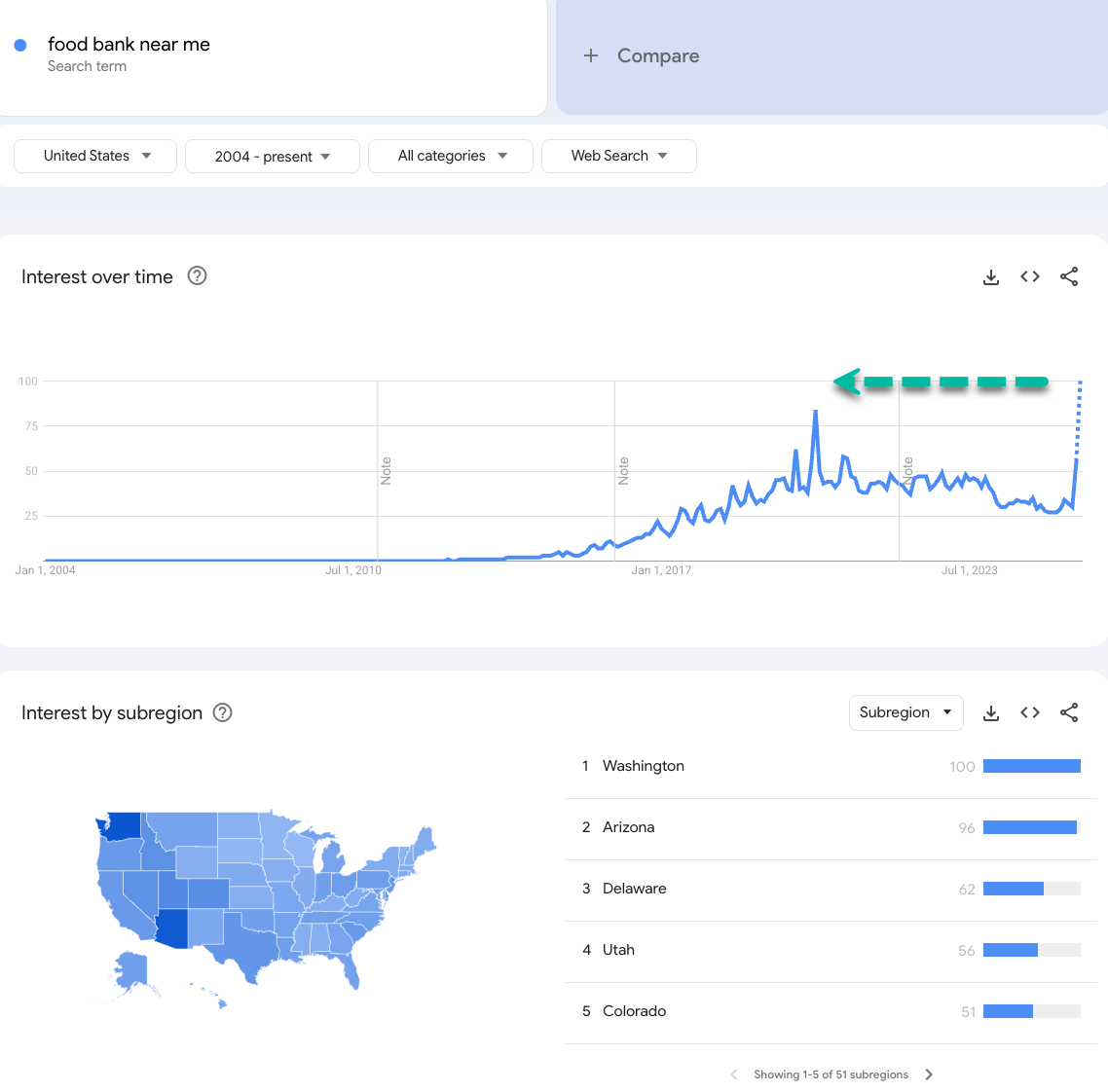
In the meantime, Google Search trends show “food bank near me” surged above Covid panic highs as those who rely heavily on the federal government to survive scramble for food

Last week, major airlines and unions blasted Democrats for the government shutdown. Airline bosses demanded that leftist politicians back the Republican-led clean continued resolution bill. 

A video posted on X shows Benny Johnson telling Newsmax’s Rob Finnerty that if tens of millions of Americans were willing to stand in line for an experimental Covid vaccine, they can just as well stand in line for to reapply for food stamps.

My thought is shut it all down. Force everyone to reapply with American citizenship. Crack down on what is available on these programs – take the junk food off – and you’ll see the number of people applying for these programs collapse. Force them to cook their own food,” Johnson told Finnerty. 

Finnerty responded, “They forced people like sheep to get in line to take vaccines – and within two months – something like 67% of the country was vaccinated – hundreds of millions of people in a short amount of time. You have to do the same thing here,” adding, “You’re talking about 42 million people and you can federalize it – don’t leave it up to the states.” 

Related:

A vetting process for SNAP can crack down on claims of widespread fraud and root out illegal aliens who are a net drain on the nation.

Tyler Durden
Sun, 11/02/2025 – 12:15

via ZeroHedge News https://ift.tt/nCYs4aO Tyler Durden

Let Commie Mamdani Take New York City

Let Commie Mamdani Take New York City

Authored by Arthur Schaper via American Greatness,

The three remaining major candidates for mayor of New York City recently had their debate. It was contentious!

The only one who offered any serious solutions, instead of corruption or communism, was Curt Sliwa, the sole Republican. Sadly, Sliwa’s chances are nothing like what Republicans enjoyed in New York City before and after 9/11. From 1993 to 2001, New Yorkers had given Republican Rudy Giuliani the reins of the largest city in the country. He cracked down on crime, he brought back business, and he restored in New Yorkers a sense of pride for their city.

His successor, media mogul Michael Bloomberg, continued the Giuliani legacy of posh gentility, upscale standards, and moderate liberalism. He focused on crime reduction, prioritizing the best interests of all citizens. Bloomberg routinely rode the subway to work, proving that the stations were safe.

Everything went downhill with Democratic Bill de Blasio. For whatever reason, New Yorkers welcomed a communist to take the mayor’s mansion. And yes, he was a communist, a sympathizer of Central American drug lords and dictators. What were New Yorkers thinking? Not much, apparently, as they willfully endured de Blasio’s unprecedented permission of crime, corruption, and, of course, communism. And when you allow collectivism of any kind, you see crime and corruption come together in one big conniption of crap.

After Mayor Blah Blah, Gothamites seemed to have learned their lesson, and they elected a former police officer and state senator—and former Republican!—named Eric Adams. He put more emphasis on fighting crime, and he pushed back on some of the wokeness, although not enough. After all, he was still a Democrat when he served as mayor, and he still promoted a whole bunch of the Democrats’ major progressive talking points to stay in good graces with the generally liberal hoi polloi. While de Blasio was unkind and contemptible, Adams was personable but relatively incompetent. Of course, corruption issues dogged him, too, but New Yorkers were willing to give someone who was a little less crazy a better chance at governing the city.

Still, Democratic politicians running (or rather, ruining) New York City inevitably unleashed a long subway of failures. They run on pragmatic platforms, but they will cower to all the progressive lobbying and donor groups really running city political machinations. Sure, more common-sense Democrats are getting elected to the city council, but along with their few Republican colleagues, their stalwart opposition to the communistic madness accomplishes very little.

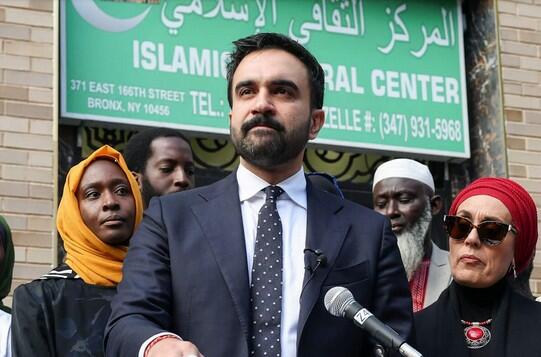
Add unrelenting Trump derangement syndrome to this slummy situation, and we can see why New York City is facing inescapable disaster. Democratic primary voters are sticking to their political program. Rejecting incumbent mayor Adams and disgraced former governor Andrew Cuomo, New York City’s Democratic primary voters nominated democratic socialist Zohran Mamdani. This guy has every element of intersectionality behind him: born in Uganda, of Hindu-Indian descent, a practicing Muslim, the child of progressive professors, a community organizer, and a small-time state assemblyman—and this radical, pro-Palestinian agitator is about to be New York City’s next leader. After 24 years, not only did New York forget 9/11, but they are also allowing a militant Islamic fundamentalist to take over! Some may remember the extensive opposition that erupted when Muslim investors wanted to put up a mosque near the World Trade Center just a year after the attacks on the World Trade Center. The outrage from the public was so great that the Muslim interests backed off.

Where’s the outrage now? Directed at Trump and to the city’s own hurt.

Pro-Palestinian militants are gleefully propping up a nepo-baby communist as the next Hizzoner. Mamdani doesn’t exactly live by Quranic principles, though. He has supported decriminalizing prostitution, he’s all in on the LGBT agenda, and he has openly fraternized with atheistic liberal elements. Of course, interest groups determined to consolidate power will tolerate all sorts of contradictions.

With Commie Mamdani, is there any hope for New York City?

The other Democrat-leaning viable alternative remains former governor Andrew Cuomo. He switched to Independent since New York allows sore losers a second chance in the general election if they lose the primary. But he is a horrible choice. He presided over COVID lockdowns, pushed sick seniors into senior centers, and allowed COVID to spread. He has a dark background littered with accusations of sexual harassment, unbridled incompetence, and other corruption issues. The best man for the job is Curt Sliwa, the civic-minded Guardian Angel who cares about people and animals (he has lots of cats!). Though not friendly with Trump, Sliwa will fight for the city.

And he doesn’t have a chance. New York City Republicans are urging him to drop out and give Cuomo a chance of winning. I hope Sliwae fights to the end. Let the commies take New York City.

The vast majority of New Yorkers still register as Democratic voters, including Jewish voters who remain progressive activists who have lined up behind pro-Hamas Mamdani, like chickens for KFC! If they don’t care about the dangers posed by this self-righteous socialist who has lived off everyone else, who can change that?

So be it. Let the Democratic socialist turn New York City into a Potemkin village of “successful communism.” Any political calculation to stop the worst candidate (Mamdani!) is inherently flawed. Supporters of Sliwa are not going to gravitate towards Cuomo. He’s just as ruthless and uncaring as Mamdani, only he doesn’t hide his disdain for collectivism. Imagine having to pick a communist or a corrupt criminal for mayor. These are the choices, and they’re very bad.

Conservative pundits are divided on allowing Mamdani to walk away with the mayoralty. Could four years of abject communism be the necessary tonic to break New Yorkers’ addiction to progressive politics? Then again, does it matter if a Mamdani mayoralty means the end of New York City as we know it? The fact is that the voters in New York City deserve to vote for whoever they want, and they deserve to get what they voted for, good and hard. If the rich white liberals and the abject, self-absorbed interest groups in New York City are so determined to virtue signal themselves into destruction, then who are we to stand in their way? Despite all the warnings from center-right pundits and media, the voters embrace the fantasy rather than a rigorous yet welcome reality.

It’s sad to see America’s largest city, and one of our most ostentatious cultural icons, deteriorate into irredeemable disrepute and disrepair, but if New Yorkers insist on a communist, they deserve all the consequences.

Is there any bright side to this Gotham political darkness? Thousands, perhaps hundreds of thousands, of New Yorkers will flee the city and settle in other parts of the country as registered Republicans, recognizing how far left (and far gone) the Democratic Party has become, and strengthen the conservative resurgence in other states.  On top of that, Republicans can connect Mamdani to every Democrat politician across the country. Democratic socialism is just communism, a few steps behind the curve. And the dank memory of the damage that communism can and has already done to other countries is still fresh in older generations. Conservatives can enjoy a renewed resurgence everywhere else.

Tyler Durden
Sun, 11/02/2025 – 11:40

via ZeroHedge News https://ift.tt/RCrdF4j Tyler Durden

Here’s Why Asian Americans Shifted Right

Here’s Why Asian Americans Shifted Right

Authored by Neetu Arnold via American Greatness,

The 2024 election season featured an unprecedented number of Asian Americans, from Vivek Ramaswamy’s rise in the Republican primary to soon-to-be second lady Usha Vance, to the Democratic candidate herself, Kamala Harris. Just a few years ago, this would have been a cause for celebration on the political left: Asian Americans have reliably voted for Democrats for decades. But the election results revealed that racial and ethnic minorities are not as loyal to the Democratic Party as previously believed. Much like Hispanics, Asian American voters made a major shift to the right.

Nationally, 2020 and 2024 exit polls from the Washington Post show a 9-point shift to the Republicans in the presidential race among Asian American voters relative to 2020. In some states, such as Nevada and Texas, the polls suggest that Trump won the Asian American vote outright. The NBC News exit poll found a 5-point shift to the right nationally among Asian Americans relative to 2020. And in their survey of Asian American voters prior to the election, Asian Americans Advancing Justice saw a 7-point shift away from the Democrats relative to 2020.

Exit polls are far from perfect measures of voting behavior, though. A spokesperson for APIAVote, a group that focuses on encouraging Asian American political engagement, pointed out when asked for comment that the exit polls may not be a “representative sample of the Asian American electorate.” For instance, the exit polls were not conducted in any Asian languages, which would preclude some Asian American voters with poor English skills from participating.

My analysis of precinct-level voting data in four major urban areas shows that the exit polls may actually be understating the degree to which Asian Americans shifted to the right. Using census data, I identified majority-Asian precincts in these areas and compared the Republican margin of victory (or loss) between the 2024 and 2020 elections. The results are much more stark: Majority-Asian precincts in New York City, for instance, saw a rightward shift of 31 percentage points. Precincts in Dallas and Fort Bend counties in Texas both saw rightward shifts between 17 and 20 points. And precincts in Chicago saw a 23-point shift to the right.

If the rightward shift among Asian American voters is real and significant, what is behind it?

When asked, neither APIAVote nor Asian Americans Advancing Justice were able to provide an explanation. But several Republican-leaning Asian American voters I spoke with were not surprised by the shift.

“I had so many [South] Asians, who are registered Democrats, let me know specifically that they voted for TRUMP this year,” South Asian Coalition Chairwoman for New Jersey’s Republican Party Priti Pandya-Patel said. “I believe most were always ‘closet Republicans’ and now they are starting to come out.”

The economy

The voters I spoke with repeatedly mentioned a few key reasons why they and others they knew voted for Trump this election. The first was a dissatisfaction with the Democrats’ handling of the economy, particularly inflation.

Many of us expressed discontent towards Biden’s energy policies that skyrocketed the costs of grocery prices and gas prices,” Nevada voter Lisa Noeth said. “Las Vegas specifically is like an island in the middle of the desert, the increase of fuel costs trickled down to the pockets of consumers at the grocery stores with goods being transported from California to Las Vegas.”

Rudy Pamintuan, chief of staff for Nevada’s lieutenant governor, said inflation was tough on Asian American entrepreneurs. “Many households had to take an extra part-time job to make ends meet.”

The data backs up Noeth and Pamintuan’s perceptions. John Yang, president and executive director of Asian Americans Advancing Justice, said economic-related concerns, healthcare, and housing costs were some of the top issues the organization found in its 2024 survey of Asian Americans. And a July AAPI Data survey indicated that Asian Americans thought Republicans had a slight edge on handling inflation over Democrats.

Public safety

While voters across all racial and ethnic lines felt the impacts of inflation, Asian Americans grew dissatisfied with poor Democratic leadership on crime and safety in major cities. As disorder grew after the pandemic, Asian Americans soured on Democrats as they watched their quality of life decrease. Asra Nomani, author of “Woke Army,” said many Asian Americans felt “unprotected amid rising violence and harassment.”

In New York City, a 2023 survey found substantial portions of Asian Americans adopted some kind of “avoidance behavior” to deal with crime – 48% avoided going out late at night, and 41% avoided taking public transportation. Meanwhile, Democrat-run city governments have taken more relaxed approach to handling crime, even spending thousands of dollars to protect criminals by humanizing them as “justice-impacted individuals.”

“You only understand what you signed up for after they [Democrats] win and you have to put up with crime and squalor,” Pennsylvania voter Teesta Dasgupta said.

Asian Americans increasingly oppose soft-on-crime policies. The majority of Asian Americans in California supported the passage of Proposition 36, which imposes harsher penalties for certain types of crimes. A disproportionate Asian American voter base also recalled former San Francisco District Attorney Chesa Boudin, who infamously declined to prosecute the murder of an elderly Thai immigrant as a hate crime and instead chalked it up to a “temper tantrum” of the perpetrator.

‘Wrong side of brown’

Asian American voters also told me that they were turned off by the Democrats’ racial equity policies. The Democratic Party heavily leaned into racial equity following George Floyd’s death and the riots that followed in 2020. Democrats made bold promises to reduce racial disparities in economic and other outcomes, arguing that current racial disparities are the result of decades of systemic discrimination that must be addressed. However, race-conscious policies like affirmative action often ended up pitting Asian Americans against other minority groups. For many Asian Americans, they end up on the “wrong side of brown,” as Nomani puts it.

Noeth told me that Asian American parents were “fed up” with affirmative action policies in school admissions. Sue Ghosh Stricklett, a former Trump administration appointee, said the Harvard affirmative action case and the removal of merit-based admissions at Thomas Jefferson High School in Virginia both “ignited passionate activism” among Asian American parents. In Fairfax County, Virginia, Thomas Jefferson High School for Science and Technology changed its merit-based admissions policy in a bid to “decrease the representation of Asian Americans” in favor of other racial minorities.

“The injustice of being labeled as ‘privileged,’ ‘selfish,’ ‘cheaters,’ ‘overrepresented,’ ‘white adjacent,’ and ‘resource hoarders’ hurt very deeply,” Nomani, who is also a parent of a Thomas Jefferson graduate, said. It led to “political mobilization and a reconsideration of long-standing political loyalties.”

Is this a permanent shift?

According to the Asian Americans I spoke with, many factors will determine if the momentum remains.

Kenny Xu, author of “An Inconvenient Minority,” believes the growth to the right is limited.

“There is a definite ceiling in Asian American rightward support due to their highly educated demographics, and the tendency of highly educated people to vote Left.”

Dasgupta believes growth is dependent on messaging.

“If Dems move to the center, Asian Americans stay where they are right now but if the allegiance to gender ideology and soft on crime remains then they [Asian Americans] will move right.”

Pamintuan says engagement with Asian American voters “could make a difference between winning or losing” in tight races, particularly at the local level.

Time will tell if Asian Americans will fully shift right. But an alliance is emerging. And both Democrats and Republicans should pay attention.

*  *  * ORDER BY MIDNIGHT! (Free shipping over $500)


Tyler Durden
Sun, 11/02/2025 – 09:20

via ZeroHedge News https://ift.tt/OHcFl6K Tyler Durden

Germany’s High-Tech Agenda: Trapped In The Subsidy Loop

Germany’s High-Tech Agenda: Trapped In The Subsidy Loop

Submitted by Thomas Kolbe

Germany is falling behind in the economy’s future fields. Whether artificial intelligence, autonomous driving, biotech or quantum technology – the US and China are making the headlines. A high-tech agenda by the federal government is meant to close this gap.

On Wednesday, Chancellor Friedrich Merz and Research Minister Dorothee Bär presented the federal government’s high-tech agenda in Berlin. At the centre of the initiative is a state subsidy fund that is intended to kick-start pre-selected high-technology projects such as artificial intelligence in the future.

Of course — how could it be different — green projects, climate-neutral approaches in the fields of quantum technology, mobility and other so-called future fields are at the forefront of the political engagement.

Subsidy pot and governance

The technology fund is to make available up to €2 billion by 2029. “We want to close the technological gap to the US,” demanded Chancellor Merz — with more competition, less bureaucracy and technology-open processes, the Chancellor said.

That competition gap is by now so wide that international investors barely find Europe on their strategic map.

The tech initiative is accompanied, as always, by political buzzwords such as the necessary reduction of bureaucracy and fast approval procedures.

That sounds charming, it sounds citizen-friendly and above all it suggests an interest in the flourishing of the Mittelstand — a media evergreen.

But beneath the slick presentation paper lies the same old playbook: A problem has been identified, a tailor-made subsidy pot filled with fresh credit — always aligned with the political-ideological line of climate regulation. Understanding of market-economic dynamics, open markets or technology-neutrality? None.

Even Merz’s repeated lip service to competitiveness and free-market economy changes nothing: the federal government ignores the real capital market until Germany has finally disappeared from the international high-tech radar.

Competitiveness as a complex problem

Competitiveness of an economy is a tricky matter. Sometimes it’s skill shortages, sometimes lack of investment capital. Then again regulations, fiscal burdens or lack of access to resources weigh on firms’ performance. In Germany’s case, indeed each of those conditions seems to be fulfilled. 

Well-educated young Germans are leaving the country in droves. Foreign direct investment flows elsewhere. China threatens to turn off the resource tap — and from the Kafkaesque regulatory work, the overflowing bureaucracy and the ever-rising burdens on companies and employees we have reported regularly.

Germany would have to start very small as a provider of niche products in the competition environment. To put the problem in perspective: The gulf between Germany’s economy and the US in artificial intelligence and the booming data-centres is enormous.

This year alone, Microsoft is pumping $80 billion into its AI data-centres, Google follows with $75 billion, Meta with $65 billion. The entire sector in the US invests year after year well over a half-trillion dollars in its high-technology infrastructure — driven by the free-market process of a largely deregulated economy.

Here lies the secret of success. Europe’s political experiments — be it censorship or the threatened taxation of US digital platforms like recently demanded by Culture Minister Wolfram Weimar — will not change anything about the competitive situation of German firms.

Innovation does not emerge through political subsidy packages, regulation or fiscal harassment, but through massive, consistent investments by the private economy in free markets, which make high-tech a locational advantage.

Germany way behind

How far the German business location is lagging is shown by the example of Deutsche Telekom: Together with the US company NVIDIA it is “only” investing a billion euros in an AI data-centre in Munich. In contrast stands Intel, which simply rejected a €10 billion subsidy and decided against locating chip production in Magdeburg.

A case study of the real problems of the location: too high energy costs, crushing regulation, fiscally unattractive. Here it becomes clear that political subsidy packages alone cannot close the gap to the global frontrunners. They are rather counterproductive, because they politically-selectively weaken competition and tie up capital.

If one wants to be internationally competitive, one needs market-economic framework conditions that don’t deter companies, but attract them.

In the wrong company

The complaint from the economy across the land always sounds the same: The location lacks competitiveness massively. The criticism of the German corporations — because only here you still meet chancellor and ministers regularly in dialogue — at least seems to bear fruit in the diagnosis work. Both the Chancellor and Economy Minister Katherina Reiche stressed last week in unison the competitive gap that has opened up between the German economy and the leading locations — above all the US and China.

Too expensive, too over-regulated, too slow, concluded Friedrich Merz yesterday in his Berlin speech. It cannot go on like this. Administrative tasks, approval procedures, general bureaucratic processes must become leaner. Overall there must prevail a different competitive climate, said the Chancellor.

In principle with politics it’s always the same problem. It is of course more effective in the media to address the large industry. Here one bundles the forces of joint media work, known names, familiar faces. That sells well. The structural problems we see in the Mittelstand. Here are the problems that the grotesque regulatory work of Brussels and Berlin produce, felt day by day. 

Here it leads to distortions and significant burdens in the cost structure when an export business is encumbered by a supply-chain law or the European deforestation regulation. Big corporations have their own administration department and are in fact indirect beneficiaries of regulatory work, because they suppress annoying competition.

Politics on the wrong track

And so we experience the repeat of the always same: Shocked outrage at Germany’s economic weakness, full-blooded reform announcements to reassure the public, only to immediately return to business as usual and keep the course.

It cannot be denied that of the gaily announced initiative to reduce bureaucracy — which was meant to relieve the German economy up to €16 billion or 25 % of the bureaucratic burdens per year — nothing remains. Merz wanted to save eight percent of public-service personnel to relieve the state budget — a nice dream and a typical Merz number: full-blooded announcements that then, in hope that soon other topics will cover them, dissipate in the wave of the daily press spectacle.

But from all the appearances of the Chancellor, his Finance Minister Lars Klingbeil and the Economy Minister nevertheless a last hope glimmers through. The big debt-package, camouflaged under the euphemism of the “special asset”, is now supposed to bring the great turnaround.

As Lars Klingbeil said a week ago in New York during the UN-Congress: For companies a unique window of opportunity is opening — enabled by the massive engagement of the state in the coming years. The calculation is simple: subsidies, price guarantees, aid to the exploding energy costs shall brighten individual corporate balance sheets.

Merz should have discussed with Intel’s management in depth about the German location. What must go wrong, so that a firm — despite its internal problems — rejects a €10 billion subsidy, which would have carried about a third of the total investment, and instead prefers the US location? 

As long as politics cannot give a substantive answer to this question, nothing will change about Germany’s decline and the downfall of the European Union.

* * * 

About the author: Thomas Kolbe is a German graduate economist who has worked as a journalist and media producer for clients from various industries and business associations. As a publicist, he focuses on economic processes and observes geopolitical events from the perspective of the capital markets. His publications follow a philosophy that focuses on the individual and their right to self-determination.

Tyler Durden
Sun, 11/02/2025 – 08:45

via ZeroHedge News https://ift.tt/YTF390u Tyler Durden

What Cracked? Leftist-Controlled Maryland County Stuns Residents By Striking Deal With ICE

What Cracked? Leftist-Controlled Maryland County Stuns Residents By Striking Deal With ICE

The Democratic Party’s power grip on the Mid-Atlantic, particularly in Maryland, appears to be eroding. 

Local headlines and a Justice Department statement confirm that leftist-controlled Baltimore County has been removed from the federal list of sanctuary jurisdictions after signing a cooperation agreement with Immigration and Customs Enforcement (ICE).

The DoJ wrote in a press release that the county’s cooperation represents progress in restoring public safety, despite state-level restrictions on federal immigration enforcement. The county had been listed as a sanctuary jurisdiction since August, a designation leftist County Executive Kathy Klausmeier argued was a mistake. 

Despite restrictions from state leadership, Baltimore County has shown a willingness to cooperate with federal immigration enforcement. This is a small step toward restoring public safety and we appreciate the county’s commitment to updating its policies,” Associate Attorney General Stanley Woodward wrote in a statement.

“This agreement makes no changes to the Department of Corrections’ standard practices and aligns Baltimore County with peer jurisdictions throughout the state of Maryland,” the county Executive’s office said in a statement Friday.

In total, eight Maryland counties, plus crime-ridden Baltimore City, were placed on the list of sanctuary jurisdictions published by the Trump administration earlier this year. The common denominator among all these areas is that they’re controlled by far-left lawmakers who prioritize illegal aliens over their constituents. The goal is clear: illegals mean future voters, which ultimately disenfranchises the existing voting base.

For far too long, the Democratic Party has maintained a stranglehold over the central part of the state. No sane person voted to have illegal aliens funneled into their neighborhoods by the thousands, only to observe violent crime and an affordability crisis unfold as illegals absorbed housing stock.

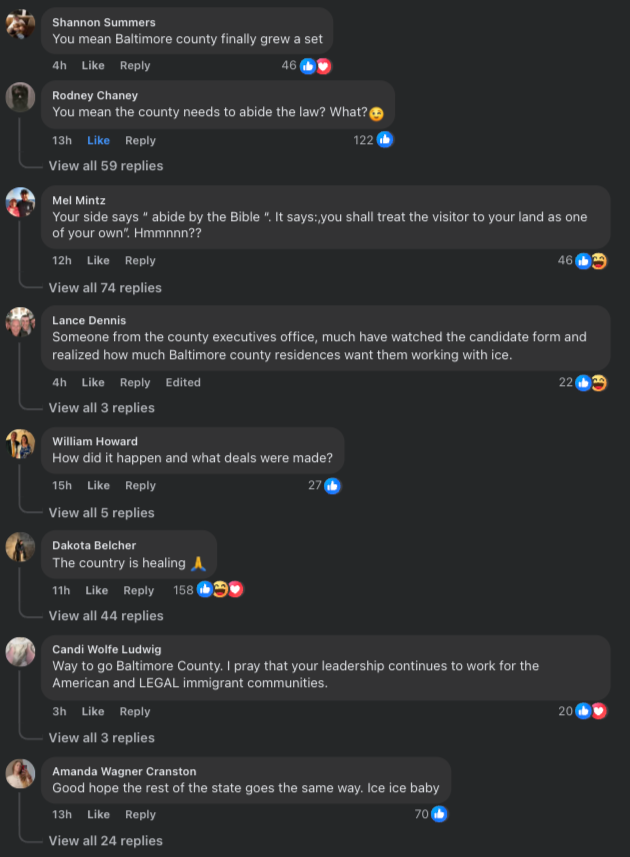
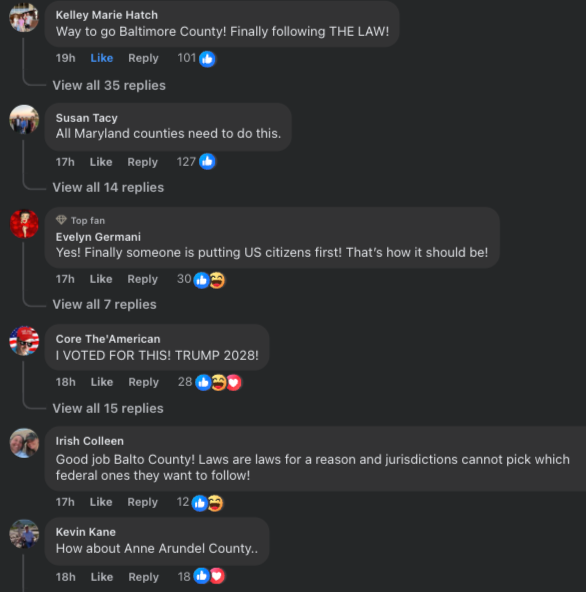
A snapshot of the vibe of county residents was observed on Facebook, in which many were in pure joy:

Delegate Nino Mangione (R-District 42A) commented:

I am delighted that Baltimore County has finally realized the importance of cooperating with ICE and following the rule of law. Our citizens deserve the protection this MOU provides, and I am very pleased about it. Illegal immigration is one of the greatest threats we face in our communities and it is essential that there be full cooperation between federal and local law enforcement. We never want to see another senseless murder by an illegal. We do not want a repeat where innocent citizens like Rachel Morin or Kayla Hamilton lose their lives to the violent actions of an illegal. The signing of this MOU is a great step forward for the protection of Baltimore County.”

I am also very pleased to see Baltimore County lose the stain of being listed as a sanctuary jurisdiction.

Whether the Trump administration applied pressure on Democrats in the county or due to imploding poll numbers …  

… it’s clear voters in the Mid-Atlantic are rejecting the Democratic Party in growing numbers. From nation-destroying open borders/sanctuary policies to skyrocketing power bills, progressives have fumbled the policy football, and their grip on power in the region is beginning to erode.

Just wait until Republicans figure out how to capitalize on the failed green energy crisis – oh wait, that’s already happening.

Tyler Durden
Sun, 11/02/2025 – 07:35

via ZeroHedge News https://ift.tt/nKW5q09 Tyler Durden

Europe’s Solar Surge Exposes Cracks In Aging Power Grid: Analysts

Europe’s Solar Surge Exposes Cracks In Aging Power Grid: Analysts

Authored by Evgenia Filimianova via The Epoch Times (emphasis ours),

Europe’s solar power boom is putting huge pressure on electricity grids that were never built to handle this much renewable energy, say analysts.

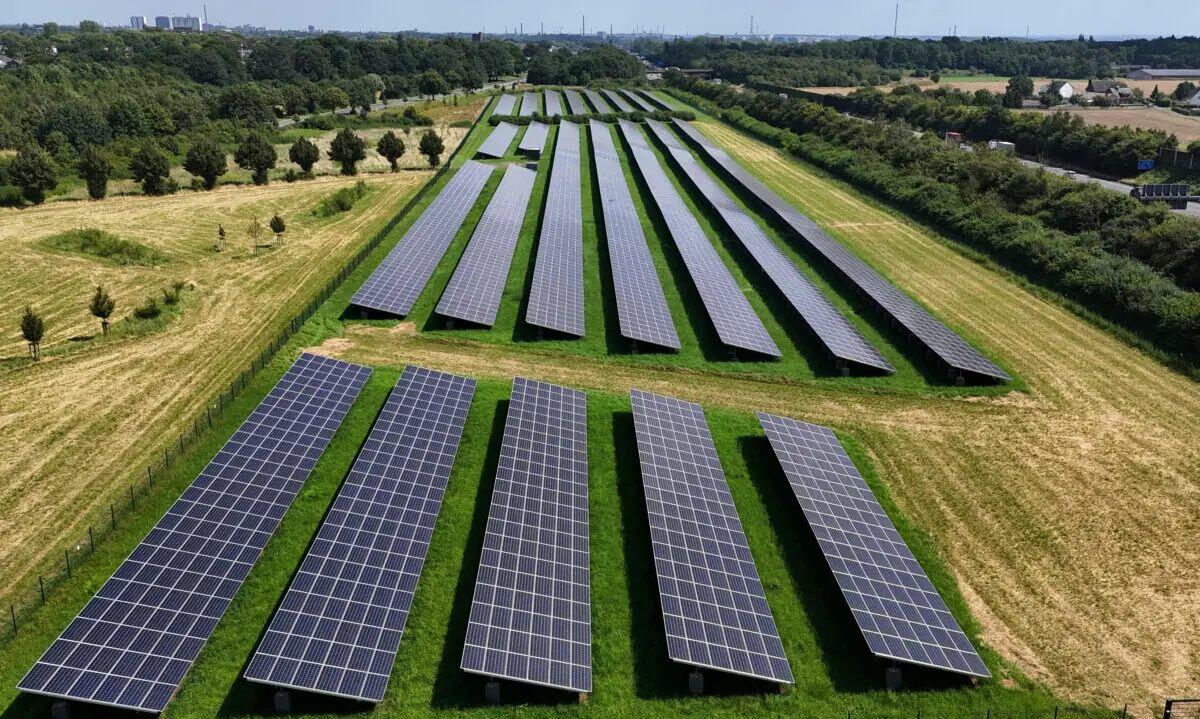
An aerial view taken with a drone shows a solar energy field near Weilheim, Germany, on Oct. 16, 2025. Philipp Guelland/Getty Images

As a record number of new solar panels are being installed every year, the old grid system is struggling to keep up.

Solar generation capacity in the European Union continues to increase and reached an estimated 338 GW by 2024, according to SolarPower Europe.

To curb its dependence on Russian energy and accelerate its green transition, the EU set a goal in 2022 to install at least 700 gigawatts of solar power by 2030, enough to supply electricity to hundreds of millions of homes.

But the rapid expansion has exposed cracks in Europe’s energy system, threatening to slow the transition unless grids catch up.

Europe’s power grids faced a surge in voltage problems last year, with 8,645 over-voltage incidents reported in 2024—nearly 10 times more than in 2023, according to the European Network of Transmission System Operators for Electricity (ENTSO-E).

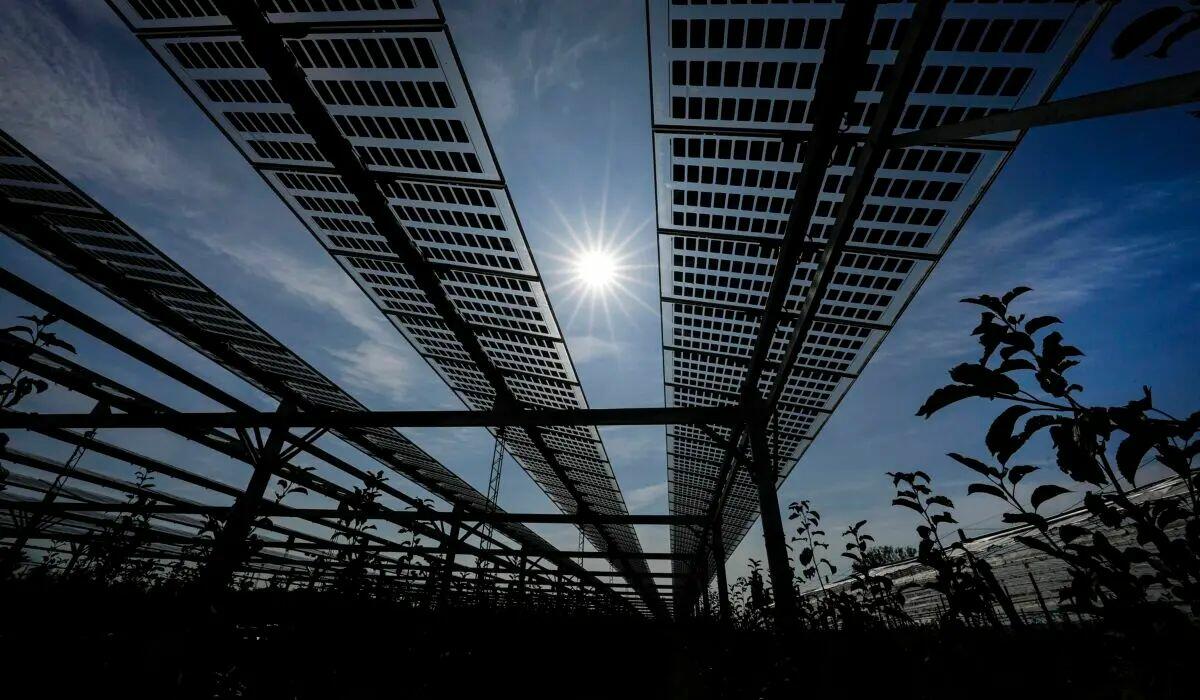
Special mounted solar panels are installed over a biological apple fruit tree plantation in Gelsdorf, western Germany, on Aug. 30, 2022. Martin Meissner/AP Photo

Aging distribution infrastructure complicates the issue. Industry group Eurelectric estimates that nearly half of Europe’s distribution networks will be more than 40 years old by 2030.

Energy analyst and project lead at the Helmholtz Center Berlin, Susanne Nies, told The Epoch Times that Europe’s power system is under heavy strain because it was designed for a time when electricity made up only a small share of total energy use.

“When you go to the countryside and countries like France or even Germany, those grids have been built in the 50s. They are really nearly 70 years old,” she said.

Europe’s electricity system was initially designed for one-way flows—from large power plants to homes and businesses, Nies explained, adding that now it must handle power flowing in both directions, as millions of solar panels feed energy back into the grid.

She said today’s grid needs to combine large regional “super grids” with smaller, local systems that can operate independently during emergencies.

Harry Wilkinson, head of policy at the Global Warming Policy Foundation, said the challenge is not only that Europe’s grid is aging but that it must be vastly expanded to connect power sources that are far more scattered than in the past.

“Just the physical amount of additional cabling that you have to add to the grid, to connect, that is a big challenge, just in itself,” he said.

Voltage Problems and Spain’s Grid Struggles

Most voltage problems in 2024 originated from Sweden’s Svenska kraftnät, which implemented automated reporting, while operators in Slovenia, Moldova, and Romania also experienced increases as renewables expanded, according to Eurelectric.

Others fared better: Hungary’s MAVIR cut incidents for a second year, and grid operators in Spain, the Netherlands, and France reported none at all.

However, in April, huge power outages hit Spain and Portugal, leaving millions of homes and businesses without power. In Spain, where solar energy now provides about 21 percent of the country’s power—up from 8 percent five years ago—emergency measures have been necessary to prevent blackouts.

Customers dine in a restaurant illuminated by a generator during a blackout in Barcelona, Spain, on April 28, 2025. AP Photo/Emilio Morenatti

Nies said that while in Spain’s case, the solar power grid was not the culprit, it has not been updated as fast as needed, and parts of it could be improved.

Wilkinson disagrees that it wasn’t the grid’s fault. He told The Epoch Times that renewables are simply more complicated to manage as a technology.

Nies noted that Spain remains poorly connected to its neighbors, while Germany’s grid is far more integrated, with four transmission operators and nearly 900 distribution system operators that manage local electricity networks.

According to independent energy consultant Kathryn Porter, location plays a far greater role in weaker grids. While frequency stays consistent across a network, voltage is a local factor that must be stabilized by nearby equipment.

“Spain’s conventional generation is concentrated in the north and east, while the south is dominated by renewables, making the southern network weak and increasingly difficult to control,” she said in her blog.

Grid Spending

Solar power supplies 22.1 percent of the EU’s electricity, according to energy thinktank Ember Climate, compared with 12.4 percent in China.

In the United States, the share is projected to reach about 7 percent in 2025, according to the U.S. Energy Information Administration.

Even as solar output soars, Europe’s electricity demand has stagnated, falling last year and recovering only slightly in 2025. Weak demand makes it more challenging to balance an energy system that is increasingly dominated by intermittent renewables.

The International Energy Agency (IEA) says investment in transmission and distribution networks is becoming critical as grid upgrades struggle to keep pace with the rapid buildout of low-emission power.

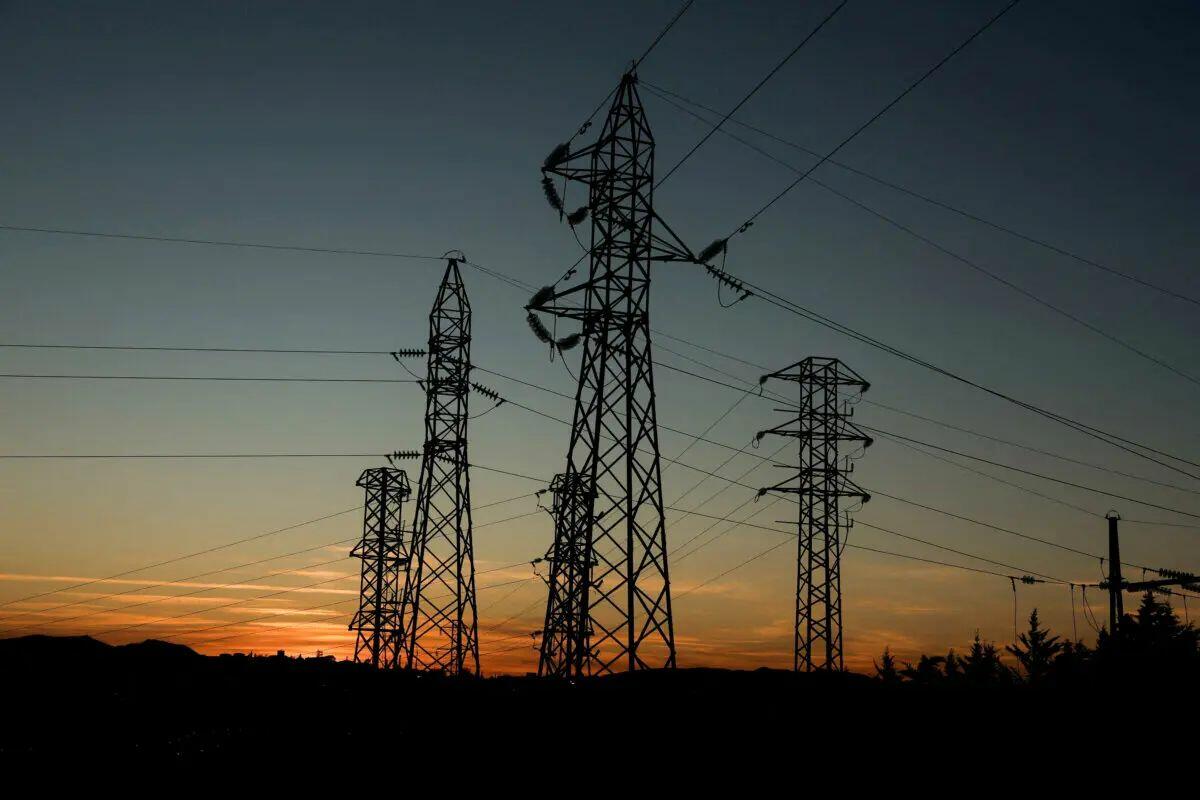
Power lines connecting pylons of high-tension electricity are seen during sunset at an electricity substation on the outskirts of Ronda, during a blackout in the Spanish city, on April 28, 2025. Jon Nazca/Reuters

Annual grid spending in the EU is set to exceed $70 billion in 2025, double the level a decade ago, the IEA said in a June report. Yet investment still trails the growth of clean-energy projects, leading to long connection queues and bottlenecks in moving cheap solar power from southern Europe to industrial centers in the north.

The European Investment Bank, the EU’s lending arm, warned in September that a lack of investment in grid spending causes inefficiencies in Europe and beyond. It stated that investment should remain a top policy priority if Europe wants to stay competitive.

When reviewing the overall economics of solar energy, the costs of grid management and the impact of high penetration levels on the grid are crucial, Wilkinson said. High penetration levels refer to a situation where the system relies heavily on one or more sources of renewable energy, which are intermittent and more challenging to ensure voltage and frequency stability.

“We should be realistic about the enormous cost burden that is likely to be faced because of those decisions,” he said.

New Solar Installations

Industry group SolarPower Europe expects a slight drop in new solar installations in 2025, marking the first decline in a decade. In its July statement, the group attributed the slowdown to grid bottlenecks, falling subsidies, and permitting delays.

The downturn is driven mainly by a slump in rooftop solar, especially among homeowners.

“In traditionally strong residential rooftop solar markets, like Italy, the Netherlands, Austria, Belgium, Czechia, and Hungary, households are now postponing installations as the impact of the 2022 energy crisis wanes,” SolarPower Europe said.

Solar panels on a solar field in Moers, Germany, on Aug. 5, 2024. Ina Fassbender/AFP via Getty Images

It added that the withdrawal of incentive schemes without adequate replacements has led to a collapse of more than 60 percent in some rooftop markets compared with 2023, while Poland, Spain, and Germany have seen drops of over 40 percent.

A policy brief from Ember last year warned that renewable expansion was being “held back by urgent stress signals” in Europe’s electricity networks.

Another report by Strategic Energy Europe found that more than 1,700 GW of potential renewable capacity was being held in connection queues due to limited grid capacity.

Tyler Durden
Sun, 11/02/2025 – 07:00

via ZeroHedge News https://ift.tt/IjYRF0z Tyler Durden

How the Punisher, a Murderous Anti-Hero, Became the Mascot for Increasingly Militarized Police Forces


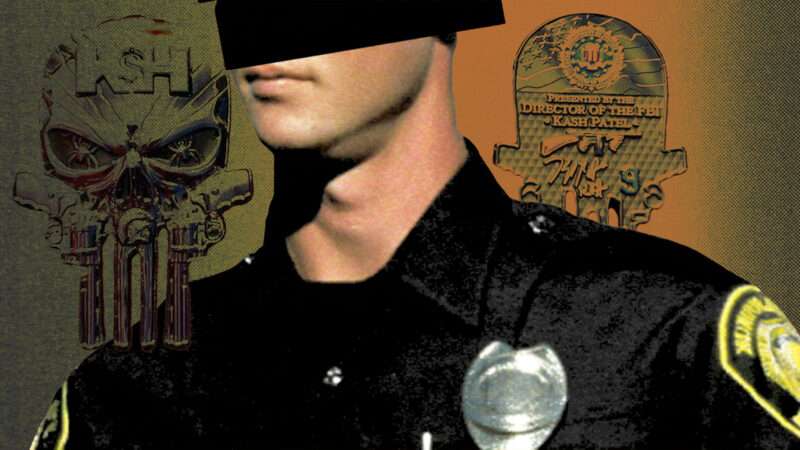
A police officer pictured with Punisher challenge coins | Photo: Ken Dilanian | Illustration: Eddie Marshall | Midjourney

In 2015, actor Jon Bernthal appeared at New York Comic Con soon after the announcement that he would portray Marvel Comics’ famous vigilante the Punisher in the Netflix series Daredevil. “I know how important he is to law enforcement, to the military,” he told the crowd. “I look at this as a huge honor, a huge responsibility. And I give you my absolute word, I’m gonna give everything that I have.”

Since then, Punisher iconography has only continued to proliferate among police officers. The character’s skull logo has become synonymous with uncritical support for police. Even FBI Director Kash Patel is a fan. In October, MSNBC’s Ken Dilanian shared a photo of a challenge coin Patel had given out featuring a skull that greatly resembled the Punisher symbol. That trend is disheartening, both for fans of the comics character, like me, and for Americans who want a sane law enforcement apparatus dedicated to serving citizens rather than unleashing violence.

Unlike most of his superhero compatriots, the Punisher is an unrepentant murderer, focused less on restorative justice than on simply massacring his enemies. He is quite possibly the worst role model comics have ever produced. While sometimes a thrilling story of a man able to right the wrongs he sees in the world, the Punisher also functions as an indictment of feckless or corrupt police and a military that sends people off to kill but does too little when they come home damaged. Some of the people who lionize the character these days miss that point—to our detriment.

As a teenager, I found the Punisher’s brutally uncompromising Manichaean worldview a fascinatingly stark contrast to other, more optimistic comic book heroes. The Punisher inhabited that same world but seemed to flout all its rules and conventions: He had no superpowers other than military training, a seemingly unlimited arsenal, and tenacity. I’ve accrued numerous issues of Punisher comics and collectibles and multiple T-shirts bearing his signature skull logo.

But in the more than two decades since I picked up my first issue at the local grocery store, the character’s cultural meaning has shifted. For years, the people most likely to wear the skull logo were comic fans like me; then, over time, it became noticeably more popular among police officers. Custom shops such as Etsy and Redbubble, and mass retailers such as Amazon, carry thousands of items printed with Punisher skulls, often combined with American flags and pro-police iconography.

“There has to be a recognition that while he’s doing what they want to fantasize about doing, that he’s wrong,” Punisher co-creator Gerry Conway tells Reason. “He is breaking the very laws, for example, that cops are supposed to uphold. So, putting a Punisher decal on your cop car is saying you want to break the rules and you want to be outside the law.”

A Unique Character in Superhero Comics

“He’s this normal street-level guy in this world of gods and monsters and marvels,” says David Pepose, who wrote the 2024 Punisher comic series. While benevolent heroes fly through the sky overhead, “the Punisher’s the guy in the gutters. He’s seeing the worst of the worst.”

The character, born Frank Castle, debuted in a 1974 issue of The Amazing Spider-Man as a mercenary hell-bent on killing criminals—”a warrior fighting a lonely war,” as he put it, who “kill[s] only those who deserve killing.” Conway, the series’ writer at the time, saysthat “he had a purpose” and a “sense of honor. There was something behind his motivation that we didn’t know….Something terrible had to turn this very straight-laced, rules-bound guy into the Punisher.”

Later issues filled in his backstory. Castle received numerous medals for meritorious service in Vietnam, but his final tour went badly and the experience haunts him. He survived combat and returned home to Queens, only to see his wife and children murdered in Central Park after they accidentally witnessed a Mafia hit. When corrupt cops and courts fail to bring the killers to justice, Castle declares war on all criminals—from terrorists to muggers and everyone in between. “Frank Castle died with his family,” he corrects a villain while pulling the trigger. “I’m the Punisher.”

Initially planned as a one-off henchman type, Conway liked the Punisher so much that he brought him back as a recurring character. Audiences also responded positively, and he soon appeared in other characters’ series as well. He did not get his own solo title until 1986, a dozen years after his debut. Writer Steven Grant said he had “been trying to get a Punisher series off the ground for years and no one [at Marvel] was interested.” But Grant’s five-issue Punisher limited series sold well and led to an ongoing comic the following year. That series ran for eight years and launched multiple spinoffs; from 1992 through 1995, three monthly Punisher titles were running concurrently.

Comic book heroes were traditionally inherently benevolent: Though they operated outside the law and spent much of their time beating criminals into submission, they usually refused to kill. The Punisher not only had no compunction about killing, but it was his singular purpose. Other comic heroes face many of the same villains again and again over their many decades in print; by definition, the Punisher’s roster of recurring foes is rather short. Marvel senior editor Stephen Wacker said in 2011 that since debuting, Castle had killed 48,502 people.

His murderousness also puts him at odds with other heroes, who can see him as little better than the crooks and killers they encounter. As a result, he has battled fellow heroes such as Daredevil, Spider-Man, and Wolverine (and also, for some reason, Archie).

Cops Heart the Punisher

In 2017, Catlettsburg, Kentucky, Police Chief Cameron Logan commissioned vinyl decals for the department’s cruisers: Punisher skulls that read “Blue Lives Matter.”

“I consider it to be a ‘warrior logo,'” Logan told local media. “That decal represents that we will take any means necessary to keep our community safe.” Logan spoke as if he were commanding troops in a war zone, but Catlettsburg employed only eight full-time officers for a town of 2,500. According to the app Nextdoor, “Catlettsburg is considered a safe place to live,” with violent and property crime rates below state and national averages. After a public backlash, Logan had the decals removed.

That same year, the Solvay, New York, Police Department drew criticism for similar decals. “The Punisher symbol on the patrol vehicles…is our way of showing our citizens that we will stand between good and evil,” according to a statement credited in part to Solvay’s police chief. “There is clearly a war on police and the criminal element attempting to infiltrate and destroy our communities, lifestyles and quality of living requiring men and women willing to stand up to evil and protect the good of society.” (Solvay, a village of about 6,500, is “known for its clean streets and welcoming community,” declared Nextdoor. At the time, its police department employed only 16 people, including the chief.)

Taken at face value, these police departments see themselves as under assault from unchecked criminal forces. In that mindset, the only way to survive is to treat the community like an occupied territory, seeing civilians as potential threats and displaying a decal that signals your willingness to use unconstrained violence.

Solvay’s decals, in particular, featured a thin blue line in the skull design. As noted in Errol Morris’ documentary of the same name, the phrase refers to the concept of “the ‘thin blue line’ of police that separate[s] the public from anarchy.” While now ubiquitous, the design of a thin blue line on an American flag originated in 2014, three years before it was incorporated into Punisher skulls on police cars in Solvay.

In 2019, St. Louis barred 22 city police officers from submitting cases for prosecution after they were found to have posted racist content on social media. Ed Clark, president of the city’s police union, published a letter on the union’s Facebook page “asking all officers and supporters to adopt the Blue Line Punisher symbol as their profile symbol in a show of solidarity.”

“The Blue Line symbol and the Blue Line Punisher symbol have been widely embraced by the law enforcement community as a symbol of the war against those who hate law enforcement,” Clark added. “It’s how we show the world that we hold the line between good and evil.”

But it’s more complicated than that.

“The thin blue line narrative…highlights the assumed differences between officers and citizens and further progresses an ‘us versus them’ mentality among officers,” criminologists Don L. Kurtz and Alayna Colburn wrote in 2019.

Kurtz and Colburn found that the thin blue line narrative “relates to the idea that death surrounds officers as they go about their daily job,” though statistically that’s not necessarily true. As a result, the narrative “pushes a limited subset of society into seeking the profession—people that are more likely to be conservative, justify physical violence and deadly force, are distrustful of the community, and generally suspicious of those outside of law enforcement.”

Now imagine what that same symbol signifies when paired with the skull logo of an extrajudicial murderer.

Why Police Adoration of the Punisher Matters

One could argue that police adopting the cartoonish logo of a fictional character is no big deal. Nobody would bat an eye at police officers with Superman patches. But the Punisher specifically contradicts what the police should represent.

“While tamer vigilantes complicate the job of law enforcement, they accept the legitimacy of the justice system and supplement rather than deconstruct the political order,” Kent Worcester, a political scientist at Marymount Manhattan College, wrote in A Cultural History of the Punisher. “Frank Castle…operates under the assumption that the law itself is a fraud and a fiction.”

All too often, an embrace of the character demonstrably coincides with a proclivity to abuse one’s power. “Frank Castle does to bad guys and girls what we sometimes wish we could legally do,” Jesse Murrieta, a security official who had worked in federal law enforcement, told Vulture in 2020. “Castle doesn’t see shades of grey, which, unfortunately, the American justice system is littered with and which tends to slow down and sometimes even hinder victims of crime from getting the justice they deserve.”

In 2004, numerous off-duty Milwaukee police officers accused Frank Jude Jr. of stealing a wallet and badge at a house party. Though they searched him and didn’t find either, they then assaulted Jude so badly that an emergency room physician resorted to taking photos because “there were too many [injuries] to document” in writing.

Milwaukee Police Captain James Galezewski later discovered the officers involved in the assault belonged to a “clique” within the department who called themselves “the Punishers,” who “wear black caps with a skull on them” and “get carried away” while on duty. “This is a group of rogue officers within our agency who I would characterize as brutal and abusive,” Galezewski noted in a 2007 report.

In 2009, Sgt. Brent Raban of Florida’s Palm Beach County Sheriff’s Office repeatedly bragged on Facebook about beating suspects in the course of his work. He wore a skull cap with the word “punishment on it. Raban told investigators he was inspired by comic book characters like the Punisher. He was demoted and reassigned, and he would be fired the following year. An arbitrator later ordered the department to reinstate Raban and pay him $150,000 in back pay.

As actor Bernthal alluded, the Punisher is also popular among members of the military. This makes sense, given Castle’s status as a war hero and his overtly militaristic worldview. But it also fits another troubling aspect of the police/Punisher intersection.

The Punisher as Symbol of a Militarized Police

The 9/11 attacks inspired a patriotic and nationalistic fervor and ushered in an era of unchecked police militarization. Such militarization was already on the rise over the previous few decades, but 9/11 created an atmosphere in which no method of retaliation was off limits. In 2003, as a means of fighting terrorism, the Department of Homeland Security began dispensing military weapons and equipment to police departments throughout the country.

When protests broke out after a police shooting in Ferguson, Missouri, in August 2014, officers responded wearing camouflage, brandishing military surplus shotguns and M4 rifles, and driving armored vehicles designed to withstand mines and roadside bombs. In 2020, similar scenes took place across the country: As Black Lives Matter demonstrators protested police brutality, officers outfitted in combat gear deployed brutal and violent tactics to put down demonstrations that often warranted little or no force. Some protests did turn violent, marked by rioting and looting, but reports later found that across the country, police largely responded in excess of what the situation required—ironically validating many of the protesters’ concerns.

As both the 2020 protests and the police response made international news, commenters noted the presence of Punisher skulls on officers’ uniforms. Sadly, neither trend was new. A 75-second video uploaded to YouTube in 2009 depicts a police training exercise in Doraville, Georgia. In the video, several heavily armed SWAT officers pile out of an M113 armored personnel carrier—designed to safely transport up to 11 soldiers at a time to the front lines of a combat zone—with “Doraville Police Department SWAT” printed on the side. The video starts and ends with flashes of the Punisher skull, set to the industrial metal song “Die Motherfucker Die.” The city didn’t add these flourishes, but as Radley Balko wrote in 2014 in The Washington Post, “At least as of this writing, the video was posted on the front page of the Doraville Police Department Web site.”

Doraville, a suburb of Atlanta with about 10,000 residents, has crime rates higher than the state and national averages. But most of that crime is property-related, hardly the kind that would require an armored vehicle. In emails exchanged after Balko’s article, city officials chose to take the video down from the police department’s website, and city manager Shawn Gillen noted, “We no longer own the tank.” But the emails also showed the vehicle’s primary usefulness was not in stopping or solving crime: A city councilmember asked if the city should create a “presentation” to “show how the tank has helped in the past, specifically during the ice storms.”

“The Department of Defense’s 1033 program, which offers free surplus military equipment to police departments, has transferred at least $1.6 billion worth of equipment to departments across the country since 9/11, compared to just $27 million before the attacks,” Reason‘s C.J. Ciaramella wrote in 2021. That was in addition to another $24.3 billion in grants that city and state governments used to purchase additional military-style equipment.

“When controlling for other variables, counties who received the highest amount of military equipment through the 1033 Program recorded twice as many police killings than counties that did not receive any equipment,” according to a 2020 article in the Georgetown Security Studies Review. “A report on Georgia law enforcement agencies discovered that participating police departments and sheriff offices who took in more than $1,000 in 1033 money, on average, had four times as many fatalities as non-participating agencies.”

Given what the Punisher represents, and how police departments have militarized over the last few years, it’s unfortunate but perhaps unsurprising that police have adopted the character’s iconography as their own. Comics writers have increasingly contended with the Punisher’s popularity among police—even adapting it into the pages of the comics. In a 1993 storyline, Castle travels to Baltimore to find and kill a major drug distributor. While there, he is stopped by two local cops—but instead of arresting him, they encourage him to finish the job and marvel at his freedom to operate with “no courts, no warrants, no rules.” They even threaten him with reprisal if he doesn’t kill his target. Castle bristles at doing the officers’ bidding, even indirectly, but he decides that unless they’re “dirty,” they aren’t his concern.

In a storyline from the early 2000s, the New York Police Department (NYPD) names its most ineffectual detective to head the Punisher task force, because the other detectives not so secretly prefer the Punisher’s method of handling criminals to their own. Over time, as life began to imitate art, writers took a different approach, openly confronting whether cops should support Frank’s mission. Matthew Rosenberg tackled the issue most directly when writing the character in 2018 and 2019. In one issue, NYPD officers argue over Castle’s methods—whether he “does more to clean up the streets than we’ll ever be allowed to” or if he’s just “a frickin’ Nazi.”

Later in the same series, when two officers spot Castle on the street—blood on his gloves, still fresh from a recent kill—they get excited and try to take selfies. While most of the NYPD “want[s] you in the ground,” they tell him, they belong to a small but vocal contingent who “believe in what you do” and sport his skull logo as a decal on their car.

Castle peels off the decal and rips it up. “We’re not the same,” he admonishes them. “You took an oath to uphold the law. You help people. I gave all that up a long time ago.” When the officers protest that he “started something” and “showed how it’s done,” Castle replies, “If I find out you are trying to do what I do, I’ll come for you next.”

The Punisher as a Creature of His Time

As a longtime fan of the character who is uncomfortable with the way the police and military have co-opted him, I have to ask myself: What should he represent?

The Punisher was a product of his time. He debuted in February 1974, just five months before the theatrical release of Death Wish, in which Charles Bronson wages a one-man war on crime after a gang murders his wife and brutalizes his daughter. The film had so much prerelease hype that Paramount Pictures raised ticket prices for its premiere screening. Three years earlier, Clint Eastwood starred in Dirty Harry as a San Francisco detective willing to break any rule—including limitations on the use of force—to catch a killer. Each film would spawn four sequels.

Americans were concerned about crime, and for good reason. “Between 1960 and 1980, the homicide rate doubled, and the violent crime rate, as measured by police reports, more than tripled,” according to Alex Tabarrok of the Mercatus Center at George Mason University. “The violence of the 1970s was also more impersonal than previous violence. Homicide rates doubled, but homicide rates by strangers increased much faster, especially in the big cities.”

The same was true when the Punisher’s first solo series debuted in January 1986. The previous year, “the number of crimes reported in the United States rose 5 percent,” including “increases in all major categories of crime,” The New York Times reported. “The numbers showed that violent crime, including murder and rape, was up 4 percent in 1985.”

Just like Death Wish, Dirty Harry, and other revenge thrillers from the era, the Punisher reflected people’s concerns about crime, meeting the senseless violence they feared with a brutally effective counterresponse. “I’ve heard people call me crazy, and maybe they’re right. I can’t judge something like that,” Castle says in a 1975 issue. “I only know there’s a war going on in this country between citizen and criminal—and the citizens are losing.”

Marvel ended all Punisher series in 1995 amid declining sales throughout the industry—the company would file for bankruptcy the following year. When the Punisher returned in 2000, the U.S. looked very different than it had when the character debuted.

“Homicide rates plunged 43 percent from the peak in 1991 to 2001, reaching the lowest levels in 35 years,” economist Steven Levitt wrote in 2004. The FBI’s “violent and property crime indexes fell 34 and 29 percent, respectively, over that same period. These declines occurred essentially without warning: leading experts were predicting an explosion in crime in the early and mid-1990s, precisely the point when crime rates began to plunge.”

That included Castle’s home city: From 1990 through 1998, New York City’s homicide rate plummeted, falling from 30.7 per 100,000 people to 8; the city hadn’t seen a rate in the single digits since 1967. New York City, portrayed as a dystopia in films like Death Wish and The Warriors, was somehow becoming one of the safest cities in America.

The Punisher had thrived in an era of seemingly unchecked crime. What does a writer do with him when, statistically, Americans are safer than they’ve been in decades?

Garth Ennis is often named as one of the Punisher’s greatest writers. He is credited with revitalizing the character’s popularity in the 21st century, starting with the 2000 miniseries The Punisher: Welcome Back, Frank. While never shying away from the character’s proclivity for violence, Ennis also depicted the mental and emotional toll Castle’s experiences had on him.

Ennis “tended to write Castle as a man who was mentally destroyed during his service in Vietnam,” Abraham Josephine Riesman wrote for Vulture in 2015, “and who has become a dangerous psychopath.” Ennis’ 21st century Punisher is not a badass hero or an avenging angel; he is a killer for the sake of killing. He is less ideological than pathological, a textbook case of PTSD. More broadly, he is a casualty of America’s reckless warmaking abroad and its spiraling crime rates at home: Vietnam traumatized him, and the deaths of his family radicalized him to seek retributive violence.

Handling the character through the PTSD lens may be unsatisfying for those who look to Castle as a hero—or worse, as a role model. But it’s perfectly in keeping with his history, and what has always made him work as a character. “The attraction to me back when I was creating the character was that complexity, that layer of semi-justification, but still [being] on the wrong side,” Conway says. “It’s a tough thing to unravel, but it’s worth unraveling….It is complex, and the complexity is what we should be interested in.”

Rethinking a Complex Legacy

People who should know better continue to pattern themselves after a comic book character who is definitively not to be emulated. In addition to cops and soldiers, the character has also proven popular among President Donald Trump’s supporters and the paramilitary right—groups who want to convey strength over all else. Some of the rioters who stormed the U.S. Capitol on January 6, 2021, wore Punisher skulls. “These people are misguided, lost, and afraid. They have nothing to do with what Frank stands for or is about,” Bernthal tweeted at the time.

After January 6, Mike Avila wrote in SYFY WIRE that perhaps Marvel should retire the character. Is there another option—one that doesn’t mean giving up on the Punisher altogether? Conway thinks so. For the past few years, the Punisher’s creator has spoken out against the character’s misuse, including by police. In 2020, he raised over $75,000 for Black Lives Matter in Los Angeles, selling T-shirts with artists’ designs of the Punisher skull with BLM symbology. But he isn’t ready to give up on the character.

He points to a scene in the Disney+ series Daredevil: Born Again, where Castle directly confronts and repudiates police who have taken up his mantle, in a way that feels authentic to the character.

“You don’t embrace his attitude, but you recognize it. You see it for what it is,” Conway says. “This is a guy who is in terrible pain….And I think that’s something that should be addressed. I think that’s some way toward a healing of the readership or the viewership, and an introduction to the complexity of the character going forward. Don’t be afraid of this guy as a publisher, or as a studio. He asks you to think, he asks you to feel. And that’s a valuable thing to do. I think that’s justification for keeping the character alive.”

I agree the Punisher still serves a legitimate purpose—not as a role model, but as an examination of our own impulses, and our desire to do the right thing even if in the wrong way. “As long as there are innocents who need avenging, the Punisher will never die,” Pepose’s 2024 series says in its closing panel.

I still like the character. I’ll keep reading his comics and watching him on TV and in movies. But perhaps the days of wearing the skull are behind me.

The post How the Punisher, a Murderous Anti-Hero, Became the Mascot for Increasingly Militarized Police Forces appeared first on Reason.com.

from Latest – Reason.com https://ift.tt/NzbXAT1
via IFTTT

Illinois Is Taking the Feds to Court Over ‘Trump’s Invasion’ of Chicago


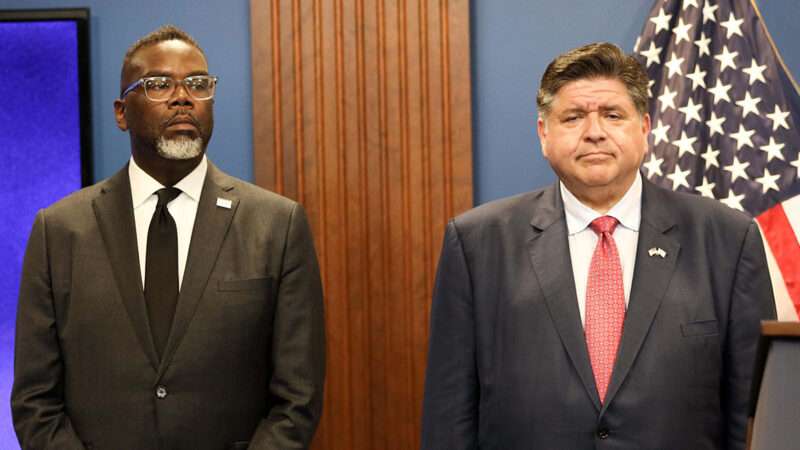
Brandon Johnson and JB Pritzker | Photo: Chicago Mayor Brandon Johnson and Illinois Governor J.B. Pritzker; Alexandra Buxbaum/Sipa/Alamy

“Chicago Mayor should be in jail for failing to protect Ice [sic] Officers!” President Donald Trump blasted on Truth Social on October 8. “Governor Pritzker also!”

The state of Illinois and the city of Chicago filed suit against the Trump administration on October 6, arguing that the Defense Department’s deployment of both Illinois and Texas National Guard members to Chicago is unlawful and unconstitutional.

The suit was a response to Defense Secretary Pete Hegseth federalizing 300 Illinois National Guard members on October 4, and 400 from Texas the following day. Despite opposition from both Illinois Democratic Gov. J.B. Pritzker and Chicago Mayor Brandon Johnson, the troops arrived in Chicago on October 8.

“The Trump Administration’s Department of War gave me an ultimatum: call up your troops, or we will,” Pritzker wrote in a statement condemning the “outrageous and un-American” deployment of the Illinois Guard. After the Texas National Guard was deployed, he added, “We must now start calling this what it is: Trump’s Invasion.”

Illinois’ complaint closely resembles Oregon’s lawsuit filed a week earlier, arguing that the Trump administration’s action does not meet the prerequisites necessary to federalize the National Guard, violates the Posse Comitatus Act, and violates the 10th Amendment by infringing on “Illinois’s sovereignty and right to self-governance.”

On October 4, Judge Karin Immergut of U.S. District Court for the District of Oregon granted a temporary restraining order against the federalization of the Oregon National Guard. She rules that plaintiffs were “likely to succeed on their claim that the President’s federalization…exceeded his statutory authority” and “violated the Tenth Amendment.” She added, “Whether we choose to follow what the Constitution mandates goes to the heart of what it means to live under the rule of law in the United States.”

The very next day, Trump attempted to send out-of-state troops to Oregon—”in direct contravention of the court’s order,” according to Immergut, who issued a second order blocking the deployment.

Illinois plaintiffs argue the same rationale articulated by Immergut should apply in their case. Laying out the long, hostile history between Trump and Chicago’s leaders—including Trump’s “Chipocalypse Now” Truth Social post, which Pritzker took as a threat of war—the complaint asserts that the decision to deploy troops “was made long before recent events” of “small, primarily peaceful” protests outside the Broadview ICE facility in the suburbs of Chicago.

A few weeks later, Trump called Pritzker “incompetent” and “stupid” in a speech to hundreds of generals and admirals. He proposed using large Democrat-run American cities—such as Chicago—as “training grounds” for the military.

Amid the escalating tensions and awaiting a court decision, Pritzker didn’t mince words. “The brave men and women who serve in our national guards must not be used as political props,” Pritzker wrote in a statement. “This is a moment where every American must speak up and help stop this madness.”

The post Illinois Is Taking the Feds to Court Over 'Trump's Invasion' of Chicago appeared first on Reason.com.

from Latest – Reason.com https://ift.tt/3NYIZM0
via IFTTT