11/2/2010: Brown v. Entertainment Merchants Association argued.
The post Today in Supreme Court History: November 2, 2010 appeared first on Reason.com.
from Latest – Reason.com https://ift.tt/tzyCOrK
via IFTTT
another site
11/2/2010: Brown v. Entertainment Merchants Association argued.
The post Today in Supreme Court History: November 2, 2010 appeared first on Reason.com.
from Latest – Reason.com https://ift.tt/tzyCOrK
via IFTTT
In 2015, actor Jon Bernthal appeared at New York Comic Con soon after the announcement that he would portray Marvel Comics’ famous vigilante the Punisher in the Netflix series Daredevil. “I know how important he is to law enforcement, to the military,” he told the crowd. “I look at this as a huge honor, a huge responsibility. And I give you my absolute word, I’m gonna give everything that I have.”
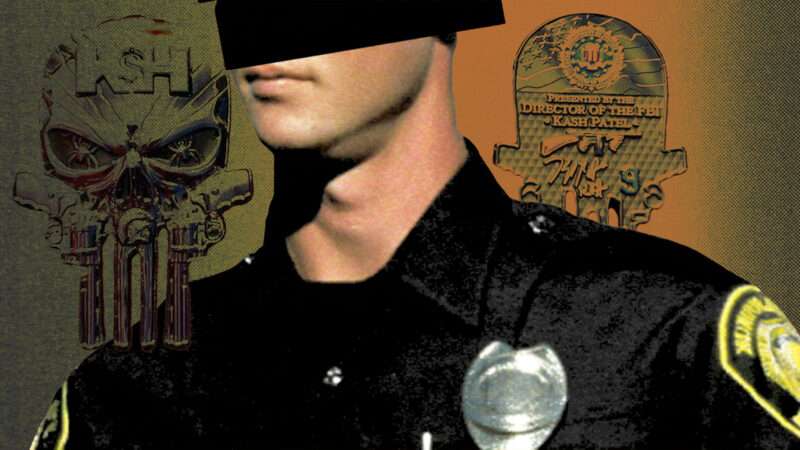
Since then, Punisher iconography has only continued to proliferate among police officers. The character’s skull logo has become synonymous with uncritical support for police. Even FBI Director Kash Patel is a fan. In October, MSNBC’s Ken Dilanian shared a photo of a challenge coin Patel had given out featuring a skull that greatly resembled the Punisher symbol. That trend is disheartening, both for fans of the comics character, like me, and for Americans who want a sane law enforcement apparatus dedicated to serving citizens rather than unleashing violence.
Unlike most of his superhero compatriots, the Punisher is an unrepentant murderer, focused less on restorative justice than on simply massacring his enemies. He is quite possibly the worst role model comics have ever produced. While sometimes a thrilling story of a man able to right the wrongs he sees in the world, the Punisher also functions as an indictment of feckless or corrupt police and a military that sends people off to kill but does too little when they come home damaged. Some of the people who lionize the character these days miss that point—to our detriment.
As a teenager, I found the Punisher’s brutally uncompromising Manichaean worldview a fascinatingly stark contrast to other, more optimistic comic book heroes. The Punisher inhabited that same world but seemed to flout all its rules and conventions: He had no superpowers other than military training, a seemingly unlimited arsenal, and tenacity. I’ve accrued numerous issues of Punisher comics and collectibles and multiple T-shirts bearing his signature skull logo.
But in the more than two decades since I picked up my first issue at the local grocery store, the character’s cultural meaning has shifted. For years, the people most likely to wear the skull logo were comic fans like me; then, over time, it became noticeably more popular among police officers. Custom shops such as Etsy and Redbubble, and mass retailers such as Amazon, carry thousands of items printed with Punisher skulls, often combined with American flags and pro-police iconography.
“There has to be a recognition that while he’s doing what they want to fantasize about doing, that he’s wrong,” Punisher co-creator Gerry Conway tells Reason. “He is breaking the very laws, for example, that cops are supposed to uphold. So, putting a Punisher decal on your cop car is saying you want to break the rules and you want to be outside the law.”
“He’s this normal street-level guy in this world of gods and monsters and marvels,” says David Pepose, who wrote the 2024 Punisher comic series. While benevolent heroes fly through the sky overhead, “the Punisher’s the guy in the gutters. He’s seeing the worst of the worst.”
The character, born Frank Castle, debuted in a 1974 issue of The Amazing Spider-Man as a mercenary hell-bent on killing criminals—”a warrior fighting a lonely war,” as he put it, who “kill[s] only those who deserve killing.” Conway, the series’ writer at the time, saysthat “he had a purpose” and a “sense of honor. There was something behind his motivation that we didn’t know….Something terrible had to turn this very straight-laced, rules-bound guy into the Punisher.”
Later issues filled in his backstory. Castle received numerous medals for meritorious service in Vietnam, but his final tour went badly and the experience haunts him. He survived combat and returned home to Queens, only to see his wife and children murdered in Central Park after they accidentally witnessed a Mafia hit. When corrupt cops and courts fail to bring the killers to justice, Castle declares war on all criminals—from terrorists to muggers and everyone in between. “Frank Castle died with his family,” he corrects a villain while pulling the trigger. “I’m the Punisher.”
Initially planned as a one-off henchman type, Conway liked the Punisher so much that he brought him back as a recurring character. Audiences also responded positively, and he soon appeared in other characters’ series as well. He did not get his own solo title until 1986, a dozen years after his debut. Writer Steven Grant said he had “been trying to get a Punisher series off the ground for years and no one [at Marvel] was interested.” But Grant’s five-issue Punisher limited series sold well and led to an ongoing comic the following year. That series ran for eight years and launched multiple spinoffs; from 1992 through 1995, three monthly Punisher titles were running concurrently.
Comic book heroes were traditionally inherently benevolent: Though they operated outside the law and spent much of their time beating criminals into submission, they usually refused to kill. The Punisher not only had no compunction about killing, but it was his singular purpose. Other comic heroes face many of the same villains again and again over their many decades in print; by definition, the Punisher’s roster of recurring foes is rather short. Marvel senior editor Stephen Wacker said in 2011 that since debuting, Castle had killed 48,502 people.
His murderousness also puts him at odds with other heroes, who can see him as little better than the crooks and killers they encounter. As a result, he has battled fellow heroes such as Daredevil, Spider-Man, and Wolverine (and also, for some reason, Archie).
In 2017, Catlettsburg, Kentucky, Police Chief Cameron Logan commissioned vinyl decals for the department’s cruisers: Punisher skulls that read “Blue Lives Matter.”
“I consider it to be a ‘warrior logo,'” Logan told local media. “That decal represents that we will take any means necessary to keep our community safe.” Logan spoke as if he were commanding troops in a war zone, but Catlettsburg employed only eight full-time officers for a town of 2,500. According to the app Nextdoor, “Catlettsburg is considered a safe place to live,” with violent and property crime rates below state and national averages. After a public backlash, Logan had the decals removed.
That same year, the Solvay, New York, Police Department drew criticism for similar decals. “The Punisher symbol on the patrol vehicles…is our way of showing our citizens that we will stand between good and evil,” according to a statement credited in part to Solvay’s police chief. “There is clearly a war on police and the criminal element attempting to infiltrate and destroy our communities, lifestyles and quality of living requiring men and women willing to stand up to evil and protect the good of society.” (Solvay, a village of about 6,500, is “known for its clean streets and welcoming community,” declared Nextdoor. At the time, its police department employed only 16 people, including the chief.)
Taken at face value, these police departments see themselves as under assault from unchecked criminal forces. In that mindset, the only way to survive is to treat the community like an occupied territory, seeing civilians as potential threats and displaying a decal that signals your willingness to use unconstrained violence.
Solvay’s decals, in particular, featured a thin blue line in the skull design. As noted in Errol Morris’ documentary of the same name, the phrase refers to the concept of “the ‘thin blue line’ of police that separate[s] the public from anarchy.” While now ubiquitous, the design of a thin blue line on an American flag originated in 2014, three years before it was incorporated into Punisher skulls on police cars in Solvay.
In 2019, St. Louis barred 22 city police officers from submitting cases for prosecution after they were found to have posted racist content on social media. Ed Clark, president of the city’s police union, published a letter on the union’s Facebook page “asking all officers and supporters to adopt the Blue Line Punisher symbol as their profile symbol in a show of solidarity.”
“The Blue Line symbol and the Blue Line Punisher symbol have been widely embraced by the law enforcement community as a symbol of the war against those who hate law enforcement,” Clark added. “It’s how we show the world that we hold the line between good and evil.”
But it’s more complicated than that.
“The thin blue line narrative…highlights the assumed differences between officers and citizens and further progresses an ‘us versus them’ mentality among officers,” criminologists Don L. Kurtz and Alayna Colburn wrote in 2019.
Kurtz and Colburn found that the thin blue line narrative “relates to the idea that death surrounds officers as they go about their daily job,” though statistically that’s not necessarily true. As a result, the narrative “pushes a limited subset of society into seeking the profession—people that are more likely to be conservative, justify physical violence and deadly force, are distrustful of the community, and generally suspicious of those outside of law enforcement.”
Now imagine what that same symbol signifies when paired with the skull logo of an extrajudicial murderer.
One could argue that police adopting the cartoonish logo of a fictional character is no big deal. Nobody would bat an eye at police officers with Superman patches. But the Punisher specifically contradicts what the police should represent.
“While tamer vigilantes complicate the job of law enforcement, they accept the legitimacy of the justice system and supplement rather than deconstruct the political order,” Kent Worcester, a political scientist at Marymount Manhattan College, wrote in A Cultural History of the Punisher. “Frank Castle…operates under the assumption that the law itself is a fraud and a fiction.”
All too often, an embrace of the character demonstrably coincides with a proclivity to abuse one’s power. “Frank Castle does to bad guys and girls what we sometimes wish we could legally do,” Jesse Murrieta, a security official who had worked in federal law enforcement, told Vulture in 2020. “Castle doesn’t see shades of grey, which, unfortunately, the American justice system is littered with and which tends to slow down and sometimes even hinder victims of crime from getting the justice they deserve.”
In 2004, numerous off-duty Milwaukee police officers accused Frank Jude Jr. of stealing a wallet and badge at a house party. Though they searched him and didn’t find either, they then assaulted Jude so badly that an emergency room physician resorted to taking photos because “there were too many [injuries] to document” in writing.
Milwaukee Police Captain James Galezewski later discovered the officers involved in the assault belonged to a “clique” within the department who called themselves “the Punishers,” who “wear black caps with a skull on them” and “get carried away” while on duty. “This is a group of rogue officers within our agency who I would characterize as brutal and abusive,” Galezewski noted in a 2007 report.
In 2009, Sgt. Brent Raban of Florida’s Palm Beach County Sheriff’s Office repeatedly bragged on Facebook about beating suspects in the course of his work. He wore a skull cap with the word “punishment“ on it. Raban told investigators he was inspired by comic book characters like the Punisher. He was demoted and reassigned, and he would be fired the following year. An arbitrator later ordered the department to reinstate Raban and pay him $150,000 in back pay.
As actor Bernthal alluded, the Punisher is also popular among members of the military. This makes sense, given Castle’s status as a war hero and his overtly militaristic worldview. But it also fits another troubling aspect of the police/Punisher intersection.
The 9/11 attacks inspired a patriotic and nationalistic fervor and ushered in an era of unchecked police militarization. Such militarization was already on the rise over the previous few decades, but 9/11 created an atmosphere in which no method of retaliation was off limits. In 2003, as a means of fighting terrorism, the Department of Homeland Security began dispensing military weapons and equipment to police departments throughout the country.
When protests broke out after a police shooting in Ferguson, Missouri, in August 2014, officers responded wearing camouflage, brandishing military surplus shotguns and M4 rifles, and driving armored vehicles designed to withstand mines and roadside bombs. In 2020, similar scenes took place across the country: As Black Lives Matter demonstrators protested police brutality, officers outfitted in combat gear deployed brutal and violent tactics to put down demonstrations that often warranted little or no force. Some protests did turn violent, marked by rioting and looting, but reports later found that across the country, police largely responded in excess of what the situation required—ironically validating many of the protesters’ concerns.
As both the 2020 protests and the police response made international news, commenters noted the presence of Punisher skulls on officers’ uniforms. Sadly, neither trend was new. A 75-second video uploaded to YouTube in 2009 depicts a police training exercise in Doraville, Georgia. In the video, several heavily armed SWAT officers pile out of an M113 armored personnel carrier—designed to safely transport up to 11 soldiers at a time to the front lines of a combat zone—with “Doraville Police Department SWAT” printed on the side. The video starts and ends with flashes of the Punisher skull, set to the industrial metal song “Die Motherfucker Die.” The city didn’t add these flourishes, but as Radley Balko wrote in 2014 in The Washington Post, “At least as of this writing, the video was posted on the front page of the Doraville Police Department Web site.”
Doraville, a suburb of Atlanta with about 10,000 residents, has crime rates higher than the state and national averages. But most of that crime is property-related, hardly the kind that would require an armored vehicle. In emails exchanged after Balko’s article, city officials chose to take the video down from the police department’s website, and city manager Shawn Gillen noted, “We no longer own the tank.” But the emails also showed the vehicle’s primary usefulness was not in stopping or solving crime: A city councilmember asked if the city should create a “presentation” to “show how the tank has helped in the past, specifically during the ice storms.”
“The Department of Defense’s 1033 program, which offers free surplus military equipment to police departments, has transferred at least $1.6 billion worth of equipment to departments across the country since 9/11, compared to just $27 million before the attacks,” Reason‘s C.J. Ciaramella wrote in 2021. That was in addition to another $24.3 billion in grants that city and state governments used to purchase additional military-style equipment.
“When controlling for other variables, counties who received the highest amount of military equipment through the 1033 Program recorded twice as many police killings than counties that did not receive any equipment,” according to a 2020 article in the Georgetown Security Studies Review. “A report on Georgia law enforcement agencies discovered that participating police departments and sheriff offices who took in more than $1,000 in 1033 money, on average, had four times as many fatalities as non-participating agencies.”
Given what the Punisher represents, and how police departments have militarized over the last few years, it’s unfortunate but perhaps unsurprising that police have adopted the character’s iconography as their own. Comics writers have increasingly contended with the Punisher’s popularity among police—even adapting it into the pages of the comics. In a 1993 storyline, Castle travels to Baltimore to find and kill a major drug distributor. While there, he is stopped by two local cops—but instead of arresting him, they encourage him to finish the job and marvel at his freedom to operate with “no courts, no warrants, no rules.” They even threaten him with reprisal if he doesn’t kill his target. Castle bristles at doing the officers’ bidding, even indirectly, but he decides that unless they’re “dirty,” they aren’t his concern.
In a storyline from the early 2000s, the New York Police Department (NYPD) names its most ineffectual detective to head the Punisher task force, because the other detectives not so secretly prefer the Punisher’s method of handling criminals to their own. Over time, as life began to imitate art, writers took a different approach, openly confronting whether cops should support Frank’s mission. Matthew Rosenberg tackled the issue most directly when writing the character in 2018 and 2019. In one issue, NYPD officers argue over Castle’s methods—whether he “does more to clean up the streets than we’ll ever be allowed to” or if he’s just “a frickin’ Nazi.”
Later in the same series, when two officers spot Castle on the street—blood on his gloves, still fresh from a recent kill—they get excited and try to take selfies. While most of the NYPD “want[s] you in the ground,” they tell him, they belong to a small but vocal contingent who “believe in what you do” and sport his skull logo as a decal on their car.
Castle peels off the decal and rips it up. “We’re not the same,” he admonishes them. “You took an oath to uphold the law. You help people. I gave all that up a long time ago.” When the officers protest that he “started something” and “showed how it’s done,” Castle replies, “If I find out you are trying to do what I do, I’ll come for you next.”
As a longtime fan of the character who is uncomfortable with the way the police and military have co-opted him, I have to ask myself: What should he represent?
The Punisher was a product of his time. He debuted in February 1974, just five months before the theatrical release of Death Wish, in which Charles Bronson wages a one-man war on crime after a gang murders his wife and brutalizes his daughter. The film had so much prerelease hype that Paramount Pictures raised ticket prices for its premiere screening. Three years earlier, Clint Eastwood starred in Dirty Harry as a San Francisco detective willing to break any rule—including limitations on the use of force—to catch a killer. Each film would spawn four sequels.
Americans were concerned about crime, and for good reason. “Between 1960 and 1980, the homicide rate doubled, and the violent crime rate, as measured by police reports, more than tripled,” according to Alex Tabarrok of the Mercatus Center at George Mason University. “The violence of the 1970s was also more impersonal than previous violence. Homicide rates doubled, but homicide rates by strangers increased much faster, especially in the big cities.”
The same was true when the Punisher’s first solo series debuted in January 1986. The previous year, “the number of crimes reported in the United States rose 5 percent,” including “increases in all major categories of crime,” The New York Times reported. “The numbers showed that violent crime, including murder and rape, was up 4 percent in 1985.”
Just like Death Wish, Dirty Harry, and other revenge thrillers from the era, the Punisher reflected people’s concerns about crime, meeting the senseless violence they feared with a brutally effective counterresponse. “I’ve heard people call me crazy, and maybe they’re right. I can’t judge something like that,” Castle says in a 1975 issue. “I only know there’s a war going on in this country between citizen and criminal—and the citizens are losing.”
Marvel ended all Punisher series in 1995 amid declining sales throughout the industry—the company would file for bankruptcy the following year. When the Punisher returned in 2000, the U.S. looked very different than it had when the character debuted.
“Homicide rates plunged 43 percent from the peak in 1991 to 2001, reaching the lowest levels in 35 years,” economist Steven Levitt wrote in 2004. The FBI’s “violent and property crime indexes fell 34 and 29 percent, respectively, over that same period. These declines occurred essentially without warning: leading experts were predicting an explosion in crime in the early and mid-1990s, precisely the point when crime rates began to plunge.”
That included Castle’s home city: From 1990 through 1998, New York City’s homicide rate plummeted, falling from 30.7 per 100,000 people to 8; the city hadn’t seen a rate in the single digits since 1967. New York City, portrayed as a dystopia in films like Death Wish and The Warriors, was somehow becoming one of the safest cities in America.
The Punisher had thrived in an era of seemingly unchecked crime. What does a writer do with him when, statistically, Americans are safer than they’ve been in decades?
Garth Ennis is often named as one of the Punisher’s greatest writers. He is credited with revitalizing the character’s popularity in the 21st century, starting with the 2000 miniseries The Punisher: Welcome Back, Frank. While never shying away from the character’s proclivity for violence, Ennis also depicted the mental and emotional toll Castle’s experiences had on him.
Ennis “tended to write Castle as a man who was mentally destroyed during his service in Vietnam,” Abraham Josephine Riesman wrote for Vulture in 2015, “and who has become a dangerous psychopath.” Ennis’ 21st century Punisher is not a badass hero or an avenging angel; he is a killer for the sake of killing. He is less ideological than pathological, a textbook case of PTSD. More broadly, he is a casualty of America’s reckless warmaking abroad and its spiraling crime rates at home: Vietnam traumatized him, and the deaths of his family radicalized him to seek retributive violence.
Handling the character through the PTSD lens may be unsatisfying for those who look to Castle as a hero—or worse, as a role model. But it’s perfectly in keeping with his history, and what has always made him work as a character. “The attraction to me back when I was creating the character was that complexity, that layer of semi-justification, but still [being] on the wrong side,” Conway says. “It’s a tough thing to unravel, but it’s worth unraveling….It is complex, and the complexity is what we should be interested in.”
People who should know better continue to pattern themselves after a comic book character who is definitively not to be emulated. In addition to cops and soldiers, the character has also proven popular among President Donald Trump’s supporters and the paramilitary right—groups who want to convey strength over all else. Some of the rioters who stormed the U.S. Capitol on January 6, 2021, wore Punisher skulls. “These people are misguided, lost, and afraid. They have nothing to do with what Frank stands for or is about,” Bernthal tweeted at the time.
After January 6, Mike Avila wrote in SYFY WIRE that perhaps Marvel should retire the character. Is there another option—one that doesn’t mean giving up on the Punisher altogether? Conway thinks so. For the past few years, the Punisher’s creator has spoken out against the character’s misuse, including by police. In 2020, he raised over $75,000 for Black Lives Matter in Los Angeles, selling T-shirts with artists’ designs of the Punisher skull with BLM symbology. But he isn’t ready to give up on the character.
He points to a scene in the Disney+ series Daredevil: Born Again, where Castle directly confronts and repudiates police who have taken up his mantle, in a way that feels authentic to the character.
“You don’t embrace his attitude, but you recognize it. You see it for what it is,” Conway says. “This is a guy who is in terrible pain….And I think that’s something that should be addressed. I think that’s some way toward a healing of the readership or the viewership, and an introduction to the complexity of the character going forward. Don’t be afraid of this guy as a publisher, or as a studio. He asks you to think, he asks you to feel. And that’s a valuable thing to do. I think that’s justification for keeping the character alive.”
I agree the Punisher still serves a legitimate purpose—not as a role model, but as an examination of our own impulses, and our desire to do the right thing even if in the wrong way. “As long as there are innocents who need avenging, the Punisher will never die,” Pepose’s 2024 series says in its closing panel.
I still like the character. I’ll keep reading his comics and watching him on TV and in movies. But perhaps the days of wearing the skull are behind me.
The post How the Punisher, a Murderous Anti-Hero, Became the Mascot for Increasingly Militarized Police Forces appeared first on Reason.com.
from Latest – Reason.com https://ift.tt/NzbXAT1
via IFTTT
The post Sunday Open Thread appeared first on Reason.com.
from Latest – Reason.com https://ift.tt/m5NL2AK
via IFTTT
Jodi Kantor continues her series of articles with inside scoops about the Supreme Court. In the past, I’ve been critical that she has focused only on the Court’s conservatives. To her credit, Kantor has done a deep dive on the Court’s three progressives. Much of what she wrote is consistent with things I’ve gleaned from listening to oral argument and reading opinions. But there is some new stuff .
First, the Court installed some kind of tracker into the bench to indicate how much time each Justice speaks for.
At oral arguments, she has taken up far more speaking time than her colleagues, even though the court several years ago tucked timers into the justices’ imposing wood table to tally each of their ticking minutes, according to several people familiar with the devices.
How did we not know about this?! How does this system even work? My best guess is that the timer starts ticking when a Justice’s microphone is being used. Are these digital timers or analog timers? Did the Chief Justice have these installed during the pandemic so the Justices could keep track of time during the seriatim rounds? Its seems obvious enough that the Justices have zero impact whatsoever on how long the Justice speak for. I want a picture of these devices!
Second, we learn that Justice Jackson apparently reads prepared statements during the conferences:
Now, in private Supreme Court conference meetings, she tended to go on longer than the other justices, sometimes reading from statements she had prepared in advance. Some of the other justices became annoyed by how much airtime she consumed there and during oral arguments, according to both liberals and conservatives who heard the complaints.
Justice Douglas would complain that Justice Frankfurter made 50-minute long statements at conference, since that was the length of a Harvard Law School class. I do not know if Frankfurter brought prepared statements.
Third, Kantor confirms the compromise in Masterpiece Cakeshop:
In 2018, the court sided with a Colorado baker who had refused to create a wedding cake for a same-sex couple. The result looked like a loss for gay rights. But Justices Kagan and Breyer had helped persuade Justice Kennedy to rule on grounds so narrow they neutered the decision, according to people familiar with the proceedings. The baker won — but the results could not be applied to any other case.
Masterpiece Cakeshop was a 7-2 vote. It seemed clear enough that Justices Kagan and Breyer went along with Justice Kennedy’s super-narrow decision on the Free Exercise Clause, to avoid a ruling on the Free Speech Clause. Of course, 303 Creative blew up that narrow holding.
Kantor also provides this reporting on how Kagan and Breyer approached compromises:
The court she joined in 2010 leaned rightward, but not by much, and she devised a way of operating that sometimes allowed her to win. Justice Kagan became a confidante of the chief justice, and so avidly monitored the mood of Justice Anthony Kennedy — a Republican appointee who had become the court’s swing vote — that people who worked with them joked that she knew what he had for breakfast each day. While Justice Stephen Breyer, a fellow liberal also devoted to compromise, was spontaneous, Justice Kagan was tactical. She assessed where to expend capital and what to write off as a lost cause, and took copious notes on the views her colleagues expressed in conference meetings. She did not publicize her maneuvers or gains, lest visibility make her less effective.
Laurence Tribe was right. Kagan would be persuasive to Justice Kennedy.
Fourth, Justice Kagan apparently circulated a very harsh dissent in the student loan case, Biden v. Nebraska, which she deleted:
As they prepared to strike down President Joseph R. Biden Jr.’s student loan forgiveness program, she blasted Chief Justice John G. Roberts Jr. in a draft dissent she circulated within the court, according to several people familiar with the episode.
But before the decision went public, she hit delete. Her final dissent was adamant, but the most heated passages never saw daylight, as she abided by a taboo among the justices against steaming publicly at colleagues or the institution.
For years, as the court has moved right, Justice Kagan has agonized over whether to be more confrontational, confidantes say, and has mostly concluded that to be effective, she must be careful about rocking the boat. . . . Before she deleted the most vehement passages from her student loan decision, she circulated them to other justices — a warning, perhaps, of how scathing she could choose to be.
I thought that the published dissent was pretty harsh, but maybe it could have been worse.
Fifth, there are extended discussions about a growing rift between Justices Jackson on the one hand, and Justices Sotomayor and Kagan on the other.
Ever since Justice Jackson arrived in 2022, friction has been building: between her and Justices Sotomayor and Kagan, who are more aligned strategically, and between her and the rest of the court, according to more than a dozen associates of the justices, including both liberals and conservatives. They spoke on condition of anonymity, in order to share sensitive details about closely held conversations.
Kantor confirms that Justice Kagan tries to persuade Justice Barrett–something that has been clear to me for some time.
Justice Kagan’s approach goes like this: Even on a 6-to-3 court, the Democratic appointees can sometimes strategize their way into narrower rulings, smaller losses or even outright victory. To do so, the liberals must generally sway the chief justice and Justice Barrett. Admirers of Justice Kagan say she is prudent to show restraint, displaying her frustration only in flashes. Justice Jackson’s outspokenness could risk those votes, or further erode faith in a court that may yet stand up to Mr. Trump, they say.
People who worked with her describe her attitude as: Let’s make this opinion 30 percent better. . . .
As Justice Jackson settled in, Justice Sotomayor and Justice Kagan were drawing closer to one another, according to numerous people who know them both, and also forming ties with Justice Barrett, whose vote they desperately needed. . . .
Barrett described Kagan as her friend on the Court, who shared an “analytical” mode of thinking.
But Justice Jackson is not interested in this compromise.
The two more senior liberals tried to advise and coordinate with Justice Jackson, people close to all three jurists said in interviews. The new justice sometimes deferred, softening or withdrawing opinions. But she also felt compelled to express frank disagreement even if it caused friction.
…
By the summer of 2024, two years into Justice Jackson’s tenure, Justices Sotomayor and Kagan had grown worried that their newer colleague’s candor and propensity to add her own dissents were diluting the group’s impact, according to their confidantes. . . .
Her choices have been purposeful, people close to Justice Jackson said. Winning cases was going to be almost impossible, she believed. Any liberal gains exacted through diplomacy would be small and not worth the price of staying silent.
I often describe Justice Jackson’s appointment as moving the Court to the right. Students are perplexed by this answer. But I think it is right. Jackson subverts Kagan’s ability to make compromises, and turns what could be a narrow 8-1 or 7-2 decision into a sharp 6-3 decision.
Sixth, Kantor describes Justice Kagan as “despondent.”
As the court approaches the pivotal Trump questions, Justice Kagan is the one to watch, scholars and people close to her say.
Her tone in recent private conversations has been despondent, they said. Because of her discipline, her words have special potential to critique the court, they said.
I have made a similar observation. Justice Kagan’s questions have not been as sharp, her opinions have not been as tight, and her dissents have not been as memorable. For some time, she has seemed off her game. It would be easy enough to blame the Court’s conservatives, but I suspect that KBJ bears a lot of the blame. Maybe Justice Kagan should have resigned during the Biden administration, in addition to Justice Breyer.
The post Six Things I Learned From Jodi Kantor's Latest Article appeared first on Reason.com.
from Latest – Reason.com https://ift.tt/dbJmFH9
via IFTTT
The post Sunday Open Thread appeared first on Reason.com.
from Latest – Reason.com https://ift.tt/m5NL2AK
via IFTTT
Jodi Kantor continues her series of articles with inside scoops about the Supreme Court. In the past, I’ve been critical that she has focused only on the Court’s conservatives. To her credit, Kantor has done a deep dive on the Court’s three progressives. Much of what she wrote is consistent with things I’ve gleaned from listening to oral argument and reading opinions. But there is some new stuff .
First, the Court installed some kind of tracker into the bench to indicate how much time each Justice speaks for.
At oral arguments, she has taken up far more speaking time than her colleagues, even though the court several years ago tucked timers into the justices’ imposing wood table to tally each of their ticking minutes, according to several people familiar with the devices.
How did we not know about this?! How does this system even work? My best guess is that the timer starts ticking when a Justice’s microphone is being used. Are these digital timers or analog timers? Did the Chief Justice have these installed during the pandemic so the Justices could keep track of time during the seriatim rounds? Its seems obvious enough that the Justices have zero impact whatsoever on how long the Justice speak for. I want a picture of these devices!
Second, we learn that Justice Jackson apparently reads prepared statements during the conferences:
Now, in private Supreme Court conference meetings, she tended to go on longer than the other justices, sometimes reading from statements she had prepared in advance. Some of the other justices became annoyed by how much airtime she consumed there and during oral arguments, according to both liberals and conservatives who heard the complaints.
Justice Douglas would complain that Justice Frankfurter made 50-minute long statements at conference, since that was the length of a Harvard Law School class. I do not know if Frankfurter brought prepared statements.
Third, Kantor confirms the compromise in Masterpiece Cakeshop:
In 2018, the court sided with a Colorado baker who had refused to create a wedding cake for a same-sex couple. The result looked like a loss for gay rights. But Justices Kagan and Breyer had helped persuade Justice Kennedy to rule on grounds so narrow they neutered the decision, according to people familiar with the proceedings. The baker won — but the results could not be applied to any other case.
Masterpiece Cakeshop was a 7-2 vote. It seemed clear enough that Justices Kagan and Breyer went along with Justice Kennedy’s super-narrow decision on the Free Exercise Clause, to avoid a ruling on the Free Speech Clause. Of course, 303 Creative blew up that narrow holding.
Kantor also provides this reporting on how Kagan and Breyer approached compromises:
The court she joined in 2010 leaned rightward, but not by much, and she devised a way of operating that sometimes allowed her to win. Justice Kagan became a confidante of the chief justice, and so avidly monitored the mood of Justice Anthony Kennedy — a Republican appointee who had become the court’s swing vote — that people who worked with them joked that she knew what he had for breakfast each day. While Justice Stephen Breyer, a fellow liberal also devoted to compromise, was spontaneous, Justice Kagan was tactical. She assessed where to expend capital and what to write off as a lost cause, and took copious notes on the views her colleagues expressed in conference meetings. She did not publicize her maneuvers or gains, lest visibility make her less effective.
Laurence Tribe was right. Kagan would be persuasive to Justice Kennedy.
Fourth, Justice Kagan apparently circulated a very harsh dissent in the student loan case, Biden v. Nebraska, which she deleted:
As they prepared to strike down President Joseph R. Biden Jr.’s student loan forgiveness program, she blasted Chief Justice John G. Roberts Jr. in a draft dissent she circulated within the court, according to several people familiar with the episode.
But before the decision went public, she hit delete. Her final dissent was adamant, but the most heated passages never saw daylight, as she abided by a taboo among the justices against steaming publicly at colleagues or the institution.
For years, as the court has moved right, Justice Kagan has agonized over whether to be more confrontational, confidantes say, and has mostly concluded that to be effective, she must be careful about rocking the boat. . . . Before she deleted the most vehement passages from her student loan decision, she circulated them to other justices — a warning, perhaps, of how scathing she could choose to be.
I thought that the published dissent was pretty harsh, but maybe it could have been worse.
Fifth, there are extended discussions about a growing rift between Justices Jackson on the one hand, and Justices Sotomayor and Kagan on the other.
Ever since Justice Jackson arrived in 2022, friction has been building: between her and Justices Sotomayor and Kagan, who are more aligned strategically, and between her and the rest of the court, according to more than a dozen associates of the justices, including both liberals and conservatives. They spoke on condition of anonymity, in order to share sensitive details about closely held conversations.
Kantor confirms that Justice Kagan tries to persuade Justice Barrett–something that has been clear to me for some time.
Justice Kagan’s approach goes like this: Even on a 6-to-3 court, the Democratic appointees can sometimes strategize their way into narrower rulings, smaller losses or even outright victory. To do so, the liberals must generally sway the chief justice and Justice Barrett. Admirers of Justice Kagan say she is prudent to show restraint, displaying her frustration only in flashes. Justice Jackson’s outspokenness could risk those votes, or further erode faith in a court that may yet stand up to Mr. Trump, they say.
People who worked with her describe her attitude as: Let’s make this opinion 30 percent better. . . .
As Justice Jackson settled in, Justice Sotomayor and Justice Kagan were drawing closer to one another, according to numerous people who know them both, and also forming ties with Justice Barrett, whose vote they desperately needed. . . .
Barrett described Kagan as her friend on the Court, who shared an “analytical” mode of thinking.
But Justice Jackson is not interested in this compromise.
The two more senior liberals tried to advise and coordinate with Justice Jackson, people close to all three jurists said in interviews. The new justice sometimes deferred, softening or withdrawing opinions. But she also felt compelled to express frank disagreement even if it caused friction.
…
By the summer of 2024, two years into Justice Jackson’s tenure, Justices Sotomayor and Kagan had grown worried that their newer colleague’s candor and propensity to add her own dissents were diluting the group’s impact, according to their confidantes. . . .
Her choices have been purposeful, people close to Justice Jackson said. Winning cases was going to be almost impossible, she believed. Any liberal gains exacted through diplomacy would be small and not worth the price of staying silent.
I often describe Justice Jackson’s appointment as moving the Court to the right. Students are perplexed by this answer. But I think it is right. Jackson subverts Kagan’s ability to make compromises, and turns what could be a narrow 8-1 or 7-2 decision into a sharp 6-3 decision.
Sixth, Kantor describes Justice Kagan as “despondent.”
As the court approaches the pivotal Trump questions, Justice Kagan is the one to watch, scholars and people close to her say.
Her tone in recent private conversations has been despondent, they said. Because of her discipline, her words have special potential to critique the court, they said.
I have made a similar observation. Justice Kagan’s questions have not been as sharp, her opinions have not been as tight, and her dissents have not been as memorable. For some time, she has seemed off her game. It would be easy enough to blame the Court’s conservatives, but I suspect that KBJ bears a lot of the blame. Maybe Justice Kagan should have resigned during the Biden administration, in addition to Justice Breyer.
The post Six Things I Learned From Jodi Kantor's Latest Article appeared first on Reason.com.
from Latest – Reason.com https://ift.tt/dbJmFH9
via IFTTT
Ohio Sec. Of State Refers 1,084 Cases Of Suspected Fraudulent Voter Registration to DOJ
Ohio Secretary of State Frank LaRose says he’s found 1,084 alleged cases of noncitizens who appear registered to vote and is referring them to the U.S. Department of Justice (DOJ) after county prosecutors failed to act.
LaRose said his office has also uncovered instances of 167 people who have allegedly voted in a federal election as far back as 2018.
“In these cases, the county prosecutor has decided for whatever reason not to take them up. In some cases they’ve been referred to the attorney general as well, and we’re sending them along to the federal government to see if they want to prosecute these cases,” LaRose said.
LaRose had asked county prosecutors to act on 633 cases of suspected voter fraud last year but prosecutors took up just 12 of them, saying the others lacked evidence to pursue indictments.
The number of election fraud allegations in Ohio are a direct challenge to Democrat claims that noncitizens registering to vote in U.S. elections never happens.
The real amount of illegal voting is vastly greater than this.
Consider that California and New York banned the use of ID for voting! They legalized fraudulent voting. https://t.co/aprvhBu3Bf
— Elon Musk (@elonmusk) October 28, 2025
Secretary LaRose gave credit to a special investigative unit in his office for uncovering the cases, although he noted that, while unusual, there does not appear to be a pattern to them.
LaRose stated:
What we know is that noncitizens registering is exceedingly rare. It’s even more rare for noncitizens to actually cast a ballot, especially now that we’ve got a really good process in place for identifying that at the time of registration and checking for that. But in some cases it has happened. And we’re talking about hundreds of cases, not thousands and thousands of cases.
A press release from LaRose’s office says the Ohio Sec. of State is also referring to the DOJ, 99 individuals who appear to have voted in two states in the same federal election, 16 individuals who appear to have voted twice in Ohio in the same federal election and 14 individuals who appear to have voted in a federal election after the date of their deaths.
Four individuals also are suspected of ballot harvesting and 2 individuals appear to have registered to vote at a residence where they were not entitled to register.
In his letter to the DOJ Criminal Division, LaRose wrote:
I have made numerous criminal referrals throughout my administration, with much of the evidence related to unlawful registration and voting activity. These cases have encountered varying degrees of adjudication from Ohio’s 88 county prosecutors. We now have an executive administration at the White House and the Department of Justice that has expressed an interest in actively reviewing and potentially prosecuting evidence of federal election crimes.
The Secretary’s letter also gives credit to constructive feedback from state and local prosecutors in helping his office improve the quality of evidence referred for investigation.
Tyler Durden
Sat, 11/01/2025 – 22:20
via ZeroHedge News https://ift.tt/wg4BekQ Tyler Durden
Where US Families Are Most Strained By Debt
Americans are always worrying about debt: their own and their government’s.
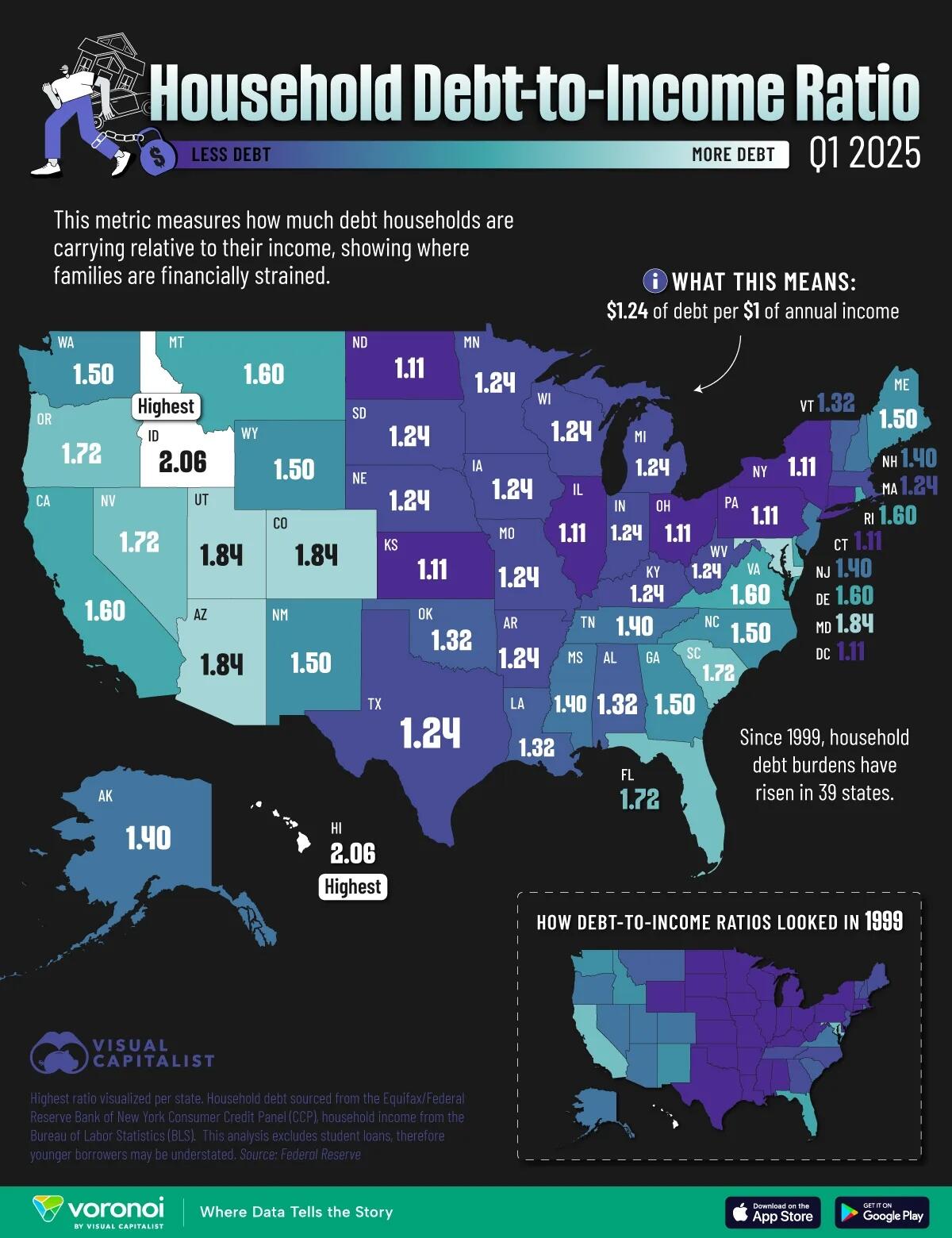
This visualization, via Visual Capitalist’s Pallavi Rao, maps each state by their household debt-to-income ratios (DTI) in Q1, 2025, revealing which states carry the heaviest burdens and which ones keep borrowing in check.
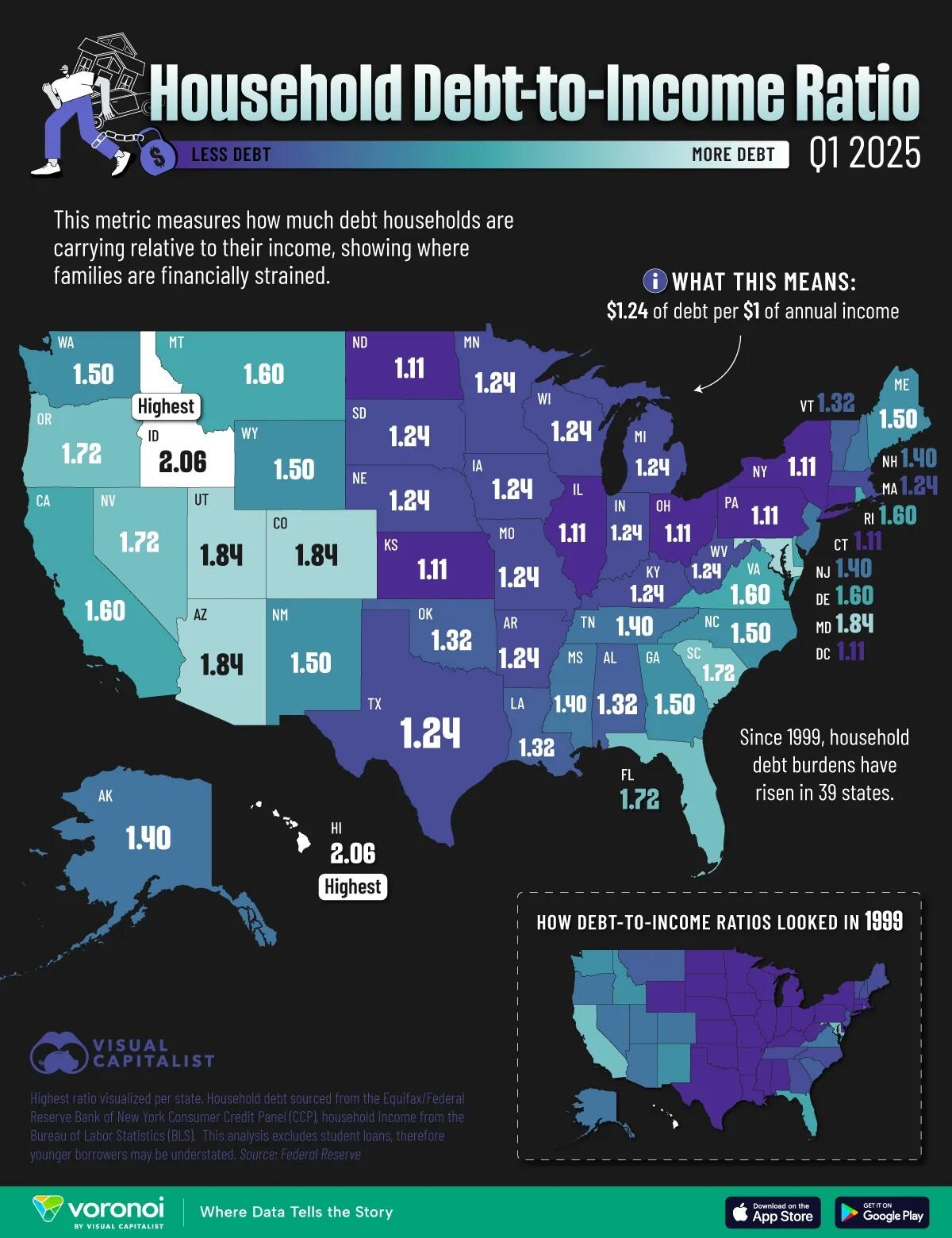
Data for this visualization comes from the Federal Reserve. The highest ratio is visualized per state.
ℹ️ Debt includes mortgages, autos, credit cards, etc., and excludes student loans. Income is based on unemployment insurance-covered wages, as reported to the Bureau of Labor Statistics.
Two states share the top spot: Idaho and Hawaii both post a DTI of 2.06, meaning households owe just over twice their annual after-tax income.
| Rank | State | State Code | Debt-to-Income Ratio (2025) | Debt-to-Income Ratio (1999) | 1999–2025 Change |
|---|---|---|---|---|---|
| 1 | Idaho | ID | 2.06 | 1.50 | 0.56 |
| 2 | Hawaii | HI | 2.06 | 2.06 | 0.00 |
| 3 | Arizona | AZ | 1.84 | 1.40 | 0.44 |
| 4 | Colorado | CO | 1.84 | 1.40 | 0.44 |
| 5 | Utah | UT | 1.84 | 1.40 | 0.44 |
| 6 | Maryland | MD | 1.84 | 1.72 | 0.12 |
| 7 | South Carolina | SC | 1.72 | 1.32 | 0.40 |
| 8 | Nevada | NV | 1.72 | 1.40 | 0.32 |
| 9 | Oregon | OR | 1.72 | 1.40 | 0.32 |
| 10 | Florida | FL | 1.72 | 1.60 | 0.12 |
| 11 | Delaware | DE | 1.60 | 1.11 | 0.49 |
| 12 | Montana | MT | 1.60 | 1.32 | 0.28 |
| 13 | Rhode Island | RI | 1.60 | 1.32 | 0.28 |
| 14 | Virginia | VA | 1.60 | 1.40 | 0.20 |
| 15 | California | CA | 1.60 | 1.72 | -0.12 |
| 16 | Wyoming | WY | 1.50 | 1.11 | 0.39 |
| 17 | Georgia | GA | 1.50 | 1.24 | 0.26 |
| 18 | Maine | ME | 1.50 | 1.24 | 0.26 |
| 19 | North Carolina | NC | 1.50 | 1.24 | 0.26 |
| 20 | New Mexico | NM | 1.50 | 1.50 | 0.00 |
| 21 | Washington | WA | 1.50 | 1.50 | 0.00 |
| 22 | Mississippi | MS | 1.40 | 1.11 | 0.29 |
| 23 | New Hampshire | NH | 1.40 | 1.24 | 0.16 |
| 24 | New Jersey | NJ | 1.40 | 1.24 | 0.16 |
| 25 | Tennessee | TN | 1.40 | 1.24 | 0.16 |
| 26 | Alaska | AK | 1.40 | 1.32 | 0.08 |
| 27 | Alabama | AL | 1.32 | 1.11 | 0.21 |
| 28 | Louisiana | LA | 1.32 | 1.11 | 0.21 |
| 29 | Oklahoma | OK | 1.32 | 1.11 | 0.21 |
| 30 | Vermont | VT | 1.32 | 1.24 | 0.08 |
| 31 | Arkansas | AR | 1.24 | 1.11 | 0.13 |
| 32 | Indiana | IN | 1.24 | 1.11 | 0.13 |
| 33 | Iowa | IA | 1.24 | 1.11 | 0.13 |
| 34 | Kentucky | KY | 1.24 | 1.11 | 0.13 |
| 35 | Massachusetts | MA | 1.24 | 1.11 | 0.13 |
| 36 | Michigan | MI | 1.24 | 1.11 | 0.13 |
| 37 | Minnesota | MN | 1.24 | 1.11 | 0.13 |
| 38 | Missouri | MO | 1.24 | 1.11 | 0.13 |
| 39 | Nebraska | NE | 1.24 | 1.11 | 0.13 |
| 40 | South Dakota | SD | 1.24 | 1.11 | 0.13 |
| 41 | Texas | TX | 1.24 | 1.11 | 0.13 |
| 42 | West Virginia | WV | 1.24 | 1.11 | 0.13 |
| 43 | Wisconsin | WI | 1.24 | 1.11 | 0.13 |
| 44 | Connecticut | CT | 1.11 | 1.11 | 0.00 |
| 45 | District of Columbia | DC | 1.11 | 1.11 | 0.00 |
| 46 | Illinois | IL | 1.11 | 1.11 | 0.00 |
| 47 | Kansas | KS | 1.11 | 1.11 | 0.00 |
| 48 | New York | NY | 1.11 | 1.11 | 0.00 |
| 49 | North Dakota | ND | 1.11 | 1.11 | 0.00 |
| 50 | Ohio | OH | 1.11 | 1.11 | 0.00 |
| 51 | Pennsylvania | PA | 1.11 | 1.11 | 0.00 |
In Hawaii’s case, elevated housing costs push mortgage balances sky-high. In Idaho, a surge of migrants since 2020 has driven up home prices and left many newcomers with large, fresh mortgages.
Rounding out the top five are Arizona, Colorado, and Utah (all 1.84). Once again, fast-growing markets where rising prices and younger populations translate into higher leverage.
ℹ️ Related: Hawaii has the fifth-lowest homeownership rate in the country.
At the other end of the spectrum, Pennsylvania, Ohio, and North Dakota come in at just 1.11.
Many low-debt states share three traits. They have lower housing costs, older homeowner bases with significant equity, and slower population growth that tempers new borrowing.
However, even high-income states like Connecticut and the District of Columbia can land in this cohort thanks to well-paid residents who keep balances in check.
The gap underscores how regional housing dynamics, more than incomes alone, dictate household debt.
Finally, due to how this ratio is calculated, younger households’ true burden may be understated (student loan exclusion).
At the same time, the income measure is unemployment insurance-covered wages wages (not total personal income), which can overstate the ratio in high-capital-income areas (e.g., states with finance-heavy metros).
If you enjoyed today’s post, check out Visualizing Government Debt-to-GDP Around the World on Voronoi, the new app from Visual Capitalist.
Tyler Durden
Sat, 11/01/2025 – 21:45
via ZeroHedge News https://ift.tt/MTV3eYi Tyler Durden
Almost Half Of Humanity Is Gen Z Or Gen Alpha
As of December 2024, the global population has reached 8.2 billion. For the first time in history, nearly half of humanity belongs to Generation Z and Generation Alpha—the digital-native generations.
This visualization, via Visual Capitalist’s Bruno Venditti, ranks the world’s population by generation, showing how age cohorts are distributed across the planet.
The data for this graphic comes from We Are Social, IntelPoint, and the United Nations World Population Prospects 2024. Generation Beta (born 2025–2039), representing less than 1% of the population, is not shown in the graphic because of limited data.
Generation Alpha, born between 2013 and 2025, now includes roughly 2.0 billion people, or 24.4% of the world’s population. Many of them are still in primary school, but they already outnumber every other generation.
Their demographic weight will increasingly shape consumer markets, education systems, and technology trends in the coming decades. The countries driving this growth are concentrated in Africa and South Asia, where birth rates remain high.
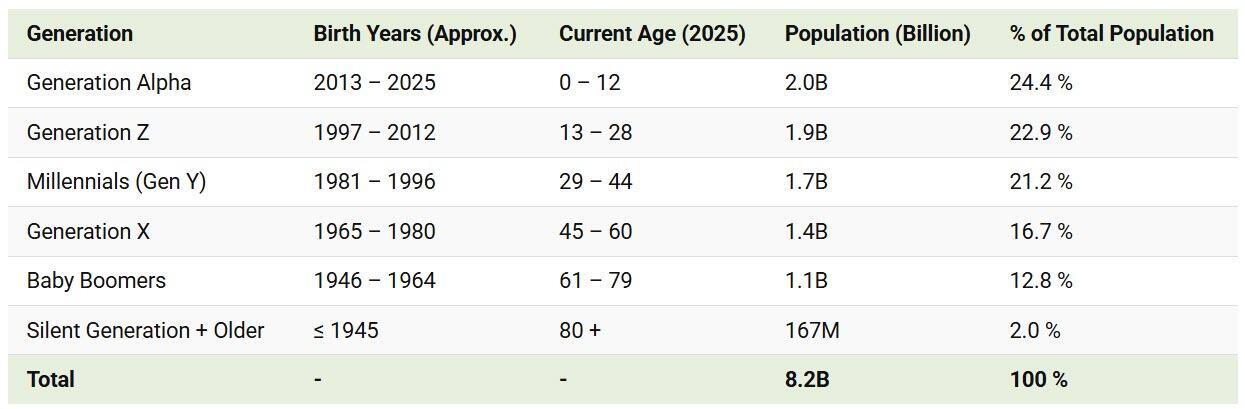
Gen Z (ages 13–28) and Millennials (ages 29–44) together account for 44% of all people—and most of the world’s workers. Millennials alone make up 1.7 billion people.
At the upper end of the age spectrum, Baby Boomers (ages 61–79) represent about 12.8% of the population, while those 80 or older—the Silent Generation and older cohorts—make up just 2%.
If you enjoyed today’s post, check out Visualizing America’s Wealth Distribution by Generation on Voronoi, the new app from Visual Capitalist.
Tyler Durden
Sat, 11/01/2025 – 19:25
via ZeroHedge News https://ift.tt/OotQeIT Tyler Durden
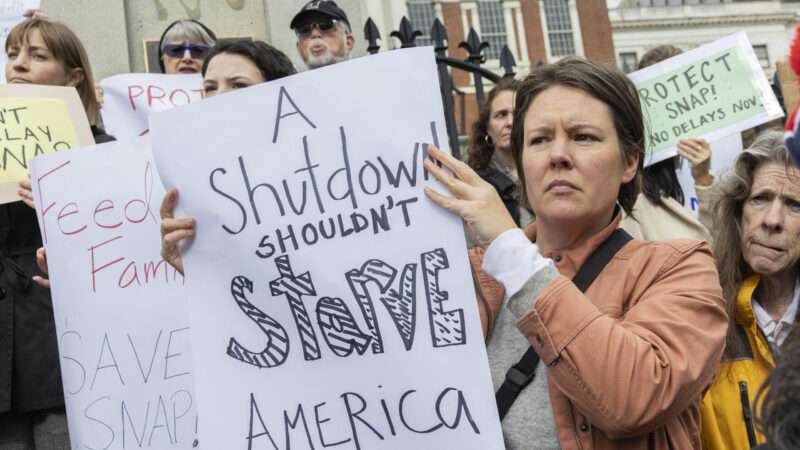
The federal government shutdown is disrupting major federal programs, including the Supplemental Nutrition Assistance Program (SNAP). Now one in five children nationwide risks losing benefits because Congress has failed to pass a budget. On October 30, a federal judge ordered the United States Department of Agriculture (USDA) to draw from SNAP’s contingency fund to cover payments, but that fund holds roughly $5–6 billion—barely enough to cover three weeks of payments for a program that spends more than $8 billion each month.
The ongoing deadlock highlights SNAP’s fragility due to its near-total reliance on federal funding. More importantly, its chronic dependency on Washington’s one-size-fits-all solutions has left it failing the very children it’s supposed to help. The best way to ensure healthy outcomes for kids and protect them from the partisan crossfire of D.C. politicking is to break the federal grip on nutrition programs.
Washington has become a permanent fixture of childhood in low-income America. The N in SNAP stands for “nutrition,” but federal food aid has routinely failed to deliver healthy diets for low-income families despite nearly $2 trillion in spending since 2000. Almost one-quarter of food purchases by SNAP households are for junk food, which undermines the efforts of doctors and other federal agencies to promote healthy diets. SNAP participants also have higher rates of obesity and poorer nutrition than nonparticipants, regularly failing to meet dietary guidelines while performing poorly on key health indicators. All of this has helped drive child obesity to nearly one in five children and adolescents as of 2020.
SNAP may provide assistance to families, but a program that consistently fails to deliver positive outcomes for the children it aims to serve falls far short of its purpose.
We’ve seen this problem before—and its solution. Like SNAP, Congress designed Aid to Families with Dependent Children (AFDC) to assist low-income households, but its structure created perverse incentives that encouraged single motherhood, punished work, and trapped families in dependency for years. The 1996 welfare reforms replaced AFDC with Temporary Assistance for Needy Families (TANF), a fixed block grant program that provided states with much-needed flexibility to innovate and tailor their programs to fit the needs of their residents.
States leveraged TANF’s block grant flexibility by shifting funds from pure cash assistance to targeted supports such as childcare subsidies, job training, and education programs. These reforms helped parents—especially single mothers—overcome employment barriers and increase their income. The results surpassed everyone’s predictions. Within a decade, more than 1.6 million children were lifted out of poverty. Additionally, poverty in single-mother families fell to record lows, and overall poverty and child hunger declined substantially. All of this occurred while welfare caseloads declined by more than half.
By converting SNAP into a block grant and gradually decoupling it from federal dollars, states would be able to take on decision-making and responsibility for their programs, controlling funding and tailoring solutions to the needs of their low-income families. Just as TANF prioritized economic independence and employment, state SNAP reforms could prioritize better health and self-sufficiency.
The current shutdown should serve as a catalyst for Congress to reassess the federal role in welfare. Children shouldn’t go hungry because Congress can’t govern—nor should they be dependent on the D.C. bureaucracy for their food. SNAP’s centralization and reliance on federal dollars have caused it to fail at meeting the nutritional needs of children, and now, millions of families face the prospect of sudden benefit disruptions.
Congress should stop treating Americans as collateral damage in their fight over extending Obamacare subsidies and end the shutdown immediately. While restoring federal funding will avoid immediate disruptions to benefits, Congress should also reform welfare to ensure it helps rather than hinders the families who rely on it.
SNAP is outdated. Congress should devolve funding and administration to the states, allowing them to pursue more effective nutrition policies for low-income families.
The post About 1 in 5 Kids Are at Risk of Losing SNAP. Centralized Control Keeps Failing Low-Income Families. appeared first on Reason.com.
from Latest – Reason.com https://ift.tt/xeHVQ6M
via IFTTT