The federal government shutdown is disrupting major federal programs, including the Supplemental Nutrition Assistance Program (SNAP). Now one in five children nationwide risks losing benefits because Congress has failed to pass a budget. On October 30, a federal judge ordered the United States Department of Agriculture (USDA) to draw from SNAP’s contingency fund to cover payments, but that fund holds roughly $5–6 billion—barely enough to cover three weeks of payments for a program that spends more than $8 billion each month.
The ongoing deadlock highlights SNAP’s fragility due to its near-total reliance on federal funding. More importantly, its chronic dependency on Washington’s one-size-fits-all solutions has left it failing the very children it’s supposed to help. The best way to ensure healthy outcomes for kids and protect them from the partisan crossfire of D.C. politicking is to break the federal grip on nutrition programs.
Washington has become a permanent fixture of childhood in low-income America. The N in SNAP stands for “nutrition,” but federal food aid has routinely failed to deliver healthy diets for low-income families despite nearly $2 trillion in spending since 2000. Almost one-quarter of food purchases by SNAP households are for junk food, which undermines the efforts of doctors and other federal agencies to promote healthy diets. SNAP participants also have higher rates of obesity and poorer nutrition than nonparticipants, regularly failing to meet dietary guidelines while performing poorly on key health indicators. All of this has helped drive child obesity to nearly one in five children and adolescents as of 2020.
SNAP may provide assistance to families, but a program that consistently fails to deliver positive outcomes for the children it aims to serve falls far short of its purpose.
We’ve seen this problem before—and its solution. Like SNAP, Congress designed Aid to Families with Dependent Children (AFDC) to assist low-income households, but its structure created perverse incentives that encouraged single motherhood, punished work, and trapped families in dependency for years. The 1996 welfare reforms replaced AFDC with Temporary Assistance for Needy Families (TANF), a fixed block grant program that provided states with much-needed flexibility to innovate and tailor their programs to fit the needs of their residents.
States leveraged TANF’s block grant flexibility by shifting funds from pure cash assistance to targeted supports such as childcare subsidies, job training, and education programs. These reforms helped parents—especially single mothers—overcome employment barriers and increase their income. The results surpassed everyone’s predictions. Within a decade, more than 1.6 million children were lifted out of poverty. Additionally, poverty in single-mother families fell to record lows, and overall poverty and child hunger declined substantially. All of this occurred while welfare caseloads declined by more than half.
By converting SNAP into a block grant and gradually decoupling it from federal dollars, states would be able to take on decision-making and responsibility for their programs, controlling funding and tailoring solutions to the needs of their low-income families. Just as TANF prioritized economic independence and employment, state SNAP reforms could prioritize better health and self-sufficiency.
The current shutdown should serve as a catalyst for Congress to reassess the federal role in welfare. Children shouldn’t go hungry because Congress can’t govern—nor should they be dependent on the D.C. bureaucracy for their food. SNAP’s centralization and reliance on federal dollars have caused it to fail at meeting the nutritional needs of children, and now, millions of families face the prospect of sudden benefit disruptions.
Congress should stop treating Americans as collateral damage in their fight over extending Obamacare subsidies and end the shutdown immediately. While restoring federal funding will avoid immediate disruptions to benefits, Congress should also reform welfare to ensure it helps rather than hinders the families who rely on it.
SNAP is outdated. Congress should devolve funding and administration to the states, allowing them to pursue more effective nutrition policies for low-income families.
I once worked in communities supported mainly through a form of Universal Basic Income (UBI). Most money was received from the government for no (or token) work, or from mining royalties where others worked digging on the communities’ lands. There were walls black and heaving with cockroaches while children slept with dogs on stained mattresses below, and babies covered head to toe in pustular scabies while the mother complained about a sore back.
This was not universal, but not uncommon.
Other communities that stood out as strong and healthy had people working hard for a living – particularly in roles that reflected their culture – a very different economy.
Men who once worked hard to support families lose the reason to do so when it makes no real difference, when basics of life and leisure are equally available to those who work for them and those who do nothing. It is not a political issue, just a human behavioural and psychological one. Removing the need to work and the dignity that striving and succeeding brings, especially for one’s family, leads to inaction, loss of interest in the world, a loss of role, loss of dignity and depression. This is dampened by alcohol or drugs. Wives and children suffer by being beaten up by drunk, frustrated and drug-addled men. Having two frequently drunk parents ensures children are malnourished and aimless.
This is not theoretical – it is seen all over the world where people of one culture are overrun by those of another and confined to subservience, economic and societal irrelevance, and handouts. Some people and communities break out of it, usually by finding ways to grow their local economy and achieve some form of self-governance and self-reliance. Breaking out is not common and requires an opportunity, the possibility, to do so.
Our brave new technocratic world
The road much of the ‘developed’ world is currently on is towards UBI, but without that potential for escape. I use this term ‘developed’ in a technological sense – not a human sense – as it denotes technology rather than awareness. UBI will be introduced as a panacea to the problem of artificial intelligence replacing a lot of jobs. The use of AI is increasing because it can accumulate wealth for investors more reliably than employees can. Amazon’s plans to replace humans with robots will not only mean a few hundred thousand human jobs gone at Amazon, but lots more high-street shops boarded up and their employees and owners gone. AI may be overplayed or not, but what Amazon is doing will be widely repeated.
The people out of work, by and large, will be city and town dwellers who must obtain their food from shops (or Amazon). They will need to be given money or food vouchers to do this. Governments will provide these, because they cannot afford responsibility for abject poverty on a mass scale, and many in government also mean well. People will increasingly rent their housing from Blackstone or a similar corporate entity rather than own it, further increasing their dependence. For a while, some people will play online games or draw pictures and grow token lettuces on their balconies, but knowing this is just window dressing on life. Then they will go the way of the communities at the top of this piece, taking families and communities with them.
Government UBI will happen – it already does to some extent in the widespread use of welfare payments, but the future will see it on a far, far larger scale. It will not be cash handouts but digital currency. This will be a tightly controlled version, as in a Central Bank Digital Currency (CBDC), because the government will claim responsibility to control the money it dispenses. CBDC is essentially food vouchers, and intended to be. Your UBI will be yours as long as you use it for what the government allows, within the time it allows.
Well-meaning people are already building the social acceptability for this. Those suggesting now that a virtuous society should prevent food vouchers or unemployment benefits being used for sugar-based drinks or tobacco believe already that dependent people have lost the right to autonomy. Again, this is not at all theoretical. It is exactly what this form of money is intended for. Most people in society will see its introduction as a good thing, as they are fine limiting the freedom of others if they beileve it serves a greater good.
Living as safe as slaves
In countries like Canada, if you protest against the government you can already lose your right to buy or sell. If you need permission to obtain the basics of life and cannot make your own choices on the pursuit of happiness, and you are punished for questioning those who restrict you, then you are in a master-slave relationship. In time, most people will become essentially a slave of the UBI provider, the government. This is the design behind UBI and CBDCs. It is why very rich people, the people who own the AI and robotics that are going to make so much human labour superfluous, see this as an excellent path.
All the above will not seem at all dystopian. Governments will control their populations as part of ‘saving the world’ and will readily convince a majority of the population that being saved is a good idea. We need governments to save us from climate catastrophe by stopping us travelling, as our children are already told. We need large corporations to save us from pandemics, including those the same corporations’ laboratories may develop. We need ever more expensive pharmaceuticals injected into us to save us from the scourge of obesity – to save us from our own inability to control our eating. We will certainly need saving from mass unemployment and the inability of a large part of the population to earn their own keep.
Saving people is, after all, the government’s job. As the last few years have shown, convincing populations to indulge in self-harm on the pretext of being saved is much easier than we thought. We will slip back into slavery, into a feudal system, because most people will choose it.
A conversation we are unlikely to have
So, we need to talk about UBI because a lot of people think it is a harbinger of a great future, but it is something else. They think people will somehow flourish when they have nothing much useful to do, when they get money for being idle and compliant and there is no compelling incentive to get out of bed in the morning. A temporary social welfare net is what society should do to protect its members and act with decency. UBI – permanent free money for the majority – is something else entirely. It will ensure that the vast majority can never break out of their lot and recover any semblance of the real economic autonomy necessary for societal flourishing.
The UBI future is simply a return to the default of human societies through the ages – feudalism – but without even the relative purpose found in walking behind a plough. Human nature leads us to want to stay on top if we are already there, or wallow in depression if there is no potential for improvement. Depression, drugs, violence, neglect – this is the UBI and CBDC future.
Over the past few hundred years many societies broke free of feudalism. This freedom has been a brief time in the sun. Accepting or rejecting Universal Basic Income as a basis for fixing the rapidly approaching decimation of useful employment will determine whether the sun keeps shining or we return to the oppressive societal default. Slavery for many will seem easier than struggling, and far safer. Once dependent, the luxury of struggling may be gone. We need a real conversation before we turn irretrievably down that road.
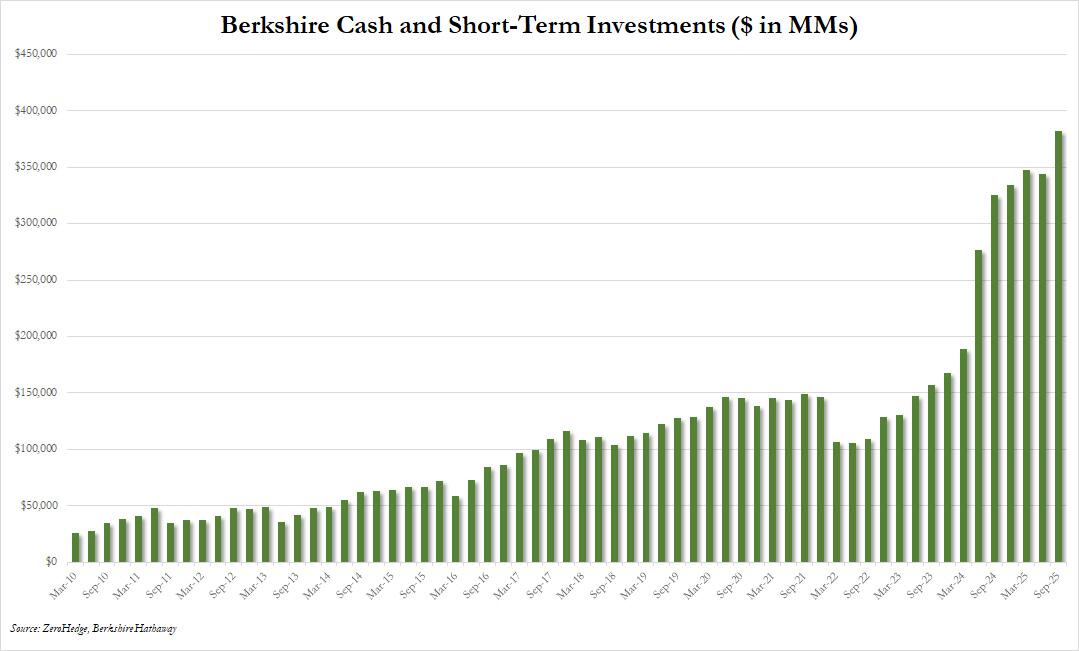
Berkshire’s Cash Pile Hits A Record $382 Billion Amid Continued Stock Sales As T-Bill Purchases Soar
With just two months left until Warren Buffett, 95, departs as CEO of the iconic conglomerate he made into one of the world’s largest investment companies over the past 60 years, earlier today Berkshire reported in its latest 10Q filings that its cash pile soared to a new all time high of $381.7 billion in the third quarter, an increase of $37.6 billion for the quarter, which translate to $420 million per day, and $17 million per hour.
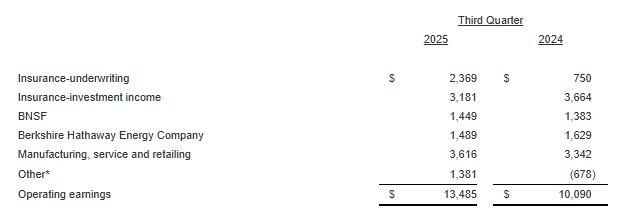
At the same time operating earnings jumped 34% to $13.5 billion from $10.1 billion, as the firm’s insurance underwriting profit more than tripled in the third quarter boosted by lower insurance losses, offsetting declines in the Insurance-investment income and Berkshire’s Energy company.
The $13.49 billion quarterly operating profit, or $9,376 per Class A share, grew from $10.09 billion a year earlier. Currency fluctuations accounted for more than two-fifths of the increase.
While results benefited in part from an absence of major catastrophes such as hurricanes, Berkshire auto insurer Geico’s pretax underwriting profit fell 13% amid higher claims and a 40% increase in underwriting costs, which the firm said is due to “increased policy acquisition-related expenses” i.e., advertising, to acquire new policies in a period of soaring insurance costs. Additionally, insurance will likely face headwinds as falling interest rates reduce income from Berkshire’s cash holdings, which also occurred in the third quarter.
Meanwhile, Berkshire’s utilities business, which runs PacifiCorp, MidAmerican and NV Energy, posted a 9% decline in operating earnings, to $1.5 billion over the period, and reflected legal bills from wildfires, and higher costs from natural gas pipelines and Northern Powergrid in Britain. Berkshire is still evaluating how U.S. President Donald Trump’s One Big Beautiful Bill Act signed in July might affect the viability of its renewable energy projects.
One especially sore point was Pilot, which posted a $17 million loss in the third quarter. Berkshire said the decline is driven by lower wholesale fuel and retail margins, as well as higher expenses. “The Pilot business is not really doing very well,” Shanahan said. “I’m interested to see what the plan might be to turn that around.”
On the positive side, the BNSF railroad boosted operating earnings rose 6% to $1.4 billion, on lower fuel costs and “improved employee productivity” while revenue from the transportation of agricultural and energy products grew, driven in part by slightly higher grain exports.
Berkshire’s $30.8 billion of net income, or $21,413 per Class A share, rose from $26.25 billion a year earlier. Net results include gains and losses on stocks Berkshire is not selling. This adds volatility, and Buffett believes such results are useless in understanding his company.
Also of note: revenue for Berkshire, which is seen by many as a mini model of the broader US economy due to its extensive diversification, grew just 2%, slower than the overall U.S. economy’s growth rate.
Economic uncertainty and waning consumer confidence have been drags, Berkshire said, stalling sales growth at the Clayton Homes homebuilder and reducing revenue from Duracell batteries, Fruit of the Loom apparel and Squishmallows toymaker Jazwares.
“Berkshire, which is often considered a microcosm of the U.S. economy, isn’t even keeping up,” said Cathy Seifert, a CFRA Research analyst with a “hold” rating on Berkshire. “Investors will struggle to find a catalyst for this stock.”
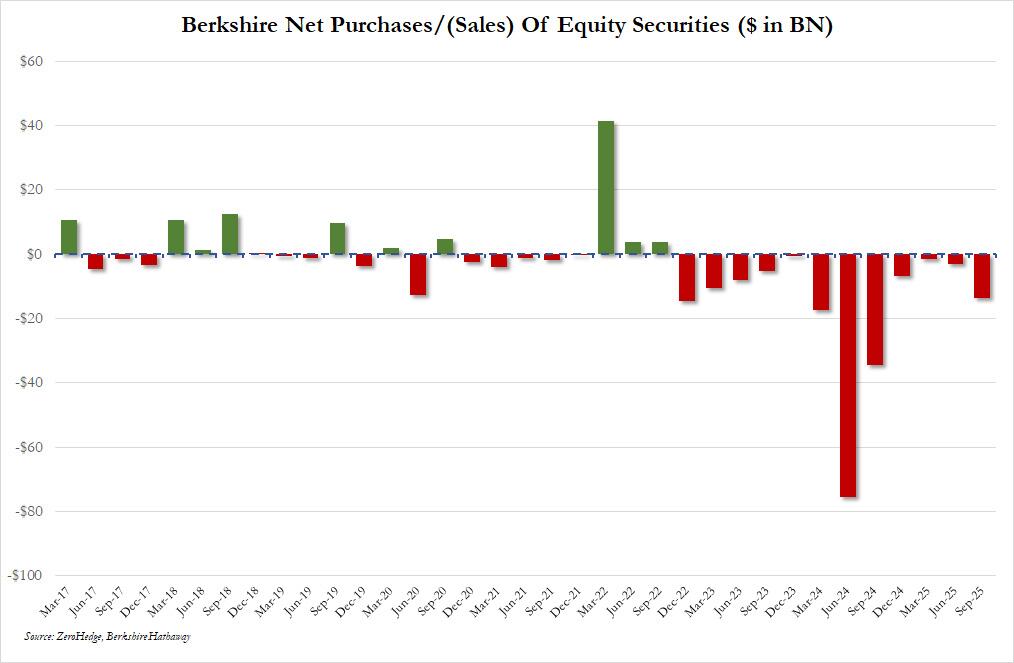
Turning to the company’s investment activities, for the 12th straight quarter, Berkshire sold more stocks than it bought for its $283.2 billion equity portfolio…
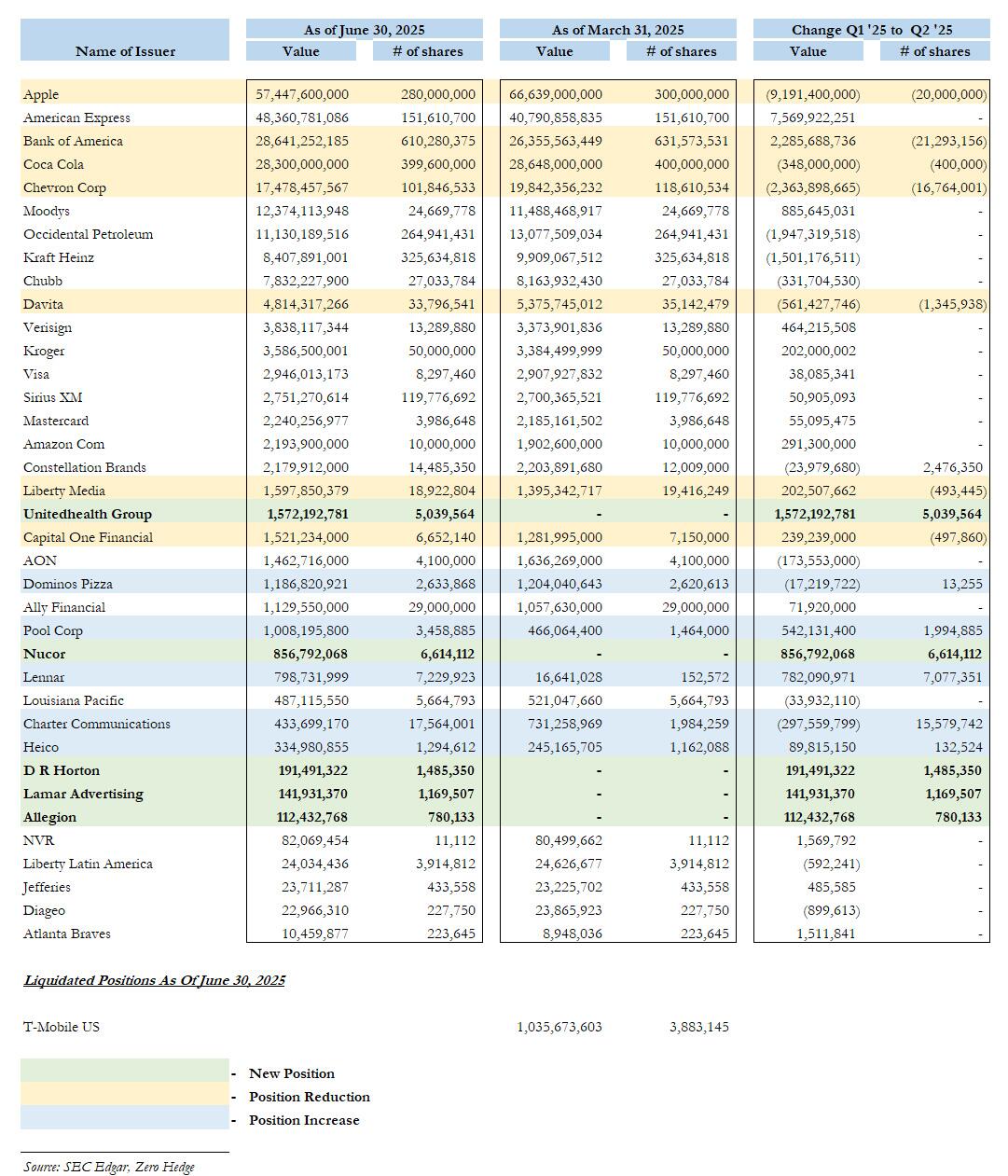
… whose largest holdings are Apple, American Express and Bank of America.
In fact, at $13.7BN in sales in Q3, this was the most aggressive purging of risk since the same quarter in 2024.
“There isn’t much opportunity in Buffett’s eyes right now,” said Jim Shanahan, an analyst for Edward Jones.
For Berkshire’s bulls this may be vexing, since earlier this year, Buffett appeared to be back on the hunt for deals, with the acquisition of a $1.6 billion stake in UnitedHealth Group and a $9.7 billion deal to buy OxyChem last month. But the famed billionaire remained on the sidelines in the third quarter. Berkshire Hathaway offloaded $6.1 billion of shares during the period.
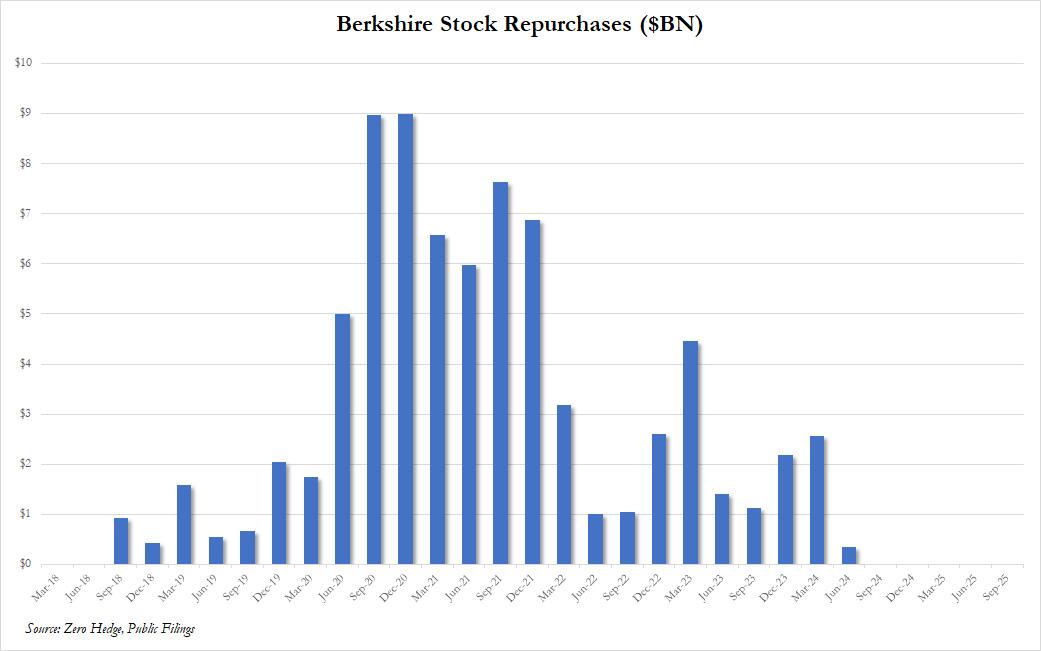
Also notable: after a burst of stock buybacks in the aftermath of the covid crash, Berkshire has not repurchased any of its own stock since Q2 2024…
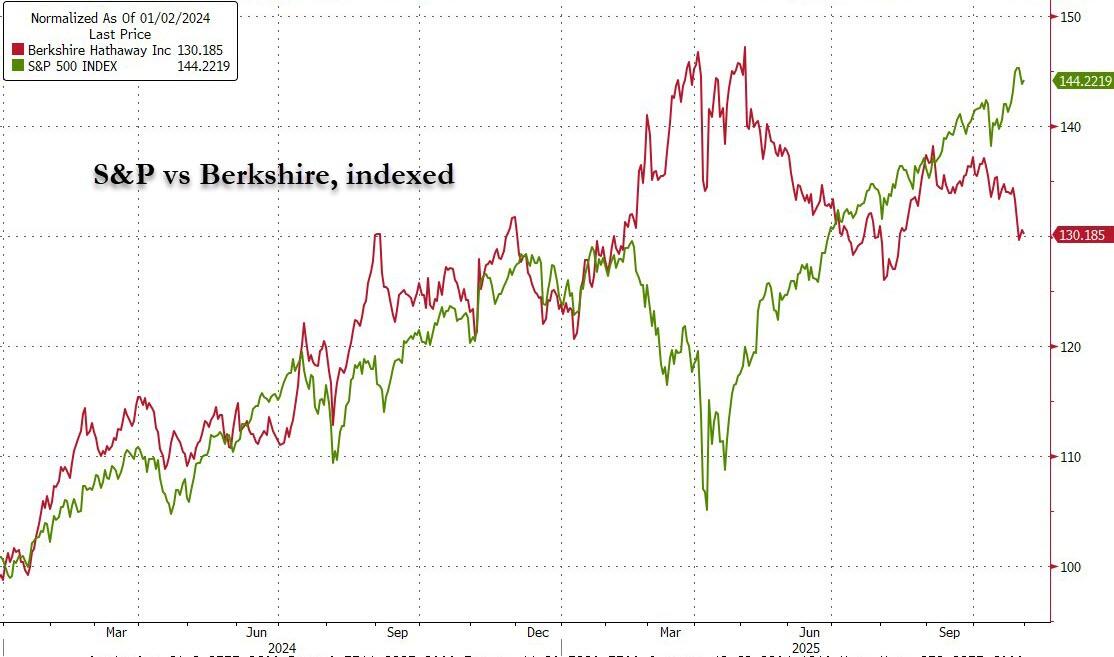
…. which may explain why Berkshire’s stock price has significantly lagged the broader market, and is now trading where it was last August
“I think that sends a very powerful message to shareholders,” said Cathy Seifert, an analyst at CFRA Research. “If they’re not buying back their shares, why should you?”
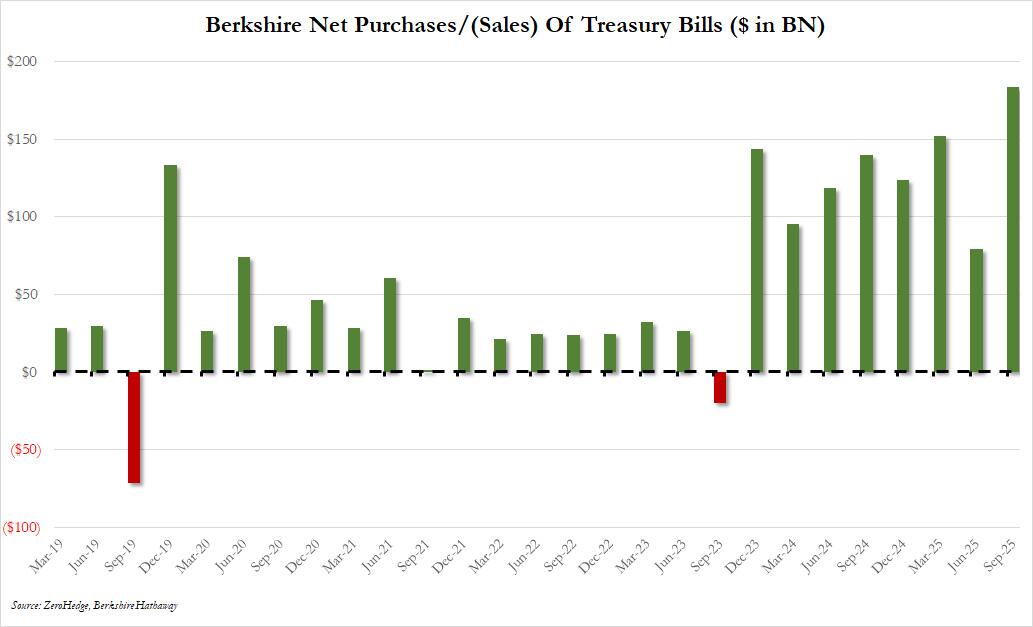
And since Berkshire isn’t buying either others shares, or its own, it had to park all this record cash somewhere; and once again it did so by buying a record $183 billion (net) in treasuries in the quarter, bringing total purchases during the past 12 months to a record $540 billion.
Berkshire’s massive holdings of T-Bills is also why the firm’s net investment income declined 13% to $3.2 billion amid lower short-term interest rates.
As previously reported, Buffett, 95, is set to end his six-decade tenure as chief executive at the end of the year. Vice Chairman Greg Abel, 63, will succeed the legendary investor, though Buffett will remain chairman. Abel is known as a more hands-on manager than Buffett.
It is unclear what he will do with Berkshire’s record cash, with options including paying the $1.03 trillion conglomerate’s first dividend since 1967. Berkshire is planning to use $9.7 billion of cash to buy Occidental Petroleum’s chemicals business, a transaction announced on October 2. James Shanahan, an Edward Jones analyst who upgraded his Berkshire rating to “buy” in September, said the company’s resistance to spending more cash during this year’s market rally has been disappointing.
“If you feel like stocks are expensive, including your own shares, you’re eventually going to be right, but you can be wrong for a long time, and that’s what happened here,” he said.
And indeed, it’s not just Berkshire that has not been buying back its own stock: investors have voted their apprehension about Berkshire’s outlook and pending management change by selling its stock. Since Buffett announced on May 3 he would step down, Berkshire’s stock price has fallen 12%, and trailed the S&P by 32%. For all of 2025, Berkshire is 11% points behind the index.
“Impatient investors feel an urgent need for Berkshire to deploy its cash, and have been casting their nets elsewhere,” said Tom Russo, a partner at Gardner Russo & Quinn in Lancaster, Pennsylvania, which invests $10 billion.
Russo has owned Berkshire stock since 1982 and said Berkshire remains “extremely well-positioned” for the long term. “Berkshire isn’t going to deploy capital that won’t increase intrinsic value on a per share basis,” he said. “Knowing that guides Berkshire means investors won’t have to second-guess it.”
The conglomerate owns close to 200 businesses that also include chemical and industrial companies, and familiar consumer brands such as Dairy Queen and See’s Candies. As noted yesterday, many US businesses which rely on the strength of the consumer has been hammered in recent weeks because while the AI trade continue to soar, the US consumer has hit a brick wall and even Goldman Sachs is warning that the deterioration in K-Shaped economy is starting to spread from the lower income class to America’s otherwise unstoppable middle class.
Berkshire has not made a huge acquisition since paying $32.1 billion for aerospace parts maker Precision Castparts in 2016, a deal which ended up being a disaster.
“Abel has a tremendous opportunity,” Shanahan said. “He has a lot of available cash and by all accounts he is an excellent operator, so he may want to deploy capital in Berkshire’s operating businesses to improve their performance.”
Still, despite the earnings gains and massive cash pile, the firm’s tepid revenue growth in the period is not going to help investor sentiment, according to CFRA’s Seifert.
“I’m struggling to find a catalyst” for an increase in the stock price, she said.
There is another bizarre filing from Mark Elias, the controversial Democratic lawyer who helped to secretly fund the infamous Steele Dossier. In a new filing, Elias is challenging the district in New York City with the lone Republican member as violating the state voting rights act. Elias is effectively arguing that voting Republican is evidence of racism.
In the petition, voters bring a New York Voting Rights Act challenge, arguing that the Eleventh District “provides Black and Latino Staten Islanders “less opportunity than other members of the electorate to elect a representative of their choice and influence elections in New York’s 11th Congressional District (“CD-11”), in violation of the prohibition against racial vote dilution in Article III, Section 4(c)(1) of the New York Constitution.”
The filing occurs after New York moved to further gerrymander the state, aiming to eliminate more Republican members of Congress.Across the country, Democrats have pushed for such gerrymandering, but in New York, the efforts are particularly extreme.
Trump received 45 percent of the vote. Republicans are confined to a small handful of districts. It is still too much for Elias.
Elias has not only been sanctioned in past litigation, but past courts have also criticized his group. In Maryland, Elias filed in support of an abusive gerrymandering of the election districts that a court found violated not only Maryland law but the state constitution’s equal protection, free speech, and free elections clauses. The court found that the map pushed by Elias “subverts the will of those governed.”
It was Elias who made the key funding available to Fusion GPS, which in turn enlisted Steele to produce his now discredited dossier on Trump and his campaign.
It was not just reporters who inquired about the Clinton campaign’s role in the Steele dossier. John Podesta, Clinton’s campaign chairman, was questioned by Congress and categorically denied any contractual agreement with Fusion GPS. Sitting beside him was Elias, who reportedly said nothing to correct the misleading information given to Congress.
Back to the latest Elias filing. There is a pending case before the Supreme Court in Louisiana v. Callais that could curtail or end the use of race to set voting districts to favor black voters under the federal Voting Rights Act.
However, this is a novel claim that, even a gerrymandering state striving to reduce Republican members, a district is racist because it favors the election of a Republican Thus, as Professor Josh Blackman noted “in a district where Democratic voters cannot elect a Democrat, they can bring a VRA claim, even in an overwhelmingly democratic state where there is not even a scintilla of evidence of racial discrimination.” However, the opposite is not true. In a red state with overwhelming Republican majorities, a district that effectively bars the election of a Republican could not be grounds for a VRA claim.
The filing proclaims that the heavily Democratic gerrymandered state shows that “New York has become a national leader in protecting voting rights.” It emphasizes that the state goes further than the federal VRA:
“the NY VRA does not require the plaintiff to show that a district could have been drawn that would have a majority of residents of a single protected class. A plaintiff need only show that the current district map is responsible for the protected class’s lack of electoral influence based on the existence of racially polarized voting or the totality of the circumstances.”
The filing makes clear that Black and Latino voters support democrats and thus a Republican member favoring the GOP dilutes their votes:
“Black and Latino voters on Staten Island are politically cohesive and consistently and overwhelmingly support the same candidates, which the rest of the electorate consistently opposes. At the same time, the white majority on Staten Island overwhelmingly supports the same candidates and votes as a bloc to usually defeat Black and Latino voters’ candidates of choice.”
In other words (with translation):
“Black and Latino voters on Staten Island are politically cohesive and consistently and overwhelmingly support [Democrats], which the rest of the [District] opposes. At the same time, the white majority on Staten Island overwhelmingly supports [Republicans] and votes as a bloc to usually defeat Black and Latino voters’ [Democratic] candidates of choice.”
So, even in a state that has artificially reduced Republican members and is claimed as a model of districting to enhance minority voters, any district that favors Republicans is still evidence of racist discrimination in voting. Presumably, the only way to truly guarantee the protection of minority voters in New York City is the effective elimination of any Republican member.
As we’ve previously highlighted, Democrats have lost culture.
With that comes another massive problem for them. The kind of people they attract.
Conservative pundit Mollie Hemingway provided Democrats with a simple home truth Wednesday, that once again explains why they’re doomed.
During an appearance on Fox News, Hemingway was asked to explain why extreme left Rep. AOC has been so intent on verbally attacking former swimmer turned gender ideology critic Riley Gaines.
Hemingway noted that “the base of the Democrat party really has become angry women.”
“And women who are angry tend to be very mean to other women who are smarter or prettier or more successful or braver than they are, and that’s what we’re seeing here,” she added.
“The idea that any member of Congress would claim that anyone in the country doesn’t have a real job, which was her, you know, insult most recently against Riley Gaines, it’s just laughable,” Hemingway asserted.
“Particularly laughable when we’re dealing with a government shutdown caused by AOC and her buddies deciding that they don’t want to do any work right now,” the pundit further stressed.
“But it’s a situation where the entire party has kind of been overtaken by angry women, and that is going to cause a little bit of a political challenge for them,” she outlined.
Hemingway: The base of the Democrat Party really has become angry women and women who are angry tend to be very mean to other women who are smarter or prettier or more successful or braver than they are. pic.twitter.com/leiRvxrxuO
To be more specific, angry White liberal women in their 40s and 50s.
I could write volumes about my theories on why this is, but suffice it to say I believe they are mad at life choices they are too old to change and too young have self-reconciled.
Your support is crucial in helping us defeat mass censorship. Please consider donating via Locals or check out our unique merch. Follow us on X @ModernityNews.
America’s Power Bill Crisis Rages In Democrat-Run States
The epicenter of America’s power bill inflation crisis stretches across the Mid-Atlantic and Northeast, where far-left state and city leaders have swallowed the globalist “climate crisis” pill, which even Bill Gates admitted last week that the climate crisis narrative was fake news.
The result of these leftist extremist “green” policies has been the systematic degradation of regional power grids in Mid-Atlantic and Northeast states, as reliable fossil-fuel generation was prematurely retired in favor of unreliable, intermittent solar and wind. These nation-destroying green policies have gutted spare grid capacity (read here) just as demand surges from data centers, onshoring, and the broader electrification push (read here), culminating in today’s power bill crisis.
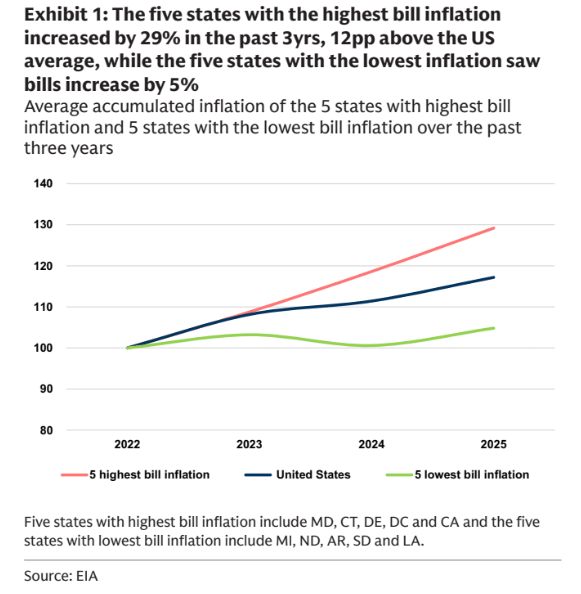
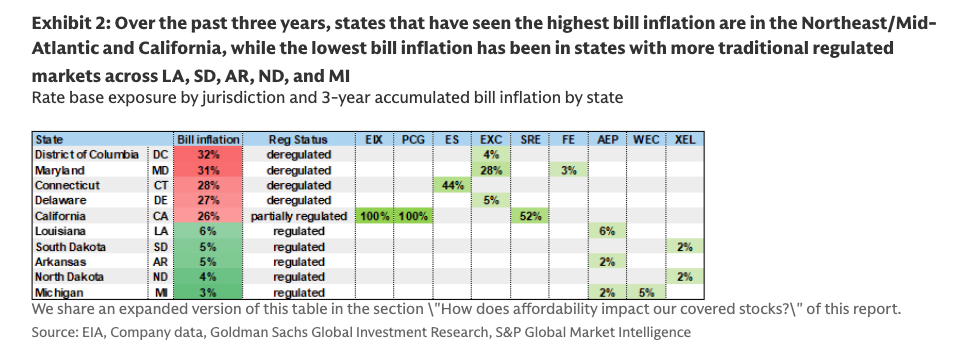
A recent Goldman Sachs report by analyst Carly Davenport found that “higher power bill inflation has been the most pronounced in the Northeast, Mid-Atlantic, and California in the past three years.”
It’s no secret that the Northeast, Mid-Atlantic, and California are governed primarily by Democratic leaders who have pushed at least a decade of climate crisis hoax narratives to justify massive “green” funding, some of which was funneled into NGOs, and to advance the progressive utopia narrative that solar and wind power would deliver clean skies and save, most importantly, planet Earth from immient climate catastrophe. Yet this fantasy was far from reality. There was never going to be a green utopia, only what millions of Americans across these states are now realizing: unaccountable Democrats have left them with a power bill crisis.
Davenport told clients:
Residential utility bill inflation has accelerated in certain regions, raising concerns about customer affordability. A few states in the Northeast/Mid-Atlantic such as MD, CT, DE and DC, as well as California, have seen accumulated bill inflation of 29% in the past three years (20pp above CPI), while other states such as MI, ND, AR, SD and LA had bill growth of only 5% in the same period (Exhibit 2). Interestingly, the states with higher bill inflation during this period have deregulated or competitive power markets, and those with lower inflation are in traditional regulated markets. We provide more details on power market fundamentals and utility bills within.
Northeast/Mid-Atlantic States Hit Hardest by Power Bill Crisis
The topic of power bills is beginning to dominate local political discussions across these states. In the New Jersey governor’s race, power bill ads seen by Republicans were criticizing the Democratic Party’s failed green energy policies. And the Maryland Freedom Caucus of lawmakers joined forces with other conservatives in surrounding states to combat and break the far-left’s stranglehold on the region.
“Politicians and special interest groups have traded energy independence for a delusional climate cultist ideology, and every Maryland family is paying the price with skyrocketing bills and a rapidly dwindling energy supply,” Maryland Delegate Brian Chisholm told local TV station Fox Baltimore.
Chisholm continued, “We stand firmly united with our colleagues in neighboring states to deliver real, adult solutions and finally put an end to the childish nonsense impacting our state.”
What’s entirely clear is that the power bill crisis began with green policies that have now backfired in an epic way, and it will continue to drive power bills higher. Ahead of the Midterms, Republicans are likely to seize on this topic as they seek to break the Democratic Party’s stranglehold over the Mid-Atlantic and Northeast regions, which have been transformed into unaffordable living, elevated violent crime, and illegal alien safe havens.
Whenever you delve into the modern history of internal national conflict you’re bound to come across post-crisis accounts from people who said “We never saw it coming…” or “The violence hit us from nowhere…” Generally speaking, these were the people who weren’t paying attention and they just happened to survive by sheer luck.
I think of this dynamic a lot these days. I see a large contingent of American society (perhaps 25% of the population) which has been radicalized or brainwashed beyond all reason or repair. These people (leftists) operate deep within a protective bubble of propaganda and zealotry; they function within a hive mind that does not deviate from the demands of their gatekeepers. They cannot be reasoned with, nor can they be satiated. They lust for power and the suffering of anyone who opposes them.
One can see an immediate difference between the sides. Conservatives are so independent we in-fight constantly. We might agree on basic values (even in this we sometimes argue), but in terms of policy and action we rarely shake hands.
For the political left, any disagreement with the majority leads to immediate ostracism. The hive mind does not tolerate individual rebellion. Only the gatekeepers can change the mindset or the mission of the mob.
It is strange then that this dichotomy has resulted in conservatives, with their values of liberty and independence, seeking order. Meanwhile leftists, in their Orwellian uniformity of thought, seek chaos and the deconstruction of civilization. You would think the relationship would be reversed, but this is the way it has always been.
Looking back on the events of the Bolshevik Revolution and the long list of Marxist disruptions in Europe following WWI, it should not have been at all surprising to Europeans that domestic conflict would erupt. It should not have been surprising that people would follow their natural inclination to rally around their founding heritage rather than submit to the cultural and moral relativism of the radical left.
Fascism was popular exactly because it offered shelter from the chaos and degeneracy of communism. The war and brutality that followed was seen as a balancing of the scales. Europeans wanted to ensure that the communists would never get a chance to wreak havoc again.
To be clear, both systems of governance are authoritarian and can lead to monstrous outcomes, but communism’s love for economic sabotage, mob actions and political violence are almost always a precursor to a fascist crackdown. The public does not embrace fascism in a vacuum, they must be compelled by an existential threat.
The question is, can communist subversion be defeated without using “authoritarian” measures? Is a constitutional republic equipped to deal with this kind of threat? When someone wages war on your society internally, is there a way to fight them while remaining civic minded? Probably not.
What we are witnessing in the US and Europe today is, in every way, a Marxist/Communist insurgency. It’s difficult to determine what stage we are at in this war. We have moved well beyond the stage of propaganda and mob influence into the realm of political violence, with multiple assassination attempts and terror attacks against civilian targets.
The gatekeepers for the woke communist movement are obviously Democrat politicians and media influencers. They have been consistently and actively encouraging mass hysteria and violence. They have used media spin to protect activist groups like Antifa, pretending that such organizations don’t exist. Whenever activists cause harm or death, the media and political leaders immediately move to defend that action as if it was justified.
When asked why Democrats are continuing down the path of militancy, their response is that Donald Trump is a “dictator and a fascist.” Yet, these same people can’t seem to come up with a single legitimate example of HOW Trump is acting like a dictator.
Deportations of illegal immigrants? Most countries on Earth have basic immigration laws and enforce them much more harshly than the Trump Administration does. Cuts to federal programs and employees? The President is perfectly within his power of office to reduce waste in the federal government. How about using the National Guard in US cities? Democrat leaders in those cities have aided violent activists, helping to disrupt ICE operations while threatening the lives of agents. If they don’t want the National Guard in their cities they should stop waging war on immigration officials.
From Trump’s remodeling of the White House ballroom to the US troops countering drug smugglers, everything Trump does is blown out of proportion by Democrats into an “end of democracy” scenario. Their useful-idiot followers then take these claims as permission to create even more turmoil.
The government shutdown in particular is becoming a nexus point for this agenda. The Senate needs only five Democrat votes to reopen the government with a clean funding bill, but Democrats refuse to see reason. Meanwhile, they are blaming Republicans for the consequences of the shutdown, specifically seeking public pain as leverage over conservatives.
Trump is already being held accountable for a prolonged shutdown of EBT. The Democrats know their audience well. They know that the free-stuff army is entitled, vicious and easy to manipulate.
I warned about this outcome at the beginning of the month; Democrats are fighting hard for the shutdown to continue because it creates greater fear in their constituency. However, if Republicans fold then Democrats will use the same threat of civil unrest over and over again. The government will be under their control even though they lost the elections.
Democrat rhetoric has been even worse than usual. DNC Chair Ken Martin recently argued on MSNBC that:
“The Democratic Party’s job right now is to win elections. That’s our focus. But we may be nearing the moment where we are truly in a dictatorship and an authoritarian regime here has completely shredded the Constitution. Then elections don’t matter, and then the resistance looks completely different. And we may be nearing that moment.”
Senator Chuck Schumer also made provocative statements calling for “resistance” against Trump:
“This is tyranny. This is what happens in dictatorships… I don’t care if you’re Democrat, Republican, liberal, conservative, moderate – people should be forcefully rising up against this…”
In an odd and obviously inciting discussion on MSNBC, Joy Reid and Jasmine Crockett sent out multiple signals to leftists, barely disguising their intent:
Joy Reid: “We’re in a moment where the MAGA crowd is armed to the teeth, and they’re not shy about it. So, everybody needs to pick up a weapon – whether it’s a vote, a protest sign, or whatever it takes – because this isn’t just politics anymore; it’s survival.”
Jasmine Crockett: “Absolutely, Joy. This is a war, this isn’t a battle. We’re talking about the soul of this country, about whether democracy survives or gets crushed under fascism. And yeah, we need to arm ourselves with everything we’ve got—truth, turnout, and tenacity. The other side declared war on us long ago.”
Numerous Democrats across social media are announcing, in no uncertain terms, that they want conservatives dead and Trump allies humiliated or eliminated. When they return to a government majority and get power back, they say conservatives are going to pay a terrible price for daring to oppose them.
But if we’re living under a fascist regime as they assert, then how could they possibly expect to return to government power? If elections are still an option, then leftists must not be too serious about their claims of fascism.
A perfect example is the New York mayor’s race, which is is going much like I predicted months ago. Zohran Mamdani (a champagne socialist/communist with wealthy parents) is holding a steep lead in polling over all other candidates. As I noted when the race began, Mamdani is the natural end game of the political left – A combination of all the groups that hate western civilization, concentrated into a single man.
Democrats are doubling down. Mamdani proudly mentioned this in a recent campaign speech, arguing that the correct path of Democrats is to blindly charge forward. In other words, they should not self reflect on their long list of failures, but dive headfirst into radical chaos.
Prominent Democrats like AOC and Bernie Sanders are openly endorsing Mamdani. Like it or not, this is the course that their party is taking, which means violent conflict is inevitable. If Dems are being honest in their rhetoric to “get revenge” on conservatives once they return to power (there’s no reason to think they are joking), then the rules of survival dictate that leftists can never be allowed to return to power.
If Democrat leaders continue on the path of disrupting deportations of illegals and threatening immigration officials, then Americans will increasingly support National Guard intervention. The public may even support the arrest of those same politicians.
If leftists incite mass violence over the loss of SNAP benefits, the gatekeepers will have to be arrested or removed from the country. One can question the constitutionality of the reaction, but the path that led us to this is undeniable. Leftists are provoking these responses; they are making peaceful resolution impossible.
They have gone so far over the top in their behavior, I have to ask: Are they doing this on purpose to trigger a civil war, or an authoritarian response? Do they really believe they will be able to use national instability as a weapon to get what they want?
My long running theory ever since Trump ran for office in 2016 is that he represents a perfect scapegoat for a leftist/globalist induced collapse of the US. In fact, for many years I have posited that if real conservatives and patriots (not Neo-Cons) ever gained legitimate government power, the elites would simply crash the system around our ears and make it look like it was our fault.
This plan seems to be unfolding right now. Progressive gatekeepers are using far-left activists as cannon fodder to induce a crisis, or a domestic war.
Think about the Bolshevik Revolution: The gatekeepers spurred a revolution of the poor and the working class, yet Lenin and Trotsky both came from upper-middle class wealth (like Mamdani). Hell, Karl Marx came from an upper middle-class family and married into his wife’s riches. When his debts and refusal to work a steady job caught up with him, he lived off the money of rich benefactors.
The gatekeepers of the left rarely share the struggles of the downtrodden workers they purport to represent, they only use the working class and the poor as tools to gain power and destroy their ideological enemies.
This is what Democrat leaders are doing with the mentally ill rabble they have accumulated. They are aiming the naive and unhinged horde at the guts of the country and they are hoping to create enough mayhem that Trump, conservatives, nationalists, all of us get blamed for the uncompromising response that follows.
Maybe they are hoping that in the process, conservatives will haphazardly jump on the bandwagon of totalitarianism; that we will look like the villains. I think the progressives are underestimating the average American’s resolve to see order restored. Playing the victim may not help them garner much public empathy this time.
It’s hard to say what the end result will be, but I’m finding it difficult to see an outcome that doesn’t include considerable conflict and, unfortunately, bloodshed. And, to be frank, most of it is likely to befall the leftist side. For the sake of their own self preservation, I hope they realize they’re only being used to further an agenda, and their gatekeepers don’t actually care what happens to them in the end.
Starbucks Can’t Get Customers to Stay, Despite Costly Cafe Makeovers
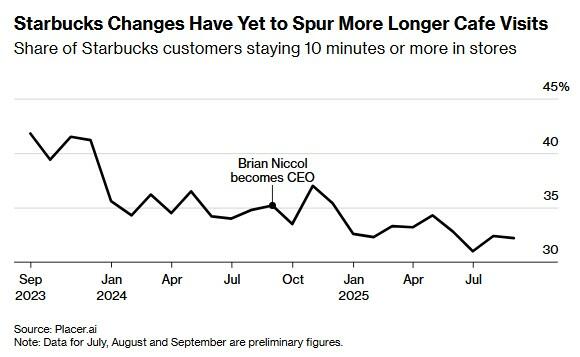
Starbucks is struggling to keep customers in its cafes, even after spending heavily to make stores more inviting. New data from Placer.ai shows the share of visits lasting more than 10 minutes has dropped from over 40% in 2023 to roughly one-third today, according to Bloomberg.
CEO Brian Niccol made longer in-store visits a core piece of his turnaround plan when he took over in September 2024, promising better service, faster drinks and a return to the “warm, cozy, comfortable environment” Starbucks once championed.
Yet foot traffic has fallen for four straight quarters, while profits have slid by double digits over the last four and same-store sales have declined for six. Shares are down 6.4% this year.
“They’ve trained their customer to use this brand as a convenience channel, not as a place where you sit down and linger,” said Citi analyst Jon Tower. Still, he noted that if shops look and feel better, customers may at least come in more often: “They just want more people to come in and walk in and say, ‘wow, this feels like a great place.’”
Bloomberg writes that Starbucks has been adding seating, more electrical outlets and ceramic mugs, effectively reversing years of redesigns that prioritized speed over comfort.
The company says remodeled locations are seeing visitors stay longer and return more frequently. “Early results from uplifted coffeehouses in New York City and Southern California are already showing promise,” a spokesperson said. “Customers are staying longer, visiting more often, and sharing positive feedback.”
Renovations have also gotten cheaper, with some now costing about $150,000 instead of up to $1 million. Starbucks plans to refresh 1,000 North American stores in fiscal 2026. The chain has also sped up service — 80% of drinks are now served in under four minutes — and simplified the menu by 25%, cutting back on seasonal excesses. “We streamlined our menu to clear the way for innovation and focus on what customers love most,” the company said.
But the company is also closing older and to-go-focused locations as part of a $1 billion restructuring meant to align operations with Niccol’s more café-centric vision.
Some customers say the shops still aren’t conducive to lingering. At a Manhattan location, Dennis O’Leary noticed design updates but complained the music was too “tinny” and loud to make him stick around. Most seats were filled with customers waiting for orders rather than relaxing or working.
Analysts expect Starbucks to report flat same-store sales in North America when it announces earnings Wednesday — signaling the company’s push to make Starbucks a place to stay, not just stop, still has a long way to go.
Sam Altman, CEO of OpenAI, recently showed a moment of humanity in a tech world that often promises too much, too fast. He urged users not to share anything with ChatGPT that they wouldn’t want a human to see. The Department of Homeland Security in the United States has already started to take notice.
His caution strikes at a more profound truth that underpins our entire digital world. In a realm where we can no longer be certain whether we’re dealing with a person, it is clear that software is often the agent communicating, not people. This growing uncertaintyis more than just a technical challenge. It strikes at the very foundation of trust that holds society together.
This should cause us to reflect not just on AI, but on something even more fundamental, far older, quieter and more critical in the digital realm: encryption.
In a world increasingly shaped by algorithms and autonomous systems, trust is more important than ever.
Encryption is our foundation
Encryption isn’t just a technical layer; it is the foundation of our digital lives. It protects everything from private conversations to global financial systems, authenticates identity and enables trust to scale across borders and institutions.
Crucially, it’s not something that can be recreated through regulation or substituted with policy. When trust breaks down, when institutions fail or power is misused, encryption is what remains. It’s the safety net that ensures our most private information stays protected, even in the absence of trust.
A cryptographic system isn’t like a house with doors and windows. It is a mathematical contract; precise, strict and meant to be unbreakable. Here, a “backdoor” is not just a secret entry but a flaw embedded in the logic of the contract, and one flaw is all it takes to destroy the entire agreement. Any weakness introduced for one purpose could become an opening for everyone, from cybercriminals to authoritarian regimes. Built entirely on trust through strong, unbreakable code, the entire structure begins to collapse once that trust is broken. And right now, that trust is under threat.
A blueprint for digital feudalism
The European Commission’s ProtectEU initiative proposes a mechanism that compels service providers to scan private communications directly on users’ devices before encryption is applied. This effectively turns personal devices into surveillance tools and breaks the integrity of end-to-end encryption. While state actors would never permit such a vulnerability in their own secure systems, this mandate creates a separate, weaker standard of security for the public.
On the surface, it sounds like a reasonable compromise: stronger encryption for governments, with so-called “lawful access” to citizens’ data. However, what it proposes is a hardcoded imbalance, one in which the state encrypts, and the public is decrypted.
This isn’t a security policy. It’s a blueprint for digital feudalism — a future where privacy becomes a privilege reserved for the powerful, not a right guaranteed to everyone. Two-tier encryption shifts the balance of trust from democratic accountability and cements a structure of control no free society should accept. Make no mistake: This debate isn’t about safety. It’s about control.
We shouldn’t live in a world where only the powerful get to be private.
In an age of ubiquitous AI, state-sponsored hacking and mass digital surveillance, weakening encryption isn’t just shortsighted but a systemic recklessness. For those of us in the decentralized world, this is not an abstract debate; it is a matter of practical concern. Strong, unbreakable encryption is far more than a technical feature; it’s the foundation upon which everything else rests.
Truth by verification
This is why the mission of Web3 must stay rooted in its core promise: truth. Not truth by authority, but truth by verification. This principle of a self-enforcing contract is why true decentralized systems are built with no key master or institution that holds the keys. Introducing a backdoor is a contradiction; it re-establishes a central point of failure, violating the very premise of a trustless system. Security is a binary state: it is either present for everyone, or it is guaranteed for no one.
Fortunately, these principles are not just theoretical. The cryptographic primitives emerging from this space — zero-knowledge proofs that can confirm facts without exposing data, and proof-of-personhood systems that resist Sybil attacks without compromising privacy — offer a real, working alternative, showing that we don’t have to choose between security and freedom.
The irony is stark: The same field now under threat holds the tools we need to build a more secure, more open digital future. One based not on surveillance or gatekeeping, but on permissionless innovation, cryptographic trust and individual dignity.
If we want a digital world that is safe, inclusive and resilient, then encryption must remain strong and universally standardized for everyone.
Not because we have something to hide, but because we all have something to protect.
Kenyan Navy Intercepts Flagless Vessel Carrying $63 Million in Meth
Kenyan authorities have seized more than a metric ton of methamphetamine in a major maritime drug bust coordinated with INTERPOL and international partners.
On 21 October 2025, the Kenyan Navy intercepted a flagless dhow roughly 340 nautical miles east of Mombasa after intelligence sharing between the Regional Narcotics Interagency Fusion Cell in Bahrain and the Regional Coordination Operations Centre in Seychelles, according to a release from Interpol.
The vessel was escorted to Mombasa three days later, where a multi-agency command center was established under the Deputy Commander of the Kenyan Navy. INTERPOL said it played a key advisory and oversight role, helping manage the search to ensure the evidence would stand up in court and coordinating support from the U.S. Naval Criminal Investigative Service, which deployed personnel to assist.
Interpol writes that authorities discovered 769 packets containing 1,024 kilograms of crystal methamphetamine with a purity level of 98%. Kenyan experts value the seizure at more than KES 8 billion (USD 63 million).
Six crew members were arrested and now face drug-trafficking charges. Kenya’s Anti-Narcotics Unit is leading the ongoing investigation.
INTERPOL said the operation demonstrates how international coordination and real-time intelligence sharing are essential to counter the growing threat of maritime drug trafficking in the Indian Ocean.