Moscow’s “Root Causes” Memo Reportedly Angered White House, Which Then Nixed Budapest Summit
The Financial Times is out with more reporting Friday on why the United States canceled a planned summit between President Donald Trump and Russian President Vladimir Putin in Budapest earlier this month. The FT report says Moscow issued sweeping demands on Ukraine, according to sources privy to the conversations, and that ultimately this ‘annoyed’ President Trump, who opted to listen to those admin officials calling for a firmer position in support of Ukraine.
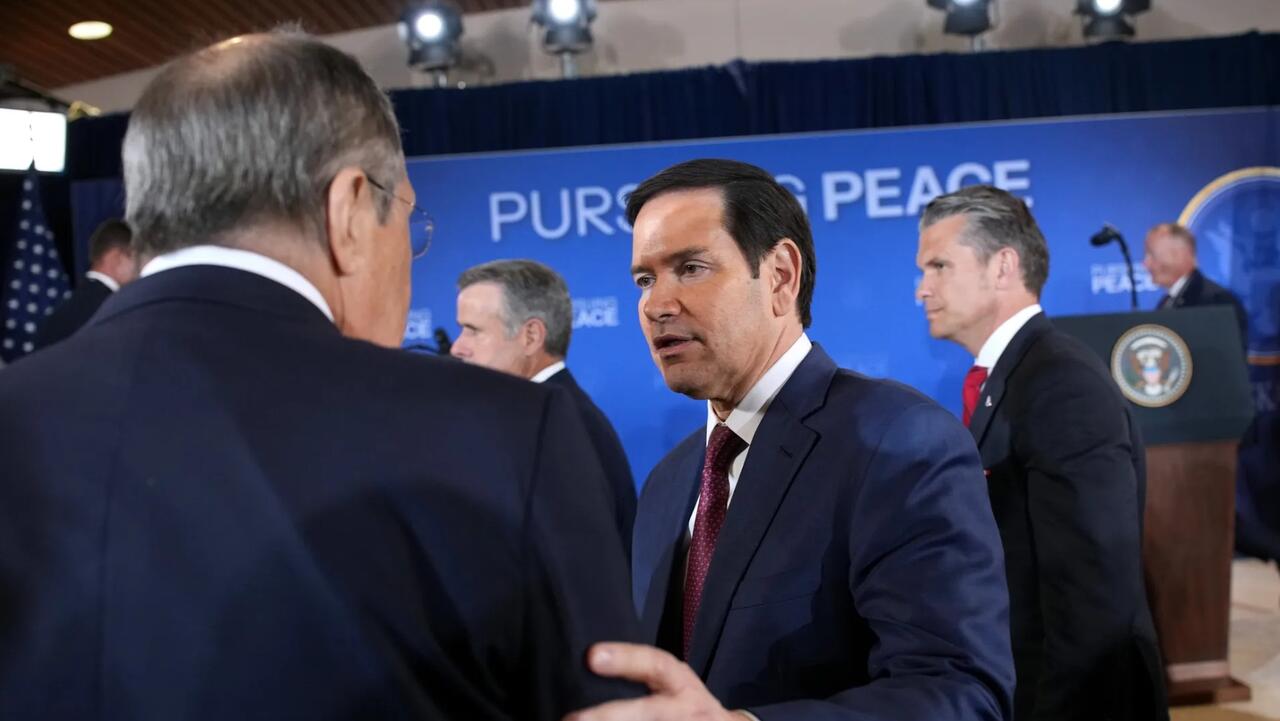
Also, Secretary of State Marco Rubio reportedly told Trump that Moscow was “showing no willingness to negotiate” after he held a phone call with his Russian counterpart Sergei Lavrov. Russia has reportedly made clear that a precondition for lasting peace rests on significant territorial concessions in the east.
Trump “was not impressed with their position,”FT quoted one source as saying, who also explained the president remains open to meeting Russian leaders only “when and where he thinks there can be progress.”
However, the ‘demands’ from the Russian side shouldn’t have come as any surprise, given also Russian forces have the initiative on the ground in the east. A “root causes” of the conflict memo laying out Moscow’s position demanded Ukraine give up large parts of its territory, cut its troops and forever abandon plans to join NATO.
President Putin has meanwhile emphasized that the planned Russian-American summit in Budapest was postponed and not canceled.
Russia seems to want to keep dialogue with Washington as positive as possible, and wants to present ‘progress’ in bilateral relations, while downplaying ongoing disagreements.
The reality remains that President Trump is trying to negotiate in favor of the Zelensky government, while Zelensky’s own forces have little to no leverage over the military situation. Russia knows it is in the driver’s seat on the ground, despite Ukraine’s unrelenting cross-border drone attacks on oil refineries. And yet the mainstream media still floats simplistic narratives and mythologies like the following:
Russian foreign ministry allegedly sent a memo to Washington outlining how Putin was still calling for the supposed “root causes” of his invasion to be addressed – even though the West widely believes he invaded Ukraine in a land grab.
President Putin has floated the idea of a “ceasefire for journalists” to allow them to reach the frontlines and report honestly on the situation.
Currently, the Kremlin is charging that Zelensky is seeking to hide the true state of the frontline situation in and around Pokrovsk, per state media:
Ukraine has effectively acknowledged the “catastrophic situation” faced by its troops in a Russian encirclement by banning journalists from reaching them, the Russian Defense Ministry has said.
On Thursday, Ukrainian Foreign Ministry spokesman Georgy Tikhy warned media workers against accepting Russian President Vladimir Putin’s offer of safe passage to the front line in Donbass to report on thousands of Kiev’s troops surrounded by Russian forces. Traveling to the area without permission from Kiev would be “a violation of our legislation” that would have “long-term reputational and legal consequences,” Tikhy said.
Russian Defense Ministry spokesman Igor Konashenkov said in a statement on Friday that Ukraine had banned local and foreign journalists from accessing the “cauldrons” in order to “conceal the real state of affairs on the front line and deceive the international community and the Ukrainian people.”
Looming large over all of this is more nuclear rhetoric and saber-rattling…
He’s referring to Russia. No one will be happier at this news than John Bolton, who killed arms control treaties with Moscow in Trump’s first term and now gets this wish fulfilled in Trump’s second. https://t.co/UiZmJaB64c
Moscow wants to especially signal to Washington that Ukrainian ground defenses are facing rapid collapse in key strategic locations; however, this is something the Zelensky government has been firmly rejecting.
There are once again efforts to ban the Alternative for Germany (AfD) in the Bundestag, with the far-left Social Democrats (SPD) leading the way. However, there is some difficult math facing the proponents of an AfD ban, which makes it unlikely — but not impossible — for the party to be banned.
In order to understand why a ban is unlikely, let us first look at what would actually happen if a ban of the AfD went forward.
The AfD is currently the most popular party in the country, according to multiple polls, scoring between 25 and 27 percent of the vote. This alone makes a ban unthinkable to many, but the German establishment does not especially care what the electorate thinks on a number of key issues, so why not just ban the party?
For starters, and most importantly, a ban of the AfD would radically reshape the German electorate in favor of the left. This would translate into the Christian Democrats (CDU) losing a massive amount of power, and potentially being relegated to the political dustbin. Due to this cold, hard reality, a ban could be suicidal for the CDU.
How one local elections tells us about the federal election
What happened in the local mayoral election in Ludwigshafen tells us what the likely outcome of an AfD ban would be for the country at the federal level. In Ludwigshafen, the AfD’s Joachim Paul was leading the polls to become mayor before he was banned from running through backroom bureaucratic channels, a move later confirmed by judges during a number of appeals. The judges all argued Paul would have to challenge the ban after the election. Paul is still filing legal actions against the decision, but the outcome of the appeal could take months or even years.
Regardless of the outcome of Paul’s appeal, the election had some interesting outcomes.
First, the voter participation rate crashed to a record low of just 29.3 percent. In 2017’s mayoral election in Ludwigshafen, the then-SPD candidate Jutta Steinruck won with 60.2 percent participation. That means voter turnout was cut in half from that election.
That is not all. For those who did vote, many of them appear to have submitted “spoiled” ballots. A record-high number of ballots were ruled invalid, at 9.2 percent. Eight years ago, that number was just 2.6 percent. The number of “spoiled ballots” jumped by nearly 400 percent.
If this same outcome occurred at the federal level, including a dramatic crash in the voter participation rate as AfD supporters boycott the election, it would be a disaster for the CDU’s electoral chances.
The way the German system works means that the pool of right-wing voters would shrink dramatically, leaving CDU voters and the left as the only remaining voting pool. However, this remaining, much smaller pool, would then feature a dramatically larger share of left-wing voters consisting of the SPD, the Greens, and the Left Party.
These three parties would be looking at a potential supermajority.
Even with a CDU scoring 30 to 35 percent of the vote, the party could be easily sidelined by this new far-left coalition.
This is what the CDU fears.
To understand this, it is important to understand that the German left does not need to increase the number of votes it receives; it just needs to increase its share of the vote. Let us consider an imaginary scenario where only 35 percent of the population votes in the next German federal election. It would be a disaster for democracy, but it could still be a huge win for the left. If the right drops out of the voting process. Suddenly, the remaining voting pie looks more left-wing, and the left can win a bigger share of this smaller voting pie.
Voilà, the left now have a super majority with just a small fraction of voters coming out to vote.
The trouble for the left is that it still needs the CDU to vote for an AfD ban in the Bundestag, otherwise they would not have the majority needed to pass such a motion. However, the CDU has no incentive to do this.
Death of democracy, rise of the left
On top of this electoral math problem for the CDU, it would not only make the electoral map vastly more favorable to the left, but it could also tear a giant hole in the CDU party itself.
A plurality of voters are against a ban on the AfD. A new Insa poll shows that 43 percent of respondents are against a ban, while 35 percent are in favor. Another 10 percent were indifferent, and 12 percent refused to comment.
However, for CDU voters, the issue was evenly split, with 42 percent supporting a ban, while 41 percent were against it.
Many CDU voters have already switched their voting intentions towards the AfD. A ban could further fuel an exodus towards the AfD party while the ban works its way through the system, all the way to the Constitutional Court, which is the final arbiter of the ban process. That could take well over a year, plenty of time to enact massive damage on the CDU.
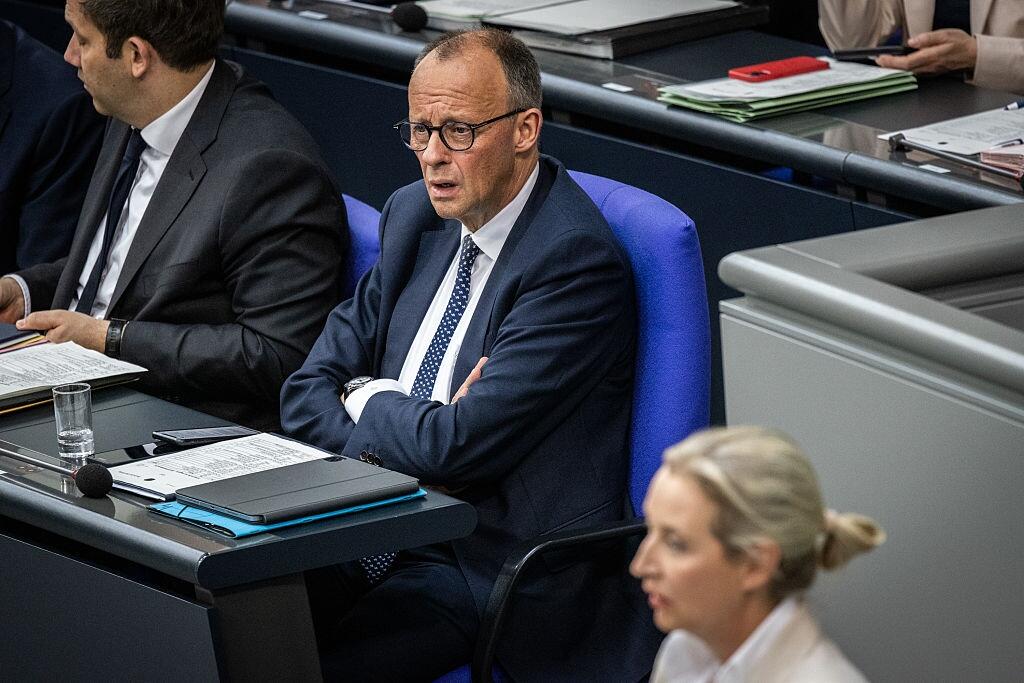
Chancellor Friedrich Merz already said that a ban of the AfD “smacks to much of the elimination of political rivals.” CDU voters all heard this statement. For him and his party to backtrack now on this issue would not sit well with many voters, many who are already dissatisfied with the economy and migration.
The Insa poll also shows that while a majority of supporters of left-wing parties back a ban, they are by no means in full agreement. Many Germans, even those on the left, believe a ban on the AfD would be a stake in the heart of democracy.
If a ban goes through, and a national vote is held featuring an abysmal voter participation rate due to mass boycotts, it would likely send the German system into chaos, leaving a massive democratic hole in the country’s landscape. It could even shake the entire foundation of the German state, calling into question the legitimacy of any government that is elected into power with an extremely low voter share and a ban on the most popular party.
What is the most likely scenario?
The left is likely to continue with its full-court press to proceed with a ban on the AfD. It would only benefit them, after all. The CDU is also likely to continue to talk of a ban, demonize the AfD, and try to snipe at the party using all the tools of the state, but is unlikely to actually back a ban. Doing so would be very foolish from a purely strategic point of view.
Of course, that is not a foregone conclusion. There are potential political realities, power struggles, and wild cards that could lead Merz and much of the CDU leadership to reverse course. However, the current risks of such a move outnumber the potential benefits by a clear margin.
“Specific guarantees in the Bill of Rights have penumbras, formed by emanations from those guarantees that help give them life and substance.” An ”emanation” refers to a ray of light. During a lunar eclipse, the ”umbra” refers to the darkest part of the shadow formed when the Earth orbits between the sun and the moon. The ”penumbra” refers to the lighter part of the shadow, where some of the ”emanations” from the sun are visible.
Gig companies like Uber and Lyft have popularized the economic concept of dynamicpricing (also known as “surge pricing”), making it a common phenomenon in our modern economy. Now, some restaurants are also considering more advanced dynamic pricing models, which has led to intense pushback from the political left.
In 2024, fast-food chain Wendy’s made waves with an announcement that it was investing $20 million in digital menus, which would allow the company to utilize dynamic pricing to adjust prices depending on the time of day or consumer demand levels. In the face of public backlash, Wendy’s claimed that it was never considering true surge pricing—i.e., raising food prices when demand was highest—but rather might use the digital menus to offer discounts during slower times of the day.
Despite Wendy’s seeming backtrack, progressive politicians have wasted no time in declaring war against dynamic food pricing. Earlier this year, Democratic state lawmakers in Maine pushed a bill to ban dynamic pricing in all restaurants and grocery stores in the state. This was done even though no restaurants in Maine were actually employing dynamic pricing models.
“The first question one might reasonably ask, as I did, is whether this is happening in Maine,” Rep. Marc Malon (D–Biddeford), the sponsor of the bill, told the Maine Wire. “The answer is, as far as I can tell, not yet, which is all the more reason to put safeguards in place now.”
While the legislation was ultimately defeated in Maine, the New York City Council decided to adopt a similar form of preemptive bans by introducing its own bill, which prohibits dynamic pricing in the Big Apple. This aligns with NYC’s larger “war on food” being waged by progressive members of the council, many of whom are prominent allies of democratic socialist mayoral frontrunner Zohran Mamdani. A Mamdani electoral victory is likely to supercharge these efforts, especially given the candidate’s focus on what he calls “halalflation.”
Lost in this debate is the fact that dynamic pricing has been used for years in the hospitality and leisure industries for everything from airline tickets to hotel rooms, which consumers accept and even expect. Other forms of dynamic pricing, such as congestion pricing for traffic in heavily urbanized environments, have also been touted as a policy advancement by many progressives for the environmental benefits and reduction of car traffic it can bring about (especially in the aftermath of President Donald Trump’s opposition to NYC’s congestion pricing system).
Restaurants have long used rudimentary forms of what could be called dynamic pricing, as Ryan Bourne of the Cato Institute has noted: “Pubs? They do dynamic pricing already: it’s called ‘happy hour.'”
Admittedly, these discounts are not in real-time and therefore might be called “differential pricing” rather than pure dynamic pricing, but nonetheless, the concept of shifting prices is not foreign to the food world. Other examples include blue plate lunch specials or even the neighborhood lemonade stand entrepreneur who charges an extra $1 for their citrusy libations on a particularly scorching day.
While it’s easy to villainize dynamic pricing, it is a model that could make sense for certain types of restaurants, particularly those in high-trafficked areas (such as downtown Manhattan) during the lunch or dinner rush. It can reduce wait times for consumers who are willing to pay a premium during such times, while allowing other consumers to potentially access off-hour deals that establishments offer to drum up business during dead periods.
Most importantly, dynamic pricing is voluntary, given that consumers can vote with their feet if they don’t want to frequent a restaurant that employs this strategy. As Bourne puts it, “some will pay more, yes, but they will still do so voluntarily.”
Left-wing politicians should pause their preemptive panic attacks about dynamic pricing and instead give it a chance. Dynamic pricing isn’t exploitation—it’s what happens when you let people, not politicians, decide what’s worth paying for.
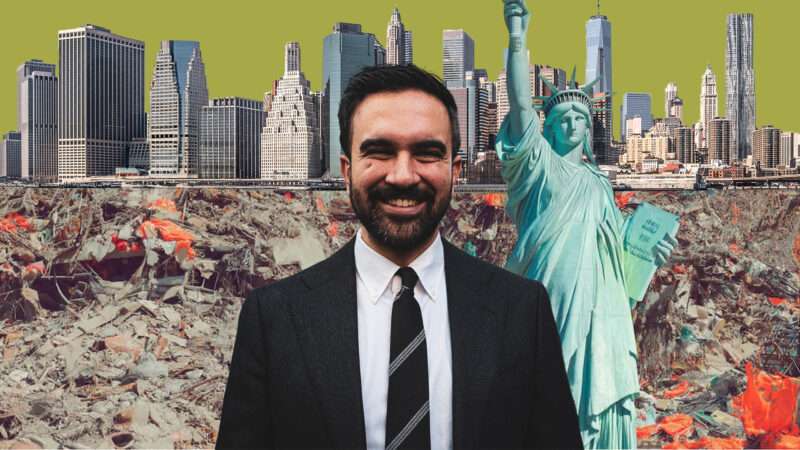
As I write this, I have yet to cast my vote for the mayor of New York City, where I live (a question I can answer more easily and definitively than the current mayor). In most elections, there are only two bad choices. But because New York has more of everything, from people to rats to unlicensed weed dispensaries, this time there are at least three terrible choices: The Democratic nominee Zohran Mamdani, the Republican Curtis Sliwa, and former Gov. Andrew Cuomo, who is running on the “Fight and Deliver Party” line.
Bad candidates are like unhappy families, each awful and terrible in their own way. But by all indications, only Mamdani matters because he is going to cruise to victory next Tuesday. When that happens, Andrew Cuomo, already hounded out of Albany due to terrible COVID policies and disturbing harassment of basically everyone he ever worked with, will disappear for good. Maybe he’ll live in South Florida like the next-in-line son of a deposed Shah or, in a more just world, in a tiny, market-rate studio apartment in Crown Heights with another disgraced politician, Anthony Weiner. The beret-wearing fabulist Curtis Sliwa will continue to haunt New York’s airwaves and local TV shows, talking about his cats and whatever else rambles like tumbleweeds through his mind.
Mamdani’s win will absolutely not be good for the city, but it will also not usher in the utter, instantaneous apocalypse that some fear. Yes, he will try to make buses and child care free, create city-owned grocery stores, jack up taxes on the ultra-rich (charitably defined as anyone making more than the “many young professionals at tech start-ups, law firms and investment companies” that seem to love him the most), and “freeze the rent” on perhaps as many as 1 million rental apartments (around half the total rental market). Maybe he will even issue an arrest warrant against Israeli Prime Minister Benjamin Netanyahu because, well, that sort of dramatic, dubiously legal action is a huge part of being the mayor of New York (and of being a member of the Democratic Socialists of America).
If you live outside New York, your biggest worry should be what effect a landslide win might have on the Democratic Party nationally. If Mamdani crushes Cuomo and Sliwa as seems likely, expect a big push from allies like Rep. Alexandria Ocasio-Cortez (D–N.Y.) to revive the worst excesses of the populist identity politics that helped cost Democrats the White House in 2024 and caused much of the discord, overspending, and stupidity of the past decade. (If the centrist Democrats running for governor in New Jersey and Virginia win as currently expected, expect a ton of articles about the fight for the soul of the Democratic Party.)
As Reason‘s Zach Weissmueller recently explained, Mamdani’s appeal goes beyond playing Santa Claus to large blocs of voters. He personifies the symbolic grievances of college-educated and relatively well-off Millennial and Gen Z voters who don’t really understand how capitalism works and what creative destruction entails. They take wealth production for granted, focusing instead on what they perceive as its morally just distribution, while overlooking the challenge of maintaining, much less expanding, economic and social opportunities for all.
For New York City, what Mamdani’s mayoralty will absolutely do is hurry along the slowly decaying orbit of the country’s largest city that commenced with the election of groundhog manhandler Bill de Blasio to two terms in Gracie Mansion and continued with the mediocre-at-best performance of Turkish Airlines enthusiast and cheese-detractor Eric Adams. We’re already a dozen-plus years into having the city run by bums or buffoons and, if you read histories like Richard E. Farley’s Drop Dead, you know this is how things go in New York City. There are long cycles of mediocre-to-terrible mayors (think of the years of Richard Wagner, John Lindsay, and Abe Beame, a period lasting from 1954 to 1977) that are interrupted by periods of better-than-average governance (think Ed Koch, Rudy Giuliani, and Mike Bloomberg, a span lasting from 1978 to 2013, exclusive of David Dinkins’ single term in the early ’90s).
New York has famously been called “the ungovernable city,” and in most ways, it is. Everything here is out of control; it is simultaneously the most regulated and freest autonomous zone imaginable. Yes, what happens here is deeply affected by politics and politicians, but those are just small streams that add to the powerful torrent of everyday life. After World War II, for a variety of reasons, New York flatlined in population in the 1950s and 1960s and then lost over 10 percent of its residents in the 1970s. Its population rebounded in the late ’80s, and the city has seen decades of sustained growth and vitality, even through events like 9/11, the financial crisis (felt deeply in the country’s finance center), and COVID (which posed particular issues for America’s most densely populated big city).
The city’s resurrection in the ’80s was in no way a foregone conclusion and was a combination of many factors. The most important parts included the invention of the contemporary financial industry that revved up so much so that by 1987 it provided the setting for Tom Wolfe’s era-defining novel, Bonfire of the Vanities, and its cast of “masters of the universe,” social justice warriors, and journalistic grifters. An influx of immigrants (both from abroad and various parts of America) flooded into a city with relatively abundant housing, reviving neighborhoods and areas written off long ago. But governance mattered greatly, too. The mayoralty of Ed Koch, a “liberal with sanity” who fought against rent control, crime, and excessive spending while personifying the city’s tolerance of all sorts of lifestyles, was an essential part of the renaissance, as we discussed in this 2011 interview.
But the fortunes of a city rarely rely solely or even mostly on its political class. In the ’50s, ’60s, and ’70s, New York was hardly the only city in the Northeast and Midwest that was seeing major population declines as the U.S. economy became more post-industrial and the South and West opened for business in big ways. Yet New York’s elected officials exacerbated exodus and decline by promising more and more services to people and papering over growing budget shortfalls with all sorts of gimmicks and tricks that ultimately came undone in the mid-1970s.
Farley’s account in Drop Dead is detailed and appalling—and it comes with a warning for today: After cleaning up its fiscal act and getting its budget more or less in order, the city is reverting to its old tricks and running up annual shortfalls of $10 billion or more for the foreseeable future. The terms of the city’s bailout by the feds (contrary to the memorable Daily News headline, Gerald Ford, desperate for Empire State electoral votes, never told the city to “drop dead”) and the state legislature of New York mean that Mayor Mamdani will be tightly constrained in what he can do. Many of his proposals (such as freezing the rent) are either legally dubious or will have to go through Albany (such as almost anything related to the public transit system).
This is good news, because his agenda, in virtually every particular, will make New York a tougher place to live and run a business (and thus work as a regular employee), or even go to school—he wants to get rid of gifted-and-talented programs and entrance-exam schools which motivate striver parents with limited financial resources to leave an expensive and generally awful system.
His housing proposals are also sure to backfire. As Reason‘s Justin Zuckerman recently documented, the city is already experiencing a severe housing drought—partly as a direct result of 2019 changes to state laws eagerly signed by then-Gov. Cuomo. Far from making housing more affordable or available, freezing rents at current levels will incentivize renters to stay put (rental turnover here is already 41 percent lower than the national average) and do nothing to spur large-scale construction of new units (who will build in a place where they have little or no say over what they can charge?). The hunt for good apartments in New York will go from bad to worse.
“When I read [Mamdani’s] proposals,” writes Andrew Sullivan at Substack, “at first I thought I was reading a high-schooler’s essay. Free everything!” He’s onto something—most of Mamdani’s ideas have already been tried extensively and failed in the immediate past. Consider his promise to hike the minimum wage from $16.50 an hour to $30 an hour in a few years. As Jim Epstein showed a decade ago for Reason, a minimum wage hike to $15 had predictable and bad effects on the city’s car wash industry. Whatever the intentions, such moves “push[ed] car washes to automate and to close down.” As bad, the mandated wage increase also fostered “a growing black market—workers increasingly have no choice but to ply their trade out of illegal vans parked on the street, because the minimum wage has made it illegal for anyone to hire them at the market rate.”
None of this is rocket science or terra incognita. One of Mamdani’s signature proposals is the creation of city-run grocery stores, an idea that is especially nonsensical in a place like New York, which already is “the No. 1 U.S. metro area in terms of residents’ ‘equitable access’ to a local supermarket.” He or his advisers might look to the recent experience of Erie, Kansas, where things are not going well for government-run supermarkets. Or he might follow the lead of Kennedy, who asked some Bronx residents about the plan and learned that they would rather the city work on homelessness, “dealing with ‘rats the size of cats,’ and cleaning ‘all of the needles on the street.'”
Depending on how much of his agenda he can muscle through, the City that Never Sleeps may be in for a longer or shorter nap when it comes to the growth and vitality of recent decades. Eventually, New York always wakes up and renews itself economically, culturally, and politically. It’s depressing that no one on the political horizon seems likely to conjure the magic that Koch, Giuliani, or Bloomberg—all of whom had terrible flaws—brought, but that’s almost always the case. The most depressing thing is that all of Mamdani’s mistakes are completely avoidable because they’ve happened time and time before. But unlike its old colonial rivals, Boston and Philadelphia, New York has never had much time or use for history.
“Specific guarantees in the Bill of Rights have penumbras, formed by emanations from those guarantees that help give them life and substance.” An ”emanation” refers to a ray of light. During a lunar eclipse, the ”umbra” refers to the darkest part of the shadow formed when the Earth orbits between the sun and the moon. The ”penumbra” refers to the lighter part of the shadow, where some of the ”emanations” from the sun are visible.
Gig companies like Uber and Lyft have popularized the economic concept of dynamicpricing (also known as “surge pricing”), making it a common phenomenon in our modern economy. Now, some restaurants are also considering more advanced dynamic pricing models, which has led to intense pushback from the political left.
In 2024, fast-food chain Wendy’s made waves with an announcement that it was investing $20 million in digital menus, which would allow the company to utilize dynamic pricing to adjust prices depending on the time of day or consumer demand levels. In the face of public backlash, Wendy’s claimed that it was never considering true surge pricing—i.e., raising food prices when demand was highest—but rather might use the digital menus to offer discounts during slower times of the day.
Despite Wendy’s seeming backtrack, progressive politicians have wasted no time in declaring war against dynamic food pricing. Earlier this year, Democratic state lawmakers in Maine pushed a bill to ban dynamic pricing in all restaurants and grocery stores in the state. This was done even though no restaurants in Maine were actually employing dynamic pricing models.
“The first question one might reasonably ask, as I did, is whether this is happening in Maine,” Rep. Marc Malon (D–Biddeford), the sponsor of the bill, told the Maine Wire. “The answer is, as far as I can tell, not yet, which is all the more reason to put safeguards in place now.”
While the legislation was ultimately defeated in Maine, the New York City Council decided to adopt a similar form of preemptive bans by introducing its own bill, which prohibits dynamic pricing in the Big Apple. This aligns with NYC’s larger “war on food” being waged by progressive members of the council, many of whom are prominent allies of democratic socialist mayoral frontrunner Zohran Mamdani. A Mamdani electoral victory is likely to supercharge these efforts, especially given the candidate’s focus on what he calls “halalflation.”
Lost in this debate is the fact that dynamic pricing has been used for years in the hospitality and leisure industries for everything from airline tickets to hotel rooms, which consumers accept and even expect. Other forms of dynamic pricing, such as congestion pricing for traffic in heavily urbanized environments, have also been touted as a policy advancement by many progressives for the environmental benefits and reduction of car traffic it can bring about (especially in the aftermath of President Donald Trump’s opposition to NYC’s congestion pricing system).
Restaurants have long used rudimentary forms of what could be called dynamic pricing, as Ryan Bourne of the Cato Institute has noted: “Pubs? They do dynamic pricing already: it’s called ‘happy hour.'”
Admittedly, these discounts are not in real-time and therefore might be called “differential pricing” rather than pure dynamic pricing, but nonetheless, the concept of shifting prices is not foreign to the food world. Other examples include blue plate lunch specials or even the neighborhood lemonade stand entrepreneur who charges an extra $1 for their citrusy libations on a particularly scorching day.
While it’s easy to villainize dynamic pricing, it is a model that could make sense for certain types of restaurants, particularly those in high-trafficked areas (such as downtown Manhattan) during the lunch or dinner rush. It can reduce wait times for consumers who are willing to pay a premium during such times, while allowing other consumers to potentially access off-hour deals that establishments offer to drum up business during dead periods.
Most importantly, dynamic pricing is voluntary, given that consumers can vote with their feet if they don’t want to frequent a restaurant that employs this strategy. As Bourne puts it, “some will pay more, yes, but they will still do so voluntarily.”
Left-wing politicians should pause their preemptive panic attacks about dynamic pricing and instead give it a chance. Dynamic pricing isn’t exploitation—it’s what happens when you let people, not politicians, decide what’s worth paying for.
As I write this, I have yet to cast my vote for the mayor of New York City, where I live (a question I can answer more easily and definitively than the current mayor). In most elections, there are only two bad choices. But because New York has more of everything, from people to rats to unlicensed weed dispensaries, this time there are at least three terrible choices: The Democratic nominee Zohran Mamdani, the Republican Curtis Sliwa, and former Gov. Andrew Cuomo, who is running on the “Fight and Deliver Party” line.
Bad candidates are like unhappy families, each awful and terrible in their own way. But by all indications, only Mamdani matters because he is going to cruise to victory next Tuesday. When that happens, Andrew Cuomo, already hounded out of Albany due to terrible COVID policies and disturbing harassment of basically everyone he ever worked with, will disappear for good. Maybe he’ll live in South Florida like the next-in-line son of a deposed Shah or, in a more just world, in a tiny, market-rate studio apartment in Crown Heights with another disgraced politician, Anthony Weiner. The beret-wearing fabulist Curtis Sliwa will continue to haunt New York’s airwaves and local TV shows, talking about his cats and whatever else rambles like tumbleweeds through his mind.
Mamdani’s win will absolutely not be good for the city, but it will also not usher in the utter, instantaneous apocalypse that some fear. Yes, he will try to make buses and child care free, create city-owned grocery stores, jack up taxes on the ultra-rich (charitably defined as anyone making more than the “many young professionals at tech start-ups, law firms and investment companies” that seem to love him the most), and “freeze the rent” on perhaps as many as 1 million rental apartments (around half the total rental market). Maybe he will even issue an arrest warrant against Israeli Prime Minister Benjamin Netanyahu because, well, that sort of dramatic, dubiously legal action is a huge part of being the mayor of New York (and of being a member of the Democratic Socialists of America).
If you live outside New York, your biggest worry should be what effect a landslide win might have on the Democratic Party nationally. If Mamdani crushes Cuomo and Sliwa as seems likely, expect a big push from allies like Rep. Alexandria Ocasio-Cortez (D–N.Y.) to revive the worst excesses of the populist identity politics that helped cost Democrats the White House in 2024 and caused much of the discord, overspending, and stupidity of the past decade. (If the centrist Democrats running for governor in New Jersey and Virginia win as currently expected, expect a ton of articles about the fight for the soul of the Democratic Party.)
As Reason‘s Zach Weissmueller recently explained, Mamdani’s appeal goes beyond playing Santa Claus to large blocs of voters. He personifies the symbolic grievances of college-educated and relatively well-off Millennial and Gen Z voters who don’t really understand how capitalism works and what creative destruction entails. They take wealth production for granted, focusing instead on what they perceive as its morally just distribution, while overlooking the challenge of maintaining, much less expanding, economic and social opportunities for all.
For New York City, what Mamdani’s mayoralty will absolutely do is hurry along the slowly decaying orbit of the country’s largest city that commenced with the election of groundhog manhandler Bill de Blasio to two terms in Gracie Mansion and continued with the mediocre-at-best performance of Turkish Airlines enthusiast and cheese-detractor Eric Adams. We’re already a dozen-plus years into having the city run by bums or buffoons and, if you read histories like Richard E. Farley’s Drop Dead, you know this is how things go in New York City. There are long cycles of mediocre-to-terrible mayors (think of the years of Richard Wagner, John Lindsay, and Abe Beame, a period lasting from 1954 to 1977) that are interrupted by periods of better-than-average governance (think Ed Koch, Rudy Giuliani, and Mike Bloomberg, a span lasting from 1978 to 2013, exclusive of David Dinkins’ single term in the early ’90s).
New York has famously been called “the ungovernable city,” and in most ways, it is. Everything here is out of control; it is simultaneously the most regulated and freest autonomous zone imaginable. Yes, what happens here is deeply affected by politics and politicians, but those are just small streams that add to the powerful torrent of everyday life. After World War II, for a variety of reasons, New York flatlined in population in the 1950s and 1960s and then lost over 10 percent of its residents in the 1970s. Its population rebounded in the late ’80s, and the city has seen decades of sustained growth and vitality, even through events like 9/11, the financial crisis (felt deeply in the country’s finance center), and COVID (which posed particular issues for America’s most densely populated big city).
The city’s resurrection in the ’80s was in no way a foregone conclusion and was a combination of many factors. The most important parts included the invention of the contemporary financial industry that revved up so much so that by 1987 it provided the setting for Tom Wolfe’s era-defining novel, Bonfire of the Vanities, and its cast of “masters of the universe,” social justice warriors, and journalistic grifters. An influx of immigrants (both from abroad and various parts of America) flooded into a city with relatively abundant housing, reviving neighborhoods and areas written off long ago. But governance mattered greatly, too. The mayoralty of Ed Koch, a “liberal with sanity” who fought against rent control, crime, and excessive spending while personifying the city’s tolerance of all sorts of lifestyles, was an essential part of the renaissance, as we discussed in this 2011 interview.
But the fortunes of a city rarely rely solely or even mostly on its political class. In the ’50s, ’60s, and ’70s, New York was hardly the only city in the Northeast and Midwest that was seeing major population declines as the U.S. economy became more post-industrial and the South and West opened for business in big ways. Yet New York’s elected officials exacerbated exodus and decline by promising more and more services to people and papering over growing budget shortfalls with all sorts of gimmicks and tricks that ultimately came undone in the mid-1970s.
Farley’s account in Drop Dead is detailed and appalling—and it comes with a warning for today: After cleaning up its fiscal act and getting its budget more or less in order, the city is reverting to its old tricks and running up annual shortfalls of $10 billion or more for the foreseeable future. The terms of the city’s bailout by the feds (contrary to the memorable Daily News headline, Gerald Ford, desperate for Empire State electoral votes, never told the city to “drop dead”) and the state legislature of New York mean that Mayor Mamdani will be tightly constrained in what he can do. Many of his proposals (such as freezing the rent) are either legally dubious or will have to go through Albany (such as almost anything related to the public transit system).
This is good news, because his agenda, in virtually every particular, will make New York a tougher place to live and run a business (and thus work as a regular employee), or even go to school—he wants to get rid of gifted-and-talented programs and entrance-exam schools which motivate striver parents with limited financial resources to leave an expensive and generally awful system.
His housing proposals are also sure to backfire. As Reason‘s Justin Zuckerman recently documented, the city is already experiencing a severe housing drought—partly as a direct result of 2019 changes to state laws eagerly signed by then-Gov. Cuomo. Far from making housing more affordable or available, freezing rents at current levels will incentivize renters to stay put (rental turnover here is already 41 percent lower than the national average) and do nothing to spur large-scale construction of new units (who will build in a place where they have little or no say over what they can charge?). The hunt for good apartments in New York will go from bad to worse.
“When I read [Mamdani’s] proposals,” writes Andrew Sullivan at Substack, “at first I thought I was reading a high-schooler’s essay. Free everything!” He’s onto something—most of Mamdani’s ideas have already been tried extensively and failed in the immediate past. Consider his promise to hike the minimum wage from $16.50 an hour to $30 an hour in a few years. As Jim Epstein showed a decade ago for Reason, a minimum wage hike to $15 had predictable and bad effects on the city’s car wash industry. Whatever the intentions, such moves “push[ed] car washes to automate and to close down.” As bad, the mandated wage increase also fostered “a growing black market—workers increasingly have no choice but to ply their trade out of illegal vans parked on the street, because the minimum wage has made it illegal for anyone to hire them at the market rate.”
None of this is rocket science or terra incognita. One of Mamdani’s signature proposals is the creation of city-run grocery stores, an idea that is especially nonsensical in a place like New York, which already is “the No. 1 U.S. metro area in terms of residents’ ‘equitable access’ to a local supermarket.” He or his advisers might look to the recent experience of Erie, Kansas, where things are not going well for government-run supermarkets. Or he might follow the lead of Kennedy, who asked some Bronx residents about the plan and learned that they would rather the city work on homelessness, “dealing with ‘rats the size of cats,’ and cleaning ‘all of the needles on the street.'”
Depending on how much of his agenda he can muscle through, the City that Never Sleeps may be in for a longer or shorter nap when it comes to the growth and vitality of recent decades. Eventually, New York always wakes up and renews itself economically, culturally, and politically. It’s depressing that no one on the political horizon seems likely to conjure the magic that Koch, Giuliani, or Bloomberg—all of whom had terrible flaws—brought, but that’s almost always the case. The most depressing thing is that all of Mamdani’s mistakes are completely avoidable because they’ve happened time and time before. But unlike its old colonial rivals, Boston and Philadelphia, New York has never had much time or use for history.
This could be averted if Poland, which commands NATO’s third-largest army and whose new president recently didn’t rule out talking to Putin if his country’s security depended on it, doesn’t allow itself to be manipulated into partaking in any related provocations or backing up those responsible for them.
Early September’s suspicious Russian drone incident over Poland, Estonia’s subsequent claim that Russian jets violated its maritime airspace, and Scandinavia’s recent Russian drone scare are responsible for NATO considering a three-pronged response along its eastern flankaccording to the Financial Times. Their sources indicate that this could take the form of arming surveillance drones, streamlining the rules of engagement for fighter pilots, and holding NATO exercises right on the bloc’s border with Russia.
The first two carry self-evident escalation risks since trigger-happy operators or pilots could provoke a serious international security crisis if they shoot at (let alone down) Russian drones or jets. This is especially so if it occurs in international airspace or especially within Russia’s own. As for the last one, Russia’s threat assessment would spike during the duration of those drills since they could be a front for aggression, including hybrid aggression via drones and/or mercenaries.
NATO jamming could also lead to Russian drones veering across the border like this analysis here argues was probably responsible for the earlier-mentioned suspicious incident over Poland. In that scenario, NATO could have the pretext for a (possibly preplanned) escalation against Russia that could easily spiral out of control if cooler heads don’t prevail. The Financial Times noted that “a shift may not be publicly communicated” so a crisis could break out with no advance warning if NATO makes one wrong move.
Communication is key for preventing that, but Poland rejected Russia’s proposal to discuss September’s suspicious drone incident and Foreign Ministry spokeswoman Maria Zakharova recently condemned it for annulling the visas of Russian experts ahead of an OSCE meeting in Warsaw. Poland aspires to revive its lost Great Power status, with September being historic in this respect as explained here, which would then revive its centuries-long rivalry with Russia at the possible expense of regional stability.
There are three fronts where Poland could apply one, some, or all three parts of NATO’s reported three-pronged response to the latest Russian scare: Kaliningrad, Belarus, and/or Ukraine. It also commands NATO’s third-largest army and has no plans to slow down its unprecedented militarization so its political-military leadership might feel emboldened to one day test Russia’s red lines. That could lead to a NATO-Russian war, however, if a Russian plane is shot down according to the Russian Ambassador to France.
New Polish President Karol Nawrocki wisely decided not to risk that by declining to impose a no-fly zone over part of Ukraine after September’s incident despite pressure from his Foreign Minister. It later turned out that the government lied about Russian responsibility for the damage inflicted on a home after it was revealed that a NATO missile was to blame. They also hid this fact from him. Deep state forces, possibly soon in collusion with Ukraine, quite clearly want to spark another Polish-Russian War.
Given that Nawrocki recently didn’t rule out talking to Putin if Poland’s security depended on it, he might thus do so in a crisis instead of allowing himself to be misled by deep state forces, particularly the liberal-globalist ruling coalition and their military-intelligence allies who just tried to manipulate him into war. Without the direct involvement of NATO’s third-largest army in any potentially forthcoming crisis, whether provoked by the Polish deep state or the Baltic States, a NATO-Russian war might be averted.
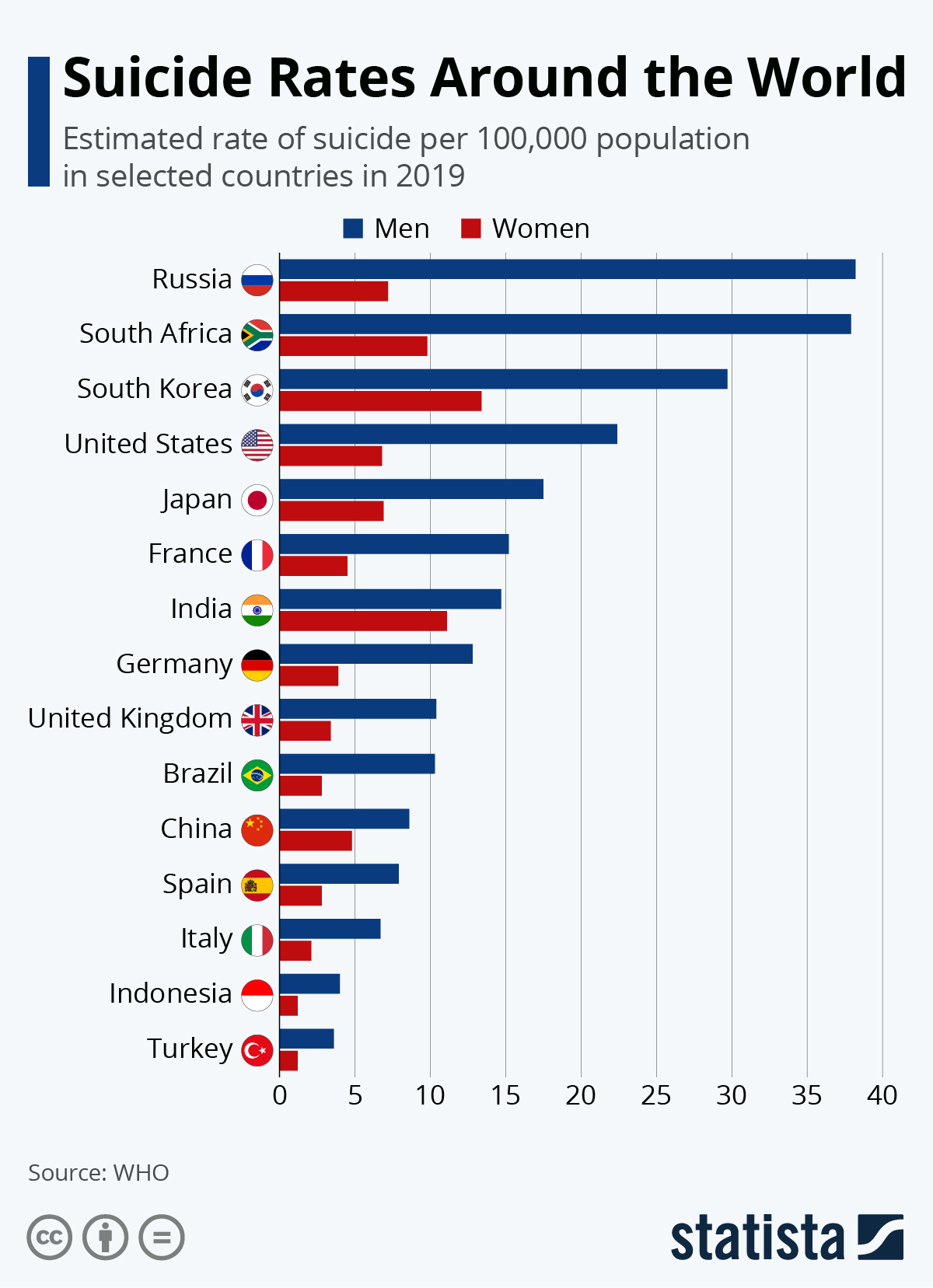
Out of every 100,000 men in the United States, an average of 24 died from suicide in 2021, while for women the average was close to seven per 100,000.
In several countries these figures were even higher, such as in South Korea, Lithuania and Hungary.
While there are significant differences between countries, one pattern is clear to see: the rates of men taking their own lives are generally higher than those of women.
Lithuania and South Korea had the highest rates of suicide among men in 2021 (out of the countries reporting data), at 50 and 37 cases per 100,000 population, respectively.
For women, South Korea, India and Japan had the highest rates of the selected countries, with 14.6, 10.9 and 10.1 cases per 100,000.
According to the World Health Organization, the African Region has the highest suicide rate in the world, estimated at 11.2 people per 100,000 population in 2019, compared to the global average of 9.0 per 100,000 population that year.
Lesotho had particularly high rates at 87.5 per 100,000 population that year, followed by Eswatini at 40.5 per 100,000 population.
The WHO underscores how 77 percent of suicides occurred in low- and middle-income countries in 2019, where a majority of the world’s population lives, adding that a lack of data on suicide has led to continued underreporting.
If you or somebody you know are in need of help, you can find a list of suicide crisis lines and website for countries around the world here.