Gold Investors: Remember 1933

Gold Investors: Remember 1933

Authored by Michael Wilkerson via The Epoch Times,

Investors have been rightly impressed by the remarkable run of gold, which in dollar terms has doubled in price over the past year.

This performance vastly outpaces the stock markets (which are also sitting near all-time highs) and bitcoin (trading sideways to down for months), the cryptocurrency challenger touted as a “digital gold” safe-haven alternative to depreciating fiat currencies such as the U.S. dollar.

The gold euphoria should be tempered by an uncomfortable recognition.

Gold’s meteoric performance is a troubling sign that something is profoundly wrong—or at least brewing—in the global geopolitical, economic, and monetary environment.

Investors are reaching for safety at the same time that risky investments continue to rise in dollar-terms value. Central banks are accumulating and hoarding gold and reducing their U.S. dollar reserves, as all the while they prepare for economic, technologic, and kinetic war. Gold is a safe haven for individual investors so long as they can legally hold, buy, and sell it. Most of us take that as a given.

But Americans should never forget that the U.S. government, under then-President Franklin Delano Roosevelt’s (FDR’s) Executive Order 6102 (April 1933), moved with coercive force (including massive fines and threat of up to 10 years’ imprisonment) to confiscate the estimated $1.5 billion in gold coins, bullion, and certificates held by ordinary Americans. This represented about 5 percent of the money supply, equivalent to about $1.1 trillion in liquidity terms in today’s financial system.

Then, in the midst of the Great Depression and related banking crisis, the U.S. dollar was convertible into gold at an artificially low fixed rate of $20.67 per ounce. Anyone could walk into their bank and demand their paper currency be redeemed for gold. Because of the loss of confidence in the banking system, that is exactly what they were doing, as were foreign governments and banks that had a claim on gold held in the United States, draining the U.S. government and banks of their reserves.

Because the dollar was 100 percent backed by gold, and with the fixed conversion rate, the Federal Reserve couldn’t increase the money supply to help ease the credit crisis and stop the deflationary spiral the country was facing … because it didn’t hold the gold.

So FDR simply declared a national emergency, confiscated citizens’ gold for $20, and then, the next year, “presto,” simply changed the official conversion rate upward by 67 percent to $35 per ounce, enabling money supply expansion, reducing the value of the dollar in foreign currency terms, and thus supporting U.S. exports.

This was done in the context of rising geopolitical tensions, tariff wars, rumors of rearmament in Europe, competitive currency devaluations, and a scramble by governments around the world to shore up their gold reserves.

Sound familiar?

Today, we are in a similar—but also very different—geopolitical environment. What is analogous is that the nations of the world are transitioning into a “war economy.” The central banks are once again buying as much gold as they can get their hands on. Protectionism and resource nationalism are the orders of the day. Fiat currencies are on a path toward debasement, an environment in which governments deprive their citizens of purchasing power and use inflation as stealth taxation.

I’m not suggesting that the U.S. government is considering gold confiscation. I’m reminding all of us that “black swan” events happen unexpectedly and suddenly. A kinetic intervention into Iran would potentially be one such event, with economic and financial ramifications likely much greater than the restrained response to U.S. action in Venezuela. When a black swan lands, the shock waves move in patterns difficult to anticipate. In perceived national emergencies, governments reach into their bags of tricks for unprecedented solutions. This was true in 1914 (the onset of the cataclysm of World War I), in the 1930s Great Depression, in 1971 when then-President Richard Nixon “temporarily” suspended dollar convertibility into gold by foreign banks and governments to stem the outward flow of reserves (temporarily lasting 55 years), and in 2008’s global financial crisis. The long list of government interventions during this period resulted in distortions to the monetary and financial markets—and the real economy—that ripple to this day.

We are in times that are not business as usual. I continue to view gold as an important part of a financial umbrella. Over millennia, gold has proven to be real money when fiat (paper) currencies inevitably fail. But I keep one eye open to the possibility that in a national emergency, all bets are off. History shows that no action is beyond the consideration of governments attempting to extricate themselves from an apparently intractable strategic predicament.

Views expressed in this article are opinions of the author and do not necessarily reflect the views of The Epoch Times or ZeroHedge.

Tyler Durden
Wed, 02/04/2026 – 08:05

via ZeroHedge News https://ift.tt/GxSJ7t9 Tyler Durden

Fifth Circuit to Hear Oral Argument on the Victims’ Families’ Challenge to the Dismissal of the Boeing Criminal Case

Tomorrow I will be arguing in the Fifth Circuit for 31 families whose relatives were killed in the crashes of two Boeing 737 MAX aircraft. I have filed two Crime Victims’ Rights Act (CVRA) petitions with the Circuit, asking it to reverse District Judge Reed O’Connor’s approval of the Justice Department’s motion to dismiss its criminal conspiracy case against Boeing. The petitions explain that the Department violated the CVRA by not reasonably conferring with the families about its dismissal plans—and by concealing a deferred prosecution agreement (DPA) from the families in the initial phases of the case. The petitions also argue that Judge O’Connor failed to fully assess whether dismissing the case was in the “public interest.” In this post, I set out the three main arguments I will be presenting, and attach the relevant filings (from both sides) for those who are interested.

I’ve blogged about the Boeing criminal case a number of times before, including here, here, and here. In a nutshell, Boeing lied to the FAA about the safety of its 737 MAX aircraft. The Justice Department charged Boeing with conspiracy for these lies, but then immediately entered into a DPA to resolve the criminal case. In subsequent litigation, the families proved that the 346 passengers and crew on board the two doomed 737 MAX flights were “crime victims” under the CVRA—they had been directly and proximately harmed by Boeing crime. This makes Boeing’s conspiracy crime the “deadliest corporate crime in U.S. history,” as Judge O’Connor described it.

In the most recent proceedings, the Justice Department moved to dismiss its earlier-filed charge against Boeing in favor of resolution through a non-prosecution agreement (NPA). Judge O’Connor of the Northern District of Texas granted the Justice Department’s motion. In his order, Judge O’Connor essentially agreed with many of the factual objections that I have made for the families who lost loved ones because of Boeing’s crime. But, reluctantly, Judge O’Connor dismissed the charge, concluding that he lacked a legal basis for blocking the Department’s ill-conceived non-prosecution plan.

As authorized by the CVRA, I have filed two petitions (found here and here) seeking to overturn Judge O’Connor ruling. DOJ has responded, as has Boeing. My reply brief sets out the three main arguments for reversing the Judge O’Connor, which the Fifth Circuit will consider tomorrow:

Did the District Court Protect the Victims’ Families’ Rights at “Every Stage” of the Process

My first petition challenges the fact that the Justice Department orchestrated a secret deferred-prosecution agreement for Boeing back in in 2021, in violation of the families CVRA rights. Now, to protect the families’ rights, the DPA needs to be declared void as against public policy. As my reply brief summarizes the argument:

the Court should instruct the district court to invalidate the DPA and conduct further proceedings free from the influence of that agreement. Directing the district court to invalidate the DPA would allow the victims’ families the “unfettered” opportunity to confer with the Government about appropriate next steps in this case. See Appx. 591-92 (discussing Does 1 & 2 v. United States, 359 F.Supp.3d 1201, 1218 (S.D. Fla. 2019) (quoting 950 F.Supp.2d at 1267)). This direction would necessarily mean reversing the  district court’s decision to grant the motion to dismiss, as the course of the new proceedings after the DPA is invalidated could alter whether (or how) the district court would need to review any motion to dismiss.

The Government seeks to conjure the illusion that the DPA has become irrelevant because the Government determined that Boeing breached the agreement. But inconveniently for the Government, the DPA refuses to remain buried in its grave. As the victims’ families explained in their DPA petition (DPA Pet. 27-28), the Government’s NPA and its incorporated attachments contain dozens of references to the DPA. See NPA, ECF No. 312-1 passim.1 As one illustration of how the DPA controlled the NPA, on its face, the NPA relied on the DPA’s Guidelines calculations to calculate Boeing’s financial penalty:

pursuant to Paragraph 26 of the DPA, the Offices have determined that the appropriate resolution of this case is for the Offices to dismiss the Information … and enter into a non-prosecution agreement with the Company with a two-year term; payment by the Company of an overall criminal monetary penalty amount of $487,200,000, which reflects a fine at the top of the applicable Sentencing Guidelines fine range and the maximum fine allowable under Title 18, United States Code, Sections 371 and 3571(c), including credit for the $243,600,000 previously paid by the Company pursuant to the DPA, resulting in a remaining criminal penalty owed by the Company of $243,600,000 ….

NPA, ¶ 3 (emphases added).

It appears to be undisputed that the Justice Department violated the victims’ rights at the first stage of this entire process. Hopefully, the Fifth Circuit will order the district court to remedy those violations by setting aside the DPA.

Did the Justice Department Reasonably Confer about the Recent Non-Prosecution Agreement

My next argument concerns the recent non-prosecution agreement (NPA), which the Justice Department did not reasonably confer about about. Here is my argument summarized in the reply brief:

The Government failed to reasonably confer about the NPA’s no-further-prosecution
provision. The provision had already gone into effect before the victims’ families knew about it, effectively rendering the families’ later objections to the motion to dismiss meaningless. See Families’ NPA Pet. 15-20 (citing, e.g., ECF No. 318-1 at 16).

The Government responds to this argument by, first, distorting the record below. The Government claims it discussed both a potential NPA and a motion to dismiss with the families—but then asserts that “[n]o one questioned, at or after the conferral, these two separate promises or their sequences.” Gov’t Resp. 48. Not true. The victims’ families lead argument—briefed extensively below (see, e.g., ECF No. 340 at 3)—was that the Government deceived them about the sequence. Specifically, as set out below in the (uncontested) sworn declaration of the families’ counsel:

If I had been made aware that the Government was considering entering into such an agreement before the Court had ruled on any motion to dismiss, I would have, on behalf of my clients, made my strenuous objection known to the Government and sought to swiftly present the issue to the Court before the Government entered into such a binding agreement. …

ECF No. 318-1 at 15.

The Government’s concealment was particularly misleading against the backdrop of the Government’s decades-long practice of presenting a motion to dismiss to the district court before entering a formal agreement not to prosecute. As counsel for the petitioning victims’ families stated, based on extensive experience with the federal criminal justice system, “it was a clear and substantial deviation from normal criminal justice processes” for the Justice Department to take such a step. Id.

In the proceedings in the district court, the victims’ families repeatedly called the Government’s approach “unprecedented.” See NPA Pet. 18 (collecting record citations). Neither the Government nor Boeing offered any precedent below.

Here again, I hope the Fifth Circuit will agree and remand the case for reasonable conferral about the unprecedented no-further-prosecution provision.

Did the District Court Treat the Families Unfairly in Assessing their Arguments Against Dismissal

My final argument concerns the district court’s conclusion that it lacked the “authority” to do anything other than approve the Justice Department’s dismissal motion. As I explain in my reply, the district court did not understand its full authority in this area:

As the victims’ families explained at length in their NPA petition, in granting
the Government’s motion to dismiss, the district court viewed its authority too
narrowly. See NPA Pet. 24-31. This Court reviews this legal issue de novo, as a trial
court necessarily “abuses its discretion when its ruling is based on an erroneous view of the law ….” United States v. Age, 136 F.4th 193, 227 (5th Cir. 2025).

As much as the parties attempt to wriggle out of the relevant caselaw, this Court has repeatedly held that the trial court can reject a motion to dismiss where it “has an affirmative reason to believe that the dismissal motion was motivated by considerations contrary to the public interest.” United States v. Hamm, 659 F.2d 624, 631 (5th Cir. en banc 1981). To be sure, the district court could begin its review of this issue by presuming that the prosecutors acted in good faith. See United States v. Cowan, 524 F.2d 504, 514 (5th Cir. 1975). But the ultimate question for the district court was whether that presumption was “overcome by ‘an affirmative reason to believe that the dismissal motion was motivated by considerations contrary to the public interest.'” United States v. Welborn, 849 F.2d 980, 984 (5th Cir. 1988) (quoting Hamm, 659 F.2d at 631).

Here, such affirmative reasons abounded. The district court found—as a finding of fact—that the families have made a “compelling” argument that the NPA “is contrary to the public interest.” Op.8. Among other things, the district court found that the families were “correct that this agreement fails to secure the necessary accountability to ensure the safety of the flying public.” Op.6. That chilling conclusion—standing alone—should have led the district court to deny dismissal.

But the district court also found that the Government had advanced an “unserious” argument that it needed to resolve the case rather than go to trial. Op.6. While the Government claimed “litigation risk,” the district court observed that the Government possesses “a confession from Boeing, signed by the CEO and Chief Legal Officer,” admitting the conspiracy charge. Id. And while an individual Boeing test pilot was acquitted in connection with the conspiracy, the trial court judge—who presided over that trial—noted that the defendant’s central defense was that he “was a scapegoat for the broader and systematic failure of Boeing’s corporate culture which led to the crashes.” Op.6n.18.

On top of these already strong arguments, the district court should have also weighed in the balance two of the victims’ families’ strongest arguments: the no-further-prosecution provision argument and the dismissal purportedly “without prejudice” argument. See NPA Pet. 29-31. The Government’s unprecedented ploy of contracting with Boeing for no-further-prosecution—even before the district court had ruled—was clearly contrary to the manifest public interest. Perhaps the district court thought that it could avoid this vital issue, because it was not allowed to “substitute its judgment for the prosecutor’s determination” of the public interest. Op.7 (citing United States v. Salinas, 904 F.2d 936, 351 (5th Cir. 1982) (dicta, as discussed in NPA Pet. 27 n.9)). But the district court would not have been substituting its judgment on this point, but rather Rule 48(a)’s. The rule presupposes that the district court will have the opportunity to deny the motion to dismiss before the Government makes a binding agreement with the defendant—the “settled sequence of federal courts’ authority” that Ryan relied on. 88 F.4th at 625. The parties do not respond to the victims’ families’ obvious point: That if this Court approves the no-further-prosecution stratagem here, then it will become the roadmap for all subsequent Rule 48(a) dismissal motions, essentially repealing Rule 48(a)’s “leave of court” requirement.

***

Tomorrow, I have 20 minutes to make my case. The Government is represented by Connor Winn of the Justice Department’s Criminal Division. Boeing is represented by Paul Clement of Clement and Murphy. They will have 20 minutes to respond. Of course, I hope that the Fifth Circuit agrees with my arguments and sets aside the district court’s dismissal of the case.

The post Fifth Circuit to Hear Oral Argument on the Victims' Families' Challenge to the Dismissal of the Boeing Criminal Case appeared first on Reason.com.

from Latest – Reason.com https://ift.tt/G56BdFf
via IFTTT

No Qualified Immunity for Arrest over “Fuck Trump” and “Fuck Biden” Flags

From Sheets v. Lipker, decided Monday by Judge John Badalamenti (M.D. Fla.):

This case is about words—specifically, a four-letter expletive that has vexed legal authorities and amused teenagers for generations. Plaintiff Andrew Sheets, proceeding pro se, alleges that Officer David Joseph Lipker violated his First Amendment rights by citing him for displaying signs bearing the word “Fuck” in a public place….

Because this case is before the Court on a motion to dismiss, we accept the factual allegations in the complaint as true. Back in 2021, Sheets stood on a public sidewalk in Punta Gorda. He was there to protest. To make his point, he displayed two flags: one reading “Fuck Trump” and the other “Fuck Biden.” He also wore a shirt emblazoned with the phrase “Fuck Policing 4 Profit.”

Officer David Joseph Lipker approached Sheets and issued him a citation for violating City Ordinance 26-11.5(z), which prohibited the public display of obscene signs. The citation was allegedly issued because of the language Sheets displayed, and Defendants do not contend otherwise. Lipker then ordered Sheets to leave the sidewalk. Sheets complied, packed up his flags, and left….

Long ago, the Supreme Court settled the question of whether the government may act as the guardian of public morality by banishing the word Fuck from the public square. In Cohen v. California (1971), the Court considered the conviction of a man who walked through a courthouse corridor wearing a jacket bearing the words “Fuck the Draft.” The State of California argued, much as Officer Lipker decided here, that such language was offensive conduct that disturbed the peace. The Court disagreed. It held that the “simple public display” of this “single four-letter expletive” could not be made a criminal offense consistent with the First Amendment. The Constitution, the Court explained, leaves matters of taste and style largely to the individual, recognizing that “one man’s vulgarity is another’s lyric.” In the decades since, the law has been made clear: the state may not censor a citizen for public display of the word “fuck.” See Mahanoy Area Sch. Dist. v. B. L. by & through Levy (2021)….

Officer Lipker asks for a free pass because he was enforcing an ordinance, but he enforced it against speech that has been protected for generations. He argues he did not mean to retaliate, but his citation targeted the very words he determined offensive. And he claims no harm was done, even though he silenced a citizen in the public square. None of these defenses hold water at this stage. When Officer Lipker cited Sheets for the content of his speech, he crossed a constitutional line that was drawn long ago….

Civility is a virtue, but it is not a legal requirement for political protest. When Officer Lipker cited Sheets for his choice of vocabulary, he ignored well-settled precedent protecting the very speech he sought to punish. He is not entitled to qualified immunity for that error….

The post No Qualified Immunity for Arrest over "Fuck Trump" and "Fuck Biden" Flags appeared first on Reason.com.

from Latest – Reason.com https://ift.tt/MckqzFZ
via IFTTT

Fifth Circuit to Hear Oral Argument on the Victims’ Families’ Challenge to the Dismissal of the Boeing Criminal Case

Tomorrow I will be arguing in the Fifth Circuit for 31 families whose relatives were killed in the crashes of two Boeing 737 MAX aircraft. I have filed two Crime Victims’ Rights Act (CVRA) petitions with the Circuit, asking it to reverse District Judge Reed O’Connor’s approval of the Justice Department’s motion to dismiss its criminal conspiracy case against Boeing. The petitions explain that the Department violated the CVRA by not reasonably conferring with the families about its dismissal plans—and by concealing a deferred prosecution agreement (DPA) from the families in the initial phases of the case. The petitions also argue that Judge O’Connor failed to fully assess whether dismissing the case was in the “public interest.” In this post, I set out the three main arguments I will be presenting, and attach the relevant filings (from both sides) for those who are interested.

I’ve blogged about the Boeing criminal case a number of times before, including here, here, and here. In a nutshell, Boeing lied to the FAA about the safety of its 737 MAX aircraft. The Justice Department charged Boeing with conspiracy for these lies, but then immediately entered into a DPA to resolve the criminal case. In subsequent litigation, the families proved that the 346 passengers and crew on board the two doomed 737 MAX flights were “crime victims” under the CVRA—they had been directly and proximately harmed by Boeing crime. This makes Boeing’s conspiracy crime the “deadliest corporate crime in U.S. history,” as Judge O’Connor described it.

In the most recent proceedings, the Justice Department moved to dismiss its earlier-filed charge against Boeing in favor of resolution through a non-prosecution agreement (NPA). Judge O’Connor of the Northern District of Texas granted the Justice Department’s motion. In his order, Judge O’Connor essentially agreed with many of the factual objections that I have made for the families who lost loved ones because of Boeing’s crime. But, reluctantly, Judge O’Connor dismissed the charge, concluding that he lacked a legal basis for blocking the Department’s ill-conceived non-prosecution plan.

As authorized by the CVRA, I have filed two petitions (found here and here) seeking to overturn Judge O’Connor ruling. DOJ has responded, as has Boeing. My reply brief sets out the three main arguments for reversing the Judge O’Connor, which the Fifth Circuit will consider tomorrow:

Did the District Court Protect the Victims’ Families’ Rights at “Every Stage” of the Process

My first petition challenges the fact that the Justice Department orchestrated a secret deferred-prosecution agreement for Boeing back in in 2021, in violation of the families CVRA rights. Now, to protect the families’ rights, the DPA needs to be declared void as against public policy. As my reply brief summarizes the argument:

the Court should instruct the district court to invalidate the DPA and conduct further proceedings free from the influence of that agreement. Directing the district court to invalidate the DPA would allow the victims’ families the “unfettered” opportunity to confer with the Government about appropriate next steps in this case. See Appx. 591-92 (discussing Does 1 & 2 v. United States, 359 F.Supp.3d 1201, 1218 (S.D. Fla. 2019) (quoting 950 F.Supp.2d at 1267)). This direction would necessarily mean reversing the  district court’s decision to grant the motion to dismiss, as the course of the new proceedings after the DPA is invalidated could alter whether (or how) the district court would need to review any motion to dismiss.

The Government seeks to conjure the illusion that the DPA has become irrelevant because the Government determined that Boeing breached the agreement. But inconveniently for the Government, the DPA refuses to remain buried in its grave. As the victims’ families explained in their DPA petition (DPA Pet. 27-28), the Government’s NPA and its incorporated attachments contain dozens of references to the DPA. See NPA, ECF No. 312-1 passim.1 As one illustration of how the DPA controlled the NPA, on its face, the NPA relied on the DPA’s Guidelines calculations to calculate Boeing’s financial penalty:

pursuant to Paragraph 26 of the DPA, the Offices have determined that the appropriate resolution of this case is for the Offices to dismiss the Information … and enter into a non-prosecution agreement with the Company with a two-year term; payment by the Company of an overall criminal monetary penalty amount of $487,200,000, which reflects a fine at the top of the applicable Sentencing Guidelines fine range and the maximum fine allowable under Title 18, United States Code, Sections 371 and 3571(c), including credit for the $243,600,000 previously paid by the Company pursuant to the DPA, resulting in a remaining criminal penalty owed by the Company of $243,600,000 ….

NPA, ¶ 3 (emphases added).

It appears to be undisputed that the Justice Department violated the victims’ rights at the first stage of this entire process. Hopefully, the Fifth Circuit will order the district court to remedy those violations by setting aside the DPA.

Did the Justice Department Reasonably Confer about the Recent Non-Prosecution Agreement

My next argument concerns the recent non-prosecution agreement (NPA), which the Justice Department did not reasonably confer about about. Here is my argument summarized in the reply brief:

The Government failed to reasonably confer about the NPA’s no-further-prosecution
provision. The provision had already gone into effect before the victims’ families knew about it, effectively rendering the families’ later objections to the motion to dismiss meaningless. See Families’ NPA Pet. 15-20 (citing, e.g., ECF No. 318-1 at 16).

The Government responds to this argument by, first, distorting the record below. The Government claims it discussed both a potential NPA and a motion to dismiss with the families—but then asserts that “[n]o one questioned, at or after the conferral, these two separate promises or their sequences.” Gov’t Resp. 48. Not true. The victims’ families lead argument—briefed extensively below (see, e.g., ECF No. 340 at 3)—was that the Government deceived them about the sequence. Specifically, as set out below in the (uncontested) sworn declaration of the families’ counsel:

If I had been made aware that the Government was considering entering into such an agreement before the Court had ruled on any motion to dismiss, I would have, on behalf of my clients, made my strenuous objection known to the Government and sought to swiftly present the issue to the Court before the Government entered into such a binding agreement. …

ECF No. 318-1 at 15.

The Government’s concealment was particularly misleading against the backdrop of the Government’s decades-long practice of presenting a motion to dismiss to the district court before entering a formal agreement not to prosecute. As counsel for the petitioning victims’ families stated, based on extensive experience with the federal criminal justice system, “it was a clear and substantial deviation from normal criminal justice processes” for the Justice Department to take such a step. Id.

In the proceedings in the district court, the victims’ families repeatedly called the Government’s approach “unprecedented.” See NPA Pet. 18 (collecting record citations). Neither the Government nor Boeing offered any precedent below.

Here again, I hope the Fifth Circuit will agree and remand the case for reasonable conferral about the unprecedented no-further-prosecution provision.

Did the District Court Treat the Families Unfairly in Assessing their Arguments Against Dismissal

My final argument concerns the district court’s conclusion that it lacked the “authority” to do anything other than approve the Justice Department’s dismissal motion. As I explain in my reply, the district court did not understand its full authority in this area:

As the victims’ families explained at length in their NPA petition, in granting
the Government’s motion to dismiss, the district court viewed its authority too
narrowly. See NPA Pet. 24-31. This Court reviews this legal issue de novo, as a trial
court necessarily “abuses its discretion when its ruling is based on an erroneous view of the law ….” United States v. Age, 136 F.4th 193, 227 (5th Cir. 2025).

As much as the parties attempt to wriggle out of the relevant caselaw, this Court has repeatedly held that the trial court can reject a motion to dismiss where it “has an affirmative reason to believe that the dismissal motion was motivated by considerations contrary to the public interest.” United States v. Hamm, 659 F.2d 624, 631 (5th Cir. en banc 1981). To be sure, the district court could begin its review of this issue by presuming that the prosecutors acted in good faith. See United States v. Cowan, 524 F.2d 504, 514 (5th Cir. 1975). But the ultimate question for the district court was whether that presumption was “overcome by ‘an affirmative reason to believe that the dismissal motion was motivated by considerations contrary to the public interest.'” United States v. Welborn, 849 F.2d 980, 984 (5th Cir. 1988) (quoting Hamm, 659 F.2d at 631).

Here, such affirmative reasons abounded. The district court found—as a finding of fact—that the families have made a “compelling” argument that the NPA “is contrary to the public interest.” Op.8. Among other things, the district court found that the families were “correct that this agreement fails to secure the necessary accountability to ensure the safety of the flying public.” Op.6. That chilling conclusion—standing alone—should have led the district court to deny dismissal.

But the district court also found that the Government had advanced an “unserious” argument that it needed to resolve the case rather than go to trial. Op.6. While the Government claimed “litigation risk,” the district court observed that the Government possesses “a confession from Boeing, signed by the CEO and Chief Legal Officer,” admitting the conspiracy charge. Id. And while an individual Boeing test pilot was acquitted in connection with the conspiracy, the trial court judge—who presided over that trial—noted that the defendant’s central defense was that he “was a scapegoat for the broader and systematic failure of Boeing’s corporate culture which led to the crashes.” Op.6n.18.

On top of these already strong arguments, the district court should have also weighed in the balance two of the victims’ families’ strongest arguments: the no-further-prosecution provision argument and the dismissal purportedly “without prejudice” argument. See NPA Pet. 29-31. The Government’s unprecedented ploy of contracting with Boeing for no-further-prosecution—even before the district court had ruled—was clearly contrary to the manifest public interest. Perhaps the district court thought that it could avoid this vital issue, because it was not allowed to “substitute its judgment for the prosecutor’s determination” of the public interest. Op.7 (citing United States v. Salinas, 904 F.2d 936, 351 (5th Cir. 1982) (dicta, as discussed in NPA Pet. 27 n.9)). But the district court would not have been substituting its judgment on this point, but rather Rule 48(a)’s. The rule presupposes that the district court will have the opportunity to deny the motion to dismiss before the Government makes a binding agreement with the defendant—the “settled sequence of federal courts’ authority” that Ryan relied on. 88 F.4th at 625. The parties do not respond to the victims’ families’ obvious point: That if this Court approves the no-further-prosecution stratagem here, then it will become the roadmap for all subsequent Rule 48(a) dismissal motions, essentially repealing Rule 48(a)’s “leave of court” requirement.

***

Tomorrow, I have 20 minutes to make my case. The Government is represented by Connor Winn of the Justice Department’s Criminal Division. Boeing is represented by Paul Clement of Clement and Murphy. They will have 20 minutes to respond. Of course, I hope that the Fifth Circuit agrees with my arguments and sets aside the district court’s dismissal of the case.

The post Fifth Circuit to Hear Oral Argument on the Victims' Families' Challenge to the Dismissal of the Boeing Criminal Case appeared first on Reason.com.

from Latest – Reason.com https://ift.tt/G56BdFf
via IFTTT
No Qualified Immunity for Arrest over “Fuck Trump” and “Fuck Biden” Flags

From Sheets v. Lipker, decided Monday by Judge John Badalamenti (M.D. Fla.):

This case is about words—specifically, a four-letter expletive that has vexed legal authorities and amused teenagers for generations. Plaintiff Andrew Sheets, proceeding pro se, alleges that Officer David Joseph Lipker violated his First Amendment rights by citing him for displaying signs bearing the word “Fuck” in a public place….

Because this case is before the Court on a motion to dismiss, we accept the factual allegations in the complaint as true. Back in 2021, Sheets stood on a public sidewalk in Punta Gorda. He was there to protest. To make his point, he displayed two flags: one reading “Fuck Trump” and the other “Fuck Biden.” He also wore a shirt emblazoned with the phrase “Fuck Policing 4 Profit.”

Officer David Joseph Lipker approached Sheets and issued him a citation for violating City Ordinance 26-11.5(z), which prohibited the public display of obscene signs. The citation was allegedly issued because of the language Sheets displayed, and Defendants do not contend otherwise. Lipker then ordered Sheets to leave the sidewalk. Sheets complied, packed up his flags, and left….

Long ago, the Supreme Court settled the question of whether the government may act as the guardian of public morality by banishing the word Fuck from the public square. In Cohen v. California (1971), the Court considered the conviction of a man who walked through a courthouse corridor wearing a jacket bearing the words “Fuck the Draft.” The State of California argued, much as Officer Lipker decided here, that such language was offensive conduct that disturbed the peace. The Court disagreed. It held that the “simple public display” of this “single four-letter expletive” could not be made a criminal offense consistent with the First Amendment. The Constitution, the Court explained, leaves matters of taste and style largely to the individual, recognizing that “one man’s vulgarity is another’s lyric.” In the decades since, the law has been made clear: the state may not censor a citizen for public display of the word “fuck.” See Mahanoy Area Sch. Dist. v. B. L. by & through Levy (2021)….

Officer Lipker asks for a free pass because he was enforcing an ordinance, but he enforced it against speech that has been protected for generations. He argues he did not mean to retaliate, but his citation targeted the very words he determined offensive. And he claims no harm was done, even though he silenced a citizen in the public square. None of these defenses hold water at this stage. When Officer Lipker cited Sheets for the content of his speech, he crossed a constitutional line that was drawn long ago….

Civility is a virtue, but it is not a legal requirement for political protest. When Officer Lipker cited Sheets for his choice of vocabulary, he ignored well-settled precedent protecting the very speech he sought to punish. He is not entitled to qualified immunity for that error….

The post No Qualified Immunity for Arrest over "Fuck Trump" and "Fuck Biden" Flags appeared first on Reason.com.

from Latest – Reason.com https://ift.tt/MckqzFZ
via IFTTT

United Nations Warns That It’s Going Broke Without US Financial Support

United Nations Warns That It’s Going Broke Without US Financial Support

Officials at the United Nations are pleading for relief this week after admitting that the premier globalist organization is going broke because of US cuts and changes to their budgeting rules which require them to pay back some “unspent funds”.  Unpaid dues from member states are also building.

As the Trump administration slashes support over criticism that the U.N. has failed to promote U.S. interests, the United Nations is warning it could face a cash crisis by July.  U.N. Secretary-General António Guterres warns that outstanding dues reached a record $1.568 billion at the end of 2025 and that collections covered only 76.7% of assessed contributions, leaving the organization dangerously exposed. 

Unless collections “drastically improve,” the secretary-general warned, the U.N. will not be able to fully implement its 2026 budget and could face a liquidity crisis by mid-year.

In 2024, US taxpayers funded around 25% of the United Nations core budget and peacekeeping operations, along with 40% of all humanitarian assistance.  As with the revelations surrounding institutions like USAID and NATO, when we look at the raw financial data for the UN we find that Americans have been paying for the rest of the world for quite some time and without US cash the house of cards quickly starts to fall apart.

Furthermore, taxpayer dollars have been flowing into organizations and countries that are explicitly hostile to US values and constitutional freedoms.

In January 2026, the United States formally withdrew from the World Health Organization and began exiting dozens of international bodies, including multiple U.N. entities, citing misalignment with American priorities.  The funding squeeze has already forced the United Nations to tighten spending across several agencies. Reports show that U.N. bodies, including the World Food Programme and refugee agencies, are preparing layoffs and program reductions as overall contributions fall to the lowest level in a decade.

“Either all member states honour their obligations to pay in full and on time – or member states must fundamentally overhaul our financial rules to prevent an imminent financial collapse,” Secretary-General Guterres wrote.

In his final yearly speech this month, Guterres, who will step down at the end of 2026, outlined his goals for the year, saying that the world was riven with “self-defeating geopolitical divides (and) brazen violations of international law.”  The UN chief also denounced “wholesale cuts in development and humanitarian aid”.  In other words, the UN admits it cannot survive without constant handouts from the US.  

However, Guterres never addresses the obvious problem:  Why should Americans continue to fund an international organization that is ideologically opposed to everything they stand for?  Why should they fund an organization that helped to fund and plan the third-world invasion of the US through mass immigration?  In fact, why wouldn’t most Americans cheer for the financial ruin of the UN?


Tyler Durden
Wed, 02/04/2026 – 07:45

via ZeroHedge News https://ift.tt/P1bBOdx Tyler Durden

EU vs. Elon Musk: The Battle Over Free Speech Escalates In Paris

EU vs. Elon Musk: The Battle Over Free Speech Escalates In Paris

Submitted by Thomas Kolbe

A raid on Elon Musk’s company X in Paris: On Tuesday morning, the French public prosecutor gained access to the company’s offices. The stated purpose of the investigation is the dissemination of child pornography and violations of personal rights through the spread of Deepfakes.

X’s offices in Paris, which were searched by investigators from the Paris prosecutor’s office, the national cyber crime unit and Europol

The French prosecutor’s office carried out the search Tuesday morning at Elon Musk’s X offices in Paris. Officially, the raid targets suspicions of distributing child pornography, according to a statement from the authority. As a further justification, the “Internet and Cybercrime” division cited the recently criticized so-called sexual Deepfakes.

These photo and video manipulations are generated using the AI of the Grok application, which the X platform provides to its users. Another allegation against the platform’s operators concerns the distribution of material denying the Holocaust.

The French prosecutor’s office is thus deploying maximum heavy artillery against X at the next escalation level. These appear to be politically motivated accusations, as the operator of a communication platform ethically cannot be responsible for content published by individual users.

Different Stage 

Clearly, there is more at stake. At the center is the conflict between the European Union and the U.S. government. The recurring point of contention: enforcing European censorship laws under the Digital Services Act (DSA)—now using a morally escalated strategy. Child pornography, Holocaust denial—hardly worse can be imagined. Such content is commercially damaging. And this aligns precisely with the French government’s strategic line, acting here as the executing arm of the EU Commission.

The fight for free speech in Europe has now shifted to a moral battlefield, where rule of law, freedom of expression, and responsibility for certain content are merged into a politically exploitable attack vector.

The message is clear: Those who do not comply with our censorship framework will be pelted with dirt until something sticks. The framework covers the entire conceivable range of direct and indirect censorship—from chat monitoring to editorial oversight of forum content, to post deletion or algorithmic reach limitations.

There is no other way to interpret it: rising criticism from the European public regarding EU Commission policies, open borders, and the green transition has gone too far for the leadership circles. Political fractures loom, seemingly irreparable.

The raid at the Paris office also resembles a classic political smoke screen. France, one of the many fading stars in the EU sky, would have every reason to debate other pressing topics rather than media-staged raids on X in the style of classic police states. Over all government action—or more precisely, inaction—hangs a veritable fiscal crisis. The welfare state is overstretched, the migration crisis forces the country into ever-expanding social programs, and debt is rising again this year by a dramatic five percent of GDP. France is approaching 120 percent debt-to-GDP, nearing de facto insolvency.

Wouldn’t even this visible plunge into the debt spiral alone warrant a deeper debate and new elections, Monsieur le Président?

That a president without a popular mandate, Emmanuel Macron, with approval ratings around 15 percent, chooses to engage in an escalating conflict with Elon Musk on a side front to distract from fundamental problems may be politically understandable. Yet it also exposes the full impotence of France and European politics in general.

The European Union presents itself as a political paper giant, now seeking open conflict with perceived internal and external enemies: internally corroded, lacking trust from the public, economically in decline, and an energy parasitic actor that has shot itself in the foot multiple times by entering a conflict with its most important supplier, Russia, blindly. The colossus staggers toward its end like a mindless schoolyard bully.

Against this backdrop, the rising pressure on opposition voices must be understood. Open resistance is forming in the digital space against the Euro-regime, now fighting back against the unraveling of its climate and power complex, which can no longer be saved. That efforts are being intensified to suppress dissenting opinions fits seamlessly into this logic of decline.

In the case of platform X, the conflict culminates with the disliked American government under President Donald Trump, alongside whom Elon Musk stands as a vocal defender of free speech—and against whom EU elites are now aggressively focusing their attacks. Whether one likes it or not: Trump remains one of the last relevant actors actively defending core Western values like free speech and market economy, while the EU mutates into a substantial control leviathan across all levels of society.

Eerie Silence 

In Europe, it has become eerily quiet around proponents of enlightened politics, those who would defend individual freedoms against an increasingly repressive state apparatus. Tuesday’s actions by French authorities fit perfectly into the EU’s general line: gradually undermining civil rights and freedom of speech through the growing censorship apparatus of the DSA.

And the more cohesive, powerful, and vocal the opposition in Eastern Europe and beyond the Atlantic becomes, forming a strategically acting unit against Brussels’ centralism, the more aggressive—and simultaneously defensive—the Brussels body reacts. Its gestures resemble a staggering boxer sensing the next punch could switch off the lights.

Repeated references to child pornography or alleged copyright violations to justify censorship appear as crude deception maneuvers that even the last supporter of the von der Leyen-Macron EU can see through. These are classic issues for which existing criminal law would suffice.

Yet this finding does nothing to change the central fact: Europe still lacks a firm, decisive confrontation of the bourgeois remnants of our society with this increasingly despotic pseudo-elite.

* * * 

About the author: Thomas Kolbe, a Germany a graduate economist, has worked for over 25 years as a journalist and media producer for clients from various industries and business associations. As a publicist, he focuses on economic processes and observes geopolitical events from the perspective of the capital markets. His publications follow a philosophy that focuses on the individual and their right to self-determination.

Tyler Durden
Wed, 02/04/2026 – 07:20

via ZeroHedge News https://ift.tt/h1Z50IF Tyler Durden

EV Bloodbath: Carmakers Suffer Face-Melting Losses As Buyers Flee, Credits End

EV Bloodbath: Carmakers Suffer Face-Melting Losses As Buyers Flee, Credits End

The push into electric vehicles was always bullshit, sold by the left as the move that would future-proof America’s and Europe’s legacy automakers and save the planet – and anyone not buying it was subject to a guilt trip from smug, private-jet-owning elitists. Instead, EVs are now looking like one of the costliest strategic blunders in modern automotive history. Major U.S. and European brands – including Ford, General Motors, Stellantis, Mercedes-Benz, and Volkswagen – have collectively burned through nearly a staggering $114 billion on EV ventures between 2022 and late 2025, according to an analysis by Robert Bryce in the The New York Post.

Thomas Edison with a Detroit Electric car in 1913. Credit: Wikimedia. Via RobertBryce.substack.com

Ford, Lucid, and Rivian report EV losses directly in their SEC filings, while GM, Stellantis, Mercedes, and Volkswagen do not break out EV performance, forcing analysts to rely on conservative estimates drawn from earnings results, write-downs, and public guidance. Among traditional automakers, Ford stands alone in providing clear EV-specific financial reporting, Bryce reports.

Between 2022 and the third quarter of 2025, legacy automakers alone are estimated to have lost roughly $83.6 billion on EV programs, including major write-downs at Ford and GM. EV-only startups Lucid and Rivian account for another $30.2 billion in red ink, with total losses across seven automakers approach $114 billion. The newspaper said it excluded Tesla from their analysis because a significant portion of its profits comes from regulatory credit sales and non-auto businesses.

Legacy automakers poured tens of billions into new factories, battery deals, and all-electric lineups, often under intense regulatory pressure and incentive schemes under the Biden administration that were premised on rapid, mass adoption that never fully materialized.

From 2015 through early 2024, automakers announced more than $188 billion in U.S. EV and battery investments, with spending accelerating after passage of the so-called Inflation Reduction Act in 2022, according to an Environmental Defense Fund report. GM pledged $35 billion through 2025, Ford committed $50 billion through 2026, and Volkswagen launched a $131 billion global electrification and digital push over five years.

But consumers didn’t follow Washington’s timetable.

In the U.S., EV sales briefly spiked in Q3 2025 as buyers rushed to capture the $7,500 federal tax credit before it expired on September 30. That incentive-driven surge pushed quarterly sales above 437,000 units and lifted EV market share to 10.5%, according to Cox Automotive. Once the subsidy disappeared, demand collapsed. Q4 sales fell to roughly 234,000 vehicles—a 46% drop from Q3—cutting market share nearly in half. Full-year EV sales for 2025 slipped to about 1.28 million units, marking the first year-over-year decline since 2019, Kelley Blue Book reported at the time.

Meanwhile, high-priced EVs piled up on dealer lots as average transaction prices hovered around $59,000, far above gas-powered alternatives. Range anxiety, uneven charging infrastructure, and cheaper gasoline pushed buyers back toward hybrids, trucks, and SUVs.

European automakers faced a similar reckoning.

Aggressive emissions mandates rammed through by climate-obsessed eurocrats collided with weakening demand and an onslaught of lower-cost Chinese competitors. In 2025, China’s BYD overtook Tesla as the world’s largest EV seller, underscoring how state-backed Chinese firms now dominate global EV volume, BBC reports. As pressure mounted, Volkswagen canceled or delayed multiple EV projects, Mercedes paused or scrapped several U.S.-bound EQ models, and others quietly extended the life of internal-combustion and hybrid platforms while lobbying for regulatory relief.

Tyler Durden
Wed, 02/04/2026 – 07:00

via ZeroHedge News https://ift.tt/cusiTRN Tyler Durden

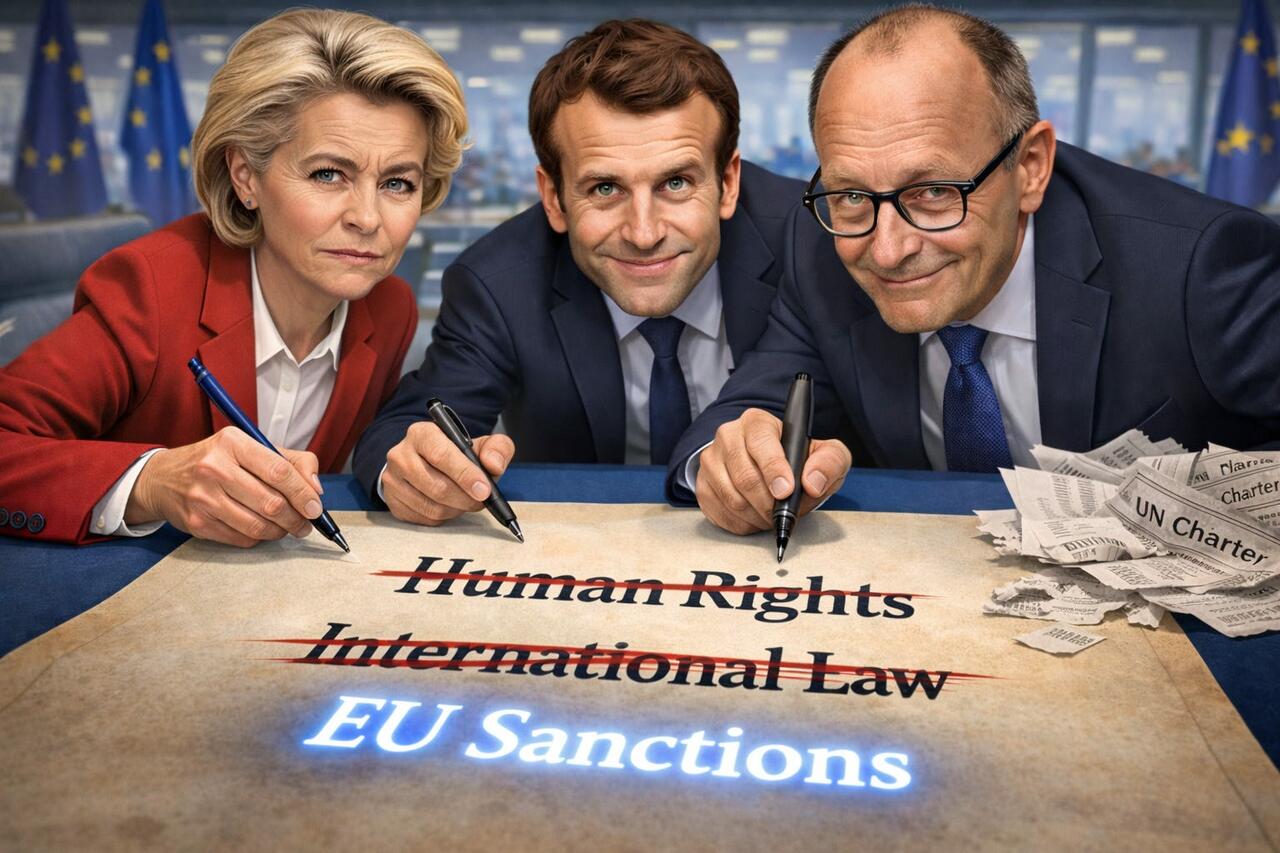
The Two Levels Of EU-Sanctions Illegality

The Two Levels Of EU-Sanctions Illegality

Submitted by Pascal Lottaz

Pascal’s Note: A previous guest on my YouTube Channel, Luis Roberto Zamora Bolaños—the international lawyer who, back in the 2000s, forced his native Costa Rica to withdraw from George W. Bush’s Coalition of the Willing—sent me a short assessment of the legality of EU sanctions. He argues that the Eurocrats are, in fact, grossly overstepping their competencies under international law. Not only are the sanctions in breach of the law between nations, but they are also a heavy infringement on the Human Rights of the targeted people. Here is his verdict.

Unilateral Sanctions against States are Illegal.

Can states do whatever they want within their own borders and jurisdictions? On the one hand, under the Lotus Principle, states (and more generally, subjects of international law) are indeed allowed to act freely as long as they don’t contravene other rules of international law, customary rules, or peremptory norms. Nonetheless, the freedom of action of a subject of international law (IL) is limited by the rights of other States, most notably the principle of sovereignty.

While unilateral acts like sanctions are not explicitly codified in IL, that doesn’t mean they are unrecognized or exempt from scrutiny. The International Court of Justice (ICJ) has dealt with them in several cases, most notably the Nuclear Tests case (also in the UK-NOR Fisheries Case). Moreover, in 2006, the United Nations International Law Commission (ILC) issued its “Guiding Principles applicable to unilateral declarations of States capable of creating legal obligations,” which should be fully applicable to other subjects of international law. Principle 9 establishes that:

No obligation may result for other States from the unilateral declaration of a State. However, the other State or States concerned may incur obligations in relation to such a unilateral declaration to the extent that they clearly accepted such a declaration.

In its commentaries about this principle, the ILC indicated that: “It is well established in international law that obligations cannot be imposed by a State upon another State without its consent.”

The same idea applies to sanctions, which is precisely the reason State consent in the form of jurisdiction acceptance is needed to be subject to a ruling by the ICJ. The UN Charter is less clear about the limits of the United Nations Security Council (UNSC) to impose sanctions. However, it has been widely accepted that the Council has that capacity. The European Union, on the other hand, as a normal subject of international law, shouldn’t have the capacity to create obligations on other subjects of international law.

The issue is further complicated if the sanctions are imposed following a proposal from a member State. Unless the proposing State abstains from voting, the principle of impartiality would be grossly violated.

Additionally, it can be said that the EU, by imposing sanctions against non-member States, would be confiscating functions reserved for international adjudicatory bodies, such as the ICJ or the Permanent Court of Arbitration. It would be highly contradictory, even immoral, if the EU justified its action by pointing to the lack of jurisdiction acceptance by the sanctioned non-member States, since several EU members have not accepted compulsory universal jurisdiction before the ICJ.

Unilateral Sanctions against Individuals are Contrary to International Law

A second level is the human rights question of the people targeted by sanctions. Article 6 of the European Convention for the Protection of Human Rights and Fundamental Freedoms establishes that:

1. In the determination of his civil rights and obligations or of any criminal charge against him, everyone is entitled to a fair and public hearing within a reasonable time by an independent and impartial tribunal established by law.

Although it has been recognized that administrative bodies can impose certain types of sanctions, the right to be heard and to exercise a defense is absolute. No one can be subject to a sanction without an opportunity to exercise a defense or challenge the sanction—before the measures take effect—which doesn’t happen with EU Council sanctions.

Moreover, Article 7 of the European Convention established the principle of nulla pena sine lege previa, meaning that the conduct and its sanction must be clearly established in a law before its imposition. The EU doesn’t have a “criminal code” or anything like that.

Furthermore, EU States (or any State) can create a subject of international law to avoid obligations that they would otherwise bear. This would be fraud on law.

To illustrate with a case, EU member states cannot authorize the EU Council to impose the death penalty, even when the EU itself is not a party to the EU Human Rights regime.

Substantively, depending on the content of the sanctions, they could violate the freedoms of thought and conscience, the right to private property, privacy, movement, and family. It could further be claimed that the conditions imposed by certain sanctions are equivalent to torture.

There is a fundamental distinction to highlight here: between rights and freedoms. Unlike rights, which require positive action by the States for their fulfillment, freedoms demand negative action. States should refrain from intervening in the enjoyment of freedoms unless a lawfully established excess has been committed. Thought and expression are freedoms, not rights, meaning that States (and the EU) should minimize their intervention and limitation, especially sine lege previa.

I think that the issue can be tackled from several fronts. Internationally, in addition to EU internal mechanisms, complaints should be submitted to the High Commissioner on Freedom of Expression and the Committee against Torture. I think this could be a particularly interesting scenario.

Tyler Durden
Wed, 02/04/2026 – 06:30

via ZeroHedge News https://ift.tt/38wXNBQ Tyler Durden

Deploying Troops to U.S. Cities Cost Half a Billion Dollars in 2025


National Guard troops walking scross the street | Illustration: Douliery Olivier/ZUMAPRESS/Newscom

After threatening to invoke the Insurrection Act to put down sometime-violent protests in Minneapolis with military force, President Donald Trump appears to have backed off, standing-down the troops slated for deployment. That’s a win for domestic peace, reducing the chances of worse conflict on city streets than we’ve already seen over the past year. It’s also a boon for taxpayers, given the high price tag—a half-billion dollars to date—that comes with deploying soldiers to patrol American communities.

Military Occupation of American Cities

In response to vigorous resistance to the Trump administration’s often-brutal immigration enforcement, the federal government several times deployed National Guard and active-duty military personnel to American cities. In the name of suppressing crime (in the nation’s capital) and protecting federal personnel and property, the president sent or attempted to send troops to Democrat-led cities including Chicago, Los Angeles, Memphis, Portland, Oregon, and Washington, D.C. The deployments look as much like schemes to humiliate the president’s political opponents as they resemble enforcement of federal policy.

Judicial responses to the deployments have been mixed, though leaning toward deep skepticism. A federal judge ruled that use of the National Guard and Marines in Los Angeles violated the Posse Comitatus Act, which restricts domestic use of the military. The U.S. Supreme Court blocked military deployments to Chicago, also with reference to the limited permissible use of the military. Now, with tensions rising, the White House looks to be pausing its efforts to militarize immigration enforcement.

Given the conflict we’ve already seen related to immigration enforcement, including the shooting deaths of Renee Good and Alex Pretti by federal agents, that’s a relief to those of us hoping to avoid worse social unrest and to avert—or at least delay—what appears to be a looming national cataclysm. But at a time of rising federal deficits and debt and semi-serious attempts to slash government expenditures, stepping back from sending troops into the streets could also save money.

Deployments Come With a High Price Tag

“Since June 2025, the Administration has deployed National Guard personnel or active-duty Marine Corps personnel to six U.S. cities: Los Angeles, California; Washington, D.C.; Memphis, Tennessee; Portland, Oregon; Chicago, Illinois; and New Orleans, Louisiana,” the Congressional Budget Office (CBO) responded to a query from Sen. Jeff Merkley (D–Ore.). “The Administration has also kept 200 National Guard personnel mobilized in Texas after they left Chicago. CBO estimates that those deployments (excluding the one to New Orleans, which occurred at the end of the year) cost a total of approximately $496 million through the end of December 2025.”

The CBO analysis makes clear that calculating future costs is a bit speculative because of variables that are unknowable ahead of time. These include the size of potential troop deployments, duration of their stay, and expenses that might be greater or lesser depending on locations where troops could be sent. Also, legal challenges to the domestic use of the military might raise costs or lower them. That said, the CBO can look to costs incurred in 2025 and extrapolate to similar situations going forward.

The High Cost of Future Occupations

“The factors CBO used to estimate the costs of deployments in 2025 suggest that continuing the ongoing deployments at their size as of the end of 2025 would cost $93 million per month,” the report noted. “More generally, deploying 1,000 National Guard personnel to a U.S. city in 2026 would cost $18 million to $21 million per month, depending mainly on the city’s cost of living.”

To arrive at its figures, the CBO looked at the cost of transporting, feeding, and lodging troops while they’re deployed. In the case of National Guard troops the costs are particularly high because they are added to the federal payroll, while active-duty personnel are already being paid.

“When National Guard members are called to federal service, they are compensated at the same rate as personnel in the military’s active component,” the report explained. “Using DoD’s 2025 budget documentation, CBO estimates that the increase in military personnel costs associated with activating National Guard troops—that is, the average increase in costs when changing Guard personnel from nonmobilized to mobilized status—is approximately $95,000 per person per year, or $260 per person per day.”

Those costs aren’t just a matter of pay; they also reflect the expense of benefits for Guard personnel and their dependents—healthcare, in particular—with such costs put at $9,100 per person per year, or $25 per person per day. Mobilizations, as the CBO points out, typically last longer than actual deployments. Each day Guard troops spend on duty brings them closer to qualifying for Veterans Administration benefits including education and disability (if they’re injured while in uniform).

These costs add up. While the CBO puts the costs of new urban deployments between $18 million and $21 million per month in each city, maintaining the nearly 3,000 troops currently deployed to pricey Washington, D.C. comes in at $55 million a month.

Additional Costs to Life, Liberty, and Political Culture

Basically, maintaining a domestic security force to enforce locally unpopular policies and to intimidate political enemies is really expensive. It’s an expense that raises tensions in a country already simmering with partisan hatreds, in which people openly discuss “national divorce” and don’t debate whether America’s near-term political future will be violent, but just how violent.

It shouldn’t be forgotten that deploying military troops to patrol our own communities is expensive in terms of life and liberty, foremost. The lives lost—in Minneapolis and elsewhere—to conflict between the public and federal agents underline that point. And imposing something akin to martial law inherently makes a place and its residents less free than they are in the absence of such an occupation. That can only be justified in the most extreme circumstances, when order has been lost—a point hard to argue when it’s the government and its agents who threaten order.

But at a time of a bloated federal government that spends wildly beyond its means, with the national debt at over $38 trillion and rising, it’s important to emphasize that military occupation of our own cities is very expensive. We can’t afford the government we have. Letting that government deploy troops to the streets is an unnecessary and unacceptable additional burden.

The post Deploying Troops to U.S. Cities Cost Half a Billion Dollars in 2025 appeared first on Reason.com.

from Latest – Reason.com https://ift.tt/Fj8hIEi
via IFTTT