This week, editors Peter Suderman, Katherine Mangu-Ward, Nick Gillespie, and Matt Welch discuss the political fallout from a shocking Texas special election,in which a Democrat flipped a district that President Donald Trump had won by 17 points in 2024, amid growing backlash to Immigration and Customs Enforcement (ICE) tactics and hardline immigration enforcement. They discuss what the result says about independent voters, the unraveling of the GOP’s 2024 coalition, and why immigration politics now appear to be driving everything from a partial government shutdown to open conflict within the Republican Party over Department of Homeland Security (DHS) funding and White House Deputy Chief of Staff Stephen Miller’s influence in the administration.
The conversation then turns to Trump’s decision to tap Kevin Warsh to lead the Federal Reserve and what his record suggests about central bank independence. The editors also scrutinize the administration’s broader economic messaging, including Trump’s Wall Street Journal op-ed defending his tariff policy and claims that inflation has been brought under control, and how those arguments hold up against the data. They then touch on former CNN journalist Don Lemon’s arrest and the White House response before turning to a listener question about whether the rhetoric coming out of AI companies points toward a libertarian utopia or a threat to liberty itself. Finally, the editors discuss Moltbook, an emerging platform built around AI systems meant to govern themselves, and why it’s stirring so much debate.
0:00—Democrats win special election in Texas
08:30—Partial government shutdown over DHS funding
“My fellow Americans, ask not what your country can do for you. Ask instead what your country has been doing to you and is likely to keep doing to you for as long as it can buy with fiat money the votes of a majority.”
Gary North’s article focuses mostly on Woodrow Wilson’s influence on the inaugural addresses of Eisenhower and Kennedy and their meaning in the world of 2008. As he observed, we have had “one long war since 1917,” with Fed fiat money playing an indispensable supporting role.
Everything the government does costs money, and it produces nothing with which to acquire it. For 2025, it coerced a total of $5.4 trillion from taxpayers and dollar-holders but ended up spending $7 trillion, producing a “rolling” deficit of $1.7 trillion. The biggest fights have always been over whose ox gets gored to fund it. Almost no one wonders whether government as it stands should exist at all.
When Wilson decided to impose democracy on the world, he had the backing of two newly-created theft mechanisms that he signed into law in 1913: The income tax and the central bank. The first extracts wealth directly from those who own it; the second takes it surreptitiously, which, as Copernicus wrote in 1526,
…is noticed by only a few very thoughtful people, since it does not operate all at once and at a single blow, but gradually overthrows governments, and in a hidden, insidious way.
There is no subtler, no surer means of overturning the existing basis of society than to debauch the currency. The process engages all the hidden forces of economic law on the side of destruction, and does it in a manner which not one man in a million is able to diagnose.
Americans like to think of themselves as sharp, incapable of being hoodwinked.
If they get scammed a second time they blame themselves for not seeing it—“Fool me twice, shame on me.”
But most of them have missed the biggest scam of all: The Federal Reserve System.
Of the various reasons for missing it, the biggest one is the conviction that market economies are vulnerable to harmful forces that only the state and its central bank can avoid. Experts on the Great Depression such as former Fed Chair Ben Bernanke build their arguments on the grounds that markets sometimes violate the fundamental law of trade—production buys production (sometimes known as Say’s Law)—and need supervision and intervention to avoid this problem.
When the roof began to fall in August 1929, they were at a loss as to which intervention to pursue. They could’ve referred to the Depression of 1921 for guidance when the government watched as the Fed tightened then eased. As one economist explained, “During this period, there was nothing remotely like a fiscal stimulus package, a TARP program, or even a QE policy designed to prevent economic collapse.” Deflation—seen as the villain in the 1930s Depression—cured the earlier slump because prices had been inflated.
Most people who study economics at state-funded universities treat the Fed as a necessary institution, not a scam. Their acquired expertise will include the view that the Fed’s Federal Open Market Committee (FOMC) has undertaken the formidable task of determining interest rates that best promotes full employment and low inflation. The Fed has a superhuman challenge and if it sometimes fails to please everyone, who could do better?
But it goes deeper. According to a FAQ section posted by the Kansas City Fed, “The Fed has long viewed transparency as a fundamental principle of central banking that supports accountability.” If Fed operations are transparent, most people are blind. The Fed’s operations are largely a mystery to most people. And this is to its advantage.
How the Fed Conducts Its Mission
It is commonly said the Fed prints money when it targets a lower Federal Funds Rate. While this is true, it shrouds all the plumbing that makes it happen.
The Federal Funds Rate is “the interest commercial banks charge when they lend money to one another for extremely short-term periods—literally, overnight.” It influences other rates such as rates for mortgages, loans, credit cards, and savings.
The FOMC meets at least eight times a year to decide what to do about the current Federal Funds Rate. Their discussions are augmented by the Beige Book report of conditions in the 12 Reserve districts. Lowering the rate means the Fed will print more money (in its convoluted manner) to get the consumer price increases it wants. If it decides that prices are running too high, it will pull money out of the economy by selling some of its securities. This is how it attempts to lower or raise the Federal Funds Rate.
Influencing the Federal Funds Rate is “the interest the Fed pays on the funds that banks hold as reserve balances at their Federal Reserve Bank, which is the Interest on Reserves Balances (IORB) rate.” If banks make more keeping their reserves than lending them to other banks, the reason is likely a high IORB. Both the Federal Funds Rate and the IORB rate are considered important tools for manipulating market prices.
Actual market prices sometimes defy Fed intentions to raise them, as seen by the Moore’s Law effects on computer technology. Fortunately for consumers, innovation can outpace monetary debasement in specific sectors.
The Arsonist is Seen as a Firefighter
The Fed sets as a target a 2 percent inflation rate. It defines inflation as “the rate at which the price of goods and services increases over time.” In other words, its job is to increase prices. Price increases, not the Fed actions that increase them, are the measure of inflation. And while many judge the results by the Consumer Price Index (CPI), the Fed relies on the Personal Consumption Index (PCI), presumably because it covers more consumer spending than the CPI.
In conducting monetary policy, we will remain highly focused on fostering as strong a labor market as possible for the benefit of all Americans. And we will steadfastly seek to achieve a 2 percent inflation rate over time.
It is pursuing, in other words, a steady 2 percent depreciation in the purchasing power of the dollar. The Fed has been exceptional in this regard: Since my daughters were born in 1982, consumer prices have risen roughly 235 percent. Its policy bias pushes people to spend rather than save, even if it means they go into debt. Savers get punished, as do people living on fixed incomes. Since savings are the pool from which investment draws, entrepreneurs are punished too. Yet investment is the springboard of rising productivity and higher living standards. It sounds like a predatory computer game but it’s Fed policy.
Inflation provides the wealth transfer. The interest-rate juggling is how it’s accomplished.
What was once a word that described a monetary cause now describes a price outcome. This shift in meaning has complicated the position of anti-inflation advocates. As a condition of the money stock, an inflating currency has but one origin—the central bank—and one solution—a less expansive money growth rate. But as a condition of the price level, which may have originated from a variety of things (including a depreciating dollar, rising labor costs, bad weather, or a number of factors other than “too much money”), the solution to—and the prudence of— eliminating inflation is much less clear.
Confusion accelerated after the publication of Keynes’s General Theory in 1936:
In addition to separating the price level from the money stock, the Keynesian revolution in economics appears to have separated the word inflation from a condition of money and redefined it as a description of prices. In this way, inflation became synonymous with any price increase.
The Fed thus escapes the public’s scrutiny when prices rise.
Fiat money is a politician’s best friend because it creates an invisible tax through the institutionalized depreciation of currency. We shouldn’t expect them to part with it—especially as their perpetual interest in war demands ever greater funding.
“All In” On AI: Deutsche Bank Says Tesla No Longer Just A Car Company
Deutsche Bank’s latest note argues that Tesla Inc. is no longer mainly a car company, but a long-term bet on artificial intelligence, robotics, and autonomy. In the report, Edison Yu and his team of analysts at Deutsche say that after Tesla’s latest earnings, any doubt about its direction is gone, describing the company as now “all in on Physical AI.”
The clearest sign of that shift is spending. Tesla plans to more than double capital expenditures, potentially topping $20 billion, with most of the money going toward AI training systems, data centers, custom chips, robotics factories, and new platforms. The analysts estimate that billions will be poured into computing alone, as Tesla builds the infrastructure needed to train self-driving and robot systems at scale. Management, they note, is aiming to “structurally disrupt labor intensive services” through vertical integration.
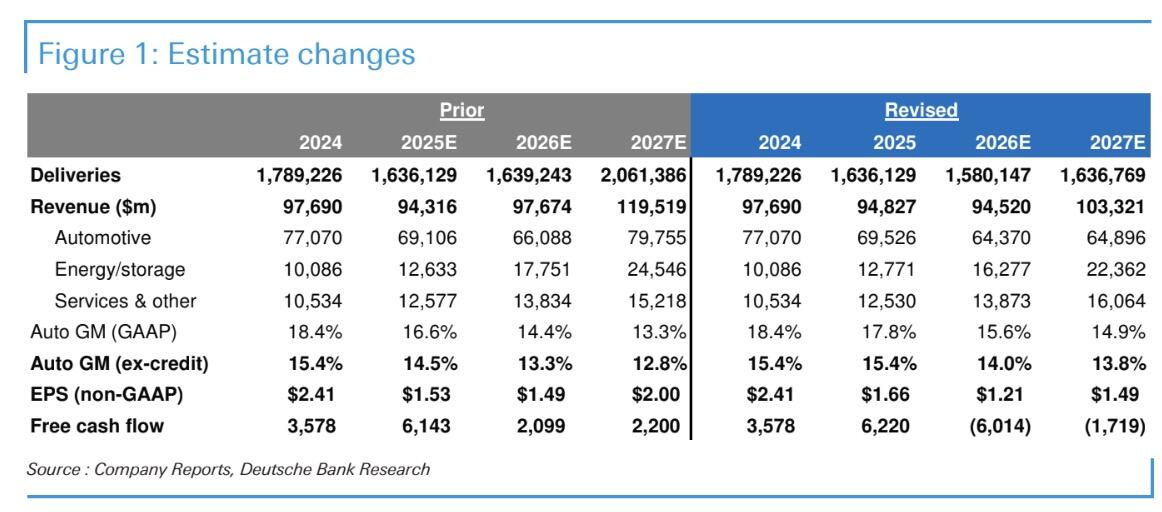
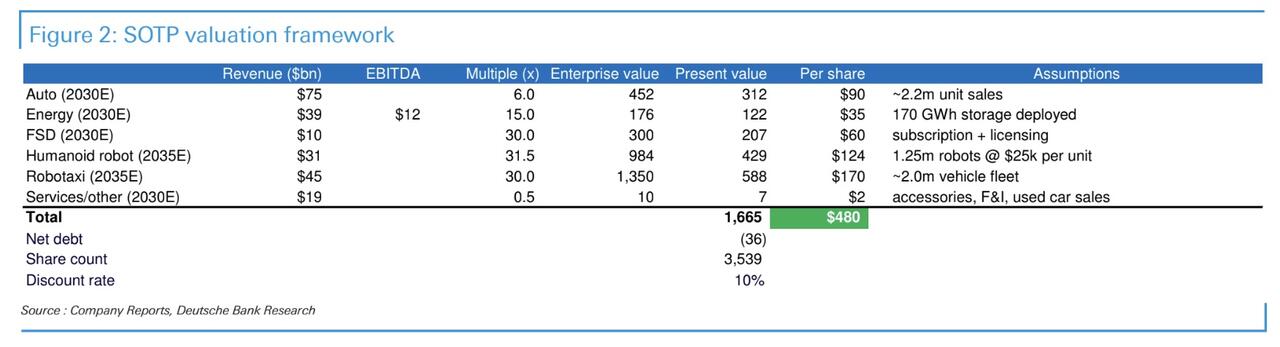
Autonomy and robotics now sit at the center of Deutsche’s long-term outlook. The firm highlights Tesla’s 1.1 million Full Self-Driving subscribers and sees FSD eventually generating up to $10 billion in annual revenue. It also expects the robotaxi network to grow to hundreds of thousands of vehicles by the end of the decade, producing more than $15 billion a year.
On Optimus, Tesla’s humanoid robot, the analysts are optimistic but realistic, warning that complex engineering, new supply chains, and slow early production will limit volumes in the near term.
Despite its bullish view on AI, Deutsche slightly trimmed its numbers. It cut earnings and revenue forecasts and lowered its price target from $500 to $480, while keeping a Buy rating. The reduction reflects more conservative assumptions on vehicle sales and slower model rollouts, along with a revised valuation that separates FSD, robotaxis, and robotics into distinct businesses.
Most of Tesla’s long-term value, in their model, now comes from software, autonomy, and robots rather than car sales.
The note also flags risks, including weaker EV demand, intense competition, high execution hurdles in AI and robotics, regulatory scrutiny, and Tesla’s dependence on Elon Musk. Still, Deutsche argues that Tesla’s scale, data advantage, and vertical integration give it a strong chance to win if its strategy works.
Overall, the report frames Tesla as a company in the middle of a major transformation. Short-term forecasts have been trimmed, but Deutsche believes the real story is Tesla’s push to become a leader in AI-powered mobility and automation, with the potential to reshape multiple industries over the next decade.
The decline of American mainstream media has long been obvious, with public trust and revenues plunging. Some companies are responding with the novel idea of restoring objectivity and neutrality to coverage. For years, news organizations have essentially written off half of the country.
However, as news organizations struggle to avoid even greater layoffs, staffers are fighting efforts to bring balance to their networks. That was evident last week in meetings at CNN and CBS where staffers continue to fight to retain their bias rather than their jobs.
CNN has long aired controversial hosts and guests who engaged in controversial statements on race and politics from the left. However, a meeting last week focused on the airing of one of the few conservatives who regularly appear on the network. As one staff member reportedly raised, there was outrage that Jennings is “allowed to exist” on the network. Even as CNN continues to languish in ratings, staffers want to fire one of the few remaining conservative voices on the network.
One of the key issues raised in the meeting was Jennings referring to “illegal aliens.” While CNN bars the term, it is used in federal law and federal cases, including by the United States Supreme Court.
In one exchange on Jan. 19, Jennings trades barbs with fellow panelist Cameron Kasky, a survivor of the 2018 Parkland school shooting. Kasky criticized Jennings for saying that ICE should be allowed to “chase down illegals” in Minnesota.
Jennings pushed back: “Who are you to tell me what I can and can’t say? I’ve never met you, brother. I can say whatever I want. They’re illegal aliens. And that’s what the law calls them. Illegal aliens. That’s what I’m going to call them.”
Staff members reportedly denounced him as a “MAGA mouthpiece” and a “firebrand Trump loyalist” who “frequently gets into verbal spats with other CNN guests.”
It is a curious objection since these panels are supposed to be lively contrasts between guests.
The meeting is reminiscent of the effort at the Washington Post to get staffers to recognize the company’s declining position.
Robert Lewis, a British media executive who joined the Post earlier this year, reportedly got into a “heated exchange” with a staffer. Lewis explained that, while reporters were protesting measures to expand readership, the very survival of the paper was now at stake:
“We are going to turn this thing around, but let’s not sugarcoat it. It needs turning around. We are losing large amounts of money. Your audience has halved in recent years. People are not reading your stuff. Right. I can’t sugarcoat it anymore.”
The response from staffers was to call for the new editors to be fired.
One staffer complained, “We now have four White men running three newsrooms.”
The Post has been buying out staff to avoid mass layoffs, but reporters were up in arms over the effort to turn the newspaper around.
The same dynamic is playing out at CBS, where Bari Weiss was brought in to turn around the network.
Weiss has been the subject of anonymous attacks since the company brought her in to reverse the decline in ratings. Like Lewis, Weiss tried to explain that the staff is “not producing a product that enough people want” and that something has to change.
According to reports, Weiss was direct and candid with the staff. She stated:
“I need to start by acknowledging that there’s been a lot of noise around me taking this job. … I get it. I also get why, in the face of all this tumult, you might feel uncertain or skeptical about me or what I’m aiming to do here. I’m not going to stand up here today and ask you for your trust. I’m going to earn it, just like we have to do with our viewers.”
However, she was also clear that returning to past practices is not one of the options:
“So, here it is as plain as I can say it: I am here to make CBS News fit for purpose in the 21st century. Our industry has changed more in the last decade than in the last 150 years and the transformation isn’t over yet. Far from it. It’s almost impossible to conceive of how fast things will move from here…Back then, 30 million people watched Walter Cronkite every night. Some were on the left, some were on the right. But they trusted him. Through Cronkite, they inhabited a shared world with shared facts and a shared sense of reality. We can’t reverse time’s arrow. He had two competitors. We have two billion, give or take.”
She then made the same point as Lewis with a brutally honest and brilliantly blunt assessment:
“What we can do is what journalists do best: look at the world as it actually is. We have to start by looking honestly at ourselves. We are not producing a product that enough people want.”
Bravo.
Weiss concluded with this powerful line:
“I realize that none of these ideas are revolutionary on their own. What’s different now is that the stakes are so very high. And the hour is late. And we are in a position, with the support of all of the leadership of this company, to really make the change we need.”
Any rational person would hear these words and understand that Weiss is struggling to protect these staffers from themselves; struggling to keep their jobs. Instead, the response has been glacial from journalists, who believe they should be able to continue covering stories for one another and for an ever-shrinking audience on the left.
The fact is that we need CNN and CBS. The Framers understood the importance of an independent press. These companies helped revolutionize media and could be restored if the staff stopped obstructing reform efforts.
Instead, staff members continue to furiously saw at the branch upon which they sit.
Federal district court Judge Katherine Menendez issued a ruling Saturday denying a motion for a preliminary injunction blocking the deployment of thousands of ICE and other federal agents to the Twin Cities.
Minnesota and the cities of Minneapolis and St. Paul filed an important lawsuit on January 12 arguing that Operation Metro Surge, as the Trump administration refers to the mass federal deployment, violates the 10th Amendment. They argue that the administration is using the deployment to try to coerce them into giving up their “sanctuary” laws, which restrict state and local assistance to federal immigration enforcement. They also say the administration’s actions have disrupted state and local government functions, including the state constitutional guarantee to education and the ability of state and local law enforcement to address crime and protect Minnesotans’ safety — which is “one of the most basic rights reserved to the States and their municipalities” in our federalist system.
Preliminary rulings like the one that came down this weekend often presage the court’s decision on the merits. But, unusually, the judge emphasized that her decision doesn’t necessarily foreshadow a final ruling for the federal government, and that it is instead based on her uncertainty about some key issues. The ultimate outcome of the case remains unclear, especially since any decision reached by the district court will almost certainly be appealed. But the suit deserves to prevail; a contrary decision would set a dangerous precedent.
What is the 10th Amendment?
The 10th Amendment states that “powers not delegated to the United States by the Constitution, nor prohibited by it to the States, are reserved to the States respectively, or to the people.” In Federalist 28, Alexander Hamilton assured readers that: “It may safely be received as an axiom in our political system, that the State governments will, in all possible contingencies, afford complete security against invasions of the public liberty by the national authority.” He emphasized that they can use their control of “the organs of the civil power” to “adopt a regular plan of opposition.” Minnesota’s resistance to oppressive — and, likely, illegal — federal policies is an example of such “opposition,” and the 10th Amendment protects the state and its local governments against federal usurpation of their authority over their own employees and resources.
A series of Supreme Court decisions primarily supported by conservative justices, such as New York v. United States (1992), Printz v. United States (1997), and Murphy v. NCAA (2018), hold that the federal government cannot “commandeer” state and local officials to do the federal government’s bidding or to help enforce federal laws. And in multiple decisions during the first Trump administration and continuing in the second, numerous lower federal courts ruled that the president could not order states to aid in immigration enforcement actions and could not withhold federal funds from sanctuary jurisdictions where doing so would be coercive or where Congress had not authorized immigration-related grants.
Control over state and local government personnel is one of the powers reserved to the states by the 10th Amendment and is a central element of state autonomy and sovereignty. If the federal government could coerce states into giving up that control, it could essentially neuter and render them almost totally subservient to the federal government.
Evidence described in the plaintiffs’ filings and Menendez’s decision extensively documents what appears to be the federal government’s main motive for launching Operation Metro Surge: to pressure Minnesota’s state and local governments into giving up their sanctuary policies. I highlighted additional evidence in a recent Lawfare article about this case, such as statements by Trump “border czar” Tom Homan last week that the administration would scale back the crackdown if state and local officials cooperated and provided greater access to jails.
An “Unprecedented” Case
As Menendez noted in her opinion, the current case isn’t precisely analogous to previous court decisions on commandeering and federal coercion of states, and raises “unprecedented” issues. The earlier precedents largely dealt with either congressional laws directly imposing coercion or the withholding of federal funds from state and local governments. It is also true that many federal policies and law enforcement efforts can indirectly burden states in various ways and that the federal government often has the option of increasing enforcement efforts in states that refuse to help. Legal scholar Jonathan Adler emphasizes these points in his defense of the government’s position in the case.
But, in this case, the “enforcement” effort has been undertaken for the specific, openly avowed purpose of punishing and coercing the states, not merely increasing enforcement to make up for its limitations on cooperation. In addition, the fact that many of the federal actions — including violations of First Amendment rights, illegal detentions, warrantless searches, and unjustified killing of protestors — are independently illegal also makes them coercive, in much the same way that a Mafia boss threatening to break your legs is coercive while threatening something he has a legal right to do is not. This illegality means private parties can bring lawsuits on other grounds, as some have. But it also bolsters a Tenth Amendment suit by states and localities. And the latter can be more effective for reasons I noted in my earlier Lawfare article.
Furthermore, as the Minnesota lawsuit documents, many of the federal actions here directly disrupt state and local government functions, such as public schools, emergency services, and local police. For example, federal raids and the threat of additional ones have forced many schools to close, preventing state and local officials from meeting their state constitutional obligations to provide an education, the state and cities say. That creates direct coercion of the states for purposes of commandeering, and is different from cases where federal enforcement efforts merely have an incidental impact on the states.
Even Otherwise Lawful Actions Can Be Coercive
Even otherwise legal federal actions become coercive if done on a large enough scale for the purpose of pressuring states. For example, Spending Clause coercion cases such as NFIB v. Sebelius (2012) — the famous Obamacare case — hold that conditioning a large enough amount of federal grants on state cooperation with a federal program qualifies as coercion, even though Congress generally has broad discretion to impose conditions on federal grants to states and local governments. Sending 3,000 armed federal officers to harass the public and disrupt state and local government functions is at least comparably coercive to threatening to withhold a large amount of grant money.
Chief Justice John Roberts famously described the grant condition struck down in NFIB as a metaphorical “gun to the head.” Several lower court cases addressing attempted denial of federal funds to sanctuary cities reached similar conclusions. Operation Metro Surge is pretty close to a literal gun to the head, featuring coercion by actual armed agents with guns.
As I explained in my earlier Lawfare article, similar violence could be used to coerce states on a wide range of policy issues. The most obvious example is that of conservative “gun sanctuary” states, which limit cooperation with federal enforcement of gun control laws. If the federal government sent thousands of agents to harass gun owners and disrupt local government operations in order to coerce gun sanctuary jurisdictions into helping the feds, that would surely violate the 10th Amendment. If courts allow such coercion-by-violence, there would not be much left the anticommandeering rule or any other constitutional protection for state autonomy.
While NFIB and other conditional-grant cases dealt with Spending Clause issues, similar reasoning applies here. In both cases, federal government action, even if otherwise legal, becomes unconstitutional if it seeks to coercively usurp state government control over their own resources and personnel. Indeed, the 10th Amendment — a provision explicitly protecting state autonomy — is a more logical basis for restricting such coercion than the Spending Clause.
Menendez decided not to grant a preliminary injunction in part because the “unprecedented” nature of the situation weighs against doing so and in favor of waiting for a full resolution on the merits. Such hesitation is understandable. But it is important to remember that the situation is unprecedented in large part because coercion by armed paramilitary agents is actually more blatant and egregious than the type of commandeering addressed in previous cases.
Judge Menendez’s Uncertainty
In addition, Menendez held back because of uncertainty over two other issues. First, though she recognized there was extensive evidence that the Trump administration’s motive was to commandeer state resources for immigration enforcement, she suggested other evidence indicated there may be other motives, such as increasing enforcement of the law and combatting welfare fraud.
There has indeed been considerable welfare fraud in Minnesota, some of it committed by Somali immigrants. But there is no reason to think the deployment of thousands of armed federal agents can somehow curb welfare fraud, which requires investigation by accountants and other experts, not armed men in the streets. Similarly, as I have noted previously, it is implausible to think that such a massive effort is needed for enforcement of immigration laws, given that Minnesota has a much lower percentage of illegal migrants in its population than national average. And an administration genuinely interested in politically neutral law enforcement would itself not be engaging in widespread, brazen violations of the law in the process of “enforcement.” Ultimately, the evidence overwhelmingly indicates that there would be no such massive federal operation in Minnesota absent a desire to engage in commandeering.
Second, Menendez worried there was no clear basis for determining exactly where to draw the line between legitimate federal law-enforcement efforts and unconstitutional coercion:
Quantitatively, Plaintiffs cannot point to what number of federal officers would demonstrate a de facto Tenth Amendment anticommandeering violation. Qualitatively, there is no clear way for the Court to determine at what point Defendants’ alleged unlawful actions (e.g., racial profiling, excessive force, deployment of chemical irritants, wearing face coverings, switching license plates, overusing city parking lots, among others) becomes so problematic that they amount to unconstitutional coercion and an infringement on Minnesota’s state sovereignty.
It may indeed be impossible to draw a precise numerical line. Commandeering and coercion are among the many legal doctrines that take the form of standards, rather than bright-line rules. Other examples include the Fourth Amendment’s ban on unreasonable searches and seizures and the First Amendment’s protection for freedom of speech, which does not draw a clear line between protected pure speech and unprotected speech closely linked to illegal conduct. Despite line-drawing difficulties, courts routinely enforce these doctrines.
Considerable precision is possible here, even if it cannot be absolutely perfect. Courts can and should enjoin federal operations — regardless of scale — that would not have been undertaken but for an unconstitutional motive related to coercion and commandeering. That seems clearly true of Operation Metro Surge. The line becomes even easier to draw when the operations in question also feature apparently extensive illegal actions by federal agents. As already noted, such illegality magnifies the coercion in question.
As Menendez noted, the plaintiffs “made a strong showing that Operation Metro Surge has had, and will likely continue to have, profound and even heartbreaking, consequences on the State of Minnesota, the Twin Cities, and Minnesotans. Since Operation Metro Surge began, there have been multiple shootings of Minnesota residents by federal immigration enforcement agents.” In the last few weeks, federal agents killed two Minneapolis residents, Renee Good and Alexander Pretti, and shot another in the leg. The judge added that there was evidence that federal agents “have engaged in racial profiling, excessive use of force, and other harmful actions,” and that the administration had done “nothing to refute the negative impacts described by Plaintiffs in almost every arena of daily life, from the expenditure of vast resources in police overtime to a plummeting of students’ attendance in schools, from a delay in responding to emergency calls to extreme hardship for small businesses.”
When such things are done for the avowed purpose of coercing state and local governments, we have a violation of the 10th Amendment. Menendez should so rule when she decides the case on the merits, and appellate courts should uphold any such decision.
Federal district court Judge Katherine Menendez issued a ruling Saturday denying a motion for a preliminary injunction blocking the deployment of thousands of ICE and other federal agents to the Twin Cities.
Minnesota and the cities of Minneapolis and St. Paul filed an important lawsuit on January 12 arguing that Operation Metro Surge, as the Trump administration refers to the mass federal deployment, violates the 10th Amendment. They argue that the administration is using the deployment to try to coerce them into giving up their “sanctuary” laws, which restrict state and local assistance to federal immigration enforcement. They also say the administration’s actions have disrupted state and local government functions, including the state constitutional guarantee to education and the ability of state and local law enforcement to address crime and protect Minnesotans’ safety — which is “one of the most basic rights reserved to the States and their municipalities” in our federalist system.
Preliminary rulings like the one that came down this weekend often presage the court’s decision on the merits. But, unusually, the judge emphasized that her decision doesn’t necessarily foreshadow a final ruling for the federal government, and that it is instead based on her uncertainty about some key issues. The ultimate outcome of the case remains unclear, especially since any decision reached by the district court will almost certainly be appealed. But the suit deserves to prevail; a contrary decision would set a dangerous precedent.
What is the 10th Amendment?
The 10th Amendment states that “powers not delegated to the United States by the Constitution, nor prohibited by it to the States, are reserved to the States respectively, or to the people.” In Federalist 28, Alexander Hamilton assured readers that: “It may safely be received as an axiom in our political system, that the State governments will, in all possible contingencies, afford complete security against invasions of the public liberty by the national authority.” He emphasized that they can use their control of “the organs of the civil power” to “adopt a regular plan of opposition.” Minnesota’s resistance to oppressive — and, likely, illegal — federal policies is an example of such “opposition,” and the 10th Amendment protects the state and its local governments against federal usurpation of their authority over their own employees and resources.
A series of Supreme Court decisions primarily supported by conservative justices, such as New York v. United States (1992), Printz v. United States (1997), and Murphy v. NCAA (2018), hold that the federal government cannot “commandeer” state and local officials to do the federal government’s bidding or to help enforce federal laws. And in multiple decisions during the first Trump administration and continuing in the second, numerous lower federal courts ruled that the president could not order states to aid in immigration enforcement actions and could not withhold federal funds from sanctuary jurisdictions where doing so would be coercive or where Congress had not authorized immigration-related grants.
Control over state and local government personnel is one of the powers reserved to the states by the 10th Amendment and is a central element of state autonomy and sovereignty. If the federal government could coerce states into giving up that control, it could essentially neuter and render them almost totally subservient to the federal government.
Evidence described in the plaintiffs’ filings and Menendez’s decision extensively documents what appears to be the federal government’s main motive for launching Operation Metro Surge: to pressure Minnesota’s state and local governments into giving up their sanctuary policies. I highlighted additional evidence in a recent Lawfare article about this case, such as statements by Trump “border czar” Tom Homan last week that the administration would scale back the crackdown if state and local officials cooperated and provided greater access to jails.
An “Unprecedented” Case
As Menendez noted in her opinion, the current case isn’t precisely analogous to previous court decisions on commandeering and federal coercion of states, and raises “unprecedented” issues. The earlier precedents largely dealt with either congressional laws directly imposing coercion or the withholding of federal funds from state and local governments. It is also true that many federal policies and law enforcement efforts can indirectly burden states in various ways and that the federal government often has the option of increasing enforcement efforts in states that refuse to help. Legal scholar Jonathan Adler emphasizes these points in his defense of the government’s position in the case.
But, in this case, the “enforcement” effort has been undertaken for the specific, openly avowed purpose of punishing and coercing the states, not merely increasing enforcement to make up for its limitations on cooperation. In addition, the fact that many of the federal actions — including violations of First Amendment rights, illegal detentions, warrantless searches, and unjustified killing of protestors — are independently illegal also makes them coercive, in much the same way that a Mafia boss threatening to break your legs is coercive while threatening something he has a legal right to do is not. This illegality means private parties can bring lawsuits on other grounds, as some have. But it also bolsters a Tenth Amendment suit by states and localities. And the latter can be more effective for reasons I noted in my earlier Lawfare article.
Furthermore, as the Minnesota lawsuit documents, many of the federal actions here directly disrupt state and local government functions, such as public schools, emergency services, and local police. For example, federal raids and the threat of additional ones have forced many schools to close, preventing state and local officials from meeting their state constitutional obligations to provide an education, the state and cities say. That creates direct coercion of the states for purposes of commandeering, and is different from cases where federal enforcement efforts merely have an incidental impact on the states.
Even Otherwise Lawful Actions Can Be Coercive
Even otherwise legal federal actions become coercive if done on a large enough scale for the purpose of pressuring states. For example, Spending Clause coercion cases such as NFIB v. Sebelius (2012) — the famous Obamacare case — hold that conditioning a large enough amount of federal grants on state cooperation with a federal program qualifies as coercion, even though Congress generally has broad discretion to impose conditions on federal grants to states and local governments. Sending 3,000 armed federal officers to harass the public and disrupt state and local government functions is at least comparably coercive to threatening to withhold a large amount of grant money.
Chief Justice John Roberts famously described the grant condition struck down in NFIB as a metaphorical “gun to the head.” Several lower court cases addressing attempted denial of federal funds to sanctuary cities reached similar conclusions. Operation Metro Surge is pretty close to a literal gun to the head, featuring coercion by actual armed agents with guns.
As I explained in my earlier Lawfare article, similar violence could be used to coerce states on a wide range of policy issues. The most obvious example is that of conservative “gun sanctuary” states, which limit cooperation with federal enforcement of gun control laws. If the federal government sent thousands of agents to harass gun owners and disrupt local government operations in order to coerce gun sanctuary jurisdictions into helping the feds, that would surely violate the 10th Amendment. If courts allow such coercion-by-violence, there would not be much left the anticommandeering rule or any other constitutional protection for state autonomy.
While NFIB and other conditional-grant cases dealt with Spending Clause issues, similar reasoning applies here. In both cases, federal government action, even if otherwise legal, becomes unconstitutional if it seeks to coercively usurp state government control over their own resources and personnel. Indeed, the 10th Amendment — a provision explicitly protecting state autonomy — is a more logical basis for restricting such coercion than the Spending Clause.
Menendez decided not to grant a preliminary injunction in part because the “unprecedented” nature of the situation weighs against doing so and in favor of waiting for a full resolution on the merits. Such hesitation is understandable. But it is important to remember that the situation is unprecedented in large part because coercion by armed paramilitary agents is actually more blatant and egregious than the type of commandeering addressed in previous cases.
Judge Menendez’s Uncertainty
In addition, Menendez held back because of uncertainty over two other issues. First, though she recognized there was extensive evidence that the Trump administration’s motive was to commandeer state resources for immigration enforcement, she suggested other evidence indicated there may be other motives, such as increasing enforcement of the law and combatting welfare fraud.
There has indeed been considerable welfare fraud in Minnesota, some of it committed by Somali immigrants. But there is no reason to think the deployment of thousands of armed federal agents can somehow curb welfare fraud, which requires investigation by accountants and other experts, not armed men in the streets. Similarly, as I have noted previously, it is implausible to think that such a massive effort is needed for enforcement of immigration laws, given that Minnesota has a much lower percentage of illegal migrants in its population than national average. And an administration genuinely interested in politically neutral law enforcement would itself not be engaging in widespread, brazen violations of the law in the process of “enforcement.” Ultimately, the evidence overwhelmingly indicates that there would be no such massive federal operation in Minnesota absent a desire to engage in commandeering.
Second, Menendez worried there was no clear basis for determining exactly where to draw the line between legitimate federal law-enforcement efforts and unconstitutional coercion:
Quantitatively, Plaintiffs cannot point to what number of federal officers would demonstrate a de facto Tenth Amendment anticommandeering violation. Qualitatively, there is no clear way for the Court to determine at what point Defendants’ alleged unlawful actions (e.g., racial profiling, excessive force, deployment of chemical irritants, wearing face coverings, switching license plates, overusing city parking lots, among others) becomes so problematic that they amount to unconstitutional coercion and an infringement on Minnesota’s state sovereignty.
It may indeed be impossible to draw a precise numerical line. Commandeering and coercion are among the many legal doctrines that take the form of standards, rather than bright-line rules. Other examples include the Fourth Amendment’s ban on unreasonable searches and seizures and the First Amendment’s protection for freedom of speech, which does not draw a clear line between protected pure speech and unprotected speech closely linked to illegal conduct. Despite line-drawing difficulties, courts routinely enforce these doctrines.
Considerable precision is possible here, even if it cannot be absolutely perfect. Courts can and should enjoin federal operations — regardless of scale — that would not have been undertaken but for an unconstitutional motive related to coercion and commandeering. That seems clearly true of Operation Metro Surge. The line becomes even easier to draw when the operations in question also feature apparently extensive illegal actions by federal agents. As already noted, such illegality magnifies the coercion in question.
As Menendez noted, the plaintiffs “made a strong showing that Operation Metro Surge has had, and will likely continue to have, profound and even heartbreaking, consequences on the State of Minnesota, the Twin Cities, and Minnesotans. Since Operation Metro Surge began, there have been multiple shootings of Minnesota residents by federal immigration enforcement agents.” In the last few weeks, federal agents killed two Minneapolis residents, Renee Good and Alexander Pretti, and shot another in the leg. The judge added that there was evidence that federal agents “have engaged in racial profiling, excessive use of force, and other harmful actions,” and that the administration had done “nothing to refute the negative impacts described by Plaintiffs in almost every arena of daily life, from the expenditure of vast resources in police overtime to a plummeting of students’ attendance in schools, from a delay in responding to emergency calls to extreme hardship for small businesses.”
When such things are done for the avowed purpose of coercing state and local governments, we have a violation of the 10th Amendment. Menendez should so rule when she decides the case on the merits, and appellate courts should uphold any such decision.
Clinton Judge Goes On Unhinged Rant In Order Releasing Illegals
In a country now run by activist judges who get to decide the ‘will of the people,’ a Clinton-appointed US District Judge has just written quite the screed.
In a three-page ruling ordering the immediate release of a 5-year-old and his father from an immigration detention facility because it’s mean to detain illegals, U.S. District Judge Fred Biery, 78, went on a complete unhinged rant against the Trump administration.
“Observing human behavior confirms that for some among us, the perfidious lust for unbridled power and the imposition of cruelty in its quest know no bounds and are bereft of human decency. And the rule of law be damned.“
“The case has its genesis in the ill-conceived and incompetently-implemented government pursuit of daily deportation quotas, apparently even if it requires traumatizing children.”
“Apparent also is the government’s ignorance of an American historical document called the Declaration of Independence. Thirty-three-year-old Thomas Jefferson enumerated grievances against a would-be authoritarian king over our nascent nation.”
Biery also compared the Trump administration to King George III – quoting grievances from the Declaration of Independence, and accused the government of needing a “civics lesson” on the Fourth Amendment.
In addition to ending the ruling with a bible quote, the elderly judge also dated the ruling on Feb. 31, 2026, an impossible date.
The verses referenced Matthew 19:14 and John 11:35. The first contains Jesus’s words about letting children come to him. The second simply states “Jesus wept.”
Legitimately the most unhinged ruling.
1) “With a judicial finger in the constitutional dike,”
The case at hand: according to DHS Assistant Secretary Tricia McLaughlin, “the facts in this case have NOT changed,” adding that claims the agents used the child as “bait” were an “abject lie.”
According to McLaughlin, the father “fled on foot, abandoning his child,” when ICE agents approached on Jan. 20 in Minnesota, the Daily Caller reports.
“On January 20, ICE conducted a targeted operation to arrest Adrian Alexander Conejo Arias, an illegal alien from Ecuador who was released into the U.S. by the Biden administration. As agents approached, Adrian Alexander Conejo Arias fled on foot – abandoning his child,” said McLaughlin.
Deputy AG Todd Blanche told ABC‘s “This Week” on Sunday that the administration may appeal the ruling, saying “Generally speaking, we are complying with the law every single day.”
We’re guessing Judge Biery was silent when his boy Obama built the cages and deported millions more than Trump.
2013. Obama is asked why his administration is deporting so many people and separating families.
Obama: I’m the President, not the Emperor. I have to enforce the law even if it is tragic and heartbreaking. pic.twitter.com/r3aeS5fPqL
Blue Origin decided to shift its focus from the edge of space to the Moon.
The company announced on Jan. 30 that it was pausing all of its suborbital commercial flights on its reusable New Shepard rocket for no less than two years in order to focus more resources on delivering a crewed lunar lander to NASA in time to meet Congress’s set deadline to establish a permanent human presence on or around the moon by 2030.
“The decision reflects Blue Origin’s commitment to the nation’s goal of returning to the Moon and establishing a permanent, sustained lunar presence,” the company said in a statement.
January saw Blue Origin achieve successes on both fronts. Its Blue Moon MK-1 lander Endurance was shipped from its assembly facility at Cape Canaveral to Johnson Space Center in Houston on Jan. 20 to undergo critical testing.
“Named for Ernest Shackleton’s legendary ship that journeyed to Earth’s South Pole, MK1 honors resilience under pressure,” Blue Origin said on X. ”That same spirit of perseverance guides our mission to the lunar South Pole.”
The MK-1 lander is the first phase of Blue Origin’s plan. Designed as an unmanned cargo transport, the company explained on its website that this first one will be used for what it called the “Pathfinder Mission.”
That will be a demonstration mission that proves out the critical systems of both the lander and the New Glenn rocket that will carry it. Along with propulsion, communications, and avionics, this mission must also demonstrate a precision landing within 100 meters of a chosen site. This was intended to occur before NASA’s uncrewed Human Landing System mission for the Artemis Program.
In its full form, the MK-1 will enter commercial service as a lunar cargo lander designed to remain on the lunar surface and provide affordable, safe, and reliable access to the Moon.
Rendering of Blue Origin’s Blue Moon MK-1 Lander on the lunar surface. Blue Origin
MK-2 will be a crewed landing craft built and operated in accordance with NASA standards.
NASA previously had an agreement with Elon Musk’s SpaceX to provide the lunar lander that would return humans to the surface for the first time since 1972 during the Artemis III mission. However, acting NASA administrator Sean Duffy reopened the mission to competition.
“We are in a race against China, so we need the best companies to operate at a speed that gets us to the Moon FIRST,” Duffy said on X.
“SpaceX has the contract to build the [Human Landing System], which will get U.S. astronauts there on Artemis III. But, competition and innovation are the keys to our dominance in space so @NASA is opening up HLS production to Blue Origin and other great American companies.”
NASA’s new full-time administrator, Jared Isaacman, agreed with his predecessor’s decision and visited Blue Origin’s facilities on Jan. 15.
Meanwhile, the 38th New Shepard mission was successfully completed on Jan. 22, carrying another six humans on an autonomous ride from a launch site in West Texas to above the Karman Line—the internationally-recognized boundary of outer space—and back.
The operation has carried more than 90 individuals and more than 200 scientific and research payloads over those commercial ventures, including the first all-female multi-person crew to fly to space.
The company noted in its press release that it has built a multi-year customer backlog, which it attributes to the rocket’s consistent, reliable performance and customer experience.
“We’re focused on continuing to deliver transformational experiences for our customers through the proven capability and reliability of New Shepard,” New Shepard senior vice president Phil Joyce said after the latest mission.
The political grandstanding started way back in 1973 when the irascible Marlon Brando stayed home from the Academy Awards but sent an Apache princess, one Sacheen Littlefeather, to the podium to decline his award (Best Actor for The Godfather) on account of the 71-day standoff at the Pine Ridge Indian Reservation in South Dakota between federal agents and Oglala Lakota activists who had seized the little town of Wounded Knee.
After that, political “statements” at awards ceremonies of all kinds became modish, then obligatory, and now in the age of Lefty-left Woke Jacobin activism, all you get is one denunciation after another of the monster who lives in their heads: ChrumpChrumpChrump. Cue the audience of fellow “stars” for the also obligatory standing-O, which is really a test to see if any among them dare not join in the hosannahs — so they can be anathemized.
You are seeing sheer ritual performance by performers, the highest perq of stardom being the approbation of their peers, fellow performers — nevermind the lowly gorks out in Flyover Land who “consume” the products of pop culture. This is cliché narcissism-on-parade, of course, and is now so completely institutionalized in the pop culture industries that seemingly all actors, musicians, dancers, mimes, comics, and literary figures must act-out an activist fantasy or face the pretty extreme punishment of being run out of their business.
It’s all fake and pathetic, and the more they do it, the more their various culture industries suffer — to the point now that feature production in Hollywood was down over 16-percent in 2025. It’s dying in a self-reinforcing doom-loop. The reason is no secret, but it is dangerous to speak of it: the management of our “sense-making” institutions — movies being an important one — has been taken over by women (and womanish men) acting out Cluster-B psychodrama fantasies obsessively attacking “the patriarchy” — by which they mean (but cannot say) civilization itself, the thing sedulously built by men.
The latest wrinkle in this tragic saga is the psychodrama over ICE, the men tasked with finding and deporting people who came into the country illegally. The Cluster-B women mis-direct their nurturing instincts to rescue this politically-designated “oppressed minority,” overlooking the fact that not a few of these illegal aliens turn out to be murderous psychopaths. Conveniently, too, the illegal aliens also happen to be a very useful device for the Democratic Party to pad the census and provide illicit votes, all to keep the party in power and sustain its rackets.
President Trump completes the doom-loop circle because he is the mythic figure who prompts all the anxiety behind the “mass formation” phenomenon we are witnessing. Mr. Trump is patriarchy-in-action, so he must be destroyed by the goddess-heroines of show business. The goddess-heroines seem to believe they are ushering-in a Utopia of Nurture in which no oppressed minority will be left behind. That fantasy happens to intersect with the leveling fantasies of Karl Marx and his apostles, the mentors of the obscenely-rich denizens of Hollywood so eager to abolish obscene riches. So, you see how either stupid, or mentally-ill, or both, the people in show business can be.
Last night’s awards extravaganza was the Grammys, for music.
The anti-ICE ritual flared in full effulgence with Song of the Year winner Billie Eilish – costumed not to look as a woman but rather like a piece of luggage – bathed in applause for heroically muttering, “Fuck ICE,” after picking up her little golden gramophone statuette. Perfect.
Few musicians can make a dime anymore, and a very few of those few make billions while the rest starve. The record album was the supreme art-form of my generation, and it is long gone. Record labels don’t continue to exist when there are no records. Musical acts don’t get contracts and don’t get paid. Nobody listens to FM radio anymore and so nobody is introduced to new musical talent. Live music on the small club scale is dying because the drinks cost too much. Does anyone still have a quaint old home stereo, a gigantic wall-of-sound, with four-foot-high speakers? All I’ve got is a seven-inch Bluetooth speaker.
The lively arts are dying and the remaining lively artists are assisting with the suicide.
Not far in the future, the motion picture might be a dead letter. Technology marches on.
Immersion in human experience depicted on a silver screen, using the techniques of dramaturgy, will be supplanted, we’re told, by video games that put you immersively into “a world” where a story is spinning that you can now act-out a role in.
You might see how that would entice an awful lot of people to check-out of reality altogether — and if that happens, you might well ask: who is left to run civilization?
The answer you get will be: artificial intelligence, AI. Oh, great.
But then, is it running civilization for all those pathetic people losing themselves in immersive video games? Or just for AI itself? And where does that take the human race?
Personally, I don’t expect it to work out that way. If I were disposed to investing money in the entertainment business, I’d build a theater for puppet shows.
That’s the level our civilization-destroying antics are taking us to, with the Democratic Party leading the way.
Detroit Judge Charged In Plot To Embezzle Money From Over 1,000 ‘Incapacitated Individuals’
A Detroit judge, her attorney father, and two other individuals were charged by federal prosecutors in an alleged “years-long scheme” to embezzle nearly $300,000 from individuals deemed incapacitated or otherwise vulnerable.
Judge Andrea Bradley-Baskin, 46, is alleged – among other things, “to have used $70,000 in a ward’s funds to purchase an ownership stake in a local bar,” and “money embezzled from the estate of a ward to pay a two-year lease on a new Ford Expedition for herself.”
In addition to Bradley-Baskin, her father, Avery Bradly, 72, Nancy Williams, 59, and Dwight Rashad, 69, were charged with conspiracy to commit wire fraud and several counts of money laundering. The judge was also hit with a single count for making a false statement to a federal law enforcement agent.
Bradley-Baskin and her father Avery represented a firm that was appointed to manage the estates of incapacitated wards of over 1,000 cases, the DOJ claims. The firm, Guardian & Associates, was run by indicted co-conspirator Nancy Williams, and would siphon funds from the estates of vulnerable individuals to the judge and her father – along with to a group home operator, Dwight Rashad, officials allege.
Bradley, Rashad, and Williams are accused of stealing $203,000 from one ward’s legal settlement, while spending nothing on the individual.
Guardian and Associates is further accused of paying out sums to Rashad for individuals who weren’t even living in his facilities, the indictment claims.
According to the indictment, probate courts regularly appoint guardians and conservators to manage the personal and financial affairs of adults, known as wards, who have been found by the court to lack the capacity to do so themselves. Guardians and conservators are fiduciaries who are obligated to act in the best interests of their wards. The indictment alleges that Nancy Williams owned Guardian and Associates, an agency that was appointed as a fiduciary by the Wayne County Probate Court for incapacitated wards in over 1,000 cases.
…
Avery Bradley is an attorney, who, along with his daughter (and fellow attorney) Andrea Bradley-Baskin, operated a law firm that often represented Guardian and Associates in Wayne County Probate Court and otherwise practiced regularly in that court. Bradley-Baskin is currently a district judge on Michigan’s 36th District Court. Dwight Rashad operated a series of group homes and residential facilities for elderly individuals, including wards, who needed support and care. –DOJ
They also claim Williams paid Rashad rent for wards who never lived in his facilities. Lawyers for Bradley-Baskin have not responded to requests for comment. The case is being investigated by the FBI and IRS Criminal Investigation.
“We respect the authority that covers a black robe. This state judge and her cronies allegedly abused that high honor for personal gain by preying on the needy protected by the court,” said U.S. Attorney Jerome Gorgon in a statement. “This would be a grievous abuse of our public trust.”
FBI Detroit Field Office chief Jennifer Runyan said, “Regardless of a person’s position in society, no one is above the law,” and accused the defendants of exploiting their authority to profit from vulnerable people.