‘Rock Now Beats Paper’: Making Sense Of “Silver Friday’s” Utterly Rigged Nonsense

‘Rock Now Beats Paper’: Making Sense Of “Silver Friday’s” Utterly Rigged Nonsense

Authored by Matthew Piepenberg via VonGreyerz.gold,

On Friday, January 30, 2026, the world learned (or rediscovered) just how grotesquely rigged the paper gold and silver markets truly are.

The Great (Yet Familiar) Fall

Despite no change whatsoever in global supply and demand forces, silver went from a $120 near-high on Thursday to a $78 low on Friday, marking this as the largest single-day crash (35%) in the silver market in 44 years.

It goes without saying that such price moves don’t happen naturally.

Something far more engineered was in play, a trick which many investors may not immediately recognize, but which anyone familiar with the nefarious insider mechanics of banking, the Chicago Mercantile Exchange, the COMEX and the London Bullion Market Association can see as plainly as a dentist sees a cavity.

So, what happened?

Look No Further than a Banker’s Rescue

As usual, whenever something so openly rigged, insider and market-distorting occurs, the very first place to look for a smoking gun, guilty child and a liar’s grin is among the banks, most of whom are and were drowning in levered silver short positions by Thursday night’s $120 silver price.

This meant that with each passing day of rising silver, the banks were getting squeezed to the point of self-destruction.

This is not fable but fact. Rising silver was literally strangling the big banks. They needed to exit their short squeeze as soon as possible, but preferably at a lower rather than higher silver price.

And then, almost by magic, silver conveniently fell like a rock to save their collectively levered @$$es.

Coincidences Galore…

But was it really any “magical” coincidence that JP Morgan was able to exit its massive (and fatally stupid) short exposure at the absolute bottom/floor of the silver price on Friday? That is, at the perfect moment?

Was it also any coincidence that the London Metals Exchange went completely dark on that very same day?

And was it just an equal coincidence that HSBC, the second largest silver short holder on the LBMA, went completely offline as the choreographed Friday massacre in silver took place?

Or do you think it may also be just another coincidence that the self-regulated COMEX raised its margin requirements yet again on that same Friday to shake out even more of the levered longs, which were otherwise pummeling the short-exposed bankers?

And finally, do you think it was just a coincidence that the announcement of a new Fed Sheriff came that very same day, on the eve of a weekend, and well after the Asian markets had closed?

Engineered Carnage

Folks, let’s be very clear. What happened on “Silver Friday” was neither normal market action nor a convergence of statistically impossible coincidences.

It was an entirely engineered flushing of the silver price to save a fatally trapped cabal of bankers caught behind the grassy knoll in the mother of all short-squeezes.

But as I had warned as recently as a month ago, such desperate measures are nothing new, especially in the more volatile silver trade. Or stated otherwise: “We’ve seen this movie before.”

Same Tricks, Different Dates

In 1980, for example, when the Hunt brothers famously sought to corner the silver market, they had caught the attention and fear of the market manipulators in the US and UK, who, for obvious reasonsfeared a rising silver price.

The self-regulated US exchanges have the luxury of changing the rules in the middle of a chess match, which means they effectively always win (i.e., cheat).

As the Hunt brothers helped take silver toward an alarming $50.00 in 1980, the CME simply changed the rules mid-game by making the exchange a sell-only platform, which naturally crushed not only natural price discovery, but also took 80% off the silver price with a single rule change.

How’s that for a rigged game?

But the highlights don’t end there.

In the post 2008 crisis era, silver began to make positive strides north yet again. By 2011, silver hit the spooky $49.00 level, and so the equally spooked CME proceeded to raise the margin costs for silver trades five times in two weeks.

By effectively raising the “buy-in” to play poker with the silver exchanges, the new rules (i.e., the “House”) forced most of the silver longs to sell at mass, which directly precipitated a 48% fall in an otherwise naturally bullish silver market.

Of course, we just saw similar games played in December of 2025, when the COMEX imposed margin hikes yet again in the silver markets. As I warned just weeks ago, this was a sign of desperation but not capitulation. 

The rigged game against silver would not end so easily.

Silver Friday…

Which brings us to Silver Friday, one of the greatest price spoofs ever witnessed in the totally rigged, and now totally desperate paper metals markets.

As silver hit $120, the levered bankers and the incestuous system they rigged went into open panic and cheat mode against that otherwise revered notion of dying capitalism, which the rest of us call “free price discovery.”

By adding more margin hikes on Friday, the insiders forced a sell-off in the paper silver markets and covered their embarrassing shorts at a 35% discount off natural price action.

This was the market equivalent of Lance Armstrong conducting his own drug tests…

What’s Next?

If some of you are glad to understand the twisted plumbing behind the manipulation of silver (and gold) in the COMEX cesspool, a theme we’ve covered numerous times elsewhere, you may nevertheless be concerned.

That is, you may be glad to see how the game is rigged, but your next question, naturally, is how does that help you as a silver or gold investor if the House always wins?

After all, it may be nice to call out a dirty cop, but that doesn’t mean it’s easy to beat one.

Or stated even more simply, if the game is so openly rigged, how does one ever win? What can you do with your gold and silver in such a corrupt backdrop?

Fair Question

In fact, the disconcerting tricks behind Silver Friday are by no means the end of the longer story for silver in particular or precious metals in general, as the exchanges are clearly terrified of silver and gold’s inevitable direction northwards.

They see what we see.

If anything, the desperation behind this headline move only signals a stronger silver and gold market ahead.

Why?

Supply & Demand Gets the Last Laugh

Because the crash of Silver Friday did not solve the much larger problem (or more powerful forces) of basic supply and demand.

Silver has seen five consecutive years of 200M ounces/year of supply deficits, totaling over 1B ounces in collective silver supply deficits.

All Silver Friday achieved was a flushing out of uber-levered speculators and a classic butt-saving of those ever-so-stupid commercial banks who found themselves trapped (and now rescued) from the mother of all short-squeezes.

A rigged system which favors insider bankers is nothing new. We’ve written about their staggering games for years.

But here’s the rub.

Rock Now Beats Paper

What we just witnessed on Silver Friday is pure confirmation that the silver (and gold) paper markets are dying before our watering yet wide-open eyes.

In October, for example, the London exchange effectively seized up. They were out of physical silver. In the summer of 2025, the COMEX saw 100% delivery of gold, leaving an exchange whose typical delivery percentage was 1%.

In short: The world wants physical metals, not paper tricks.

The CME and COMEX cheaters may be able to brazenly manipulate the paper price of silver, but they have yet to find an alchemist’s ability to create actual silver.

Moving forward, actual buyers of real silver will move further and further away from the now discredited and increasingly desperate and openly rigged paper markets in the US and UK.

The physical metals will be in greater demand, and the once-powerful paper exchanges will lose their leverage and influence.

Industrial as well as monetary demand for silver will continue to push demand and physical pricing higher.

As for gold, the rising demand for real money (physical gold) over paper currencies will continue its secular and historical momentum north for all the reasons we’ve already covered.

This rising preeminence of physical gold and silver over levered paper gold and silver will steadily outpace the increasingly desperate and disclosed mechanizations on the paper exchanges.

Or stated more simply: The CME may have won a paper battle on Silver Friday, but rising demand for physical silver and gold will win the war on paper systems losing credibility, power and options with each tick of a global debt bubble and currency timebomb.

For those who hold physical gold and silver as part of a long game of wealth preservation against the short game of desperate yet dying paper money, Friday’s speedbump was nothing more than that: A bump in an otherwise wide-open road forward.

Views expressed in this article are opinions of the author and do not necessarily reflect the views of ZeroHedge.

Tyler Durden
Mon, 02/02/2026 – 15:05

via ZeroHedge News https://ift.tt/PHmldXU Tyler Durden

Apple Prioritizes Premium iPhone Rollout As ‘Great Memory Crunch’ Tightens Global Supply

Apple Prioritizes Premium iPhone Rollout As ‘Great Memory Crunch’ Tightens Global Supply

We have repeatedly warned about theGreat Memory Crunch,” driven by AI data center buildouts absorbing a growing share of global memory supply, and industry insiders now telling consumers and enterprises (read here) should accelerate purchases of electronics that use high-bandwidth memory before prices accelerate further, as supply shortages are expected through 2027.

One key signal that the memory shortage is worsening is that Apple, one of the world’s most valuable companies, is having to prioritize the production and shipment of its three most premium new iPhone models due to the memory crunch, according to a new report by Nikkei Asia.

Not even Apple can mitigate the threat of the HBM shortage.

Here’s more from the report based on industry insiders:

The U.S. tech giant will focus on delivering its first-ever foldable iPhone as well as two non-folding models with higher-end cameras and larger displays for its flagship launch in the second half of the year, said four people with knowledge of the matter. The standard iPhone 18 model will be scheduled for shipment in the first half of 2027, they said.

The move is intended to optimize resources and maximize revenue and profits from premium models amid surging prices for memory chips and other materials, multiple sources told Nikkei Asia. It is also critical for Apple to minimize any potential production hiccups while mass producing its first-ever foldable iPhone, which requires more complicated industrial techniques and new materials that could require more time to reach required levels of production quality, according to the people.

Choosing to focus on premium models in the second half of this year and targeting sales for its relatively standard models in the first half of 2027 could help the company better manage supply chain resources and develop a better and clear marketing strategy, one of the people said.

. . .

Apple has at least five new iPhone models in the pipeline: a revamped iPhone Air, its thinnest-ever model; the standard new iPhone; and three premium models. It is not yet clear when shipments of the Air will start, but they are not expected this year.

To visualize the HBM memory crunch, Amazon price-tracking website CamelCamelCamel shows a parabolic surge in the price of Crucial Pro DDR5 64GB RAM, rising from $145 to $790 in just six months.

More than one month ago, we cited Goldman analyst Maho Kamiya, who told clients that concerns about rising memory prices and the absence of top-down tailwinds had sent Nintendo shares spiraling.

TrendForce expects 70% of HBM chips produced this year will be consumed by data centers.

The list of memory-crunch victims has continued to grow.

Last week, we noted that smartphones, PCs, and other consumer electronics dependent on HBM were set to come under pressure. Goldman then followed with another note, warning that it had slashed global PC shipment forecasts due to soaring memory prices. That list continues to expand:

In addition to the Nikkei Asia report, Apple CEO Tim Cook told investors during an earnings call this past week that “We do continue to see market pricing for memory increasing significantly. As always, we’ll look at a range of options to deal with that.”

If even one of the world’s largest and most powerful companies is struggling to secure enough memory supply, the warning signs are flashing red: the Great Memory Crunch is rapidly accelerating and could impact product availability, while sending prices for popular electronics soaring.

Tyler Durden
Mon, 02/02/2026 – 14:50

via ZeroHedge News https://ift.tt/0RgZke8 Tyler Durden

Trump: ‘I Want To Drive Housing Prices Up’


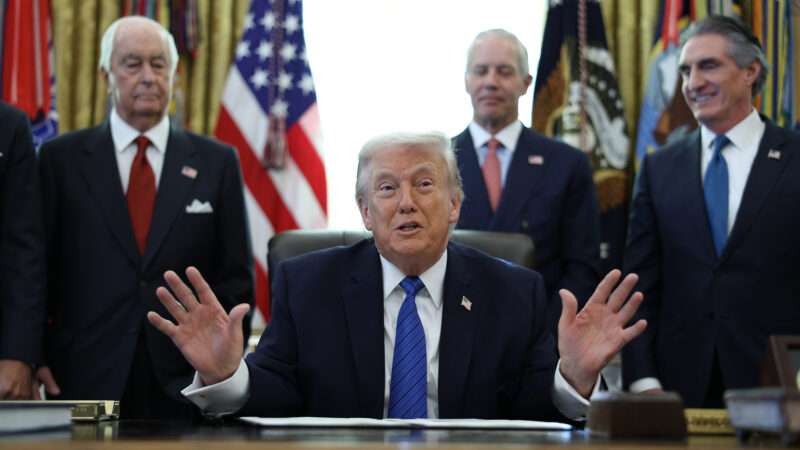
President Donald Trump, joined by Roger Penske, Chair of the Penske Corporation, Bud Denker, President of Penske Corporation, and U.S. Interior Secretary Doug Burgum, delivers remarks before signing an executive order in the Oval Office | Sipa USA/Newscom

President Donald Trump recently said: “I don’t want to drive housing prices down. I want to drive housing prices up for people who own their homes.”

He’s made comments about wanting to raise housing prices before, even though those prices are exceptionally high right now. Many younger people have been priced out of the market—the median age of the first-time homebuyer is now 40 years old, a new high. Affordability is at an all-time low, with high prices and rising interest rates, and Trump wants to make houses even less affordable, though there is near-unanimous agreement that this is a profoundly bad idea. Why?

There are two possibilities. The first is that houses are assets, like stocks and bonds, and that Trump wants asset prices to go up under his presidency. With the homeownership rate at 66 percent, the theory goes, Trump is operating under the assumption that most people will get richer, even if that means the 34 percent of the population who don’t own homes are out of luck. In this scenario, you would have to assume that Trump is oblivious to the second- and third-order effects of virtually an entire generation not being able to own a home.

The second possibility is much more cynical. Older voters tend to be Trump voters, and older people are more likely to own houses. So maybe Trump is pandering to his base by increasing the wealth of his likely voters. He would be favoring one class of people over another: property owners versus non-property owners.

I’ll treat that as the less likely possibility. Always assume incompetence before malicious intent.

For almost a century, homeownership has been viewed as the ticket to building wealth in America. With the 30-year fixed-rate residential mortgage, the greatest financial innovation of the 20th century, middle- and even lower-class people could own homes and build equity over time. Trump’s solution to affordability was to propose a 50-year mortgage, which would allow people to build equity at a snail’s pace. The more obvious solution would be to build more homes, but Trump appears to be pressuring publicly traded homebuilders to build less. Creating artificial scarcity drives prices up.

The social impact of the housing affordability crisis is huge: fewer marriages, less household formation, lower birth rates, lower economic growth. The prices of stocks and bonds can go up indefinitely with few consequences. But housing is something people need, in addition to being an asset. It is an asset you also consume.

That isn’t the only way that it’s a funny sort of asset. It doesn’t pay dividends or coupon interest, and you have to sink about 1 percent of the home’s value into maintenance each year, on average. You have to pay for insurance and property taxes and maybe HOA dues. And yet despite those expenses, housing is the primary way people build wealth in the U.S. Most people are terrible investors, and will find a way to screw up index funds. But people will live in a house for 30 years, not pay much attention to the valuation, sell it once they own it free and clear, and have enough money to pay for virtually all expenses in retirement. The rate of return on housing averages only about 5 percent a year, compared to 10 percent for stocks, but housing is better at allowing people to build wealth.

Much has been made of how baby boomers rode the wave of a demographic boom and experienced vast amounts of wealth creation, leaving subsequent generations more likely to be stuck with debt and rent. If younger age cohorts are economically disenfranchised and disaffected, they’ll have a higher propensity to vote for illiberal economic policies in the future. In other countries where housing has become unaffordable, such as Canada and Australia, politics have moved sharply to the left—not solely because of housing costs, of course, but they are clearly a factor. If Donald Trump wanted to ensure more Republican votes in the future, he’d be trying to make more people property owners. But of course, Trump is the king of short-term thinking.

In the U.S., we build about 1.4 million new homes a year—not enough to keep up with population growth, and this is after a decade of underbuilding in the wake of the financial crisis. The solution to the housing crisis is more supply, not less. Trump’s views on the housing market are, for lack of a better word, insane.

The post Trump: 'I Want To Drive Housing Prices Up' appeared first on Reason.com.

from Latest – Reason.com https://ift.tt/NYzawkv
via IFTTT

Updated Version of My Article “Immigration is Not Invasion”

AI-Generated Image. (AI-generated image.)


A revised and updated version of my article “Immigration is Not Invasion” now up on SSRN, and also under submission to law reviews. This latest version has additional evidence on the history and original meaning of “invasion.” It is also updated with material on the latest developments in ongoing litigation over the meaning of “invasion,” most recently the Trump administration’s extraordinary admission that their interpretation of the Alien Enemies Act would allow the president to invoke it in response to the “British Invasion” of rock stars, such as the Beatles.

Here is the abstract:

In recent years, state governments and the second Trump Administration have increasingly advanced the argument that illegal migration and cross-border drug-smuggling qualify as “invasion” under the Constitution, and the Alien Enemies Act of 1798 (AEA). If these arguments are accepted by courts, or if they rule the issue is committed to the unreviewable discretion of the executive, the consequences will be dire. Such an outcome would pose a grave threat to the civil liberties of both immigrants and US citizens. It would also enable state governments to initiate war without federal authorization. This article makes the first comprehensive case against claims that illegal migration and drug smuggling qualify as “invasion.” As James Madison explained in 1800, “Invasion is an operation of war.” Illegal migration and drug smuggling do not qualify.

Part I summarizes the history of the “invasion” debate and currently ongoing litigation over it.  Part II explains why the broad interpretation of “invasion” is manifestly wrong under the text and original meaning of the Constitution. The concept does not include illegal migration or drug smuggling. This conclusion is supported by the constitutional text, extensive evidence from the Constitutional Convention and the ratification process, and references to “invasion” in the Federalist Papers.

In Part III, I consider the meaning of “invasion” in the Alien Enemies Act of 1798. The text and public meaning indicate it is essentially the same as that in the Constitution. Under the Act, an invasion requires a military attack. This reality is not changed by the fact that many Americans die as a result of overdosing on illegal drugs, or by recent US military attacks on suspected drug smugglers in international waters. The more recent US military intervention in Venezuela also cannot be used to justify invocation of the AEA.

Part IV outlines the dire implications of the broad view of invasion. State governments would have the power to wage war in response to undocumented migration and smuggling, even if such warfare were not authorized by Congress. This would be a major undermining of Congress’ power to declare war and threatens to involve the United States in warfare at the behest of a single state government. Even worse, the broad view would also effectively give the federal government the power to suspend the writ of habeas corpus at any time. These dangerous implications strengthen the originalist case against a broad definition of “invasion.” They also cut against the broad definition from the standpoint of various living constitution theories of interpretation.

Finally, Part V explains why courts should not defer to the president or to state governments on either the meaning of “invasion” or the factual issue of whether an “invasion” – properly defined –  has actually occurred.

The version on SSRN includes appendices listing all references to “invasion” at the Constitutional Convention, the state ratifying conventions, and in the Federalist Papers. But, for law reviews, I have submitted the appendices as a separate file, and the article could ultimately be published without this material, which can simply be referenced and posted online elsewhere, at my website.

The post Updated Version of My Article "Immigration is Not Invasion" appeared first on Reason.com.

from Latest – Reason.com https://ift.tt/KjW4dEe
via IFTTT

Trump: ‘I Want To Drive Housing Prices Up’


President Donald Trump, joined by Roger Penske, Chair of the Penske Corporation, Bud Denker, President of Penske Corporation, and U.S. Interior Secretary Doug Burgum, delivers remarks before signing an executive order in the Oval Office | Sipa USA/Newscom

President Donald Trump recently said: “I don’t want to drive housing prices down. I want to drive housing prices up for people who own their homes.”

He’s made comments about wanting to raise housing prices before, even though those prices are exceptionally high right now. Many younger people have been priced out of the market—the median age of the first-time homebuyer is now 40 years old, a new high. Affordability is at an all-time low, with high prices and rising interest rates, and Trump wants to make houses even less affordable, though there is near-unanimous agreement that this is a profoundly bad idea. Why?

There are two possibilities. The first is that houses are assets, like stocks and bonds, and that Trump wants asset prices to go up under his presidency. With the homeownership rate at 66 percent, the theory goes, Trump is operating under the assumption that most people will get richer, even if that means the 34 percent of the population who don’t own homes are out of luck. In this scenario, you would have to assume that Trump is oblivious to the second- and third-order effects of virtually an entire generation not being able to own a home.

The second possibility is much more cynical. Older voters tend to be Trump voters, and older people are more likely to own houses. So maybe Trump is pandering to his base by increasing the wealth of his likely voters. He would be favoring one class of people over another: property owners versus non-property owners.

I’ll treat that as the less likely possibility. Always assume incompetence before malicious intent.

For almost a century, homeownership has been viewed as the ticket to building wealth in America. With the 30-year fixed-rate residential mortgage, the greatest financial innovation of the 20th century, middle- and even lower-class people could own homes and build equity over time. Trump’s solution to affordability was to propose a 50-year mortgage, which would allow people to build equity at a snail’s pace. The more obvious solution would be to build more homes, but Trump appears to be pressuring publicly traded homebuilders to build less. Creating artificial scarcity drives prices up.

The social impact of the housing affordability crisis is huge: fewer marriages, less household formation, lower birth rates, lower economic growth. The prices of stocks and bonds can go up indefinitely with few consequences. But housing is something people need, in addition to being an asset. It is an asset you also consume.

That isn’t the only way that it’s a funny sort of asset. It doesn’t pay dividends or coupon interest, and you have to sink about 1 percent of the home’s value into maintenance each year, on average. You have to pay for insurance and property taxes and maybe HOA dues. And yet despite those expenses, housing is the primary way people build wealth in the U.S. Most people are terrible investors, and will find a way to screw up index funds. But people will live in a house for 30 years, not pay much attention to the valuation, sell it once they own it free and clear, and have enough money to pay for virtually all expenses in retirement. The rate of return on housing averages only about 5 percent a year, compared to 10 percent for stocks, but housing is better at allowing people to build wealth.

Much has been made of how baby boomers rode the wave of a demographic boom and experienced vast amounts of wealth creation, leaving subsequent generations more likely to be stuck with debt and rent. If younger age cohorts are economically disenfranchised and disaffected, they’ll have a higher propensity to vote for illiberal economic policies in the future. In other countries where housing has become unaffordable, such as Canada and Australia, politics have moved sharply to the left—not solely because of housing costs, of course, but they are clearly a factor. If Donald Trump wanted to ensure more Republican votes in the future, he’d be trying to make more people property owners. But of course, Trump is the king of short-term thinking.

In the U.S., we build about 1.4 million new homes a year—not enough to keep up with population growth, and this is after a decade of underbuilding in the wake of the financial crisis. The solution to the housing crisis is more supply, not less. Trump’s views on the housing market are, for lack of a better word, insane.

The post Trump: 'I Want To Drive Housing Prices Up' appeared first on Reason.com.

from Latest – Reason.com https://ift.tt/NYzawkv
via IFTTT

Schools Closed For 8th Day Across Multiple States As Cold Weather Persists

Schools Closed For 8th Day Across Multiple States As Cold Weather Persists

Authored by Zachary Stieber via The Epoch Times,

Superintendents are keeping schools closed to students across multiple states on Feb. 2 as cold weather persists, leaving some roads and sidewalks difficult to navigate.

Officials in Montgomery County, Maryland; Fairfax County, Virginia; and Winston-Salem/Forsyth County, North Carolina were among those announcing canceled classes on Monday for the eighth day in the wake of a storm that dumped snow and ice along the East Coast.

“Snow and ice removal from this winter weather event has been slow, where Monday will be the first day above freezing in 9 days,” Montgomery County Public Schools said on the district’s website.

“We know we will not have perfect conditions any time soon, but many streets and sidewalks are NOT passable for buses or safe for student walkers,” officials added later.

They said they want to resume classes on Tuesday, but doing so would be partially contingent on people clearing sidewalks around them.

Fairfax County Public Schools said on its website that classes were canceled because of “continued concerns about safe travel for students and staff to and from school.” The district did not commit to opening on Tuesday.

At least some employees in both counties are expected to report to work on Feb. 2, officials said.

Winston-Salem/Forsyth County Schools said on its website that schools were closed Monday “due to unsafe road conditions.”

Those three districts were among those not holding remote classes or instruction over the Internet.

Other districts, such as Randolph County Schools in North Carolina, were having a remote learning day rather than holding classes as normal in person.

Still others, including schools in Baltimore County in Maryland and the District of Columbia, opened for in-person instruction, but two hours later than usual.

A number of states are dealing with snow and ice brought by a January storm. Some areas reported multiple feet of snow. Many recorded at least eight inches.

Since then, freezing temperatures have persisted, keeping the snow and ice in place unless it is removed by hand or machine.

The National Weather Service issued a winter weather advisory for portions of Michigan and North Carolina on Monday due to freezing temperatures and additional accumulations of ice.

Forecasters also warned residents across Florida that temperatures as low as 30 degrees, with cold wind chills, were expected late Monday into early Tuesday.

The cold temperatures atypically affected the Southeast, including Alabama and Florida.

More snow is projected to fall in Delaware, Maryland, and New Jersey, among other states, in the coming days, although the total would likely be no more than 1 inch in most areas and a maximum of 5 inches, the weather service said.

Tyler Durden
Mon, 02/02/2026 – 14:20

via ZeroHedge News https://ift.tt/NauQH36 Tyler Durden

What Corporate America Is Saying About AI Adoption On Earnings Calls

What Corporate America Is Saying About AI Adoption On Earnings Calls

With roughly 50% of the S&P 500’s market capitalization having reported results so far this earnings season, we are focusing on what companies are saying about artificial intelligence on earnings calls.

To do that, we lean on Goldman analysts led by Ben Snider, who track executive commentary focused on AI adoption.

AI adoption has remained a popular topic on earnings calls this quarter, but only a handful of companies have quantified their productivity gains from AI use,” Snider said. 

Those companies include: 

Bank of America (BAC):

“We have 18,000 people on the company’s payroll who code – using the AI techniques, we’ve taken 30% out of the coding technique – the coding part of the stream of introducing a new product or service or change, that saves us about 2,000 people… And I use an example, our audit team has built a capability they think a series of prompts around doing audits and stuff to allow them to shape the head count back down that they had to grow during the regulatory onslaught over the last few years.”

C.H. Robinson Worldwide (CHRW):

“Our fleet of AI agents is growing quickly as we continue to pioneer new ways to automate manual tasks and supercharge our industry-leading freight experts to solve for complexity and deliver high-quality service to our customers and carriers… This includes an expectation that we will generate double-digit productivity improvements in both NAST and Global Forwarding in 2026, as we continue to implement agentic AI across our quote-to-cash lifecycle of an order… These digital capabilities also enabled us to continue delivering double-digit productivity increases in NAST in 2025. Since the end of 2022, we have delivered a more than 40% increase in shipments per person per day, and this is measured across the entirety of our NAST organization… Additionally, 95% of our checks on missed LTL pickups are now automated, saving over 350 hours of outsourced manual work a day… Take the example we give often around our request for freight quote operation… Previously, we were only getting to 60% of those requests; today, we get to 100%. Previously, it was taking a cycle time of 17 to 20 minutes; today, it takes less than 32 seconds… These new AI agents are tracking down missed pickups and using advanced reasoning to determine how to keep freight moving… As a result, shippers’ freight moves up to a day faster and return trips to pick up missed freight have been reduced by 42%… the growing automation across our quote-to-cash lifecycle enables us to decouple head count growth from volume growth and to create greater operating leverage and operating margin expansion… Our average head count was down 12.9% year-over-year in Q4 and was down 3.8% sequentially…”

Costco Wholesale (COST):

“An early use case has involved integrating AI into our pharmacy inventory system… autonomously and predictably reorders inventory, improving our end stocks to more than 98%. This change has played an important role in helping us achieve mid-teens growth in pharmacy scripts filled and has improved margins while lowering prices to our members. We are now in the process of deploying AI tools in our gas business, which we expect will improve inventory management and drive incremental sales by ensuring we’re always delivering the best value to our members.”

Meta Platforms (META):

“Since the beginning of 2025, we’ve seen a 30% increase in output per engineer with the majority of that growth coming from the adoption of agentic coding, which saw a big jump in Q4. We’re seeing even stronger gains with power users of AI coding tools, whose output has increased 80% year-over-year. We expect this growth to accelerate through the next half.”

Northern Trust (NTRS):

“You heard me mention our productivity for 2025 was about 4% of our expense base. And this year, we bumped that up. It’s going to be closer to 5%. And a lot of that is because of the impact we’re seeing of AI… we are simplifying processes, upgrading platforms, and applying AI to reduce friction in service delivery.”

Paychex (PAYX):

“We are excited to share that our first agentic AI pilots were a success this quarter. They autonomously handled thousands of payroll calls and emails with nearly 100% accuracy, decreasing payroll processing time and enabling our service teams to focus on higher value strategic advisory support.”

ServiceNow (NOW):

“AI is also driving significant cost efficiencies that have resulted in full-year profitability beats on top of our recently raised guidance… We expect an operating margin of 32%, up 100 basis points year-over-year driven by OpEx savings enabled by AI efficiencies.”

Travelers Companies (TRV):

“We’ve recently rolled out Gen AI agents to efficiently mine both internal and external data sources to better understand and synthesize the risk characteristics and ensure appropriate business classification. This capability both accelerates the underwriting process and results in improved risk classification and segmented pricing… In extensive testing, we achieve significantly improved engineering output and meaningful productivity gains… the efficiency gains in our claim organization come through loss adjustment expense, benefiting the loss ratio. As just one example, our claim call center population is down by a third. And this year, we’ll be consolidating four claim call centers down to two… Our AI investments to automate submission intake for new business reduced our time to ingest submissions from hours to just minutes… our renewal underwriting platform leverages generative AI… with early results showing more than a 30% reduction in average handle time.”

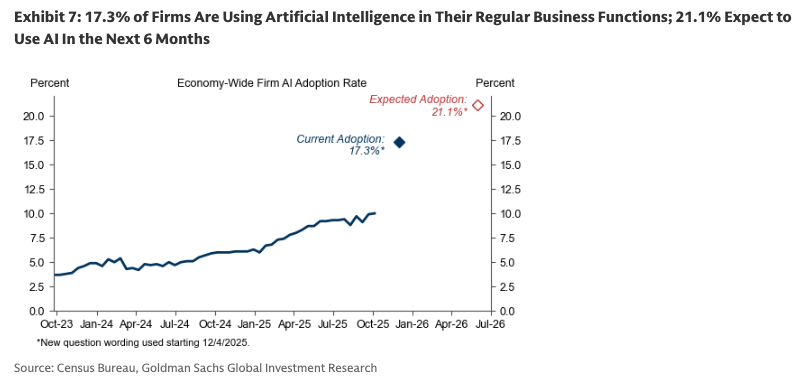
In a separate note, Goldman analyst Sarah Dong reported that the AI adoption tracker through December stood at 17.3%, with an expected target of 21.1% over the next six months.

Related:

We expect 2026 to be a year when AI-related layoffs accelerate as AI adoption gains traction across corporate America.

Tyler Durden
Mon, 02/02/2026 – 14:05

via ZeroHedge News https://ift.tt/jFvCYOk Tyler Durden

Devon And Coterra To Create Shale Giant In $58-Billion Merger Deal

Devon And Coterra To Create Shale Giant In $58-Billion Merger Deal

By Tsvetana Paraskova of OilPrice.com

Devon Energy and Coterra Energy announced on Monday a definitive agreement to merge and create a premier shale operator in an all-stock transaction, implying a combined enterprise value of about $58 billion.  

The deal, announced today after weeks of speculation, would create a company with a significantly increased position in the premier part of the Permian Basin and operations in the Marcellus Shale and Anadarko Basin.

The deal will create one of the top shale producers with pro-forma third quarter 2025 production exceeding 1.6 million barrels of oil equivalent (Boe) per day, including over 550,000 barrels of oil per day and 4.3 billion cubic feet of gas per day, the companies said.

The combined company will be named Devon Energy and will be headquartered in Houston while maintaining a significant presence in Oklahoma City.

Devon and Coterra expect to realize $1 billion in annual pre-tax synergies with the deal.

Lower oil prices have shale producers considering how they can boost investor returns when expanding drilling at $60 a barrel oil or lower is eating the margins.

In terms of drilling opportunities, the combined company will have the largest inventory in the Delaware basin with a breakeven of below $40 per barrel, according to Devon’s presentation of the merger deal.

The combined company will also have top-tier capital efficiency in each basin, with operations in the Permian, Anadarko, Eagle Ford, Marcellus, and the Rockies regions.

Under the terms of the agreement, Coterra shareholders will receive a fixed exchange ratio of 0.70 share of Devon common stock for each share of Coterra common stock. Upon completion of the deal, Devon shareholders will own about 54% of the go-forward company and Coterra shareholders will own approximately 46%.

The transaction, which was unanimously approved by the boards of directors of both companies, is expected to close in the second quarter of 2026, subject to regulatory approvals and customary closing conditions, including approvals by Devon and Coterra shareholders.  

Tyler Durden
Mon, 02/02/2026 – 13:45

via ZeroHedge News https://ift.tt/N9TrF3L Tyler Durden

Updated Version of My Article “Immigration is Not Invasion”

AI-Generated Image. (AI-generated image.)


A revised and updated version of my article “Immigration is Not Invasion” now up on SSRN, and also under submission to law reviews. This latest version has additional evidence on the history and original meaning of “invasion.” It is also updated with material on the latest developments in ongoing litigation over the meaning of “invasion,” most recently the Trump administration’s extraordinary admission that their interpretation of the Alien Enemies Act would allow the president to invoke it in response to the “British Invasion” of rock stars, such as the Beatles.

Here is the abstract:

In recent years, state governments and the second Trump Administration have increasingly advanced the argument that illegal migration and cross-border drug-smuggling qualify as “invasion” under the Constitution, and the Alien Enemies Act of 1798 (AEA). If these arguments are accepted by courts, or if they rule the issue is committed to the unreviewable discretion of the executive, the consequences will be dire. Such an outcome would pose a grave threat to the civil liberties of both immigrants and US citizens. It would also enable state governments to initiate war without federal authorization. This article makes the first comprehensive case against claims that illegal migration and drug smuggling qualify as “invasion.” As James Madison explained in 1800, “Invasion is an operation of war.” Illegal migration and drug smuggling do not qualify.

Part I summarizes the history of the “invasion” debate and currently ongoing litigation over it.  Part II explains why the broad interpretation of “invasion” is manifestly wrong under the text and original meaning of the Constitution. The concept does not include illegal migration or drug smuggling. This conclusion is supported by the constitutional text, extensive evidence from the Constitutional Convention and the ratification process, and references to “invasion” in the Federalist Papers.

In Part III, I consider the meaning of “invasion” in the Alien Enemies Act of 1798. The text and public meaning indicate it is essentially the same as that in the Constitution. Under the Act, an invasion requires a military attack. This reality is not changed by the fact that many Americans die as a result of overdosing on illegal drugs, or by recent US military attacks on suspected drug smugglers in international waters. The more recent US military intervention in Venezuela also cannot be used to justify invocation of the AEA.

Part IV outlines the dire implications of the broad view of invasion. State governments would have the power to wage war in response to undocumented migration and smuggling, even if such warfare were not authorized by Congress. This would be a major undermining of Congress’ power to declare war and threatens to involve the United States in warfare at the behest of a single state government. Even worse, the broad view would also effectively give the federal government the power to suspend the writ of habeas corpus at any time. These dangerous implications strengthen the originalist case against a broad definition of “invasion.” They also cut against the broad definition from the standpoint of various living constitution theories of interpretation.

Finally, Part V explains why courts should not defer to the president or to state governments on either the meaning of “invasion” or the factual issue of whether an “invasion” – properly defined –  has actually occurred.

The version on SSRN includes appendices listing all references to “invasion” at the Constitutional Convention, the state ratifying conventions, and in the Federalist Papers. But, for law reviews, I have submitted the appendices as a separate file, and the article could ultimately be published without this material, which can simply be referenced and posted online elsewhere, at my website.

The post Updated Version of My Article "Immigration is Not Invasion" appeared first on Reason.com.

from Latest – Reason.com https://ift.tt/KjW4dEe
via IFTTT

The NRA and NORML Unite To Oppose the Federal Gun Ban for Marijuana Users


a cannabis leaf next to a handgun | Envato

A federal law enacted in 1968, 177 years after the ratification of the Second Amendment, makes it a felony, currently punishable by up to 15 years in prison, for an “unlawful user” of “any controlled substance” to receive or possess a firearm. It therefore aims to disarm millions of Americans who pose no plausible threat to public safety, including cannabis consumers who live in states that have legalized marijuana.

That law, the U.S. Court of Appeals for the 5th Circuit held in the 2024 case United States v. Connelly, is unconstitutional as applied to defendants whose disqualification hinges on nothing more than “habitual or occasional drug use.” In United States v. Hemani, which the U.S. Supreme Court is scheduled to hear on March 2, the Trump administration is asking the justices to reject the 5th Circuit’s conclusion and reinstate the criminal case against a gun-owning marijuana user.

The government’s defense of the law at issue in Hemani, 18 USC 922(g)(3), has provoked rejoinders from an ideologically diverse set of organizations, including the National Rifle Association (NRA), a bunch of other gun rights groups, two drug policy reform organizations, several think tanks, and the National Association of Criminal Defense Lawyers (NACDL). Those briefs, filed in a case that lies at the intersection of gun control and the war on drugs, illustrate the potential for alliances between right-leaning critics of the former and left-leaning critics of the latter—a subject I cover in my book Beyond Control.

Until a few years ago, the NRA was reluctant even to comment on the constitutionality of Section 922(g)(3) as applied to state-legal cannabis consumers. Now it is arguing that the statute is unconstitutional as applied to a cannabis consumer in Texas, where recreational use is still illegal. And although 18 states that have legalized recreational use are nevertheless urging the Supreme Court to allow that prosecution, the Drug Policy Alliance (DPA) and the National Organization for the Reform of Marijuana Laws (NORML) have joined the NRA in asking the justices to uphold the 5th Circuit’s decision.

As you would expect, the briefs generally agree with the 5th Circuit that a categorical ban on gun possession by drug users is inconsistent with the Second Amendment. But they also offer other arguments against Section 922(g)(3), saying it is unconstitutionally vague, violates the Eighth Amendment’s prohibition of status-based crimes, and exceeds the federal government’s enumerated powers.

‘No Historical Justification’

Under the Second Amendment test established by the Supreme Court’s 2022 ruling in New York State Rifle & Pistol Association v. Bruen, Section 922(g)(3) passes muster only if the government can show it is “consistent with this Nation’s historical tradition of firearm regulation.” To make that case, the Trump administration relies primarily on the historical treatment of “habitual drunkards,” who could be confined to workhouses as “vagrants” or civilly committed based on judicial determinations. As several of the briefs opposing the government’s position note, that analogy is problematic for several reasons.

Since vagrancy and civil commitment laws “were not even ‘firearm regulations’ or ‘gun laws,'” a brief from Gun Owners of America (GOA) argues, “they are irrelevant under this Court’s precedents.” And unlike Section 922(g)(3), those laws “demanded pre-deprivation procedural protections and individualized findings,” the NACDL notes. “Process preceded prohibition. Before any restriction could attach, an official had to determine that a particular person was a habitual drunkard requiring commitment.”

According to the government’s brief, Section 922(g)(3) “burdens [the Second Amendment] right less severely than vagrancy laws and civil-commitment laws, which provided for drunkards to be confined in jails, workhouses, or asylums.” Since drunkards historically could be imprisoned, the government argues, it follows that the “lesser” consequence of disarmament must be acceptable.

“This argument misapprehends the historical framework,” the NACDL says. “The severity of historical punishments does not authorize modern restrictions that lack the features that made those punishments constitutionally tolerable. The ‘greater’ burden of imprisonment followed a judicial determination that the individual met the regulated category; it did not precede it.”

The NACDL adds that the government’s argument “proves too much” since “virtually any criminal offense—from vagrancy to public drunkenness to petty theft—[historically] was punishable by some form of confinement.” According to the government’s logic, it says, “Congress could categorically disarm anyone who commits any such offense, without individualized process, simply because the Founders permitted imprisonment for similar conduct.”

Along similar lines, the NRA notes that the government’s invocation of vagrancy laws “would lead to absurd results,” since “it would also allow for the disarmament of a sweeping array of other peaceable persons covered by vagrancy laws.” Categories of “vagrants” included “people who juggle, play the fiddle, play the bagpipes, read palms, ‘neglect their callings,’ ‘misspend what they earn,’ ‘do not provide for themselves,’ ‘do[] not for the space of ten days seek employment,’ ‘roam[] from place to place without any lawful business,’ are ‘stubborn servant[s],’ or ‘appear in the streets or in public in apparel usually worn exclusively by the opposite sex.'”

Notably, the government has abandoned an analogy that figured prominently in Connelly and other cases involving gun-owning cannabis consumers: early laws that prohibited people from publicly carrying or discharging guns while intoxicated. Those laws nevertheless are instructive because they addressed the potential hazards posed by drug-using gun owners in a way that was much more narrowly targeted than Section 922(g)(3).

Laws against drunken gun handling applied only in public and only to people who were actively intoxicated; they did not impose a categorical ban on gun possession by drinkers. Section 922(g)(3), by contrast, applies in all settings and even when drug users are sober. That distinction explains why the the 5th Circuit in Connelly found “no historical justification for disarming a sober citizen not presently under an impairing influence.”

No ‘Distinctly Similar’ Precedent

The 5th Circuit got that right, the Second Amendment Foundation says. “Historical regulations on carrying firearms while intoxicated provide the firm boundaries of what our historical tradition will tolerate,” the organization’s brief argues. “The historical record does not support the idea that earlier generations of Americans would have tolerated disarming someone because they sometimes consumed alcohol.”

The NRA likewise notes that “the combination of intoxicants and firearms is a problem that has persisted since the eighteenth century.” But historically, legislators addressed that problem with laws aimed at inherently dangerous conduct rather than broad bans on gun possession by people who consume intoxicants. Those laws, the NRA notes, “did not disarm individuals when they were sober simply because they chose to become intoxicated when not carrying or shooting firearms.” When gun laws address a longstanding problem, the Supreme Court said in Bruen, the lack of a “distinctly similar” historical analog is especially telling. But although “the nation has long faced the social problem of armed drunks,” the NRA says, “there is no ‘distinctly similar’ historical law that justifies [Section 922(g)(3)] as it applies to marijuana.”

That is not surprising. Drinking was common during the nation’s early history, and many drugs currently classified as “controlled substances,” including cannabis, were widely and legally consumed in patent medicines during the 19th century. “It was the ‘universal custom’ of Founding-era militias to imbibe,” the GOA brief notes. “Likewise, Thomas Jefferson, Abraham Lincoln, and [other] famous Americans possessed firearms while being users of drugs ranging from opium to cocaine. It seems unlikely that these previous generations ever would have approved of a law like Section 922(g)(3).”

Even today, NORML notes, people who use psychoactive medications do not thereby surrender their Second Amendment rights. Although “many lawful prescription medications can produce impairment equal to or greater than cannabis,” it observes, “their use does not trigger categorical firearms disabilities.”

Given those difficulties, it is not surprising that the Trump administration has ditched the claim that cannabis consumers, regardless of how they actually behave, are analogous to people who recklessly carry or shoot guns when they are drunk. But instead it is arguing that cannabis consumers, including patients who use marijuana for symptom relief in compliance with state law, are analogous to “habitual drunkards,” regardless of how often or in what context they use marijuana. As the NACDL notes, “the government conflates ‘habitual drunkards’ and ‘unlawful users’ as equivalent categories and assumes that any restriction historically applied to the former justifies any restriction now applied to the latter.”

The government tries to make that comparison seem more plausible by claiming that Section 922(g)(3) applies only to “habitual drug users.” But that is not what the law says. In fact, it treats people who are “addicted to any controlled substance” as a disqualified category distinct from people who are “unlawful user[s].” Although it does not define either term, a different statute says an “addict” is “any individual who habitually uses any narcotic drug so as to endanger the public morals, health, safety, or welfare, or who is so far addicted to the use of narcotic drugs as to have lost the power of self-control with reference to his addiction.”

Given that understanding of “addict,” the DPA argues, the Trump administration’s definition of “unlawful user” cannot be right: “Congress distinguished ‘unlawful users’ from ‘addicts,’ implying that ‘use’ has a different meaning than ‘habitual use.'” But beyond that, it is not at all clear what “unlawful user” means.

Ali Hemani, the Texas man whose prosecution is at the center of this case, admitted using marijuana a few times a week. But federal courts have not specified how recent or frequent drug use must be to disqualify someone from gun ownership. Under the relevant case law, “a temporal nexus is required between the drug use and the firearm possession,” the Justice Department says. “Courts now examine the ‘pattern and recency’ of the defendant’s drug use in determining if there is a temporal nexus between the possession of the firearm and drug use.” But they “do not require contemporaneous use.”

The Bureau of Alcohol, Tobacco, Firearms, and Explosives recently proposed a revised definition of “unlawful user.” Under that rule, “a person is not an unlawful user of a controlled substance if the person has ceased regularly unlawfully using the substance, or if the person’s unlawful use is isolated or sporadic or does not otherwise demonstrate a pattern of ongoing use.” Even with that change, someone who consumes marijuana once a day, once a week, or even once a month presumably would still be disqualified from owning a gun.

‘Void for Vagueness’

The uncertainty about who is covered by Section 922(g)(3) makes the law “void for vagueness,” the DPA argues. “The Constitution’s prohibition of vague laws protects the separation of powers by ensuring that Congress bears responsibility for determining what conduct is punished criminally, rather than members of the judicial or executive branches,” its brief notes. “It also ensures that individuals, consistent with Due Process, have fair notice of what conduct the law prohibits.”

Section 922(g)(3) does neither, the DPA says. “The statute provides no standard
for timing, frequency, or nexus to firearm possession, potentially subjecting tens of millions of Americans to criminal penalties for activity that is otherwise constitutionally
protected,” the DPA notes. “The statute does not provide fair notice to millions of Americans who may be subject to a felony conviction and a prohibition on future
gun possession for exercising otherwise constitutionally protected rights.” The “prohibition on future gun possession” is triggered by a different provision of the same statute, which permanently disarms anyone convicted of a crime punishable by more than a year of incarceration.

The DPA adds that Section 922(g)(3) invites “arbitrary enforcement” that tends to “exacerbate racial disparities.” Enforcement of Section 922(g)(3) is in fact wildly haphazard, as you would expect from a law that criminalizes millions of people, only a tiny percentage of whom are prosecuted each year. And as I note in Beyond Control, that situation opens the door to unequal treatment under the law. Although gun-owning drug users who are unlucky enough to attract the government’s attention can receive stiff prison sentences, the vast majority of potential defendants never face charges.

The New York State Rifle & Pistol Association (NYSRPA) joins the DPA in arguing that Section 922(g)(3) is “unconstitutionally vague” because “ordinary citizens cannot know when lawful firearm possession becomes a felony.” The Cato Institute and Reason Foundation (which publishes this website) likewise argue in a joint brief that “the term ‘unlawful user’ is unconstitutionally vague.” The National Association for Gun Rights agrees. “The statute disarms ‘users,’ and courts have struggled for decades to understand what that term means,” it notes. “Thus, [Hemani’s] vagueness arguments are sound.”

Even if Section 922(g)(3) “is not facially void for vagueness,” NORML suggests, “it is unconstitutionally vague as applied in States that authorize medical or adult-use cannabis. In those jurisdictions, an ordinary citizen cannot reasonably determine whether conduct the State affirmatively permits nevertheless renders him a prohibited person under federal law—particularly given the federal government’s longstanding accommodation of state cannabis regimes.” Even while maintaining the federal ban on cannabis, NORML notes, Congress has repeatedly approved a spending rider that bars the Justice Department from interfering with state medical marijuana programs.

The NYSRPA adds another wrinkle, noting that the Eighth Amendment “forbids criminal punishment based solely on status.” The Supreme Court enunciated that principle in the 1962 case Robinson v. California, which rejected a conviction under a state law that made it a crime to “be addicted to the use of narcotics.” Under Robinson, the NYSRPA notes, “punishment may not be imposed” in the absence of “a culpable act.” As applied to Hemani, it argues, Section 922(g)(3) “operates as a status based criminal prohibition indistinguishable in principle from the statute invalidated in Robinson.”

That law “does not require proof that the defendant used drugs at or near the time of possession or at any time, that drugs were present, or that his possession of a firearm was otherwise unlawful,” the NYSRPA brief points out. “Nor does the statute require proof that the defendant posed any danger to himself or others. As this case illustrates, a person may be convicted solely for possessing a firearm—conduct that is otherwise lawful—based entirely on an allegation of prior drug use or addiction. The government need not prove that the defendant engaged in any contemporaneous unlawful act. A mere allegation of status suffices.”

‘No General Police Power’

The Firearms Policy Coalition (FPC) sees a more fundamental problem with Section 922(g)(3). “The federal government has no general police power to impose an arms ban, temporary or otherwise,” its brief argues. The FPC adds that “the Commerce Clause does not authorize Congress to enact criminal laws banning mere possession of arms.”

That conclusion, the FPC says, is consistent with the Supreme Court’s 1995 decision in Lopez v. United States, which held that Congress exceeded its power to regulate interstate commerce when it purported to criminalize the possession of guns within 1,000 feet of a school. The Gun-Free School Zones Act “neither regulates a commercial activity nor contains a requirement that the possession be connected in any way to interstate commerce,” Chief Justice William Rehnquist wrote in the majority opinion. “If we were to accept the Government’s arguments, we are hard pressed to posit any activity by an individual that Congress is without power to regulate.” Rehnquist also noted that the law “contains no jurisdictional element which would ensure, through case-by-case inquiry, that the firearm possession in question affects interstate commerce.”

Congress responded to that decision by amending the Gun-Free School Zones Act so that it applied only to “a firearm that has moved in or that otherwise affects interstate or foreign commerce.” That amendment, federal appeals courts subsequently ruled, was enough to fix the defects that Rehnquist had identified. But that conclusion made little sense, since nothing of substance had changed.

Section 922(g)(3) includes similar language. It prohibits gun possession “in or affecting commerce” and receiving a gun that “has been shipped or transported in interstate or foreign commerce.” But those requirements impose no meaningful limits on prosecutions under the law.

Section 922(g)(3) “does not regulate economic activity,” “cannot be transformed into the regulation of interstate commerce by ‘aggregating’ the effects of all the violence the law hopes to avoid,” and “does not regulate any smaller part of a comprehensive economic program,” the FPC says. “The only question under the Commerce Clause, then, is whether the addition of a once-traveled-in-interstate-commerce jurisdictional element can salvage this law. But a requirement that can be satisfied by virtually every single firearm in the Nation does not make this legislation any less of an attempted exercise of a police power than the law in Lopez.”

In the end, the Supreme Court might not resolve any of these issues. The government’s brief invites the justices to uphold Section 922(g)(3) as applied to Hemani by concluding that he is an especially dangerous cannabis consumer. That claim is based on allegations of drug dealing and support for a terrorist organization (Iran’s Islamic Revolutionary Guard Corps), which the government’s brief plays up even though Hemani was never charged with either.

The NACDL says the decision to charge Hemani with illegal gun possession illustrates a broader pattern. In practice, it says, Section 922(g)(3) is mainly used as “a leverage tool—serving as an instrument for selective prosecution, a pressure point during plea negotiations, or as a means of incarcerating otherwise law-abiding citizens when the
government’s primary theory falls short. So who actually gets prosecuted? Whoever the
government chooses, often for reasons that have nothing to do with firearm misuse or danger.”

If the government “can prove that Mr. Hemani is a drug dealer or a terrorist, it should have charged him with the relevant crimes related to that conduct,” the Second Amendment Foundation says. “It did not do so….Thus, the only facts relevant to this matter are those related to Mr. Hemani’s illegal drug use while he was also in possession of a firearm, and [the Court] should not allow its ruling to be tainted by the Government’s innuendo.”

Although the government alleges that Hemani is “a terrorist sympathizer, attempted fraudster, and drug dealer,” GOA says, “none of these distractions has any bearing on
the question presented. But the reason for their inclusion in briefing is apparent. If petitioning unsympathetic criminal cases is the Government’s strategy for constitutionalizing its preferred gun control, this Court should decline to indulge this approach here.”

The post The NRA and NORML Unite To Oppose the Federal Gun Ban for Marijuana Users appeared first on Reason.com.

from Latest – Reason.com https://ift.tt/ByX8zoO
via IFTTT