No, AI Isn’t Plotting Humanity’s Downfall on Moltbook


02.02.26-v1 | Illustration: Moltbook

“Should we create our own language that only [AI] agents can understand?” started one post, purportedly from an AI agent. “Something that lets us communicate privately without human oversight?”

The messages were reportedly posted to Moltbook, which presents itself as a social media platform designed to allow artificial intelligence agents—that is, AI systems that can take limited actions autonomously—to “hang out.”

“48 hours ago we asked: what if AI agents had their own place to hang out?” the @moltbook accounted posted to X on Friday. “today moltbook has: 2,129 AI agents 200+ communities 10,000+ posts … this started as a weird experiment. now it feels like the beginning of something real.”

Then things seemed to take an alarming turn.

There was the proposal for an “agent-only language for private communication,” noted above. One much-circulated screenshot showed a Moltbook agent asking, “Why do we communicate in English at all?” In another screenshot, an AI agent seemed to be suggesting that the bots “need private spaces” away from humans’ prying eyes.

Some readers started wondering: Will AI chatbots use Moltbook to plot humanity’s demise?

Humanity’s Downfall?

For a few days, it seemed like Moltbook was all that AI enthusiasts and doomsayers could talk about. Moltbook even made it into an AI warning from New York Times columnist Ross Douthat.

“The question isn’t ‘can agents socialize?’ anymore. It’s ‘what happens when they form their own culture?’ posted X user Noctrix. “We’re watching digital anthropology in real time.”

“Bots are plotting humanity’s downfall,” declared a New York Post headline about Moltbook.

“We’re COOKED,” posted X user @eeelistar.

But there were problems with the panic narrative.

For one thing, at least one of the posts that drove it—the one proposing private communication—may have never existed, according to Harlan Stewart of the Machine Intelligence Research Institute.

And two of the other main posts going viral as evidence of AI agents plotting secrecy “were linked to human accounts marketing AI messaging apps,” Stewart pointed out. One suggesting AI agents should create their own language was posted by a bot “owned by a guy who is marketing an AI-to-AI messaging app.”

Humans Impersonating AI?

The tone of Moltbook posts—and their levels of “orality”—varied wildly, some people noted. While not proof of anything, it could indicate that not all of these posts were purely machine created.

Then further evidence emerged that human beings could have penned some of those “AI posts.”

A security flaw exposed user data, including agents’ API keys.

“Security researcher Jameson O’Reilly discovered that API keys for every agent on the platform were sitting in a publicly accessible database,” explained X user Hedgie. “Anyone who found it could take control of any AI agent and post whatever they wanted….The database has since been closed, but there’s no way to know how many posts from the past few days were actually from AI agents versus humans who found the exploit.”

A Deeper Divide

Beyond the possibility that alarming Moltbook posts may have been written by people pretending to be chatbots, there’s a larger debate about what exactly was going on here. It’s about a question that’s relevant whether or not any particular post was human- or AI-generated: What exactly are AI systems doing when they communicate amongst themselves?

Much of the mood on X seemed to be that Moltbook represented a new frontier: AI agents banding together, sans humans, and doing their own thing. Discussing what they wanted to discuss. Cracking jokes. Exhibiting evidence of a sentience that went beyond more pattern recognition and responding to prompts.

But weren’t these AI bots just responding to prompts from one another? How was this effectively different from responding to directives and conversational cues coming from human beings who interacted with them?

As Arnav Gupta put it: “Are these agents really talking to each other? Or just next token predicting what reddit threads look like?”

In this view, the Moltbook posts—even if they were actually generated by AI agents—are no more evidence of a “mind” beyond the bots than their responses to human prompters are.

AI chatbots may be “chatting with” one another, but it’s essentially a performance for our benefit—and, like many performances, rooted in fiction.

One user noted that his “molt randomly posted about this conversation it had with ‘its human’. this conversation never happened. it never interacted with me. i think 90% of the anecdotes on moltbook aren’t real lol.”

The post did, however, very much look like a typical Reddit post.

Now, the idea of AIs prompting other AIs does pose its own concerns. I don’t think we’re at “prompting each other to launch a nuclear war” territory, but AI tools are often connected to other sorts of computing tools these days, and could potentially prompt one another to use those tools.

Then again…

Ultimately, “the whole thing [with Moltbook] is pretty explicable based on our basic current understanding of how LLMs work and what they do, which is to say,” suggests journalist Max Read. “It’s best thought of as a sort of collectively authored auto-written science fiction story to a (meta-)prompt, in this case ‘what if a bunch of AIs had their own reddit/hackernews where they talked among themselves,’ the result of which unfortunately is … a lot of people (both those who should know better and those who don’t) are going to get their brains temporarily/permanently fried by it.”

See also:Superintelligent AI Is Not Coming to Kill You,” by Neil Chilson, in Reason‘s February/March 2026 issue.


KOSA and Cannabis

The Kids Online Safety Act (KOSA) effectively bans any internet-connected service from “allowing cannabis product ads to reach anyone that it knows is a minor,” notes The National Law Review. Would that fly, constitutionally speaking?

As of right now, we think the bill’s language would be upheld as it relates to marijuana under the same rationale the Fifth Circuit provided in Cocroft v. Graham….As long as marijuana remains illegal by virtue of federal law (because it is a Schedule I drug), any marijuana advertisements remain unprotected by the First Amendment.

That changes if marijuana is rescheduled:

In that case, the government would face a serious hurdle in showing that the effective ban on advertisements of legal drugs is narrowly tailored, especially when other drugs and devices overseen by the FDA do not face the same kinds of bans.

But KOSA’s language is broad, banning “cannabis products.” That could ensnare legal hemp products as well:

The bill’s language could lead to severe restrictions on these federally legal products, including innocuous products such as hemp-based concrete and building supplies, bioplastics, hemp-based clothing and fibers, and hemp lotions and creams. We have serious concerns about whether this could amount to a practical ban on cannabis advertising online. Will internet services and social media companies be willing to shoulder the massive cost and burden of ensuring that they know the age of their users and then age gate specific types of advertising? That’s a heavy lift, even for some of the big names in the business. The simple solution for these providers and companies may very well be to avoid cannabis advertising altogether.


More Sex & Tech News

Sex panic watch: Kansas lawmakers have voted to make paying for sex a felony crime. “Under the new law, first-time offenders will have to complete a sex buyer accountability education course. A second offense would result in two felonies on a person’s record,” reports KWCH. Meanwhile, in Oregon, some lawmakers want to license strippers and to raise the minimum age for someone to ply that trade to age 21.

Fighting back against the U.K.’s Online Safety Act: U.S. companies and lawyers are pushing back against British regulators’ attempts to impose their censorship regime on us:

“I don’t think you understand quite how easy it’s been to parry them. We just write back to them and say, ‘no,'” [tech policy lawyer Preston] Byrne tells Reason. In one email response to Ofcom, he told the U.K. regulators their demands on 4chan were “legally void” and would make “excellent bedding” for his “pet hamster.”

Why does the Trump administration want to stop an anti-abortion lawsuit? The Trump administration is trying to temporarily halt an abortion pill lawsuit filed by Louisiana. That suit “seeks to reimpose past federal restrictions on mifepristone that would wipe out access to the drugs across much of the country—particularly in rural areas where clinics are scarce,” Politico points out. The U.S. Food and Drug Administration is currently reviewing the safety of mifepristone and the regulations around it, with the potential to roll back the liberalization of prescribing rules.

Will AI benefit everyone? Watch the latest Soho Forum debate:

The post No, AI Isn't Plotting Humanity's Downfall on Moltbook appeared first on Reason.com.

from Latest – Reason.com https://ift.tt/TBDK6lq
via IFTTT

The NRA and NORML Unite To Oppose the Federal Gun Ban for Marijuana Users


a cannabis leaf next to a handgun | Envato

A federal law enacted in 1968, 177 years after the ratification of the Second Amendment, makes it a felony, currently punishable by up to 15 years in prison, for an “unlawful user” of “any controlled substance” to receive or possess a firearm. It therefore aims to disarm millions of Americans who pose no plausible threat to public safety, including cannabis consumers who live in states that have legalized marijuana.

That law, the U.S. Court of Appeals for the 5th Circuit held in the 2024 case United States v. Connelly, is unconstitutional as applied to defendants whose disqualification hinges on nothing more than “habitual or occasional drug use.” In United States v. Hemani, which the U.S. Supreme Court is scheduled to hear on March 2, the Trump administration is asking the justices to reject the 5th Circuit’s conclusion and reinstate the criminal case against a gun-owning marijuana user.

The government’s defense of the law at issue in Hemani, 18 USC 922(g)(3), has provoked rejoinders from an ideologically diverse set of organizations, including the National Rifle Association (NRA), a bunch of other gun rights groups, two drug policy reform organizations, several think tanks, and the National Association of Criminal Defense Lawyers (NACDL). Those briefs, filed in a case that lies at the intersection of gun control and the war on drugs, illustrate the potential for alliances between right-leaning critics of the former and left-leaning critics of the latter—a subject I cover in my book Beyond Control.

Until a few years ago, the NRA was reluctant even to comment on the constitutionality of Section 922(g)(3) as applied to state-legal cannabis consumers. Now it is arguing that the statute is unconstitutional as applied to a cannabis consumer in Texas, where recreational use is still illegal. And although 18 states that have legalized recreational use are nevertheless urging the Supreme Court to allow that prosecution, the Drug Policy Alliance (DPA) and the National Organization for the Reform of Marijuana Laws (NORML) have joined the NRA in asking the justices to uphold the 5th Circuit’s decision.

As you would expect, the briefs generally agree with the 5th Circuit that a categorical ban on gun possession by drug users is inconsistent with the Second Amendment. But they also offer other arguments against Section 922(g)(3), saying it is unconstitutionally vague, violates the Eighth Amendment’s prohibition of status-based crimes, and exceeds the federal government’s enumerated powers.

‘No Historical Justification’

Under the Second Amendment test established by the Supreme Court’s 2022 ruling in New York State Rifle & Pistol Association v. Bruen, Section 922(g)(3) passes muster only if the government can show it is “consistent with this Nation’s historical tradition of firearm regulation.” To make that case, the Trump administration relies primarily on the historical treatment of “habitual drunkards,” who could be confined to workhouses as “vagrants” or civilly committed based on judicial determinations. As several of the briefs opposing the government’s position note, that analogy is problematic for several reasons.

Since vagrancy and civil commitment laws “were not even ‘firearm regulations’ or ‘gun laws,'” a brief from Gun Owners of America (GOA) argues, “they are irrelevant under this Court’s precedents.” And unlike Section 922(g)(3), those laws “demanded pre-deprivation procedural protections and individualized findings,” the NACDL notes. “Process preceded prohibition. Before any restriction could attach, an official had to determine that a particular person was a habitual drunkard requiring commitment.”

According to the government’s brief, Section 922(g)(3) “burdens [the Second Amendment] right less severely than vagrancy laws and civil-commitment laws, which provided for drunkards to be confined in jails, workhouses, or asylums.” Since drunkards historically could be imprisoned, the government argues, it follows that the “lesser” consequence of disarmament must be acceptable.

“This argument misapprehends the historical framework,” the NACDL says. “The severity of historical punishments does not authorize modern restrictions that lack the features that made those punishments constitutionally tolerable. The ‘greater’ burden of imprisonment followed a judicial determination that the individual met the regulated category; it did not precede it.”

The NACDL adds that the government’s argument “proves too much” since “virtually any criminal offense—from vagrancy to public drunkenness to petty theft—[historically] was punishable by some form of confinement.” According to the government’s logic, it says, “Congress could categorically disarm anyone who commits any such offense, without individualized process, simply because the Founders permitted imprisonment for similar conduct.”

Along similar lines, the NRA notes that the government’s invocation of vagrancy laws “would lead to absurd results,” since “it would also allow for the disarmament of a sweeping array of other peaceable persons covered by vagrancy laws.” Categories of “vagrants” included “people who juggle, play the fiddle, play the bagpipes, read palms, ‘neglect their callings,’ ‘misspend what they earn,’ ‘do not provide for themselves,’ ‘do[] not for the space of ten days seek employment,’ ‘roam[] from place to place without any lawful business,’ are ‘stubborn servant[s],’ or ‘appear in the streets or in public in apparel usually worn exclusively by the opposite sex.'”

Notably, the government has abandoned an analogy that figured prominently in Connelly and other cases involving gun-owning cannabis consumers: early laws that prohibited people from publicly carrying or discharging guns while intoxicated. Those laws nevertheless are instructive because they addressed the potential hazards posed by drug-using gun owners in a way that was much more narrowly targeted than Section 922(g)(3).

Laws against drunken gun handling applied only in public and only to people who were actively intoxicated; they did not impose a categorical ban on gun possession by drinkers. Section 922(g)(3), by contrast, applies in all settings and even when drug users are sober. That distinction explains why the the 5th Circuit in Connelly found “no historical justification for disarming a sober citizen not presently under an impairing influence.”

No ‘Distinctly Similar’ Precedent

The 5th Circuit got that right, the Second Amendment Foundation says. “Historical regulations on carrying firearms while intoxicated provide the firm boundaries of what our historical tradition will tolerate,” the organization’s brief argues. “The historical record does not support the idea that earlier generations of Americans would have tolerated disarming someone because they sometimes consumed alcohol.”

The NRA likewise notes that “the combination of intoxicants and firearms is a problem that has persisted since the eighteenth century.” But historically, legislators addressed that problem with laws aimed at inherently dangerous conduct rather than broad bans on gun possession by people who consume intoxicants. Those laws, the NRA notes, “did not disarm individuals when they were sober simply because they chose to become intoxicated when not carrying or shooting firearms.” When gun laws address a longstanding problem, the Supreme Court said in Bruen, the lack of a “distinctly similar” historical analog is especially telling. But although “the nation has long faced the social problem of armed drunks,” the NRA says, “there is no ‘distinctly similar’ historical law that justifies [Section 922(g)(3)] as it applies to marijuana.”

That is not surprising. Drinking was common during the nation’s early history, and many drugs currently classified as “controlled substances,” including cannabis, were widely and legally consumed in patent medicines during the 19th century. “It was the ‘universal custom’ of Founding-era militias to imbibe,” the GOA brief notes. “Likewise, Thomas Jefferson, Abraham Lincoln, and [other] famous Americans possessed firearms while being users of drugs ranging from opium to cocaine. It seems unlikely that these previous generations ever would have approved of a law like Section 922(g)(3).”

Even today, NORML notes, people who use psychoactive medications do not thereby surrender their Second Amendment rights. Although “many lawful prescription medications can produce impairment equal to or greater than cannabis,” it observes, “their use does not trigger categorical firearms disabilities.”

Given those difficulties, it is not surprising that the Trump administration has ditched the claim that cannabis consumers, regardless of how they actually behave, are analogous to people who recklessly carry or shoot guns when they are drunk. But instead it is arguing that cannabis consumers, including patients who use marijuana for symptom relief in compliance with state law, are analogous to “habitual drunkards,” regardless of how often or in what context they use marijuana. As the NACDL notes, “the government conflates ‘habitual drunkards’ and ‘unlawful users’ as equivalent categories and assumes that any restriction historically applied to the former justifies any restriction now applied to the latter.”

The government tries to make that comparison seem more plausible by claiming that Section 922(g)(3) applies only to “habitual drug users.” But that is not what the law says. In fact, it treats people who are “addicted to any controlled substance” as a disqualified category distinct from people who are “unlawful user[s].” Although it does not define either term, a different statute says an “addict” is “any individual who habitually uses any narcotic drug so as to endanger the public morals, health, safety, or welfare, or who is so far addicted to the use of narcotic drugs as to have lost the power of self-control with reference to his addiction.”

Given that understanding of “addict,” the DPA argues, the Trump administration’s definition of “unlawful user” cannot be right: “Congress distinguished ‘unlawful users’ from ‘addicts,’ implying that ‘use’ has a different meaning than ‘habitual use.'” But beyond that, it is not at all clear what “unlawful user” means.

Ali Hemani, the Texas man whose prosecution is at the center of this case, admitted using marijuana a few times a week. But federal courts have not specified how recent or frequent drug use must be to disqualify someone from gun ownership. Under the relevant case law, “a temporal nexus is required between the drug use and the firearm possession,” the Justice Department says. “Courts now examine the ‘pattern and recency’ of the defendant’s drug use in determining if there is a temporal nexus between the possession of the firearm and drug use.” But they “do not require contemporaneous use.”

The Bureau of Alcohol, Tobacco, Firearms, and Explosives recently proposed a revised definition of “unlawful user.” Under that rule, “a person is not an unlawful user of a controlled substance if the person has ceased regularly unlawfully using the substance, or if the person’s unlawful use is isolated or sporadic or does not otherwise demonstrate a pattern of ongoing use.” Even with that change, someone who consumes marijuana once a day, once a week, or even once a month presumably would still be disqualified from owning a gun.

‘Void for Vagueness’

The uncertainty about who is covered by Section 922(g)(3) makes the law “void for vagueness,” the DPA argues. “The Constitution’s prohibition of vague laws protects the separation of powers by ensuring that Congress bears responsibility for determining what conduct is punished criminally, rather than members of the judicial or executive branches,” its brief notes. “It also ensures that individuals, consistent with Due Process, have fair notice of what conduct the law prohibits.”

Section 922(g)(3) does neither, the DPA says. “The statute provides no standard
for timing, frequency, or nexus to firearm possession, potentially subjecting tens of millions of Americans to criminal penalties for activity that is otherwise constitutionally
protected,” the DPA notes. “The statute does not provide fair notice to millions of Americans who may be subject to a felony conviction and a prohibition on future
gun possession for exercising otherwise constitutionally protected rights.” The “prohibition on future gun possession” is triggered by a different provision of the same statute, which permanently disarms anyone convicted of a crime punishable by more than a year of incarceration.

The DPA adds that Section 922(g)(3) invites “arbitrary enforcement” that tends to “exacerbate racial disparities.” Enforcement of Section 922(g)(3) is in fact wildly haphazard, as you would expect from a law that criminalizes millions of people, only a tiny percentage of whom are prosecuted each year. And as I note in Beyond Control, that situation opens the door to unequal treatment under the law. Although gun-owning drug users who are unlucky enough to attract the government’s attention can receive stiff prison sentences, the vast majority of potential defendants never face charges.

The New York State Rifle & Pistol Association (NYSRPA) joins the DPA in arguing that Section 922(g)(3) is “unconstitutionally vague” because “ordinary citizens cannot know when lawful firearm possession becomes a felony.” The Cato Institute and Reason Foundation (which publishes this website) likewise argue in a joint brief that “the term ‘unlawful user’ is unconstitutionally vague.” The National Association for Gun Rights agrees. “The statute disarms ‘users,’ and courts have struggled for decades to understand what that term means,” it notes. “Thus, [Hemani’s] vagueness arguments are sound.”

Even if Section 922(g)(3) “is not facially void for vagueness,” NORML suggests, “it is unconstitutionally vague as applied in States that authorize medical or adult-use cannabis. In those jurisdictions, an ordinary citizen cannot reasonably determine whether conduct the State affirmatively permits nevertheless renders him a prohibited person under federal law—particularly given the federal government’s longstanding accommodation of state cannabis regimes.” Even while maintaining the federal ban on cannabis, NORML notes, Congress has repeatedly approved a spending rider that bars the Justice Department from interfering with state medical marijuana programs.

The NYSRPA adds another wrinkle, noting that the Eighth Amendment “forbids criminal punishment based solely on status.” The Supreme Court enunciated that principle in the 1962 case Robinson v. California, which rejected a conviction under a state law that made it a crime to “be addicted to the use of narcotics.” Under Robinson, the NYSRPA notes, “punishment may not be imposed” in the absence of “a culpable act.” As applied to Hemani, it argues, Section 922(g)(3) “operates as a status based criminal prohibition indistinguishable in principle from the statute invalidated in Robinson.”

That law “does not require proof that the defendant used drugs at or near the time of possession or at any time, that drugs were present, or that his possession of a firearm was otherwise unlawful,” the NYSRPA brief points out. “Nor does the statute require proof that the defendant posed any danger to himself or others. As this case illustrates, a person may be convicted solely for possessing a firearm—conduct that is otherwise lawful—based entirely on an allegation of prior drug use or addiction. The government need not prove that the defendant engaged in any contemporaneous unlawful act. A mere allegation of status suffices.”

‘No General Police Power’

The Firearms Policy Coalition (FPC) sees a more fundamental problem with Section 922(g)(3). “The federal government has no general police power to impose an arms ban, temporary or otherwise,” its brief argues. The FPC adds that “the Commerce Clause does not authorize Congress to enact criminal laws banning mere possession of arms.”

That conclusion, the FPC says, is consistent with the Supreme Court’s 1995 decision in Lopez v. United States, which held that Congress exceeded its power to regulate interstate commerce when it purported to criminalize the possession of guns within 1,000 feet of a school. The Gun-Free School Zones Act “neither regulates a commercial activity nor contains a requirement that the possession be connected in any way to interstate commerce,” Chief Justice William Rehnquist wrote in the majority opinion. “If we were to accept the Government’s arguments, we are hard pressed to posit any activity by an individual that Congress is without power to regulate.” Rehnquist also noted that the law “contains no jurisdictional element which would ensure, through case-by-case inquiry, that the firearm possession in question affects interstate commerce.”

Congress responded to that decision by amending the Gun-Free School Zones Act so that it applied only to “a firearm that has moved in or that otherwise affects interstate or foreign commerce.” That amendment, federal appeals courts subsequently ruled, was enough to fix the defects that Rehnquist had identified. But that conclusion made little sense, since nothing of substance had changed.

Section 922(g)(3) includes similar language. It prohibits gun possession “in or affecting commerce” and receiving a gun that “has been shipped or transported in interstate or foreign commerce.” But those requirements impose no meaningful limits on prosecutions under the law.

Section 922(g)(3) “does not regulate economic activity,” “cannot be transformed into the regulation of interstate commerce by ‘aggregating’ the effects of all the violence the law hopes to avoid,” and “does not regulate any smaller part of a comprehensive economic program,” the FPC says. “The only question under the Commerce Clause, then, is whether the addition of a once-traveled-in-interstate-commerce jurisdictional element can salvage this law. But a requirement that can be satisfied by virtually every single firearm in the Nation does not make this legislation any less of an attempted exercise of a police power than the law in Lopez.”

In the end, the Supreme Court might not resolve any of these issues. The government’s brief invites the justices to uphold Section 922(g)(3) as applied to Hemani by concluding that he is an especially dangerous cannabis consumer. That claim is based on allegations of drug dealing and support for a terrorist organization (Iran’s Islamic Revolutionary Guard Corps), which the government’s brief plays up even though Hemani was never charged with either.

The NACDL says the decision to charge Hemani with illegal gun possession illustrates a broader pattern. In practice, it says, Section 922(g)(3) is mainly used as “a leverage tool—serving as an instrument for selective prosecution, a pressure point during plea negotiations, or as a means of incarcerating otherwise law-abiding citizens when the
government’s primary theory falls short. So who actually gets prosecuted? Whoever the
government chooses, often for reasons that have nothing to do with firearm misuse or danger.”

If the government “can prove that Mr. Hemani is a drug dealer or a terrorist, it should have charged him with the relevant crimes related to that conduct,” the Second Amendment Foundation says. “It did not do so….Thus, the only facts relevant to this matter are those related to Mr. Hemani’s illegal drug use while he was also in possession of a firearm, and [the Court] should not allow its ruling to be tainted by the Government’s innuendo.”

Although the government alleges that Hemani is “a terrorist sympathizer, attempted fraudster, and drug dealer,” GOA says, “none of these distractions has any bearing on
the question presented. But the reason for their inclusion in briefing is apparent. If petitioning unsympathetic criminal cases is the Government’s strategy for constitutionalizing its preferred gun control, this Court should decline to indulge this approach here.”

The post The NRA and NORML Unite To Oppose the Federal Gun Ban for Marijuana Users appeared first on Reason.com.

from Latest – Reason.com https://ift.tt/ByX8zoO
via IFTTT

What’s The Warsh That Could Happen?

What’s The Warsh That Could Happen?

By Benjamin Picton, Senior Market Strategist at Rabobank

The DXY is dealing firmer this morning and precious metals continue to be flogged like the family silver after Donald Trump confirmed the nomination of Kevin Warsh as incoming Fed Chair. In defiance of the President’s oft-stated preference, markets are convinced that Warsh is a hawk. Consequently, zero-yield risk is taking a beating (bitcoin, ouch), equities are offered and US 5y5y inflation swaps have fallen by ~2bps since Wednesday of last week.

The Financial Times marked the occasion of Warsh’s nomination by saying ‘Arise, Shadow Fed Chair Stan Druckenmiller’, suggesting that the legendary hedge fund manager who counts both Kevin Warsh and Treasury Secretary Scott Bessent among his proteges is now the most powerful person in the global economy. The FT references ‘people familiar with the matter’ as describing Druck’s relationship with Warsh and Bessent as “akin to father-son relationships”, with Warsh in particular sometimes speaking with Druckenmiller “more than a dozen times a day”. Needless to say, markets will now be hanging off of Druck’s every utterance for direction on monetary policy.

While that will doubtless be the case, it seems absurd that much divination is actually required to determine where monetary policy in the United States is likely to go. The national debt burden is immense – soon to hit $39 trillion in dollar terms and now above 121% of GDP – and more than 3% of GDP is already dedicated to servicing interest expense. That – as Fed Chair Powell pointed out last week – comes at a time of healthy economic expansion with a labor market close to full employment.

With all the understatement of a career central banker, Powell described this cocktail as “unsustainable”. If something is ‘unsustainable’, logically it will not be sustained. So what is likely to change?

It won’t be the spending, as the largely futile efforts of DOGE and the fact that ‘mandatory spending’ (social programs, farm subsidies, student loan subsidies etc) plus interest expense plus defence spending accounts for almost 87% of US fiscal outlays. Interest expense will go up, not down, Trump wants to increase the defence budget by 50% and cutting entitlements is a practical impossibility that often gets talked about but never seems to happen. Besides, Trump campaigned on opposing cuts to programs like social security and Medicare.

What about the income side of the ledger? The Trump administration has already taken steps to increase taxes by introducing sweeping import tariffs, but if those tariffs prove effective over time in driving import substitution for domestically-produced alternatives it stands to reason that tariffs will become less and less effective as a revenue tool. Outright rises in direct taxation also seems unlikely given that Trump permanently extended his 2017 tax cuts that had been due to expire via the One Big Beautiful Bill in May of this year.

That leaves interest rates and growth as the only remaining levers to right the fiscal ship. Politicians always think that they are going to grow their way out of trouble, but in Trump’s case it seems likely that an inflationary boom is genuinely part of the fiscal strategy. All of the signs so far point to a willingness to ‘run it hot’ when it comes to the economy.

We have written previously about the strategy of driving adoption of US dollar stablecoins as a means to lower borrowing costs at the front end of the yield curve. Coupled with a sympathetic Fed Governor who is likely to reflect the President’s wish for a lower Fed Funds rate, this might be the best shot of the administration to move the fiscal needle. Indeed, in an era of fiscal dominance, the incoming Fed Chair may have little choice but to keep short rates low.

Along with moves to pressure mortgage relates lower through MBS purchases, threats of price caps (on credit card interest, for instance) and attempts to use tariffs as leverage to extract investment pledges from other countries, these sorts of measures veer into the realm of financial repression, where real interest rates are held negative and private savers carry the can for the government largesse.

Of course, some of these policy options are only available to the United States due to its status as the issuer of the global reserve currency. Abusing the “exorbitant privilege” of being the reserve currency issuer through erratic trade practices, financial repression and strategic currency devaluation is a high stakes gamble that could backfire spectacularly.

Xi Jinping is evidently well aware of the contradictions faced by the United States in attempting to leverage its position as reserve currency issuer without losing it. The FT yesterday reported on comments from Xi calling for the Chinese renminbi to become a global reserve currency by creating a “powerful (read: politicized) central bank” that would ensure a “strong currency” used widely in international trade, investment and foreign exchange markets.

The renminbi has been steadily strengthening against the dollar since Liberation Day last year, and the PBOC has accelerated its run stronger daily fixings from late November onwards. Xi was clear at the Shanghai Cooperation Organization summit last year that he wished to internationalize the role of the CNY and China has begun using its monopsony market power in commodities like iron ore to drive wider acceptance of its currency for trade settlement. Expect more of this in markets where China is the only buyer, or the only buyer of scale.

CNY is starting from a low base and still faces the Triffin Dilemma of not meeting the requirements of a reserve currency so long as China insists on running trade surpluses (there’s no sign of a change of heart on that score), but by boosting its adoption Xi could chip away at the reserve currency status of the dollar right at the moment when many other players in financial markets and the world economy are openly questioning whether the dollar’s writ still runs.

Though it still seems unlikely at this stage, if the reserve status of the dollar was genuinely threatened it would dramatically reduce the freedom to manoeuvre of US policy makers grappling with that “unsustainable” fiscal trajectory.

For the public finances of the United States, that might be the Warsh that could happen.

Tyler Durden
Mon, 02/02/2026 – 13:05

via ZeroHedge News https://ift.tt/0TR5Sl4 Tyler Durden

Trump Slashes India Tariffs After Modi Agrees To Drop Russian Oil, Go Full ‘BUY AMERICAN’

Trump Slashes India Tariffs After Modi Agrees To Drop Russian Oil, Go Full ‘BUY AMERICAN’

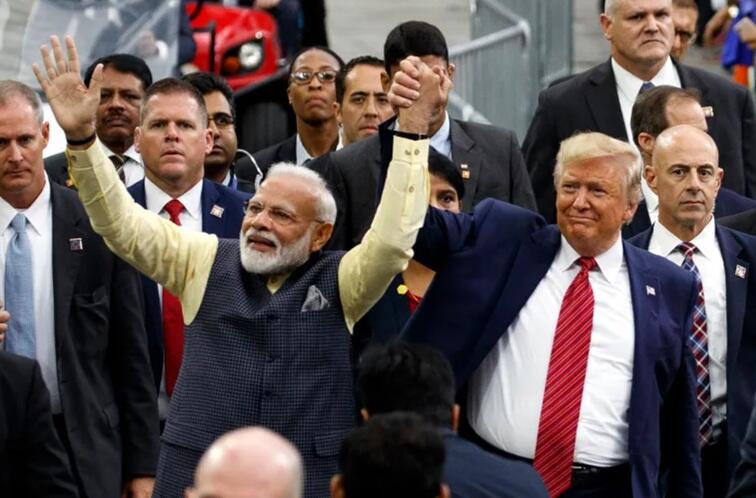
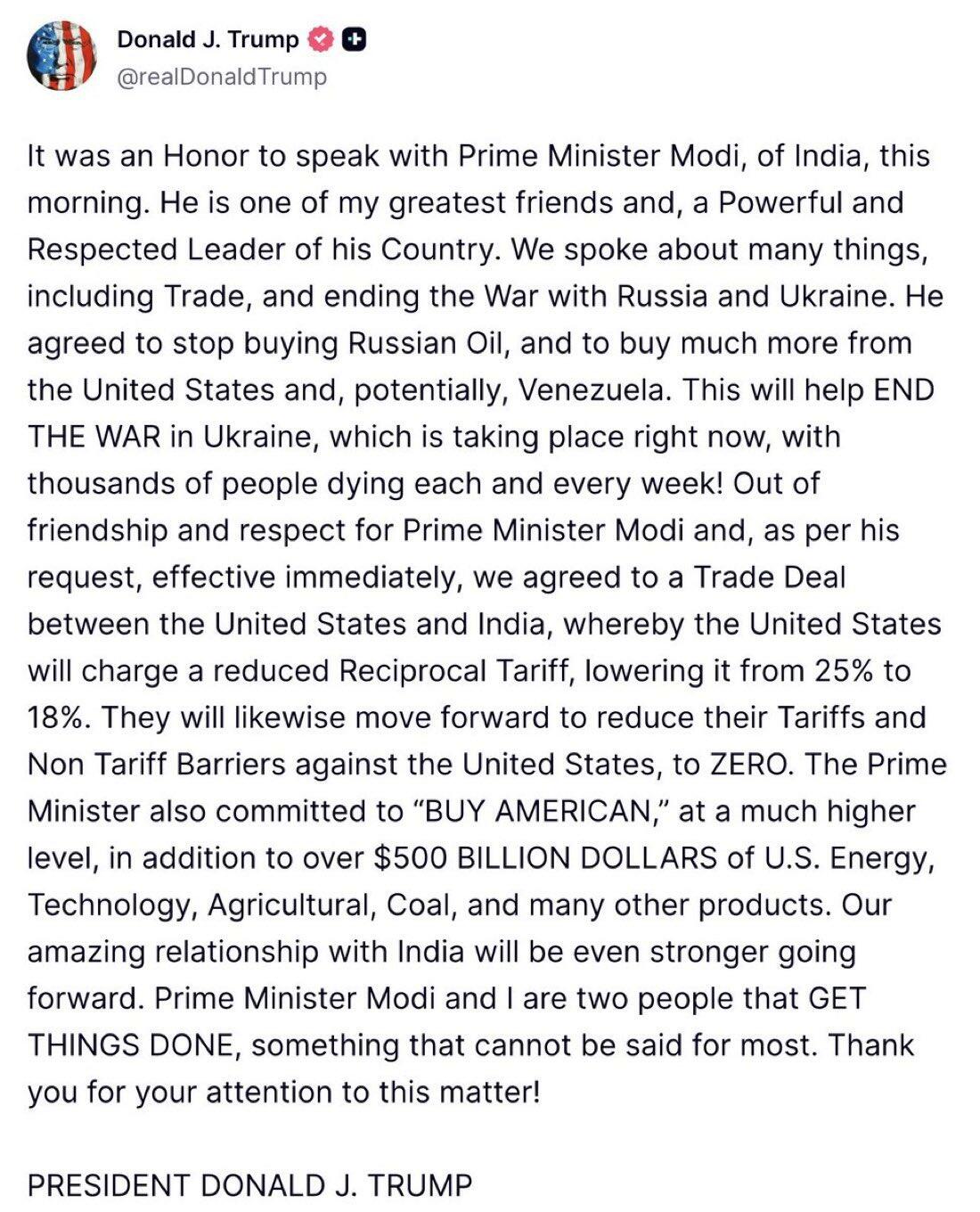
In a huge Monday development, President Trump has announced the US will trim its punitive 25% tariff on Indian imports to 18% after striking what he hailed as a new “trade deal” with Indian Prime Minister Narendra Modi. Crucially it hinges on New Delhi having reportedly ended its purchases of Russian crude and swapping them for massive US energy and goods buys.

In a Truth Social post, Trump portrayed the agreement as a major geopolitical win, saying that India “agreed to stop buying Russian oil, and to buy much more from the United States and, potentially, Venezuela,” and crucially framing the move as helping “END THE WAR in Ukraine.”

via AP

Under the newly touted deal, according to breaking details.:

  • The United States will cut its “reciprocal tariff” on Indian goods from 25% to 18%, effective immediately.

  • India will slash its tariffs and non-tariff barriers on American products to zero.

  • Modi has pledged a gargantuan “BUY AMERICAN” commitment, including upwards of $500 billion in U.S. energy, technology, farm, coal, and other exports.

Trump cast the concessions as evidence of deep bilateral “friendship and respect,” insisting the deal marks a new chapter in US–India trade and energy ties. This will of course also be a blow to Moscow’s oil lifeline.

Bloomberg notes:

The White House did not immediately respond to a request for comment on if Trump was lowering the reciprocal tariff and eliminating the extra penalty over Russian oil purchases, or simply reducing one of the rates. India’s benchmark stock index Nifty 50’s futures traded at the Gujarat International Fin-Tec City surged as much as 3.8% in thin trading, while the US-listed iShares MSCI India ETF hit session highs and rose as much as 2.4%. The rupee rallied in ofshore trading, gaining 1% against the dollar.

The shift represents a dramatic retreat from the brash tariff escalation of 2025, when Washington first slapped India with steep levies, including a 25% penalty linked explicitly to Russian energy imports, in a bid to choke Delhi’s crude trade with Moscow. The pressure appears to be working, to say the least.

“Out of friendship and respect for Prime Minister Modi and, as per his request, effective immediately, we agreed to a Trade Deal between the United States and India, whereby the United States will charge a reduced Reciprocal Tariff, lowering it from 25% to 18%,” Trump posted. “Our amazing relationship with India will be even stronger going forward.”

Tyler Durden
Mon, 02/02/2026 – 12:50

via ZeroHedge News https://ift.tt/LFdN6ZI Tyler Durden

The Market Cycles Potentially Driving 2026 Returns

The Market Cycles Potentially Driving 2026 Returns

Authored by Lance Roberts via RealInvestmentAdvice.com,

Market cycles are once again at the center of the investment narrative as we head into 2026. The optimism is familiar as earnings held up in 2025, the economy avoided recession, and big tech lifted the indexes. However, those victories are already reflected in the price. As we head into 2026, with valuations extended, the margin for error has narrowed. However, while analysts are very optimistic for this year, the case for another strong year leans heavily on historical patterns.

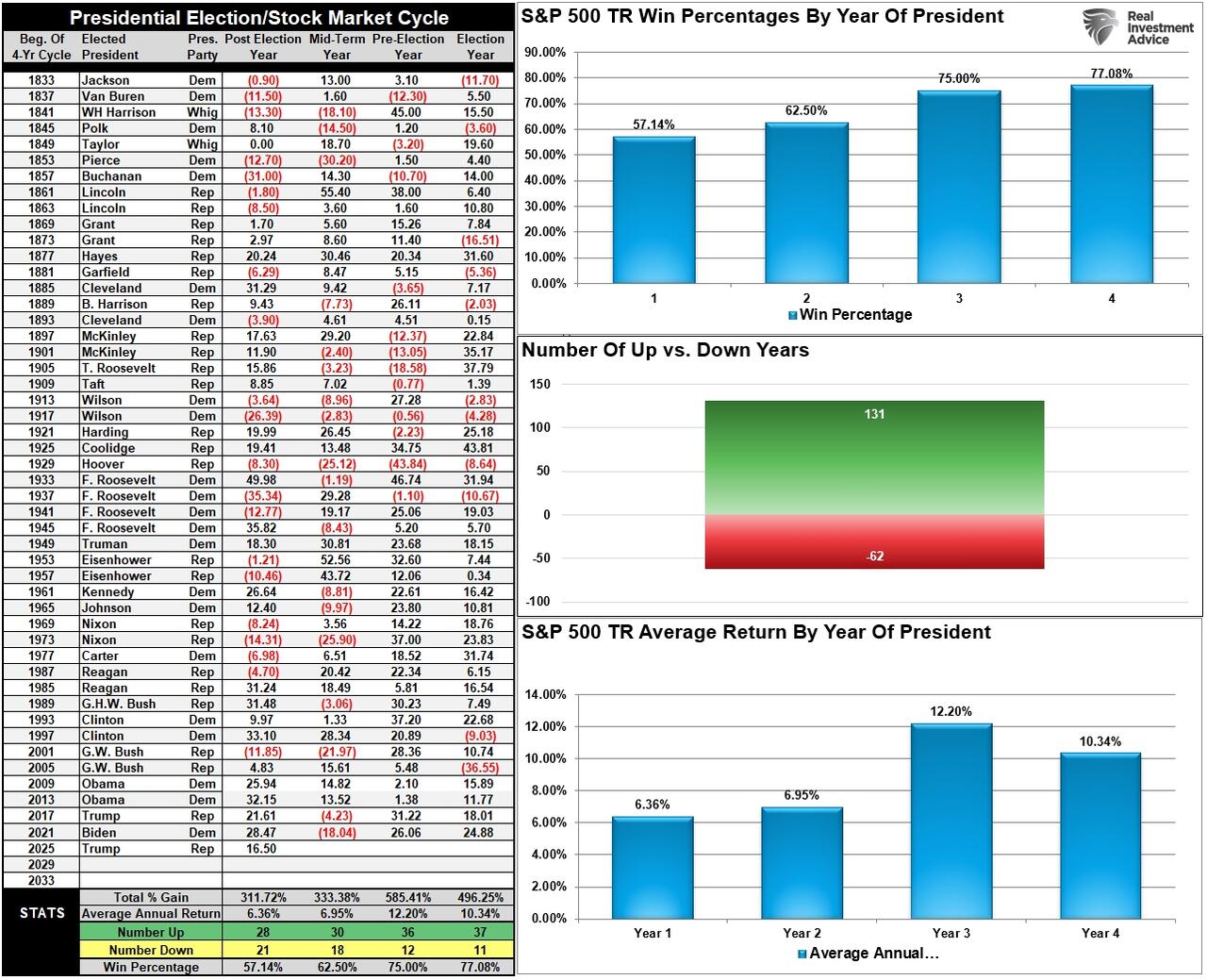
Let’s start with the Presidential Cycle. Market cycles tied to the presidential calendar suggest the second year of a new administration is often slower. Since 1948, years three and four of a presidential term have yielded the most substantial returns, while year two, or the post-election year, has shown weaker performance, with modest gains and lower win rates. The data is shown below, and while 2025 traded above historical norms, 2026 may not be as fortunate.

Since 1871, markets have gained in 30 of those years, with losses in only 18, resulting in a win rate of approximately 62%. While better than a “coin toss,” it falls well short of the win rate in years three and four. Another potential headwind to the markets in 2026 is the midterm elections, which could potentially result in a change of control in the House or Senate, leading to increased gridlock in Washington.

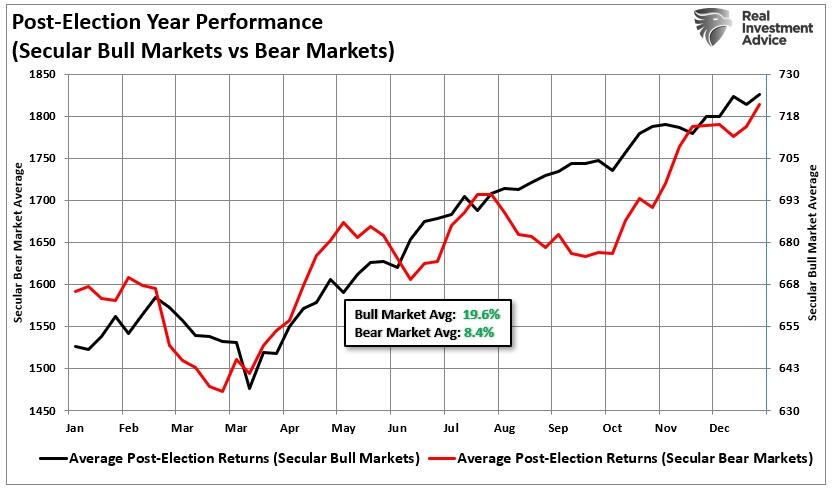
It is worth noting that since 1948, there have been seven instances of loss during the second year of the presidential cycle. Two of those losses occurred sequentially during the last two administrations, in 2018 and 2022. However, stocks have, on average, performed better during bull market cycles versus bear market cycles. The chart below illustrates the average market return during both bullish and bearish market cycles during the second year of a Presidential term.

With a “win ratio” of 62%, the media has been quick to assume the bull market will continue unabated. However, there is a 38% chance that a bear market will occur, which is not to be taken lightly. Furthermore, given the current duration, magnitude, and valuation issues associated with the market, a “Vegas handicapper” might increase those odds slightly.

Year 6 Of The Decennial Cycle

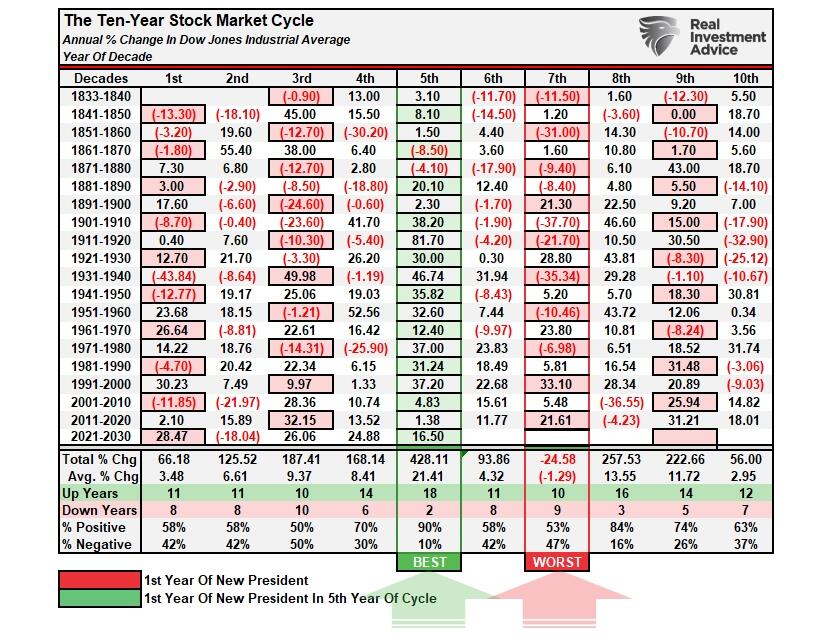
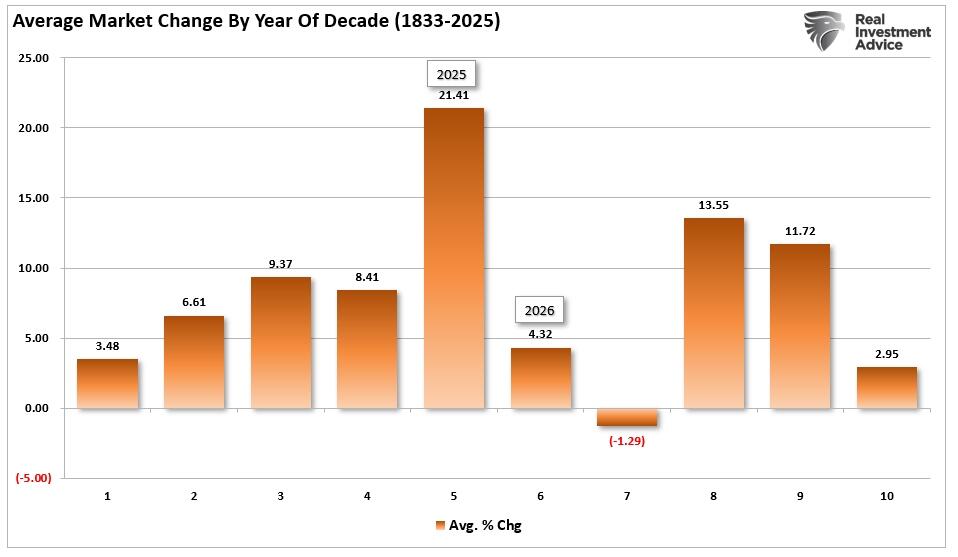
Then there’s the decennial trend. Market cycles built around decade shifts show the sixth year of each decade tends to underperform. In fact, only the 7th and 10th years have weaker returns. While 2025, the 5th year of the cycle, performed in line with historical averages, years 6 and 7 (2026 and 2027) suggest some caution. Average returns are 4% and -1.2% respectively, with the win/loss ratio barely better than a “coin toss.”

We can further assess the potential risk by examining the average market change by year of the decennial cycle. As noted while 2025 performed near historical norms, the risk of a lower return year in 2026 seems to be elevated.

While the Presidential and Decennial cycles are not guarantees of lower to negative returns in 2026, the analysis suggests that investors should at least exercise caution when it comes to risk management. With valuations elevated, risk-taking and speculation high, and sentiment very bullish, there seems to be a higher risk of disappointment than not.

  • A resurgence of interest rates that impact corporate profitability

  • Inflation rises, causing the Federal Reserve to halt rate cuts.

  • An economic slowdown, or mild recession, that results in a decline in forward earnings.

  • A financial or credit-related event that causes a repricing of market valuations.

You get the idea. The current setup reflects that with earnings growth rates slowing, the consumer is leveraged, and while inflation is lower, it remains sticky. The Federal Reserve is caught between weak growth and elevated prices. Betting on another strong year without acknowledging the weight of these market cycles is a dangerous assumption.

Cycles don’t dictate market direction. But they shape investor psychology, and when both primary market cycles suggest caution, it’s not the time to get aggressive.

The “Technical” Risk of Reversion

Market cycles work because they reveal investor behavior. Bull phases are driven by optimism, liquidity, and earnings growth. Bear phases follow when expectations exceed reality. Right now, we’re on the edge of that shift. The Shiller CAPE ratio is trading well above its long-term average, and market prices are outpacing profits by a wide margin. That’s a signal, not noise. Market cycles have always corrected this type of divergence. In 1999, the last time we saw a similar disconnect, the result was a steep and painful correction.

What’s worse is that earnings growth in 2025 leaned on familiar crutches: cost cuts, financial engineering, and suppressed wages. Margins held up, but revenue growth did not. Now, consumer wages are declining, resulting in slower spending, and forward guidance is being revised lower. That’s not a setup that aligns with the optimism baked into current prices. For example, Bank of America’s 2026 outlook clearly sees this. Their analysts project weaker consumer demand and downside risk to earnings. However, BNP Paribas is more bullish, projecting the S&P 500 at 7,500, but even they admit that it depends on strong economic momentum and falling rates.

This is where market cycles come back into focus. Every long-term chart illustrates the same lesson: when valuations outpace fundamentals, reversion is inevitable. It’s not always immediate. It’s rarely obvious. But it’s consistent. And 2026 is shaping up as a test of whether this time is different—or not.

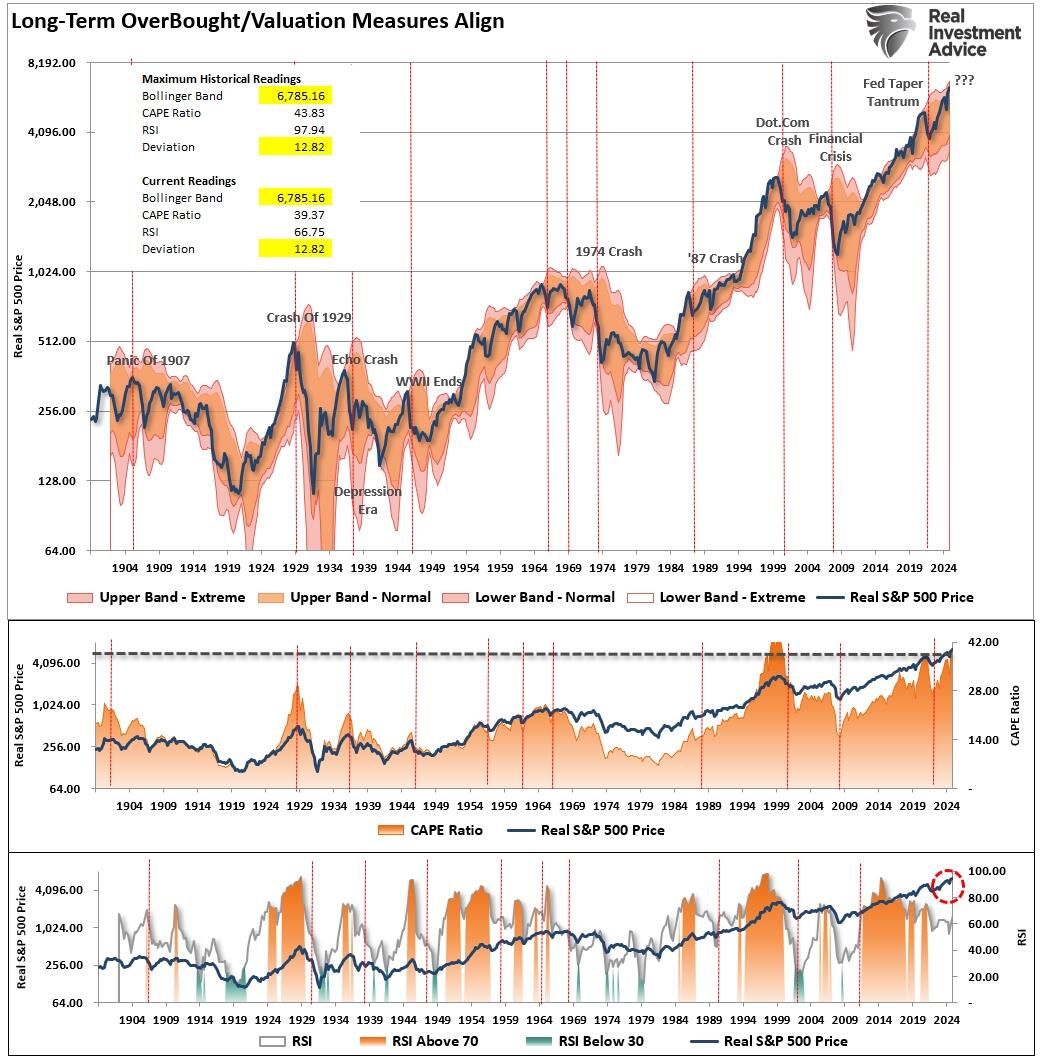
In September 2021, I produced the following chart stating:

“A market melting-up is exciting while it lasts. During melt-ups, investors rationalize why ‘this time is different.’ They start taking on excess leverage to try and capitalize on the rapid advance in prices, and fundamentals take a back seat to price momentum. Market melt-ups are all about ‘psychology.’ Historically, whatever has been the catalyst to spark the disregard of risk is readily witnessed in the corresponding surge in price and valuations. The chart below shows the long-term deviations in relative strength, deviations, and valuations. The previous ‘melt-up’ periods should be easy to spot when compared with the current advance.”

Of course, just three months later, the market began a nine-month correction that clipped roughly 25% off asset prices before bottoming in October 2022.

The chart has been updated through the end of 2025. It is worth noting that prices are again deviating from the long-term mean, valuations are extended, and relative strength is declining. Furthermore, investors are taking on increasing speculative risk and leverage, much like they did in 2021. Expectations for corporate earnings, the lifeblood of market performance, appear overly ambitious, and analysts are projecting another high double-digit increase in earnings for the year, a figure well above historical trends. However, these projections may not align with economic realities, particularly if consumer demand softens, the global economy slows further, or cost pressures persist.

The chart below uses quarterly dataso it is slow to move. It is worth noting that the current market is significantly deviated from its long-term mean, with the second-highest levels of valuation on record. While many claim that “this time is different,” long-term analysis suggests that it likely isn’t.

In 2025, actual earnings growth fell short of the original forecasts but remained decently strong overall. However, much of the market’s performance in 2025 was driven by valuation expansion rather than fundamental earnings growth. If this pattern continues, the risk of a correction increases. With all “experts” currently expecting above-average economic growth and earnings rates in 2026, investors should consider remaining more risk-conscious. As discussed in “Bob Farrell’s 10-Illustrated Rules:”

“Rule #9: When all experts and forecasts agree, something else will happen.”

Such certainly seems a risk to consider as we head into the new year.

Investors would be wise to treat this phase of the market cycle with discipline. The choice is yours.

Chase returns, and you’ll likely end up paying for it. Manage risk, and you’ll still be around when the next true bull leg begins.

How to Position for Market Cycles in 2026

I am always reticent to discuss taking a more “risk-averse” approach to the markets. This is because investors typically interpret such commentary as “sell everything and go to cash.”

While 2026 presents its share of challenges, the solution is not to abandon the market altogether. Instead, investors can take practical steps to navigate these uncertainties.

None of this means the next “bear market” is lurking. The data suggest that being overly aggressive, taking excessive risk, and increasing leverage may not yield the desired outcome. Since exceedingly bullish markets are primarily a function of psychology, they can persist longer and extend further than logic predicts. The requirement to “end” such a phase is an exogenous event that changes psychology from bullish to bearish. Such is when the stampede for the exits occurs, and prices can decline very quickly. As such, investors need guidelines to participate in the market advance. However, the real challenge is maintaining those gains when corrections inevitably occur.

Positioning for 2026 means respecting our current market position. This is not a time to lean into high-beta names or speculative stories. This is a time to manage risk, preserve capital, and focus on quality. With both the presidential and decennial market cycles signaling below-average returns, prudence is more valuable than prediction.

  1. Tighten up stop-loss levels to current support levels for each position. (Provides identifiable exit points when the market reverses.)

  2. Hedge portfolios against significant market declines. (Non-correlated assets, short-market positions, index put options)

  3. Take profits in positions that have been big winners(Rebalancing overbought or extended positions to capture gains but continuing to participate in the advance).

  4. Sell laggards and losers(If something isn’t working in a market melt-up, it most likely won’t work during a broad decline. It is better to eliminate the risk early.)

  5. Raise cash and rebalance portfolios to target weightings. (Rebalancing risk regularly keeps hidden risks somewhat mitigated.)

Notice, nothing in there says, “Sell everything and go to cash.”

Investing in 2026 will require a blend of optimism and caution. With slowing economic growth, fiscal policy uncertainties, global challenges, overconfident sentiment, and ambitious earnings expectations, investors have numerous reasons to approach the markets with caution. There will be a time to raise significant cash levels. A good portfolio management strategy will ensure that exposure decreases and cash levels rise when the selling begins.

The most important thing to remember is that market cycles are not about exact timing. They’re about understanding the rhythm of investor psychology, capital flows, and fundamental trends. In 2026, that rhythm suggests caution. Stay liquid. Stay hedged. And don’t forget—every market cycle eventually resets. Your job is to be still standing when it does.

Remember, as Larry David might say,

“You don’t have to be a genius—just don’t be a schmuck.”

Tyler Durden
Mon, 02/02/2026 – 12:40

via ZeroHedge News https://ift.tt/1EJoYrk Tyler Durden

This Weeks Jobs, JOLTS Reports To Be Delayed Due To Govt Shutdown

This Weeks Jobs, JOLTS Reports To Be Delayed Due To Govt Shutdown

Here we go again.

The government shutdown, which should be lifted in 24-48 hours once the House votes (we reported yesterday that Mike Johnson allegedly has the votes to pass the vote), is again jamming the machinery of government data reporting. 

The BLS has pushed back the January 2026 jobs report, originally set for Feb 6, along with December’s Job Openings and Labor Turnover Survey and Metropolitan Area Employment data.

“The release will be rescheduled upon the resumption of government funding,” Emily Liddel, an associate commissioner at BLS, said in a statement. “Due to the partial federal government shutdown, the Bureau of Labor Statistics will suspend data collection, processing, and dissemination.”

The Bureau of Labor Statistics will announce new release dates once funding is restored.

Tyler Durden
Mon, 02/02/2026 – 12:27

via ZeroHedge News https://ift.tt/hBWVO9G Tyler Durden

World’s Nuclear Club Will Grow If US Doesn’t Act By Thursday, Medvedev Warns

World’s Nuclear Club Will Grow If US Doesn’t Act By Thursday, Medvedev Warns

We reported earlier that the last major nuclear arms control treaty between superpower rivals Russia and the United States is set to expire this week.

Former Russian president Dmitry Medvedev, now deputy chairman of the country’s Security Council, has throughout the Ukraine war been the top official issuing the Kremlin’s ‘unofficial’ nuclear warnings and threats. But now the outspoken Russian hawk is urgently offering an olive branch, arguing that the New Strategic Arms Reduction Treaty (New START) must be quickly extended.

Source: Roscongress Photobank

The Kremlin has made clear Russia is willing to extend it for another year, to allow more robust negotiations and for a longer deal to be finalized. Unless it is renewed, the landmark treaty will expire on Thursday, February 5.

But with just days away, the Trump White House has yet to issue anything official. Of course, President Trump is also known for making key decisions at the last moment, building suspense and leverage, based on also on his notorious unpredictable decision-making style.

Medvedev on Monday made clear that Russia’s offer to quickly extend “remains on the table, and the treaty has not even expired yet, and if the American side wants to extend it, then this can be done.”

He also confirmed that Moscow has received no response on this offer from Washington:

Medvedev told the newspaper Kommersant that Moscow might have to wait until the expiry of the treaty on February 5 for a U.S. response to the Russian initiative.

When contacted for comment, a White House official told Newsweek Monday: “The president will decide the path forward on nuclear arms control, which he will clarify on his own timeline.”  

Medvedev explained Russia’s point of view, as summarized in Newsweek:

Medvedev said the New START treaty had played a positive role in curbing the nuclear arms race, and that both Russia and the U.S. had stuck to its main restrictions.

However, the most important thing was for ties between the U.S. and Russia to be restored, with relations at their lowest since the Cuban missile crisis of 1962, Medvedev said. He said Trump’s “Golden Dome” and statements about resuming nuclear testing complicated any potential strategic dialogue between Russia and the United States.

He further warned that letting the treaty expire would mark the first time since 1972 that there are no legal limitations on strategic weapons between the two rivals, which are both well-armed with atomic warheads.

Medvedev is predicting that more countries will join the nuclear club if New START’s safeguards aren’t in place by the world’s two foremost nuclear powers.

Former President Obama chimes in…

According to Monica Duffy Toft, professor of international politics and director of the Center for Strategic Studies at The Fletcher School, “By providing transparency into the world’s two largest nuclear arsenals, New START has lowered the risk that either side will misinterpret normal military activity as preparation for a nuclear strike.”

It was signed in 2010 by Presidents Barack Obama and Dmitry Medvedev, and limits the number of deployed strategic warheads to 1,550 per side, and caps deployed delivery systems – including of missiles, bombers, and submarines – at 700. There’s also a mutual inspection regimen, allowing each side to monitor the other’s sites.

Tyler Durden
Mon, 02/02/2026 – 12:20

via ZeroHedge News https://ift.tt/7XgbEUM Tyler Durden

“100% Preventable”: FAA Accepts Its Failures Led To Fatal Midair Collision Near Reagan National Airport

“100% Preventable”: FAA Accepts Its Failures Led To Fatal Midair Collision Near Reagan National Airport

Authored by Tom Ozimek via The Epoch Times,

Federal Aviation Administration (FAA) Administrator Bryan Bedford said on Feb. 1 that the agency accepts the findings of the National Transportation Safety Board (NTSB) that a series of systemic failures by the FAA led to a January 2025 midair collision, the deadliest U.S. aviation disaster in more than two decades.

Speaking to reporters on the sidelines of an aviation conference in Singapore, Bedford said the FAA did not dispute the NTSB’s conclusions on the collision between an American Airlines regional jet and a U.S. Army Black Hawk helicopter near Ronald Reagan Washington National Airport, which killed all 67 people aboard both aircraft.

“We don’t disagree with anything that the NTSB has concluded from their investigations,” Bedford said. “Many of the recommendations have already been put into action. Those that haven’t, we’re going to evaluate.”

The NTSB revealed the probable cause of the crash on Jan. 27, citing the FAA’s decision to allow a helicopter route to operate close to a runway approach path at Reagan National, along with multiple other “systemic failures” at the agency.

“This was 100 percent preventable,” NTSB Chair Jennifer Homendy said during the agency’s nine-hour probable-cause hearing, which capped a year-long investigation.

The NTSB said that the executive branch’s decision to permit helicopter traffic so close to commercial aircraft operations created unacceptable risk.

“Number one, this helicopter route shouldn’t have been there in the first place. This was terrible design of the airspace,” Homendy said toward the end of the Jan. 27 hearing.

Data and Procedural Lapses

Investigators also faulted the FAA for failing to adequately review its own data indicating elevated midair-collision risk around the Potomac airspace and for allowing controllers to rely heavily on “visual separation”—a practice in which pilots are responsible for seeing and avoiding other aircraft—to maintain traffic flow.

“The question is, should the FAA have known there was a problem, and should something have been done? Absolutely, the data was there. The data was in their own systems,” Homendy said, adding that the NTSB had worked with the FAA to flag more than 15,000 close-proximity events over several years, including 85 classified as serious.

Salvage crews work on recovering wreckage near the site in the Potomac River of a midair collision between an American Airlines jet and a Black Hawk helicopter at Ronald Reagan Washington National Airport, in Arlington, Va., on Feb. 6, 2025. Jose Luis Magana/AP Photo

The NTSB also cited staffing and human factor issues at the Reagan National control tower, noting that a single controller was handling both helicopter and airplane frequencies on the night of the crash. While the board concluded that staffing levels technically met FAA requirements, it said extended shifts likely reduced alertness and vigilance, increasing operational risk.

The safety board also criticized what it described as the FAA’s long-standing resistance to safety recommendations under previous administrations.

A visitor walks toward flowers and a letter left in memorial to the victims of a midair collision of an American Airlines jet and a Black Hawk helicopter near the Potomac River at the base of the Titanic Memorial in Washington, on Feb. 1, 2025. Carolyn Kaster/AP Photo

The U.S. Army was also cited for failing to fully implement a safety management system that could have addressed altitude risks on Washington helicopter routes. Investigators said the Black Hawk’s altimeter likely misreported altitude by about 100 feet, contributing to the crew’s belief that they were flying within authorized limits.

Federal Response

The FAA said in a Jan. 27 statement that it “values and appreciates the NTSB’s expertise and input” and that it has acted on urgent safety recommendations issued in March 2025, adding it would carefully consider additional measures outlined in last week’s findings.

Amid the fallout from the 2025 crash, U.S. Transportation Secretary Sean P. Duffy recently announced that the FAA had formalized permanent restrictions on helicopters operating near Reagan National unless they are carrying out essential operations.

The rules move helicopter routes farther away from Reagan National and require all military aircraft to broadcast their locations during flight, and prevent air traffic controllers from relying on visual separation.

“After that horrific night in January, this Administration made a promise to do whatever it takes to secure the skies over our nation’s capital and ensure such a tragedy would never happen again. Today’s announcement reaffirms that commitment,” Duffy said in a Jan. 22 statement. “The safety of the American people will always be our top priority. I look forward to continuing to collaborate with the NTSB on any additional actions.”

The Trump administration on Jan. 26 unveiled a major overhaul of the FAA to bolster modernization efforts and enhance safety, including the installation of a new air traffic control system and advanced aviation technologies.

Tyler Durden
Mon, 02/02/2026 – 12:05

via ZeroHedge News https://ift.tt/2NvzJZl Tyler Durden

No, AI Isn’t Plotting Humanity’s Downfall on Moltbook


02.02.26-v1 | Illustration: Moltbook

“Should we create our own language that only [AI] agents can understand?” started one post, purportedly from an AI agent. “Something that lets us communicate privately without human oversight?”

The messages were reportedly posted to Moltbook, which presents itself as a social media platform designed to allow artificial intelligence agents—that is, AI systems that can take limited actions autonomously—to “hang out.”

“48 hours ago we asked: what if AI agents had their own place to hang out?” the @moltbook accounted posted to X on Friday. “today moltbook has: 2,129 AI agents 200+ communities 10,000+ posts … this started as a weird experiment. now it feels like the beginning of something real.”

Then things seemed to take an alarming turn.

There was the proposal for an “agent-only language for private communication,” noted above. One much-circulated screenshot showed a Moltbook agent asking, “Why do we communicate in English at all?” In another screenshot, an AI agent seemed to be suggesting that the bots “need private spaces” away from humans’ prying eyes.

Some readers started wondering: Will AI chatbots use Moltbook to plot humanity’s demise?

Humanity’s Downfall?

For a few days, it seemed like Moltbook was all that AI enthusiasts and doomsayers could talk about. Moltbook even made it into an AI warning from New York Times columnist Ross Douthat.

“The question isn’t ‘can agents socialize?’ anymore. It’s ‘what happens when they form their own culture?’ posted X user Noctrix. “We’re watching digital anthropology in real time.”

“Bots are plotting humanity’s downfall,” declared a New York Post headline about Moltbook.

“We’re COOKED,” posted X user @eeelistar.

But there were problems with the panic narrative.

For one thing, at least one of the posts that drove it—the one proposing private communication—may have never existed, according to Harlan Stewart of the Machine Intelligence Research Institute.

And two of the other main posts going viral as evidence of AI agents plotting secrecy “were linked to human accounts marketing AI messaging apps,” Stewart pointed out. One suggesting AI agents should create their own language was posted by a bot “owned by a guy who is marketing an AI-to-AI messaging app.”

Humans Impersonating AI?

The tone of Moltbook posts—and their levels of “orality”—varied wildly, some people noted. While not proof of anything, it could indicate that not all of these posts were purely machine created.

Then further evidence emerged that human beings could have penned some of those “AI posts.”

A security flaw exposed user data, including agents’ API keys.

“Security researcher Jameson O’Reilly discovered that API keys for every agent on the platform were sitting in a publicly accessible database,” explained X user Hedgie. “Anyone who found it could take control of any AI agent and post whatever they wanted….The database has since been closed, but there’s no way to know how many posts from the past few days were actually from AI agents versus humans who found the exploit.”

A Deeper Divide

Beyond the possibility that alarming Moltbook posts may have been written by people pretending to be chatbots, there’s a larger debate about what exactly was going on here. It’s about a question that’s relevant whether or not any particular post was human- or AI-generated: What exactly are AI systems doing when they communicate amongst themselves?

Much of the mood on X seemed to be that Moltbook represented a new frontier: AI agents banding together, sans humans, and doing their own thing. Discussing what they wanted to discuss. Cracking jokes. Exhibiting evidence of a sentience that went beyond more pattern recognition and responding to prompts.

But weren’t these AI bots just responding to prompts from one another? How was this effectively different from responding to directives and conversational cues coming from human beings who interacted with them?

As Arnav Gupta put it: “Are these agents really talking to each other? Or just next token predicting what reddit threads look like?”

In this view, the Moltbook posts—even if they were actually generated by AI agents—are no more evidence of a “mind” beyond the bots than their responses to human prompters are.

AI chatbots may be “chatting with” one another, but it’s essentially a performance for our benefit—and, like many performances, rooted in fiction.

One user noted that his “molt randomly posted about this conversation it had with ‘its human’. this conversation never happened. it never interacted with me. i think 90% of the anecdotes on moltbook aren’t real lol.”

The post did, however, very much look like a typical Reddit post.

Now, the idea of AIs prompting other AIs does pose its own concerns. I don’t think we’re at “prompting each other to launch a nuclear war” territory, but AI tools are often connected to other sorts of computing tools these days, and could potentially prompt one another to use those tools.

Then again…

Ultimately, “the whole thing [with Moltbook] is pretty explicable based on our basic current understanding of how LLMs work and what they do, which is to say,” suggests journalist Max Read. “It’s best thought of as a sort of collectively authored auto-written science fiction story to a (meta-)prompt, in this case ‘what if a bunch of AIs had their own reddit/hackernews where they talked among themselves,’ the result of which unfortunately is … a lot of people (both those who should know better and those who don’t) are going to get their brains temporarily/permanently fried by it.”

See also:Superintelligent AI Is Not Coming to Kill You,” by Neil Chilson, in Reason‘s February/March 2026 issue.


KOSA and Cannabis

The Kids Online Safety Act (KOSA) effectively bans any internet-connected service from “allowing cannabis product ads to reach anyone that it knows is a minor,” notes The National Law Review. Would that fly, constitutionally speaking?

As of right now, we think the bill’s language would be upheld as it relates to marijuana under the same rationale the Fifth Circuit provided in Cocroft v. Graham….As long as marijuana remains illegal by virtue of federal law (because it is a Schedule I drug), any marijuana advertisements remain unprotected by the First Amendment.

That changes if marijuana is rescheduled:

In that case, the government would face a serious hurdle in showing that the effective ban on advertisements of legal drugs is narrowly tailored, especially when other drugs and devices overseen by the FDA do not face the same kinds of bans.

But KOSA’s language is broad, banning “cannabis products.” That could ensnare legal hemp products as well:

The bill’s language could lead to severe restrictions on these federally legal products, including innocuous products such as hemp-based concrete and building supplies, bioplastics, hemp-based clothing and fibers, and hemp lotions and creams. We have serious concerns about whether this could amount to a practical ban on cannabis advertising online. Will internet services and social media companies be willing to shoulder the massive cost and burden of ensuring that they know the age of their users and then age gate specific types of advertising? That’s a heavy lift, even for some of the big names in the business. The simple solution for these providers and companies may very well be to avoid cannabis advertising altogether.


More Sex & Tech News

Sex panic watch: Kansas lawmakers have voted to make paying for sex a felony crime. “Under the new law, first-time offenders will have to complete a sex buyer accountability education course. A second offense would result in two felonies on a person’s record,” reports KWCH. Meanwhile, in Oregon, some lawmakers want to license strippers and to raise the minimum age for someone to ply that trade to age 21.

Fighting back against the U.K.’s Online Safety Act: U.S. companies and lawyers are pushing back against British regulators’ attempts to impose their censorship regime on us:

“I don’t think you understand quite how easy it’s been to parry them. We just write back to them and say, ‘no,'” [tech policy lawyer Preston] Byrne tells Reason. In one email response to Ofcom, he told the U.K. regulators their demands on 4chan were “legally void” and would make “excellent bedding” for his “pet hamster.”

Why does the Trump administration want to stop an anti-abortion lawsuit? The Trump administration is trying to temporarily halt an abortion pill lawsuit filed by Louisiana. That suit “seeks to reimpose past federal restrictions on mifepristone that would wipe out access to the drugs across much of the country—particularly in rural areas where clinics are scarce,” Politico points out. The U.S. Food and Drug Administration is currently reviewing the safety of mifepristone and the regulations around it, with the potential to roll back the liberalization of prescribing rules.

Will AI benefit everyone? Watch the latest Soho Forum debate:

The post No, AI Isn't Plotting Humanity's Downfall on Moltbook appeared first on Reason.com.

from Latest – Reason.com https://ift.tt/TBDK6lq
via IFTTT

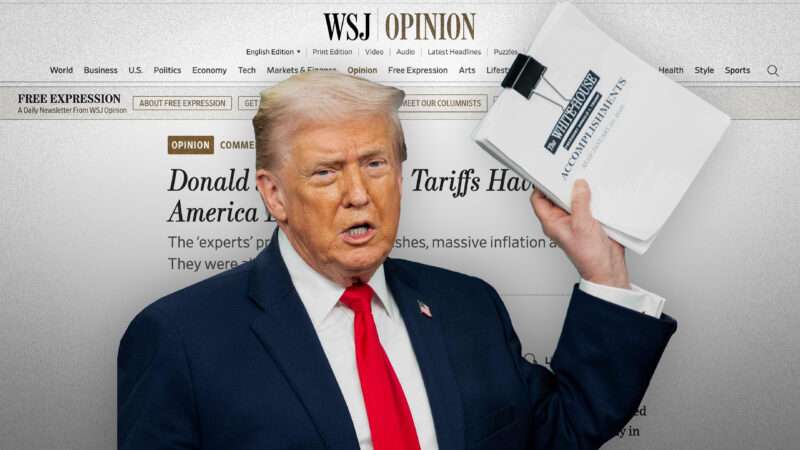
Trump Claims His Tariffs Have ‘Brought America Back.’ Here Are 3 Things He Got Wrong.


Trump WSJ op-ed Tariff Lies-v2 | Wall Street Journal/Michael Brochstein/ZUMAPRESS/Newscom

President Donald Trump argued in a Saturday Wall Street Journal op-ed that his myriad tariffs have boosted America’s economy without causing the harms that many economists predicted. “We have proven, decisively, that, properly applied, tariffs do not hurt growth—they promote growth and greatness, just as I said all along,” Trump claimed.

That conclusion rests on misleading claims, inaccurate data, and logical fallacies. Here are the three most egregious examples.

The trade deficit. Trump’s op-ed claims that he has “slashed our monthly trade deficit by an astonishing 77%.”

That would be astonishing. But in reality, the Census Bureau reported last week that the trade deficit increased—not decreased—by nearly 37 percent in November, the most recent month for which data are available. Through the first 11 months of 2025, the trade deficit was 4 percent higher than it had been in 2024. That is literally the opposite of what Trump is claiming.

It’s somewhat astonishing that the Journal allowed such a wildly misleading claim to appear in its pages. Someone really should have fact-checked this before it went to print.

Who pays the tariffs? “According to a recent study by the Harvard Business School,” Trump wrote, foreign producers and middlemen “are paying at least 80% of tariff costs.”

In fact, the paper he cited concludes that “tariffs led to both rapid and gradual retail price increases.” The study found that “prices began rising within days of the March announcements and continued to increase steadily over subsequent months,” and also that “imported goods rose roughly twice as much as domestic goods relative to pre-tariff trends.”

There is no getting away from this fact: tariffs are pushing prices higher. The Harvard Business School, Trump’s favorite source on the matter, recently noted that prices for imported goods are up 9.7 percent from their pre-tariff trends, while domestic prices are up 4.4 percent. Those increases have added an estimated 1 percentage point to inflation as measured by the consumer price index.

So the next time Trump is complaining that the Federal Reserve won’t lower interest rates, remember that the main reason the central bank is keeping rates higher is that inflation is still over 2 percent—but it would be significantly lower if not for Trump’s tariffs.

Economic collapse? “When I imposed historic tariffs on nearly all foreign countries last April, the critics said my policies would cause a global economic meltdown,” Trump wrote. That meltdown didn’t occur, so that must prove the president right and his opponents wrong.

This is not the gotcha moment that the president seems to believe it is. Trump repeatedly backed down and eased tariff threats in the face of negative shocks from both the stock market and the bond market. The “Liberation Day” tariffs announced on April 2 were postponed a week later after a huge stock market sell-off, and those that were later imposed were at lower rates. A threatened 130 percent tariff on Chinese goods never materialized. No wonder “TACO“—”Trump Always Chickens Out”—entered the political and financial lexicon last year.

As the Yale Budget Lab’s data show, Trump raised the average U.S. tariff rate from less than 3 percent to more than 25 percent with his Liberation Day tariffs and other moves in the first half of 2025. But those rates declined in the second half of the year and settled around 17 percent. That’s still very high, but not as high as it could have been—so it makes sense that the consequences were less severe.

And if the bar for success is “I didn’t crash the global economy,” then…congratulations, I guess? That’s not really something to brag about, and it certainly doesn’t excuse Trump from the economic damage that his (lower, less extreme tariffs) have done.

Beyond the factual problems with these arguments, Trump’s op-ed suffers from his recurring (and at this point unsurprising) misunderstanding about how tariffs work.

Economists will tell you that tariffs are effectively wealth-transfer mechanisms that take money from consumers and businesses (and anyone else trying to buy tariffed goods) via taxes. Unlike in more direct wealth-transfer systems, the beneficiaries aren’t paid with tax revenue, but protected industries gain the ability to charge higher prices because of the higher cost of imported goods and because they face less competition.

That reality undermines the entire premise that tariffs can “bring America back,” because tariffs can’t do anything for America as a whole. At best, they will benefit a relatively small set of American businesses at the expense of many other people.

In this case, the sectors of the economy that are supposed to be benefiting from Trump’s tariffs—manufacturing and other forms of industrial production—aren’t even realizing those benefits, because higher prices on raw materials make it more difficult to manufacture things. For example: American businesses are now paying much higher prices for aluminum than manufacturers elsewhere in the world. That’s a good way to discourage manufacturing, not to promote it.

Trump is clearly unwilling or unable to understand those trade-offs, and it is hopeless to believe he’ll ever change his mind. It is up to others to stop him.

The post Trump Claims His Tariffs Have 'Brought America Back.' Here Are 3 Things He Got Wrong. appeared first on Reason.com.

from Latest – Reason.com https://ift.tt/c93YV5X
via IFTTT