There Will Never Be Another Moira Rose


Moira Rose, played by Catherine O'Hara, | Screenshot, YouTube

Long after the sitcom Schitt’s Creek ended in 2020, it would not have been abnormal to catch me talking like a certain one of its characters in casual conversation. The show, about a wealthy family effectively exiled to life in a motel after the government seizes their assets, is teeming with weirdos. There are the townies, of course. How normal can you really expect someone to be after growing up in a place named “Schitt’s Creek”? And there are the Roses, that fallen family, who—with the exception of the dad, as every comedy needs a straight man—are the absolute kookiest of them all. Especially Moira.

Moira Rose, the soap opera actress, unlikely matriarch, and purveyor of ludicrous garments, wigs, and turns of phrase, is gone. And by that I mean Catherine O’Hara, the actor who brought her to life, died last week. The two were inseparable to me. You often catch glimpses of the familiar when watching characters onscreen: a mannerism that evokes a loved one, an archetype that reminds you of that dreadful ex, a quality that (un)comfortably makes you feel you are looking in a mirror. Moira, though, was singularly absurd—so unapologetically herself and free from ordinary social expectations in a way I had never seen before and knew I would never see again. There was no one like Moira Rose, and so there was no one like Catherine O’Hara.

First, there was the accent, that voice you’re still liable to hear me invoking to this day. I don’t know if I can describe it well, but I’ll give it a whirl: It was as if a Mid-Atlantic accent, a Cockney accent, and a Southern accent had a baby—posh with its tall vowels, harsh with its hard emphases, long with its relentless drawl. It also kind of sounded like she had cotton in her mouth, for whatever that’s worth. In other words, it is not an accent that occurs naturally on the global cadence spectrum. Moira, a.k.a. O’Hara—O’Rose? Rose’Hara?—concocted it out of thin air. Why speak like normal people, like people expect you to speak, when you can speak like Moira Rose?

The results were delightfully chaotic. During one memorable sequence, Moira leverages her celebrity to film an advertisement for a local vintner. It’s not every day a former Sunrise Bay star moves to Schitt’s Creek, after all. She struts into the shot—”If you like fruit wine as much as I do,” she tells the camera, chewing every word—before it becomes clear she cannot, under any circumstances, pronounce the winery owner’s name, Herb Ertlinger. The vowels are too narrow for her yawning twang to spit out in such quick succession. Also, she’s plastered.

Then there were the wigs. I initially thought to analogize them to the rainbow, but that would be understating the situation—Moira’s collection, which was O’Hara’s idea, was so inexhaustible that I would not know how to classify many of the shades on a color palette. Bubblegum pink? Icy-broccoli green? She was undeterred by style conventions; we will call my favorite look, a snowy white bob that developed a mind of its own during a Moira-esque bluster of emotion, Einstein chic. If you asked Moira, though, they all had minds of their own. She treated them as her daughters, or her “bébés,” each with a personality that she could embody fully via osmosis. “Maureen does not like to be manhandled,” Moira cautions a townie who tries to make contact. Ah, Maureen, the dame who’s blonde on top and raven underneath. She knows what she wants.

Maureen, of course, was Moira—not the other way around. They all were, because they were all her creations, different shades of her near-limitless individualism, her refusal to be constrained by arbitrary norms. They were paired, naturally, with an outrageous wardrobe, which looked like what you’d get if the lead in-house designer at White House Black Market had a psychotic break. She used words like “pettifogging” and “bombilating.” She likened her son’s behavior in a tense moment to that of a “disgruntled pelican.” She did not hide the ball: “What you did was impulsive, capricious, and melodramatic,” she once instructed her daughter, “but it was also wrong.”

Why was Moira the way she was? Was it pure, unbridled confidence? There was some of that. Was she simply detached from reality? There is freedom to be found in delusion. Was it a never-ending performance, driven by ego and insecurity? Her star was waning, a tragedy made worse by the fact that it never reached the stratospheric heights she intended.

Despite O’Hara’s success, I imagine she related to that inner doubt on some level, particularly as a lifelong student of one of the most merciless art forms: comedy. But the truth is that nearly everyone can relate to Moira. Who doesn’t cosplay their own life in one way or another? Perhaps the familiar glimpse we see in the character—penetrating that singular absurdity—is one of the most universal experiences: a desperate need to be liked.

And yet I frankly don’t really care what the answer is. I loved Moira less because of who she was than because of how she came to be. O’Hara could have easily mounted a cliché. The aging prima donna isn’t groundbreaking territory—hello, Norma Desmond. Instead, she stitched together something remarkably peculiar, something self-serious that demanded not to be taken seriously. I marveled at that accent, the product of unrestrained creative liberty. Meanwhile, I avoided watching O’Hara in interviews; I didn’t want to believe she spoke without it. Never have I been so enthralled by a performance while so acutely aware of the actor behind it.

I don’t know how Moira’s story ends, because I didn’t finish Schitt’s Creek. Watching those final episodes would have required accepting it was over. There would be no additional dialogue with that otherworldly Moira accent. There would be no more Moira zingers, costume changes, or surprises. There would never be someone so distinctly and deliciously unhinged. I definitely won’t be finishing now.

The post There Will Never Be Another Moira Rose appeared first on Reason.com.

from Latest – Reason.com https://ift.tt/tVfa8xW
via IFTTT

Shutdown Showdown


Speaker Johnson | Andrew Leyden

The federal government is partially shut down, at least until the U.S. House of Representatives gets back to work on Tuesday. The Senate did vote for a deal—one that President Donald Trump approves of—over the weekend, but it’s not totally clear that Speaker Mike Johnson will have the votes. At the very least, he needs virtually every single Republican House member to return to Washington, D.C. The Republican margin in the house is currently 218–213—about to become 218–214.

“I have a one-vote margin, yes, for the rest of 2026,” said Johnson, according to CNBC. “But we’re going to demonstrate once again that this is the party that takes governing seriously.”

Whether the agreement to fund the government will attract any Democratic support in the House remains to be seen. The recent controversies involving immigration enforcement in Minnesota have prompted Democrats to push for changes, and they are understandably loath to reward the Department of Homeland Security, which oversees Immigration and Customs Enforcement (ICE), with additional funding. The Senate bill keeps DHS funding at existing levels for two weeks, giving Republicans and Democrats time to haggle over accountability measures for ICE.

But House Democrats seem inclined to reject this plan. Rep. Ro Khanna (D–Calif.), for instance, said he would vote against the bill and urged his colleagues to do the same.

“I just don’t see how, in good conscience, Democrats can vote for continuing ICE funding when they’re killing American citizens, when there’s no provision to repeal the tripling of the budget,” he said. “I hope my colleagues will say no.”

During a private call on Sunday, some Democrats signaled that they would indeed be inclined to vote for the spending package.

Trump apparently has no appetite for another government shutdown, telling Fox News over the weekend that he hopes “enough people will use their heads.”

The two immigration enforcement officers who shot and killed Alex Pretti in Minneapolis, Minnesota, have been identified. They are Border Patrol agent Jesus Ochoa, age 43, and Customs and Border Protection (CBP) officer Raymundo Gutierrez, age 35. Their names were released by ProPublica, which identified them from government records.

Contrary to some speculation, they were not rookies.

“Records reportedly show that Ochoa joined CBP in 2018 as a border patrol agent, while Gutierrez began working for the agency in 2014,” reports The Guardian. “Gutierrez serves in CBP’s office of field operations and is part of a special response team that handles high-risk missions similar to those carried out by police Swat units. Both men are from south Texas.”

Sen. Rand Paul (R–Ky.) is seeking more information about Pretti’s death, calling on top immigration enforcement officials to testify before the Homeland Security and Governmental Affairs Committee. Appeared on 60 Minutes on Sunday, the senator strongly disputed the Trump administration’s contentions about Pretti’s death. Paul denied that Pretti could be seen assaulting police officers in the video.

Some powerful people are not coming off well in the Epstein files. For instance, newly released emails show that Jeffrey Epstein and Elon Musk corresponded in 2012. Musk previously claimed that he had refused an invitation to Epstein’s island. But in a November 2012 email to Epstein, Musk wrote, “What day/night will be the wildest party on your island?” Richard Branson, Andrew Farkas, and Steve Tisch also correspond with Epstein.


Scenes from Washington, D.C.: Denizens of the nation’s capital have been complaining ceaselessly about the city government’s unbelievably poor response to last month’s snowstorm, and the city has renewed its efforts to more effectively plow streets and clear away giant chunks of ice. I watched from my window on Saturday as the city employed heavy construction equipment to get the job done in my neighborhood.

Nevertheless, many school systems in the D.C. metro area will remain closed for a sixth straight day. That’s gotta be frustrating for parents!


QUICK HITS

  • While it’s likely not going to make back what it cost to produce, Melania—the new film about the first lady—had a strong opening for a documentary, bringing in about $7 million.
  • Bad Bunny and other celebrities criticized ICE during their acceptance speeches at the Grammys.
  • Elon Musk is very upset about the casting rumors for Christopher Nolan’s The Odyssey: Lupita Nyong’o is theorized to be portraying Helen of Troy.
  • Pro-Palestinian protesters, apparently unaware of the speaker’s stated views on the issue, interrupted an event at Sarah Lawrence College featuring New York Times columnist Ezra Klein.
  • Actress Catherine O’Hara has passed away at age 71.

The post Shutdown Showdown appeared first on Reason.com.

from Latest – Reason.com https://ift.tt/9NwBv7j
via IFTTT

New in WaPo: “College deans aren’t protected by academic freedom”

Recently, the University of Arkansas Law School made an offer to a dean candidate, and then promptly rescinded it, apparently because she joined an amicus brief in the transgender athletics case. The AALS and other groups charged this rescission violated norms of academic freedom. Not quite. Individual professors have academic freedom rights, but Deans, in their administrative capacities do not. At state institutions, deans are at-will employees who are appointed by politically accountable bodies.

Ilya Shapiro and I discuss this situation in the Washington Post. Here is the introduction:

The University of Arkansas School of Law hired Professor Emily Suski as dean in early January, but promptly rescinded that offer less than a week later based on “feedback from key external stakeholders.”

It turns out that Suski joined a Supreme Court brief arguing that federal law guarantees biological males the right to participate in female sports. That position might seem self-evident in the ivory tower, but in the real world, there’s consensus across the political spectrum that this position is wrong as a matter of law, policy and science.

Elite academics predictably cried foul. The Association of American Law Schools charged that the job rescission was a “blatant violation of academic freedom” and a “threat to the legal profession.” That group of august law professors might need to go back to school. While individual professors, including Suski in her scholarly capacity, enjoy academic freedom protections, there’s no First Amendment right to a deanship. The dean is appointed by the university’s governing body as an at-will employee to serve the university’s interests. A public university in particular could reasonably have concluded that Suski might have had a hard time interacting with the legislature, executive branch officials, alumni and donors. This red state was the first to ban medical treatment for minors with gender dysphoria.

Perhaps we would have more sympathy for the AALS’s claim, but this organization has done nothing to protect conservative dean candidates who are systematically excluded from higher education. Now, legislatures in red states are finally pushing back:

States must ensure that university officials can faithfully serve their communities without alienating either side of the political spectrum. Candidates with obvious blue flags should be vetted so they can effectively interact with “key external stakeholders.” They should also be able to credibly deal with a Republican-run Department of Education, as well as state supreme courts that are removing the far-left American Bar Association’s monopoly on law school accreditation.

In an ideal world, politics would play no role in dean selection. But we’re far from an ideal world. Those who dissent from progressive orthodoxy have been excluded from legal academia for generations — we’ve both personally felt that sting in our careers — and the AALS has done nothing. But as soon as one progressive dean is axed, the fainting couches come out.

Finally, I am proud to announce my new affiliation as an adjunct scholar with the Manhattan Institute. You will hear more about my work with MI in due course.

The post New in WaPo: "College deans aren't protected by academic freedom" appeared first on Reason.com.

from Latest – Reason.com https://ift.tt/PmOzQ1q
via IFTTT

ICE Drops $70 Million On Massive Arizona Warehouse To Detain And Deport Illegals

ICE Drops $70 Million On Massive Arizona Warehouse To Detain And Deport Illegals

Authored by Steve Watson via Modernity.news,

Arizona is ground zero in the fight to reclaim U.S. borders, with ICE shelling out a whopping $70 million for a 418,000-square-foot warehouse in Surprise—the size of seven football fields—to process and detain illegal aliens targeted for deportation. The acquisition under the Trump administration marks a long-overdue shift from the chaos of unchecked migration that flooded communities under previous Democrat-led policies.

The Department of Homeland Security snapped up the sprawling industrial site near Dysart and Cactus roads in a cash deal completed January 23, as property records confirm. ICE plans to convert it into a 1,500-bed processing center, part of a broader push to expand detention capacity amid renewed focus on mass deportations.

Local officials in Surprise distanced themselves, stating they “do not participate in ICE operations” but can’t block federal authority. Yet the move has ignited fury from Arizona Democrats, who see it as a direct threat to their sanctuary-state dreams.

State Senator Analise Ortiz slammed the purchase as “abhorrent,” adding “It really should chill all of us because ICE is violating the US Constitution, which means none of us are safe, including United States citizens.”

The warehouse buy comes hot on the heels of Arizona Attorney General Kris Mayes’ inflammatory warnings to ICE agents, where she suggested citizens could legally shoot masked feds under the state’s Stand Your Ground law.

In a brazen display of anti-enforcement bias, Mayes told local media: “You have these masked Federal officers with very little identification, sometimes no identification, wearing plain clothes and masks. And we have a stand your ground law that says that if you reasonably believe that your life is in danger, and you’re in your house or your car or on your property, that you can defend yourself with lethal force.”

She doubled down, questioning how people would know if masked intruders are legitimate officers: “But how do you know they’re a peace officer? It becomes, did they reasonably know that they were a peace officer?” Mayes even boasted of her own gun ownership, implying she’d react the same way.

Republicans blasted her comments as dangerously irresponsible, with calls for resignation pouring in. Senate Majority Leader John Kavanagh demanded she retract and step down, while Congressman Abe Hamadeh accused her of justifying murder against federal agents. It’s classic leftist hypocrisy: championing gun rights only when it suits their agenda to sabotage border security.

Mayes also launched a webpage urging citizens to report and film alleged ICE misconduct, vowing to prosecute agents for “assault, murder, unlawful imprisonment” if they step out of line. She warned ICE to “keep your hands off of our tribal members,” positioning herself as a defender against federal overreach while ignoring the real victims—American communities ravaged by illegal immigration.

The new Arizona facility is just one piece of ICE’s aggressive warehouse-buying spree across the U.S., with the agency acquiring sites in at least eight states to ramp up detention networks. Recent purchases include a $102 million warehouse in Maryland and plans for an 8,500-bed mega-jail in El Paso, Texas, as part of a $45 billion effort to enforce immigration laws long ignored by deep-state bureaucrats.

While open-borders advocates howl in protest, this facility promises to bolster enforcement efforts, ensuring criminals and overstays are swiftly removed to protect American families and sovereignty.

Your support is crucial in helping us defeat mass censorship. Please consider donating via Locals or check out our unique merch. Follow us on X @ModernityNews.

Tyler Durden
Mon, 02/02/2026 – 11:25

via ZeroHedge News https://ift.tt/D6dZHa3 Tyler Durden

The ‘Full Of Wind’-y City: Chicago Mayor Johnson Puts “ICE On Notice”… Of Meaningless Gesture

The ‘Full Of Wind’-y City: Chicago Mayor Johnson Puts “ICE On Notice”… Of Meaningless Gesture

Authored by Jonathan Turley,

I have long been a critic of Chicago Mayor Brandon Johnson, who has been a disaster for my home city.

From moronic proposed taxes to racist comments, Johnson has brought some of the greatest devastation to the city since the Great Fire.

Deeply unpopular, he often uses race-baiting commentary or gimmicks to distract voters. The latest is his chest-pounding press conference where he declared “we are putting ICE on notice in our city.” 

The threat was that he was ordering the Chicago Police Department to move against ICE in the city.

However, even a cursory examination reveals that, as before, there is less than meets the eye in Johnson’s theatrics.

Democratic leaders have jumped the shark on ICE and are now trying to outdo each other with increasingly reckless rhetoric.

Gov. Tim Walz declared last week that this was now a “Fort Sumter” moment, alluding to a new civil war.

Philadelphia District Attorney Larry Krasner promised to “hunt down” ICE officers like “Nazis.”

Rep. Eric Swalwell has promised, if elected governor, he will take away the driver’s licenses of ICE officers and bar them from employment in the state.

It is hard to see what else he can promise to take away other than cable and WiFi.

Johnson is not to be out-yelled on this or any other subject.

He signed an executive order Saturday laying the groundwork for the city to investigate and seek prosecution of federal law enforcement officers.

The order, titled “ICE On Notice,” directs members of the Chicago Police Department (CPD) to document alleged illegal activity by federal immigration agents and refer evidence of felony violations to the Cook County State’s Attorney’s Office for possible prosecution.

He declared that “with today’s order, we are putting ICE on notice in our city. Chicago will not sit idly by while Trump floods federal agents into our communities and terrorizes our residents.”

While it is true that officers do not have absolute immunity, it is highly unlikely that they could be liable for the increased enforcement of immigration laws. Just a day ago, a federal judge and Biden appointee in Minnesota rejected Attorney General Keith Ellison’s demand that federal operations be enjoined in his state. He could not come up with a single claim that the expanded operations were unlawful to sustain the burden for an injunction.

A close examination of the Johnson order shows that it is little more than a directive to the CPD to document any alleged violations. While suggesting that CPD would arrest federal officers, it merely states that they should take statements and preserve any videotapes of alleged violations.

Johnson said the order makes Chicago the first city in the nation to pursue legal accountability for alleged misconduct by federal immigration agents.

That included the alleged game-changing order that police should file “incident reports.” Actual incident reports! ICE officers are presumably fleeing en masse at the very threat of such CPD reports.

The term “windy city” is not, as commonly believed, a reference to the wind off the lake. In the Nineteenth Century, it was a reference to how Chicago politicians were full of wind in their bragging and exaggerations. In that sense, Johnson is the very personification of the Windy City, but this order will not even rustle the leaves in Lincoln Park.

Tyler Durden
Mon, 02/02/2026 – 10:50

via ZeroHedge News https://ift.tt/YPVmtQ1 Tyler Durden

On-Chain Activity Soars As Crypto Crumbles, ‘Mega-Whales’ Buying The Bitcoin Dip As Retail Runs For Exits

On-Chain Activity Soars As Crypto Crumbles, ‘Mega-Whales’ Buying The Bitcoin Dip As Retail Runs For Exits

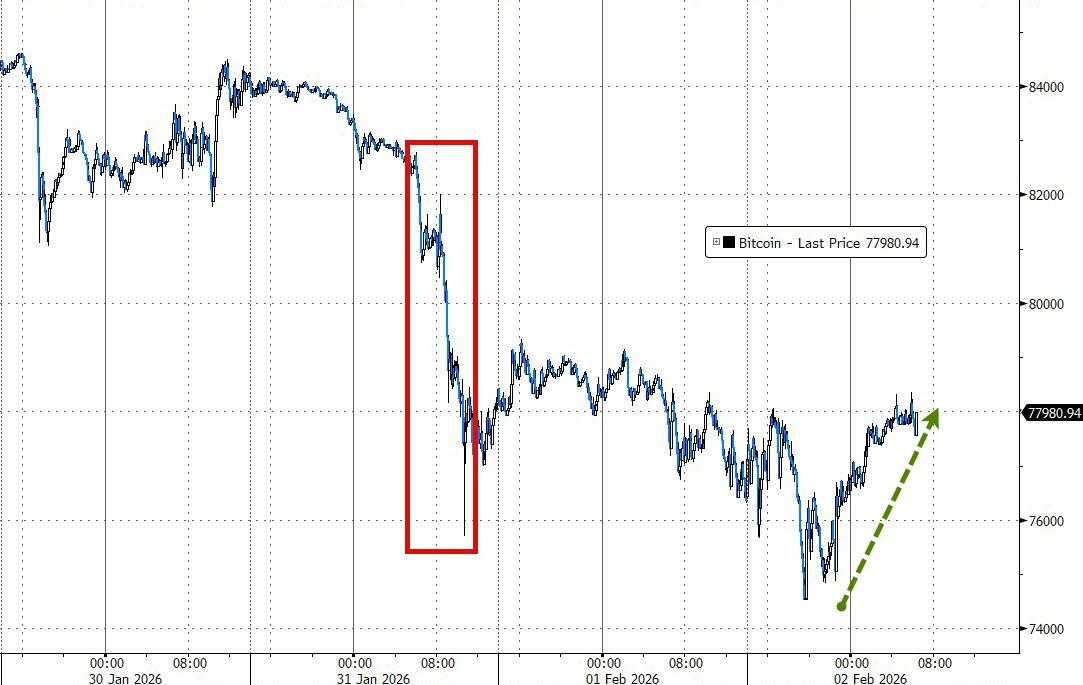
Crypto prices are rebounding this morning, after further weakness over the weekend to its lowest since Trump’s election victory

“From a technical perspective, the recent drawdown is bringing price closer to attractive levels,” said Joel Kruger, a markets strategist at LMAX Group.

Bitcoin is likely to find “strong support” should it drop to around $70,000, he said.

Other cryptocurrencies like Ether and Solana also staged modest rebounds after slipping earlier Monday.

“For crypto specifically, ETF flow stabilization is the key signal to monitor,” said Timothy Misir, head of research at digital asset analytics firm BRN.

“Without it, rallies are likely to fade.”

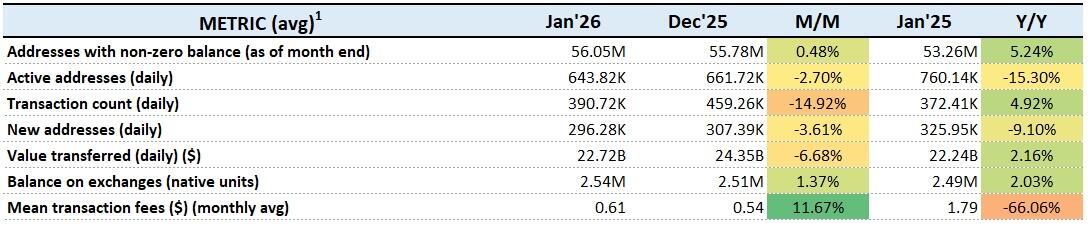
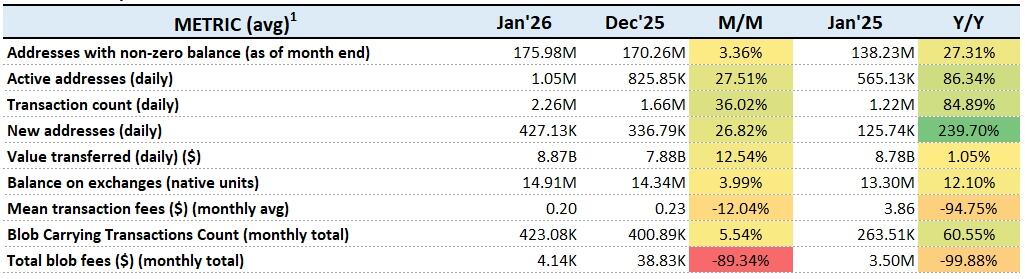
Interestingly, Goldman points out that in contrast to the declining price performance, on-chain activity painted a different picture, especially for the Ethereum and Solana networks.

Activity across the Bitcoin network was down over the month, suggested by decreased average daily transaction count (-14.9% MoM), average daily new addresses (-3.6% MoM) and average active addresses (-2.7% MoM) (Figure 2).

However, for Ethereum, average daily active addresses, new addresses, and transaction counts were up by +27.5%, +26.8% and +36.0% MoM respectively.

For Solana, average daily active addresses and transaction counts were up by +24.3% and +8.2% MoM respectively (Figure 10).

Looking at Ethereum specifically, we are seeing an ATH in daily new addresses.

On average, Jan saw 427k new addresses – if we compare this to the 2020 ‘DeFi summer’, the average daily new addresses back then were 162k.

In terms of activity, we have registered 1.2m daily active Ethereum addresses – another ATH from a 7-d moving avg basis 

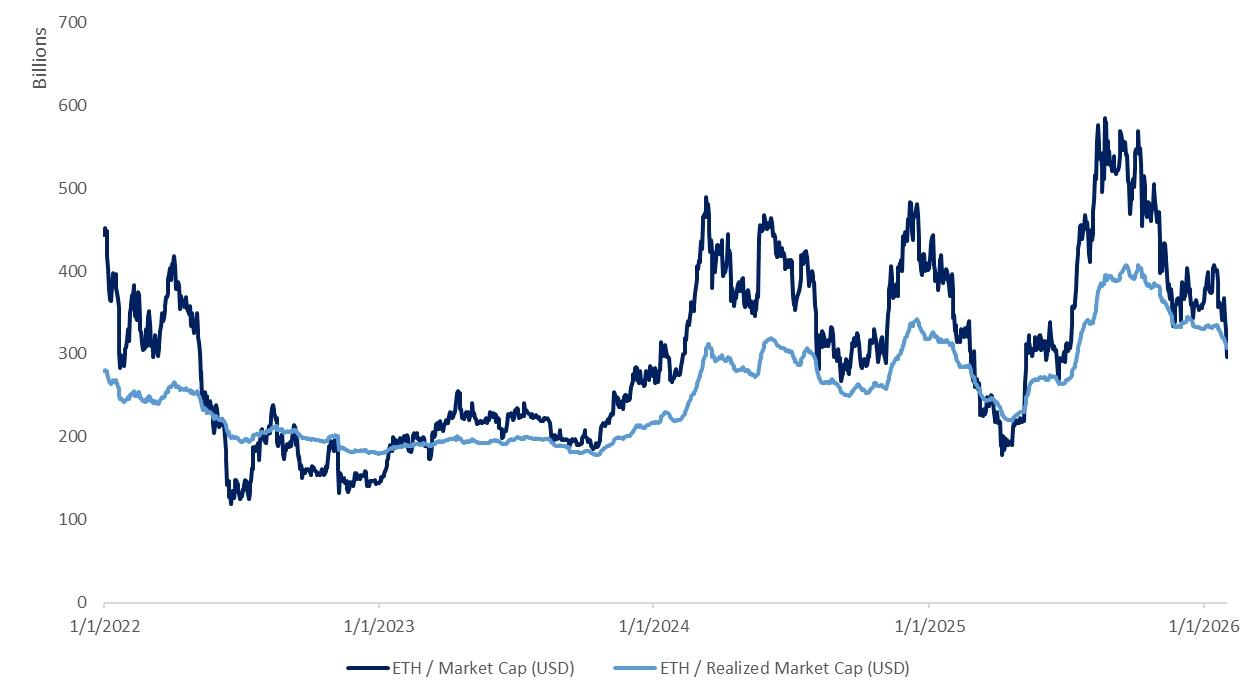
Separately for Ethereum, Goldman notes that the market cap is now below its realized market cap (which values each coin at the last time they moved on the network – representing the aggregate cost basis), signifying that most ETH holders are now sitting on a loss

Meanwhile, as James Van Starten reports below for CoinDesk.com, very large investors, or whales, holding 10,000 bitcoin or more are currently the only ones that are buying the largest cryptocurrency as prices plummet.

All other holder groups are hitting the sell button, according to onchain data.

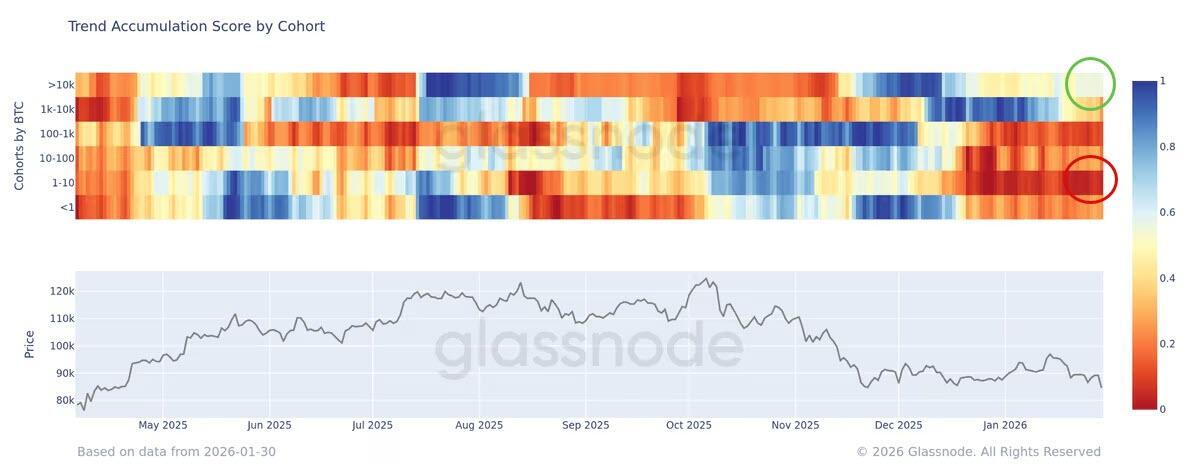
This divergence is highlighted by Glassnode’s Accumulation Trend Score by wallet cohort, which measures the relative behavior of different entity sizes based on both balance and the amount of bitcoin acquired over the past 15 days. Scores closer to 1 indicate buying, while values near 0 signal selling.

Bitcoin accumulation trend (Glassnode)

According to Glassnode data, the largest whales are in a “light accumulation” phase and have maintained a neutral-to-slightly-positive balance trend since bitcoin fell to $80,000 in late November. During this period, price has largely consolidated, trading within a $80,000 to $97,000 range through the end of January.

Bitcoin is now trading near $78,000, according to CoinDesk data.

In contrast, all smaller cohorts are net sellers, particularly retail holders with less than 10 BTC.

This group has been in persistent selling for over a month, reflecting continued downside and risk aversion among smaller participants.

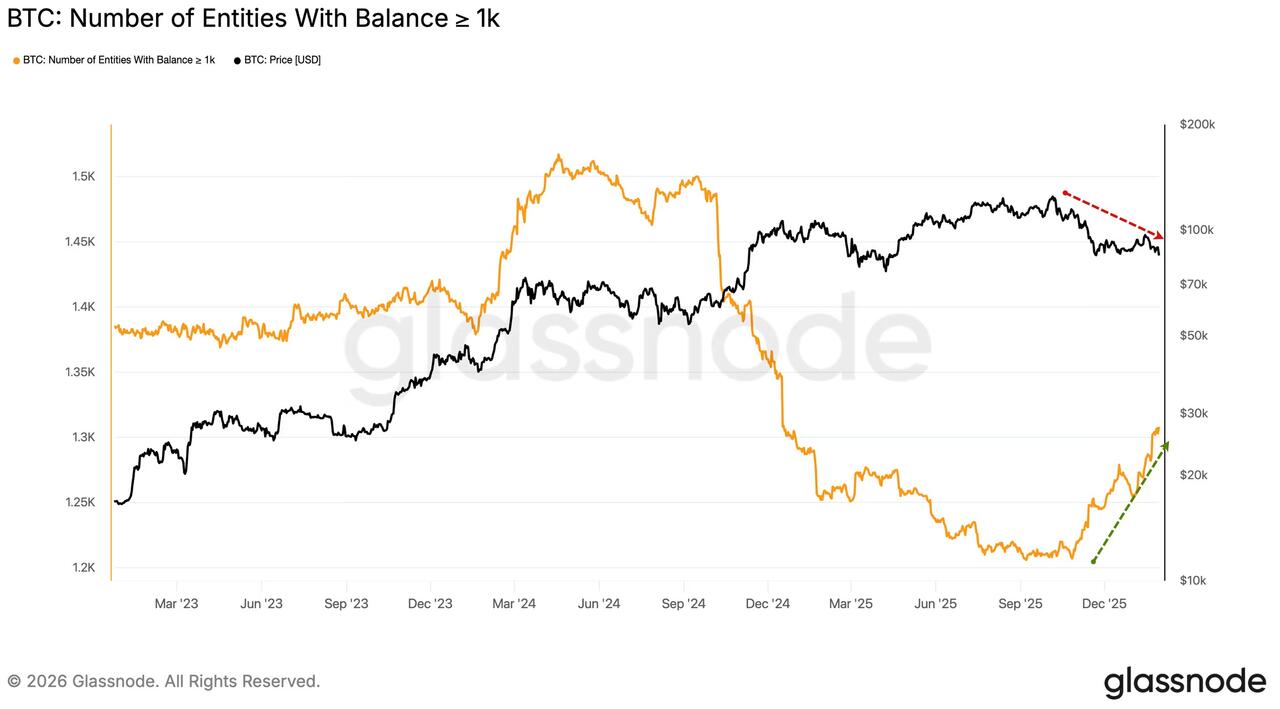
At the same time, the number of unique entities holding at least 1,000 BTC has increased from 1,207 in October to 1,303.

Number of Entities with balance 1k BTC (Glassnode)

Since bitcoin’s October all-time high, growth in this cohort suggests that larger holders have been buying into the correction.

Whales holding at least 1,000 BTC are now back at December 2024 highs, reinforcing the view that large players are absorbing supply while smaller holders continue to exit.

Tyler Durden
Mon, 02/02/2026 – 10:35

via ZeroHedge News https://ift.tt/p3khjo4 Tyler Durden

EU Faces Hard Choices After LNG ‘Wake-Up Call’

EU Faces Hard Choices After LNG ‘Wake-Up Call’

Authored by Irina Slav, via OilPrice.com,

  • Europe is growing uneasy over its heavy reliance on U.S. LNG, with EU officials warning that energy security risks are shifting rather than disappearing.

  • Diversification options are limited: sanctions on Russian gas and strict EU methane regulations effectively rule out major suppliers like Russia, Qatar, and much of U.S. LNG.

  • Gas costs and policy contradictions are rising, as Europe pushes for diversification while remaining locked into record U.S. LNG imports

The European Union needs to diversify its natural gas sources, Brussels’ energy commissioner said this week, expressing a growing unease in European capitals that the EU has become too dependent on liquefied natural gas from the United States. Yet succeeding in that diversification drive will be tricky because of the bloc’s emissions-focused energy policies – and the sanctions on Russia.

“We are speaking to countries around the world that are able to deliver LNG to us,” Energy Commissioner Dan Jorgensen told media in Brussels this week, as quoted by Bloomberg.

“I definitely hear this when speaking to energy ministers and heads of state from all over Europe that there is a growing concern.”

The situation represents an interesting reversal of sentiment from just four years ago. Back in 2022, the European Union declared it would switch from Russian pipeline gas as punishment for the invasion of eastern Ukraine and start buying U.S. liquefied gas instead. EU officials hailed the decision as a big step towards energy independence and praised U.S. LNG producers—and the U.S. federal government—as a reliable business partner and energy supplier.

Now, the European Union is the biggest regional buyer of U.S. liquefied gas, which seems to have been the plan all along—but that gas is coming at a steep cost, and with the federal government very different from the one of four years ago, the image of the reliable business partner and energy supplier has changed quite radically.

It was the Greenland affair that played the role of the alarm clock that woke Brussels and national capitals up. Until that point, the European leaders had apparently assumed that Trump would keep doing business with their countries—and the EU—as Biden had before him, namely by continuing the security guarantees and preferential trade arrangements that had been the hallmark of trans-Atlantic relations for decades. Only Trump did not feel like that. Trump demonstrated early on that he was coming to collect—higher NATO spending, import tariffs, and, finally, Greenland.

The myth of the friendly American LNG that could replace all Russian gas and ensure energy security for a continent was, however, dispelled even before Greenland, by Trump’s top energy man. Secretary Chris Wright stated plainly that U.S. producers of liquefied gas have no intention of complying with the EU’s new methane regulation. The regulation requires constant monitoring, tracking, and reporting of methane leaks along the LNG supply chain—and U.S. LNG producers are not investing in that. Incidentally, neither is QatarEnergy.

During his talk with reporters, Commissioner Jorgensen said that European gas buyers were eyeing Qatar, Canada, and Algeria as potential avenues for gas supply diversification. But Qatar, for one, has made it as clear as the U.S. that it will not be doing methane tracking and reporting. And it has done so repeatedly. And with the world’s two biggest LNG exporters out of the methane-reporting experiment, the EU is really short on options—especially now that the top brass in Brussels approved the total ban on any and all Russian gas imports, beginning next year. Of course, it’s still January 2026, and a lot of things could change over the next 12 months, with some observers of the EU arguing that it will soon change its tune on Russian gas. Until this argument finds factual backing, however, the EU is off Russian gas—and unless it drops the methane regulation, it is also out of Qatari and most U.S. gas, too. Alternatively, U.S. gas will simply become even more expensive, raising the question of just how long the EU would be able to afford it.

The bigger question is what the realistic alternatives to U.S. LNG are. The answer, alas, is unpleasant. There is no large enough LNG supplier to step in and take the place of the United States, not economically, at least. This means gas buyers in Europe would be scouring the world for LNG from now on in a bid to advance the new diversification vision of the Brussels political establishment.

Meanwhile, however, there is that trade deal that Commission President Ursula von der Leyen signed with President Trump last year that calls for $250 billion worth of U.S. energy imports into the EU every year until 2027. One could argue whether Trump knew the EU could not physically buy so much U.S. energy, but wanted to make them buy more oil and LNG—which is what he got, by the way. European Union imports of American LNG hit an all-time high last year, though their price was nowhere near $250 billion.

Trump probably knew the Europeans couldn’t buy $250 billion worth of oil and LNG. But if the Europeans get really serious about that diversification, the Greenland deal may be canceled in favor of another, more direct option. If anything, President Trump has proven repeatedly that he follows his own rules.

Tyler Durden
Mon, 02/02/2026 – 10:20

via ZeroHedge News https://ift.tt/OCuzjhD Tyler Durden

Key Events This Week: Payrolls, ISMs, ADP And Many More Earnings

Key Events This Week: Payrolls, ISMs, ADP And Many More Earnings

Welcome to February with another big sell-off in Gold (-5%) and Silver (-10%) overnight, and a partial US government shutdown that isn’t as severe as the record one before Xmas, and is expected to get resolved soon. Nevertheless, as Jim Reid writes, it’s typical of the 2026 constant stream of complicated news flow. This follows a January that managed to both shock and awe in various ways, yet still delivered broad based gains across all global assets in our monthly performance review when measured in USD terms—a genuinely rare occurrence.

It was perhaps fitting then, that the month ended with extraordinary volatility: silver saw its largest daily fall on record (36% at the intraday lows,  26.3% at the close), while Gold recorded its biggest one day decline since 2013 ( 8.95%). With the overnight moves, Silver is now around $5 below its real adjusted level from 1790. Even incorporating the dramatic 1980 boom and bust and the recent surge, Silver has failed to outperform inflation over more than 230 years of data. So while Reid has long been a bit of a gold bug given his strong views on the inflationary consequences of fiat money, the recent run up in precious metals feels to have an enormous speculative element. Friday’s moves, almost certainly driven by positioning and margin dynamics, only reinforced that impression.

Anyway, turning our attention to the coming week, we will get a dense run of US macro releases, with the January jobs report set to dominate attention on Friday. We also have the ISM surveys, consumer sentiment and the latest Treasury’s quarterly refunding details.

Central banks be in focus with decisions due from the ECB, the BoE (both Thursday) and the RBA (tomorrow). Elsewhere we have the latest global PMIs and inflation in Europe. Corporate earnings include Alphabet (Wednesday), Amazon (Thursday) and AMD (Tuesday). Remember that Meta (+6.56%) and Microsoft (-8.50%) saw big moves in either direction last week with both having a 10% plus intra-day rise and decline respectively. 

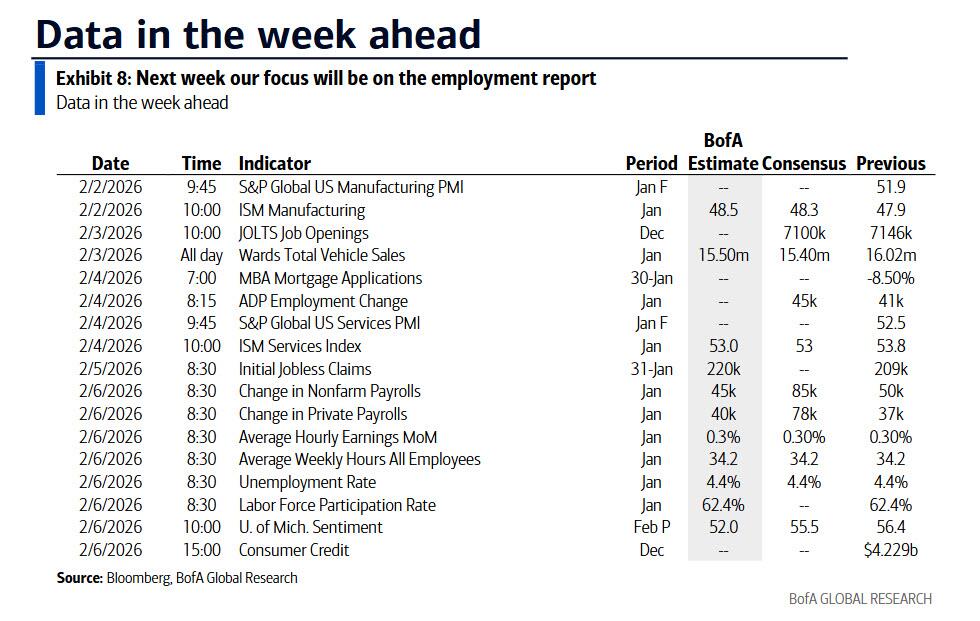
Looking at more detail into the week ahead, Friday’s employment report is the highlight, with forecasts pointing to another modest payroll gain (consensus at +50k and +37k for headline and private respectively) and no change in either the unemployment rate (4.4%) or the pace of hourly earnings growth. Ahead of that, the JOLTS data tomorrow and the ADP report on Wednesday will give early clues on labor market momentum. The week also brings the manufacturing ISM on Monday and the services ISM mid week, followed by the University of Michigan’s February sentiment survey on Friday. Fixed income investors will also be watching Wednesday’s quarterly refunding announcement and today’s Treasury borrowing estimate closely.

Central banks will remain a major theme as well. The ECB and Bank of England both meet on Thursday, and neither is expected to adjust policy, with the ECB likely extending its on hold stance for a fifth straight meeting and the BoE seen keeping Bank Rate unchanged once again. The Reserve Bank of Australia is also expected to stand pat tomorrow. Additional colour on financial conditions will come from the Fed’s senior loan officer survey today and the ECB’s latest bank lending survey tomorrow.

Across Europe, the flow of flash January inflation reports continues, with France tomorrow and Italy and the broader euro area following on Wednesday. Sweden publishes its CPI on Friday. Several Eurozone economies will also release December retail sales and trade figures, while Germany rounds out the week with its factory orders and industrial production numbers. It’ll be interesting to see if they show continued evidence of the fiscal stimulus.

The corporate earnings calendar remains active, with attention in the US turning to two members of the Mag-7, Alphabet on Wednesday and Amazon on Thursday — alongside a range of other tech firms such as Palantir, AMD and Qualcomm. Major healthcare names are also reporting, including Eli Lilly and AbbVie in the US and Novartis and Novo Nordisk in Europe. Broader US earnings include updates from PepsiCo, Walt Disney and Uber. In Europe, several banks are scheduled to report, while in Japan, Toyota, Sony and Tokyo Electron will be among the key companies releasing results.

Here is a day-by-day calendar of events, courtesy of DB:

Monday February 2

  • Data: US January ISM index, China January RatingDog manufacturing PMI, Germany December retail sales, Italy January manufacturing PMI, new car registrations, budget balance, Canada January manufacturing PMI
  • Central banks: Fed’s SLOOS, BoJ Summary of Opinions from the January meeting, Fed’s Bostic speaks, BoE’s Breeden speaks
  • Earnings: Palantir, Walt Disney, Intesa Sanpaolo, NXP Semiconductors, Teradyne
  • Auctions: US Treasury quarterly borrowing estimate

Tuesday February 3

  • Data: US December JOLTS report, January total vehicle sales, Japan January monetary base, France January CPI, December budget balance, New Zealand labour force survey
  • Central banks: RBA decision, ECB’s bank lending survey, Fed’s Bowman and Barkin speak
  • Earnings: AMD, Merck, PepsiCo, Amgen, Pfizer, Eaton, Nintendo, Emerson Electric, TransDigm, Mondelez, Chipotle, Electronic Arts, PayPal, Corteva, Take-Two, Super Micro Computer

Wednesday February 4

  • Data: US January ADP report, ISM services, China January RatingDog services PMI, UK January official reserves changes, Italy January CPI, services PMI, Eurozone January CPI, December PPI, Canada January services PMI
  • Earnings: Alphabet, Eli Lilly, AbbVie, Novartis, Novo Nordisk, Mitsubishi UFJ, Banco Santander, Uber, QUALCOMM, UBS, Boston Scientific, ARM, CME Group, GSK, Mitsubishi Heavy Industries, Equinor, Credit Agricole
  • Auctions: US Treasury quarterly refunding announcement

Thursday February 5

  • Data: US initial jobless claims, UK January new car registrations, construction PMI, Germany December factory orders, January construction PMI, France December industrial production, Italy December retail sales, Eurozone December retail sales
  • Central banks: ECB’s decision, BoE’s decision, Fed’s Bostic speaks, BoC’s Macklem speaks, BoE’s DMP survey
  • Earnings: Amazon, Shell, Linde, BBVA, Sony, ConocoPhillips, BNP Paribas, Bristol-Myers Squibb, KKR, Intercontinental Exchange, Barrick Mining, Vinci, Cigna, Fortinet, Siemens Healthineers, ROBLOX, Ares, Rockwell Automation, Assa Abloy, Saab, ArcelorMittal, Estee Lauder, AP Moller – Maersk, Reddit, Atlassian, Vestas, BT, Blue Owl, Illumina, Affirm, Neste

Friday February 6

  • Data: US January jobs report, February University of Michigan survey, December consumer credit, Japan December household spending, leading index, coincident index, Germany December industrial production, trade balance, France December trade balance, current account balance, Q4 wages, Canada January labour force survey, Sweden January CPI
  • Central banks: ECB’s survey of professional forecasters, ECB’s Cipollone and Kocher speak, BoE’s Pill speaks
  • Earnings: Toyota, Philip Morris International, Tokyo Electron, Societe Generale, Orsted, Telenor, Centene

Finally, looking at just the US, Goldman writes that the key economic data release this week is the employment report on Friday. There are several speaking engagements by Fed officials scheduled this week, including events with Governors Bowman and Cook and Vice Chair Jefferson

 Monday, February 2 

  • 10:00 AM ISM manufacturing index, January (GS 48.5, consensus 48.5, last 47.9): We estimate that the ISM manufacturing index increased by 0.6pt to 48.5 in January, reflecting an increase in our manufacturing survey tracker (+2.0pt to 51.7).
  • 12:30 PM Atlanta Fed President Bostic (FOMC non-voter) speaks: Atlanta Fed President Raphael Bostic will speak at the Atlanta Rotary Club. Moderated Q&A is expected. On January 30, Bostic said, “We should be waiting, and be more patient. We are still too high in inflation, so I think [policy needs] to be somewhat restrictive.”

Tuesday, February 3 

  • 08:00 AM Richmond Fed President Barkin (FOMC non-voter) speaks: Richmond Fed President Thomas Barkin will speak on the economic outlook. Speech text and Q&A are expected. On January 6, Barkin said, “Going forward, policy will require finely tuned judgments balancing progress on each side of our mandate.”
  • 09:40 AM Fed Governor Bowman speaks: Vice Chair for Supervision Michelle Bowman will speak at the Wall Street Journal Invest Live event. Moderated Q&A is expected. On January 16, Bowman said, “Absent a clear and sustained improvement in labor market conditions, we should remain ready to adjust policy to bring it closer to neutral. We should also avoid signaling that we will pause without identifying that conditions have changed.”
  • 10:00 AM JOLTS job openings, December (GS 7,300k, consensus 7,250k, last 7,146k)
  • 05:00 PM Lightweight motor vehicle sales, January (GS 15.1mn, consensus 15.3mn, last 16.0mn)

Wednesday, February 4 

  • 08:15 AM ADP employment change, January (GS +40k, consensus +45k, last +41k)
  • 10:00 AM ISM services index, January (GS 53.0, consensus 53.5, last 53.8): We estimate that the ISM services index declined 0.8pt to 53.0 in January, reflecting an improvement in our non-manufacturing survey tracker (+1.1pt to 53.3) but a headwind from potential residual seasonality.
  • 06:30 PM Fed Governor Cook speaks: Fed Governor Lisa Cook will speak on monetary policy and the economic outlook at the Economic Club of Miami. Speech text and moderated Q&A are expected. 

Thursday, February 5 

  • 08:30 AM Initial jobless claims, week ended January 31 (GS 210k, consensus 212k, last 209k); Continuing jobless claims, week ended January 24 (consensus 1,850k, last 1,827k): We forecast roughly unchanged initial jobless claims (210k) reflecting upward pressure from seasonal distortions that is offset by downward pressure from severe winter weather.
  • 10:30 AM Atlanta Fed President Bostic speaks: Atlanta Fed President Raphael Bostic will speak. Moderated Q&A is expected. 

Friday, February 6 

  • 08:30 AM Nonfarm payroll employment, January (GS +45k, consensus +68k, last +50k); Private payroll employment, January (GS +45k, consensus +75k, last +37k); Average hourly earnings (MoM), January (GS +0.35%, consensus +0.3%, last +0.3%); Unemployment rate, January (GS 4.4%, consensus 4.4%, last 4.4%): We estimate nonfarm payrolls increased 45k in January. On the negative side, we estimate that the birth-death model—which will be updated with this report, more details below—could contribute 30-50k fewer jobs to payroll growth (on a seasonally adjusted basis) than in recent months and big data indicators indicated a modest pace of private sector job growth. Additionally, we expect unchanged government payrolls—reflecting a 10k decline in federal government payrolls that is offset by a 10k increase in state and local government payrolls. On the positive side, the pace of layoffs—a particularly important determinant of net job growth in January—remained subdued. However, the seasonal factors have evolved to expect smaller declines in employment in recent Januarys, limiting the potential boost from this channel. At the industry level, we expect rebounds in retail trade employment—which saw less holiday hiring than usual that should correspond to fewer January layoffs—and construction employment—for which unusually poor weather likely contributed to a decline in December. We do not expect a drag from Winter Storm Fern, which formed about a week after the reference week. We estimate that the unemployment rate was unchanged at 4.4% in January, though see risks as skewed to a decline: the bar for rounding down to 4.3% is not high from an unrounded 4.38% in December and the January unemployment rate appears to suffer from modestly negative residual seasonality (the unrounded unemployment rate has declined in each of the last three Januarys). We estimate average hourly earnings rose 0.35% month-over-month in January, reflecting positive calendar effects.
    • This month’s report will be accompanied by the annual benchmark revision to the establishment survey and a methodological update to the birth-death model. The BLS’s preliminary estimate of the benchmark payrolls revision indicated that cumulative payroll growth between April 2024 and March 2025 would be revised 911k lower. We estimate that the final downward revision will likely be somewhat smaller—in the range of 750-900k—as job growth in the QCEW, which informs the revision, has been revised up since the BLS issued the preliminary estimate. The BLS will also update the net birth-death forecasts in the post-benchmark period (April 2025-December 2025) to incorporate information from the QCEW and the monthly payrolls survey. A downward revision to the post-benchmark period appears likely, reflecting the continued slowdown in the QCEW and weak private payroll growth during the post-benchmark period. Starting with this month’s report, the birth-death model will incorporate current sample information each month. This methodological change is intended to reduce the magnitude of annual revisions, as changes in employment at continuing establishments will provide a more timely signal about net job creation from firm births and deaths than the current methodology based on lagged QCEW data does. However, the methodological change could contribute to greater month-to-month volatility in payrolls readings, as the birth-death assumption will be impacted by the responses to the monthly survey.
  • 10:00 AM University of Michigan consumer sentiment, February preliminary (GS 54.0, consensus 55.0, last 56.4) : University of Michigan 5-10-year inflation expectations, February preliminary (GS 3.2%, last 3.3%)
  • 12:00 PM Fed Vice Chair Jefferson speaks: Fed Vice Chair Phillip Jefferson will speak on the economic outlook and supply-side inflation dynamics at the Brookings Institution. Speech text and moderated Q&A are expected. On January 16, Jefferson said, “In my view, the current policy stance leaves us well positioned to determine the extent and timing of additional adjustments to our policy rate based on the incoming data, the evolving outlook, and the balance of risks.”

Source: DB, Goldman

Tyler Durden
Mon, 02/02/2026 – 10:15

via ZeroHedge News https://ift.tt/ygMr4Qa Tyler Durden

Huge Surge In New Orders Sends US Manufacturing Activity Near 4 Year Highs

Huge Surge In New Orders Sends US Manufacturing Activity Near 4 Year Highs

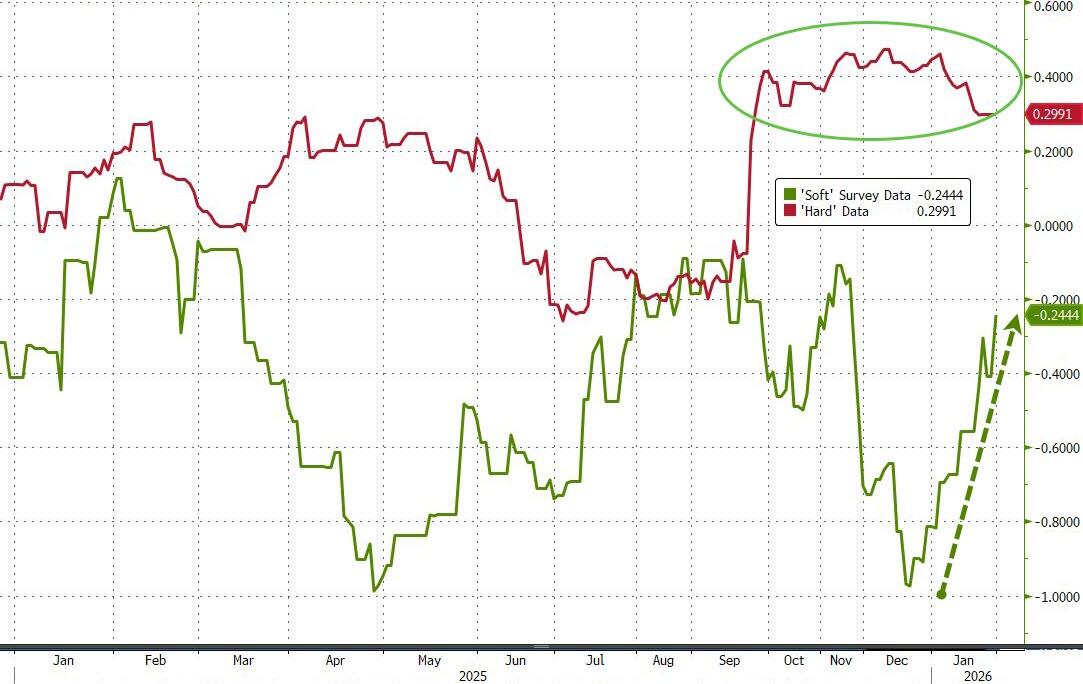
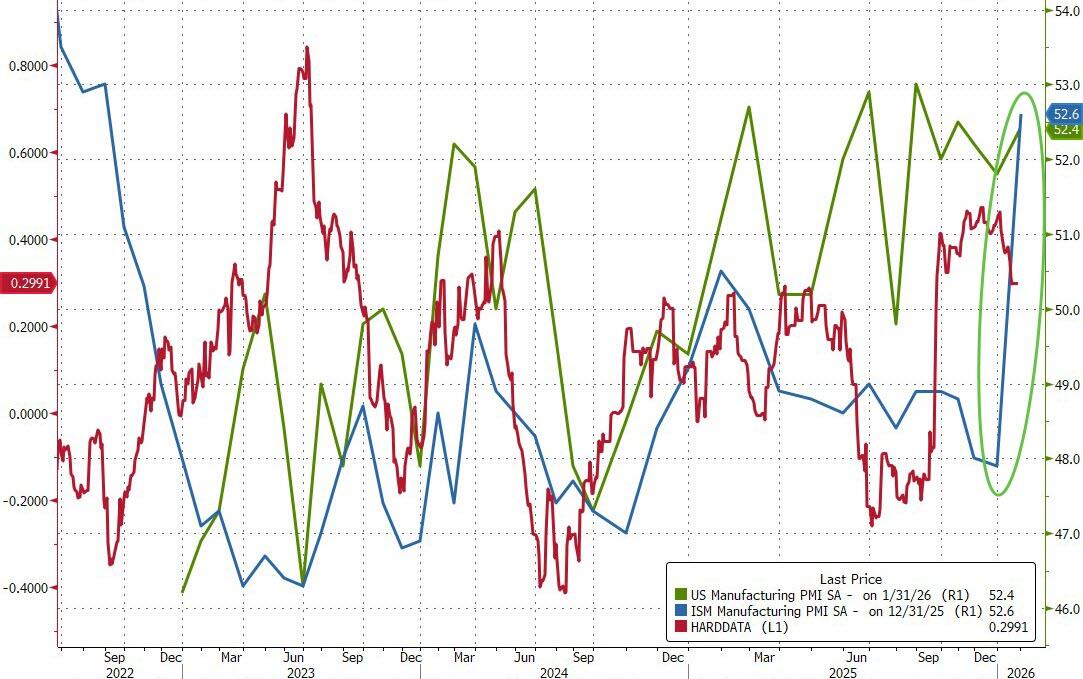
With ‘hard’ data sustaining signs of solid growth (e.g. factory orders and jobless claims), ‘soft’ survey data has been bouncing back since the start of the year

This morning we get the final Manufacturing PMI data from S&P Global and ISM for January.

A solid and stronger improvement in US manufacturing sector operating conditions (52.4 vs 52.0 exp) was signaled by January’s S&P Global PMI data amid the joint-sharpest upturn in production since May 2022.

However, growth was in part driven by inventory building as new orders, despite returning to expansion in January, increased only modestly.

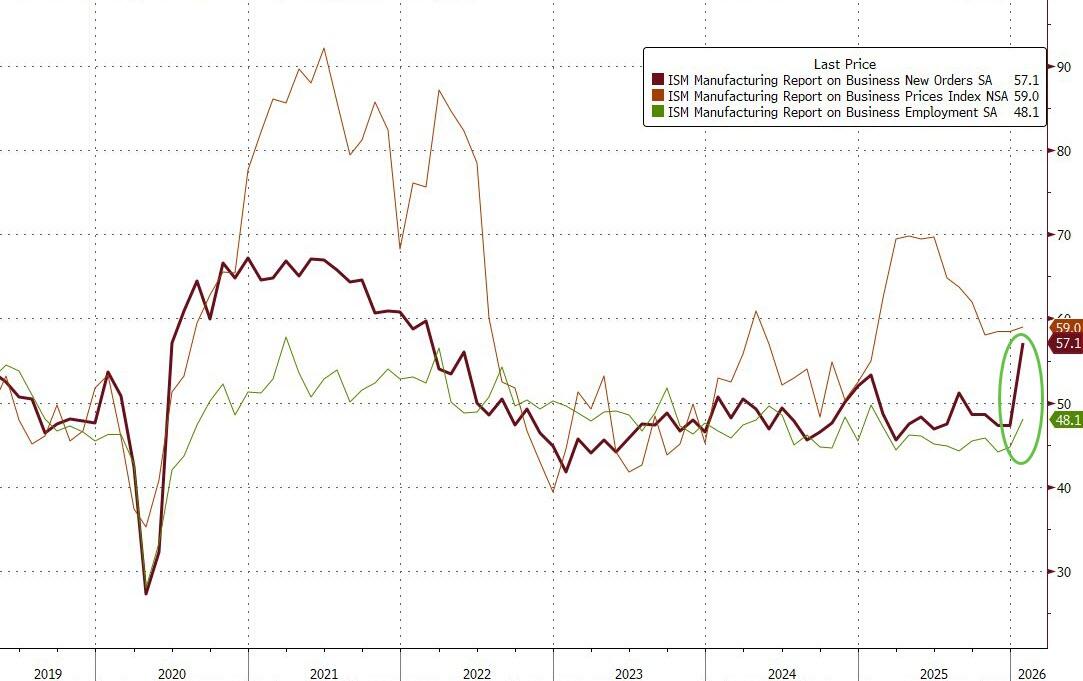
ISM’s Manufacturing was expected to rise from 47.9 to 48.5 in January but instead it soared to 52.6 – its highest since Aug 2022. This is the first print above 50 since January 2025.

Source: Bloomberg

This was the biggest MoM surge in the ISM print since April 2020 (COVID rebound), led by a huge surge in new orders and rise in employment (highest in a year) and prices (though elevated) are stable…

“News of the joint largest rise in factory production since May 2022 is tainted by reports of ongoing subdued sales growth,” says Chris Williamson, Chief Business Economist at S&P Global Market Intelligence.

“Production growth consequently significantly outpaced that of new orders at the start of the year, resulting in a further accumulation of unsold warehouse inventory.”

Over the past three months, the survey indicates that factories have typically produced more goods than they have sold to a degree we have not previously seen since the global financial crisis back in early 2009.”

This highly unusual situation is clearly unsustainable, hinting at risks of a production slowdown and a potential knock-on effect on employment, unless demand improves markedly in the coming months.

Williamson adds that “sluggish sales and order book growth are being commonly linked to customer resistance to high prices, in turn often blamed on tariffs, as well as increased uncertainty over the economic outlook.”

While just below trend, business growth expectations for the year ahead are, however, holding up as firms anticipate improving demand, “thanks in part to lower interest rates, reduced import competition due to tariffs, and more government support.”

However, as Williamson concludes, “political uncertainty remains a key drag on business sentiment.”

Tyler Durden
Mon, 02/02/2026 – 10:07

via ZeroHedge News https://ift.tt/1j4Tums Tyler Durden

Trump Claims His Tariffs Have ‘Brought America Back.’ Here Are 3 Things He Got Wrong.


Trump WSJ op-ed Tariff Lies-v2 | Wall Street Journal/Michael Brochstein/ZUMAPRESS/Newscom

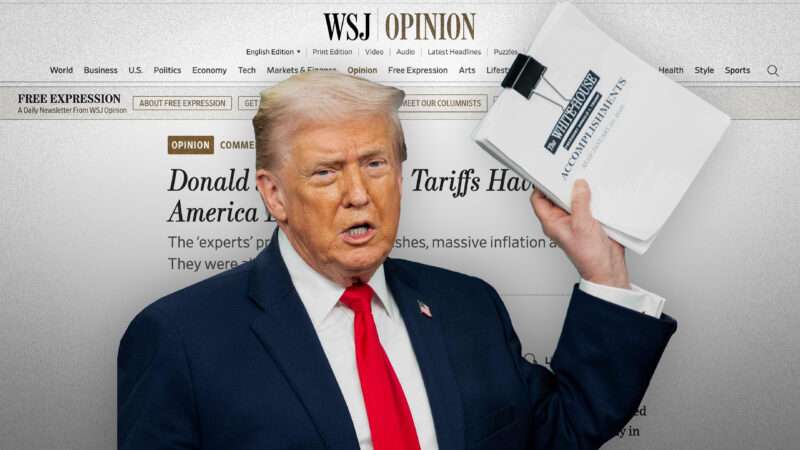
President Donald Trump argued in a Saturday Wall Street Journal op-ed that his myriad tariffs have boosted America’s economy without causing the harms that many economists predicted. “We have proven, decisively, that, properly applied, tariffs do not hurt growth—they promote growth and greatness, just as I said all along,” Trump claimed.

That conclusion rests on misleading claims, inaccurate data, and logical fallacies. Here are the three most egregious examples.

The trade deficit. Trump’s op-ed claims that he has “slashed our monthly trade deficit by an astonishing 77%.”

That would be astonishing. But in reality, the Census Bureau reported last week that the trade deficit increased—not decreased—by nearly 37 percent in November, the most recent month for which data are available. Through the first 11 months of 2025, the trade deficit was 4 percent higher than it had been in 2024. That is literally the opposite of what Trump is claiming.

It’s somewhat astonishing that the Journal allowed such a wildly misleading claim to appear in its pages. Someone really should have fact-checked this before it went to print.

Who pays the tariffs? “According to a recent study by the Harvard Business School,” Trump wrote, foreign producers and middlemen “are paying at least 80% of tariff costs.”

In fact, the paper he cited concludes that “tariffs led to both rapid and gradual retail price increases.” The study found that “prices began rising within days of the March announcements and continued to increase steadily over subsequent months,” and also that “imported goods rose roughly twice as much as domestic goods relative to pre-tariff trends.”

There is no getting away from this fact: tariffs are pushing prices higher. The Harvard Business School, Trump’s favorite source on the matter, recently noted that prices for imported goods are up 9.7 percent from their pre-tariff trends, while domestic prices are up 4.4 percent. Those increases have added an estimated 1 percentage point to inflation as measured by the consumer price index.

So the next time Trump is complaining that the Federal Reserve won’t lower interest rates, remember that the main reason the central bank is keeping rates higher is that inflation is still over 2 percent—but it would be significantly lower if not for Trump’s tariffs.

Economic collapse? “When I imposed historic tariffs on nearly all foreign countries last April, the critics said my policies would cause a global economic meltdown,” Trump wrote. That meltdown didn’t occur, so that must prove the president right and his opponents wrong.

This is not the gotcha moment that the president seems to believe it is. Trump repeatedly backed down and eased tariff threats in the face of negative shocks from both the stock market and the bond market. The “Liberation Day” tariffs announced on April 2 were postponed a week later after a huge stock market sell-off, and those that were later imposed were at lower rates. A threatened 130 percent tariff on Chinese goods never materialized. No wonder “TACO“—”Trump Always Chickens Out”—entered the political and financial lexicon last year.

As the Yale Budget Lab’s data show, Trump raised the average U.S. tariff rate from less than 3 percent to more than 25 percent with his Liberation Day tariffs and other moves in the first half of 2025. But those rates declined in the second half of the year and settled around 17 percent. That’s still very high, but not as high as it could have been—so it makes sense that the consequences were less severe.

And if the bar for success is “I didn’t crash the global economy,” then…congratulations, I guess? That’s not really something to brag about, and it certainly doesn’t excuse Trump from the economic damage that his (lower, less extreme tariffs) have done.

Beyond the factual problems with these arguments, Trump’s op-ed suffers from his recurring (and at this point unsurprising) misunderstanding about how tariffs work.

Economists will tell you that tariffs are effectively wealth-transfer mechanisms that take money from consumers and businesses (and anyone else trying to buy tariffed goods) via taxes. Unlike in more direct wealth-transfer systems, the beneficiaries aren’t paid with tax revenue, but protected industries gain the ability to charge higher prices because of the higher cost of imported goods and because they face less competition.

That reality undermines the entire premise that tariffs can “bring America back,” because tariffs can’t do anything for America as a whole. At best, they will benefit a relatively small set of American businesses at the expense of many other people.

In this case, the sectors of the economy that are supposed to be benefiting from Trump’s tariffs—manufacturing and other forms of industrial production—aren’t even realizing those benefits, because higher prices on raw materials make it more difficult to manufacture things. For example: American businesses are now paying much higher prices for aluminum than manufacturers elsewhere in the world. That’s a good way to discourage manufacturing, not to promote it.

Trump is clearly unwilling or unable to understand those trade-offs, and it is hopeless to believe he’ll ever change his mind. It is up to others to stop him.

The post Trump Claims His Tariffs Have 'Brought America Back.' Here Are 3 Things He Got Wrong. appeared first on Reason.com.

from Latest – Reason.com https://ift.tt/c93YV5X
via IFTTT