San Jose City Council Member’s Request for Restraining Order Against Critic Denied on Appeal

From Ortiz v. Saenz, decided Friday by the California Court of Appeal (San Diego County Superior Court Judge Victor Rodriguez sitting by designation, joined by Judges Mary Greenwood and Cynthia Lie):

Saenz operated a social media account under the username “@ESSJTIMES” which, at the relevant time, was accessible to the public and had almost 80,000 followers. Saenz used the account to disseminate news pertaining to the Eastside San Jose community….

During the time period at issue in this case, Ortiz was a member of the San Jose City Council. In the fall of 2023, Saenz posted a video on his account criticizing another elected member of the San Jose City for promoting a children’s event known as “Drag Queen story time.” In the video, Saenz claimed the event was “inherently sexual” and posed a threat to children. He included the council member’s social media account in his post (a practice commonly referred to as “tag” or “tagging”), after which Saenz’s followers began posting negative messages on that council member’s account.

Ortiz, in defense of his colleague, used his social media account to report Saenz to the platform for hate speech and misinformation, and posted a statement on his account suggesting that Saenz and his followers were targeting and threatening his fellow council member. Ortiz and his girlfriend, Brenda Zendejas {Saenz alleged Zendejas was also Ortiz’s campaign manager}, also posted messages on their accounts asking the public to report Saenz to the social media platform for hateful speech.

In response, Saenz shared their messages on his account, with his added comment stating, in part, “You are throwing a ralley [sic] to label this page a hate page? Are you kidding me. I am only saying this once this last time.” Saenz’s followers responded by posting negative remarks about Ortiz and Zendejas, including accusing Ortiz of being a pedophile for defending his fellow council member.

A few months later, in December 2023, Saenz posted a video and message on his account referring to Ortiz and the same colleague as “brown puppets” and tagged Ortiz’s social media account. Saenz stated that they did “not represent the Latino and Mexican community at all. Especially the majority of the community that is against grooming our children. We need those brown puppets pushing that crap on our children out of City Hall ASAP!” In the video, Saenz called Ortiz a “showered cholo” and alluded to Ortiz being a “sick fuck.” Other account users responding to Saenz’s post referred to Ortiz as a pedophile.

Saenz posted a second video to his account making reference to Ortiz. This video appeared to be altered by Saenz and opposed what another user called the “trans kids” movement. Saenz alleged that “Big Pharma” profited from transgender children due to increased healthcare costs and suggested through imagery that Ortiz and his colleague were puppets of “Big Pharma.” In a voiceover, Saenz demanded the council members “[l]eave the babies alone” and declared “We gotta get [Ortiz’s colleague] out… and [Ortiz] comes in backing him. So does his little girlfriend.”

In another section of the post, text appeared on the screen “Please watch the whole video. We need to get these people out of City Hall ASAP. Protect our children!” The video showed images of Ortiz and two other council members with a voiceover by Saenz stating “We gotta clean them out and put in new brown people who actually care about the community.” Saenz’s video ends with an image proclaiming his account was a “hate free” page for “those who do not groom/sexualize children.” Responses from other account users to the video contained insinuations that supporters of the “trans kids” movement were child predators.

Thereafter, based solely on those social media posts by Saenz and the responses by Saenz’s followers, Ortiz sought a civil harassment restraining order against Saenz. In his petition for the restraining order, Ortiz alleged Saenz had harassed him and Zendejas “on [Saenz’s] social media posts, claiming that we are attacking his social media page. As a result, [Saenz’s] social media followers have made hateful comments and threats towards [them].”

Specifically, Ortiz claimed Saenz and his followers falsely accused him of “grooming” or sexualizing children and labeled him a pedophile. Ortiz alleged that the social media posts portrayed him as “a danger to children” and he was “afraid that [Saenz] or one of his followers will act on [Saenz’s] calls to ‘protect our children’ by physically attacking [him or Zendejas].” Ortiz further stated that these statements damaged his “ability to work with members of [the] community,” harmed his reputation, and caused him emotional distress…. To support his allegation that Saenz’s posts portraying him as a child groomer or pedophile could incite harassment, threats, or violence, Ortiz attached an article reporting an increase in harassment, threats, and violence toward the LGBTQ community resulting from groups that demonize and label its members as pedophiles or groomers.

On December 21, 2023, the trial court issued a temporary restraining order (TRO) pending the hearing, which included orders that Saenz not “[h]arass, … stalk, threaten … or disturb the peace [of the protected persons],” and that he not “publish defamatory statements about [Ortiz and Zendejas] … use the name, image, likeness or otherwise reference the protected parties in social media posts in connection [with] crimes against children; or encourage others to do the same.” …

In follow-up proceedings,

Ortiz alleged that shortly after issuance of the TRO, Saenz posted videos commenting on the litigation and TRO, asserting the TRO was obtained based on false information and violated the first amendment rights of reporters and freedom of the press. In his posts, Saenz stated, “I firmly believe they’re covering [sic] the fact that they had people threaten me because they labeled my page a hate page.” In total, Ortiz alleged that Saenz posted and then deleted more than 11 videos concerning him, Zendejas, and the underlying proceedings in violation of the TRO.

In support of his claims, Ortiz submitted screenshots of videos Saenz posted on his social media account. One video, posted after Saenz was served with the TRO, displayed Saenz’s own press release regarding the order and his voice stating: “So I have Councilman Peter Ortiz putting a restraining order on me, yes, Peter Ortiz, active homeboy was tatted, gangs, now he’s [unintelligible] scared for himself, he says that he gets nervous in public because of me.” The video displayed an image of Ortiz’s prior mugshot and referenced his criminal history, which Ortiz acknowledged was public information, accompanied by additional commentary from Saenz calling Ortiz a “weirdo,” stating that he was the “same weirdo that stuck up for [Ortiz’s colleague] after I called him out saying why are you bringing our kids around this tranny story hour….” Saenz also posted a video solicitating information from Ortiz’s former classmates because Saenz was “investigating a tip [he] received” regarding Ortiz.

In another video, Saenz stated the Mercury News’s coverage of the litigation was biased, stating “[t]his article is not a news report; it’s an attack on you guys and the ESSJ times, that’s all it is.” Saenz also shared on his account an online news article about the litigation entitled “Controversial City Councilmember’s Temporary Restraining Order Chills Political Speech on Social Media.”

In his third supplemental declaration filed a week before the hearing, Ortiz stated that Saenz “continue[d] to claim that I’m a pedophile, I groom children, and that I’m crooked. In some of these posts, [Saenz] infer[red] that I am a child molester or pedophile by saying that I’m only in a relationship with Ms. Zendejas so that I can get to her children or touch her children.”

He claimed that Saenz threatened to “‘silence me’ or ‘end me’—indicating to his followers that he is going to take my life,” and encouraged his followers to take unspecified action. Ortiz noted in one video posted in March 2024, “[Saenz] called on his followers to show up at Ms. Zendejas’ children’s baseball event, causing Ms. Zendejas and I to fear for the safety of the children.” Ortiz also asserted that “[i]n another recent video, [Saenz] is swinging a baseball bat pretending to hit other people—specifically what he describes as small business owners in San Jose—stating that he is going to come after any small business owner that supports me.”

About a week before the hearing, Saenz posted a video encouraging his followers to attend the court proceedings, promising a free tamale for any person that takes “a selfie with [Ortiz’s] crooked ass lawyer.” Saenz referred to Ortiz as a “crooked councilmember,” suggesting that Ortiz’s restraining order request was filed because Saenz “called them out” on their support of “Drag Queen story time.” In another video, Saenz stated, “we see what’s going on, what they’re trying to pull with the kids. You see the corruption he is pulling at City Hall.” …

On April 18, 2024—after the temporary restraining order had been in effect for nearly four months—the trial court declined to issue the permanent restraining order, so the temporary restraining order was therefore terminated. The court also granted Saenz’s anti-SLAPP motion, which would allow Saenz to recover his attorney fees.

Friday’s appellate decision affirmed the denial of the permanent restraining order, and affirmed the grant of Saenz’s anti-SLAPP motion. An excerpt from the long analysis:

Viewing Saenz’s conduct in the full context of his social media activity, his statements and the videos he posted, though provocative, inflammatory and challenging, are more reasonably understood as criticism of Ortiz’s character and qualifications as council member, his conduct in office, and a call for the public to vote him out of office….

[E]ach challenged statement and act was made in a public forum, addressed matters of public interest, and was directed to the public to promote political discourse or action: to remove Ortiz from office. Saenz directed those statements to his 80,000 followers and urged them to remove the council members from office.

In the first two videos that formed the basis for Oritz’s request for the restraining order, Saenz specifically calls to get Ortiz and his colleague “out of City Hall ASAP.” Similarly, after the trial court issued the TRO, Saenz continued to criticize Ortiz’s character, qualifications, and fitness for office, cloaked in the same hyperbole and conspiratorial rhetoric, and again urged his followers to both vote Ortiz out of office and to share their positions with Ortiz regarding his qualifications. Thus, the purpose of the speech was to further public discussion regarding the suitability of Ortiz for his office and suggested political recourse for those who agreed with Saenz….

Saenz’s conduct [does not] constitute a “true threat.” Ortiz claimed that Saenz threatened to “silence” and “end” him, urged his followers to “take action,” and incited violence by posting a video of Saenz swinging a baseball bat. However, when considered in context, these statements and actions were made in connection with Saenz’s broader political commentary and efforts to encourage Ortiz’s removal from office.

The further allegation that Saenz “called on his followers to show up at Ms. Zendejas’ children’s baseball event” lacks any accompanying claim that Saenz directed his followers to engage in violence, unlawful behavior, or physical harm. Viewed from the standpoint of a reasonable person, Saenz’s statements and conduct do not evidence an intent to inflict bodily harm or to incite others to do so.

[A]lthough Ortiz’s arguments on appeal present a distressing scenario for civil harassment, legal arguments are not facts. Here, the record lacks specific facts to substantiate his arguments. Ortiz relies heavily on Saenz’s post concerning the children’s baseball event and a separate post in which Saenz pretends to swing a baseball bat as proof of harassment. Saenz’s statements in urging the public to show up at Zendejas’ children’s baseball event, though highly inappropriate and irresponsible, contain no suggestion for his followers to engage in violence or unlawful activity there. Nor is there any specificity or context: it is not clear when this was posted, exactly what was said or if the post included information about what the “baseball event” entailed, the actual location or time said event was occurring.

As to the video depicting Saenz swinging a baseball bat, there is no evidence that the video was posted in relation to or simultaneously with the post asking his followers to show up at the children’s baseball event. For example, had the video of Saenz swinging the baseball bat been posted a week after the children’s baseball event, it would be hard to draw the connection that his swinging the bat had any relation to inciting violence at the children’s event.

Additionally, Ortiz’s own declaration stated that the video was posted with commentary suggesting Saenz was going to “come after any small business owner” that supported Ortiz, not Ortiz or his girlfriend or her children. Viewed in the context of Saenz’s other posts, … the evidence demonstrated that Saenz’s speech was focused on urging followers to take action in the political process to vote Ortiz out of office or express their opposition to the council member’s positions.

Even assuming Saenz irresponsibly likened Ortiz to child groomers and pedophiles, his statements—however extreme and hyperbolic—were directed at whether Ortiz, as an elected government official, was qualified to sit on the San Jose City Council. Because the record reflects a legitimate purpose, Ortiz fails to show a prima facie case of harassment….

The circumstances here fall far short of the threatening conduct present in the other cases Ortiz cites, where courts concluded that such conduct was unprotected by the First Amendment. (Huntingdon Life Sciences, Inc. v. Stop Huntingdon Animal Cruelty USA, Inc. (Cal. App. 2005) [activist group, known to support illegal activities including assault, trespass and vandalism, targeted a laboratory employee on its website and threatened physical violence]; City of San Jose v. Garbett (Cal. App. 2010) [defendant with a history of threatening city employees alluded to mass shootings to effectuate change].) …

Even assuming Saenz violated the TRO, Ortiz has not shown that the alleged violations establish a probability of prevailing on his civil harassment claim. Ortiz’s initial petition relied solely on two videos posted by Saenz, each of which served a legitimate purpose: to encourage the public to seek Ortiz’s removal from office. Ortiz’s subsequently filed supplemental declarations, though asserting harassment in conclusory terms, failed to set forth concrete, specific facts that demonstrated that those posts or any subsequent posts constituted harassment….

Patrick J. Evans represents Saenz.

The post San Jose City Council Member's Request for Restraining Order Against Critic Denied on Appeal appeared first on Reason.com.

from Latest – Reason.com https://ift.tt/XilAxJz
via IFTTT
Kentucky Law Lets Citizens Live-Stream Public Agency Meetings Using Cell Phones

From Kentucky A.G. opinion 26-01, released Jan. 5 but just posted on Westlaw:

The “basic policy” of the Open Meetings Act … “is that the formation of public policy is public business and shall not be conducted in secret and the exceptions provided for by KRS 61.810 or otherwise provided for by law shall be strictly construed.” Under KRS 61.840, “[n]o condition other than those required for the maintenance of order shall apply to the attendance of any member of the public at any meeting of a public agency” and “[a]ll agencies shall permit news media coverage, including but not limited to recording and broadcasting.”

The Office has previously found that “KRS 61.840 vests members of the public with a virtually unconditional right to attend all meetings of a public agency.” Indeed, the only conditions of attendance permitted by the Act are “those required for the maintenance of order.”

Regarding the recording of public meetings, the Office has found that public agencies that did not allow members of the public to record their meetings violated KRS 61.840…. For the purpose of KRS 61.840, there is little difference between recording a meeting on a cellphone and live-streaming a meeting on a cellphone. Indeed, KRS 61.840 also requires the “broadcasting” of public meetings to be permitted.

Though KRS 61.840 specifically requires agencies to permit “news media coverage, including but not limited to recording and broadcasting.” that requirement does not place the news media in a position superior to that of the common citizen. Rather, it is simply illustrative of what it means for public agencies’ meetings to be open to the public and that any exceptions to this general rule be “strictly construed” under KRS 61.800. Thus, the Office has previously found that KRS 61.840’s grant of recording authority extends to members of the public. In light of the current state of technology and the ubiquity of persons live-streaming content using their cell phones, the live-streaming of a public meeting with a cellphone is but a modern example of “recording and broadcasting” public meetings that is protected by KRS 61.840.

[Senator Gex Williams, who posed the question that led to the opinion,] limits his inquiry only to members of the public who are “non-intrusive and non-disruptive.” No conditions are necessary for the “maintenance of order” if the live-streaming member of the public is “non-intrusive and non-disruptive.” As such, a public agency may not prevent a “non-intrusive and non-disruptive” member of the public from live-streaming meetings of public agencies. It is therefore the opinion of the Office that the Act does not allow a public agency to prevent a “non-intrusive and non-disruptive” member of the public from live-streaming its meetings.

{Senator Williams also asks whether KRS 61.840’s mandate that public agencies “shall permit news media coverage” violates the First Amendment by not expressly granting the same right to all members of the public. Because it is the opinion of the Office that KRS 61.840 does not allow a public agency to prevent a “non-intrusive and non-disruptive” member of the public from live-streaming its public meetings, KRS 61.840 does not treat the news media differently from members of the public.}

The post Kentucky Law Lets Citizens Live-Stream Public Agency Meetings Using Cell Phones appeared first on Reason.com.

from Latest – Reason.com https://ift.tt/G4iRMfu
via IFTTT

San Jose City Council Member’s Request for Restraining Order Against Critic Denied on Appeal

From Ortiz v. Saenz, decided Friday by the California Court of Appeal (San Diego County Superior Court Judge Victor Rodriguez sitting by designation, joined by Judges Mary Greenwood and Cynthia Lie):

Saenz operated a social media account under the username “@ESSJTIMES” which, at the relevant time, was accessible to the public and had almost 80,000 followers. Saenz used the account to disseminate news pertaining to the Eastside San Jose community….

During the time period at issue in this case, Ortiz was a member of the San Jose City Council. In the fall of 2023, Saenz posted a video on his account criticizing another elected member of the San Jose City for promoting a children’s event known as “Drag Queen story time.” In the video, Saenz claimed the event was “inherently sexual” and posed a threat to children. He included the council member’s social media account in his post (a practice commonly referred to as “tag” or “tagging”), after which Saenz’s followers began posting negative messages on that council member’s account.

Ortiz, in defense of his colleague, used his social media account to report Saenz to the platform for hate speech and misinformation, and posted a statement on his account suggesting that Saenz and his followers were targeting and threatening his fellow council member. Ortiz and his girlfriend, Brenda Zendejas {Saenz alleged Zendejas was also Ortiz’s campaign manager}, also posted messages on their accounts asking the public to report Saenz to the social media platform for hateful speech.

In response, Saenz shared their messages on his account, with his added comment stating, in part, “You are throwing a ralley [sic] to label this page a hate page? Are you kidding me. I am only saying this once this last time.” Saenz’s followers responded by posting negative remarks about Ortiz and Zendejas, including accusing Ortiz of being a pedophile for defending his fellow council member.

A few months later, in December 2023, Saenz posted a video and message on his account referring to Ortiz and the same colleague as “brown puppets” and tagged Ortiz’s social media account. Saenz stated that they did “not represent the Latino and Mexican community at all. Especially the majority of the community that is against grooming our children. We need those brown puppets pushing that crap on our children out of City Hall ASAP!” In the video, Saenz called Ortiz a “showered cholo” and alluded to Ortiz being a “sick fuck.” Other account users responding to Saenz’s post referred to Ortiz as a pedophile.

Saenz posted a second video to his account making reference to Ortiz. This video appeared to be altered by Saenz and opposed what another user called the “trans kids” movement. Saenz alleged that “Big Pharma” profited from transgender children due to increased healthcare costs and suggested through imagery that Ortiz and his colleague were puppets of “Big Pharma.” In a voiceover, Saenz demanded the council members “[l]eave the babies alone” and declared “We gotta get [Ortiz’s colleague] out… and [Ortiz] comes in backing him. So does his little girlfriend.”

In another section of the post, text appeared on the screen “Please watch the whole video. We need to get these people out of City Hall ASAP. Protect our children!” The video showed images of Ortiz and two other council members with a voiceover by Saenz stating “We gotta clean them out and put in new brown people who actually care about the community.” Saenz’s video ends with an image proclaiming his account was a “hate free” page for “those who do not groom/sexualize children.” Responses from other account users to the video contained insinuations that supporters of the “trans kids” movement were child predators.

Thereafter, based solely on those social media posts by Saenz and the responses by Saenz’s followers, Ortiz sought a civil harassment restraining order against Saenz. In his petition for the restraining order, Ortiz alleged Saenz had harassed him and Zendejas “on [Saenz’s] social media posts, claiming that we are attacking his social media page. As a result, [Saenz’s] social media followers have made hateful comments and threats towards [them].”

Specifically, Ortiz claimed Saenz and his followers falsely accused him of “grooming” or sexualizing children and labeled him a pedophile. Ortiz alleged that the social media posts portrayed him as “a danger to children” and he was “afraid that [Saenz] or one of his followers will act on [Saenz’s] calls to ‘protect our children’ by physically attacking [him or Zendejas].” Ortiz further stated that these statements damaged his “ability to work with members of [the] community,” harmed his reputation, and caused him emotional distress…. To support his allegation that Saenz’s posts portraying him as a child groomer or pedophile could incite harassment, threats, or violence, Ortiz attached an article reporting an increase in harassment, threats, and violence toward the LGBTQ community resulting from groups that demonize and label its members as pedophiles or groomers.

On December 21, 2023, the trial court issued a temporary restraining order (TRO) pending the hearing, which included orders that Saenz not “[h]arass, … stalk, threaten … or disturb the peace [of the protected persons],” and that he not “publish defamatory statements about [Ortiz and Zendejas] … use the name, image, likeness or otherwise reference the protected parties in social media posts in connection [with] crimes against children; or encourage others to do the same.” …

In follow-up proceedings,

Ortiz alleged that shortly after issuance of the TRO, Saenz posted videos commenting on the litigation and TRO, asserting the TRO was obtained based on false information and violated the first amendment rights of reporters and freedom of the press. In his posts, Saenz stated, “I firmly believe they’re covering [sic] the fact that they had people threaten me because they labeled my page a hate page.” In total, Ortiz alleged that Saenz posted and then deleted more than 11 videos concerning him, Zendejas, and the underlying proceedings in violation of the TRO.

In support of his claims, Ortiz submitted screenshots of videos Saenz posted on his social media account. One video, posted after Saenz was served with the TRO, displayed Saenz’s own press release regarding the order and his voice stating: “So I have Councilman Peter Ortiz putting a restraining order on me, yes, Peter Ortiz, active homeboy was tatted, gangs, now he’s [unintelligible] scared for himself, he says that he gets nervous in public because of me.” The video displayed an image of Ortiz’s prior mugshot and referenced his criminal history, which Ortiz acknowledged was public information, accompanied by additional commentary from Saenz calling Ortiz a “weirdo,” stating that he was the “same weirdo that stuck up for [Ortiz’s colleague] after I called him out saying why are you bringing our kids around this tranny story hour….” Saenz also posted a video solicitating information from Ortiz’s former classmates because Saenz was “investigating a tip [he] received” regarding Ortiz.

In another video, Saenz stated the Mercury News’s coverage of the litigation was biased, stating “[t]his article is not a news report; it’s an attack on you guys and the ESSJ times, that’s all it is.” Saenz also shared on his account an online news article about the litigation entitled “Controversial City Councilmember’s Temporary Restraining Order Chills Political Speech on Social Media.”

In his third supplemental declaration filed a week before the hearing, Ortiz stated that Saenz “continue[d] to claim that I’m a pedophile, I groom children, and that I’m crooked. In some of these posts, [Saenz] infer[red] that I am a child molester or pedophile by saying that I’m only in a relationship with Ms. Zendejas so that I can get to her children or touch her children.”

He claimed that Saenz threatened to “‘silence me’ or ‘end me’—indicating to his followers that he is going to take my life,” and encouraged his followers to take unspecified action. Ortiz noted in one video posted in March 2024, “[Saenz] called on his followers to show up at Ms. Zendejas’ children’s baseball event, causing Ms. Zendejas and I to fear for the safety of the children.” Ortiz also asserted that “[i]n another recent video, [Saenz] is swinging a baseball bat pretending to hit other people—specifically what he describes as small business owners in San Jose—stating that he is going to come after any small business owner that supports me.”

About a week before the hearing, Saenz posted a video encouraging his followers to attend the court proceedings, promising a free tamale for any person that takes “a selfie with [Ortiz’s] crooked ass lawyer.” Saenz referred to Ortiz as a “crooked councilmember,” suggesting that Ortiz’s restraining order request was filed because Saenz “called them out” on their support of “Drag Queen story time.” In another video, Saenz stated, “we see what’s going on, what they’re trying to pull with the kids. You see the corruption he is pulling at City Hall.” …

On April 18, 2024—after the temporary restraining order had been in effect for nearly four months—the trial court declined to issue the permanent restraining order, so the temporary restraining order was therefore terminated. The court also granted Saenz’s anti-SLAPP motion, which would allow Saenz to recover his attorney fees.

Friday’s appellate decision affirmed the denial of the permanent restraining order, and affirmed the grant of Saenz’s anti-SLAPP motion. An excerpt from the long analysis:

Viewing Saenz’s conduct in the full context of his social media activity, his statements and the videos he posted, though provocative, inflammatory and challenging, are more reasonably understood as criticism of Ortiz’s character and qualifications as council member, his conduct in office, and a call for the public to vote him out of office….

[E]ach challenged statement and act was made in a public forum, addressed matters of public interest, and was directed to the public to promote political discourse or action: to remove Ortiz from office. Saenz directed those statements to his 80,000 followers and urged them to remove the council members from office.

In the first two videos that formed the basis for Oritz’s request for the restraining order, Saenz specifically calls to get Ortiz and his colleague “out of City Hall ASAP.” Similarly, after the trial court issued the TRO, Saenz continued to criticize Ortiz’s character, qualifications, and fitness for office, cloaked in the same hyperbole and conspiratorial rhetoric, and again urged his followers to both vote Ortiz out of office and to share their positions with Ortiz regarding his qualifications. Thus, the purpose of the speech was to further public discussion regarding the suitability of Ortiz for his office and suggested political recourse for those who agreed with Saenz….

Saenz’s conduct [does not] constitute a “true threat.” Ortiz claimed that Saenz threatened to “silence” and “end” him, urged his followers to “take action,” and incited violence by posting a video of Saenz swinging a baseball bat. However, when considered in context, these statements and actions were made in connection with Saenz’s broader political commentary and efforts to encourage Ortiz’s removal from office.

The further allegation that Saenz “called on his followers to show up at Ms. Zendejas’ children’s baseball event” lacks any accompanying claim that Saenz directed his followers to engage in violence, unlawful behavior, or physical harm. Viewed from the standpoint of a reasonable person, Saenz’s statements and conduct do not evidence an intent to inflict bodily harm or to incite others to do so.

[A]lthough Ortiz’s arguments on appeal present a distressing scenario for civil harassment, legal arguments are not facts. Here, the record lacks specific facts to substantiate his arguments. Ortiz relies heavily on Saenz’s post concerning the children’s baseball event and a separate post in which Saenz pretends to swing a baseball bat as proof of harassment. Saenz’s statements in urging the public to show up at Zendejas’ children’s baseball event, though highly inappropriate and irresponsible, contain no suggestion for his followers to engage in violence or unlawful activity there. Nor is there any specificity or context: it is not clear when this was posted, exactly what was said or if the post included information about what the “baseball event” entailed, the actual location or time said event was occurring.

As to the video depicting Saenz swinging a baseball bat, there is no evidence that the video was posted in relation to or simultaneously with the post asking his followers to show up at the children’s baseball event. For example, had the video of Saenz swinging the baseball bat been posted a week after the children’s baseball event, it would be hard to draw the connection that his swinging the bat had any relation to inciting violence at the children’s event.

Additionally, Ortiz’s own declaration stated that the video was posted with commentary suggesting Saenz was going to “come after any small business owner” that supported Ortiz, not Ortiz or his girlfriend or her children. Viewed in the context of Saenz’s other posts, … the evidence demonstrated that Saenz’s speech was focused on urging followers to take action in the political process to vote Ortiz out of office or express their opposition to the council member’s positions.

Even assuming Saenz irresponsibly likened Ortiz to child groomers and pedophiles, his statements—however extreme and hyperbolic—were directed at whether Ortiz, as an elected government official, was qualified to sit on the San Jose City Council. Because the record reflects a legitimate purpose, Ortiz fails to show a prima facie case of harassment….

The circumstances here fall far short of the threatening conduct present in the other cases Ortiz cites, where courts concluded that such conduct was unprotected by the First Amendment. (Huntingdon Life Sciences, Inc. v. Stop Huntingdon Animal Cruelty USA, Inc. (Cal. App. 2005) [activist group, known to support illegal activities including assault, trespass and vandalism, targeted a laboratory employee on its website and threatened physical violence]; City of San Jose v. Garbett (Cal. App. 2010) [defendant with a history of threatening city employees alluded to mass shootings to effectuate change].) …

Even assuming Saenz violated the TRO, Ortiz has not shown that the alleged violations establish a probability of prevailing on his civil harassment claim. Ortiz’s initial petition relied solely on two videos posted by Saenz, each of which served a legitimate purpose: to encourage the public to seek Ortiz’s removal from office. Ortiz’s subsequently filed supplemental declarations, though asserting harassment in conclusory terms, failed to set forth concrete, specific facts that demonstrated that those posts or any subsequent posts constituted harassment….

Patrick J. Evans represents Saenz.

The post San Jose City Council Member's Request for Restraining Order Against Critic Denied on Appeal appeared first on Reason.com.

from Latest – Reason.com https://ift.tt/XilAxJz
via IFTTT

Kentucky Law Lets Citizens Live-Stream Public Agency Meetings Using Cell Phones

From Kentucky A.G. opinion 26-01, released Jan. 5 but just posted on Westlaw:

The “basic policy” of the Open Meetings Act … “is that the formation of public policy is public business and shall not be conducted in secret and the exceptions provided for by KRS 61.810 or otherwise provided for by law shall be strictly construed.” Under KRS 61.840, “[n]o condition other than those required for the maintenance of order shall apply to the attendance of any member of the public at any meeting of a public agency” and “[a]ll agencies shall permit news media coverage, including but not limited to recording and broadcasting.”

The Office has previously found that “KRS 61.840 vests members of the public with a virtually unconditional right to attend all meetings of a public agency.” Indeed, the only conditions of attendance permitted by the Act are “those required for the maintenance of order.”

Regarding the recording of public meetings, the Office has found that public agencies that did not allow members of the public to record their meetings violated KRS 61.840…. For the purpose of KRS 61.840, there is little difference between recording a meeting on a cellphone and live-streaming a meeting on a cellphone. Indeed, KRS 61.840 also requires the “broadcasting” of public meetings to be permitted.

Though KRS 61.840 specifically requires agencies to permit “news media coverage, including but not limited to recording and broadcasting.” that requirement does not place the news media in a position superior to that of the common citizen. Rather, it is simply illustrative of what it means for public agencies’ meetings to be open to the public and that any exceptions to this general rule be “strictly construed” under KRS 61.800. Thus, the Office has previously found that KRS 61.840’s grant of recording authority extends to members of the public. In light of the current state of technology and the ubiquity of persons live-streaming content using their cell phones, the live-streaming of a public meeting with a cellphone is but a modern example of “recording and broadcasting” public meetings that is protected by KRS 61.840.

[Senator Gex Williams, who posed the question that led to the opinion,] limits his inquiry only to members of the public who are “non-intrusive and non-disruptive.” No conditions are necessary for the “maintenance of order” if the live-streaming member of the public is “non-intrusive and non-disruptive.” As such, a public agency may not prevent a “non-intrusive and non-disruptive” member of the public from live-streaming meetings of public agencies. It is therefore the opinion of the Office that the Act does not allow a public agency to prevent a “non-intrusive and non-disruptive” member of the public from live-streaming its meetings.

{Senator Williams also asks whether KRS 61.840’s mandate that public agencies “shall permit news media coverage” violates the First Amendment by not expressly granting the same right to all members of the public. Because it is the opinion of the Office that KRS 61.840 does not allow a public agency to prevent a “non-intrusive and non-disruptive” member of the public from live-streaming its public meetings, KRS 61.840 does not treat the news media differently from members of the public.}

The post Kentucky Law Lets Citizens Live-Stream Public Agency Meetings Using Cell Phones appeared first on Reason.com.

from Latest – Reason.com https://ift.tt/G4iRMfu
via IFTTT

SpaceX In Advanced Talks To Combine With xAI: Report

SpaceX In Advanced Talks To Combine With xAI: Report

First Reuters and Bloomberg last week, and now Bloomberg reports again early Monday that Elon Musk’s SpaceX is in advanced talks to combine with his artificial intelligence firm xAI. The move appears to be a consolidation, positioning Musk’s empire for the “data centers in space” theme as Starship approaches commercialization.

The financial media outlet says the potential SpaceX-xAI deal reporting is based on people familiar with the matter and has not been confirmed by Musk.

Here’s more from the report:

The rocket and satellite maker and the artificial intelligence firm have informed some of their investors about the plans, the people said, asking not to be identified because the information is private. They could announce an agreement as soon as this week, some of the people said.

Deliberations are ongoing and talks could still drag on longer or fall apart, the people said.

We’ve seen this before, where Reuters and other MSM outlets have jumped the gun or published factually incorrect reporting on Musk’s empire, prompting him to blast them for “fake news” on his X platform. So far, no denial.

Let’s circle back to Bloomberg’s report last week, in which it said: “xAI could benefit enormously from computing capacity provided by SpaceX’s data centers in orbit, if the company can make the engineering work.”

Bloomberg has also reported that SpaceX is planning an IPO as soon as June, though nothing has been confirmed. If so, it would roughly coincide with Musk’s birthday. The IPO could raise up to $50 billion for SpaceX, potentially making it the largest IPO to ever.

What has been clear to ZeroHedge readers is that the next major theme, data centers in space, is coming quick. We’ve already explained how to position in this theme: Data Centers in Space Are Coming: Here’s How to Profit.

Tyler Durden
Mon, 02/02/2026 – 07:45

via ZeroHedge News https://ift.tt/fIxmhFH Tyler Durden

FAA To Allow 44 SpaceX Starship Launches From Kennedy Space Center Per Year

FAA To Allow 44 SpaceX Starship Launches From Kennedy Space Center Per Year

Authored by T.J. Muscaro via The Epoch Times (emphasis ours),

The Federal Aviation Administration (FAA) will allow SpaceX to launch its behemoth Starship from Kennedy Space Center in Florida 44 times per year.

SpaceX’s mega rocket Starship is prepared for a test flight from Starbase, Texas, on May 26, 2025. AP Photo/Eric Gay

That decision was released on Jan. 30 in an environmental impact report, which also recommended that the company conduct 88 landings: 44 for the Starship spacecraft and 44 for the Super Heavy booster.

The FAA makes this recommendation while noting concerns from Brevard County residents about noise, especially sonic booms during late-night operations; beach access related to the launches; and the possibility that the National Park Service could lose revenue due to the increased need to close parts of the Canaveral National Seashore.

Impacts on commercial flights, especially international ones, due to ground stops or re-routing were also acknowledged.

The administration also noted that SpaceX still needs to obtain FAA launch license approval and complete mitigation work before those new launches can begin.

Once that happens, these launches and landings would commence at Launch Complex 39-A, continuing that pad’s historic legacy of hosting the Saturn V moon rocket, the Space Shuttle, and the SpaceX Falcon 9.

Construction on an assembly facility specifically for the vehicle, which SpaceX called a “Gigabay,” is underway at the space center, as well as construction of the Starship launch tower at Launch Complex 39-A.

As those plans come to fruition, Falcon 9 operations will be relocated south to Space Launch Complex 40 at Cape Canaveral Space Force Station, where NASA’s SpaceX Crew-12 mission is scheduled to launch to the International Space Station in February.

Lee Eckert, senior mission manager for human spaceflight mission management at SpaceX, told the media on Jan. 30 that the company looks to move all Falcon 9 operations, including crewed launches, to Space Launch Complex 40 going forward, allowing Launch Complex 39-A to focus on Falcon Heavy and Starship launches.

Eckert said SpaceX hopes to begin launching Starships from Cape Canaveral later this year.

But Kennedy Space Center will not be the only place Starships launch in Florida. Construction is also underway further south at Space Launch Complex 37 at Cape Canaveral Space Force Station, following approval from the U.S. Air Force in December. A rendering shared by SpaceX shows two launch towers occupying the space.

“With three launch pads in Florida, Starship will be ready to support America’s national security and Artemis goals as the world’s premiere spaceport continues to evolve to enable airport-like operations,” SpaceX said on X.

Meanwhile, SpaceX will continue its Starship development and operations at Starbase, Texas.

SpaceX conducted a total of 109 launches from Florida in 2025, most of which occurred at Space Launch Complex 40.

Tyler Durden
Mon, 02/02/2026 – 07:20

via ZeroHedge News https://ift.tt/M02l1zb Tyler Durden

Light At The End Of The Tunnel Emerges For US East After Weeks Of Winter Madness

Light At The End Of The Tunnel Emerges For US East After Weeks Of Winter Madness

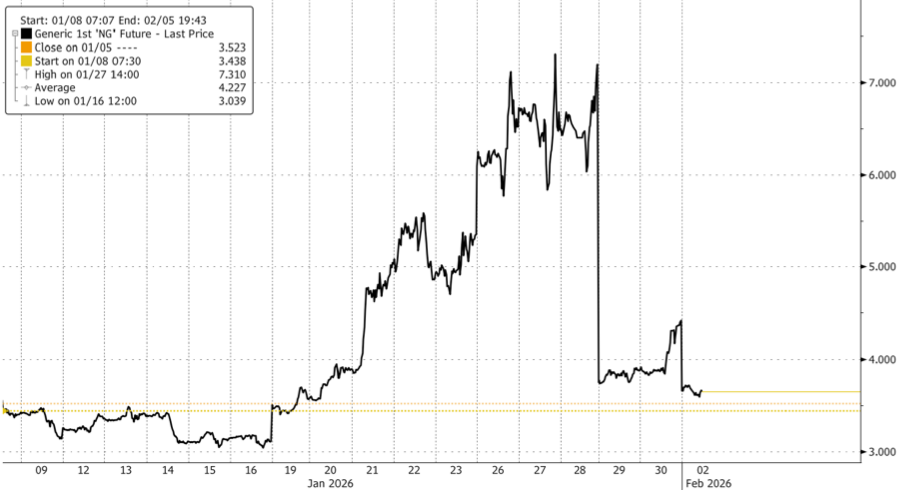
A sharp reversal in US natural gas futures was seen early Monday after skyrocketing prices in the second half of January, when dangerously cold air and a major winter storm triggered freeze-offs across critical NatGas infrastructure. The weather-driven supply disruptions coincided with a spike in heating demand, unleashing stress on power grids across much of the eastern US and driving NatGas spot prices sharply higher before the pullback, as well as power prices…

The front-month NatGas contract plunged as much as 17% to $3.620 per million British thermal units in early Asian trading, erasing Friday’s 11% gain after weeks of record-breaking cold.

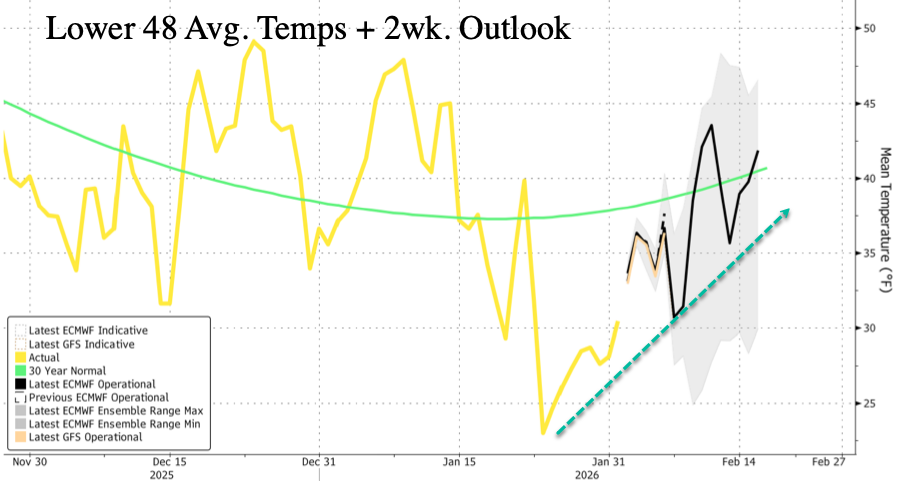
New weather models show milder conditions across parts of the Lower 48 over the next two weeks.

By mid-month, temperatures in the US are expected to revert to 30-year seasonal norms.

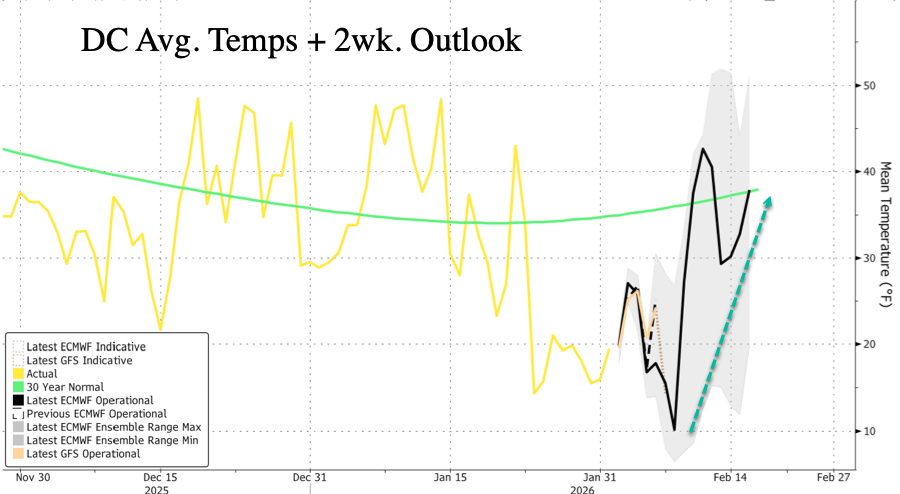
For our readers in Washington, DC… 

Let’s recap weather and energy reporting over the last few weeks, in which we led the discussion on NatGas freeze-offs and power grid stress. It’s clear that fossil fuel power generation saved many grids from collapse across the eastern US.

Recap:

Our takeaway from the record cold and severe winter weather is clear: the Trump administration’s push to boost reliable fossil fuel power generation helped prevent grid collapse. Dispatchable coal and NatGas plants, some of which had been slated for early retirement under the Democratic Party’s insane green-energy policies, proved essential in stabilizing power systems under extreme winter stress.

With nuclear capacity additions unlikely to be added to the grid until the 2030s, fossil fuels remain the backbone of the US economy and grid reliability. This latest weather episode reinforces an optically displeasing reality for radical-left Democrats: energy policy must prioritize reliability and resilience over toxic green ideology that appears to do more to self-sabotage the nation than improve life for everyone. Just look at the mess Europe is in.

Tyler Durden
Mon, 02/02/2026 – 06:55

via ZeroHedge News https://ift.tt/JeyzgYM Tyler Durden

Dumping State Income Taxes Could Mean High Sales Taxes—or an Opportunity for Smaller Government


The U.S. Capitol is pictured alongside a map of the U.S., with Missouri and Georgia highlighted. | Illustration: Luckyphotographer/Lightvision/Dreamstime

Missouri lawmakers are considering a proposal to abolish the state’s income tax and replace it with a sales tax. They’re not alone: Last year, Mississippi approved legislation that will decrease the state income tax over several years until it’s eliminated. That follows in the footsteps of Kentucky and Oklahoma. New Hampshire, which has no income tax, phased out its tax on interest and dividends. Several states making the move are considering sales taxes to fill the revenue gap, and they have the backing of the White House. But a new report warns that sales taxes may have to be higher than anticipated to make up the difference—unless state governments shrink in size and expense.

States Move To Shed a Hated Tax

“Mississippi will no longer tax the work, the earnings, or the ambition of its people,” Mississippi Gov. Tate Reeves boasted last March in a statement that captured low popular opinions of income taxes (and taxes in general). “I believe in a simple idea: that government should take less so that you can keep more. That our people should be rewarded for hard work, not punished. And that Mississippi has the potential to be a magnet for opportunity, for investment, for talent—and for families looking to build a better life.”

Unmentioned, but a worthy addition to Reeves’ observations about income taxes, is the inquisitorial nature of their enforcement. People must open their financial lives to government officials, allowing collectors to know how much they make and from whom, and to track flows and expenditures. The intrusive nature of income taxes is compounded by dueling guesses between taxpayers assessing their liability and officials who have the final word (and the force of law behind them).

In coverage of the recent move to jettison income taxes, the American Legislative Exchange Council (ALEC) reports “the statutes set to eliminate income taxes in Kentucky, Mississippi, and Oklahoma have all followed the same basic principle: When the state has extra funds available, the first use of them should be to put money into taxpayer pockets, prioritizing reducing income tax rates over increasing government spending.” Conditions—triggers—must be met before rates decline on their way to zero.

With income taxes going away, that raises questions about the implications for state finances since revenue will decline. Missouri Gov. Mike Kehoe proposes to hike sales taxes to make up the shortfall, though he vowed in his 2026 state of the state address that he will “never support extending sales taxes on agriculture, healthcare, or real estate.” Georgia is considering a similar proposal. In this they have the support of the White House Council of Economic Advisors (CEA).

White House Supports Dumping State Income Taxes

In a January 28 report, the CEA points out that states without income taxes lead the way in attracting and retaining residents and businesses. In part, that’s because “workers and businesses can avoid taxes by moving to lower-tax jurisdictions, and high-income individuals—those with the greatest tax liability and often the most career flexibility—are particularly responsive to income taxes.” The report adds that throughout the 20th century, “implementation of a state income tax led to significant population losses. The out-migration was so substantial that states saw little net revenue gain from their new income taxes—the expanded tax base was largely offset by the loss of taxpayers who left.”

The CEA concludes that most states could replace income tax revenue with “an average state sales tax rate of under 8 percent under full revenue replacement with no limits on spending growth.” With spending growth limits, states could offset lost revenue from abolished income taxes with “an average state sales tax rate of 6.2 percent.”

That sounds like a fair tradeoff. But the Tax Foundation’s Jared Walczak finds it far too optimistic.

A Higher Price Tag Than Advertised

Walczak agrees that “reducing income tax burdens and shifting toward well-designed sales taxes is pro-growth tax policy.” He also concurs with the CEA’s prediction of a significant increase in prosperity produced by a revenue-neutral shift from income to sales taxes. But he worries the CEA is pitching sales tax rates at far too low a level to replace income tax revenue. Unfortunately, he says, “the CEA’s calculations omit important factors and envision a sales tax base that violates federal law, among other serious impediments.”

The CEA’s proposal, for example, would tax all healthcare expenditures, even though many are off-limits to taxation under current law or involve no taxable transaction. Also, to arrive at the average replacement tax rate, the CEA assumed a sales tax on transactions in all states, “even those that already forgo an income tax, a sales tax, or both,” Walczak writes. That distorts the economic calculations.

The CEA report also assumes 100 percent compliance—something never achieved by any tax regime.

By his own calculations, including an assumption of 89 percent compliance, Walczak arrived at replacement sales tax rates of 12.08 percent on the low end and what he believes to be a more realistic rate of 17.51 percent. Ignoring the CEA’s proposed taxable base in favor of raising existing tax rates arrived at slightly lower rate of 15.66 percent.

Interestingly, the Georgia Budget and Policy Institute (GBPI), which prefers retaining the income tax, estimates a sales tax of 15.44 percent is required to replace lost revenue. That’s closer to Walczak’s figure than to the 7.19 percent the CEA proposes for full revenue replacement in the Peach State.

“Through flawed estimates, the CEA dramatically overstates the ease with which states could replace their income taxes,” Walczak cautions. “Real reform is worth doing—but that starts with realistic figures.”

An Opportunity for Smaller Government

Walczak and GBPI’s Daniel Kanso both work from the credible assumption that many people would find high sales rates daunting, with Kanso emphasizing “painful tradeoffs” to make the transition work. But the switch from income taxes to sales taxes could also be an opportunity. If paying 12 or 15 or 17 percent in tax on every transaction is painful, it’s pain that has been hidden from people through income withholding taxes even as the money was extracted behind the scenes. Mitigating that pain could be accomplished through smaller, leaner government that spends less and requires less revenue.

At the same time, smaller state governments funded by sales taxes wouldn’t need to peer over everybody’s shoulders, violating privacy and imposing a financial surveillance state.

Nine states currently have no state income tax, with several others planning to join them in the next few years. To prevent sticker shock at the cost of making the change, elected officials need to be honest about the cost of replacing the lost revenue with money from other sources, such as sales taxes. Or they could look at the end of state income taxes as an opportunity to shrink state government.

The post Dumping State Income Taxes Could Mean High Sales Taxes—or an Opportunity for Smaller Government appeared first on Reason.com.

from Latest – Reason.com https://ift.tt/qTQU7vB
via IFTTT