Trump Administration Insists Blowing Up Boats Is Not ‘Hostilities’


An aerial photo of military ships in the water | Photo: U.S. Southern Command

President Donald Trump has sought to justify his policy of summarily executing suspected drug smugglers by arguing that the United States is engaged in an “armed conflict” with criminal organizations that supply prohibited intoxicants. Yet the Trump administration also insists that U.S. forces are not engaging in “hostilities” when they blow up boats believed to be carrying illegal drugs.

Those positions are hard to reconcile with each other, but they are consistent with Trump’s disregard for legal limits on his use of the military to prosecute a
literalized war on drugs. His administration has tied itself in knots to portray murder as self-defense while avoiding
congressional constraints.

As of early December 2025, Trump had ordered 21 attacks on suspected drug boats in the Caribbean and the eastern Pacific, killing a total of 83 people. As he tells it, those people were “unlawful combatants” in a “noninternational armed conflict” with the United States because they were affiliated with “nonstate armed groups” whose actions “constitute an armed attack against the United States.”

According to the United Nations, the
definition of a “noninternational armed
conflict” requires violent confrontations between “organised Parties” that possess “organised armed forces.” The violence must “meet a minimum threshold of
intensity” that distinguishes it from threats such as “riots,” “banditry,” “unorganized and short-lived insurrections,” and “terrorist activities.”

The “armed conflict” that Trump describes does not meet these criteria. “This is not stretching the envelope,” Geoffrey Corn, formerly the U.S. Army’s senior adviser on the law of war, told The New York Times. “This is shredding it.”

Cardozo Law School professor Gabor Rona concurs. If the men whose deaths Trump has ordered “were running illicit drugs destined for the United States,” Rona writes, “the proper—and entirely feasible and precedented—response would have been interdiction, arrest, and trial. The Trump administration’s summary execution/targeted killing of suspected drug dealers, by contrast, is utterly without precedent in international law.”

Even if Trump’s conflation of drug smuggling with violent aggression made sense, his use of the military would still be subject to the War Powers Resolution. That 1973 law requires the president to report “any incident in which the United States Armed Forces are involved in an attack or hostilities” within 48 hours. It adds that the president “shall terminate any use of United States Armed Forces with respect to which such report was submitted” within 60 days unless Congress has declared war or authorized an extension.

Since Trump notified Congress of the first boat strike on September 4, 2025, the 60-day period expired on November 3, 2025. But shortly before the deadline, the Justice Department told Congress the 60-day rule does not apply in this case because blowing up suspected drug boats does not count as “hostilities” under the War Powers Resolution.

That position—which resembles former President Barack Obama’s controversial claim that dropping bombs on Libya in 2011 did not constitute “hostilities”—hinges on the premise that U.S. forces face no plausible risk of casualties. “In a statement provided by the White House,” The New York Times reported, “an unnamed senior administration official said that American service members were not in danger because the boats suspected of smuggling drugs were mostly being struck by drones far from naval ships carrying U.S. forces.”

This argument concedes that the targets posed no immediate threat, meaning Trump authorized the use of lethal force in circumstances where it was morally and legally unjustified. And in denying the existence of “hostilities,” the government implicitly contradicted Trump’s September 4 letter to Congress about the first boat strike, which said the report was “consistent with the War Powers Resolution.” The provision to which he was referring requires a “report on hostilities involving United States Armed Forces.” The government’s characterization of the attacks also seemed inconsistent with Trump’s assertion of a “noninternational armed conflict,” which requires “hostilities.”

Trump, who has preposterously claimed that “we save 25,000 American lives” with each boat strike, is keen to conceal the reality of his bloodthirsty tactics. By choosing to kill alleged drug smugglers instead of intercepting and arresting them, Trump is imposing the death penalty on criminal suspects without statutory authorization or any semblance of due process.

During his first term, Trump repeatedly praised Rodrigo Duterte, then president of the Philippines, who likened himself to Adolf Hitler while urging the murder of drug offenders. Trump bragged of his “great relationship” with the brutal authoritarian, who he said was doing “a great job” in tackling substance abuse. Now Trump is copying the example set by Duterte, who is currently imprisoned at The Hague, awaiting trial on charges of crimes against humanity.

The post Trump Administration Insists Blowing Up Boats Is Not 'Hostilities' appeared first on Reason.com.

from Latest – Reason.com https://ift.tt/e0pHPMU
via IFTTT
Dumping State Income Taxes Could Mean High Sales Taxes—or an Opportunity for Smaller Government


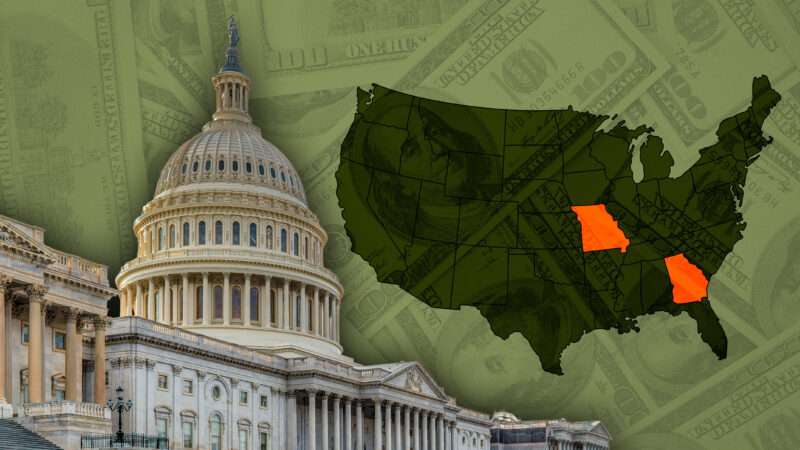
The U.S. Capitol is pictured alongside a map of the U.S., with Missouri and Georgia highlighted. | Illustration: Luckyphotographer/Lightvision/Dreamstime

Missouri lawmakers are considering a proposal to abolish the state’s income tax and replace it with a sales tax. They’re not alone: Last year, Mississippi approved legislation that will decrease the state income tax over several years until it’s eliminated. That follows in the footsteps of Kentucky and Oklahoma. New Hampshire, which has no income tax, phased out its tax on interest and dividends. Several states making the move are considering sales taxes to fill the revenue gap, and they have the backing of the White House. But a new report warns that sales taxes may have to be higher than anticipated to make up the difference—unless state governments shrink in size and expense.

States Move To Shed a Hated Tax

“Mississippi will no longer tax the work, the earnings, or the ambition of its people,” Mississippi Gov. Tate Reeves boasted last March in a statement that captured low popular opinions of income taxes (and taxes in general). “I believe in a simple idea: that government should take less so that you can keep more. That our people should be rewarded for hard work, not punished. And that Mississippi has the potential to be a magnet for opportunity, for investment, for talent—and for families looking to build a better life.”

Unmentioned, but a worthy addition to Reeves’ observations about income taxes, is the inquisitorial nature of their enforcement. People must open their financial lives to government officials, allowing collectors to know how much they make and from whom, and to track flows and expenditures. The intrusive nature of income taxes is compounded by dueling guesses between taxpayers assessing their liability and officials who have the final word (and the force of law behind them).

In coverage of the recent move to jettison income taxes, the American Legislative Exchange Council (ALEC) reports “the statutes set to eliminate income taxes in Kentucky, Mississippi, and Oklahoma have all followed the same basic principle: When the state has extra funds available, the first use of them should be to put money into taxpayer pockets, prioritizing reducing income tax rates over increasing government spending.” Conditions—triggers—must be met before rates decline on their way to zero.

With income taxes going away, that raises questions about the implications for state finances since revenue will decline. Missouri Gov. Mike Kehoe proposes to hike sales taxes to make up the shortfall, though he vowed in his 2026 state of the state address that he will “never support extending sales taxes on agriculture, healthcare, or real estate.” Georgia is considering a similar proposal. In this they have the support of the White House Council of Economic Advisors (CEA).

White House Supports Dumping State Income Taxes

In a January 28 report, the CEA points out that states without income taxes lead the way in attracting and retaining residents and businesses. In part, that’s because “workers and businesses can avoid taxes by moving to lower-tax jurisdictions, and high-income individuals—those with the greatest tax liability and often the most career flexibility—are particularly responsive to income taxes.” The report adds that throughout the 20th century, “implementation of a state income tax led to significant population losses. The out-migration was so substantial that states saw little net revenue gain from their new income taxes—the expanded tax base was largely offset by the loss of taxpayers who left.”

The CEA concludes that most states could replace income tax revenue with “an average state sales tax rate of under 8 percent under full revenue replacement with no limits on spending growth.” With spending growth limits, states could offset lost revenue from abolished income taxes with “an average state sales tax rate of 6.2 percent.”

That sounds like a fair tradeoff. But the Tax Foundation’s Jared Walczak finds it far too optimistic.

A Higher Price Tag Than Advertised

Walczak agrees that “reducing income tax burdens and shifting toward well-designed sales taxes is pro-growth tax policy.” He also concurs with the CEA’s prediction of a significant increase in prosperity produced by a revenue-neutral shift from income to sales taxes. But he worries the CEA is pitching sales tax rates at far too low a level to replace income tax revenue. Unfortunately, he says, “the CEA’s calculations omit important factors and envision a sales tax base that violates federal law, among other serious impediments.”

The CEA’s proposal, for example, would tax all healthcare expenditures, even though many are off-limits to taxation under current law or involve no taxable transaction. Also, to arrive at the average replacement tax rate, the CEA assumed a sales tax on transactions in all states, “even those that already forgo an income tax, a sales tax, or both,” Walczak writes. That distorts the economic calculations.

The CEA report also assumes 100 percent compliance—something never achieved by any tax regime.

By his own calculations, including an assumption of 89 percent compliance, Walczak arrived at replacement sales tax rates of 12.08 percent on the low end and what he believes to be a more realistic rate of 17.51 percent. Ignoring the CEA’s proposed taxable base in favor of raising existing tax rates arrived at slightly lower rate of 15.66 percent.

Interestingly, the Georgia Budget and Policy Institute (GBPI), which prefers retaining the income tax, estimates a sales tax of 15.44 percent is required to replace lost revenue. That’s closer to Walczak’s figure than to the 7.19 percent the CEA proposes for full revenue replacement in the Peach State.

“Through flawed estimates, the CEA dramatically overstates the ease with which states could replace their income taxes,” Walczak cautions. “Real reform is worth doing—but that starts with realistic figures.”

An Opportunity for Smaller Government

Walczak and GBPI’s Daniel Kanso both work from the credible assumption that many people would find high sales rates daunting, with Kanso emphasizing “painful tradeoffs” to make the transition work. But the switch from income taxes to sales taxes could also be an opportunity. If paying 12 or 15 or 17 percent in tax on every transaction is painful, it’s pain that has been hidden from people through income withholding taxes even as the money was extracted behind the scenes. Mitigating that pain could be accomplished through smaller, leaner government that spends less and requires less revenue.

At the same time, smaller state governments funded by sales taxes wouldn’t need to peer over everybody’s shoulders, violating privacy and imposing a financial surveillance state.

Nine states currently have no state income tax, with several others planning to join them in the next few years. To prevent sticker shock at the cost of making the change, elected officials need to be honest about the cost of replacing the lost revenue with money from other sources, such as sales taxes. Or they could look at the end of state income taxes as an opportunity to shrink state government.

The post Dumping State Income Taxes Could Mean High Sales Taxes—or an Opportunity for Smaller Government appeared first on Reason.com.

from Latest – Reason.com https://ift.tt/qTQU7vB
via IFTTT

“Never Seen Risk Like This Before In My Career”, Ed Dowd Warns

“Never Seen Risk Like This Before In My Career”, Ed Dowd Warns

Via Greg Hunter’s USAWatchdog.com,

Former Wall Street money manager and financial analyst Ed Dowd of PhinanceTechnologies.com warned in December we were “At the Beginning of Credit Destruction Cycle.” 

Renowned hedge fund BlackRock was the latest victim of credit destruction with this week’s headline that said, “BlackRock cuts value of private debt fund by 19%, waives fee.”

Dowd is right—again.

It’s going to get a lot worse, according to Dowd’s latest report called “US Economy Outlook 2026.”  Dowd says, “This is a big call, and what is going to happen does not happen that often…”

”  We will try to call the bottom in the future, but right now, I have never seen risk like this before in my career. 

This has been unfolding. . .. I have not been wrong in the 2025 call.  The stock market did go up 17%, but the rest of the economy imploded.  Real estate started rolling over…

Unfortunately, because this is such a bubble because they kicked the can down the road . . . the odds of this happening fast have increased exponentially since the beginning of 2025.”

Dowd goes on to explain, “The three fundamental risks that we see for the US economy for 2026…”

“There are two internal risks and one external risk. 

The first risk is US housing crisis/white swan event.  Immigrants came in and filled the gap. 

That’s now stopped. . .. Deportations are going to continue over the next year to two years, and that is going to continue to put pressure on homes.  

Affordability is a disaster.  Incomes do not allow people to buy homes at these prices. 

The only way to correct this is home prices dropping 25% to 30% over the next two years.  That would set us up for a recovery.”

Dowd continues, “The second risk to the US economy is a stock market bubble…”

The valuations are as bad as the Dot Com bubble. 

This is driven by the AI bubble, and we see the cracks are starting there. 

We expect that to pop sometime this year. 

The third risk is China. 

It is entering into the acute phase of its economic crisis. 

This is going to be a global contagion.  It will hurt Japan and South Korea, and this will spill over to the US. . .. It will be a liquidity crisis, and that is why we are bullish on the US dollar.”  (Dowd has new cutting-edge analysis on China for institutional investors.  It has shocking new and never before released details about how much trouble China is really in.)

Dowd goes on to point out, “We have a lot of headwinds coming at us in 2026…”

“We think the first problems will begin in the shadow banking system, which is private equity, private credit funds and all these non-depository financial institution loans commercial banks made over the last two years. (See BlackRock story above.)  

All their loan growth came from that source. 

There was no loan growth in commercial and industrial.  It was all in the shadow banking system.”

What is Dowd not worried about?  Despite the big gut punch in the gold and silver market on Friday, Dowd says:

“I am still bullish on gold and silver, and my target on gold by 2030 is $10,000 per ounce.  

It’s going to consolidate now.  Is it the end?  I don’t think so. 

There is a veracious appetite from big banks for gold and, in the case of silver, industrial users for the metal.”

There is much more in the 44-minute interview.

Join Greg Hunter of USAWatchdog as he goes One-on-One with money manager and investment expert Ed Dowd where he previews his latest report called US Economy Outlook 2026 for 1.31.26.

To get Dowd’s latest red-hot report called “US Economy Outlook 2026,” click here.

Tyler Durden
Mon, 02/02/2026 – 06:30

via ZeroHedge News https://ift.tt/tdc8Yfr Tyler Durden

Waste Of The Day: NYC Healthcare Fund Is Out Of Cash

Waste Of The Day: NYC Healthcare Fund Is Out Of Cash

Authored by Jeremy Portnoy via RealClearInvestigations,

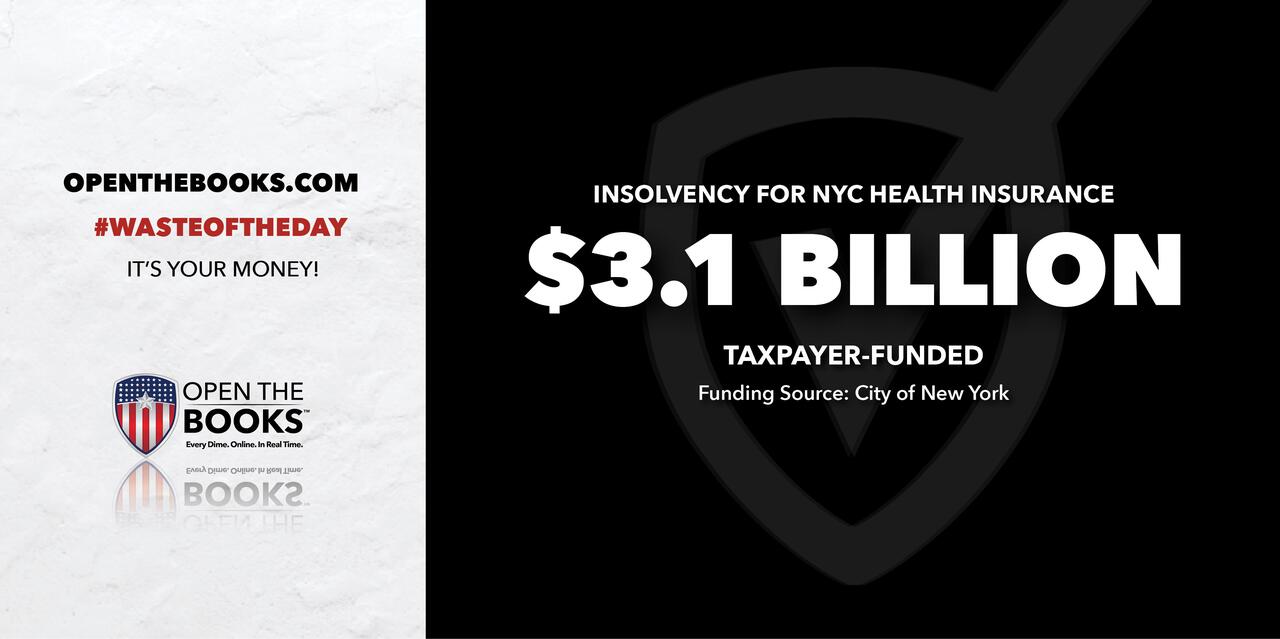
Topline: Former New York City Comptroller Brad Lander claims one of the city’s health insurance funds has “no path to solvency” after labor unions used it to cover pay raises, Weight Watchers and more.

Key facts: New York’s taxpayer-funded Health Insurance Stabilization Fund owes $3.1 billion to outside vendors and the city that it’s unable to pay. The actual amount is likely much higher because expenses from 2024 and 2025 have not been totaled yet, according to Lander’s Dec. 30 audit.

The fund was created in 1985 to help employees afford the city’s Group Health Insurance (GHI) plan, a more costly alternative to the older Health Insurance Plan (HIP).

The fund has since been used for several other purposes, which Lander claims is illegal. The city’s labor unions, in their response to the audit, argued the fund can be used for “any mutually agreed upon purpose” reached through collective bargaining.

From 2001 to 2024, the unions used $4.3 billion to fund pay raises, avoid layoffs and cover added benefits like dental and vision insurance. That included $1 billion in 2014 “to support wage increases and other economic items.” 

In 2024, the fund spent $166 million on additional benefits like Weight Watchers, Teladoc virtual doctors’ appointments and a mental health subsidy. However, most of that sum —$131.4 million — was for the city’s Psychotropic, Injectable, Chemotherapy & Asthma program, the audit found.

The audit claims the unions have known since 2018 that the fund was insolvent.

Since then, the fund’s cash balance has depleted almost entirely. In fiscal year 2019, the fund had $1.1 billion in cash available. But only $3 million was available as of 2024, when considering the cost of health care that has been provided but not yet paid for.

The fund’s shortfall cost the city an estimated $612 million in fiscal year 2025, according to Lander.

Search all federal, state and local salaries and vendor spending with the world’s largest government spending database at OpenTheBooks.com

Background: The GHI plan, run by Anthem Blue Cross Blue Shield, was replaced this year by a new plan run by UnitedHealthcare and EmblemHealth.

Lander was also replaced this year by newly elected Comptroller Mark Levine, who said on Jan. 2 that he was going to read the health-care audit “soon.” Mayor Zohran Mamdani said in a press conference that he takes the findings “seriously.”

Summary: There is no medicine that will be able to improve New York’s fiscal health if the city continues spending beyond its means.

The #WasteOfTheDay is brought to you by the forensic auditors at OpenTheBooks.com

Tyler Durden
Mon, 02/02/2026 – 06:30

via ZeroHedge News https://ift.tt/qYuFhzU Tyler Durden

FTC Warns 42 Law Firms Over DEI Hiring

FTC Warns 42 Law Firms Over DEI Hiring

The Trump administration is still going after DEI – or ‘diversity, equity and inclusion’ (i.e. white people are the scourge of the earth) – this time, in Big Law

The office of the law firm Perkins Coie is seen in Washington, on April 10, 2025. Photo by Kevin Dietsch/Getty Images

On Friday, the Federal Trade Commission (FTC) sent letters to 42 law firms warning them about “potentially unfair and anticompetitive employment practices” involving DEI, after they all participated in an anti-white program run by “Diversity Lab,” a “for-profit DEI-consultancy business.” 

All of these firms recently participated in the Mansfield Certification program, according to public information. Mansfield Certification is a creation of the company Diversity Lab, a for-profit DEI-consultancy business, which claims to “write the unwritten rules” establishing common race and gender-based employment practices across the legal industry. To receive the certification, law firms must agree to follow certain of Diversity Lab’s DEI-based employment standards. Public information also suggests that they would meet regularly with Diversity Lab and their competitor law firms to discuss common implementation of Diversity Lab’s criteria.

According to the FTC, the letter recipients “are among the largest law firms in the United States, collectively employing over 50,000 attorneys subject to Diversity Lab’s criteria.” 

In order to qualify for Mansfield Certification, law firms must agree to consider talent pools for promotions and leadership opportunities that comprise at least 30% ‘underrepresented’ racial and other groups

As a result of the process, many firms have reportedly met the 30% benchmark for external hiring and internal promotion.

“Millions of American citizens participate in our economy both as workers and as consumers. The antitrust laws protect them from anticompetitive employer agreements in labor markets just as much as they do from anticompetitive seller agreements in product markets,” reads the letter. 

Diversity Lab says the Mansfield program ensures “fair and equal” opportunity for all lawyers to advance to leadership roles, and focuses on “equal treatment, equal opportunity, and equal access.” The program is pitched as an “inclusive sourcing process” rather than a diverse slate policy. 

The premise, of course, is that merit-based hiring is racist – yet they claim it’s the exact opposite. 

As the Epoch Times notes further, the program does not dictate or require that underrepresented groups be selected for any leadership role or activity. Nor does adopting the initiative result in any individual being excluded from employment consideration on the basis of gender, race, or other demographic characteristics.

“Mansfield does not, explicitly or implicitly, ask employers or their decision-makers to make any selection or employment decision because of a demographic trait. As always, employment and advancement decisions remain outside of the scope of Mansfield and should be based solely on merit,” according to Diversity Lab.

The FTC letter cited an October 2024 statement from Diversity Lab, which claimed that more than 360 law firms earned Mansfield Certification in 2023-24.

The agency reminded law firms that unfair and anticompetitive employment practices also include collusion or unlawful coordination among entities regarding DEI metrics.

Potentially anticompetitive collusion between law firms on DEI metrics can include quotas by which they agree to compose panels of job candidates based on race, sex, or other personal characteristics other than the candidate’s merit, or by which law firms agree to make final decisions about hiring and promotions based on those personal characteristics,” it said.

“Such agreements can distort competition for labor in legal professions, including along dimensions like hiring decisions, pay, and promotions.”

Ferguson warned that participation in the Mansfield program risks subjecting law firms to liability under civil rights laws. He asked the firms to review their relationship with Diversity Lab and other similar organizations.

Tackling DEI

Since assuming office, President Donald Trump has signed orders aimed at dismantling DEI policies.

On Jan. 20, he issued a presidential action titled “Ending Radical And Wasteful Government DEI Programs And Preferencing” with the objective of terminating all discriminatory programs, including illegal DEI and diversity, equity, inclusion, and accessibility (DEIA) policies and practices in the federal government.

Trump signed another presidential action on Jan. 21—Ending Illegal Discrimination and Restoring Merit-Based Opportunity.

DEI and DEIA policies “undermine our national unity, as they deny, discredit, and undermine the traditional American values of hard work, excellence, and individual achievement in favor of an unlawful, corrosive, and pernicious identity-based spoils system,” Trump wrote.

He ordered all agencies to “enforce our longstanding civil-rights laws and to combat illegal private-sector DEI preferences, mandates, policies, programs, and activities.”

In its statement, the FTC said the letters’ recipients are among the largest law firms in the country, collectively employing over 50,000 attorneys who are subject to Diversity Lab’s Mansfield criteria.

One of the law firms to whom the FTC letter was sent is Paul Weiss. In March last year, Trump issued a presidential action aimed at “addressing risks” from Paul Weiss, alleging that the law firm discriminates against its employees based on race and other categories banned by civil rights laws.

Those who engage in blatant discrimination and other activities inconsistent with the interests of the United States should not have access to our Nation’s secrets nor be deemed responsible stewards of any Federal funds,” the president wrote.

Trump later agreed to drop the action after Paul Weiss pledged to eliminate DEI policies, including in hiring, and to provide $40 million in free legal services to support the administration’s initiatives.

Another law firm mentioned in the FTC letter, Latham & Watkins, also entered into a similar settlement with the Trump administration.

Law firm Perkins Coie, which sued the administration after being named in a presidential executive action, is included among the 42 law firms targeted in the FTC letter.

The Epoch Times reached out to Paul Weiss, Latham & Watkins, Perkins Coie, and Diversity Lab for comment, but did not receive a response by publication time.

Tyler Durden
Mon, 02/02/2026 – 05:45

via ZeroHedge News https://ift.tt/fuXdVSB Tyler Durden

US Approves New Massive Arms Deals For Israel, Saudis – Bypasses Congressional Review

US Approves New Massive Arms Deals For Israel, Saudis – Bypasses Congressional Review

Via The Cradle

On Friday, the US government authorized significant arms sales to Israel and Saudi Arabia, amounting to approximately $15.7 billion, as the White House continues to escalate threats of war against Iran.

The US State Department approved four arms packages for Israel totaling $6.67 billion, which includes a $3.8 billion deal for 30 Apache attack helicopters and a $1.98 billion sale of 3,250 Joint Light Tactical Vehicles. 

via Associated Press

Additional approvals include $740 million for power packs for armored personnel carriers and $150 million for light utility helicopters.

House Democratic Representative Gregory Meeks called the move shameful for “bypassing the Congressional review process” and a repudiation of Congress’ oversight role by Donald Trump.

“Shamefully, this is now the second time the Trump administration has blatantly ignored long-standing Congressional prerogatives while also refusing to engage Congress on critical questions about the next steps in Gaza and broader US policy,” Meeks declared.

White House officials justified the approvals by citing Washington’s commitment to “upholding Israel’s security,” even as war monitors have alleged Israeli forces have commit war crimes in Gaza, including ongoing violations that have killed over 500 Palestinians since the “ceasefire” began in October 2025.

In parallel, the State Department also approved a $9 billion sale to Saudi Arabia, covering 730 Patriot interceptor missiles intended for air defense systems.

The sales come amid a heightened risk of a new US war against Iran and the heavy militarization of West Asian waters.

US President Donald Trump has publicly referred to the deployment of the USS Abraham Lincoln Carrier and its accompanying warships as a “beautiful armada” currently stationed in the Arabian Sea and moving toward the Persian Gulf.

Iranian officials warned that any US base used to attack their country would be considered a legitimate target, saying: “We will target the same base and the same point from which air operations against us are launched,” but clarified that the Islamic Republic “will not attack countries because we do not consider them to be enemy countries.”

Gulf states warn that further escalation could destabilize the region, putting their economic and security interests at risk, and threatening major infrastructure and development plans such as Saudi Arabia’s Vision 2030.

Saudi Arabia, the UAE, Qatar, and Kuwait have informed the US that they will not allow their territory or airspace to be used for military actions against Iran, seeking to maintain a neutral stance and avoid becoming targets.

Tyler Durden
Mon, 02/02/2026 – 05:00

via ZeroHedge News https://ift.tt/KmOD0Af Tyler Durden

Trump Administration Insists Blowing Up Boats Is Not ‘Hostilities’


An aerial photo of military ships in the water | Photo: U.S. Southern Command

President Donald Trump has sought to justify his policy of summarily executing suspected drug smugglers by arguing that the United States is engaged in an “armed conflict” with criminal organizations that supply prohibited intoxicants. Yet the Trump administration also insists that U.S. forces are not engaging in “hostilities” when they blow up boats believed to be carrying illegal drugs.

Those positions are hard to reconcile with each other, but they are consistent with Trump’s disregard for legal limits on his use of the military to prosecute a
literalized war on drugs. His administration has tied itself in knots to portray murder as self-defense while avoiding
congressional constraints.

As of early December 2025, Trump had ordered 21 attacks on suspected drug boats in the Caribbean and the eastern Pacific, killing a total of 83 people. As he tells it, those people were “unlawful combatants” in a “noninternational armed conflict” with the United States because they were affiliated with “nonstate armed groups” whose actions “constitute an armed attack against the United States.”

According to the United Nations, the
definition of a “noninternational armed
conflict” requires violent confrontations between “organised Parties” that possess “organised armed forces.” The violence must “meet a minimum threshold of
intensity” that distinguishes it from threats such as “riots,” “banditry,” “unorganized and short-lived insurrections,” and “terrorist activities.”

The “armed conflict” that Trump describes does not meet these criteria. “This is not stretching the envelope,” Geoffrey Corn, formerly the U.S. Army’s senior adviser on the law of war, told The New York Times. “This is shredding it.”

Cardozo Law School professor Gabor Rona concurs. If the men whose deaths Trump has ordered “were running illicit drugs destined for the United States,” Rona writes, “the proper—and entirely feasible and precedented—response would have been interdiction, arrest, and trial. The Trump administration’s summary execution/targeted killing of suspected drug dealers, by contrast, is utterly without precedent in international law.”

Even if Trump’s conflation of drug smuggling with violent aggression made sense, his use of the military would still be subject to the War Powers Resolution. That 1973 law requires the president to report “any incident in which the United States Armed Forces are involved in an attack or hostilities” within 48 hours. It adds that the president “shall terminate any use of United States Armed Forces with respect to which such report was submitted” within 60 days unless Congress has declared war or authorized an extension.

Since Trump notified Congress of the first boat strike on September 4, 2025, the 60-day period expired on November 3, 2025. But shortly before the deadline, the Justice Department told Congress the 60-day rule does not apply in this case because blowing up suspected drug boats does not count as “hostilities” under the War Powers Resolution.

That position—which resembles former President Barack Obama’s controversial claim that dropping bombs on Libya in 2011 did not constitute “hostilities”—hinges on the premise that U.S. forces face no plausible risk of casualties. “In a statement provided by the White House,” The New York Times reported, “an unnamed senior administration official said that American service members were not in danger because the boats suspected of smuggling drugs were mostly being struck by drones far from naval ships carrying U.S. forces.”

This argument concedes that the targets posed no immediate threat, meaning Trump authorized the use of lethal force in circumstances where it was morally and legally unjustified. And in denying the existence of “hostilities,” the government implicitly contradicted Trump’s September 4 letter to Congress about the first boat strike, which said the report was “consistent with the War Powers Resolution.” The provision to which he was referring requires a “report on hostilities involving United States Armed Forces.” The government’s characterization of the attacks also seemed inconsistent with Trump’s assertion of a “noninternational armed conflict,” which requires “hostilities.”

Trump, who has preposterously claimed that “we save 25,000 American lives” with each boat strike, is keen to conceal the reality of his bloodthirsty tactics. By choosing to kill alleged drug smugglers instead of intercepting and arresting them, Trump is imposing the death penalty on criminal suspects without statutory authorization or any semblance of due process.

During his first term, Trump repeatedly praised Rodrigo Duterte, then president of the Philippines, who likened himself to Adolf Hitler while urging the murder of drug offenders. Trump bragged of his “great relationship” with the brutal authoritarian, who he said was doing “a great job” in tackling substance abuse. Now Trump is copying the example set by Duterte, who is currently imprisoned at The Hague, awaiting trial on charges of crimes against humanity.

The post Trump Administration Insists Blowing Up Boats Is Not 'Hostilities' appeared first on Reason.com.

from Latest – Reason.com https://ift.tt/e0pHPMU
via IFTTT

Hero British Bus Driver Fired For Stopping Thief And Protecting Passenger

Hero British Bus Driver Fired For Stopping Thief And Protecting Passenger

Authored by Steve Watson via Modernity.news,

In a nation where self-defense is apparently a fireable offense, Mark Hehir, a dedicated London bus driver, has been hailed as a hero by the public but sacked by his employer for daring to chase down a thief who snatched a passenger’s necklace.

This absurdity highlights how the UK’s bureaucratic overlords prioritize corporate protocols over actual justice, leaving ordinary citizens vulnerable to rampant crime while the establishment looks the other way.

Hehir’s act of bravery, which even the police deemed “proportionate and necessary,” has sparked petitions, fundraisers, and widespread fury online. But in today’s Britain, where globalist policies have eroded basic freedoms, punishing the good guys seems to be the new normal—echoing a broader decline that sees literal convicted terrorists eyeing political power while heroes like Hehir get the boot.

The incident unfolded on June 25, 2024, aboard the 206 bus route in northwest London. A man boarded, shoved past a female passenger, and ripped a necklace from her neck before fleeing. Hehir, 62, didn’t hesitate—he pursued the thief for about 200 meters, retrieved the jewelry after a scuffle, and returned it to the distressed woman.

But the story didn’t end there. The thief returned to the bus, allegedly to “apologize” according to Metroline, the bus company. Hehir insists the man threw the first punch, prompting him to retaliate in self-defense and restrain the assailant until police arrived. Both were arrested, but authorities quickly cleared Hehir, with a detective noting the force used was justified “in the defence of himself and the female passenger.”

Metroline saw it differently. They fired Hehir for gross misconduct, accusing him of assault, leaving the bus unattended, and bringing the company into disrepute. An employment tribunal upheld the decision, claiming it fell within a “band of reasonable responses” for an employer. Never mind that Hehir had put himself in harm’s way to protect others.

Public backlash has been swift and fierce. A petition demanding his reinstatement has garnered over 5,000 signatures, while thousands of pounds have been raised in support. On X, users decried the ruling as emblematic of “anarcho-tyranny,” where criminals roam free but citizens are penalized for stepping up.

The exact opposite happens in other countries:

Hehir himself called into LBC radio to set the record straight. “I’m the actual bus driver,” he told host Tom Swarbrick, explaining how the thief came back aggressive, not apologetic. “He went to throw a left punch and I met him with a right punch and clearly he went down.”

This case isn’t isolated. It fits a disturbing pattern in the UK, where the establishment’s obsession with “protocols” and political correctness tramples on individual rights. Under Labour’s watch, crime surges unchecked, fueled by open borders and soft-on-crime policies that echo the globalist agenda eroding Western societies.

Tie this to the latest outrage: a convicted terrorist running for office in the UK’s second city Birmingham. Shahid Butt, sentenced to five years in Yemen for plotting bombings against British targets and with a history of violent offenses in the UK, is now campaigning on a pro-Gaza platform in a Muslim-majority ward. He dismisses his conviction as a setup, but facts don’t lie.

Sharon Osbourne, widow of rock legend Ozzy, fired back on social media: “This has nothing to do with racism. I think I’m gonna move to Birmingham and put my name down for the ballot to be on the council. I’m serious.” Supporters cheered her on, with comments like “Please do, Sharon. Gosh, it’s just unbelievable that someone like him can stand. It’s just so demoralising. What is this country coming to?”

This juxtaposition is damning. While a bus driver gets sacked for defending a victim, a man with terrorist ties can vie for public office, backed by pro-Gaza activists. It’s the same system that welcomes extremists like Alaa Abd el-Fattah—who praised Osama bin Laden—while jailing Brits for social media posts criticizing immigration.

Such hypocrisy exposes the rot: a two-tier justice system where mass migration and woke ideologies prioritize outsiders over natives, stifling freedom and safety. Hehir’s sacking isn’t just a corporate blunder—it’s a symptom of a nation surrendering to chaos.

Brits deserve better than a government that handcuffs heroes while handing platforms to radicals.

Your support is crucial in helping us defeat mass censorship. Please consider donating via Locals or check out our unique merch. Follow us on X @ModernityNews.


Tyler Durden
Mon, 02/02/2026 – 03:30

via ZeroHedge News https://ift.tt/UR3tKmX Tyler Durden

How Arctic Ice Loss Is Reshaping Global Shipping

How Arctic Ice Loss Is Reshaping Global Shipping

Not only does the Arctic hold significant oil and rare earth resources, thawing ice means that shipping routes can be reduced drastically.

Since 1980, the Arctic’s minimal ice extent, its smallest point, has shrunk by 39%.

At the same time, the Arctic is a strategic priority for Russia, both for freight transport and military security.

More recently, President Trump has argued that Greenland – a territory he has threatened to acquire – is critical to U.S. security.

This graphic, via Visual Capitalist’s Dorothy Neufeld, shows how Arctic ice loss is redrawing shipping routes, based on data from multiple sources, including NASA, World Bank, NOAA, and ArcData.

The Rise of Arctic Shipping As Ice Thaws

Over the last decade, Arctic shipping has increased 37%, with 1,781 unique ships sailing a combined 12.7 million nautical miles in 2024.

Ship traffic is increasing as Arctic ice is thawing at a notable pace. For perspective, the loss in minimal ice extent between 1980 and 2025 is greater than the size of India’s land area.

Below, we show the annual minimum Arctic ice extent over the past several decades.

Among the region’s key shipping corridors are the Northern Sea Route and the Northwest Passage.

The Northern Sea Route, in particular, is central to Russia’s strategic ambitions.

In 2025, the first vessel completed a China–Europe transit along the route in roughly 20 days, covering 7,850 nautical miles.

By comparison, the southern route via the Suez Canal takes about 27 days and spans 11,167 nautical miles.

Looking ahead, the even shorter Transpolar Route—cutting directly across the North Pole—could become viable as early as 2059.

The Arctic is warming at roughly four times the global average, accelerating ice melt and extending navigable seasons.

If realized, the Transpolar Route would further reduce shipping distances and costs, while significantly increasing the Arctic’s geopolitical and economic importance.

To learn more about this topic, check out this map explainer on the territory of Greenland.

Tyler Durden
Mon, 02/02/2026 – 02:45

via ZeroHedge News https://ift.tt/QnV2Xht Tyler Durden

Brickbat: Down the Wrong Pathway


Pathways video game and the British Home Office | Illustration: Chucklefish/Facundo Arrizabalaga/EPA

A British government–funded video game aimed at students aged 11 to 18 is warning teenagers that questioning mass migration or even researching immigration statistics online could lead to a referral to the U.K.’s counterterrorism program, Prevent. The game, titled Pathways, guides white teenage characters through scenarios in which they must avoid being flagged for “extreme right-wing ideology,” portraying certain political activity or even searches for information as potential warning signs. Within the game, characters are told they risk referral if they interact with groups said to spread “harmful ideological messages” or attend protests opposing what is described as the “erosion of British values.”

The post Brickbat: Down the Wrong Pathway appeared first on Reason.com.

from Latest – Reason.com https://ift.tt/0SkVWvu
via IFTTT