One Man Thinks He Knows “Why Everything Sucks”

One Man Thinks He Knows “Why Everything Sucks”

Authored by Matt Van Swol via X,

I think I know why everything sucks…

…and it’s because everything is fake

We are getting fake college degrees that cost 4 years and six figures that teach you fake education and get you fake jobs.

We are eating fake food, with fake ingredients, funded by fake research.

We are scrolling through fake lives, with fake relationships, who take fake, curated vacations to promote brands that make fake products.

We are voting for fake candidates, who run on fake promises, inside a fake system that was never designed to fix anything.

We are raising kids in fake schools that teach fake history, fake science, which quietly produce fake adults who can’t think for themselves.

We are watching fake news, about fake crises, produced by fake journalists, for fake outrage.

We are borrowing fake money that was printed from nothing, to fund a fake economy that would collapse in an afternoon if people stopped pretending it was real.

We are buying fake organic food that’s just a paid label, and drinking fake juice with two percent juice in it, and putting fake cheese on cheeseburgers that’s just “cheese product” on fake burger meat.

We are donating to fake nonprofits where the money never makes it to the people and then funding fake foreign aid that buys real weapons to prop up fake governments.

We are going to fake therapy that teaches fake coping skills instead of telling you hard truths.

We are buying fake furniture made of fake wood that’s actually compressed sawdust and glue that looks like wood, ships in fourteen boxes with instructions written in a fake language that isn’t quite any language, requires tools it doesn’t include, takes 4 hours to build, wobbles on day 1, and is totally destroyed in 6 months.

We are downloading fake “free” apps that charge a subscription after three days for AI features that don’t work, hidden behind a paywall we didn’t see, protected by a privacy policy we didn’t read, buried inside Terms of Service written by lawyers specifically so we wouldn’t read them, that we agreed to by tapping a button the size of a thumbnail, that gave a company we’ve never heard of the right to sell our data to companies we’ll never hear of, to build a profile on us we’ll never see, to influence decisions we’ll never know were made.

IT. IS. ALL. FAKE.

And we all yearn for what was once real.

Don’t you remember? Did you forget?

There was a time with a simple handshake between men was a contract.

When bread went stale because… well, that’s what real bread does!

When kids played outside all day until it was dark, and nobody tracked them.

When a family could live off a single income.

When music was made by people who LIVED something real and you could feel it.

When schools was HARD… and that was the point!

When doctors knew your name and your family, they even came to your house.

When you bought something once… and it was yours forever.

When the chair your grandmother bought once lasted 70 years and she passed it onto your dad.

And now nothing is real, and that’s why everything sucks.

Tyler Durden
Tue, 03/31/2026 – 16:25

via ZeroHedge News https://ift.tt/1qeCslr Tyler Durden

Gearing Up For Artemis II: NASA’s High-Stakes Test Run Around the Moon

Gearing Up For Artemis II: NASA’s High-Stakes Test Run Around the Moon

NASA is gearing up for Artemis II, its first crewed mission to the moon since the Apollo era—but this one is more of a high-speed dress rehearsal than a landing, according to KSL.com. Four astronauts will take a roughly 10-day trip that loops around the moon and comes straight back, with no orbiting or moonwalks.

The crew—Reid Wiseman, Victor Glover, Christina Koch, and Jeremy Hansen—marks a few firsts: the first woman, first person of color, and first non-American assigned to a lunar mission. Koch already holds the record for the longest single spaceflight by a woman, while Glover previously made history aboard the International Space Station. Hansen, representing Canada, is the only rookie in the group.

They’ll launch aboard NASA’s massive Space Launch System rocket, with the Orion capsule on top. After liftoff, the plan is to spend about a day in an elongated orbit around Earth, practicing navigation by flying close to a spent rocket stage—without docking, just eyeballing the distance. As commander Wiseman put it, “Sometimes simple stuff is the best.”

KSL writes that from there, Orion will fire its engine and send the crew on a long arc toward the moon, roughly 244,000 miles away. Using a “free-return” trajectory—basically letting gravity do most of the work—they’ll swing around the far side and travel about 5,000 miles beyond it, farther than any humans have gone before. The moon will loom large during the flyby, and the crew is expected to document rarely seen regions of its far side.

After about six days, they’ll slingshot back toward Earth, wrapping up the mission with a Pacific Ocean splashdown just under 10 days after launch. Engineers will be paying close attention to Orion’s heat shield during reentry, since it took heavy damage during an earlier uncrewed test.

The mission hasn’t been perfectly smooth so far—fueling issues like hydrogen leaks have already caused delays—but Artemis II is still a crucial step. NASA ultimately wants to return astronauts to the lunar surface, and this flight is meant to prove they can get there—and back—safely.

Tyler Durden
Tue, 03/31/2026 – 15:45

via ZeroHedge News https://ift.tt/qYgdxTB Tyler Durden

New Restrictions On SNAP Purchases To Take Effect In More States In April

New Restrictions On SNAP Purchases To Take Effect In More States In April

Authored by Tom Gantert via The Epoch Times (emphasis ours),

Food stamp recipients in Florida, Texas, and West Virginia will face restrictions on buying certain kinds of less nutritious items such as soda and candy, some starting in April.

A sign on the window of a grocery store in the Flatbush neighborhood of the Brooklyn borough of New York City on Oct. 30, 2025. Michael M. Santiago/Getty Images

West Virginia’s restrictions became effective on Jan. 1, but retailers have until April 1 to be fully compliant.

The U.S. Department of Agriculture (USDA) has approved Colorado’s restrictions waiver, but the state has delayed implementation of restrictions on certain items for food stamp recipients until after April 30 and stated that it would have a final vote on April 3 on the program.

The Trump administration is clamping down on soda and candy being charged to food stamps, as 22 states now have been approved to restrict certain purchases under the program. The restrictions still require state approval before taking effect.

Kansas, Nevada, Ohio, and Wyoming were the latest states to receive USDA approval for food and beverage restrictions.

The Supplemental Nutrition Assistance Program (SNAP), also known as food stamps, had 40.7 million people participating nationwide at a monthly cost of $7.97 billion as of November 2025.

The Trump Administration is leading bold reform to strengthen integrity and restore nutritional value within the Supplemental Nutrition Assistance Program,” the USDA stated on its website. “USDA is empowering states with greater flexibility to manage their programs by approving SNAP Food Restriction Waivers that restrict the purchase of non-nutritious items like soda and candy. These waivers are a key step in ensuring that taxpayer dollars provide nutritious options that improve health outcomes within SNAP.”

For example, starting on April 1, Texas residents will not be able to buy candy or sweetened drinks on their SNAP-provided Lone Star Cards. Those restrictions will ban such purchases as candy bars, gum, and taffy, as well as nuts, raisins, or fruits that have been “candied, crystallized, glazed or coated with chocolate, yogurt or caramel.”

Texas also will ban sweetened non-alcoholic beverages made with water that contain 5 or more grams of sugar or artificial sweetener, according to Texas Health and Human Services.

The USDA also maintains the Restaurant Meals Program in nine states, including New York and California, which allows eligible participants to use their SNAP debit card at qualified fast food restaurants. Those restaurants include such food chains as KFC, Subway, Taco Bell, McDonald’s, and Popeyes. To be eligible for the program, participants must be 60 years of age or older, disabled, homeless, or the spouse of a SNAP client who is eligible for the Restaurant Meals Program.

The Food Research & Action Center, a nonprofit advocacy group, is opposed to SNAP benefit restrictions on items such as candy and soda.

State efforts to restrict what SNAP recipients can buy with their benefits are expanding across the country—despite evidence that they are harmful, burdensome, and ineffective,” the Food Research & Action Center stated on its website.

The organization said that the modifications of such programs are time-consuming and “fiscally irresponsible” and that research shows that “SNAP participants eat no differently than other Americans.”

The Food Research & Action Center stated: “Policing food choices is ineffective, undermines American values, and worsens food insecurity. The real solution is strengthening SNAP with adequate benefits, access to healthy foods, and proven produce incentives.”

The USDA also offers a SNAP healthy incentive program that provides coupons, discounts, gift cards, and bonus food or extra money to participants who purchase specified healthy foods.

Tyler Durden
Tue, 03/31/2026 – 15:25

via ZeroHedge News https://ift.tt/qOv7Ebs Tyler Durden

“There Is Evidence That This Particular Proceeding Before the Beijing Court Was Dominated by the” Chinese Communist Party,

A short excerpt from from today’s long opinion by Judge John Tigar (N.D. Cal.) in Stanford Univ. v. Yuzhen; I am an employee of Hoover and Stanford, but I haven’t been involved in the lawsuit, and wasn’t prompted by anyone to write bout it:

Plaintiff Board of Trustees of Leland Stanford Junior University seeks to quiet title in certain materials denominated the Li Materials, which consist of original materials written by Chinese political figure Li Rui [and by people connected to him] …. Stanford and Li’s daughter, Li Nanyang, contend that: (1) during his lifetime, Li Rui gave the Li Materials to Li Nanyang and instructed her to make a permanent gift of the Li Materials to Stanford, to be preserved by and made freely available for scholarly research and public review at the Hoover Institution Library & Archives at Stanford University (“Hoover”); and (2) in accordance with Li Rui’s instructions, the original Li Materials were donated to and delivered to Hoover by Li Nanyang prior to Li Rui’s death.

Defendant and Counterclaimant Zhang Yuzhen, who was Li Rui’s second wife, contends that Li Rui did not transfer ownership of his original manuscripts to Li Nanyang, and that Li Nanyang did not have the legal right to donate any of Li Rui’s original materials to Hoover prior to Li Rui’s death. Zhang Yuzhen further contends that pursuant to the Chinese court’s judgment in a proceeding called the Zhang Action, she is the sole owner of the original manuscripts contained in the Li Materials, and that this Court should recognize and enforce the Chinese judgment and order Stanford to return to Zhang Yuzhen the original manuscripts that were improperly transferred to Stanford by Li Nanyang….

Li Rui held various government positions in the People’s Republic of China during the 1950s. He became Chairman Mao’s personal secretary in 1958, placing him at the center of political activity in China.

Li Rui was a person of strong opinions who spoke out against the CCP during his lifetime and who “ha[d] a lot of guts.” In 1959, Li Rui attended a leadership meeting of the CCP called the Lushan Conference. At the conference, Li made comments critical of Mao Zedong and the CCP. Because of these criticisms, Li Rui was exiled and transferred between jail and work camps for approximately 20 years….

In 1979, two-and-a-half years after Chairman Mao’s death, Li was released from prison, his membership in the Communist Party was restored, and he was reinstated to his prior position as Deputy Minister of the Electric Power Ministry. Also in 1979, Li Rui married Zhang Yuzhen, and they remained married until Li Rui’s death on February 16, 2019.

In 1982, Li became the Deputy Director of the Organization Department of the CCP. During this time, Li also became a member of the Central Committee of the CCP, and then the Advisory Committee.

In February 1989, Li Rui visited the Hoover Institution at Stanford University. He was “amazed” by the collection at Hoover because it contained writings about historical events that were not available in China, including extensive materials about the Cultural Revolution.

Li Rui witnessed the events in Tiananmen Square in June 1989 from the balcony of his apartment. He wrote an open letter critical of the CCP’s decision to send in soldiers to crack down on the protesting students. He also took notes of the event in his diary.

On August 28, 1999, Li Rui executed a “Testament” noting how fortunate he was to marry Zhang Yuzhen and giving the following “instruction” to his children:

  1. The copyrights to all my written works (including those already published and those not yet published) shall all belong to Yuzhen after my demise.
  2. All my deposits and household items shall belong to Yuzhen after my demise.
  3. My collection of calligraphy and painting works shall all be managed and handled by Yuzhen after my demise.
  4. All books shall be donated to Pingjiang Library on my behalf by Yuzhen after my demise.

The testament did not address the disposition of the Li Materials….

There are a lot of further factual findings and legal conclusions in the opinion, but here’s an interesting passage on the non-enforceability of a Chinese court judgment:

“There is currently no federal statute governing recognition of foreign judgments in the federal courts.” “Generally, the recognition of foreign judgments is an issue of state law.” “In matters not involving money judgments, California courts “look to general principles of comity followed by the California courts[.]”

“Comity is ‘the recognition which one nation allows within its territory to the legislative, executive or judicial acts of another nation.'” “Extension of comity to a foreign judgment is neither a matter of absolute obligation, on the one hand, nor of mere courtesy and good will, upon the other.” A federal court should generally give preclusive effect to a foreign court’s finding as a matter of comity.” However, “[c]omity is not an inexorable command, and a request for recognition of a foreign judgment may be rebuffed on any number of grounds.” …

Applying [generally recognized comity] principles, the Court concludes that the Zhang Judgment is not enforceable, for the following reasons.

First, the Beijing Court lacked jurisdiction over Stanford because it was not originally named as a party in Zhang Yuzhen’s civil complaint. [Details omitted. -EV] …

Second, even if the Beijing Court had personal jurisdiction over Stanford, Stanford was denied an opportunity to appear and defend itself in the Zhang Action because the Beijing Court would not allow Stanford’s lawyers to appear, despite their substantial efforts to do so. A well-established principle of comity is that “it would be unjust to [a sovereign’s] own citizens to give effect to the judgments of a foreign tribunal against them when they had no opportunity of being heard.” Such was the case here.

DeJoria v. Maghreb Petroleum (W.D. Tex. 2018) is instructive. In that case, Plaintiff DeJoria sought a declaration that a judgment of the court in Morocco was invalid because, among other reasons, DeJoria had not been able to participate in the litigation leading to the judgment. The Court found that DeJoria had a legitimate fear of traveling to Morocco based on threats made against him by persons connected with his litigation opponents, who were also members of the royal family. He also was not able to retain counsel, “due to the fact that he was a defendant in a case that was of great political interest to the King of Morocco, and his interests were adverse to the King’s.” These facts and others compelled the DeJoria court to find that “the specific proceeding in the foreign court leading to the judgment was not compatible with the requirements of due process of law.”

Here, although Stanford was able to retain counsel, that counsel was not able to participate in the litigation and its views were not considered by the court. This meant that Stanford did not receive due process.

Third, the Beijing Court failed to keep the “clear and formal record” of the proceedings that would allow this Court to find that the proceedings were fair…. [And i]n at least one respect, the judgment is at odds with the facts, stating that Hoover, Stanford, and Li Nanyang were “summoned by the court and did not appear, with no justified reason” and “did not present any statements, either.” In actual fact, however, Hoover had attempted to appear through Stanford’s counsel and to present evidence and argument and Li Nanyang had presented jurisdictional objections. Because there is no “clear and formal record,” the Court cannot determine whether the proceedings afforded Stanford the due process to which it was entitled, or satisfied the other Hilton factors.

Fourth, there is evidence that this particular proceeding before the Beijing Court was dominated by the CCP, as summarized by Professor Kellogg. [American law] permit[s] denial of enforcement of a foreign judgment when the foreign judicial system from which the judgment originated did not provide an impartial tribunal or due process of law in a particular case. Evidence “that the judiciary was dominated by the political branches of government or by an opposing litigant, or that a party was unable to obtain counsel, to secure documents or attendance of witnesses, or to have access to appeal or review, would support a conclusion that the legal system was one whose judgments are not entitled to recognition.”

The State Department Country Reports on Human Rights Practices “ha[ve] been described as the most appropriate and perhaps the best resource for information on political situations in foreign nations.” The U.S. State Department Country Report on Human Rights Practices in China for 2019 states:

Although the law states the courts shall exercise judicial power independently, without interference from administrative organs, social organizations, and individuals, the judiciary did not exercise judicial power independently. Judges regularly received political guidance on pending cases, including instructions on how to rule, from both the government and the CCP, particularly in politically sensitive cases.

Professor Kellogg’s expert report notes that “[p]arty control over the judiciary is well-documented …. The State Department’s findings on judicial independence remain unchanged: its reports on China have continued to note the judiciary’s lack of judicial independence on an annual basis each year, including 2023, the most recent report currently available.”

And the court finds that Li Rui gave the Li Rui materials to Li Nanyang for the purpose of removing them from China and donating them to the Hoover Center at Stanford”:

Thus, when Li Nanyang donated the materials to the Hoover Institute, she was acting in accordance with and pursuant to Li Rui’s expressed wishes. Accordingly, Stanford now holds good title to the Li Rui Materials.

Li Rui knew that Stanford would preserve the Li Materials and make them available to the public. He also believed that the CCP was likely to secrete, censor, redact, or destroy the Li Materials. His desire that his writings be made available to the public in perpetuity and not be censored in any way was the primary motivation for giving the materials to Li Nanyang so she could deposit them at Stanford/Hoover. Li Rui’s fears that his writings would be banned, burned, or otherwise made unavailable were reasonable and consistent with other evidence received in the case as set forth above.

Because Li Rui gave the materials to Li Nanyang for this purpose prior to his death, the materials were not part of his estate at the time of his death and therefore were not subject to the law of inheritance….

Jeffrey David Wexler, Mark Davis Litvack, and Ryan Adelsperger (Pillsbury Winthrop Shaw Pittman LLP) represent Stanford.

The post "There Is Evidence That This Particular Proceeding Before the Beijing Court Was Dominated by the" Chinese Communist Party, appeared first on Reason.com.

from Latest – Reason.com https://ift.tt/U6b4nMO
via IFTTT

“Rising Wave of Antisemitism” Doesn’t Justify Letting Jewish Plaintiff Sue Pseudonymolusly

From Doe v. Life Time, Inc., decided today (correctly, I think) by Judge Dora Irizarry (E.D.N.Y.):

The Complaint alleges that Plaintiff attended Life Time Fitness from 2018 to 2024, and in 2023 his local gym hired Defendant Ahmed to “man the front desk in the evenings.” Ahmed is alleged to be a member of the Muslim faith who “flaunts his religion” The Complaint alleges that, as an employee, Ahmed discriminated against Jewish members, such as Plaintiff [in violation of federal and state antidiscrimination law], by prohibiting Plaintiff from entering the gym after 8:00 PM on weekends, while allowing members of the Muslim faith to enter.

Plaintiff recounts a specific encounter on October 26, 2024, in which Plaintiff arrived with a guest wearing a yarmulke (a small round head covering worn by male practitioners of the Orthodox Jewish faith) and requested late entry. Ahmed is alleged to have denied entry and then admitted to selectively enforcing policies when pressed by Plaintiff. The situation escalated and Plaintiff’s membership to the gym was suspended. Plaintiff alleges that his membership was reinstated the next day; however, on December 14, 2024, three Life Time employees, including Ahmed, assaulted him in the gym locker room.

Plaintiff attests that he raised Ahmed’s discriminatory actions to his gym’s general manager, but nothing was ever done. After lodging a number of complaints, Plaintiff alleges that the general manager banned him from the gym. Plaintiff further alleges he never was given a reason from Life Time as to why he was banned….

Fed. R. Civ. P. 10(a) provides that the “title of [a] complaint must name all the parties.” This requirement serves “the vital purpose of facilitating public scrutiny of judicial proceedings and … cannot be set aside lightly.” … The [Second C]ircuit has cautioned that there are “a limited number of exceptions” to the general rule, which includes the privacy of minors… [Plaintiff] does not fall into one of the previously recognized exceptions and the public’s interest in the litigation is furthered by identification because the public has a presumptive “right to know who is using their courts.” …

[C]ourts [should] consider whether disclosure of a plaintiff’s identity would subject them, or non-parties, to possible harm. Speculative or “generalized harm” is not sufficient to establish a likelihood of harm following identification. Here, Plaintiff argues that he is in “real danger” of physical harm and that the harm is not speculative because he previously was assaulted by Ahmed and that the rising wave of antisemitism across the nation subjects him to harm upon being identified as a member of the Jewish faith.

Plaintiff’s argument is unavailing because his basis for “likely” harm is entirely speculative. Whether Plaintiff was assaulted by Ahmed at the gym in the past does not establish that it will occur again, especially considering that Plaintiff was banned from returning to the gym. Notably, the Complaint is devoid of allegations suggesting that he will be unduly targeted at large because of his Jewish Faith.

[Courts should also consider] whether “the litigation involves matters that are highly sensitive and of a personal nature.” Courts have found birth control, abortion, homosexuality, welfare rights of illegitimate children, abandoned families, and sexual assault and harassment to be highly sensitive matters. While conceding that his “status as a Jewish individual is not inherently sensitive information,” nonetheless, Plaintiff contends that this action involves highly sensitive matters because of the social stigma attendant to his private Jewish beliefs. Plaintiff relies on the Fifth Circuit’s opinion in Doe v. Stegall (5th Cir. 1981), which involved religious freedom pursuant to the First Amendment.

However, Stegall is distinguishable from the instant action for three reasons: (1) Stegall involved children; (2) Stegall was brought against the county government; and (3) the plaintiffs in Stegall had evidence indicating a likelihood of “extensive harassment” from the county community. Plaintiff’s reliance on the rise of antisemitism here amounts to nothing more than speculation. Significantly, he does not distinguish the unique characteristics of his case that mandate departure from the preference for public disclosure as in the litany of other religion-based cases on this issue. Therefore, factor one also weighs against Plaintiff….

For a somewhat different approach to such cases (though the facts there are somewhat different as well), see Pseudonymity Allowed (for Now) in Lawsuit Against Palestinian Student Groups.

The post "Rising Wave of Antisemitism" Doesn't Justify Letting Jewish Plaintiff Sue Pseudonymolusly appeared first on Reason.com.

from Latest – Reason.com https://ift.tt/r9axy4v
via IFTTT

Another Greek Tanker Sneaks Through Strait Of Hormuz

Another Greek Tanker Sneaks Through Strait Of Hormuz

Another Greek-controlled oil tanker has crossed the Strait of Hormuz, despite Iran’s declaration that only “friendly” vessels will be allowed to make the transit, marking the fourth such voyage since hostilities in the Middle East began.

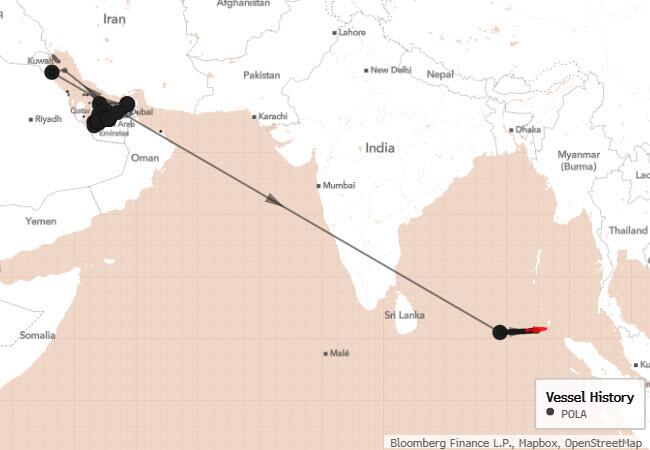
The suezmax Pola, which switched off its tracking system in the Persian Gulf on March 10, was detected again on Monday by the Automatic Identification System: it was located several thousand miles away. 

The ship was sailing in the eastern Indian Ocean near the maritime corridor off the coast of Indonesia’s Sumatra island, according to vessel tracking data compiled by Bloomberg.

Its reappearance obviously confirms the tanker successfully crossed the Strait of Hormuz.  The tanker, laden with roughly 1 million barrels of crude, is en route to Thailand, according to data from intelligence firm Kpler.

The Pola is the fourth vessel managed by Dynacom Tankers Management Ltd. to make the passage through Hormuz with its transponder switched off since its effective closure. The firm also sent the oil tankers Shenlong, Smyrni and Marathi through the narrow waterway earlier this month.

While Iran continues to bar “hostile” entities from the strategic waterway, several Asian countries, including Thailand, have secured bilateral agreements to allow passage through the Strait for some tankers and cargo ships. However, Greece is not among the countries publicly viewed by Tehran as “friendly.”

Still, risks to shipping in the Persian Gulf remain high, with Iran hitting a fully laden Kuwaiti tanker off Dubai in a drone strike last night.

Tyler Durden
Tue, 03/31/2026 – 14:20

via ZeroHedge News https://ift.tt/xHn5apK Tyler Durden

Stock Market Breadth: Warning Or Opportunity?

Stock Market Breadth: Warning Or Opportunity?

Authored by Lance Roberts via RealInvestmentAdvice.com,

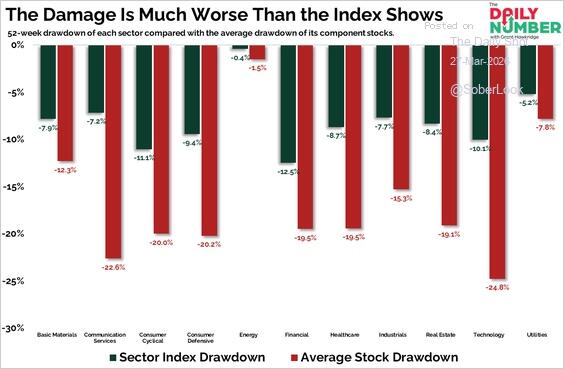
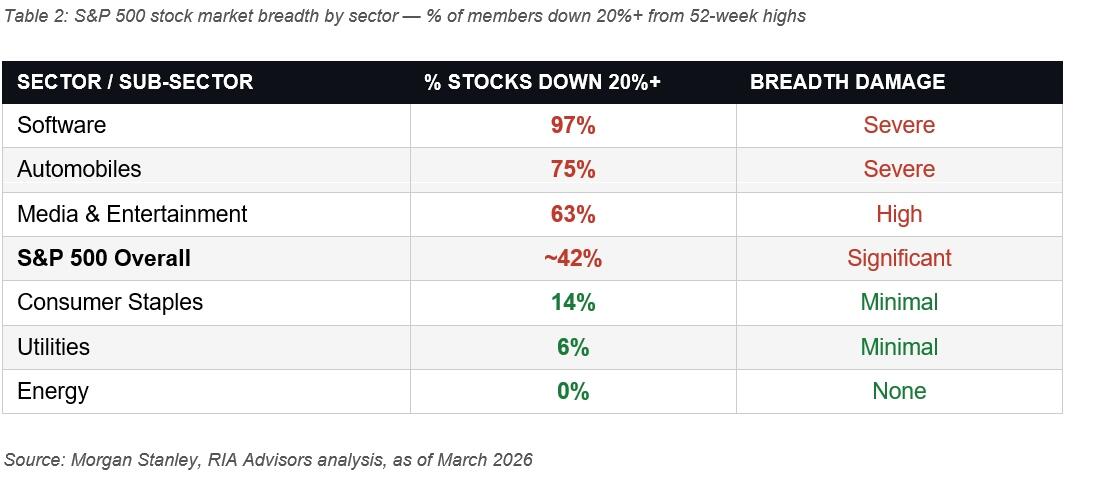
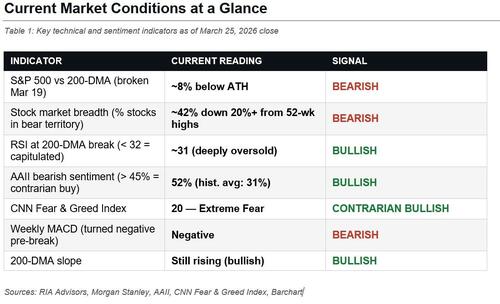
The S&P 500 is down roughly 7% from its January 27 all-time high. Unsurprisingly, the media is full of “red” headlines discussing the seemingly “endless” correction we are in. Unsurprisingly, previously complacent investors are now anxious, as nothing seems to be working. But that index-level headline conceals something far more alarming: stock market breadth has collapsed. According to Morgan Stanley, approximately 42% of S&P 500 members are already down 20% or more from their 52-week highs. More than 200 companies are in their own private bear markets, even as the index itself is not.

This was a point we noted in this past weekend’s Bull Bear Report:

“J.P. Morgan captured the paradox: the S&P 500 is down only ~9% despite oil rising 70% and the Fed shifting from pricing two cuts to a 50% probability of a hike, and software falling 20%. As we noted recently, a much larger correction is underway in the market.”
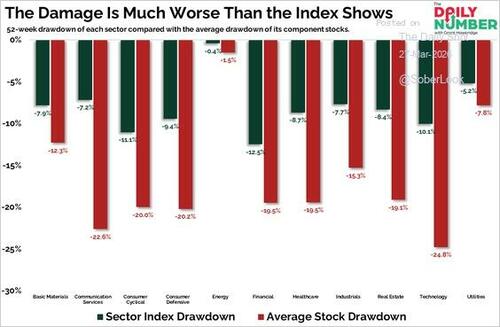
While “times have been tough lately,” this is not a new phenomenon. Stock market breadth deterioration almost always precedes index-level damage, not the other way around. On March 9th, we noted in Technical Deterioration: Risk Management Is Key:”

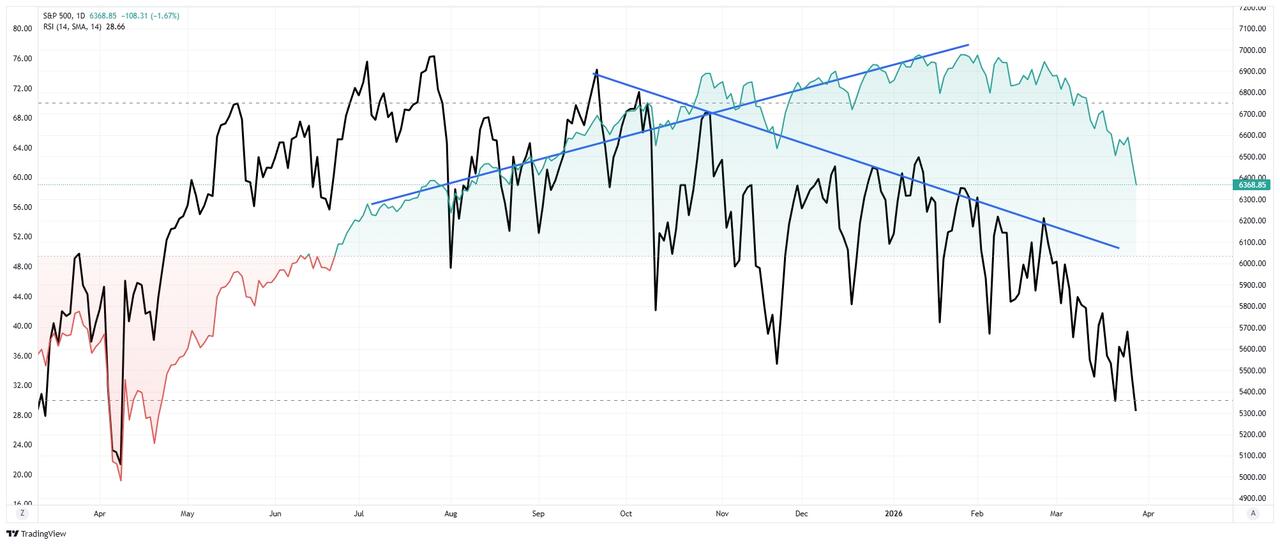
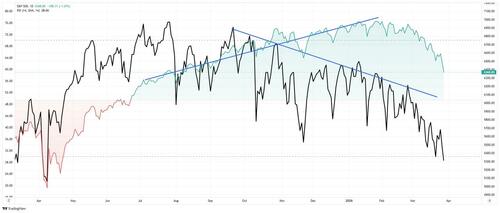
“More importantly, the RSI exhibited a textbook bearish divergence at the all-time high: price made a new peak, but momentum did not confirm. We repeatedly discussed that divergence was the earliest signal of the distribution phase now unfolding. With the RSI not in oversold territory below 30, there is room for more pressure before a technical bounce becomes probable.”

Here is an updated chart showing that previous divergence. Along with waning stock market breadth, relative strength is now in oversold territory.
What’s unusual today is the degree of divergence between individual stocks and the cap-weighted index. When a handful of stocks carry enough weight to paper over widespread internal damage, investors holding diversified portfolios feel the pain long before the headlines acknowledge it.

Furthermore, as detailed in The 200-DMA Just Broke, the deterioration is not uncommon of corrective markets. That break, combined with deeply oversold momentum readings and AAII bearish sentiment, creates a historically specific setup.
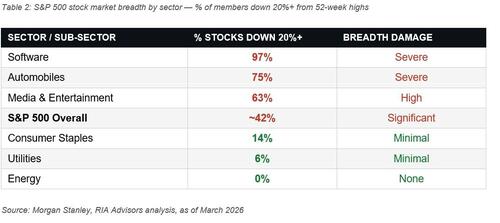
The breadth story is quite fascinating. The software sector has 97% of its S&P 500 members 20% of more below their respective 52-week highs. Automobile stocks follow at 75%, with media and entertainment at 63%.

The other end of the distribution is equally instructive. Energy stocks have zero members in bear territory. Utilities sit at just 6%, and consumer staples at 14%. Those numbers confirm the rotation that’s been underway since January.

“Significant rotation trades, characterized by heavy trading activity in and out of various sectors and factors, have led to large daily divergences in the performance of certain sectors. The market’s surface may look calm, but beneath it, passive investors are actively shifting between narratives, valuations, and risk exposures.” — RIA Advisors, February 2026
So, what likely happens next?

Reading the 200-DMA Break: Six Signals, Mixed Picture

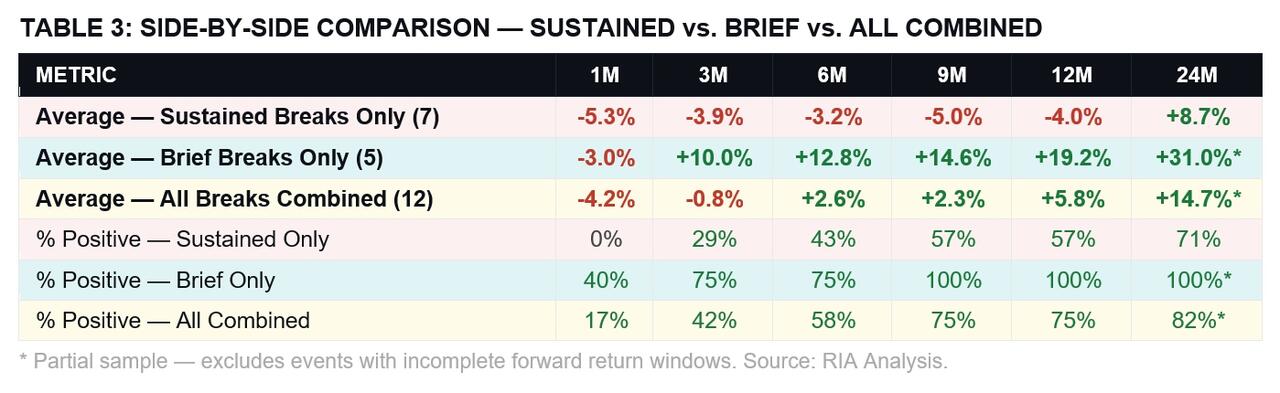
Since 2000, the S&P 500 has broken its 200-DMA on a sustained basis seven times. The average one-month return following those breaks was -5.3%, and none produced a positive first-month return. The average 12-month return after a sustained break was -4.0%.
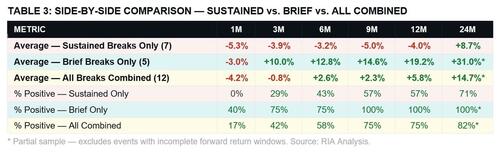
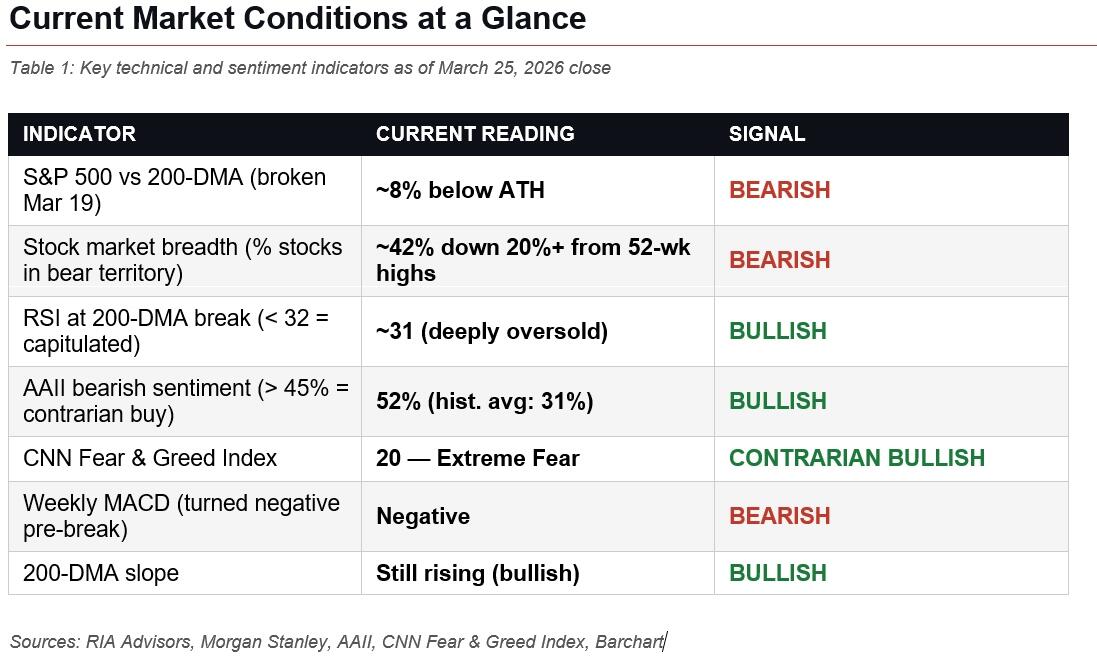
But the distinction between a sustained break and a reflexive whipsaw matters enormously. When the 200-DMA was already flat or declining before the price crossed below, every major bear market since 2000 followed: 2000, 2008, 2022. When the 200-DMA was still rising at the break, as it is currently, the average 12-month return was +19.8%, with a 100% hit rate for positive returns at 3, 6, 9, and 12 months.

Today’s scorecard is mixed. The 200-DMA is still rising, RSI is now below 30, and AAII bearish sentiment has risen sharply. and well above the 45% contrarian threshold. These are all still bullish. Against that, the weekly MACD had already turned negative before the price break, which has preceded every sustained bear since 2000. Stock market breadth, measured by the percentage of S&P 500 stocks above their 200-day moving averages, has dropped sharply and is below the 60% level that historically characterizes whipsaw recoveries.

Bank of America’s Michael Hartnett described the current environment as approaching a “buyable washout.” He is probably correct, but until the Iran situation is resolved, or at least a path to resolution is visible, the risk of a deeper decline can not be discounted. However, investors shouldn’t panic-sell this correction. As JPMorgan’s global market strategist, Jack Manley, noted:

“When there’s a bad sell-off, that bad sell-off is typically followed by a strong bounce back. Given the nature of this sell-off, the likelihood for that bounce back, whenever it occurs, to be pretty concentrated and pretty powerful is that much higher.”

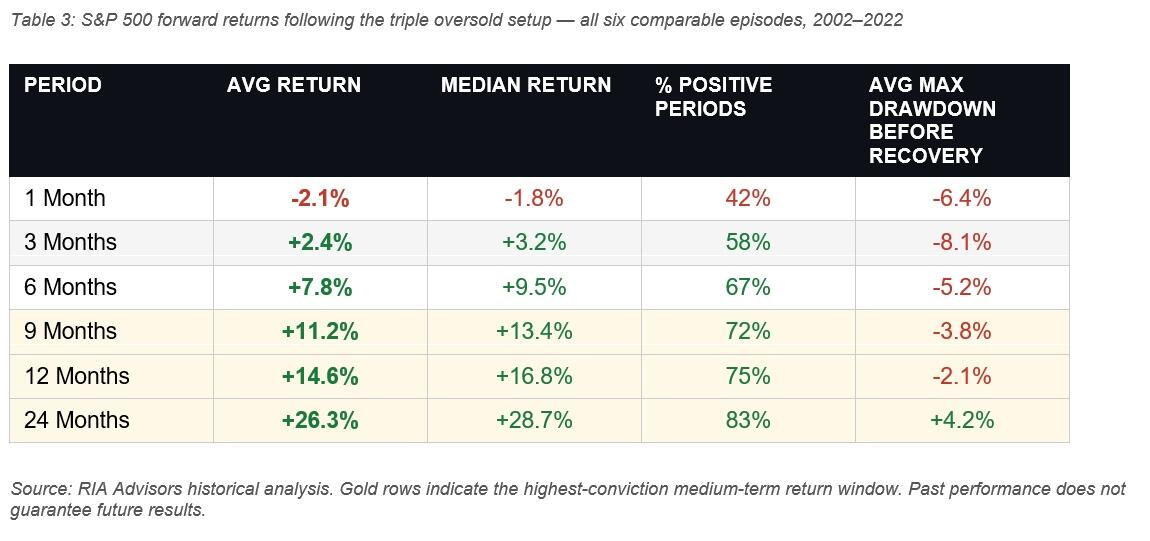
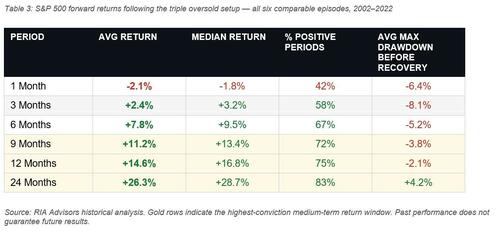
In that previous article, we examined every instance since 2000 where all three conditions aligned simultaneously: stock market breadth deterioration with 40% or more of S&P 500 members in bear territory, the index trading below its 200-DMA, and both MACD and RSI in oversold territory. Six comparable episodes emerged:

  • October 2002,

  • March 2009,

  • February 2016,

  • December 2018,

  • March 2020, and

  • October 2022.

If those dates don’t mean anything to you, those were the months that previous corrections and bear markets ended…not began.

Yes, the near-term picture is uncomfortable, and the average one-month return in these setups is -2.1%, with only 42% of periods producing positive outcomes. While pain tends to extend, and a lower low within one to three months is the historical norm rather than the exception, it serves to wash out weaker hands.

It is the medium- and long-term data that convey the real message. By 12 months, the average return climbs to +14.6%, with 75% of comparable periods producing positive outcomes. At 24 months, average returns reach +26.3%, and the positive hit rate rises to 83%. The investor who stayed positioned through the fear, in all six of these episodes, came out far ahead of the investor who sold into it.
The Permanent Cost of Panic Selling

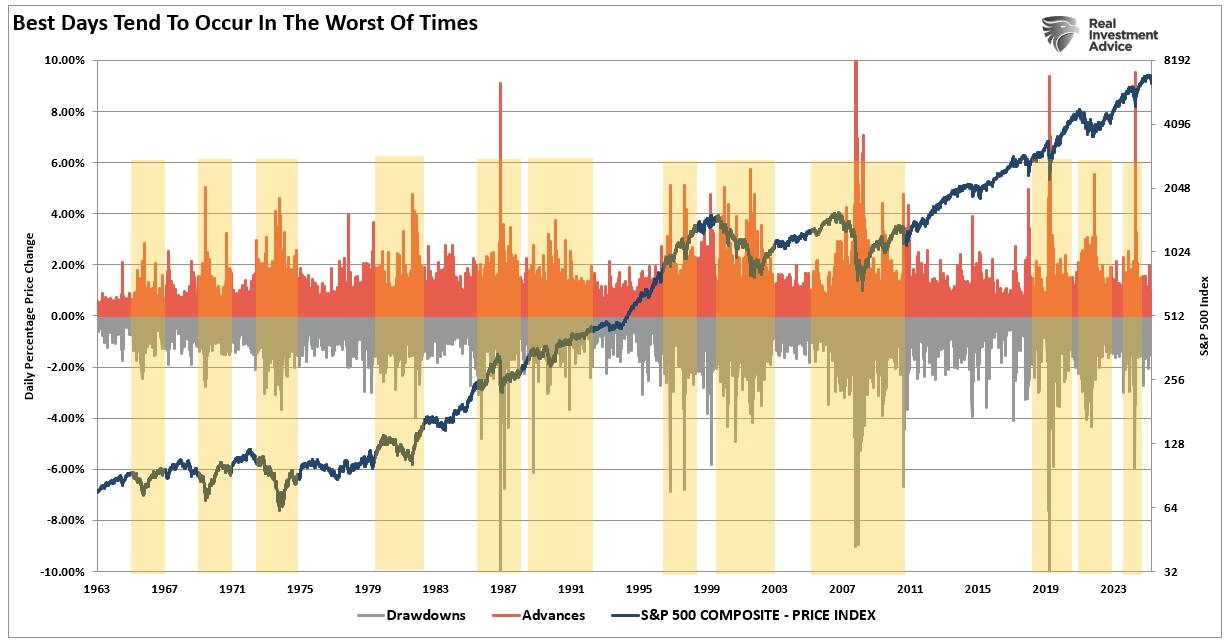
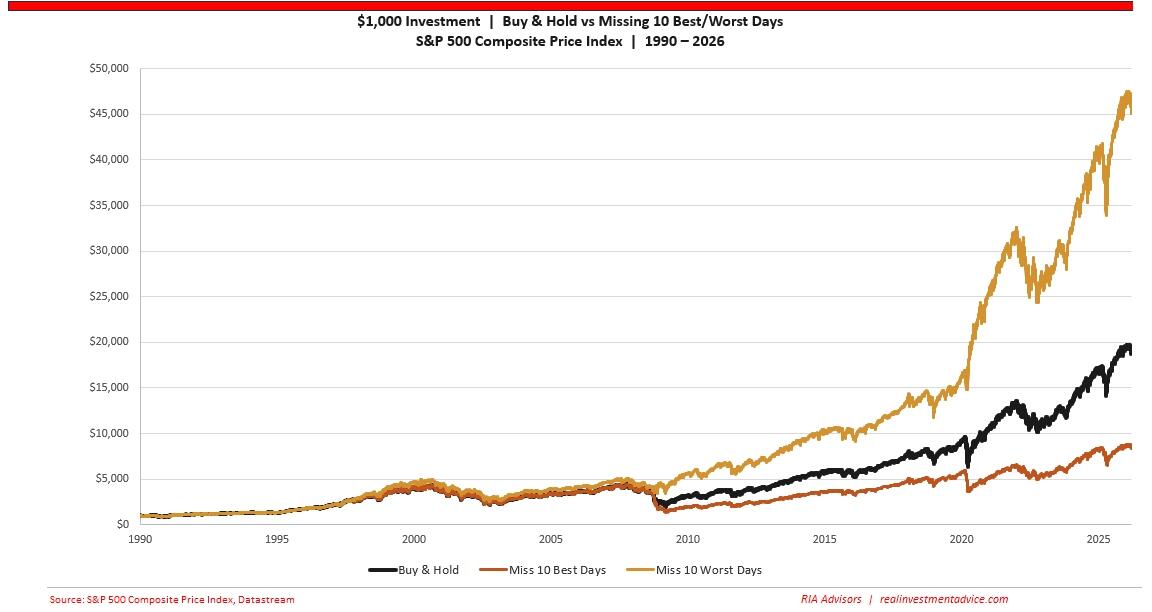
The single most damaging decision most investors make during periods of falling stock market breadth is selling. The data on this is unambiguous. Seven of the market’s 10 best days in any given 20-year period occur within two weeks of the 10 worst days, according to JPMorgan Asset Management research. The best days follow the worst days because fear-driven selling creates dislocations that are rapidly corrected. You can see this in the chart below, that the best and worst days are clustered together.
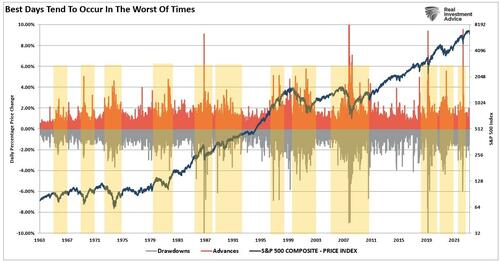
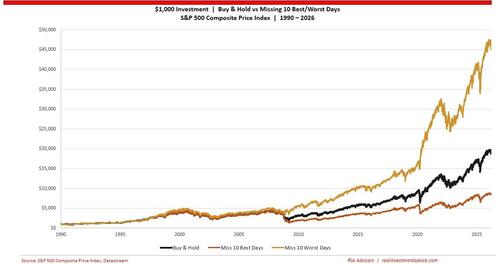
In other words, while investors are always told to just “buy and hold” because they will miss the 10-BEST days if they don’t, investors should focus on mitigating the risk of significant capital losses during those periods.

This doesn’t mean you can effectively miss all the bad days; however, given that higher-volatility periods tend to cluster, understanding when to reduce exposure can significantly improve outcomes over time. Even if you miss the 10-best days along the way. That math applies with particular force in setups like the current one. Since 1974, according to data compiled by Clear Perspective Advisors, the S&P 500 has returned more than 24% on average following a market correction. Only 25% of the 48 corrections since World War II have progressed into full bear markets. In other words, there is a 75% chance this correction will not turn into a bear market. However, dismissing that 25% entirely is just as foolish for future outcomes.
The One Variable That Changes Everything

The honest caveat to all this data is the recession. The two worst outcomes in the six-episode dataset, 2002 and 2008, were both accompanied by genuine economic contractions that extended the drawdown far beyond what the averages suggest. In those cases, forward returns at 12 months were still negative.

Today’s macro environment doesn’t yet show the classic recessionary signatures that preceded those two episodes. The 200-DMA is still rising, not declining, but time will change that. The Fed retains room to cut rates, but higher sustained oil prices could curtail that. Furthermore, deeply oversold sentiment indicators have historically correlated more with fear peaks than with the beginning of prolonged selling cycles. But oversold markets can, and have, become even more so previously.

Whether the Iran conflict and its oil price transmission into consumer spending and corporate margins eventually tips the economy into contraction remains the central unresolved question. That question is the one thing that investors need to guard against the most.

Goldman Sachs has held its 7,600 year-end S&P 500 target through the recent sell-off, anchored by projections of roughly $309 per share in 2026 earnings and $342 in 2027. That base case rests on 12% earnings growth and an economy that continues to expand despite the headwinds from the Iran conflict. Goldman’s own bear cases are sobering: a moderate growth shock takes the index to 6,300, while a severe oil-driven disruption could push it as low as 5,400, with the forward P/E compressing from 21x to 16x in the worst case.

JPMorgan has moved more decisively in the other direction, cutting its year-end target to 7,200 from 7,500 on March 19, citing oil supply shut-ins of 8 million barrels per day, the highest on record, and warning that markets are dangerously underestimating the demand destruction risk. JPMorgan strategist Dubravko Lakos-Bujas explicitly flagged near-term downside to 6,000–6,200, noting that four of five oil shocks since the 1970s have preceded a recession. Neither bank is calling for 2008. But the spread between their base cases and their downside scenarios has rarely been this wide.

Here is the most important point.

“Stock market breadth will eventually resolve, either by individual stocks recovering toward the benchmark level, or by the index itself catching down to the damage that’s already been inflicted.”

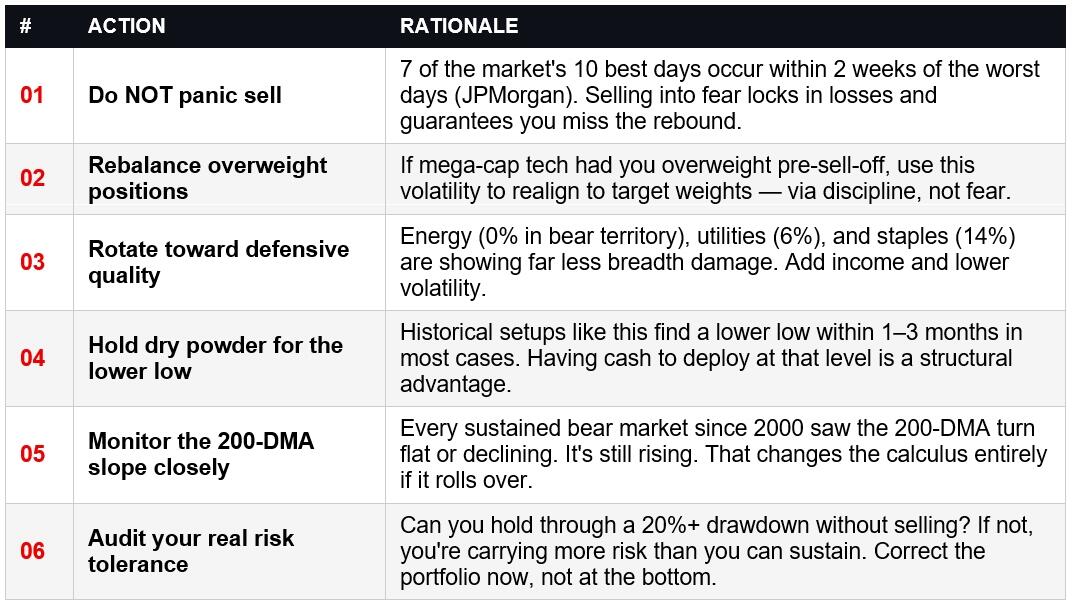
History says the former is far more likely given the current configuration of indicators. Given that backdrop, here are some steps to consider with respect to your own personal situation, goals, and objectives.
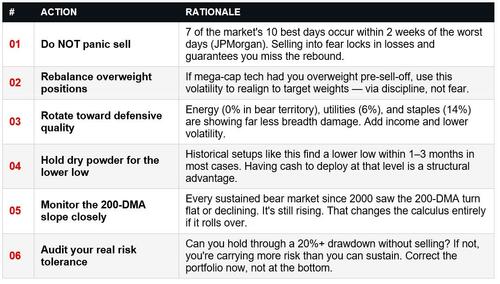
Stock market breadth, by any measure, is at levels historically associated with significant forward returns for patient investors. Three of the six key indicators that separate a brief, recoverable 200-DMA break from a sustained bear market are currently bullish, not bearish. That doesn’t mean the pain is over, as near-term data suggest a lower low is possible. However, for investors who can navigate the storm, clearer skies and calmer tides will eventually prevail

The goal isn’t to time the bottom. Nobody does that consistently. The goal is to avoid permanent capital impairment from panic selling, reduce risk through disciplined rebalancing, and be positioned to participate in the recovery. Based on every comparable episode in the modern era, that recovery has come, and it has come faster than the fear of the moment would suggest.


Tyler Durden
Tue, 03/31/2026 – 14:00

via ZeroHedge News https://ift.tt/IkfQ0lD Tyler Durden

A Fifth Circuit Bait-and-Switch to Ignore Crime Victims’ Rights

Today the Fifth Circuit denied my Crime Victims’ Rights Act (CVRA) challenges to the Justice Department’s 2021 deferred prosecution agreement (DPA) and 2025 non-prosecution agreement (NPA) with Boeing. VC readers will recall this case, as I have blogged about it many times over the years, including here, here, and here. In today’s ruling, the Circuit said that the families’ victims rights challenges to these agreements came too late to allow any remedy. But earlier, in 2023, the Circuit had said that the families’ challenges were “premature.” The fact that the families now will seemingly never receive any remedy is a cruel judicial bait-and-switch, revealing how much work remains to be done to create truly enforcable crime victims’ rights in the criminal justice system.

Here’s the case in a nutshell: In and around 2016 to 2019, Boeing lied to the FAA about the safety of its new 737 MAX aircraft. When two MAX aircraft crashed in late 2018 and then again in early 2019, the Justice Department investigated. And, in 2021, the Department charged Boeing with criminal conspiracy to defraud the FAA through its lies. But the Department immediately entered into a DPA in the Northern District of Texas to resolve the criminal case.

In subsequent litigation, the families proved that the 346 passengers and crew on board the two doomed 737 MAX flights were “crime victims” under the CVRA—they had been directly and proximately harmed by Boeing lies. If Boeing had revealed the safety issues surrounding the MAX to the FAA, the result would have been training of pilots that would have prevented the two crashes. This makes Boeing’s conspiracy crime the “deadliest corporate crime in U.S. history,” as Judge Reed O’Connor in the Northern District of Texas later described it.

In their litigation, the victims’ families challenged the sweetheart DPA, which allowed Boeing to avoid a criminal conviction in exchange for payment of penalties and compensation to the families, along with Boeing’s promises to improve safety in its manufacturing processes. The families explained–and proved–that the Justice Department  had concealed the DPA from the victims’ families, violating the CVRA which required the Justice Department to confer with the prosecutors. In October 2022, Judge O’Connor concluded that the Justice Department had violated the families’ CVRA rights connected to the DPA by failing to confer. But later, in January 2023, Judge O’Connor ruled, quite reluctantly, that he was powerless to provide the victims’ families with any remedy.

In February 2023, I filed a petition with the Fifth Circuit asking it to overturn Judge O’Connor’s ruling that he could not award any remedy for the CVRA violation. After oral argument, in December 2023, the Fifth Circuit ruled that any relief was “premature” because it was confident that the district court would uphold the families’ CVRA “rights at every stage of the court’s criminal proceedings.” In re Ryan, 88 F.4th 614, 627 (5th Cir. 2023). Accordingly, the Fifth Circuit denied the petition to allow proceedings to continue in the district court.

Less than a month later, the DPA’s three-year term was set to expire on January 7, 2024. But two days before that expiration, on January 5, 2024, a mid-cabin door plug on Alaska Airlines Flight 1282 suddenly detached from a Boeing 737 MAX, exposing Boeing’s failure to follow its DPA safety obligations. In light of these and numerous other dangerous failures by Boeing, in May 2024, the Justice Department determined that Boeing had breached its obligations under various DPA provisions. Further negotiations between the Justice Department and Boeing produced a proposed guilty plea arrangement between Boeing and the Justice Department—and objections to the plea from the victims’ families. And in December 2024, the district court rejected the proposed guilty plea. The district held that, for various reasons, the agreement was not in the public interest.

In the most recent proceedings, the Justice Department moved to dismiss its earlier-filed charge against Boeing in favor of resolution through a non-prosecution agreement (NPA).  The Department and Boeing entered into a binding NPA, and then afterwards the Department moved to dismiss the pending charged under Rule 48(a) of the Federal Rules of Criminal Procedure.

I filed objections for the families to the dismissal motion, arguing that it was (finally) time to award a remedy for the Department’s CVRA violations all the way back in 2021, when it entered into the DPA and concealled what it was doing from the victims’ families. And I also argued that the Department had failed to properly confer about its new NPA.

Following oral argument, in November 2025, Judge O’Connor granted the Justice Department’s dismissal motion. In his order, Judge O’Connor essentially agreed with many of the factual objections that I have made for the families who lost loved ones because of Boeing’s crime. Indeed, he even stated that the NPA was not consistent with the public interest. But, reluctantly, Judge O’Connor granted the Department’s motion to dismiss the charge, concluding that he lacked a legal basis for blocking the  Department’s ill-conceived non-prosecution plan.

In December, I filed two CVRA petitions for review with the Fifth Circuit. The first petition challenged Judge O’Connor’s failure to award any remedy for the violation of the families’ CVRA rights when the DPA was negotiated and consumated. The second petition challenged Judge O’Connor’s decision to approve dismissal of the charge against Boeing based on the new NPA.

Today, the Fifth Circuit rejected both of my petitions in a ten-page per curiam order.

With regard to my first petition arguing that the Judge O’Connor should have remedied the CVRA violations connected to the DPA, the Circuit concluded that the petition was moot:

Agreements not to prosecute are “contractual in nature, and are therefore interpreted in accordance with general principles of contract law.” United States v. Castaneda, 162 F.3d 832, 835 (5th Cir. 1998). Under those principles, a third-party’s challenge to a contract that no longer binds a contracting party is moot. Bender v. Donoghue, 70 F.2d 723, 724 (5th Cir. 1934). When Boeing violated the DPA, the agreement’s express terms made Boeing “subject to prosecution for any federal criminal violation,” thus relieving the Department of its obligations under the agreement. At that point, the agreement no longer bound the contracting parties and any challenge based on its terms became moot.

With regard to my second petition arguing that Judge O’Connor should have rejected the NPA, the Circuit rejected my argument that the Department had deceived the families by failing to tell them that it planned to entered in a binding NPA with Boeing before presenting a motion to dismiss to the district court. In my brief, I explained that in the more than 70-year history of Rule 48(a) dismissals, the Justice Department had never before entered into a binding agreement not to prosecute before presenting its dismissal motion to the district court. Nonetheless, the Circuit concluded:

The families were entitled to a “reasonable right to confer” with the prosecution. 18 U.S.C. § 3771(a)(5). They were afforded this right when the prosecution met with them via video call in May 2025. During that call, the prosecution  compare[d] [its] views” with those of the families, thereby conferring with them as the CVRA requires. Even assuming the prosecution could have been clearer about its intention to enter an NPA before the district court ruled on a motion to dismiss, the families cite no authority for the proposition that this means the Department failed to “confer” with them as the CVRA demands. See 18 U.S.C. § 3771(a)(5).

It should come as no surprise that, as counsel for the victims’ families, I find today’s ruling to be not only legally incorrect but fundamentally offensive. Regarding the 2021 DPA, today’s ruling is an absurd bait-and-switch. Back in 2023, the victims’ families asked the Fifth Circuit to set aside the DPA so that they would have their promised CVRA right to confer with prosecutors before the Justice Department reached any agreement with Boeing. The Circuit agreed that the Justice Department had violated families’ CVRA right to confer. But it denied relief at that time as “premature”–and promised the families that the district court would “uphold crime victims’ statutory rights at every stage of the court’s criminal proceedings.” Ryan, 88 F.4th at 627 (emphasis added). Indeed, the Circuit stressed that the district court must “uphold victims’ CVRA rights throughout the instant criminal proceedings.” Id. at 629 (emphasis added). These earlier promises from the Fifth Circuit’s earlier (2023) decision were the centerpiece of my arguments to the Circuit this year. I cited the italicized language above repeatedly–yes, repeatedly–in my briefs and oral argument.

And yet, in today’s decision, the Court simply ignored its earlier promises. It did not cite, much less discuss, the language above. Whatever else can be said about today’s decision, it is clear that the result is that the victims’ families rights were not upheld at “every stage” of the proceedings below. Indeed, the Justice Department violated families’ CVRA rights at the critical first stage of the proceedings, when it entered into the sweetheart DPA that set the unfortunate trajectory for the rest of the case.

Regarding the 2025 NPA, the Circuit briefly acknowledged that the Department “could have been clearer” about its plan to enter into an NPA before presenting its motion to dismiss to the district court. But the Circuit skips over the families’ argument the NPA provision promising no-further-prosecution of Boeing had already gone into effect before the victims’ families knew about it, effectively rendering meaningless the families’ later objections to the motion to dismiss.

The Department’s concealment was particularly misleading against the backdrop of the  Department’s decades-long practice of presenting a motion to dismiss to the district court before consummating a formal agreement not to prosecute. As I stated in an uncontested affidavit, based on extensive experience with the federal criminal justice system, “it was a clear and substantial deviation from normal criminal justice processes” for the Justice Department to take such a step.”

In the proceedings in the district court, the victims’ families repeatedly called the Government’s approach “unprecedented.” See NPA Pet. at 18 (collecting record
citations). Neither the Government nor Boeing offered any precedent below.

In today’s ruling, however, the Circuit seems to have bizarrely flipped things around. Without questioning my argument for the families that the Department’s approach was unprecedented, the Circuit rejected my claim the Department deceived the families because “the families cite no authority for the proposition that this [failure to disclose what the Department was doing] means the Department failed to ‘confer’ with them as the CVRA demands.” So the families lose because the Department employed an unprecedented manuever–and then the families have no legal authority they can cite about why that manuever was deceptive?!

More broadly, today’s ruling demonstrates how much work remains to be done to enforce Congress’ promises in the CVRA to crime victims and their families. In this very high-profile case involving the deaths of hundreds, the Department violated the CVRA by failing to confer with the families–and then, according to the Fifth Circuit, the courts are powerless to do anything about it. I know my families’ are furious about today’s ruling. Crime victims’ rights advocates feared that then Congress passed the CVRA, the courts would undercut its effective enforcement through unwarranted and chary readings of its provisions. Sadly, today’s ruling proves that those fears were well-founded.

And ominously, today’s ruling leaves in place a NPA with the Boeing that does not properly protect public safety. In reviewing the NPA, Judge O’Connor ruled that the families were “correct that this agreement fails to secure the necessary accountability to ensure the safety of the flying public.” That chilling conclusion—standing alone—should have led to a different outcome. Time will tell whether today’s ruling leaving the NPA in place will have fatal consequences.

The post A Fifth Circuit Bait-and-Switch to Ignore Crime Victims' Rights appeared first on Reason.com.

from Latest – Reason.com https://ift.tt/Se2i4nq
via IFTTT

A Fifth Circuit Bait-and-Switch to Ignore Crime Victims’ Rights

Today the Fifth Circuit denied my Crime Victims’ Rights Act (CVRA) challenges to the Justice Department’s 2021 deferred prosecution agreement (DPA) and 2025 non-prosecution agreement (NPA) with Boeing. VC readers will recall this case, as I have blogged about it many times over the years, including here, here, and here. In today’s ruling, the Circuit said that the families’ victims rights challenges to these agreements came too late to allow any remedy. But earlier, in 2023, the Circuit had said that the families’ challenges were “premature.” The fact that the families now will seemingly never receive any remedy is a cruel judicial bait-and-switch, revealing how much work remains to be done to create truly enforcable crime victims’ rights in the criminal justice system.

Here’s the case in a nutshell: In and around 2016 to 2019, Boeing lied to the FAA about the safety of its new 737 MAX aircraft. When two MAX aircraft crashed in late 2018 and then again in early 2019, the Justice Department investigated. And, in 2021, the Department charged Boeing with criminal conspiracy to defraud the FAA through its lies. But the Department immediately entered into a DPA in the Northern District of Texas to resolve the criminal case.

In subsequent litigation, the families proved that the 346 passengers and crew on board the two doomed 737 MAX flights were “crime victims” under the CVRA—they had been directly and proximately harmed by Boeing lies. If Boeing had revealed the safety issues surrounding the MAX to the FAA, the result would have been training of pilots that would have prevented the two crashes. This makes Boeing’s conspiracy crime the “deadliest corporate crime in U.S. history,” as Judge Reed O’Connor in the Northern District of Texas later described it.

In their litigation, the victims’ families challenged the sweetheart DPA, which allowed Boeing to avoid a criminal conviction in exchange for payment of penalties and compensation to the families, along with Boeing’s promises to improve safety in its manufacturing processes. The families explained–and proved–that the Justice Department  had concealed the DPA from the victims’ families, violating the CVRA which required the Justice Department to confer with the prosecutors. In October 2022, Judge O’Connor concluded that the Justice Department had violated the families’ CVRA rights connected to the DPA by failing to confer. But later, in January 2023, Judge O’Connor ruled, quite reluctantly, that he was powerless to provide the victims’ families with any remedy.

In February 2023, I filed a petition with the Fifth Circuit asking it to overturn Judge O’Connor’s ruling that he could not award any remedy for the CVRA violation. After oral argument, in December 2023, the Fifth Circuit ruled that any relief was “premature” because it was confident that the district court would uphold the families’ CVRA “rights at every stage of the court’s criminal proceedings.” In re Ryan, 88 F.4th 614, 627 (5th Cir. 2023). Accordingly, the Fifth Circuit denied the petition to allow proceedings to continue in the district court.

Less than a month later, the DPA’s three-year term was set to expire on January 7, 2024. But two days before that expiration, on January 5, 2024, a mid-cabin door plug on Alaska Airlines Flight 1282 suddenly detached from a Boeing 737 MAX, exposing Boeing’s failure to follow its DPA safety obligations. In light of these and numerous other dangerous failures by Boeing, in May 2024, the Justice Department determined that Boeing had breached its obligations under various DPA provisions. Further negotiations between the Justice Department and Boeing produced a proposed guilty plea arrangement between Boeing and the Justice Department—and objections to the plea from the victims’ families. And in December 2024, the district court rejected the proposed guilty plea. The district held that, for various reasons, the agreement was not in the public interest.

In the most recent proceedings, the Justice Department moved to dismiss its earlier-filed charge against Boeing in favor of resolution through a non-prosecution agreement (NPA).  The Department and Boeing entered into a binding NPA, and then afterwards the Department moved to dismiss the pending charged under Rule 48(a) of the Federal Rules of Criminal Procedure.

I filed objections for the families to the dismissal motion, arguing that it was (finally) time to award a remedy for the Department’s CVRA violations all the way back in 2021, when it entered into the DPA and concealled what it was doing from the victims’ families. And I also argued that the Department had failed to properly confer about its new NPA.

Following oral argument, in November 2025, Judge O’Connor granted the Justice Department’s dismissal motion. In his order, Judge O’Connor essentially agreed with many of the factual objections that I have made for the families who lost loved ones because of Boeing’s crime. Indeed, he even stated that the NPA was not consistent with the public interest. But, reluctantly, Judge O’Connor granted the Department’s motion to dismiss the charge, concluding that he lacked a legal basis for blocking the  Department’s ill-conceived non-prosecution plan.

In December, I filed two CVRA petitions for review with the Fifth Circuit. The first petition challenged Judge O’Connor’s failure to award any remedy for the violation of the families’ CVRA rights when the DPA was negotiated and consumated. The second petition challenged Judge O’Connor’s decision to approve dismissal of the charge against Boeing based on the new NPA.

Today, the Fifth Circuit rejected both of my petitions in a ten-page per curiam order.

With regard to my first petition arguing that the Judge O’Connor should have remedied the CVRA violations connected to the DPA, the Circuit concluded that the petition was moot:

Agreements not to prosecute are “contractual in nature, and are therefore interpreted in accordance with general principles of contract law.” United States v. Castaneda, 162 F.3d 832, 835 (5th Cir. 1998). Under those principles, a third-party’s challenge to a contract that no longer binds a contracting party is moot. Bender v. Donoghue, 70 F.2d 723, 724 (5th Cir. 1934). When Boeing violated the DPA, the agreement’s express terms made Boeing “subject to prosecution for any federal criminal violation,” thus relieving the Department of its obligations under the agreement. At that point, the agreement no longer bound the contracting parties and any challenge based on its terms became moot.

With regard to my second petition arguing that Judge O’Connor should have rejected the NPA, the Circuit rejected my argument that the Department had deceived the families by failing to tell them that it planned to entered in a binding NPA with Boeing before presenting a motion to dismiss to the district court. In my brief, I explained that in the more than 70-year history of Rule 48(a) dismissals, the Justice Department had never before entered into a binding agreement not to prosecute before presenting its dismissal motion to the district court. Nonetheless, the Circuit concluded:

The families were entitled to a “reasonable right to confer” with the prosecution. 18 U.S.C. § 3771(a)(5). They were afforded this right when the prosecution met with them via video call in May 2025. During that call, the prosecution  compare[d] [its] views” with those of the families, thereby conferring with them as the CVRA requires. Even assuming the prosecution could have been clearer about its intention to enter an NPA before the district court ruled on a motion to dismiss, the families cite no authority for the proposition that this means the Department failed to “confer” with them as the CVRA demands. See 18 U.S.C. § 3771(a)(5).

It should come as no surprise that, as counsel for the victims’ families, I find today’s ruling to be not only legally incorrect but fundamentally offensive. Regarding the 2021 DPA, today’s ruling is an absurd bait-and-switch. Back in 2023, the victims’ families asked the Fifth Circuit to set aside the DPA so that they would have their promised CVRA right to confer with prosecutors before the Justice Department reached any agreement with Boeing. The Circuit agreed that the Justice Department had violated families’ CVRA right to confer. But it denied relief at that time as “premature”–and promised the families that the district court would “uphold crime victims’ statutory rights at every stage of the court’s criminal proceedings.” Ryan, 88 F.4th at 627 (emphasis added). Indeed, the Circuit stressed that the district court must “uphold victims’ CVRA rights throughout the instant criminal proceedings.” Id. at 629 (emphasis added). These earlier promises from the Fifth Circuit’s earlier (2023) decision were the centerpiece of my arguments to the Circuit this year. I cited the italicized language above repeatedly–yes, repeatedly–in my briefs and oral argument.

And yet, in today’s decision, the Court simply ignored its earlier promises. It did not cite, much less discuss, the language above. Whatever else can be said about today’s decision, it is clear that the result is that the victims’ families rights were not upheld at “every stage” of the proceedings below. Indeed, the Justice Department violated families’ CVRA rights at the critical first stage of the proceedings, when it entered into the sweetheart DPA that set the unfortunate trajectory for the rest of the case.

Regarding the 2025 NPA, the Circuit briefly acknowledged that the Department “could have been clearer” about its plan to enter into an NPA before presenting its motion to dismiss to the district court. But the Circuit skips over the families’ argument the NPA provision promising no-further-prosecution of Boeing had already gone into effect before the victims’ families knew about it, effectively rendering meaningless the families’ later objections to the motion to dismiss.

The Department’s concealment was particularly misleading against the backdrop of the  Department’s decades-long practice of presenting a motion to dismiss to the district court before consummating a formal agreement not to prosecute. As I stated in an uncontested affidavit, based on extensive experience with the federal criminal justice system, “it was a clear and substantial deviation from normal criminal justice processes” for the Justice Department to take such a step.”

In the proceedings in the district court, the victims’ families repeatedly called the Government’s approach “unprecedented.” See NPA Pet. at 18 (collecting record
citations). Neither the Government nor Boeing offered any precedent below.

In today’s ruling, however, the Circuit seems to have bizarrely flipped things around. Without questioning my argument for the families that the Department’s approach was unprecedented, the Circuit rejected my claim the Department deceived the families because “the families cite no authority for the proposition that this [failure to disclose what the Department was doing] means the Department failed to ‘confer’ with them as the CVRA demands.” So the families lose because the Department employed an unprecedented manuever–and then the families have no legal authority they can cite about why that manuever was deceptive?!

More broadly, today’s ruling demonstrates how much work remains to be done to enforce Congress’ promises in the CVRA to crime victims and their families. In this very high-profile case involving the deaths of hundreds, the Department violated the CVRA by failing to confer with the families–and then, according to the Fifth Circuit, the courts are powerless to do anything about it. I know my families’ are furious about today’s ruling. Crime victims’ rights advocates feared that then Congress passed the CVRA, the courts would undercut its effective enforcement through unwarranted and chary readings of its provisions. Sadly, today’s ruling proves that those fears were well-founded.

And ominously, today’s ruling leaves in place a NPA with the Boeing that does not properly protect public safety. In reviewing the NPA, Judge O’Connor ruled that the families were “correct that this agreement fails to secure the necessary accountability to ensure the safety of the flying public.” That chilling conclusion—standing alone—should have led to a different outcome. Time will tell whether today’s ruling leaving the NPA in place will have fatal consequences.

The post A Fifth Circuit Bait-and-Switch to Ignore Crime Victims' Rights appeared first on Reason.com.

from Latest – Reason.com https://ift.tt/Se2i4nq
via IFTTT

Justice Jackson’s Dissent, on Why Viewpoint-Based Restrictions on Professional-Client Speech May Be Permissible

A short excerpt from Justice Jackson’s long solo dissent today in Chiles v. Salazar, where she argued that the Colorado ban on conversion therapy for minors was constitutional:

The conclusion that a State can regulate the provision of medical care even if, in so doing, it incidentally restricts the speech of some providers, fully comports with the First Amendment’s animating principles. These principles include the well-settled notion that context matters when evaluating First Amendment challenges to state regulation. The context that frames today’s debate is the kind of speech that is at issue here—what I am calling (as shorthand) “professional medical speech.” …

[A.] [P]rofessional medical speech occurs when a medical professional speaks to a client (1) in the context of the professional-patient relationship; (2) on matters within the provider’s professional expertise as defined by the medical community; (3) for the purpose of providing medical care.

First, professional medical speech is speech uttered within the bounds of the professional-patient relationship. That relationship imposes certain duties and restrictions on the medical professional. For example, medical providers are bound by the twin duties of beneficence (the obligation to act for the benefit of the patient) and nonmaleficence (the obligation not to harm the patient).

Second, professional medical speech is speech within the healthcare provider’s area of expertise as a member of the medical community. Within the professional-patient relationship, the professional has knowledge that the patient does not have, including knowledge of which medical treatments are appropriate and how to administer them. The patient comes to the provider to access that expertise, which is informed by—and constrained by—what the medical community knows.

Finally, and most importantly, professional medical speech is made for the purpose of providing the patient with medical care. This speech is a tool employed to treat patients. In this sense, professional medical speech facilitates the professional’s goal of providing the patient with the treatment, procedure, or healthcare that is within her expertise and that forms the basis of the professional-patient relationship.

[B.] Keeping in mind these characteristics of professional medical speech, consider the First Amendment principles that serve as guideposts for determining the level of scrutiny that a government restriction of such speech deserves.

First, and most fundamentally, is preservation of the marketplace of ideas. Indeed, the “whole project of the First Amendment” stemmed from the Founders’ desire to protect the “critically important” goal of having “a well-functioning sphere of expression, in which citizens have access to information from many sources.” Within the marketplace of ideas, speech that is expressive of the speaker’s thoughts and views is, generally speaking, highly valued.

But professional medical speech does not intersect with the marketplace of ideas: “[I]n the context of medical practice we insist upon competence, not debate.” The degree to which medical providers speaking within the boundaries of providing patient care can express themselves is limited because their interactions with patients are constrained by their well-established duties to those patients and the requirement that they meet the standard of care. Moreover, given these limits, professional medical speech does not necessarily involve the expression of ideas or messages, so it does not provide significant value to the general marketplace.

That’s not to say that there isn’t a robust marketplace of ideas within the medical community. Medical professionals contribute to that particular marketplace by writing papers, giving speeches, and pushing the bounds of the community’s knowledge through experimentation. And, indeed, the standard of care for a medical treatment can be greatly influenced and changed by virtue of such speech. It is there that truth competes for “accept[ance] in the … market.” But that marketplace exists outside the confines of the professional-patient relationship.

Within the confines of the professional-patient relationship, treatment-related “truths” are a given—they are set by licensing and malpractice standards, and it is not uncommon that such regulation incidentally restricts provider speech. Moreover, regulation of the practice of medicine is pervasively and unavoidably viewpoint based. The majority and the concurrence both resist this: They relentlessly deride Colorado for engaging in “viewpoint discrimination” by banning conversion therapy but permitting affirming care. But context makes that point ring hollow.

When a State establishes a standard of care, or punishes a doctor for providing care outside of that standard, it necessarily limits what medical professionals can say and do on the basis of viewpoint. A State can permissibly “prohibi[t] the administration of specific drugs for particular medical uses” but not for others. So, too, may it prohibit a doctor from encouraging a patient to commit suicide, or a dietician from telling an anorexic patient to eat less. Likewise, no one would bat an eye if a State required its doctors to discourage, but not encourage, smoking tobacco.

Even though these kinds of regulations are inherently viewpoint based, in the context of medical care, a State can certainly require the medical professionals it licenses to stand on one side of an issue. Though these proscriptions certainly promote a viewpoint, in this context, that alone does not suffice to establish a presumptive First Amendment violation. Instead, under the “speech incident to conduct” doctrine, the challenged laws must also operate as speech-suppression tools, designed to vanquish free expression.

But, here, Colorado’s clear aim is enforcement of a standard of care that is indisputably applicable to the State’s licensed healthcare professionals. Taking a position as to how those providers should handle a medical issue is the very essence of standard-setting—once again, this kind of viewpoint-based regulation ensures “competence, not debate.” My colleagues’ contrary conclusions are puzzling, for a standards-based healthcare scheme cannot function unless its regulators are permitted to choose sides.

A second and corollary First Amendment principle is the listener’s interest in receiving information. In the professional medical context, however, informational asymmetry shapes the listener’s interest. To be sure, “[r]espect for patients’ autonomy is a cornerstone of medical ethics.” But that interest is not served by receiving all existing opinions—only information about treatments that are within the standard of care advances patients’ interests. Patients are not in a position to wade through medical discourse and independently evaluate the best treatment for their circumstances. Their interests as listeners are thus limited by the nature and purpose of the professional-patient relationship.

Third, and finally, the First Amendment protects a speaker’s autonomy. “‘[T]he fundamental rule of protection under the First Amendment [is] that a speaker has the autonomy to choose the content of his own message.'” But, here again, with respect to professional medical speech, healthcare providers do not have autonomy; when it comes to providing treatments for their patients, they are bound by the standard of care and are not generally free to “choose the content” of their message. Put differently, although medical professionals do have an autonomy interest in communicating their ideas to the patients they are treating, that interest only extends to treatment-related advice and information that is consistent with the standard of care….

[C.] The majority … insist[s] that it is antithetical to the First Amendment for a State to incidentally restrict a healthcare provider’s treatment-related speech based on a “prevailing ‘standard of care'” because “[m]edical consensus … is not static; it evolves and always has.” The mutability of medical standards tells us little about the First Amendment’s scope in a country where medical standards are enforceable by law and govern the treatment-related conduct of professional healthcare providers.

Like it or not, treatment standards exist in America. And those standards necessarily reflect the expert medical community’s current beliefs about the safety and efficacy of various medical treatments, whatever those beliefs might be. Medical standards are driven by science (objective facts and data), but, naturally, they are not viewpoint neutral. Consequently, the people win—not lose—when a State incorporates medical profession’s viewpoint into laws that require licensed treatment providers to conform to prevailing standards of care. For this reason, the Court has long recognized a State’s power to regulate to protect its residents even in the face of uncertainty.

{The majority laments that, because medical consensus is “not static,” a law like the MCTL might operate to “silenc[e]” professional speech going forward even if medical consensus swings the other way. Illustrating this problem, the majority points to shameful parts of this country’s past to show the dangers that can come from regulation that relies on outdated medical practices … (citing Buck v. Bell (1927)).

But the majority does not mention that, if the standard of care does change, the state legislature has the power to change the law in response to that evidence. The majority’s point seems to be that States should not be permitted to enact (rigid) laws based on current scientific thought because expert opinions might shift over time. But those uncertainties—which have always existed—are no reason to abandon medical standards or to alter how the law has traditionally accommodated scientific discoveries. The potential that medical consensus may change in the future does not mean that the Constitution prevents a State from acting today to protect its residents from what medical experts currently believe is a harmful medical treatment.}

Put differently, States impose treatment standards incorporating the current consensus of medical experts to protect state residents from harm. And they do this to ensure that professionals provide patients with high-quality care. A State that, alternatively, pursues an agenda of purposefully silencing critics, muzzling opponents, or targeting views it considers threatening would, of course, violate the First Amendment. But it behooves us all (and especially courts) to see and know the difference.

{Under my analysis, evidence of speech targeting or suppression could include the fact that the challenged state regulation does not, in fact, reflect current medical consensus. If a State enacts a treatment prohibition that substantially diverges from the medical community’s present beliefs, the law might well be a pretext for illicit speech-targeting objectives. Far from requiring “reflexive deference,” proof of such motivation would be unearthed, and carefully examined, as part and parcel of a court’s proper “speech incident to conduct” inquiry, since the doctrine is only applicable to reasonable State regulations.}

[D.] The centuries-long tradition of States using their police powers to establish and enforce the standards of care that bind medical professionals—including those who use speech to administer treatments—is another indication that heightened scrutiny does not and need not apply here. The majority’s opinion largely omits this broader historical record. But, when consulted, that history demonstrates unequivocally that the MCTL is neither unusual nor inherently suspect. [For more details, see the opinion, starting p. 57. -EV]

The post Justice Jackson's Dissent, on Why Viewpoint-Based Restrictions on Professional-Client Speech May Be Permissible appeared first on Reason.com.

from Latest – Reason.com https://ift.tt/xkdXYGF
via IFTTT