Was CASA Really Worth It?

On the eve of the birthright citizenship case, it is useful to think back to last year. The Trump Administration could have rushed the merits to the Supreme Court, but instead only sought certiorari in the nationwide injunction issue. And to win that case, the executive branch sacrificed its own power. The Solicitor General said it would bind itself to the decisions of the Supreme Court. No decision, not Marbury, not Cooper v. Aaron, ever stipulated that point. Now a coordinate branch of government surrendered. And to what end? Was CASA such an important case that justified that unilateral disarmament?

I think the answer is no. In the year since CASA, there have been a never-ending spate of universal vacaturs against the executive branch. District Courts have certified classes on the fly. And the Supreme Court has shown no interest in clamping down this practice. And if, as expected, the Supreme Court strikes down the birthright citizenship order, all of this litigation will have been for naught. The executive branch is weaker because of this order. What was gained?

On the other side, the doomsday predictions from CASA simply have not come to fruition. Richard Re brings the receipts:

First, the CASA dissenters repeatedly suggested that relief would be practically unavailable, at least for many affected individuals, if universal relief were disallowed. . . . As it happened, the EO was swiftly enjoined and so has yet to go into effect. Moreover, that outcome was not only foreseeable but foreseen by at least some justices and commentators. . . .

Second, the CASA dissenters, especially Justice Kagan at oral argument, worried that the merits of the birthright citizenship EO would never reach the Supreme Court. . . . To some degree, this second worry was parasitic on the first one, for a lack of SCOTUS review might not be a problem if the relevant executive action were still expeditiously enjoined via class action. At any rate, the oral argument resulted in a promise from the SG that he would in fact seek certiorari on the merits, and that is of course what happened. . . .

In CASA, the dissenters raised concerns that were unusually immediate and specific. Perhaps they left enough wiggle room for plausible deniability. But to the extent that the dissenters made testable claims, those claims have not been borne out. The dissenters’ doomsaying, in other words, can be viewed as both falsifiable and falsified. One might remember this example when considering other assertions in dissenting opinions.

CASA was so important last year. This year, it barely matters. Yet another instance where it is difficult to know in the moment what Supreme Court rulings will have any resonance in the longterm.

The post Was <i>CASA</i> Really Worth It? appeared first on Reason.com.

from Latest – Reason.com https://ift.tt/YefaNcm
via IFTTT

Live Free or Ban Data Centers


data center | Meta

Happy Tuesday, and welcome to another edition of Rent Free. This week’s newsletter covers a number of new reforms that try to relegalize formerly ubiquitous forms of affordable housing.

  • In Washington, D.C., the city council will consider a bill to allow taller single-stair apartment buildings.
  • The Idaho Legislature has passed a bill allowing small starter homes to be built on smaller lots.
  • Florida Gov. Ron DeSantis has signed into law a bill that allows manufactured housing to be built in single-family areas.

Single-stair apartment buildings, starter homes, and manufactured housing are nothing new. All worked to make the American cities and towns of the past more affordable, accessible places to live.

Over the decades, states and localities have imposed rules that restrict or even ban these forms of housing. As evidenced by the reforms advancing across the country, many policymakers consider those restrictions a mistake. Bit by bit, we’re returning to the old, freer land use regime.

But first, the newsletter covers how the backlash to data centers in rural Ohio is leading some communities to consider adopting zoning for the first time.


Live Free or Ban Data Centers?

In rural Ohio, residents are balancing two uncomfortable propositions: live next to new data centers or adopt zoning codes to stop them.

WUOB, the state’s public media outlet, reports that a mounting number of data center developments are springing up in the state’s southeast, where many of the area’s rural counties have no zoning codes.

The data centers are often unpopular, with local residents complaining about large, unsightly buildings consuming existing farmland and the lack of transparency from local governments and data center builders about their projects.

But without zoning codes, local officials have limited ability to block new data centers where they’re proposed.

As I noted in a recent cover story for Reason, data centers are—all things considered—pretty low-impact land uses. They’re not particularly noisy. They don’t emit noxious fumes or smells. Their small permanent staffs mean that they also don’t strain local roads and schools. Their water use is normal, and the impacts of their admittedly gargantuan power consumption are overblown.

For all those reasons, there are few environmental laws or nuisance regulations focused on actual neighborhood effects that one could use to stop new data centers from opening up. For that task, one needs zoning.

Zoning skips the whole business of regulating externalities and instead gives local officials the direct power to say what kinds of buildings are allowed where.

It’s a perfect tool for stopping data centers. The problem is that zoning is a perfect tool for stopping almost everything.

“We don’t have to ask permission for simple things like putting up a fence, so that’s great.…At the same time, I think there should be some form of protection in place for this type of thing,” WUOB quotes one woman who is concerned about new data center development while also wary of the regulations required to stop them.

The outlet notes that some towns are adopting straight moratoriums on data center development as an alternative to comprehensive zoning, but these can only be a temporary measure.

For people who don’t want zoning, moratoriums can be risky business. Read Reason‘s coverage of land use battles in Caroline, New York, where a temporary moratorium designed to stop a Dollar General morphed into a wider effort to impose zoning on the then-unzoned town.

At the end of the day, freedom for me but not for thee is a hard thing to write into the law. The conflict over data centers in unzoned Ohio is evidence that being allowed to do what you want on your property usually requires tolerating what someone else does on their property—even if it’s building a data center.


The D.C. City Council Considers Single-Stair Reform

Today, the Washington, D.C., City Council’s Committee of the Whole will consider a bill introduced by Councilmember Brianne Nadeau that would allow apartment buildings of up to six stories to be built with just one staircase.

Like most U.S. cities, D.C. currently requires apartment buildings over three stories in height to have two staircases as a fire safety measure.

Reformers have argued that the requirement of a second staircase significantly increases costs to new construction and stymies the construction of smaller apartment buildings on smaller urban lots.

That’s a loss for supply and affordability, advocates argue. And because new multifamily housing has the best fire safety record, single-stair requirements that prevent new multifamily construction could actually reduce fire safety.

New York City and Seattle have long allowed single-stair buildings to rise six stories. According to Pew, seven states passed single-stair reforms in 2025 that either require building code updates to allow taller single-stair buildings or otherwise require building code officials to consider such reforms.

Nadeau’s “One Front Door Act” would require city building officials to update construction codes to allow six-story single-stair buildings within two years.

The reform will “increase the amount of space that can be built for residents, making it more economical and easier for builders to create more units or bigger units, which are good for families,” said Nadeau in introducing the bill last year.

A public hearing on the bill was held in January. Written testimony shows a long list of housing policy groups, architects, and real estate advocates in favor of the reform. The main opposition comes from the city’s Fire Fighter Association.


Idaho Passes Sweeping Starter Home Reforms  

Last week, the Idaho Legislature passed a bill allowing “starter home subdivisions” in municipalities across the state.

Senate Bill 1352, which was transmitted to the governor yesterday, would require cities of 10,000 people or more to update their land use laws to allow single-family homes on lots as small as 1,500 square feet within new subdivisions of at least four acres.

Similar “starter home” legislation is becoming an increasingly common form of housing supply reform. “Small homes on small lots” offers the potential for more modestly priced, owner-occupied housing. When restricted to new subdivisions, these bills can avoid some of the fights about allowing multifamily housing in existing residential areas.

According to the American Enterprise Institute’s housing legislation tracker, over a dozen states have considered lot size reform bills this year.

Texas made headlines last year when it adopted a law allowing starter homes on 3,000-square-foot lots in five-acre subdivisions in larger cities and counties last year. Idaho’s reforms go beyond Texas’ policy by allowing even smaller lots in smaller subdivisions in smaller communities.

In addition to S.B. 1352, the Idaho Legislature is also considering reforms that would allow duplexes and accessory dwelling units in single-family areas. Bills that would enact those reforms passed the Idaho Senate earlier this month and are now being considered by the House.


Florida Passes Bill To Boost Manufactured Housing, Reduce Permit Fees

On Friday, Florida Gov. Ron DeSantis signed into law House Bill (H.B.) 399, which would restrict local governments’ ability to discriminate against manufactured housing.

The new law requires local governments to allow off-site constructed manufactured housing anywhere that detached single-family homes are also allowed. Localities are also forbidden from regulating manufactured housing more restrictively than single-family housing in the same zoning district.

Manufactured, a.k.a. mobile, homes used to be a significant portion of new homes built in America. These homes were also typically the most affordable form of new housing.

Brian Potter, author of the Construction Physics Substack, notes that in some years in the 1960s and 70s, as many as a fifth of new homes were factory-built manufactured housing.

In the 1970s, this type of housing went into steep decline, the reasons for which are debated. Some blame federal regulations of manufactured housing. Certainly not helping matters were the proliferation of zoning codes that explicitly banned manufactured housing in whole communities.

In more recent years, there’s been a rising interest in attempting to revive the manufactured housing sector.

The housing bill currently being considered by Congress would peel back some federal regulations on manufactured homes. Florida’s H.B. 399, meanwhile, tackles the zoning restrictions that keep these units out of town.

The new law also requires local governments to cap permitting fees at the cost of actually reviewing and processing building permits.


Quick Links

  • The Argument‘s Jerusalem Demsas on Congress’ bipartisan bias against renters
  • The FBI is warning homeowners about a new scam in which fraudsters send them fake letters demanding payment for building permits. The bureau says the scam is so successful because the fraudulent fee demands sound so much like the real, random fees homeowners have to pay.
  • A Rhode Island House committee will consider a bill that repeals regulations on single-room occupancy and co-living housing today.
  • America’s first developer president wants his presidential library to be a gleaming glass tower.
  • No lies detected:

The post Live Free or Ban Data Centers appeared first on Reason.com.

from Latest – Reason.com https://ift.tt/UXiSkjB
via IFTTT

What Took So Long In Chiles?

I give a lot of thought to timing on the Supreme Court. Internal deliberations are usually a black box, unless there are some leaks. All we know for sure is when a case is argued and when it is decided.

Today, the Court decided Chiles v. Salazar. This case was argued six months ago on October 7. The vote was 8-1. Justice Gorsuch wrote the majority opinion, which was about twenty-pages long. Justice Kagan wrote a short concurrence, joined by Justice Sotomayor, that was about four pages long. Justice Jackson wrote a solo dissent that spanned more than thirty pages.

Why did this case take six months? It seems pretty clear the majority opinion coalesced fairly early on. There is not much daylight between the majority and the concurrence. I have to imagine that Justice Gorsuch circulated his majority opinion fairly quickly. There are no footnotes suggesting attempts to modify or water-down the majority opinion.

What we don’t know is how Justice Jackson affected the process. The majority opinion offers a few citations to Jackson’s dissent, but there is no lengthy back-and-forth. I don’t think there was much engagement here at all. Indeed, it is telling that Justice Kagan felt compelled to respond to Justice Jackson in a footnote.

This opinion also makes me think about Callais, which was argued on October 15. I doubt that case will be 8-1. But it may take around the same time, if not longer.

For those who care about such things, Justice Alito is the only Justice who has not yet written a majority opinion from October.

The post What Took So Long In <i>Chiles</i>? appeared first on Reason.com.

from Latest – Reason.com https://ift.tt/I5EbUx0
via IFTTT

Justice Kagan’s Arguments for “Relax[ing] Our Guard” as to Some Content-Based (But Viewpoint-Neutral) Speech Restrictions

From Justice Kagan’s concurrence, joined by Justice Sotomayor, in today’s Chiles v. Salazar:

[A.] The Court today decides that the Colorado law challenged here, as applied to talk therapy, conflicts with core First Amendment principles because it regulates speech based on viewpoint. I agree. I write only to note that if Colorado had instead enacted a content-based but viewpoint-neutral law, it would raise a different and more difficult question.

As the Court states, governments must “nearly always” abstain from adopting viewpoint-based restrictions. Those laws represent a particularly “egregious form” of content-based regulation, implicating First Amendment concerns to the highest possible degree. A law drawing a line based on the “ideology” of the speaker—disadvantaging one view and advantaging another—skews the marketplace of ideas our society depends on to discover truth. And such a law suggests an impermissible motive—that the government is regulating speech because of its own “hostility” toward the targeted messages. If the First Amendment prohibits anything, it is the “official suppression of ideas.” …

Consider a hypothetical law that is the mirror image of Colorado’s. Instead of barring talk therapy designed to change a minor’s sexual orientation or gender identity, this law bars therapy affirming those things. As Ms. Chiles readily acknowledges, the First Amendment would apply in the identical way. Once again, because the State has suppressed one side of a debate, while aiding the other, the constitutional issue is straightforward.

[B.] It would, however, be less so if the law under review was content based but viewpoint neutral. Such content-based laws, as the Court explains, trigger strict scrutiny “[a]s a general rule.” But our precedents respecting those laws recognize complexity and nuance. We apply our most demanding standard when there is any “realistic possibility that official suppression of ideas is afoot”—when, that is, a (merely) content-based law may reasonably be thought to pose the dangers that viewpoint-based laws always do. But when that is not the case—when a law, though based on content, raises no real concern that the government is censoring disfavored ideas—then we have not infrequently “relax[ed] our guard.” …

Medical care typically involves speech, so the regulation of medical care (which is, of course, pervasive) may involve speech restrictions. And those restrictions will generally refer to the speech’s content. But laws of that kind may not pose the risk of censorship—of “official suppression of ideas”—that appropriately triggers our most rigorous review. And that means the “difference between viewpoint-based and viewpoint-neutral content discrimination” in the health-care context could prove “decisive.” Fuller consideration of that question, though, can wait for another day. We need not here decide how to assess viewpoint-neutral laws regulating health providers’ expression because, as the Court holds, Colorado’s is not one.

Here’s more from her opinion dealing with a similar question in Reed v. Town of Gilbert (2015), which she cites in her opinion in Chiles:

We apply strict scrutiny to facially content-based regulations of speech … when there is any “realistic possibility that official suppression of ideas is afoot.” That is always the case when the regulation facially differentiates on the basis of viewpoint.

It is also the case … when a law restricts “discussion of an entire topic” in public debate. We have stated that “[i]f the marketplace of ideas is to remain free and open, governments must not be allowed to choose ‘which issues are worth discussing or debating.'” And we have recognized that such subject-matter restrictions, even though viewpoint-neutral on their face, may “suggest[] an attempt to give one side of a debatable public question an advantage in expressing its views to the people.”

Subject-matter regulation, in other words, may have the intent or effect of favoring some ideas over others…. But when that is not realistically possible, we may do well to relax our guard so that “entirely reasonable” laws imperiled by strict scrutiny can survive…. Our concern with content-based regulation arises from the fear that the government will skew the public’s debate of ideas—so when “that risk is inconsequential, … strict scrutiny is unwarranted.”

To do its intended work, of course, the category of content-based regulation triggering strict scrutiny must sweep more broadly than the actual harm; that category exists to create a buffer zone guaranteeing that the government cannot favor or disfavor certain viewpoints. But that buffer zone need not extend forever. We can administer our content-regulation doctrine with a dose of common sense, so as to leave standing laws that in no way implicate its intended function….

The post Justice Kagan's Arguments for "Relax[ing] Our Guard" as to Some Content-Based (But Viewpoint-Neutral) Speech Restrictions appeared first on Reason.com.

from Latest – Reason.com https://ift.tt/DeoSxl4
via IFTTT

10 Years Ago Today, Trump Promised To Eliminate the National Debt. Instead, It Has Doubled.


Republican presidential candidates in 2016 | Photo: Joseph Sohm/Visions of America/Newscom

Ten years ago today, Donald Trump said he would pay off the national debt in the span of just eight years.

That did not happen. Instead, the gross national debt has doubled since that day—from about $19 trillion to over $39 trillion. Much of that additional borrowing has taken place during Trump’s five-plus years in the White House.

The gap between Trump’s outlandish promise and the brutal fiscal reality of the past decade is not just a political gotcha. It’s also an apt illustration of how far and how fast the debt has spiraled. And it’s a painful reminder of a missed opportunity that Americans will be facing for a long, long time. The bill for these 10 years of fiscal profligacy will be coming due long after Trump has finally departed from the political scene.

But it’s a story that starts, as everything in politics seems to these days, with Trump.

“We’re not a rich country. We’re a debtor nation,” is what then-candidate Trump told The Washington Post in an interview on March 31, 2016 (a full transcript was published two days later). “We’ve got to get rid of the $19 trillion in debt.”

How long would it take to do that, asked the Post‘s Bob Woodward.

“Fairly quickly,” Trump replied. When pressed for a more specific answer, Trump provided a shocking timeline. “Well, I would say over a period of eight years.”

That was never going to happen. As the Committee for a Responsible Federal Budget (CRFB) pointed out shortly after Trump’s comments made headlines, “achieving this goal would be virtually impossible—particularly for a candidate who has proposed large tax cuts and ruled out significant entitlement reforms.”

Instead, the CRFB estimated that Trump’s proposals would cause the national debt to nearly double within 10 years. The group arrived at that figure by taking the existing baseline for the debt—which, as of early 2016, was expected to grow to about $28 trillion by 2026—and adding the estimated cost of Trump’s various campaign promises.

It’s worth appreciating how remarkably accurate that assessment turned out to be. The number-crunchers at the Congressional Budget Office and the CRFB didn’t know there would be a pandemic. They didn’t know the outcome of the major tax-and-spending bills that Trump and President Joe Biden would pass. Heck, they didn’t even know who would be president—remember, in April 2026, most of the political class didn’t believe Trump had much of a chance.

The accuracy of that prediction points to two things, Marc Goldwein, senior policy director at the CRFB, said when asked about it this week. First, the extent to which rising debt was baked into the federal budget before Trump came on the scene. Social Security and Medicare are the largest federal programs, and both were on pace to borrow more during the 2020s.

Second, it’s due to Trump keeping many of his campaign promises. That’s not the compliment that it might sound like. Trump vowed not to touch the aforementioned entitlement programs that were driving borrowing to new heights, and he promised to both cut taxes and increase military spending. That was a recipe for higher deficits, and over his first four years in office, Trump added over $8 trillion to the national debt that he’d once sought to “get rid of.”

Biden picked up where Trump left off, adding another $4.7 trillion to the debt with various proposals. In his first year back in the White House, Trump has done nothing to address the growing pile of debt. The federal government borrowed $1.8 trillion during the fiscal year that ended in September and is on pace to borrow about the same amount this year.

What have Americans gotten from a decade of heavy borrowing that doubled the size of the debt? Higher inflation and higher interest rates, for starters.

A recent analysis from the Yale Budget Lab found that federal borrowing since 2015 has contributed to rising yields on long-term Treasury bonds. Those increases, in turn, have put upward pressure on interest rates and will, in the years ahead, make it more difficult for Americans to finance homes, cars, and other things.

For a typical 30-year mortgage, borrowing costs today are about $2,500 higher annually than they would be in the alternate reality where federal borrowing didn’t explode in the past decade, the Yale Budget Lab estimates. Similarly, the average car loan costs $120 more annually, and the average small business loan costs $770 more.

Meanwhile, Americans will also face higher taxes or reduced government services to pay for the debt. Interest payments on the national debt will exceed $1 trillion this year—about 20 percent of all tax collections.

There are a few lessons that might be taken from all this.

First, trust the budget wonks more than the politicians. Trump’s promise to pay off the national debt might be an all-time whopper of an impossible campaign promise, but he’s certainly not the first or last politician to make an unrealistic claim about fiscal policy. The next time it happens, pay more attention to what the CBO or the CRFB says than anything else.

To that end, I asked Goldwein for a realistic goal that a prospective presidential candidate should set for the country.

The key, he said, is to keep the debt from growing faster than the economy as a whole, which it has been doing recently. Capping budget deficits at 3 percent of gross domestic product would stabilize the debt and put needed constraints on future borrowing.

Second, when it comes to Trump, the claim he made 10 years ago to the Post remains an illustrative example of how he engages in politics. Saying he could pay off the national debt in eight years was a ridiculous, grandiose promise made off-the-cuff without any semblance of a plan or even the intention to follow through on it.

That seems particularly relevant right now, as the Trump administration tries to figure out the next steps in a war with Iran that it launched in a similar grandiose, improvisational manner.

Trump has been making it up as he goes for a decade now, and Americans will be left to pay the price.

The post 10 Years Ago Today, Trump Promised To Eliminate the National Debt. Instead, It Has Doubled. appeared first on Reason.com.

from Latest – Reason.com https://ift.tt/6miQ01E
via IFTTT

Justice Jackson’s Dissent, on Why Viewpoint-Based Restrictions on Professional-Client Speech May Be Permissible

A short excerpt from Justice Jackson’s long solo dissent today in Chiles v. Salazar, where she argued that the Colorado ban on conversion therapy for minors was constitutional:

The conclusion that a State can regulate the provision of medical care even if, in so doing, it incidentally restricts the speech of some providers, fully comports with the First Amendment’s animating principles. These principles include the well-settled notion that context matters when evaluating First Amendment challenges to state regulation. The context that frames today’s debate is the kind of speech that is at issue here—what I am calling (as shorthand) “professional medical speech.” …

[A.] [P]rofessional medical speech occurs when a medical professional speaks to a client (1) in the context of the professional-patient relationship; (2) on matters within the provider’s professional expertise as defined by the medical community; (3) for the purpose of providing medical care.

First, professional medical speech is speech uttered within the bounds of the professional-patient relationship. That relationship imposes certain duties and restrictions on the medical professional. For example, medical providers are bound by the twin duties of beneficence (the obligation to act for the benefit of the patient) and nonmaleficence (the obligation not to harm the patient).

Second, professional medical speech is speech within the healthcare provider’s area of expertise as a member of the medical community. Within the professional-patient relationship, the professional has knowledge that the patient does not have, including knowledge of which medical treatments are appropriate and how to administer them. The patient comes to the provider to access that expertise, which is informed by—and constrained by—what the medical community knows.

Finally, and most importantly, professional medical speech is made for the purpose of providing the patient with medical care. This speech is a tool employed to treat patients. In this sense, professional medical speech facilitates the professional’s goal of providing the patient with the treatment, procedure, or healthcare that is within her expertise and that forms the basis of the professional-patient relationship.

[B.] Keeping in mind these characteristics of professional medical speech, consider the First Amendment principles that serve as guideposts for determining the level of scrutiny that a government restriction of such speech deserves.

First, and most fundamentally, is preservation of the marketplace of ideas. Indeed, the “whole project of the First Amendment” stemmed from the Founders’ desire to protect the “critically important” goal of having “a well-functioning sphere of expression, in which citizens have access to information from many sources.” Within the marketplace of ideas, speech that is expressive of the speaker’s thoughts and views is, generally speaking, highly valued.

But professional medical speech does not intersect with the marketplace of ideas: “[I]n the context of medical practice we insist upon competence, not debate.” The degree to which medical providers speaking within the boundaries of providing patient care can express themselves is limited because their interactions with patients are constrained by their well-established duties to those patients and the requirement that they meet the standard of care. Moreover, given these limits, professional medical speech does not necessarily involve the expression of ideas or messages, so it does not provide significant value to the general marketplace.

That’s not to say that there isn’t a robust marketplace of ideas within the medical community. Medical professionals contribute to that particular marketplace by writing papers, giving speeches, and pushing the bounds of the community’s knowledge through experimentation. And, indeed, the standard of care for a medical treatment can be greatly influenced and changed by virtue of such speech. It is there that truth competes for “accept[ance] in the … market.” But that marketplace exists outside the confines of the professional-patient relationship.

Within the confines of the professional-patient relationship, treatment-related “truths” are a given—they are set by licensing and malpractice standards, and it is not uncommon that such regulation incidentally restricts provider speech. Moreover, regulation of the practice of medicine is pervasively and unavoidably viewpoint based. The majority and the concurrence both resist this: They relentlessly deride Colorado for engaging in “viewpoint discrimination” by banning conversion therapy but permitting affirming care. But context makes that point ring hollow.

When a State establishes a standard of care, or punishes a doctor for providing care outside of that standard, it necessarily limits what medical professionals can say and do on the basis of viewpoint. A State can permissibly “prohibi[t] the administration of specific drugs for particular medical uses” but not for others. So, too, may it prohibit a doctor from encouraging a patient to commit suicide, or a dietician from telling an anorexic patient to eat less. Likewise, no one would bat an eye if a State required its doctors to discourage, but not encourage, smoking tobacco.

Even though these kinds of regulations are inherently viewpoint based, in the context of medical care, a State can certainly require the medical professionals it licenses to stand on one side of an issue. Though these proscriptions certainly promote a viewpoint, in this context, that alone does not suffice to establish a presumptive First Amendment violation. Instead, under the “speech incident to conduct” doctrine, the challenged laws must also operate as speech-suppression tools, designed to vanquish free expression.

But, here, Colorado’s clear aim is enforcement of a standard of care that is indisputably applicable to the State’s licensed healthcare professionals. Taking a position as to how those providers should handle a medical issue is the very essence of standard-setting—once again, this kind of viewpoint-based regulation ensures “competence, not debate.” My colleagues’ contrary conclusions are puzzling, for a standards-based healthcare scheme cannot function unless its regulators are permitted to choose sides.

A second and corollary First Amendment principle is the listener’s interest in receiving information. In the professional medical context, however, informational asymmetry shapes the listener’s interest. To be sure, “[r]espect for patients’ autonomy is a cornerstone of medical ethics.” But that interest is not served by receiving all existing opinions—only information about treatments that are within the standard of care advances patients’ interests. Patients are not in a position to wade through medical discourse and independently evaluate the best treatment for their circumstances. Their interests as listeners are thus limited by the nature and purpose of the professional-patient relationship.

Third, and finally, the First Amendment protects a speaker’s autonomy. “‘[T]he fundamental rule of protection under the First Amendment [is] that a speaker has the autonomy to choose the content of his own message.'” But, here again, with respect to professional medical speech, healthcare providers do not have autonomy; when it comes to providing treatments for their patients, they are bound by the standard of care and are not generally free to “choose the content” of their message. Put differently, although medical professionals do have an autonomy interest in communicating their ideas to the patients they are treating, that interest only extends to treatment-related advice and information that is consistent with the standard of care….

[C.] The majority … insist[s] that it is antithetical to the First Amendment for a State to incidentally restrict a healthcare provider’s treatment-related speech based on a “prevailing ‘standard of care'” because “[m]edical consensus … is not static; it evolves and always has.” The mutability of medical standards tells us little about the First Amendment’s scope in a country where medical standards are enforceable by law and govern the treatment-related conduct of professional healthcare providers.

Like it or not, treatment standards exist in America. And those standards necessarily reflect the expert medical community’s current beliefs about the safety and efficacy of various medical treatments, whatever those beliefs might be. Medical standards are driven by science (objective facts and data), but, naturally, they are not viewpoint neutral. Consequently, the people win—not lose—when a State incorporates medical profession’s viewpoint into laws that require licensed treatment providers to conform to prevailing standards of care. For this reason, the Court has long recognized a State’s power to regulate to protect its residents even in the face of uncertainty.

{The majority laments that, because medical consensus is “not static,” a law like the MCTL might operate to “silenc[e]” professional speech going forward even if medical consensus swings the other way. Illustrating this problem, the majority points to shameful parts of this country’s past to show the dangers that can come from regulation that relies on outdated medical practices … (citing Buck v. Bell (1927)).

But the majority does not mention that, if the standard of care does change, the state legislature has the power to change the law in response to that evidence. The majority’s point seems to be that States should not be permitted to enact (rigid) laws based on current scientific thought because expert opinions might shift over time. But those uncertainties—which have always existed—are no reason to abandon medical standards or to alter how the law has traditionally accommodated scientific discoveries. The potential that medical consensus may change in the future does not mean that the Constitution prevents a State from acting today to protect its residents from what medical experts currently believe is a harmful medical treatment.}

Put differently, States impose treatment standards incorporating the current consensus of medical experts to protect state residents from harm. And they do this to ensure that professionals provide patients with high-quality care. A State that, alternatively, pursues an agenda of purposefully silencing critics, muzzling opponents, or targeting views it considers threatening would, of course, violate the First Amendment. But it behooves us all (and especially courts) to see and know the difference.

{Under my analysis, evidence of speech targeting or suppression could include the fact that the challenged state regulation does not, in fact, reflect current medical consensus. If a State enacts a treatment prohibition that substantially diverges from the medical community’s present beliefs, the law might well be a pretext for illicit speech-targeting objectives. Far from requiring “reflexive deference,” proof of such motivation would be unearthed, and carefully examined, as part and parcel of a court’s proper “speech incident to conduct” inquiry, since the doctrine is only applicable to reasonable State regulations.}

[D.] The centuries-long tradition of States using their police powers to establish and enforce the standards of care that bind medical professionals—including those who use speech to administer treatments—is another indication that heightened scrutiny does not and need not apply here. The majority’s opinion largely omits this broader historical record. But, when consulted, that history demonstrates unequivocally that the MCTL is neither unusual nor inherently suspect. [For more details, see the opinion, starting p. 57. -EV]

The post Justice Jackson's Dissent, on Why Viewpoint-Based Restrictions on Professional-Client Speech May Be Permissible appeared first on Reason.com.

from Latest – Reason.com https://ift.tt/xkdXYGF
via IFTTT

Air Canada CEO Out After Admitting In PR Video That He Can’t Speak French

Air Canada CEO Out After Admitting In PR Video That He Can’t Speak French

Michael Rousseau is on his way out as head of Air Canada, after a crisis response that somehow made a bad situation worse – and then kept digging.

The backdrop: a fatal March 22 crash at LaGuardia Airport involving a flight from Montreal to New York City. Two pilots were killed.

Rousseau responded with a video offering his “deepest sorrow for everyone affected,” but delivered almost all of it in English, tossing in a token “bonjour” and “merci” like that would smooth things over, according to Bloomberg.

It did not.

In Quebec—where language politics are less “preference” and more “contact sport”—the backlash was immediate.

The National Assembly of Quebec unanimously called for him to go, and Prime Minister Mark Carney slammed the video as a “lack of judgment and lack of compassion.” Notably, one of the deceased pilots was from Quebec, which made the whole thing land even worse.

Rousseau tried damage control, noting he’d taken hundreds of hours of French lessons and saying his shortcomings had “diverted attention from the profound grief.”

Unfortunately, after years in Montreal and all that studying, he still couldn’t get through a serious statement without subtitles—at which point the problem kind of explains itself.

Bloomberg wrote that with complaints piling up and a parliamentary grilling (partly in French, the horror) looming, the exit became inevitable.

He’ll step down by the end of Q3, and the board is now very publicly emphasizing that the next CEO should, you know, speak both official languages.

So yes—there were operational challenges, political pressure, and a tragic accident.

But in the end, what really grounded him was French: studied extensively, deployed minimally, and apparently career-ending when it mattered most.

Tyler Durden
Tue, 03/31/2026 – 13:40

via ZeroHedge News https://ift.tt/7VwoCMH Tyler Durden

Oracle Firing Tens Of Thousands As CDS Explodes To Financial Crisis Record

Oracle Firing Tens Of Thousands As CDS Explodes To Financial Crisis Record

Two months ago, when ORCL announced it would raise $50 billion in a combination of stock and bonds to ease market fears about its soaring funding costs and lack of actual revenues and “to build additional capacity to meet the contracted demand from the company’s largest cloud customers, including Advanced Micro Devices, Meta Platforms, Nvidia, OpenAI, TikTok and xAI” we said that this latest example of financial engineering, which perhaps most importantly was meant to push its soaring Credit Default Swap lower, was doomed to fail. 

We didnt have long to wait: since the Feb 1 announcement, the stock has tumbled to fresh multi year lows…

… but the big risk is that despite the company’s best equity-diluting intentions, ORCL 5 Year CDS just hit the widest on record, a level first (and only) seen during the global financial crisis.

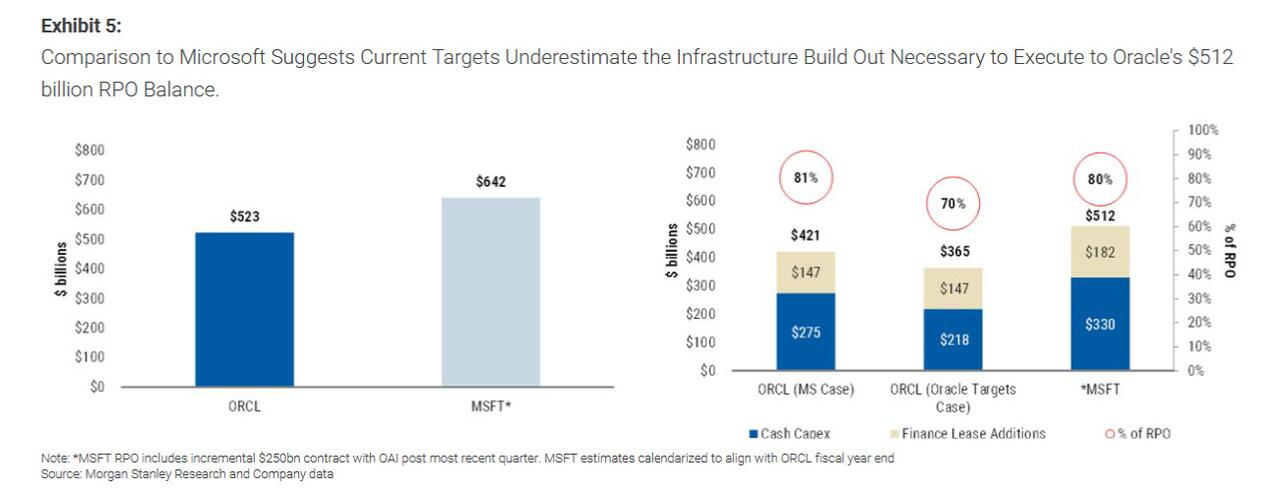
This is a problem because despite Larry Ellison’s best efforts to convince the market that Oracle has more than enough projected revenue – and a massive enough backlog – to grow into its bloated balance sheet, which is approaching $200 billion including off-balance sheet exposure, and refute such claims such as the following from Barclays which warned two months ago that the market “Underestimates the Infrastructure Build Out Necessary to Execute to Oracle’s $512 billion RPO Balance”…

Source: Barclays, available to pro subs

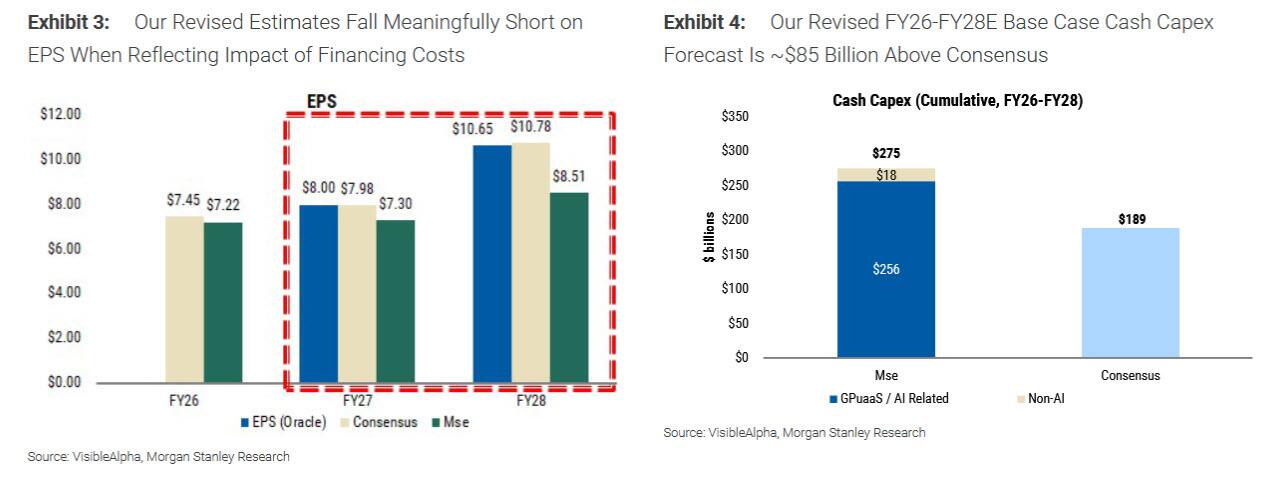
… and that the company will badly miss estimates, as it is forced to fund a much higher capex (some $275 billion) than consensus projects…

Source: Barclays, available to pro subs

… the market simply is not buying it. Literally. 

So what is Oracle to do? Well, it is literally going down the list of what Barclays proposed two months ago would be “next steps” as the cold hard reality slams Oracle’s publicly traded securities, the first of which was…

  • RIF of 20-30K employees which could drive ~$8-10B of incremental free cash flow,

And sure enough, this morning Oracle told employees that it’s conducting a major round of layoffs. 

According to CNBC “the layoffs were in the thousands”  although with the company employing some 162,000 people, to make an actual dent in free cash flow (which ORCL does not have), it will have to fire tens of thousands.

Layoff emails began landing in inboxes around 6:00 a.m. EST, informing recipients that their roles had been “eliminated” and that the day of notification would be their last working day — with no prior discussion or HR outreach.

“We are sharing some difficult news regarding your position. After careful consideration of Oracle’s current business needs, we have made the decision to eliminate your role as part of a broader organizational change. As a result, today is your last working day. We are grateful for your dedication, hard work, and the impact you have made during your time with us,” the email read.

Industry sources estimate that between 20,000 and 30,000 positions have been impacted, potentially affecting up to 18% of Oracle’s global workforce of roughly 162,000.

Employees reported that the automated mass emails were their only notification, with system access revoked shortly thereafter and instructions to provide personal email addresses to receive severance paperwork.

With Oracle slashing overhead, it will use the funds to invest in CapEx instead. Here is CNBC “While continuing to push its flagship database for storing and serving up corporate information, Oracle has ratcheted up its capital expenditures as it builds data center infrastructure that can handle AI workloads.” 

Needless to say, this process has been anything but smooth for the most indebted tech giant, and the company many view as the first canary in the AI bubble coalmine. 

While Oracle disclosed that its remaining performance obligations (basically backlog) jumped 359% to $455 billion following an agreement with OpenAI worth over $300 billion, the market refused to reward the company for the circular financing number,  and weeks later, Oracle picked executives Mike Sicilia and Clay Magouyrk to replace its CEO, Safra Catz. 

As for ORCL’s employees, while tens of thousands are about to be fired, expect many more to leave the company if Barclays is right and the company’s CapEx spending ends up being some $85 billion above the current consensus of $189 billion…

More in the full Barclays report available to pro subs.

Tyler Durden
Tue, 03/31/2026 – 13:00

via ZeroHedge News https://ift.tt/IxX2lFv Tyler Durden

Pentagon Weighs Anti-Drone Laser Weapon Deployment In DC To Fortify Airspace

Pentagon Weighs Anti-Drone Laser Weapon Deployment In DC To Fortify Airspace

We outlined a glaring security gap in U.S. counter-drone defenses well before the U.S.-Iran conflict erupted one month ago.

At the time, we specifically pointed out that data centers are largely unprepared for drone threats. We believe the Gulf conflict – after Iran bombed multiple data centers and military bases – has likely pushed the federal government into panic mode, accelerating efforts to deploy counter-drone systems around high-value targets across the homeland, whether military bases or civilian infrastructure.

This brings us to a New York Times report from Tuesday morning outlining how the Department of War is considering deploying anti-drone laser weapons near Fort McNair in Washington, DC, where Defense Secretary Pete Hegseth and Secretary of State Marco Rubio reside, following recent reports of suspicious activity and ongoing concerns about drone attacks on the homeland.

The report cited sources who “requested anonymity” and said the Army is discussing deploying laser weapons that would add an extra layer of security to some of the world’s most secure airspace across the Washington-Baltimore region.

The Federal Aviation Administration and the DoW are reportedly moving closer to a broader agreement on laser weapons, which offer a low-cost solution for defeating drone threats at scale, especially in an era when cheap kamikaze drones and swarms can quickly exhaust even the most sophisticated air defenses.

On Sunday, Heather Chairez, a spokeswoman for an Army-led joint task force in the DC area, said she was “aware of the reported drone sightings near Fort McNair and the surrounding areas.” She noted there was no credible threat in the recent incident, yet the task force had increased its counter-drone activities “to keep our service members and civilians who work and live on Fort McNair safe.”

An FAA spokeswoman, Hannah Walden, said the heads of her agency are prepared to work with the DoW and other agencies “to protect the homeland while ensuring the safety of the national airspace system.”

Security gaps in America’s airspace regarding cheap drones are alarming, and it is not just military installations that need protection. Data centers, ports, refineries, and power infrastructure are also vulnerable. The list is endless.

With battlefields raging across Eurasia, from Russia and Ukraine to the Gulf, one thing is clear: using expensive missile interceptors against $20,000 drones is not sustainable in the economics of war. In fact, low-cost lasers could be part of the answer, though low-cost interceptor drones have also proven valuable in places like Ukraine.

One of the first known instances of the U.S. military using laser weapons against a “foreign object” occurred last month in El Paso, though it actually turned out to be party balloons.

NYT did not identify the laser power class for the DC region, but the most likely option for counter-drone deployment would be around 50 to 60 kilowatts, which aligns with systems the U.S. military is already fielding and developing for air-defense missions. 

Tyler Durden
Tue, 03/31/2026 – 12:40

via ZeroHedge News https://ift.tt/5uckhmy Tyler Durden

Was CASA Really Worth It?

On the eve of the birthright citizenship case, it is useful to think back to last year. The Trump Administration could have rushed the merits to the Supreme Court, but instead only sought certiorari in the nationwide injunction issue. And to win that case, the executive branch sacrificed its own power. The Solicitor General said it would bind itself to the decisions of the Supreme Court. No decision, not Marbury, not Cooper v. Aaron, ever stipulated that point. Now a coordinate branch of government surrendered. And to what end? Was CASA such an important case that justified that unilateral disarmament?

I think the answer is no. In the year since CASA, there have been a never-ending spate of universal vacaturs against the executive branch. District Courts have certified classes on the fly. And the Supreme Court has shown no interest in clamping down this practice. And if, as expected, the Supreme Court strikes down the birthright citizenship order, all of this litigation will have been for naught. The executive branch is weaker because of this order. What was gained?

On the other side, the doomsday predictions from CASA simply have not come to fruition. Richard Re brings the receipts:

First, the CASA dissenters repeatedly suggested that relief would be practically unavailable, at least for many affected individuals, if universal relief were disallowed. . . . As it happened, the EO was swiftly enjoined and so has yet to go into effect. Moreover, that outcome was not only foreseeable but foreseen by at least some justices and commentators. . . .

Second, the CASA dissenters, especially Justice Kagan at oral argument, worried that the merits of the birthright citizenship EO would never reach the Supreme Court. . . . To some degree, this second worry was parasitic on the first one, for a lack of SCOTUS review might not be a problem if the relevant executive action were still expeditiously enjoined via class action. At any rate, the oral argument resulted in a promise from the SG that he would in fact seek certiorari on the merits, and that is of course what happened. . . .

In CASA, the dissenters raised concerns that were unusually immediate and specific. Perhaps they left enough wiggle room for plausible deniability. But to the extent that the dissenters made testable claims, those claims have not been borne out. The dissenters’ doomsaying, in other words, can be viewed as both falsifiable and falsified. One might remember this example when considering other assertions in dissenting opinions.

CASA was so important last year. This year, it barely matters. Yet another instance where it is difficult to know in the moment what Supreme Court rulings will have any resonance in the longterm.

The post Was <i>CASA</i> Really Worth It? appeared first on Reason.com.

from Latest – Reason.com https://ift.tt/YefaNcm
via IFTTT