Live Free or Ban Data Centers


data center | Meta

Happy Tuesday, and welcome to another edition of Rent Free. This week’s newsletter covers a number of new reforms that try to relegalize formerly ubiquitous forms of affordable housing.

  • In Washington, D.C., the city council will consider a bill to allow taller single-stair apartment buildings.
  • The Idaho Legislature has passed a bill allowing small starter homes to be built on smaller lots.
  • Florida Gov. Ron DeSantis has signed into law a bill that allows manufactured housing to be built in single-family areas.

Single-stair apartment buildings, starter homes, and manufactured housing are nothing new. All worked to make the American cities and towns of the past more affordable, accessible places to live.

Over the decades, states and localities have imposed rules that restrict or even ban these forms of housing. As evidenced by the reforms advancing across the country, many policymakers consider those restrictions a mistake. Bit by bit, we’re returning to the old, freer land use regime.

But first, the newsletter covers how the backlash to data centers in rural Ohio is leading some communities to consider adopting zoning for the first time.


Live Free or Ban Data Centers?

In rural Ohio, residents are balancing two uncomfortable propositions: live next to new data centers or adopt zoning codes to stop them.

WUOB, the state’s public media outlet, reports that a mounting number of data center developments are springing up in the state’s southeast, where many of the area’s rural counties have no zoning codes.

The data centers are often unpopular, with local residents complaining about large, unsightly buildings consuming existing farmland and the lack of transparency from local governments and data center builders about their projects.

But without zoning codes, local officials have limited ability to block new data centers where they’re proposed.

As I noted in a recent cover story for Reason, data centers are—all things considered—pretty low-impact land uses. They’re not particularly noisy. They don’t emit noxious fumes or smells. Their small permanent staffs mean that they also don’t strain local roads and schools. Their water use is normal, and the impacts of their admittedly gargantuan power consumption are overblown.

For all those reasons, there are few environmental laws or nuisance regulations focused on actual neighborhood effects that one could use to stop new data centers from opening up. For that task, one needs zoning.

Zoning skips the whole business of regulating externalities and instead gives local officials the direct power to say what kinds of buildings are allowed where.

It’s a perfect tool for stopping data centers. The problem is that zoning is a perfect tool for stopping almost everything.

“We don’t have to ask permission for simple things like putting up a fence, so that’s great.…At the same time, I think there should be some form of protection in place for this type of thing,” WUOB quotes one woman who is concerned about new data center development while also wary of the regulations required to stop them.

The outlet notes that some towns are adopting straight moratoriums on data center development as an alternative to comprehensive zoning, but these can only be a temporary measure.

For people who don’t want zoning, moratoriums can be risky business. Read Reason‘s coverage of land use battles in Caroline, New York, where a temporary moratorium designed to stop a Dollar General morphed into a wider effort to impose zoning on the then-unzoned town.

At the end of the day, freedom for me but not for thee is a hard thing to write into the law. The conflict over data centers in unzoned Ohio is evidence that being allowed to do what you want on your property usually requires tolerating what someone else does on their property—even if it’s building a data center.


The D.C. City Council Considers Single-Stair Reform

Today, the Washington, D.C., City Council’s Committee of the Whole will consider a bill introduced by Councilmember Brianne Nadeau that would allow apartment buildings of up to six stories to be built with just one staircase.

Like most U.S. cities, D.C. currently requires apartment buildings over three stories in height to have two staircases as a fire safety measure.

Reformers have argued that the requirement of a second staircase significantly increases costs to new construction and stymies the construction of smaller apartment buildings on smaller urban lots.

That’s a loss for supply and affordability, advocates argue. And because new multifamily housing has the best fire safety record, single-stair requirements that prevent new multifamily construction could actually reduce fire safety.

New York City and Seattle have long allowed single-stair buildings to rise six stories. According to Pew, seven states passed single-stair reforms in 2025 that either require building code updates to allow taller single-stair buildings or otherwise require building code officials to consider such reforms.

Nadeau’s “One Front Door Act” would require city building officials to update construction codes to allow six-story single-stair buildings within two years.

The reform will “increase the amount of space that can be built for residents, making it more economical and easier for builders to create more units or bigger units, which are good for families,” said Nadeau in introducing the bill last year.

A public hearing on the bill was held in January. Written testimony shows a long list of housing policy groups, architects, and real estate advocates in favor of the reform. The main opposition comes from the city’s Fire Fighter Association.


Idaho Passes Sweeping Starter Home Reforms  

Last week, the Idaho Legislature passed a bill allowing “starter home subdivisions” in municipalities across the state.

Senate Bill 1352, which was transmitted to the governor yesterday, would require cities of 10,000 people or more to update their land use laws to allow single-family homes on lots as small as 1,500 square feet within new subdivisions of at least four acres.

Similar “starter home” legislation is becoming an increasingly common form of housing supply reform. “Small homes on small lots” offers the potential for more modestly priced, owner-occupied housing. When restricted to new subdivisions, these bills can avoid some of the fights about allowing multifamily housing in existing residential areas.

According to the American Enterprise Institute’s housing legislation tracker, over a dozen states have considered lot size reform bills this year.

Texas made headlines last year when it adopted a law allowing starter homes on 3,000-square-foot lots in five-acre subdivisions in larger cities and counties last year. Idaho’s reforms go beyond Texas’ policy by allowing even smaller lots in smaller subdivisions in smaller communities.

In addition to S.B. 1352, the Idaho Legislature is also considering reforms that would allow duplexes and accessory dwelling units in single-family areas. Bills that would enact those reforms passed the Idaho Senate earlier this month and are now being considered by the House.


Florida Passes Bill To Boost Manufactured Housing, Reduce Permit Fees

On Friday, Florida Gov. Ron DeSantis signed into law House Bill (H.B.) 399, which would restrict local governments’ ability to discriminate against manufactured housing.

The new law requires local governments to allow off-site constructed manufactured housing anywhere that detached single-family homes are also allowed. Localities are also forbidden from regulating manufactured housing more restrictively than single-family housing in the same zoning district.

Manufactured, a.k.a. mobile, homes used to be a significant portion of new homes built in America. These homes were also typically the most affordable form of new housing.

Brian Potter, author of the Construction Physics Substack, notes that in some years in the 1960s and 70s, as many as a fifth of new homes were factory-built manufactured housing.

In the 1970s, this type of housing went into steep decline, the reasons for which are debated. Some blame federal regulations of manufactured housing. Certainly not helping matters were the proliferation of zoning codes that explicitly banned manufactured housing in whole communities.

In more recent years, there’s been a rising interest in attempting to revive the manufactured housing sector.

The housing bill currently being considered by Congress would peel back some federal regulations on manufactured homes. Florida’s H.B. 399, meanwhile, tackles the zoning restrictions that keep these units out of town.

The new law also requires local governments to cap permitting fees at the cost of actually reviewing and processing building permits.


Quick Links

  • The Argument‘s Jerusalem Demsas on Congress’ bipartisan bias against renters
  • The FBI is warning homeowners about a new scam in which fraudsters send them fake letters demanding payment for building permits. The bureau says the scam is so successful because the fraudulent fee demands sound so much like the real, random fees homeowners have to pay.
  • A Rhode Island House committee will consider a bill that repeals regulations on single-room occupancy and co-living housing today.
  • America’s first developer president wants his presidential library to be a gleaming glass tower.
  • No lies detected:

The post Live Free or Ban Data Centers appeared first on Reason.com.

from Latest – Reason.com https://ift.tt/UXiSkjB
via IFTTT

What Took So Long In Chiles?

I give a lot of thought to timing on the Supreme Court. Internal deliberations are usually a black box, unless there are some leaks. All we know for sure is when a case is argued and when it is decided.

Today, the Court decided Chiles v. Salazar. This case was argued six months ago on October 7. The vote was 8-1. Justice Gorsuch wrote the majority opinion, which was about twenty-pages long. Justice Kagan wrote a short concurrence, joined by Justice Sotomayor, that was about four pages long. Justice Jackson wrote a solo dissent that spanned more than thirty pages.

Why did this case take six months? It seems pretty clear the majority opinion coalesced fairly early on. There is not much daylight between the majority and the concurrence. I have to imagine that Justice Gorsuch circulated his majority opinion fairly quickly. There are no footnotes suggesting attempts to modify or water-down the majority opinion.

What we don’t know is how Justice Jackson affected the process. The majority opinion offers a few citations to Jackson’s dissent, but there is no lengthy back-and-forth. I don’t think there was much engagement here at all. Indeed, it is telling that Justice Kagan felt compelled to respond to Justice Jackson in a footnote.

This opinion also makes me think about Callais, which was argued on October 15. I doubt that case will be 8-1. But it may take around the same time, if not longer.

For those who care about such things, Justice Alito is the only Justice who has not yet written a majority opinion from October.

The post What Took So Long In <i>Chiles</i>? appeared first on Reason.com.

from Latest – Reason.com https://ift.tt/I5EbUx0
via IFTTT

Justice Kagan’s Arguments for “Relax[ing] Our Guard” as to Some Content-Based (But Viewpoint-Neutral) Speech Restrictions

From Justice Kagan’s concurrence, joined by Justice Sotomayor, in today’s Chiles v. Salazar:

[A.] The Court today decides that the Colorado law challenged here, as applied to talk therapy, conflicts with core First Amendment principles because it regulates speech based on viewpoint. I agree. I write only to note that if Colorado had instead enacted a content-based but viewpoint-neutral law, it would raise a different and more difficult question.

As the Court states, governments must “nearly always” abstain from adopting viewpoint-based restrictions. Those laws represent a particularly “egregious form” of content-based regulation, implicating First Amendment concerns to the highest possible degree. A law drawing a line based on the “ideology” of the speaker—disadvantaging one view and advantaging another—skews the marketplace of ideas our society depends on to discover truth. And such a law suggests an impermissible motive—that the government is regulating speech because of its own “hostility” toward the targeted messages. If the First Amendment prohibits anything, it is the “official suppression of ideas.” …

Consider a hypothetical law that is the mirror image of Colorado’s. Instead of barring talk therapy designed to change a minor’s sexual orientation or gender identity, this law bars therapy affirming those things. As Ms. Chiles readily acknowledges, the First Amendment would apply in the identical way. Once again, because the State has suppressed one side of a debate, while aiding the other, the constitutional issue is straightforward.

[B.] It would, however, be less so if the law under review was content based but viewpoint neutral. Such content-based laws, as the Court explains, trigger strict scrutiny “[a]s a general rule.” But our precedents respecting those laws recognize complexity and nuance. We apply our most demanding standard when there is any “realistic possibility that official suppression of ideas is afoot”—when, that is, a (merely) content-based law may reasonably be thought to pose the dangers that viewpoint-based laws always do. But when that is not the case—when a law, though based on content, raises no real concern that the government is censoring disfavored ideas—then we have not infrequently “relax[ed] our guard.” …

Medical care typically involves speech, so the regulation of medical care (which is, of course, pervasive) may involve speech restrictions. And those restrictions will generally refer to the speech’s content. But laws of that kind may not pose the risk of censorship—of “official suppression of ideas”—that appropriately triggers our most rigorous review. And that means the “difference between viewpoint-based and viewpoint-neutral content discrimination” in the health-care context could prove “decisive.” Fuller consideration of that question, though, can wait for another day. We need not here decide how to assess viewpoint-neutral laws regulating health providers’ expression because, as the Court holds, Colorado’s is not one.

Here’s more from her opinion dealing with a similar question in Reed v. Town of Gilbert (2015), which she cites in her opinion in Chiles:

We apply strict scrutiny to facially content-based regulations of speech … when there is any “realistic possibility that official suppression of ideas is afoot.” That is always the case when the regulation facially differentiates on the basis of viewpoint.

It is also the case … when a law restricts “discussion of an entire topic” in public debate. We have stated that “[i]f the marketplace of ideas is to remain free and open, governments must not be allowed to choose ‘which issues are worth discussing or debating.'” And we have recognized that such subject-matter restrictions, even though viewpoint-neutral on their face, may “suggest[] an attempt to give one side of a debatable public question an advantage in expressing its views to the people.”

Subject-matter regulation, in other words, may have the intent or effect of favoring some ideas over others…. But when that is not realistically possible, we may do well to relax our guard so that “entirely reasonable” laws imperiled by strict scrutiny can survive…. Our concern with content-based regulation arises from the fear that the government will skew the public’s debate of ideas—so when “that risk is inconsequential, … strict scrutiny is unwarranted.”

To do its intended work, of course, the category of content-based regulation triggering strict scrutiny must sweep more broadly than the actual harm; that category exists to create a buffer zone guaranteeing that the government cannot favor or disfavor certain viewpoints. But that buffer zone need not extend forever. We can administer our content-regulation doctrine with a dose of common sense, so as to leave standing laws that in no way implicate its intended function….

The post Justice Kagan's Arguments for "Relax[ing] Our Guard" as to Some Content-Based (But Viewpoint-Neutral) Speech Restrictions appeared first on Reason.com.

from Latest – Reason.com https://ift.tt/DeoSxl4
via IFTTT

10 Years Ago Today, Trump Promised To Eliminate the National Debt. Instead, It Has Doubled.


Republican presidential candidates in 2016 | Photo: Joseph Sohm/Visions of America/Newscom

Ten years ago today, Donald Trump said he would pay off the national debt in the span of just eight years.

That did not happen. Instead, the gross national debt has doubled since that day—from about $19 trillion to over $39 trillion. Much of that additional borrowing has taken place during Trump’s five-plus years in the White House.

The gap between Trump’s outlandish promise and the brutal fiscal reality of the past decade is not just a political gotcha. It’s also an apt illustration of how far and how fast the debt has spiraled. And it’s a painful reminder of a missed opportunity that Americans will be facing for a long, long time. The bill for these 10 years of fiscal profligacy will be coming due long after Trump has finally departed from the political scene.

But it’s a story that starts, as everything in politics seems to these days, with Trump.

“We’re not a rich country. We’re a debtor nation,” is what then-candidate Trump told The Washington Post in an interview on March 31, 2016 (a full transcript was published two days later). “We’ve got to get rid of the $19 trillion in debt.”

How long would it take to do that, asked the Post‘s Bob Woodward.

“Fairly quickly,” Trump replied. When pressed for a more specific answer, Trump provided a shocking timeline. “Well, I would say over a period of eight years.”

That was never going to happen. As the Committee for a Responsible Federal Budget (CRFB) pointed out shortly after Trump’s comments made headlines, “achieving this goal would be virtually impossible—particularly for a candidate who has proposed large tax cuts and ruled out significant entitlement reforms.”

Instead, the CRFB estimated that Trump’s proposals would cause the national debt to nearly double within 10 years. The group arrived at that figure by taking the existing baseline for the debt—which, as of early 2016, was expected to grow to about $28 trillion by 2026—and adding the estimated cost of Trump’s various campaign promises.

It’s worth appreciating how remarkably accurate that assessment turned out to be. The number-crunchers at the Congressional Budget Office and the CRFB didn’t know there would be a pandemic. They didn’t know the outcome of the major tax-and-spending bills that Trump and President Joe Biden would pass. Heck, they didn’t even know who would be president—remember, in April 2026, most of the political class didn’t believe Trump had much of a chance.

The accuracy of that prediction points to two things, Marc Goldwein, senior policy director at the CRFB, said when asked about it this week. First, the extent to which rising debt was baked into the federal budget before Trump came on the scene. Social Security and Medicare are the largest federal programs, and both were on pace to borrow more during the 2020s.

Second, it’s due to Trump keeping many of his campaign promises. That’s not the compliment that it might sound like. Trump vowed not to touch the aforementioned entitlement programs that were driving borrowing to new heights, and he promised to both cut taxes and increase military spending. That was a recipe for higher deficits, and over his first four years in office, Trump added over $8 trillion to the national debt that he’d once sought to “get rid of.”

Biden picked up where Trump left off, adding another $4.7 trillion to the debt with various proposals. In his first year back in the White House, Trump has done nothing to address the growing pile of debt. The federal government borrowed $1.8 trillion during the fiscal year that ended in September and is on pace to borrow about the same amount this year.

What have Americans gotten from a decade of heavy borrowing that doubled the size of the debt? Higher inflation and higher interest rates, for starters.

A recent analysis from the Yale Budget Lab found that federal borrowing since 2015 has contributed to rising yields on long-term Treasury bonds. Those increases, in turn, have put upward pressure on interest rates and will, in the years ahead, make it more difficult for Americans to finance homes, cars, and other things.

For a typical 30-year mortgage, borrowing costs today are about $2,500 higher annually than they would be in the alternate reality where federal borrowing didn’t explode in the past decade, the Yale Budget Lab estimates. Similarly, the average car loan costs $120 more annually, and the average small business loan costs $770 more.

Meanwhile, Americans will also face higher taxes or reduced government services to pay for the debt. Interest payments on the national debt will exceed $1 trillion this year—about 20 percent of all tax collections.

There are a few lessons that might be taken from all this.

First, trust the budget wonks more than the politicians. Trump’s promise to pay off the national debt might be an all-time whopper of an impossible campaign promise, but he’s certainly not the first or last politician to make an unrealistic claim about fiscal policy. The next time it happens, pay more attention to what the CBO or the CRFB says than anything else.

To that end, I asked Goldwein for a realistic goal that a prospective presidential candidate should set for the country.

The key, he said, is to keep the debt from growing faster than the economy as a whole, which it has been doing recently. Capping budget deficits at 3 percent of gross domestic product would stabilize the debt and put needed constraints on future borrowing.

Second, when it comes to Trump, the claim he made 10 years ago to the Post remains an illustrative example of how he engages in politics. Saying he could pay off the national debt in eight years was a ridiculous, grandiose promise made off-the-cuff without any semblance of a plan or even the intention to follow through on it.

That seems particularly relevant right now, as the Trump administration tries to figure out the next steps in a war with Iran that it launched in a similar grandiose, improvisational manner.

Trump has been making it up as he goes for a decade now, and Americans will be left to pay the price.

The post 10 Years Ago Today, Trump Promised To Eliminate the National Debt. Instead, It Has Doubled. appeared first on Reason.com.

from Latest – Reason.com https://ift.tt/6miQ01E
via IFTTT

Treasury Unveils Whistleblower Portal To Combat Transnational Medicare, Medicaid Fraud Rings

Treasury Unveils Whistleblower Portal To Combat Transnational Medicare, Medicaid Fraud Rings

Authored by Kimberly Hayek via The Epoch Times (emphasis ours),

Whistleblowers are encouraged to report abuse of Medicare, Medicaid, and other government health benefit programs, the Department of the Treasury announced on March 30, while warning that sophisticated fraud schemes are siphoning billions from them.

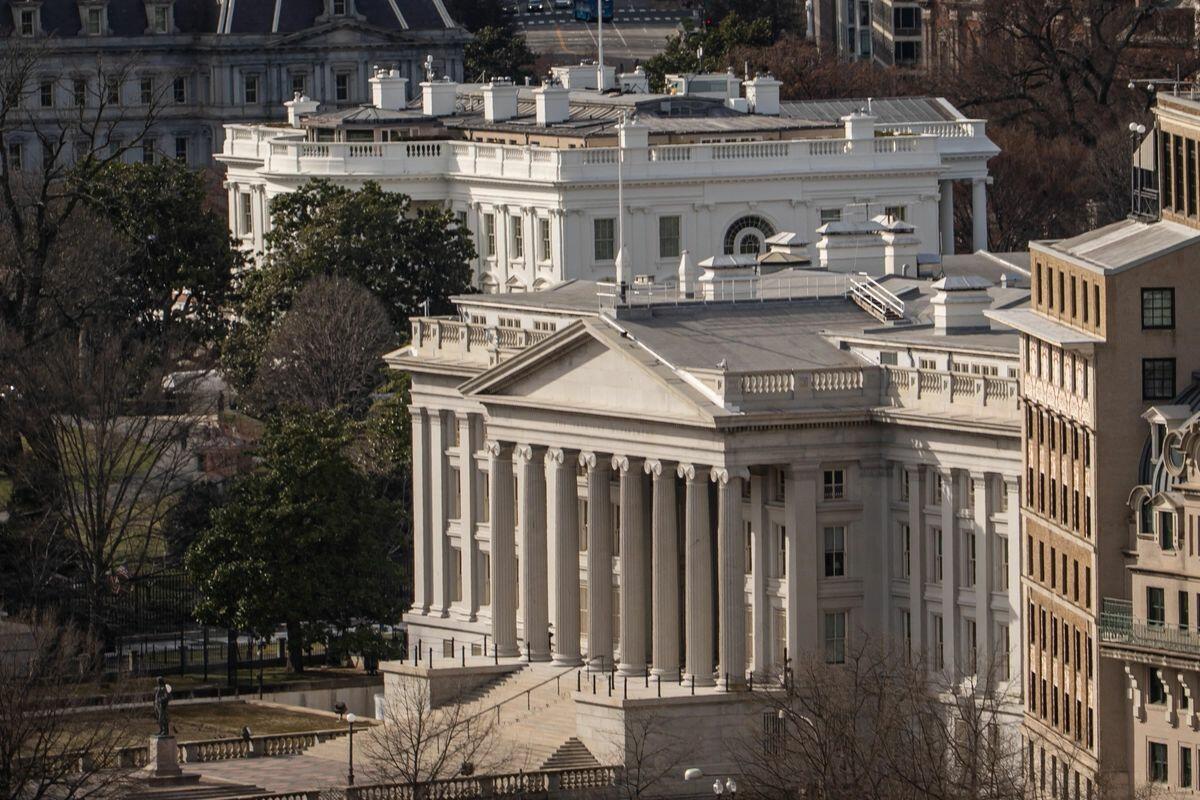
The White House and the U.S. Department of the Treasury in Washington on March 10, 2025. Madalina Vasiliu/The Epoch Times

In an advisory, the Treasury detailed the way in which transnational criminal organizations—working with domestic fraudsters and organized crime groups—create fake health care providers, employ cover people to pose as owners who are not U.S. residents, and steal the personal data of actual beneficiaries to submit false claims for care that was never provided or was not needed. Proceeds are then laundered through wire transfers, digital assets, and culpable bank co-conspirators before being transferred overseas.

The department said its Financial Crimes Enforcement Network (FinCEN) has published a proposed rule to fully implement a whistleblower program that would reward 10–30 percent of penalties collected in successful enforcement in fraud and money laundering cases, as well as sanctions violations. Payments would be taken from penalties obtained under the Bank Secrecy Act and other laws already in place.

“The regulation proposed today, when finalized, will fully implement these statutes,” FinCEN said. “Whistleblowers are encouraged to submit information as soon as possible and to provide detailed, specific documentation to support their claims.”

In the meantime, FinCEN said it “recently launched a portal” for whistleblowers to begin making reports.

Financial institutions reported a 20 percent increase in suspicious activity linked to health care fraud in 2025 over the previous year, according to the advisory. Officials, however, suspect the filings reveal only a small part of the fraud.

“President Trump has been clear that Americans have a right to know that their tax dollars are not being used to commit fraud,” Treasury Secretary Scott Bessent said in a statement. “Under President Trump’s leadership, Treasury will continue to find and disrupt fraud schemes wherever they exist, and we will work with our law enforcement partners to hold perpetrators to account.”

The department’s Financial Crimes Enforcement Network advisory comes as the Trump administration works to undermine waste and abuse in federal spending.

The advisory was released in collaboration with the FBI and the Health and Human Services Department’s Office of Inspector General. It aligns with an executive order targeting fraud across federal payments.

Treasury officials said the advisory and proposed regulation are in line with administration actions to protect taxpayer dollars and protect the financial system against illicit activity, and that financial institutions are requested to file suspicious activity reports and to inform law enforcement immediately upon encountering suspicious transactions.

In February, Bessent described efforts to combat fraud in federal spending.

“We are encouraging whistleblowers who know about fraud, people who are stealing from the American taxpayer, to come forward at Treasury,” he said. “We will be giving rewards up to 10 percent to 30 percent of the fines that we levy.

Bessent added that these efforts represent a great way to ferret out waste, fraud, and abuse.

The Trump administration has also flagged fraud concerns in New York.

Federal investigators there have homed in on the state’s Medicaid program. In March, Centers for Medicare and Medicaid Services Administrator Dr. Mehmet Oz, tasked with spearheading a federal review of Medicaid spending, cited abnormal job growth in home health and personal care aides as showing signs of possible abuse.

Heart surgeons are trained to look at the numbers,” the cardiothoracic surgeon said. “When something doesn’t add up, you don’t ignore it; you investigate.”

In a specific New York case, eight people were indicted in a $68 million Medicaid fraud scheme revolving around Brooklyn adult day care centers that allegedly entailed bribes and inflated claims.

Tyler Durden
Tue, 03/31/2026 – 12:20

via ZeroHedge News https://ift.tt/3EM1SxW Tyler Durden

Ukraine’s Backers Want Reduction In Long-Range Strikes On Russian Oil, Zelensky Says

Ukraine’s Backers Want Reduction In Long-Range Strikes On Russian Oil, Zelensky Says

We’ve been highlighting the significant impact of the Iran war on developments in Ukraine, where the over four-year long war is showing no end in sight. Ukraine’s President Zelensky has made clear his view that the current global focus on the Iran conflict has put Kiev in a weakened position.

Already, Ukraine’s international partners are ‘primarily’ sending their anti-ballistic missile systems to the Middle East – with Ukraine ‘forgotten’ – Zelensky has recently said. But there’s more, as the hits keep coming: Zelensky revealed Monday that some of Ukraine’s backers have sent “signals” to scale back long-range strikes on Russia’s oil sector as global energy prices have soared.

via Associated Press

“Recently, following such a severe global energy crisis, we have indeed ⁠received signals from some of our partners about how to reduce our responses in the ​oil sector and the energy sector of the Russian Federation,” Zelensky told journalists in a WhatsApp briefing, reported by Reuters.

This is perhaps what’s behind his calling for an Easter holiday truce with Russia. He had on the same day that he told journalists about a potential pause on long-range attacks on Russian energy stated“If Russia is ready to stop hitting Ukrainian energy facilities, we will not respond against their energy sector.”

Zelensky just came off a tour of Middle East Gulf states, even amid Iran’s ongoing retaliation in the region, while seeking Ukrainian security assistance. In recent days he met with the leaders of Saudi Arabia, the UAE, Qatar and Jordan.

Reuters notes of this, “Fresh from a four-day visit to the Middle East, Zelenskiy said that he had reached agreement with some countries in the region to provide energy support to Ukraine.”

“Zelenskiy said at the weekend during his Middle ​East tour that he ​had reached a deal ⁠on diesel deliveries for a year to Ukraine, without providing further details,” the report continues. “Diesel is vital for the functioning of the Ukrainian armed forces and ​the country’s agricultural sector, the bedrock of the economy.”

So indeed any new pause in tit-for-tat assaults on energy infrastructure would be a welcome reprieve for Ukraine as well.

One interesting aspect to the Reuters report is that while the US side hasn’t commented, one unnamed source tries to inject that the ‘signaling’ on reducing or halting long-range strikes on energy is actually coming from Moscow:

A source familiar with the situation said U.S. officials had conveyed this message to their Ukrainian counterparts as part of their regular conversations, adding that the initial “signals” appeared to have come from Moscow.

And yet, even as Zelensky himself admits, Trump’s easing of Russian oil sanctions has put the Kremlin in the driver’s seat, in terms of energy leverage, at this crucial moment – also as the peace process and talks between Moscow and Keiv are non-existent.

In the meantime, amid waning support from the Trump administration, Zelensky has set his sights on greatly improving ties with the wealthy oil and gas monarchies in the Gulf.

Tyler Durden
Tue, 03/31/2026 – 12:00

via ZeroHedge News https://ift.tt/pIat4Hf Tyler Durden

Supreme Court Sides With Christian Counselor, Strikes Down Colorado ‘Conversion Therapy’ Ban

Supreme Court Sides With Christian Counselor, Strikes Down Colorado ‘Conversion Therapy’ Ban

In a landmark 8-1 decision issued today, the Supreme Court sided with a Christian mental health counselor – ruling that Colorado’s law banning “conversion therapy” violates the First Amendment

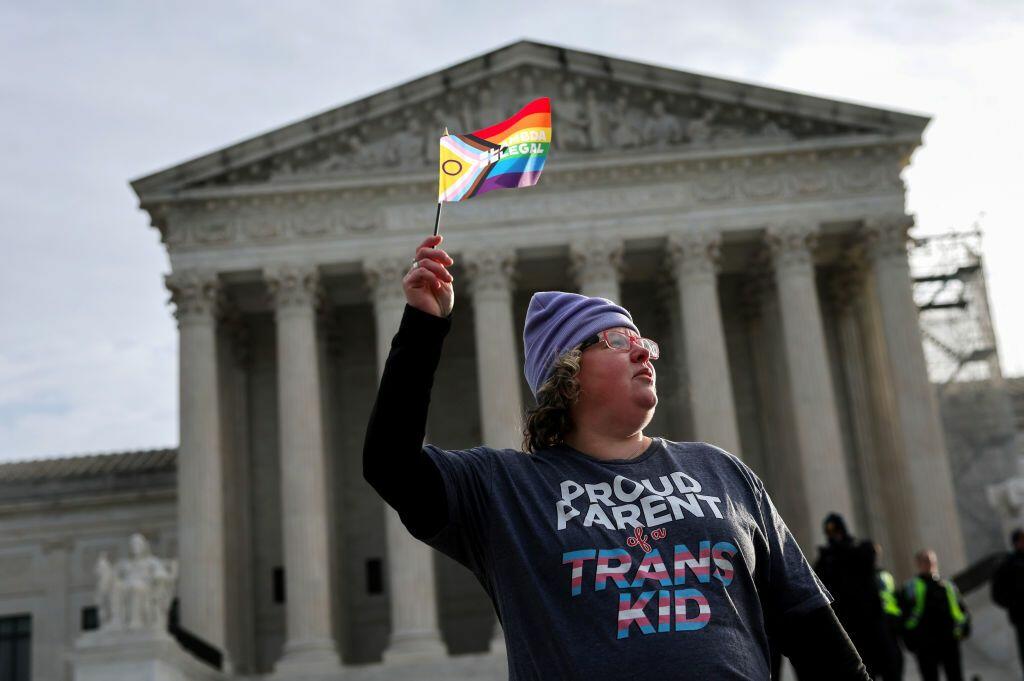
A transgender rights supporter takes part in a rally outside of the U.S. Supreme Court in December. The court on Tuesday heard arguments in a conversion therapy ban case out of Colorado. (Photo by Kevin Dietsch/Getty Images)

The majority held that Colorado’s 2019 law unconstitutionally discriminates on the basis of viewpoint by allowing counselors to affirm and support clients exploring gender transition or identity while prohibiting any talk-therapy efforts to help clients reduce unwanted same-sex attractions, change sexual behaviors, or align their gender identity with their biological sex.

The solo dissent being (drumroll…) Ketanji Brown Jackson.  

Writing for the majority, Justice Neil Gorsuch declared that Colorado’s statute “regulates speech based on viewpoint” by permitting counselors to affirm clients’ gender transitions or identity exploration while prohibiting any efforts to help clients reduce same-sex attractions, change sexual behaviors, or align their gender identity with their biological sex. The decision reverses the U.S. Court of Appeals for the Tenth Circuit and remands the case for further proceedings consistent with rigorous First Amendment scrutiny.

“Colorado’s law permits her to express acceptance and support for clients exploring their identity or undergoing gender transition,” Gorsuch wrote. “but forbids her from saying anything that attempts to change a client’s ‘sexual orientation or gender identity,’ including efforts to change ‘behaviors,’ ‘gender expressions,’ or ‘romantic attraction[s].’”

He emphasized that speech does not lose constitutional protection merely because the government labels it “treatment” or “therapeutic modality.” The First Amendment is no word game,” the opinion states, citing NAACP v. Button (1963).

Jackson, meanwhile, wrote that the decision “opens a dangerous can of worms” that “threatens to impair states’ ability to regulate the provision of medical care in any respect.”

“In the worst-case scenario, our medical system unravels as various licensed healthcare professionals — talk therapists, psychiatrists, and presumably anyone else who claims to utilize speech when administering treatments to patients — start broadly wielding their new-found constitutional right to provide substandard medical care.” 

Unsurprisingly, Axios agrees with Jackson – writing that the decision “has implications beyond the Colorado therapy sessions by setting precedent that therapists’ conversations with patients are regarded as a form of constitutionally protected speech and rolling back protections for LGBTQ+ youth.”

Background

Chiles is a licensed professional counselor in Colorado Springs and a practicing Christian. She holds a master’s degree in clinical mental health and provides exclusively talk therapy—no medications, physical interventions, or coercive techniques. As described in the case, she does not approach sessions with predetermined outcomes. Instead, she listens to clients, including minors, as they articulate their own goals and works with them to pursue those objectives while respecting their autonomy.

Many clients seek her out specifically for her faith-integrated approach. Chiles has said she believes people flourish when they live in alignment with God’s design, including their biological sex. Some clients want support affirming their current identity, while others seek help reducing unwanted same-sex attractions, changing behaviors, or finding greater alignment with their bodies.

In 2019, Colorado enacted a law prohibiting licensed counselors from engaging in “conversion therapy” with minors. The statute broadly bans practices aimed at changing a minor’s sexual orientation or gender identity, including efforts to alter behaviors, gender expression, or reduce same-sex attractions. At the same time, it expressly allows counselors to provide “acceptance, support, and understanding” for identity exploration and to assist individuals undergoing gender transition.

Chiles filed suit in federal court in 2022, seeking a preliminary injunction limited to her talk-therapy practice. Both the district court and the Tenth Circuit found she had Article III standing but denied relief, ruling that the law regulated professional conduct and only incidentally burdened speech, so it needed only rational-basis review. Judge Harris Hartz dissented in the Tenth Circuit. The Supreme Court granted certiorari to resolve the circuit split, heard argument on October 7, 2025, and issued its 8-1 decision today

Tyler Durden
Tue, 03/31/2026 – 11:30

via ZeroHedge News https://ift.tt/OklqRIN Tyler Durden

European Inflation Jumps Most Since 2022 On Soaring Energy Prices Even As Core CPI Unexpectedly Shrinks

European Inflation Jumps Most Since 2022 On Soaring Energy Prices Even As Core CPI Unexpectedly Shrinks

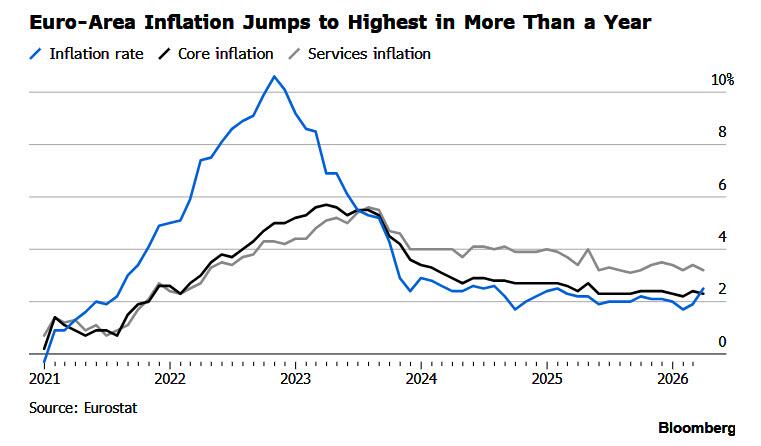
In an early preview of the coming inflation spike, the euro area saw its steepest jump in inflation since 2022 as the Iran war pushed energy costs sharply higher, backing expectations that the ECB will have to raise interest rates.

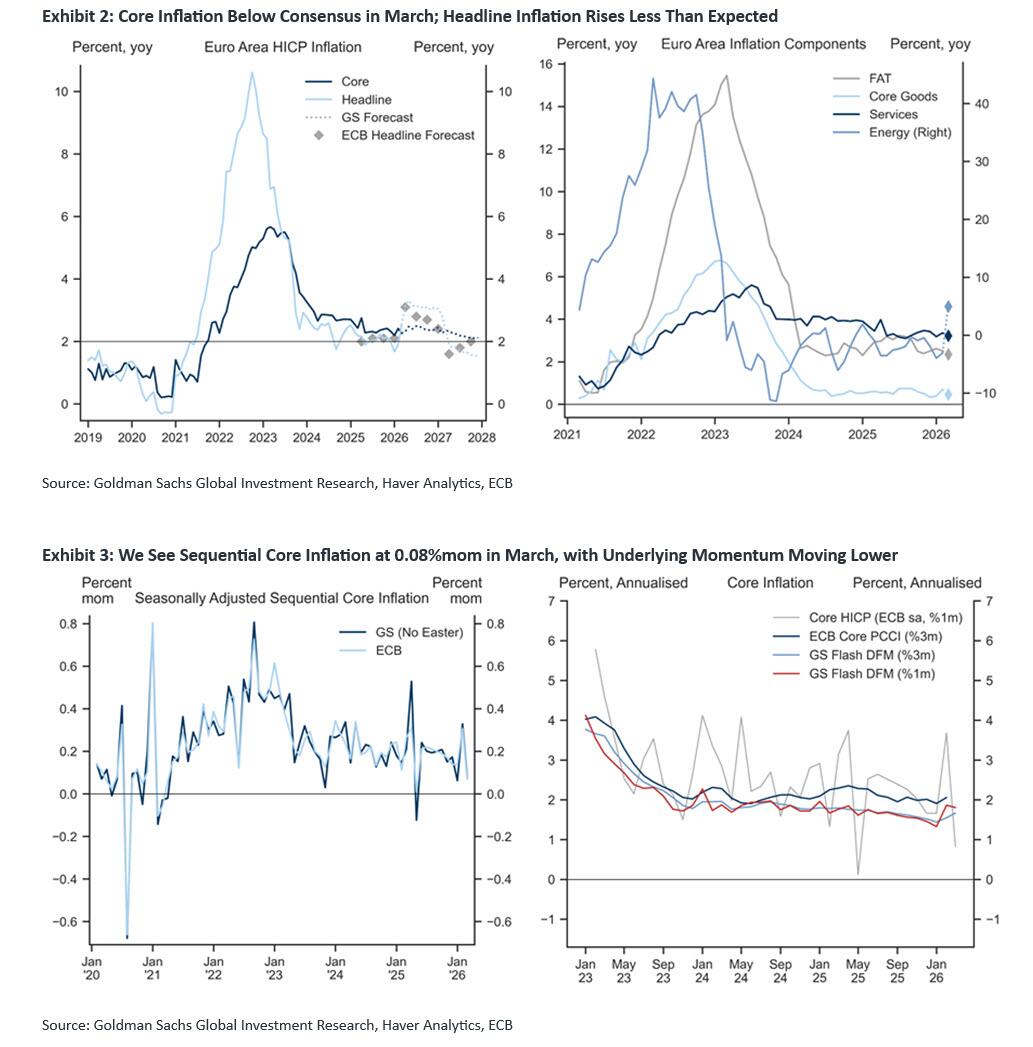
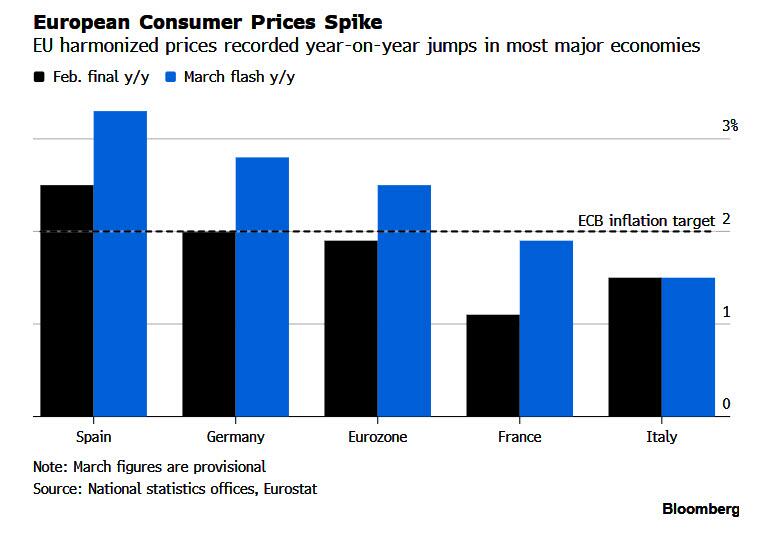
In March, European consumer prices rose 2.5% from a year ago in March – and up a whopping 1.9% from the previous month – to the highest since January 2025. The silver lining: the median estimate was for an even higher 2.6% print. 

Yet while headline inflation soared, demand destruction appears to have depressed other purchases, and core inflation, which excludes volatile items like food and energy, unexpectedly slowed to 2.3%, while the closely watched services gauge also eased, Eurostat said Tuesday.

Some more details from Goldman:

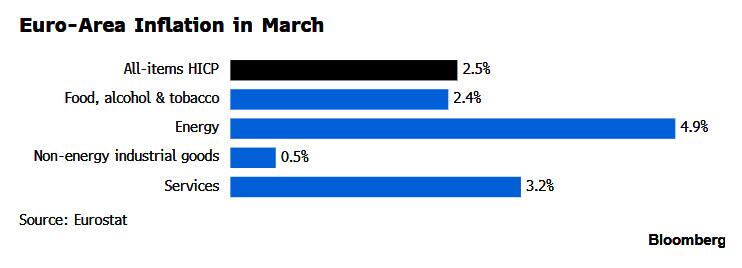
  • Euro area headline HICP inflation increased by 0.63pp to 2.52%yoy in March, below our tracking and consensus of 2.6%yoy. Core HICP inflation, excluding energy, food, alcohol and tobacco, went down 15bp to 2.26%yoy, broadly in line with our latest tracking estimate but below consensus expectations of 2.4%yoy.
  • The breakdown by main expenditure categories showed services inflation declining to 3.23%yoy, with part of the decline likely driven by Olympics-induced tourism and hospitality-related components payback in Italy, while non-energy industrial goods inflation went down to 0.47%yoy, surprising our latest tracking estimate to the downside. Of the non-core components, energy inflation increased to 4.9%yoy, close to our latest tracking but lower than we initially expected, while food, alcohol and tobacco inflation decline to 2.35%yoy, weaker than we expected.
  • Using our seasonal adjustment methodology, aimed to closely replicate the ECB’s, and removing the Easter adjustment for the whole services basket, we estimate that seasonally adjusted sequential core inflation was 0.08%mom in March, down from 0.33%mom in the February reading (Exhibit 3). Within core inflation, we estimate that seasonally adjusted sequential core goods inflation went down to -0.13%mom in March, while sequential services inflation declined to 0.19%mom from 0.38%mom in February. This compares to the ECB’s estimates of 0.07%mom, -0.17%mom and 0.20%mom for core, goods and services inflation respectively. 
  • Our flash measure of underlying inflation moved down from 0.154%mom to 0.149%mom in March.
  • Incorporating the March flash release into the Euro area inflation path, our medium-term path continues to show core inflation at 2.4%yoy in 2026, peaking at 2.5%yoy in Q3 and then falling to 2.4%yoy by end-2026 and to 2.1% by end-2027, somewhat above the ECB staff March projections in the medium term. As for headline inflation, we continue to see it notably above target this year. We see it averaging 2.9%yoy in 2026, peaking at 3.2%yoy in Q2, and at 2.0%yoy in 2027, using our commodities team’s latest baseline path for gas and oil prices.

With the conflict in the Middle East now extending beyond a month, its effects are increasingly being felt in Europe, where not only inflation but expectations on where prices are headed are picking up markedly.

As Bloomberg notes, individual countries saw mixed inflation results for March. In Italy, there was no uptick at all, with the reading unexpectedly coming in unchanged at 1.5%. French inflation quickened, but didn’t quite reach 2%. Germany and Spain, which reported numbers earlier, recorded more rapid price increases, of 2.8% and 3.3%. Further accelerations are expected and will only add to pressure on the ECB.

“The longer the war in Iran lasts and the more destructive it becomes, the greater the risk of inflation will be,” Slovakia’s Peter Kazimir said. “Consequently, the sooner and more decisively we’ll have to respond.”

Governments and central banks in Europe are also slashing their projections for economic growth, while firms are bracing for a hit to demand among their customers. 

The ECB says it won’t to allow a repeat of the inflation spike that followed Russia’s invasion of Ukraine in 2022, vowing to act quickly and decisively as needed. But with no clarity on when the fighting will end, officials are still assessing the toll. Elevated oil and natural gas prices are already casting doubt on the ECB’s baseline outlook for inflation to average 2.6% this year. Under a more extreme outcome, price gains could peak at as high as 6.3% in 2027.

“Today we can say that the base-case scenario — for which assumptions were locked in on March 11 — can probably be considered to be the optimistic scenario,” Estonian central-bank chief Madis Muller said Tuesday in Tallinn. “We certainly can’t rule out changes in interest rates already in April if energy prices remain at a high level for a long time.”

Powerless to prevent the gyrations in energy markets, the ECB is instead focused on avoiding second-round effects including excessive increases in wages and selling prices. It’s also worried about knock-on effects to things like fertilizer and food prices that help shape households’ perceptions. 

A survey published Monday showed consumers’ inflation expectations surged in March, while firms also anticipate marking up their prices sharply. Market-based indicators have also already reacted. Long-dated inflation swaps jumped in the early days of the war, before paring much of the move as traders started to price rate hikes.

Croatian central-bank chief Boris Vujcic said views of faster inflation were “what we have expected,” while his Italian counterpart Fabio Panetta said it’s “essential to monitor expectations closely and to prevent a wage-price spiral, while ensuring that monetary-policy action remains proportionate.”

Their Bulgarian colleague Dimitar Radev argued that past inflation shocks have left a “durable imprint” on European consumers and highlighted that “developments that were previously perceived as external shocks are now feeding directly into inflation expectations, energy prices, financing conditions and broader confidence.”

In a speech text published Tuesday, he said risks to the inflation outlook “are not only elevated” but also “asymmetric and closely linked to geopolitical developments.”

Tyler Durden
Tue, 03/31/2026 – 11:20

via ZeroHedge News https://ift.tt/ON0udwa Tyler Durden

Conversion Therapy Bans, as Applied to Talk Therapy, Regulate Speech and Not Just Conduct

Justice Gorsuch’s opinion for a nearly unanimous Court today in Chiles v. Salazar (only Justice Jackson dissented) struck down Colorado’s ban on conversion therapy for minors. The Court held that the ban regulated speech and not just conduct, because it covered pure “talk therapy” and not just physical conduct such as electric shock therapy or administering drugs:

[A] law regulating the content of speech cannot avoid searching First Amendment review just because it mostly regulates non-expressive conduct. Take a classic illustration: Cohen v. California (1971). There, the State of California charged Paul Cohen with “maliciously and willfully disturb[ing] the peace.” Often, of course, a person disturbs the peace through conduct alone (say, by brawling at a city council meeting). But that is not always true. And in Mr. Cohen’s case, California charged him for disturbing the peace because he wore a jacket bearing the words “‘Fuck the Draft'” in the corridor of a municipal courthouse. As applied to him, the Court recognized, the law implicated core First Amendment concerns because the only “‘conduct'” he engaged in was the speech he displayed. And, we held, California could not constitutionally punish him because of the “content” of his message.

We repeated the point in Holder v. Humanitarian Law Project (2010). That case involved a federal law banning the provision of “‘material support'” to certain foreign terrorist organizations. Much as California had in Cohen, the federal government in Holder argued that the law did not trigger strict scrutiny because it addressed “conduct, not speech.” We disagreed. True, we acknowledged, the law often might regulate conduct. But, we observed, in the case before us the government threatened to prosecute lawyers, doctors, and others for providing spoken training and expert advice (such as “‘how to use humanitarian and international law to peacefully resolve disputes'”) to certain groups. And that application of the law, we held, sought to “regulat[e] speech on the basis of its content” and thus demanded strict-scrutiny review…..

As a talk therapist, all Ms. Chiles does is speak with clients; she does not prescribe medication, use medical devices, or employ any physical methods…. Colorado seeks to regulate the content of Ms. Chiles’s speech. When it comes to issues of human sexuality, some of her clients “are content with” their sexual identity and orientation and want help only “with social issues [or] family relationships.” But other clients seek her counsel on how to “reduce or eliminate unwanted sexual attractions, change sexual behaviors, or grow in the experience of harmony with [their] bod[ies].” And in those cases, Colorado regulates how Ms. Chiles may respond. Under its law, she may not speak in any way that attempts to change a client’s “sexual orientation or gender identity”—including a client’s “behaviors or gender expressions”—or in any way that seeks to “eliminate or reduce” a client’s “sexual or romantic attraction or feelings toward individuals of the same sex.”

[Colorado] insists … that its law does not “regulate expression” at all, only “conduct,” “treatment,” or a “therapeutic modality.” As a result, Colorado reasons, its law triggers no more than rational-basis or intermediate-scrutiny review…. In many applications, the State’s law banning “conversion therapy” may address conduct—such as aversive physical interventions. But here, Ms. Chiles seeks to engage only in speech, and as applied to her the law regulates what she may say. Her speech does not become conduct just because the State may call it that. Nor does her speech become conduct just because it can also be described as a “treatment,” a “therapeutic modality,” or anything else. The First Amendment is no word game. And the rights it protects cannot be renamed away or their protections nullified by “mere labels.”

Our precedents have long made that much clear. California faulted Mr. Cohen for the “conduct” of wearing an offensive jacket. The federal government insisted that its law banning support to terrorists regulated “conduct” even as applied to the written and spoken advice of professionals like lawyers and doctors. Holder. But the effort to recast speech as conduct failed in those cases—and it must here too. Under the First Amendment, what matters is not how a government describes its law or whether the law may regulate conduct in other circumstances. What matters is whether, in fact, the law regulates speech in the case at hand.

As applied here, Colorado’s law does not just regulate the content of Ms. Chiles’s speech. It goes a step further, prescribing what views she may and may not express. For a gay client, Ms. Chiles may express “[a]cceptance, support, and understanding for the facilitation of … identity exploration.” For a client “undergoing gender transition,” Ms. Chiles may likewise offer words of “[a]ssistance.” But if a gay or transgender client seeks her counsel in the hope of changing his sexual orientation or gender identity, Ms. Chiles cannot provide it. The law forbids her from saying anything that “attempts … to change” a client’s “sexual orientation or gender identity,” including anything that might represent an “effor[t] to change [her client’s] behaviors or gender expressions or … romantic attraction[s].” … [V]iewpoint restrictions like that … represent “an egregious form of content discrimination” where First Amendment concerns are at their most “blatant.”

And though the Court has also recognized a First Amendment exception for certain restrictions on “speech incident to conduct,” the Court held that this exception didn’t apply here:

If a government could reclassify talk therapy as speech incident to conduct, it might just as easily do the same for speech incident to “teaching or protesting.” “[B]oth are activities, after all.” Were that the rule, “[w]hat an opportunity for [the] suppression of dissent this would offer.” Governments could easily wield all manner of laws regulating some conduct to silence speech they disfavor. It is a result that would not “compor[t] with the First Amendment’s animating principles” so much as betray them.

Recognizing as much, our precedents in Cohen and Holder already foreclose exactly this move. California prosecuted Mr. Cohen under a law banning disturbances of the peace. The federal government threatened lawyers and doctors with prosecution under a law prohibiting support for terrorists. In both cases, the government defended its actions on the ground that the law in question was generally aimed at certain types of conduct. But in both cases, we emphatically rejected that argument. Just because a law may “generally functio[n] as a regulation of conduct,” we held, does not exempt it from demanding First Amendment review when a government seeks to apply that law to speech alone.

At bottom, Colorado and the dissent fundamentally misconceive this Court’s speech-incident-to-conduct precedents. In these cases, the question is not whether a law mostly addresses conduct and only sometimes sweeps in speech.

Instead, the focus lies on two entirely different questions: [1] whether the law in question restricts speech only because it is integrally related to unlawful conduct—or [2] whether the law restricts expressive conduct only for reasons unrelated to its content. Illustrative of the first category, this Court has held that strict scrutiny does not apply to regulations aimed at speech promoting the sale of contraband because such speech is often bound up with traditional criminal conduct. Illustrative of the second category, “an ordinance against outdoor fires” would not require a court to apply strict scrutiny even if it prohibited burning a flag in protest, because the law forbids conduct without regard to the message it may convey.

Colorado’s law does not regulate speech incident to conduct under either test. The State does not dictate what Ms. Chiles may say because her speech bears a close causal connection to some separately unlawful conduct like a traditional crime. Rather, Ms. Chiles seeks to speak with interested clients about steps they might take to change unwanted behaviors, expressions, or attractions related to sexual orientation or gender identity—conduct Colorado itself does not dispute those clients (or anyone else) may lawfully undertake….

For the Court’s rejection of Colorado’s proposal that the Court recognize a special “professional-client speech” exception, see this post.

The post Conversion Therapy Bans, as Applied to Talk Therapy, Regulate Speech and Not Just Conduct appeared first on Reason.com.

from Latest – Reason.com https://ift.tt/vrlb1H0
via IFTTT

No First Amendment Exception for Professional-Client Speech: States Can’t Ban “Conversion Therapy” Speech for Minors

From Justice Gorsuch’s opinion for a nearly unanimous Court today in Chiles v. Salazar (only Justice Jackson dissented):

In 2019, Colorado adopted a law prohibiting licensed counselors from engaging in “conversion therapy” with minors…. Colorado’s ban on conversion therapy reaches [to cover speech], forbidding “any practice or treatment … that attempts … to change an individual’s sexual orientation or gender identity.” The law forbids as well any “effor[t] to change behaviors or gender expressions or to eliminate or reduce sexual or romantic attraction or feelings toward individuals of the same sex.”

At the same time, the law explicitly allows counselors to engage in “practices” that provide “[a]cceptance, support, and understanding for the facilitation of an individual’s … identity exploration and development.” Likewise, the law allows counselors to provide “[a]ssistance to a person undergoing gender transition.” …

The Court held that the law was an unconstitutional viewpoint-based restriction on the counselors’ speech, and in the process held that there’s no general First Amendment exception for professional-client speech:

[O]ur precedents have expressly rejected the State and dissent’s notion that “professional speech” represents some “separate category of speech” subject to “diminished constitutional protection.” [Holder v. Humanitarian Law Project (2010); NIFLA v. Becerra (2018).] History is littered with examples of official efforts to manipulate and control professional speech—including “the content of doctor-patient discourse”—in ways designed “to increase state power,” “suppress minorities,” and muzzle “unpopular ideas.” And the “dangers associated with” censorship, we have recognized, are no less acute “in the fields of medicine and public health” than they are anywhere else….

NIFLA left open the possibility that a future party might present “persuasive evidence … of a long (if heretofore unrecognized) tradition” of content regulation regarding additional categories of professional (or other) speech that might likewise warrant only “diminished” First Amendment protection.[But an argument that such an exception should be recognized] comes with a daunting burden. Under our precedents, the State must present “persuasive” historical evidence in order to overcome our “especia[l]” “reluctan[ce] to mark off new categories of speech for diminished constitutional protection.” …

[Colorado argues that] States have traditionally enjoyed wide latitude to proscribe “substandard care” even when that involves regulating the content of speech. As evidence, Colorado points to the history of state laws [1] licensing the practice of medicine, [2] regulating informed consent, and [3] permitting tort suits for medical malpractice….

This argument stumbles out of the gate, for it proceeds at far too high a level of generality. From three specific sets of laws, Colorado and the dissent ask us to recognize a cavernous “First Amendment Free Zone,” one in which States may censor almost any speech they consider “substandard care.” It is, once more, an approach our precedents already foreclose.

Consider a couple examples. In U.S. v. Alvarez (2012), the federal government pointed to specific, historical laws proscribing fraud and defamation and asked us to extrapolate from them a much broader rule allowing it to enforce content-based restrictions on any “false statements.” In NIFLA, California suggested that informed-consent laws and our speech-incident-to-conduct doctrine might be cobbled together to sustain the recognition of a field of “professional speech” subject only to rational-basis review. We rejected both efforts, stressing instead that discrete traditions of content-based regulations cannot be aggregated together to sustain some new and broader category of lesser-protected speech. And Colorado’s similar effort can succeed no more than others like it have in the past.

Beyond that problem lies another. Taking each of the three traditions Colorado and the dissent invoke on its own terms—as we must—none delivers the support they suppose.

[1.] Start with Colorado’s suggestion, endorsed by the dissent, that the State’s statute represents nothing more than a traditional law licensing the practice of medicine…. First, the State has not presented persuasive evidence that its law is part of a historical tradition. When assessed at the level of generality our precedents demand, what Colorado describes turns out to be a relatively recent innovation. Indeed, the briefing before us suggests that the very first state “counselor-licensure bill” was adopted only in 1976. And that is far from the sort of “persuasive evidence” of a historically grounded practice our precedents require.

Second, licensing laws have traditionally addressed what qualifications an individual must possess before practicing a particular profession. And whatever traditional interest a State may have in ensuring a professional possesses a particular set of qualifications, that interest does not automatically entail a right to dictate a professional’s point of view….

[2.] [I]nformed-consent laws … generally require a doctor to inform a patient about “the nature of [a proposed] procedure” and its attendant “risks.” As such, informed-consent laws do not usually trigger strict scrutiny because they regulate speech only incident to separate physical conduct that would, “without [the] patient’s consent,” amount to “an assault.” Usually, too, informed-consent laws require practitioners to disclose only factual and uncontroversial information. But[,] … [a]s applied to Ms. Chiles, the State seeks neither to regulate her speech incident to any conduct, nor does it seek to compel disclosure of factual and uncontroversial information. Instead, it seeks to silence a viewpoint she wishes to express….

[3.] In a traditional malpractice action, liability attaches only if the plaintiff shows, among other things, that he has suffered an injury caused by the defendant’s breach of the applicable duty of care. Those kinds of “[e]xacting proof requirements,” we have observed, may “provide sufficient breathing room for protected speech.” Yet Colorado’s law contains nothing like them, instead threatening individuals with fines, probation, and the loss of their licenses simply for expressing a particular view.

Nor does Colorado’s law allow clients to consent to practices that depart from the prevailing standard of care, while malpractice law sometimes does. See Restatement (Third) of Torts: Medical Malpractice § 11 [allowing “the governing standard of care” to be modified with the patient’s consent “to the extent that a reasonably informed patient: (a) refuses one or more elements of recommended care; (b) affirmatively seeks a different approach that does not violate public policy; (c) agrees to a different approach where public policy affirmatively favors allowing such an agreement to foster improvement of medical care, provided the agreement is voluntary and the provider reasonably believes that the patient has actual knowledge of the approach’s known risks and potential drawback” -EV]; Schneider v. Revici (2d Cir. 1987) [holding that “a patient should not be allowed to make an informed decision to go outside currently approved medical methods in search of an unconventional treatment” -EV].

Consider, too, where the State and dissent’s logic leads. Not long ago, many medical experts and organizations, including the American Psychiatric Association, considered homosexuality a mental disorder. On the view Colorado and the dissent advance, a law adopted during that era prohibiting counselors from engaging in the “substandard care” of affirming their clients’ homosexuality would have been subject to only rational-basis or intermediate-scrutiny review—and likely upheld.

Today, tomorrow, and forever, too, any professional speech that deviates from “current beliefs about the safety and efficacy of various medical treatments” could be silenced with relative ease. It is a consequence Colorado freely acknowledges. And one the dissent embraces. So what if that kind of reflexive deference to currently prevailing professional views may not always end well? Cf. Buck v. Bell (1927).

Fortunately, that is not the world the First Amendment envisions for us. Licensed professionals “have a host of good-faith disagreements” about the “prudence” and “ethics” of various practices in their fields. Medical consensus, too, is not static; it evolves and always has. A prevailing standard of care may reflect what most practitioners believe today, but it cannot mark the outer boundary of what they may say tomorrow. Far from a test of professional consensus, the First Amendment rests instead on a simple truth: “[T]he people lose” whenever the government transforms prevailing opinion into enforced conformity….

We do not doubt that the question “how best to help minors” struggling with issues of gender identity or sexual orientation is presently a subject of “fierce public debate.” But Colorado’s law addressing conversion therapy does not just ban physical interventions. In cases like this, it censors speech based on viewpoint. Colorado may regard its policy as essential to public health and safety. Certainly, censorious governments throughout history have believed the same. But the First Amendment stands as a shield against any effort to enforce orthodoxy in thought or speech in this country. It reflects instead a judgment that every American possesses an inalienable right to think and speak freely, and a faith in the free marketplace of ideas as the best means for discovering truth. However well-intentioned, any law that suppresses speech based on viewpoint represents an “egregious” assault on both of those commitments….

I’ll be posting more on another facet of the majority opinion—the conclusion that the law here should be seen as a speech restriction, not a conduct restriction—as well as on Justice Kagan’s concurrence (joined by Justice Sotomayor) and on Justice Jackson’s dissent.

James A. Campbell (Alliance Defending Freedom) argued on behalf of Chiles; Hashim Mooppan of the Solicitor General’s Office argued on behalf of the federal government as amicus.

The post No First Amendment Exception for Professional-Client Speech: States Can't Ban "Conversion Therapy" Speech for Minors appeared first on Reason.com.

from Latest – Reason.com https://ift.tt/XBYPVvw
via IFTTT