What the ICE Crackdown and China’s One-Child Policy Have in Common


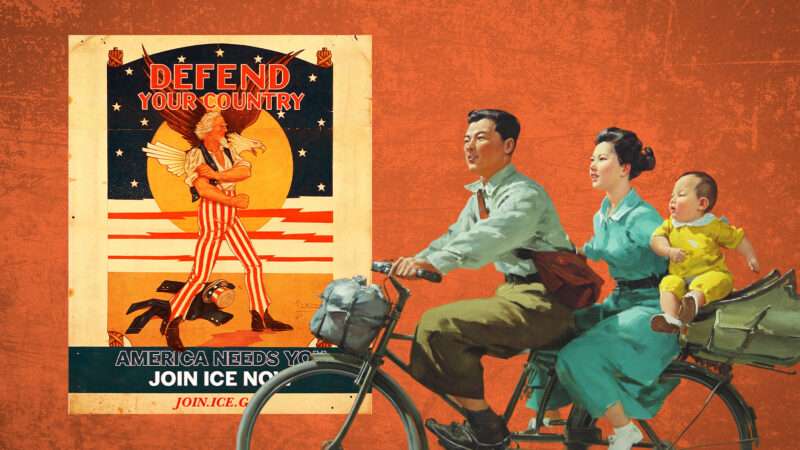
An illustration showing an ICE recruitment poster alongside a retro painting of a Chinese family with two parents and one child | Illustration: U.S. Immigration and Customs Enforcement/Midjourney/Ekkachai Tisantia/Dreamstime

In 1988, Peng Peiyun was assigned to China’s State Family Planning Commission. Her job was to implement the relatively new one-child policy. The Communist Party was sure that it knew how many people should be in the Chinese population to prevent famine and overcrowding—so sure, in fact, that it was willing to require abortions and sterilization under threat of violence. It was willing to remove “illegal children” from their homes and deny their families access to work, education, and medical care.

After Peng’s recent death, official state media dutifully called her “an outstanding leader” for her work on women and children. But on Chinese social platforms, many people responded with anger: “Those children who were lost, naked, are waiting for you over there” in the afterlife, read one Weibo post translated by The Times of India.

The one-child policy’s consequences are now well known: millions of “missing girls” due to sex-selective abortion, a rapidly aging society with too few young workers to support it, a generation of only children facing crushing demographic math, and a citizenry trained to believe that population levels are a matter of state permission, not personal choice.

During the four decades the policy was in place, 324 million Chinese women received IUDs (placed four months after the delivery of their first child, by law). Another 108 million were sterilized. The IUD could be removed only after a collective political decision was made to grant an exception and permit a second birth, or after menopause.

That did not stop millions of Chinese people from having the additional children they desperately wanted. Families bore harsh but irregularly enforced penalties for their decisions. Over time, exceptions to the policy proliferated for different classes, demographics, and ethnicities, demonstrating greater mercy and even greater hubris.

Today, China’s population is shrinking, births are collapsing, and the same government that once punished pregnancy is now begging for it with subsidies, propaganda, and social pressure, all of which have so far failed to reverse the trend. Even after decades of highly directive engineering and violent enforcement, the “right” number of people remains stubbornly out of reach.

***

The same category error animates today’s immigration crackdowns in the United States. Population control is technocratic arrogance at its most intimate and brutal.

The Trump administration is attempting to violently control the country’s population numbers. Officials insist that there is an optimal number of people, that this number can be known in advance, and that the state is justified in taking extraordinary measures to reach it (perhaps as many as 100 million deportations). Human beings are reduced to variables in a giant math problem—too many or too few, surplus or shortage—rather than agents whose individual choices matter.

The United States is now living with the consequences of this mindset. Immigration enforcement has become a delivery system for broader state power: warrantless checkpoints within 100 miles of the border, covering roughly two-thirds of the population; secretive detention and data sharing; increasingly aggressive surveillance tools originally justified as exceptional. Reason has documented, just in recent weeks, ICE’s purchase of phone-cracking technology, the collection of American citizens’ DNA into federal databases, and repeated cases of citizens wrongly detained in immigration raids because bureaucrats doubted their papers. These are not hypotheticals. They are the routine costs of trying to fine-tune the population by force.

America’s own history provides a
counterexample every bit as clear as China’s cautionary tale. For most of its existence, the United States did not centrally plan its population numbers at all. The federal government barely policed entry until the late 19th century. Even during the so-called Great Wave of immigration from roughly 1870 to 1914—when tens of millions arrived and the foreign-born share of the population matched today’s levels—exclusion rates were minimal. This was the era in which America industrialized, built continental infrastructure, and emerged as a global power.

Restriction was the anomaly. When broad federal immigration barriers arrived—beginning with the Page Act of 1875 and the Chinese Exclusion Act of 1882—they were motivated by fear, racism, and economic misunderstanding. They did not make the country stronger or more cohesive. They made it smaller, meaner, and more reliant on coercive state power to enforce artificial limits. Like the exceptions to the one-child policy, the thicket of rules became increasingly complex without providing clarity or justice.

No planner knows in advance how many people are “too many,” or which people will contribute most to a society’s future. China’s leaders thought fewer births would guarantee prosperity; they are now trapped by demographic decline. American immigration hawks insist fewer newcomers will preserve stability; the price they are already paying is expanded surveillance, higher prices for goods and labor, eroded civil liberties, and a creeping normalization of authoritarianism.

Peng changed her mind by the end of her life. She saw that population control had produced the opposite of its intended effect, and that human societies are not machines to be optimized by decree. Her New York Times obituary noted that she is survived by her husband, four children, four grandchildren, five great-grandchildren, three sisters, and two brothers.

“Fertility policy should return to the norm of allowing citizens to make their own decisions about childbearing,” she wrote to China’s leaders in 2018. That recognition came far too late for millions of Chinese families, but it is still a lesson worth learning.

The post What the ICE Crackdown and China's One-Child Policy Have in Common appeared first on Reason.com.

from Latest – Reason.com https://ift.tt/O08f63b
via IFTTT
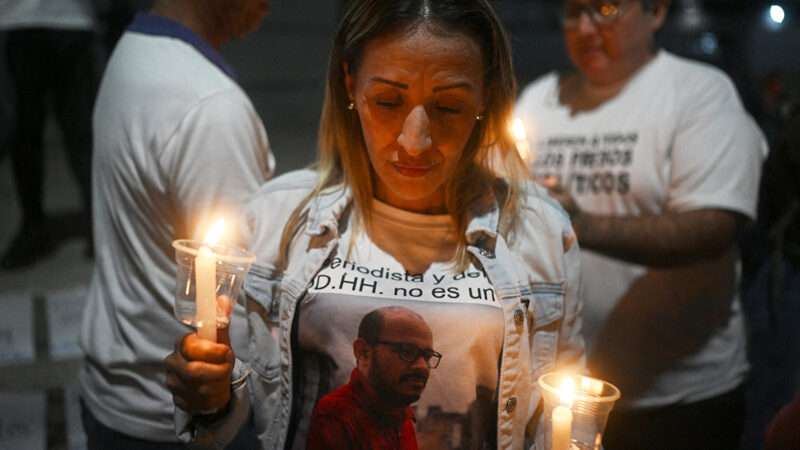
Photo: Venezuela’s Political Prisoners


People holding candles at a vigil | Photo: Federico Parra/AFP/Getty

Many Venezuelans celebrated after U.S. forces captured President Nicolás Maduro on January 3 and flew him to New York to face “narcoterrorism” charges. The arrest raised hopes for the release of nearly 900 political prisoners—activists, journalists, and critics—jailed under his rule, including several U.S. citizens. President Donald Trump said he canceled a “second Wave of Attacks” after the government of acting President Delcy Rodríguez agreed to begin releases. As of early February, only about 300 prisoners have been freed, leaving hundreds still detained despite official promises.

The post Photo: Venezuela's Political Prisoners appeared first on Reason.com.

from Latest – Reason.com https://ift.tt/Cp6iHy5
via IFTTT

In Sensational Ruling, Court Prohibits German State From Classifying AfD As A “Confirmed Right-Wing Extremist” Organization

In Sensational Ruling, Court Prohibits German State From Classifying AfD As A “Confirmed Right-Wing Extremist” Organization

Authored by ‘eugyppius’,

Old friends may remember the farce we experienced last May, when outgoing Marshmallow Interior Minister Nancy Faeser pushed her gaggle of goons in the Federal Office for the Protection of the Constitution (BfV) to upgrade their political classification of Alternative für Deutschland.

No longer did the BfV consider the national political party to lurk under mere “suspicion of right-wing extremism,” oh no. They announced suddenly and with much establishment fanfare that they had determined the AfD to be “confirmed right-wing extremists.”

Faeser and her goons hoped this new designation would edge the AfD more firmly into Evil Nazi Fascist Hitler territory in the popular mind, thereby preparing the way for banning the party. According to the dumb Gender Studies-tier retards unassailable and unbiased experts of the BfV, the AfD were more definitely Evil, more definitely Nazi, more definitely Fascist and more definitely Hitler than ever before. They had such clear proofs of all the Evil Nazi Fascist Hitlerism lurking within the AfD that they could not even reveal them. Doing so, Faeser said, would compromise the mysterious sources and methods of her highly sophisticated political spy agency. Instead, the Interior Ministry leaked a classified dossier supporting the upgrade to sympathetic media like Der Spiegel, and these media promptly published earnest articles telling us all how absolutely Fascist and Evil and Nazi and Hitler all the secret evidence showed the AfD to be, because trust us bro.

What happened next is that somebody leaked the full 1,000-page dossier to the alternative news outlets Cicero and NiUS, both of which promptly published the full .pdf. It turned out to be one of the stupidest and most trivial documents I’ve ever read. The supersecret hyperspy sources tapped by the BfV? Google and social media posts. The supersecret hyperspy methods used by the BfV? Compiling interminable lists of potentially untoward or possibly impolite things AfD politicians uttered in googlable documents or on social media. It was so bad that almost overnight the dossier destroyed much of the momentum for an AfD ban – exactly the opposite of what its architects had intended. Even many establishment figures quietly admitted what a travesty the whole thing had turned out to be.

NEVERTHELESS: The establishment moved quickly to capitalise on the new extremist designation. Various state governments began plotting to cleanse the civil service of AfD members on the grounds that they were affiliates of an officially “extremist” organisation. In Rheinland-Pfalz they even toyed with the idea of illegally excluding AfD candidates from running in local elections also on the basis of this bureaucratic designation. The Social Democrats began pushing to initiate ban proceedings against the AfD, a move that – if successful – would grant the left parties indefinite parliamentary majorities both nationally and across many state parliaments, amounting to a kind of legal coup and casting us into a new DDR-light regime.

Meanwhile, the AfD filed suit with the Administrative Court in Cologne to overturn their upgraded designation because it was so obviously dumb and unfounded. They also asked the court to prohibit the designation temporarily, while their primary lawsuit is pending – a long involved process that will take years. The Cologne judges released their unusually extensive 55-page decision on the temporary injunction yesterday. For the party-banning speech-repressing opinion-monitoring enthusiasts of Our Democracy, it is a disaster.

From the Cologne court’s press release:

The Federal Office for the Protection of the Constitution (BfV) may not classify and treat the Alternative for Germany (AfD) as a confirmed right-wing extremist organisation until the conclusion of the main proceedings … The BfV must also refrain from publicly announcing such a classification …

In its decision today, the court has rejected the BfV’s assessment. We give the following reasons: According to the findings of the summary proceedings, there is sufficient certainty that the AfD houses some efforts directed against the free democratic basic order … These efforts, however, do not characterise the AfD such that its overall essence may be described as anti-constitutional.

That is very important.

Not only the AfD, but all political parties, have randos saying potentially or probably or even certainly anti-constitutional things.

To justify a ban, you need more than random people saying random things.

You need to show a) that the party is fundamentally opposed to the “free democratic basic order” (an ideological trinity consisting of human dignity, democracy and the rule of law), and b) that it exercises this opposition in an “aggressive” or “combative” manner. The BfV have hardly addressed b) at all, and their evidence has not convinced the court that a) applies.

To argue their case, the BfV seem to have positively emptied their archives, submitting not only the leaked 1,000-page dossier to the court, but also an additional raft of supporting materials running to 7,000 pages across 20 different binders and electronic files extending to 1.5 terabytes.

The court finds that some “anti-Muslim” demands formulated by the AfD in the course of the 2025 election campaign are contrary to the German Basic Law, because these would tend to vitiate “the equal practice of religion,” but the judges also find that these are insufficient to “establish the anti-constitutional character of the party as a whole.” The court further noted that the BfV “has not disclosed any intelligence information … even in court proceedings” relating to allegedly secret anti-constitutional plots within the AfD, which means that “we cannot assume to the detriment of [the AfD] that [the party] is pursuing such further plans internally.”

A significant prong of the constitutional protectors’ argument held that the AfD’s advocacy of “remigration” was itself openly unconstitutional. Importantly, the court completely disagreed:

… [N]o sufficient conclusions can be drawn from any plans pursued by [the AfD] … with regard to so-called remigration. The vague term “remigration” does not imply a concrete political goal in the sense of undifferentiated deportations … In the absence of a more concrete explanation of specific anti-constitutional intentions with respect to implementing a … remigration policy, such intentions are not apparent.

As I said, this is only a temporary ruling, but given the devastating wording of the court’s judgment, it seems unlikely that the judges in Cologne will ultimately uphold the “extremist” designation when to comes time to decide the main case some years from now. The constitutional protectors may also appeal this injunction, but they would be unlikely to win, and also too I think there is a substantial chance that their ultimate boss, Interior Minister Alexander Dobrindt (CSU), directs them to let this go. Whatever happens, the case for banning the AfD has taken a major, perhaps a fatal, blow. The fundamental problem this whole time has been that the AfD programme is pretty much constitutionally unassailable. Those who want to ban the party have had to hope against hope that the constitutional protectors could unearth secret AfD Nazi plans via their super advanced espionage methods. Instead they’ve spent years copying and pasting Facebook posts and they have basically nothing.

This case converges with other evidence suggesting that the German state – while it may presently wish to ban the opposition and repress its critics – increasingly lacks the internal resolve and coherence for this project.

I’ll write more about that tomorrow; today’s adventures (see below) interrupted my routine, but I wanted to get this news out there as soon as possible.

Tyler Durden
Sun, 03/01/2026 – 07:00

via ZeroHedge News https://ift.tt/AyxgmsM Tyler Durden

What the ICE Crackdown and China’s One-Child Policy Have in Common


An illustration showing an ICE recruitment poster alongside a retro painting of a Chinese family with two parents and one child | Illustration: U.S. Immigration and Customs Enforcement/Midjourney/Ekkachai Tisantia/Dreamstime

In 1988, Peng Peiyun was assigned to China’s State Family Planning Commission. Her job was to implement the relatively new one-child policy. The Communist Party was sure that it knew how many people should be in the Chinese population to prevent famine and overcrowding—so sure, in fact, that it was willing to require abortions and sterilization under threat of violence. It was willing to remove “illegal children” from their homes and deny their families access to work, education, and medical care.

After Peng’s recent death, official state media dutifully called her “an outstanding leader” for her work on women and children. But on Chinese social platforms, many people responded with anger: “Those children who were lost, naked, are waiting for you over there” in the afterlife, read one Weibo post translated by The Times of India.

The one-child policy’s consequences are now well known: millions of “missing girls” due to sex-selective abortion, a rapidly aging society with too few young workers to support it, a generation of only children facing crushing demographic math, and a citizenry trained to believe that population levels are a matter of state permission, not personal choice.

During the four decades the policy was in place, 324 million Chinese women received IUDs (placed four months after the delivery of their first child, by law). Another 108 million were sterilized. The IUD could be removed only after a collective political decision was made to grant an exception and permit a second birth, or after menopause.

That did not stop millions of Chinese people from having the additional children they desperately wanted. Families bore harsh but irregularly enforced penalties for their decisions. Over time, exceptions to the policy proliferated for different classes, demographics, and ethnicities, demonstrating greater mercy and even greater hubris.

Today, China’s population is shrinking, births are collapsing, and the same government that once punished pregnancy is now begging for it with subsidies, propaganda, and social pressure, all of which have so far failed to reverse the trend. Even after decades of highly directive engineering and violent enforcement, the “right” number of people remains stubbornly out of reach.

***

The same category error animates today’s immigration crackdowns in the United States. Population control is technocratic arrogance at its most intimate and brutal.

The Trump administration is attempting to violently control the country’s population numbers. Officials insist that there is an optimal number of people, that this number can be known in advance, and that the state is justified in taking extraordinary measures to reach it (perhaps as many as 100 million deportations). Human beings are reduced to variables in a giant math problem—too many or too few, surplus or shortage—rather than agents whose individual choices matter.

The United States is now living with the consequences of this mindset. Immigration enforcement has become a delivery system for broader state power: warrantless checkpoints within 100 miles of the border, covering roughly two-thirds of the population; secretive detention and data sharing; increasingly aggressive surveillance tools originally justified as exceptional. Reason has documented, just in recent weeks, ICE’s purchase of phone-cracking technology, the collection of American citizens’ DNA into federal databases, and repeated cases of citizens wrongly detained in immigration raids because bureaucrats doubted their papers. These are not hypotheticals. They are the routine costs of trying to fine-tune the population by force.

America’s own history provides a
counterexample every bit as clear as China’s cautionary tale. For most of its existence, the United States did not centrally plan its population numbers at all. The federal government barely policed entry until the late 19th century. Even during the so-called Great Wave of immigration from roughly 1870 to 1914—when tens of millions arrived and the foreign-born share of the population matched today’s levels—exclusion rates were minimal. This was the era in which America industrialized, built continental infrastructure, and emerged as a global power.

Restriction was the anomaly. When broad federal immigration barriers arrived—beginning with the Page Act of 1875 and the Chinese Exclusion Act of 1882—they were motivated by fear, racism, and economic misunderstanding. They did not make the country stronger or more cohesive. They made it smaller, meaner, and more reliant on coercive state power to enforce artificial limits. Like the exceptions to the one-child policy, the thicket of rules became increasingly complex without providing clarity or justice.

No planner knows in advance how many people are “too many,” or which people will contribute most to a society’s future. China’s leaders thought fewer births would guarantee prosperity; they are now trapped by demographic decline. American immigration hawks insist fewer newcomers will preserve stability; the price they are already paying is expanded surveillance, higher prices for goods and labor, eroded civil liberties, and a creeping normalization of authoritarianism.

Peng changed her mind by the end of her life. She saw that population control had produced the opposite of its intended effect, and that human societies are not machines to be optimized by decree. Her New York Times obituary noted that she is survived by her husband, four children, four grandchildren, five great-grandchildren, three sisters, and two brothers.

“Fertility policy should return to the norm of allowing citizens to make their own decisions about childbearing,” she wrote to China’s leaders in 2018. That recognition came far too late for millions of Chinese families, but it is still a lesson worth learning.

The post What the ICE Crackdown and China's One-Child Policy Have in Common appeared first on Reason.com.

from Latest – Reason.com https://ift.tt/O08f63b
via IFTTT

Photo: Venezuela’s Political Prisoners


People holding candles at a vigil | Photo: Federico Parra/AFP/Getty

Many Venezuelans celebrated after U.S. forces captured President Nicolás Maduro on January 3 and flew him to New York to face “narcoterrorism” charges. The arrest raised hopes for the release of nearly 900 political prisoners—activists, journalists, and critics—jailed under his rule, including several U.S. citizens. President Donald Trump said he canceled a “second Wave of Attacks” after the government of acting President Delcy Rodríguez agreed to begin releases. As of early February, only about 300 prisoners have been freed, leaving hundreds still detained despite official promises.

The post Photo: Venezuela's Political Prisoners appeared first on Reason.com.

from Latest – Reason.com https://ift.tt/Cp6iHy5
via IFTTT

After The Iran Attack, Is Bitcoin GIving A “Green Light” Ahead Of Monday’s Market Open

After The Iran Attack, Is Bitcoin GIving A “Green Light” Ahead Of Monday’s Market Open

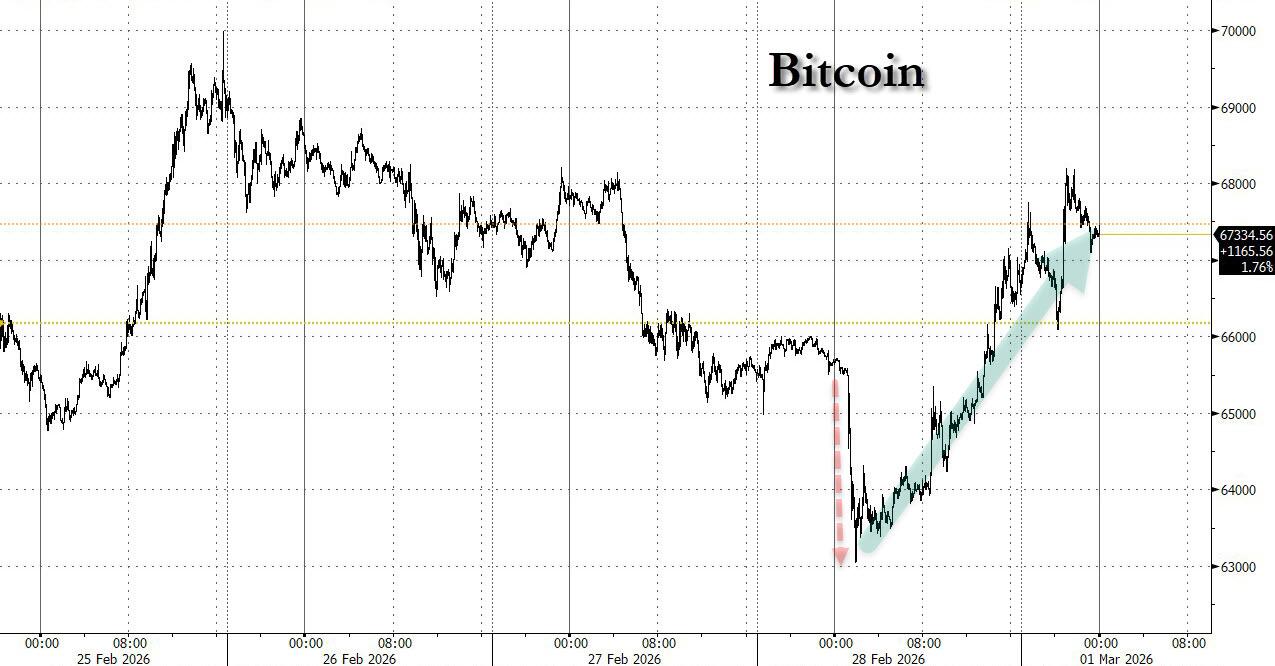
The first time Iran found itself in a major regional war with Donald Trump about to enter the White House, was April 13, 2024 when as part of escalating tensions with Israel, “Iran began an attack on Israel by launching dozens of suicide drones” on April 13, 2024. That said, it is s stretch to call that particular weapons exchange war, as both sides just wanted some theatrical appreciation rather than rearranging the borders of the middle East. What is more notable, is that the war started in the deep dark of a Saturday morning (April 13, 2024) when global markets were closed, and the only traded asset was crypto in general, and bitcoin in particular. The kneejerk reaction was sharply lower. 

The second time Iran found itself in a major regional war with Donald Trump (already in) the White House, was a little over a year later, on June 21-22, when in a much more serious and aggressive attack, Operation Midnight Hammer saw airstrikes, cruise missile attacks and B-2 bombers drop Massive Ordnance Penetrators on three key Iranian nuclear sites: Fordow, Natanz, and Isfahan, all of which were quickly destroyed As a result, Iran’s nuclear enrichment process was effectively (and literally) buried under a mountain, and then the major regional conflict was again promptly forgotten. What is most notable, is that that war, too, started in the deep dark of a Saturday morning (June 21, 2025) when global markets were closed, and the only traded asset was crypto in general, and bitcoin in particular. The kneejerk reaction this time too, was sharply lower. 

Fast forward to today, when in the most serious war between Iran and a coalition of US and Israel forces in decades, Iran was promptly “decapitated” as all of its top generals and IRGC personnel were killed, while also losing its spiritual head, the Ayatollah, who had led the country ever since those fateful days in 1978 when Shah Mohammed Reza-Pahlavi was replaced with Ruhollah Ayatollah, and an American embassy and its occupants were taken hostage. This conflict started shortly after the sun rose, as the attacking generals thought a night attack which everyone – and especially Iran – would expect as it is “meant” to be surprise would have little impact. They were right, and Ayatollah Khomeini was promptly vaporized. Where there was similarity to previous conflicts is that this one too started early on Saturday, when global markets were closed. Well, not all: bitcoin was trading. And, like the previous two most recent regional wars, Bitcoin’s kneejerk reaction this time too, was sharply lower… but not for long, and shortly after it emerged that Ayatollah Khameini was dead and most of the army leaders had been killed, bitcoin – that weekend trading risk barometer – staged a remarkable rebound and was actually trading well above where it was before the currency sold off shortly after midnight on Saturday East Coast time.

Which begs the question: is the conflict now effectively over and is Wall Street getting the all-green signals? 

This is also the question asked by Academy Securities strategist Peter Tchir, who in a late Saturday note – when most of the latest development were already known –  wrote that he remains comfortable buying the market.

He explains why below: 

A lot was priced in. Brent has gone for $60 late December to $72 on Friday. Some of that move in energy prices likely tied to cold winter in America, etc, but away from the risk of conflict, the market was positioned for selling off. So far the “bad” news on the oil front should have been largely priced in.

  • Insurance for shipping in region cancelled.  pretty standard
  • Limited or no transit in the Strait of Hormuz. Should be expected

The “good” news on the oil front is that nothing has happened that would prevent transit if there is an off ramp. 

China supposedly has large stockpiles of crude and the U.S. in good shape, so a short disruption (a week or so) should have minimal impact. Spot oil contracts might go as high as $80 but am not expecting a big move out the curve

Furthermore, while it is early, so far intelligence and military in action have delivered at high levels for the US and Israel. Not so much for Iran.  Maybe they have another round up their sleeve, but according to Tchir, :”their calculus should be adjusted – to seek off ramp

With confirmations stating that the leadership has been hit hard, what is the thought process of those assuming command:

You know that Isreal and the U.S. probably know who you are and possibly where you will be. That cannot be comforting.

Their weapon systems have performed as advertised (or maybe even better than expected).

Your weapons, like in prior attacks, and like Russia has experience, have not been as good as expected.

Which brings us to Bitcoin, which Tchir – and anyone else – views as a risk-on type of asset in this situation, has now recovered from small early loss to slightly highere. 

Putting it all together, Tchir – looking through the fog of war – says that he is optimistic for a “risk on” start to the week, while may sound a little bit callous, which is also why the Academy Strategist notes that “we can only hope that the events in the Middle East lead to a peaceful resolution, putting the Iranian people on a better path to prosperity and freedom, while minimizing the loss of life for everyone in the region.”

Tyler Durden
Sun, 03/01/2026 – 00:19

via ZeroHedge News https://ift.tt/JVcoO3W Tyler Durden

What A Taiwan Invasion Would Cost China

What A Taiwan Invasion Would Cost China

Authored by Antonio Graceffo via The Epoch Times (emphasis ours),

Shortly after meeting with Chinese Communist Party (CCP) leader Xi Jinping in late October, President Donald Trump said China would never attack Taiwan while he is president because Chinese officials “know the consequences.” While support from the United States is welcome news for Taiwan, Trump’s words raise a real question: Does Xi actually know the cost of invading Taiwan?

A U.S.-made F-16V fighter jet taxis on the runway at an airforce base during the annual Han Kuang military drills in Hualien, Taiwan, on July 23, 2024. Sam Yeh/AFP via Getty Images

Much of the analysis of a potential Beijing attempt to seize Taiwan by force has centered on the Chinese military’s capabilities and Taiwan’s defenses, especially if supported by the United States. Many assessments conclude that the People’s Liberation Army (PLA) is not currently capable of defeating the U.S. military in a direct conflict.

However, analysts still warn of a worst-case scenario in which Xi, seeking to cement his legacy, launches a premature strike. Xi has tied his legitimacy to the “China Dream” of national rejuvenation by 2049 and has framed unifying Taiwan with the mainland as essential to achieving that goal.

The recent wave of purges, particularly of senior leaders such as former Central Military Commission (CMC) Vice Chairman General Zhang Youxia, has intensified speculation. With most of the commission allegedly removed and the CMC now effectively consisting of Xi and loyalist Vice Chairman Zhang Shengmin, some analysts argue that Xi has eliminated voices that could have dissuaded him from attacking Taiwan. Even if that was not his intent, the practical result may be similar. With little meaningful pushback inside the system, Xi could face fewer internal constraints if he chooses to act.

The German Marshall Fund and the Rhodium Group recently published “If China Attacks Taiwan,” a report examining the potential costs to Beijing of a prolonged war. The authors note they were not asked to adopt Xi’s personal perspective and acknowledge that Chinese authorities could misjudge the likely consequences.

Even when costs are high, national leaders sometimes proceed if perceived benefits or political pressures outweigh the risks. Xi could conclude that failing to act—particularly if he believes Taipei is moving toward permanent separation with U.S. backing—would damage his authority more than launching a risky military operation.

The study examines how a conflict would affect China’s economy, military capabilities, social stability, and international position. It warns that war could produce massive economic disruption, catastrophic military losses, serious social unrest, and severe sanctions. This brings the analysis back to three critical questions: What would the price of a Taiwan invasion be? Is Xi fully aware of that price? And does he care? The latter two only Xi can answer, but the first is measurable, and the potential impact on the CCP would be staggering.

In the report’s major war scenario, an invasion lasts several months and draws in the United States and its allies. The conflict begins with an amphibious assault and missile strikes on Taiwan as well as on U.S. forces in Japan and Guam. Although Chinese forces land on Taiwan, sustained Taiwanese and U.S. strikes disrupt resupply across the Taiwan Strait. After months of heavy fighting, the PLA withdraws to the mainland, having lost roughly 100,000 personnel. Taiwan suffers approximately 50,000 military and 50,000 civilian casualties. The United States loses 5,000 military personnel and 1,000 civilians, Japan loses 1,000 military personnel and 500 civilians, and the PLA retains control only of Kinmen and Matsu.

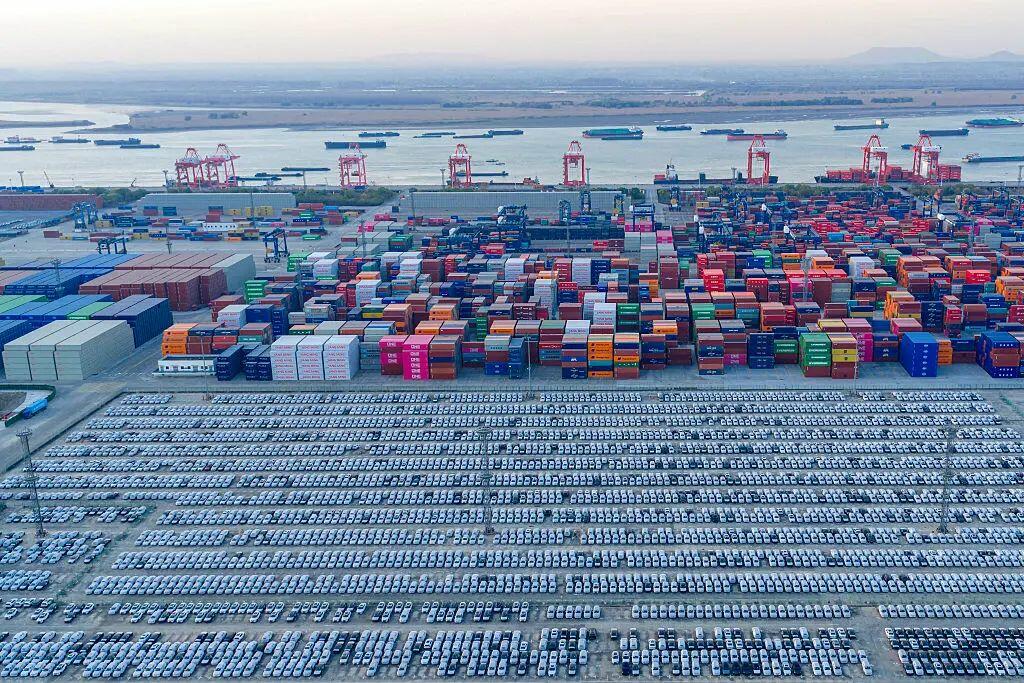
An aerial view of vehicles awaiting their export at a port in Nanjing, eastern Jiangsu Province, China, on Dec. 9, 2025. AFP via Getty Images

The report argues that a failed Chinese attack would impose severe economic, military, social, and international costs, and that it would be a mistake to assume Beijing would necessarily prevail. Even a limited military engagement could result in trillions of dollars in losses.

A 2022 Rhodium study estimated economic damage of at least $2 trillion to $3 trillion under conservative assumptions, while Bloomberg analysts projected costs closer to $10 trillion. In a prolonged war ending with Chinese withdrawal, the economic impact would extend beyond market disruption to systemic breakdown.

China is uniquely exposed because roughly 20 percent of its GDP and about 13 percent of its employment depend on exports, double the U.S. share. A major conflict would likely trigger a near-total embargo by G7 nations. After years of doubling down on high-tech manufacturing such as electric vehicles, semiconductors, and green technology instead of strengthening domestic consumption, China would have few alternative markets for its surplus output. Without export demand, large portions of its industrial base would idle, leading to a contraction in GDP potentially worse than during the COVID-19 pandemic period.

[ZH: And where, pray-tell, does the west get all of the ‘shit’ made during this embargo?]

Financial decoupling would compound the shock. The report anticipates the freezing of China’s roughly $3.39 trillion in foreign exchange reserves and places its $3.6 trillion in foreign direct investment at risk. Even if Beijing achieved military objectives, the global financial system could treat China as permanently uninvestable, effectively ending its role as a global financial hub. Hong Kong would likely lose its status as the primary gateway for international capital into the mainland.

Energy and food security add further strain. A months-long war could allow the United States and its allies to impose a distant blockade, cutting off 70 percent to 90 percent of the oil and roughly 40 percent of the natural gas that China imports by sea. Severe energy and food rationing could follow, increasing the risk of domestic unrest. With domestic demand already weakening, sanctions or a blockade would strike at one of China’s remaining growth engines.

The CCP’s legitimacy depends heavily on economic stability. A failed war that produces mass unemployment, shortages, a financial crisis, and long-term technological isolation could fracture the global economy into rival blocs, leaving China isolated for decades. Although the PLA has grown stronger, its economic vulnerabilities mean that the cost of a failed invasion could pose an existential challenge to the CCP itself.

Views expressed in this article are opinions of the author and do not necessarily reflect the views of The Epoch Times or ZeroHedge

Tyler Durden
Sat, 02/28/2026 – 23:40

via ZeroHedge News https://ift.tt/kGU9ZLt Tyler Durden