Pentagon Confirms First US Troop Deaths Of ‘Operation Epic Fury’

Pentagon Confirms First US Troop Deaths Of ‘Operation Epic Fury’

The Pentagon is confirming the first American troop deaths of the Trump-ordered ‘Operation Epic Fury’ toward accomplishing regime change in Iran:

U.S. military says three service members have been killed and five seriously wounded in the Iran operation: Associated Press

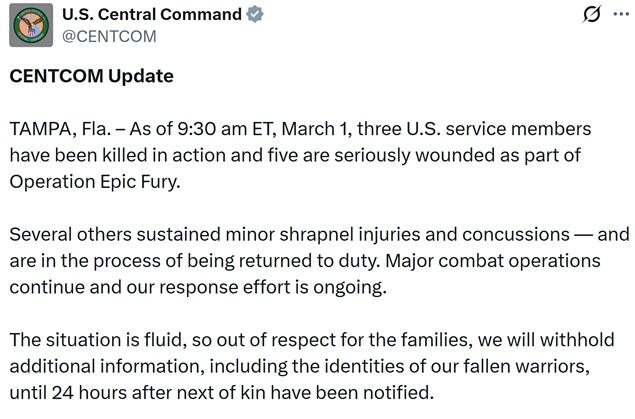
The president campaigned hard on starting no new wars in the Middle East, and abandoning Washington’s “addiction to regime change”… but here we are once again. Below is the full statement issued by US Central Command:
President Trump, who has never served in the military, raised eyebrows with the following remark on Saturday:

The lives of courageous American heroes may be lost, and we may have casualties, that often happens in war, but we’re doing this not for now; we’re doing this for the future.”

Some Congressional leaders are outraged that we are clearly in a war, and yet there’s been no war authorization from Congress as required by the US Constitution.

On the question of ‘legality’ and Congressional oversight, Time notes as follows:

The White House said that the so-called Gang of Eight, the bipartisan group of top House and Senate leaders and intelligence committee chairs who are briefed on the nation’s most sensitive security matters, were notified by Secretary of State Marco Rubio shortly before the strikes began. Administration officials had also briefed congressional leadership and intelligence committee heads earlier in the week on escalating tensions with Iran. But those notifications fell short of formal authorization from Congress, which the Constitution assigns the power to declare war under Article 1.
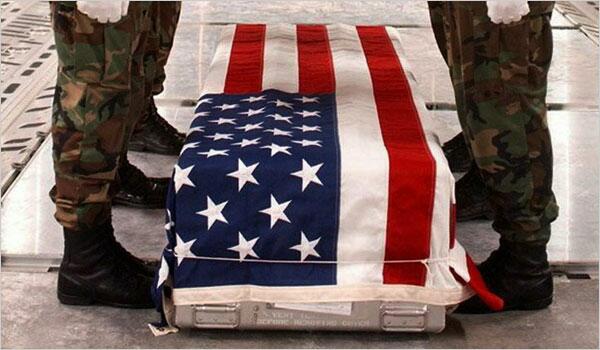
Illustrative of prior American combat death: European Pressphoto Agency

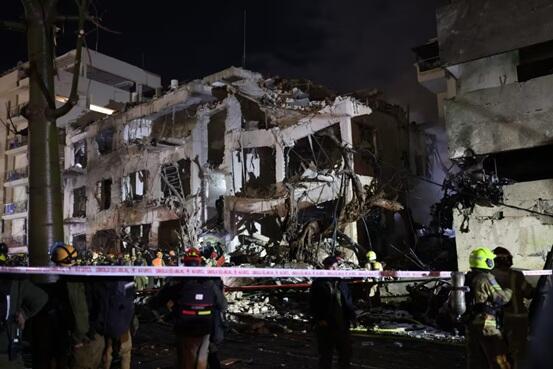
While the Pentagon has not revealed specifics or the locations of the troop casualties, there’s a likelihood it was the result of Iran’s ongoing ballistic missile launches against US bases in the Gulf and Mideast region. Tehran has promised more to come, especially to avenge the death of Supreme Leader Khamenei. 

A look at the massive saturation strikes over the Iranian capital, as presented by the Israeli Air Force, with machine translation:

Below: Dozens of Air Force fighter jets completed another wave of strikes in the skies over Tehran, during which the General Headquarters of the Internal Security Forces was attacked—a facility that served as a command and control center responsible for linking the command echelon with the Iranian terror regime’s forces in the field, and which also led the brutal suppression against the Iranian people.

There’s also the possibility that US aviators may have been downed in these opening 48 hours of aerial attacks, given Tehran has already downed an MQ-9 Reaper drone, state media says. Likely there will be more American troop deaths to come, given the operation looks to be expanding, and could takes days, weeks, or even months or more.

Could the war go global as more and more countries and assets in the region are impacted?

Glenn Greenwald has summarized, “For decades, Israeli Prime Minister Benjamin Netanyahu and American neoconservatives have dreamed of only one foreign policy goal: having the United States fight a regime-change war against Iran. With the Oval Office occupied by Donald Trump — who campaigned for a full decade on a vow to end regime-change wars and vanquish neoconservatism — their goal has finally been realized.”

There’s still hope for an offramp, however. On Sunday, Iranian Foreign Minister Abbas Araghchi told his Omani counterpart Badr Albusaidi in a call that Iran is open to “serious efforts” toward de-escalation and stability, according to Bloomberg. Albusaidi called for ceasefire and return to negotiation, urging Iran to exercise restraint and avoid moves that could undermine and disrupt good neighborly relations, particularly as Gulf countries are outraged.

Tyler Durden
Sun, 03/01/2026 – 11:05

via ZeroHedge News https://ift.tt/Crs8mNg Tyler Durden

Germany’s Pension Time Bomb: $2+ Billion In CRE Losses Expose Cracks In The Fiat Era

Germany’s Pension Time Bomb: $2+ Billion In CRE Losses Expose Cracks In The Fiat Era

Submitted by Thomas Kolbe,

A shock for the insured members of the Versorgungswerk Zahnärzte Berlin-Brandenburg (VZB). According to a report this week by Bloomberg, losses at the private pension fund total €1.1 billion. Roughly 50 percent of its invested capital has effectively been wiped out—channeled into private loans to non-listed companies, including rPlanet Earth in California, a shrimp farm in northern Germany, and, repeatedly featured on the investment menus of German pension funds, U.S. commercial real estate.

The auditors, advisors, and executives involved now face what may become a legal marathon. Much suggests that VZB ventured well beyond the traditional risk framework that would normally be considered prudent for a professional pension institution.

A similar fate befell the Bayerische Versorgungskammer (BVK). Last year it recorded accounting losses of up to €853 million. Once again, U.S. commercial real estate exposures were at the center of the turbulence, including properties such as the Transamerica Building in San Francisco—an internationally recognized problem asset.

Unlike VZB, however, BVK has substantial financial reserves. The assets it manages still total around €170 billion. On this robust capital base, it secures retirement benefits for physicians, lawyers, and numerous other professional groups.

The Bloomberg report further lists additional pension schemes displaying a similar pattern: recurring write-downs in the U.S. commercial real estate segment. Among the affected institutions are the Kirchliche Zusatzversorgungskasse des Verbandes der Diözesen Deutschlands (KZVK), the BASF Pensionskasse, the Telekom Pensionskasse, and the Apotheker- und Zahnärztefonds Schleswig-Holstein.

Nationwide, at least 18 pension institutions have taken unscheduled write-downs totaling more than €2 billion on commercial real estate investments since 2020. The system is under pressure—but it is not yet tottering. German pension funds collectively manage around €300 billion in assets. Nevertheless, pressure on asset managers to recalibrate risk profiles to a changed interest-rate and market environment is likely to intensify in the coming years. But where can reliable returns still be found when the classic portfolio mix of safe sovereign bonds—upon which entire pension systems were built over decades—appears to belong to the past?

Few will be able to avoid adding equity risk going forward. Allocations to precious metals—and possibly to Bitcoin, the so-called digital gold—as assets without traditional third-party risk appear to be a logical option. Equity stakes in the energy sector are also likely to gain significantly in attractiveness. In particular, the economic superpowers U.S. and China are on the verge of a massive AI and nuclear power boom, developments that are likely to be reflected in capital markets.

Yet many portfolio managers have remained anchored to the old worldview: sovereign bonds and commercial real estate—precisely those segments that, against the backdrop of high public debt and negative demographic trends, are increasingly losing structural stability and thus implying growing downside risk—remain dominant building blocks of portfolio strategy.

This traditional portfolio approach promised stable income and attractive yields. What was overlooked, however, is that structural shifts have fundamentally altered the underlying data: the rise of remote work, sweeping restructuring within the American economy, and the accelerating deployment of artificial intelligence have significantly reduced demand for conventional office space. What was intended as yield-enhancing diversification has, in many cases, turned into concentrated risk—with substantial consequences for the stability of the affected pension institutions.

Mounting pressure under expansionary monetary policy led to a gradual shift away from the liquid, stable-yielding, long-term sovereign bonds that had proven themselves over decades, toward higher-yielding but significantly more illiquid asset classes. Many asset managers tilted portfolios toward private debt, real assets, and promissory note loans backed by real estate covenants—extending even into high-risk mezzanine financing for non-listed, speculative projects.

The sharp interest-rate hikes that followed years of monetary expansion in 2022 hit the real estate sector with full force. Insolvencies increased, default risks slipped beyond the effective control of auditors, while asset managers responded to monetary volatility and swelling public debt by assuming ever greater risks.

The combination of prolonged ultra-low rates followed by abrupt tightening has exposed the weaknesses of many investment strategies.

The deep cracks now visible in the financial architecture of German pension funds are systemic. Years of low-rate policy aimed at financing highly deficit-ridden state budgets, along with the economic damage inflicted by lockdowns during the Covid years, have dramatically increased pressure on both investors and pension portfolio managers. In essence, we have been living under this policy regime since the great debt crisis a decade and a half ago.

Pension liabilities require a minimum return on invested capital. The crisis in bond markets is pushing investor strategies further along the risk curve into asset classes that traditionally did not appear on the radar of these institutions’ portfolio managers. Put differently: high volatility and the selloff at the long end of top-rated sovereign bonds reflect a fundamental reassessment of inflation and debt risks currently underway in government bond markets. The fiat credit-money system is entering a particularly volatile phase.

How private pension funds and insurance systems will ultimately be financed and backstopped remains unclear. Will state guarantee funds step in if losses escalate into systemic risk and entire institutions begin to wobble?

Experience from the rescue practices during the great financial crisis suggests that governments may once again act in line with the protective umbrella strategy associated with former German Chancellor Angela Merkel. That would mean placing large bond issues on the market, underwritten by the European Central Bank, to secure payment flows and obligations of affected institutions. Market distortion follows market distortion—an intervention spiral designed to stabilize the financial structure in the short term, yet failing to resolve underlying problems and sending fatal signals for further misallocation of capital.

For individual investors, it is crucial to recognize that many central banks have gradually reduced their bond holdings after years of large-scale asset purchases.

The fact that major central banks—such as China’s—are increasingly backing their balance sheets with structurally expanded gold reserves is a clear warning signal.

How stable is our banking system, really? How large are the third-party risks hidden in balance sheets? And how liquid will bond markets remain in the coming years if even formerly fiscally reliable states like Germany issue hundreds of billions of euros in new debt?

The fact that numerous states worldwide have begun expanding strategic energy and commodity reserves is another strong signal. It suggests that future currency systems may, sooner than expected, once again become more tightly linked to real scarcities—whether precious metals, energy, or broad commodity baskets.

The era of unbacked fiat credit money, at least in its current form, is gradually drawing to a close. German pension funds must incorporate this reality into their calculations—sooner rather than later.

* * * 

About the author: Thomas Kolbe, a German graduate economist, has worked for over 25 years as a journalist and media producer for clients from various industries and business associations. As a publicist, he focuses on economic processes and observes geopolitical events from the perspective of the capital markets. His publications follow a philosophy that focuses on the individual and their right to self-determination.

Tyler Durden
Sun, 03/01/2026 – 10:30

via ZeroHedge News https://ift.tt/GlumD2e Tyler Durden

Amazon Warns Of “Degraded” AWS Service In UAE After “Power Issues” Amid Middle East Conflict

Amazon Warns Of “Degraded” AWS Service In UAE After “Power Issues” Amid Middle East Conflict

Iran’s retaliatory attack ramped up on Sunday after the U.S.-Israeli Operation Epic Fury killed Supreme Leader Ayatollah Ali Khamenei on Saturday morning. Follow-on strikes were reported in Israel, across multiple Gulf states, and maritime incidents affected commercial shipping lanes in and around the Strait of Hormuz.

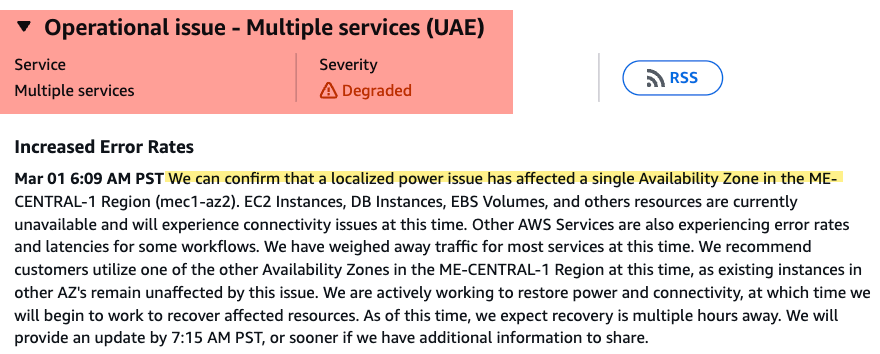
One notable and unexpected point of disruption has emerged in the Middle East critical infrastructure on Sunday morning, with Amazon reporting that its Middle East (UAE) data center region has experienced a power issue that degraded internet connectivity and impaired cloud service availability.

AWS reported that its ME-CENTRAL-1 Region (mec1-az2), which refers to a specific cluster of AWS data-center infrastructure in the United Arab Emirates, is experiencing operational issues due to a “localized power issue.” AWS stated that the severity of the incident is “degraded.”

Other AWS Services are also experiencing error rates and latencies for some workflows. We have weighed away traffic for most services at this time. We recommend customers utilize one of the other Availability Zones in the ME-CENTRAL-1 Region at this time, as existing instances in other AZ’s remain unaffected by this issue,” AWS wrote on its status page, adding, “We are actively working to restore power and connectivity, at which time we will begin to work to recover affected resources. As of this time, we expect recovery is multiple hours away.”

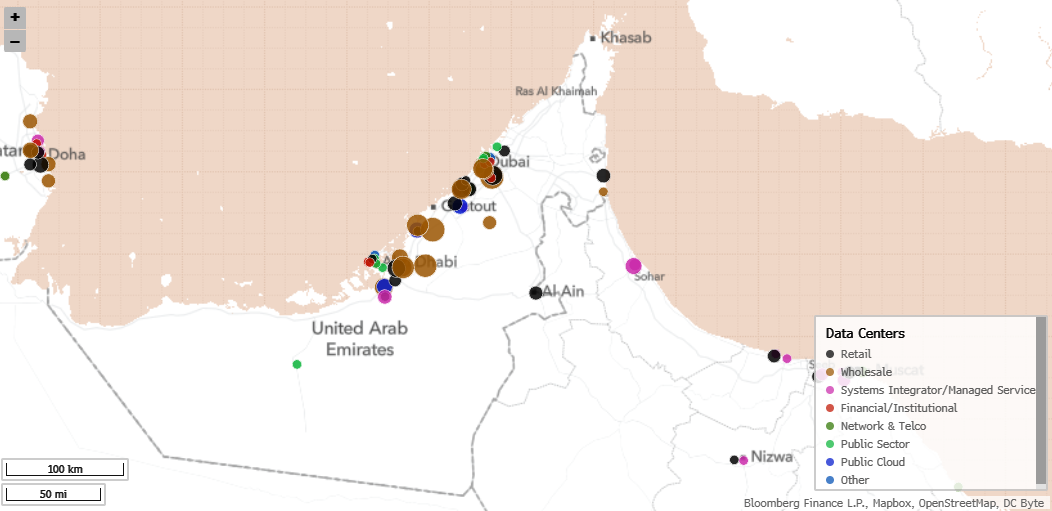
UAE Data Center Map 

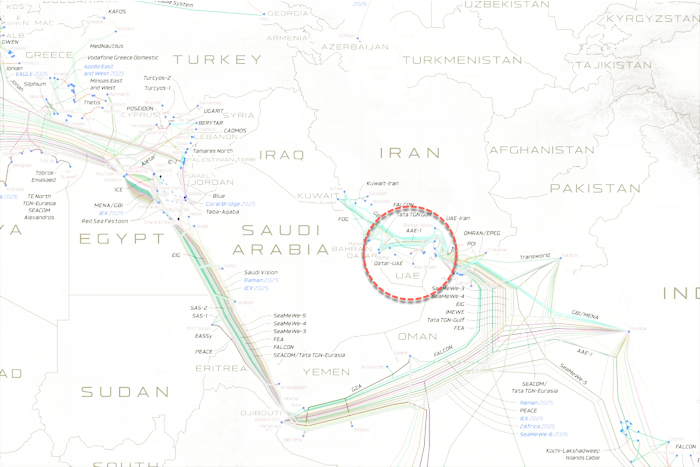
Data Cables Map 

The AWS status report made no mention of whether the power disruptions were due to Iranian missile or drone strikes on UAE critical infrastructure, such as transmission lines or power generation facilities.

Earlier, the UAE Ministry of Defense announced that the “country was subjected today to a blatant attack by Iranian ballistic missiles, which was dealt with by the UAE air defenses with high efficiency, and a number of missiles were successfully intercepted.”

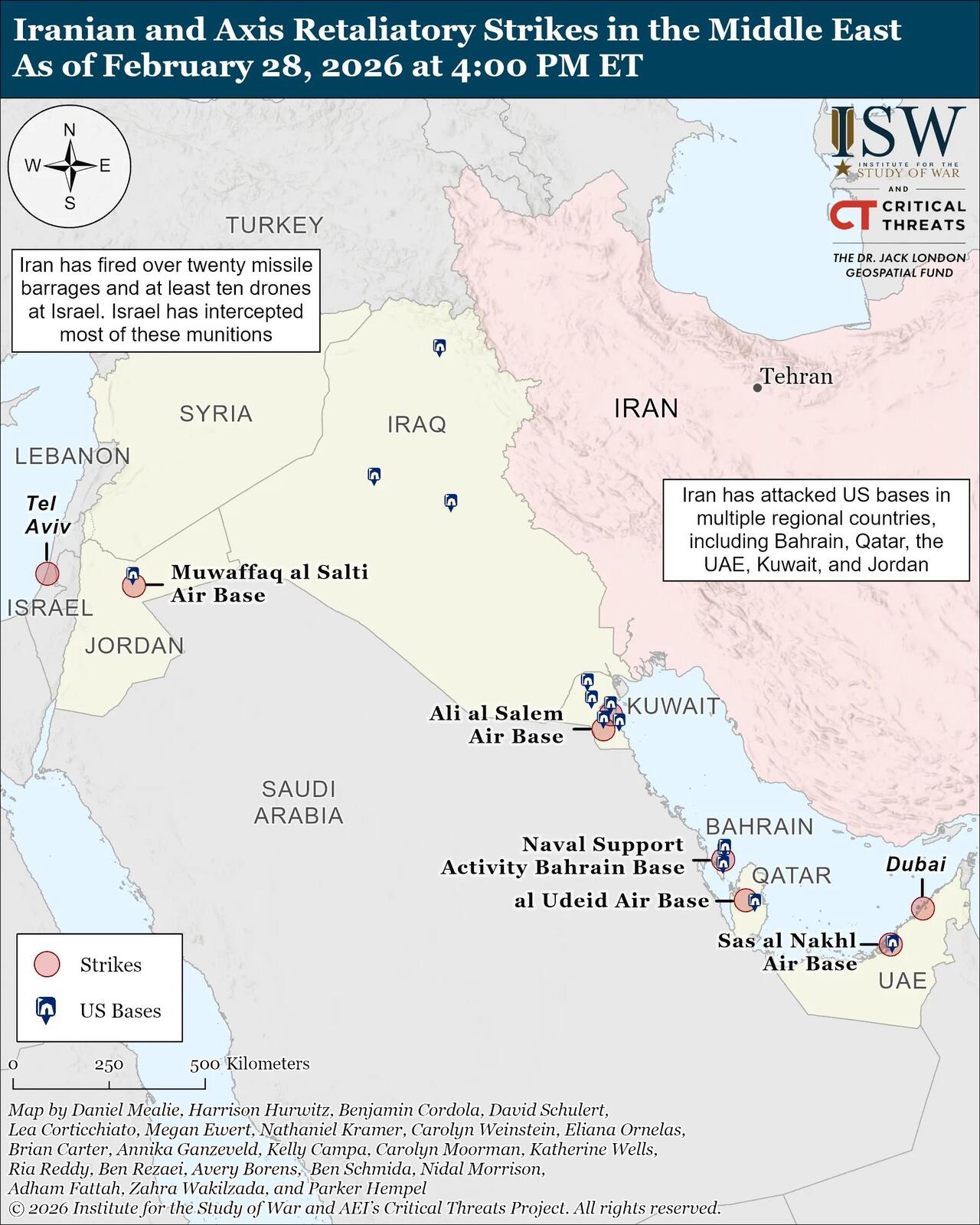
Beyond the UAE, Bahrain, Kuwait, Qatar, Jordan, and Israel have been subjected to Iranian retaliatory attacks – this is mostly because US military installations are in these countries.

Qatar’s Ministry of Defense issued a statement saying: “The State of Qatar expresses its strong condemnation of the targeting of Qatari territory with Iranian ballistic missiles.”

The UAE has confirmed a temporary closure of its airspace as an “exceptional precautionary measure.”

One key question is whether the conflict is now spilling beyond military targets and into civilian critical infrastructure. If that line has already been crossed, U.S. hyperscalers expanding in the UAE, including Microsoft, whose commitment totals about $15.2 billion and includes significant AI and cloud datacenter spending, may need to be reassessed given the fiery geopolitical climate.

Tyler Durden
Sun, 03/01/2026 – 10:15

via ZeroHedge News https://ift.tt/7EUZGBW Tyler Durden

Tens Of Thousands Stranded Amid Mass Airspace Closures At Mideast Hubs: “It’s Chaos Here”

Tens Of Thousands Stranded Amid Mass Airspace Closures At Mideast Hubs: “It’s Chaos Here”

The US State Department is warning all American citizens to exercises extreme caution when traveling abroad amid the ongoing US-Israeli military operation against Iran, which has included two days of heavy bombing aimed at regime change – and which has already resulted in the death of Ayatollah Ali Khamenei and some 40 top military leaders.

“Following the launch of U.S. combat operations in Iran, Americans worldwide and especially in the Middle East should follow the guidance in the latest security alerts issued by the nearest U.S. embassy or consulate,” a fresh weekend US notification says. “They may experience travel disruptions due to periodic airspace closures. The Department of State advises Americans worldwide to exercise increased caution.”

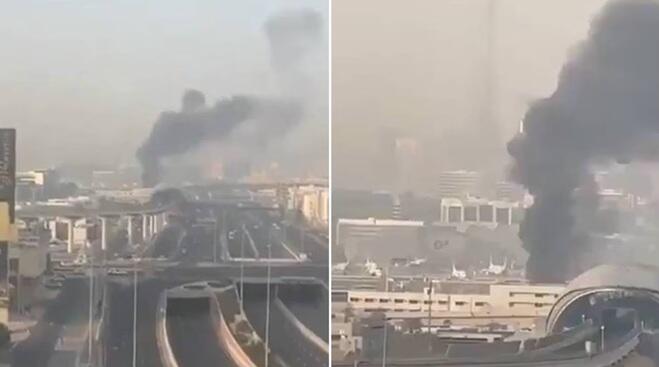
Explosions at Dubai International Airport following Iranian strike.

Not only is Israel’s airspace closed, as Iranian retaliatory ballistic missiles rain down, but much of the Gulf nations have restrictions and airspace closures in place. This after at least two regional airports have been struck.

One person has been killed and 11 injured at airports in Dubai and Abu Dhabi, as Iran launched attacks across the Middle East in response to a massive and ongoing attack against it by the US and Israel,” BBC reports.

Abu Dhabi authorities said a drone targeting Zayed International Airport (AUH) was intercepted, resulting in “falling debris” which killed one person and injuring seven.

Dubai International Airport, one of the busiest hubs in the world, has also been hit and suffered damage. So it’s not just the skies over the region which are dangerous at this moment, but in some cases the very airport terminals, especially if located just across the Persian Gulf from Iran, amid its broader retaliation targeting US bases and those Arab states hosting them. The Iranians appear to be going straight after Gulf civic infrastructure, given the same is being done to Tehran.

More than 3,400 flights were canceled Sunday across seven airports in the Mideast, according to flight tracker Flightradar24,” AP notes. “Airports in Dubai and Abu Dhabi in the United Arab Emirates, and Qatar’s capital, Doha, and Manama in Bahrain were among those closed.”

Thousands are stranded at regional airports, and many are likely seeking refuge and shelter elsewhere in these cities, as major civic infrastructure from Bahrain to UAE to Kuwait could come under potential attack. “It’s chaos here” – some stranded British travelers have said:

Thousands of Britons have been left stranded in the Middle East after global airlines grounded hundreds of flights due to US and Israeli strikes against Iran.

Iran and Iraq’s airspaces were closed due to the escalating military action, which has seen blasts reported in multiple countries across the region, and Dubai International Airport, the biggest global aviation hub, suspended all flights on Saturday.

Mike Boreham, who had been on holiday in Dubai with his wife, was due to get the 1.10pm British Airways flight back to Heathrow when the captain told the passengers the airspace had been closed.

And it goes the other way too. People from the Mideast and Mediterranean region who are trying to get back home often cannot at this point:

Tens of thousands of Israelis found themselves unable to return to Israel on Saturday after Israel and the US launched a major joint military strike on Iran.

As Iran responded by firing missiles and drones, Israel closed its airspace until at least Monday, the Transportation Ministry said, making travel through Ben Gurion Airport and other flight hubs impossible.

Rescue flights are being planned for when Israel reopens its airspace, with El Al announcing it was putting a wide plan in place and saying that its own ticket holders will automatically be assigned seats.

Meanwhile President Trump has called for full regime change in Iran, after the Iranians have already appointed an interim successor to the slain Ayatollah Khamenei. This means that US-Israeli military operations there could continue for days more, and possible weeks, or even longer

The Middle East’s travel woes, and possibly by extension and domino effect – some European hubs – could soon grow much worse. Of course, this is the least of the region’s problems as broader war breaks out.

Tyler Durden
Sun, 03/01/2026 – 09:55

via ZeroHedge News https://ift.tt/N0ijD1K Tyler Durden

EU Imposes Drastic Tariffs on Chinese Goods: Is A Trade War Looming?

EU Imposes Drastic Tariffs on Chinese Goods: Is A Trade War Looming?

Submitted by Thomas Kolbe

Tensions in international trade policy are escalating on multiple fronts. After the U.S. Supreme Court initially declared the tariff regime implemented by President Donald Trump since April of last year unlawful, it appears the administration has explored new ways to stabilize its tariff policy going forward.

The signs on the international trade front continue to point toward turmoil. Not least, it is the ramped-up Chinese export machine that is increasingly in the crosshairs of U.S. protectionism and European defensive measures.

Beijing is using its massive export engine to offset deflationary pressures in its domestic economy—a result of state-induced capital misallocation and a shrinking population. Through export subsidies and other support measures, the government seeks to stabilize employment while boosting industrial production.

However, this comes at the expense of trade margins and production capacities in other countries, which increasingly fall behind in competition with China.

It was predictable that the still high-purchasing-power internal market of the European Union would attract attention, given the U.S.’s hardline approach. Europe risks becoming a de facto unloading hub for Chinese goods. The consequences are evident in the trade balance, which recorded a deficit of €305 billion for the EU economy last year.

Weakened by its own energy policy and the regulatory framework of the green transition, European manufacturers in nearly all industrial and consumer sectors face the global competitive arena with their backs to the wall. The ongoing deindustrialization has significantly contributed to many European business models losing ground in international competition.

Germany, in particular, appears as a sort of laboratory experiment: in trade with China, the country has now become a net importer of capital. The former know-how advantage of German engineering is no longer unassailable—it seems to be history.

European policymakers now appear determined to pursue a path of protectionism themselves.

On February 7, 2026, the European Commission adopted Regulation 2026/274, responding to the Chinese export surge with anti-dumping tariffs. The first targeted product group: ceramic and porcelain imports. Around 60% of the assortments in European e-commerce and physical retail come from Chinese production. Tariffs within this group were raised from 18–36% to a consolidated 79%.

The affected products include, among others, tableware and kitchen items made of ceramic, porcelain, and stoneware originating from China. This also includes items such as spice grinders, coffee mills, and pizza stones. The new tariff regime is set to last initially for five years.

The Commission acted without involving national parliaments—mirroring the approach frequently criticized when applied to U.S. President Donald Trump, particularly in trade matters. In precisely those instances where Brussels regularly demands transparency, multilateralism, and rule-based procedures, it now itself takes unilateral executive action. Viewed in this light, criticism of Trump’s unilateralism appears profoundly hypocritical.

The Commission’s executive action reflects a rather elastic interpretation of its mandate. Should it identify dumping practices by trade partners—as in this case—it may impose corresponding tariffs. Neither the Council of the European Union, the European Parliament, nor national governments are involved in this process—a clear indication of growing concentration of power in Brussels.

The consequences of this tariff move—which is likely to expand to additional product groups—impact not only Chinese exporters but also European traders. They report liquidity shortfalls, rising insolvency risks, and significant challenges in compensating pre-financed transactions. The interests of European consumers evidently play no role in Brussels’ decisions.

Should further categories such as e-bikes, auto parts, or tires be added, as is currently rumored, this could have tangible effects on consumer prices across the EU. Moreover, the tariffs apply retroactively to ongoing shipments, further exacerbating the financial strain on European traders.

Brussels’ drastic response indicates that parts of European industry are under severe pressure from Chinese imports—and that the escalation in trade policy has now reached a new level.

So far, the Chinese leadership has not reacted to Brussels’ tariff measures. Chancellor Friedrich Merz may place trade issues at the forefront during his visit to China from February 24–26, where he is also expected to meet President Xi Jinping.

Recall that last year the dispute over the strategically critical export of rare earths—dominated by China—nearly escalated twice. Beijing is not hesitant to wield its geostrategic leverage in trade policy and defend its interests with a firm hand.

Fundamentally, a recalibration has occurred. In its strategy toward China, the EU is first raising the tariff wall, ignoring potential countermeasures from Beijing. Starting July 1, 2026, e-commerce imports from third countries with a value under €150 will face a €3 flat-rate fee per package. This aims not only to complicate invoicing by Chinese companies via third countries but also to exert targeted pressure on trade channeled primarily through platforms like Temu and Shein.

According to the EU, these measures aim to curb unfair competition and stabilize the internal market. Of course, such claims must be taken cum grano salis. Europeans are, after all, the undisputed masters of hidden trade protectionism. Their regulatory catalogs—particularly in climate policy—contain numerous non-tariff measures with deep protective effects.

Global trade is increasingly moving within geopolitical spheres of influence. Europeans would be wise to align with U.S. rules and integrate into the Western hemisphere. Yet Brussels appears intent on simultaneously confronting both major trade blocs.

* * * 

About the author: Thomas Kolbe, a German graduate economist, has worked for over 25 years as a journalist and media producer for clients from various industries and business associations. As a publicist, he focuses on economic processes and observes geopolitical events from the perspective of the capital markets. His publications follow a philosophy that focuses on the individual and their right to self-determination.

Tyler Durden
Sun, 03/01/2026 – 09:20

via ZeroHedge News https://ift.tt/0QBm3OD Tyler Durden

85% Of Babies In 2026 Will Be Born In Asia And Africa

85% Of Babies In 2026 Will Be Born In Asia And Africa

In 2026, 85% of babies worldwide will be born in just two continents: Asia and Africa.

Where someone is born can shape everything from access to education and healthcare to long-term economic opportunity.

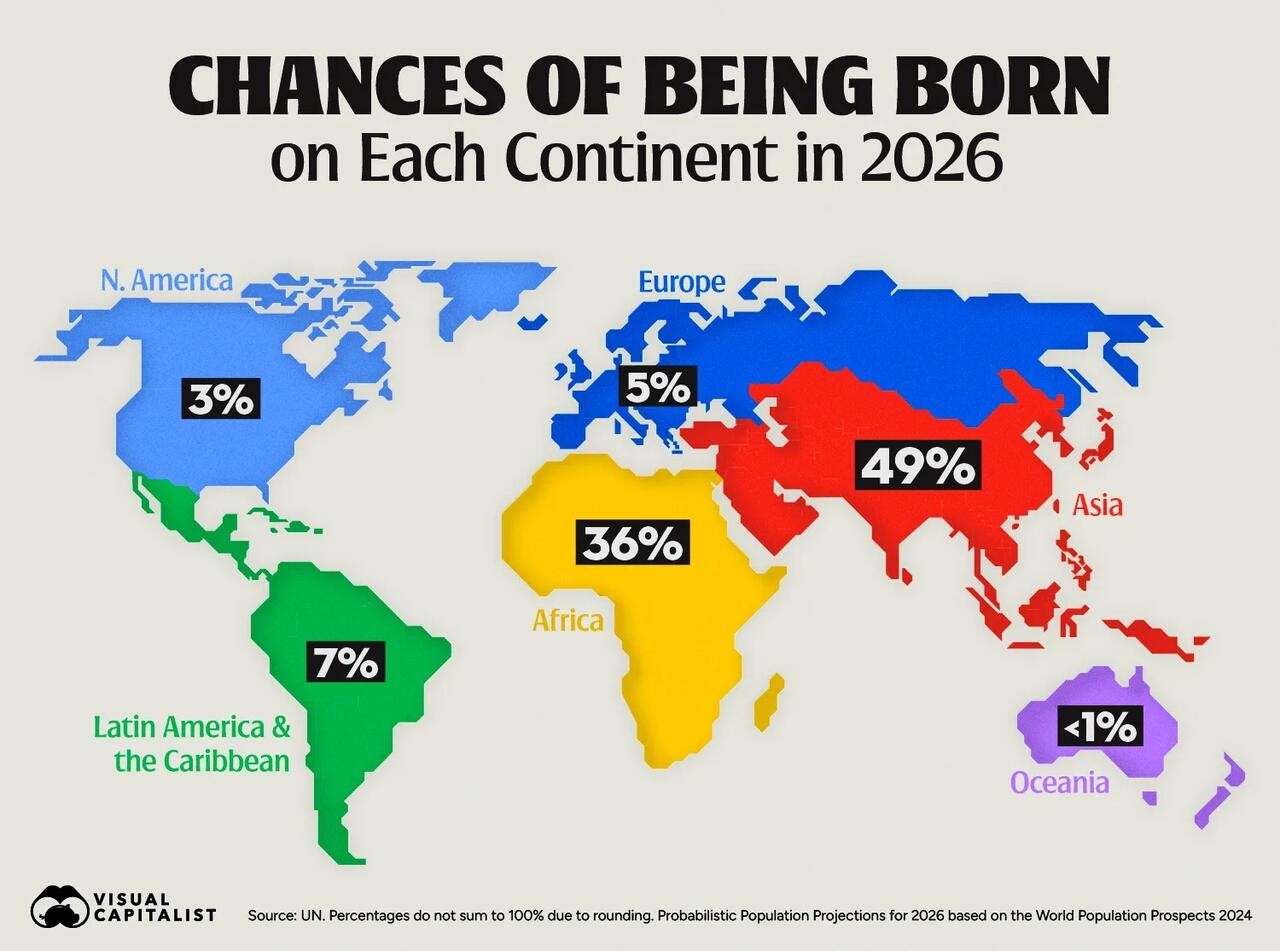
This map, via Visual Capitalist’s Bruno Venditti, shows how global births are distributed across continents, based on population projections from the United Nations.

Asia Accounts for Nearly Half of Global Births

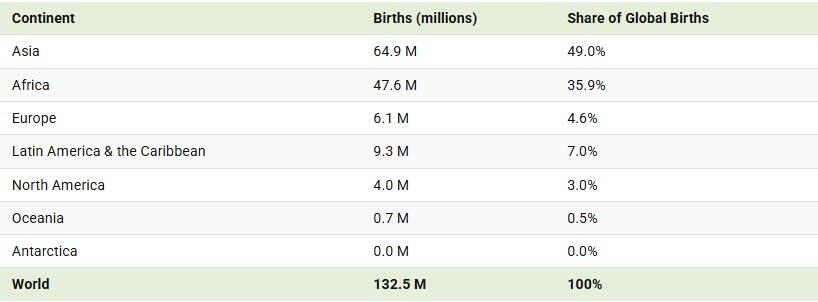
Asia is expected to see about 64.9 million births in 2026, accounting for roughly 49% of all births worldwide. Despite declining fertility rates in countries like China, Japan, and South Korea, Asia’s sheer population size keeps it at the center of global demographics.

South and Southeast Asia, in particular, continue to contribute large numbers of births each year. As a result, nearly one in every two people born in 2026 will be born somewhere in Asia.

Africa Makes Up More Than One-Third of Global Births

Africa is projected to record 47.6 million births in 2026, representing 35.9% of the global total. This reflects the continent’s high fertility rates and young population structure.

Many African countries are still early in their demographic transitions, with limited declines in birth rates so far. As population growth accelerates, Africa’s share of global births has been rising steadily and is projected to increase further later this century.

Smaller Shares in the Rest of the World

All other continents account for a relatively small share of global births.

Latin America and the Caribbean are expected to see 9.3 million births, or 7% of the total, while Europe accounts for just 4.6%. North America’s share stands at 3%, reflecting lower fertility rates despite population growth driven by migration. Oceania contributes 0.5% of births, and Antarctica, with no permanent population, records no births at all.

If you enjoyed today’s post, check out The World’s Safest (and Least Safe) Countries on Voronoi, the new app from Visual Capitalist.

Tyler Durden
Sun, 03/01/2026 – 08:45

via ZeroHedge News https://ift.tt/BR7hLnz Tyler Durden

AI Boom And European Bond Markets: A Deep Dive

AI Boom And European Bond Markets: A Deep Dive

Submitted by Thomas Kolbe

The “credit pump” could rightfully claim its place as a symbolic flag of the European Union. With virtually unlimited access to the bond market, politics magically transforms an inexhaustible credit stream into political maneuvers and ideological wizardry. Through this manipulation of money, processes and institutions are transplanted into the real world that, under normal circumstances, could never have surpassed the fantasies and limits of political ideology.

Wind turbines in forests, fully electric cargo bikes in an industrial nation that destroys its own engines of prosperity in favor of an artificial green subsidy economy, plunging itself into trillions of euros in new debt – a historically unprecedented degrowth spectacle, which has not erupted into open revolt only because hundreds of thousands losing their jobs are somehow absorbed into the public sector or cushioned, if not sedated, by the largesse of the German welfare state.

The same applies to open-border policies. Here too, perpetual credit seems to lubricate a project designed to unlock new voter potential for the political left. This process becomes possible through the systematic destruction of monetary value. National debt is not merely a fiscal problem; it erodes the fragile economic fabric of society. Moreover, it sends the fatal signal that an overpowering actor like the state can override the limits of productivity, reason, and scarcity at the push of a button.

Thus, the so-called debt brake was a political paper tiger from the start: Germany abandoned the path of political seriousness long ago and joined the ranks of debt magicians. It has become a driving force in an ideologically overgrown swamp of debt, making the refinancing problems of heavily indebted Eurozone states increasingly visible year after year.

Leading the debt race this year is the magic duo Germany-France. Budget figures are falsified, accounting tricks like special funds have become the standard of self-deception. Both countries enter 2026 with new debt of roughly five percent each.

The overall refinancing requirement of the Eurozone stands at €1.5 trillion. These are the gross issuances of government bonds necessary to roll existing debt forward and finance newly incurred deficits. 

This means around €100 billion more must be funneled into public coffers via the bond market. Will the legal framework be adjusted? Will major capital pools, banks, and pension funds be further coerced into the fiat credit system? Will the ECB once again step in massively as a buyer to dampen rising interest rates amid higher debt loads?

But how long can such a process sustain itself like a perpetuum mobile? When will the seemingly inexhaustible sources of the bond market run dry? The political camouflage will end when only the European Central Bank, as lender of last resort, keeps new debt liquid through massive market interventions. With each intervention, the money supply grows, along with doubts about the currency’s stability. Trust erodes, and the truth about the manipulation of interest rates, time preferences, and real costs – including the financial dimension of green transformation and migration into European social systems – can no longer be concealed.

This would be the moment of truth, the instant the house of cards of permanent debt starts to wobble. The crucial question is: which forces or developments could accelerate this process? Real resources for financing investments in the capital stock are limited. The state competes for credit to fund its social, climate, and military ambitions. It systematically displaces productive capital and lures scarce resources into unproductive channels with promises of returns, incentives, and subsidies. Growth dies; the nation’s prosperity diminishes.

If this is insufficient, additional credit is mobilized – if necessary, through central bank bond purchases. Meanwhile, pressure on the bond market intensifies: investors increasingly turn away from long-term government securities, while in the United States, the AI-driven economic miracle is heating up capital markets.

US tech corporations alone plan bond issuances of up to $360 billion this year to finance additional data centers and expand energy capacities. The European market is also under the sights of Microsoft, Google, Facebook, and others. Bonds worth €120–170 billion are expected to be placed on the Euro market, a growth of over ten percent compared to last year. The US economy is mobilizing all sources to anchor domestic growth with capital.

A tough competitor for sovereign issuers, as the private sector lures with dynamic business projects and generally higher returns. 

How much additional capital will flow from Europe to the United States? How large is the negative effect triggered by this American capital vacuum in the EU, which must mobilize resources to fund growing welfare states?

Clearly, interest rates will gradually rise, making refinancing and debt service in Europe more expensive. Budgetary room will shrink further.

And it becomes obvious what no one talks about: the massive downward movement of the US dollar against the euro is now a trap. Every investment from a European perspective in the United States, with a prospectively rising USD, becomes more profitable and yield-bearing. The strong euro acts as a second tariff barrier and intensifies the suction effect of investment capital into the US.

The Eurozone, and thus the economically closely interlinked EU member states, are coming under growing pressure. Geopolitically dependent on their energy suppliers, they remain rigid toward the energy and resource giant Russia. Europe walks a narrow line between dependence and self-interest.

Europe is strong when it relies on its regional competencies and strengthens intra-continental competition. Only this way can business models, engineering skill, and ideas emerge to meet the strong competition from China and the US on equal footing and maneuver into a better strategic position relative to competitors.

Ideologically, patriotic-conservative forces are called upon to end the climate-socialist madness, stabilize budgets, and put an end to the disastrous open-border policies – time is pressing for fiscal consolidation and state downsizing, even if Brussels and Berlin see it differently.

State downsizing and consolidation may sound like political fairy tales, yet Europe should never be written off. The continent has repeatedly emerged from severe crises and self-inflicted civilizational ruptures renewed and reinvented.

Capital and cultural foundations exist. Perhaps the American capital vacuum will help bounce Europe’s cultural decay – financed by the debt printer – off the wall of truth in the bond market.

* * * 

About the author: Thomas Kolbe, a German graduate economist, has worked for over 25 years as a journalist and media producer for clients from various industries and business associations. As a publicist, he focuses on economic processes and observes geopolitical events from the perspective of the capital markets. His publications follow a philosophy that focuses on the individual and their right to self-determination.

Tyler Durden
Sun, 03/01/2026 – 08:10

via ZeroHedge News https://ift.tt/P6iIezL Tyler Durden

Iran Names Interim Successor To Khamenei Under 2nd Day Of Massive Bombs, Trump Demands Regime Change

Iran Names Interim Successor To Khamenei Under 2nd Day Of Massive Bombs, Trump Demands Regime Change

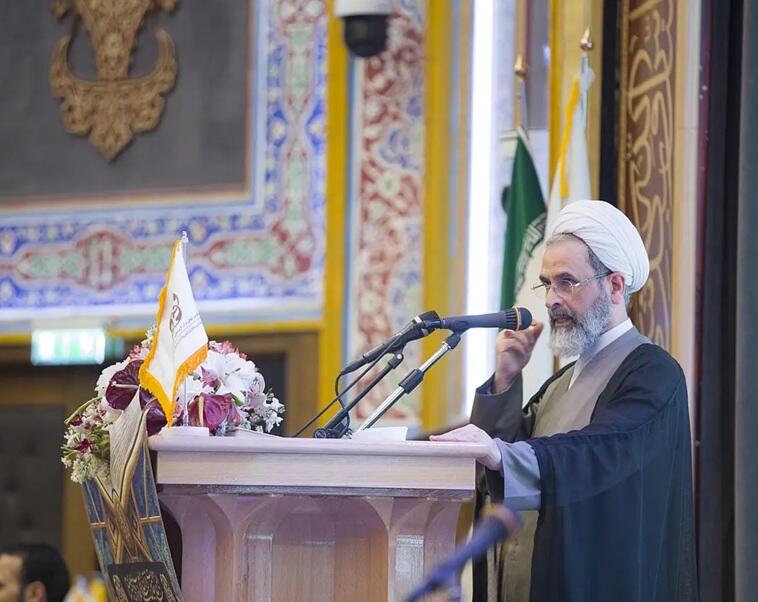
As questions hang over who will ultimately succeed Iran’s slain supreme leader Ayatollah Ali Khamenei, an interim leader has been appointed to fulfill his duties. Top Shia cleric Alireza Arafi has been named to the interim Leadership Council after Supreme Leader Khamenei was confirmed killed in US-Israeli strikes, state media reported Sunday.

The ISNA news agency has described that Arafi, a member of the Guardian Council, is joining President Masoud Pezeshkian and Chief Justice Gholamhossein Mohseni Ejei on the body tasked with carrying out the supreme leader’s responsibilities until the Assembly of Experts appoints a permanent successor. All of this happening as US-Israeli bombs continue to fall on Tehran and other sites for a second straight day, ‘uninterrupted’ – as President Trump pledged Saturday.

Born in 1959, 67-year-old Alireza Arafi ranks among the most powerful clerics in Iran. Before his emergency elevation, he held three key posts: director of the nationwide Islamic Seminary system, member of the Guardian Council, and member of the Assembly of Experts.

While rooted in Qom’s clerical establishment, Arafi combines traditional religious authority with seeking to carefully modernize Iran; however his appointment of course signals continuity, and he’ll be tasked with seeking to ensure regime survival – which is what this moment is all about for Tehran. Most importantly, Arafi is viewed by the IRGC and political leadership as a loyal insider who will preserve a retaliatory trajectory during wartime.

Heavy US and Israeli bombing has been observed Sunday on the Iranian capital, particularly on known government and military command centers, but that hasn’t stopped large gatherings of mourners in other parts of the country.

While there’s been evidence of local celebrations in some sectors among anti-government Iranians, Sunday footage on state TV and other international media shows loyalists in possibly the hundreds of thousands showing solidarity with the slain Ayatollah the Islamic Republic leadership.

President Masoud Pezeshkian condemned the killing as “a great crime” and has declared seven days of public holidays in addition to the 40-day mourning period. Outraged and saddened Iranians were seen pouring into the streets of the capital soon after state TV finally made the announcement confirming Khamenei’s killing during the opening salvo of the US-Israeli attack. Iranian authorities have alleged major war crimes, including the deaths of over 85 young girls attending school when a bomb struck.

“There will be expected ceremonies,” Pezeshkian said, while noting they will have to happen even while the bombardment continues across the country. He’s also said his country views revenge as its “legitimate right and duty” after Khamenei had been murdered by the “most wicked villains in the world.”

The president further claimed the act was a “declaration of open war on Muslims, especially Shiites, in all corners of the world.” According to NBC:

The government in Iran is under attack like never before. Today tens of thousands of regime supporters packed into Tehran’s Revolution Square to mourn the late Supreme Leader Ayatollah Ali Khamenei, who was killed in a joint U.S. and Israel military operation.

They chanted “God is great!” while officials promised revenge. One said Iran would deliver “terrifying blows” to make the U.S. and Israel beg for mercy.

Iran’s interim leadership council: President Masoud Pezeshkian, Head of Judiciary Gholam-Hossein Mohseni-Ejei, and member of the Guardian Council and Assembly of Experts Ayatollah Ali Arafi. 

As for the day to day running of the country and immediately overseeing the military response, Ali Larijani is believed to be in the driver’s seat. Khamenei had reportedly personally tapped Larijani – a former Revolutionary Guards (IRGC) commander and political heavyweight – to take charge in the event of the Supreme Leader’s death.

Israel has confirmed it has conducted new strikes “in the heart of Tehran” and that the “majority” or Iran’s senior military leaders – some 40 of them – were killed in the opening wave. “The Israeli Air Force continues to operate extensively in both defense and offense, with the goal of removing threats posed to the State of Israel,” the IDF said – alongside the US boasting that they have established air superiority with much of Iran’s radars and air defenses having been taken out already.

Iran has said that at least 200 of its people have been killed, but the actual figure could be much higher, and is expected to be in the coming days. The external attack could go on for weeks, given especially President Trump is now calling for full regime change, which would mean defeating and dismantling the Islamic Revolutionary Guard Corps (IRGC). The problem with this is that most analyst agree it would require boots on the ground. Trump says he wants to see full “freedom” in Iran as the goal of the military operation.

Trump’s ‘shock & awe’: Tehran is a densely packed modern cosmopolitan city of almost 10 million people. The wider metropolitan area has over 16 million.

Massive airstrikes on Tehran:

So far, it’s been limited to an air war, and with naval assets also firing, and no casualties on the US or Israeli sides have yet to be reported. It’s mainly America’s Gulf allies which have suffered, with Iranian ballistic missiles coming down on US bases in the region – but also strikes which have landed on hotels, buildings, and even major airports around the Gulf.

By all accounts Israel has been getting hit hard – though many analysts say Israel’s military censor is working in overdrive, preventing an avalanche of information from getting out. However, there’s still plenty of confirmation of some Iranian ballistic missile impacts:

Air alert sirens continue sounding especially across central Israel. Tel Aviv was struck overnight:

DPA via Getty Images

This war looks to go on, even if there’s desire in the White House for it to be ‘one and done’ – as increasingly the Iranians have nothing to lose. One likely result of the unprovoked US-Israeli attack is that leadership in Tehran will only become more hardline. We detailed some of the initial Saturday blowback on the Gulf allies – but Sunday has witnessed some direct repercussions on US embassies and diplomatic compounds in the region

The US Consulates General in Karachi and Lahore has come under attack by large angry mobs, within hours after Khamenei’s death was announced. “Violent clashes between protesters and security forces in the Pakistani port city of Karachi left at least nine people killed and more than 50 others wounded on Sunday, after hundreds of demonstrators attempted to storm the U.S. Consulate, authorities said,” according to AP.

Things are also popping off outside high-secured Baghdad’s Green Zone, where Iraqis are trying to breach the US embassy, with hundreds seen rioting and even bringing bulldozing equipment to the site. The mob threw stones and clashed with Iraqi security forces, which responded with tear gas. “Their attempts had been thwarted so far, but they keep trying,” an official told AFP. Iraq is a Shia majority country with heavy loyalty to the Shia religious establishment in Iran. Baghdad’s general pro-Iran stance and influence is a legacy of the Bush Neocons, who overthrow Sunni secular Baath dictator Saddam Hussein and elevated the Shia Mullahs. 

Tyler Durden
Sun, 03/01/2026 – 08:05

via ZeroHedge News https://ift.tt/M0fRTq9 Tyler Durden

Germany To Scrap Subsidy For Rooftop Solar

Germany To Scrap Subsidy For Rooftop Solar

Germany is planning to abolish fixed feed-in tariffs for small rooftop solar installations as of 2027, saying that falling costs have made the technology economically sound without subsidies (narrator: “it isn’t“), Bloomberg reported on Friday, citing a draft proposal for reforms it has seen.

At present, rooftop solar installations of any kind are eligible for guaranteed tariffs. But this could change in a few months, if the government approves the proposal of the German economy ministry to have subsidies abolished for projects of less than 25 kilowatts, according to OilPrice.

The ministry argues that the small rooftop solar are now often viable on their own without incentives, thanks to the lower costs.

“To strengthen the cost efficiency of solar expansion, a stronger focus will in future be placed on cost-effective solar parks,” the ministry’s proposal reads, as carried by Bloomberg.

The plans for a reform of the subsidies was first leaked by German media outlets.

“If the leaked draft is genuine, it would be yet another attack on renewable energy, following the grid package proposal,” said Ursula Heinen-Esser, president of Germany’s renewable energy association BEE.

Abolishing support for rooftop solar would have “disastrous consequences” for the sector and would deprive homeowners from participating in the energy transition, Heinen-Esser added.

The German Solar Association, BSW-Solar, also deplored the leaked draft proposal as “a frontal attack on Germany’s energy transition.”

Germany plans to boost onshore wind capacity to 115 gigawatts and solar capacity to 215 gigawatts by the end of the decade—targets which it will keep in the proposal for reforms. Europe’s biggest economy has a target to have renewables account for 80% of its electricity generation in 2030.

In solar, Germany is halfway through reaching its 2030 solar power targets, BSW-Solar said in June last year.

Germany saw the highest number of onshore wind turbines commissioned in the first half of 2025 for eight years, but the rebound in installations is still off track to reach the official targets, the German wind energy association, Bundesverband WindEnergie (BWE), said in the middle of 2025.

Tyler Durden
Sun, 03/01/2026 – 07:35

via ZeroHedge News https://ift.tt/e4X2nNz Tyler Durden