Tens Of Millions Of Taxpayers May Be Owed IRS Refunds From Pandemic Era: Watchdog

Tens Of Millions Of Taxpayers May Be Owed IRS Refunds From Pandemic Era: Watchdog

Authored by Jack Phillips via The Epoch Times (emphasis ours),

The IRS’s internal watchdog has stated that tens of millions of U.S. taxpayers may be owed refunds or abatements of penalties or interest during the COVID-19 federal disaster period.
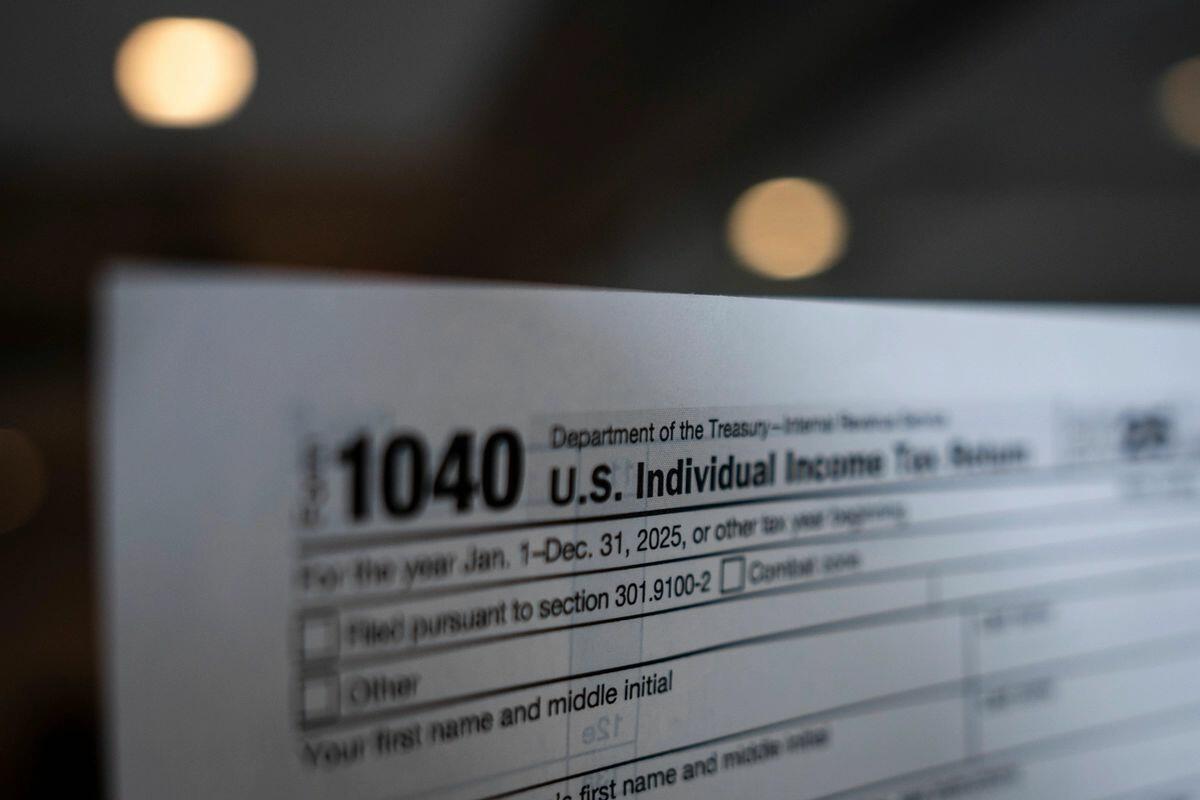
A 1040 Internal Revenue Service tax form, in this file photo. Madalina Kilroy/The Epoch Times

“The bottom line: You may be entitled to a refund or reduction of assessed penalties and interest,” the National Taxpayer Advocate (NTA) stated in a notice published on April 30 and updated on May 1. “For taxpayers dealing with financial pressures, these amounts can make a real difference. But most taxpayers must act by July 10, 2026, to request their potential refunds.”

The NTA stated that the refunds or payments had arisen from multiple court decisions, including one handed down in November 2025 that “provides for the automatic postponement of filing and payment deadlines during the period a federal disaster declaration is in effect, plus 60 days” during the COVID-19 federal disaster period, which lasted more than three years.

The declaration for COVID-19 was in effect from Jan. 20, 2020, through May 11, 2023, it noted. Another 60 days extended that period to July 10, 2023, for tax-related purposes.

“Based on the court’s reasoning … filing and payment deadlines were postponed during that entire period, and as a result, tax returns and payments due anytime within that window were not late until after July 10, 2023,” the NTA stated. “By the court’s logic, the IRS should not have assessed penalties for late filing or payment during that 3.5-year period, nor charged interest on those amounts.”

Taxpayers may be able to receive an abatement or refund for certain amounts during that federal disaster period, the NTA stated, such as for failure to pay taxes, failure to make estimated tax payments, or penalties that were incurred for not filing timely tax returns.

Taxpayers may also be able to receive refunds on interest that started accruing earlier than it should have or that should not have accrued at all or overpayment for interest in the 2020–2023 COVID-19 disaster period, it stated.

“This issue is widespread and not limited to a small or specialized group of taxpayers,” the NTA stated. “As noted, tens of millions of taxpayers have been assessed penalties or interest for late filings or payments during these years.”

The IRS, in most cases, will not issue refunds or abatements unless a taxpayer files a claim, it warned, noting that a taxpayer likely will have to file a claim within three years of the date they filed a tax return or two years from the date when they paid their tax.

As a result, most taxpayers who are affected would need to file claims by July 10 and will have to use Form 843, titled, “Claim for Refund and Request for Abatement.” Some taxpayers may “consider filing protective claims to preserve their rights,” the watchdog stated, citing the fact that the cases are still being litigated.

The NTA, which warned that Form 843 must be completed on paper and cannot be done electronically, also suggested that taxpayers contact a tax professional to claim the refund or abatement. It further suggested that members of Congress should highlight the coming deadline and that tax professionals keep their clients informed about the rebate.

Tyler Durden
Mon, 05/04/2026 – 08:05

via ZeroHedge News https://ift.tt/OWowRsL Tyler Durden
Trump Disapproval Rate Hits Career-High – War And Rising Costs Take Toll

Trump Disapproval Rate Hits Career-High – War And Rising Costs Take Toll

Though tempered by the prospect of additional GOP gerrymandering of House districts in the wake of a pivotal Supreme Court decision, Democrats’ hopes for a rout of Republicans in the approaching midterm elections are rising after a Washington Post-ABC News-Ipsos poll found that President Trump’s disapproval rating is now the highest of either of his two terms in office. Trump’s decision to launch a war on Iran is taking a toll — voters are not only dismayed by his handling of Iran, but also dissatisfied with his work on the economy, which is itself being harmed by the war. 

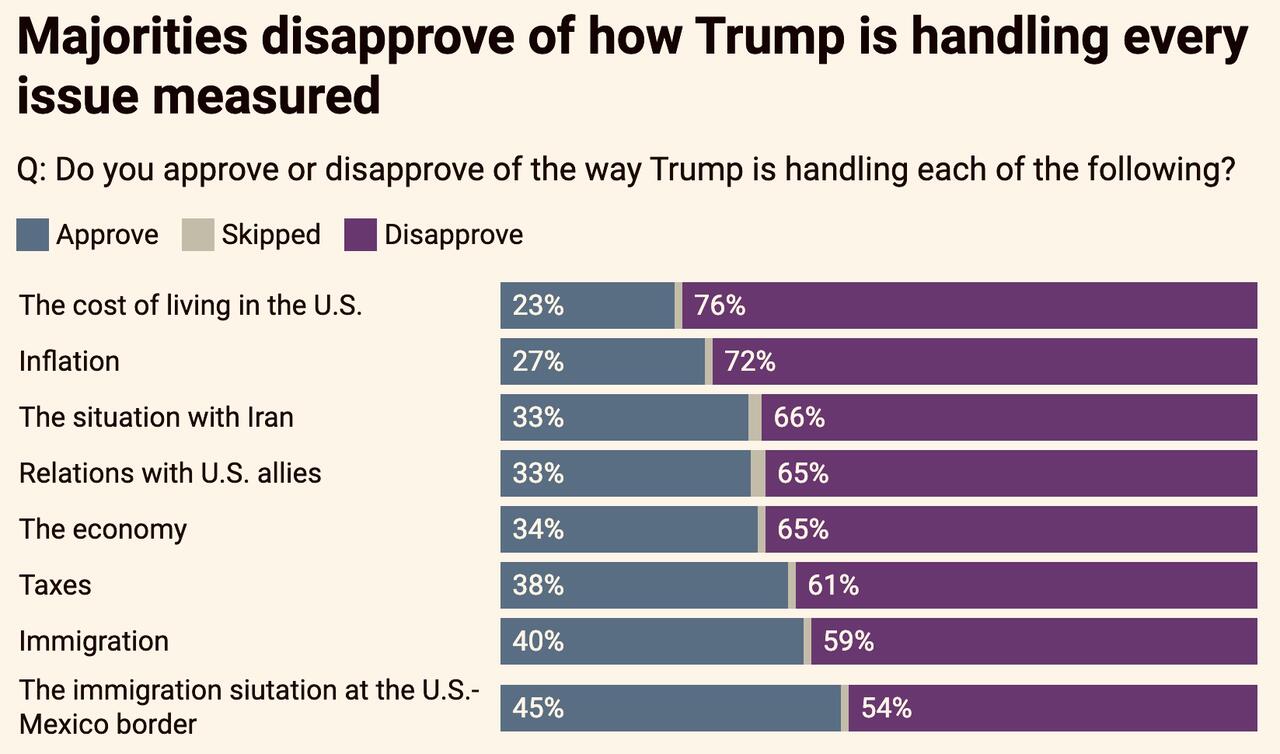
In a survey of US adults taken in the last week of April, 62% said they disapprove of his general performance in the Oval Office.  A whopping 76% disapprove of his handling of the cost of living and 66% disapprove of what he’s done with Iran. A majority of Americans surveyed expressed disapproval of his handling of every issue covered by the survey.   

via ABC News

While 85% of Republicans approve of his performance, the share who strongly approve fell to 45% — that’s down 8% since September and is a new Trump low. Perhaps more importantly, his approval among Republican-leaning independents is also at a new low of 56%. Overall, just 25% of independents approve of his performance.

Trump also scored terribly on some personal attributes. For example, 71% said the descriptors “honest and trustworthy” are not applicable to Trump, while 67% said Trump does not “carefully consider important decisions.” Meanwhile, 59% said he lacks the “mental sharpness” required of his position.  

The poll provides a little insight into the upcoming midterm races. Today, Republicans have a slim, 3-seat margin of control of the House of Representatives. Asked if they would vote for a Democrat or Republican candidate if the House election were held today, 49% said they would for a Democrat, compared to 44% who would choose a Republican. At the same point in the 2022 midterms, that question yielded a 42-42 tie, with the GOP proceeding to win the House when votes were cast six months later, securing a 222 – 213 margin in seats (a 9-seat pickup for the Republicans).  As for intended turnout, 79% of registered Democrats say they are “absolutely certain” they’ll vote, compared to 72% of Republicans — a 7-point improvement on the GOP turnout expectation recorded in a February survey.  

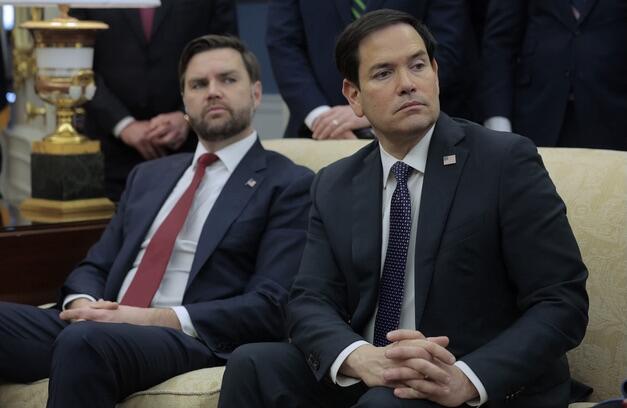
Vance had higher approval and disapproval ratings than Rubio — as more survey participants shrugged at the Rubio performance question

Looking at the big picture, 67% of Americans said the country is moving in the wrong direction. Here, there’s a vast difference among parties: 94% of Democrats felt that way, compared to 25% of Republicans. As a general caveat, we’ll note that — since more and more Americans identify as independent — party results are growing less meaningful. A hefty 78% of independents say the country is heading south.  

Finally, the poll had some incidental insights for those looking ahead to the 2028 presidential race. While participants weren’t asked about that contest, they were asked to rate the job performance of various Trump administration officials, including two potential GOP contenders: Vice President JD Vance and Secretary of State Marco Rubio. They came out with similar approval ratings — 35% for Vance and 33% for Rubio — but Vance had a 48% disapproval rating, compared to 40% for Rubio. The remainder of respondents had no opinion. 

Tyler Durden
Mon, 05/04/2026 – 07:45

via ZeroHedge News https://ift.tt/PnHztio Tyler Durden

Norwegian Cruise Cuts Outlook On Gulf Disruptions, Fuel Shock

Norwegian Cruise Cuts Outlook On Gulf Disruptions, Fuel Shock

Norwegian Cruise Line Holdings shares fell in premarket trading in New York after the cruise ship operator lowered its full-year 2026 outlook, as disruptions in the Middle East, higher diesel costs, and softer travel demand in Europe weighed on first-quarter bookings.

“The Company is experiencing headwinds related to disruptions in the Middle East, including higher fuel expense and signs of softer demand as consumers reevaluate travel plans, particularly to Europe,” Norwegian Cruise wrote in a press release.

It continued, “As previously noted, the Company entered 2026 behind its targeted booking curve, and these headwinds have hindered the Company’s ability to accelerate bookings and close that gap,” adding, “These external pressures come as the Company continues to enhance its revenue management system and improve execution, resulting in additional pressure on the business and a reduction in its full-year guidance.”

Norwegian Cruise now expects adjusted EPS of $1.45 to $1.79, down from its prior forecast of $2.38 and well below the Bloomberg Consensus estimate. The downgraded outlook reflects, as management noted above, higher fuel prices, weaker European travel demand, and softer-than-expected bookings across all three of its brands.

Here’s a snapshot of the full-year outlook (courtesy of Bloomberg):

  • Sees adjusted EPS $1.45 to $1.79, saw about $2.38, estimate $2.13

  • Sees adjusted Ebitda $2.48 billion to $2.64 billion, saw $2.95 billion, estimate $2.79 billion

  • Sees depreciation and amortization $1.09 billion, saw $1.09 billion, estimate $1.08 billion

  • Sees net yields -3% to -5%

  • Sees Constant currency net yields about -3% to -5%

Norwegian Cruise’s second-quarter forecast also missed the Bloomberg Consensus, reinforcing all the concerns management noted above.

Here’s a snapshot of the second-quarter outlook (courtesy of Bloomberg):

  • Sees adjusted EPS 38c, estimate 53c (Bloomberg Consensus)

  • Sees adjusted Ebitda about $632 million, estimate $700.6 million

  • Sees occupancy about 102.5%, estimate 105.9%

  • Sees depreciation and amortization about $275 million, estimate $266.8 million

  • Sees net yields about -3.6%

  • Sees Constant currency net yields about -3.6%

Management provided more color on the current booking environment:

The Company remains below its optimal booking range following certain execution missteps, exacerbated by softer demand related to heightened geopolitical uncertainty. Recent events related to the conflict in the Middle East have impacted bookings across all three brands, especially in Europe during the summer season. While the near-term environment remains challenging, the Company is taking targeted actions to better align commercial strategy, including marketing, with deployment and revenue management, with the benefits of these actions expected to materialize gradually over time.

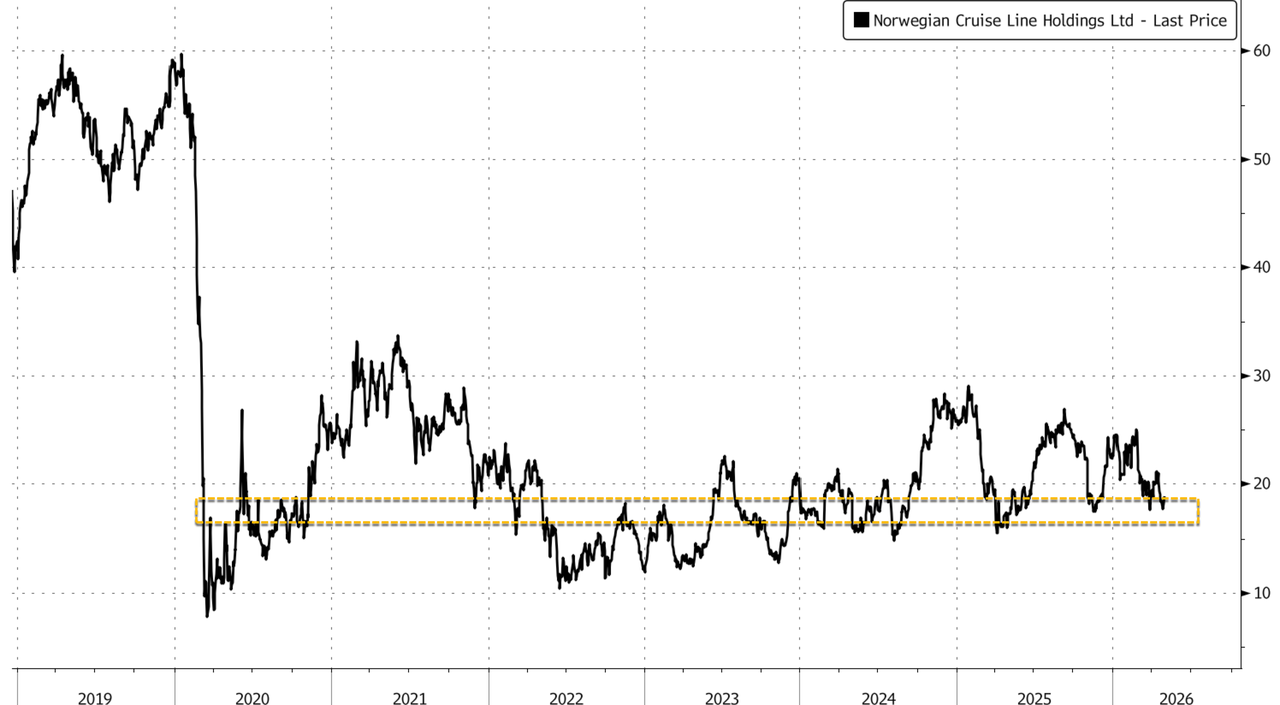
Shares of Norwegian Cruise fell more than 5% in premarket trading. For the year, as of Friday’s close, shares were down about 16%. Short interest in the stock stands at 12.33% of the float, or about 56 million shares, with 2.9 days to cover. Overall, shares are still trading near Covid-era lows.

In the transportation space, the Gulf energy shock derailed Spirit Airlines’ ability to reemerge from bankruptcy, with all flights canceled over the weekend and operations ceasing

Tyler Durden
Mon, 05/04/2026 – 07:20

via ZeroHedge News https://ift.tt/Hbxelg4 Tyler Durden

Just “Felonious Peccadillos”; I’m “Overqualified for Oklahoma”; Bar Association, “Bring It on Bitch”: Surprisingly Ineffective in Fighting Disbarment

Some excerpts from the long opinion in State ex rel. Oklahoma Bar Ass’n v. Barlean, decided Tuesday by the Oklahoma Supreme Court (opinion by Justice Kuehn); Barlean appears to have been a former candidate for the Oklahoma state legislature:

On January 5, 2023, Respondent pled guilty to two misdemeanor charges of Domestic Assault and Battery …. Both charges stemmed from violent incidents involving Respondent and a woman with whom he had a romantic relationship. On August 16, 2021, during an argument, Respondent strangled or choked the woman until she gave him her car keys. He was arrested, charged with a felony and bound over for trial. While out on bond, on December 2, 2022, during another fight Respondent pushed the woman down a flight of stairs, injuring her arm. He was arrested again and charged with a misdemeanor.

Under Respondent’s plea agreement, the felony charge was reduced to a misdemeanor and Respondent pled guilty to both charges. He agreed to supervised probation with requirements including restitution, community service, completion of an intervention program, anger management classes, an alcohol and drug assessment and any recommended treatment. Respondent failed to complete these requirements. The State moved to accelerate his deferred sentence on September 30, 2024; on November 22, 2024 Respondent pled no contest to the motion to accelerate. Both counts were reduced to convictions and he was fined….

This Court’s May 20, 2024 order of interim suspension directed Respondent to show cause why a final order of discipline should not be imposed. In his Answer, Respondent claimed that a June 2021 arrest, search of his house, and incarceration—unrelated to the charges at issue here—was illegal and led him down a “dark, self-destructive path” which culminated in his arrest for domestic violence by strangulation, the basis for the charge in CF-2021-3557. He attached a copy of a civil rights complaint he had filed in federal court as a result of the allegedly illegal search and incarceration.

In that complaint, Respondent blamed the victim in both criminal cases for his troubles. Respondent also claimed in his Answer that he had barely practiced law in Oklahoma and retired from legal practice in the 2010s. He appeared to argue that there would be no point in imposing a suspension from practice, or any form of discipline, since he did not practice law or represent clients.

This Court has held that domestic violence is itself a “serious breach of a lawyer’s ethical duty and will not be tolerated.” Respondent pled guilty to two crimes of violence against a person with whom he had an intimate relationship. In each instance he resorted to violence while quarrelling with the victim. The crimes were separated by several months, and the second occurred while he was out on bond after having been charged with the first crime. Although his deferred sentence offered him the opportunity to avoid those convictions, he admitted that he failed to complete the requirements he himself had agreed to. These convictions and the circumstances surrounding them reflect, at best, extremely poor judgment and a propensity to violence….

The court also referred to other incidents involving Barlean, including this:

Respondent sent the OBA [Oklahoma Bar Association] more than twenty emails after the Rule 7 Notice of Judgment and Sentence [in the disciplinary action] was filed. He claimed the criminal charges would be dismissed (as discussed above, they were not). He called this Court incompetent, a joke, redneck and lazy, invited the OBA to “bring it on bitch”, and stated he was overqualified for Oklahoma. Along with a certificate of completion of his required anger management program, he wrote, “I don’t strangle. I crush or pull out voice boxes. Ask my Airborne instructors.” He suggested the female OBA attorney was embarrassed to be “schooled by a Man”, and threatened to drag the State through a federal Section 1983 civil rights claim. He invited an OBA paralegal trying to help him with subpoenas to “come after me so I can show you what the United States trained me to do to Communists.” …

[As to another claim,] Respondent did admit that he is not “a choirboy”, with a “colorful youth and felonious peccadillos.” …

Respondent’s conduct reveals a consistent pattern of violence and poor judgment compelling our conclusion that Respondent is unfit to practice law. He is disbarred….

Jana J. Harris, Assistant General Counsel, Oklahoma Bar Association, Oklahoma City, Oklahoma, for Complainant.

The post Just "Felonious Peccadillos"; I'm "Overqualified for Oklahoma"; Bar Association, "Bring It on Bitch": Surprisingly Ineffective in Fighting Disbarment appeared first on Reason.com.

from Latest – Reason.com https://ift.tt/3chbqB8
via IFTTT

Posting Video of 10-Year-Old Hockey Player’s “Tantrum” Isn’t Intentional Infliction of Emotional Distress

In Mufarreh v. Google, Inc., decided Friday by the Illinois Appellate Court (Justice Raymond Mitchell, joined by Justices Sharon Oden-Johnson and Thaddeus Wilson), a 10-year-old hockey player and his parents sued an anonymous video poster, and sought to discover the poster’s name:

[I]n a competitive youth hockey game[,] Mufarreh missed the final penalty shot, losing the game, and had a severe emotional response on the ice. Among other things, he screamed, threw his hockey stick, gloves, and helmet, and fell to the ground.

On November 2, 2023, YouTube user FunnyIllinoisHockey uploaded a compilation video of Mufarreh’s emotional episode. The video, entitled “TI Tantrum,” was set to the song “Tantrum” by Madeline The Person. The video was two minutes and forty-four seconds in length and tracked Mufarreh’s movements around the ice, zooming in on him as he broke down.

According to the petition, between November 2023 and April 2024, every time petitioners sought to have the video taken down, it would reappear. The video spread widely throughout the small youth hockey community. Mufarreh alleged that he suffered from restless sleep and anxiety attacks and was humiliated, mocked, and socially ostracized. His parents also alleged that they endured sleepless nights, psychological distress, and a strain on their marriage.

Petitioners alleged that the video was repeatedly republished “purely to humiliate, isolate, and psychologically destroy” them. Petitioners also alleged that, based on information and belief, the anonymous account belonged to a 23-year-old coach from a rival hockey team who was using the video to recruit kids for his team and keep them away from Mufarreh’s team.

Petitioners sought to compel respondents Google and YouTube to disclose the identity of the user who posted the video so they could sue the user for defamation, infringement on the right of publicity, and intentional infliction of emotional distress. Respondents informed the user of the litigation, and he appeared as John Doe, an interested party….

[T]he circuit court dismissed petitioners’ claims for defamation and infringement on the right of publicity with prejudice. The circuit court also dismissed the [parents’] intentional infliction of emotional distress claims but allowed petitioners to proceed on the son’s claim. Accordingly, the circuit court ordered respondents to turn over Doe’s identity….

The court reversed, concluding that, as a matter of law, Doe’s behavior as alleged by the plaintiffs didn’t constitute intentional infliction of emotional distress:

“[T]o state a cause of action for intentional infliction of emotional distress, a plaintiff must adequately allege that: (1) the defendant’s conduct was extreme and outrageous; (2) the defendant either intended to inflict severe emotional distress or knew that there was a high probability that its conduct would do so; and (3) the defendant’s conduct actually caused severe emotional distress.”

Whether conduct is extreme and outrageous is determined using an objective standard considering the facts and circumstances. “Extreme and outrageous behavior will not be found with mere insults, indignities, threats, annoyances, petty oppressions, or trivialities.” “Liability has been found only where the conduct has been so outrageous in character, and so extreme in degree, as to go beyond all possible bounds of decency.” The conduct must “be regarded as intolerable in a civilized community.” Conduct is extreme and outrageous if “recitation of the facts to an average member of the community would arouse his resentment against the actor, and lead him to exclaim, ‘Outrageous!'” …

According to the petition, Doe posted a video to YouTube that depicted Mufarreh having a strong emotional reaction to missing a penalty shot. The video shows Mufarreh having a breakdown on the ice with incidents of screaming, throwing his gear, and falling to the ground. However, the petition also alleged that Mufarreh is a star youth hockey player who regularly competes in high-profile tournaments that “are streamed live with commentary.” This suggests Mufarreh was accustomed to playing in games that were public, high stakes, scrutinized, and recorded for online viewers.

Additionally, “Illinois cases in which intentional infliction of emotional distress has been sufficiently alleged have in fact very frequently involved a defendant who stood in a position of power or authority relative to the plaintiff.” This situation does not involve any abuse of power over Mufarreh. Petitioners did not allege that Doe abused any position of authority. Rather, Doe posted a video depicting public events. Further, petitioners do not contend that the video was altered or inaccurate.

In other complaints involving media, the extreme and outrageous conduct was far more egregious than the conduct at issue here. See, e.g., Green v. Chicago Tribune Co. (Ill. App. 1996) (“We hold plaintiff stated a cause of action for intentional infliction of emotional distress caused by the Tribune when it barred her from seeing her dead son on December 31 while it photographed him, and when it published the January 1 article featuring her statements to her son and the photograph of him lying dead.”); Kolegas v. Heftel Broadcasting Corp. (Ill. 1992) (concluding radio announcers’ conduct was sufficiently extreme and outrageous where they broadcast derogatory remarks about plaintiff’s wife and child with neurofibromatosis throughout the larger Chicago area and implied they had deformed heads and were hideous). Additionally, the Illinois Supreme Court in Kolegas highlighted that the radio announcers who behaved outrageously “had access to channels of communication,” whereas “the plaintiffs had no similar access to the public,” so were deprived “of the opportunity to deny or rebut [the] false statements.” Due to this communication imbalance, the radio announcers had power over the plaintiffs. The same is not true for petitioners here, who also had access to Doe’s channels of communication, the internet, if they wished. There was no power imbalance.

Moreover, while the plaintiffs in Green and Kolegas were identified by name in the respective publications, Mufarreh is not recognizable from the video. The recording is filmed from a distance and is of poor quality, making Mufarreh’s face blurry, pixelated, and not clearly depicted. Neither is his name or other identifying information on his jersey visible to the camera. Nothing distinguishes him from the other players on his team.

Ultimately, unless a viewer already knew it was Mufarreh, they would not be able to identify him from the video. Thus, considering the totality of the facts and circumstances, posting the video to YouTube does not go “beyond all possible bounds of decency, such that a reasonable person would hear the facts and be compelled to feelings of resentment and outrage.” …

Petitioners also argue that because Mufarreh was a 10-year-old child, he was particularly susceptible to emotional distress. But “peculiar susceptibility unaccompanied by major outrage cannot of itself raise the defendants’ conduct to the level of extreme and outrageous.” …

Petitioners were also required to show that Doe “either intended that his [ ] conduct should inflict severe emotional distress or knew there was a high probability” that his conduct would do so. However, petitioners alleged that Doe “is using the video as a weapon to recruit kids to his program and keep kids away from Team Illinois.” Thus, petitioners alleged Doe’s intent was to benefit his team, not to cause Mufarreh severe emotional distress. Elsewhere, petitioners alleged the video was posted “purely to humiliate, isolate, and psychologically destroy the Mufarrehs,” but these allegations are conclusory and insufficient on their own.

Likewise, petitioners needed to allege that “the defendant’s conduct actually caused severe emotional distress.” “To constitute severe distress, the distress inflicted must be so severe that no reasonable man could be expected to endure it; fright, horror, grief, shame, humiliation, worry, etc. alone are not actionable.”

Petitioners alleged that Mufarreh “endured persistent psychological torment” and was “terrorized.” They alleged that Mufarreh suffered “severe sleep deprivation” due to “repeated nights of restless sleep, haunted by the humiliation and social ostracization caused by the video’s relentless circulation.” Mufarreh was “emotionally paralyzed,” enduring “anxiety attacks” and withdrawing from friends and hockey.

Although petitioners alleged Mufarreh suffered from humiliation and anxiety, “[m]erely characterizing emotional distress as severe is not sufficient.” “[T]he plaintiffs generally allege that they suffered anxiety, humiliation, and extreme and severe emotional distress, but the complaint contains no factual allegations from which the level of severity of the emotional distress could be inferred.” Without more specificity, petitioners’ allegations that Mufarreh endured restless sleep and anxiety attacks are insufficient to meet the heightened pleading standard for intentional infliction of emotional distress….

Allen R. Perl, Bridgette M. Moran, and Christopher M. Goodsnyder (Perl & Goodsnyder, Ltd.) represent Doe.

The post Posting Video of 10-Year-Old Hockey Player's "Tantrum" Isn't Intentional Infliction of Emotional Distress appeared first on Reason.com.

from Latest – Reason.com https://ift.tt/OCs0XdF
via IFTTT

Posting Video of 10-Year-Old Hockey Player’s “Tantrum” Isn’t Intentional Infliction of Emotional Distress

In Mufarreh v. Google, Inc., decided Friday by the Illinois Appellate Court (Justice Raymond Mitchell, joined by Justices Sharon Oden-Johnson and Thaddeus Wilson), a 10-year-old hockey player and his parents sued an anonymous video poster, and sought to discover the poster’s name:

[I]n a competitive youth hockey game[,] Mufarreh missed the final penalty shot, losing the game, and had a severe emotional response on the ice. Among other things, he screamed, threw his hockey stick, gloves, and helmet, and fell to the ground.

On November 2, 2023, YouTube user FunnyIllinoisHockey uploaded a compilation video of Mufarreh’s emotional episode. The video, entitled “TI Tantrum,” was set to the song “Tantrum” by Madeline The Person. The video was two minutes and forty-four seconds in length and tracked Mufarreh’s movements around the ice, zooming in on him as he broke down.

According to the petition, between November 2023 and April 2024, every time petitioners sought to have the video taken down, it would reappear. The video spread widely throughout the small youth hockey community. Mufarreh alleged that he suffered from restless sleep and anxiety attacks and was humiliated, mocked, and socially ostracized. His parents also alleged that they endured sleepless nights, psychological distress, and a strain on their marriage.

Petitioners alleged that the video was repeatedly republished “purely to humiliate, isolate, and psychologically destroy” them. Petitioners also alleged that, based on information and belief, the anonymous account belonged to a 23-year-old coach from a rival hockey team who was using the video to recruit kids for his team and keep them away from Mufarreh’s team.

Petitioners sought to compel respondents Google and YouTube to disclose the identity of the user who posted the video so they could sue the user for defamation, infringement on the right of publicity, and intentional infliction of emotional distress. Respondents informed the user of the litigation, and he appeared as John Doe, an interested party….

[T]he circuit court dismissed petitioners’ claims for defamation and infringement on the right of publicity with prejudice. The circuit court also dismissed the [parents’] intentional infliction of emotional distress claims but allowed petitioners to proceed on the son’s claim. Accordingly, the circuit court ordered respondents to turn over Doe’s identity….

The court reversed, concluding that, as a matter of law, Doe’s behavior as alleged by the plaintiffs didn’t constitute intentional infliction of emotional distress:

“[T]o state a cause of action for intentional infliction of emotional distress, a plaintiff must adequately allege that: (1) the defendant’s conduct was extreme and outrageous; (2) the defendant either intended to inflict severe emotional distress or knew that there was a high probability that its conduct would do so; and (3) the defendant’s conduct actually caused severe emotional distress.”

Whether conduct is extreme and outrageous is determined using an objective standard considering the facts and circumstances. “Extreme and outrageous behavior will not be found with mere insults, indignities, threats, annoyances, petty oppressions, or trivialities.” “Liability has been found only where the conduct has been so outrageous in character, and so extreme in degree, as to go beyond all possible bounds of decency.” The conduct must “be regarded as intolerable in a civilized community.” Conduct is extreme and outrageous if “recitation of the facts to an average member of the community would arouse his resentment against the actor, and lead him to exclaim, ‘Outrageous!'” …

According to the petition, Doe posted a video to YouTube that depicted Mufarreh having a strong emotional reaction to missing a penalty shot. The video shows Mufarreh having a breakdown on the ice with incidents of screaming, throwing his gear, and falling to the ground. However, the petition also alleged that Mufarreh is a star youth hockey player who regularly competes in high-profile tournaments that “are streamed live with commentary.” This suggests Mufarreh was accustomed to playing in games that were public, high stakes, scrutinized, and recorded for online viewers.

Additionally, “Illinois cases in which intentional infliction of emotional distress has been sufficiently alleged have in fact very frequently involved a defendant who stood in a position of power or authority relative to the plaintiff.” This situation does not involve any abuse of power over Mufarreh. Petitioners did not allege that Doe abused any position of authority. Rather, Doe posted a video depicting public events. Further, petitioners do not contend that the video was altered or inaccurate.

In other complaints involving media, the extreme and outrageous conduct was far more egregious than the conduct at issue here. See, e.g., Green v. Chicago Tribune Co. (Ill. App. 1996) (“We hold plaintiff stated a cause of action for intentional infliction of emotional distress caused by the Tribune when it barred her from seeing her dead son on December 31 while it photographed him, and when it published the January 1 article featuring her statements to her son and the photograph of him lying dead.”); Kolegas v. Heftel Broadcasting Corp. (Ill. 1992) (concluding radio announcers’ conduct was sufficiently extreme and outrageous where they broadcast derogatory remarks about plaintiff’s wife and child with neurofibromatosis throughout the larger Chicago area and implied they had deformed heads and were hideous). Additionally, the Illinois Supreme Court in Kolegas highlighted that the radio announcers who behaved outrageously “had access to channels of communication,” whereas “the plaintiffs had no similar access to the public,” so were deprived “of the opportunity to deny or rebut [the] false statements.” Due to this communication imbalance, the radio announcers had power over the plaintiffs. The same is not true for petitioners here, who also had access to Doe’s channels of communication, the internet, if they wished. There was no power imbalance.

Moreover, while the plaintiffs in Green and Kolegas were identified by name in the respective publications, Mufarreh is not recognizable from the video. The recording is filmed from a distance and is of poor quality, making Mufarreh’s face blurry, pixelated, and not clearly depicted. Neither is his name or other identifying information on his jersey visible to the camera. Nothing distinguishes him from the other players on his team.

Ultimately, unless a viewer already knew it was Mufarreh, they would not be able to identify him from the video. Thus, considering the totality of the facts and circumstances, posting the video to YouTube does not go “beyond all possible bounds of decency, such that a reasonable person would hear the facts and be compelled to feelings of resentment and outrage.” …

Petitioners also argue that because Mufarreh was a 10-year-old child, he was particularly susceptible to emotional distress. But “peculiar susceptibility unaccompanied by major outrage cannot of itself raise the defendants’ conduct to the level of extreme and outrageous.” …

Petitioners were also required to show that Doe “either intended that his [ ] conduct should inflict severe emotional distress or knew there was a high probability” that his conduct would do so. However, petitioners alleged that Doe “is using the video as a weapon to recruit kids to his program and keep kids away from Team Illinois.” Thus, petitioners alleged Doe’s intent was to benefit his team, not to cause Mufarreh severe emotional distress. Elsewhere, petitioners alleged the video was posted “purely to humiliate, isolate, and psychologically destroy the Mufarrehs,” but these allegations are conclusory and insufficient on their own.

Likewise, petitioners needed to allege that “the defendant’s conduct actually caused severe emotional distress.” “To constitute severe distress, the distress inflicted must be so severe that no reasonable man could be expected to endure it; fright, horror, grief, shame, humiliation, worry, etc. alone are not actionable.”

Petitioners alleged that Mufarreh “endured persistent psychological torment” and was “terrorized.” They alleged that Mufarreh suffered “severe sleep deprivation” due to “repeated nights of restless sleep, haunted by the humiliation and social ostracization caused by the video’s relentless circulation.” Mufarreh was “emotionally paralyzed,” enduring “anxiety attacks” and withdrawing from friends and hockey.

Although petitioners alleged Mufarreh suffered from humiliation and anxiety, “[m]erely characterizing emotional distress as severe is not sufficient.” “[T]he plaintiffs generally allege that they suffered anxiety, humiliation, and extreme and severe emotional distress, but the complaint contains no factual allegations from which the level of severity of the emotional distress could be inferred.” Without more specificity, petitioners’ allegations that Mufarreh endured restless sleep and anxiety attacks are insufficient to meet the heightened pleading standard for intentional infliction of emotional distress….

Allen R. Perl, Bridgette M. Moran, and Christopher M. Goodsnyder (Perl & Goodsnyder, Ltd.) represent Doe.

The post Posting Video of 10-Year-Old Hockey Player's "Tantrum" Isn't Intentional Infliction of Emotional Distress appeared first on Reason.com.

from Latest – Reason.com https://ift.tt/OCs0XdF
via IFTTT

Seattle’s Socialist Mayor Laughs at Wealthy Residents Leaving To Escape High Taxes


Seattle Mayor Katie Wilson | Illustration: Lex Villena; M. Scott Brauer/ZUMAPRESS/Newscom

Seattle’s socialist Mayor Katie Wilson has a message for prosperous people leaving Washington over the state’s soaring tax burden. “Bye!” she says with a laugh, to cheers from a largely progressive audience. Entrepreneurs and investors will certainly take that comment into account as they consider where to live and do business. We can be sure of that fact because recent research further supports the commonsense idea that people often leave high-tax states in search of lower tax bills.

Goodbye, Wealthy People!

Wilson’s comments came during an April 16 discussion about “The New Progressives” as part of Seattle University’s Conversations series. Wilson and King County Executive Girmay Zahilay fielded a series of questions by host Joni Balter and graduate student Ari Winter.

Asked about major companies leaving or threatening to leave over Seattle’s and Washington’s escalating tax burden, Zahilay acknowledged that “everything is a tradeoff” and “of course I think taxes can make companies make decisions about staying or leaving.” You wouldn’t necessarily want to live under his policies, but he sounds like he understands that his decisions may drive people out and impose costs on the community.

Wilson, a self-described “socialist,” was presented with a follow-up question by Winter. She was asked, “do you still think progressive taxes are an easy and promising solution?”

Wilson responded that it was “very, very exciting to see the billionaire tax pass the legislature” and described her history of advocating for higher taxes. She then cut to the heart of her response.

“I think the claims that millionaires are going to leave our state are, like, super overblown. And if, you know, the ones that leave, like, bye!,” she said with a wave and a snicker. The audience at the university event joined in with whoops and applause.

Wilson may want to practice her goodbyes. Fisher Investments moved from Washington to Texas to escape a new capital gains tax. Starbucks is building a corporate hub in Tennessee and moving jobs there, largely over tax concerns. Billionaire Jeff Bezos fled the state for Florida, also motivated by taxes.

“Jeff Bezos sold about $15 billion in stocks before the new law took effect, potentially saving over $1 billion in taxes,” the Washington Policy Center’s Chris Corry noted. “Moving his primary residency to Florida would ensure that any future stock sales would not be subject to the excise tax.”

Tech giant Microsoft criticized Washington’s tax environment and threatened to move jobs elsewhere.

A Growing Tax Burden

On top of an already high burden, including the recently adopted capital gains tax, Washington Gov. Bob Ferguson in March signed a “millionaire’s tax” that imposes a 9.9 percent tax on income over $1 million. These stiff levies add up—especially when socialists make policy for a major city. Before the latest tax passed, the Tax Foundation warned that the “proposed 9.9 percent ‘millionaire’s tax’ in Washington would yield a top rate of 18.037 percent on wage income and restricted stock units (RSUs) vesting in Seattle, the highest rate in the country.” That’s painful. And people don’t have to stick around to be mugged. Historically, many leave when taxes get too burdensome.

A Long History of Tax-Fueled Migration

“Analysis of the latest state-level migration data reveals a continued and pronounced domestic shift: millions of Americans, along with significant amounts of income and economic activity, are moving from high-tax states to those with more competitive tax systems and lower overall costs of living,” the Tax Foundation’s Abir Mandal reported last month.

Crunching IRS data, Mandal found that “states with no income tax or lower overall tax burdens not only gained population but also attracted a disproportionate share of adjusted gross income. Florida led with a net AGI gain equivalent to roughly $184,771 per new resident. Texas, South Carolina, North Carolina, and Tennessee also recorded strong income inflows, with net AGI per new resident typically ranging from $49,000 to $70,000.” He also found that “in contrast, high-tax states suffered substantial AGI losses per departing resident. California lost approximately $59,440 in AGI per person, New York lost $62,633, New Jersey lost $85,562, Illinois lost $110,618, and Massachusetts lost $141,672.”

Interestingly, the county that gained the most tax filers between 2022 and 2023 was tax-hungry New York County (Manhattan). But it also lost $922 million in adjusted gross income, meaning that high-income people left and were replaced by those with less money to tax.

Overall, population and money moved from higher-tax states to those with lower tax burdens.

This isn’t exactly a revelation. We always knew that taxes matter when people decide where to live or work. But it’s important to see that research continues to support the point that “certain segments of the labor market, especially high-income workers and professions with little location-specific human capital, may be quite responsive to taxes in their location decisions,” as the authors of a 2020 paper in the Journal of Economic Perspectives found.

While remote work and modern mobility encourage people to move to where they feel happy, this isn’t a new phenomenon. A 2024 paper by Traviss Cassidy, Mark Dincecco, and Ugo Antonio Troiano found that across the U.S., from 1900 to 2010, “the introduction of the income tax induced significant outmigration to non-income-tax states by middle- and high-earning households.”

High Taxes Are a Push Toward the Exits

The lesson, the Tax Foundation’s Mandal summarizes, is that “states that maintain competitive, low-burden tax systems continue to attract population and income, while those with higher and more complex tax structures experience sustained outflows.”

Seattle’s Katie Wilson appears to be replicating the mistake of New York Gov. Kathy Hochul, who in 2022 invited Republicans to “just jump on a bus and head down to Florida where you belong.”

In March, she was reduced to speculating that maybe New York officials should “go down to Palm Beach and see who we can bring back home because our tax base has been eroded….I have to look at the fact that we are in competition with other states who have less of a tax burden on their corporations and their individuals.”

Hochul was motivated by politics, rather than by Wilson’s disdain for success, but the lesson is the same: If people are made to feel unwelcome or abused, they can leave. Heavy taxation is one very effective way of pushing people toward the door.

The post Seattle's Socialist Mayor Laughs at Wealthy Residents Leaving To Escape High Taxes appeared first on Reason.com.

from Latest – Reason.com https://ift.tt/JRLPCAX
via IFTTT

AI Companies Learn the Word No


An illustration of Dario Amodei and Pete Hegseth | Illustration: Algi Febri Sugita/ZUMAPRESS/Jen Golbeck/SOPA Images/Sipa USA/BONNIE CASH/UPI/Newscom/Tech Crunch/Wikimedia Commons

One of the more encouraging developments in artificial intelligence is that some of the people building it have started acting like it might be dangerous. Not in the Skynet sense or the HAL 9000 sense or even the “oops, it deleted all my emails” sense, though AI might be dangerous in all of those ways too. The question is whether the latest models are dangerous to infrastructure, dangerous to privacy, dangerous to security, and dangerous to the blurry line between public and private. For years, Big Tech has been heavy on the gas, light on the brakes—and we have all benefited tremendously, even as angry debates about the downsides have raged. But with AI, at least in a few notable cases, the companies themselves have begun doing something unusual. They have started saying no.

Anthropic has announced that it would not broadly release Claude Mythos Preview, a frontier model that it says has already found “thousands of high-severity vulnerabilities,” including in every major operating system and web browser. Instead, it is confining access to a consortium that includes Amazon Web Services, Apple, Broadcom, Cisco, CrowdStrike, Google, JPMorganChase, the Linux Foundation, Microsoft, NVIDIA, Palo Alto Networks, and some other organizations that build or maintain critical software infrastructure. Anthropic says the point is defensive: to use the model to find and patch catastrophic flaws before less scrupulous actors get their hands on similar capabilities.

There is no shortage of self-interest in that decision to launch Project Glasswing. These companies would rather be seen as stewards than as Visigoths. Waiting for general release will slow the cycle of copycatting by rivals. But in an industry that spent years insisting that every new capability had to be shipped immediately because progress was inevitable, it is genuinely notable to see a major player conclude that a sufficiently powerful model should not simply be tossed into the public square.

***

The same instinct showed up, more dramatically, in Anthropic’s recent fight with the Pentagon. The company publicly said it had only two “narrow exceptions” to military use of its models: mass domestic surveillance and fully autonomous weapons. On surveillance, Anthropic CEO Dario Amodei argued that AI makes it possible to turn commercially available data into “a comprehensive picture of any person’s life—automatically and at massive scale.” On autonomous weapons, he said today’s frontier systems are “not reliable enough” to “take humans out of the loop entirely and automate selecting and engaging targets” on their own.

Like nearly every other major tech company, Anthropic remains perfectly happy to assist the government with most of its run-of-the-mill murder and destruction. But it’s notable, and praiseworthy, that the company wanted to insist on some contractual limits to how its product is used.

The response reflected the Pentagon’s chaotic, vengeful new normal. The military insisted it would contract only with AI companies willing to accept “any lawful use” and remove those safeguards. When Anthropic refused, Defense Secretary Pete Hegseth designated the company a risk to national security, a label that blocks Pentagon contracts and could potentially widen into a broader blacklist. Anthropic sued, arguing the move was retaliation. The status as of mid-April is messy: A California federal judge blocked one set of punitive actions and forced the government to remove stigmatizing labels, while on April 8 the D.C. Circuit declined, for now, to pause the Pentagon’s separate supply-chain-risk designation as litigation continues.

The California judge, Rita Lin, had it right when she wrote: “Nothing in the governing statute supports the Orwellian notion that an American company may be branded a potential adversary and saboteur of the U.S. for expressing disagreement with the government.”

***

A great many people, on both the right and the left, have spent the past two years demanding that somebody, somewhere, place meaningful limits on AI. Now a major company has done exactly that, and it turns out many of the same people are uncomfortable with what limits actually look like in practice.

Project Glasswing is, after all, a cartel. There are many ways such an arrangement might go wrong. There is every reason to worry that the major AI players could use “safety” language as a way to consolidate their own power and freeze out smaller competitors. Antitrust regulators must be salivating at the prospect. But one can also imagine a far worse alternative, in which we wait for some combination of Congress, the Federal Trade Commission, the Commerce Department, the European Union, and 17 blue-state attorneys general to act.

The informal coordination of the major players may, for a time, be the best bet. It is more flexible, more reversible, and more tightly connected to the people who actually understand the technology.

This new phase in the story of AI arrives at a strange moment. As this issue goes to press, the United States and Iran have agreed to a two-week ceasefire after a six-week war that killed thousands and disrupted global trade and energy markets. Everything is uncertain, and that’s one reason the Pentagon AI fight matters so much: It is happening in the middle of an actual war, with actual stakes, as AI becomes ever more entangled with military planning, intelligence, cyber operations, and state power. A question hangs over all of it: Was this the first AI war, or the last war of a previous age?

The post AI Companies Learn the Word <i>No</i> appeared first on Reason.com.

from Latest – Reason.com https://ift.tt/y1UfDPv
via IFTTT