5/2/1927: Buck v. Bell decided.
The post Today in Supreme Court History: May 2, 1927 appeared first on Reason.com.
from Latest – Reason.com https://ift.tt/EsZe4o0
via IFTTT
another site
5/2/1927: Buck v. Bell decided.
The post Today in Supreme Court History: May 2, 1927 appeared first on Reason.com.
from Latest – Reason.com https://ift.tt/EsZe4o0
via IFTTT

Self-checkout machines are in the crosshairs. In recent months, numerous states and localities have considered legislation to curtail the use of automated checkout in grocery stores. These bills are often positioned as part of an effort to cut down on retail theft, but it appears the driving force behind them is to create more unionized jobs.
According to USA Today, at least six states have considered rules that would restrict self-checkout machines. The states range from blue Connecticut to red Ohio, but it doesn’t stop there. Two cities in California already have self-checkout limits in place, while New York City is currently considering restrictions as well.
Self-checkout restrictions are often framed as a commonsense crime prevention measure that protects grocery store workers and cuts back against the recent uptick in retail theft nationwide. But when it comes to these bills, the fine print points toward a different motivation.
For instance, the Connecticut bill mandates that stores must have one employee for every two self-checkout machines, in addition to having one manual checkout station for every two automated lanes. Stores cannot go over eight self-checkout lanes total. And any employee designated with the task of supervising self-checkouts is barred from engaging in any other simultaneous duties that could interfere with such supervision.
The various bills percolating in other state capitals and city halls are all largely structured the same. A previous iteration of California’s self-checkout bill specified that any store seeking to implement technology that “significantly affects the essential job functions of its employees” or “eliminates jobs or functions” must conduct an “impact assessment” before doing so, underscoring the real impetus there.
In other words, in the name of reducing theft, these rules would functionally operate to increase the number of clerks that each store must employ at any given time. Given that the grocery industry has historically had higher unionization rates than other retail sectors, this would translate into more unionized jobs.
If any doubt remains, one need only look at the biggest supporters of these bills. In Connecticut, all the legislative testimony submitted in favor of restricting self-checkout came from labor unions, including representatives affiliated with AFL-CIO, Service Employees International Union (SEIU), and the United Food and Commercial Workers (UFCW), which is the largest grocery worker union in the U.S. A CalMatters summary of sponsors and opponents for California’s self-checkout bill likewise shows that the majority of the bill’s boosters are labor unions.
News articles published about these bills also frequently quote UFCW reps touting their virtues. The effort to restrict self-checkout dates back to at least 2019, when unions in Oregon pushed a state ballot measure that would have limited groceries to two self-checkout lanes per store.
To be sure, there is evidence that self-checkout machines can result in higher shoplifting rates. One frequently-cited study found that so-called inventory shrink at grocery stores was 16 times more likely with self-checkout than with traditional cashiers. A LendingTree survey reported that 27 percent of self-checkout users admit to intentionally stealing items in self-checkout lanes, with another 36 percent saying they took items inadvertently.
But unsurprisingly, stores themselves—who have a direct bottom-line incentive to prevent shoplifting—have proven more than capable of responding. Walmart and Target have garnered headlines for dropping or limiting self-checkout at various stores around the country, while Five Below and Dollar General have also curtailed automated checkout in recent years. Technology also offers promise, with various groceries now onboarding smart video and AI to crack down on shoplifting in the self-checkout lane.
In the end, no one wants to clamp down on retail theft more than grocery stores themselves. If that means cutting back on self-checkout, they will do so. But they don’t need the government, aided by unions, to decide for them—and to forcibly inflate their payrolls at the same time.
The post Self-Checkout Is Under Fire Across the Country. Is Theft Really the Reason? appeared first on Reason.com.
from Latest – Reason.com https://ift.tt/5g3mPac
via IFTTT
Syrian Gets Just Six Months In Jail For Raping 13-Year-Old Girl After Court Cites His Low IQ
Authored by Thomas Brooke via Remix News,
A 21-year-old Syrian man convicted of raping a 13-year-old Norwegian girl in a bike shed will serve just six months in prison after a court cited his low IQ, limited development, and a recent change in Norwegian sentencing law.
Abdelmonem Abdelrazak Al-Yousef was found guilty by Nord-Troms and Senja District Court on March 31 in relation to the rape that occurred during the night of Sept. 7, 2024, near the Harbour Terminal in Tromso.
As reported by Norwegian news outlet Document, the teen victim had left her home during the night and gone into the city center. At the Harbour Terminal, she encountered Al-Yousef and another man. The court said there was little conversation because the defendant spoke only Arabic.
The court found that Al-Yousef first assaulted the girl on a bench near the Edge Hotel before the abuse continued in a covered bicycle parking area belonging to the Harbour Terminal. He also attempted vaginal intercourse, but the judgment said he did not succeed because the victim did not want to.
Al-Yousef, who arrived in Norway from Syria in 2023, initially denied ever meeting the girl and denied being the person seen in surveillance images. He later admitted meeting and kissing her, but continued to deny sexual activity or entering the bicycle area.
Police found semen on the asphalt at the scene, and DNA testing linked it to Al-Yousef. The court rejected his defense, noting it was entirely lacking in credibility.
The court also found that Al-Yousef should have understood the girl was underage. The victim had said she was born in 2008, while a witness said she appeared visibly young and childlike. In a police interview, Al-Yousef himself said she looked small and around the same age as his younger sister, who was born in 2010.
However, the sentence was reduced after forensic psychiatric experts found that he had a mild intellectual disability. One assessment estimated his IQ at 41, although a later report put it in the range of 64 to 75.
The court treated his condition as a mitigating factor and said that, despite being 19 years and 8 months old at the time of the offense, his developmental level could be considered comparable to that of the 13-year-old victim.
The judgment, cited by Utenfilter, said, “In mitigation, the court finds that it must be emphasized that the defendant is most likely no further along in development than the victim, and that he appears to have a reduced understanding of reality.”
The case was also affected by a Norwegian legal change that entered into force last July, when the minimum sentence for rape of children under 14 was repealed. Previously, such cases carried a minimum sentence of three years in prison.
The court described the abuse as degrading and clearly exploitative, noting that it took place outdoors in public after the defendant and victim had met only a short time earlier. It nevertheless set a starting point of two years in prison before reducing the effective sentence.
After deductions for Al-Yousef’s low level of development and the age of the case, one year and six months of the sentence was made conditional with a three-year probation period. As a result, he will serve six months in prison.
The victim was awarded 280,000 Norwegian kroner (€25,700) in compensation for damages. The court said that although the girl had reportedly not described the incident as especially burdensome, she was young and such events could affect her later in life.
Tyler Durden
Sat, 05/02/2026 – 07:00
via ZeroHedge News https://ift.tt/EkWeaSU Tyler Durden
5/2/1927: Buck v. Bell decided.
The post Today in Supreme Court History: May 2, 1927 appeared first on Reason.com.
from Latest – Reason.com https://ift.tt/EsZe4o0
via IFTTT
Self-checkout machines are in the crosshairs. In recent months, numerous states and localities have considered legislation to curtail the use of automated checkout in grocery stores. These bills are often positioned as part of an effort to cut down on retail theft, but it appears the driving force behind them is to create more unionized jobs.
According to USA Today, at least six states have considered rules that would restrict self-checkout machines. The states range from blue Connecticut to red Ohio, but it doesn’t stop there. Two cities in California already have self-checkout limits in place, while New York City is currently considering restrictions as well.
Self-checkout restrictions are often framed as a commonsense crime prevention measure that protects grocery store workers and cuts back against the recent uptick in retail theft nationwide. But when it comes to these bills, the fine print points toward a different motivation.
For instance, the Connecticut bill mandates that stores must have one employee for every two self-checkout machines, in addition to having one manual checkout station for every two automated lanes. Stores cannot go over eight self-checkout lanes total. And any employee designated with the task of supervising self-checkouts is barred from engaging in any other simultaneous duties that could interfere with such supervision.
The various bills percolating in other state capitals and city halls are all largely structured the same. A previous iteration of California’s self-checkout bill specified that any store seeking to implement technology that “significantly affects the essential job functions of its employees” or “eliminates jobs or functions” must conduct an “impact assessment” before doing so, underscoring the real impetus there.
In other words, in the name of reducing theft, these rules would functionally operate to increase the number of clerks that each store must employ at any given time. Given that the grocery industry has historically had higher unionization rates than other retail sectors, this would translate into more unionized jobs.
If any doubt remains, one need only look at the biggest supporters of these bills. In Connecticut, all the legislative testimony submitted in favor of restricting self-checkout came from labor unions, including representatives affiliated with AFL-CIO, Service Employees International Union (SEIU), and the United Food and Commercial Workers (UFCW), which is the largest grocery worker union in the U.S. A CalMatters summary of sponsors and opponents for California’s self-checkout bill likewise shows that the majority of the bill’s boosters are labor unions.
News articles published about these bills also frequently quote UFCW reps touting their virtues. The effort to restrict self-checkout dates back to at least 2019, when unions in Oregon pushed a state ballot measure that would have limited groceries to two self-checkout lanes per store.
To be sure, there is evidence that self-checkout machines can result in higher shoplifting rates. One frequently-cited study found that so-called inventory shrink at grocery stores was 16 times more likely with self-checkout than with traditional cashiers. A LendingTree survey reported that 27 percent of self-checkout users admit to intentionally stealing items in self-checkout lanes, with another 36 percent saying they took items inadvertently.
But unsurprisingly, stores themselves—who have a direct bottom-line incentive to prevent shoplifting—have proven more than capable of responding. Walmart and Target have garnered headlines for dropping or limiting self-checkout at various stores around the country, while Five Below and Dollar General have also curtailed automated checkout in recent years. Technology also offers promise, with various groceries now onboarding smart video and AI to crack down on shoplifting in the self-checkout lane.
In the end, no one wants to clamp down on retail theft more than grocery stores themselves. If that means cutting back on self-checkout, they will do so. But they don’t need the government, aided by unions, to decide for them—and to forcibly inflate their payrolls at the same time.
The post Self-Checkout Is Under Fire Across the Country. Is Theft Really the Reason? appeared first on Reason.com.
from Latest – Reason.com https://ift.tt/5g3mPac
via IFTTT
The Strait of Hormuz is straight out of a storybook. Named for an ancient Persian god, the 24-mile-wide waterway flows between jagged cliffs, inlets that look like a desert version of Scandinavian fjords, and multicolored salt formations. Centuries-old Portuguese castles dot both sides of the straits, and traditional sailboats called dhows still ply the waters, carrying tourists and small wares.
Hormuz, the only connection between the oil-rich Persian Gulf and the wider ocean, is also the artery of the modern industrial economy that is most vulnerable to war. On February 28, 2026, shortly after Israel and the United States attacked Iran, the Iranian military broadcast on the radio that the strait was closed for shipping. Two days later, a (presumably Iranian) weapon smashed into an oil tanker, killing two crew members. Iran began charging multimillion-dollar ransoms for the few ships that continue to pass.
Global crude oil prices nearly doubled in the first few weeks of war—and oil isn’t the whole story. Many critical manufacturing processes around the world rely on inputs from the gulf’s petrochemical industry, which Iran has also bombed directly and which will take months to restart once the coast is clear. Electronics manufacturers in South Korea and Taiwan are suddenly short on helium, which they need to produce semiconductors. So ends the age of uninterrupted artificial intelligence growth. The plastic, metal, and pharmaceutical industries are running into similar shortages of raw materials. And the world is staring down a food crisis next year as farmers struggle to find fertilizer for the current planting season.
President Donald Trump has made reopening the strait a major goal of the war and the negotiations to end it during the mid-April 2026 ceasefire. In other words, Trump’s struggle is now to reverse the consequences of choosing to start the war.
Starting this war was indeed a choice. The Trump administration spent months building up military forces in the Middle East while issuing constantly shifting demands. Iran had agreed to negotiate; the U.S. attacked on a weekend between two scheduled rounds of talks.
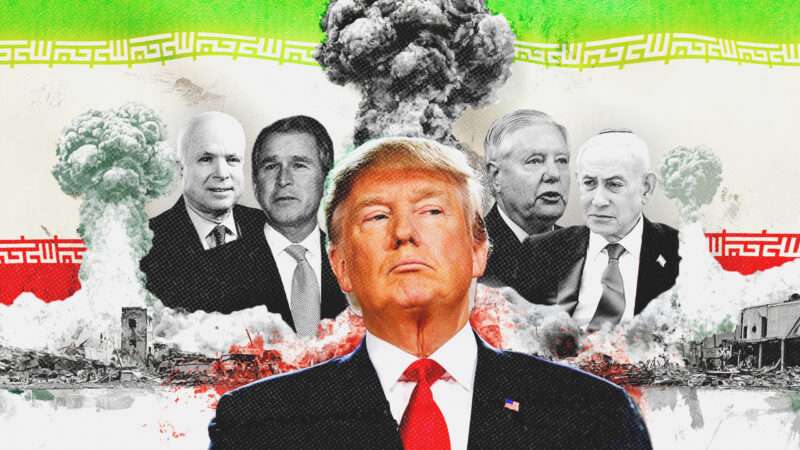
Although the war came out of the blue for most Americans, the Iran hawks spent decades working to put the United States in this position. They made it politically easier to go to war than not go to war. Politicians took it for granted that Israel and the Arab monarchies’ problems with Iran were also America’s problems. But hawkish factions from both parties also shot down any attempt to solve those problems through compromise or even containment of Iran. They pushed the U.S. to take greater and greater risks while avoiding a public debate on war.
“If Iran presents a quasi-existential menace, diplomacy is a political liability and sanctions don’t work, what is left besides military force?” Robert Malley, the Biden administration’s envoy to Iran, wrote in a recent New York Times essay criticizing his former boss for helping create the conditions for war. “If the United States wants to stop plunging into Middle East wars, it needs to value its own interests more than it hates its old enemies.”
The hawkish coalition’s shifting goalposts, designed to make avoiding war impossible, haunted the execution of the war itself. Since the conflict began, the Trump administration has thrown out many different, contradictory victory conditions: overthrowing the Iranian government, making a deal with the Iranian government, destroying Iran’s nuclear program, sending Iran’s entire industrial base “back to the Stone Age,” unleashing a “prosperous and glorious future” for Iran, taking control of the Strait of Hormuz, or letting the strait “open itself.”
For many hawks, the specific rationales for fighting Iran don’t seem to matter. What they want is someone to pay for the past decades of U.S. failures in the Middle East. The Trump administration and its allies have tried to hold Iran responsible for attacks by Al Qaeda, Tehran’s sworn enemy. More accurately, politicians from both parties have blamed Iran for stirring up violent resistance to U.S. troops during the Iraq War, the last big regime change war of choice. At the same time, hawks insist that this regime change war will be different.
“Iran is not Iraq. Anyone saying otherwise doesn’t understand Middle East geopolitics, the Iranian people, their neighbors, or the diaspora. The Iranian people hate this regime,” Rep. Nancy Mace (R–S.C.) argued in March 2026. But that’s a lot like how the Bush administration sold the Iraq War in 2002: Deputy Defense Secretary Paul Wolfowitz claimed that Iraqis were “the most educated people in the Arab world, who are going to welcome us as liberators.”
Of course, it takes two to tango. The Islamic Republic of Iran was founded in a 1979 revolution that intentionally antagonized America, including by taking U.S. diplomats hostage, and that announced its intention to spread that revolution by sending guns to rebels around the region, including to the Lebanese militia Hezbollah, which attacked U.S. troops sent to end Lebanon’s civil war in 1983. Over the years, Iranian leaders have made threats (including the destruction of Israel) that were both aggressive enough to provoke a response and empty enough to make Iran look weak.
But a majority of Americans and Iranians weren’t even born yet when most of these grievances happened—and the world has changed a lot since then. Iran, exhausted by the consequences of its revolution, has been looking for a way out.
After Al Qaeda attacked America on September 11, 2001, the Iranian intelligence services actually participated in the U.S. retaliation campaign in Afghanistan. Two years later, Iran quietly shut down its nuclear weapons research, and a Swiss diplomat presented the U.S. government with a letter from Iran proposing a “grand bargain.” Iran would open up its nuclear facilities for inspection, cooperate in stabilizing Iraq, support Israeli-Palestinian peace talks, and even pressure Hamas and Hezbollah to lay down their arms. In exchange, Iran asked for normalized relations and an end to U.S. regime change threats.
The Bush administration disagreed internally on whether the offer was serious and how to respond. Secretary of State Condoleezza Rice argued that the seriousness of the Iranian offer was actually proof of Iran’s weakness, so the U.S. should turn it down and push for more. Her view carried the day.
That became the pattern of U.S.-Iranian diplomacy for the next two decades. Every time Iran offered compromise, American hawks used that offer to argue that more pressure would lead to more Iranian concessions. This circular logic—the U.S. demand should always be something more than Iran is offering—made diplomacy almost impossible. Yet there would never be another Iranian offer as good as the grand bargain.
The next big diplomatic moment came under President Barack Obama. Though Iran had stopped its secret nuclear weapons program, it was now openly enriching uranium, ostensibly as fuel for nuclear power plants. In response, Israel threatened war and assassinated Iranian scientists while the U.S. imposed economic sanctions to cut off Iran’s access to foreign trade and carried out covert sabotage against Iranian enrichment plants. But then, in agreements signed in 2013 and 2015, Iran accepted a set of temporary and permanent restrictions on its nuclear industry in exchange for the U.S. and five other world powers lifting economic sanctions.
Hawks hated the deal, insisting that they could have secured a better bargain with just a little more pressure—or that any deal with Iran was cowardly “appeasement.” The debate had a bizarre quality to it: Sens. Lindsey Graham (R–S.C.) and John McCain (R–Ariz.), both of whom had publicly called for bombing Iran, feigned outrage when Obama said that the alternative to a deal was war.
Iran’s regional rivals also lobbied against the agreement. They were particularly alarmed by Obama’s comments that Saudi Arabia would have to learn to “share the neighborhood” with Iran while the U.S. military made a “pivot to Asia.” (East Asia, that is.) Israeli Prime Minister Benjamin Netanyahu gave a speech to the U.S. Congress in 2015 attacking Obama’s “very bad deal” with what he described as a Nazi-like regime. Saudi Crown Prince Mohammed bin Salman denounced “the new Hitler in Iran” to The New York Times in 2017.
The United Arab Emirates, meanwhile, played the classic game of “bootleggers and Baptists,” working with the pro-sanctions lobby in Washington while continuing to profit from Iranian sanctions busting in Dubai.
Opponents of the deal often said that it failed to address two nonnuclear issues: Iran’s conventional missile arsenal and its proxy wars in the region. (In addition to arming Lebanese, Palestinian, and Iraqi paramilitaries, the Islamic Republic had by now intervened in the civil wars in Syria and Yemen.) Asking Iran to leave its neighbors alone was one thing. But demanding its conventional weapons was another. Even an ability to hit back against foreign attacks was now deemed an unacceptable threat.
The hawks got what they wanted from the first Trump administration, which tore up the nuclear agreements in 2018 and began a policy of “super maximum economic pressure.” The regime-change maximalists took the initial results as a vindication. In November 2019, a fuel price hike in Iran led to the deadliest civil unrest there since the 1979 revolution. Two months later, Trump ordered the assassination of Iranian Gen. Qassem Soleimani, and Iran retaliated with a one-off military operation that did not kill any Americans (though it accidentally blew up an airliner full of Iranian civilians).
Although President Joe Biden promised to return to diplomacy on the 2020 campaign trail, his advisers were convinced that pressure was working better than expected. Ariane Tabatabai, who later worked on Biden’s negotiating team, warned in an essay before Biden took office that the next U.S. president should not “rush” back to a deal, because continued pressure over time would only degrade Iran’s position. Ilan Goldenberg, another future Biden official, wrote a paper suggesting “calculated risks” against Iran, modeled on Israeli raids into Syria that Israel dubbed the “campaign between wars.”
And the hawkish Senate Foreign Relations Committee Chair Bob Menendez (D–N.J.)—later convicted of selling information to Egyptian spies—threatened to block any return to Obama’s deal. Biden’s negotiators thus spent fruitless years pressuring Iran to give the U.S. a “longer and stronger” deal than before. Meanwhile, Biden offered the Arab monarchies defense pacts that would guarantee permanent U.S. military protection, even as Saudi Arabia was quietly negotiating with Iran for a separate peace.
Iranian protests against hijab laws in September 2022 and the Hamas attacks against Israel on October 7, 2023, both made further negotiations with Iran politically toxic in America. The surprise violence of October 7 also seemed to vindicate Israeli factions who believed that enemies could not be deterred, only destroyed. In response to Hezbollah’s cross-border shelling, Israel launched an all-out invasion of Lebanon in the autumn of 2024. Contrary to the Biden administration’s worries—and my own—this campaign did not escalate into an international war. Immediately after the Israeli-Lebanese ceasefire in November 2024, a revolution in Syria ejected Iranian forces, another sign of Iran’s weakness. By the end of his term, members of Biden’s camp were publicly and privately endorsing an attack on Iran itself.
After returning to office, Trump embraced that feeling that taking risks against Iran pays off. He reopened and then reclosed conflicts in Gaza and Yemen, seemingly at his leisure. In June 2025, he took the greatest gamble so far, supporting an Israeli attack on Iran in the middle of U.S.-Iranian negotiations, joining in with an air raid on the 12th day of the war, and offering a ceasefire immediately after. Iran launched a token retaliation on U.S. forces and then accepted.
The decisive moment for Trump was probably an incident halfway around the world from the Middle Eastern desert, on the lush Caribbean coast. On January 3, 2026, a detachment of U.S. special operators swooped into Caracas by night and arrested Venezuelan President Nicolás Maduro on drug trafficking charges. Vice President Delcy Rodríguez immediately began kowtowing to U.S. demands. Overthrowing foreign leaders had never looked so easy.
The same week as the raid on Caracas, inflation protests in Iran escalated to a nationwide uprising against the Islamic Republic. (U.S. Treasury Secretary Scott Bessent bragged that the unrest was the “grand culmination” of U.S. sanctions.) Much of the Iranian opposition was now explicitly asking for foreign military support. One Iranian told the Financial Times that Venezuela had given her hope for a “clean, bloodless regime change.”
On January 8, the Iranian government shut down the internet and began clearing the streets with gunfire, killing thousands of people. Four days later, Trump posted on social media, “Iranian Patriots, KEEP PROTESTING—TAKE OVER YOUR INSTITUTIONS!!! Save the names of the killers and abusers. They will pay a big price. I have cancelled all meetings with Iranian Officials until the senseless killing of protesters STOPS. HELP IS ON ITS WAY.”
The unrest died down as the government imposed martial law. Iranians within the country told me at the time that everyone, whether opposition or loyalists or bystanders, was waiting to see what the U.S. would do.
Then Trump uncanceled the meetings, sending Special Envoy Steve Witkoff to negotiate on the future of Iran’s nuclear program, which had been badly damaged during the June 2025 war. Witkoff’s team was openly contemptuous of spending time discussing or even understanding the details of the nuclear issue, refusing to bring technical experts to the final round of negotiations. What Trump really wanted, Witkoff told Fox News on February 22, was for Iranian leaders to explain “why they haven’t capitulated” in the face of an ongoing U.S. military buildup.
Trump still expected a quick and unambiguous surrender when he and Netanyahu launched the war a few days later. Israel assassinated Iranian Supreme Leader Ali Khamenei in a first strike, and Trump said that he was anticipating a situation “like with Delcy in Venezuela.”
A month into the war, Trump admitted at an Easter dinner that he had told the British prime minister the war would last only three days. He gave a similar timeline to “skeptical” Middle Eastern leaders before the war began, telling them it would “only take 100 hours,” according to Trita Parsi, executive vice president of the Quincy Institute for Responsible Statecraft, a pro-diplomacy nonprofit, who also broke the news of Iran’s 2003 offer.
At the same time that the Trump administration was looking for a Delcy figure, Israel’s intelligence services were promising that they could spark another uprising in Iran. That didn’t materialize, either. Even Kurdish rebels directly armed by the CIA were reluctant to rush into what they feared would end with “a massacre of our own people,” as one Kurdish commander told New Lines Magazine.
Instead of falling, Iran fought back and escalated. The U.S. military is stuck playing Whac-A-Mole with Iranian missiles and drones, burning through valuable munitions that are also supposed to be on hand to defend Ukraine and Taiwan. Bessent even lifted sanctions on Iranian oil exports in hopes of relieving some of the shortages caused by the fighting in Hormuz. Iranian civilians have paid the highest price, with between 1,700 and 2,400 killed in the bombing by mid-April. And the war spread beyond Hormuz, reigniting fighting in Lebanon and Iraq.
In mid-April 2026, the United States and Iran agreed to a “fragile ceasefire,” as U.S. Vice President J.D. Vance put it. Immediately, both sides tried to change the terms. Despite Pakistani mediators announcing that the ceasefire would cover “everywhere including Lebanon”—and Trump agreeing privately, according to CBS News—the Israeli government escalated its bombing in Lebanon, and the Trump administration rushed to justify it. Despite promising “safe passage through the Strait of Hormuz” during the ceasefire, Iranian authorities continued to limit shipping and demand ransoms.
Whether or not the truce holds past April, Trump has lost control over the conflict he has entangled the U.S. in. With its back to the wall, Iran discovered that it holds a lot of leverage over the world economy. Israel and the Arab states, meanwhile, found that they can push the U.S. to adopt maximalist goals.
The war has led to an outcome that neither Iranians nor Americans wanted. But it has fulfilled the vision of Netanyahu, who declared from the rooftop of the military headquarters in Tel Aviv that bringing the U.S. directly into the war “allows us to do what I have been hoping to do for 40 years.”
Ironically, it has also fulfilled the vision of the late Hamas leader Yahya Sinwar, who foreshadowed his plans in a 2022 speech: “By God, I see it with my own eyes, a war that will change the face of the globe, a regional religious war that will burn both the green and the dry.” The American political class helped pile a lot of the kindling, and it doesn’t know how to put the fire out.
The post A Pointless War: How Iran Hawks Finally Got Their Way appeared first on Reason.com.
from Latest – Reason.com https://ift.tt/t9b4Pur
via IFTTT
The Strait of Hormuz is straight out of a storybook. Named for an ancient Persian god, the 24-mile-wide waterway flows between jagged cliffs, inlets that look like a desert version of Scandinavian fjords, and multicolored salt formations. Centuries-old Portuguese castles dot both sides of the straits, and traditional sailboats called dhows still ply the waters, carrying tourists and small wares.
Hormuz, the only connection between the oil-rich Persian Gulf and the wider ocean, is also the artery of the modern industrial economy that is most vulnerable to war. On February 28, 2026, shortly after Israel and the United States attacked Iran, the Iranian military broadcast on the radio that the strait was closed for shipping. Two days later, a (presumably Iranian) weapon smashed into an oil tanker, killing two crew members. Iran began charging multimillion-dollar ransoms for the few ships that continue to pass.
Global crude oil prices nearly doubled in the first few weeks of war—and oil isn’t the whole story. Many critical manufacturing processes around the world rely on inputs from the gulf’s petrochemical industry, which Iran has also bombed directly and which will take months to restart once the coast is clear. Electronics manufacturers in South Korea and Taiwan are suddenly short on helium, which they need to produce semiconductors. So ends the age of uninterrupted artificial intelligence growth. The plastic, metal, and pharmaceutical industries are running into similar shortages of raw materials. And the world is staring down a food crisis next year as farmers struggle to find fertilizer for the current planting season.
President Donald Trump has made reopening the strait a major goal of the war and the negotiations to end it during the mid-April 2026 ceasefire. In other words, Trump’s struggle is now to reverse the consequences of choosing to start the war.
Starting this war was indeed a choice. The Trump administration spent months building up military forces in the Middle East while issuing constantly shifting demands. Iran had agreed to negotiate; the U.S. attacked on a weekend between two scheduled rounds of talks.
Although the war came out of the blue for most Americans, the Iran hawks spent decades working to put the United States in this position. They made it politically easier to go to war than not go to war. Politicians took it for granted that Israel and the Arab monarchies’ problems with Iran were also America’s problems. But hawkish factions from both parties also shot down any attempt to solve those problems through compromise or even containment of Iran. They pushed the U.S. to take greater and greater risks while avoiding a public debate on war.
“If Iran presents a quasi-existential menace, diplomacy is a political liability and sanctions don’t work, what is left besides military force?” Robert Malley, the Biden administration’s envoy to Iran, wrote in a recent New York Times essay criticizing his former boss for helping create the conditions for war. “If the United States wants to stop plunging into Middle East wars, it needs to value its own interests more than it hates its old enemies.”
The hawkish coalition’s shifting goalposts, designed to make avoiding war impossible, haunted the execution of the war itself. Since the conflict began, the Trump administration has thrown out many different, contradictory victory conditions: overthrowing the Iranian government, making a deal with the Iranian government, destroying Iran’s nuclear program, sending Iran’s entire industrial base “back to the Stone Age,” unleashing a “prosperous and glorious future” for Iran, taking control of the Strait of Hormuz, or letting the strait “open itself.”
For many hawks, the specific rationales for fighting Iran don’t seem to matter. What they want is someone to pay for the past decades of U.S. failures in the Middle East. The Trump administration and its allies have tried to hold Iran responsible for attacks by Al Qaeda, Tehran’s sworn enemy. More accurately, politicians from both parties have blamed Iran for stirring up violent resistance to U.S. troops during the Iraq War, the last big regime change war of choice. At the same time, hawks insist that this regime change war will be different.
“Iran is not Iraq. Anyone saying otherwise doesn’t understand Middle East geopolitics, the Iranian people, their neighbors, or the diaspora. The Iranian people hate this regime,” Rep. Nancy Mace (R–S.C.) argued in March 2026. But that’s a lot like how the Bush administration sold the Iraq War in 2002: Deputy Defense Secretary Paul Wolfowitz claimed that Iraqis were “the most educated people in the Arab world, who are going to welcome us as liberators.”
Of course, it takes two to tango. The Islamic Republic of Iran was founded in a 1979 revolution that intentionally antagonized America, including by taking U.S. diplomats hostage, and that announced its intention to spread that revolution by sending guns to rebels around the region, including to the Lebanese militia Hezbollah, which attacked U.S. troops sent to end Lebanon’s civil war in 1983. Over the years, Iranian leaders have made threats (including the destruction of Israel) that were both aggressive enough to provoke a response and empty enough to make Iran look weak.
But a majority of Americans and Iranians weren’t even born yet when most of these grievances happened—and the world has changed a lot since then. Iran, exhausted by the consequences of its revolution, has been looking for a way out.
After Al Qaeda attacked America on September 11, 2001, the Iranian intelligence services actually participated in the U.S. retaliation campaign in Afghanistan. Two years later, Iran quietly shut down its nuclear weapons research, and a Swiss diplomat presented the U.S. government with a letter from Iran proposing a “grand bargain.” Iran would open up its nuclear facilities for inspection, cooperate in stabilizing Iraq, support Israeli-Palestinian peace talks, and even pressure Hamas and Hezbollah to lay down their arms. In exchange, Iran asked for normalized relations and an end to U.S. regime change threats.
The Bush administration disagreed internally on whether the offer was serious and how to respond. Secretary of State Condoleezza Rice argued that the seriousness of the Iranian offer was actually proof of Iran’s weakness, so the U.S. should turn it down and push for more. Her view carried the day.
That became the pattern of U.S.-Iranian diplomacy for the next two decades. Every time Iran offered compromise, American hawks used that offer to argue that more pressure would lead to more Iranian concessions. This circular logic—the U.S. demand should always be something more than Iran is offering—made diplomacy almost impossible. Yet there would never be another Iranian offer as good as the grand bargain.
The next big diplomatic moment came under President Barack Obama. Though Iran had stopped its secret nuclear weapons program, it was now openly enriching uranium, ostensibly as fuel for nuclear power plants. In response, Israel threatened war and assassinated Iranian scientists while the U.S. imposed economic sanctions to cut off Iran’s access to foreign trade and carried out covert sabotage against Iranian enrichment plants. But then, in agreements signed in 2013 and 2015, Iran accepted a set of temporary and permanent restrictions on its nuclear industry in exchange for the U.S. and five other world powers lifting economic sanctions.
Hawks hated the deal, insisting that they could have secured a better bargain with just a little more pressure—or that any deal with Iran was cowardly “appeasement.” The debate had a bizarre quality to it: Sens. Lindsey Graham (R–S.C.) and John McCain (R–Ariz.), both of whom had publicly called for bombing Iran, feigned outrage when Obama said that the alternative to a deal was war.
Iran’s regional rivals also lobbied against the agreement. They were particularly alarmed by Obama’s comments that Saudi Arabia would have to learn to “share the neighborhood” with Iran while the U.S. military made a “pivot to Asia.” (East Asia, that is.) Israeli Prime Minister Benjamin Netanyahu gave a speech to the U.S. Congress in 2015 attacking Obama’s “very bad deal” with what he described as a Nazi-like regime. Saudi Crown Prince Mohammed bin Salman denounced “the new Hitler in Iran” to The New York Times in 2017.
The United Arab Emirates, meanwhile, played the classic game of “bootleggers and Baptists,” working with the pro-sanctions lobby in Washington while continuing to profit from Iranian sanctions busting in Dubai.
Opponents of the deal often said that it failed to address two nonnuclear issues: Iran’s conventional missile arsenal and its proxy wars in the region. (In addition to arming Lebanese, Palestinian, and Iraqi paramilitaries, the Islamic Republic had by now intervened in the civil wars in Syria and Yemen.) Asking Iran to leave its neighbors alone was one thing. But demanding its conventional weapons was another. Even an ability to hit back against foreign attacks was now deemed an unacceptable threat.
The hawks got what they wanted from the first Trump administration, which tore up the nuclear agreements in 2018 and began a policy of “super maximum economic pressure.” The regime-change maximalists took the initial results as a vindication. In November 2019, a fuel price hike in Iran led to the deadliest civil unrest there since the 1979 revolution. Two months later, Trump ordered the assassination of Iranian Gen. Qassem Soleimani, and Iran retaliated with a one-off military operation that did not kill any Americans (though it accidentally blew up an airliner full of Iranian civilians).
Although President Joe Biden promised to return to diplomacy on the 2020 campaign trail, his advisers were convinced that pressure was working better than expected. Ariane Tabatabai, who later worked on Biden’s negotiating team, warned in an essay before Biden took office that the next U.S. president should not “rush” back to a deal, because continued pressure over time would only degrade Iran’s position. Ilan Goldenberg, another future Biden official, wrote a paper suggesting “calculated risks” against Iran, modeled on Israeli raids into Syria that Israel dubbed the “campaign between wars.”
And the hawkish Senate Foreign Relations Committee Chair Bob Menendez (D–N.J.)—later convicted of selling information to Egyptian spies—threatened to block any return to Obama’s deal. Biden’s negotiators thus spent fruitless years pressuring Iran to give the U.S. a “longer and stronger” deal than before. Meanwhile, Biden offered the Arab monarchies defense pacts that would guarantee permanent U.S. military protection, even as Saudi Arabia was quietly negotiating with Iran for a separate peace.
Iranian protests against hijab laws in September 2022 and the Hamas attacks against Israel on October 7, 2023, both made further negotiations with Iran politically toxic in America. The surprise violence of October 7 also seemed to vindicate Israeli factions who believed that enemies could not be deterred, only destroyed. In response to Hezbollah’s cross-border shelling, Israel launched an all-out invasion of Lebanon in the autumn of 2024. Contrary to the Biden administration’s worries—and my own—this campaign did not escalate into an international war. Immediately after the Israeli-Lebanese ceasefire in November 2024, a revolution in Syria ejected Iranian forces, another sign of Iran’s weakness. By the end of his term, members of Biden’s camp were publicly and privately endorsing an attack on Iran itself.
After returning to office, Trump embraced that feeling that taking risks against Iran pays off. He reopened and then reclosed conflicts in Gaza and Yemen, seemingly at his leisure. In June 2025, he took the greatest gamble so far, supporting an Israeli attack on Iran in the middle of U.S.-Iranian negotiations, joining in with an air raid on the 12th day of the war, and offering a ceasefire immediately after. Iran launched a token retaliation on U.S. forces and then accepted.
The decisive moment for Trump was probably an incident halfway around the world from the Middle Eastern desert, on the lush Caribbean coast. On January 3, 2026, a detachment of U.S. special operators swooped into Caracas by night and arrested Venezuelan President Nicolás Maduro on drug trafficking charges. Vice President Delcy Rodríguez immediately began kowtowing to U.S. demands. Overthrowing foreign leaders had never looked so easy.
The same week as the raid on Caracas, inflation protests in Iran escalated to a nationwide uprising against the Islamic Republic. (U.S. Treasury Secretary Scott Bessent bragged that the unrest was the “grand culmination” of U.S. sanctions.) Much of the Iranian opposition was now explicitly asking for foreign military support. One Iranian told the Financial Times that Venezuela had given her hope for a “clean, bloodless regime change.”
On January 8, the Iranian government shut down the internet and began clearing the streets with gunfire, killing thousands of people. Four days later, Trump posted on social media, “Iranian Patriots, KEEP PROTESTING—TAKE OVER YOUR INSTITUTIONS!!! Save the names of the killers and abusers. They will pay a big price. I have cancelled all meetings with Iranian Officials until the senseless killing of protesters STOPS. HELP IS ON ITS WAY.”
The unrest died down as the government imposed martial law. Iranians within the country told me at the time that everyone, whether opposition or loyalists or bystanders, was waiting to see what the U.S. would do.
Then Trump uncanceled the meetings, sending Special Envoy Steve Witkoff to negotiate on the future of Iran’s nuclear program, which had been badly damaged during the June 2025 war. Witkoff’s team was openly contemptuous of spending time discussing or even understanding the details of the nuclear issue, refusing to bring technical experts to the final round of negotiations. What Trump really wanted, Witkoff told Fox News on February 22, was for Iranian leaders to explain “why they haven’t capitulated” in the face of an ongoing U.S. military buildup.
Trump still expected a quick and unambiguous surrender when he and Netanyahu launched the war a few days later. Israel assassinated Iranian Supreme Leader Ali Khamenei in a first strike, and Trump said that he was anticipating a situation “like with Delcy in Venezuela.”
A month into the war, Trump admitted at an Easter dinner that he had told the British prime minister the war would last only three days. He gave a similar timeline to “skeptical” Middle Eastern leaders before the war began, telling them it would “only take 100 hours,” according to Trita Parsi, executive vice president of the Quincy Institute for Responsible Statecraft, a pro-diplomacy nonprofit, who also broke the news of Iran’s 2003 offer.
At the same time that the Trump administration was looking for a Delcy figure, Israel’s intelligence services were promising that they could spark another uprising in Iran. That didn’t materialize, either. Even Kurdish rebels directly armed by the CIA were reluctant to rush into what they feared would end with “a massacre of our own people,” as one Kurdish commander told New Lines Magazine.
Instead of falling, Iran fought back and escalated. The U.S. military is stuck playing Whac-A-Mole with Iranian missiles and drones, burning through valuable munitions that are also supposed to be on hand to defend Ukraine and Taiwan. Bessent even lifted sanctions on Iranian oil exports in hopes of relieving some of the shortages caused by the fighting in Hormuz. Iranian civilians have paid the highest price, with between 1,700 and 2,400 killed in the bombing by mid-April. And the war spread beyond Hormuz, reigniting fighting in Lebanon and Iraq.
In mid-April 2026, the United States and Iran agreed to a “fragile ceasefire,” as U.S. Vice President J.D. Vance put it. Immediately, both sides tried to change the terms. Despite Pakistani mediators announcing that the ceasefire would cover “everywhere including Lebanon”—and Trump agreeing privately, according to CBS News—the Israeli government escalated its bombing in Lebanon, and the Trump administration rushed to justify it. Despite promising “safe passage through the Strait of Hormuz” during the ceasefire, Iranian authorities continued to limit shipping and demand ransoms.
Whether or not the truce holds past April, Trump has lost control over the conflict he has entangled the U.S. in. With its back to the wall, Iran discovered that it holds a lot of leverage over the world economy. Israel and the Arab states, meanwhile, found that they can push the U.S. to adopt maximalist goals.
The war has led to an outcome that neither Iranians nor Americans wanted. But it has fulfilled the vision of Netanyahu, who declared from the rooftop of the military headquarters in Tel Aviv that bringing the U.S. directly into the war “allows us to do what I have been hoping to do for 40 years.”
Ironically, it has also fulfilled the vision of the late Hamas leader Yahya Sinwar, who foreshadowed his plans in a 2022 speech: “By God, I see it with my own eyes, a war that will change the face of the globe, a regional religious war that will burn both the green and the dry.” The American political class helped pile a lot of the kindling, and it doesn’t know how to put the fire out.
The post A Pointless War: How Iran Hawks Finally Got Their Way appeared first on Reason.com.
from Latest – Reason.com https://ift.tt/t9b4Pur
via IFTTT
The post Open Thread appeared first on Reason.com.
from Latest – Reason.com https://ift.tt/PqNTWB3
via IFTTT
The post Open Thread appeared first on Reason.com.
from Latest – Reason.com https://ift.tt/PqNTWB3
via IFTTT
Mills Drops Out In Maine Governor’s Race As Oysterman With Nazi Tattoo Becomes Democratic Frontrunner
Maine Gov. Janet Mills suspended her U.S. Senate campaign Thursday morning, citing a lack of financial resources. That’s the official explanation. The more accurate one is that the polls showed her trailing badly to Graham Platner, an oysterman from coastal Maine with no electoral experience.

Mills had every structural advantage working for her: she’d already won a statewide election, had name identification, and the support of Senate Minority Leader Chuck Schumer. The writing was on the wall for weeks, but Mills’s exit from the race was her concession that all the momentum on the Democratic side was for Platner.
Platner had long lapped Mills in polling and fundraising, and she’d stopped running television ads weeks earlier. Which means Platner will be the party’s nominee against Sen. Susan Collins in one of the most consequential Senate races of the 2026 cycle.
In 2007, Graham Platner got a Nazi Totenkopf tattoo on his chest. He kept it there for roughly 18 years. He claims he didn’t know what the symbol meant for nearly two decades. But there is significant evidence that he did, and that it was intentional. Platner amplified a social media post from Stew Peters, a neo-Nazi radio host the Anti-Defamation League has called “a prolific antisemite” who blames “‘the Jews’ for everything he believes is wrong with society” and who has openly called for a “final solution” to mass-deport American Jews. Platner deleted the post, but only after it got attention, not before. He also sat for a lengthy interview with antisemitic conspiracy theorist Nate Cornacchia, describing himself as a longtime fan. He has called the U.S.-Israel relationship “shameful” and praised a violent Hamas attack on Israel in 2014.
“In November Susan Collins, a proven leader with an indisputable record of delivering for Maine, will face a Nazi sympathizing self-proclaimed communist with a record of hate-mongering and dishonesty,” said RNC spokesperson Kristen Cianci. “It’s safe to say we are confident going into Election Day.”
There’s no denying that a candidate with this profile would have been a liability the party ran from not all that long ago. Now he’s the frontrunner with enough momentum that he forced the sitting governor – recruited by Senate Minority Leader Chuck Schumer himself – to drop out of the race.
This didn’t materialize overnight. The Democratic Party’s tolerance for anti-Israel sentiment has been building for decades.
The trajectory is traceable.
Barack Obama won the presidency despite his two-decade relationship with Rev. Jeremiah Wright, a pastor whose hostility toward Israel and Jews was a matter of public record. Once in office, Obama systematically manufactured distance between Washington and Jerusalem, signaling that cool skepticism toward Israel was not just acceptable but arguably sophisticated Democratic foreign policy.
Obama’s administration was the most anti-Israel administration since Jimmy Carter, and it frequently undermined our democratic ally in the Middle East. Obama exposed classified information about Israel’s nuclear capabilities – an alarming breach of trust. His IRS targeted pro-Israel organizations, and his administration declined to enforce anti-BDS provisions, effectively offering a federal green light to a movement whose stated purpose is the economic strangulation of the Jewish state. At the 2012 Democratic National Convention, delegates initially refused to recognize Jerusalem as Israel’s capital — a true sign that the party was becoming more openly antisemitic.
Joe Biden accelerated the trend by allowing the antisemitic wing of his party to set the terms of the Israel debate rather than confronting it. Last year, polling showed Democrats favoring Palestinians over Israelis by a staggering 59–21 percent margin, and overall American sympathy for Israel reached a 25-year low.
The line from Jimmy Carter to Barack Obama to Graham Platner is unmistakable. It also helps explain how anti-Israel sentiment found a foothold inside the Democratic Party. Each step made the next one easier to accept, and party leadership either accepted it each time or chose not to push back.
Ironically, Democrats spent years calling their Republican opponents Nazis. The charge was deployed so casually and so broadly that it became almost ambient noise in American political life. Now the same party is on the verge of nominating a man who wore a Nazi symbol on his chest for two decades as its nominee for the United States Senate in Maine.
Tyler Durden
Fri, 05/01/2026 – 22:55
via ZeroHedge News https://ift.tt/mvOZXQ4 Tyler Durden