Estée Lauder Accelerates Turnaround, Adds 3,000 Jobs To Chopping Block

Estée Lauder Accelerates Turnaround, Adds 3,000 Jobs To Chopping Block

Beauty and cosmetics giant Estée Lauder is accelerating its workforce restructuring, announcing Friday morning that it will cut another 3,000 jobs, bringing total planned reductions to as many as 10,000 roles. The move is expected to unlock hundreds of millions of dollars in additional savings. Still, it also suggests a deeper reset in the company’s workforce after its hiring spree leading up to  Covid, potentially putting a long-term cap on headcount.

The owner of Clinique, La Mer, MAC, Aveda, Bobbi Brown, Jo Malone London, Le Labo, Tom Ford Beauty, Too Faced, and others wrote in an earnings press release that it now “estimates a final net reduction in positions of 9,000 to 10,000, an increase from 5,800 to 7,000.” In other words, management found another 3,000 jobs to cut.

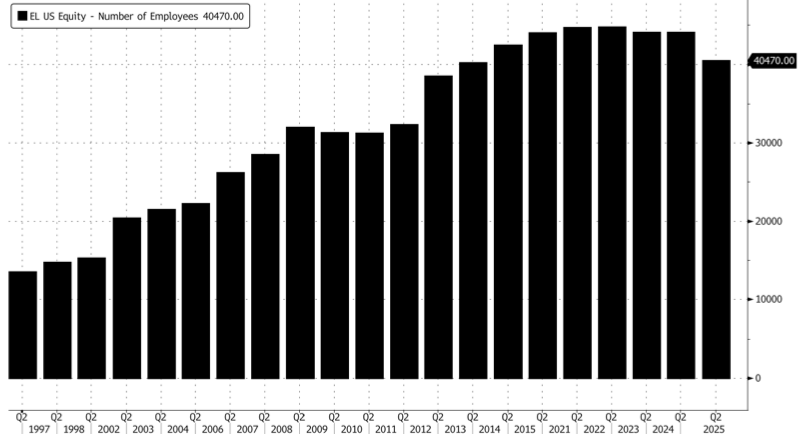
According to Bloomberg data, Estée Lauder has a global workforce of about 40,470 as of the second quarter of 2025. The total workforce peaked in 2022 at around 44,800, ending a multi-decade hiring spree.

“Over 70% of the increase is attributable to the reduction in point-of-sale demonstration roles at select unproductive doors in its department store and freestanding store channels, as the Company continues to evolve its focus towards high-growth channels,” the company noted.

Management said the restructuring is based on four objectives:

  1. reorganization and rightsizing of certain areas,

  2. simplification and acceleration of processes,

  3. outsourcing of select services and

  4. evolution of go-to-market footprint and selling models, all to help rebuild operating margin and also fuel reinvestment in consumer-facing areas to drive sustainable sales growth.

Shares jumped as much as 16% in premarket trading, and if those gains hold through the cash session, it would be the largest increase since November 3, 2011. The optimism stemmed from Estée Lauder’s earnings report, which raised its profit outlook.

The company now expects adjusted EPS of $2.35 to $2.45, above analyst estimates tracked by Bloomberg and higher than its prior $2.05 to $2.25 range. Organic sales growth is expected to be 3%, at the high end of previous guidance.

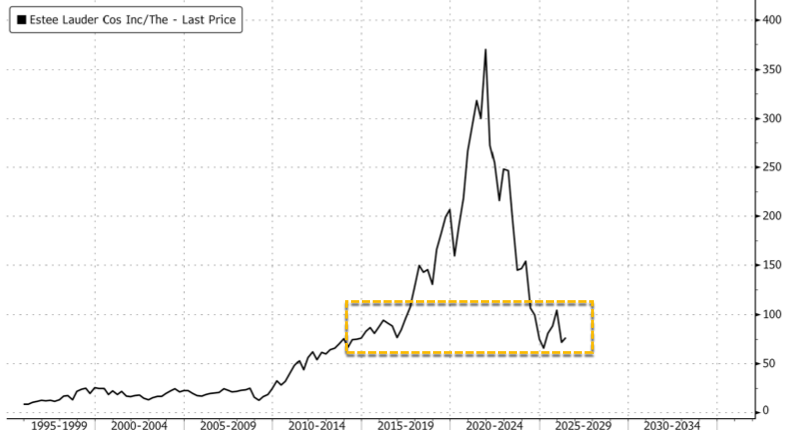
Shares are trading around 2016 levels after what can only be described as a boom-and-bust cycle, peaking in 2021. Shares remain down roughly 80%, as of Thursday’s close, from the peak of $370 in late 2021.

The question Wall Street analysts have been asking is whether CEO Stéphane de La Faverie’s turnaround will be successful.

Tyler Durden
Fri, 05/01/2026 – 20:10

via ZeroHedge News https://ift.tt/c4QkUPA Tyler Durden

A Robot Economy: Who Gets Rich, Who Gets Left Behind

A Robot Economy: Who Gets Rich, Who Gets Left Behind

Authored by Lance Roberts via RealInvestmentAdvice.com,

Robots are coming to the economy. It is inevitable, really, and there is nothing that will stop it. At some point in the not-so-distant future, robots will infiltrate every aspect of our lives, from office work and manufacturing to service work and trade skills, and even your home. Here are some numbers for you.

The real question I want to explore in today’s post is what happens to the people who don’t own the robots? Let’s dig in.

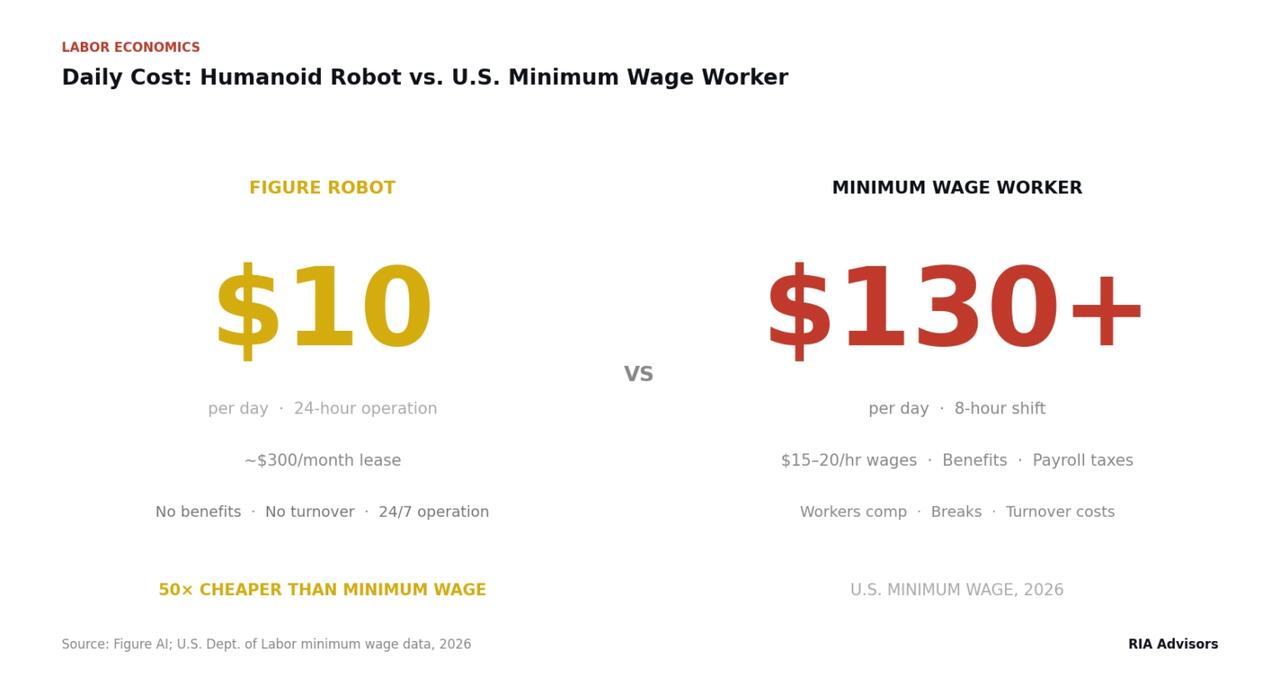
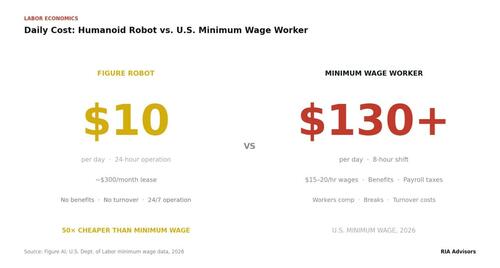
I spent the past week reading through a detailed account of what’s happening inside Figure’s robotics facility in San Jose, and I want to be direct: the humanoid robots economy is no longer a thought experiment. Figure’s latest robot ran for 67 consecutive hours of fully autonomous work, kitchen tasks, package handling, and logistics, without a single error. That’s not a demo reel, that’s a product. When you factor in a projected lease cost of roughly $10 a day, it’s a product priced to replace the single largest input cost on every corporate income statement in America: human labor.

The optimists call what’s coming the “age of abundance.” Cheaper goods, freed-up time, robots building robots until supply constraints essentially disappear. That would be incredible, and you should not dismiss that vision. Furthermore, I think it’s directionally correct over a long enough horizon. But after 35 years of watching economic cycles play out, I’ve learned that the gap between a macro promise and the lived experience of actual households is where the real story lives.

In an upcoming article, we will dig deeper into the problems plaguing the K-shaped economy. However, that bifurcated structure, in which higher-income households ascend while lower-income ones stagnate, was already a structural feature of American life before a single humanoid robot touched a factory floor. Back to our question, does the arrival of humanoid robots at scale fix that problem? Or, does it make it dramatically worse? The answer, I believe, is both, in that order, and separated by a decade of potential pain.

The Technology Of Robots Is Not Waiting For A Policy Response

It’s worth taking the technology seriously before discussing the economics, because the economics are downstream of the hardware reality. Figure has replaced over 100,000 lines of handwritten control code with a single neural network — what they call Helix 2 — that controls the robot’s entire body in real time. The key shift is that neural networks learn from data rather than explicit instructions. Once a robot masters a task, that knowledge propagates instantly across the entire fleet. Humans don’t work that way. Robots do.

At $300 per month to lease, against a U.S. minimum wage that runs $15 to $20 per hour, a humanoid robot is already 50 times cheaper than the human it displaces, and it works around the clock without benefits, turnover, or OSHA violations. The corporate incentive to adopt is not subtle. JPMorgan’s own disclosures describe AI-driven efficiency gains of 40% to 50% in certain operations. Add a physical labor layer to that, and you have the most powerful deflationary force for corporate margins in modern history.
While shareholders of corporations with large labor forces will love the improvement in profit margins, workers will not. That asymmetry is not a flaw in the system; it’s a feature of who owns the system. And that ownership structure is the core issue this article is really about.

The K-Shaped Economy Was Already Broken

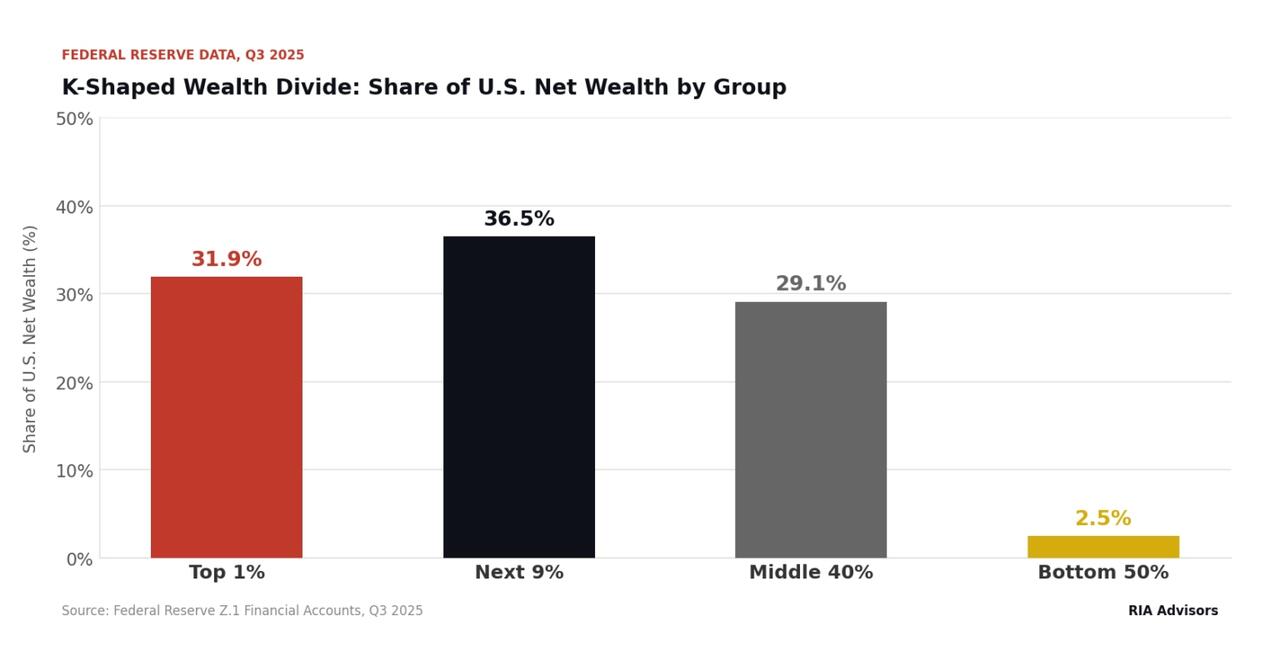
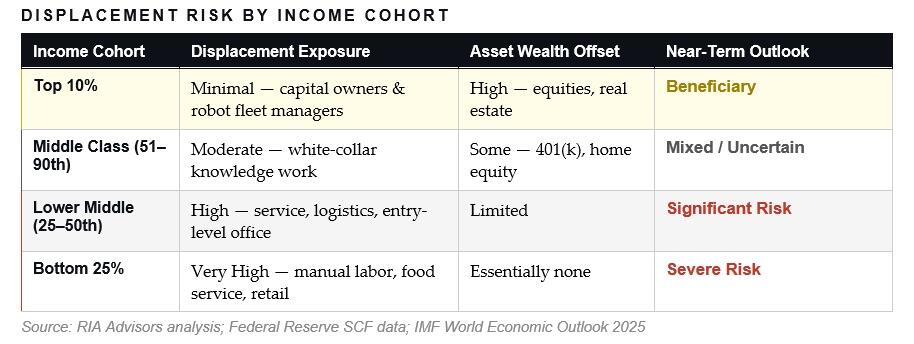
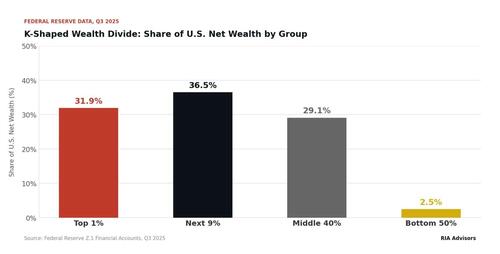
Here’s what makes the discussion of humanoid robots’ economy so complicated: we’re not starting from a position of broad-based prosperity. The K-shaped economy is already a structural, not cyclical, feature of modern America. The Federal Reserve’s own data shows the top 1% of households hold nearly 32% of total net worth, while the bottom 50% collectively hold 2.5%. The portion of GDP flowing to workers as compensation just hit its lowest level in over 75 years of Bureau of Labor Statistics tracking. The middle class shrank from 61% of the population in 1971 to barely 51% in 2023.
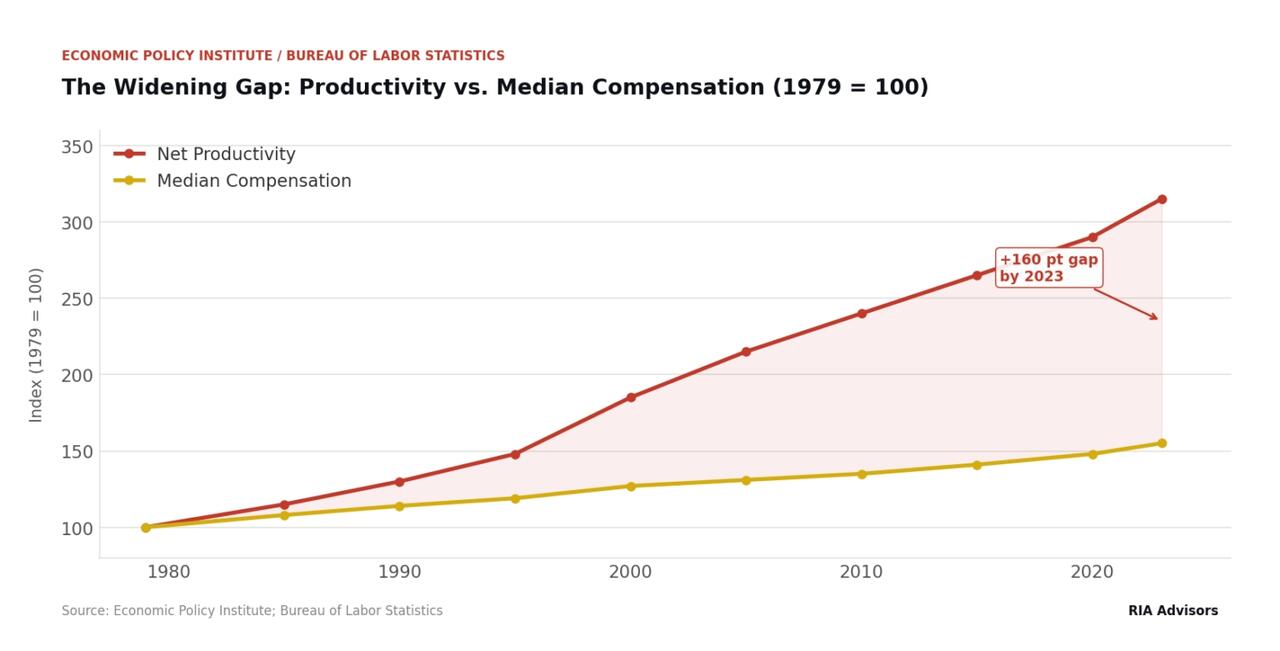
Moody’s Analytics chief economist Mark Zandi described this not as a temporary anomaly but as “a structural, fundamental issue.” U.S. Bank’s economics team concluded in their 2026 report that income concentration now exceeds its pre-pandemic peak and sits at levels not seen in 60 years. These figures predate the meaningful deployment of humanoid robots. They reflect decades of technology-driven productivity gains that have flowed disproportionately to capital owners rather than to labor.
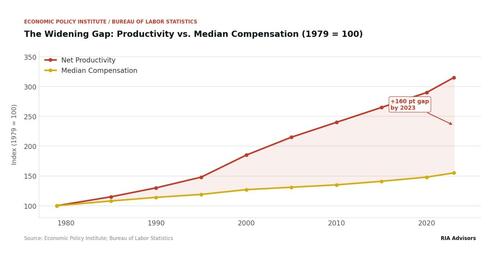
The gains from technology have reliably accrued to capital. There is no structural reason to expect the arrival of humanoid robots to reverse that pattern — and strong structural reasons to expect it accelerates it.” – US Bank

Fortune’s analysis earlier this year captured the consensus view among economists. That view is that while AI and robots may eventually close the inequality gap, productivity gains need to first reach low-skilled workers. That must come through real wage increases at the bottom of the distribution, before that convergence happens. That process won’t complete until well into the 2030s at the earliest. In the meantime, the wealth effect continues to push the two tracks of the K further apart.

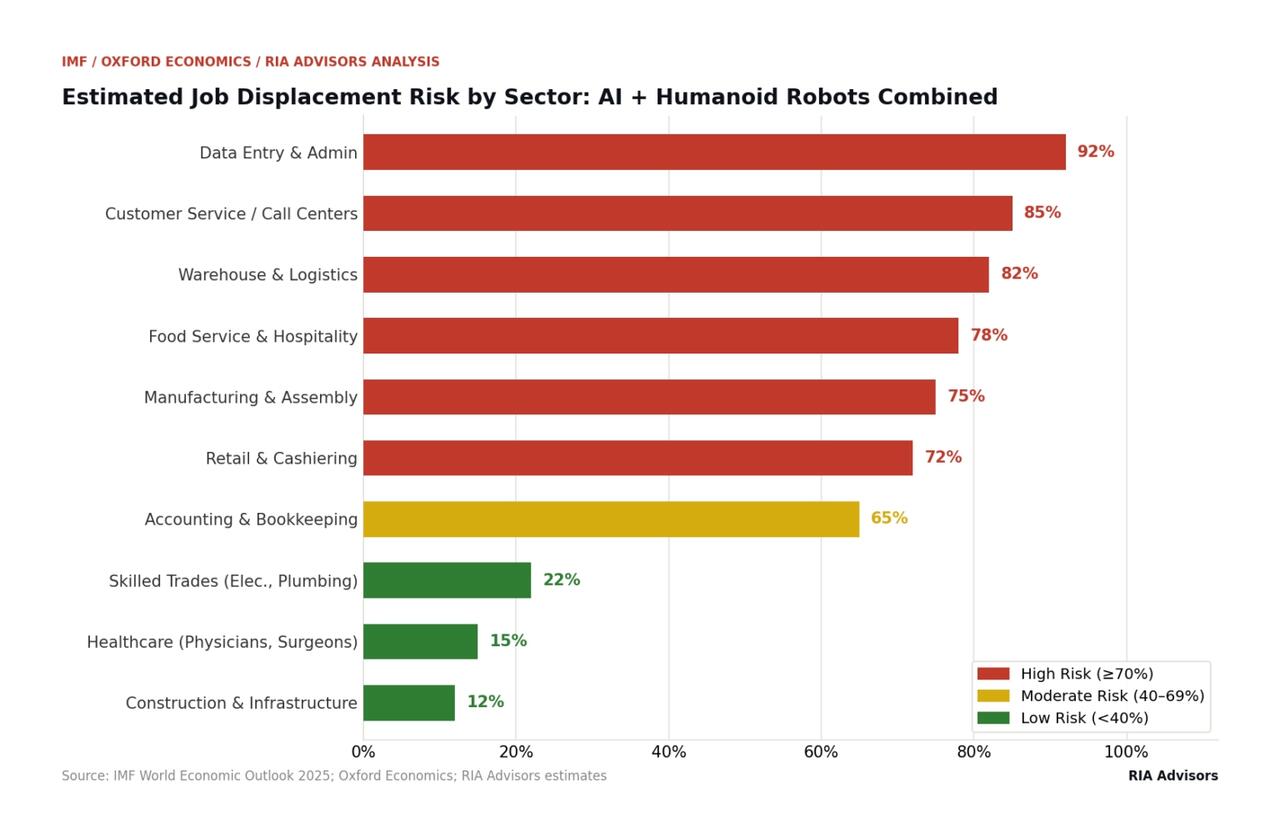
Stanford’s Erik Brynjolfsson, director of the Stanford Digital Economy Lab, drew a blunt historical parallel: the Midwest auto communities hollowed out by trade and automation in the 1990s. But the coming displacement is potentially 10 to 100 times more disruptive — not because it’s faster, but because it spans both blue-collar and white-collar work simultaneously. Software engineers, call center workers, and administrative roles face AI-driven displacement. Factory workers, warehouse staff, and service workers are facing displacement by humanoid robots. There’s no obvious “up-the-ladder” escape hatch when both rungs are being removed at once.
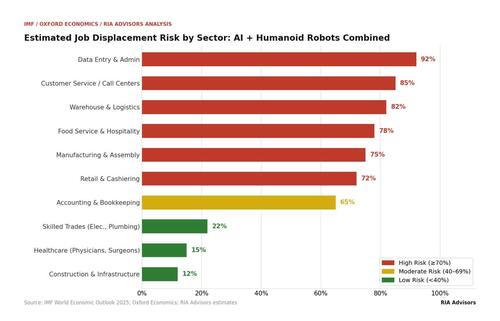
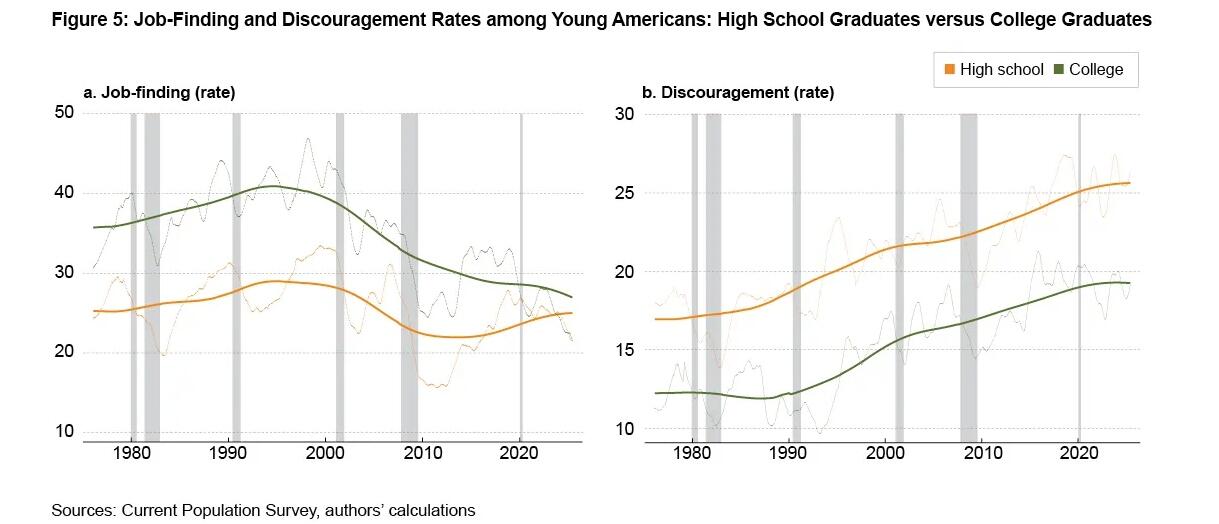
We already discussed the structural challenge in our January 2026 piece on AI Productivity, Employment, and UBI. The IMF estimates that AI could significantly affect nearly 40% of jobs worldwide. But the distribution of risk is deeply unequal. Entry-level roles, historically the on-ramp for younger workers without established skills, are exactly the jobs being automated first.

“The pace of technological change means millions of Americans face an uncertain labor market. Young workers entering the workforce find fewer traditional hiring pathways and rising expectations around digital and AI‑related skills. Older workers frequently lack the time or resources to retrain in rapidly shifting skill environments. Across age groups, employers deploying AI experience reduced labor costs and increased productivity, which simultaneously puts pressure on wages and job security.”
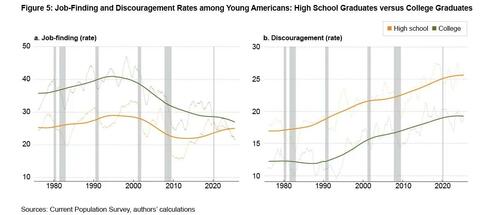
The problem already exists, and robots will likely only make things worse. For example, layoffs in 2025 ran more than 50% above the prior year, according to Challenger, Gray & Christmas. That displacement risk will grow further as robots enter the mainstream.
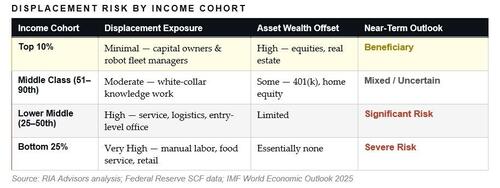
As we concluded in that previous article:

“The reality is stark. The economy may grow, but how the gains are distributed will determine whether everyday Americans thrive or struggle. Without structural policy interventions, technological displacement risks widening income inequality and weakening labor market attachment. The promise of more leisure, education, and family time from productivity gains remains theoretical. If workers lack stable incomes, employment opportunities, or bridging support, the rest won’t matter.”

But, this is where the “cries for UBI” become most vocal.

The UBI Trap

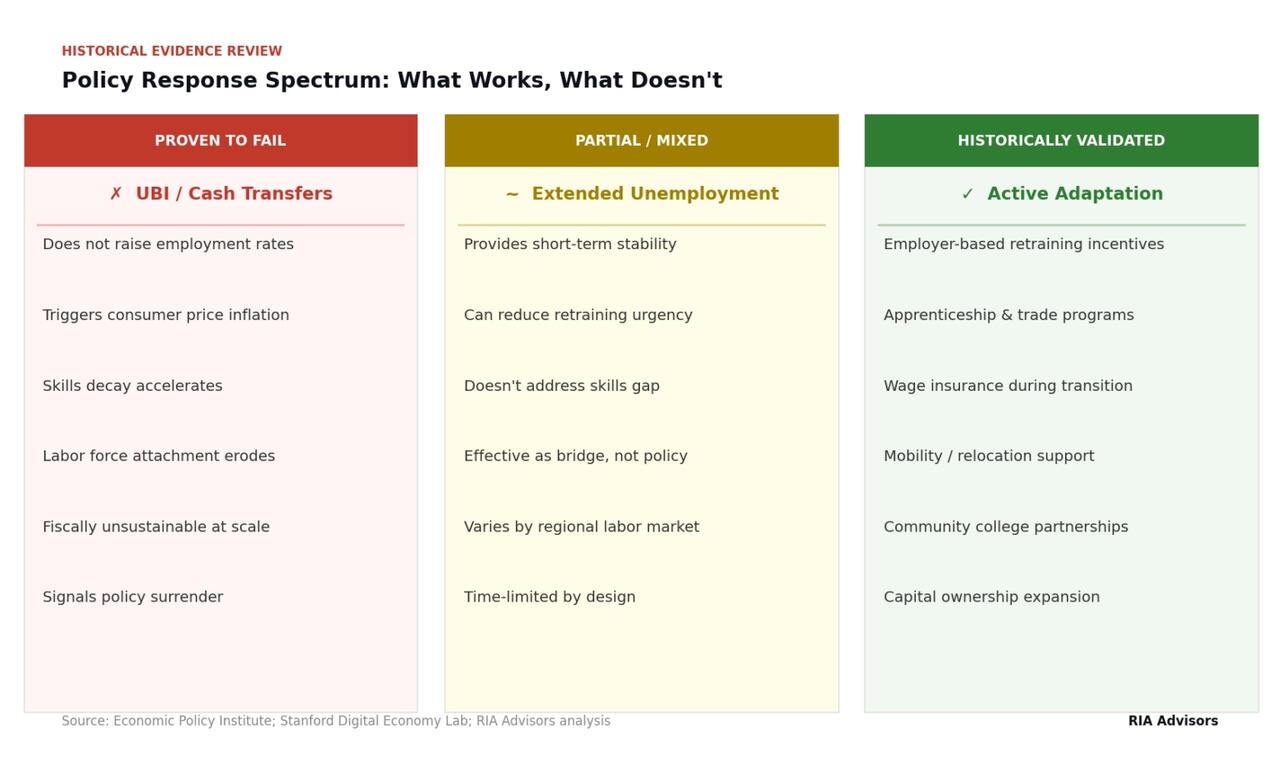
When people confront this picture, the political reflex is predictable: send checks. Universal Basic Income has become the default policy proposal for managing automation-driven displacement, and it’s worth taking seriously, not because it works, but because understanding why it doesn’t tells you a great deal about what actually might.

We covered the evidence in detail in our earlier piece on UBI experiments. The real-world results were consistent: cash transfers increased short-term consumption and reduced reported stress. They did not raise employment. They did not meaningfully increase retraining, skill development, or entrepreneurship. The largest behavioral response was an uptick in what researchers categorized as “social and solo leisure activities.” Legendary investor Howard Marks framed the core problem plainly: financial support alone cannot replace the psychological and social benefits of employment. Work provides identity, structure, and purpose, not just income. A check replaces the wage. It replaces nothing else.

The structural flaw is deeper than behavioral. An economy cannot function on transfers alone. Production must precede consumption. When the government sends checks to households without a corresponding increase in productive output, the result is inflation, exactly what 2020–2022 demonstrated. Producers observe increased purchasing power and raise prices to capture it. The real value of the transfer evaporates. A national UBI program large enough to offset meaningful displacement would cost trillions annually, requiring higher taxes or debt expansion, each of which suppresses the private investment needed to create new roles.
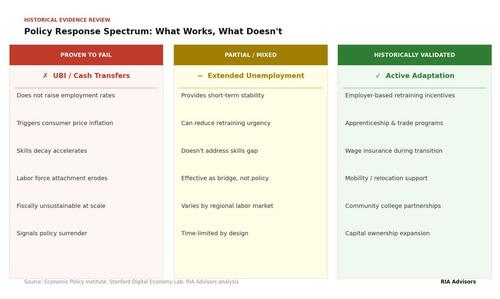
While that all seems bad, there is a more optimistic possibility, and why I want to push back on the dystopian framing. First, I don’t think the outcome is predetermined. The Industrial Revolution created enormous displacement: artisans lost work to mechanized production, and whole trades disappeared. But it also produced a century of rising living standards for people who successfully transitioned into new economic roles. The difference between that transition going well and going badly was not a UBI check. It was access to new skills, new institutions, and new markets.

The economy of humanoid robots creates real demand for roles that robots genuinely cannot fill. Trades requiring tactile judgment in unpredictable environments, such as master electricians, structural engineers, and experienced surgeons, aren’t going anywhere quickly. Secondly, AI and robotics are capital-intensive industries themselves, generating sustained demand for maintenance technicians, fleet managers, training data specialists, and deployment engineers. These aren’t science-fiction roles, but the downstream jobs for the infrastructure being built right now.

Lastly, there’s one lever that doesn’t get discussed enough: ownership. The K-shaped economy is, at its core, a problem of capital ownership. The households that benefit from automation are the ones that own the companies deploying it. Expanding the share of Americans with meaningful exposure to productive capital, whether through 401(k) reforms, Employee Stock Ownership Plans, or accessible investment platforms, does more for long-term inequality than any transfer payment. If a displaced warehouse worker owns shares in the company whose humanoid robots replaced her, the economics look very different than if she doesn’t.

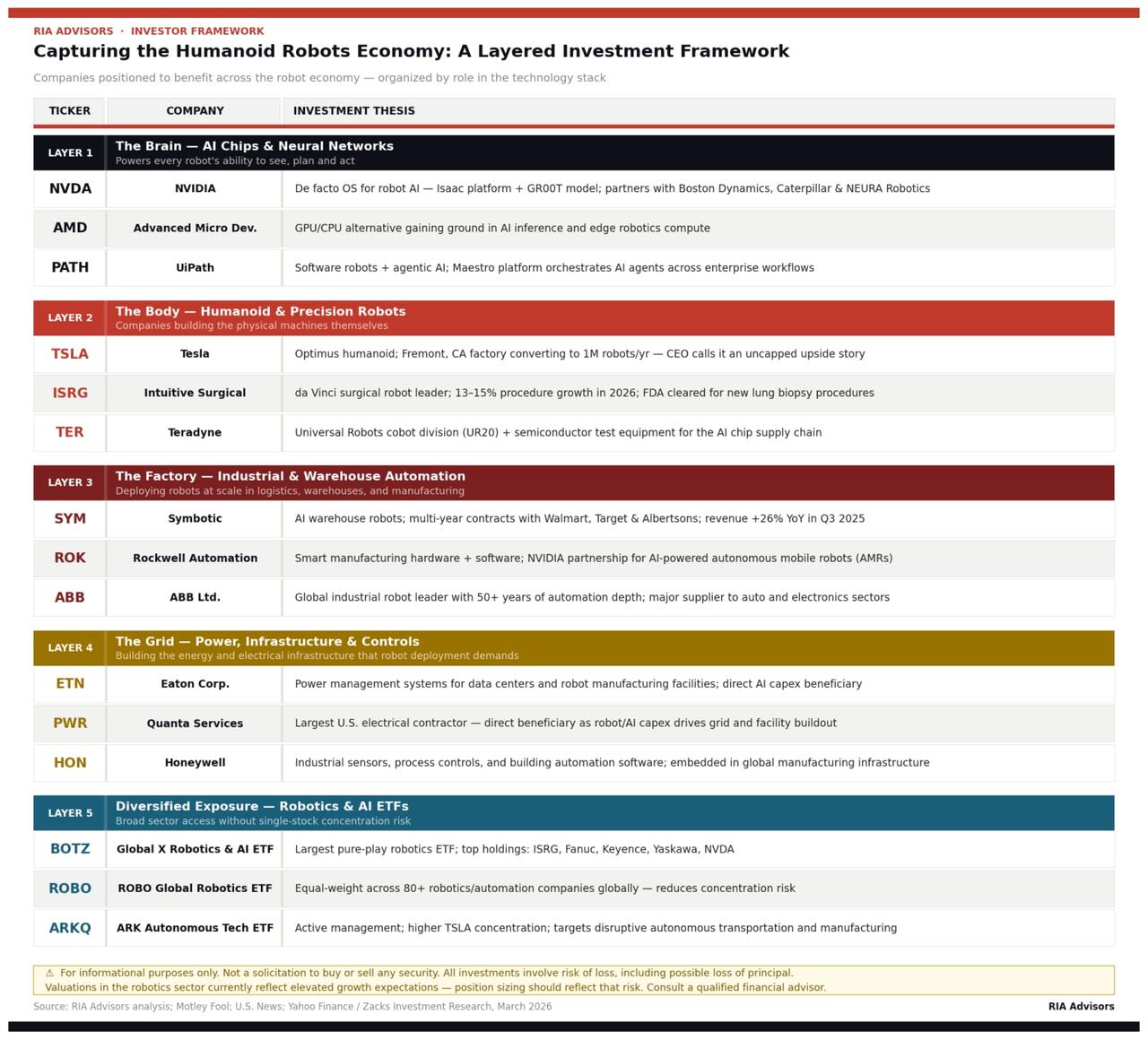
What This Means for Investors Right Now

From a portfolio standpoint, the humanoid robots economy creates some of the most asymmetric opportunities I’ve seen in my career. However, the risk distribution is equally asymmetric, and most retail investors are positioned to capture the downside more than the upside.

The companies building the enabling infrastructure, robotics manufacturers, neural network chip designers, industrial automation software, and energy infrastructure to power the compute are the obvious beneficiaries. But valuations in that space already reflect extraordinary expectations. Morgan Stanley’s Global Investment Committee assigns roughly a 50/50 probability to AI-related capital expenditures meeting investor expectations, noting that implementation timelines frequently slip and productivity gains tend to concentrate in a handful of large firms. That’s not a reason to avoid the sector. It is a reason to size positions carefully and not chase narratives at elevated multiples.

The overlooked angle is the deflationary pressure on companies that rely heavily on service labor. Hospitality, food service, residential services, and logistics firms currently trade at labor cost structures that will look dramatically different in five to seven years. For some, that’s a margin expansion story. For others, it’s a demand destruction story. A significant portion of their customer base works in exactly the jobs being displaced. The companies that survive the transition are the ones that both reduce labor costs and retain the purchasing power of their customer base. That’s a genuinely difficult needle to thread.
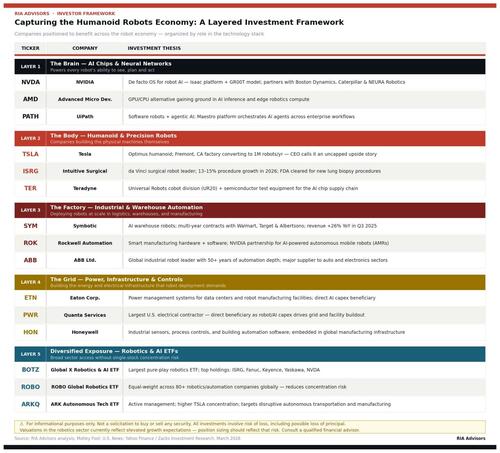
The investors who benefit most from the humanoid robots economy will be those who own the productive assets. Investing in equities, real estate, and capital-allocating businesses will far outpace depending solely on earned income. That pattern is not new. It’s the same dynamic that has driven the K-shaped divergence for the past 50 years. The robotics revolution amplifies it; it doesn’t invent it. Which means the single most important investment decision most Americans can make today has nothing to do with picking the right robotics stock. It’s making sure they own enough capital to participate in the upside that’s coming, whatever form it ultimately takes.

The age of abundance is coming. I genuinely believe that. But abundance distributed through ownership looks completely different from abundance distributed through government transfers. The first compounds. The second erodes. History has run this experiment repeatedly, and the result is not ambiguous. The question isn’t whether humanoid robots will transform the economy. They already are. The question is whether you’re positioned on the right side of the ledger when they do.

Tyler Durden
Fri, 05/01/2026 – 19:45

via ZeroHedge News https://ift.tt/zSvjJuG Tyler Durden

New California DMV Rules Allow Autonomous Vehicles To Be Cited

New California DMV Rules Allow Autonomous Vehicles To Be Cited

Authored by Lear Zhou via The Epoch Times (emphasis ours),

SAN FRANCISCO—Driverless vehicles such as Waymo robotaxis could be ticketed for moving violations, according to updated autonomous vehicle (AV) regulations approved by the California Department of Motor Vehicles (DMV) on April 28, to enhance safety, oversight, and enforcement requirements.

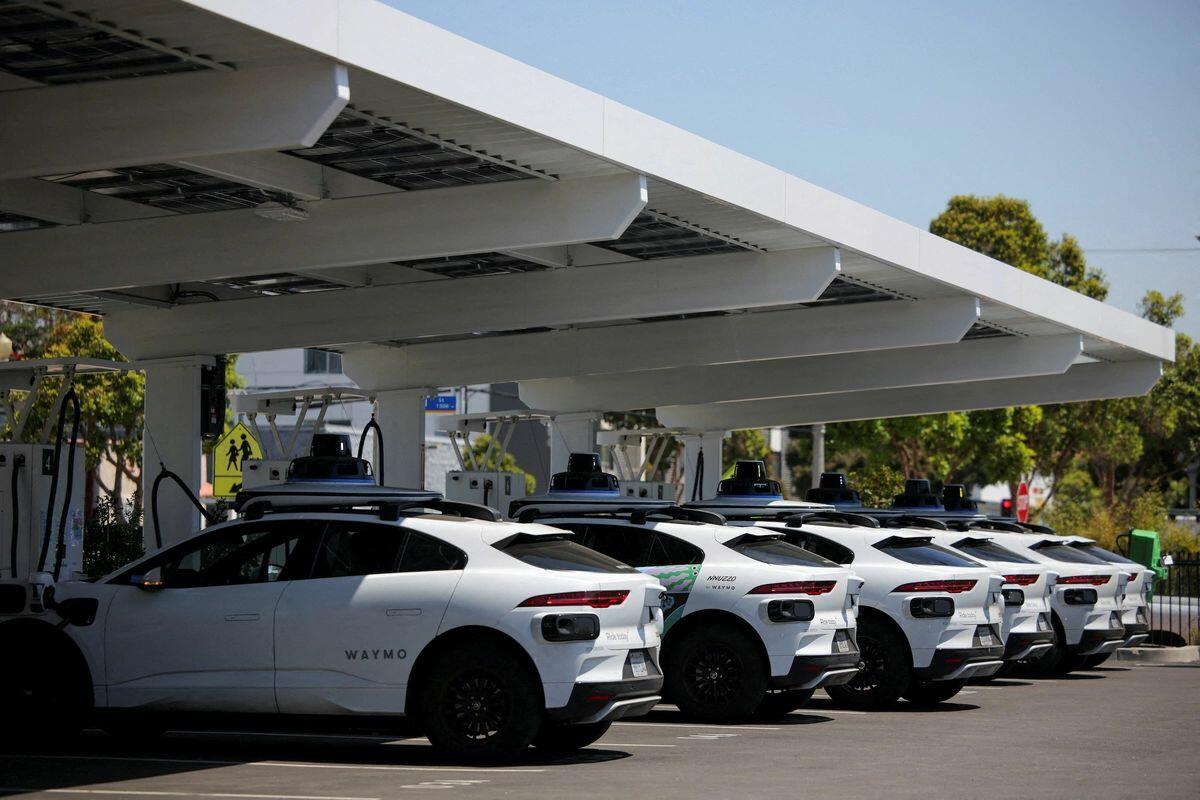
Waymo driverless vehicles charge at a Waymo charging station in Santa Monica, Calif., on May 30, 2025. Daniel Cole/Reuters

The new rules allow law enforcement agencies to cite the companies that own the AVs for traffic violations committed by their vehicles.

Part of the regulations, which were implemented based on the California Legislature’s Assembly Bill 1777, also require companies to respond to calls from police, firefighters, and other emergency officials within 30 seconds.

The rules also authorize emergency response officials to issue electronic geofencing requests to an AV manufacturer to direct its AV fleet to leave or avoid the area within two minutes. “AVs that violate this restriction may be subject to permit restrictions or suspension,” according to DMV’s news release.

Autonomous vehicle innovators operating in California have a clear, workable path to test and deploy, ensuring the state will continue to benefit from autonomous technology through safer roads, enhanced accessibility, and strengthened supply chains.” said Jeff Farrah, CEO of the Autonomous Vehicle Industry Association (AVIA), referring to the new regulation in an April 29 statement.

AVIA is a non-governmental organization advocating for the safe and timely deployment of autonomous driving technologies.

The new rules send a clear message that “autonomy does not remove responsibility,” Ahmed Banafa, an engineering professor of San Jose State University, told The Epoch Times via email.

“These vehicles must integrate smoothly into real-world environments that include law enforcement, pedestrians, and unpredictable situations.” he said.

Previously law enforcement officers often didn’t know how to deal with driverless cars. The new rules are meant to lead to more standardized procedures, clearer communication channels, and better coordination between AV fleets and the law enforcement agencies.

While it may introduce additional compliance costs and slow down some rollouts, it creates a clearer framework for companies to operate within,” Banafa said.

DMV’s new rules based on AB 1777 would require AV manufacturers to maintain a dedicated emergency response telephone line, and equip each AV with a two-way voice communication device for emergency response officers to communicate with a remote human operator.

The deadline for the AV companies to comply was set as July 1, 2026.

The rule updates come after issues were revealed involving autonomous vehicles in San Francisco, including Waymo cars blocking intersections during a massive blackout that disabled traffic signals in December.

The San Francisco Fire Department also complained after dozens of incidents involving driverless vehicles interfering with emergency response teams in 2023.

To comply with the new regulations, the AV manufacturers must increase human involvement, but in a different form, Banafa ssaid. “Humans are now part of a centralized support system rather than physically inside the car.”

On Feb. 4, 2026, in a Senate Commerce Committee hearing, Waymo’s chief safety officer Mauricio Peña testified that when the company’s robotaxis encounter unusual situations, a remote human operator may step in.

Peña said some of the operators are located in the United States, while other workers are abroad, including in the Philippines.

Tyler Durden
Fri, 05/01/2026 – 18:55

via ZeroHedge News https://ift.tt/F5pNRLW Tyler Durden

Trump Pulling 5,000 US Troops From Germany In Punitive Move Amid Merz Spat

Trump Pulling 5,000 US Troops From Germany In Punitive Move Amid Merz Spat

In a huge late in the day Friday development, the Trump administration plans to pull some 5,000 troops from NATO member Germany, CBS is reporting. Citing senior defense officials, the Pentagon expects the troop draw down will happen over a six to twelve month period, Reuters has also separately reported, in what clearly appears a punitive measure aimed at Berlin by the Trump White House.

Over several years, and stretching back decades, the US has maintained the most number of troops on the European continent in Germany – currently estimated at over 36,000 active duty personnel. So the 5,000 – while significant – is still somewhat of a symbolic move and number.

Source: DPA

The large US presence hearkens back to the post WWII division of Germany and post-war order, and is also a legacy of the Cold War. Ironically at this very moment European leaders have hyped a ‘new Cold War’ with Russia, as the Ukraine war continues raging.

“The officials characterized the move as a signal of President Trump’s discontent with the level of assistance that European allies have offered in the U.S.-Iran war,” CBS writes.

The significance of the planned move also lies in the fact that America’s German bases serve as headquarters of US European Command and Africa Command – with the historic Ramstein Air Base being the key hub.

The announcement via US reporting comes just a day after Trump again lambasted German Chancellor Friedrich Merz:

“The Chancellor of Germany should spend more time on ending the war with Russia/Ukraine (Where he has been totally ineffective!), and fixing his broken Country, especially Immigration and Energy, and less time on interfering with those that are getting rid of the Iran Nuclear threat, thereby making the World, including Germany, a safer place!” Trump wrote on Truth Social.

Merz had in a rare moment torched US foreign policy and the Trump administration’s Iran war gambit in Monday remarks given at a local event in Germany.

Included in that very head-on critique of Operation Epic Fury came in the following: “An entire nation is being humiliated by the Iranian leadership, especially by these so-called Revolutionary Guards. And so I hope that this ends as quickly as possible.”

Merz had also claimed, “If I had known that it would continue like this for five or six weeks and get progressively worse, I would have told ​him even more emphatically.” ​

Yet the reality is that criticisms from EU leaders in the opening days were somewhat muted, meager, and weak. Indeed, where was Merz during the opening days of Operation Epic Fury as it was bombs away?

Tyler Durden
Fri, 05/01/2026 – 18:30

via ZeroHedge News https://ift.tt/luCi6ck Tyler Durden

In Charts: Communist Cuba’s Lights Dim Amid US Oil Blockade

In Charts: Communist Cuba’s Lights Dim Amid US Oil Blockade

Authored by Sylvia Xu, Andrew Moran via The Epoch Times (emphasis ours),

Blackouts, shortages, fuel rationing, and empty streets now define daily life in Cuba.

People wait to fill their water containers during a nationwide blackout in Havana on March 22, 2026. Cuban authorities scrambled on March 22 to restore power to the island after the second nationwide blackout in less than a week, as the grid struggles due to an aging infrastructure and a U.S. oil blockade. Yamil Lage/AFP via Getty Images

Although the norm for decades, these hardships have reached catastrophic proportions as the island nation suffers its worst energy and economic crisis since the fall of the Soviet Union.

Cuba’s energy infrastructure is collapsing amid restrictions on oil imports from its key ally Venezuela, along with a U.S. military operation that has further disrupted Venezuela’s production and shipping.

With the country’s main supplier impaired, Havana is without the energy needed to keep its grid stable, leading to rolling blackouts and widespread shortages of everything from medicines to food.

The White House aims to push the communist-led nation into talks and concessions. A combination of indirect pressure through increased tariffs on Cuba’s oil suppliers and direct intervention by the U.S. Coast Guard in the region has amounted to an effective blockade of the island.

A tugboat guides a Russian oil tanker as it arrives at the oil terminal in the port of Matanzas, Cuba, on March 31, 2026. The shipment of 730,000 barrels marked Cuba’s first crude import in three months as the White House aims to push the communist-led nation into talks and concessions. Yamil Lage/AFP via Getty Images

In February, the United States made a key exception: the sale of fuel directly to private businesses in Cuba. The shipments are small, however, totaling an estimated 30,000 barrels so far this year.

The Trump administration is showing some signs of easing pressure, allowing a Russia-flagged tanker to deliver 730,000 barrels of oil to Cuba on March 31—the island’s first sizable import of crude in three months. Given Cuba’s daily needs of nearly 80,000 barrels per day in 2025, the shipment provided less than 10 days of supply.

A gas station remains closed due to a lack of fuel in Havana on March 24, 2026. Cuba’s government confirmed on April 20 it had returned to the table to meet with U.S. officials, seeking to ease tensions and address energy restrictions. Yuri Cortez/AFP via Getty Images

Risky Reliance on Imported Oil

Imported oil is the lifeblood of Cuba’s energy infrastructure; net crude oil imports accounted for nearly 60 percent of the country’s total supply as of 2023, according to the International Energy Agency (IEA).

For more than 25 years, those imports primarily came from Venezuela, under a bilateral agreement based on bartering products and services instead of cash payment.

Alternative suppliers have included Mexico (25 percent), Russia (10 percent), and Algeria (4 percent), according to S&P Global Commodities at Sea data.

Even before the current blockade, imports from Venezuela and Mexico were jeopardized by those countries’ struggles to maintain fuel production.

Venezuela’s once-thriving petroleum industry has been crippled by years of mismanagement and sanctions, although the United States is now working with the interim government to rebuild its crumbling energy infrastructure.

Mexico’s state-owned company Pemex ended 2025 with its lowest level of production in 46 years amid operational and financial constraints on the country’s oil sector.

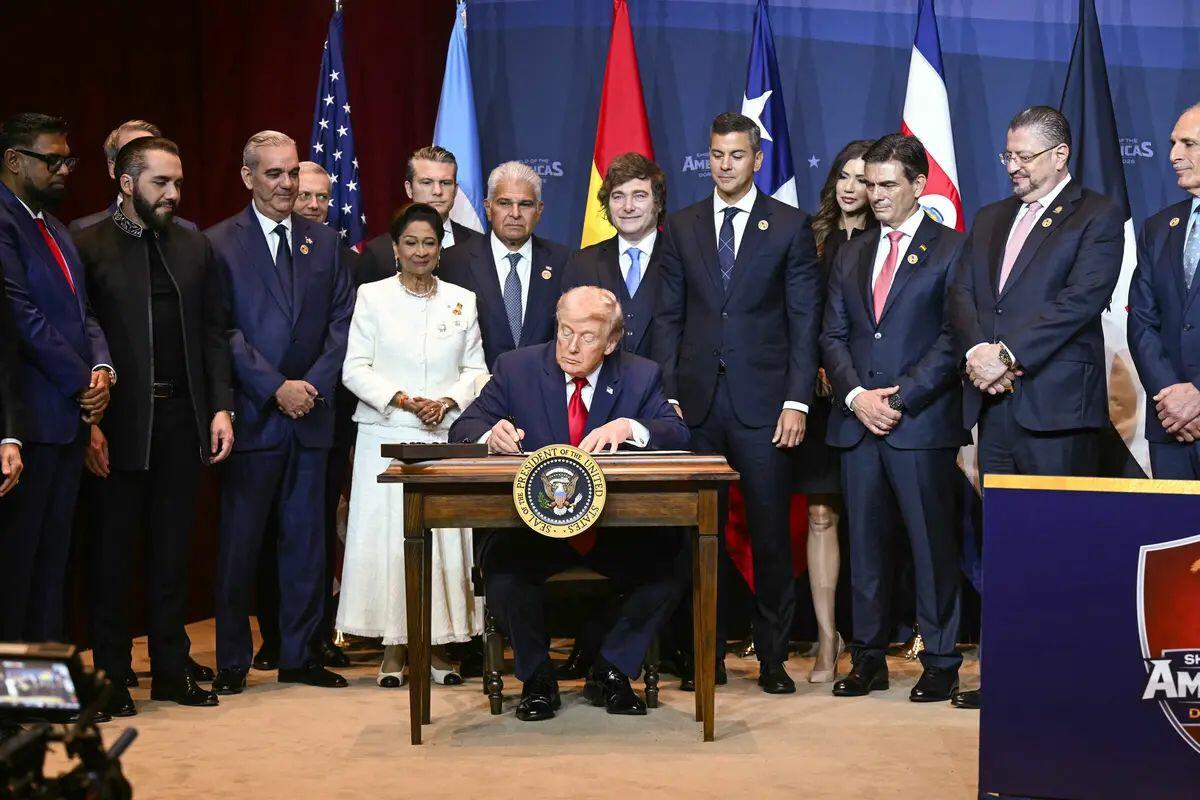
U.S. President Donald Trump signs a proclamation at the Shield of the Americas Summit at Trump National Doral in Miami on March 7, 2026. Trump said the United States is “looking forward to the great change” coming to Cuba following what he called a

Energy Blockade

Now, U.S. foreign policy is making it even more difficult for Cuba to navigate global energy markets.

Following the U.S. capture of Venezuelan leader Nicolás Maduro on Jan. 3, President Donald Trump persuaded interim leader Delcy Rodríguez to halt oil and gas exports to Cuba.

A small shipment of oil from Mexico—86,000 barrels—arrived in Cuba on Jan. 9.

But crude oil flowing from Mexico dried up after Trump ramped up pressure on Jan. 29 with an executive order imposing tariffs on any country that “directly or indirectly provides oil to Cuba.” On Feb. 2, Trump announced that Mexico would cease oil shipments to Cuba.

On March 7, Trump told the Shield of the Americas summit: “As we achieve a historic transformation in Venezuela, we’re also looking forward to the great change that will soon be coming to Cuba. 

Cuba is at the end of the line. … They have a bad regime that’s been bad for a long time. And they used to get the money from Venezuela.”

Cuban leader Miguel Díaz-Canel announced March 13 that the regime had opened talks with the United States, and on April 20, U.S. diplomats set foot on Cuban soil for the first time since 2016. 

Alejandro García del Toro, deputy director general in charge of U.S. affairs at the Cuban Ministry of Foreign Affairs, said that “the elimination of the energy embargo against the country was a top priority” for the meetings.

Senate Republicans on April 28 rejected Democratic legislation that would stop the energy blockade of Cuba without congressional approval.

Energy Sources

Over the past two decades, Cuba has attempted to somewhat emulate its neighbors Jamaica and the Dominican Republic, which have managed to offset their petroleum needs with coal, natural gas, and renewables.

The Castro regime in 2005 launched an “energy revolution”—introducing solar and wind, bolstering bioenergy consumption, and expanding distributed generation—in an attempt to diversify the country’s energy portfolio. 

However, the leadership failed to address fundamental problems, such as aging Soviet-era infrastructure, underinvestment, reliance on subsidized crude, failure to finance new technologies, and lack of long-term planning and maintenance.

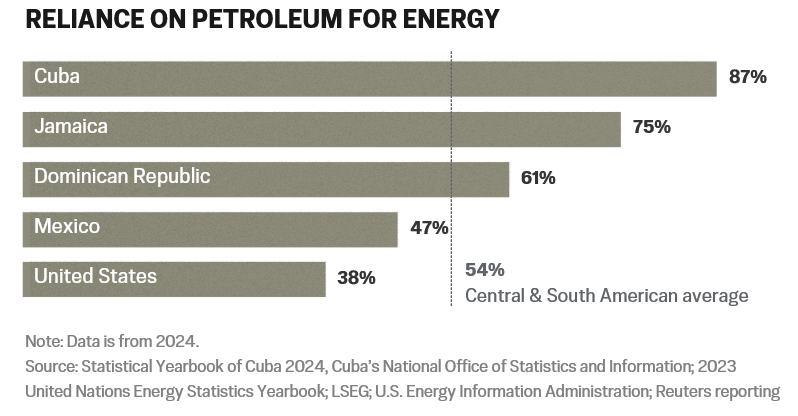
As of 2024, Cuba still relied on oil for 87 percent of its energy, exceeding the Central and South American average of 54 percent, according to a Reuters analysis.

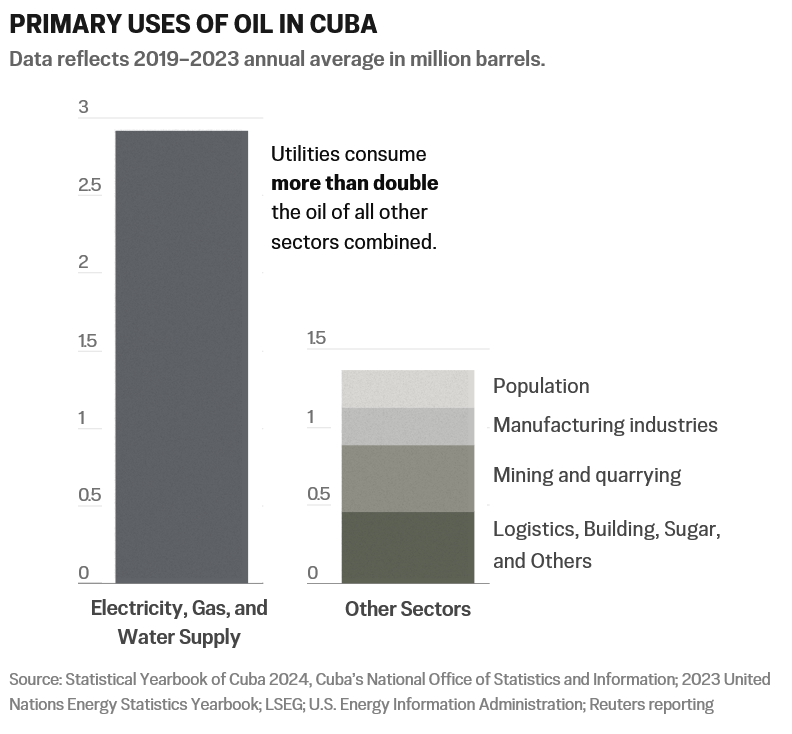
The island nation dedicates more than 80 percent of its oil to electricity generation, according to 2023 data from the IEA. In fact, utilities consume more than double the oil of all other sectors combined, underscoring Cuba’s reliance on petroleum.

Cuba’s thermoelectric infrastructure, loaded with high-sulfur oil, is “old, tired, and highly inefficient,” Jorge Piñon, senior research fellow at the University of Texas at Austin’s Energy Institute, said in a 2023 interview with the Center for Engagement and Advocacy in the Americas.

To revive its power system, Cuba “must decentralize its economic model and resolve its political differences with the United States.”

Cuba has to abandon its failed Soviet-style centralized command economic model based on state ownership of all means of production and industrial transformation,” Piñon said.

“It should welcome a market economic system in which the decisions regarding investments and production are guided by supply and demand market forces.”

More than 1 million individuals have fled Cuba since 2021. Analysts compare the exodus to that seen during 1994’s Special Period—a time of food scarcity, energy shortages, and agricultural decimation after the demise of the Soviet Union.

Tyler Durden
Fri, 05/01/2026 – 18:05

via ZeroHedge News https://ift.tt/Wtqip39 Tyler Durden

5th Circuit Panel Blocks 2023 Mifepristone Telemedicine Approval

It has been a very busy 48 hours for Louisiana. On Wednesday, the Supreme Court decided Callais. The following day, the Governor announced he would suspend the upcoming primary elections to allow the legislature to redistrict. There is also litigation before the Supreme Court about the issuance of the judgment in Callais. Earlier today, the Governor was sued to enjoin the cancellation of the election.

And just a few moments ago, the Fifth Circuit panel granted a stay in Louisiana’s challenge to the mifepristone telemedicine approval from 2023. What, you thought the case was over after Alliance for Hippocratic Medicine? You have not been following the Fifth Circuit closely enough.

For now, I will just paste the introduction of Judge Kyle Duncan’s panel opinion.

In Dobbs v. Jackson Women’s Health Organization, 597 U.S. 215 (2022), the Supreme Court returned the regulation of abortion to the states. In response, the Biden Administration directed federal agencies to “expand access to . . . medication abortion.” Exec. Order No. 14076, 87 Fed. Reg. 42053 (July 8, 2022). The next year, the Food and Drug Administration (FDA) formally altered its safety guidelines for the abortion drug mifepristone. Under the new regulation, the drug could now be prescribed online and dispensed through the mail, without any need for an in-person visit to a doctor. In 2025, Louisiana challenged the new regulation in federal court under the Administrative Procedure Act (APA). It argued that FDA’s justifications for remotely dispensing mifepristone were based on flawed or nonexistent data. It also documented how the new regulation had resulted in numerous illegal abortions in Louisiana and in Louisiana paying thousands in Medicaid bills for women harmed by mifepristone. Louisiana sought a stay of the regulation while the litigation proceeded. In response, FDA conceded it had failed to adequately study whether remotely prescribing mifepristone is safe. But the agency resisted staying the regulation, arguing it was in the midst of a comprehensive review of mifepristone protocols. The agency, however, could not say when that review might be complete and admitted it was still collecting data. The district court agreed that Louisiana was likely to win its challenge to the mifepristone regulation and was suffering irreparable harm from it. Nonetheless, the court declined to stay the regulation based on its balancing of the equities and the public interest. Louisiana appealed to our court and sought a stay pending appeal under 5 U.S.C. § 705.

We grant the stay.

This case should get to the Supreme Court ver soon.

To be clear, this ruling would not take mifepristone off the market. But it would require people to have an in person evaluation before receiving a prescription for the abortion drug. Post-Dobbs, the number of abortions nationwide has likely increased, in large part, because of the telemedicine requirement. Doctors in blue states send these pills to Louisiana, Texas, and other red states, and are protected by state shield laws. But if there is an in-person requirement to prescribe the drug, those doctors would not be able to dispense across state lines.

The Trump Administration likely does not want this headache. The government has raised a host of standing and other procedural defenses, but has not defended the Biden decision on the merits. Let’s see what SG Sauer does before the Supreme Court everyone.

The post 5th Circuit Panel Blocks 2023 Mifepristone Telemedicine Approval appeared first on Reason.com.

from Latest – Reason.com https://ift.tt/Yh8teVK
via IFTTT

First Circuit Stays Court Order Commandeering New Hampshire (Though Doesn’t Rely on Anti-Commandeering Arguments)

Yesterday a panel of the U.S. Court of Appeals for the First Circuit stayed a district court injunction, pending appeal, that would have commandeered New Hampshire by requiring it to maintain a vehicle emissions inspection program to comply with the federal Clean Air Act. As I explained here and here, the court’s order violated the anti-commandeering doctrine (though the state had not made much effort to make this argument).

The unsigned order (on behalf of Chief Judge Barron and Judges Aframe and Dunlap) concluded (correctly) that New Hampshire was likely to prevail on the merits, even if it did not conclude that the order violated the anti-commandeering doctrine. Rather, the court concluded that Gordon-Darby, which had sued New Hampshire in order to protect its lucrative vehicle emissions testing contract, was premature in alleging the state was “in violation of” the Clean Air Act when it sued under the law’s citizen suit provision, as the state law terminating the vehicle emissions inspection program had not yet taken effect. While the relevant case law allows citizen suits for past or present violations, the district court, in effect, allowed a suit for (and entered an injunction against) wholly prospective violations.

Having concluded New Hampshire was likely to succeed on the merits, it was easy for court to further conclude that the injunction would cause irreparable injury by “forc[ing] a State to continue enforcing a program that the State’s legislature has repealed.” It further noted that any benefit to Gordon-Darby from the injunction was speculative, as forcing New Hampshire to continue the emission inspection program would not guarantee that Gordon-Darby would get the contract.

It is too bad the court saw no need to reach the state’s commandeering or other federalism arguments, but entirely understandable. The Gordon-Darby suit was a transparent ploy to preserve a lucrative contract that the state had lawfully terminated, and like many such ploys, it was not well-grounded in the law.

Perhaps anticipating the First Circuit’s order, on Wednesday the district court denied Gordon-Darby’s quite audacious request to hold New Hampshire officials in contempt and award sanctions. The district court judge apparently thought better of holding state officials in contempt for failing to urge or enact laws the federal government has no authority to compel.

As a technical matter, New Hampshire’s appeal remains pending, but there should be little question anymore about how this litigation will end.

The post First Circuit Stays Court Order Commandeering New Hampshire (Though Doesn't Rely on Anti-Commandeering Arguments) appeared first on Reason.com.

from Latest – Reason.com https://ift.tt/dU4cKmB
via IFTTT

The Major Questions Doctrine Constrains Presidential Power Over Elections

NA

Donald Trump has been trying to “nationalize” (his term, not mine) control over elections, claiming sweeping presidential power to control voting processes in a variety of ways. In a compelling recent post at the Election Law Blog, Richard Bernstein explains why these moves run afoul of the major questions doctrine:

Briefing has begun in the cases challenging President Trump’s latest attempt to arrogate power over federal elections to the federal executive branch—EO 14399’s direction that the USPS provide lists states of voters eligible to vote by mail and to block the mail-in votes of those not on the USPS lists.  The Society for the Rule of Law (with me as counsel) filed an amicus brief arguing, at pages 10-14, that the major questions doctrine applies to interpretations of federal agency authority on elections issues.  That brief is linked here.  The lack of authority for EO 14399 is so clear that a federal court does not need to rely on the major questions doctrine in order to invalidate EO 14399.  But it should, as an alternative holding….

Before a federal agency has authority to regulate a major question, a statute must provide “clear congressional authorization.” West Virginia v. EPA, 597 U.S. 697, 723-24 (2022).  “[M]odest words, vague terms, or subtle devices” do not suffice.  Id. at 723.  Under  the major questions doctrine, courts “presume that Congress intends to make major policy decisions itself, not leave these decisions to agencies.”  Id. at 723 (quotations omitted).  This reflects “both separation of powers principles and a practical understanding of legislative intent.”  Id. at 723-24.  “[A] reasonable interpreter would not expect Congress to pawn . . . a big-time policy call . . . off to another branch.”  Learning Resources, Inc. v. Trump, 146 S. Ct. 628, 641 (2026) (plurality opinion) (“Learning Resources Plurality”) (cleaned up).  Deciding what is a major question also reflects “constitutional structure and common sense.”  Id. at 639.

The major questions doctrine is especially suitable for federal agency regulations of federal election issues.  That is because federal elections control who exercises federal legislative and federal executive power.  To compare an election issue to Learning Resources, Congress has the power to impose tariffs, but federal elections decide who exercises that power and every other legislative and executive power, and therefore how all those powers are exercised.  As James Madison explained in Federalist No. 51, “[a] dependence on the people” through elections “is, no doubt, the primary control on the government.”

The Elections Clause unmistakably vests the power to decide the rules for federal elections in legislatures – first and foremost state legislatures, subject to alteration by Congress.  Congress has not been shy about exercising this power…..

Allocating power to any President to make election rules would be a fundamental departure from our constitutional structure.  Our federalist election structure, designed by the Elections and Electors Clauses and still upheld in federal election statutes, fosters both the reality and appearance of election integrity by decentralizing election rules and who executes them.  In our nation’s history, it is rare that control of either house of Congress or the Presidency is decided by a single disputed election in one state.  Thus, stealing control would require a conspiracy involving officials in multiple states.  Stealing such control would be easier if the unitary federal executive branch could make rules for, and exercise greater power over, federal elections in all 50 states.

I largely agree. The major questions doctrine   (MQD) requires Congress to “speak clearly” when authorizing the executive to make “decisions of vast ‘economic and political significance.'”  If the statute is ambiguous, courts must presume that Congress didn’t give the executive branch the authority it claims.

Previous Supreme Court major questions decisions – most recently, the tariff case, which Bernstein cites and  which I helped litigate – concerned assertions of power over substantive policy issues. These election cases concern power over procedures. Nonetheless, as Bernstein notes, control over elections is a way to leverage vast power over a range of issues (because election winners get to make a variety of policy decisions), and that control is crucial to America’s system of federalism and separation of powers. Thus, when the president claims sweeping delegations of power over election procedures, the major questions doctrine applies.

And, as in the case of tariffs, the Constitution gives the president no inherent power over election procedures. Any authority he might have must be delegated by Congress exercising its Article I power to “make or alter” state regulations relating to the time, place, and manner of congressional elections.

To be sure,  MQD would not apply in situations where the executive claims he has been delegated only some relatively minor power, such as authority over some minor aspect of election administration. But here, the White House is claiming far greater authority than that.

NOTE: The amicus brief Bernstein refers to was filed on behalf of the Society for the Rule of Law. the Society for the Rule of Law. I am a member of SRL’s Advisory Council (an unpaid position).

The post The Major Questions Doctrine Constrains Presidential Power Over Elections appeared first on Reason.com.

from Latest – Reason.com https://ift.tt/GjSV15B
via IFTTT

Trump’s Iran War Continues to Violate the Constitution – and Now Also the War Powers Act of 1973

Defense Secretary Pete Hegseth speaks during a press conference at the Pentagon.
 Secretary of Defense Pete Hegseth. (Kyodonews/Zuma Press/Newscom)


In my March 5 Dispatch article on the Iran War and the Constitution, I explained why Donald Trump’s initiation of the war without congressional authorization is unconstitutional. As of today, it is also in violation of the War Powers Act of 1973. Enacted in the wake of the Vietnam War, the WPA requires the president to secure congressional approval within 60 days of entering U.S. troops into “hostilities” or situations “where imminent involvement in hostilities is clearly indicated by the circumstances.” The president can seek a 30 day extension without additional congressional authorization, but Trump has not done so in this case.

The sixty day deadline expires today. Therefore, Trump is now in violation of the WPA, as well as the Constitution. Yesterday, Secretary of Defense Pete Hegseth claimed that the WPA clock “stops” because of the ongoing ceasefire with Iran, curently still (tenuously) in effect. But the WPA doesn’t just apply to situations where US forces are in active combat. It also applies “where imminent involvement in hostilities is clearly indicated by the circumstances.” Such “imminent involvement” is indeed “clearly indicated” now. Most informed observers know the ceasefire could break down at any time. Trump himself repeatedly threatens to restart the fighting. Thus, the WPA clock is still ticking, and Trump is now in violation of that law. This violation is not as grave an issue as his violation of the Constitution. But it is significant nonetheless.

Earlier in the conflict, some defenders of the administration claimed that the WPA authorized Trump to start the war without congressional approval. In my Dispatch article, I explained why this claim is false. The WPA is a limitation on executive power, not a grant:

Many, particularly on social media, argue that Trump’s actions are authorized by the War Powers Act of 1973. But the WPA is a limitation on presidential power, not a grant of it…

The purpose of this requirement is to constrain even small-scale combat deployments that might otherwise not require congressional authorization, because they fall short of being a war. Section 2(C) of the WPA makes clear that the statute does not expand presidential war initiation authority, emphasizing that “[t]he constitutional powers of the President as Commander-in-Chief to introduce United States Armed Forces into hostilities, or into situations where imminent involvement in hostilities is clearly indicated by the circumstances, are exercised only pursuant to (1) a declaration of war, (2) specific statutory authorization, or (3) a national emergency created by attack upon the United States, its territories or possessions, or its armed forces.” None of these three preconditions exist in the current situation.

Even if the WPA did, initially, grant Trump authority to wage this war, it now no longer does.

As also discussed in my Dispatch article, I am not completely averse to the idea of waging war against Iran. Replacing the brutally oppressive anti-American government with a better one would be a great gain. But, so far, there is little evidence that The US and Israel are likely to achieve any significant gains that justify the costs. And, as noted in my earlier article, that failure is connected with the failure to secure broad congressional and public support for the conflict, which leaves the administration with little political capital to continue fighting if the going gets tough:

This limitation on presidential power is more than just a technical legal point. The requirement of congressional authorization for the initiation of war is there to ensure that no one person can take the country to war on his own, and that any major military actions have broad public support, which can be essential to ensuring that we have the will and commitment needed to achieve victory against difficult opponents. Trump’s failure to seek and secure that kind of broad public support has ensured that only about 27 percent of Americans approve of this military action, compared to 43 percent who disapprove, according to a Reuters poll. Other surveys show similar results. This is a historically low level of public support at the start of a major military action and bodes ill for U.S. staying power if we suffer reverses or a prolonged conflict results.

Sure enough, after Iran closed the Strait of Hormuz and energy prices greatly increased, Trump agreed to a ceasefire, despite getting few if any Iranian concessions relative to the prewar status quo.

War is dynamic, and it is certainly possible this one will take a different direction, or even reach a more desirable outcome. So far, however, it has achieved little of value.  Certainly nothing substantial enough to justify undermining our constitutional system. Among other things, the radical Islamist regime remains in power, it retains the ability to close the Strait of Hormuz, and it can still continue its nuclear program.

In my earlier article, I explained why congressional authorization is required on originalist grounds, and addressed various pragmatic arguments against enforcing the requirement.

The post Trump's Iran War Continues to Violate the Constitution – and Now Also the War Powers Act of 1973 appeared first on Reason.com.

from Latest – Reason.com https://ift.tt/mf4NCvr
via IFTTT

The Elites And Their Contempt

The Elites And Their Contempt

Authored by Rev. John F. Naugle via The Brownstone Institute,

Last week, I was unexpectedly hit with a post-lockdown trauma response. While driving to a baseball game days before the NFL Draft came to Pittsburgh, I passed a digital highway sign instructing me to avoid nonessential travel.

Suddenly, memories of empty highways with signs instructing drivers to “Stay Safe and Stay Home” came flooding back to me.

As the week developed, it began to occur to me that the parallels were deeper than my subjective emotional response. Road closures intensified, rendering my beloved city of Pittsburgh less and less functional. Even sidewalks were closed. 

Entire parking garages were emptied and abandoned. Pittsburgh’s “most visited museum,” the Kamin Science Center, has been closed to the public for weeks because it was within the footprint of the upcoming event. For the actual days of the draft, Pittsburgh Public Schools were shuttered as if a blizzard had rendered travel impossible.

How do I walk to PNC Park?

The attempt by local officials to trigger hysteria in the populace worked, maybe too well. People traveling to Pittsburgh for the event heeded the instructions to use the special free public transit to make their way in. Parking operators, expecting a huge windfall, saw themselves lower their exorbitant prices midday. For example, the Rivers Casino quickly abandoned their plan to charge $250 per day, lowering their rate to $100 for the first day of the draft and then abandoning charging altogether for subsequent days.

Local businesses outside the official footprint of the event were told to prepare for heavy crowds, but instead experienced a weekend worse than anything they had seen since the Covid hysteria. Those who didn’t want to go to the draft were terrified to go anywhere near the city.

In summary, children were deprived of education, small business owners were drastically harmed, public spaces which exist for the common good were shuttered, and normal life ceased for those who actually live in the City of Pittsburgh. While all of this was happening, local politicians were patting themselves on the back for how well everything was pulled off, taking pride that this draft broke attendance records for the NFL and that their plans of getting people in and out of the city were effective. It was our own personal Operation Warp Speed.

I think there’s a lesson here that applies not merely to Pittsburgh politics but also to the wider dysfunction we see in elected officials throughout what used to be Western Civilization.

Our political leaders view their own constituents with a sort of boredom or indifference. In the leadup to the draft, Pittsburgh, Allegheny County, and the Commonwealth of Pennsylvania engaged in a number of public works projects designed to improve the area in preparation for the draft. 

Suddenly, our governments remembered that potholes aren’t supposed to be allowed to exist and that crime isn’t supposed to be allowed to happen. For three days, Pittsburgh had a heavily subsidized and highly functional public transit system, something that hasn’t existed the entirety of my lifetime.

Any one of these projects could have been accomplished at any time, but the actual people who live there provided insufficient motivation for our leaders. Rather, what really mattered to them was looking good in front of millionaires, soon-to-be millionaires, and the powerful elites who would gather to party the night away with Nelly, Steve Aoki, and 2 Chainz.

Meanwhile, the elites themselves seem to view the common people with at least implicit contempt. They desire entire blocks to be shut down for their own amusement. The common man, including those who wait upon them, should be relegated to buses or walking so as not to encroach upon their experience. This is their party, and the city is lucky to have them there.

We live in a world where the elites view the common man as a problem to be solved and the leaders elected by the common man anxiously present themselves as lapdogs to these elites, forgetting any sense of duty or obligation to those who placed them in power.

We saw this during lockdowns, we saw this as inflation raged on, and we see it now as gas prices remain above $4. The urgent and pressing question that faces all of us: what is the political solution in a system where elected officials conspire with elites who hold the voters themselves in contempt?

Tyler Durden
Fri, 05/01/2026 – 17:15

via ZeroHedge News https://ift.tt/E1Pu9Vk Tyler Durden