The Major Questions Doctrine Constrains Presidential Power Over Elections

NA

Donald Trump has been trying to “nationalize” (his term, not mine) control over elections, claiming sweeping presidential power to control voting processes in a variety of ways. In a compelling recent post at the Election Law Blog, Richard Bernstein explains why these moves run afoul of the major questions doctrine:

Briefing has begun in the cases challenging President Trump’s latest attempt to arrogate power over federal elections to the federal executive branch—EO 14399’s direction that the USPS provide lists states of voters eligible to vote by mail and to block the mail-in votes of those not on the USPS lists.  The Society for the Rule of Law (with me as counsel) filed an amicus brief arguing, at pages 10-14, that the major questions doctrine applies to interpretations of federal agency authority on elections issues.  That brief is linked here.  The lack of authority for EO 14399 is so clear that a federal court does not need to rely on the major questions doctrine in order to invalidate EO 14399.  But it should, as an alternative holding….

Before a federal agency has authority to regulate a major question, a statute must provide “clear congressional authorization.” West Virginia v. EPA, 597 U.S. 697, 723-24 (2022).  “[M]odest words, vague terms, or subtle devices” do not suffice.  Id. at 723.  Under  the major questions doctrine, courts “presume that Congress intends to make major policy decisions itself, not leave these decisions to agencies.”  Id. at 723 (quotations omitted).  This reflects “both separation of powers principles and a practical understanding of legislative intent.”  Id. at 723-24.  “[A] reasonable interpreter would not expect Congress to pawn . . . a big-time policy call . . . off to another branch.”  Learning Resources, Inc. v. Trump, 146 S. Ct. 628, 641 (2026) (plurality opinion) (“Learning Resources Plurality”) (cleaned up).  Deciding what is a major question also reflects “constitutional structure and common sense.”  Id. at 639.

The major questions doctrine is especially suitable for federal agency regulations of federal election issues.  That is because federal elections control who exercises federal legislative and federal executive power.  To compare an election issue to Learning Resources, Congress has the power to impose tariffs, but federal elections decide who exercises that power and every other legislative and executive power, and therefore how all those powers are exercised.  As James Madison explained in Federalist No. 51, “[a] dependence on the people” through elections “is, no doubt, the primary control on the government.”

The Elections Clause unmistakably vests the power to decide the rules for federal elections in legislatures – first and foremost state legislatures, subject to alteration by Congress.  Congress has not been shy about exercising this power…..

Allocating power to any President to make election rules would be a fundamental departure from our constitutional structure.  Our federalist election structure, designed by the Elections and Electors Clauses and still upheld in federal election statutes, fosters both the reality and appearance of election integrity by decentralizing election rules and who executes them.  In our nation’s history, it is rare that control of either house of Congress or the Presidency is decided by a single disputed election in one state.  Thus, stealing control would require a conspiracy involving officials in multiple states.  Stealing such control would be easier if the unitary federal executive branch could make rules for, and exercise greater power over, federal elections in all 50 states.

I largely agree. The major questions doctrine   (MQD) requires Congress to “speak clearly” when authorizing the executive to make “decisions of vast ‘economic and political significance.'”  If the statute is ambiguous, courts must presume that Congress didn’t give the executive branch the authority it claims.

Previous Supreme Court major questions decisions – most recently, the tariff case, which Bernstein cites and  which I helped litigate – concerned assertions of power over substantive policy issues. These election cases concern power over procedures. Nonetheless, as Bernstein notes, control over elections is a way to leverage vast power over a range of issues (because election winners get to make a variety of policy decisions), and that control is crucial to America’s system of federalism and separation of powers. Thus, when the president claims sweeping delegations of power over election procedures, the major questions doctrine applies.

And, as in the case of tariffs, the Constitution gives the president no inherent power over election procedures. Any authority he might have must be delegated by Congress exercising its Article I power to “make or alter” state regulations relating to the time, place, and manner of congressional elections.

To be sure,  MQD would not apply in situations where the executive claims he has been delegated only some relatively minor power, such as authority over some minor aspect of election administration. But here, the White House is claiming far greater authority than that.

NOTE: The amicus brief Bernstein refers to was filed on behalf of the Society for the Rule of Law. the Society for the Rule of Law. I am a member of SRL’s Advisory Council (an unpaid position).

The post The Major Questions Doctrine Constrains Presidential Power Over Elections appeared first on Reason.com.

from Latest – Reason.com https://ift.tt/GjSV15B
via IFTTT

Trump’s Iran War Continues to Violate the Constitution – and Now Also the War Powers Act of 1973

Defense Secretary Pete Hegseth speaks during a press conference at the Pentagon.
 Secretary of Defense Pete Hegseth. (Kyodonews/Zuma Press/Newscom)


In my March 5 Dispatch article on the Iran War and the Constitution, I explained why Donald Trump’s initiation of the war without congressional authorization is unconstitutional. As of today, it is also in violation of the War Powers Act of 1973. Enacted in the wake of the Vietnam War, the WPA requires the president to secure congressional approval within 60 days of entering U.S. troops into “hostilities” or situations “where imminent involvement in hostilities is clearly indicated by the circumstances.” The president can seek a 30 day extension without additional congressional authorization, but Trump has not done so in this case.

The sixty day deadline expires today. Therefore, Trump is now in violation of the WPA, as well as the Constitution. Yesterday, Secretary of Defense Pete Hegseth claimed that the WPA clock “stops” because of the ongoing ceasefire with Iran, curently still (tenuously) in effect. But the WPA doesn’t just apply to situations where US forces are in active combat. It also applies “where imminent involvement in hostilities is clearly indicated by the circumstances.” Such “imminent involvement” is indeed “clearly indicated” now. Most informed observers know the ceasefire could break down at any time. Trump himself repeatedly threatens to restart the fighting. Thus, the WPA clock is still ticking, and Trump is now in violation of that law. This violation is not as grave an issue as his violation of the Constitution. But it is significant nonetheless.

Earlier in the conflict, some defenders of the administration claimed that the WPA authorized Trump to start the war without congressional approval. In my Dispatch article, I explained why this claim is false. The WPA is a limitation on executive power, not a grant:

Many, particularly on social media, argue that Trump’s actions are authorized by the War Powers Act of 1973. But the WPA is a limitation on presidential power, not a grant of it…

The purpose of this requirement is to constrain even small-scale combat deployments that might otherwise not require congressional authorization, because they fall short of being a war. Section 2(C) of the WPA makes clear that the statute does not expand presidential war initiation authority, emphasizing that “[t]he constitutional powers of the President as Commander-in-Chief to introduce United States Armed Forces into hostilities, or into situations where imminent involvement in hostilities is clearly indicated by the circumstances, are exercised only pursuant to (1) a declaration of war, (2) specific statutory authorization, or (3) a national emergency created by attack upon the United States, its territories or possessions, or its armed forces.” None of these three preconditions exist in the current situation.

Even if the WPA did, initially, grant Trump authority to wage this war, it now no longer does.

As also discussed in my Dispatch article, I am not completely averse to the idea of waging war against Iran. Replacing the brutally oppressive anti-American government with a better one would be a great gain. But, so far, there is little evidence that The US and Israel are likely to achieve any significant gains that justify the costs. And, as noted in my earlier article, that failure is connected with the failure to secure broad congressional and public support for the conflict, which leaves the administration with little political capital to continue fighting if the going gets tough:

This limitation on presidential power is more than just a technical legal point. The requirement of congressional authorization for the initiation of war is there to ensure that no one person can take the country to war on his own, and that any major military actions have broad public support, which can be essential to ensuring that we have the will and commitment needed to achieve victory against difficult opponents. Trump’s failure to seek and secure that kind of broad public support has ensured that only about 27 percent of Americans approve of this military action, compared to 43 percent who disapprove, according to a Reuters poll. Other surveys show similar results. This is a historically low level of public support at the start of a major military action and bodes ill for U.S. staying power if we suffer reverses or a prolonged conflict results.

Sure enough, after Iran closed the Strait of Hormuz and energy prices greatly increased, Trump agreed to a ceasefire, despite getting few if any Iranian concessions relative to the prewar status quo.

War is dynamic, and it is certainly possible this one will take a different direction, or even reach a more desirable outcome. So far, however, it has achieved little of value.  Certainly nothing substantial enough to justify undermining our constitutional system. Among other things, the radical Islamist regime remains in power, it retains the ability to close the Strait of Hormuz, and it can still continue its nuclear program.

In my earlier article, I explained why congressional authorization is required on originalist grounds, and addressed various pragmatic arguments against enforcing the requirement.

The post Trump's Iran War Continues to Violate the Constitution – and Now Also the War Powers Act of 1973 appeared first on Reason.com.

from Latest – Reason.com https://ift.tt/mf4NCvr
via IFTTT

Trump Had 60 Days To End the Iran War. Instead, He’s Just Pretending It’s Over.


President Donald Trump and a map of Iran | Illustration: Lex Villena; AdMedia/SIPA/Newscom

On February 28, President Donald Trump authorized military strikes against Iran. It has now been over 60 days since the first bombs fell.

Legally, that means Trump must either cease operations or get permission from Congress to continue. Instead, he split the difference: continuing operations while simply saying they’ve ended.

In 1973, Congress passed the War Powers Resolution. Though the U.S. Constitution gives Congress the power “to declare war,” the War Powers Resolution enshrined into law the president’s ability to deploy troops “into hostilities, or into situations where imminent involvement in hostilities is clearly indicated by the circumstances.” In return, he must wrap things up within 60 days, unless Congress votes to continue the operation.

Trump notified the Senate in writing on March 2, and May 1 marks 60 days. That means Trump must either immediately withdraw or ask Congress for more time.

Lawmakers, even those in his own party, expressed hesitation at extending hostilities. “From the beginning, my position has been that the President’s actions in Iran have been consistent with his legal authority under the War Powers Resolution of 1973. However, that same law is clear that after 60 days, military action must begin to wind down unless Congress provides formal authorization,” Sen. John Curtis (R–Utah) said in a statement. “I will not support continued funding for the use of force without Congress weighing in.”

“I do not believe we should engage in open-ended military action without clear accountability,” added Sen. Lisa Murkowski (R–Alaska). “Congress has a role.”

On Friday, the administration announced it did not have to seek Congress’ approval because the fighting was over.

“The hostilities that began on February 28, 2026, have terminated,” Trump said in a letter to House Speaker Mike Johnson (R–La.) and Senate President pro tempore Chuck Grassley (R–Iowa), according to the Associated Press.

But “despite the success of United States operations against the Iranian regime and continued efforts to secure a lasting peace,” he added, “the threat posed by Iran to the United States and our Armed Forces remains significant.”

The administration had previously used a version of this argument, saying ever since the April 7 ceasefire, “the hostilities that began on Saturday, February 28 have terminated.”

On Thursday, just one day before the end of the War Powers Resolution window, Secretary of Defense Pete Hegseth told the Senate Armed Services Committee that “our understanding means the 60-day clock pauses or stops in a ceasefire.”

But even if U.S. and Iranian forces are not currently exchanging gunfire, each side is enforcing a blockade of the Strait of Hormuz; Trump has said the U.S. will continue to do so until Iran abandons its nuclear weapons program.

Besides, in his letter to Congress, Trump left open the possibility of future conflict; would the clock start over at that time, giving Trump another 60 days to do what he wants, without Congress?

This would be a perfect time for Congress to act in its capacity as a coequal branch of government and conduct some basic oversight: If Trump says combat operations are “terminated,” then they should vote to rescind all funding for any such operations without congressional approval.

But who’s going to do that? On Friday, before Trump had even submitted the letter, the House and Senate started a weeklong recess.

It’s clear Trump has no interest in actually drawing down operations. The War Powers Resolution allows him to request an additional 30 days if he “determines and certifies to the Congress in writing that unavoidable military necessity respecting the safety of United States Armed Forces requires the continued use of such armed forces in the course of bringing about a prompt removal of such forces.”

Instead of taking the extra 30 days to finish whatever job he thinks he’s carrying out and bring all U.S. forces home, he is simply pretending to have already done so.

The Framers gave the president and Congress separate war powers for a reason: “The sword is in the hands of the British King. The purse in the hands of the Parliament. It is so in America,” wrote James Madison. “The purse is in the hands of the representatives of the people. They have the appropriation of all monies. They have the direction and regulation of land and naval forces. They are to provide for calling forth the militia—and the president is to have the command.”

The post Trump Had 60 Days To End the Iran War. Instead, He's Just Pretending It's Over. appeared first on Reason.com.

from Latest – Reason.com https://ift.tt/4WnGifZ
via IFTTT

Short Circuit: An inexhaustive weekly compendium of rulings from the federal courts of appeal

Please enjoy the latest edition of Short Circuit, a weekly feature written by a bunch of people at the Institute for Justice.

IJ is going to The Show for the 14th time! On Monday, the Supreme Court announced that it was granting review in the case of Sun Valley Orchards, which the Department of Labor started targeting for penalties in 2015. Represented by IJ, Sun Valley fought back, and last year the Third Circuit unanimously held that DOL’s in-house courts violated the Constitution. Now the Supreme Court has a chance to extend that ruling nationwide.

New on the Short Circuit podcast: The government’s power over home distilling and virtual school vaccinations.

  1. Whistleblower goes to the media with information about misconduct by a large company. The SEC opens an investigation and asks the whistleblower for information, which he provides. The whistleblower then files an application for a monetary award, available to individuals who “voluntarily” provide “original information” to the SEC. SEC: Sorry, the disclosure wasn’t made “voluntarily” because we asked you for the information after we saw the news stories. C. Circuit: Which is a fine interpretation of “voluntarily.” But the SEC can also waive that requirement and needs to explain why it didn’t, because it seems like a good idea here.
  2. Mainer with lymphoma sues the power company, arguing it’s disability discrimination to charge him a fee to use an old-fashioned meter rather than a smart meter. The smart meter emits radio waves, and radio waves, you see, worsen his cancer. First Circuit: So about causation …
  3. Allegation: During an early COVID-era “lockdown,” Columbia, S.C. cop sees a teenager strolling down a sidewalk. He takes off after the cop approaches. Cop repeatedly yells for the kid to stop and sees he has a firearm, although it’s not pointed at anyone. Cope fires 9 times and it ends with a fatal forehead shot. Fourth Circuit: It’s clearly established you can’t use deadly force when a fleeing suspect poses no immediate threat. No qualified immunity.
  4. What does Steph Curry’s career free throw percentage (91.2%) as applied to ten shots (39.8% to hit them all) have to do with a preliminary injunction? It’s explained in the dissent to this Fourth Circuit (unpublished) grant of a motion for a stay of removal. The dissent also suggests the math relies on “divine characteristics.”
  5. Allegation: Man suffering from a medical episode, and who relies on a prosthetic leg, breaks into a Chesterfield County, Va. used car dealership. Police arrive and he curls up in the fetal position. An officer with a dog named “Kona” allows Kona to savagely attack the man, causing severe damage to his prosthetic leg—and real body parts as well. Police: But we gave some warnings. District court: In that case, qualified immunity. Fourth Circuit: What does “fetal position” mean to you? Reversed. Dissent: The case the majority relies on concerns a baseball bat, not a dog.
  6. Late at night in Raleigh, N.C., a man on a bike repeatedly weaves in and out of a crime scene full of cops. After telling the cyclist to get lost for 10-20 minutes, the cops lose their patience, grab, and subdue him. During the extended struggle they take two cross-body bags he was carrying. Cops search the bags, finding a mega amount of criminal things. Cyclist: Unreasonable search, as by the time you looked in my bags I wasn’t a threat. Fourth Circuit: They would have found the bad stuff anyway.
  7. Want to be a part of a congressionally sanctioned monopoly that doles out extremely prestigious benefits while simultaneously being impervious to the Constitution? Fourth Circuit: Then you should work for the United States Olympic Committee and its subsidiary “SafeSport.”
  8. It’s heartwarming to learn from the Seventh Circuit that in addition to a long line of Illinois governors spending time in federal prison, the occasional Speaker of the Illinois House of Representatives does too.
  9. In which a Mexican applicant is denied a visa. The applicant: This was just because of my many tattoos. The government: There were other reasons that we can be completely vague about. Ninth Circuit: Good enough for us! (Judge Lee, concurring, argues that courts aren’t supposed to be reviewing these consular decisions in the first place.)
  10. Plaintiffs: Facebook’s algorithm deliberately amplified controversial posts, which resulted in amplifying posts advocating for the genocide of the Rohingya, which resulted in, well, the genocide of the Rohingya. Ninth Circuit: Our circuit’s interpretation of Section 230 bars these claims. Two-judge concurrence: Our circuit precedent reads Section 230 far too broadly. One-judge concurrence: Oh, boy, does it ever.
  11. The Supreme Court’s interim orders get all the press, but the circuits do them, too. Consider this Ninth Circuit order staying an injunction that struck the word “operation” from Arizona’s law governing when transgender people may amend their birth certificates.
  12. Or! Consider this (much longer) Ninth Circuit order staying (over a dissent) an injunction restricting how ICE officers may treat protestors at their Portland detention facility or what those officers may wear when so doing.
  13. Or! Or!! Consider this third Ninth Circuit order staying an injunction by squarely holding that there is no due-process right for innocent property owners to be free from exposure to tear gas.
  14. Ninth Circuit (unpublished): We’re not here to give you legal advice, buddy, but if you want to challenge the enforceability of an arbitration clause, maybe don’t, like, fully participate in the disputed arbitration while your case is on appeal.
  15. Inmate at Bent County, Colo. Correctional Facility falls, breaks neck. Prison medical staff: “Vic’s Vapor Rub” [sic] should clear that right up for you. More shambolic treatment ensues. Tenth Circuit: The guy should have another chance to amend his pro se complaint.
  16. Everyone loves a good metaphor. But pro tip for prosecutors: In your closing argument urging that a defendant be convicted for enticing a minor, maybe don’t present a full-body image of the guy naked in his shower before going on a riff about how the “cloak” of the presumption of innocence has fallen and the dude stands before the jury “naked in his guilt.” Tenth Circuit: The government stands before us naked in its plain-error prosecutorial misconduct. Conviction vacated.
  17. Was this Aurora, Colo. policeman acting “under color of state law” when, while on administrative leave for having shot a man in the leg, he allegedly accosts a disabled neighbor walking her dog and proceeds to pummel her so hard that she suffers traumatic brain injury and vision loss—all while saying “I’m a cop,” displaying his badge, and saying he was trying to arrest her? Tenth Circuit: He was not acting under color of state law, since the terms of his administrative leave had stripped him of all authority as a police officer. So the City of Aurora itself is not on the hook. (Don’t be glum, though, the court reassures us! The now-former officer was criminally charged with first-degree assault by strangulation, attempting to influence a public servant, and third-degree assault! Unmentioned? He’d later plead out to one count of reckless endangerment, avoiding any jail time at all. … Hrm.)
  18. Georgia man offers friends all-expenses-paid vacations to Costa Rica. All he asks in exchange is that they bring back souvenirs in their luggage—most importantly, canned fruits and vegetables. When the travelers returned, he would collect only the cans and let them keep the other souvenirs. Eleventh Circuit: “The cans, as the reader may have suspected, contained neither fruit nor vegetables, but cocaine.”
  19. And in en banc news, the Second Circuit will not reconsider its earlier panel opinion affirming E. Jean Carroll’s $83.3 million defamation award against President Trump for statements he made while president. Three dissenting judges would have granted rehearing to consider presidential immunity arguments and to allow the United States to belatedly substitute itself in Trump’s shoes.
  20. And in further en banc news, the Third Circuit will not reconsider its earlier panel opinion holding that talc producers facing thousands of tort suits alleging asbestos-related injury may file for bankruptcy. The panel will, however, provide additional explanation for why this is so.
  21. And in additional en banc news, the Fifth Circuit will reconsider its earlier panel opinion about two of America’s favorite topics (arbitrability and ERISA) in a dispute between two of America’s favorite companies (Aramark and Aetna).
  22. And in still more en banc news, the Fifth Circuit will not reconsider its earlier panel opinion holding that the federal machinegun ban survives both Commerce Clause and Second Amendment challenge; Judge Willett, concurring in the denial, thinks the Fifth Circuit’s earlier rulings on these issues are dubious, but that this case is the wrong vehicle for revisiting them. Judges Ho and Oldham, are not pleased.
  23. And in final en banc news, the Ninth Circuit will not reconsider its earlier panel opinion allowing a death row inmate to reopen habeas proceedings challenging his murder conviction from the 1980s. Nine judges dissent and would not further disturb a conviction based on ineffective-assistance-of-counsel claims raised for the first time seventeen years later.

Victory! For 13 years, IJ has been representing retired Texas veterinarian Ron Hines in his long-running fight for the freedom to give online veterinary advice to pet owners around the world. In 2024, the Fifth Circuit held that Ron’s speech was protected by the First Amendment, but the state board of veterinary medicine sought review at the Supreme Court. Last month, the Supreme Court denied review, giving Ron a well-deserved final victory! Learn more here.

The post Short Circuit: An inexhaustive weekly compendium of rulings from the federal courts of appeal appeared first on Reason.com.

from Latest – Reason.com https://ift.tt/27Y1vF5
via IFTTT

Prosecuting Fauci, Pirate Economy, and Mr. Beast’s Red Button Blues

Robby Soave and Christian Britschgi break down how extreme the COVID cover-up has been. They also discuss how Sen. Rand Paul (R–Ky.) is gung-ho on prosecuting Anthony Fauci even though he has a full pardon from the Biden administration. Then they talk about their favorite revolutions and maybe even some of their favorite monarchies. Finally, they talk about Mr. Beast, The Matrix, and how complicated intellectual property and patents are.

0:00—Will Congress try to test the power of Anthony Fauci’s pardon?

8:27—James Comey has been arrested for the silliest reason.

10:40—Celebrating the American revolution and some other revolutions

19:39—The White House Correspondents’ Dinner chaos

32:58—Christian visits James Garfields’ grave.

39:04—Robby and Christian are pro-science, but not pro-scientists.

43:39—Mr. Beast’s Red Button vs. Blue Button test

51:05—Pro-libertarian takes on pirates?

54:28—The Matrix and Pirates of the Caribbean sequels

1:04:11—It’s too easy to get a patent

The post Prosecuting Fauci, Pirate Economy, and Mr. Beast's Red Button Blues appeared first on Reason.com.

from Latest – Reason.com https://ift.tt/vWRpFq6
via IFTTT

“Gaslighting” Isn’t “Abuse” for Child Custody Law Purposes

From Oregon Court of Appeals Judge Ramón Pagán, joined by Judges Robyn Aoyagi and Jacqueline Kamins, Wednesday in Estens v. Wells:

[In a child custody hearing, w]itnesses testified to an incident in which mother took the child on vacation to Hawaii and claimed to father that she had been bumped from her flight, requiring her to return the child late. Mother’s boyfriend testified that she had not been bumped from the flight. Mother was also found to be evasive about details of the child’s medical care. She denied, but then later admitted, that she had cancelled or skipped medical appointments. The parties also testified about text messages between mother and father where mother had greatly exaggerated the number of times that child had attended a particular extracurricular activity in what appeared to be an attempt to have father help pay for the activity.

In its decision, the trial court explained that one of the factors it was considering was that mother had abused father:

“Another factor that I may have skipped over is the abuse of one parent by the other. There has been no allegation of abuse. However, I find that Mother’s communication with Father and the testimony amounts to a lot of gaslighting. It’s a moving target, the truth with Mother’s testimony has been a moving target. ‘Didn’t you say this?’ ‘Oh, yes, but I meant this.’ There’s six different explanations for everything. And it is not good for the child and it does constitute abuse, gaslighting is abuse. And so that is another factor that the Court is considering.”

The trial court found mother not credible and father credible. The trial court thus modified sole custody to father….

Mother appealed, and the court reversed, concluding in part:

We agree with mother that the conduct that the trial court described as “gaslighting” is not sufficient to be considered “abuse” under the relevant statutes.

In making custody decisions, courts consider two relevant provisions of ORS 107.137 that use the word “abuse.” ORS 107.137(1)(d) requires the court to consider, among other relevant factors, “[t]he abuse of one parent by the other[.]” As relevant here, ORS 107.137(2) goes on to provide:

“The best interests and welfare of the child in a custody matter may not be determined by isolating any one of the relevant factors referred to in subsection (1) of this section, or any other relevant factor, and relying on it to the exclusion of other factors. However, if a parent has committed abuse as defined in ORS 107.705, * * * there is a rebuttable presumption that it is not in the best interests and welfare of the child to award sole or joint custody of the child to the parent who committed the abuse.”

Thus, a finding of abuse is highly significant because if a parent’s conduct is found to qualify as abuse under ORS 107.705, custody is presumed to not be awarded to the abusive parent.

Abuse is not defined in ORS 107.137(1)(d). However, ORS 107.137(2) relies on the definition in ORS 107.705(1) …:

“(1) Abuse’ means the occurrence of one or more of the following acts between family or household members:

“(a) Attempting to cause or intentionally, knowingly or recklessly causing bodily injury.

“(b) Intentionally, knowingly or recklessly placing another in fear of imminent bodily injury.

“(c) Causing another to engage in involuntary sexual relations by force or threat of force.”

There is no evidence of any abuse that meets the ORS 107.705(1) definition. Father did not allege that mother engaged in verbal threats that put him in fear of imminent bodily injury. Nor was there any evidence that mother had ever threatened father with bodily injury.

The only remaining question then is whether the evidence could meet a more general definition of abuse under ORS 107.137(1)(d), assuming there is such a distinction in the law….  For the sake of argument, we assume—but do not conclude—that ORS 107.137(1)(d) has a separate, more general, definition of abuse than ORS 107.705(1). To the extent that we have allowed verbal abuse to be considered in a prior case, it was accompanied by physical abuse … [or at least verbal conduct] of a serious and menacing nature that implied a threat of physical violence….

Thus, the question is whether mother’s alleged verbal abuse, characterized as “gaslighting” by the trial court, legally rises to the level of “abuse” under ORS 107.137(1)(d). We conclude that the alleged conduct could not rise to the level of abuse under ORS 107.137(1)(d).

At most, the evidence here could show that mother and father did not communicate in a healthy manner, that mother had been at times dishonest with excuses for her frequent tardiness, and that mother had exaggerated or misrepresented childcare matters to father and the court. But mother did not threaten physical violence, nor were any of the comments of a serious and menacing nature. The method of the comments’ delivery, chiefly via text, as opposed to [an] in-person threat …, further attenuates any possible abusiveness. That is not to say that no verbal conduct could ever rise to the level of abuse under ORS 107.137(1) (d), but we cannot say that mother’s statements or actions identified by father or the court in this case rose to the level of abuse.

Father argues that the court’s use of the terms gaslighting and abuse are irrelevant because the trial court was simply trying to articulate that it found mother not credible. We disagree with that reading. The trial court made its finding of abuse in the course of articulating the list of factors it had to consider under ORS 107.137(1). The court acknowledged that it had initially skipped ORS 107.137(1)(d), which addresses abuse, but then returned to it and made a finding that mother had abused father and noted that the court was considering that factor. While the trial court may have also used that evidence to find mother to be not credible (as, again, the trial court did explicitly find her to not be credible at the outset of its ruling), it still found that mother had committed abuse by gaslighting father….

The post "Gaslighting" Isn't "Abuse" for Child Custody Law Purposes appeared first on Reason.com.

from Latest – Reason.com https://ift.tt/Zd0UCB3
via IFTTT

Donald Trump’s Deeply Disappointing Would-Be Assassin


Cole Tomas Allen | Avalon/U.S. DEPARTMENT OF JUSTICE/UPI/Newscom

On September 5, 1975, Lynette “Squeaky” Fromme, a member of the Manson Family cult, stood a few feet away from President Gerald Ford in Sacramento, California, pointed a pistol at him, and unsuccessfully tried to shoot him. Less than three weeks later in San Francisco, a different woman, an accountant named Sara Jane Moore, managed to actually fire her weapon but missed Ford before being tackled by a bystander.

Was there any deep meaning to such violent and potentially world-changing actions? According to her biographer, Fromme “had no personal feelings about [Ford] one way or another….She felt he was destroying the redwoods.” The motivations of Moore, who died last year at age 95, were similarly vague and impersonal, if a bit more political. The Washington Post noted in its obituary that she at various points was a “suburban Republican matron,” an FBI informant, and “enthralled” by San Francisco’s “radical activists and their Marxist rhetoric.” As the Post summarized her comments at her sentencing hearing, “I finally understood and joined those who have only destruction and violence for a means of making change…and came to understand that violence can sometimes be constructive.”

The twin attempts to assassinate Gerald Ford, one of America’s least consequential but also least offensive presidents, remain puzzling, to say the least. As conspiracy theorists will remind you, Ford was part of the Warren Commission and thus guilty of something, right? He was appointed vice president by Richard Nixon and confirmed by the Senate in December 1973, after Spiro Agnew resigned due to corruption charges but long before it became apparent Nixon might have to quit the Oval Office. Ford came in for a fair amount of abuse when he became president in August 1974 and immediately gave Nixon, by then the most hated person in the country, a “full, free, and absolute pardon…for all offenses against the United States which he, Richard Nixon, has committed or may have committed.”

Yet nobody, even his would-be assassins, could muster strong feelings about Ford. Maybe the assassination attempts say less about him and his would-be killers and more about the times. The 1970s were, in the words of historian Kevin Starr, “the goofiest decade of the century for California…in terms of its sheer ominous weirdness.”

We desperately want our times to make sense and not just be goofy, ominous, and weird. When confronted with monstrous and seemingly inexplicable acts, we want their perpetrators to make sense too. Villainy and evil demand a backstory. But if Ford’s two near misses with death a half-century ago suggest anything, it’s that we are often left unsatisfied not just by history but by the people who would change its course.

That certainly seems to be the case with Cole Tomas Allen, the 31-year-old alleged gunman at last week’s White House Correspondents’ Dinner. His biography and manifesto provide some clues to his actions and state of mind but very little in the way of satisfactory answers that explain the sheer lunacy of what he tried to do.

He graduated from the prestigious California Institute of Technology in 2017 with an engineering degree, picked up a master’s in computer science from Cal State Dominguez Hills last year, and was working as a tutor right before he took a cross-country train trip to kill the president. Described in news accounts as “highly intelligent, shy, socially reclusive,” and “at one point a devoted Christian,” it’s possible to patch together an outline of a character frustrated by a failure to deliver on early promise. But how does one get from there to trying to kill the president?

Allen’s manifesto is an odd document, not least of which because of its chipper opening: “Hello everybody!” Though tidy and mostly temperate, there are signs of a deep-seated, internal struggle in lines such as this:

I am no longer willing to permit a pedophile, rapist, and traitor to coat my hands with his crimes.

(Well, to be completely honest, I was no longer willing a long time ago, but this is the first real opportunity I’ve had to do something about it.)

Though only a thousand or so words, the document rambles and shifts from basic declarations to a series of “Rebuttals to objections” in which he raises issues (“As a Christian, you should turn the other cheek”) and then answers them (“Turning the other cheek when *someone else* is oppressed is not Christian behavior; it is complicity in the oppressor’s crimes”), in a format that suggests (to me, anyway) he might have used an AI program or some other compositional aid. While mostly presented in mild, clinical language, the manifesto strongly suggests a disordered mind, one incapable of staying focused on the import of the task at hand. One of the objections he raises, for instance, is “This is not a convenient time for you to do this.” That doesn’t suggest a revolutionary in the throes of ideology as much as someone struggling to hang on to basic reality. Perhaps strangest of all, he signs off with advice that seems fully misplaced: “Stay in school, kids.”

It’s unlikely that whatever else we learn about him will help explain his behavior or motivation in any way that’s more satisfying than Squeaky Fromme’s or Sara Jane Moore’s. People on the right might argue that the left has created a “permission structure” for political violence, especially toward Donald Trump, who is reviled as a dictator, tool of Russian autocrat Vladimir Putin, and, per Allen’s manifesto, a child molester. They point to the continuing support for the alleged killer of healthcare executive Brian Thompson by radical chic journalists and podcasters such as Jia Tolentino and Hassan Piker. Given such a context, who can be surprised when violence erupts?

But hyperbolic language that seems to be a call to action by any means necessary is evident on the right, too, as when presidential adviser Stephen Miller tells Fox News that “the Democrat Party is not a political party. It is a domestic extremist organization.” More importantly, as the Cato Institute’s Alex Nowrasteh has documented, “politically motivated violence is a small threat” and one that shows no substantial uptick in recent years. In his study of “killings by ideology” in the United States between 1975 and 2025, he notes that “Islamism” is by far and away the largest motivating factor but concludes, “there isn’t…a statistically significant increase in the number of victims over time, as the deadliest triennial period was 2014-2016, and the safest was 2005-2007.”

Cole Tomas Allen—like virtually all would-be and actual presidential assassins, he has been given a three-part name, a sick variation on teen mag conventions—didn’t just fail in his grim and deranged task of killing the president. He has failed to explain himself. And it’s unlikely that we will do a better job.

The post Donald Trump's Deeply Disappointing Would-Be Assassin appeared first on Reason.com.

from Latest – Reason.com https://ift.tt/KlN9FcS
via IFTTT

Gov. Newsom’s Defamation Lawsuit Against Fox News Over “Gavin Lied About Trump’s Call” Claim Can Go Forward

An excerpt from Delaware Superior Court Judge Sean Lugg’s 42-page opinion yesterday in Newsom v. Fox News Network, LLC:

In the midst of civil unrest in Los Angeles, California, Governor Gavin C. Newsom spoke on the telephone with President Donald Trump. The call took place after 10:00 p.m. on the night of Friday, June 6, 2025 (Pacific Daylight Time) (after 1:00 a.m. on Saturday, June 7, 2025 (Eastern Daylight Time)). The two did not speak again before President Trump, at a Tuesday, June 10, 2025, Oval Office press conference, was asked when he last spoke with Governor Newsom; President Trump responded that he and Governor Newsom spoke “[a] day ago.”

Soon thereafter, Governor Newsom posted on X that “[t]here was no call.” President Trump then provided Fox News Network (“FNN”) reporters a “phone log” evidencing the Friday night / Saturday morning call he had with Governor Newsom. On this information, FNN published—through nationally televised reporting overlaid by chyron—that “Gavin Lied About Trump’s Call.” …

The court allowed Newsom’s defamation case to go forward:

Delaware’s pleading standards at the motion to dismiss stage are minimal…. A complaint is sufficient to survive a motion to dismiss under [Delaware] Rule 12(b)(6) “[if] a plaintiff may recover under any reasonably conceivable set of circumstances susceptible of proof under the complaint.” …

[1.] It is reasonably conceivable that FNN knew the statements were false at the time of making them.

FNN contends that the “‘gist’ or ‘sting’ of the suggestion that Newsom lied was substantially true,” because “[t]he word ‘lie’ certainly encompasses Newsom’s misleading tweet categorically denying he had a call with the President.” “Substantial truth,” FNN asserts, “turns on what Newsom actually said, not what he wishes he had said.”

Governor Newsom responds that “the central—indeed, the only—dispute between Newsom and Trump was when the two had last spoken.” According to Governor Newsom, this issue was so important that “reporters asked Trump when he has last spoken to Newsom.” Governor Newsom’s comment that he had no call with President Trump “[a] day ago” was not a lie as “[t]he timing of any call was not minor. It was the question.” …

The crux of FNN’s statements is that Governor Newsom was dishonest—lied—about not speaking with President Trump. [FNN host John] Roberts’ response on June 10, 2025, to Governor Newsom’s X post states that President Trump’s call logs, and President Trump himself, assert that the President spoke with Governor Newsom. Roberts’s response on X does not indicate when this conversation between Governor Newsom and President Trump occurred. [The host of another FNN show, Jesse Watters,] questioned why Governor Newsom would lie about speaking with the President. Watters’ statement does not indicate when this conversation between Governor Newsom and President Trump occurred. The issue at the heart of FNN’s statements was if Governor Newsom ever had a phone call conversation with President Trump, not when. And, FNN excluded pertinent context in casting this assertion of dishonesty.

It is reasonably conceivable, under the facts set forth in the complaint, that the “gist” or “sting” of FNN’s statements is that Governor Newsom lied about having ever talked with President Trump and, thus, FNN’s statements may reasonably be understood to be substantially untrue.

[2.] It is reasonably conceivable that Watters’ statement is not a protected opinion….

{FNN argues that its statements cannot be proven false because they are statements of opinion. Because falsity is a necessary element of defamation, “only statements alleging facts can properly be the subject of a defamation action.” Pure opinions are not actionable.

Opinions do not, however, enjoy blanket protection. “[W]here an expression of opinion implies a false assertion of fact, the opinion can constitute actionable defamation.” Whether a statement constitutes a statement of fact or opinion is a question of law. As such, this Court must determine whether the statements expressed in FNN’s broadcasts are actionable: “whether a reasonable fact finder could conclude that the published statement declares or implies a provably false assertion of fact.”}

[S]tating “in my opinion, this person is a liar,” “implies a knowledge of facts which lead to the conclusion that [a particular person] told an untruth.” “To decide whether a statement is fact or opinion, a court must put itself in the place of an average reader and determine the natural and probable effect of the statement, considering both the language and the context.” …

Watters, framed by the chyron “Gavin Lied about Trump’s Call,” stated:

Newsom responded, and he said there wasn’t a phone call. He said Trump never called him. Not even a voicemail, he said. But John Roberts got Trump’s call logs, and it shows Trump called him late Friday night and they talked for 16 minutes. Why would Newsom lie and claim Trump never called him? Why would he do that?

On the record presently established, this statement implies knowledge of facts that could lead a person to believe Governor Newsom lied. FNN relied on President Trump’s phone call logs yet excluded President Trump’s temporal description of the call—”a day ago.”

The alleged facts do not support finding Watters’ rhetorical question to be a constitutionally protected opinion. FNN broadcast the statement on Fox News Channel. The statement was announced as a “Fox News Alert.” “[A] headline over a news story arguably implies a factual assertion.” It is reasonably conceivable that an average viewer could determine the statement to be one of fact, not opinion.

[3.] A finding of actual malice [i.e., that FNN knew the statement was false or likely false] is reasonably conceivable …

Governor Newsom alleges that FNN “deliberately presented a false picture” of the June 6/7 phone call “to fulfill their preconceived narrative” and that “Fox advanced this falsity about Governor Newsom out of a desire to harm him politically.” He contends that FNN harbors ill-will towards him and engages in a “pattern of employing preconceived false narratives to attack Governor Newsom.”

To support this claim, Governor Newsom cites to a segment aired on Jesse Watters Primetime, on June 20, 2025, in which Watters states Governor Newsom attended “a swanky wine tasting party as riots engulfed Los Angeles and mobs vandalized buildings.” While Governor Newsom asserts the June 20 comments about his attending a “swanky wine tasting party” are false, the Court understands their inclusion in the complaint to support his allegation of actual malice. This “misrepresentation,” Governor Newsom argues, represents “Fox’s perverse internal culture and slavish partisan mission … to purposely avoid the truth in service of a preconceived narrative.”

The Amended Complaint alleges facts which, when viewed in a light most favorable to Governor Newsom, evidence FNN published false information about Governor Newsom with knowledge of the statement’s falsity or with a reckless disregard for whether or not it was true. Thus, under the standard applicable here, the facts are reasonably susceptible to a finding of actual malice….

Michael J. Teter (Legal Accountability Center / Teter Legal), and Mark Bankston, Brian E. Farnan, and Michael J. Farnan (Farnan LLP) represents Newsom.

The post Gov. Newsom's Defamation Lawsuit Against Fox News Over "Gavin Lied About Trump's Call" Claim Can Go Forward appeared first on Reason.com.

from Latest – Reason.com https://ift.tt/IvOLGrC
via IFTTT

Meta Buys Robot Brain Startup As Zuck Wants Humanoids In Homes

Meta Buys Robot Brain Startup As Zuck Wants Humanoids In Homes

After the Oculus and Metaverse bets turned into costly disappointments for Mark Zuckerberg’s Meta Platforms, the tech giant’s pivot to real-world humanoid robotics appears to be gaining momentum, with news Friday afternoon that it is acquiring Assured Robot Intelligence.

Bloomberg reports that Meta has closed the acquisition of the humanoid robotics startup, which develops AI models to help robots understand, predict, and adapt to human behavior in complex environments.

What Meta has acquired appears to be a “robot brain” designed to give Zuckerberg’s humanoid robots better control, self-learning capabilities, and whole-body movement, enabling them to operate around people and perform physical tasks. Eventually, Zuckerberg wants these bots in your home.

Under the deal, co-founders Lerrel Pinto and Xiaolong Wang will join Meta Superintelligence Labs and work with the Meta Robotics Studio.

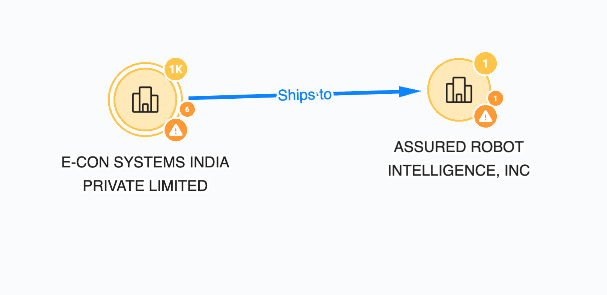
There is no information about the robot brains on ARI’s website. Using the commercial risk intelligence firm Sayari, we can see the founders and directors of the startup.

More interestingly, trade data shows that ARI imported “8529.90 – Parts for TVs & Radios” from India.

Hopefully, Zuck can end his cold streak of failures with humanoid robots.


Tyler Durden
Fri, 05/01/2026 – 15:35

via ZeroHedge News https://ift.tt/I8WFZd2 Tyler Durden

OPEC Just Signaled A Historic Gold Tailwind

OPEC Just Signaled A Historic Gold Tailwind

Authored by Matthew Piepenburg via VonGreyerz.gold,

The United Arab Emirates’ headline departure from OPEC this week has now made the case for precious metals almost too obvious. In fact, the critical USD-Petrodollar-Gold triangle just sent us one of the most important gold signals in over 50 years.

And for anyone paying attention, this should come as no surprise.

Warnings from 2022

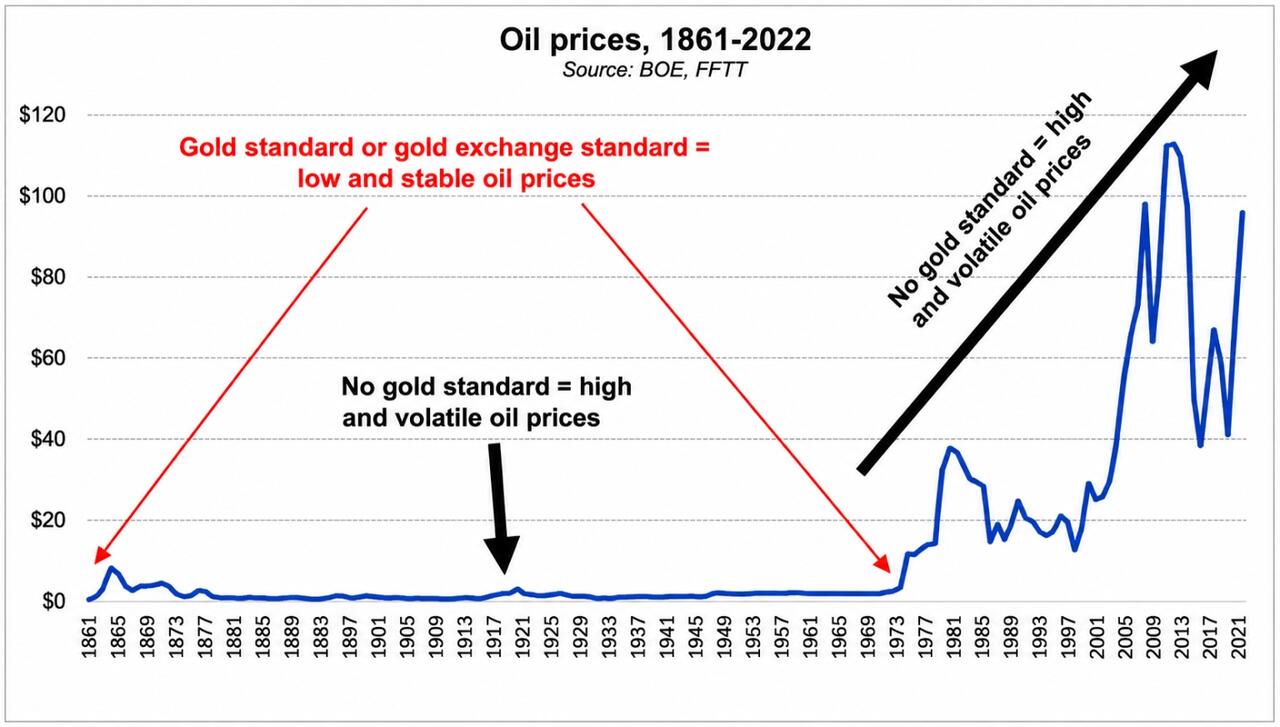
From day one of the 2022 U.S. sanctions against Russia, we argued in “How the West was Lost that this event marked the greatest macro-economic watershed to hit the world since Nixon decoupled the dollar from gold in 1971.

As of this week, the ripple effects of that warning just grew to wave height.

Back in 2022, we warned that trust in a now weaponized world reserve currency would fall, creating a scenario in which the BRICs+ nations would slowly de-dollarize, thereby weakening the hegemony of the USD in general and the USA in particular.

In the years that immediately followed, de-dollarization became an undeniable current, the momentum of which we have written and spoken with both consistency and conviction ever since. 

Petrodollar Significance

We further warned that there would be gradual, then inevitable, threats to the Petrodollar, an essential pillar of the USD’s hegemony. 

After all, forcing the world to buy oil in USDs (and oil producers to use their oil revenues to buy USTs) is indeed an “exorbitant privilege.” 

The 1974 Petrodollar effectively created a global sponge for otherwise over-produced/printed Greenbacks, which explains why the U.S. could so easily export its inflation to the rest of the world with impunity for decades.

But if that “sponge” ever weakened, so too would dollar supremacy. 

One simply cannot overstate enough how essential the Petrodollar is/was to the USD as a currency and to the USA as a financial hegemon. 

This is why we have been tracking the Petrodollar’s post-2022 cracks hereherehereherehere and, well… here.

In short: The Petrodollar matters; it really matters.

Petrodollar Cracks

Once the USA weaponized its already over-indebted and increasingly debased Greenback in 2022, we argued that even its oil “allies” at OPEC would eventually rethink their 1974 agreement to sell oil only in dollars. 

As China openly sought a non-dollar oil solution, it was only a matter of time and circumstance before the OPEC nations would move away from the dollar and look east toward the yuan.

And as of this week, it is now apparent that each of these warnings is slowly coming to fruition. 

Petrodollar Uh-Oh Moment: What Happened?

The UAE, one of America’s biggest allies, just ended its OPEC membership while simultaneously announcing to the U.S. Treasury Department that it may begin to sell its oil in other currencies.

Why?

There are many answers, but they all boil down to an increasing distrust of the USD and a decreasing respect for U.S. global hegemony/policy.

When Kissinger made the 1974 Petrodollar deal with the Saudis, for example, it was effectively a handshake deal made at knifepoint—i.e., a coerced arrangement in which the U.S. promised military protection to the OPEC members in exchange for their forced sale of oil in Greenbacks.

Fast forward some 50 years later, however, and that overly-indebted USD and increasingly impotent UST are not nearly as attractive/strong as they were in the early 1970’s.

Furthermore, the “threat of the Soviet” in 1974 is not the same in 2026 as it was in 1974. 

Nations like the UAE and Saudi Arabia are no longer worried about a red star over Riyadh or Abu Dhabi, but they are certainly aware of the U.S. missiles crisscrossing their current skies in what, at least to many and for now, feels like an absolute military fiasco led by an increasingly desperate U.S.

The OPEC nations see a rich oil market in China and debt-soaked bully in an America who already has its own oil. 

The UAE (already tilting into the BRICs coalition since 2024 and selling oil to India in rupees rather than dollars) is now the first nation to openly reveal that it is tired of being the dog wagged by a Petrodollar tail. 

Meanwhile, even Saudi Arabia has been flirting with China for years, considering oil sales in yuan rather than dollars.

The Petrodollar: What Its Cracks Mean for the Greenback

All of this is a direct threat to an America which always assumed the world would follow its orders to buy oil in dollars and hoard USTs like dutiful serfs. 

But China is no longer a serf, and has sold 48% of its USTs while looking for non-dollar oil.

As I argued earlier this year from Vancouver, John Connally’s infamous (and arrogant) declaration to the world in the 1970’s that it was “our dollar but your problem” would turn out to be an historically embarrassing and short-sighted homage to hubris before the fall.

Today, Uncle Sam’s dollar is his dollar and his problem” for the simple reason that after 50+ years of deficit spending, inflation, exporting, and oil-driven wars of “freedom and democracy,” the world no longer trusts or wants that dollar.

The Petrodollar: What Its Cracks Mean for Gold

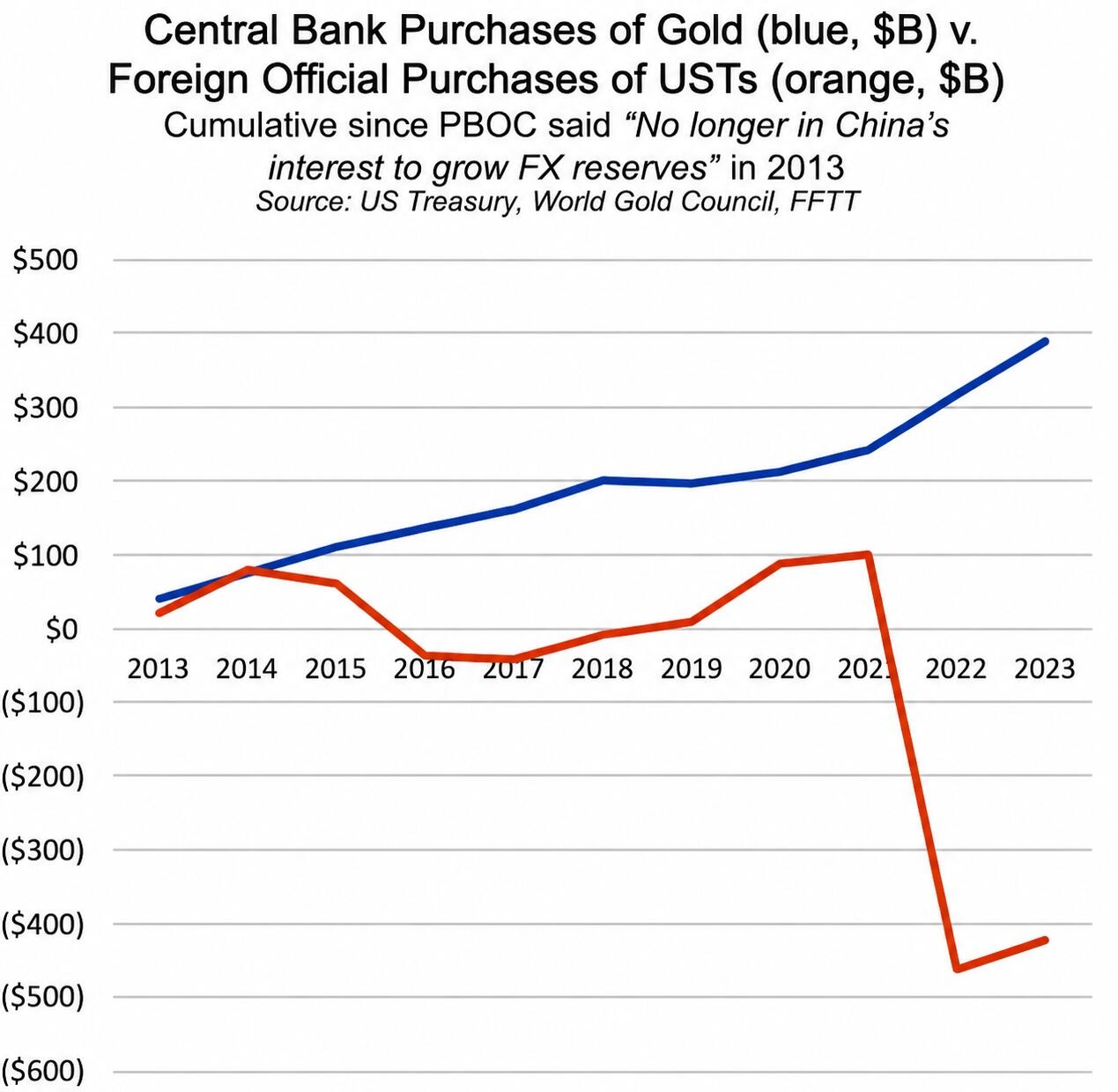
In fact, ever since 2014, when U.S. money printing became addictive rather than “temporary,” nations slowly lost faith in Uncle Sam’s “exorbitant privilege.” They began net-buying gold (blue line) and net dumping USTs (red line) that very same year:

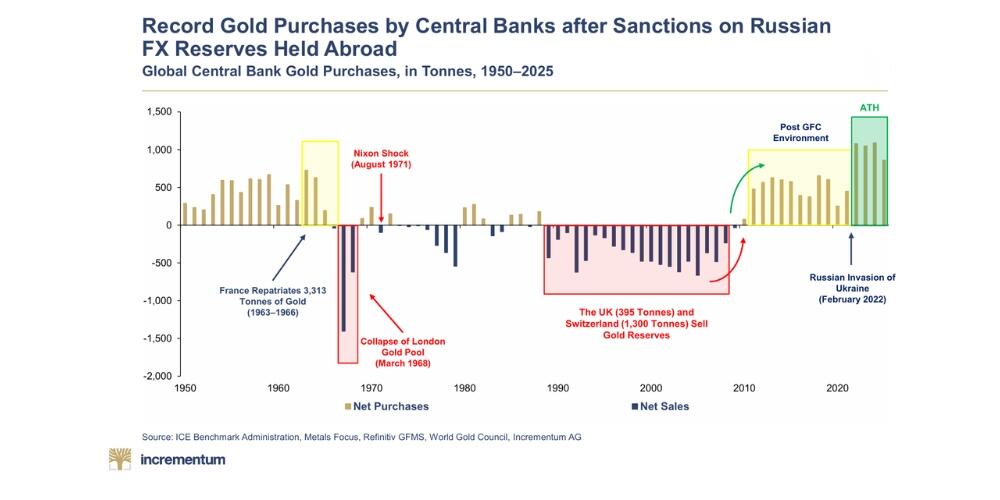
By 2022, of course, the net-stacking of gold by global central banks went from incremental to exponential. 

Between then and now, central bank gold stacking has increased by 5X, acting as an open middle finger to the USD and UST.

Furthermore, ever since the USA weaponized the dollar in 2022, the BIS has made gold a tier-one asset, a nd even the TBTF commercial banks like UBS, Goldman Sachs, and JP Morgan (once intentionally complicit in downplaying gold) are now structurally bullish on the “pet rock.”

In short, the combined forces of 1) a debased and weaponized dollar, 2) a negative real-yielding UST, 3) undeniable de-dollarization trends, 4) unsustainable U.S. public debt levels, 5) a disastrous war in Iran, and 6) a now openly failing Petrodollar make it obvious (rather than debatable) that demand for, and trust in, the USD is tanking.

This slow, but oh-so predictable devolution from U.S. superpower and super-currency to a debt-desperate, debased fall is as old and familiar as history itself, a cycle I explained years ago.

Without a powerful Petrodollar to absorb its inflated and over-expanded Greenback, America’s economic and currency fall will only accelerate going forward.

As the world (and that includes a crumbling OPEC) increasingly turns its back on USDs and USTs, American bond yields and U.S. debt levels will rise as USD purchasing power falls, creating the perfect setup for more mouse-clicked trillions and a stagflation backdrop of historic proportions.

The inevitable monetary and fiscal “accommodation” (i.e., money printing) to “support” a tanking Main Street economy and entirely Fed-centralized S&P will only accelerate the debasement of an already openly debased USD.

This dollar expansion/debasement will act as a massive tailwind to gold in the years to come.

As we’ve argued for years, the inevitable decline in paper currencies fully explains the rise in physical gold, which, not so coincidentally, saw more than 50 all-time highs in 2025, for the simple reason that paper currencies were falling with equal panache.

Toward this end, the bull market in gold has only just begun. 

Gold’s staying power and secular direction North (despite recent forced sell-offs) is effectively guaranteed for the simple reason that the fate of a paper currency system, debased in a backdrop of a decaying credit cycle, is now equally (and historically) unavoidable. 

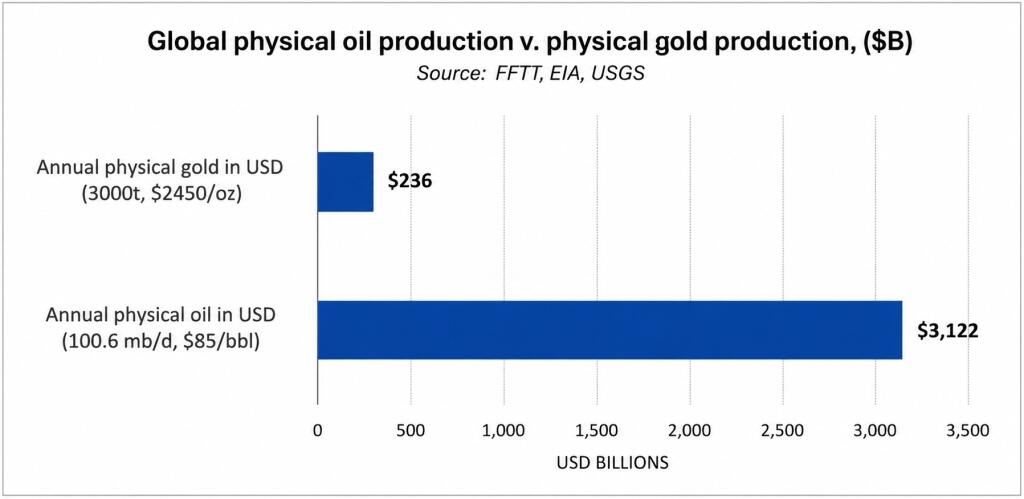
What we are seeing in the crumbling OPEC membership is a slow shift from dollar-backed oil to nations who will be net-settling more of their regional currency oil trades in gold, whose market cap is only a tiny fraction of the global oil market.

Slowly, gold will not only store value better than a distrusted and debased USD, but t will rise in prominence (and price) in the global oil trade.

After all, oil net-settled in gold is far less volatile than dollar-settled oil. 

If we can see this, so can the oil nations of the OPEC cartel. Their move away from the dollar will be slow but brutal to a USD whose supremacy has been slowly declining for years.

After decades of hegemony, the USD is losing trust not only among American Main Streets, central banks, commercial banks, and oil nations, but also among all of us who understand the history of currency debasement, the math of gold, the theft of inflation, and the dishonesty of policymakers

In short: What we saw this week with the UAE’s infamous OPEC exit is just further confirmation of the dollar’s gradual end-game and the first innings of gold (and silver’s) winning game.

Tyler Durden
Fri, 05/01/2026 – 14:45

via ZeroHedge News https://ift.tt/g3kaYXF Tyler Durden