The Federal Government Once Tried To Restrict Prediction Markets. Now It’s Suing States To Save Them.


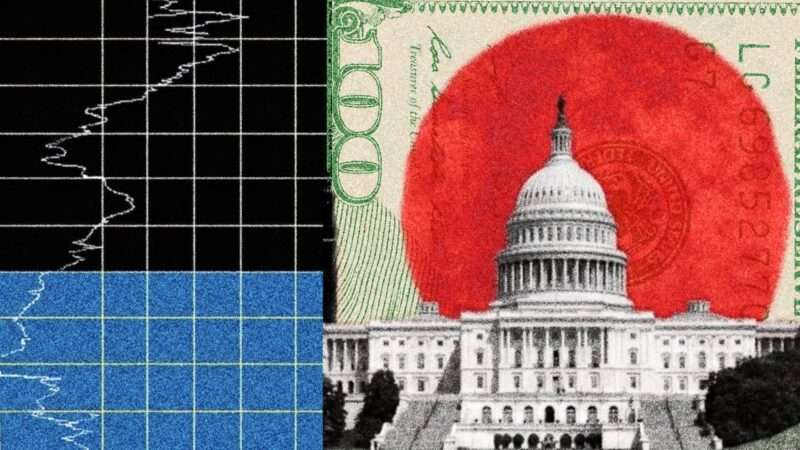
Betting market graph and the U.S. Capitol with money in the background | Illustration: Lex Villena; Midjourney

“When will traffic at the Strait of Hormuz return to normal?” Depending on when you believe this will happen and which prediction market you’re using, a $100 position on this event contract could net as much as $400. But if you live in one of the states suing the prediction market Kalshi, you might not be able to profit off your hunch.

In April, Wisconsin sued Kalshi and several other prediction markets—platforms that let people make bets on the outcomes of various events—alleging that they facilitate illegal sports gambling. The platforms, and their millions of users, have found an unlikely ally: the federal government.

Shortly after Wisconsin filed suit, the U.S. Commodity Futures Trading Commission (CFTC)—the federal body that regulates prediction markets—filed a legal challenge against the state. The CFTC argues that the Commodity Exchange Act (CEA) gives it “exclusive jurisdiction” in the “operation of federal law in regulating financial markets,” including prediction markets, which operate more like marketplaces than gaming houses.

Wisconsin isn’t the only state treating prediction markets as traditional gambling. Arizona, Connecticut, Illinois, New Jersey, and Massachusetts have all pursued legal action against these platforms. The CFTC has countersued these states too, and has filed amicus briefs in the U.S. Court of Appeals for the 9th Circuit and the Supreme Judicial Court of Massachusetts in support of prediction markets.

Ironically, the federal government itself was eager to regulate these platforms strictly. In 2023, the CFTC blocked Kalshi from trading contracts on the political party most likely to control Congress, labeling them “political event contracts” linked to illegal gaming and contrary to the public interest.

Kalshi challenged the order, and the U.S. District Court for the District of Columbia found in the platform’s favor, ruling that contracts on elections involve neither illegal activity nor gaming. The U.S. Court of Appeals for the D.C. Circuit later upheld the ruling.

But with prediction markets growing in popularity over the last five years and with more Americans concerned about the effects of legalized gambling, several states are moving against these platforms. In 2025, Massachusetts became the first state to sue a prediction market, charging Kalshi with “neglecting age restrictions, player protection programs, state taxes, and other consumer protections.”

An amicus brief from 38 states and D.C. supporting Massachusetts’s lawsuit against Kalshi argues that the CEA bans event contracts tied to illegal acts—such as war or gaming—or to activities that the CFTC deems, “by rule or regulation,” to be contrary to the public interest.

Yet Judge Jia M. Cobb already rejected this argument when the U.S. District Court for D.C. ruled in Kalshi’s favor in 2024. Cobb stated that the CEA “specifically preempts the application of state law to derivative markets” and that event contracts do not “amount to” terrorism, assassination, or war.

The CFTC can, for example, reject a contract on whether a plane sabotaged by terrorists will crash, because a payout based on criminal conduct is both illegal and against the public interest. But it couldn’t reject a contract on a routine policy decision, such as whether the Federal Reserve will raise interest rates.

Cobb also found that the CEA’s prohibitions on prediction markets apply only “if the contract’s subject itself” is related to the terms. In fact, the 2024 circuit court ruling seems to nullify each state’s major point of contention, since it found that prediction markets for sports are not “gaming”—that term, it determined, describes playing a game rather than trading on its outcome.

This could render Massachusetts’ entire argument moot, as the state specifically alleges that Kalshi runs afoul of laws governing “sports gaming.”

It’s unclear how these court challenges will turn out. But if you’re an adult who uses these aggregators of public opinion and who wants to spend your money as you see fit, you now have an unlikely ally in the federal government. Perhaps there’s a way to cash in on that.

The post The Federal Government Once Tried To Restrict Prediction Markets. Now It's Suing States To Save Them. appeared first on Reason.com.

from Latest – Reason.com https://ift.tt/qBdWFOY
via IFTTT

A Journalism Tax Is a New Front in Australia’s War on American Tech


Smart phone with tech apps on it, with the Australian flag in the background | Jonathan Raa/ZUMAPRESS/Newscom/Envato

The Australian government, which has already imposed strict regulations on American tech firms operating in the country, now expects these companies to pay taxes to support Australian journalism.

On Tuesday, Australia unveiled draft legislation for a “News Bargaining Incentive,” which would require major tech companies, including Meta, Google, and TikTok, to make commercial deals with news organizations or face a 2.25 percent tax on local revenue, reports The Wall Street Journal. Companies would be incentivized to comply by receiving offsets of either 150 or 170 percent, effectively reducing the tax. The legislation would not apply to AI companies.

Prime Minister Anthony Albanese told reporters that the bargaining incentive would bring in an expected 200 to 250 million Australian dollars, “every single dollar” of which “will go back to journalists.”

Australia’s communications minister, Anika Wells, pitches this as a way to fix the country’s old News Media Bargaining Code, which took effect in 2021. Like the legislation introduced this week, that code pressured designated tech companies to pay journalistic outlets for news. Google and Meta initially entered into agreements with news outlets. But when Meta’s contract expired in 2024, the company refused to renew, arguing that just 3 percent of its content was news-related.

A Meta spokesperson criticized Australia’s most recent proposal as a “digital services tax,” writing on X: “News organizations opt to post content on our platforms because they get value from it. We don’t take their news content. Yet the tax applies whether or not news content appears on our platforms.”

Google is also pushing back against the tax, explaining in a statement that the proposal “ignores the fact that Google already has commercial agreements with the news industry, misunderstands how the ad market changed and mandates payments from some companies while arbitrarily excluding platforms like Microsoft, Snapchat and OpenAI—despite the major shift in how people consume news.”

The Australian government has a history of meddling in its country’s information environment. In December, it prohibited people under the age of 16 from using social media platforms. Enforcement has been rocky, and many young Australians have successfully evaded the ban. Instead of accepting that kids are savvy enough to evade restrictions, the Australian government threatened to sue Facebook, Instagram, Snapchat, TikTok, and YouTube for noncompliance.

The mission to save local journalism may appear well-meaning. Who doesn’t want to support original reporting? But the new scheme would not just benefit scrappy reporters at small-town papers doing shoe-leather journalism. While it offers incentives for tech companies to strike deals with smaller organizations, the companies could still reduce their tax burden by making deals with larger operations. Australia’s major news organizations, including News Corp Australia, the Australian Broadcasting Corporation, and Nine Entertainment Co., have been vocal supporters of the code and would likely be its major beneficiaries.

And even if the new code gives a boost to struggling newsrooms, that wouldn’t address the journalism industry’s underlying problems. It would impose a system where Australian newsrooms rely on another country’s tech industry for survival. The more durable, albeit challenging, path forward for newsrooms is to reach audiences and secure funding without a government middleman.

The post A Journalism Tax Is a New Front in Australia's War on American Tech appeared first on Reason.com.

from Latest – Reason.com https://ift.tt/jhCsiMI
via IFTTT

Tune In To Tonight’s Fertilizer Debate: How Bad Will It Get?

Tune In To Tonight’s Fertilizer Debate: How Bad Will It Get?

As we covered earlier this week, Goldman Sachs analysts now say the fertilizer disruption is larger than expected, with nitrogen markets taking the brunt. Urea prices have risen 50% to 70% since the conflict began. Goldman’s Duffy Fischer wrote that “nitrogen fertilizer is the most impacted chemical chain,” adding that the scale of disruption is “greater than we originally expected.”

And signs of improvement have yet to reveal themselves…

As the U.S.–Iran conflict enters its seventh week, ZeroHedge, in partnership with the Macro Dirt Podcast, will host a debate tonight focused on the implications for agriculture, inflation, and global supply chains.

The discussion features former Bridgewater head of commodities Alex Campbell, Brent Johnson of Santiago Capital, and is hosted by Tony Greer and Jared Dillian.

Johnson appeared with Marc Faber and Adam Taggart on an Iran-focused ZeroHedge debate earlier this month and announced that his fund was loading up on fertilizer producers, arguing that even if Hormuz were to open today, he believes the supply shock has yet to be felt and will be severe.

And, of course… Hormuz remains closed.

The hike in prices is already flowing through to earnings. U.S. producers CF Industries and Nutrien are positioned to benefit, supported by relatively stable domestic natural gas costs. Goldman estimates that every $50-per-ton increase in urea prices adds roughly $800 million in annualized EBITDA for CF. Since late February, U.S. Gulf urea prices have climbed about $234 per ton.

Pressure is also building in phosphate markets. U.S. prices, which initially lagged, are now up roughly 23% since the start of the conflict. At the same time, sulfur prices have reached record highs, forcing production curtailments and tightening supply further as input costs rise.

Potash remains less affected for now. Supply routes through the Red Sea have stayed open, and North American supply remains ample, limiting near-term upside.

Join us tonight to see how you should be positioning your portfolio to be better prepared for the coming inflationary shock.

7pm ET here on the ZeroHedge homepage, X feed, and YouTube channel.

Tyler Durden
Fri, 05/01/2026 – 13:00

via ZeroHedge News https://ift.tt/Wv4coIO Tyler Durden

Google DeepMind Veteran Raises $1.1 Billion For AI That Doesn’t Train On Human Data

Google DeepMind Veteran Raises $1.1 Billion For AI That Doesn’t Train On Human Data

Authored by Jason Nelson via decrypt.io,

In brief

  • DeepMind veteran David Silver raised $1.1 billion for his new startup Ineffable Intelligence at a $5.1 billion valuation.
  • Silver says reinforcement learning, not large language models, is the best path to superintelligence.
  • The startup aims to build AI “superlearners” that learn through simulations and self-play.

David Silver, the DeepMind scientist behind AlphaGo’s historic 2016 win over world Go champion Lee Sedol, has raised $1.1 billion to launch a startup betting that the next era of AI won’t come from today’s dominant technology.

Image: Shutterstock/Decrypt

Silver’s company, Ineffable Intelligence, launched in January at a $5.1 billion valuation and is betting on reinforcement learning, a method where AI systems improve through trial and error. Silver argues that approach, rather than the large language models now dominating the field, offers a more credible route to superintelligence.

I think of our mission as making first contact with superintelligence,” Silver told Wired. “By superintelligence, I really mean something incredible. It should discover new forms of science or technology or government or economics for itself.

Popularized by philosopher Nick Bostrom in his 2014 book “Superintelligence,” the term refers to AI that surpasses human intelligence across nearly all domains, while artificial general intelligence, or AGI, describes systems capable of matching human-level reasoning across a wide range of tasks.

Silver argues that large language models are fundamentally limited because they learn from human-generated data, instead of building their own understanding through experience.

Human data is like a kind of fossil fuel that has provided an amazing shortcut,” he said. “You can think of systems that learn for themselves as a renewable fuel—something that can just learn and learn and learn forever, without limit.”

Silver has spent much of his career advancing that argument. AlphaGo, which combined human training data with reinforcement learning and self-play, developed strategies that surprised even top human players and demonstrated how AI can exceed human precedent in narrow domains.

I feel it’s really important that there is an elite AI lab that actually focuses a hundred percent on this approach,” he told Wired. “That it’s not just a corner of another place dedicated to LLMs.

Ineffable Intelligence plans to build what Silver calls “superlearners”—AI agents placed inside simulations where they can pursue goals, fail, adapt, and improve without the limits of a static human dataset. Silver declined to describe what those simulations would look like, but said the approach would allow agents to collaborate and develop capabilities autonomously.

Silver argued that large language models are limited by the data they are trained on, adding that a model trained in a world where everyone believed the Earth was flat would likely keep that belief unless it could test reality for itself. A system that learns through experience, he said, could discover otherwise.

Ineffable Intelligence did not immediately respond to a request for comment by Decrypt.

Tyler Durden
Fri, 05/01/2026 – 12:40

via ZeroHedge News https://ift.tt/CO2SZ8o Tyler Durden

Trump Says Spirit Airlines Rescue Still In Review, Final Proposal Coming

Trump Says Spirit Airlines Rescue Still In Review, Final Proposal Coming

Summary: 

  • Trump says Spirit received the final proposal for the lifeline deal 

  • WSJ reported that bankrupt Spirit Airlines was preparing to shutter operations 

President Trump comments on Spirit Airlines:

  • TRUMP: GAVE SPIRIT FINAL PROPOSAL

  • TRUMP SAYS US STILL LOOKING AT SPIRIT, WILL GIVE FINAL PROPOSAL

  • TRUMP SAYS TRYING TO HELP SPIRIT, CITING JOBS 

  • TRUMP SAYS WILL HAVE SOMETHING ON SPIRIT TODAY OR TOMORROW 

WSJ Reports Spirit Airlines Prepares To Shutter Operations 

The Wall Street Journal reports that bankrupt Spirit Airlines is preparing to wind down operations after failing to secure a $500 million lifeline from the Trump administration.

WSJ reports:

The ailing budget airline had been hoping to finalize a $500 million lifeline from the government before running out of cash. The discount carrier hasn’t been able to get sufficient support between certain bondholders and the government to secure the funding to keep it in business, people familiar with the matter said.

News last week raised hopes that Spirit would secure a rescue deal of up to $500 million from the Trump administration, which could have left the federal government with 90% control.

A reporter asked Trump last week: “Is the government going to buy a stake in Spirit Airlines?”

The president responded: “So we are looking at Spirit. It’s in bankruptcy court. And we’re looking, if we could get it for the right price…”

Polymarket odds:

US takes a stake in Spirit Airlines by May 31?

US takes a stake in Spirit Airlines by May 31?
Yes 19% · No 81%
View full market & trade on Polymarket

Spirit Airlines shutdown/liquidation by May 31?

Spirit Airlines shutdown/liquidation by May 31?
Yes 79% · No 22%
View full market & trade on Polymarket


Tyler Durden
Fri, 05/01/2026 – 12:39

via ZeroHedge News https://ift.tt/V2UDXWl Tyler Durden

Beijing Bad: Chinese Nationals Charged Building Meth Super Factory

Beijing Bad: Chinese Nationals Charged Building Meth Super Factory

Two Chinese citizens were indicted on by the DOJ on charges of conspiring to flood the United States with methamphetamine through a sophisticated, factory-style production operation, federal prosecutors announced this week.

Wenfeng Cui, 41, also known as “Vincen,” (no “t’) and Fan Pang, 26, also known as “Jerry,” both nationals of the People’s Republic of China, were arrested in New York City on February 2, 2026, after allegedly meeting with undercover sources and providing detailed instructions on the chemical synthesis of methamphetamine and the operation of custom-built industrial machinery designed to mass-produce the drug.

The unsealed indictment, announced by U.S. Attorney Jay Clayton and DEA Special Agent in Charge Cindy Marx of the Special Operations Division, charges the pair with one count of conspiracy to distribute methamphetamine (maximum penalty: life in prison), one count of conspiracy to import methamphetamine precursor chemicals with intent to manufacture narcotics (maximum 20 years), and one count of importation of methamphetamine precursor chemicals (maximum 20 years).

“Terrifying in its ambition”

According to the indictment and related court filings, over roughly eight months the defendants worked with chemists and engineers to research, design, and fabricate a technologically advanced methamphetamine production facility. Prosecutors allege the operation was capable of producing 400 kilograms of methamphetamine per day – or as much as 800 kilograms per production cycle – using automated industrial equipment.

“As alleged, the defendants worked with chemists and engineers to develop and deploy a sophisticated technology for the industrial production of methamphetamine capable of producing 400 kilograms of ‘meth’ every day,” Clayton said. “Their goal was terrifying in its ambition. The potential harm of this scale of methamphetamine on our streets should give all New Yorkers and all Americans pause. This Office will find and prosecute not only the dealers distributing poison to New Yorkers, but also the people behind those operations. Working with our international law enforcement partners, we will bring narcotics traffickers to justice — no matter where they are in the world, and no matter whether they commit their crimes in laboratories or on street corners.”

DEA Special Agent in Charge Cindy Marx added: “This indictment underscores the evolving threat posed by the synthetic drug market, in particular the increase we are seeing in methamphetamine. The level of technical expertise, industrial-scale machinery, and international reach revealed in this case is a stark reminder that today’s illicit drug trade is driven by innovation and relentless adaptation. The cartels are adapting, and so are we.”

Detailed blueprints and a “complete set of automated equipment”

Court documents describe an elaborate scheme in which confidential sources, acting at the direction of the DEA and posing as narcotics traffickers, communicated regularly with Cui and Pang to broker chemical and equipment deals.

In recorded conversations and meetings in June 2025, Cui claimed he could manufacture customized machinery within several months and produce refined versions in as little as 30 days. He offered training in assembly, installation, and operation, plus ongoing technical support on-site in Central America. Pang stated that a completed machine could be ready by July 2025 and would yield up to 800 kilograms of methamphetamine per cycle. The defendants also offered to sell approximately 40 kilograms of methylamine hydrochloride — a key List I precursor chemical — for $4,000, to be shipped from China to New York.

Cui later provided the sources with extensive technical materials, including:

  • A spreadsheet listing dozens of industrial components (stainless-steel reactors, condensers, storage tanks, explosion-proof pumps, refrigeration and hydrogenation systems, centrifuges, and compressors);
  • A nearly 5,000-word instruction manual specifying chemical proportions, pressure levels, and temperature controls;
  • Production flowcharts and laboratory renderings.

By December 2025 the full-scale factory had been fabricated in China. Freight records show the equipment – weighing more than 21,120 kilograms and occupying nearly 200 cubic meters – was packed into multiple shipping containers and dispatched from a port in Shanghai. Cui sent sources photographs of workers loading the machinery, with one worker boasting that the “complete set of automated equipment” represented “the future of the global chemical industry.”

In January 2026, Cui forwarded additional photos and videos of the machinery nearing completion. The containers were later seized by law enforcement in a European country. The seizure was conducted with the assistance of the Polish Provincial Police of Wrocław, the Lower Silesian Branch of the National Prosecutors Office, and the German Zentrale Kriminalinspektion (ZKI) Osnabrück.

Tyler Durden
Fri, 05/01/2026 – 12:20

via ZeroHedge News https://ift.tt/7jKbUS0 Tyler Durden

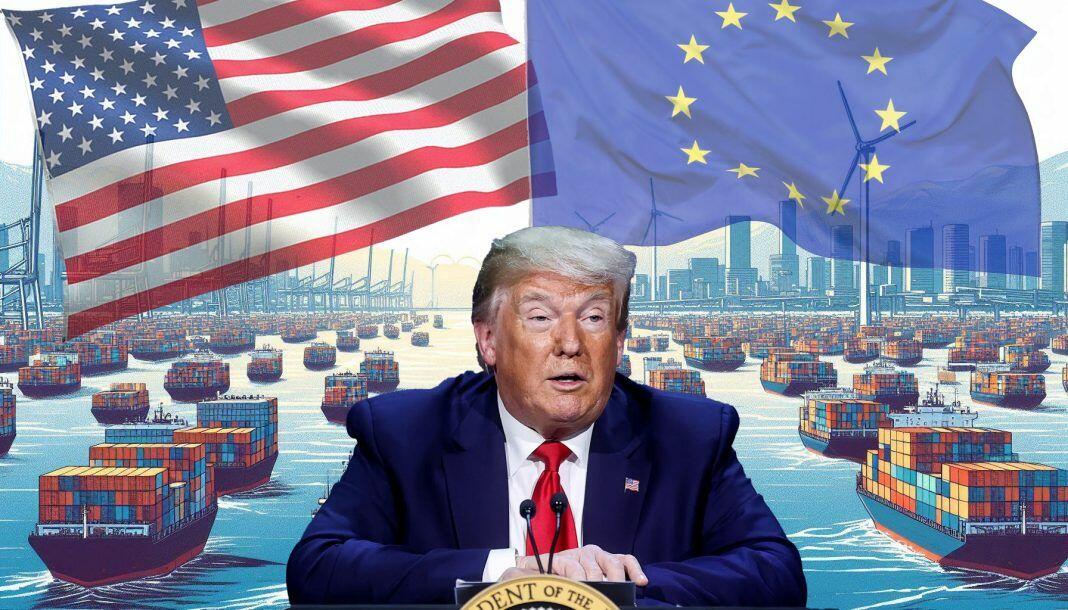
Trump Escalates Tariffs On EU Vehicles To 25%, Accusing Bloc Of Trade Deal Violations

Trump Escalates Tariffs On EU Vehicles To 25%, Accusing Bloc Of Trade Deal Violations

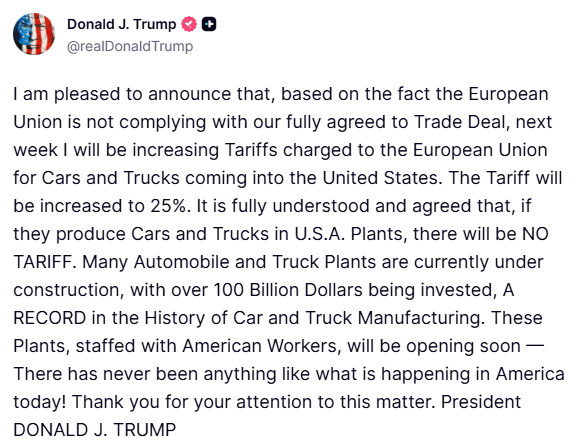
President Donald Trump announced Friday that the United States will raise tariffs on cars and trucks imported from the European Union to 25% starting next week, citing the EU’s failure to comply with a 2025 bilateral trade framework.

“I am pleased to announce that, based on the fact the European Union is not complying with our fully agreed to Trade Deal, next week I will be increasing Tariffs charged to the European Union for Cars and Trucks coming into the United States. The Tariff will be increased to 25%. It is fully understood and agreed that, if they produce Cars and Trucks in U.S.A. Plants, there will be NO TARIFF.”

Trump highlighted over $100 billion in ongoing U.S. auto manufacturing investments – a record, he said – and praised American workers staffing new plants set to open soon.

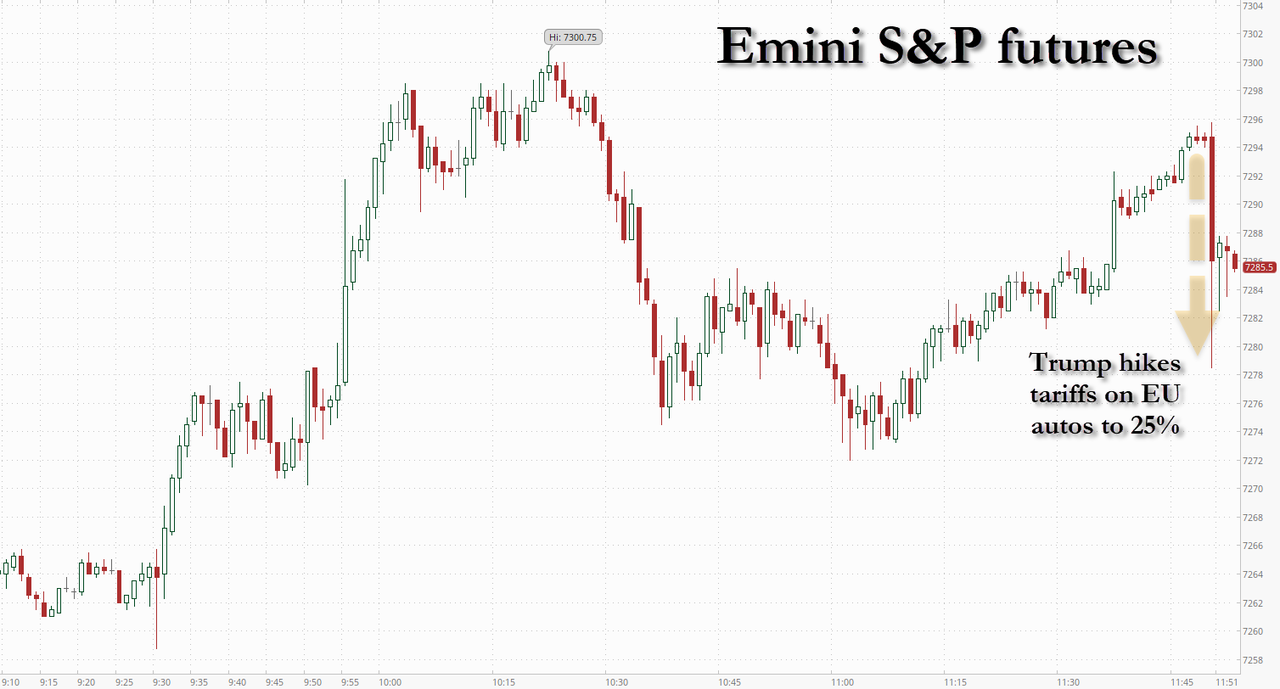
This sent Emini S&P futures cascading lower:

The move reverses a temporary reduction under the July 2025 U.S.-EU Framework Agreement on Reciprocal, Fair, and Balanced Trade. That deal, reached after Trump initially imposed broad 25% Section 232 national-security tariffs on automobiles and parts in March 2025, lowered the rate on most EU vehicles and parts to 15% (retroactive to August 1, 2025) in exchange for EU commitments. These included cutting tariffs on U.S. industrial and agricultural goods, purchasing hundreds of billions in American energy, and increasing investment in the U.S.

EU implementation has lagged. The European Parliament conditionally approved enabling legislation in late March 2026 with multiple “safeguard” clauses – including a “sunrise” provision tying EU concessions to verified U.S. compliance, a suspension mechanism for new U.S. tariffs, and a sunset date in 2028. Tensions have simmered over non-tariff issues as well. In April 2026, U.S. automakers (GM, Ford, and Stellantis) warned that proposed EU safety and emissions standards could effectively block large U.S.-built pickup trucks and vans from the European market, a step they called inconsistent with the deal’s spirit of mutual recognition.

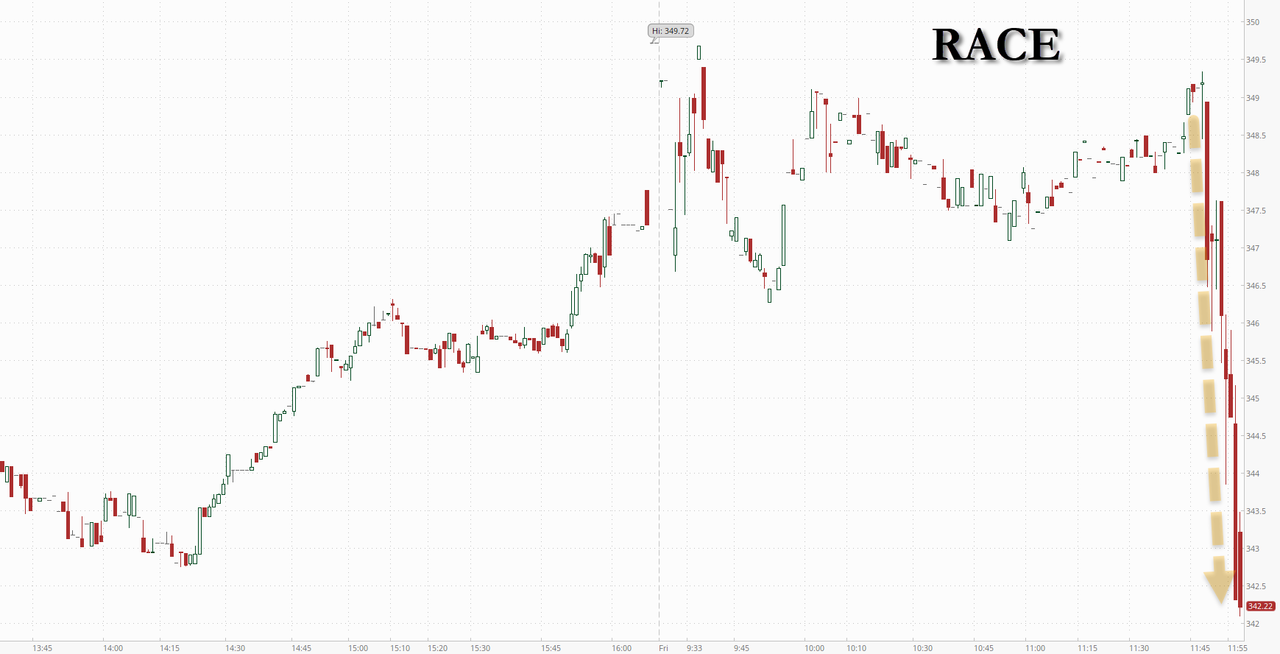
Ferrari also RACE‘d lower on the news, one day after Vanguard added to their position.

The original 2025 auto tariffs were justified on national-security grounds and aimed at spurring domestic production; the administration has repeatedly offered exemptions or lower rates to allies that negotiate deals or shift manufacturing stateside. Trump’s post explicitly ties the new 25% levy to onshoring: EU brands that build in the United States face zero additional tariff.

The announcement comes amid broader Trump administration tariff actions that have reshaped global auto supply chains since January of last year. European manufacturers such as BMW, Mercedes-Benz, Volkswagen, and Stellantis have already faced pressure from the earlier duties, prompting some to accelerate U.S. investment plans or adjust pricing. Industry analysts warn that a return to 25% could raise costs for consumers, disrupt transatlantic supply chains, and invite EU retaliation.

Developing…

Tyler Durden
Fri, 05/01/2026 – 12:00

via ZeroHedge News https://ift.tt/BP9tIkX Tyler Durden

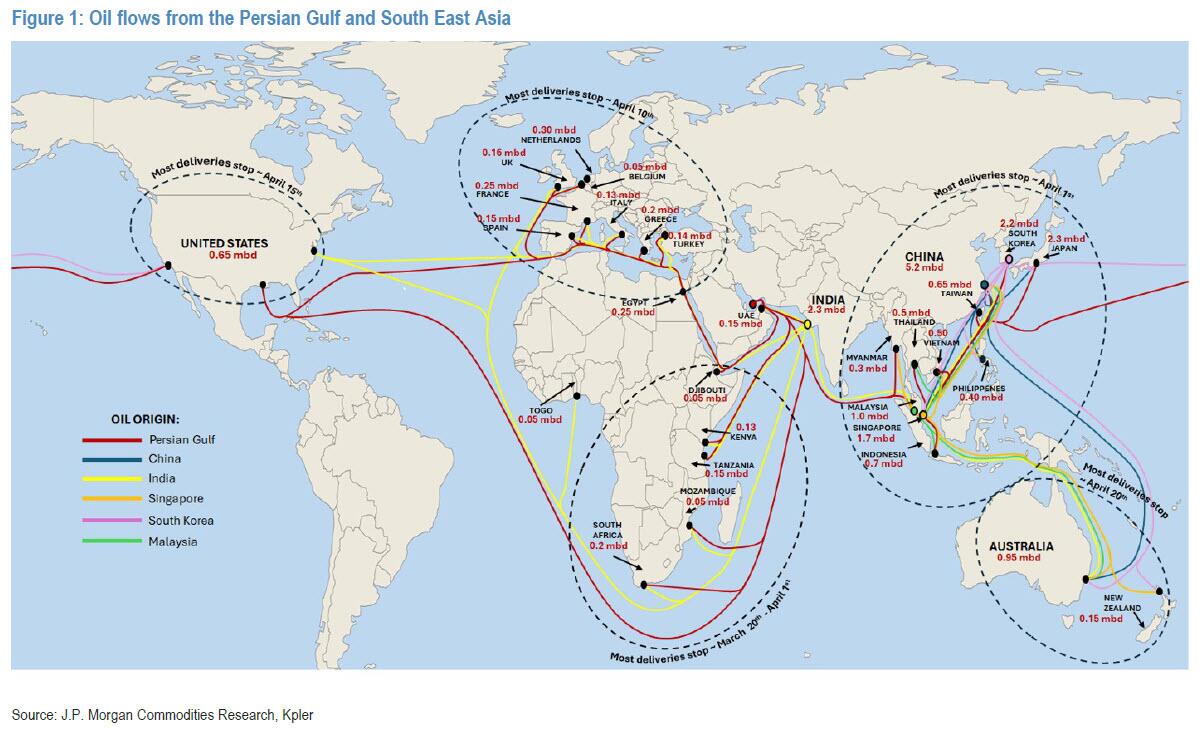
Chevron, ConocoPhillips Warn About “Critical Shortages” Of Oil, Soaring Prices And Demand Destruction

Chevron, ConocoPhillips Warn About “Critical Shortages” Of Oil, Soaring Prices And Demand Destruction

This morning, most of the world’s energy giants including Exxon and Chevron, reported stellar earnings as surging oil prices more than offset curtailed output. They also issued several loud warnings about the ongoing Hormuz blockage which is no closer to resolution. 

ConocoPhillips was first, warning of imminent “critical shortages” of oil for some nations as the Iran war that has crippled global energy flows enters its third month. 

The supply crunch that already pushed Brent prices up more than 50% in just nine weeks and just 2 days ago hit a multi-year high, appears likely to significantly worsen as soon as June, Chief Financial Officer Andy O’Brien told analysts during a conference call Thursday.

“The biggest challenge we’re about to face is that the markets sort of had a bit of a grace period initially when the tankers that left the Persian Gulf in late February were still on the water; now all of those have reached their destination,” O’Brien said, touching on a topic we discussed at the start of April.

“We are going to start to see some import-dependent countries potentially start to face critical shortages as we get into the June-July time frame” at which point the dreaded “demand destruction” kicks in. 

Oil refiners around the world have responded to the Iran war-driven drop Gulf oil shipments by curbing daily processing rates by roughly 8 million barrels, roughly the amount that has been blockaded by Iran, O’Brien noted. The knock-on effects of those cuts and the wider market disruption have included skyrocketing prices for everything from jet fuel and gasoline to fertilizer. 

The ConocoPhillips executive’s comments represented some of the starkest yet from a US oil producer with a global footprint that stretches from Alaska to Australia.  As for ConocoPhillips, the conflict that began with US-Israeli attacks on the Islamic Republic in late February prompted the company to reduce its full-year output forecast to the equivalent of 2.3 million barrels a day of oil, according to a statement. That figure, the midpoint of a forecast that includes a cut in supplies from Qatar, would be the lowest since the company’s 2024 takeover of Marathon Oil Corp. The energy giant on Thursday also raised spending guidance for the year by about 2% to $12.3 billion, based on the midpoint of the range, reflecting increased activity in the US Permian Basin, the most prolific oilfield in North America.

A second oil major to voice a warning this morning was Chevron, which echoed Conoco’s concerns and said it is worried that global oil supplies are running dry as the US-Israel war with Iran enters its third month.

“That’s certainly the scenario we’re concerned about,” Chief Executive Officer Mike Wirth said Friday in an interview on CNBC. “If we don’t get supply reestablished, demand will have to come down across different sectors of the economy. That’s the big concern that everybody has as we try to avoid a scenario where that becomes extreme.” And by demand destruction he, of course, means soaring prices, something which JPM also warned about – again – last night

The conflict has already eroded oil demand, and crude traders have warned of a bigger hit to come. There’s no get-around with the effective closure of Hormuz, through which about 20% of the world’s oil and liquefied natural gas typically flows, Wirth added.

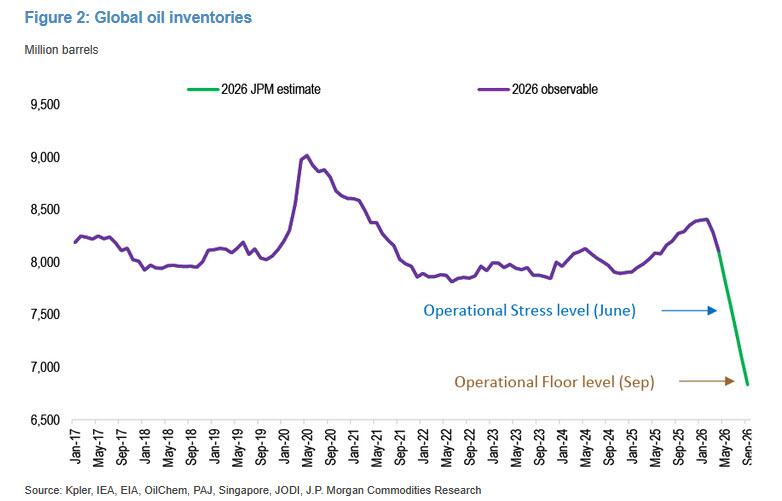
“The global energy system continues to be under extreme stress,” he said, and it will only get worse as the ongoing drain of global inventories pushes them to operational stress levels, and then, hit the operational floor.

Source: JPMorgan

Wirth, who added that his company is speaking with the Trump administration on an “almost constant basis,” most recently this week when the White House spoke to the largest US companies about a prolonged blockade of Hormuz, was the latest US oil executive to share concerns that the world’s extra supply of oil stored on land and at sea could be running out if the Strait of Hormuz remains closed.

Tyler Durden
Fri, 05/01/2026 – 11:40

via ZeroHedge News https://ift.tt/d1URMh0 Tyler Durden

US Mortgage Debt Hits $13.2 Trillion, Average Household Owes Nearly $109,000

US Mortgage Debt Hits $13.2 Trillion, Average Household Owes Nearly $109,000

Authored by Mary Prenon via The Epoch Times,

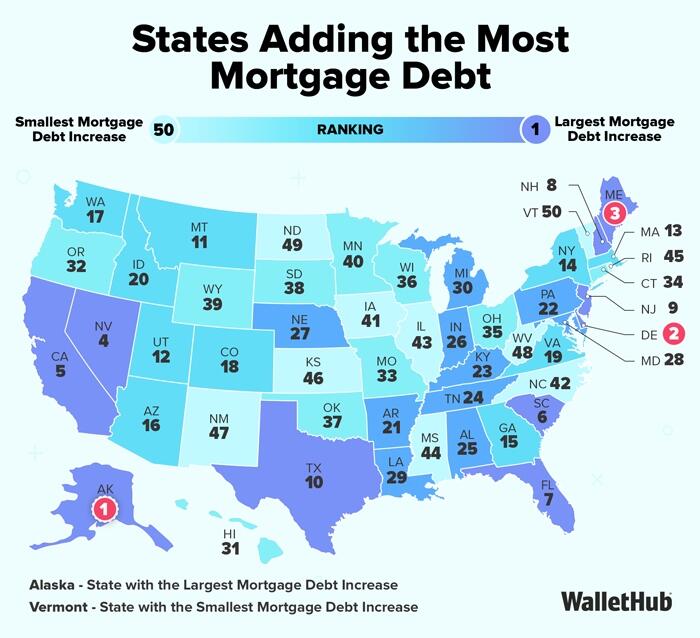
America’s mortgage debt continues to escalate, hitting the $13.2 trillion mark, according to an April 30 WalletHub report.

The personal finance website and app indicated that the average U.S. household owes nearly $109,000 in outstanding mortgage balances and that mortgage debt has remained on an upward trend over the past few years.

“Mortgage rates are the highest they’ve been in around a decade, and home prices have seen a meteoric rise in recent years as well,” WalletHub analyst John Kiernan said in the report.

“Even small increases in home prices can lead to thousands of dollars in extra mortgage interest costs for homeowners, so it’s important to choose wisely when deciding where and when to buy a house.”

Comparing the 50 states based on proprietary data from the third quarter of 2025 to the fourth quarter, WalletHub found that the northernmost state, Alaska, added the most mortgage debt during that time frame, in percentage terms. The average balance there rose by 2.52 percent to $248,013.

Meanwhile, Alaska residents still carry significant mortgage balances in general, with average monthly payments of $2,078. Homeowners in Alaska are also saddled with relatively high property taxes. According to Redfin, the current median list price in Alaska is $465,000.

Delaware ranked second for the most added mortgage debt during the same period, showing a 2.51 percent increase to $210,542 for the average balance. A typical homeowner in Delaware spends nearly $1,689 per month in mortgage costs. Redfin lists the median home price in the state at $460,000.

The third-highest state for added mortgage debt goes to Maine, with average balances rising by 1.98 percent to an outstanding balance of $209,936. Average homeowners there pay about $1,723 each month toward their mortgage. Maine’s median home price stands at $390,300, as per Redfin.

Nevada and California complete the top five states with the highest mortgage debt increases. South Carolina, Florida, New Hampshire, New Jersey, and Texas round out the top 10.

On the opposite side, the report indicates that  mortgage debt decreased in 19 states during the fourth quarter of 2025. Vermont ranked the lowest in the nation for mortgage debt, followed by North Dakota, West Virginia, New Mexico, and Kansas.

Earlier this year, WalletHub reported America’s total household debt, including mortgage payments, car loans, credit card debt, and other expenses, at $18.78 trillion, with an average debt per household at $155,594.

Kiernan noted that since mortgage rates have recently become a bit more favorable, those currently paying higher rates could consider refinancing as a way of lowering monthly costs. As of April 23, Freddie Mac reported the average 30-year fixed mortgage rate at 6.23 percent.

Other money-saving tips include making extra mortgage payments when possible to reduce total interest costs or switching to biweekly payments.

“This results in 26 half-payments per year instead of the usual 12,” Kiernan noted. “Over time, this can shave years off your mortgage term and save you money on interest.”

Finally, homeowners could consider putting unexpected windfalls such as tax refunds or work bonuses toward the mortgage payment, shortening the overall repayment period.

Tyler Durden
Fri, 05/01/2026 – 11:20

via ZeroHedge News https://ift.tt/D7Xi1ru Tyler Durden

The Federal Government Once Tried To Restrict Prediction Markets. Now It’s Suing States To Save Them.


Betting market graph and the U.S. Capitol with money in the background | Illustration: Lex Villena; Midjourney

“When will traffic at the Strait of Hormuz return to normal?” Depending on when you believe this will happen and which prediction market you’re using, a $100 position on this event contract could net as much as $400. But if you live in one of the states suing the prediction market Kalshi, you might not be able to profit off your hunch.

In April, Wisconsin sued Kalshi and several other prediction markets—platforms that let people make bets on the outcomes of various events—alleging that they facilitate illegal sports gambling. The platforms, and their millions of users, have found an unlikely ally: the federal government.

Shortly after Wisconsin filed suit, the U.S. Commodity Futures Trading Commission (CFTC)—the federal body that regulates prediction markets—filed a legal challenge against the state. The CFTC argues that the Commodity Exchange Act (CEA) gives it “exclusive jurisdiction” in the “operation of federal law in regulating financial markets,” including prediction markets, which operate more like marketplaces than gaming houses.

Wisconsin isn’t the only state treating prediction markets as traditional gambling. Arizona, Connecticut, Illinois, New Jersey, and Massachusetts have all pursued legal action against these platforms. The CFTC has countersued these states too, and has filed amicus briefs in the U.S. Court of Appeals for the 9th Circuit and the Supreme Judicial Court of Massachusetts in support of prediction markets.

Ironically, the federal government itself was eager to regulate these platforms strictly. In 2023, the CFTC blocked Kalshi from trading contracts on the political party most likely to control Congress, labeling them “political event contracts” linked to illegal gaming and contrary to the public interest.

Kalshi challenged the order, and the U.S. District Court for the District of Columbia found in the platform’s favor, ruling that contracts on elections involve neither illegal activity nor gaming. The U.S. Court of Appeals for the D.C. Circuit later upheld the ruling.

But with prediction markets growing in popularity over the last five years and with more Americans concerned about the effects of legalized gambling, several states are moving against these platforms. In 2025, Massachusetts became the first state to sue a prediction market, charging Kalshi with “neglecting age restrictions, player protection programs, state taxes, and other consumer protections.”

An amicus brief from 38 states and D.C. supporting Massachusetts’s lawsuit against Kalshi argues that the CEA bans event contracts tied to illegal acts—such as war or gaming—or to activities that the CFTC deems, “by rule or regulation,” to be contrary to the public interest.

Yet Judge Jia M. Cobb already rejected this argument when the U.S. District Court for D.C. ruled in Kalshi’s favor in 2024. Cobb stated that the CEA “specifically preempts the application of state law to derivative markets” and that event contracts do not “amount to” terrorism, assassination, or war.

The CFTC can, for example, reject a contract on whether a plane sabotaged by terrorists will crash, because a payout based on criminal conduct is both illegal and against the public interest. But it couldn’t reject a contract on a routine policy decision, such as whether the Federal Reserve will raise interest rates.

Cobb also found that the CEA’s prohibitions on prediction markets apply only “if the contract’s subject itself” is related to the terms. In fact, the 2024 circuit court ruling seems to nullify each state’s major point of contention, since it found that prediction markets for sports are not “gaming”—that term, it determined, describes playing a game rather than trading on its outcome.

This could render Massachusetts’ entire argument moot, as the state specifically alleges that Kalshi runs afoul of laws governing “sports gaming.”

It’s unclear how these court challenges will turn out. But if you’re an adult who uses these aggregators of public opinion and who wants to spend your money as you see fit, you now have an unlikely ally in the federal government. Perhaps there’s a way to cash in on that.

The post The Federal Government Once Tried To Restrict Prediction Markets. Now It's Suing States To Save Them. appeared first on Reason.com.

from Latest – Reason.com https://ift.tt/qBdWFOY
via IFTTT