Manufacturing ISM Misses As Prices Surge Most Since April 2022, Employment Slides To Worst Print Of 2026

Manufacturing ISM Misses As Prices Surge Most Since April 2022, Employment Slides To Worst Print Of 2026

Amid the fog of war and fading ‘hard’ data, the final April S&P Global Manufacturing PMI printed 54.5, a small gain from the flash 54.0 print, and higher than the 52.3 February final print, although it came with a warning from Chris Williamson, Chief Business Economist at S&P Global Market Intelligence:

“The surge in manufacturing activity in April is not the cause for cheer that at first glance it suggests. A key driving force behind the upturn is the need for companies to get ahead of further feared price rises and supply shortages, providing a short-term boost that could fade in the coming months as headwinds to the economy continue to build… employment has fallen as firms grow increasingly worried over the need to reduce cost overheads amid an environment of rising raw material prices, while selling prices have jumped higher as producers seek to protect their margins.

There was some good news: “More encouragingly, business expectations for output in the year ahead have improved, partly reflecting hopes that the US will be less affected by the war than previously feared, and less than other economies, as well as reduced concerns over the impact of tariffs given the recent Supreme Court ruling. However, some of these improved expectations of future production gains reflected a reaction to better than anticipated order book inflows in April, which may prove to be a chimera as the stock building boost fades.”

Shortly after, the ISM Manufacturing PMI published its April number which remained unchanged at 52.7, matching the highest since August 2022, and missing estimates of an increase to 53.2
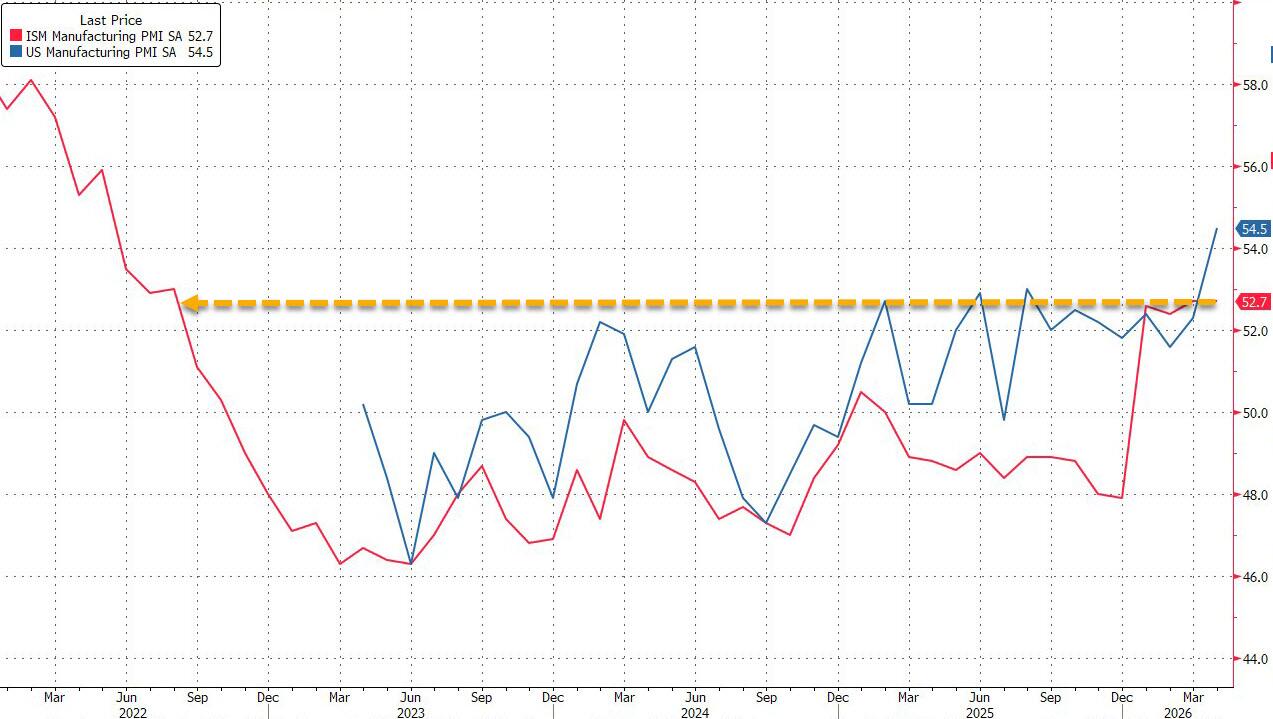
However, a look under the hood reveals that like last month, there was continued deterioration in the core components: Under the hood, Prices Paid continued to rise dramatically while New Orders and Employment dipped again – another indication that stagflation remains the biggest risk for the economy.

  • New Orders 54.1, missing expectations of 54.5
  • Prices Paid 84.6, higher than expectations of 80.3
  • Employment 46.4, missing expectations of48.8

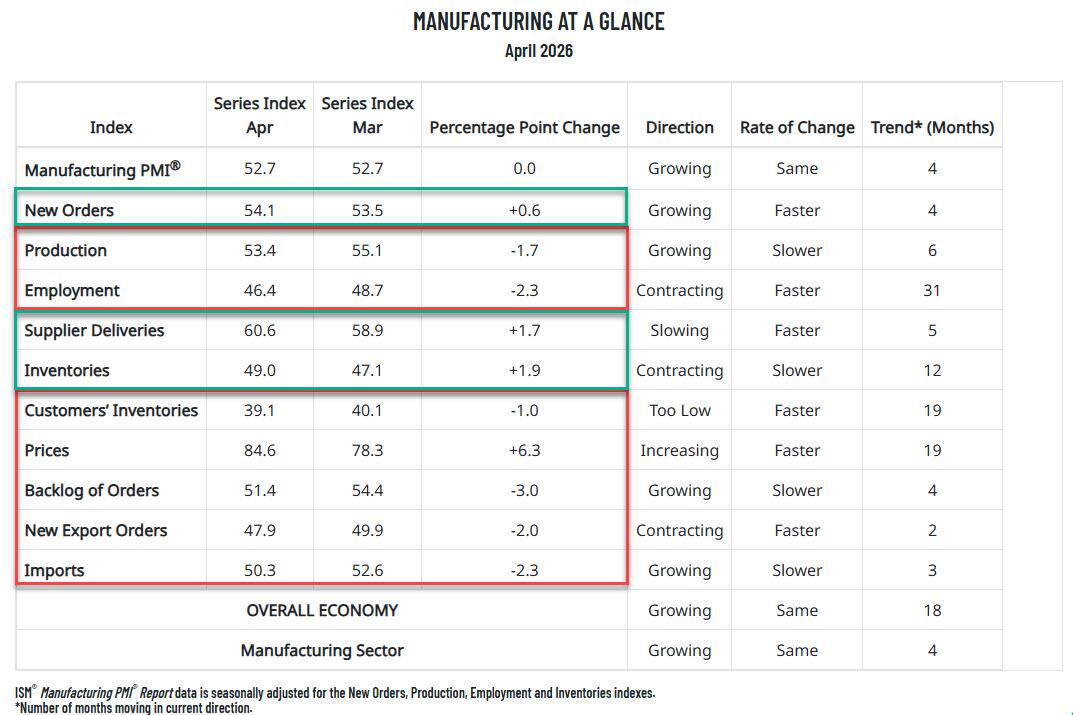
As shown below, the New Orders Index expanded for the fourth straight month after four straight readings in contraction, registering 54.1 percent, up 0.6 percentage point compared to March’s figure of 53.5 percent. The April reading of the Production Index (53.4 percent) is 1.7 percentage points lower than March’s reading of 55.1 percent. The Prices Index remained in expansion (or ‘increasing’ territory), registering 84.6 percent, a 6.3-percentage point jump from March’s reading of 78.3 percent. In the last three months, the Prices Index has increased 25.6 percentage points to reach its highest level since April 2022 (84.6 percent). The Backlog of Orders Index registered 51.4 percent, down 3 percentage points compared to the 54.4 percent recorded in March. The Employment Index registered 46.4 percent, down 2.3 percentage points from March’s figure of 48.7 percent.
Some more details:

“In April, U.S. manufacturing activity remained in expansion territory, growing at the same pace as the month before. Of the five subindexes that make up the PMI®, the New Orders and Supplier Deliveries indexes indicated faster growth compared to the previous month, the Production Index grew at a slower rate, and the Employment and Inventories indexes remained in contraction.

“Two of four demand indicators (the New Orders and Backlog of Orders indexes) remain in expansion, although the Backlog of Orders Index dropped 3 percentage points compared to March. The New Export Orders Index remained in contraction with a 2-percentage point decrease, and the Customers’ Inventories Index remains in ‘too low’ territory, contracting at a slightly faster rate. A ‘too low’ status for the Customers’ Inventories Index is usually considered positive for future production.

“Regarding output, the Production Index is in expansion for the sixth month in a row (although it lost ground compared to March), and the Employment Index decreased by 2.3 percentage points and remains in contraction. Among panelists, 60 percent indicated that managing head counts remains the norm at their companies as opposed to hiring, and of those managing head counts, 34 percent are using layoffs and 43 percent using attrition or not backfilling positions.

“Finally, inputs (defined as supplier deliveries, inventories, prices, and imports) had another month of mixed results. The Supplier Deliveries Index indicated increasingly slowing deliveries, the Inventories Index contracted at a slower rate, and the Prices Index vaulted again — up another 6.3 percentage points to 84.6 percent, from 78.3 percent in March, and the highest reading from April 2022, when it was also at 84.6 percent. The Imports Index lost 2.3 percentage points for a reading of 50.3 percent, compared to 52.6 percent in March.

“Looking at the manufacturing economy, 19 percent of the sector’s gross domestic product (GDP) contracted in April, compared to 16 percent in March, and the percentage of manufacturing GDP in strong contraction (defined as a composite PMI® of 45 percent or lower) decreased to 2 percent, compared to 4 percent in March. The share of sector GDP with a PMI® at or below 45 percent is a good metric to gauge overall manufacturing weakness. Of the six largest manufacturing industries, four (Transportation Equipment; Machinery; Computer & Electronic Products; and Chemical Products) expanded in April,” says Spence.

According to the report, “In April, U.S. manufacturing activity remained in expansion territory, growing at the same pace as the month before. Of the five subindexes that make up the PMI, the New Orders and Supplier Deliveries indexes indicated faster growth compared to the previous month, the Production Index grew at a slower rate, and the Employment and Inventories indexes remained in contraction.”

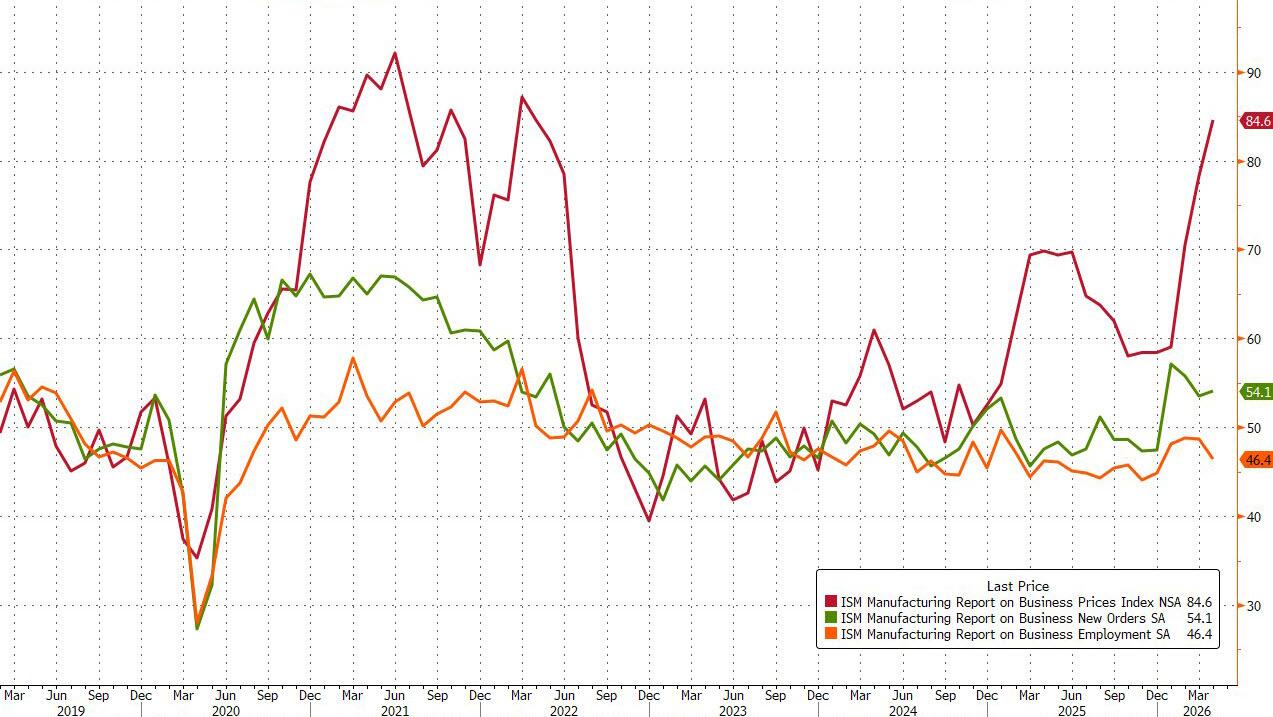
Yet for all the rhetoric, what matters is that  prices continued to rise, surging to 84.6, the highest since April 2022 and approaching their 2021 record high, while employment shrank further into contraction, down to 46.4, the lowest print of 2026.
Furthermore, as expected the Iran war remains: “In this second month of the Iran War (at the time of data collection), 31 percent of the comments were positive and 69 percent negative, with a positive to negative sentiment ratio of 1 to 2.2. Among comments, the war was mentioned in 47 percent and tariffs in 18 percent. As was the case last month, some panelists referenced both topics within a single comment or in mixed sentiment.”

Obviously, if the war persists and price pressures and supply delays accelerate, demand, employment and production capabilities will inevitably start to be even more adversely affected until the broader economy finally cracks. 

Tyler Durden
Fri, 05/01/2026 – 10:22

via ZeroHedge News https://ift.tt/cD0Kp8w Tyler Durden
Final Warnings

Final Warnings

By Elwin de Groot, head of macro strategy at Rabobank

Some headlines write themselves. Tokyo has already delivered one – and likely acted on it. Tehran may be waiting for its turn. The bond market, meanwhile, could have issued another warning to the Fed. As for the long-held consensus that 2026 would bring smooth disinflation, gentle policy easing, and AI-driven multiple expansion, that narrative has been under strain for some time. Yesterday’s European inflation – and to a lesser extent growth – data did little to support it. Both US and Eurozone Q1 GDP undershot expectations even as inflation pressures persist. To be sure, central banks held their fire, but no one can say they haven’t been warned.

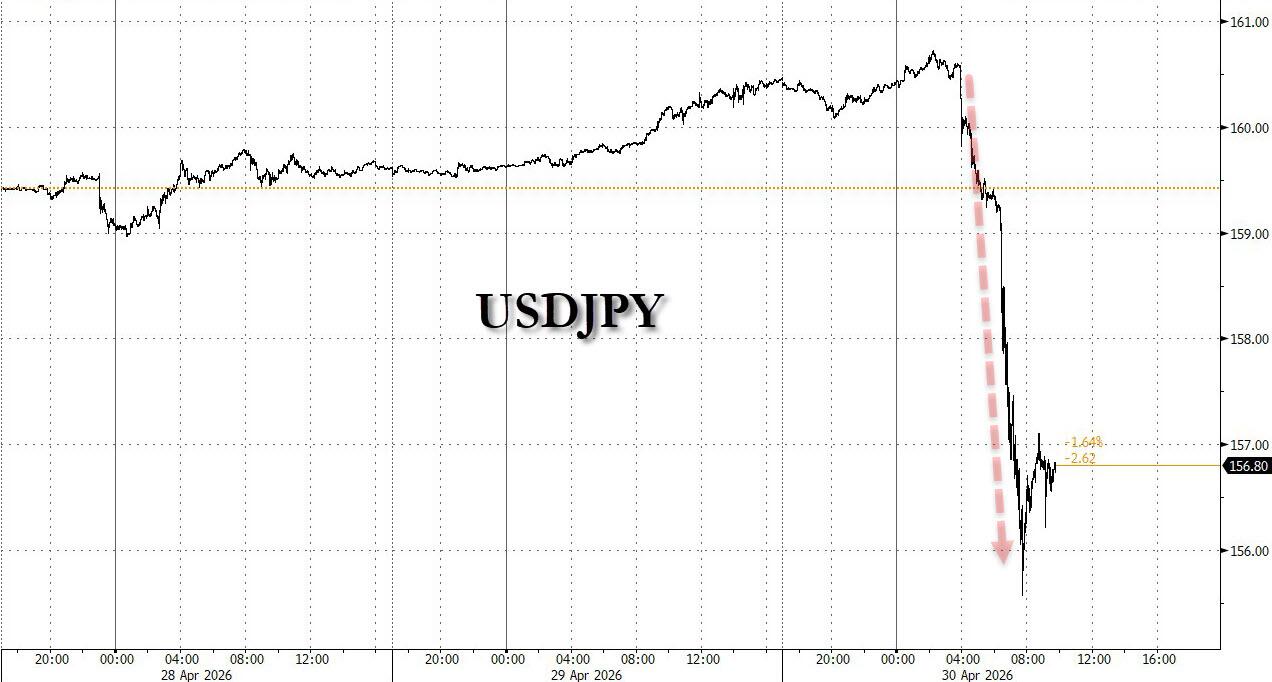
Start with the yen, because that’s where yesterday’s most audible bang came from. After Finance Minister Katayama and top FX diplomat Mimura took turns at the microphone delivering what Mimura himself called Japan’s “final evacuation warning” to markets, USD/JPY collapsed from above 160 to under 156 – the largest one-day move in the dollar against the yen since December 2022.

The MOF, predictably, won’t confirm. But when a currency moves three big figures in a few hours with no other catalyst, traders who’ve sat through previous interventions tend to recognize the fingerprints. While writing this Daily, the USD/JPY pair is coming down sharply again.

Atsushi Mimura

The bigger issue, however, is whether intervention can do more than briefly stabilize markets. Japan faces structural pressures: it is a major energy importer amid elevated oil prices, and its central bank is cautiously pursuing policy normalisation after years of ultra-loose settings. Recent spikes in government bond yields – touching multi-decade highs – highlight the risks. Authorities can resist market forces for a time, but they cannot fundamentally change them.

Speaking of which: oil. Brent traded above $125 yesterday in early European trading on yet more reporting that Washington is preparing for an extended blockade of Iran’s ports and may be considering renewed military action, before being abruptly knocked lower in heavy volume – possibly, some sources suggested, by official Japanese selling alongside the yen operation. So have we arrived at the point where finance ministries are actively managing crude on the side?

In any case, oil appears to be holding on to its decline despite rising geopolitical tensions. The UAE has urged its citizens in Iran, Lebanon, and Iraq to leave “immediately,” citing deteriorating regional conditions. At the same time, sources suggest the US is completing final pre-strike preparations, including intelligence gathering on Iranian oil infrastructure. In response, Iran is reportedly planning a “dual response”: missile strikes on Gulf energy assets and US-linked bases, alongside a potential closure of the Strait of Hormuz using mines and missiles. Senior US military officials have briefed President Trump on updated options for possible action against Iran. In short, multiple warnings have been issued, and the situation remains highly fluid – meaning the landscape could shift markedly over the coming days. Warnings are out.

In the Eurozone, April’s flash HICP rose to 3.0% y/y – the highest since September 2023 – driven largely by a 10.9% surge in energy prices, with inflation accelerating across Germany, France, Spain, and Italy. While the headline print was slightly below our forecast, this mainly reflected easing in core inflation, particularly services, which slowed from 3.2% to 3.0% y/y. This distinction is important. The headline signals renewed pressure, but core dynamics suggest inflation has not yet broadened into a wage‑price spiral that would warrant aggressive monetary tightening beyond limited “warning shots.” We expect Eurozone inflation to average around 3.1% in 2026, easing to 2.5% in 2027. While still above pre-war expectations – by roughly 1.7 percentage points cumulatively – this profile does not justify tightening policy into a slowing growth backdrop.

Indeed, Eurozone GDP data sharpened the inflation–growth trade-off. Q1 growth came in at just 0.1% q/q, below the 0.2%–0.3% consensus. France stagnated, Italy slowed, Germany surprised modestly to the upside at 0.3%, and Spain remained the standout at 0.6%. Importantly, most of the quarter predates the peak of the Iran-related energy shock, meaning the weakness reflects an economy already losing momentum rather than the direct impact of recent geopolitical developments (see our more in-depth take here). This suggests Q2 is likely to be similarly weak – or weaker in underlying terms – and implies that the ECB’s prior growth projections were already too optimistic before the latest shock. Our forecasts see Eurozone growth slowing from 1.5% in 2025 to 0.6% this year, followed by a modest recovery to 0.9% in 2027.

Against this backdrop, the ECB left rates unchanged at 2%, as widely expected. The decision itself was uneventful; the message was not. The Governing Council acknowledged that “upside risks to inflation and downside risks to growth have intensified,” with President Lagarde describing the outcome as “an informed decision on the basis of yet-insufficient information.” That phrasing suggests the decision was finely balanced, with some policymakers inclined to move – a message that also came through via ‘sources’ shortly after the press conference had ended.

Our ECB watcher Bas van Geffen characterises this as a “June or never” moment – and the uncertainty embedded in that phrase is key. Hawks still have a window to push for tightening, but it is narrowing. Earlier in the month, markets had priced in multiple hikes, driven by inflation concerns, yet that urgency has since faded. Financial conditions have remained orderly: spreads are contained, equities resilient, and no disorderly market reaction has emerged to compel ECB action. In that environment, the burden of proof shifts to those advocating a hike. 

Our base case remains a 25bp increase in June, taking the deposit rate to 2.25%. June offers fresh staff projections and another month of data, making it the natural decision point. However, if the ECB does not act then, the case for tightening weakens materially. By July, energy pass-through should be near its peak, and evidence of second-round effects – if present – should be clearer. Absent such evidence, the argument for higher rates loses traction. A key condition for a June pause, however, would be a meaningful easing in energy prices, implying improvement in Middle East tensions – something not evident at present. The ECB, for its part, cannot be accused of failing to signal these risks.

Across the Channel, the Bank of England struck an “Alert but careful” tone, also holding rates steady. Governor Bailey described the stance as an “active hold,” balancing persistent inflation risks against growing concerns over employment and activity. While the BoE reiterated that it stands “ready to act as necessary,” both the minutes and Bailey’s remarks suggested reluctance to move prematurely. An overload of scenarios and caveats provided limited forward guidance. That said, we expect more Monetary Policy Committee members to lean toward tightening in June. Ultimately, how far that shift goes will depend heavily on developments around the Strait of Hormuz and the extent to which higher energy costs feed through into broader inflation.

Tyler Durden
Fri, 05/01/2026 – 10:10

via ZeroHedge News https://ift.tt/IbcXwpV Tyler Durden

Pentagon Finalizes Deal With Top AI Firms For National Security Work

Pentagon Finalizes Deal With Top AI Firms For National Security Work

The Department of War has finalized agreements with OpenAI, Google, SpaceX/xAI, Microsoft, Amazon, Nvidia, and Reflection AI to deploy AI tools in “classified settings.” This means these tools will operate within secure government networks where sensitive or secret national security information is handled, according to The Wall Street Journal.

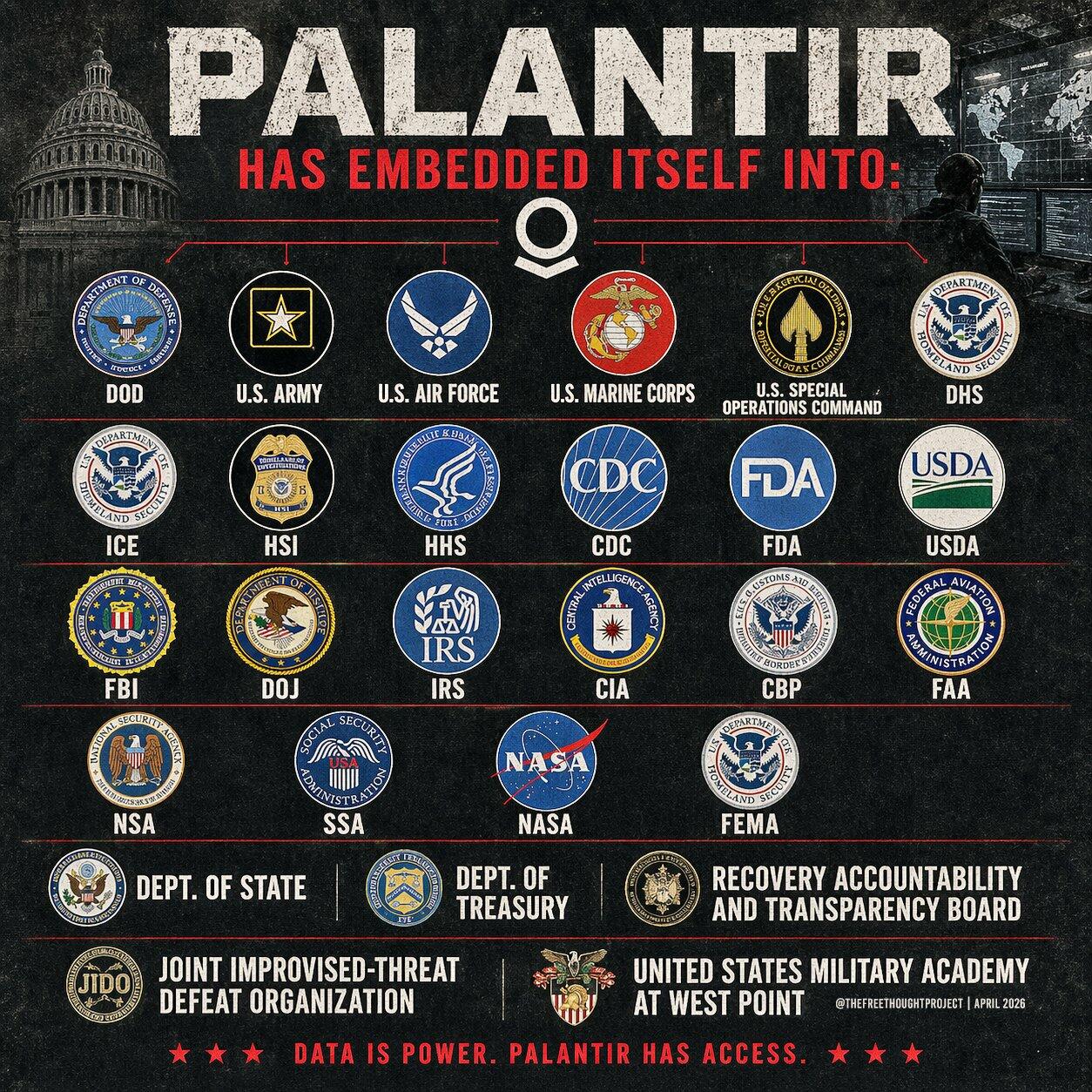
Anthropic’s Claude had previously been one of the few AI tools available on Palantir’s Maven platform. However, after the DoW labeled Anthropic a supply chain risk, the department pushed to broaden access to AI tools for top-secret work.

The deal with the seven AI companies to unleash these models for secret national-security work, such as intelligence reports, satellite imagery, drone feeds, signals data, battlefield updates, logistics data, or classified planning documents, merely reflects that Silicon Valley is coming around in supporting the DoD after years of rejecting work with the department.

Emil Michael, undersecretary of defense for research and engineering, told the outlet, “We are equipping the warfighter with a suite of AI tools to maintain an unfair advantage and achieve absolute decision superiority.”

A Reflection spokeswoman told the outlet, “This shared understanding with the Pentagon is a first step in supporting U.S. national security, and sets a precedent for how AI labs could work across the U.S. government, from supporting our servicemembers to our scientists.”

The first indication that at least one Big Tech company had reached a deal with the DoW came on Thursday afternoon, when NBC News reported that Google had agreed to deploy its powerful Gemini AI systems on classified networks.

Defense Secretary Pete Hegseth has made AI a top priority for the armed forces, vowing to transform the military into “an AI-first warfighting force.”

“We are proud to be part of a broad consortium of leading AI labs and technology and cloud companies providing AI services and infrastructure in support of national security,” Google spokesperson Kate Dreyer said in an email to NBC News.

Hegseth on Thursday defended the DoW’s use of AI tools in classified military operations, telling Congress that “humans make decisions” and that “AI is not making lethal decisions.”

Hegseth called Anthropic’s CEO an “ideological lunatic,” which only shows the rift between the left-leaning AI startup and the military is widening. 

According to Tech Crunch, Anthropic is in the process of closing another fundraising round, asking investors to submit applications over the next two days as the startup seeks $50 billion at a $900 billion valuation. The previous valuation of $380 billion was in February. 

Tyler Durden
Fri, 05/01/2026 – 09:50

via ZeroHedge News https://ift.tt/pzh1a2j Tyler Durden

Medicaid Withholds Additional $91 Million In Funding For Minnesota

Medicaid Withholds Additional $91 Million In Funding For Minnesota

Authored by Janice Hisle via The Epoch Times,

In his latest action targeting Minnesota fraud, Dr. Mehmet Oz, administrator for the Centers for Medicare & Medicaid Services, said his agency would delay paying $91 million in Medicaid claims to the state.

“This is about protecting patients and respecting taxpayers,” Oz said in a video posted April 30 on X, announcing the decision.

The money being withheld includes “$76 million tied to 14 service categories highly vulnerable to fraud,” Oz wrote on X. The remaining deferred payments—$14 million—could potentially have been directed “towards illegal immigrants who weren’t supposed to be getting this coverage,” he stated in the video.

The most recent amounts are on top of an initial $259 million the agency halted in February amid the North Star State’s ongoing fraud scandals.

Minnesota sued Oz’s agency and the U.S. Department of Health and Human Services over that decision, but earlier this month a federal court refused to unfreeze the funds as the litigation continues.

Oz said he notified Minnesota Gov. Tim Walz and other state officials before going public with his most recent decision. The Epoch Times sought comment from Walz but received no reply prior to publication.

Minnesota’s fraud scandals drew widespread attention in late 2025. Since then, President Donald Trump has ratcheted up fraud investigations across the nation. Trump appointed Vice President JD Vance to head an anti-fraud task force and the Justice Department formed a National Fraud Enforcement Division.

Oz’s new Minnesota funding freeze comes two days after agents raided 22 Minnesota sites in connection with fraud investigations.

The state’s issues with the defrauding of its public programs follow “a pattern we can’t ignore,” Oz said.

“Minnesota’s Medicaid program has shown serious vulnerabilities to fraud,” Oz wrote. “These are not isolated breakdowns—they point to systemic issues that must be addressed.”

The federal government funds roughly half of Medicaid, he wrote, which gives his agency “the authority and the responsibility to ensure those dollars are spent legally and appropriately.”

Medicaid will refuse to pay “bad bills,” he said, adding that Minnesota is therefore being asked to provide more documentation to justify payment of the requested funds. “When something doesn’t look right, we investigate; it’s our job.”

Oz said his agency is providing “as much support as we can” to help Walz “turn this around.”

Earlier this year, following months of nationwide attention on Minnesota’s fraud-plagued programs, Walz asked state lawmakers to enact what he called “a comprehensive anti-fraud package.”

In an April 17 newsletter, Minnesota Rep. Kristin Robbins, who chairs the state’s anti-fraud legislative committee, said she remains concerned that officials with two key state agencies have continued to testify that “they don’t think anyone who fails to do their job will be fired.”

“Instead, they talked about how they will provide additional training and support,” Robbins said.

Robbins is running as a Republican gubernatorial candidate to replace Walz, who withdrew his reelection bid amid the scandals. She wrote that she supports a few of Walz’s fraud-prevention ideas, including upgrading computer systems that are used to verify eligibility for government benefits. She also agrees with Walz that the time limits for prosecuting fraud crimes should be extended beyond the current six years. Walz proposed a one-year extension, Robbins said, but she proposed a bill calling for an additional four years so that prosecutors could move forward with charges a decade after the alleged offenses.

“The most important element in preventing fraud is creating a no fraud, no excuses culture,” Robbins wrote.

Tyler Durden
Fri, 05/01/2026 – 09:30

via ZeroHedge News https://ift.tt/q8SbpRH Tyler Durden

Roblox Shares Crash As Engagement Headwinds Blindside Wall Street

Roblox Shares Crash As Engagement Headwinds Blindside Wall Street

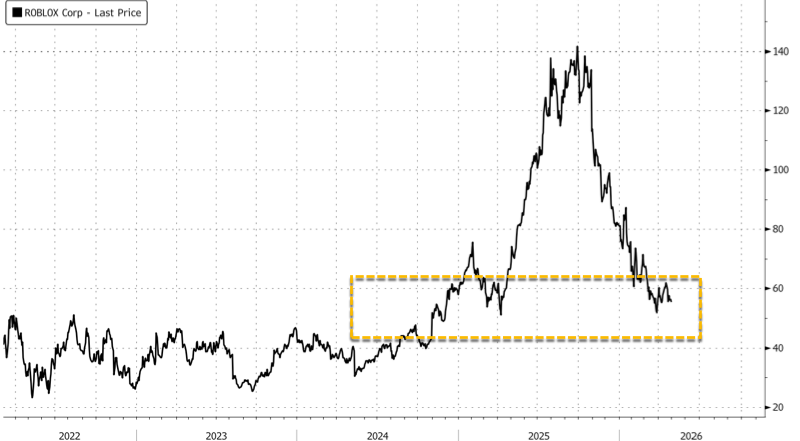
Online gaming platform Roblox crashed the most in four years in premarket trading to the tune of 24%, after the company reported weaker-than-expected first-quarter user metrics and slashed its full-year bookings outlook.

One of the major problems plaguing Roblox has been that new child-safety features, including age-verification requirements and limits on platform communication, have slowed user growth.

Daily active users came in at 132 million, missing the Bloomberg Consensus estimate of 143.8 million, while hours engaged also missed estimates.

Here’s a snapshot of first-quarter results (courtesy of Bloomberg):

  • Daily active users 132 million, estimate 143.8 million (Bloomberg Consensus)

  • Bookings $1.7 billion, estimate $1.73 billion

  • Hours engaged 31 billion, estimate 33.68 billion

  • Revenue $1.4 billion, estimate $1.42 billion

  • Loss per share 35c vs. loss/shr 32c y/y, estimate loss/shr 40c * Free cash flow $596 million, estimate $564.5 million

Despite the user and bookings misses, free cash flow exceeded Bloomberg Consensus estimates, coming in at $596 million versus expectations of $564.5 million.

Second-quarter forecast (courtesy of Bloomberg):

  • Sees bookings $1.55 billion to $1.61 billion, estimate $1.88 billion

  • Sees revenue $1.39 billion to $1.45 billion, estimate $1.45 billion

  • Sees consolidated net loss $242 million to $257 million, estimate loss $253 million

And full-year forecast (courtesy of Bloomberg):

  • Sees bookings $7.33 billion to $7.60 billion, saw $8.28 billion to $8.55 billion, estimate $8.38 billion

  • Sees revenue $5.87 billion to $6.14 billion, saw $6.02 billion to $6.29 billion, estimate $6.6 billion

  • Sees consolidated net loss $1.04 billion to $1.18 billion, saw loss $1.14 billion to loss $1.30 billion, estimate loss $1.15 billion

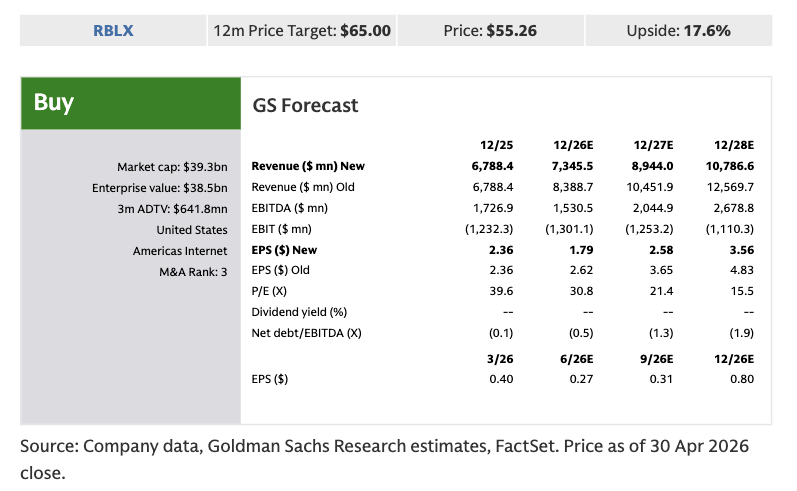
Goldman analyst Eric Sheridan offered clients his first take on the earnings:

In its Q1 ’26 earnings report, Roblox (RBLX) management framed a few key themes: 1) the rollout of age verification resulted in larger than expected engagement headwinds during the quarter – with management framing decreased communication (in-game chat) within experiences as having a likely impact on App Store ratings (and driving headwinds to organic user acquisition); 2) on the back of engagement headwinds, paired with the exit from Russia, Q1 DAUs underperformed relative to GS/Street expectations – and is now expected to continue to decline on a sequential basis during Q2’26; 3) positive commentary surrounding US O18 DAUs – with the cohort growing 40%+ YoY (vs. overall UCAN DAU growth of 17% YoY during Q1); & 4) an emphasis on scaling out novel experiences – with mgmt. supporting the rollout of novel game creation through an increase in targeted DevEx rates, & the announcement of several creator programs (incl. Roblox Jumpstart & Incubator).

In total, Roblox management initiated and implemented a series of long-term structural changes (which should be positive for long-term platform health and growth), including a lowered 2026 guidance for bookings & Adj. EBITDA, but by doing so, the company must now rebuild investor confidence in the building blocks toward its long-term goals of scaling to 10%+ market share in the US/global gaming content market while also navigating increased regulatory scrutiny on user safety.

Over the coming quarters, we believe that further visibility into user growth (acquisition & retention), and engagement heading into 2H will likely be needed for investors to gain confidence around the long-term growth algorithm of RBLX. To be more pointed, this is unlikely to be a one quarter recovery story – we think additional visibility into the navigation past tougher comps in 2H 2026 and the trajectory of 2027+ operating margins will be critical for forward operating estimates and a truer measure of valuation multiples aligned with growth outcomes. That said, at current share price levels, the valuation skew on the shares leaves us constructive on the stock.

While this reset in expectations is difficult, we view Roblox mgmt as reiterating its long-term goals surrounding: 1) compounded forward bookings growth of 20%+; 2) the potential for increased user monetization on the back of a number of initiatives (optimized and dynamic pricing in emerging markets, scaling of Novel games, etc.); & 3) a scaling Adj. EBITDA margin in 2027+ on the back of fixed cost leverage – even when including DevEx increases.

We reiterate our Buy rating on the shares and update our forward operating estimate for this set of earnings results & mgmt commentary and adjust our 12-month price target from $125 to $65.

Q1’26 Positives & Negatives:

Positives: a) Positive commentary surrounding the O18 user opportunity with the US cohort growing 40%+, with mgmt also highlighting that the cohort monetizes at a 50%+ higher rate than U18 US DAUs; b) continued expansion of offerings to native advertisers & adoption by creators, with more than 60 out of the top 100 creators using RBLX’s native ads manager – and mgmt. reiterating confidence surrounding the long-term growth potential of the business initiative; & c) mgmt reiterated their commitment toward driving an expansion in Novel game offerings – with the announcement of targeted DevEx rate increases (beginning on June 8th) & the launch of several programs to support creators (incl. Roblox Jumpstart & Incubator).

Negatives: a) Q2 & 2026 bookings/Adj. EBITDA guidance came in well below GS/Street (and prior FY26 guidance) estimates, as the company reflects ongoing headwinds from safety initiatives, continued investments into long-term strategic priorities, paired with lower fixed cost leverage (due to lower bookings growth assumptions); b) Q1 DAUs were below GSe/Street expectations due to greater-than-expected headwinds from the rollout of age-checks and the platform ban in Russia – with mgmt. also expecting DAUs to continue to decline on a sequential basis during Q2; c) on the back of age verification checks (which were a headwind to communication on the platform during Q1), RBLX App Store ratings declined, resulting in a reduction to organic signups that have traditionally been derived from the app store; & d) mgmt noted that additional algorithm & home page layout experimentation (which are expected to continue in Q2) could result in near-term headwinds to bookings & engagement.

Additional institutional commentary (courtsey of Bloomberg):

Bloomberg Intelligence analyst Nathan Naidu

  • “Roblox’s push to have users complete age verification or face limits on platform communication is expected to extend a near-term slowdown in engagement and bookings but should support longer-term growth by addressing child-safety scrutiny and heavy sales concentration in a few major games”

Morgan Stanley analyst Matthew Cost (overweight, PT $62)

  • Roblox’s age verification system is creating headwinds

  • “That said, this system is fully within RBLX’s control and fixes are on the way, as strength beneath the surface could create greater room for revisions ahead.”

Jefferies analyst James Heaney (hold, PT $46 from $60)

  • Against what were already low expectations, Roblox’s updated FY26 bookings forecast “will continue fueling the bear case for the stock.”

  • “Primary issues were unexpectedly negative impacts from age check rollout and discovery algo changes, both of which could be multi-quarter headwinds.”

Market reaction to the dismal earnings report sent Roblox shares crashing in premarket trading, down 24%, and if losses persist through the cash session, this would be the largest intraday decline since the 26% plunge on February 16, 2022.

Boom/bust…

The broader takeaway is that parents may be becoming more aware of the risks of their children spending hours in online gaming ecosystems, particularly on platforms with social chat features and monetized engagement loops. 

Tyler Durden
Fri, 05/01/2026 – 09:10

via ZeroHedge News https://ift.tt/sqNMFdh Tyler Durden

Workers Voted on Decertifying Unions 1,600 Times in the Past Decade. Teamsters Are the Most Common Target.


People holding Teamsters signs | Illustration: International Brotherhood of Teamster/Wikimedia Commons/Midjourney/Photka/Dreamstime

Like hundreds of her coworkers, Kira Junod never voted to join the Teamsters.

The massive Lamb Weston plant in American Falls, Idaho, where Junod works, is one of the world’s largest suppliers of frozen french fries and other potato products. The employees there voted decades ago to unionize. Now, even with Idaho’s right-to-work laws that allow workers to opt out of paying dues, the local Teamsters union was the only entity allowed to negotiate with management on behalf of Junod and her colleagues.

When you got a job at Lamb Weston, you were subject to the union contract. That’s just how it was.

“There’s a lot of people that have been there 30, 40 years that are set in their ways and they’re union,” says Junod. “And I’m like, ‘Why are you in the union?’ And they’re like, ‘I don’t know.'”

Junod and some of her coworkers began to question that arrangement when they discovered the benefits offered to workers at the nonunion Lamb Weston plant in Twin Falls, a few hours away. Those included more paid sick leave, higher differentials for overnight and weekend shifts, and quarterly bonuses for meeting quotas.

“That’s free money, even if it’s 20 bucks every quarter,” she says. “Why wouldn’t I want that?”

Standing in the way: the local Teamsters union.

When workers band together to demand union representation at an Amazon warehouse or at Starbucks, it gets front-page media coverage and provides fodder for think pieces about the class struggle between labor and capital. When the story is workers rising up against a union that has failed to deliver on the promise of better working conditions through solidarity, it tends not to draw as much attention.

But it happens more often than you might think—though the process is not easy, as Junod would learn.

Dozens of union decertification elections are held in workplaces across America every year, according to data collected by the National Labor Relations Board (NLRB). The Teamsters are often the target.

Of the 1,620 decertification elections that the NLRB tracked between 2016 and 2025, more than 23 percent sought to end Teamsters representation. The 373 decertification petitions targeting the Teamsters during that period were more than twice the number filed against the Service Employees International Union (SEIU), which had the second most.

More than 60 percent of those decertification elections targeting the Teamsters have been successful.

The decertification efforts that do attract media attention usually revolve around the issues that motivated Junod: workers who are unhappy with contracts and benefits offered by the union.

“Poor vacation, poor pay, subpar benefits, no real job protections [and] our contract wages were way below standard for our industry” is how Ray Cotts, a driver at the Keurig Dr Pepper plant in Oshkosh, Wisconsin, described his most recent Teamsters contract to the Oshkosh Northwestern in 2024. That was shortly after three successful decertification elections at the company’s plants in Wisconsin.

The number of decertification elections launched against the Teamsters seem to reflect dissatisfaction among the Teamsters’ rank-and-file members at a time when the union’s leadership has been seeking the spotlight. Union boss Sean O’Brien spoke at the Republican National Convention in 2024 and has tried to cozy up with pro-labor Republicans such as Sen. Josh Hawley (R–Mo.).

They may also reflect a national trend away from unionization, despite a few high-profile organizing efforts at Amazon and the like. About 10 percent of U.S. workers were members of a union in 2025, according to the Bureau of Labor Statistics. That’s down from more than 20 percent in 1983, when the bureau began tracking those figures. In the private sector, fewer than 6 percent of workers were in a union last year.

Decertification efforts, like the one in American Falls, have been happening despite a lack of widespread knowledge that they are even possible—and with few resources available to workers who might want one. The NLRB’s website, for example, offers just a single paragraph explaining what decertification elections are and how they work.

Even that brief description offers an indication of how complicated the process can be. To trigger a decertification election, at least 30 percent of the workforce at a union shop must sign a petition asking for an election. But decertification elections are forbidden within three years of a new collective bargaining agreement being signed, with some limited exceptions.

Groups like the National Right To Work Legal Defense Foundation offer support to workers trying to discard a union, but collecting signatures and, ultimately, winning a decertification election requires a lot of extra work from unhappy employees. Junod and some of her coworkers on “Line 7” at the Lamb Weston plant would show up early and stay late to collect signatures and make the pitch to colleagues who had never even questioned the union before.

They also faced a backlash. Junod says she lost friends over the decertification effort and recalls several instances of intimidation. She was accused of using drugs at the workplace and offered to take a test to prove her innocence. On another occasion, a pro-union coworker followed her home. “He rode my tail all the way into town,” she recalls.

The Teamsters have used other tactics to stop decertification elections. In 2019, a group of school bus drivers who tried to decertify discovered that their bargaining unit had been merged into a national entity with more than 22,000 members across 33 states—so many that it made the 30 percent signature threshold effectively impossible to meet.

When the votes were counted in American Falls, the Teamsters narrowly prevailed by a vote of 311–291.

As she headed home from an overnight shift on Thursday morning, Junod told Reason that she plans to keep pushing for decertification. But she’ll have to wait a while, because a new collective bargaining agreement just went into effect. She remains convinced that workers at the Lamb Weston plant will be treated better if they’re no longer subject to the Teamsters’ contract.

“What was most disappointing is all the stuff that we could have. The benefits and the better work-life balance and all that,” she says. “It was like my word against the union that’s been there for 60 years….It worked, almost.”

If the decertification election data are any indication, she’s far from the only one thinking that way.

The post Workers Voted on Decertifying Unions 1,600 Times in the Past Decade. Teamsters Are the Most Common Target. appeared first on Reason.com.

from Latest – Reason.com https://ift.tt/voqgcRP
via IFTTT

Victims of Communism Day – 2026

Bones of tortured prisoners. Kolyma Gulag, USSR (Nikolai Nikitin, Tass). (NA)


NOTE: This post largely reprints last year’s Victims of Communism Day post, with some modifications.

Today is May Day. Since 2007, I have advocated using this date as an international Victims of Communism Day. I outlined the rationale for this proposal (which was not my original idea) in my very first post on the subject:

May Day began as a holiday for socialists and labor union activists, not just communists. But over time, the date was taken over by the Soviet Union and other communist regimes and used as a propaganda tool to prop up their [authority]. I suggest that we instead use it as a day to commemorate those regimes’ millions of victims. The authoritative Black Book of Communism estimates the total at 80 to 100 million dead, greater than that caused by all other twentieth century tyrannies combined. We appropriately have a Holocaust Memorial Day. It is equally appropriate to commemorate the victims of the twentieth century’s other great totalitarian tyranny. And May Day is the most fitting day to do so….

Our comparative neglect of communist crimes has serious costs. Victims of Communism Day can serve the dual purpose of appropriately commemorating the millions of victims, and diminishing the likelihood that such atrocities will recur. Just as Holocaust Memorial Day and other similar events promote awareness of the dangers of racism, anti-Semitism, and radical nationalism, so Victims of Communism Day can increase awareness of the dangers of left-wing forms of totalitarianism, and government domination of the economy and civil society.

While communism is most closely associated with Russia, where the first communist regime was established, it had comparably horrendous effects in other nations around the world. The highest death toll for a communist regime was not in Russia, but in China. Mao Zedong’s Great Leap Forward was likely the biggest episode of mass murder in the entire history of the world.

November 7, 2017 was the 100th anniversary of the Bolshevik seizure of power in Russia, which led to the establishment of the first-ever communist regime. On that day, I put up a post outlining some of the lessons to be learned from a century of experience with communism.  The post explains why the lion’s share of the horrors perpetrated by communist regimes were inherent flaws  of the system. For the most part, they cannot be ascribed to circumstantial factors, such as flawed individual leaders, peculiarities of Russian and Chinese culture, or the absence of democracy. Some of these other factors, especially the last, probably did make the situation worse than it might have been otherwise. But, for reasons I explained in the same post, some form of dictatorship or oligarchy is  virtually inevitable in a socialist economic system where the government controls all or nearly all of the economy.

While the influence of communist ideology has declined since its mid-twentieth century peak, it is far from dead. Largely unreformed communist regimes remain in power in Cuba and North Korea. In Venezuela, the Marxist government’s policies have resulted in political repression, the starvation of children, and a massive refugee crisis – the biggest in the history of the Western hemisphere. The removal of President Nicolas Maduro has so far done little to change the nature of that regime.

In Russia, the authoritarian regime of former KGB Colonel Vladimir Putin has embarked on a wholesale whitewashing of communism’s historical record. Putin’s brutal and indefensible invasion of Ukraine owes more to Russian nationalist ideology than communism. But it is nonetheless fed in part by his desire to recapture the supposed power and glory of the Soviet Union, and his long-held belief that the collapse of the USSR was “the greatest geopolitical catastrophe of the century.” It is also telling that most communists in Russia and elsewhere have joined with far-right nationalists in  backing Putin’s line on the war.

In China, the Communist Party remains in power (albeit after having abandoned many of its previous socialist economic policies), and has recently become less tolerant of criticism of the mass murders of the Mao era (part of a more general turn towards greater repression).

China’s horrific repression of the Uighur minority is reminiscent of similar policies under Mao and Stalin, though it has not – so far – reached the level of actual mass murder. But imprisoning over 1 million people in horrific concentration camps is more than bad enough.

Far-left support for Hamas since the horrific October 7, 2023 terrorist attack is yet another reminder of the inherently evil nature of communist ideology. Backing terrorism is part of a long history of support for repression and mass murder. Not all extreme socialists of the type who support Hamas are communists. But the latter are a subset of the former.

In the West, the popularity of “democratic socialism” in some quarters is a sign that many have failed to learn the lessons of the communist experience. Democratic socialism has many of the same flaws as its authoritarian counterpart, and – as the Venezuelan case shows –  is unlikely to stay democratic for long, if implemented.

Victims of Communism Day is also a good time to remember our duty to help those victims. Among other things, it is unjust to deport migrants fleeing oppressive Marxist dictatorships, like those Cuba, Nicaragua and Venezuela, as the Trump Administration seeks to do to hundreds of thousands who entered the US legally under the CNVH program. Trump has recently ramped up efforts to deport Cubans back to their communist oppressors.

In a 2012 post, I explained why May 1 is a better date for Victims of Communism Day than the available alternatives, such as November 7 (the anniversary of the Bolshevik seizure of power in Russia) and August 23 (the anniversary of the Nazi-Soviet Pact). I also addressed various possible objections to using May Day, including claims that the date should be reserved for the celebration of labor unions.

But, as explained in my 2013 Victims of Communism Day post, I would be happy to support a different date if it turns out to be easier to build a consensus around it. If another date is chosen, I would prefer November 7; not out of any desire to diminish the significance of communist atrocities in other nations, but because it marks the establishment of the very first communist regime. November 7 has in fact been declared Victims of Communism Memorial Day by three state legislatures.

If this approach continues to spread, I would be happy to switch to November 7, even though May 1 might be still more appropriate. For that reason, I have adopted the practice of also commemorating the victims of communism on November 7.

I  would also be happy to back almost any other date that could command broad support. Unless and until that happens, however, May 1 will continue to be Victims of Communism Day at the Volokh Conspiracy.

The post Victims of Communism Day – 2026 appeared first on Reason.com.

from Latest – Reason.com https://ift.tt/13Jr2mi
via IFTTT

Is The Devil Wears Prada 2 the Great Millennial Journalism Movie?


Anne Hathaway, Meryl Streep, and Stanley Tucci in "The Devil Wears Prada 2" | Photo: The Devil Wears Prada 2/20th Century Studios

Normally, I am against content labels for media, but I might have to make an exception for The Devil Wears Prada 2. This movie should come with a trigger warning, at least for millennial journalists. The fizzy, frothy comedy is also a jewel-box encapsulation of a generation’s broken dreams, told through the decline of magazine journalism. 

The film opens at a journalistic awards ceremony, one of those rubber chicken dinners where journalists give each other plastic trophies to honor worthy (but often little-read) work. Just as our heroine, Andy Sachs (a perky, perfectly neurotic Anne Hathaway), accepts the top honor, she receives a text. Everyone at her table has been fired as part of a corporate cost-cutting deal. Andy makes tearful remarks and goes off to mourn her job and the industry. 

At the same time, Andy’s old nemesis, the fearsome Miranda Priestly—the formidable editor of the (former) fashion powerhouse Runway—is facing a scandal for running a puff piece about a dicey fast fashion company. Runway‘s owner sees Andy’s speech, which has gone viral, and offers her a job as the magazine’s features editor in an attempt to revitalize the publication’s journalistic credibility. 

The setup is somewhat strained, but the important thing is that it quickly brings Andy back into Miranda’s orbit, renewing the cat-and-mouse dynamic that drove its hit predecessor. 

The Devil Wears Prada was released in 2006, before smartphones, before the publishing industry crashed, before everything went online. Watching it now is like finding a buried time capsule, every detail a precise signifier: Andy’s fling is not just a successful magazine journalist, but a freelancer. Her friends drink wine and Cosmopolitans. Andy even wears a toe ring. 

Much of that movie’s tension was about journalistic values: She wanted to be a serious reporter, but by working at Runway, she learned that fashion has value too. 

This late-breaking sequel inverts that idea. The question it poses is whether either journalism or fashion matters anymore. 

Yes, is the movie’s emphatic answer. But the film is also honest enough to acknowledge that neither journalism nor fashion have the cultural cache they used to. The first film was a breezy coming-of-age fantasy about a young woman making her way in the hustle and bustle of the world’s greatest metropolis. The sequel is about what happens when the world has changed, and those hopes seem dashed. 

And it’s not just Andy who has lost something. Miranda, once again played by Meryl Streep, used to be the queen of her domain, which was everything everyone wore. But she’s been reduced to something smaller: hanging her own coat, trying to avoid H.R. complaints about political correctness, and begging advertisers for forgiveness while refusing to put up a fight against the tasteless tech-and-money men who control her fate. Streep made Miranda an exquisite terror in the first film, but there’s a kind of powerlessness to her now, a sense of fading glory in a world that has passed her by. 

The Devil Wears Prada 2 is never maudlin, but it’s quite sentimental. It doesn’t have much sympathy for economic dynamism or technological change. Nor does it acknowledge the actually good fortunes that American millennials have experienced; we are far richer than our parents were at this stage of life, and far more materially comfortable in nearly every way. 

I’m normally annoyed with such static, pessimistic, nostalgia-tinged worldviews, but as a mid-40s journalist who moved to a city to write for magazines at almost the exact same time that the fictional Andy did, I can’t view this one from a distance. I’m way too close to the story. 

And if you look closely, the movie isn’t simply arguing for nostalgia to rule. A key scene comes when Andy meets a new love interest, a handsome contractor who modernizes old urban buildings that were going to be torn down. She argues that he’s destroying history; he makes a convincing rebuttal that he’s actually preserving it by making it new. She ends up falling for him—and moving into one of his apartments. Is this an act of betrayal? Or is Andy just making peace with a world in constant flux?

The movie suggests that beautiful, human things like clothing and stories and buildings still matter and will always matter—and that it’s up to those who care, and have the means, to support them. I don’t want to spoil things, but the billionaire class comes through in the end. 

The Devil Wears Prada 2 may not quite be the great millennial journalism movie, but it comes surprisingly close. Consider yourself warned.

The post Is <i>The Devil Wears Prada 2</i> the Great Millennial Journalism Movie? appeared first on Reason.com.

from Latest – Reason.com https://ift.tt/a6BkrUc
via IFTTT

United Arab Emirates Law and Maine Courts

From last week’s Maine high court decision in Aldarraji v. Alolwan, written by Justice Julia Lipe, dealing with Ms. Aldarraji’s divorce complaint against Mr. Alolwan:

Aldarraji argues that she and Alolwan were legally married under Maine law. Because the parties’ marriage ceremony did not occur in Maine, however, the proper question in assessing the legality of the marriage is whether it was valid under the laws of the jurisdiction where the marriage ceremony occurred—here, the United Arab Emirates….

Alolwan was born in Saudi Arabia and is a dual citizen of Saudi Arabia and the United States, having moved to the United States in 2006. Aldarraji came to the United States from Iraq in 2018. The parties met in 2019, and later that year they traveled to Dubai, United Arab Emirates, for a religious marriage ceremony. There was no religious official physically present with the parties in Dubai; an imam affiliated with a mosque in Biddeford, Maine, officiated the ceremony remotely. The ceremony was performed according to the laws of the parties’ Islamic faith, and after the ceremony the imam provided them with a certificate of religious marriage.

Soon after, the parties had a wedding reception in Turkey, and on January 16, 2020, while in Turkey, the parties and two witnesses signed the certificate of religious marriage that the imam had provided them. The parties then returned to Maine. They never participated in a marriage ceremony in Maine nor took any steps to validate their marriage in accordance with Maine law ….

Alolwan filed a motion to dismiss [Aldarraji’s] complaint on the basis that no lawful marriage existed between the parties. The court held an evidentiary hearing and later issued a written order granting Alolwan’s motion to dismiss. The court concluded that although the parties had participated in a valid religious marriage ceremony, they had not complied with Maine’s statutory marriage requirements and therefore had “failed to establish a legal marriage in Maine.” Nor, according to the court, were the parties legally married “anywhere else.” …

“[W]e have declined to recognize common law marriage” in Maine, instead leaving “policy decisions regarding marriage and divorce to the Legislature.” “[T]he requirements for a valid marriage are provided by statute” …. Generally, a couple seeking to become married under Maine law must first record their intention to be married by submitting a marriage application to a municipal clerk or the State Registrar of Vital Statistics. The clerk or Registrar then issues the parties a marriage license. The couple is then free to marry, and the ceremony must be solemnized by a person authorized by law to do so and must occur in the presence of at least two other witnesses. The marriage becomes legal once certain information, including the location and date of the ceremony, has been documented on the marriage license and the license has been signed by the couple, the witnesses, and the officiant. Finally, within fifteen “working days” of the date of solemnization, the marriage license must be returned to the clerk or Registrar.

Although Aldarraji does not argue that she and Alolwan complied with this procedure, she contends that her religious marriage to Alolwan was nonetheless valid under Maine’s statutory scheme. For support, she relies on two provisions of Title 19-A that allow for exceptions to the general rules: section 657, which provides that a marriage that is “in other respects lawful” is valid even if the solemnizing official lacks jurisdiction or authority or there exists an “omission or informality” in the process the parties followed; and section 658, which exempts Quakers or Friends and members of the Baha’i faith from some of the statutory requirements. Regarding section 658, Aldarraji asserts that unless we interpret the statute to extend to members of the Islamic faith, it is unconstitutional….

We do not reach Aldarraji’s statutory or constitutional arguments, however, because we conclude that Maine law does not apply when determining the validity of a marriage that did not occur in Maine….

Generally, in the case of a marriage that occurred elsewhere, we will recognize the marriage as valid if entered into pursuant to the laws of the jurisdiction where it occurred, unless it is contrary to the basic public policies of this state. Aldarraji argues that we should jettison this approach in favor of the Second Restatement[ of Conflict of Laws] mode of analysis, which involves using the laws of the jurisdiction that “has the most significant relationship to the spouses and the marriage” to determine the validity of a marriage. She further contends that because she and Alolwan have continuously resided in Maine since before their religious ceremony, we should use Maine law to assess the legality of their marriage.

We have never applied the Second Restatement’s approach in the context of determining the validity of a marriage, and we decline to do so here. Instead, we adhere to our general rule that the validity of a marriage should be determined according to the laws of the jurisdiction in which the marriage ceremony occurred. This is consistent with the view of a number of courts faced with this question….

The benefit of this rule is its simplicity. One of the major drawbacks of the Second Restatement method is its complexity. “Sound public policy dictates that there be a minimum of uncertainty as to whether or not a valid marriage exists.” Our decision today provides that clarity—when Maine courts are asked to determine the validity of a marriage, they will look to the laws of the jurisdiction where the marriage ceremony occurred.

{We emphasize that nothing in our decision precludes Maine couples from having a wedding outside of Maine and achieving a valid marriage by either complying with the requirements of the out-of-state jurisdiction or following Maine’s statutory process before or after the wedding.} …

The trial court … invit[ed] Aldarraji to demonstrate “that there was a legal marriage in Dubai that the State of Maine should recognize.” Aldarraji did not avail herself of this opportunity, arguing instead that her extraterritorial marriage complied with Maine’s statutory marriage procedures. On appeal, Aldarraji continues to insist that we should assess the validity of her marriage by reference to Maine law. She has therefore waived any argument that she was lawfully married according to the laws of the United Arab Emirates….

Colin W.B. Chard (Robinson Kriger & McCallum) represents Aldarraji.

The post United Arab Emirates Law and Maine Courts appeared first on Reason.com.

from Latest – Reason.com https://ift.tt/QOUBW1Z
via IFTTT

$800K Defamation Damages in “Israeli Spy” Allegations Against Consultant Involved in Examining Hunter Biden’s Laptop

See Monday’s jury verdict, which awards $75K in compensatory damages plus $125K in punitive damages for each of two statements, and for each of two plaintiffs (Yaacov Apelbaum and his company XRVision). Here’s an excerpt of the July decision allowing the case to go forward (Apelbaum v. Bloom):

Yaacov Apelbaum is the founder of XRVision, Ltd., a cybersecurity and analytics company. Plaintiffs Apelbaum and XRVision … attracted media attention in 2020 for their role in examining Hunter Biden’s laptop computer, purportedly “analyz[ing] the contents” of a copy of the hard drive “to determine the legitimacy of the [l]aptop.”

[Defendant] Jordan Arthur Bloom … is an independent journalist who maintains a blog on the platform Substack. On January 29, 2024, Defendant published an article, “The Role of Yaacov Apelbaum in the Hunter Biden Drama” (“First Article”)…. The alleged defamatory statements in the First Article include:

  • Yaacov Apelbaum is an Israeli spy, and the sort of Israeli spy who would have good reasons to smear American facial recognition technology, because his company, XRVision, is a competitor.” [Emphasis in complaint.]
  • “XRVision has provided sourcing to a bunch of conservative publications, including the Washington Times. So this is an Israeli spy who’s deeply involved in shaping the Hunter Biden story.” [Emphasis in complaint.] …

These statements were published on Defendant’s Substack and also to thousands of viewers on Twitter and other platforms, then were “subsequently and virally” republished on other websites. Defendant intentionally failed to conduct any investigation before publishing these statements and “made zero effort to contact Plaintiffs to seek out their knowledge or position to include in his article.” …

Plaintiffs sued, and the court allowed the case to go forward:

[i.] Plaintiffs set forth an actionable statement (defamation per se)….

A statement is considered defamation per se [and thus actionable without proof of tangible loss -EV] if, among other things, it “prejudice[s] such person in his or her profession or trade.” Defendant argues that “identification as an Israeli spy is [not] inherently damaging to one’s reputation in business.”

Keeping in mind that at this procedural juncture the Court is obliged to assume the truth of Plaintiffs’ factual allegations, Plaintiffs’ assertions overcome any dispute as to the “inherent” reputational impact of these statements. The complaint submits that Plaintiffs work in the cybersecurity industry, and Plaintiffs “periodically work[ ] with the [United States] government” in this field. This Court concludes that allegations of close ties to a foreign intelligence agency could prejudice a cybersecurity professional and his firm….

[And a]t this stage, the Court must credit the Plaintiffs’ well pled allegation of the factual falsity of the statements. The complaint alleges the statements are factually false, citing in support that “Mr. Apelbaum [has] renounced his Israeli citizenship and is presently a citizen of the United States of America, only,” that “Mr. Apelbaum is not a foreign agent,” and that Defendant “conceived a storyline in advance of any adequate investigation and then consciously set out to insert Plaintiffs into his preconceived narratives.” …

[ii.] Actual [m]alice …

[B]ecause Plaintiffs have alleged that Bloom made his statements with actual malice, this Court need not resolve at this juncture whether or not Plaintiffs constitute public figures.

Actual malice requires “knowledge that [the statement] was false or … reckless disregard of whether it was false or not.” Contrary to Defendant’s claims, the complaint makes numerous allegations that go to actual malice: that “Bloom merely relied on tropes and his own pre-existing bigotry and biases, devoid of facts, and he knowingly sought to harm, and did harm, Plaintiffs,” that he “deliberately avoided conducting any investigation into Plaintiffs and made zero effort to contact Plaintiffs,” that he “has a history of writing anti-Semitic articles that accuse Jews and Israel of manipulating and/or controlling the U.S. government,” and that his “publications and pattern of publishing are evidence that he conceived a storyline in advance of any adequate investigation and then consciously set out to insert Plaintiffs into his preconceived narratives as discussed throughout the Complaint.”

Other cases have found actual malice in quite similar circumstances. In a defamation case where the plaintiff was accused by media sites of orchestrating the violence at the “Unite The Right” rally in Charlottesville, VA, it was enough for the plaintiff to allege “that Defendants ‘twisted’ elements of his personal and professional history to fit a pre-conceived narrative.” Gilmore v. Jones (W.D. Va. 2019). There, as here, the defendant was alleged to have shoehorned his statements into a preconceived “storyline” and “departed from even the most basic journalistic standards by, for instance, failing to reach out to [Plaintiff].” Accordingly, Plaintiffs’ allegations of Defendant’s lack of due diligence and shoehorning of their actions into a preconceived narrative about Israelis and Jews are adequate to plead actual malice….

Timothy Hyland and Jamie Michelle Hertz (Hyland Law PLLC) and John C. Burns (Burns Law Firm) represent Plaintiffs.

The post $800K Defamation Damages in "Israeli Spy" Allegations Against Consultant Involved in Examining Hunter Biden's Laptop appeared first on Reason.com.

from Latest – Reason.com https://ift.tt/snEZCt9
via IFTTT