Futures Rise, Oil Slides On Iran Ceasefire Optimism After Best Month For Stocks Since 2020

Futures Rise, Oil Slides On Iran Ceasefire Optimism After Best Month For Stocks Since 2020

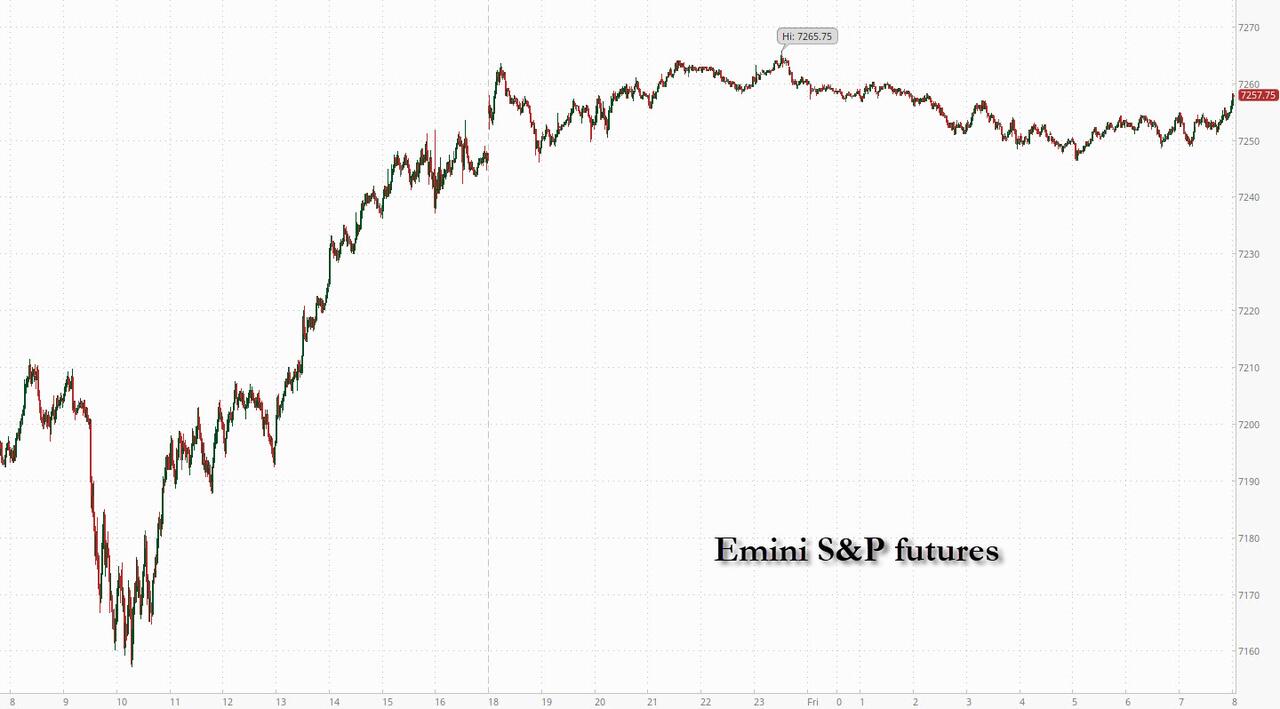
US equity futures are higher, set for a new all time high, as the rally that’s pushed Wall Street to record highs on strong megacap tech earnings continues, after the S&P posted its best monthly increase since November 2020. As of 8:00am ET, S&P futures are up 0.3% (spiking moments ago on a report that Iran submitted its latest response to US amendments on the ceasefire agreement), while Nasdaq futures are modestly in the red and the Russell underperforms. Pre-market, AAPL is up 3% on healthy guidance and earnings beat even as it warned that memory-chip costs will increase and that shortages of Mac computers will persist for “several months.” NVDA and MSFT are 40bp higher, while AMZN is down 60bp. Headlines since yesterday’s close have been largely quiet, especially given the market holidays across most European and Asian markets. Bond yields dropped 1-2bp, and oil slipped after news that Iran had delivered its response to the latest US ceasefire amendment via Pakistani sources; the news pushed Brent down by about $1 to $110 and WTI dropped to session lows around $103; precious metals and aluminum are lower. The dollar was little changed having wrapped up its worst month since June, after a second intervention to by the BOJ/MOF in Japan pushed the yen sharply higher (although it has again given up most of its gains). Gold traded around $4,600 an ounce. Today’s economic data calendar slate includes April manufacturing PMI (9:45am) and ISM manufacturing (10am). Fed speaker slate includes Miran at 8am
In premarket trading, Mag 7 stocks are mixed: Apple is up 3.8% after giving a surprisingly strong revenue forecast for the third quarter, even as it warned that memory-chip costs will increase and that shortages of Mac computers will persist for “several months” (Nvidia +0.4%, Microsoft +0.4%, Meta +0.3%, Tesla -0.2%, Alphabet -0.2%, Amazon -0.7%). 

  • Amgen (AMGN) is down 1.6% after the drugmaker reported underwhelming sales of some of its newer products for the first quarter, with Baird calling the results a “mixed bag.”
  • Cohu (COHU) falls 1.1% after the semiconductor manufacturing company reported adjusted earnings per share that missed the average analyst estimate. However, analysts remain positive on its long-term growth prospects.
  • Moderna Inc. (MRNA) jumps 6.7% after first-quarter sales beat expectations, as the struggling vaccine maker that’s faced resistance from the Trump administration has found new growth outside the US.
  • Roblox (RBLX) tumbles 24% after the video-game company reported daily active users for the first quarter that missed the average analyst estimate. The company also lowered its forecast for full-year bookings, a key measure of sales, after implementing safety features restricting how kids, who make up a majority of its audience, can use the platform.
  • Sandisk (SNDK) is down 6.2% after the computer hardware and storage company reported third-quarter results that were much stronger than expected and gave an outlook that was well above the consensus. Despite the upside in the report and forecast, analysts said the report may not have been strong enough to meet high investor expectations.
  • Summit Therapeutics (SMMT) is down 21% after the biotech firm said it plans to continue the study of its experimental cancer drug, following a review by an independent committee. Barclays analysts say the optics of the new guidance pressured shares.
  • Sunbelt Rentals (SUNB) is down 2.6% after JPMorgan cut the recommendation on the equipment rental company to underweight from neutral, citing an “increase in industry-wide freight rates and fuel costs and the expected outperformance of Specialty (which is lower margin vs. General Tool).”
  • Twilio Inc. (TWLO) jumps 18% after the software company reported revenue for the first quarter that beat the average analyst estimate. The company also raised its revenue growth forecast for the year.
  • Veeva Systems (VEEV) rises 9.7% as the cloud-based software company is set to replace Coterra Energy in the S&P 500.
  • Zeta Global (ZETA) is up 6.5% after the software company reported first-quarter results that beat expectations and raised its full-year forecast. Analysts are especially positive on the company’s Athena AI operating system.

In other corporate news, Tesla generated more than half a billion dollars in revenue last year from selling products to two of Elon Musk’s other companies, the carmaker disclosed in an amended annual filing. Western Digital shares fell in extended trading despite reporting better than expected results across key metrics. Expectations were high, with shares up more than 60% in April. Novo Nordisk’s obesity shot Wegovy helped people with alcoholism reduce their drinking in a controlled study of patients who sought help with their addiction. 

Stocks are set to start the month of May in the green after closing a volatile April at record highs, with the S&P 500 logging its strongest monthly gain since 2020. Apple, the fifth Mag 7 megacap to report in two days, delivered a surprisingly strong revenue forecast for its third quarter, even as it warned that memory-chip costs will increase and that shortages of Mac computers will persist for “several months.”

Apple aside, it’s all about AI: according to Bloomberg, S&P 500 margin expansion is being entirely driven by AI stocks, and without those companies, margins would have contracted.  And AI stocks are cheap relative to history alongside much stronger fundamentals, with AI stocks expected to deliver 33.7% EPS growth from 2Q to 4Q 2026 — roughly 2.5x that of non-AI peers, writes Bloomberg analyst Nathaniel T Welnhofer. 

Alphabet’s 10% gain on Thursday added $421 billion to its market value, the second-biggest one-day jump in market cap add for any stock ever. OpenAI CFO Sarah Friar, rebutting concerns about missing internal targets, said the company is meeting objectives and sees “a vertical wall of demand” for its products. Elsewhere in AI, debt investors are showing signs of fatigue after $300 billion of deals that have spanned every corner of the credit market, with bankers having to work harder to sell deals by offering more incentives and higher compensation. 

“The latest US earnings season has been robust, which has helped prevent global markets from suffering big losses despite the impact of the Iran conflict,” said Russ Mould, investment director at AJ Bell.

Meanwhile, Goldman traders note that May is likely to see moderate tailwinds from corporate buybacks, while systematic strategies are more likely to become sellers of global stocks after a heavy re-leveraging.  S&P Dow Jones Indices has launched a consultation that could eventually speed up the entry of mega cap companies seeking to IPO into its indexes, including the S&P 500.

Fitch Ratings warned the US’s credit grade faces challenges due to a widening deficit that leaves its debt burden “far above” other nations that share its AA score. 

Oil held its second weekly gain as US President Donald Trump said he was sticking with a naval blockade of Iranian ports, elevating concerns the vital Strait of Hormuz would not reopen anytime soon. Brent for July rose above $111 a barrel, while West Texas Intermediate was above $105 — up 12% this week.

“Oil prices remaining above $110 per barrel though are a reminder of the stakes for the global economy and the fact that there looks no path to the Strait of Hormuz reopening in the near term,” AJ Bell’s Mould said.

Most European markets are closed for a public holiday; UK stocks dropped in thin holiday trading, led lower by NatWest on disappointing earnings and AstraZeneca on a regulatory setback. Meanwhile, water utilities fell after Citi downgraded United Utilities and Severn Trent on “limited absolute valuation upside.” Diageo rose on tariff relief hopes.  The FTSE 100 fell 0.5%, while Denmark’s OMX Copenhagen 25 Index was little changed, amid holidays for many other European markets. Here are the key stock movements this morning

  • Diageo gained 1.6% after US President Donald Trump said he would be removing some Scotch tariffs following a visit from King Charles III.
  • NatWest dropped as much as 4.2%, hitting a one-month low, as analysts looked past forecast-beating results to note that the UK lender’s adjusted profit had undershot expectations, while the improved income target had already been anticipated. Net interest income came in slightly below expectations.
  • AstraZeneca slipped as much as 2.2% after the US Food and Drug Administration’s Oncology Drugs Advisory Committee voted against the drugmaker’s breast cancer medicine, known as camizestrant. Morgan Stanley noted the vote creates a “regulatory overhang and a dent to investor sentiment,” though the commercial impact is “relatively modest.”
  • UK water utility stocks slide following a steep rally on Thursday as Citi downgrades United Utilities and Severn Trent due to “limited absolute valuation upside” on a 12-month view.

Asian stocks rose, poised to cap a fourth-straight weekly gain, buoyed by tech earnings as traders awaited more catalysts. The MSCI Asia Pacific Index was up about 0.3% Friday, with key gauges in Japan, Australia and New Zealand closing in the green. All of the region’s other key markets were closed for holidays. The regional benchmark was on track for a weekly advance of 0.7%. Japan’s tech-heavy Nikkei 225 tracked gains in US peers after results from major tech firms. Chip-equipment Tokyo Electron was among the biggest boosts to the regional gauge after a better-than-expected forecast. Next week’s highlights include rate decisions in Australia and Malaysia. Companies including HSBC, Toyota, Nintendo and Westpac will report results.

In FX, USD/JPY is little changed near 156.50 although that underplays another volatile session. The pair rose in Asia but fell abruptly during European morning hours, shedding ~150 pips in just a few minutes before recovering after a 2nd Japanese FX intervention. The swings are not as large as those observed on Thursday where Japan likely spent around $34.5 billion Thursday to prop up the yen, according to a Bloomberg analysis of central bank accounts.

In rates, treasuries are steady over Asia, early London session with yields trading marginally cheaper on the day, as oil is set to hold a second weekly gain after President Trump said he was sticking with Iran naval blockade. US yields dropped by 1-2bps across the curve following news that Iran delivered its latest response to US amendments on the agreement to end the war through Pakistani mediators. US 10-year yields trade around 4.36%. IG dollar issuance slate empty so far. Gilts fall, with declines more pronounced at the short-end. UK two-year yields rise 3 bps to 4.48%.  Twelve names priced $38.3 billion Thursday, paying about 4.5 basis points in new issue concessions on deals that were 3.7 times oversubscribed. Weekly volumes past $62 billion so far exceed dealer forecasts of near $50 billion. Friday is expected to be quiet.

In commodities, oil remains key driver for Treasuries price action. July Brent traded near $112 a barrel, heading for a weekly gain of more than 6%, while West Texas Intermediate was near $106 — up more than 12% for the period. Precious metals fall. Bitcoin rises 1%.

US economic data calendar slate includes April manufacturing PMI (9:45am) and ISM manufacturing (10am). Fed speaker slate includes Miran at 8am.

Market Snapshot

  • S&P 500 mini +0.2%
  • Nasdaq 100 mini -0.1%
  • Russell 2000 mini -0.1%
  • Stoxx Europe 600 -0.2%
  • FTSE 100 -0.7%
  • 10-year Treasury yield +1 basis point at 4.38%
  • VIX +0.2 points at 17.1
  • Bloomberg Dollar Index little changed at 1192.06
  • euro little changed at $1.1738
  • WTI crude +0.6% at $105.75/barrel

Top Overnight News

  • Iran delivered its latest response to US amendments on the agreement to end the war through Pakistani mediators: Al Jazeera
  • Weeks of conflict have aggravated Iran’s dire economic problems, risking calamity after the war, but the Islamic Republic looks able to survive a standoff in the Gulf for now, despite a U.S. blockade that has cut off energy exports. With major fighting paused by an April 8 truce, Iran is locked in a stalemate with the U.S. and Israel, with talks for a lasting ceasefire stalled while Tehran keeps the Strait of Hormuz shut and Washington blockades Iranian Gulf ports. RTRS
  • A U.S.-Iran ceasefire that began in early April has “terminated” hostilities between the two sides for the purposes of an approaching congressional war powers deadline, a senior official of President Donald Trump’s ‌administration said on Thursday. RTRS
  • The US credit rating is under pressure from a widening deficit, with debt “far above” other AA peers, Fitch warned. It expects further fiscal deterioration, driven by tax cuts. BBG
  • Huawei is set to capture the largest share of China’s AI chip market this year, with sales jumping by at least 60 per cent amid strong demand from Chinese companies seeking domestic alternatives to Nvidia. FT
  • OpenAI CFO Sarah Friar said the company sees a “vertical wall of demand,” after a WSJ report about missed internal goals weighed on AI-linked stocks earlier this week. She said growth may be constrained by limited computing capacity. BBG
  • A growing camp of hard-liners believe Iran has to take the military initiative and start a shooting war again to send oil prices soaring higher and increase the pressure on Trump. They argue that the blockade goes beyond the sanctions Iran has faced down in the past and amounts to an act of war that must have a military response. WSJ
  • S&P Dow Jones Indices LLC has launched a consultation that could speed up the entry of mega cap companies into its indexes, including the S&P 500. The proposed rule change would shorten the time a company needs to be public before being eligible to six months versus the current minimum of 12 months. If approved, the changes would apply to indexes including the S&P 500, S&P MidCap 400 and S&P SmallCap 600, with any changes to be adopted prior to the market open on June 8.  BBG
  • Chevron and Exxon beat estimates, offsetting supply and production losses from the Iran war. Shares of both firms rose premarket (CVX+1%, XOM +60 bps). BBG
  • Anthropic is racing to close another fundraising round, asking investors to submit applications within the next 48 hours as the company looks to take in ~$50B at a valuation of ~$900B+ (Anthropic closed its last round in Feb at a ~$380B valuation). Tech Crunch
  • US President Trump has signed the DHS funding bill.

Iran News

  • US President Trump is expected to make a decision on the path forward [on Iran] in the coming days, NBC reported citing a US official.
  • US President Trump said would not have approved enriched Uranium for Iran; needs guarantees Iran will not have a nuclear weapon ever. Hormuz blockade is 100% effective.
  • A senior Trump administration official said that for War Power Resolution purposes, hostilities that began on February 28th have been terminated.
  • Iranian Judiciary head said Iran does not accept negotiation based on imposition; adds Iran has never left the negotiating table, Iranian press reported.
  • Iranian National Security Commission member Rezei said “we are currently in the second phase of the war with the enemy..the naval blockade is a continuation of the war.. we are not in a ceasefire situation now”, Mehr reported. Full post:”Iran cannot be besieged; We have different ways to export and import In a conversation with Mehr, Ebrahim Rezaei said: “The enemy has turned to our naval blockade after failing in the military war and direct confrontation, and we are currently in the second phase of the war with the enemy.” In other words, the naval blockade is a continuation of the war that the Americans have started against us. So, we are not in a ceasefire situation now. A member of the National Security Commission of the Majlis, stating that the Americans do not have the operational capacity to blockade Iran by sea, said: “Our only access route for transit is not through the Persian Gulf and the Strait of Hormuz.”.
  • US CENTCOM Commander Cooper briefed President Trump for 45 minutes on new operational plans for potential strikes against Iran, Axios’ Ravid reported citing sources.
  • Iranian Foreign Ministry Spokesperson said that it is not responsible to expect a quick conclusion of the negotiations and that the other party has not used the opportunity provided by Iran’s proposal, must be ready for any eventuality. The US and Israeli regime are famous for breaking their promises and the biggest guarantee for not repeating the war is the power of Iran.
  • Drone attack hits Iranian Kurdish opposition camp east of Iraq’s Erbil, according to Reuters, citing security sources. via vv.
  • The defense sound heard over Tehran is related to countering micro-birds and reconnaissance drones, via Tasnim.
  • Air defence sounds are being heard in some areas of Tehran but reasons are unclear, Mehr News reported.

A more detailed look at global markets courtesy of Newqsuawk

Asia-Pac stocks traded with decent gains, helped by the positivity seen stateside. The majority of markets are closed today for Labour Day. ASX 200 rebounded after 8 straight days of losses. Miners led gains while Energy underperformed following Thursday’s drop in oil prices. ANZ reported cash profit that beat estimates; however shares have slipped lower after it raised its coverage ratio by 4bps due to the heightened geopolitical risk. Nikkei 225 posted decent gains, despite the sudden JPY strength amid intervention talk. Tokyo Electron benefited following its positive Q4 results, in which net profit beat estimates.

Top Asian News

  • Japan’s Top Diplomat Mimura said will not comment on FX.

Eurozone cash and derivatives are closed today in observance of Labour Day. FTSE 100 (-0.6%) is lower this morning, dragged lower by the likes of NatWest (-4.2%), AstraZeneca (-2%) and pressure across the mining names. Delving into the UK bank in a bit more detail, the Co. reported strong headline metrics and lifted its income guidance for the year, whilst reaffirming other components. Despite the upbeat Q1, shares find themselves in the red; some will point towards the 1.4% decline in interest income. As for AstraZeneca, shares have dropped after the US FDA voted against the co’s breast cancer drug.

Top European News

  • UK M4 Money Supply MoM (Mar) M/M 0.8% vs. Exp. 0.5% (Prev. 0.6%).
  • UK Net Lending to Individuals MoM (Mar) M/M 8B vs. Exp. 5.9B (Prev. 6.8B).
  • UK BoE Consumer Credit (Mar) 1.895B (Prev. 1.935B).
  • UK Mortgage Approvals (Mar) 63.53K vs. Exp. 60K (Prev. 62.58K).
  • UK Mortgage Lending (Mar) 6.15B (Prev. 4.84B).
  • UK S&P Global Manufacturing PMI Final (Apr) 53.7 vs. Exp. 53.6 (Prev. 51.0).
  • UK Nationwide Housing Prices YoY (Apr) Y/Y 3.0% (Prev. 2.2%).
  • UK Nationwide Housing Prices MoM (Apr) M/M 0.4% vs. Exp. -0.3% (Prev. 0.9%).

Trade/Tariffs

  • Japanese PM Takaichi said she will be visiting Vietnam and Australia. “Moreover, through these visits to both countries, taking into account the current situation in the Middle East, I will confirm cooperation on strengthening supply chain resilience, including stable energy supply and critical minerals within the Asian region. I believe such initiatives are also important for procuring critical supplies such as crude oil and petroleum products in Japan.”.
  • USTR Greer said he suggested a US-China Board of Trade in his meeting with Chinese VP He Lifeng.
  • USTR Greer said the US will extend preferential treatment to other UK goods.

FX

  • USD/JPY took another leg lower this morning, surpassing Thursday’s low of 155.55 to mark a session trough of 155.48.
  • Thursday saw strong verbal intervention from Japanese Finance Minister Katayama, then later comments from top FX official Mimura, which pushed the pair lower in excess of 2%. Later in the session on Thursday, Nikkei sources said a Japanese government official confirmed the intervention to Nikkei, but we are still awaiting official confirmation, with Mimura declining to comment on intervention speculation, and figures showing potential FX intervention due late May. Some desks noted the remarks/potential intervention on Thursday may have had a follow-through to the downside in Brent prices as Mimura’s “looking at markets on all fronts” could have been viewed as having cross-asset implications. However, there was no move in the Brent Jul’26 contract this morning.
  • Though it is impossible to say whether intervention occurred in this morning’s 150pip+ move, 7:45 am BST (3:45 pm JST) marks the low-liquidity period and the final hour of the Tokyo trading session, a European holiday, and also month-end. Factors which provide a relatively low liquidity environment, which boost the effectiveness of intervention.
  • In terms of the move this morning, USD/JPY fell 156 pips from 157.05 to a low of 155.48, half of the move has now been pared as participants continue to price the still low real rates in Japan, and the potential for energy prices to remain high, which MUFG says will see USD/JPY rebound quickly.
  • DXY was resilient to JPY moves, with the index falling briefly below the 98.00 mark, then paring most of the move. DXY will likely attempt to return to 100 and 200 DMAs either side of 98.50, which it has mostly respected throughout the week.
  • BoJ data for April 30th shows FX intervention of some JPY 5.4tln.

Fixed Income

  • Fixed benchmarks are flat amid mass market closures with liquidity thin and the docket sparse.
  • USTs in a narrow 110-17+ to 110-22+ range, awaiting Final Manufacturing PMI and then the ISM Manufacturing figure thereafter. Today’s docket also has Fed’s Miran; reminder, as Powell has indicated he will remain at the Fed once he is no longer Chair, Miran will likely vacate his spot for Warsh.
  • Gilts gapped lower by 15 ticks and then slipped to an 86.36 low, though comfortably above Thursday’s 85.90 contract base. No move to the Final Manufacturing PMI, which unsurprisingly points to marked price pressures and frontloading of purchase activity.
  • Ahead, BoE Chief Economist Pill is due; Pill was the sole hawkish dissenter in April, and sees the risk of second round effects as being to the upside vs the three scenarios, calling for a “prompt but modest hike” to “help mitigate upside risks to price stability”.
  • Japan sold JPY 250bln 10-year I/L JGBs: b/c 3.40x, Yield at the Lowest Accepted Price 0.578%.
  • Australia sold AUD 1.0bln 4.50% 2033 bond: b/c 3.56x, average yield 4.8608%.

Commodities

  • In geopolitics, the Trump administration is framing hostilities with Iran as “terminated” under the War Powers Resolution due to a ceasefire, allowing it to bypass the 60-day congressional approval requirement despite ongoing tensions and historically weak enforcement of the law. Trump’s stance remains inconsistent—he alternates between suggesting a deal with Iran may or may not be necessary while firmly maintaining that Iran must never acquire nuclear weapons—and he has indicated that Iran’s military capabilities are significantly degraded, though the ceasefire’s durability is uncertain. Meanwhile, CENTCOM has already presented detailed strike options, with a decision on next steps expected within days. Diplomatically, talks are stalled: Iran signals slow progress, internal disagreements are emerging within its leadership over negotiation strategy, and external actors like Israel anticipate a collapse in talks, potentially triggering escalation, including possible strikes on Iranian energy infrastructure. Iran, for its part, is preparing for “any eventuality,” adopting a defiant posture, reinforcing defences, and continuing limited military responses.
  • Crude prices remain elevated with WTI Jun between USD 104.13-106.65/bbl and Brent July towards the middle of a USD 110.33-112.45/bbl range at the time of writing. Price action this morning has been fairly muted amid broad market closures in APAC and Europe, due to the Labour Day holiday. Unlike Thursday, oil was unreactive this morning to JPY strength. (See FX for details)
  • Spot gold and silver are softer as higher crude prices keep the precious metals space pressured, with little action seen from a slide in the DXY amid a sudden surge in the JPY around 0745BST. Spot gold resides within yesterday’s USD 4,539-4,647.05/oz.
  • Base metals are mixed with 3M LME copper flat within a narrow USD 13,008.53-13,121.88/t range amid little impetus as Chinese markets were closed overnight and a large part of Europe is away.
  • US President Trump’s mineral reserve reportedly plans to purchase rare earths from China.
  • White House said presidential permit authorizes bridger pipeline expansion to construct, connect, operate, and maintain pipeline facilities at boundary at Phillips County, Montana, between US and Canada. Permitee granted permission to transport between the United States and Canada crude oil and petroleum products.

US Event Calendar

  • 9:45 am: United States Apr F S&P Global US Manufacturing PMI, est. 54, prior 54
  • 10:00 am: United States Apr ISM Manufacturing, est. 53.2, prior 52.7
  • 10:00 am: United States Apr ISM Prices Paid, est. 80.3, prior 78.3

DB’s Jim Reid concludes the overnight wrap

It should be quiet today, with many countries around the world on holiday, particularly in Europe. The UK is off on Monday so it should be a couple of days of low volume even as the war uncertainty drags on.

As it’s the start of the month, Henry will shortly release our regular performance review for April. It was another eventful month, as mounting fears about stagflation pushed many government bond yields to multi-year highs. However, equities had a much stronger time after their March slump, with the S&P 500 (+10.5% in total return terms) posting its best monthly performance since November 2020 when the vaccine news was released, ending the month at a new record high. And most notably, the Philly Semiconductor index (+38.4% total return) had its best month since February 2000, the month before the dot com bubble began to burst. For all the negativity around Europe of late, the Stoxx 600 (+5.6%) managed its best month since January 2025 while the MSCI EM index (+14.7%) had its best month since November 2022. Oil had a U-shaped performance, ending not far from where it started, but with Brent crude up over 25% from the mid-month lows. So a fascinating month. See the full review in your inboxes shortly.

Oil prices have continued to creep higher overnight, with no sign that the US and Iran are moving closer to a deal. Given the month-end, there’s been a contract roll, but if we stick with the July 2026 contract for consistency, Brent crude is up +1.07% this morning to $111.58/bbl. Moreover, Trump showed no sign of backing down, saying “Their economy is crashing, the blockade is incredible”, and “we’ll see how long they hold out.” Meanwhile, there’s been no sign of comprise from the Iranian side, with new Supreme Leader Mojtaba Khamenei issuing a statement that Iran would maintain its missile and nuclear capabilities and suggesting that Iran would implement “new legal frameworks” over the Strait of Hormuz.

This morning in Asia, the yen has weakened -0.36%, after surging +2.44% against the US Dollar yesterday. There was no official word on whether an intervention had taken place, but Nikkei reported later in the day that the Japanese government and the Bank of Japan conducted a yen-buying operation. And Bloomberg also reported overnight that an intervention had taken place. Those moves accelerated after Japan’s currency chief Atsushi Mimura said he was giving a “final warning” before taking action on FX. So if there was intervention, that final warning didn’t last very long. In turn, that pushed the yen to 156.59 per dollar by the close, strengthening from its level of 160.41 on Wednesday, when it hit its weakest closing level since July 2024.

Otherwise overnight, the risk-on tone has generally continued as May begins, although many indices are closed for a holiday. However, those that are open have generally risen, with the Nikkei (+0.60%) and Australia’s S&P/ASX 200 (+0.98%) both higher this morning, whilst futures on the S&P 500 (+0.23%) are pointing to further gains as well.

Markets also ended April on a stronger note yesterday, as a sharp intraday pullback for oil helped to ease fears about stagflation. In fact, Brent crude fell from an intraday high for this conflict of $126.41/bbl, all the way down to $114.01/bbl by the close. These moves may have been distorted by the impending end-of-month benchmark shift, but even for WTI we saw prices rise to a post-ceasefire high of $110.93/bbl intra-day before easing to $105.07/bbl by the close (-1.69% on the day). So relative to 24 hours ago, concerns about inflation have eased considerably, with markets pricing in a slightly more dovish path for central banks as well.

Those oil moves came as central banks sounded less hawkish in their decisions than many feared yesterday, which led to a decent sovereign bond rally on both sides of the Atlantic. For instance, the ECB held rates as expected, keeping their deposit rate at 2%. President Lagarde did give several hints towards a June hike, saying “directionally, I know where we are heading” and acknowledging that rate hikes had been discussed yesterday. But she also offered some dovish counterarguments and didn’t paint a June hike as a fully done deal. This led markets to dial back their expectations for imminent tightening, with the number of hikes priced by year-end falling -10.6bps to 73bps. Our European economists’ main takeaway is that the data and events now need to disprove the case for a hike in June, but they see this leading to a “measured” tightening cycle rather than a “forceful or persistent” one. 

That backdrop meant that European bond yields fell back from their recent highs. So 10yr bund yields (-7.3bps) fell to 3.03%, down from their post-2011 high on Wednesday, and yields on 10yr OATs (-8.4bps) and BTPs (-9.8bps) also fell back. Moreover, that was particularly clear at the front end, with 2yr yields seeing even sharper declines in Germany (-10.0bps), France (-9.3bps) and Italy (-11.7bps). Otherwise, European equities made a decent recovery too, with the STOXX 600 (+1.38%) recovering after four consecutive declines.

For the Bank of England, it was a similar story yesterday, as they also held rates at 3.75% as expected, but didn’t sound in a rush to hike rates. The decision was an 8-1 vote, with chief economist Huw Pill dissenting for a 25bp rate hike. But otherwise, Governor Bailey said that they weren’t “giving some slightly clandestine message that interest rates are going to go up”. So yields fell back after the decision, with the 2yr gilt yield (-10.5bps) coming down to 4.45%, whilst the 10yr gilt yield (-5.9bps) fell back to 5.01%. And as with the ECB, given markets had already priced material tightening for the rest of year, the reaction went in a more dovish direction, with the probability of a hike at the next meeting in June falling from 85% to 61%. So there was some contrast with the Fed’s announcement on Wednesday, which had been more hawkish than expected as three regional presidents dissented against the easing bias. Obviously the unfolding oil narrative of the day helped cement the moves as well.

This backdrop also meant equities put in a decent performance on both sides of the Atlantic. So the S&P 500 (+1.02%) rebounded after the last two days of losses, albeit with some weakness among tech stocks, with the Mag-7 (-0.41%) slipping as losses for Meta (-8.55%) and Microsoft (-3.93%) outweighed Alphabet’s (+9.96%) rally after their results the previous evening. After the close, we also had Apple’s results, whose shares rose around +2% after-hours after projecting stronger-than-expected sales growth for the current quarter (+14-17% vs +9% expected).

That equity recovery was supported by the latest batch of US data, which added to the theme of economic resiliency. For example, the weekly initial jobless claims fell to their lowest level since 1969, coming in at just 189k in the week ending April 25 (vs. 212k expected). Separately, we also had the Q1 GDP print, which came in at an annualised rate of +2.0% (vs. +2.3% expected). But the so-called “core GDP” measure of real final sales to private domestic purchasers was slightly stronger at +2.5%.

Otherwise, we also had the PCE inflation data for March, which showed headline PCE at a monthly pace of +0.7%, with the year-on-year print moving up to +3.5%. The print was as expected, but significantly, it means that PCE inflation has now been above the Fed’s 2% target for five full years, which is something I looked at in my chart of the day yesterday (link here). Many thought we were in a permanent period of lower inflation back in the 2010s, but the last five years have seen US inflation consistently above target. As I show in the note, regimes have tended to last for long periods of time. Are we in the early stages of an above-target regime now? Or will we ultimately trend back to target in a reasonable period? My bias is for the former.

However yesterday was a day of relief and Treasury yields also fell back, with the 2yr yield (-7.8bps) falling to 3.87%, whilst the 10yr yield (-5.9bps) fell to 4.37%. In large part that was helped by easing concerns around inflation as oil prices fell back. But we also saw Fed pricing shift in a slightly dovish direction as well, with futures for the December meeting going from 3bps of hikes on Wednesday to 3bps of cuts by yesterday’s close.

Looking at the day ahead, data releases include the ISM manufacturing for April, along with UK mortgage approvals for March. Otherwise, central bank speakers include the BoE’s Pill. Finally, earnings releases include Exxon Mobil and Chevron.

Tyler Durden
Fri, 05/01/2026 – 08:41

via ZeroHedge News https://ift.tt/s2ZSJHD Tyler Durden
US Pledges $100 Million To Repair Chornobyl Nuclear Plant

US Pledges $100 Million To Repair Chornobyl Nuclear Plant

Authored by Naveen Athrappully via The Epoch Times (emphasis ours),

The U.S. Department of State intends to offer up to $100 million in foreign assistance toward a G7 initiative to repair the Chornobyl nuclear plant’s protective structure that was damaged in Russian strikes.

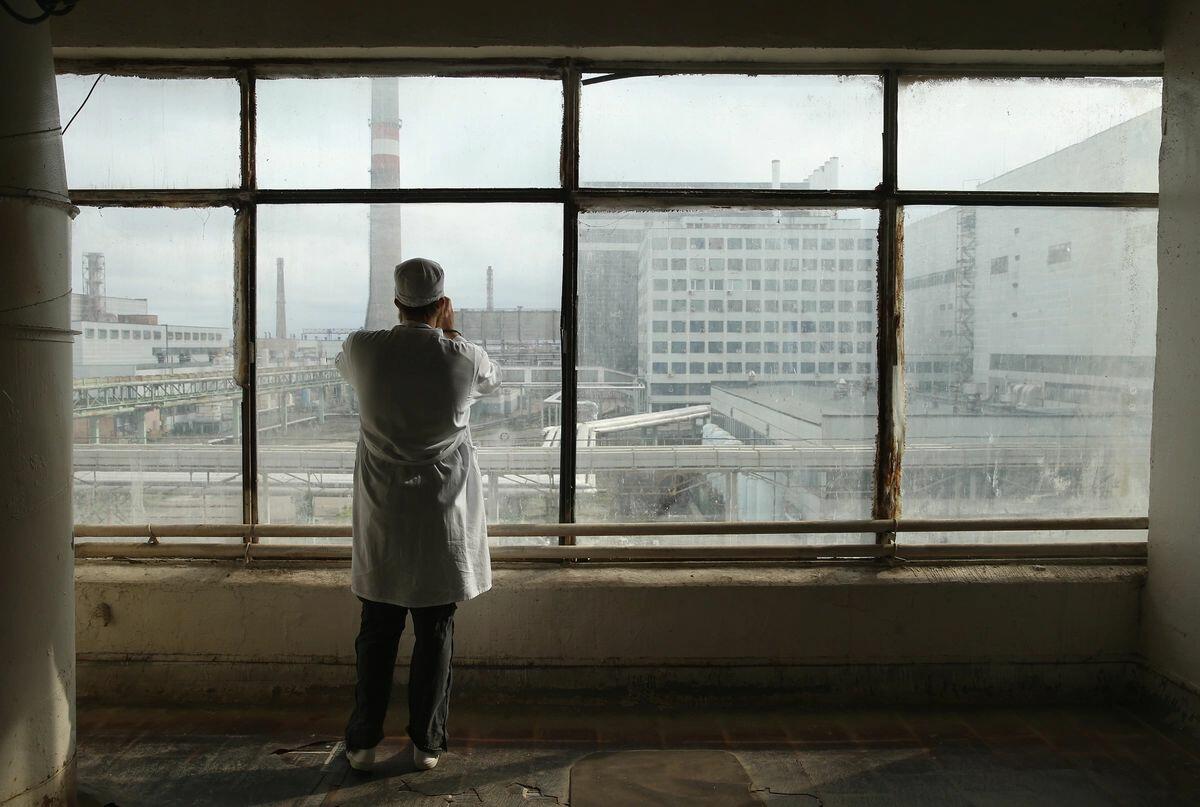
A visitor touring the former Chernobyl nuclear power plant takes a photo through a window looking toward facilities that house reactors 1 and 2 near Chernobyl, Ukraine, on Sept. 29, 2015. Sean Gallup/Getty Images

The plant, located in Ukraine, was the site of a major disaster in 1986 when Reactor No. 4 exploded, releasing radioactive material across Europe. This prompted one of the biggest emergency responses in history, including building protective structures around the plant. While the final reactor at Chornobyl was shut down in 2000, the site continues to remain highly sensitive.

“For three decades, the United States and G7 partners have led efforts to secure nuclear material at the Chornobyl plant, with the United States providing more than $365 million in total funding towards the New Safe Confinement (NSC) arch that secures the main reactor areas,” the State Department said in an April 29 statement.

Initially built with a 100-year lifespan, the NSC was damaged last year in a drone strike during the senseless ongoing war between Russia and Ukraine. Without repairs, the NSC can no longer provide adequate protection, creating the specter of a dangerous leak of highly radioactive material in Europe.”

According to a report from campaign network Greenpeace, Soviet authorities constructed what was called the Shelter Object over the destroyed Reactor 4 in the aftermath of the 1986 accident.

The Shelter Object aimed to reduce radiation levels at the site, minimize the release of radionuclides into the atmosphere, and prevent water contamination. It was never intended to be permanent and had a design life of around 20 years.

Between 1998 and 2016, the NSC structure was designed and constructed, covering the Shelter Object. NSC was formally commissioned in 2019.

“The NSC was designed to provide a 100-year safe and secure environment for the dismantlement of the Shelter Object and the control of highly radioactive materials inside the building – nuclear fuel, lava-like melted fuel, radioactive dust, and all structural debris,” the report said.

The design and functioning of the NSC was intended to prevent the release of radioactive materials during the many decades required to conduct this work.”

In February 2025, the NSC was struck by what Ukraine identified as a Russian long-range drone. Moscow denied the claim, saying it does not target nuclear infrastructure and accused Ukraine of staging the incident.

The strike on NSC’s north-west side created an opening of roughly 15 square meters, according to the Greenpeace report. While emergency repairs were initiated on the exterior of the NSC, they could not fully restore the confinement function of the structure.

“This increases the risk of radioactivity release in the environment especially in the case of a collapse of the Shelter Object. The dismantlement of the vulnerable Shelter Object is not possible without repairs to the NSC,” the report said.

“A collapse of the Shelter Object would have significant consequences, including for radiation issues inside the NSC, additional financial costs and in terms of the total collective radiation dose to workers.”

The European Bank for Reconstruction and Development has initiated a funding program to restore NSC’s functionality, setting 2030 as the deadline to complete the repairs.

The bank warned that without repairs, the structure faces irreversible corrosion within four years.

In its statement, the State Department said it was “proactively committing 20 percent, or $100 million, of the G7’s estimated $500 million cost to rehabilitate the NSC arch and ensure continued safety and security of the Chornobyl reactors and nuclear material.”

“We call upon our G7 and European partners to follow suit and make substantial financial commitments to share the burden of these essential repairs.”

Greenpeace said in an April 14 statement that the ongoing war conditions in the Chornobyl region, including the threat of Russian missiles and drones, make it “near impossible” to kick off major engineering work at the site to repair the NSC.

Eric Schmieman, an engineer who wrote the report and was involved in the design and construction of NSC, said that it’s almost impossible for people to understand the magnitude of lethal conditions inside the Shelter Object.

Tons of highly radioactive nuclear fuel, dust and debris. My colleagues and I spent years investigating inside the ruins of Chornobyl reactor 4. We designed and built the New Safe Confinement to protect the environment and people of Ukraine and Europe,” Schmieman said.

“It is urgent that all measures are taken to find a way to restore as much of the critical functions of the facility as possible.”

Tyler Durden
Fri, 05/01/2026 – 08:10

via ZeroHedge News https://ift.tt/YcQ9M5N Tyler Durden

Nearly 70% Inflation, Mass Layoffs, And A Strangled Economy: Iran’s Brutal Test Of Endurance

Nearly 70% Inflation, Mass Layoffs, And A Strangled Economy: Iran’s Brutal Test Of Endurance

Iran’s economy is undergoing one of the most brutal stress tests in its modern history. Official annual inflation has surged to 50% according to central bank figures released shortly after the ceasefire, while the year-on-year rate reached as high as 67% through mid-April, according to the Wall Street Journal. The rial has crashed to a record low of 1.8 million to the dollar, roughly two million workers have lost their jobs, and the US naval blockade of the Strait of Hormuz continues to throttle the country’s oil exports and critical imports. Reconstruction costs from bombed infrastructure are estimated near $270 billion – alarmingly close to the country’s entire annual GDP of roughly $341 billion last year. What was already a sanctions-battered, mismanaged economy now confronts a grinding “no war, no peace” stalemate. Tehran is wagering that it can hunker down and endure a protracted war – allowing it to outlast American pressure. The early data and on-the-ground reality suggest that wager is being tested to its limits.

The human impact is immediate and visible in everyday Tehran life. A 56-year-old housewife described to Najmeh Bozorgmehr of the Financial Times how a simple block of cheese rose from 5.2 million rials to 6.7 million rials (about $5.09) in a single week. Comparable jumps have struck rice, eggs, chicken, red meat, and other staples. A popular Peugeot 207 has climbed from 18 billion rials to 25 billion since the conflict began, while officials are preparing to authorize a 40 percent increase in government-mandated cement prices.

The cost of living has soared, with the annual inflation rate reaching 67% in the month through mid-April from the same period a year earlier, according to Iran’s central bank. The subsidized price of red meat, which was mostly imported through sea routes, has gone up to the equivalent of around $3.60 a pound, beyond the reach of most in a country where the minimum wage is around $130 a month. -WSJ

Business consultant Siamak Ghassemi publicly advised Iranians that anything short of a near-doubling of wages would fail to offset the cost-of-living explosion. One small petrochemical-dependent factory outside the capital has already dismissed nearly a third of its workforce. A clothing business owner reported recent costs running 150 percent above sales, bluntly concluding, “This is not sustainable.”

A street vendor on the Tehran Metro last week. Unemployment stood at 7.6% before the US-Israeli war with Iran © Vahid Salemi/AP va FT

Macro indicators reveal the depth of the damage. The Journal’s reporting, informed by Iranian officials and international analysts, estimates around one million direct job losses and another million indirect – equivalent to roughly 8 percent of the pre-war employed population of 25 million. War-related unemployment benefit applications have already reached 191,000. Steel output has dropped by up to 30 percent, while damaged petrochemical, gas, and steel complexes – major employers – grapple with raw-material shortages and physical destruction. Oil exports, which averaged 1.85 million barrels per day as recently as March, have been reduced to a near standstill, with shipping analysts at Kpler finding no confirmed evidence of cargoes successfully breaching the US blockade to reach buyers in China or elsewhere.

At the strategic core of the crisis lies the Strait of Hormuz. Iran initially tried to use the waterway as leverage by disrupting traffic; the US responded with a naval blockade that has effectively severed the Islamic Republic’s economic lifeline. Before the war, the strait carried the vast majority of Iran’s oil revenue and imports ranging from food and medicine to industrial components. In response, Tehran has activated emergency bypass routes: rail and road connections through Turkey, Armenia, and Azerbaijan, Caspian Sea ports supplied by Russia, Kazakhstan, and Turkmenistan, and new transit corridors via Pakistan. It has drawn heavily on strategic food reserves, raised the minimum wage, increased government salaries, issued monthly food coupons worth around $7 per person, and appealed to citizens to conserve energy and reduce driving.

Yet these measures are widely viewed as temporary holding operations rather than solutions. Virginia Tech economist Djavad Salehi-Isfahani told the Journal that Iranian leaders recognize ending the war is merely the prelude to an even harder challenge: managing a disillusioned and impoverished population without the rapid return of oil income. Middle East Institute fellow Alex Vatanka points out that while the regime can still portray endurance as a badge of national pride, prolonged revenue collapse increases the risk of renewed street mobilization. Vienna-based economist Mahdi Ghodsi offered a stark assessment: “Living is not affordable anymore. Iran is at its weakest point.”

One medium-sized steel entrepreneur told FT that his firm has so far avoided layoffs by shifting entirely to overland routes, but he expressed deep concern about how long this uncertain limbo can continue. Pre-war protests, already triggered by economic distress and crushed with lethal force earlier this year, provide a sobering precedent. The regime retains a formidable toolkit – subsidies, repression, parallel trade networks, and a narrative of resistance – but whether these tools can withstand another year of 50-percent-plus inflation, double-digit unemployment, and eroding living standards is the central question. This is not a sudden collapse, but a brutal, extended test of endurance whose outcome will shape not only Iran’s economy but the broader regional balance of power.

Tyler Durden
Fri, 05/01/2026 – 07:50

via ZeroHedge News https://ift.tt/9QnfPoU Tyler Durden

AfD Vows To Drain ‘NGO Swamp’ After Berlin Café That Bans White People Received Taxpayer Cash

AfD Vows To Drain ‘NGO Swamp’ After Berlin Café That Bans White People Received Taxpayer Cash

Authored by Thomas Brooke via Remix News,

The right-wing Alternative for Germany (AfD) has vowed to cut off taxpayer money for left-wing activist groups after a Berlin organization that runs a coworking café that reportedly excludes White people received more than €662,000 in public funding.

The controversy centers on BIWOC Rising, a nonprofit group in Berlin-Kreuzberg that operates a coworking space and café marketed as a protected venue for Black, Indigenous, and women of color, as well as transgender, intersex, and nonbinary people of color.

Critics say the model amounts to a publicly subsidized space that excludes white people while presenting itself as a project for tolerance, diversity, and democracy.

AfD co-leader Alice Weidel said the case showed why the party wants to overhaul Germany’s taxpayer-funded activist sector.

“A Berlin café that bans white people from entering was funded with €662,450 in taxpayer money — from the federal program ‘Democracy in Action!’ Pure racism! The AfD will drain the NGO swamp and end the waste of taxpayer money on left-wing ideology,” she wrote on X.

According to German media reports citing funding lists from the Federal Ministry for Family Affairs, Senior Citizens, Women and Youth, BIWOC Rising received €662,450 from the federal “Live Democracy!” program between 2021 and 2024. Other calculations place the figure closer to €800,000 when related funding is included, according to reporting from Tichys Einblick.

The program was created to support democracy, counter extremism, and prevent radicalization, but critics say the BIWOC Rising case exposes how public money has been channeled into highly ideological projects.

The group’s official charitable purposes reportedly include education, the promotion of tolerance, and support for people persecuted on political, racial, or religious grounds. However, questions have been raised over how those aims can be reconciled with a venue that restricts access according to racial and identity categories.

The organization is believed not to have responded to media inquiries about the allegations.

It’s not the first time allegations of White racism have been made within German institutions. In August 2023, a German museum of industrial heritage in Dortmund was scolded for only allowing “Black, Indigenous, and People of Color” to enter the museum on Saturdays between 10:00 a.m. and 2:00 p.m. for the “That’s Colonial” exhibition. The Zollern Colliery museum argued it was creating a “safer space” intended to protect people of color from “further discrimination.”

The exclusive access was “an offer for BIPoC and black people to be able to withdraw and exchange ideas openly,” according to the museum. “For BIPoC, such safe spaces are rarely found in everyday life or in museum rooms.”

In May 2025, the German Evangelical Church (EKD) was accused of racism after banning White children from attending a workshop on being “courageous and strong” during its Church Congress in Hanover.

The “Become Courage and Strong” workshop was, again, only open to Black, indigenous, and children of color. However, while ethnic Germans and ethnic Europeans are indigenous to Germany and Europe, the designation did not apply to them, only indigenous people from other continents.

“This offer is aimed exclusively at Black, Indigenous, and children of color,” read the program website.

In January of this year, the German taxpayer-funded NGO “Black Sheep,” Schwarze Schafe in German, was offering a six-month intensive seminar designed specifically for White individuals to examine their “alleged privileges,” which is modeled after the concept of “Critical Whiteness.”

The organization, which identifies as a “post-migrant education initiative,” has received significant taxpayer funding from Germans and operates a reporting center for anti-Muslim racism.

White participants were expected to pay up to €2,290 for the course that runs from March to September.

Read more here…

Tyler Durden
Fri, 05/01/2026 – 07:30

via ZeroHedge News https://ift.tt/IgsGQTA Tyler Durden

$800K Defamation Damages in “Israeli Spy” Allegations Against Consultant Involved in Examining Hunter Biden’s Laptop

See Monday’s jury verdict, which awards $75K in compensatory damages plus $125K in punitive damages for each of two statements, and for each of two plaintiffs (Yaacov Apelbaum and his company XRVision). Here’s an excerpt of the July decision allowing the case to go forward (Apelbaum v. Bloom):

Yaacov Apelbaum is the founder of XRVision, Ltd., a cybersecurity and analytics company. Plaintiffs Apelbaum and XRVision … attracted media attention in 2020 for their role in examining Hunter Biden’s laptop computer, purportedly “analyz[ing] the contents” of a copy of the hard drive “to determine the legitimacy of the [l]aptop.”

[Defendant] Jordan Arthur Bloom … is an independent journalist who maintains a blog on the platform Substack. On January 29, 2024, Defendant published an article, “The Role of Yaacov Apelbaum in the Hunter Biden Drama” (“First Article”)…. The alleged defamatory statements in the First Article include:

  • Yaacov Apelbaum is an Israeli spy, and the sort of Israeli spy who would have good reasons to smear American facial recognition technology, because his company, XRVision, is a competitor.” [Emphasis in complaint.]
  • “XRVision has provided sourcing to a bunch of conservative publications, including the Washington Times. So this is an Israeli spy who’s deeply involved in shaping the Hunter Biden story.” [Emphasis in complaint.] …

These statements were published on Defendant’s Substack and also to thousands of viewers on Twitter and other platforms, then were “subsequently and virally” republished on other websites. Defendant intentionally failed to conduct any investigation before publishing these statements and “made zero effort to contact Plaintiffs to seek out their knowledge or position to include in his article.” …

Plaintiffs sued, and the court allowed the case to go forward:

[i.] Plaintiffs set forth an actionable statement (defamation per se)….

A statement is considered defamation per se [and thus actionable without proof of tangible loss -EV] if, among other things, it “prejudice[s] such person in his or her profession or trade.” Defendant argues that “identification as an Israeli spy is [not] inherently damaging to one’s reputation in business.”

Keeping in mind that at this procedural juncture the Court is obliged to assume the truth of Plaintiffs’ factual allegations, Plaintiffs’ assertions overcome any dispute as to the “inherent” reputational impact of these statements. The complaint submits that Plaintiffs work in the cybersecurity industry, and Plaintiffs “periodically work[ ] with the [United States] government” in this field. This Court concludes that allegations of close ties to a foreign intelligence agency could prejudice a cybersecurity professional and his firm….

[And a]t this stage, the Court must credit the Plaintiffs’ well pled allegation of the factual falsity of the statements. The complaint alleges the statements are factually false, citing in support that “Mr. Apelbaum [has] renounced his Israeli citizenship and is presently a citizen of the United States of America, only,” that “Mr. Apelbaum is not a foreign agent,” and that Defendant “conceived a storyline in advance of any adequate investigation and then consciously set out to insert Plaintiffs into his preconceived narratives.” …

[ii.] Actual [m]alice …

[B]ecause Plaintiffs have alleged that Bloom made his statements with actual malice, this Court need not resolve at this juncture whether or not Plaintiffs constitute public figures.

Actual malice requires “knowledge that [the statement] was false or … reckless disregard of whether it was false or not.” Contrary to Defendant’s claims, the complaint makes numerous allegations that go to actual malice: that “Bloom merely relied on tropes and his own pre-existing bigotry and biases, devoid of facts, and he knowingly sought to harm, and did harm, Plaintiffs,” that he “deliberately avoided conducting any investigation into Plaintiffs and made zero effort to contact Plaintiffs,” that he “has a history of writing anti-Semitic articles that accuse Jews and Israel of manipulating and/or controlling the U.S. government,” and that his “publications and pattern of publishing are evidence that he conceived a storyline in advance of any adequate investigation and then consciously set out to insert Plaintiffs into his preconceived narratives as discussed throughout the Complaint.”

Other cases have found actual malice in quite similar circumstances. In a defamation case where the plaintiff was accused by media sites of orchestrating the violence at the “Unite The Right” rally in Charlottesville, VA, it was enough for the plaintiff to allege “that Defendants ‘twisted’ elements of his personal and professional history to fit a pre-conceived narrative.” Gilmore v. Jones (W.D. Va. 2019). There, as here, the defendant was alleged to have shoehorned his statements into a preconceived “storyline” and “departed from even the most basic journalistic standards by, for instance, failing to reach out to [Plaintiff].” Accordingly, Plaintiffs’ allegations of Defendant’s lack of due diligence and shoehorning of their actions into a preconceived narrative about Israelis and Jews are adequate to plead actual malice….

Timothy Hyland and Jamie Michelle Hertz (Hyland Law PLLC) and John C. Burns (Burns Law Firm) represent Plaintiffs.

The post $800K Defamation Damages in "Israeli Spy" Allegations Against Consultant Involved in Examining Hunter Biden's Laptop appeared first on Reason.com.

from Latest – Reason.com https://ift.tt/snEZCt9
via IFTTT

California Lawmakers Are Ignoring History by Boosting Pension Benefits as the State’s Economy Teeters


The California state flag next to a stack of cash | Credit: Wellesenterprises/Dreamstime/Envato

As Mark Twain wrote, “History doesn’t repeat itself, but it often rhymes.” Lately, I’ve been hearing a recurring rhythm—and getting the blues—as the legislature is about to repeat a grievous mistake. The issue involves public-employee pensions, as the legislature has advanced two bills that would exacerbate the state’s pension problems in much the way it did 27 years ago.

First the requisite history lesson. In 1999, the Legislature passed Senate Bill 400. The stock market was booming, and the nation’s largest pension fund, the California Public Employees’ Retirement System, was awash in cash. “Investment earnings had averaged 13.5 percent for a decade, soaring in the two prior years to 20 percent,” per Calpensions. The state’s pension plans, it noted, were funded at 100 percent to 139 percent.

In private 401(k) plans, employees contribute a portion of their income to investment accounts. When the market soars, the employee’s account goes up and vice versa. The employee owns what’s in the account. With “defined benefit” accounts, the pension fund invests the contributions. Employees receive a guaranteed pension based on a formula. If stocks soar, investment funds are in good shape to pay what’s promised. If they tank, it creates shortfalls that are backed by taxpayers.

Flush with cash, union-friendly CalPERS lobbied the legislature to significantly increase pension formulas rather than prepare for a rainy day. S.B. 400 created a “3 percent at 50” retirement benefit for California Highway Patrol officers. They could then retire at age 50 with 90 percent of their final pay after 30 years of service. The benefit applied retroactively, in some cases boosting pensions by 50 percent.

When public-employee unions want to boost benefits, they start with public safety unions, given the wide support that police and firefighters have from the public. By design, “3 percent at 50”  spread from CHP to police and fire agencies across the state. Agencies then gave their other employees the old public-safety formula. Hey, they had to do it lest they have trouble with recruiting.

Lo and behold, the stock market didn’t keep soaring. Markets go up, and they go down. The ensuing bust caused massive unfunded pension liabilities, as funding levels fell far below those halcyon days. CalPERS currently is now funded at a poor 79 percent, which is considered decent by post-financial-crisis standards. Governments slashed services and raised taxes to cover their massive new pension contributions. If you’re wondering why California public services of every type are so dismal, this tops the list of reasons.

“Proponents sold the measure in 1999 with the promise that it would impose no new costs on California taxpayers,” explained a 2016 Los Angeles Times retrospective. “The state employees’ pension fund, they said, would grow fast enough to pay the bill in full. They were off—by billions of dollars—and taxpayers will bear the consequences for decades to come.” Ironically, it noted, the Dow Jones Industrial Average started dropping precipitously the same year (2000) that SB 400 went into effect.

The state spent 12 years trying to dig itself out of a hole, culminating in the 2012 passage of the Public Employee Pension Reform Act, led by then-Gov. Jerry Brown. Pensions are a tough problem because of something known as the California Rule (really a series of court decisions rather than a regulation). Once a governing body grants a public employee a vested benefit boost, it cannot take it away, even going forward. Therefore, anyone who received the new pension formula would receive it until their dying day—no matter its impact on budgets or services.

PEPRA was modest, but it wisely increased retirement ages and reduced benefits for new hires. It didn’t fix the problem immediately, but it was designed to slow the state’s pension debt after a decade or so. As the younger workforce has grown, the system has stabilized. Now, public employee unions are complaining that most of the governmental workforce is receiving the PEPRA-era benefits—and they’re lobbying the legislature to vastly expand those payouts.

Just like in the past, the legislature is starting by boosting public-safety benefits. For instance, Assembly Bill 1383 would authorize public agencies to reduce retirement ages and increase benefit formulas for police and fire for political reasons. It basically guts PEPRA. Also like S.B. 400, the legislation passed the Assembly floor on a bipartisan basis (70-2). The bill almost certainly will be expanded to other categories of workers if the past is an indicator.

Furthermore, the Legislature is also looking at creating a DROP (Defined Retirement Option Plan) that would let public-safety employees, who already earn eye-popping pension payouts, retire with a giant lump-sum payout when they retire at enviably young ages. That atrocity passed the Assembly floor with only one “no” vote. And the Legislature is doing this at a time when the national economy is teetering, and the stock market is volatile.

If it all sounds eerily familiar, that’s because it is.

The post California Lawmakers Are Ignoring History by Boosting Pension Benefits as the State's Economy Teeters appeared first on Reason.com.

from Latest – Reason.com https://ift.tt/bYdFxiX
via IFTTT

California Can’t Define ‘Hate Speech’ But May Mandate Workplace Training Anyway


A man with headphones on holds a laptop. | Illustration: Luri Gagarin/Dreamstime/California Legislative Information

“Hate speech” is notoriously hard to define and is usually a subjective characterization of harsh words. Though the term is thrown around by people describing comments they don’t like, it generally refers to expression that might not be nice but is protected by the First Amendment to the United States Constitution as well as state speech protections. But that’s not going to stop California lawmakers from trying to hector people into refraining from voicing nasty sentiments.

Training the Hate Away

Existing California law requires employers with five or more employees to provide at least two hours of training regarding sexual harassment to all supervisors, and at least one hour of training to all other employees, repeated every two years. Assembly Bill 1803, introduced by Assemblymembers Josh Lowenthal (D–Long Beach) and Rick Chavez Zbur (D–Los Angeles) and co-authored by Assemblymember Corey Jackson (D–Moreno Valley), “would additionally require that the above-described training and education include, as a component of the training and education, anti-hate speech training.”

In a press release, Lowenthal claims that “AB 1803 is about making our workplaces safer, more respectful, and more inclusive for everyone. Hate speech has no place on the job, just as sexual harassment has no place on the job. By incorporating anti hate speech training into existing sexual harassment prevention programs, we are building on a proven framework to address harmful behavior before it escalates.”

What the world really doesn’t need, it should be noted, is more state-mandated nagging about the allegedly naughty activities we shouldn’t engage in. As PBS’s Rhana Natour reported in 2018, “there’s little evidence that sexual harassment training works.” A 2016 U.S. Equal Opportunity Employment Commission report concluded that “much of the training done over the last 30 years has not worked as a prevention tool—it’s been too focused on simply avoiding legal liability.” Research by Justine Tinkler, a sociologist at the University of Georgia, found that such training mostly reinforces traditional views of sex roles by portraying men as predators and women as victims. But training is an effective time suck.

Hate speech has the added burden of being primarily a political term used to describe expression that somebody doesn’t like. This makes it very difficult to describe in an actionable way in a country that has vigorous speech protections. California’s lawmakers have not risen to the challenge.

Defining ‘Hate Speech’ Eludes Everybody

“As drafted, AB 1803 does not define hate speech,” observes the California Assembly Committee on Labor and Employment analysis of the bill. “Committee staff is not aware of a definition of hate speech in California law. Hate speech itself is not illegal but can violate employment law if it rises to an actionable level of workplace harassment or discrimination. Nevertheless, the author may wish to consider defining hate speech in the bill so as to give guidance to employers and the CRD [Civil Rights Department] since these entities will be developing the anti-hate speech training.”

So, the bill in its current reform would require employers to consume business resources and workers’ time with mandatory admonishments to not do something called “hate speech,” whatever that might be. Which is probably not illegal to begin with.

“‘Hate speech’ includes speech protected by the First Amendment — speech the government has no business trying to snuff out with legal mandates,” point out Adam Goldstein and Greg Gonzalez of the Foundation for Individual Rights and Expression (FIRE). “But also, it has no clear or consistent definition. Because of that vagueness, efforts to regulate ‘hate speech’ risk giving the government sweeping authority to suppress views it doesn’t like.”

That’s not a hypothetical possibility—it’s reality in countries that have adopted hate speech laws. Robert Habeck, an official in Germany’s last government, was infamous for wielding the country’s restrictive speech laws against his critics. “German Economy Minister Robert Habeck has filed complaints over 730 cases of criminal hate speech since April last year,” Politico‘s Nette Nöstlinger reported in 2024. A few of the cases involved actual threats, but many others were sparked by insults such as referring to Habeck as a “professional idiot.”

Current Chancellor Freidrich Merz continues that tradition; his government pressed charges against a man who called the politician “Pinocchio.” With around 300 such prosecutions underway, a German court recently ordered the government to disclose which prosecutors are handling the cases.

In the majority of these prosecutions, people face fines and prison time for saying unpleasant things that enjoy full legal protection under American law.

Hate Speech Is Legal in the United States

“In the United States, hate speech is protected by the First Amendment,” according to the American Library Association. “Courts extend this protection on the grounds that the First Amendment requires the government to strictly protect robust debate on matters of public concern even when such debate devolves into distasteful, offensive, or hateful speech that causes others to feel grief, anger, or fear.”

“Hate speech can only be criminalized when it directly incites imminent criminal activity or consists of specific threats of violence targeted against a person or group,” the group adds.

California lawmakers have tried to clarify their proposed legislation—mostly by adding scare words. That doesn’t make supposedly hateful speech itself illegal because it can’t.

“Recent amendments to AB 1803, citing speech that ‘vilifies, humiliates, or incites hatred’ based on protected characteristics, do little to resolve this problem,” comment FIRE’s Goldstein and Gonzalez. “Terms like ‘vilify,’ ‘humiliate,’ and ‘incite hatred’ lack clear legal meaning, so you end up with a vague mandate that fails to distinguish between protected speech and unprotected conduct.”

They warn that if forced to implement hate speech training, private employers will probably restrict perfectly lawful speech just to avoid hassles with state regulators.

A.B. 1803 was introduced as part of a package with A.B. 1578, which mandates hate speech training for state and local elected officials, and A.B. 2347, which mandates hate crime training for police officers.

It will be interesting to see if California lawmakers succeed more at consuming workplace time or at inviting First Amendment lawsuits.

The post California Can't Define 'Hate Speech' But May Mandate Workplace Training Anyway appeared first on Reason.com.

from Latest – Reason.com https://ift.tt/wbHj2vf
via IFTTT

Review: Latest Bridgerton Season Explores Personal Autonomy


minisbridgerton | Photo: <em>Bridgerton</em>/Netflix

Netflix’s Bridgerton is a Regency-era drama known for its lavish balls and magnificently over-the-top dresses. In the show’s fourth season, released on Netflix in January and February, the show circles timely themes of journalistic freedom and personal autonomy amid all the pomp and pretension.

Set in an alternate-history version of early 19th century London, Bridgerton follows young men and women navigating the “marriage mart” under the watchful eyes of several judgmental aristocratic families, Queen Charlotte, and an ever-present gossip column written by the mysterious Lady Whistledown.

The identity of the author of those pseudonymous missives was outed in Season 3 as Penelope Featherington. Operating outside of polite society’s rules, Penelope becomes the show’s quiet radical. Her anonymous gossip pamphlet is an enormous success, so much so that she earns an income. Of course, the state attempts to control it.

In the newest season, Penelope is summoned to the queen’s palace, where she is told who and what she must write about. Coverage of the “maid wars,” a shortage of domestic help that causes havoc and forces households to raise wages, is not interesting enough for the queen. The queen demands gossip!

When the gossip writer seeks permission to give up her column entirely, Queen Charlotte refuses. Penelope is forced to choose between having her thoughts and words censored by the queen or risking everything—social standing, financial security, and more—to defy the bullying head of state.

For all its romantic escapism, Bridgerton quietly reminds viewers that the fight for freedom to write freely and earn a living has always been a radical act—especially for women.

The post Review: Latest <i>Bridgerton</i> Season Explores Personal Autonomy appeared first on Reason.com.

from Latest – Reason.com https://ift.tt/CIcFX1a
via IFTTT

Review: Minecraft Is Still Getting Better Over 15 Years After Its Original Release


Minecraft screenshot | Photo: Minecraft/Microsoft

With its iconic blocky visual style, intuitive crafting system, rewarding resource acquisition, and many multiplayer game modes to explore, Minecraft revolutionized the sandbox survival genre. Fifteen years later, it’s still going strong.

The game was created by the Swedish programmer Markus “Notch” Persson over a single weekend in May 2009. A month later, Notch founded the Stockholm-based Mojang Studios to develop Minecraft 1.0.0, the official version released for Mac and PC in November 2011. Microsoft announced its acquisition of Minecraft and Mojang Studios in September 2014, after the game had sold 54 million copies and boasted 100 million registered users.

Contrary to the concerns of big-is-bad types, Minecraft‘s charm has only grown since its Big Tech acquisition. Minecraft 26.1—the newest version of the game, released in March—features myriad new blocks, mechanics, mobs, and challenges that preacquisition Minecraft lacked.

The post Review: <i>Minecraft</i> Is Still Getting Better Over 15 Years After Its Original Release appeared first on Reason.com.

from Latest – Reason.com https://ift.tt/J7Re9Nu
via IFTTT