The Most Interesting Supreme Court Opinion Line-Up You Will See This Year

Today the Supreme Court decided T.M. v. University of Maryland Medical System Corp., a case concerning the application of the Rooker-Feldman doctrine, under which federal district court review of state court decisions is generally barred.

The justices split 5-4 on the application of the doctrine here. Justice Sotomayor wrote for the Court. She summarized the issue in T.M. this way:

Under what has become known as the Rooker-Feldman doctrine, federal district courts lack jurisdiction over “cases brought by state-court losers complaining of injuries caused by state-court judgments rendered before the district court proceedings commenced and inviting district court review and rejection of those judgments.” Exxon Mobil Corp. v. Saudi Basic Industries Corp., 544 U. S. 280, 284 (2005). This case asks whether this rule bars suit when the state court judgment at issue is subject to further review in state appellate proceedings. A straightforward application of the logic and reasoning underlying Rooker-Feldman leads to one conclusion: It does. Because this suit falls within the narrow doctrine’s limits, the Court of Appeals for the Fourth Circuit properly affirmed its dismissal.

The line-up this decision produced is what is particularly interesting. Justice Sotomayor was joined by Justices Thomas, Alito, Kavanaugh, and Jackson. (Justice Thomas also wrote a separate concurrence, defending Rooker “as an original matter.”)

Justice Barrett dissented, joined by the Chief Justice and Justices Kagan and Gorsuch. Her opinion begins:

Twenty years ago, this Court held that the Rooker-Feldman doctrine is “confined” to the procedural circumstances of the two cases from which the doctrine draws its name. Exxon Mobil Corp. v. Saudi Basic Industries Corp., 544 U. S. 280, 284, 291 (2005); see Rooker v. Fidelity Trust Co., 263 U. S. 413 (1923); District of Columbia Court of Appeals v. Feldman, 460 U. S. 462 (1983). In “both cases,” we emphasized, the federal action was brought “after the state proceedings ended.” Exxon, 544 U. S., at 291. Seven Courts of Appeals took us at our word, refusing to apply Rooker-Feldman when the underlying state action remained pending. They were right to hold the line. Because the Court has chosen to relax it, I respectfully dissent.

Her dissent concludes:

The upshot of today’s decision is that the Court has muddied waters that were hardly clear to begin with. That is unfortunate, because there was a better path available: treating Rooker-Feldman as “the §1257 Rule.” VanderKodde, 951 F. 3d, at 409 (Sutton, J., concurring). Doing so would have been both clearer and more faithful to Exxon.

Still, the news is not all bad. Although the Court expands Rooker-Feldman beyond Exxon‘s line, it repeatedly emphasizes that the doctrine is “narrow.” See ante, at 1, 7, 8, 18. Courts should not lose sight of that message. In the end, Rooker-Feldman has been given an inch—it should not be allowed to take a mile.

T.M. was not the only decision today to produce an interesting lineup. The Court was unanimous in the judgment in United States v. Hemani–a potentially important Second Amendment case–but split on the rationale. Justice Gorsuch wrote for the Court. Justice Alito wrote separately, only concurring in the judgment and was joined by Justice Kagan. (Yes, you read that correctly.) Justices Thomas and Jackson also authored concurring opinions.

The post The Most Interesting Supreme Court Opinion Line-Up You Will See This Year appeared first on Reason.com.

from Latest – Reason.com https://ift.tt/5YOpybQ
via IFTTT

Americans Still Believe in the Founding—and Want Schools To Teach Capitalism


Figures on a boat looking at money | Illustration: Midjourney

As the 250th anniversary of the signing of the Declaration of Independence nears, it looks like Americans overwhelmingly approve of their country’s cardinal principles.

That’s the top-line finding from a recent survey conducted by the American Enterprise Institute (AEI) about the legacy of America’s founding. While its results did reflect a generational divide—baby boomers were much friendlier to the Founding than Gen Z—73 percent of the younger generation still agreed that “the founders deserve respect…for how they set up the United States.” And 74 percent of Gen Z respondents agreed that “studying the political principles of the founding fathers can help inform our decisions today.”

Support for Founding principles was also impressively robust across party lines: 92 percent of Republicans and 77 percent of Democrats said that it was “more important than ever to teach all kids the history of the founding fathers.”

But though the sentiment is generally popular, its specific implementations tend to be rather controversial. In Florida, a recently devised A.P. U.S. History alternative, which casts the Founding and its Enlightenment-influenced classical liberalism in a rosier light, has been characterized by the media as an “anti-woke” reaction and a specifically “conservative” reform. 

The AEI survey also revealed surprisingly broad support for capitalism. Among 5,306 respondents, 82 percent said it was “very” or “somewhat important” to teach about “the benefit of free market capitalism” in high schools. Only 4 percent said that it should not be taught.

The result stands in stark contrast with other recent polling on the popularity of capitalism. For instance, a Gallup survey from last September found that just 54 percent of Americans have a positive opinion of the economic system, down from 61 percent in 2010.

There have been other prominent indications that Americans’ faith in the free market could be slipping. New York City, for instance, elected a self-avowed socialist for mayor, who used his inauguration speech to decry “the frigidity of rugged individualism.” (Washington, D.C., may soon follow in NYC’s footsteps.)

Still, not all of the AEI survey results tell a story of Americans eager to “accentuat[e] positive views of America.” Among parents surveyed in 1998, 50 percent said they would be upset if their children’s teacher “constantly criticized America’s economic and political system”—this year, only 32 percent agreed.

But beneath the malaise, it would seem that Americans are fundamentally committed to the values and freedoms of the Founding. “Much has changed since the late 1990s,” the AEI report reads, but “still, most Americans in 2026 report that they are familiar with our founding documents and endorse long-standing civic ideals such as freedom of speech, freedom of religion, and equal opportunity.”

The post Americans Still Believe in the Founding—and Want Schools To Teach Capitalism appeared first on Reason.com.

from Latest – Reason.com https://ift.tt/zYJKLH3
via IFTTT

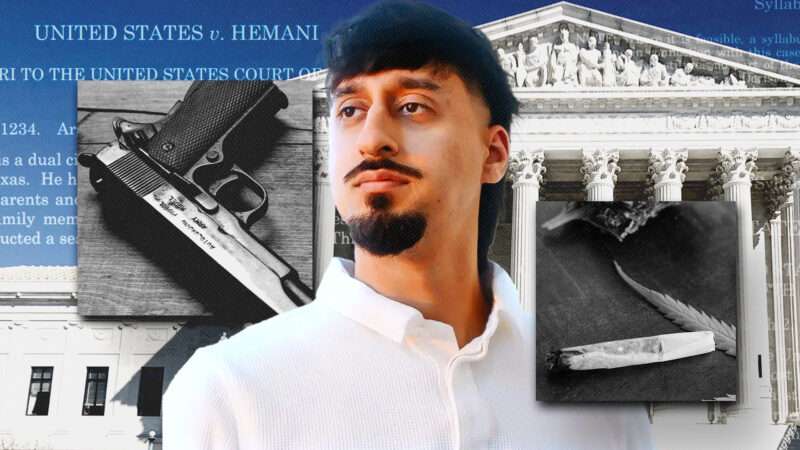
SCOTUS Says Federal Prosecution of Marijuana-Using Gun Owner Violates the Second Amendment


Ali-Hemani-6-18 | Ali Hemani/cunyclear.org/Marielam1/Envato/Adani Samat

Until today, the federal law that prohibits “unlawful users” of controlled substances from possessing a gun was generally understood to cover all unlawful users of marijuana. But in a landmark decision issued this morning, the U.S. Supreme Court found the federal prosecution of a gun-possessing marijuana user to be in violation of that man’s Second Amendment rights.

The decision came in the case of United States v. Hemani. “We do not question that sometimes an individual’s unlawful use of marijuana (or any other controlled substance) may render him a danger to others,” observed the majority opinion of Justice Neil Gorsuch. But here the government “asks us to conclude that anyone who regularly uses marijuana is categorically violent and dangerous without any further showing.”

And that was simply too much to ask of the Court. To allow “the government that kind of ‘broad power to designate any group as dangerous and thereby disqualify its members from having a gun,'” Gorsuch wrote, “would risk allowing it to ‘quickly swallow’ the Second Amendment.”

Gorsuch was equally dismissive of the government’s argument that historical laws regulating the conduct of “habitual drunkards” could form a justification for this sort of modern gun control prosecution. “The habitual drunkard laws on which the government relies here differ dramatically from [the federal] unlawful user provision on every single metric the government invites us to consider,” Gorsuch wrote. “They targeted different kinds of people, did so for different purposes, and operated in different ways. Whether any one of these problems taken in isolation would prove fatal to the government’s cause, we need not decide. Taken cumulatively, we hold, they certainly do.” And, Gorsuch added, “apart from pointing to habitual drunkard laws, the government has not even attempted to prove that any other specific historical principle might justify its prosecution in this case.”

I expected the federal government to lose this case, given the current Supreme Court’s generally hawkish stance on the Second Amendment. But I am somewhat surprised by just how overwhelming the government’s loss turned out to be. Gorsuch’s majority opinion was joined in full by Chief Justice John Roberts and Justices Clarence Thomas, Sonia Sotomayor, Brett Kavanaugh, Amy Coney Barrett, and Ketanji Brown Jackson. Meanwhile, Justice Samuel Alito, joined by Justice Elena Kagan (an unusual pairing to say the least), wrote separately in concurrence to say that they would have ruled for Hemani “on a different ground from those on which the majority relies.”

In short, all nine justices agreed that the federal government’s prosecution of this particular nonviolent marijuana user for possessing a gun violated the constitutional right to keep and bear arms. To call this decision a huge win for the Second Amendment would be an understatement.

The post SCOTUS Says Federal Prosecution of Marijuana-Using Gun Owner Violates the Second Amendment appeared first on Reason.com.

from Latest – Reason.com https://ift.tt/a2uUD73
via IFTTT

A Slow Thursday At The Court

This evening, I will be speaking to students with The Fund for American Studies. As is my usual custom with June trips to DC, I went to the Court for opinion hand downs. And, as per my usual custom, I rolled up to First Street around 9:20 a.m. Usually, the bar section is completely empty in June, but today was different. The officer at the front gate said there were more than 200 people seeking bar admissions today, and that I might not even get a seat. That was something I hadn’t experienced before.

I was asked to wait in the cafeteria to see how many empty seats there would be in the bar section. Also waiting was John Coghlan of Torridon Law, who was there to see his sister get sworn in. (Fun fact: John was the first lawyer to argue in person at the Court after the COVID shutdown on October 4, 2021.) Thankfully, we were let upstairs shortly before 10:00. Only three bar members would be allowed in.

I was seated just as Justice Gorsuch began announcing the majority opinion in Hemani. That meant no opinions from Justices Jackson, Barrett, or Kavanaugh. As Gorsuch read the summary of the facts, it became clear he wasn’t buying the government’s “habitual” drunkard argument. He dropped a few laugh lines about how much John Adams and James Madison drank. The Fifth Circuit would be affirmed here. But not in the next case.

Justice Kagan had the opinion of the Court for Hunter v. United States. This case concerned when a defendant was not bound by an appeal waiver. Kagan said that the government proposed an unforgiving standard, the Fifth Circuit adopted a middle standard, and other circuits adopted a forgiving standard. It was obvious who was going to win here. The Fifth Circuit was reversed.

Justice Sotomayor was next with T.M. v. University of Maryland. I had written about this case before. Elizabeth Prelogar was a last minute substitute for Kannon Shanmugam. Respondent was represented by Lisa Blatt. Justice Sotomayor made clear that the Court was not going to overrule the Rooker-Feldman doctrine, as Prelogar had asked for. She also rejected Prelogar’s backup argument. But to my surprise, the opinion split 5-4 in an unusual fashion. The majority had Sotomayor, Thomas, Alito, Kavanaugh, and Jackson. Barrett dissented, joined by Roberts, Kagan, and Gorsuch. I will note that Justice Thomas cited the Heritage Guide to the Constitution (Third Edition).

In 1780, the Confederation Congress created a court under that authority whose jurisdiction allowed it to “hear new evidence without deference to state courts'” legal conclusions. W. Pryor, The Appellate Jurisdiction Clause, in The Heritage Guide to the Constitution 499 (3d ed. 2025) (Pryor)

I hope this is the first of many Supreme Court citations for this important book. Whatever baggage the Heritage brand may have should not override the amazing scholarship in the book from Judge Pryor and others.

I did notice the Justices seemed tense. They weren’t talking to each other. I didn’t see them laughing or joking around. Justice Alito was closely reading something. I thought he had an opinion to deliver, but it was apparently something else. Chief Justice Roberts was staring up at the ceiling for an extended period of time while Justice Sotomayor was reading. Justice Barrett was just looking forward intently. The only moment of levity came when Justice Gorsuch joked about our alcoholic founders. These vibes do not augur for a pleasant end-of-term.

After Sotomayor finished reading her opinion, the Chief Justice asked the clerk to begin the admissions process. Most of the members of the press box left at that point, somewhat disappointed at the lack of blockbusters. For a Thursday in June, this was a slow day. And given the federal holiday tomorrow, there are no more opinions for this week.

I stepped out of the Court to grab a copy of the bench opinions. It had been some time since I waited for a paper copy, and didn’t realize the binding had changed. Two staples are visible on the spine. Mark Walsh, whose father was in the printing business, told me it is called a “Perfect Binding.”

Mark also told me that there would be no opinions on Monday, and the next batch is scheduled for Tuesday. There is also a scheduled hand down for Thursday. So next week will likely add a Wednesday or Friday session. The consensus from several reporters I spoke with is that the term will end on June 30 or July 1.

A few other miscellaneous notes as I traveled around town.

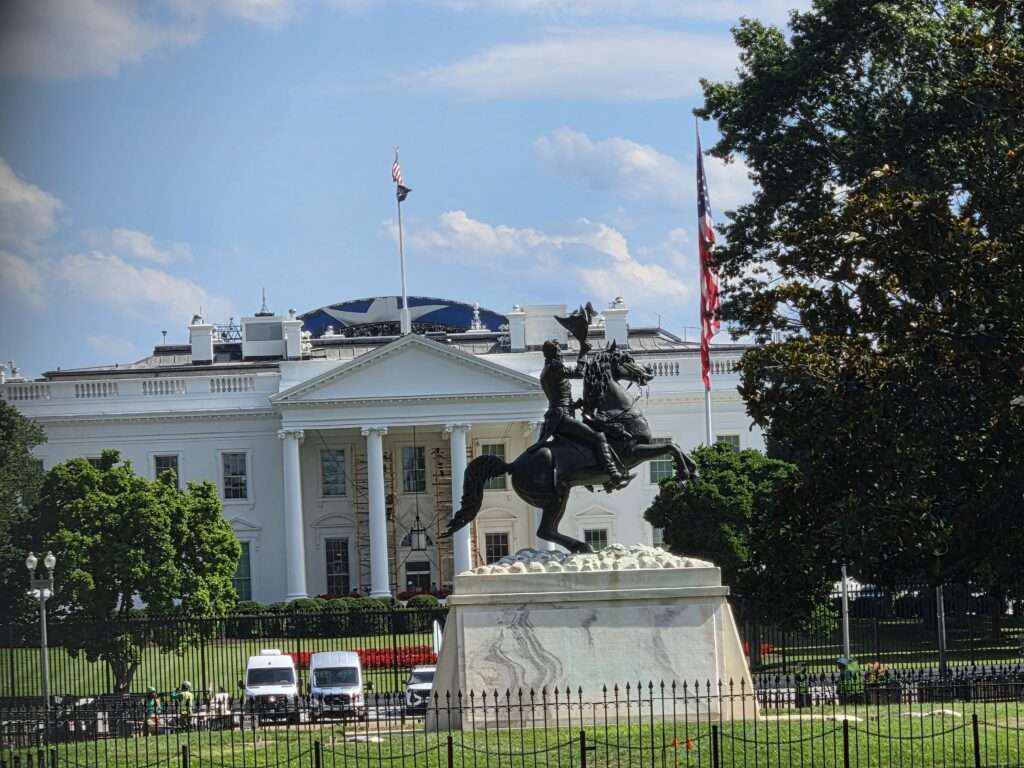
Yesterday, out of curiosity, I walked past the White House to see the renovated reflecting pool. It is difficult to convey how large the UFC Claw was. It towers over the White House. It can be seen from both Pennsylvania and Constitution Avenue.

The reflecting pool was green. It was filled with algae and other growth. I did not see American Flag Blue.



On the way back from the Court, I passed the “86-47” tent outside the D.C. Circuit Court House. Free Speech in action.

One last point. I have always been bothered by the “Man Controlling Trade” statue outside of the FTC building. This sculpture was made in 1942 to symbolize how the federal government controls the unbridled energy of the market. That certainly would have been how the Roosevelt administration viewed the power of the federal government. But it makes little sense for the present moment. Shouldn’t the man let the horse run free? Maybe this is another item of D.C. architecture that warrants a change.

The post A Slow Thursday At The Court appeared first on Reason.com.

from Latest – Reason.com https://ift.tt/XvkYIDa
via IFTTT

Colorado Gun Owners Sue Over New Law Allowing Warrantless Access to Dealer Records


Man holding a firearm in a store | Photo: John J. Kim/TNS/Newscom

A new Colorado law has raised the hackles of a coalition of gun owners in the state, leading them to challenge its constitutionality in federal court.

Signed into law on June 2 by Colorado Democratic Gov. Jared Polis, the Requirements for Firearms Dealers Act requires all gun sellers in the state to allow any “duly authorized peace officer” to inspect their sales records “at all times.”

The bill follows in the footsteps of 11 other states and Washington, D.C., by extending the state’s record-keeping requirements for firearms dealers to all retail transactions, including transfers. Dealers will be required to note the customer’s name, age, and address, as well as the firearm’s serial number, letters, make, and caliber. Failure to comply could result in a fine of up to $75,000, the loss of a dealer’s license, and up to a year in jail. 

Gun owners in the state are pushing back against this overreach. Ten days after Polis signed the bill into law, three firearms dealers and two firearms associations filed a joint civil suit in the U.S. District Court for the District of Colorado, arguing that the bill is a “warrantless-inspection scheme for firearms dealers” that violates the Fourth Amendment because it includes no stipulations for warrants or probable cause and no restrictions on time or frequency.

Colorado’s law would make it easier for law enforcement to engage in fishing expeditions. Under the law, a Colorado police officer could presumably demand that a dealer provide records of firearms sales for the last month, with no mention of a crime being committed or a suspect in mind. While the bill does prohibit law enforcement from creating or maintaining a firearms registry, that provision seems moot if firearms dealers are themselves forced to maintain the registry for cops. 

While the court challenge is ongoing, it’s difficult to see how Colorado’s law complies with the Supreme Court’s precedents on warrantless searches. 

In New York v. Burger (1987), the Court ruled that a warrantless search of a “closely regulated” industry violates the Fourth Amendment unless it satisfies three criteria: the state must have a substantial interest in regulating the industry; the warrantless inspections must directly serve that interest, be necessary for the regulatory scheme; and the statute must offer a constitutionally adequate warrant substitute, such as notification and limits on “time, place, and scope,” to “impose appropriate restraints” on an officer’s discretion. 

Colorado’s law might satisfy the first criterion. But it appears to fall short of the other two entirely, especially since the law is broad enough to allow sheriffs and campus security alike to inspect the records of any firearms dealer in the state.

Even when the law permits the government to inspect a business without a warrant—an administrative search—the Supreme Court ruled in Los Angeles v. Patel (2015) that the subject must be afforded a review by a “neutral decisionmaker” for the search to be constitutional. Colorado law does not provide firearms dealers with an opportunity for such a review before inspection.

Aside from the record-keeping provisions, the bill adds new administrative burdens for firearms dealers by requiring businesses in the state to provide the Department of Revenue with a “comprehensive security plan.” It also tasks the department with adopting rules on acceptable security measures that dealers must comply with. Those requirements will go into effect in October 2027.

State Sen. Cathy Kipp (D–Fort Collins), a cosponsor of the bill, told Complete Colorado the new law “builds on a new bureaucracy established in 2024” to stop “preventable shooting deaths” and reduce gun violence. But another outcome is far more likely: treating gun owners and firearm dealers like de facto criminals.

Colorado lawmakers have created an environment ripe for confrontation between law enforcement and legally armed Americans, all while violating Coloradans’ right to privacy.

The post Colorado Gun Owners Sue Over New Law Allowing Warrantless Access to Dealer Records appeared first on Reason.com.

from Latest – Reason.com https://ift.tt/uDgp1hE
via IFTTT

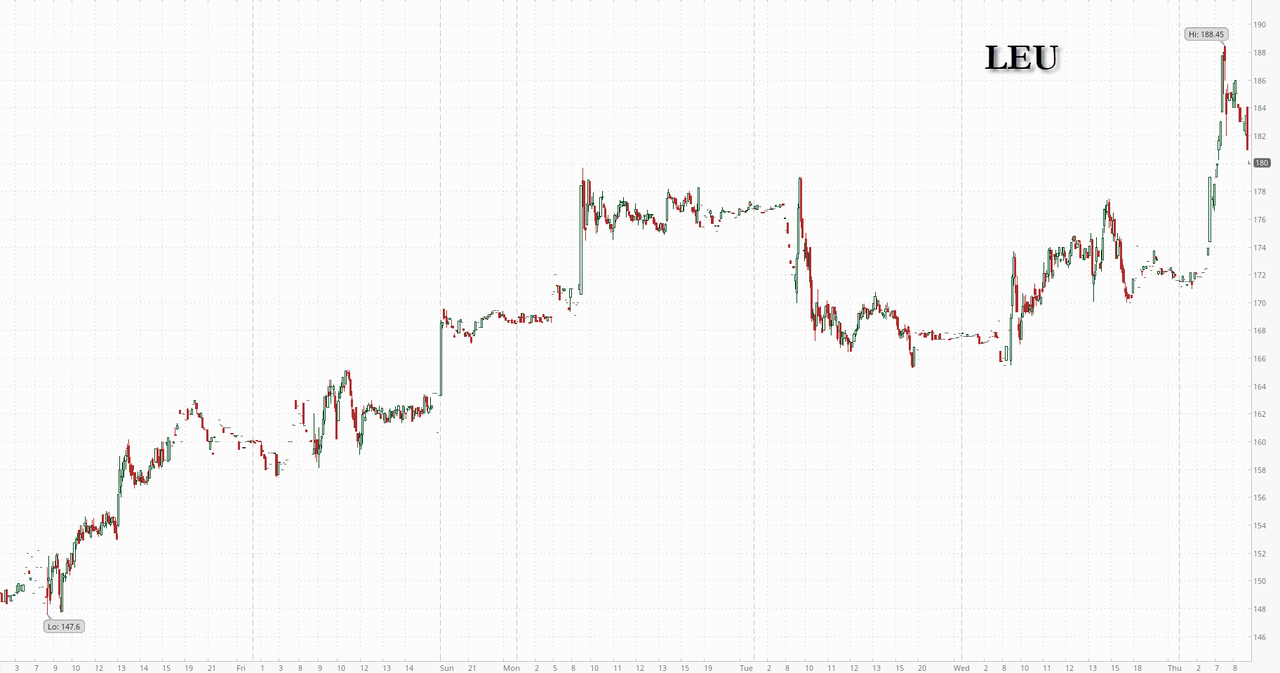
Centrus Jumps On Deal To Supply Oklo With Domestically-Produced Uranium

Centrus Jumps On Deal To Supply Oklo With Domestically-Produced Uranium

Centrus Energy continues to solidify its role as a cornerstone of America’s emerging advanced nuclear sector, today announcing a letter of intent with Oklo to provide domestically produced high-assay low-enriched uranium (HALEU) for the company’s next generation of nuclear reactors, according to a release from the company’s website.

Shares the domestic enricher jumped more than 6% this morning. 

Under the proposed multi-year agreement, Centrus will begin supplying HALEU in 2029 to support up to five Oklo Aurora powerhouses, including reactors planned for Oklo’s 1.2-gigawatt clean energy campus in Ohio. The fuel is expected to be produced at Centrus’ enrichment facility in Pike County, Ohio, highlighting the growing importance of domestic nuclear fuel infrastructure.

The agreement represents a meaningful milestone for the broader advanced reactor industry. One of the largest challenges facing nuclear developers has been securing reliable access to HALEU, a specialized fuel required by many next-generation reactor designs. With global commercial HALEU production historically concentrated in Russia and China, the development of a U.S.-based supply chain has become a national priority.

Centrus has emerged as the top solution to this challenge. By establishing itself as a domestic source of HALEU, the company is helping address a critical bottleneck that has limited deployment of advanced nuclear technologies across the United States.

The deal is a confirmation of what we said a year ago: in a country starved for domestically-produced HALEU, Centrus will outperform, even though sometimes the market is somewhat obtuse and slow in figuring even the most obvious stuff.

The proposed agreement also reinforces growing confidence in Centrus’ production capabilities and strengthens its visibility as advanced reactor developers move closer to commercialization. As demand for clean, reliable baseload power continues to accelerate, Centrus appears increasingly well-positioned to benefit from the expansion of the U.S. nuclear energy ecosystem.

With advanced reactor companies such as Oklo advancing toward deployment and domestic fuel supply becoming an essential national objective, Centrus’ role as a leading HALEU supplier could become a significant driver of long-term growth and strategic relevance within the nuclear energy industry.

Centrus President and CEO Amir Vexler commented: “Today’s announcement is an important step toward ensuring reliable HALEU supply for next generation reactors and represents a crucial milestone as we work to restore America’s ability to enrich uranium at scale. By connecting advanced nuclear power generation and customer demand with domestic HALEU production in southern Ohio, this agreement helps establish a foundation for a new U.S. advanced nuclear energy hub.”

Other nuclear stocks are also on the rise, with Energy Fuels up almost 17% and reactor manufacturers NuScale Power and NANO Nuclear Energy up about 3% and 5%, respectively.

Tyler Durden
Thu, 06/18/2026 – 11:00

via ZeroHedge News https://ift.tt/DZB4Qrs Tyler Durden

The Treaty Of Versailles

The Treaty Of Versailles

By Michael Every of Rabobank

Yesterday, President Trump signed the US-Iran MoU in Versailles. It’s not a treaty, but the parallel with the one signed by Germany there on June 28, 1919, is notable: post-WW1, French Marshal Foch is widely credited with saying, “This is not a peace. It is an armistice for twenty years,” because he saw it as too lenient on the loser of that war.

This MoU is also lenient on Iran, who thinks it won, and again doesn’t look like peace, just an armistice for 20 weeks – which ends two days after the US midterm elections. Indeed, even as Trump was touting the importance of the deal to avoid “economic catastrophe,” he underlined he’ll bomb Iran again if they don’t honor it.

Yet what they honor depends on whose MoU version you read. The 14-point text the US released to CNN differs in important regards from what Bloomberg was running with and the Iranian version:

  • Point 1: There is a link to Lebanon but not necessarily one that forces an Israeli withdrawal. The text calls for the “immediate and permanent termination of military operations on all fronts”, and “ensuring the territorial integrity and sovereignty of Lebanon”, which technically a temporary Israeli security presence does not prevent any more than heavily armed Hezbollah –counter to UN resolutions and the government’s proclamations– does. Regardless, the IDF is so far saying it won’t withdraw.
  • Point 5: The US says Iran “will make arrangements using its best efforts for the safe passage of commercial vessels with no charge, for 60 days only, from the Persian Gulf to the Sea of Oman and vice versa.” Iran says it will charge on day 61, but can that also be read that the passage is for 60 days, which would then need to be extended? The placing of a comma there could be the literal meme ‘NO MORE WAR’ > ‘NO, MORE WAR.’ The text also says Iran “will conduct dialog with the Sultanate of Oman to define the future administration and maritime services in the Strait of Hormuz in discussion with other Persian Gulf littoral states in line with the applicable international law and the sovereign rights of coastal states of the Strait of Hormuz.” Iran is taking that to mean that it can charge ‘service fees’; yet international law and GCC states may think otherwise when this is discussed.
  • Point 8: The two sides “have agreed to resolve the disposition of stockpiled enriched material pursuant to a mechanism that will be mutually agreed upon in accordance with the schedule mentioned in paragraph seven, with the minimum methodology to be down blended on site under the supervision of the IAEA.” That additional clause is key, and while a step back vs. earlier US uranium demands is a clear deliverable else this all falls apart. Is Iran going to blink here?

Trump also thanked China and Russia for remaining “neutral” in the war, adding “it’s OK” for Iran to have some ballistic missiles, as the Wall Street Journal estimates Iran could earn up $60bn from oil revenues ahead. What that’s spent on (reconstruction, Chinese or Russian arms, or shaheed drone factories to use locally and send to Russia, etc.) is also critical.

Understandably, Iran hawks are lamenting this all as a “disaster” or “catastrophe.” Even Bloomberg underlines what was flagged here months ago: if this MoU is a TACO not a can-kicking exercise until November, it will “unravel geopolitics”, the US creating a power vacuum others will try to fill.

That’s as South Korea’s President Lee just asked Trump to solve the North Korea issue… but they already have a nuke, so what do they get given – access to Anthropic AI?

As all is in flux, the US is also working with Europe to again back Ukraine, whose drone tech now means they hold some good cards, even as the EU reopens official communication channels with the Kremlin. It seems likely that US sanctions could soon go back on Russian oil, which would see the energy complex reshuffled again.

In market terms, the IEA is now seeing a gradual Hormuz recovery tipping into a significant 2027 oil surplus, flipping the narrative entirely – unless war restarts in 20 weeks. Most things remain a passenger to that dynamic.

Ironically, but as expected, the market is trading that possible Mou TACO as dollar positive even as it actually undermines the global architecture that holds the dollar up: but since when did FX look at the long term?

In other geoeconomics, as Europe seems set for a sustained trade war vs. China ahead, the G7 agreed to set up a critical minerals alliance platform to cut their reliance on China – which, as explained here before, logically implies trade decoupling downstream too and the emergence of geopolitical trade blocs.

Meanwhile, in a changing world, the Fed under Chair Warsh is ripping treaties up, not signing them. As our US strategist notes, the FOMC left rates unchanged as expected, with an easing bias dropped, but with an unusually short statement. Indeed, Warsh just terminated forward guidance – which is arguably not such a bad idea given what happens in the Middle East is pivotal to what happens to inflation, and central banks have no idea at all about what will transpire there(?)

In cyclical terms, the June Summary of Economic Projections had already revealed that half of the FOMC participants (who submitted a forecast) expected to hike before the end of the year. Warsh did not submit his.

More importantly, in structural terms, Warsh announced the establishment of five task forces on: Fed communications (is so much needed?); the balance sheet (is so much needed?); improving data (more, better is needed, and Warsh prefers real-time numbers over backwards looking surveys); productivity and jobs (will AI allow for rate cuts?); and inflation frameworks (where things will get even more interesting).

Just as many suspect there is more drama ahead in Hormuz, and that it will never go back to being what it was until recently, the same may be true for the Fed.

Tyler Durden
Thu, 06/18/2026 – 10:40

via ZeroHedge News https://ift.tt/FVXN5bJ Tyler Durden

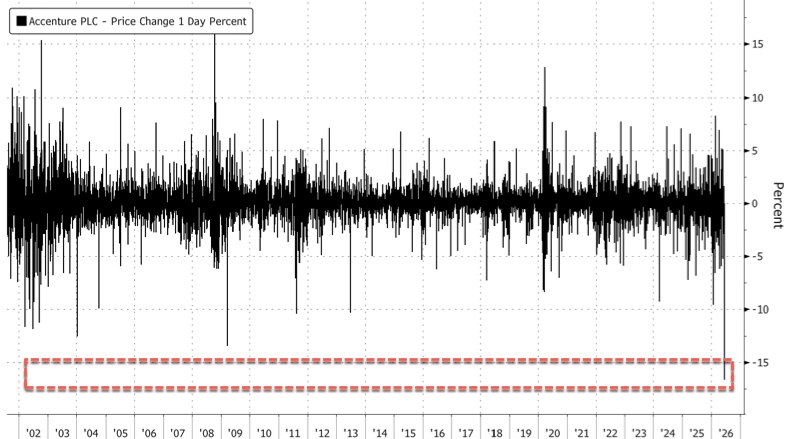
Accenture Crashes Most On Record As AI Threatens Consulting Demand

Accenture Crashes Most On Record As AI Threatens Consulting Demand

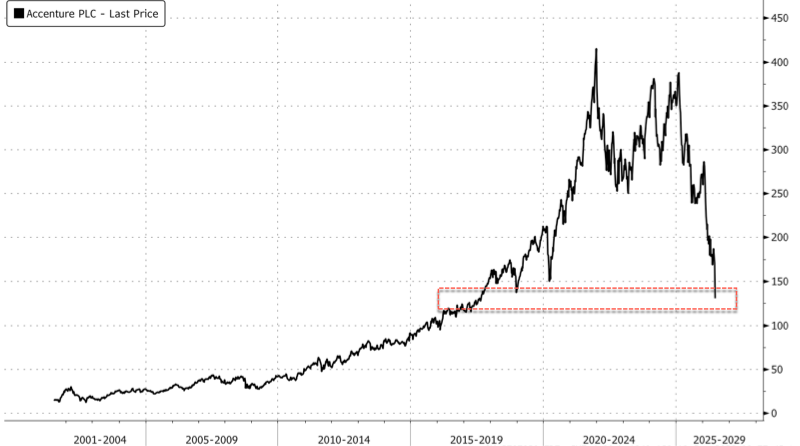
Accenture shares crashed by the most on record in premarket trading on a confluence of issues. First, the company’s fourth-quarter revenue outlook missed Bloomberg consensus estimates and third-quarter bookings declined, reinforcing investors’ belief that consulting demand is declining in the era of AI adoption across corporate America, which is wreaking havoc in the white-collar job market.

The global consulting and technology services company, which helps large corporations and governments with strategy, IT, cloud migration, cybersecurity, and more, guided August-quarter revenue to a range of $17.75 billion to $18.4 billion, below the $18.47 billion figure that analysts tracked by Bloomberg were forecasting. Third-quarter bookings fell to $19.3 billion, down from $19.7 billion a year earlier, while revenue rose to $18.7 billion, slightly below estimates. EPS increased 9% to $3.80.

Here’s a snapshot of 3Q earnings, courtesy of Bloomberg:

EPS $3.80 vs. $3.49 y/y

Revenue $18.7 billion, +5.6% y/y, estimate $18.76 billion

  • Communications, Media & Technology revenue $3.22 billion, +10% y/y, estimate $3.2 billion
  • Financial Services revenue $3.49 billion, +6.4% y/y, estimate $3.54 billion
  • Product revenue $5.67 billion, +6.1% y/y, estimate $5.67 billion

Health & Public Service revenue $3.85 billion, +1.8% y/y, estimate $3.82 billion

  • Resources revenue $2.50 billion, +3.4% y/y, estimate $2.54 billion

Bookings $19.32 billion, -1.9% y/y, estimate $20.66 billion

  • Consulting new bookings $10.26 billion, +13% y/y, estimate $9.54 billion
  • Managed Services new bookings $9.06 billion, -15% y/y, estimate $11.12 billion

Gross margin 32.8% vs. 32.9% y/y, estimate 32.9%

Free cash flow $3.60 billion, +2.9% y/y

Operating cash flow $3.79 billion, +2.8% y/y, estimate $3.06 billion

Snapshot of 4Q forecast:

Sees revenue $17.75 billion to $18.4 billion, estimate $18.47 billion (Bloomberg Consensus)

Sees revenue +1% to +5%

Full-Year Forecast:

Sees revenue +3% to +4%, saw +3% to +5%

Sees adjusted EPS $13.78 to $13.90, saw $13.65 to $13.90

Sees effective tax rate 24% to 25%, saw 23.5% to 25.5%

Still sees operating cash flow $11.5 billion to $12.2 billion

Still sees free cash flow $10.8 billion to $11.5 billion

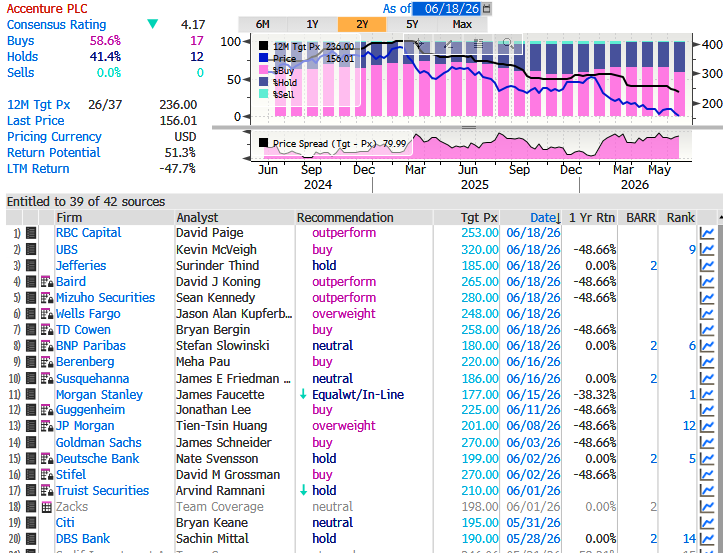
Beyond earnings, one major issue plaguing Accenture is investor confidence in the business model. Morgan Stanley downgraded Accenture to Equal-weight from Overweight and slashed its price target to $177 from $240, arguing that the anticipated boost to IT services spending from artificial intelligence investments has yet to materialize, as enterprises continue to prioritize AI projects over traditional discretionary technology spending.

Crucially, “we are not seeing the budget growth inflection we had previously expected,” the analysts wrote.

Morgan Stanley is not the first to sound the alarm on declining IT consulting demand. In March, Jefferies analyst Surinder Thind told clients there was limited evidence of a recovery in customer appetite, directly contradicting management’s upbeat commentary.

Accenture shares crashed the most on record, down 16% in the early cash session. 

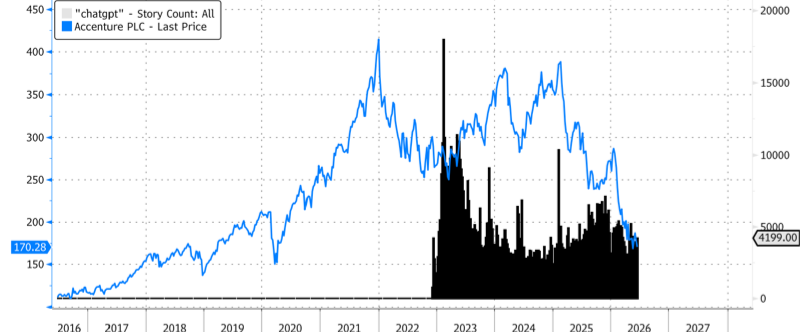
What goes up must go down. 

Emergence of OpenAI’s ChatGPT (news headlines) vs. ACN stock price. 

According to Bloomberg data, Wall Street analysts have 17 “Buy” ratings, 12 “Neutral” ratings, and zero “Sell” ratings on the stock. The 12-month average price target is $236.

Thind called the latest earnings disappointing. “Questions around the resiliency of demand in an AI-first world are likely to be amplified,” he said, adding, “especially in light of recent advancements in AI models and agentic capabilities.”

Tyler Durden
Thu, 06/18/2026 – 10:10

via ZeroHedge News https://ift.tt/CgmUbk0 Tyler Durden

Both Parents Work Full-Time In Majority Of Families, Census Data Show

Both Parents Work Full-Time In Majority Of Families, Census Data Show

Authored by Zachary Stieber via The Epoch Times,

Both parents work full-time in more than half of couples with children under 18, according to newly analyzed data.

Fifty-two percent of couples comprised of a mother and father work full-time jobs as of 2025, according to the Pew Research Center analysis of data from the U.S. Census Bureau released on June 16.

That percentage is an increase from 46 percent in 2015 and 31 percent in 1975.

Black mothers are still the most likely to be in a couple where both she and the father work, according to an analysis broken down by race. Sixty percent of black mothers are in such a partnership, down slightly from 64 percent in 2000.

Majorities of white, 54 percent, and Asian, 52 percent, women with children are for the first time in couples comprised of two working parents. Hispanic women are still more likely to be in a couple with only one working parent.

Mothers with lower levels of education are the most likely to be in a couple in which the dad works full-time, and the mom is not employed, according to the analysis.

That figure was 30 percent for mothers with, at most, some college education, compared to 21 percent for mothers with bachelor’s degrees and 11 percent for mothers with postgraduate degrees.

Across all couples with minor children, the percentage in which the father works full-time and the mother is not employed declined from 42 percent in 1975 to 23 percent in 2025.

In another 15 percent of couples, the father works full-time and the mother works part-time. In five percent, the father works part-time or is not employed, and the mother has a full-time job. And in the remaining five percent, there is some other arrangement.

Many parents view their family’s financial situation as positive, according to a Pew survey conducted in March, provided the mother works at least part-time. For parents in couples where the dad works full time, and the mother does not have a job, only 19 percent said their financial situation is positive, and 41 percent said it is negative.

Adults in those couples were the most likely to say that the work arrangement was positive for their children’s well-being. Eighty-five percent did. Just 49 percent of parents in couples where both mothers and fathers work full-time answered the same.

Some 52 percent of the respondents also said their job makes it harder to be a good parent, and 45 percent said that being a parent has made it difficult to advance at work.

Additionally, 62 percent of mothers who work full-time expressed frustration with balancing work and family responsibilities, compared with 47 percent of fathers who work full-time.

Tyler Durden
Thu, 06/18/2026 – 10:00

via ZeroHedge News https://ift.tt/1aMXLmj Tyler Durden

“The Impact was Devastating”: Chicago’s Cross-Burning Was Set By Liberal, Anti-Trump Protester

“The Impact was Devastating”: Chicago’s Cross-Burning Was Set By Liberal, Anti-Trump Protester

Authored by Jonathan Turley,

After the Southern Poverty Law Center scandal of actually funding and encouraging racist protests, it appears that at least one individual has created his own orchestrated racist incident.

In Chicago (where Jussie Smollett committed his infamous racist hoax), a burning cross was denounced by Mayor Brandon Johnson as a sign of the racism in society.

Johnson, however, refused to address the fact that the cross burning was actually the work of an anti-Trump liberal student.

University of Illinois senior Merlin Lu said it was never intended as a racist symbol, but the question is whether it could still be charged as a hate crime.

In posting a reward for the culprit soon after the incident, Rev. Michael Pfleger declared that “this bold rise of racism must be condemned by every race, faith community, and Chicagoan as was done with the swastika and treated as a hate crime.”

It turns out that this was not evidence of the rise of racism but another possible hoax.

Lu bizarrely claimed that he was unaware that a burning cross had racist connotations and insisted that there was no racist message intended.

Others suspected that this was a type of false-flag effort to outrage the left.

Johnson later denounced the incident as a “symbol of hatred is one that we must continue to reject, and I wholeheartedly reject it. I can’t speak to anyone’s motives; I can only speak to the impact, and the impact was devastating.”

It seems curious that Johnson would not “speak to motives” when he knows that this was set by a leftist radical.

The question is whether it is still a hate crime under Illinois law. Under Section 12-7.1, the law states:

(a) A person commits hate crime when, by reason of the actual or perceived race, color, creed, religion, ancestry, gender, sexual orientation, physical or mental disability, citizenship, immigration status, or national origin of another individual or group of individuals, regardless of the existence of any other motivating factor or factors, he or she commits assault, battery, aggravated assault, intimidation, stalking, cyberstalking, misdemeanor theft, criminal trespass to residence, misdemeanor criminal damage to property, criminal trespass to vehicle, criminal trespass to real property, mob action, disorderly conduct, transmission of obscene messages, harassment by telephone, or harassment through electronic communications as these crimes are defined in Sections 12-1, 12-2, 12-3(a), 12-7.3, 12-7.5, 16-1, 19-4, 21-1, 21-2, 21-3, 25-1, 26-1, 26.5-1, 26.5-2, paragraphs (a)(1), (a)(2), and (a)(3) of Section 12-6, and paragraphs (a)(2) and (a)(5) of Section 26.5-3 of this Code, respectively.

The notable language is “regardless of the existence of any other motivating factor or factors.” The inclusion of property damage could allow a charge to be brought.

The case could rekindle the debate over intent for threats. Many professors and pundits on the left have long argued that the standard should be how a message is received rather than how it is intended. That issue arose in the decision in Counterman v. Colorado, 600 U.S. 66 (2023), concerning the standard for the “true threats” exception to the First Amendment. In an opinion written by Justice Elena Kagan, the Court reversed the conviction. While rejecting an “objective” standard, the Court declared that such cases had to be based on evidence of the defendant’s state of mind under a “subjective standard.” Accordingly, the government must prove recklessness, but not necessarily intent: “The State must show that the defendant consciously disregarded a substantial risk that his communications would be viewed as threatening violence.”

Recklessness would be a dangerous standard for the defense of Merlin Liu. He insists that he was entirely clueless about what a burning cross represents in our culture. Yet, if Chicago does not bring a hate crime charge, it could be cited in future cases in suggesting that intent or “motivating factors” do matter in such cases.

I have favored stronger scienter or intent standards in true threat cases. It seems like a hate crime should, at a minimum, also be based on an intent to cause such alarm or fear. That does not mean that Liu’s defense of ignorance will work. However, in my view, prosecutors should have to show more than how others perceive a protest.

Unlike Johnson, the prosecutors and the Court will have to “speak to motivations” before this case is concluded.

Jonathan Turley is a law professor and the New York Times best-selling author of “Rage and the Republic: The Unfinished Story of the American Revolution.”

Tyler Durden
Thu, 06/18/2026 – 09:20

via ZeroHedge News https://ift.tt/wbH8ZXf Tyler Durden