Trump Has Used Taxpayer Money To Purchase Stakes in Dozens of Companies. Congress Is About to Make It Easier.


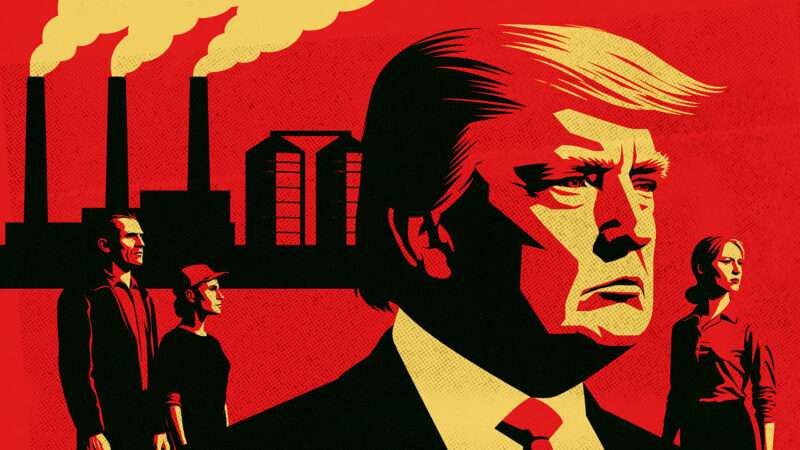
An illustration of Trump in front of a factory | Adani Samat/Midjourney

By taking equity stakes in more than a dozen private businesses, the Trump administration has stretched executive power to new heights—and now Congress is working to ensure that future presidents get the same opportunity.

The Senate’s version of the 2027 National Defense Authorization Act includes a provision to create a new slush fund within the U.S. Treasury for the purpose of buying stakes in more private businesses. The Pentagon would be able to tap the proposed Defense Equity Investment Account to make investments of up to $500 million in private companies involved in the production of “critical minerals, materials, and chemicals” or batteries.

The provision, which is buried within the 1,500-word bill drafted this week by the Senate Armed Services Committee, would allow the “direct or indirect purchase, acquisition, or commitment of funds by the Department of Defense in exchange for an ownership interest, convertible interest, warrant, revenue-sharing instrument, or other similar financial instrument in a non-Federal entity.”

Besides the $500 million cap on those investments, the government is also forbidden from taking more than a 50 percent ownership stake in any private business. Other than that, however, there seem to be few limitations or guardrails on how the new equity account could be used.

During a closed-door session last week, the Senate Armed Services Committee reportedly voted down an amendment that would have prohibited the Trump administration from taking equity stakes in businesses with ties to the president, his family members, and members of his cabinet.

Some of the Trump administration’s investment decisions have seemingly benefited those close to Trump. Vulcan Elements, which makes magnets out of rare earth elements, got a $620 million loan from the Pentagon’s Office of Strategic Capital. Donald Trump Jr. is a partner at the company.

Sen. Elissa Slotkin (D–Mich.) told NOTUS that Republicans rejected that proposal after expressing worries about how Trump would react. “Over and over we heard in the NDAA markup a number of my Republican colleagues express concern that they didn’t want to insult the president, they didn’t want to send a negative message to the president, they didn’t want to offend the president, or they were scared of his reaction,” Slotkin said.

It would be a good idea for lawmakers to prevent the president from using a new Pentagon slush fund to enrich his relatives and allies. But it would be better to avoid creating this account in the first place. Congress should not be codifying Trump’s socialist behavior and should not be making it easier (and legal) for future presidents to follow suit.

“If Washington wants more domestic or allied production of minerals, magnets, chemicals, or batteries, it has tools that do not require making taxpayers shareholders,” like removing permitting and regulatory hurdles or following the regular government procurement process, writes Tad DeHaven, a policy analyst at the Cato Institute. “What it shouldn’t do is pick favored companies and make the federal government an investor, customer, regulator, and political patron.”

The post Trump Has Used Taxpayer Money To Purchase Stakes in Dozens of Companies. Congress Is About to Make It Easier. appeared first on Reason.com.

from Latest – Reason.com https://ift.tt/EhPyjGJ
via IFTTT

Fed Moves To Close Stablecoin Loopholes With New Customer ID Rules

Fed Moves To Close Stablecoin Loopholes With New Customer ID Rules

Authored by Micah Zimmermann via BitcoinMagazine.com,

The Federal Reserve proposed Thursday that payment stablecoin issuers maintain written customer identification programs, a move that signals Washington’s determination to bring digital asset markets under the same anti-money laundering discipline long applied to traditional banks — even as regulators race to finalize rules before a statutory deadline this coming January.

The proposal would require so-called permitted payment stablecoin issuers, or PPSIs, to collect from each new customer a legal name, date of birth or formation, physical address, and a government-issued identification number before opening an account. 

The Federal Reserve framework mirrors CIP obligations that banks, broker-dealers, mutual funds, and futures commission merchants have operated under for more than two decades. Regulators will take public feedback on the proposal for 60 days.

The Federal Reserve’s action follows a wave of rulemaking set in motion by the Genius Act — formally, the Guiding and Establishing National Innovation for U.S. Stablecoins Act — which President Trump signed into law in July 2025.

That landmark legislation created the first federal regulatory system for stablecoins, mandating 100% reserve backing with liquid assets and subjecting issuers to the Bank Secrecy Act for the first time. 

The statute requires stablecoin issuers to establish effective anti-money laundering, sanctions compliance, and customer identification programs. The Genius Act becomes effective on the earlier of January 18, 2027, or 120 days after primary federal regulators issue their final implementing rules.

Federal Reserve Governor cautions towards stablecoins

Federal Reserve Governor Michael Barr has emerged as the most vocal voice of caution within the regulatory apparatus, even as his colleagues have embraced digital assets with new openness. Speaking in March at a Federalist Society conference in Washington, Barr warned that stablecoins face material risks around reserve asset quality, regulatory arbitrage, anti-money laundering gaps, and financial stability — concerns he argued the Genius Act’s primary text does not resolve on its own. 

“While some digital asset service providers are subject to anti-money laundering and anti-terrorist financing requirements in their home jurisdiction, it is far too easy for bad actors to evade these restrictions and operate without detection when transacting in digital assets,” Barr said in a statement Thursday. 

Barr, who previously served as the Federal Reserve’s top bank cop, contends that detailed rulemaking remains the critical instrument for translating the statute’s intent into enforceable protections.

Thursday’s proposal is the latest in a dense sequence of rulemakings from multiple agencies. In April 2026, the Treasury Department’s Financial Crimes Enforcement Network and the Office of Foreign Assets Control issued a joint proposed rule requiring PPSIs to adopt written AML and countering-the-financing-of-terrorism programs and a full sanctions compliance framework. 

That rule would carve PPSIs out of the existing money services business category and treat them as a distinct class of BSA-covered financial institutions — a significant structural change, given FinCEN’s finding that roughly half of known stablecoin issuers have not registered as MSBs at all. 

The FDIC and OCC each issued their own notices of proposed rulemaking in parallel, covering licensing, reserves, capital requirements, and redemption standards. The CIP proposal announced Thursday is a separate, complementary rulemaking to those AML and sanctions rules.

Stablecoin rules and nuance

The proposed customer identification requirements carry technical nuance tailored to stablecoin markets. Unlike banks, a PPSI can face demands for direct redemption from token holders who acquired coins on the secondary market rather than through a direct issuance relationship. 

The proposal addresses this by defining an “account” to include that redemption event, meaning an individual who acquires a stablecoin on an exchange and later redeems it directly with the issuer would trigger CIP obligations at the moment of that interaction. 

Purely secondary market transactions in which the PPSI is not a direct counterparty — including transfers conducted via smart contract — would not constitute an account relationship under the proposed framework.

The timeline for finalization is tight. With the Genius Act’s effective date potentially arriving as early as 120 days after the agencies publish their final rules, the window for comment, revision, and adoption is compressed. Final CIP rules are not expected before 2027, which means the statute could take effect before its customer identification architecture is fully in place. 

Tyler Durden
Thu, 06/18/2026 – 14:45

via ZeroHedge News https://ift.tt/4O5y02R Tyler Durden

It Wasn’t Fireworks… Social Isolation, Escalating Anger Drove Palisades Arsonist’s Desire For Revenge, Jury Told

It Wasn’t Fireworks… Social Isolation, Escalating Anger Drove Palisades Arsonist’s Desire For Revenge, Jury Told

Explosives and arson experts from the U.S. Bureau of Alcohol, Tobacco, and Firearms this week told a jury in the federal arson case against Jonathan Rinderknecht that fireworks could not have been the culprit.

The 29-year-old Rinderknecht is accused of starting a blaze in the Santa Monica Mountains, which investigators say led to the deadly Palisades Fire of 2025.

“Anyone who was in this area—if there was a firework launched, burning, or landing here—would have seen it. They’re bright, there’s a lot of color, a lot of flame, a lot of stars. And you would definitely hear it,” Kevin Miner, an explosives enforcement officer and unit chief at the agency’s training facility in Huntsville, Alabama, told the court.

“It’s 140 decibels of sound—that’s more than twice what it takes to harm the human ear.”

Miner said he based his findings on video surveillance footage, witness testimony, and analysis of sound profiles, topography, and weather conditions.
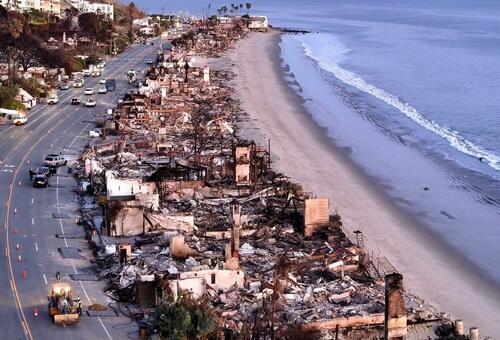
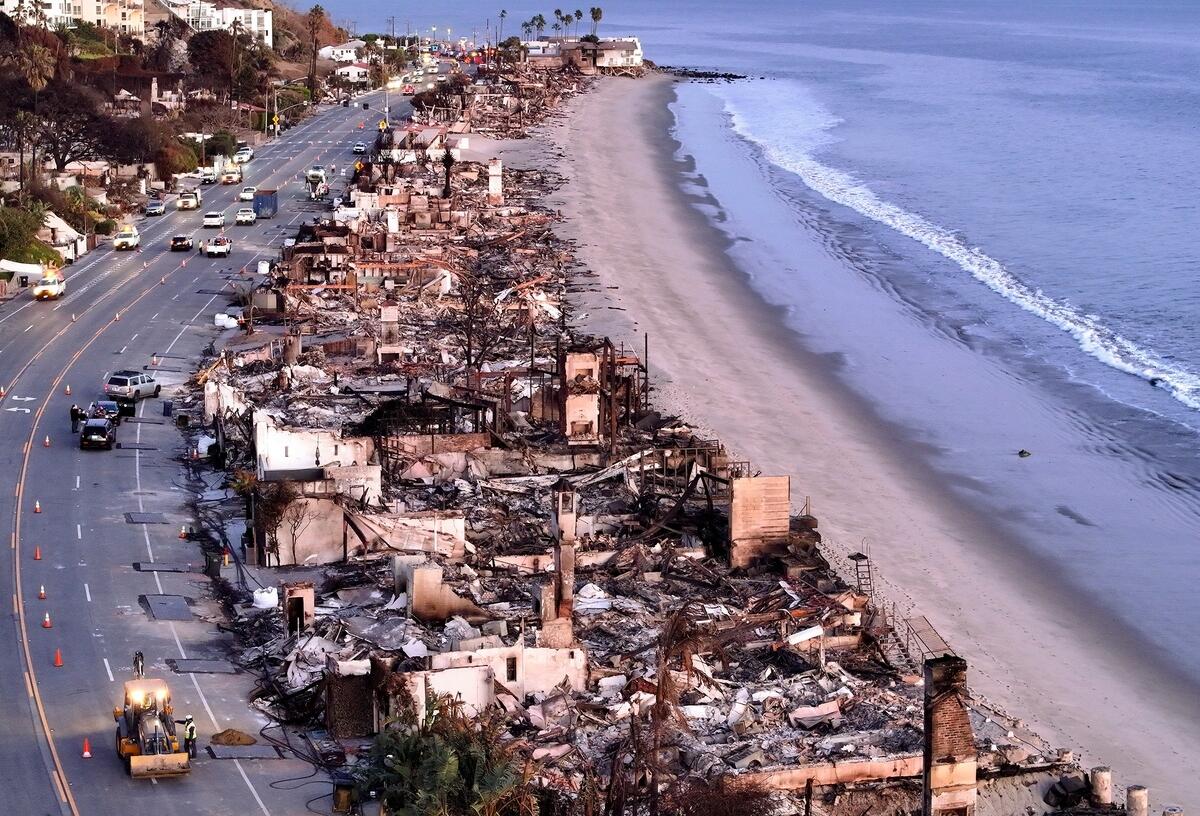
As Beige Luciano-Adams reports for The Epoch Times, Rinderknecht is on trial for three federal counts of arson related to property damage sustained in the Pacific Palisades Fire, which killed 12 people and incinerated more than 6,000 homes in the eponymous coastal enclave.

The state argues the catastrophe was a “holdover” or continuation of the Lachman Fire, which investigators say Rinderknecht allegedly ignited with a Bic lighter just after midnight on New Year’s Eve 2024, driven by a desire for “revenge against society.”

Defense attorneys maintain the government has no “reliable evidence” showing that Rinderknecht started the Lachman Fire on Jan. 1, much less that he was responsible for a separate fire that began a week later on Jan. 7.

Rather, Rinderknecht’s defense team says he encountered a fire and called 911 to report it in good faith—and that a firework was the more likely cause.

ATF agents on Monday and Wednesday dismantled the firework origin theory with a methodical recounting of the evidence.

While in theory, an aerial firework could cause a blaze like the Lachman Fire, Miner acknowledged under cross-examination that the specific conditions in the area and the fact that no witnesses—including, by his own account, the defendant—saw any fireworks, make it extremely unlikely.

Federal fire investigators also ruled out so-called “ground salutes” or ground-based fireworks, a malfunctioning or smoldering firework, or other potential causes like cigarettes, lightning, or powerlines.

Steve Haney, an attorney for Rinderknecht, sought to sow the seeds of reasonable doubt.

“For 10 days, everyone ignored a crime scene, didn’t they?” he asked Miner on cross-examination.

If the Jan. 1 Lachman Fire was an arson, then it was a crime scene—but it wasn’t preserved as such, Haney said, noting the area remained open to the public, planes dropped water and fire retardant on the burn scar, and a subsequent fire razed the area, potentially incinerating physical evidence.

“Isn’t it true that if there were evidence of fireworks, it would have been washed down the hill?” Haney asked. “And for at least nine days, no one went up there to look for fireworks materials?”

Miner ultimately agreed such was theoretically possible, but said the lack of physical evidence in this particular case was not a concern.

“I relied more on the sound profiles, and the video and witness statements. Frequently we have very little physical evidence of the fireworks after suppression, so it’s not uncommon for that to disappear.”

Fireworks

Attorneys for the state preempted the defense’s argument that witnesses, including nearby residents, heard what they thought were fireworks just before midnight that could have emanated from the origin area.

“There are a variety of statements—most in their homes, some said they heard a popping, and a couple people referred to bottle rockets, some to fireworks,” Miner said.

But, he said, any firework sounds they heard more likely than not would have come from below the neighborhood, given the fact that the homes are terraced into the mountainside, and the fire origin area is around 350 feet above it.

“It drops off significantly … Sound has a tendency to travel up,” he said.

Sound emanating from an aerial firework, Miner explained, is omnidirectional—“anything airborne will send sound and blast waves out in all directions.”

In the particular area where investigators believe the fire started, the sound would have traveled everywhere until it hit objects, clouds, hard land, or buildings to absorb or reflect it, Miner said.

“In calm weather like that, there’s nothing to mask the sound. Sound travels very quickly and easily through that medium.”

Something set off in the lower canyons below the homes, he explained, would bounce until it hit objects, clouds, or buildings to absorb it; something set off up higher would be less likely to be heard at all, as the sound energy would “escape into the atmosphere.”

One nearby resident, located around 0.2 miles and around 350 feet below the fire’s area of origin, reported his windows shaking before midnight.

But Miner said it was extremely unlikely he would’ve been the only one to experience this if it came from a firework above him.

“If that were to actually be caused by anything on the mountaintop, you would expect to see evidence in houses adjacent, maybe 200 to 300 feet away—broken glass, cameras askew,” Miner said.

“You can’t rattle a window 0.2 miles away without rattling everyone’s windows.”

A Burning Bush

Investigators determined the fire was incendiary in nature—in this case, ignition of vegetation. They came to this conclusion based on a review of video surveillance, witness testimony, and the defendant’s own statements.

“The defendant admitted having a lighter with him up on Buddha Hill,” said Derek Hill, a fire analyst and recently retired Certified Fire Investigator with the ATF who worked the case, referring to the landing area where investigators believe the Lachman Fire started.

“He said he was alone on the hill. He identified where the fire started correctly—this was information that wasn’t public at the time.

“It gave us pause because he was recognizing the fire from a location we know he was at, but not when that fire would have been visible,” he said.

Investigators tracked Rinderknecht’s movements using geolocation data from nearby cellular towers, constructing a detailed timeline that they overlaid with one constructed from video surveillance footage.

All of this, Hill said, corroborated investigators’ work, including a meticulous mapping of fire pattern indicators, in which they looked at the fire’s impact on the environment to determine how and where it spread, and at what intensity.

Hill helped lead a team that included 11 federal Certified Fire Investigators and five wildland investigators. Arriving on the scene of the Palisades Fire on Jan. 13, they spread across a general area where they believe the blaze originated, and studied the terrain, at times crawling or slithering across the charred ground to find clues.

Ultimately, they were able to narrow a specific area of suspected origin—and then a single bush from where the fire allegedly emerged.

Firefighters had described firebrands or embers that came off the Lachman Fire, which burned from north to south. A detailed analysis, investigators say, confirmed their hypothesis that the Jan. 1 fire had smoldered underground until resurfacing seven days later, when it was picked up by winds and continued as the Palisades Fire.

“We started identifying burned out roots, some exposed and some not,” Hill said. “That was indicative of fire burning underground in the root structure of the shrub. We know the fire came out of this root ball and spread out.”

Compromised Crime Scene

Haney noted—and Hill acknowledged—that investigators could not preclude the existence of an unknown combustible that may have been lost in the fire, or during suppression or cleanup activities.

If the allegation is that Rinderknecht maliciously and willfully started the Lachman Fire, Haney said, the crime scene was compromised.

The fact that people were allowed to walk through a crime scene for nine days was “not ideal,” Hill acknowledged.

Under redirect, the witness said that in nearly 800 fire scenes he’d worked during the course of his career, the majority involved some kind of water suppression before investigators arrived—meaning it was a common condition and one for which agents are trained to take into account.

“Water didn’t wash away the surveillance footage, did it?” Mark Williams, attorney with the Department of Justice, asked.

“It did not,” Hill said, explaining that investigators used the surveillance footage to construct a detailed timeline of when the fire was first visible and how it developed, which they compared with a timeline of the defendant’s movements.

Haney suggested that timeline was incomplete—some videos were taken from miles away and didn’t have audio. And while footage may have depicted when the fire was visible, it didn’t show when it started.

Where Hill said investigators determined the fire ignited between 12:10–12:12 a.m.—when it shows up on surveillance video—Haney noted there was no direct evidence of such.

“You don’t have any cameras that show ignition of when the Lachman Fire occurred, do you?”

“No,” Hill replied.
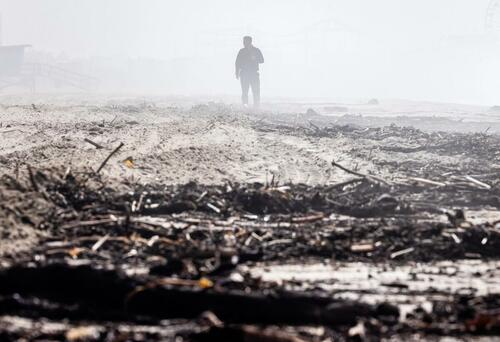
Social Isolation, Escalating Anger Drove Palisades Arsonist’s Desire for Revenge, Analyst Tells Jury

However, as Luciano-Adams continues, a behavioral analyst on Wednesday told a federal jury that social isolation and escalating anger helped drive a 29-year-old Uber driver to ignite a brush fire in the Santa Monica Mountains, which days later would resurface as the deadly inferno that killed 12 people and leveled more than 6,000 homes in the wealthy coastal enclave of the Pacific Palisades.

Dr. Kevin Kelm, a retired supervisory special agent with the U.S. Bureau of Alcohol, Tobacco, and Firearms who specializes in behavioral analysis and criminal profiling related to arson, alleges Jonathan Rinderknecht was motivated by an “expressive,” or emotionally driven, and opportunistic desire for revenge on society at large.

“In my opinion, the defendant exhibited behavior consistent with [a] ‘revenge’ or ‘societal motivated revenge’ fire,” Kelm said, describing his analysis of Rinderknecht’s behavior before, during, and after the fire.

The state argues that Rinderknecht’s deteriorating mental state and escalating fixation on themes such as wealth disparity, “climate change,” and vigilantism in the months leading up to the fire reveal his motive.

Arsonists motivated by societal revenge, Kelm said, referring to an arson motive typology used by the FBI, typically have many things going wrong in their lives and fixate on problems, which are exacerbated by an accumulation of stressors–including interpersonal relations and social isolation.

“These pressures continue to build and build,” Kelm said, and the act of setting a fire “provides some emotional relief and diversion from the problems.”

Analysis of Rinderknecht’s behavior in the months leading up to the fire, including in fraught interpersonal relationships and in thousands of increasingly frustrated interactions with the OpenAI chatbot ChatGPT, is evidence of such escalation, Kelm said.

It goes to the inability to deal with a stressor. And it was focused on a large stressor for the defendant, which has to do with societal issues, one being wealth inequality and large corporations that were distressing to [him],” said the analyst, who previously worked on cases related to both the Oklahoma City Bombing of 1996 and the 911 terrorist attack on the Pentagon.

Digital records uncovered in the investigation reveal that Rinderknecht was at least fixated on a tableau pitting the world’s rich and powerful against the rest of society and the environment, and related feelings of loneliness and helplessness. Uber passengers who rode with him around the time of the fire testified about vitriolic, threatening rants, “incel vibes,” and erratic behavior.

Steve Haney, his attorney, has argued that none of this makes him an arsonist.

Cross-examining Kelm on Wednesday, Haney suggested that many people are upset about large corporations, politics, the wealth disparity, or “climate change.”

“Much of what you’ve testified and observed is pretty normal American thinking right now, isn’t it?” Haney queried.

“I didn’t cherry-pick,” Kelm said, noting that each behavior on its own may not in itself constitute motivation. “You’re correct. Each one of these things applies to large parts of the population. But not when it’s in your everyday life and occurs over and over and in all these domains … it becomes controlling and the behavior is a response to that.”

Societal revenge arsonists, according to the FBI typology, do not plan.

“It’s extremely impulsive. And in this case, the defendant put himself at the location. He stopped taking work calls, he went to this isolated location he had familiarity with,” Kelm said, noting that almost all arsonists choose locations that are in their environment or “comfort zone.”

The witness said investigators’ conclusion that Rinderknecht started the fire with a lighter, as opposed to accelerants or other ignition methods, was consistent with expressive arson.

While Rinderknecht’s attorneys point out he called 911 repeatedly to report the fire, investigators allege such was part of a staging he did to appear cooperative and deflect suspicion, which Kelm said was common in arson cases.

Authorities also suspect the defendant attempted to cover his tracks by making a screen video of a 911 call and by asking ChatGPT whether one could be blamed for a fire started with a discarded cigarette.

The defendant’s “methodical stroll” down the hill as he made 911 calls, Kelm said, “is just totally inconsistent with someone who discovers a fire.”

The ChatGPT query, Kelm argued, was “unnecessary behavior” by Rinderknecht. “It’s excessive, and very inconsistent with what I’d expect an average individual to do when trying to report a fire and get out of harm’s way.”
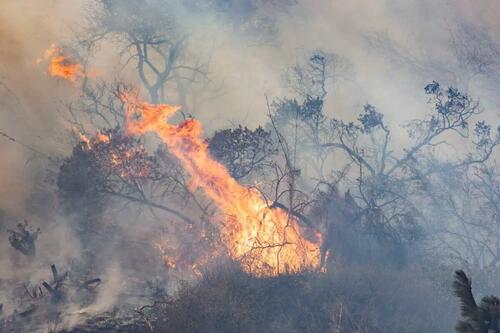
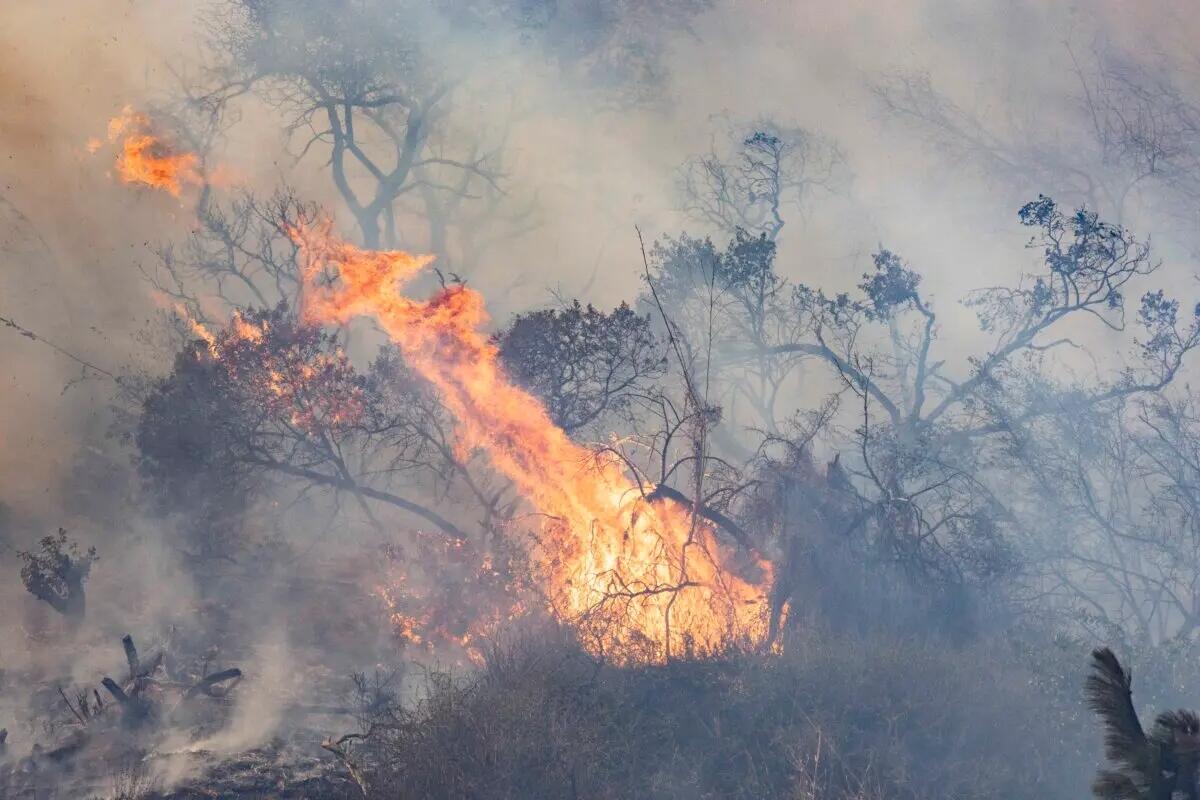
Firefighters work to extinguish the Palisades Fire burning near Los Angeles, Calif., on Jan. 8, 2025. John Fredricks/The Epoch Times

After leaving the scene, Rinderknecht returned and took videos of the fire and first responders; Kelm suggested this could indicate the fire was a source of excitement—another motive typology.

But the emotional release that an expressive arsonist may feel after lighting a fire, Kelm said, can be short-lived.

“I think once some of the initial excitement wears off, the daily routine hasn’t changed. It’s back to being an Uber driver, to not making enough money: listening to partygoers sitting in your back seat having a great time while your life hasn’t changed at all,” he said.

Kelm described the defendant’s behavior, both before and after the fire, as typical of a “a grievance collector—things go wrong, and he’s not the cause, it’s always someone else’s fault.”

Writ large, the profiler said, the behavior took on increased significance, as the pieces fit together like a “jigsaw puzzle.”

“What I’m looking for is to see this pattern emerge over time in all of the domains … it tells me what the whole picture is,” Kelm said.

Haney asked whether anger-motivated arsonists want to destroy things.

“No, not necessarily. The act of actually setting the fire is the objective. Oftentimes, the consequences are very surprising to the individual and result in a panic response, because what happens wasn’t what was expected.”

Haney asked whether Kelm had ever, in a half-century of experience, seen a revenge arsonist call 911 17 times, as his client had.

“It’s pretty unusual,” Kelm said. “That caught my attention.”
Tyler Durden
Thu, 06/18/2026 – 14:25

via ZeroHedge News https://ift.tt/TNbJvOA Tyler Durden

Asian Refiners Swamped, Brace For Over 60 Million Barrels Of Oil Ready To Exit Hormuz

Asian Refiners Swamped, Brace For Over 60 Million Barrels Of Oil Ready To Exit Hormuz

By Tsvetana Parskova of OilPrice.com

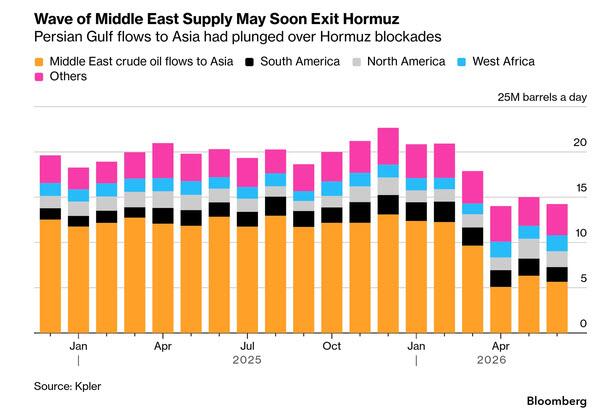
Crude cargo arrivals in Asia from the Middle East could accelerate in the coming weeks as more than 60 million barrels of oil stuck in the Persian Gulf prepare to exit the Strait of Hormuz and head to Asian markets once the chokepoint reopens to traffic.  

About 62 million barrels of crude oil on nearly three dozen supertankers are expected to make their way to Asia within weeks after the Strait reopens, according to Signal Group data carried by Bloomberg.

Asia, which felt the supply shock first and the most as early as in March, could now see a wave of much-delayed crude supply that would weigh on prices. Refiners in Asia, including China, have slashed run rates in response to the loss of supply from the Middle East and the high prices to procure alternative cargoes.    

The supply waiting to exit the Strait of Hormuz could prompt some refiners to increase processing rates or opt for replenishing commercial stock tanks that have been drawn down over the past three months.

Asia, however, appears to have stocked up on enough supply at least for June and July after turning to West Africa and South and North America to offset the losses from the Middle East.

Asian refiners are well-supplied for the coming weeks, anonymous traders with knowledge of the situation told Bloomberg.

The expected imminent reopening of the Strait of Hormuz has prompted investment banks to slash their oil price forecasts for this year and next.

Morgan Stanley, for example, now sees Brent crude averaging $80 per barrel in the last quarter of 2026, and $90 per barrel in the third quarter. The bank’s earlier forecast was for an average of $100 per barrel of Brent in the third quarter, while the fourth-quarter price forecast was unchanged.

Goldman Sachs cut its price forecast for the fourth quarter to $80 per barrel from $90 per barrel, and the 2027 average forecast for Brent crude to $75 per barrel from $80 in earlier forecasts. According to the bank’s commodity analysts, tanker traffic via the Strait of Hormuz would recover fully by the end of July.

Tyler Durden
Thu, 06/18/2026 – 14:05

via ZeroHedge News https://ift.tt/qrbaMGX Tyler Durden

Just Days After Record IPO, SpaceX To Sell $20 Billion In Bonds

Just Days After Record IPO, SpaceX To Sell $20 Billion In Bonds

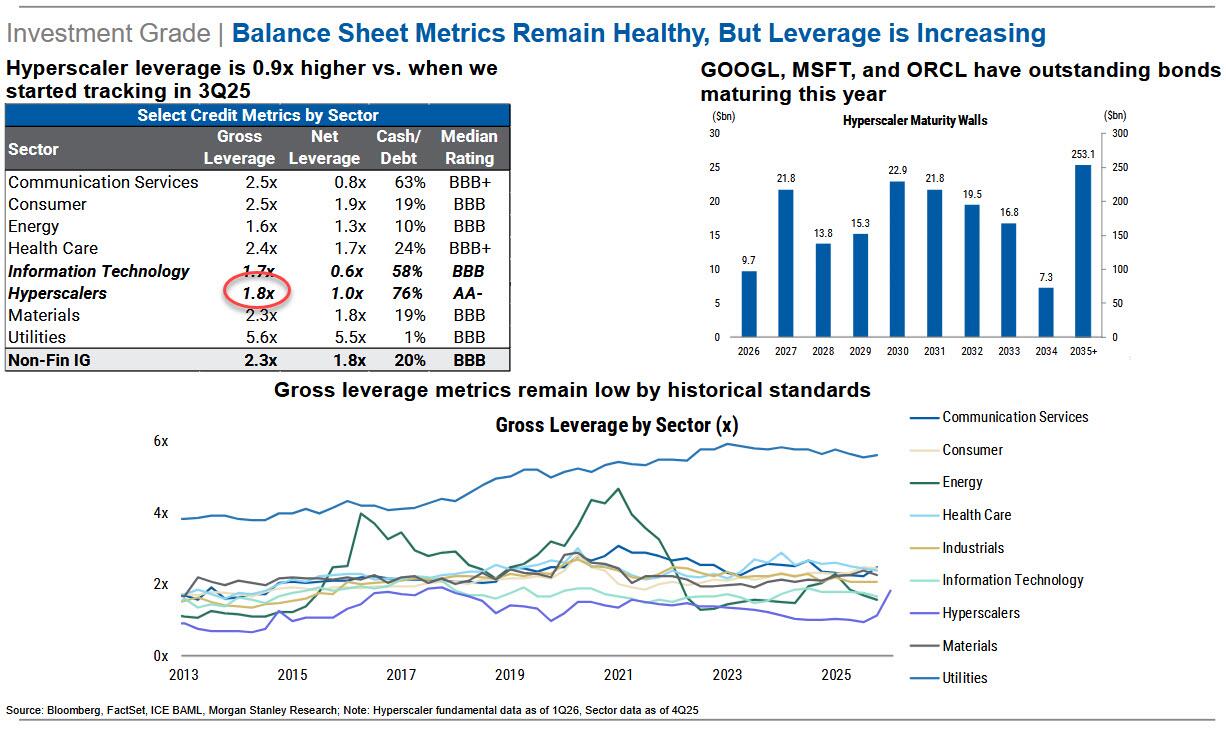
Earlier this week, we showed the unprecedented pace of hyperscaler Investment Grade debt accumulation, which according to Morgan Stanley calculations had doubled in just two quarters, rising from 0.9x leverage in Q3 ’25 to 1.8x currently, a pace that has already surpassed the entire energy sector’s gross leverage of 1.6%. 

Source

We predicted that this staggering growth rate would continue increasing at a pace of over 0.3x per quarter, and moments ago we got another confirmation of the insatiable demand for AI debt when Bloomberg reported that just days after the biggest ever Initial Public Offering in history, bankers for SpaceX are preparing to hold calls with investors as soon as next week to discuss a potential bond offering.

The bond is expected to be at least $20 billion, and the investor calls may kick off on Monday. Plans and timing may change of the offering may yet change, according to Bloomberg. 

SpaceX plans to issue investment-grade bonds for the first time, adding to the already overheating IG calendar. The bond proceeds would refinance a temporary $20 billion bridge loan that matures in September 2027. The bridge loan makes up the bulk of SpaceX’s $29.1 billion of long-term debt as of March 31, the company said in its IPO prospectus. 

Bank of America, Citigroup, JPMorgan, Goldman and Morgan Stanley provided the bridge financing and are expected to run the bond deal .

SpaceX’s historic IPO turned the start-up into one of the world’s most valuable public companies and turned its founder into the world’s first trillionaire (although the stock is sliding today, down 10% at one point as momentum left the stock to go back to its preferred memory momentum names). The company’s embrace of AI with the acquisition of Musk’s xAI in February made the listing somewhat of a referendum on the IPO prospects of competitors Anthropic and OpenAI, both of which are expected to go public as soon as this year.  

The bottom line here is that literally every company is now rushing to issue as much debt (and equity) as the market will possibly absorb, as it is only a matter of time before the debt, and thus capex, window closes. 

As Goldman Delta-1 head Rich Privorotsky wrotes, “everyone still appears convinced they must keep spending simply to remain competitive, while token cost compression/advent of neoclouds puts pricing pressure on core business. If token prices continue to compress alongside falling compute costs, the benefits may accrue to users faster than providers. Ironically, the first hyperscaler to signal that it can slow the pace of spending will likely see its share price rewarded (and will crush semiconductor stocks). If that happens, others will take notice. That is the reflexivity that ultimately stalls the capex cycle… not a lack of demand, but investors deciding that incremental returns on the next dollar of spend are no longer attractive.”

Privo’s conclusion: “Watch hyperscalers share price as leading indicator.”

Tyler Durden
Thu, 06/18/2026 – 13:50

via ZeroHedge News https://ift.tt/ezhw3kZ Tyler Durden

ICE Says It’s Moved Detainees Out of ‘Alligator Alcatraz’ For Hurricane Season


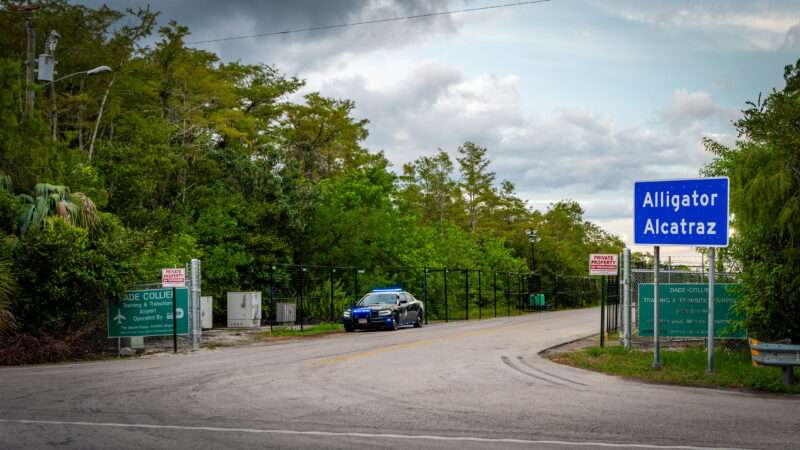
Alligator Alcatraz | Photo: Pedro Portal/TNS/Newscom

After reports that the Trump administration and state of Florida are considering abandoning the “Alligator Alcatraz” detention center in the Florida Everglades, the Department of Homeland Security (DHS) says it has transferred detainees out of the tent camp in preparation for hurricane season.

Florida news outlet WINK News first reported Tuesday that all detainees had been moved out of the Everglades detention camp. “As we enter into hurricane season, ICE and the state of Florida have moved illegal aliens from the soft sided facility. For the safety of the illegal alien detainees, we transferred them to other facilities,” an Immigration and Customs Enforcement (ICE) official told the outlet.

A DHS spokesperson gave an identical statement to Reason. DHS did not respond to follow-up questions asking if the camp was currently empty and if it would resume operations after hurricane season.

At a press conference Tuesday, Republican Florida Gov. Ron DeSantis said the camp had always been a temporary solution to help the federal government ramp up immigration enforcement after it had been “neutered” by the Biden administration. With the recent huge increases in funding to DHS and more cooperation between the federal government and Florida law enforcement, DeSantis said the camp may have served its purpose.

“We were never going to make that a permanent facility,” DeSantis said.

DeSantis’ office referred requests for more information to the Florida Division of Emergency Management (FDEM), which did not respond to inquiries.

Advocacy groups were still trying to confirm whether there were detainees left at the camp, but Noelle Damico, director of social justice for The Workers Circle, a progressive Jewish advocacy group, says the population significantly declined recently.

“We heard from detainees that as of Sunday there were 60 people spread across five cages,” Damico says, “and of course that’s a far cry from earlier this year, when there were upwards of 1,400.”

The quiet drawdown of Alligator Alcatraz stands in contrast to its bombastic grand opening last July, during hurricane season, which included a tour by President Donald Trump and custom merchandise. The detention camp was also a blueprint for a new, legally dubious model of state-run immigration detention centers. However, the site has been dogged by constant allegations of inhumane conditions, brutality, excessively high operating costs, environmental violations, secrecy, and lack of due process.

Civil rights and immigrant aid groups openly doubted ICE’s justification for emptying the detention camp.

“They opened this facility during hurricane season last year,” Damico says. “To say that they’re moving them for the safety of these people that have been detained—the same people that they have tortured, that they have not given sufficient food to, that they have kept in unsanitary conditions, that they have pepper-bombed, that they have shackled, that they have beaten—to suddenly have this great concern for their well-being defies credulity, frankly.”

One former Alligator Alcatraz detainee says in an interview with Reason that medical neglect was a constant problem at the detention camp. Luis Miguel Rubiano, a 29-year-old Venezuelan national with a pending asylum claim, spent six days in Alligator Alcatraz in January after being arrested by ICE while on his way to work at an Orlando-area auto parts warehouse.

Although he was also detained at an ICE field office, a county jail, and another DHS detention center, Rubiano says “Alligator Alcatraz was the worst place for [medical] treatment.”

“They didn’t have the tools,” Rubiano says. “They always told us to wait for the next day or something like that. They were supposed to take my blood pressure, but the machine was without batteries for like two days straight.”

In addition to human rights complaints, Florida’s choice of location for the detention center outraged conservation groups and local Native American tribes, who were appalled at the degradation of one of Florida’s most treasured wildlife habitats.

In a press conference Wednesday, environmental groups vowed to continue litigating a lawsuit filed last year alleging that the hasty construction of the detention camp violated environmental permitting laws and is damaging sensitive wetlands.

“This administration never acknowledges when they have made an error,” Paul Schwiep, an attorney at the law firm Coffee Burlington, said. “They don’t accept responsibility for their mistakes. In this case they built a Soviet gulag in the Everglades without pulling one permit, one environmental review, and now they hope they can slink away in the middle of the night without explaining what they did.”

Environmentalists won a temporary victory last August when a federal judge issued a preliminary injunction halting operations at the camp, but that injunction was later vacated on appeal. The lawsuit is scheduled to continue proceeding toward trial later this month in a federal courthouse in Miami.

Friends of the Everglades also pried loose records in court showing that Alligator Alcatraz is exorbitantly expensive. State documents estimated that the “burn rate” to hold 500 detainees there was $1.2 million a day. The FDEM requested a $1.49 billion grant from the federal government to offset the costs of running the facility.

“The expense to taxpayers that has been borne as a result is inexcusable, particularly since it’s being spent at the expense of the Everglades,” Eve Samples, executive director of Friends of the Everglades, said.

The Florida Phoenix reported Wednesday that Florida still owes at least $603 million in immigration enforcement contracts to 27 companies.

At Wednesday’s virtual press conference, one of the speakers, Jessica Namath, the founder of Floridians for Public Lands, called in from outside the entrance of Alligator Alcatraz.

Namath said she’d seen about 40 to 50 fewer vehicles going in and out of the facility than normal, but there was still the usual procession of trucks and transport buses. A Florida Highway Patrol car was still stationed outside to shoo away protesters and tourists.

“It still looks like business as usual here,” Namath said.

The post ICE Says It's Moved Detainees Out of 'Alligator Alcatraz' For Hurricane Season appeared first on Reason.com.

from Latest – Reason.com https://ift.tt/DH2MGeN
via IFTTT

Trump Has Used Taxpayer Money To Purchase Stakes in Dozens of Companies. Congress Is About to Make It Easier.


An illustration of Trump in front of a factory | Adani Samat/Midjourney

By taking equity stakes in more than a dozen private businesses, the Trump administration has stretched executive power to new heights—and now Congress is working to ensure that future presidents get the same opportunity.

The Senate’s version of the 2027 National Defense Authorization Act includes a provision to create a new slush fund within the U.S. Treasury for the purpose of buying stakes in more private businesses. The Pentagon would be able to tap the proposed Defense Equity Investment Account to make investments of up to $500 million in private companies involved in the production of “critical minerals, materials, and chemicals” or batteries.

The provision, which is buried within the 1,500-word bill drafted this week by the Senate Armed Services Committee, would allow the “direct or indirect purchase, acquisition, or commitment of funds by the Department of Defense in exchange for an ownership interest, convertible interest, warrant, revenue-sharing instrument, or other similar financial instrument in a non-Federal entity.”

Besides the $500 million cap on those investments, the government is also forbidden from taking more than a 50 percent ownership stake in any private business. Other than that, however, there seem to be few limitations or guardrails on how the new equity account could be used.

During a closed-door session last week, the Senate Armed Services Committee reportedly voted down an amendment that would have prohibited the Trump administration from taking equity stakes in businesses with ties to the president, his family members, and members of his cabinet.

Some of the Trump administration’s investment decisions have seemingly benefited those close to Trump. Vulcan Elements, which makes magnets out of rare earth elements, got a $620 million loan from the Pentagon’s Office of Strategic Capital. Donald Trump Jr. is a partner at the company.

Sen. Elissa Slotkin (D–Mich.) told NOTUS that Republicans rejected that proposal after expressing worries about how Trump would react. “Over and over we heard in the NDAA markup a number of my Republican colleagues express concern that they didn’t want to insult the president, they didn’t want to send a negative message to the president, they didn’t want to offend the president, or they were scared of his reaction,” Slotkin said.

It would be a good idea for lawmakers to prevent the president from using a new Pentagon slush fund to enrich his relatives and allies. But it would be better to avoid creating this account in the first place. Congress should not be codifying Trump’s socialist behavior and should not be making it easier (and legal) for future presidents to follow suit.

“If Washington wants more domestic or allied production of minerals, magnets, chemicals, or batteries, it has tools that do not require making taxpayers shareholders,” like removing permitting and regulatory hurdles or following the regular government procurement process, writes Tad DeHaven, a policy analyst at the Cato Institute. “What it shouldn’t do is pick favored companies and make the federal government an investor, customer, regulator, and political patron.”

The post Trump Has Used Taxpayer Money To Purchase Stakes in Dozens of Companies. Congress Is About to Make It Easier. appeared first on Reason.com.

from Latest – Reason.com https://ift.tt/EhPyjGJ
via IFTTT

Supreme Court Rules Government Cannot Bar Marijuana Users From Owning Guns

AI-generated image.

Today, in United States v. Hemani, the Supreme Court ruled that the Second Amendment prevents the federal government from banning gun ownership by marijuana users. Unusually for a Second Amendment case, the ruling is unanimous. It’s a significant application and extension of the Court’s 2022 ruling in the 2022 Bruen case, which sought to put more meat on the bones of Second Amendment rights by establishing a “history and tradition” test for reviewing gun regulations.  It’s a great moment for those of us who both support strong Second Amendment rights and hate the War on Drugs (elsewhere, I have argued that most of the federal War on Drugs is itself unconstitutional). The ruling also features a joint concurring opinion by Justice Alito joined by Justice Kagan – a rarely seen combination.

Justice Neil Gorsuch wrote the opinion for the Court, joined by seven justices in all. Here’s an excerpt:

To determine when the government infringes the Second Amendment, we begin by asking whether the Amendment’s terms cover the conduct in question. Bruen, 597 U. S., at 24. If so, the Constitution “presumptively” protects it. Ibid. To overcome that presumption, the government then bears the burden of showing its regulatory efforts are “consistent with the Nation’s historical tradition of firearm regulation.”  Ibid….

§922(g)(3)’s unlawful user provision burdens conduct presumptively protected by the Second Amendment. After all, that statute bans a class of people including Mr. Hemani
from possessing essentially any firearm for any purpose. As a result, the government acknowledges, it has a burden to carry….

To meet its burden of showing a law like that is consistent with the Nation’s tradition of firearm regulation, the government relies on an analogy to what it calls “habitual drunkard” laws. These laws, the government submits, enjoy deep roots in the country’s history and are “relevantly similar” to the regulation it wishes to enforce against Mr.
Hemani….

We disagree. We appreciate that drugs and guns can sometimes make for a dangerous mix. We appreciate, too, that the government’s effort to analogize a modern statute
addressing drug use to historical laws must be approached with a sensitivity to the fact that many drugs well known today were unknown in early America. As we have put it,
the Second Amendment “can, and must, apply to circumstances beyond those the Founders specifically anticipated.” Bruen, 597 U. S., at 28. But, even taking all that
into account, the government cannot carry the burden it has set for itself. We decide cases “based on the historical record” and arguments “compiled by the parties” before us. Id., at 26, n. 6. And the habitual drunkard laws on which the government relies here differ dramatically from §922(g)(3)’s unlawful user provision on every single metric the government invites us to consider: They targeted different kinds of people, did so for different purposes, and operated in different ways. Whether any one of these problems taken in isolation would prove fatal to the government’s cause, we need not decide. Taken cumulatively, we hold, they certainly do. And, apart from pointing to habitual drunkard laws, the government has not even attempted to prove that any other specific historical principle might justify its prosecution in this case….

Gorsuch goes on to point out that habitual drunkards are fundamentally different from people who merely drink alcohol – or use marijuana – on a regular basis:

Had habitual drunkard laws applied to those who simply drank regularly, many notable early Americans could have faced trouble. John Adams took “a tankard of hard cider”
with his “daily breakfast….”. Some say James Madison “consumed a pint of whiskey daily.” D. Okrent, Last Call: The Rise and Fall of Prohibition 8 (2010)…. George Washington often drank three glasses of madeira in the evening—”not enough to be considered a heavy drinker in his day.” Id., at 5. Thomas Jefferson enjoyed “3 or 4 glasses [of wine] at dinner….”

There was, in short, a “culture of copious drinking” in early America. D. Korostyshevsky, Incapable of Managing His Estate: Habitual Drunkards and the Expansion of Guardianship in the Nineteenth-Century United States, 43 Law & Hist. Rev. 795, 800 (2025)….

Given all this, it seems the government’s historical laws targeted habitual drunkards not merely because they regularly used intoxicants, or even sometimes used them to excess. Instead, those laws focused on habitual drunkards because their drinking rendered them practically incapacitated and incapable of managing their affairs….

The law [at issue in this case], the government insists, does not require it to show that a particular individual is regularly incapacitated, much less incapable of conducting his
affairs or a threat to himself or others. Put simply, on the government’s telling, §922(g)(3) sweeps in large numbers of people without regard to whether their substance use has the kind of incapacitating effect on them that historical habitual drunkard laws normally required. This case illustrates the disconnect. The government considers Mr. Hemani an unlawful user of a controlled substance because he admits to using marijuana about every other day. But how much marijuana does Mr. Hemani use, in what potency, and to what effect? Is he routinely unable to manage his affairs, a risk to himself or his family?….. We do not know and, the government says, it doesn’t matter…

Importantly, the Court’s reasoning isn’t limited to disarming marijuana users alone. Justice Gorsuch emphasizes that one problem with the government’s position is that it would allow denying gun rights to anyone who uses a drug in a way restricted by federal law, regardless of whether the user becomes dangerously incapacitated or not:

Nor does the government’s theory stop at Mr. Hemani. It extends equally to a husband who regularly takes his wife’s prescription Ambien to sleep and a college student who routinely uses a friend’s Adderall to cram for exams. Id., at 56–58. The drug involved makes no difference. Nor, again, does it matter how much an individual uses or the effects it has on him. That someone regularly uses any substance found on any of the CSA’s five schedules for anything other than its “prescribed purpose” is enough…. Without more, the government asks us to analogize all such persons to habitual drunkards. To state the analogy is to expose its deficiency….

[W]e do not question that sometimes an individual’s unlawful use of marijuana (or any other controlled substance) may render him a danger to others. But, again, the government disclaims the need to show anything like that in this case. Instead, it asks us to conclude that anyone who regularly uses marijuana is categorically violent and dangerous without any further showing. All based on little more than its current say-so, one at odds with its own regulatory actions. And affording the government that
kind of “broad power to designate any group as dangerous and thereby disqualify its members from having a gun” would risk allowing it to “quickly swallow” the Second
Amendment. Kanter v. Barr, 919 F. 3d 437, 465 (CA7 2019)(Barrett, J., dissenting).

This suggests that mandated disarmament of other types of users of illegal or restricted drugs is also unconstitutional, except in cases where the users are incapacitated or dangerous in ways similar to “habitual drunkards.”

Gorsuch does stress that the ruling is in many respects…a narrow one.” It does not definitively resolve the issue of how to address alls laws disarming users of various illegal or restricted drugs. Nor does it deal with situations where the law bans possession of a gun while the user is actually intoxicated or high. But the Court’s reasoning nonetheless clearly sweeps beyond the specific circumstance of marijuana use.

In his concurring opinion, Justice Alito, joined by Kagan, applies slightly different reasoning:

Although I agree with the Court on [various key] points, I would affirm on a different ground from those on which the majority relies. As the opinion of the Court explains, the habitual-drunkard laws that the Government cites did not allowofficials to disarm all those who “regularly used intoxicants,” or even just those who “sometimes used them to excess….”  These laws instead threatened disarmament only for those whose use of an intoxicant “rendered them practically incapacitated and incapable of managing
their affairs….”

The mismatch between the Government’s historical analogues and the theory on which the Government defends the constitutionality of §922(g)(3) as applied to respondent is
clear. All that we know about respondent’s marijuana use is that he used the drug about every other day. We do not know how much he used, the strength of the marijuana he used, how many times he used it on the days in question, the time of day when he used it, where he used it, or the degree to which this use affected his ability to exercise judgment and perform daily tasks responsibly….

Marijuana consumption is increasingly common in this country. Many States have legalized its use and sale, and although possession of the drug remains a federal crime,
very few persons are convicted of that offense each year. The Government has largely tolerated the production and sale of marijuana when done in accord with state law, and it has allowed a multi-billion-dollar marijuana business to develop….

In these circumstances, marijuana use today is like alcohol use at the founding. It is widespread and increasingly considered socially acceptable in many quarters. And from
a practical standpoint, law enforcement widely tolerates the use of marijuana.
These similarities underscore the deficiency of the Government’s analogues. To succeed, the Government would need to identify a regulatory principle that justified disarmament of persons who are relevantly similar to the occasional marijuana user. But whereas the Government’s analogues allowed disarmament only of those whose extreme use of an intoxicant (alcohol) incapacitated them habitually, §922(g)(3) as applied to respondent allows disarmament of those who do no more than “regularly us[e]” a similar intoxicant (marijuana) unlawfully….

I agree with both the majority and with Alito’s uncharacteristically civil-libertarian concurrence.

In a concurring opinion joined by Justice Sotomayor, Justice Ketanji Brown Jackson agrees that the Court rightly applied the Bruen “history and tradition” framework, but argues that that framework is itself badly flawed, relying on dubious and difficult-to-apply historical analogies. She argues, instead, for applying “means-ends scrutiny.” I think she’s largely right about that. But the solution is not to weaken judicial protection for Second Amendment rights to but use a different approach to enforcing them. On that point, I agree with much of Randy Barnett and Nelson Lund’s critique of Bruen, published soon after the ruling:

[H]istorical analogies will frequently provide insufficient guidance, particularly for novel gun control laws that address modern problems. Looking at whether individuals could have knives and guns on eighteenth-century ships, for instance, does not provide a persuasive reason either to uphold or invalidate a modern regulation prohibiting
weapons on commercial aircraft. That law is designed to prevent aircraft hijackings, a danger quite unlike the threat of mutinies in previous centuries.

What’s the alternative? Rather than relying on specious historical traditions, courts could evaluate gun laws against the purpose of protecting the right to keep and bear arms: facilitating the exercise of the fundamental right of personal and collective self-defense. In particular, judges could require the government to prove that a challenged restriction of the right to keep or bear arms does not vitiate the ability of Americans to use firearms to defend themselves against violent threats that the government cannot or will not prevent. In this way, judges can distinguish regulations that reasonably regulate this fundamental right from those that unreasonably obstruct it.

Better to start with the text and purpose of the Amendment and apply that to the facts of particular gun regulations, than the reverse! And the Barnett-Lund approach strikes me as compatible with Jackson’s advocacy of “means-ends scrutiny,” though I’m not sure either they or she would agree. Courts should consider whether the purpose and operation of the law in question is incompatible with the rights protected by the Second Amendment, and – if the purpose is permissible – whether the means used nonetheless unduly “obstruct” the right to bear arms.

Finally, Justice Clarence Thomas has a concurring opinion arguing that the law in question not only runs afoul of the Second Amendment, but also goes beyond Congress’s authority under its power to regulate interstate commerce. The Commerce Clause does not authorize Congress to criminalize  intrastate possession of guns “solely on the ground
that they crossed state lines at some point in the past.”  I agree! Congress may only restrict the interstate sale and transportation of goods, not their mere intrastate use and possession. And this point, as Thomas has recognized in past opinions, applies to the War on Drugs, as well.

In sum, not only is this an excellent decision, but it’s a rare case where we have four different opinions by various justices, all of which are largely right. I wish there were more rulings like this one!

The post Supreme Court Rules Government Cannot Bar Marijuana Users From Owning Guns appeared first on Reason.com.

from Latest – Reason.com https://ift.tt/JZFo8yp
via IFTTT

Supreme Court Rules Government Cannot Bar Marijuana Users From Owning Guns

AI-generated image.

Today, in United States v. Hemani, the Supreme Court ruled that the Second Amendment prevents the federal government from banning gun ownership by marijuana users. Unusually for a Second Amendment case, the ruling is unanimous. It’s a significant application and extension of the Court’s 2022 ruling in the 2022 Bruen case, which sought to put more meat on the bones of Second Amendment rights by establishing a “history and tradition” test for reviewing gun regulations.  It’s a great moment for those of us who both support strong Second Amendment rights and hate the War on Drugs (elsewhere, I have argued that most of the federal War on Drugs is itself unconstitutional). The ruling also features a joint concurring opinion by Justice Alito joined by Justice Kagan – a rarely seen combination.

Justice Neil Gorsuch wrote the opinion for the Court, joined by seven justices in all. Here’s an excerpt:

To determine when the government infringes the Second Amendment, we begin by asking whether the Amendment’s terms cover the conduct in question. Bruen, 597 U. S., at 24. If so, the Constitution “presumptively” protects it. Ibid. To overcome that presumption, the government then bears the burden of showing its regulatory efforts are “consistent with the Nation’s historical tradition of firearm regulation.”  Ibid….

§922(g)(3)’s unlawful user provision burdens conduct presumptively protected by the Second Amendment. After all, that statute bans a class of people including Mr. Hemani
from possessing essentially any firearm for any purpose. As a result, the government acknowledges, it has a burden to carry….

To meet its burden of showing a law like that is consistent with the Nation’s tradition of firearm regulation, the government relies on an analogy to what it calls “habitual drunkard” laws. These laws, the government submits, enjoy deep roots in the country’s history and are “relevantly similar” to the regulation it wishes to enforce against Mr.
Hemani….

We disagree. We appreciate that drugs and guns can sometimes make for a dangerous mix. We appreciate, too, that the government’s effort to analogize a modern statute
addressing drug use to historical laws must be approached with a sensitivity to the fact that many drugs well known today were unknown in early America. As we have put it,
the Second Amendment “can, and must, apply to circumstances beyond those the Founders specifically anticipated.” Bruen, 597 U. S., at 28. But, even taking all that
into account, the government cannot carry the burden it has set for itself. We decide cases “based on the historical record” and arguments “compiled by the parties” before us. Id., at 26, n. 6. And the habitual drunkard laws on which the government relies here differ dramatically from §922(g)(3)’s unlawful user provision on every single metric the government invites us to consider: They targeted different kinds of people, did so for different purposes, and operated in different ways. Whether any one of these problems taken in isolation would prove fatal to the government’s cause, we need not decide. Taken cumulatively, we hold, they certainly do. And, apart from pointing to habitual drunkard laws, the government has not even attempted to prove that any other specific historical principle might justify its prosecution in this case….

Gorsuch goes on to point out that habitual drunkards are fundamentally different from people who merely drink alcohol – or use marijuana – on a regular basis:

Had habitual drunkard laws applied to those who simply drank regularly, many notable early Americans could have faced trouble. John Adams took “a tankard of hard cider”
with his “daily breakfast….”. Some say James Madison “consumed a pint of whiskey daily.” D. Okrent, Last Call: The Rise and Fall of Prohibition 8 (2010)…. George Washington often drank three glasses of madeira in the evening—”not enough to be considered a heavy drinker in his day.” Id., at 5. Thomas Jefferson enjoyed “3 or 4 glasses [of wine] at dinner….”

There was, in short, a “culture of copious drinking” in early America. D. Korostyshevsky, Incapable of Managing His Estate: Habitual Drunkards and the Expansion of Guardianship in the Nineteenth-Century United States, 43 Law & Hist. Rev. 795, 800 (2025)….

Given all this, it seems the government’s historical laws targeted habitual drunkards not merely because they regularly used intoxicants, or even sometimes used them to excess. Instead, those laws focused on habitual drunkards because their drinking rendered them practically incapacitated and incapable of managing their affairs….

The law [at issue in this case], the government insists, does not require it to show that a particular individual is regularly incapacitated, much less incapable of conducting his
affairs or a threat to himself or others. Put simply, on the government’s telling, §922(g)(3) sweeps in large numbers of people without regard to whether their substance use has the kind of incapacitating effect on them that historical habitual drunkard laws normally required. This case illustrates the disconnect. The government considers Mr. Hemani an unlawful user of a controlled substance because he admits to using marijuana about every other day. But how much marijuana does Mr. Hemani use, in what potency, and to what effect? Is he routinely unable to manage his affairs, a risk to himself or his family?….. We do not know and, the government says, it doesn’t matter…

Importantly, the Court’s reasoning isn’t limited to disarming marijuana users alone. Justice Gorsuch emphasizes that one problem with the government’s position is that it would allow denying gun rights to anyone who uses a drug in a way restricted by federal law, regardless of whether the user becomes dangerously incapacitated or not:

Nor does the government’s theory stop at Mr. Hemani. It extends equally to a husband who regularly takes his wife’s prescription Ambien to sleep and a college student who routinely uses a friend’s Adderall to cram for exams. Id., at 56–58. The drug involved makes no difference. Nor, again, does it matter how much an individual uses or the effects it has on him. That someone regularly uses any substance found on any of the CSA’s five schedules for anything other than its “prescribed purpose” is enough…. Without more, the government asks us to analogize all such persons to habitual drunkards. To state the analogy is to expose its deficiency….

[W]e do not question that sometimes an individual’s unlawful use of marijuana (or any other controlled substance) may render him a danger to others. But, again, the government disclaims the need to show anything like that in this case. Instead, it asks us to conclude that anyone who regularly uses marijuana is categorically violent and dangerous without any further showing. All based on little more than its current say-so, one at odds with its own regulatory actions. And affording the government that
kind of “broad power to designate any group as dangerous and thereby disqualify its members from having a gun” would risk allowing it to “quickly swallow” the Second
Amendment. Kanter v. Barr, 919 F. 3d 437, 465 (CA7 2019)(Barrett, J., dissenting).

This suggests that mandated disarmament of other types of users of illegal or restricted drugs is also unconstitutional, except in cases where the users are incapacitated or dangerous in ways similar to “habitual drunkards.”

Gorsuch does stress that the ruling is in many respects…a narrow one.” It does not definitively resolve the issue of how to address alls laws disarming users of various illegal or restricted drugs. Nor does it deal with situations where the law bans possession of a gun while the user is actually intoxicated or high. But the Court’s reasoning nonetheless clearly sweeps beyond the specific circumstance of marijuana use.

In his concurring opinion, Justice Alito, joined by Kagan, applies slightly different reasoning:

Although I agree with the Court on [various key] points, I would affirm on a different ground from those on which the majority relies. As the opinion of the Court explains, the habitual-drunkard laws that the Government cites did not allowofficials to disarm all those who “regularly used intoxicants,” or even just those who “sometimes used them to excess….”  These laws instead threatened disarmament only for those whose use of an intoxicant “rendered them practically incapacitated and incapable of managing
their affairs….”

The mismatch between the Government’s historical analogues and the theory on which the Government defends the constitutionality of §922(g)(3) as applied to respondent is
clear. All that we know about respondent’s marijuana use is that he used the drug about every other day. We do not know how much he used, the strength of the marijuana he used, how many times he used it on the days in question, the time of day when he used it, where he used it, or the degree to which this use affected his ability to exercise judgment and perform daily tasks responsibly….

Marijuana consumption is increasingly common in this country. Many States have legalized its use and sale, and although possession of the drug remains a federal crime,
very few persons are convicted of that offense each year. The Government has largely tolerated the production and sale of marijuana when done in accord with state law, and it has allowed a multi-billion-dollar marijuana business to develop….

In these circumstances, marijuana use today is like alcohol use at the founding. It is widespread and increasingly considered socially acceptable in many quarters. And from
a practical standpoint, law enforcement widely tolerates the use of marijuana.
These similarities underscore the deficiency of the Government’s analogues. To succeed, the Government would need to identify a regulatory principle that justified disarmament of persons who are relevantly similar to the occasional marijuana user. But whereas the Government’s analogues allowed disarmament only of those whose extreme use of an intoxicant (alcohol) incapacitated them habitually, §922(g)(3) as applied to respondent allows disarmament of those who do no more than “regularly us[e]” a similar intoxicant (marijuana) unlawfully….

I agree with both the majority and with Alito’s uncharacteristically civil-libertarian concurrence.

In a concurring opinion joined by Justice Sotomayor, Justice Ketanji Brown Jackson agrees that the Court rightly applied the Bruen “history and tradition” framework, but argues that that framework is itself badly flawed, relying on dubious and difficult-to-apply historical analogies. She argues, instead, for applying “means-ends scrutiny.” I think she’s largely right about that. But the solution is not to weaken judicial protection for Second Amendment rights to but use a different approach to enforcing them. On that point, I agree with much of Randy Barnett and Nelson Lund’s critique of Bruen, published soon after the ruling:

[H]istorical analogies will frequently provide insufficient guidance, particularly for novel gun control laws that address modern problems. Looking at whether individuals could have knives and guns on eighteenth-century ships, for instance, does not provide a persuasive reason either to uphold or invalidate a modern regulation prohibiting
weapons on commercial aircraft. That law is designed to prevent aircraft hijackings, a danger quite unlike the threat of mutinies in previous centuries.

What’s the alternative? Rather than relying on specious historical traditions, courts could evaluate gun laws against the purpose of protecting the right to keep and bear arms: facilitating the exercise of the fundamental right of personal and collective self-defense. In particular, judges could require the government to prove that a challenged restriction of the right to keep or bear arms does not vitiate the ability of Americans to use firearms to defend themselves against violent threats that the government cannot or will not prevent. In this way, judges can distinguish regulations that reasonably regulate this fundamental right from those that unreasonably obstruct it.

Better to start with the text and purpose of the Amendment and apply that to the facts of particular gun regulations, than the reverse! And the Barnett-Lund approach strikes me as compatible with Jackson’s advocacy of “means-ends scrutiny,” though I’m not sure either they or she would agree. Courts should consider whether the purpose and operation of the law in question is incompatible with the rights protected by the Second Amendment, and – if the purpose is permissible – whether the means used nonetheless unduly “obstruct” the right to bear arms.

Finally, Justice Clarence Thomas has a concurring opinion arguing that the law in question not only runs afoul of the Second Amendment, but also goes beyond Congress’s authority under its power to regulate interstate commerce. The Commerce Clause does not authorize Congress to criminalize  intrastate possession of guns “solely on the ground
that they crossed state lines at some point in the past.”  I agree! Congress may only restrict the interstate sale and transportation of goods, not their mere intrastate use and possession. And this point, as Thomas has recognized in past opinions, applies to the War on Drugs, as well.

In sum, not only is this an excellent decision, but it’s a rare case where we have four different opinions by various justices, all of which are largely right. I wish there were more rulings like this one!

The post Supreme Court Rules Government Cannot Bar Marijuana Users From Owning Guns appeared first on Reason.com.

from Latest – Reason.com https://ift.tt/JZFo8yp
via IFTTT

Take-Two Shares Jump As ‘Grand Theft Auto VI’ Pre-Orders Open Next Week

Take-Two Shares Jump As ‘Grand Theft Auto VI’ Pre-Orders Open Next Week

Take-Two Interactive Software shares jumped early in the cash session after the company announced on X that pre-orders for Grand Theft Auto VI will open next Thursday. The move is easing investor concerns that the highly anticipated game could face another delay, reinforcing expectations that Rockstar Games remains on track for its Nov. 19 launch date.

Pre-orders for Grand Theft Auto VI will officially begin on June 25 on digital storefronts and at other select retailers,” Rockstar Games wrote on X. The gaming studio is a wholly owned subsidiary of Take-Two.

The last major GTA release was GTA V, which launched on Sept. 17, 2013. Gamers have been waiting 13 years for a major GTA installment.

Rockstar has upset not just Take-Two investors but also GTA gamers on numerous occasions, indicating that its developers needed more time to finish the game, thereby delaying the launch. The launch date is set for Nov. 19.

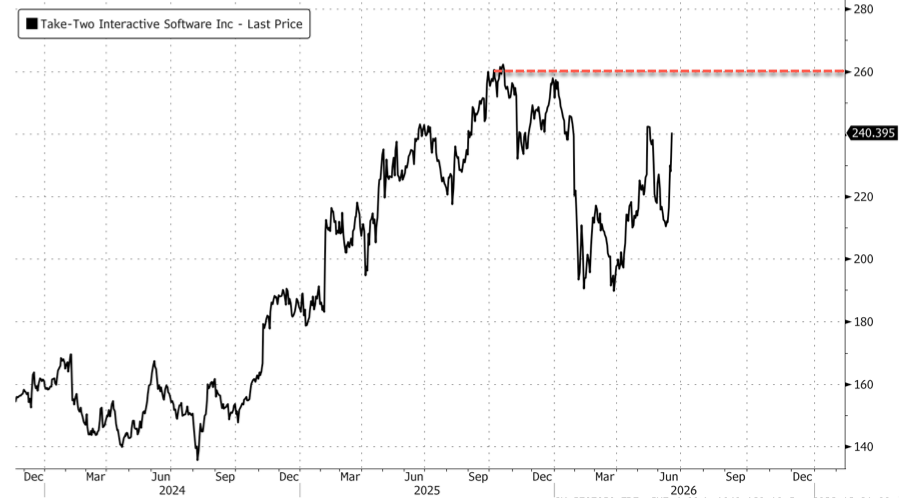
Take-Two shares are up nearly 6% in the cash session, though the stock has traded mostly sideways since peaking around $262 in October 2025.

Last month, we asked:

BMO Capital Markets analyst Brian Pitz noted, “We highlight that the game’s price remains a key question, as the launch of preorders next Friday should confirm base game pricing. We will also closely monitor for any higher-priced SKUs that give players early access to the game. Reiterate our Outperform, Top Pick, and $280 target price.”

According to Bloomberg data, 97% of the analyst coverage on TWWO is “Buy” rated with an average 12-month price target of $281.97.

For reference, GTA V sold about 225 million to 230 million copies worldwide.

There is already a report from Oppenheimer analyst Martin Yang that console sales are increasing ahead of the GTA VI release.

Tyler Durden
Thu, 06/18/2026 – 13:05

via ZeroHedge News https://ift.tt/zlftgFq Tyler Durden