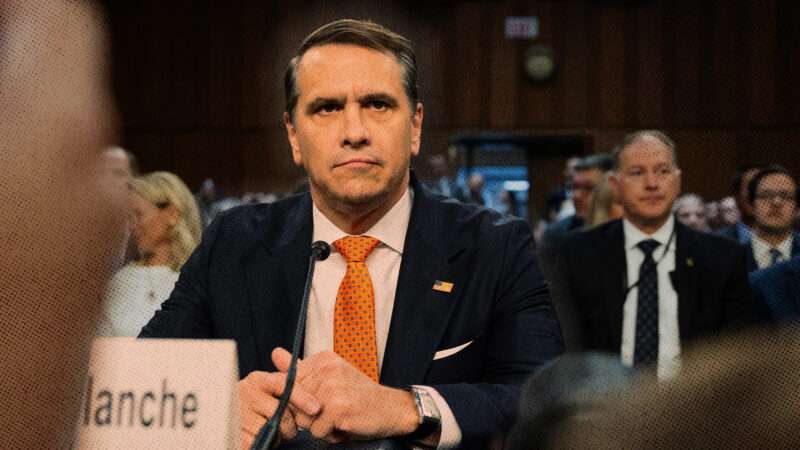
On Sunday night, Acting Attorney General Todd Blanche announced that he had agreed to change the terms of President Donald Trump’s “settlement agreement” with the IRS. Blanche formally rescinded his May 18 order establishing a $1.8 billion “Anti-Weaponization Fund” designed to benefit the president’s friends and followers, and he issued a statement about the scope of the IRS immunity he gave Trump in another order issued on May 19. Those moves were aimed at addressing the concerns of two Republican senators who had held up the Senate Judiciary Committee’s vote on Blanche’s nomination as attorney general.
Although Blanche’s concessions may clear the way for his confirmation, they underline the flagrant phoniness of a brazenly corrupt arrangement that he dishonestly portrays as the result of a bona fide legal dispute between Trump and the IRS. Trump’s lawsuit against the agency, which alleged damages from an IRS contractor’s illegal disclosure of his tax returns, never involved a genuine controversy between adverse parties. It was a transparent excuse for granting Trump, his family, and his supporters huge favors at taxpayers’ expense. By itself, Blanche’s approval of that jaw-dropping scam makes him unfit to run the Justice Department.
Trump’s lawsuit pitted him against an agency he oversees, represented by Justice Department lawyers who also answer to him. It was legally doomed right out of the gate because he missed the statutory deadline for filing such claims. And even if he had filed his lawsuit on time, he would have faced the challenge of arguing that an IRS contractor qualifies as an “officer or employee of the United States”—a point that the Justice Department has disputed in other cases involving similar claims.
Despite those legal weaknesses, the government’s lawyers never bothered to contest Trump’s claims, in sharp contrast with the way they usually handle such lawsuits. Instead, the Justice Department agreed to what Trump has described as “a settlement with myself.”
That product of admitted self-dealing included $1.8 billion in taxpayer money for Trump supporters who claim they suffered from abuses of power during the Biden administration. Blanche approved the Anti-Weaponization Fund and repeatedly defended it. But the plan provoked a bipartisan backlash so intense that he ditched the idea within two weeks, saying, “We’re not moving forward with the fund, period.”
That unilateral decision contradicted the pretense that the fund was part of a “settlement agreement” between the IRS and the plaintiffs: the president, two of his sons, and the Trump Organization. Consistent with that fiction, the document describing the fund was signed by the plaintiffs’ lawyers, IRS CEO Frank Bisignano, and Associate Attorney General Stanley E. Woodward Jr. Yet there was Blanche, orally negating the central feature of the “settlement” during congressional testimony without bothering to revise the “agreement” or obtain the plaintiffs’ written consent.
That move was illegitimate on its face, and Trump cast further doubt on the reliability of Blanche’s assurance by continuing to push the idea of payouts to his supporters, including people convicted of participating in the 2021 riot at the U.S. Capitol. After Sens. John Cornyn (R–Texas) and Thom Tillis (R–N.C.) asked Blanche to back up his promise in writing, which they presented as a condition of voting to confirm him, Trump kept talking as if the Anti-Weaponization Fund was a live proposition.
The fund “will not benefit me,” Trump wrote on Truth Social last Friday, “but rather the great American Patriots who were hunted down like dogs and whose lives were unfairly and illegally destroyed by the Crooked Joe Biden Administration.” If Cornyn and Tillis do not vote to confirm Blanche, Trump warned on Saturday, “I will keep Todd as Acting A.G.” and “push hard” for legislation establishing a fund that “takes care of those who have been so badly treated by the Crooked Joe Biden (and Obuma! [sic]) Administration.”
Blanche’s announcement that he has rescinded his order creating the Anti-Weaponization Fund glides over those presidential signals. Blanche “has repeatedly advised Congress through testimony, including under oath, as well as in written responses, that the Fund is not moving forward, and the Department has repeatedly represented to district courts that the Fund is not moving forward,” it says. Despite that, the rescission order complains, “several frivolous lawsuits have been filed challenging the Fund, and at least one court has declined to dismiss those claims as moot.”
Contrary to Blanche’s take, it was reasonable to wonder whether the Anti-Weaponization Fund might be revived given the president’s public statements that he wanted to do just that. In any case, Blanche’s withdrawal of his order poses the same puzzle as his previous promises: How can one side of a civil case unilaterally revise a settlement agreement? The answer, of course, is that there were never two sides in this case.
As the federal judge who oversaw Trump v. IRS noted two days before the Senate Judiciary Committee began considering Blanche’s nomination, the lawsuit was fake from the beginning because the president controlled both sides. The plaintiffs and the defendants “worked in tandem and were never actually adverse,” U.S. District Judge Kathleen Williams wrote, saying the lawsuit was nothing more than a pretext for “a ‘settlement’ that had no viable basis in law or fact.”
Blanche’s conduct confirmed that he was simultaneously acting as the head of the Justice Department and Trump’s personal lawyer. Blanche’s abandonment of the Anti-Weaponization Fund “demonstrates his confidence that he could speak for, and bind, both sides of this matter,” Williams noted. “This certitude supports the conclusion that the Parties worked in tandem and were never actually adverse. Indeed, ‘a party may not unilaterally repudiate a settlement agreement once it is reached.'”
Blanche’s grant of immunity reinforces the point that he perpetrated a fraud by pretending that the cozy arrangement he approved was simply the resolution of a legal dispute. Although Blanche presented his sweeping promise of protection as an addendum to the “settlement agreement,” he was the only person who signed it. And like the Anti-Weaponization Fund, the immunity deal had nothing to do with Trump’s complaint that the IRS had failed to properly supervise contractors entrusted with confidential tax information.
On Sunday, Blanche purported to clarify that order, which says “the United States” is “FOREVER BARRED and PRECLUDED” from pursuing “any and all claims” against Trump or his relatives regarding “any matters currently pending or that could be pending” before the IRS, the Treasury Department, or “other agencies or departments.” Although that broad language suggests that Trump’s immunity extends far beyond the IRS, Blanche has denied that implication, and his statement addresses only the scope of the restrictions on IRS claims.
Cornyn and Tillis wanted Blanche to clarify that his order does not apply to future conduct or extend beyond the plaintiffs. The “mutual release of claims applies by its terms only retroactively,” he says. But while the order does refer to IRS claims that “have been or could have been asserted” as of May 19, the language regarding “any matters currently pending or that could be pending,” which purports to bind every federal agency, is more ambiguous.
Blanche also claims the order affects only “the named parties in the lawsuit.” But that is plainly not true: The order also applies to “related or affiliated individuals” and “parties.” Those categories, it says, include “families or others filing jointly,” plus “trusts, parent, sister, or related companies, affiliates, and subsidiaries.” It is not clear what “related or affiliated” means or whether the list of examples is exhaustive.
Even under Blanche’s dubious interpretation of the order, it relieves Trump and the other plaintiffs of liability for any tax violations they may have committed prior to May 19. Although Blanche says that benefit is “typical” of settlements between the IRS and taxpayers, no other similarly situated plaintiff has ever received such broad relief. And judging from just one dispute concerning Trump’s reported business losses, the immunity approved by Blanche could save Trump more than $100 million in back taxes, interest, and penalties.
Williams concluded that Blanche’s order “directly contravenes” federal law. Under 26 USC 7217, it is “unlawful” for an executive-branch official to “request, directly or indirectly, any officer or employee of the Internal Revenue Service to conduct or terminate an audit or other investigation of any particular taxpayer with respect to the tax liability of such taxpayer.”
If we reject the preposterous premise that the ban on IRS claims was part of a “settlement agreement,” here is what happened: The acting attorney general issued a seemingly illegal order that relieves the president, his sons, and his business of liability based on their past tax returns, requiring the IRS to terminate any existing audits or investigations and refrain from starting new ones. He thereby shielded them from the consequences that ordinary Americans face when they run into trouble with the IRS.
If Blanche had simply done that out of the blue, it would be plainly outrageous. Trump’s bogus lawsuit does not change that reality.
The post Todd Blanche's Concessions Underline the Flagrant Phoniness of Trump's IRS 'Settlement' appeared first on Reason.com.
from Latest – Reason.com https://ift.tt/4OFqobh
via IFTTT