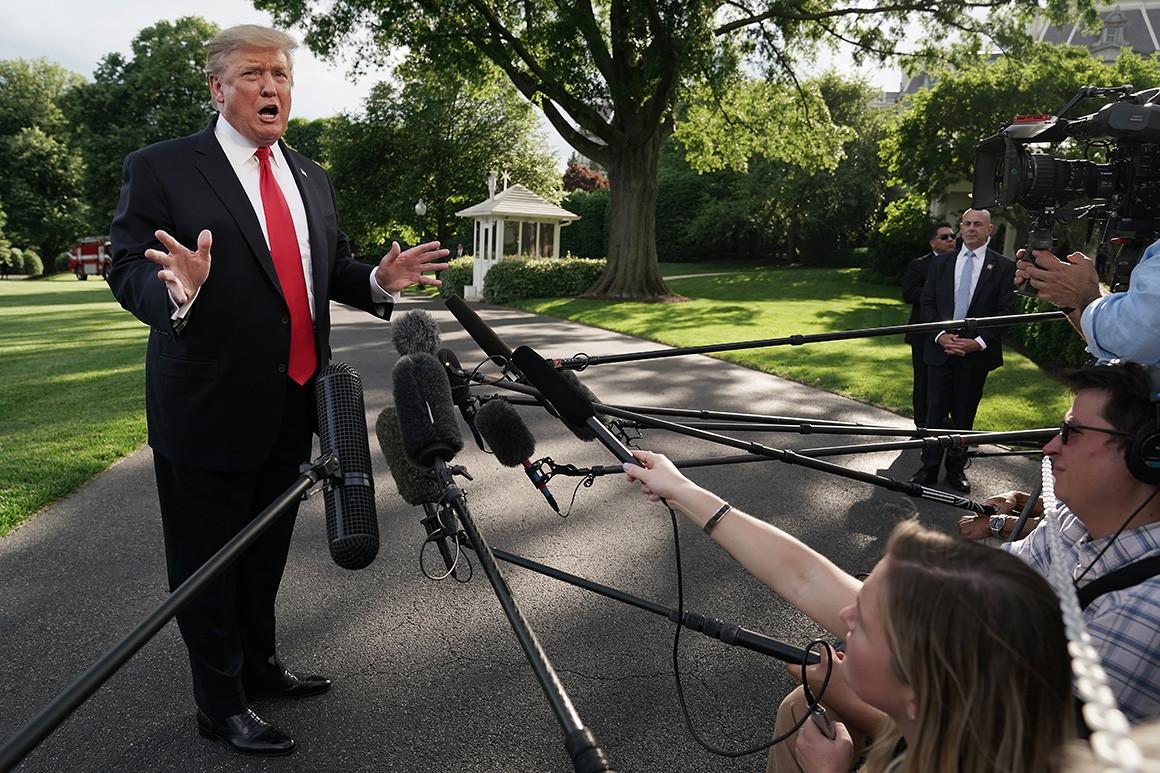
Attorneys for President Trump have reached an agreement with the House Intelligence & Financial Services Committees to quash subpoenas for Trump’s financial records from Deutsche Bank and Capital One, according to CNN‘s Cristina Alesci.
Lawyers for President Trump have reached an agreement with the House Intelligence & Financial Services panels to stay the subpoenas of Trump’s financial records from Deutsche Bank & Capital One. In exchange, they agreed to an expedited court schedule. Story @cnn soon
In exchange, Trump’s team has agreed to an expedited court schedule in front of three DC Circuit Court of Appeals judges – two of which were appointed by presidents Obama and Clinton, and one Trump appointee. The panel will determine whether the accounting firm Mazars USA must comply with Congressional demands for years of Trump’s financial records, after a lower court initially rejected Trump’s attempts to block the subpoena.
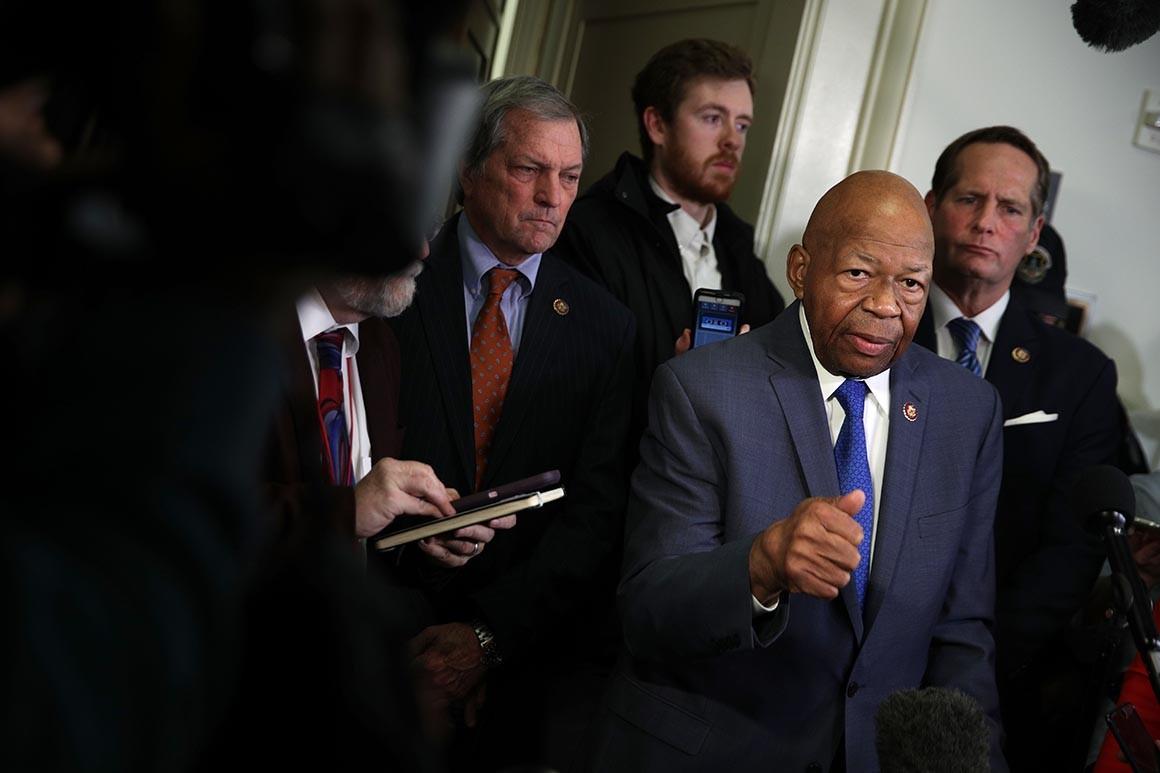
House Oversight Chairman Elijah Cummings (D-Md.) sent the subpoena to Mazars last month as part of the panel‘s investigation into whether Trump committed financial crimes before he became president.
The panel’s focus has been on trying to corroborate claims made by Trump’s former personal attorney Michael Cohen, who earlier this year gave the committee documents purporting to show Trump artificially inflated and deflated the value of his assets for his personal financial benefit. –Politico
Two congressional committees issued subpoenas last month to Deutsche Bank – the president’s primary lender over the last 20 years, and Capital One, where he keeps some of his money.
Mr. Trump, his company and his three eldest children — Donald Jr., Eric and Ivanka — filed a lawsuit on April 29 to block Deutsche Bank and Capital One from complying with the subpoenas. –New York Times
Developing…
via ZeroHedge News http://bit.ly/2EtWYyX Tyler Durden
Every single day, most Americans eagerly gobble down foods that contain ingredients that have been genetically-modified without ever considering the consequences. Most of us simply assume that the federal government would never allow us to eat GMOs if they were not safe. Unfortunately, it appears that the federal government has completely failed us. The material that I am about to share with you is deeply disturbing, and after reading this article there is a very good chance that you will never want to eat genetically-modified food ever again. But at this point it is almost impossible to completely avoid GMOs, because they are in almost everything. Unless they are specifically designated “organic”, most corn, soy, canola and sugar beets grown in America today have been genetically modified, and almost all packaged foods contain ingredients derived from at least one of those sources.
We’ll get into some of the potential health effects of eating foods derived from GMO crops in a moment, but first I want to discuss a new trend that is potentially even more dangerous.
In recent years, researchers have been pushing the boundaries of biology in order to come up with new “plant-based” alternatives to existing food products. Essentially, “synthetic biology” is being used “to create life forms from scratch”…
Impossible’s “bleeding” veggie burger, shrimp made of algae, and vegan cheeses that melt are all making their way into restaurants and on to supermarket shelves, offering consumers a new generation of plant-based proteins that look, act, and taste far more like the real thing than ever before.
What consumers may not realize, however, is that many of these new foods are made using synthetic biology, an emerging science that applies principles of genetic engineering to create life forms from scratch.
But of course nobody really knows what the long-term health effects will be once humans start eating “synthetic proteins” on a massive scale.
And once these gene-edited organisms start spreading their genetic material in the wild, it could be a complete and total environmental nightmare. According to Rebecca Burgess, these food companies are “not considering the future of genetic pollution”…
Rebecca Burgess, the founder of Fibershed, which last fall produced a report with ETC Group on the hazards of clothing made from genetically modified or synbio-derived materials, questions the efficacy of methods to keep gene-edited material from getting into the environment. “The concern is that they’re using base life forms that grow rapidly and transfer genes rapidly and they’re not considering the future of genetic pollution.”
This is an even bigger issue in the agricultural world, and at this point “genetic drift” has become a global problem…
GMO contamination is well documented. According to the International Journal of Food Contamination, almost 400 cases of GMO contamination occurred between 1997 and 2013 in 63 countries. Part of the problem is the very nature of nature. Many plants are pollinated by insects, birds or wind, allowing pollen from a GMO plant to move to neighboring fields or into the wild. This “genetic drift” illustrates the enormous difficulty in containing GMO technology. Not only is genetic drift impossible to prevent, inadequate regulation also fails to hold seed companies accountable for any resulting damages and ultimately puts the onus on farmers who have been the victims of contamination.
We are monkeying around with life itself, and we really have no idea what the long-term consequences will look like.
But what we do know is that a number of scientific studies seem to indicate that GMO food is not healthy. According to a paper released by the American Academy of Environmental Medicine, animal studies have linked GMO food with a whole host of health problems…
“Several animal studies indicate serious health risks associated with GM food,” including infertility, immune problems, accelerated aging, insulin regulation, and changes in major organs and the gastrointestinal system.
None of us would willingly sign up for any of those conditions, but that is what we are potentially doing when we regularly consume food that has been genetically modified.
For those that are skeptical, I would like for you to consider what scientists discovered when they fed genetically-modified soy to rats…
The experience of actual GM-fed experimental animals is scary. When GM soy was fed to female rats, most of their babies died within three weeks — compared to a 10% death rate among the control group fed natural soy. The GM-fed babies were also smaller, and later had problems getting pregnant.
When male rats were fed GM soy, their testicles actually changed color — from the normal pink to dark blue. Mice fed GM soy had altered young sperm. Even the embryos of GM fed parent mice had significant changes in their DNA. Mice fed GM corn in an Austrian government study had fewer babies, which were also smaller than normal.
Could this be a clue as to why there is a “fertility crisis” in the United States today?
Reproductive problems also plague livestock. Investigations in the state of Haryana, India revealed that most buffalo that ate GM cottonseed had complications such as premature deliveries, abortions, infertility, and prolapsed uteruses. Many calves died. In the US, about two dozen farmers reported thousands of pigs became sterile after consuming certain GM corn varieties. Some had false pregnancies; others gave birth to bags of water. Cows and bulls also became infertile when fed the same corn.
If this is what the hard science is telling us, why in the world are we doing this to ourselves?
In the end, it all comes down to greed. Four giant corporations have a virtual monopoly on the seed market today, and billions of dollars are at stake. So an enormous amount of time and energy is spent trying to convince the American public that there is nothing to be concerned about, and massive amounts of money is poured into the campaigns of politicians that support GMO food.
But they can’t keep a lid on the truth forever, and an increasing number of doctors are starting to speak out…
More and more doctors are already prescribing GM-free diets. Dr. Amy Dean, a Michigan internal medicine specialist, and board member of AAEM says, “I strongly recommend patients eat strictly non-genetically modified foods.” Ohio allergist Dr. John Boyles says “I used to test for soy allergies all the time, but now that soy is genetically engineered, it is so dangerous that I tell people never to eat it.”
Dr. Jennifer Armstrong, President of AAEM, says, “Physicians are probably seeing the effects in their patients, but need to know how to ask the right questions.” World renowned biologist Pushpa M. Bhargava goes one step further. After reviewing more than 600 scientific journals, he concludes that genetically modified organisms (GMOs) are a major contributor to the sharply deteriorating health of Americans.
GM corn and cotton are engineered to produce their own built-in pesticide in every cell. When bugs bite the plant, the poison splits open their stomach and kills them. Biotech companies claim that the pesticide, called Bt — produced from soil bacteria Bacillus thuringiensis’ has a history of safe use, since organic farmers and others use Bt bacteria spray for natural insect control. Genetic engineers insert Bt genes into corn and cotton, so the plants do the killing.
The Bt-toxin produced in GM plants, however, is thousands of times more concentrated than natural Bt spray, is designed to be more toxic, has properties of an allergen, and unlike the spray, cannot be washed off the plant.
Do you think that it is actually safe to eat such “food”?
Sadly, the health consequences from eating GMO food may not just be temporary. In fact, one study found that the effects of eating genetically-modified food could last for a lot longer that anyone had anticipated…
The only published human feeding study revealed what may be the most dangerous problem from GM foods. The gene inserted into GM soy transfers into the DNA of bacteria living inside our intestines and continues to function. This means that long after we stop eating GMOs, we may still have potentially harmful GM proteins produced continuously inside of us. Put more plainly, eating a corn chip produced from Bt corn might transform our intestinal bacteria into living pesticide factories, possibly for the rest of our lives.
Personally, I am going to re-evaluate my own diet, because doing research for this article has kind of freaked me out.
Most of the packaged foods that we eat today are not safe, and it is getting worse with each passing year.
via ZeroHedge News http://bit.ly/2wkOrdq Tyler Durden
Three weeks ago, a CNN executive suggested that talk of impending layoffs were nothing more than a “crazy rumor.” Last week, the network laid off nearly all of the Atlanta-based staff that cover health care, according to Fox Newsand confirmed by TVNewser – a media watchdog site founded by CNN‘s Brian Stelter.
“Basically the whole division” is set to lose their jobs, according to an anonymous Fox News source who said that employees were notified on Tuesday of the layoffs.
A CNN spokesperson told Stelter’s TVNewser: “As part of the normal course of business, our newsgathering team made a small restructure earlier this week that ultimately impacts 6-7 employees within CNN’s Health Unit.”
Many health department staffers met with human resources on Tuesday. Katz noted that correspondent Elizabeth Cohen is also safe.
Staffers are shocked, as the health department is considered successful and CNN recently declared that no layoffs were imminent. –Fox News
On May 7, CNN Executive Vice President Allison Gollust told Fox News: “There are no mass layoffs at CNN. I have no idea where that crazy rumor came from. We have recently offered a voluntary buyout option for employees, and just over 100 people voluntarily decided to take it. That’s it,” adding “We have nearly 4,000 people at CNN… and around 100 of them exercised the option for a program that was offered. That’s it. Those are the facts.”
TVNewser adds that “CNN’s Southeast Bureau in Atlanta, CNN Health and CNN Climate will now be under one leadership, something that was not the case before.”
Of note, CNN’s prime-time ratings dropped 26% in April – the worst month for total viewers since October 2015, according to Nielsen Media Research.
The slide came right after special counsel Robert Mueller’s Russia report found no collusion between Russia and the Trump campaign – a narrative CNN bet their reputation on for over two years.
via ZeroHedge News http://bit.ly/2ExmPpY Tyler Durden
There is a disproportionate buzz about the newly signed Florida legislation that allows its school districts (each at its own discretion) to authorize concealed carry of firearms by teachers in their schools.
Why disproportionate? Because the Marjory Stoneman Douglas High School Public Safety Act, signed into law in March 2018 soon after the Parkland mass shooting, had already established the “Coach Aaron Feis Guardian Program” named after the coach who gave his life attempting to shield students with his body during that shooting. That program gave school boards the option of allowing school staff members to carry firearms, excluding most classroom teachers who were not JROTC teachers, or current service members, or current or former law enforcement officers.
Last year’s bill established a tough training standard, and left the decision to local school boards, both very good things. And since school staff who are not classroom teachers often comprise as high as 50% of the total, this approach was rational, if overly cautious, as school boards would still have the authority to approve or disapprove any applicant, without the no-teacher provision imposed by law.
The only change with the new law is that now all classroom teachers are also eligible to volunteer for the Guardian program.
Note “eligible” and “volunteer” and you will understand why so much of the near-hysterical opposition to this law is baseless.
Of course, no one is actually “arming” any teachers — there is no arms room where they will line up to be issued weapons before filing into the trenches — much less “all” teachers, which is how the opposition likes to frame its strawman argument. They will arm themselves, if their school board votes to implement the Guardian program, and if they individually volunteer, pass rigorous screening and selection, and complete the legally mandated 132 hours of training. No one is guaranteed approval, and the standards they must meet are high.
The Miami New Times, not known for smart or principled positions on any firearms issue, is one of the media outlets appalled that the legislature and governor, elected by citizens to legislate and govern, have not allowed themselves to be ruled by teachers’ unions, high school students, and some school boards and administrators. All those folks display their statist leanings by wanting to impose their own fears of positive protective measures on everyone. Under Florida law, if they (and, pointedly, the voters in their school districts) do not want to implement the Guardian program, they don’t have to. They can keep the Gun Free Zone signs over their doors and hope for the best. But that’s not enough for them; they think they know better than anyone else what is best for every school district in Florida.
Local control on this issue is a sound and sensible approach, in line with the rule of subsidiarity, the concept that decision-making should occur at the lowest level appropriate to its purpose. Local control is often preferable to decision making by officials far-removed from the affected population, less responsive to their local and regional preferences, and more likely to impose one-size-fits-all solutions. Voters can more easily influence or replace an unresponsive local elected official than his state or federal counterparts. Here it means what Florida and many other states have ruled: let the school districts decide for themselves.
Beyond that repugnant statist attitude, opponents of “arming” school staff try to bolster their argument with unsupportable claims and sloppy ‘research’ — textbook examples of confirmation bias, the tendency to only consider evidence that supports one’s preconceived notions. The Miami New Times cites an analysis by Gabrielle Giffords’ anti-gun organization that purports to show how dangerous introducing “more guns” to schools will be. It is such a sloppy piece of research and reasoning that I cannot let it go unanswered.
This long piece cites 67 “incidents of mishandled guns in schools” from all over America, from 2014 to the present, to support their opposition to concealed carry of firearms by school staff who meet the requirements of Florida’s Guardian program. But here’s the rub: only one of these 67 incidents involved a school staffer carrying a firearm under similar requirements. That one involved a Texas superintendent who left her authorized firearm locked in a district vehicle when she and her staff visited another district where she was not authorized to carry it – and then forgot to recover the weapon and left it in the van overnight, to be found in the morning.
Every other incident on this list actually supports the premises behind Florida’s Guardian program, and similar programs in the many other states with similar laws on the books. Not one carefully vetted armed staff member carrying a concealed firearm with knowledge and approval of their school board, in accordance with strict standards, in well over 1,000 schools around the country, was involved in any of the other 66 incidents cited.
Fifteen of the incidents on this list involved subjects who were not staff members at all; some of these were commissioned officers, while others were merely family members or or other visitors carrying firearms on school property in violation of the law. Another incident involved two coaches, but occurred off school property. Desperate to plump up the numbers, are we?
(For a tabulation of the incidents the Giffords piece cites, see here.)
What this list actually does is to demolish the assertion often made by opponents of armed school staff, that guns in school should be left to the “armed professionals.” While the Miami New Times quotes some who seem to believe that armed officers make schools safer, Giffords does not think so, and on this point at least, we can at least understand the sentiment. Fully 27 of the 67 incidents in the Giffords study involve “armed professionals” — commissioned police officers or deputies assigned to a school, officers responding to a call for assistance or visiting for other reasons, or other uniformed security guards or school resource officers employed on site. These “armed professionals” had unintentional discharges (several of which injured themselves or others), left their weapons in restroomsor elsewhere unattended, and in two egregious cases, failed to stop a child from pulling the trigger of their holstered weapon.
So much for “armed professionals” — we who are armed professionals know how little sustained, realistic, demanding training most officers undergo, and how easily complacency creeps in. Uniformed guards — commissioned or not — are not ten feet tall. They are unfortunately sometimes less dedicated and often less proficient than educators who understand their responsibilities “in loco parentis” and undergo rigorous and frequent training required by law and school district policy. Who has not heard educators saying, “we would sacrifice our lives to protect the kids in our care”? Give the tools and the skills to those who are willing, and they can do better than just sacrifice themselves like Coach Feis did at Parkland.
This is not to say that officers are all deficient in their skills and judgment — far from it — or that they cannot train to a high standard; but we who are trainers know without a shadow of a doubt that motivated civilians can do just as well, with the proper training. In the schools as on the streets, they are not volunteering to act as law enforcement officers, which is a very broad skill set indeed, but only to protect innocents against lethal threats — a very narrow skill set that comprises only a small slice of a police officer’s responsibilities.
In fact, what we do know is that responding police — even when do not have unintentional discharges like several in this list — do not protect schools against active shooters, because they almost always arrive too late; and that uniformed officers on site have a very spotty record. The uncertainty in a potential aggressor’s mind that is created by the prospect of an unknown number of trained staff members carrying concealed weapons at various but unpredictable locations throughout a school, appears to be a better deterrent than one uniformed officer, as evidenced by the complete absence of active shooter incidents in such schools. Arguably, if one is swayed by logic, they will prove to be a more effective and flexible defense as well, if that unprecedented day does arrive when a shooting happens in their school.
Again, with the exception of that Texas superintendent, none of these incidents involved an approved, trained, school staff member carrying a concealed weapon. The closest thing to it is the anomalous case of a teacher in Utah in 2014. State law there allows any resident with a concealed carry permit to carry in the schools. There is no requirement to even notify the school board or administration, much less be vetted or approved, or to be trained to any standard beyond the 8 hours of mostly classroom training required for a permit. This teacher dropped her weapon in a toilet stall (before school, with no students in the building); it discharged, shattering the bowl and cutting her calf with a flying shard. That’s not a laughing matter, or not only a laughing matter, but should be taken in context. Utah’s law has been in place for 20 years, and out of 700,000 citizens with concealed carry permits (14 million person-years?), this is the only reported occasion in which anyone has been injured by a legal concealed carrier’s firearm in a Utah school. And she doesn’t work there any more. It may also be significant that Utah has had no mass shootings in its schools, but we can only speculate. Pretty safe state, Utah, for all that their statute is far less prescriptive than Florida’s or many other states.
Gifford titles its piece “Every Incident of Mishandled Guns in Schools” and assures us that theirs is a “systematic analysis,” and that this list of 67 incidents is “comprehensive” for the date range of 2014-2014. But in reality, theirs is a list of those who violate the law and/or handle firearms incompetently — precisely the sort who are unlikely to volunteer in the first place, or to pass a careful vetting and selection process, or a demanding, standards-based training program, as required by statute in Florida and many other states that authorize concealed carry by school staff.
The actions of criminals and incompetents do not form a rational basis for criticizing or opposing these programs, which have been successful everywhere they are in place. Giffords has absolutely failed to make a case against armed school staff members in districts that opt in, under authorizing state law, with well-drafted programs and requirements.
Opponents of protecting our schools and children with armed staff on site will have to do better than this, to make a case worth listening to.
via ZeroHedge News http://bit.ly/30LflsH Tyler Durden
On Friday night, Federal District Judge Haywood Gilliam ruled against the administration in what is likely to be the first of many court decisions on the legality of President Trump’s plans to reallocate federal defense and and drug interdiction funds to build his border wall. The court concluded that none of the the federal laws that the administration wants to use to reallocate funds for wall construction in California actually permits it to spend more money on the wall than Congress specifically authorized for that purpose. Judge Gilliam also emphasized that the administration’s attempts to circumvent Congress’ power of the purse threaten to undermine our constitutional system of separation of powers.
In order to build parts of Trump’s planned border wall, the administration wants to reallocate funds under 10 USC Section 284, which allows the use of Department of Defense “counternarcotics” funds to provide support for “counterdrug activities” by other agencies, and 10 USC Section 2808, which applies during a “national emergency” that “requires the use of the armed forces” an allows the president to reallocate defense funds to “undertake military construction projects … that are necessary to support such use of the armed forces.” In order to make use of Section 2808, Trump declared a “national emergency” under the National Emergencies Act of 1976.
Since the funds Congress specifically allocated to fund Section 284 during the current fiscal year are nearly exhausted, the Department of Defense wants to tap some $2.5 billion in additional funds by using Section 8005 of the most recent Department of Defense Appropriations Act. As Judge Gilliam explains, Section 8005 “authorizes the Secretary of Defense to transfer up to $4 billion ‘of working capital funds of the Department of Defense or funds made available in this Act to the Department of Defense for military functions … Section 8005 further provides that such authority to transfer may only be used (1) for higher priority items than those for which originally appropriated, and (2) based on unforeseen military requirements, but (3) in no case where the item for which funds are requested has been denied by the Congress.” The federal government also plans to utilize some $3.6 billion under Section 2808. This combined total is far more than the $1.375 billion that Congress authorized in new border barrier spending in the deal that ended the government shutdown earlier this year.
For reasons Judge Gilliam explains, neither Section 2808 nor the combination of Section 284 and Section 8005 actually authorize the president to spend money on border barriers. Moreover, the administration’s efforts to tap these funds would seriously undermine the separation of powers of the courts allow them to succeed.
In his opinion, Judge Gilliam concludes that the administration’s attempt to use Section 8005 runs afoul of two of that provisions’ requirements: that the expenditure in question cannot be for a purpose “denied by Congress”, and that it must be for “unforeseen military requirements.”
As Judge Gilliam points out, “the Defendants’ argument that the need for the requested border barrier construction funding was “unforeseen” cannot logically be squared with the Administration’s multiple requests for funding for exactly that purpose dating back to at least early 2018.” Trump has been lobbying Congress for extensive new border wall funding for a long time now. Their refusal to satisfy his demands does not make the wall an “unforeseen” military need. He notes that if the administration prevails on this issue, virtually any Section 284 spending could qualify as as an “unforeseen” need, based on the theory that the need for the spending was not known until the administration demanded it.
The administration’s position on the “denied by Congress” issue is perhaps even more troubling. Judge Gilliam’s ruling explains that the administration’s demands for new border wall spending beyond the $1.375 billion included in the recent budget deal, were repeatedly rejected by Congress. This surely qualifies as a “denial” by Congress. The administration’s attempts to get around this problem pose a serious threat to the separation of powers:
[T]he upshot of Defendants’ argument is that the Acting Secretary of Defense is authorized to use Section 8005 to funnel an additional $1 billion to the Section 284 account for border barrier construction, notwithstanding that (1) Congress decided to appropriate only $1.375 billion for that purpose; (2) Congress’s total fiscal year 2019 appropriation available under Section 284 for “[c]onstruction of roads and fences and installation of lighting to block drug smuggling corridors across international boundaries of the United States” was $517 million, much of which already has been spent; and (3) Defendants have acknowledged that the Administration considered reprogramming funds for border barrier construction even before the President signed into law Congress’s $1.375 billion appropriation….
Put differently, according to Defendants, Section 8005 authorizes the Acting Secretary of Defense to essentially triple—or quintuple, when considering the recent additional $1.5 billion reprogramming—the amount Congress allocated to this account for these purposes, notwithstanding Congress’s recent and clear actions in passing the CAA, and the relevant committees’ express disapproval of the proposed reprogramming….
[R]eading Section 8005 to permit this massive redirection of funds under these circumstances likely would amount to an “unbounded authorization for Defendants to rewrite the federal budget…”
Judge Gilliam goes on to emphasize that:
The Court has serious concerns with Defendants’ theory of appropriations law, which presumes that the Executive Branch can exercise spending authority unless Congress explicitly restricts such authority by statute…. But it is not Congress’s burden to prohibit the Executive from spending the Nation’s funds: it is the Executive’s burden to show that its desired use of those funds was “affirmatively approved by Congress…
To have this any other way would deprive Congress of its absolute control over the power of the purse, “one of the most important authorities allocated to Congress in the Constitution’s ‘necessary partition of power among the several departments.'”… (quoting The Federalist No. 51, at 320 (James Madison)..).
On Section 2808, Judge Gilliam concludes that “it is unclear how border barrier construction could reasonably constitute a ‘military construction project’ such that Defendants’ invocation of Section 2808 would be lawful.” For reasons he explains, such border barriers do not qualify as a “military construction projects” as that term is defined in Section 2801 (which provides relevant definitions for 2808).
I pointed out some additional reasons why the administration’s reliance on Section 2808 is flawed here. Among other things, immigration law enforcement does not qualify as an “emergency” that “requires the use of the armed forces.” Indeed, using the armed forces for domestic law enforcement purposes is actually illegal.
Because the administration has not yet decided when and where it intends to use the Section 2808 funds, Judge Gilliam only issued a preliminary injunction against the use of Section 8005/Section 284 funds.
The bottom line in this case is that the president does not have the power to spend money for purposes not authorized by Congress, and he cannot circumvent Congress’ power of the purse through creative manipulation of statues. As Judge Gilliam puts it, “Congress’s ‘absolute’ control over federal expenditures—even when that control may frustrate the desires of the Executive Branch regarding initiatives it views as important—is not a bug in our constitutional system. It is a feature of that system, and an essential one.”
This is not the first time the Trump Administration infringed on Congress’ power of the purse. It has repeatedly done much the same thing in its efforts to withhold federal funds from “sanctuary cities,” a strategy that has led to a long series of well-deserved defeats in court.
Judge Gilliam’s decision only deals with the plaintiffs’ motion for a preliminary injunction. But it is obvious which way he is likely to rule once the case reaches a final decision on the merits. In addressing the preliminary injunction question, he concluded that the plaintiffs are likely to prevail on the merits on both the Section 2808 and Section 8005/Section 284 issues.
Yesterday’s ruling is just the beginning of what is likely to be a prolonged legal battle over Trump’s efforts to reallocate funds to “build the wall.” This case, filed by the ACLU on behalf of the Sierra Club and others groups, is just one of many lawsuits against the president’s plan. It is the first to result in a judicial decision. There will likely be many more before this
Judge Gilliam does not address a number of issues that are likely to be dealt with in other cases, or perhaps even in this one, after the federal government files an appeal. These include whether the situation at the border qualifies as “national emergency” under the National Emergencies Act of 1976 (whose invocation was necessary to trigger Section 2808), and whether the president has the authority to use eminent domain to seize property for border wall construction not specifically authorized by Congress. Yesterday’s ruling did not need to address these issues because Judge Gilliam concluded that the use of Section 2808 was illegal for other reasons, and because the administration has not yet tried to use the new funds to condemn property in the areas in question. Similarly, the ruling does not consider the legality of the administration’s plan use federal asset forfeiture funds to build the wall, relying on 31 USC 9705. The Administration intends to use Section 9705 to fund wall construction in Texas, but in areas not covered by the lawsuit before Judge Gilliam.
As Winston Churchill might have put it, this ruling is not the end of the legal struggle over Trump’s border wall; it barely even qualifies as the end of the beginning. But Judge Gilliam’s decision is still a notable victory for opponents of the wall. It effectively highlights some key flaws in the administration’s position.
from Latest – Reason.com http://bit.ly/2W9GmI0
via IFTTT
The Chicago Tribune has published what can only be described as yellow journalism – calling a dead, gun-toting thug who was shot in the neck by a concealed-carry holder, a “victim” after the armed robber succumbed to his wounds nearly 18 months later.
On December 12, 2017, 18-year-old Brian Ford pulled a gun on a 27-year-old concealed carry holder as the man pulled into a backyard. After walking up and pointing his gun at the man, Ford was shot in the neck and paralyzed after the driver says he feared “he may become a victim of a battery.”
Ford was taken to the hospital in critical condition, and was later charged with a felony count of aggravated unlawful use of a weapon, and a misdemeanor count of aggravated assault with a deadly weapon. His bail was set at $50,000. 10 days later, the Cook County state’s attorney’s office (which dropped all charges against Jussie Smollett), dropped the case.
Notably, the gun Ford used was found to have been used during the commission of other crimes, while police found the concealed-carry holder’s use an act of self defense under Stand Your Ground / Castle Doctrine laws.
On May 18, Ford died. His autopsy, released Wednesday, found that he died of complications of quadriplegia from a gunshot wound to the neck.
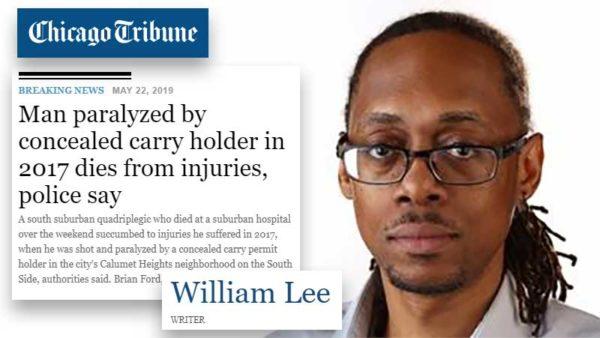
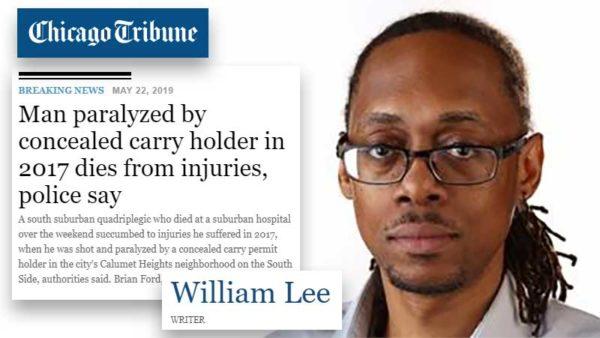
The Chicago Tribune framed the incident, and Ford’s death like this:
A south suburban quadriplegic who died at a suburban hospital over the weekend succumbed to injuries he suffered in 2017, when he was shot and paralyzed by a concealed carry permit holder in the city’s Calumet Heights neighborhood on the South Side, authorities said.
…
Ford’s injury stemmed from a Dec. 12, 2017, shooting that began with the then-18-year-old pulling his own gun on a 27-year-old man driving his vehicle into a rear yard in the 9100 block of South Harper Avenue, according to Chicago police.
The older man, a concealed carry holder, pulled his own firearm and shot the victim, police said. –Chicago Tribune
And now, the ‘victim’ is dead.
William Lee needs to be fired. Trying to make it seem like the concealed carry holder was the criminal when he was protecting himself. Shame on you.
William Lee https://t.co/vaf4P8Kh0n. So, a criminal who tried to rob people, gets shot by a hero (concealed carry holder) and you twist the headline and call the perp the “victim”? You’re sick bro, and should be fired. @chicagotribune should be ashamed.
On Friday night, Federal District Judge Haywood Gilliam ruled against the administration in what is likely to be the first of many court decisions on the legality of President Trump’s plans to reallocate federal defense and and drug interdiction funds to build his border wall. The court concluded that none of the the federal laws that the administration wants to use to reallocate funds for wall construction in California actually permits it to spend more money on the wall than Congress specifically authorized for that purpose.
In order to build parts of Trump’s planned border wall, the administration wants to reallocate funds under 10 USC Section 284, which allows the use of Department of Defense “counternarcotics” funds to provide support for “counterdrug activities” by other agencies, and 10 USC Section 2808, which applies during a “national emergency” that “requires the use of the armed forces” an allows the president to reallocate defense funds to “undertake military construction projects … that are necessary to support such use of the armed forces.” In order to make use of Section 2808, Trump declared a “national emergency” under the National Emergencies Act of 1976.
Since the funds Congress specifically allocated to fund Section 284 during the current fiscal year are nearly exhausted, the Department of Defense wants to tap some $2.5 billion in additional funds by using Section 8005 of the most recent Department of Defense Appropriations Act. As Judge Gilliam explains, Section 8005 “authorizes the Secretary of Defense to transfer up to $4 billion ‘of working capital funds of the Department of Defense or funds made available in this Act to the Department of Defense for military functions … Section 8005 further provides that such authority to transfer may only be used (1) for higher priority items than those for which originally appropriated, and (2) based on unforeseen military requirements, but (3) in no case where the item for which funds are requested has been denied by the Congress.” The federal government also plans to utilize some $3.6 billion under Section 2808. This combined total is far more than the $1.375 billion that Congress authorized in new border barrier spending in the deal that ended the government shutdown earlier this year.
For reasons Judge Gilliam explains, neither Section 2808 nor the combination of Section 284 and Section 8005 actually authorize the president to spend money on border barriers. Moreover, the administration’s efforts to tap these funds would seriously undermine the separation of powers of the courts allow them to succeed.
In his opinion, Judge Gilliam concludes that the administration’s attempt to use Section 8005 runs afoul of two of that provisions’ requirements: that the expenditure in question cannot be for a purpose “denied by Congress”, and that it must be for “unforeseen military requirements.”
As Judge Gilliam points out, “the Defendants’ argument that the need for the requested border barrier construction funding was “unforeseen” cannot logically be squared with the Administration’s multiple requests for funding for exactly that purpose dating back to at least early 2018.” Trump has been lobbying Congress for extensive new border wall funding for a long time now. Their refusal to satisfy his demands does not make the wall an “unforeseen” military need. He notes that if the administration prevails on this issue, virtually any Section 284 spending could qualify as as an “unforeseen” need, based on the theory that the need for the spending was not known until the administration demanded it.
The administration’s position on the “denied by Congress” issue is perhaps even more troubling. Judge Gilliam’s ruling explains that the administration’s demands for new border wall spending beyond the $1.375 billion included in the recent budget deal, were repeatedly rejected by Congress. This surely qualifies as a “denial” by Congress. The administration’s attempts to get around this problem pose a serious threat to the separation of powers:
[T]he upshot of Defendants’ argument is that the Acting Secretary of Defense is authorized to use Section 8005 to funnel an additional $1 billion to the Section 284 account for border barrier construction, notwithstanding that (1) Congress decided to appropriate only $1.375 billion for that purpose; (2) Congress’s total fiscal year 2019 appropriation available under Section 284 for “[c]onstruction of roads and fences and installation of lighting to block drug smuggling corridors across international boundaries of the United States” was $517 million, much of which already has been spent; and (3) Defendants have acknowledged that the Administration considered reprogramming funds for border barrier construction even before the President signed into law Congress’s $1.375 billion appropriation….
Put differently, according to Defendants, Section 8005 authorizes the Acting Secretary of Defense to essentially triple—or quintuple, when considering the recent additional $1.5 billion reprogramming—the amount Congress allocated to this account for these purposes, notwithstanding Congress’s recent and clear actions in passing the CAA, and the relevant committees’ express disapproval of the proposed reprogramming….
[R]eading Section 8005 to permit this massive redirection of funds under these circumstances likely would amount to an “unbounded authorization for Defendants to rewrite the federal budget…”
Judge Gilliam goes on to emphasize that:
The Court has serious concerns with Defendants’ theory of appropriations law, which presumes that the Executive Branch can exercise spending authority unless Congress explicitly restricts such authority by statute…. But it is not Congress’s burden to prohibit the Executive from spending the Nation’s funds: it is the Executive’s burden to show that its desired use of those funds was “affirmatively approved by Congress…
To have this any other way would deprive Congress of its absolute control over the power of the purse, “one of the most important authorities allocated to Congress in the Constitution’s ‘necessary partition of power among the several departments.'”… (quoting The Federalist No. 51, at 320 (James Madison)..).
On Section 2808, Judge Gilliam concludes that “it is unclear how border barrier construction could reasonably constitute a ‘military construction project’ such that Defendants’ invocation of Section 2808 would be lawful.” For reasons he explains, such border barriers do not qualify as a “military construction projects” as that term is defined in Section 2801 (which provides relevant definitions for 2808).
I pointed out some additional reasons why the administration’s reliance on Section 2808 is flawed here. Among other things, immigration law enforcement does not qualify as an “emergency” that “requires the use of the armed forces.” Indeed, using the armed forces for domestic law enforcement purposes is actually illegal.
Because the administration has not yet decided when and where it intends to use the Section 2808 funds, Judge Gilliam only issued a preliminary injunction against the use of Section 8005/Section 284 funds.
The bottom line in this case is that the president does not have the power to spend money for purposes not authorized by Congress, and he cannot circumvent Congress’ power of the purse through creative manipulation of statues. As Judge Gilliam puts it, “Congress’s ‘absolute’ control over federal expenditures—even when that control may frustrate the desires of the Executive Branch regarding initiatives it views as important—is not a bug in our constitutional system. It is a feature of that system, and an essential one.”
This is not the first time the Trump Administration infringed on Congress’ power of the purse. It has repeatedly done much the same thing in its efforts to withhold federal funds from “sanctuary cities,” a strategy that has led to a long series of well-deserved defeats in court.
Judge Gilliam’s decision only deals with the plaintiffs’ motion for a preliminary injunction. But it is obvious which way he is likely to rule once the case reaches a final decision on the merits. In addressing the preliminary injunction question, he concluded that the plaintiffs are likely to prevail on the merits on both the Section 2808 and Section 8005/Section 284 issues.
Yesterday’s ruling is just the beginning of what is likely to be a prolonged legal battle over Trump’s efforts to reallocate funds to “build the wall.” This case, filed by the ACLU on behalf of the Sierra Club and others groups, is just one of many lawsuits against the president’s plan. It is the first to result in a judicial decision. There will likely be many more before this
Judge Gilliam does not address a number of issues that are likely to be dealt with in other cases, or perhaps even in this one, after the federal government files an appeal. These include whether the situation at the border qualifies as “national emergency” under the National Emergencies Act of 1976 (whose invocation was necessary to trigger Section 2808), and whether the president has the authority to use eminent domain to seize property for border wall construction not specifically authorized by Congress. Yesterday’s ruling did not need to address these issues because Judge Gilliam concluded that the use of Section 2808 was illegal for other reasons, and because the administration has not yet tried to use the new funds to condemn property in the areas in question. Similarly, the ruling does not consider the legality of the administration’s plan use federal asset forfeiture funds to build the wall, relying on 31 USC 9705. The Administration intends to use Section 9705 to fund wall construction in Texas, but in areas not covered by the lawsuit before Judge Gilliam.
As Winston Churchill might have put it, this ruling is not the end of the legal struggle over Trump’s border wall; it barely even qualifies as the end of the beginning. But Judge Gilliam’s decision is still a notable victory for opponents of the wall. It effectively highlights some key flaws in the administration’s position.
from Latest – Reason.com http://bit.ly/2W9GmI0
via IFTTT
Thanks to commenter James Pollock for highlighting this, and adding: “To be fair to our robed brethren, NOBODY is as funny as they think they are”—though, as the Utah Supreme Court opinion suggests, judges are likelier than the rest of us to draw laughter even for their less funny jokes.
from Latest – Reason.com http://bit.ly/2X5wo6F
via IFTTT
Here’s our weekly roll-up of some of the most bizarre (and often disturbing) stories from around the world that we’re following:
Apparently it’s a crime to sit down in public
A dangerous criminal in the United Kingdom has been sentenced to 20 weeks in prison after an egregious crime spree.
This psychopath admitted to the heinous crime of SITTING in public THREE TIMES, without a valid excuse.
The homeless man had already been given a “criminal behavior order” which banned him from sitting on the ground. But this social deviant just went ahead and did it anyway.
The Ministry of Justice says the average price of incarceration in Great Britain is around £32,500 per year.
So now instead of sitting on the ground in public, taxpayers will spend about £12,500 over 20 weeks for him to sit in a jail cell.
A US Congressman wants to ban Bitcoin for threatening the Federal Reserve
A US Congressman, Brad Sherman, is worried that Bitcoin and other cryptocurrencies will threaten US foreign policy, tax collection, and traditional law enforcement.
So his solution is to ban it.
Last week he urged his colleagues to make it illegal to mine, sell, or use Bitcoin and other cryptocurrencies in the United States.
The problem, he says, is that the US currently gains much of its power from the fact that most international money moves in US dollars, through the Federal Reserve.
“It is the announced purpose of the supporters of cryptocurrency to take that power away from us… the advantage of crypto over sovereign currency is solely to aid in the disempowerment of the United States and the rule of law.”
His version of “rule of law” includes things like civil asset forfeiture, just straight up stealing cash from people without even charging them with a crime.
So yes, if that is the type of “traditional law enforcement” Congressman Sherman fears will be undermined, he is correct.
And since US foreign policy involves funding endless wars with an inflationary fiat currency… well, he’s right again.
The aim of cryptocurrency is to hand the power of the purse back to the people.
Which is why it is comical that he thinks the cryptocurrency movement even could be nipped in the bud if they tried.
Maine wants to void its citizens’ Presidential votes
If a bill passed by the Maine Senate becomes law, the state will join 15 other states which have nullified their citizens’ choice for President.
These states have pledged to ignore their own voters, and just hand the state’s Electoral College votes to whichever candidate can scoop up the majority of the national ballots.
So if this passes, votes in Maine will no longer count – the state’s delegates will just automatically be cast for whoever people in the other 49 states choose.
For a country that prides itself on representative democracy, this is a truly bizarre trend.
The Supreme Court long ago decided in Kelo v. New London that the government can use eminent domain to steal your property.
Of course they still have to give you “just compensation.” But now they can take your land, and delay payment for several years. Here’s how it works:
When a company (often a company that builds oil pipelines) wants your land, they’ll petition the government to seize it under eminent domain authority.
The pipeline company then makes a ridiculous, lowball offer to compensate you for your land. But before you even accept, the government has already awarded them your property.
So you either have to accept their pitiful offer, or battle them in court for years to seek more appropriate compensation (let alone the fact that your land was seized without your consent).
This system is obviously an enormous disadvantage to people who are having their property seized, and the Institute for Justice is now helping affected landowners take this to the Supreme Court.
We’re following this one very closely to see how the Court votes.
Taxpayers pay for defense contractor’s 9400% profit margin
A $4,300 half-inch steel pin worth about $46 is just one of the products TransDigm supplies to the Pentagon.
This isn’t unusual for them– nearly all of the company’s products earn them between 95% to 9400% profits.
Now they are being brought in front of Congress to answer for these prices. But it takes two to tango.
Undoubtedly this company is taking advantage of government incompetence and bureaucracy, and they’re making a fortune. But the government is just as much to blame for being incompetent and bureaucratic in the first place.
Now Congress wants to show that they’re ‘doing something’ by chewing out these contractors in public. But it’s not like the system will really change. And the taxpayers will keep paying for it.
Thanks to commenter James Pollock for highlighting this, and adding: “To be fair to our robed brethren, NOBODY is as funny as they think they are”—though, as the Utah Supreme Court opinion suggests, judges are likelier than the rest of us to draw laughter even for their less funny jokes.
from Latest – Reason.com http://bit.ly/2X5wo6F
via IFTTT