Senators Demand Details On US Aid To Possible Saudi “Covert Nuclear Weapons Program”

The Trump administration has been sharing sensitive nuclear technology and energy information with the Saudis — an issue that’s gained increased scrutiny since the Oct. 2 murder of journalist Jamal Kashoggi by a Saudi hit team at the consulate in Istanbul. 

American lawmakers now want to get to bottom of it, and a group of senators have notified Energy Secretary Rick Perry to demand answers over how and why he allowed multiple US firms to provide Riyadh with potential nuclear secrets and information sharing typically only available to Washington’s closest western allies. The Senators are also seeking answers regarding the kingdom’s possible development of atomic weapons and the degree to which they’ve received any level of assistance from the United States.

Rick Perry with Saudi officials, via AFP/Getty

Starting a week ago various media reports revealed that Perry had authorized so-called Part 810 approvals, which gave US companies authorization to share otherwise closely guarded nuclear information with Riyadh. Alarmingly, according to Reuters, the “approvals were kept from the public and from Congress.” The approval had been reportedly given first in November 2017, which facilitated the transfer of “unclassified civil nuclear technology”.

It appears the Energy Department’s defense will hinge on the necessity of leaving such information sharing programs private in order not to reveal “proprietary business information.” The department has further emphasized “no enrichment or reprocessing technology” was shared with Saudi Arabia.

Perry has also recently testified before Congress that countries like Saudi Arabia will go elsewhere, relying on unsavory actors like Russia and China, for help with nuclear energy if the US shuts the door on them. 

However, in their letter Senate leaders have given Perry until April 10 to provide answers and details over just what information was shared. 

Senators Bob Menendez and Marco Rubio wrote that the Saudis have engaged in “many deeply troubling actions and statements that have provoked alarm in Congress,” according to the letter seen by Reuters. The letter further said that the lack of what’s called a 123 agreement with the kingdom prevents the Nuclear Regulatory Commission to license the export of nuclear material, equipment and components. Thus information sharing must meet with congressional approval, stated the letter. 

“We are particularly concerned about this mechanism being used right now with Saudi Arabia,” the Senators wrote. They also voiced fears that Saudi Arabia could be pursuing a banned nuclear weapons program. 

The letter said further, “Many in Congress, therefore, worry that Saudi Arabia’s interest in someday producing its own stocks of nuclear fuel – despite the fact the Kingdom could purchase fuel on the international market more cheaply – could lead to it to divert fuel to a covert nuclear weapons program,” according to Reuters and Washington Post reports.

The Senate leaders are further inquiring into the names of private companies involved:

The senators asked Perry to provide them by April 10 with the names of the companies that got the 810 approvals, what was in the authorizations, and why the companies asked that the approvals be kept secret. U.S. Representative Brad Sherman, a Democrat, also asked the Energy Department in a separate letter what was in the approvals.

While 810 agreements are routine, the Obama administration made them available for the public to read at Energy Department headquarters. Lawmakers say the department is legally required to inform Congress about the approvals.

Interestingly, President Trump’s son-in-law and adviser Jared Kushner may have been directly involved in secret dealings with the Saudis related to nuclear power, recent reports suggest. 

The Senators concluded that ultimately, “We… believe the United States should not be providing nuclear technology or information to them at this time.”

via ZeroHedge News https://ift.tt/2TWXcDG Tyler Durden

KU Offers “Angry White Male” Course

Authored by Grace Gottschling via Campus Reform,

The University of Kansas is offering a course on angry white men and the role of “dominant and subordinate masculinities” as they connect to “rights-based movements of women, people of color, homosexuals and trans individuals.”

“Angry White Male Studies” (HUM 365), which is being offered during the fall 2019 semester, will explore “the deeper sources of this emotional state while evaluating recent manifestations of male anger” in Europe and America from 1950 to present, according to the course description.

The course is cross-listed under both the Humanities department and the Women’s, Gender and Sexuality Studies department at KU and is an option to satisfy a Humanities course requirement.

Christopher E. Forth, the Dean’s Professor of Humanities and Professor of History at KU, is listed as the course instructor. Forth has considerable history studying masculinities and European cultural history and has “Cultural History, Gender and Sexuality, the Body and the Senses” listed as teaching interests.

Campus Reform reached out to both Forth and KU for comment but did not hear back in time for publishing. If and when a comment is received, the article will be updated.

via ZeroHedge News https://ift.tt/2WL6sfU Tyler Durden

Icahn Dumps $550 Million Lyft Stake To George Soros Ahead Of IPO Debacle

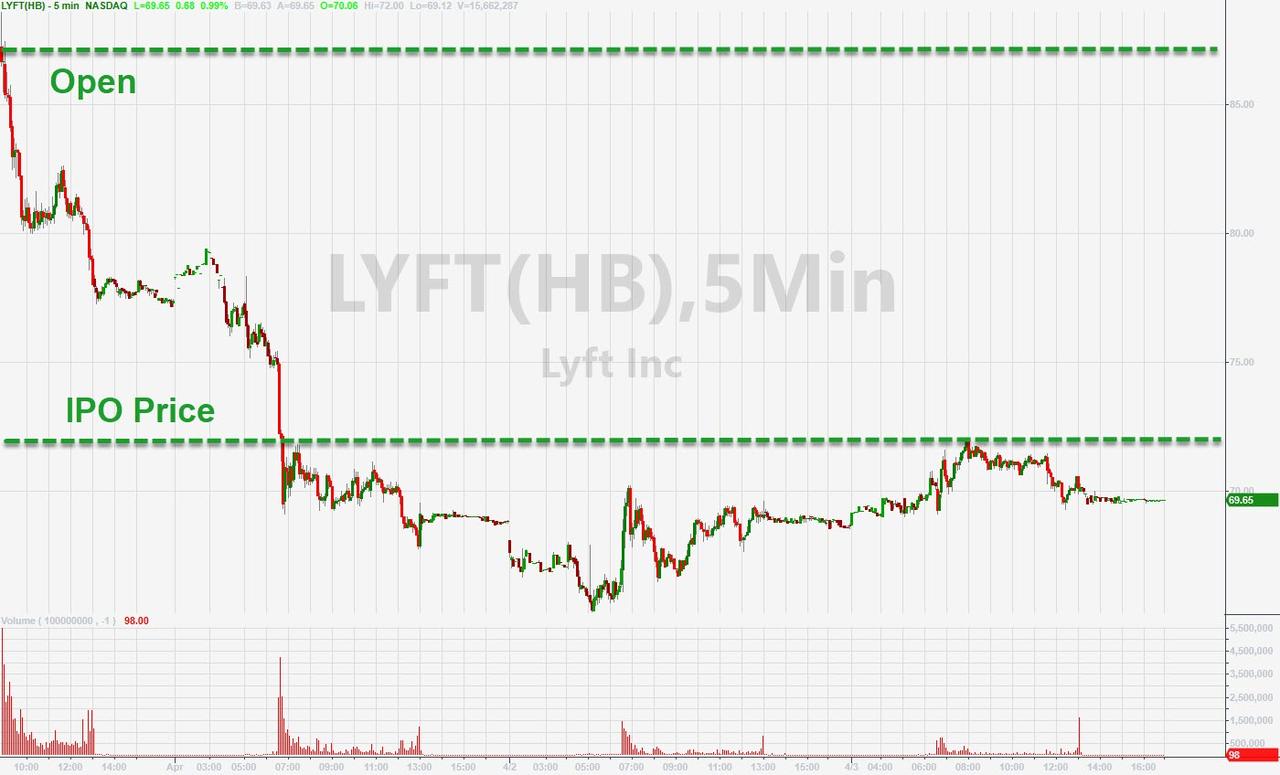
Some time before the epic collapse of LYFT’s post-IPO-open share price, billionaire investor Carl Icahn sold his roughly 2.7% (or around $550 Million) stake in the cash-burning ride-hailing venture.

The Wall Street Journal reports that, according to people familiar with the matter, Jonathan Christodoro, a former Icahn Capital LP managing director who sat on Lyft’s board until last month, facilitated the sale of Mr. Icahn’s stake.

Mr. Christodoro, Mr. Icahn’s designee on the Lyft board, resigned in March, the company said in a filing that month without giving a reason. Mr. Icahn could have chosen to replace Mr. Christodoro with another representative, but didn’t.

And well-timed it was. Just as Icahn bought-the-f##king-dip on Trump’s election night, his sale of this speculative stake before the stock tumbled 25% from its post-IPO-open is fortuitous to say the least.

While the exact timing and motivation of Icahn’s move wasn’t clear, it is the alleged buyer of Icahn’s stake that caught many people’s attention…

Icahn reportedly sold his stake to fellow billionaire George Soros…

While WSJ notes that it isn’t clear what price Mr. Soros paid, with the stock trading well below its IPO price, he is likely not so enthused as he remains subject to a lockup that expires in 180 days that prohibits Lyft’s pre-IPO investors from selling shares.

But the investment was a very successful one for the 83 year-old Mr. Icahn. He had invested roughly $100 million in Lyft in 2015 at a valuation of $2.5 billion, and later added $50 million at the same valuation. The IPO valued Lyft at $24 billion, or $72 a share, though he likely sold it for a bit less than that.

Finally, WSJ notes that the activist investor, who rarely invests in private companies, had been unhappy with Lyft’s plan to use super-voting shares to give its two founders near-majority voting rights, some of the people said.

via ZeroHedge News https://ift.tt/2WPr2Mx Tyler Durden

11 Charts Show The World Has Learned Nothing From Global Financial Crisis

After the 2008 crisis forcefully shoved the faces of most countries directly into the mess they had created, most major global economic participants arrived at the obvious conclusion that since debt caused the crisis to begin with, a deleveraging was necessary in coming years.

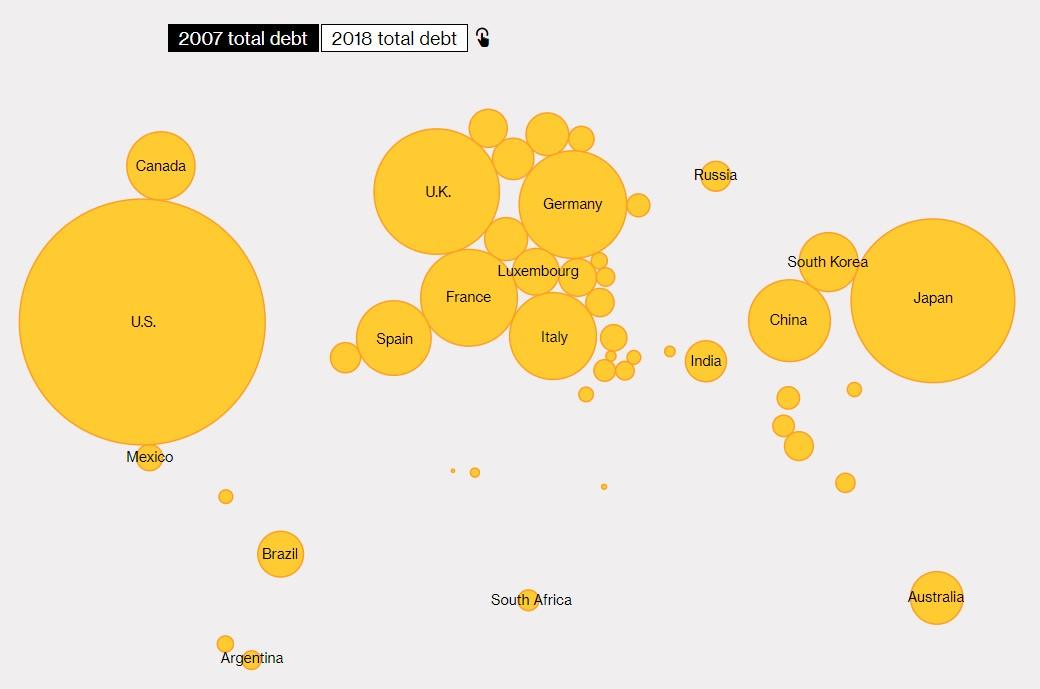
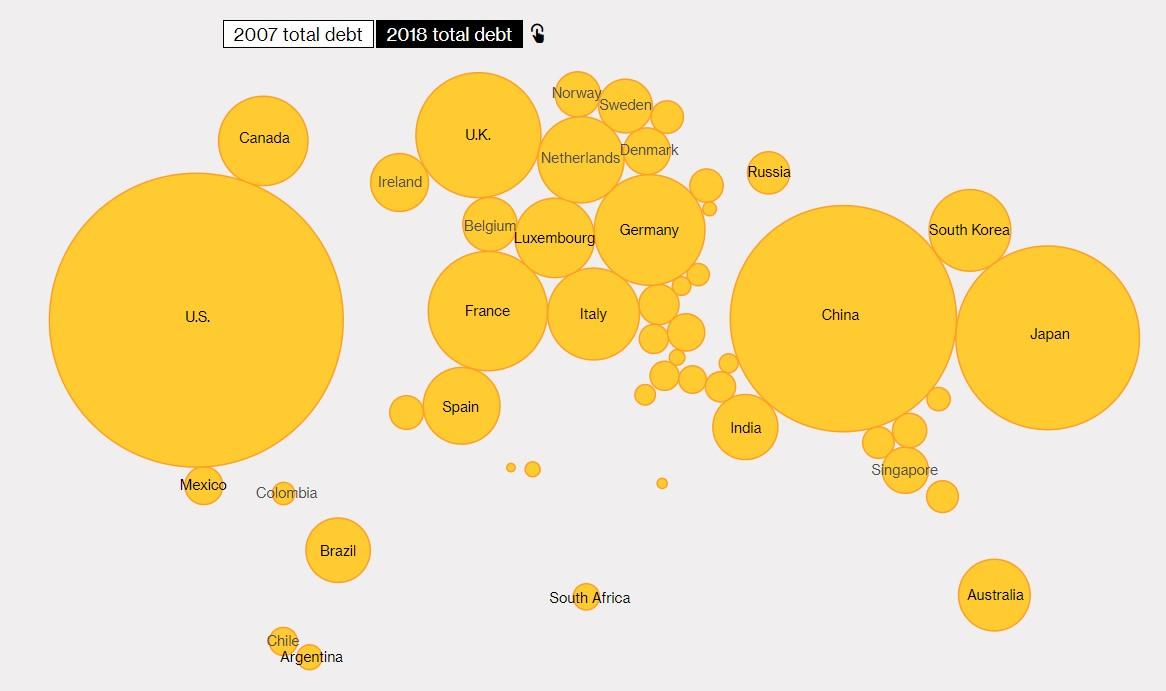
But instead, just the opposite has happened, according to Bloomberg: central banking cowardice and flawed monetary policy have, over the last decade, dug the world deeper into the hole it was in prior to the crisis. In the U.S., for instance, debt has shifted between industries, but it has not gone away. China, once relatively responsible in its debt positioning, has now emerged as the newest bastion for taking on debt to encourage growth.  

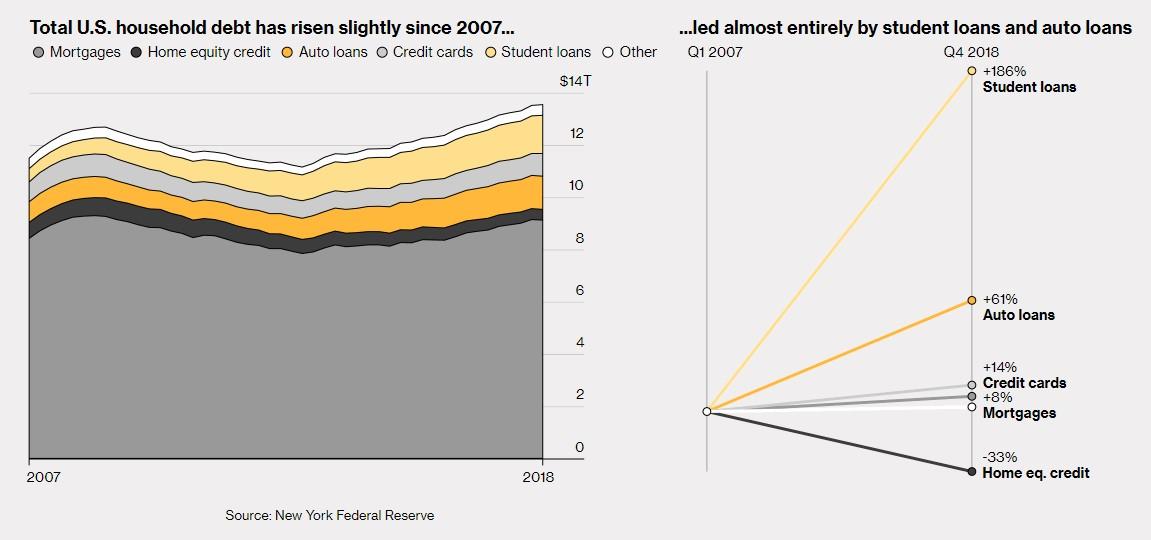
Here’s a graphic representation of debt in 2007: 

And where we stood in 2018:

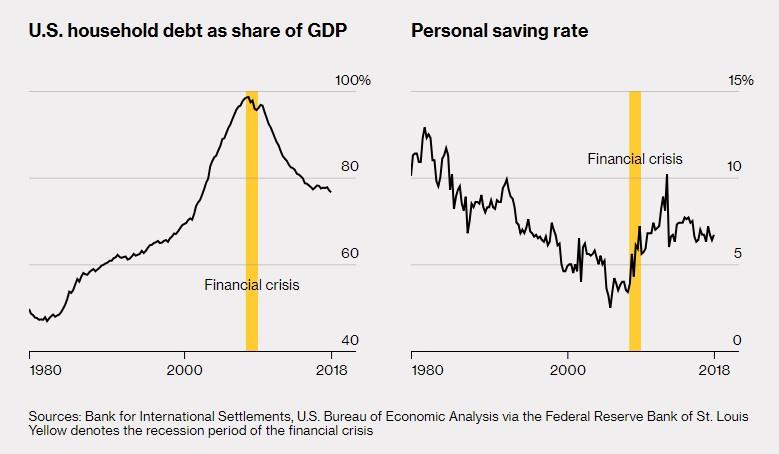
It was well known in Wall Street circles that there was simply too much leverage prior to the 2008 crisis. Bankers would reportedly compare U.S. household debt to GDP against the personal saving rate, which painted a clear picture of the chaos that would be coming. Here’s how those numbers stacked up during 2008, versus where they are today:

Heading into the financial crisis, consumers were overlevered as low rates allowed them access to cheap credit – sound familiar? At the same time, European banks were suffering meaningful losses.

Of course, nobody likes a deleveraging, no matter how absolutely necessary it is: it’s uncomfortable, generally results in underconsumption and it leads to collapsing economic growth. So instead of dealing with that discomfort, post-crisis, central banks just cut rates leading to even more leverage. In addition, the world discovered a new “borrower of last resort” in China, whose debt has skyrocketed over the last decade, putting it alongside of the U.S. as leaders in global debt. 

By 2008, household debt accounted for 98% of U.S. GDP. While spending excesses have been reined in to some degree, the country is seeing new types of debt come to prominence. Auto loans and student loans, for instance, have doubled since the crisis, moving from $1.36 trillion to $2.73 trillion.

The news isn’t all terrible. If you’re a perma-bull (or you work for the New York Fed) and are looking for one metric to hang your hat on, you could note that housing debt is lower than it was ten years ago, and Helocs have declined sharply. And as banks have offered more credit to card holders, balances haven’t been rising in concert – yet

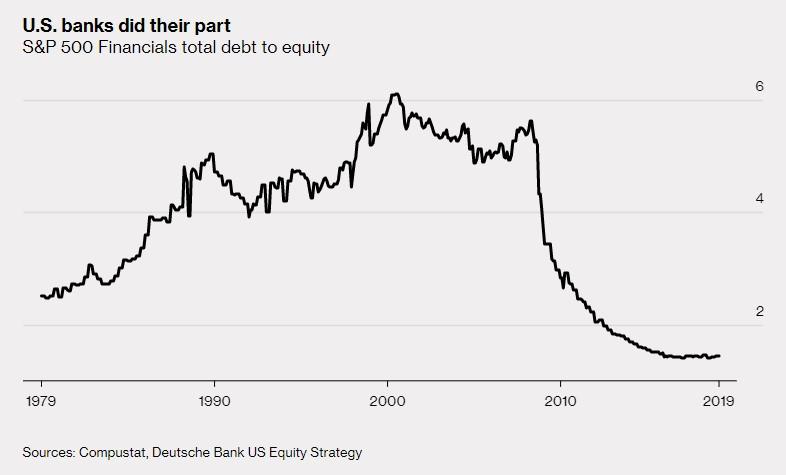
And (for now) banks seem to be on better footing. After the crisis, banks in the U.S. deleveraged as the government stepped in to rescue them. Since being re-regulated, they have used low rates to put their financial houses back in order. It’s amazing how trillions of dollars in freshly printed bailout money and low rates can really shore up a bank’s debt to equity ratio. 

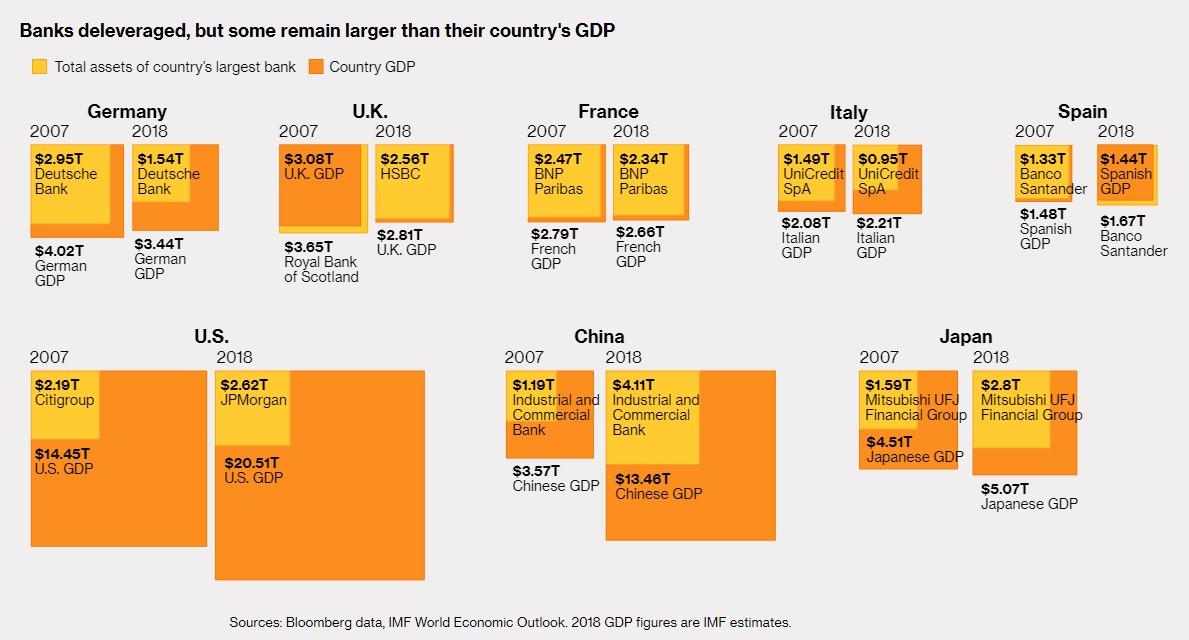
Banks in Europe have also started to deleverage. Germany has seen its banking assets go from 3x its GDP to about 2x its GDP now. And many of the big banks in Europe are too large for their respective governments to ever step in and rescue them, should the situation again warrant it. Banks in the euro zone over the last decade have cut back their assets by an amount equivalent to the region’s entire GDP.

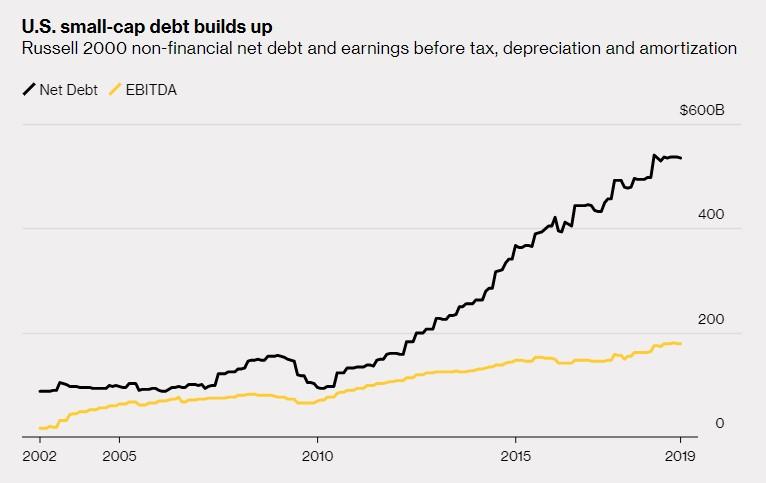
Non-bank corporations were less leveraged entering the 2008 crisis than they were at the beginning of the decade. Since then, new debt has outpaced the free cash that these companies have been generating – especially companies that make up the Russell 2000 index. This could suggest further vulnerabilities going forward. 

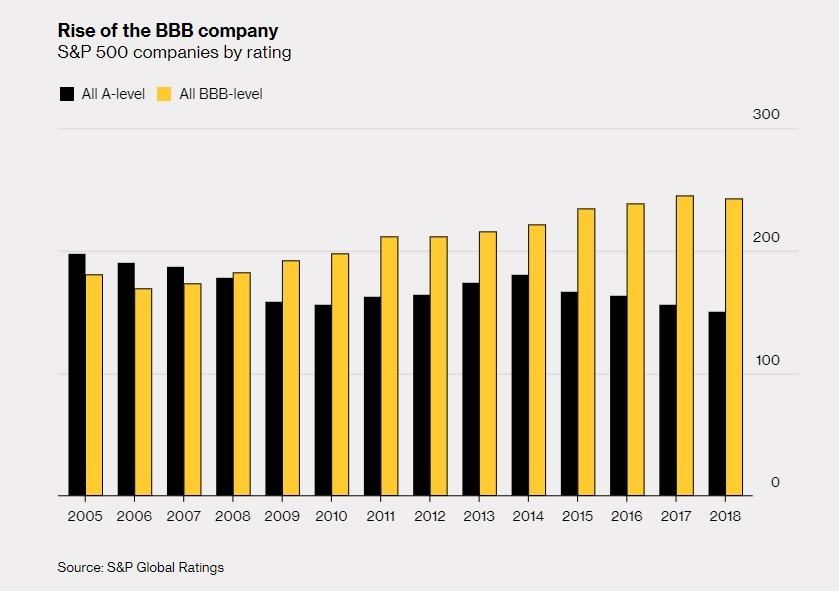
Perhaps the most frightening detail is that companies rated BBB+, BBB, or BBB- (the three lowest grades before they would hit “junk” status and be faced with higher interest payments) now outnumber companies with some level of debt rated A. Companies appear to be purposely toeing the line between BBB- and junk, trying to take on as much debt as possible before getting downgraded. From the below chart, you can see how it looks like companies are “pushing it”:

But nothing in the U.S. could compare to the obscene amount of debt China has taken on in the last decade to fund its own growth and stave off recession. Prior to the crisis, the country had financed its growth without abusing debt. Household debt in 2008 was equal to 18.8% of China’s GDP. That number is now 51%. China’s total debt has increased about 700% since the crisis and it accounts for 70% of new debt taken on anywhere in the world since the crisis. 

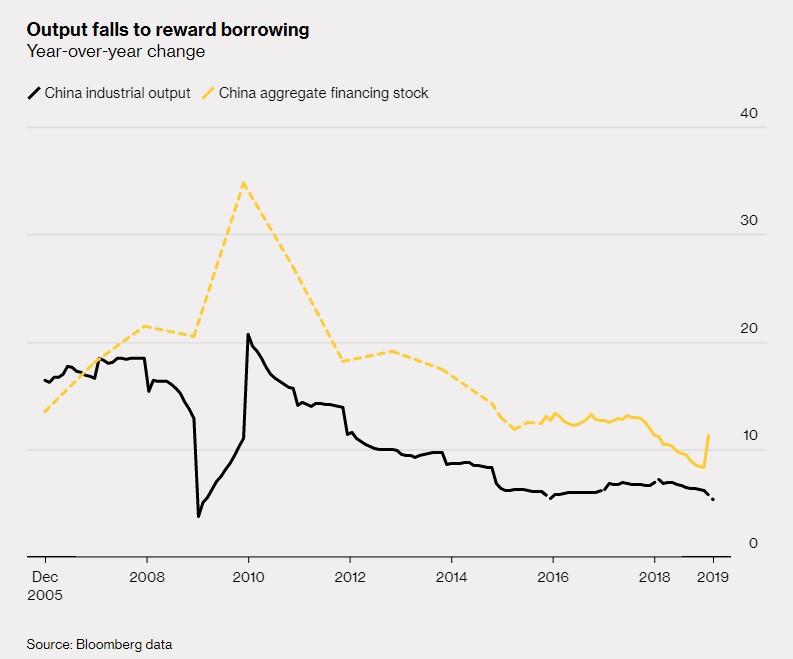
The debt splurge has reluctantly kept the wheels of China’s economy grinding. It has also kept demand for Western products robust. Without this demand, Western banks and consumers may not have been able to deleverage as much as they have. However, China’s debt is doing little to prevent the country’s now-dwindling growth in output.

And of course, the Chinese want to deleverage, but they also don’t want growth to drop under 6% per year. Every time the country goes to regulate banks and lending, growth falls, and the country capitulates to keep its growth number elevated.

The country’s aspirations to be the best at something worldwide have finally come to fruition: China has now replaced the U.S. as the “source of greatest anxiety over debt.”

We can’t wait to see how it all comes crashing down next time.

via ZeroHedge News https://ift.tt/2FNr7sZ Tyler Durden

Tesla Q1 Delivery Numbers Miss Dismal Estimates, Warns Will “Negatively Affect” Q1 Net Income

The wait is finally over, and with such grand fanfare: Tesla’s Q1 deliveries fell short of already extremely pessimistic estimates, with total deliveries coming in at just 63,000 vehicles and Model 3 deliveries coming in at a paltry 50,900.

To add insult to injury, the company said it expects the poor delivery number to negatively impact its Q1 net income:

Because of the lower than expected delivery volumes and several pricing adjustments, we expect Q1 net income to be negatively impacted. 

The company’s press release offered the following bullshit excuses and carrot on a string for Q2 additional information:

Due to a massive increase in deliveries in Europe and China, which at times exceeded 5x that of prior peak delivery levels, and many challenges encountered for the first time, we had only delivered half of the entire quarter’s numbers by March 21, ten days before end of quarter. This caused a large number of vehicle deliveries to shift to the second quarter. At the end of the first quarter, approximately 10,600 vehicles were in transit to customers globally. 

The original consensus, before being revised lower several times, was around 80,000 total vehicles for the quarter. Tesla’s release came out at about 8:10pm EST or, said otherwise, about 10 minutes after extended hours trading ended. It was not coincidental as Elon Musk is all too aware of the power of rapid repricings in the illiquid afterhours market.

The forecast for Tesla’s Q1 was widely expected to be ugly, with headlines like “Get ready for a big drop in Tesla sales” even permeating mainstream news media, like CNN Business. Nearly every estimate had called for a roughly 40% sequential drop in total deliveries from Q4. These numbers turned out to not be negative enough. 

CNBC’s Phil Lebeau said on Wednesday morning that the street was expecting 55,100 Model 3 deliveries for the quarter, before he quickly changed the subject and directed the viewer’s attention to the recently announced April 19 Autonomous Vehicle meeting that was “conveniently” announced right around Q1 delivery numbers. We’re sure Lebeau will stay true to form and make excuses for Musk and Tesla missing these awful estimates, just as he has been doing in his recent reporting of Musk’s screwups. 

Regardless the Model 3 number, missing consensus estimates of 55,100 by nearly 10%, also fell well short of the 63,000 Model 3s that the company produced last quarter. They also fell short of analysts’ estimates of 58,900, according to IBES data from Refinitiv. Deliveries of all models fell 31 percent from the fourth quarter to 63,000 vehicles, including 12,100 Model S sedans and Model X SUVs, according to Bloomberg. 

The company missed almost all other estimates: 

RBC’s Joseph Spak was looking for 52,500 Model 3 deliveries, down from his previous estimate of 57,000:

“Spak trimmed his Q1 2019 Model 3 delivery forecasts to 52,500. This number is 4,500 less than Spak’s previous estimates over what he cited as ‘meager demand’ for the electric sedan.”

Jeff Osborne at Cowen was looking for 47,500, down from previous estimates of 55,000:

“Analyst Jeff Osborne is lowering his Model 3 delivery forecast from 55,000 to 47,500. He also lowered his Model S and Model X delivery forecast from 21,500 to 18,000.”

Anton Wahlman, auto industry expert and prolific blogger on both Seeking Alpha and now The Street.com, predicted 60,828 total deliveries:

“The total quarterly unit estimate now stands at 60,828, which would be down 33% from Tesla’s Q4 2018 unit sales number of 90,966.”

Bloomberg had estimated 80,000 Models 3s produced for the quarter. CleanTechnica had hilariously estimated a “lower bound of 95,000 and an upper bound of 105,000 for total production this quarter”.

Finally, Tesla reaffirmed one of its several prior guidances on the record of 360,000 to 400,000 vehicle deliveries in 2019. 

via ZeroHedge News https://ift.tt/2VmtUQm Tyler Durden

Rubino: Maybe Politics Matters After All

Authored by John Rubino via DollarCollapse.com,

Looking strictly at the numbers it’s hard to work up much interest in whether Republicans or Democrats are in charge after 2020. Either way, trillion-dollar deficits and extremely easy money are guaranteed, which means the US – along with most of the rest of the world – will fall off a financial cliff shortly. After that, the only non-financial issue that will matter is war – and both parties seem about equally bloodthirsty these days.

However, after the November congressional elections – in which Democrats with, ahem, assertive ideas and attitudes did extremely well – proposing big, potentially transformative change now looks like the best way to cut through the media clutter and gain a following.

So the Democrat base has lost its fear of the “S” word and is now embracing a list of policies that are designed to lock in their dominance for a generation, but which carry myriad unintended consequences.

If the Dems were in charge today, there’s a good chance that they would:

Make Washington D.C. a state

This is a no-brainer for Democrats. Since DC voters skew liberal (no surprise for people who by and large work for the government), making it a state adds two guaranteed votes in the Senate and several solid votes in the House. That alone might be enough to tip the balance on many votes.

Lower the voting age to 16

This is another no-brainer for Democrats. Younger people tend to be more idealistic and less experienced, which means they, like D.C. residents, tend to skew liberal. Adding a bunch of young voters to the rolls means adding a disproportionate share of those votes to Democrat candidates.

Pack the Supreme Court

Republican presidents have been able to add more judges to the Court in the past couple of decades than have Democrats. The result is a solid conservative majority that might become even more so if President Trump gets to add another Justice in the next two years. Let Trump win a second term and the Court will be untouchably conservative for a generation.

This is intolerable for Democrats, a growing number of whom are proposing to simply increase the size of the Court and add a bunch of liberal justices for balance.

FDR tried this in the 1930s and failed, but his successors are looking at various ways to get away with it.

Eliminate the Electoral College

According to Wikipedia, “The United States Electoral College is a body of electors established by the United States Constitution, constituted every four years for the sole purpose of electing the president and vice president of the United States. The Electoral College consists of 538 electors, and an absolute majority of 270 electoral votes is required to win an election. Each state’s number of electors is equal to the combined total of the state’s membership in the Senate and House of Representatives; currently there are 100 senators and 435 representatives.”

The math of elector apportionment gives more per-capita clout to small states as a way of protecting them from the whims of the large. Without this advantage, according to fans of the Electoral College, candidates would ignore Wyoming and Rhode Island and spend all their time in population centers like Los Angeles and Dallas. Subsequent governments would favor big states over small; good luck to Nevada if it has a water dispute with California.

In short, without the Electoral College, flyover country is toast. But with the Electoral College it’s possible to win the most votes and still lose the election, as has happened a couple of times recently to the Dems. As the following chart shows, a majority of Democrats would abolish the College while Republicans would keep it.

Several 2020 Democratic presidential hopefuls have recently gotten behind proposals to eliminate the Electoral College, including Elizabeth Warren and Beto O’Rourke.

Impose a wealth tax

Keynesian economics, which dominates the thinking of today’s political class, really doesn’t get savings. For Keynesians, the only good wealth is circulating wealth that buys stuff, preferably with leverage. So 1000 shares of Amazon stock do no one any good while they’re just sitting on some rich guy’s balance sheet. Only when he cashes out and buys something is he contributing to society. Same thing with buildings, paintings, farmland, etc.

Hence the concept of a wealth tax, which takes part of the value of such assets each year and puts it back in circulation. Historically this has been viewed by those with common sense as both dangerous – because it makes investing in productive assets less attractive – and even more dangerous because it sends capital fleeing to more hospitable climes.

But as the public sector descends into bankruptcy it’s becoming desperate for some of that “idle” capital. And given control of both the executive and legislative branches, the Democrats might try to take it. From today’s Wall Street Journal:

Plan from Sen. Ron Wyden would treat increased value of long-term investments like income

The top Democrat on the Senate’s tax-writing committee wants to tax long-term investments like other types of income, raising rates and requiring the wealthiest people to pay taxes on their unrealized gains each year.

The plan from Sen. Ron Wyden of Oregon is the latest proposal from Democrats in Congress and on the presidential-campaign trail to boost taxes on the wealthy in a bid to address what they view as the problems of economic inequality and provide a funding stream to pay for new programs. While the specific proposal has little chance to become law anytime soon, such ideas could carry over into policy if the party makes gains in 2020 elections.

Unlike plans from Sens. Elizabeth Warren and Bernie Sanders, Mr. Wyden’s tax would go after investment income rather than total accumulated wealth or estates that are passed on from wealthy individuals to their heirs.

Mr. Wyden’s plan would tax the gains on long-term investments annually, rather than when someone decides to sell the asset, as is the case currently. It would also raise the current taxes on capital gains to match the rates on other types of income, such as salaries.

Okay maybe it does matter who ends up running the government in 2020. They’ll preside over an epic crash in any event, but avoiding the above might make the eventual recovery marginally easier.

via ZeroHedge News https://ift.tt/2uL0MH6 Tyler Durden

‘A Historic Day’ – Former Malaysian PM Appears In Court As 1MDB Corruption Trial Begins

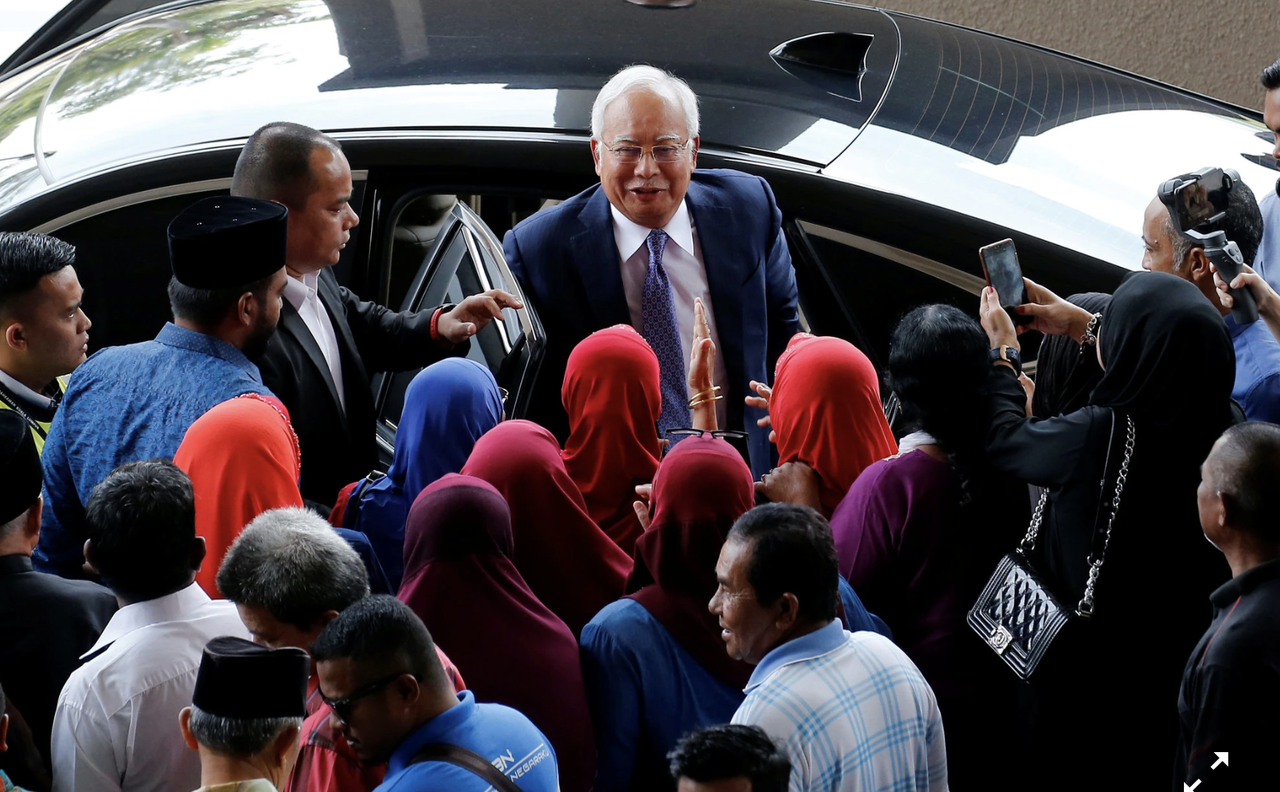
After his lawyers succeeded in delaying the start of the trial by two months, former Malaysian Prime Minister Najib Razak appeared in a Kuala Lumpur courtroom on Wednesday for the first time, marking the beginning of a historic trial where the former leader of a political party that dominated Malaysian politics for 60 years could face decades in prison, the New York Times  reports.

The dozens of corruption and graft charges levied against Razak stem from the looting of 1MDB, the government development fund that was looted of an estimated $4.5 billion by Razak and members of his inner circle. More than $700 million of that money was allegedly funneled into bank accounts controlled by Razak and his wife, Rosmah Mansor, who has been charged with 17 counts of money laundering and tax evasion.

Razak

Najib Razak

Wednesday’s proceedings marked the beginning of the first in what’s expected to be a series of four trials held this year. Right now, Razak is facing seven charges of criminal breach of trust, abuse of power and money laundering stemming from $10 million that prosecutors say was transferred from former 1MDB subsidiary SRC International into accounts controlled by Razak. The former prime minister has pleaded not guilty.

After losing to his former mentor Mahathir Mohammad during Malaysia’s heated 2018 presidential race, Razak’s successor immediately ordered an investigation into Razak’s wrongdoing, which ultimately lead to charges against Razak and Goldman Sachs, which infamously circumvented its own compliance controls to held raise some $6 billion for the fund in three separate bond offerings. The trial marks the first time a former prime minister has been held criminally accountable for acts of corruption committed in office.

Attorney General Tommy Thomas told the court that Najib had once “wielded near-absolute power.”

“The accused is not above the law, and his prosecution and this trial should serve as precedents for all future holders of this august office,” Thomas said.

As the prosecution began laying out its case, Thomas alleged that Najib laundered money stolen from SRC by spending $130,625 at a Chanel store in Honolulu, by doing renovations at his two his residences and handing out campaign money to politicians from his former ruling coalition. Defense lead counsel Muhammad Shafee Abdullahn dismissed these allegations as “rumors.” Calling its first witness, a deputy registrar from the Malaysian companies commission, explained the corporate structure of 1MDB and SRC to the jury, per the FT.

Though Razak was intially quiet after being charged, he has emerged in recent months as a vocal opponent of Mahathir’s government, even helping a member of his party win a special election earlier this year. According to the NYT, Razak is probably hoping for a pardon should his party retake control.

Though Malaysia’s case against Goldman will be carried out in a separate proceedings, the bank’s involvement in the scandal, which was masterminded by fugitive banker Jho Low, currently believed to be hiding in China, will likely factor into the Razak trial, since he met personally with senior Goldman bankers.

We eagerly look forward to all of that discovery evidence being laid out by the prosecution.

via ZeroHedge News https://ift.tt/2Ur8pku Tyler Durden

American Farmers On Verge Of Disaster

Submitted by Grant’s Almost Daily

It’s been a tough road for the U.S. farming industry, which is seemingly beset on all sides. Agricultural commodity prices remain low, with spot corn and soybean currently fetching $3.62 and $8.99 per bushel, respectively, each roughly 22% below their respective 10-year average prices. 

Meanwhile, the ongoing Sino-American trade war continues to crimp overseas demand, as the U.S. Department of Agriculture reports that soybean deliveries to China fell more than 80% year-over-year since September. That helped push soybean stocks to a record 3.7 billion bushels as of year-end 2018.  

By the same token, the USDA forecast Friday that corn plantings will rise 4.1% in 2019 to 92.8 million this year, an unwelcome development considering that “American silos are already bulging with the grain,” according to Bloomberg. Adding insult to injury, devastating floods have afflicted large swaths of the Midwest during the heart of spring planting season.  

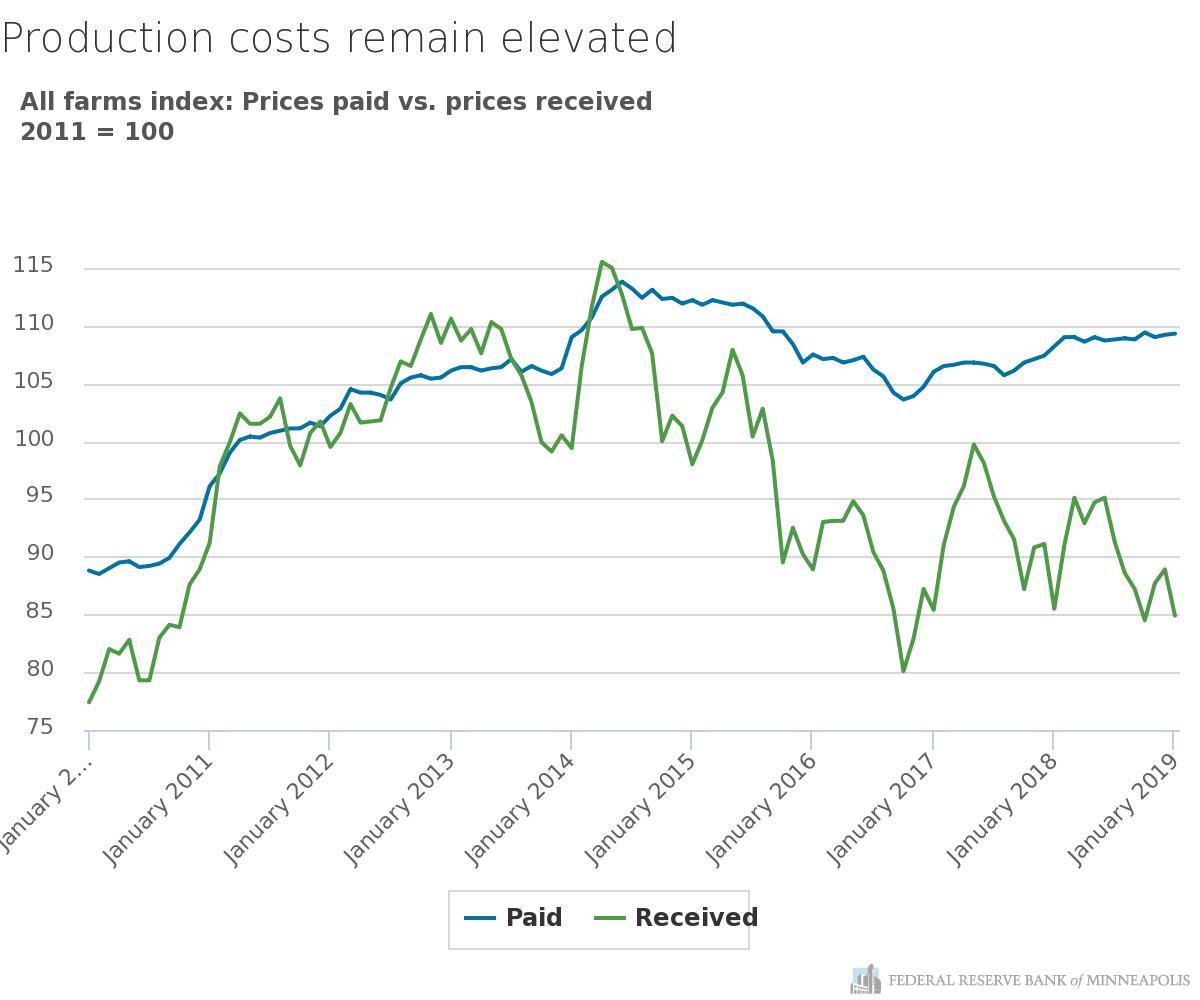
The USDA estimates that net farm incomes plunged 16% year-over-year in 2018 to $63.1 billion, down from more than $120 billion as recently as 2013.  Rising operating costs play a prominent role in that shrinkage. According to the All Farms Index tabulated by the Federal Reserve Bank of Minneapolis, the prices received component fell to 84.9 in January from 95.1 in June, while prices paid registered 109.3 and has remained north of 100 since 2011.

Things are particularly grim in Minnesota and surrounding states. The Minneapolis Fed reports that in-state farmers have seen total input costs for seed, fertilizer, pesticides, fuel and electricity rise by 50% since 2006, after adjusting for CPI-measured inflation. As a result, Minnesota farmers reported real median net income of $26,055 last year, down 8% from 2017 and the lowest figure since the early 1980’s, per an estimate from Dale Nordquist with the University of Minnesota’s Center for Farm Financial Management.

Unsurprisingly, that one-two punch is leading to increasing distress. The Minneapolis Fed reports that the ninth district (encompassing Minnesota, Wisconsin, North and South Dakota and Montana) has seen farm bankruptcies rise to more than 100 in the 12 months ended in December, up from 46 in calendar 2015.

As farmers struggle under the weight of low prices, bulging stockpiles and the wrath of mother nature, Grant’s asked grains expert and paid-up subscriber Keith Bronstein whether a supply disruption could augur better days ahead:

The flooding is currently a localized disaster for those producers in areas affected.

Can this become sufficiently widespread to have a true impact on U S production of row crops? The answer is a resounding yes, but it is too soon to make that statement. Early planting is a boon to yields and, given relatively depressed prices, it is easy to imagine farmers making extensive use of crop insurance policies if things get very late. I think we need to revisit this in 2.5 weeks to see how conditions have changed (or not) as snow melt and runoff and rain or lack thereof play themselves out over this period.

In summary, some notable areas are experiencing great misfortune but it is not yet a “national” story.

One farm commodity that has decisively broken higher is hogs. The emergence of African swine fever in China has led to the culling of an estimated 100 million hogs, a figure that compares to the U.S. inventory of 74.3 million hogs as of the first quarter. That sudden shortage of Chinese supply has spurred a major change in world fundamentals. Arlan Suderman, chief commodities analyst at INTL FCStone, Inc., estimates that “hog feeding in China is down by more than 30%, while some estimates coming out of China are much higher than that.” The Farm Journal notes that replacing a 31% decline in Chinese output “would require all of the annual production of Canada, the U.S., Mexico and Brazil.”

That supply swing is already having a major impact, as lean hog prices have jumped to $84 a pound, up 58% since Feb. 22. Bronstein observes:

China will be an increasingly aggressive buyer of pork around the world yet is not the only place experiencing the spread of this particular disease. . . China is restricting imports from Vietnam to try and preclude a more aggressive disease spread.

North America, probably thanks to distance and very advanced containment regimens, seems pretty safe now. North America should have an expanding hog population and expanding exports. With cheap feed, it’s a pretty good business to be in.

via ZeroHedge News https://ift.tt/2uOYPsV Tyler Durden

Russia Offers Stealth Fighters To China As War Preparations Continue 

The Beijing controlled Global Times reports China will purchase Russia’s Su-57 fifth-generation fighters in a move that will expand strategic relations between both countries.

Viktor Kladov, director for international cooperation and regional policy at Rostec, announced at the 2019 Langkawi International Maritime and Aerospace Exhibition (LIMA) in Malaysia, an export version of the Su-57, dubbed Su-57E, will receive export approval from Russian President Vladimir Putin in a few weeks.

Kladov said, “China has recently taken delivery of 24 Su-35 aircraft, and in the next two years [China] will make a decision to either procure additional Su-35s, build the Su-35 in China, or buy a fifth-generation fighter aircraft, which could be another opportunity for the Su-57E.”

Global Times said, “China [was] to be offered Russia’s best warplane.” However, citing an interview with Wang Yongqing, chief designer at Shenyang Aircraft Corporation, Global Times said, integrating another stealth fighter into the fleet could raise challenges for China’s J-20 stealth fighter program. Yongqing said the Su-57E could be helpful for a “technical study” on stealth technologies.

As per Jane’s Defence Weekly, Kladov said Middle Eastern customers have been interested in the Su-57E as a cheap alternative to the Lockheed Martin F-35 Lightning II.

The plane is expected to be unveiled at the Dubai Air Show later this year. Kladov said India and China are expected to be the first customers in the Asia-Pacific region.

However, Aerospace Knowledge’s chief editor Wang Ya’nan said although he is satisfied with Russia’s stealth plane, there are some conflicts of interest because China has already developed the J-20.

China is in the midst of tweaking the J-20 before series production, which is expected to begin in the near term, Ya’nan told the Global Times.

Several Su-57s were reportedly battle-tested in Syria in 1Q18. In March, Russian President Vladimir Putin declared the Su-57 the world’s best fighter jet.

China’s potential acquisition of Russian stealth planes comes at a time when the U.S. is constructing an F-35 friends circle around both countries.

With Cold War 2.0 underway, the rapid deployment of stealth jets across the Eastern Hemisphere by NATO and the U.S. and China/Russia hint that the odds of a significant conflict will dramatically increase beyond 2020.

via ZeroHedge News https://ift.tt/2uJ0wrQ Tyler Durden

Americans Had To Borrow 88 Billion Dollars To Cover Their Medical Bills Last Year

Authored by Michael Snyder via The Economic Collapse blog,

I know that the headline sounds outrageous, but it is actually true.  According to a brand new report that was just released, Americans had to borrow 88 billion dollars to cover their medical bills last year.  That is a truly astounding number, and it shows just how dramatically our current health care system has failed.  And even though the vast majority of Americans are covered by “health insurance”, millions of us are deathly afraid to go to the hospital because of what it might cost.  Today, two-thirds of all personal bankruptcies in the United States are caused by medical bills, and most of the people going bankrupt actually had health insurance.  Overall, more than half a million American families are financially ruined by medical bills each year, and meanwhile our “representatives” in Washington are doing absolutely nothing to fix the problem.

Surveys have shown that up to two-thirds of the country is living paycheck to paycheck at least part of the time, and an unexpected medical bill can be absolutely devastating for those that are just barely scraping by.

Without much of a financial cushion to fall back on, many families must borrow money when confronted with a large medical expense, and the scale at which this is happening is absolutely stunning

Health care costs in the United States are generally measured as the highest in the world. Last year, many Americans could not afford their health care costs and so borrowed $88 billion to pay for that portion they could not afford.

According to a new West Health and Gallup poll, in a new report titled “The U.S. Healthcare Cost Crisis,” the $88 billion was borrowed in the year before the survey, which was done from January 14 to February 20. The poll was conducted via a random group of 3,537 adults over 18 living in the 50 states and the District of Columbia.

How in the world is this possible?

After all, more than 90 percent of all Americans have some form of health coverage.  So why did Americans need to borrow 88 billion dollars to cover their unpaid medical bills last year alone?

Well, first of all it is important to remember that health insurance deductibles have gotten obscenely huge.  The following numbers come from a CNN article about Obamacare

The law sets a ceiling on how much consumers have to spend on health care. In 2019, it’s $7,900 for a single person and double that for a family. Some bronze plans peg their deductibles to those levels.

The average deductible for a 2019 bronze policy — which have higher deductibles, but lower premiums than other tiers of Obamacare plans — is nearly $5,900, while the average maximum of out-of-pocket limit is just under $7,000, according to Health Pocket, an online health insurance shopping tool. Family bronze plans have an average deductible of just under $12,200 and an average out-of-pocket maximum of nearly $14,000.

Secondly, even if you have surpassed your deductible, there is still no guarantee that your health insurance company will cover your medical bills.  If you do not jump through every single little hoop they want you to jump through, in many instances they will leave you high and dry.  When I was running for Congress I had personal conversations with so many people that had been screwed over by the health insurance companies.  The more claims they deny, the more money they make, and they have become masters at finding even the smallest loophole that will enable them to wiggle off the hook.

Of course there are some health insurance companies out there that are doing a good job, but the bad apples give the entire industry a very bad name.

We have a system that is deeply broken, and it greatly frustrates me that both political parties seem so uninterested in getting a solution through Congress.

Here are some more numbers that show the current state of the U.S. health care system…

3.7 trillion dollars was spent on health care in the United States in 2018.  That breaks down to $10,739 per person.

-If our health care system was a country, it would have the fifth largest GDP on the entire planet.

76 percent of Americans believe that they pay too much for the quality of health care that they receive.

-Out of the 36 counties in the OECD, the U.S. ranks 31st in infant mortality.

-Prescription drugs are the fourth leading cause of death in the United States today.

-Pharmaceutical companies spend approximately 30 billion dollars a year to market their drugs to all of us.

Nearly half of all U.S. doctors are considering leaving the field of medicine, and health insurance companies are the primary reason.

-The median charge for visiting an emergency room in the United States is well over a thousand dollars.

When I was growing up, my mother took me and my siblings to the doctor constantly.  But I don’t know anyone that does that today, because it would be ridiculously expensive in most cases.

And one recent survey actually found that 41 percent of all Americans decided against an emergency room visit last year “due to cost”

Another major personal financial concern among Americans is that 45% worry that a “major health care event” would leave them bankrupt, the West Health-Gallup survey found. Additionally, in the past year, 41% said they did not visit an emergency room due to cost.

Fifteen million Americans “deferred” purchasing prescription drugs in the past year because of costs as well. Finally, 76% believe the problem will become worse because health care costs will rise more over the next two years.

Fixing our horribly broken health care system needs to be a top national priority, but earlier today Senate Majority Leader Mitch McConnell made it abundantly clearthat nothing will be done about Obamacare in the Senate until the 2020 election.  And of course the Democrats are not going to make any major moves on health care until the 2020 election either.

Unfortunately, we are stuck with what we have got for the moment.

Our health care crisis is a national nightmare that never seems to end, and it gets worse with each passing year.

So for now, just hope that nobody in your family becomes seriously ill, because if that happens there is a good chance you might go bankrupt.

via ZeroHedge News https://ift.tt/2G0cC6G Tyler Durden